




Abstract
This paper presents findings from a grounded theory study of consumer ethics among feminists who use porn. It presents a range of exogenous and endogenous factors reported to be influential on ethical decision-making in this context and demonstrates how such factors may be perceived as impeding or facilitating the types of behaviour that consumers consider to be more in keeping with their moral and political beliefs. It furthermore highlights how such influences are often undergirded by seemingly deep-seated stigma around pornography, and often around sex and sexuality at large. The paper concludes that the direct and indirect effects of stigma may present additional obstacles for “fairtrade” and feminist-branded porn projects seeking to leverage consumer demand to support the development of more ethical industry practices. While it has been argued that stigma-reduction efforts can help reduce exploitative practices in the porn industry – by improving sex workers’ ability to demand rights, freedoms, safety, and better labour conditions and remuneration – the analysis from this study suggests that such efforts may also result in secondary benefits. These may be brought about by (a) removing obstacles to the types of consumer practice that could in turn support worker rights and livelihoods, and (b) disrupting rationalisations used to justify consumer choices that threaten to undermine these ends.
Keywords
Introduction
The world of online pornographies has been identified as both pivotal to the sexual expression of a new generation, and as simultaneously representing a dangerous space for the proliferation of harmful attitudes towards sex and society (O’Brien and Shapiro, 2004: 118). However, in spite of the estimated size and significance of that which we call the “online porn industry”, comparatively little is known about its consumers (Attwood, 2007; Mowlabocus and Wood, 2015) and there is a lack of published research on feminists’ use thereof. This study aimed to make headway in addressing this research gap.
The Methodology section of the paper begins with an overview of the methodology and research question: “(how) do feminists in London experience and negotiate matters of ethics when choosing and using porn?”. This empirical focus was developed iteratively alongside a theoretical framework for conceptualising consumer ethics among feminists who use pornography (Macleod, 2020a), and a literature review was conducted concurrently in response to the emergent themes. A major theoretical category developed from the data pertained to the factors perceived to exert influence upon ethical decision-making processes. These factors constitute the primary focus of this article, with an emphasis on the ways in which each appears to be bound up with stigma.
While the paper does not seek to define “ethical consumption” in any objective sense, the Influences on ethical decision-making section presents the exogenous and endogenous factors that participants believed to affect their experiences of ethical decision-making and their perceived ability to act in accordance with what they considered to be ethical practice. This begins with an analysis of the “macro” level social and historical factors that respondents felt contributed to stigma around pornography, along with the perceived challenges such stigma posed for “consumer citizenship” in a neoliberal political economy that relies heavily on consumer choice as a vector for change. The section subsequently turns to participants’ attitudes and beliefs around where the responsibility for porn industry ethics should lie and the role to be played by consumers. It discusses the associations that respondents made between stigma on one hand, and the paucity of available information about porn companies’ ethical standards and practice on the other, as well as the implications of this opacity for ethical decision-making. Finally, this section explores detail at the “micro” level, including individual tastes in pornography – particularly those that may carry additional stigma or taboo status – and how these were thought to interact with participants’ feminist values and views on consumer ethics.
While it is customary to situate one’s research within the broader literature at the beginning of the paper, here the literature is drawn upon throughout the presentation of findings and in the discussion section, in order to reflect the sequence of work advocated in grounded theory, to which this project adhered. The article thus goes on to explore extant scholarship around social and historical foundations of sexual stigma and how stigma is thought to function in the context of porn consumption. It also discusses implications of the study’s findings for worker-led projects such as the #payforyourporn campaign, which sees porn performers seeking to leverage consumer demand for the benefit of (a) their own rights and livelihoods and (b) porn projects adopting a more ethical or feminist ethos, which have developed in response to problematic content and exploitative labour conditions reported in some parts of the porn industry.
The article concludes by highlighting that pornography – as with other sectors that have come to be considered “dirty work” (Ashforth et al., 2007; Koken, 2012) – remains socially and morally tainted, and suggests that this stigma may have noteworthy consequences for consumer behaviour and rationalisations of behaviour. While research into stigma around sex work and pornography has rightly paid attention to its impact on workers themselves – particularly with regards to safety, health and rights (Krüsi et al., 2016; Sanders, 2016) – this paper points to ways in which the study of stigma in relation to consumers and consumption may also prove pertinent, particularly given the implications it may have for feminist-oriented and worker-led porn projects seeking to garner consumer support.
Methodology
This research used grounded theory to deliver a “bottom-up”, inductive approach to data collection and analysis (Glaser and Strauss, 1967). The reasons for this related not to the pursuit of objectivity as an epistemological ideal, but to a desire to minimise constraints on research outcomes caused by my own political, social, and moral perspectives in a field that remains fraught with polarised opinion. The usefulness of repurposing grounded theory in this way has been discussed previously (Macleod, 2020b).
The methods employed for data collection in this project were almost entirely internet-based, in order to enable participants to remain anonymous when making their contributions to the online group activity (discussed later in this section), and to help widen participation amongst those for whom focus groups would otherwise be inaccessible. Moreover, conducting interviews via teleconferencing software enabled participants to take part remotely from wherever they felt most comfortable; a key priority when conducting research that invites interviewees to discuss potentially sensitive issues around sex and sexuality.
The data collection and analysis process was split into two stages: an unstructured online group discussion, followed by a demographic questionnaire and in-depth semi-structured interviews with selected respondents, which were recorded and transcribed with participants’ consent. The purpose of the online group discussion was to facilitate a shallow but broad exploration of themes that participants themselves deemed significant, thereby delineating the parameters of the research topic without having to rely on my own interests and pre-existing assumptions as a researcher. By means of line-by-line analysis, descriptive and analytical codes were developed from the data collected during this initial group discussion, which later formed the basis of the questionnaire and interview questions posed in the second phase of the research. Subsequent interview transcripts were analysed using open, selective and theoretical coding (Glaser, 1978). Open coding produced very detailed and rich descriptions and insights. Meanwhile, it was the task of selective coding to narrow these down into key themes and a core conceptual category, around which theoretical codes and relationships between them could be identified. It is through this process that the concepts presented in this paper were developed.
Interviewee self-identification demographics.
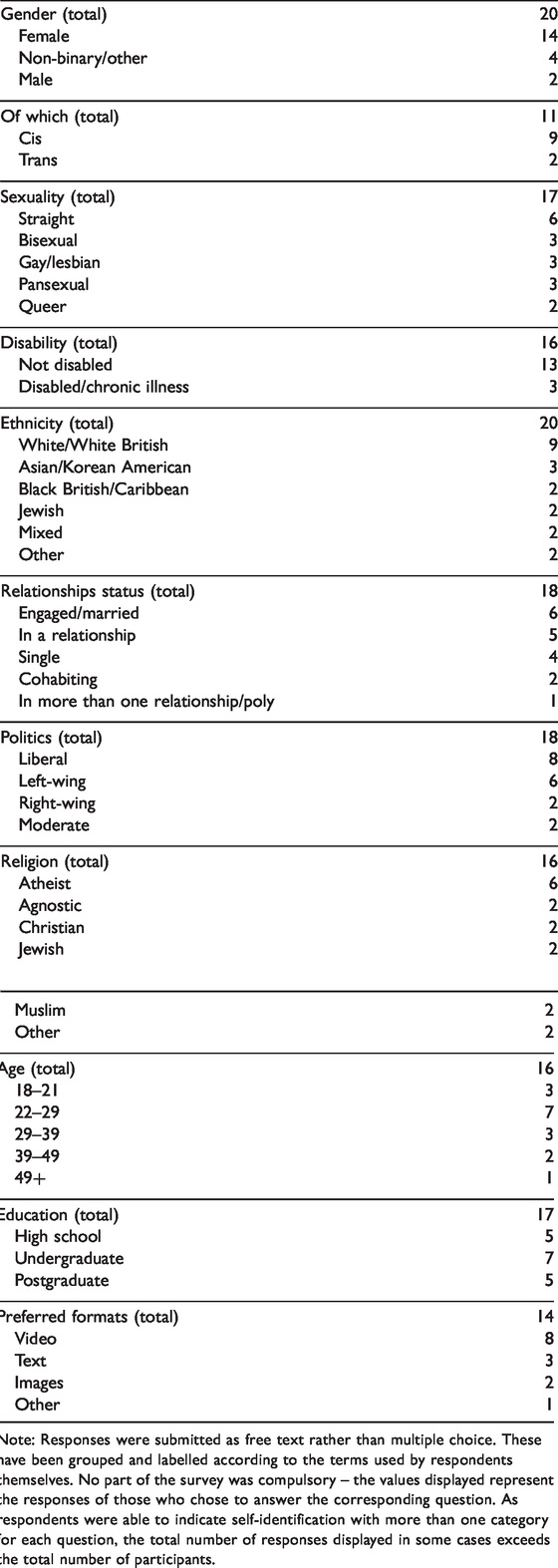
Note: Responses were submitted as free text rather than multiple choice. These have been grouped and labelled according to the terms used by respondents themselves. No part of the survey was compulsory – the values displayed represent the responses of those who chose to answer the corresponding question. As respondents were able to indicate self-identification with more than one category for each question, the total number of responses displayed in some cases exceeds the total number of participants.
In total, 38 people contributed to the online discussion and 22 completed the demographic questionnaire, of which 17 participants were selected and 18 in-depth interviews held. Questionnaire responses were used primarily for the purposes of theoretical sampling; a core component of grounded theory, whereby emergent theoretical categories are refined and saturated by selectively choosing where to collect data from next. For the purposes of this study, theoretical sampling was deployed primarily to “test” emergent themes with participants from similar and dissimilar demographic groups, in order to identify both supportive and counterfactual cases that would further strengthen the analysis. This resulted in one participant being interviewed twice, to enable a deeper exploration of concepts broached in an early interview that later emerged as central to the analysis.
Interviews took place between January 2016 and August 2017. Participants were recruited via online feminist networks hosted on social media platforms and were asked to assign themselves pseudonyms to help preserve anonymity. The criteria for participation were that individuals were (a) London residents, (b) users of online porn, and (c) feminists, with respondents self-identifying their conformity to these conditions. I endeavoured to analyse the ways in which these divergent understandings may impact or relate to other categories within the developing theory, over and above making any attempts to police them. In this way, I tentatively aligned myself with Ryberg’s (2012: 17–18) approach to defining pornography; one that uses as its starting point a conventional understanding of porn as “representations with explicit sexual content aiming at arousing sexual excitement” but that welcomes the inclusion of “many different objective and visual strategies that also challenge and expand the standard definition”.
Influences on ethical decision-making
As Johnson-Laird and Shafir (1993: 2–3) note: “introspection makes available to [interviewees] what they are thinking, and in this way … can provide clues to the underlying process”. This is characterised by Jensen (1987: 31) as a “flash of insight” for both researcher and respondent helping to establish new analytical themes and conceptual frameworks. Whilst not claiming to reveal any unmediated truth about behaviour, by shedding light on consumer experiences of choosing and using porn this study provides flashes of insight into the importance of certain influential elements to ethical decision-making amongst feminist porn users. It identifies four key areas of influence described as pertinent to feminist participants’ ethical decision-making experiences: contexts and conditions, attitudes and beliefs, knowledge and information, and tastes. This section explores each area one by one – first looking at the “macro” level factors relating to social, historical and political context, before moving on to explore individual attitudes, beliefs and tastes at the “micro” levels – highlighting how stigma permeates participant experiences at each stage.
Context and conditions (562 references)
As noted by Attwood (2005), paying attention to the contexts and conditions of consumption is crucial for understanding how consumers use and negotiate sexually explicit media. In the context of consumer ethics research, Chatzidakis et al. (2018: 18) similarly note that “it is impossible to consider moral decisions outside the biographical, relational, and socio-cultural context in which acts of care (and failure to care) take place.” Conditional elements that revealed themselves as pertinent in this study included circumstances such as upbringing and familial/social environment; financial situation; body and identity; state of health; age; and profession. Meanwhile, contextual factors largely pertained to the global digital economy; UK political climate; and London as a particular socio-cultural setting. In this context, the feminist conversation on sex, sexuality and pornography – which in the UK (and beyond) has been dominated by the feminist “porn wars” debates – emerges as especially noteworthy. These debates have fractured feminist communities across the country creating deep divisions between those who appear to view pornography as inherently exploitative and harmful to women, and others perceived to embody a “post-feminist” view of porn as an empowering tool for female sexual expression.
A “sex critical” position has since begun to develop within UK feminism, which uses as its foundation an assumption that no representations are inherently positive or negative and that all forms of sexual representation should be subject “to critical thinking and interrogation about the normative or otherwise ideologies they uphold” (Downing, 2012). A sex critical approach thus advocates for the judicious examination all sexual representations, regardless of whether they may be considered “acceptable” or “transgressive” by society at large. In many ways, the feminists interviewed for this research embodied such an approach, as the analysis to follow suggests. This “middle-ground”, however, did not appear to be easily traversed and the task of devising a seemingly sex critical approach to porn consumer ethics appeared to be subject to a number of important influential socio-cultural factors, upon which I will now elaborate.
Cultural and historical context
The first of these factors relates to the influence of culture on participants’ experiences of porn consumption. Of particular note here is that, while respondents felt an open discussion of porn and sexuality tended to help them reconcile feelings of conflict that they may have experienced between their feminisms and their porn use, opportunities and spaces for these conversations to take place were identified as scarce. This appears reflective of the ways in which pornography and the sex industry have come to be seen as socially and morally tainted (Neal, 2018; Scambler, 2007; Voss, 2015) and of the development of widespread social taboos around sexuality (Kirkman et al., 2005). All participants perceived and commented upon this type of stigma, often attributing it to social and religious values: “The biggest religions in the world today are demonising sexuality and sex and, I don’t know, pleasure in opposition to … fertility and children-making basically … and it usually targets the female body of course … Even if people are not really religious, the cultural remnants [are] incorporated into everyday practices and cultures.” – Helen
This view was reiterated by Natasha, who emphasised the centrality of “Western, monotheistic, religious … conservatism” in the stigmatisation – and legislation – of porn, sex and (female/) sexuality. Such sentiments tended to be accompanied by strong opinions regarding the “guilt-shame culture” that Sally, amongst others, attributed to a morally and sexually conservative social tradition, thought to be supported by policy enshrining these relative understandings of “obscenity” into state law. Gayle, similarly, noted the ways in which sexually explicit representations have historically been hidden from society and reserved for the privileged few deemed immune to the corrupt effects of its obscenity. “I saw a documentary about the history of pornography and how it very much started with a realm of, um, scientific exploration of, uh, the remains of Pompeii, that there were all these kind of very, rude statues … And what the British Victorians did was, of course, to hide it all into a cupboard and go and kind of examine it from a scientific point of view and only give access to, like, really kind of high-end scholars and … rich, middle-class, white men … So, it's something that has a long history of being … having the state and the status quo attempt to contain it, um, and I think that's a large part of what is wrong with it now. It's like, if you can liberate it … then maybe people's relationship would be better with it.” – Gayle
Gayle, along with many others, considered government attempts to censor pornographic content – exemplified by the Audiovisual Media Services Regulations 2014, which had been recently introduced at the time of interviewing – to represent a continuation of this class-related, repressive trend. In particular Gayle bemoaned the stigma and secrecy around porn that this social, historical and legislative context appeared to foster. This, she ultimately felt, prevented her from having the types of frank conversations about pornography that she believed would be productive.
Others expressed similar grievances pertaining to stigma and shame around sexuality, porn and the sex industry more widely; culpability for which was often ascribed to culture and tradition. Many felt that the secretive manner in which pornography must be consumed and produced served only to foster a lack of industry transparency. “I think uh, it’s a conversation that’s not being had in society in an upfront way, and that makes it something shameful, and when something’s shameful people don’t want to come forward and say that they do it, and when they can’t legitimately claim it as their work, like, and their rights are infringed, then they have no way of addressing that … Like as soon as society does some sort of shift to take like porn use outside of like the darkness and all, like masturbation and sexual desires, as they become more liberated, porn becomes something worthy and just to spend your money on and something that is legitimate to to invest in. I know that I, I think consciously or subconsciously, like a part of me not paying for porn is I don’t want it to be on my record or on my bank statement. And … that’s, um, kind of a cycle.” – Yosef
Here Yosef’s speculations echo Bryce et al.’s (2015) assertion that reduced social stigma around sex work may help ensure those who experience abuse in the sex industry are able to report crimes and unjust practices more easily. Moreover, however, Yosef’s comment highlights how this stigma may also foster an environment in which porn users are less willing to respond to calls for consumer behaviour change from porn performers – such as campaigns encouraging consumers to pay for their porn (Lee, 2015) – and participate in the types of ethical consumption practices that they feel could indirectly help improve labour standards and ethical production values. The implications of this tension, especially for feminist consumers who express an interest in, and concern about, sex worker rights, are elaborated upon later in the section entitled Discussion: Sexual stigma and pornographic taboo.
Politico-economic context
In a capitalist society where consumer choice ideology reigns, the move towards ethical consumerism in porn is perhaps not entirely unexpected. As porn performer Maggie Mayhem (in Hester, 2015) has suggested: “It is our obligation as consumers to inform ourselves and make sure that our dollar really is our vote.” In this way, she encapsulates the ways in which porn – whether “ethical”/“feminist” or “mainstream” – is inevitably caught up in a wider capitalist system of supply and demand. This system and the processes that underpin it effectively shift the responsibility for improving industry standards from companies onto consumers, who must en-masse exhibit sufficient demand for ethically-produced products in order to realise market change (often in turn shifting the burden of persuading consumers to collectively take action back onto workers themselves). As such, the ethical consumption mission relies on individualised ethical purchasing to achieve an outcome that arguably only collective action amongst consumer-citizens can accomplish.
It is perhaps for this reason that the ethical consumption “movement” has developed, with a quest to unify individual ethically-inclined consumers under one umbrella campaign. The enhanced efficacy of a combined approach is captured by Papaoikonomou et al., who claim “collective ethical action is more formalized and standardized, resulting in homogenous, stronger and more effective strategy” (2012: 28–29). This type of joined-up strategy appears to represent a particularly tricky challenge in the porn context, however, in light of the stigma and secrecy that surround it.
Whilst consumer choice, in theory, was thought to be the key to enacting change within the porn industry given the capitalist economy in which it – like other industries – must operate, most interviewees had serious concerns about its plausibility in practice. In particular, many participants ultimately remained unconvinced that a critical mass of individuals with a sufficient level of concern for the welfare of others – especially sex workers (among whom they included porn performers) – could ever exist in reality. Yan, for example, estimated the number of other people that cared about social issues, such as exploitation in the porn industry, to be low. This severely truncated the degree of impact that Yan, and others, felt their money, time or mouse clicks could practically have, purportedly bringing about less favourable attitudes towards the possibility of taking action in this way themselves: “Like, even with my feminist politics, I'm not that inclined … [because] me and 50 other feminists isn't going to do anything about that. But, hundreds or thousands or whatever of adult men not clicking on their video, that would do something, but that's not going to happen.” – Yan
As Helen pointed out, for people to make positive associations with ethical porn choices, such individualised decision-making should demonstrate a bigger impact, beyond the scope of that specific purchase or click. To do this, she felt that society must first render porn an acceptable topic of conversation, thereby increasing the reach of consumer-citizenship initiatives such as boycotts and buycotts. Just as Natasha would later express, however, Helen went on to note that the secrecy surrounding porn consumption and its confinement, on the whole, to the private domain may serve to thwart such efforts: “I think because … we do it secretly, you’re not really going into detail and talk about ethical choices, so I think it’s one step to make it less [secretive].”
Thus, a key difference is revealed between ethical consumption in the porn context and similar fairtrade movements in other industries. Whilst many ethical consumption campaigns gain traction through publicity and word-of-mouth promotion (Bedford, 1999; Carrington et al., 2014; Devinney et al., 2006), porn consumption largely operates under a veil of secrecy that seems to reflect and further reinforce the alleged opacity of the porn production business itself. It is within such a context that porn consumers, including many of those interviewed for this study, may be seen to deprioritise ethical porn purchasing, citing the limited impact they feel their consumer choice could actually have as a reason for this. A number of tensions follow from this perspective, however, as explored later in the paper.
Knowledge and information (123 references)
Issues of secrecy and opacity likewise carry implications for the circulation of knowledge and information about industry ethics and practice, not least because many participants associated enhanced ethical practice with being “in the know”. Sources of information included books and articles, documentaries, social media and traditional media, as well as first- and second-hand experience of the industry. The information participants sought out tended to relate largely to the porn industry, porn performers, porn websites and materials, porn studios and producers, as well as more general understandings of what more ethical porn might look like and where to find it. Those with first-hand knowledge or friends in the industry tended to express more resolute opinions about pornography and fewer feelings of ambivalence with regards to the sources and types of pornography they accessed. Those without first- or second-hand knowledge of working in the porn industry, however, often described feeling confused by the conflicting information they came across, and expressed frustration about the dearth of resources available for determining the ethicality of particular porn companies and producers: “Well, first of all, it’s very difficult to know the circumstances of how a porn was shot, so it’s really difficult unless you are really into the industry and you know people, and then, ok, which is not my case … To be sure, really, it’s almost like trying to make sure you’re buying ethical products and then you find out that this ethical company has their, I don’t know, factories in Pakistan, or – you know what I mean? You … make all this effort [for nothing].” – Helen
This resulted in situations in which some consumers felt compelled to make assumptions about how a particular scene was produced based on limited or conflicting information about the source, the ways in which the product was labelled, and/or observations of the performance itself – which, as Hester (2015: 39) argues, may be considered fallible at best.
Bryce et al. (2015) and Holt (2015) suggest that sex workers need to be able to talk about their experiences more easily and openly in order for consumers and clients to accurately inform themselves about the ethical standards and working conditions associated with particular companies, and to take action accordingly. They go on to point out, however, that the stigma and shame around pornography and sex work currently make it difficult for that to happen on a large scale. Echoing these views, a number of interviewees described a cycle beginning and ending with porn stigma; a social ill thought to facilitate industry secrecy and hide shady practices, in turn producing further stigmatisation. It was felt that additional obstacles to consumers finding reliable information about porn production and ethical standards ensued as a side effect of this cycle, and simultaneously served to propel it.
Consequently, some participants described attempts to intervene in this cycle of stigmatisation. Natasha recalled making an effort to start an open conversation about sex, sexuality and porn with her friends and family, thereby challenging the secrecy that often surrounds these topics. Similarly, Helen discussed having initiated sometimes uncomfortable discussions about porn in order to tackle associated stigma. Such interventions it was felt, would support moves towards greater transparency around this sector and area of consumer culture. The potential power of consumer contributions to this endeavour was thought to be limited, however, and participants thus believed this responsibility ought also to be shared with other actors, including the state, educational institutions and porn companies themselves.
Attitudes and beliefs (1618 references)
Whilst respondents discussed a variety of pertinent attitudes and beliefs – on topics such as porn, feminism, labour and politics – it is their views on responsibility upon which this segment will focus. In general, participants felt the responsibility for porn ethics fell on a wide variety of actors, including production and distribution companies, consumers and the state. They tended to agree that consumers had a responsibility for the porn that they used, but challenged neoliberal views that shift accountability for production ethics from company conscience onto consumer demand. Consumer responsibility tended, instead, to be understood as necessarily just one part of a wider joined-up effort.
Many respondents, for example, highlighted the role of the government in improving ethical practice in the porn industry. However, echoing the views of sex worker-led campaigns and porn activists in the UK (Blake, 2016) in some (though not all) respects, participants tended to feel strongly that state remit should exclude censorship measures: “The recent laws that have just been enacted … seem very focused on denying female pleasure in porn … and things like face-sitting have been banned in British porn. It's like, well … why? Why has the government arbitrarily decided that this thing is not allowed? It's … I really don't like that … There's a role for government in that, that you know, there have to be laws about um you know trafficking and uh coercion … but in terms of policing what we see and what genres of porn are acceptable and what are not, I don't think government really should have a role in that.” – Josie
Instead, some respondents asserted that the role of the state lay in the provision of rights and protection from control and coercion. It was believed that new policy in this area could intervene in the cycle of stigma seemingly working to perpetuate shame and secrecy around the porn industry, to hamper sex workers’ ability to publicly engage in labour rights activism and demand change, and to facilitate the concealment of malpractice. This went hand-in-hand, however, with some participants simultaneously expressing a lack of faith in the state’s capacity or inclination to take appropriate action to eliminate exploitation in the porn industry. This hypothesis is perhaps supported by recent critiques highlighting how government policy purportedly aiming to address labour exploitation in the sex industry has instead enabled the state to limit its obligations in this area (Davidson, 2006).
In light of such doubts, others felt that addressing issues of exploitation and malpractice could perhaps only be accomplished through the cooperation of porn companies themselves, and that industry responsibility was thus the most important factor with regards to production ethics. Many, however, dismissed this as unrealistic in a politico-economic climate in which profit seems to represents the key priority, with Lacey describing the mission of convincing porn companies to take responsibility as “a battle that can’t be won”. The role of porn consumers, then, was described in terms of efforts to report and reduce demand for abusive content and to increase support for and interest in what they saw as more ethical porn. As explored earlier in the paper, however, these beliefs lived alongside considerable doubt as to the capacity of consumer choice endeavours to have any significant impact in reality.
Nonetheless, deontological notions of a consumer obligation to avoid partaking in harmful systems or practices persisted among some respondents: “Like in the moment that you are watching something that seems wrong, and you are not doing anything about it, then you’re contributing to it, I feel.” – Serena
Equally so, in a teleological sense, consumer responsibility was thought to extend beyond a duty to buy porn they believed to be more ethical and/or avoid porn they perceived as more unethical, to include wider efforts towards reducing stigma and calling out injustice: “As [porn] viewers, as consumers I think we have responsibility to speak up about certain issues, and like fairness and ethics and stuff.” – Courtney
As such, respondents once again emphasised the importance of efforts to break the taboo around porn, and around sexuality and pleasure itself. As Paasonen et al. assert, it is this end that porn itself serves to achieve, via the way that it “confronts tendencies to silence or demonize sexualities” (2007: 14). As such, just as a perceived cycle of stigmatisation can be identified in the data, this is complemented by participants’ concurrent beliefs in a more hopeful cycle of destigmatisation based on visibility and open conversation – beliefs that Paasonen and colleagues might claim to be in keeping with the very nature of porn in the first place.
Tastes (105 references)
Finally, before moving on to a wider discussion of stigma, I wish to explore the relationship participants described between their ethical considerations on one hand, and their sexual interests and porn tastes on the other. The latter were talked about in terms of diverse genres, sex acts or (gendered/) physical attributes of featured performers and characters. Sometimes, preferences were rooted in a desire to identify with or relate to characters and performers. Leticia for example preferred porn that “focused on the pleasure or experience of the woman” over and above that of her male counterpart/s, in order that she could vicariously experience the sexual encounter being viewed. Shreya, in contrast, preferred to see bodies that she desired, rather than those that resembled her own, and lamented the lack of porn that focused on the male physique. This was attributed to the “male gaze” of the presumed pornographic target audience, which Courtney felt usually sought to view the object of desire rather than itself: “I guess for me I, it's nice when I see the guy's face … instead of just the women, or just the particular woman's body part, that interaction between the two … not just I guess the male point of view of seeing a woman's body where you don't see any of the guy's face.” – Courtney
In contrast, these respondents described what might be referred to as the female gaze, with the act of looking seemingly representing a subversion of viewership; a challenge to the “tradition of an active male and passive female” (Hambleton, 2016: 437). Neville (2015) similarly draws upon the pornographic gaze when discussing women’s use of gay porn. Namely, she suggests that some women’s interest in this type of material may be attributable to the way in which male-male porn does not compel them to participate in the male gaze, commonly associated with the objectification of women’s bodies. Indeed, the perceived risk of being or becoming complicit in patriarchal systems of oppression emerged as a key concern for many feminist participants in this research.
Neville also discusses women’s enjoyment of male-male porn as being associated with taboo and the excitement and enjoyment that controversial or forbidden themes can evoke. This is a term that many participants likewise drew upon when describing their tastes. For some, particularly those who had been able to discuss their “kinks” in a safe environment, these tastes were celebrated. For example, Charlie saw her interest in BDSM and female submission as a celebration of sexuality rather than a reflection of patriarchal values. Holt (2015) echoes this sentiment in her discussion of masochism and female sexual submission as agentive practices. She notes, however, that individuals themselves have little control over the narratives of others and that the perpetuation of imagery depicting women as submissive may have wider social implications.
Such concerns were similarly reflected in a number of interviews, wherein respondents expressed anxiety about increasing demand for a type of porn that they felt could reiterate harmful gendered and sexual stereotypes. For others, their enjoyment of porn depicting this type of power dynamic produced a more intrinsic sense of dissonance, discomfort or sometimes confusion, particularly when such tastes were understood to stand in inherent conflict with their feminist principles: “I think that thing of domination just … I feel a bit like, why do I have those fantasies? It's not a case of going, oh well, because I'm a feminist and I'm having this fantasy, therefore it aligns with feminism, you know. It's like … why do I have this, kind of, latent thing of just like, picturing real kind of violence in terms of sex and sexuality - where's that come from? And that, sort of, troubles me a bit.” – Gayle
This caused a number of respondents to experience a great deal of guilt and shame, with the secrecy around porn rendering them unable or unwilling to address such issues with others.
Those who did find an outlet for talking about seemingly controversial porn tastes, tended to find discussion helpful in addressing feelings of distress and conflict. Helen, for example, described speaking with a therapist about the concerns she had around her interest in violent imagery, an experience that she remembered positively for its role in initiating an ongoing journey of reflection and reconciliation. Yan, on the other hand, who experienced some unease about their ongoing interest in incest-themed erotic fiction, wished to reach out to friends about this, but felt that online social groups would be hostile to disclosures around such a taboo topic and found it difficult to talk to “real life” friends about porn at all. Other participants discussed similar experiences of discomfort even when discussing less controversial porn tastes or talking about pornography in a more general sense. For many, such discussions were either met with disdain from female friends, or were misconstrued by male friends as flirtation.
As such, it is possible to identify another way in which stigma and secrecy punctuates feminists’ experiences of porn consumption, fostering a sometimes restrictive environment in which certain issues pertaining to sex and sexuality are off-limits. In the context of such stigma and taboo, participants’ respective efforts to develop “sex critical” approaches to porn consumption and ethics – were rendered a particularly challenging task.
Discussion: Sexual stigma and pornographic taboo
If we are to understand taboo as “a behavioral or verbal act that societal norms prohibit and [that is] generally considered to be publicly unmentionable” (Sabri and Obermiller, 2012: 870), then pornography – unlike many other industries or products – may be considered a taboo phenomenon almost by definition. As Lederer (1980: 40) asserts: “if pornography does not offend local community standards, we say, then something is wrong because it should!” In this way, we might conclude that understandings of pornography are derived less from particular, tangible or measurable characteristics common to all material labelled as such, and more from the extent to which such material is viewed as objectionable or transgressive. In fact, the association of pornography with transgression is one that has been well documented (Kipnis, 1996), and is a link so prevalent that contemporary usages of the word “porn” appear now to describe contexts and activities that have seemingly little to do with the adult entertainment industry at all and more to do with that which may be considered taboo (Hester, 2014: 186). Taboo thus seems to represent a characteristic that is, according to common understandings, inherent to pornography, in a way that is perhaps not the case for consumer products in other areas of consumer culture and industry.
Participants linked their perceptions of pornography as taboo with notions of stigma and shame surrounding its production and consumption. Indeed, Rubin (1993: 37) argues that the secrecy and suppression surrounding taboo phenomena such as pornography, and the stigma it produces, is actually reflective of a desire to halt social and moral degeneration. If anti-porn discourse dictates that pornographication and raunch culture have permeated British society then, as Smith asserts, legislative penalties and social stigma are seen to represent “the very last bastions which prevent culture sliding into the very worst excesses” (2007: 29). Whilst it may be argued that porn has undergone a cultural shift, from a fringe position to a more visible location – aided by the rapid evolution of digital and online technologies – Voss (2015: 392) argues that stigma surrounding the production, consumption and very existence of sexually explicit materials nonetheless persists. This may be seen as an extension of the stigma surrounding sex and sexuality more generally, and women’s sexuality specifically. As Diamond (1985: 50) has posited: “where boys learn that sex makes them powerful, we learn that it makes us powerless and bad.” This is particularly the case for working class women, who Ciclitira (1998: 277) argues “generally have fewer choices about sexuality and employment, and are stigmatized on these counts more than middle class women.”
The stigma referred to by sexuality researchers, and participants in this study alike, has been traced back to the Victorian moral crusades in England and the United States, characterised by chastity campaigns seeking to eliminate extra-marital sex, masturbation and prostitution (Rubin, 1993: 100). Attitudes towards sex and sexuality today, it is argued, are part of that heritage, particularly where young people and adolescent development are concerned. Where interest in masturbation amongst children was historically chastised out of fear for their physical and psychological wellbeing, so too it appears that concerns about pornography effects often focus on young people’s sexual and emotional development. Whilst some of the most extreme measures taken to thwart sexual “corruption” may no longer take place in UK medical settings, “the notion that sex per se is harmful to the young has been chiselled into extensive social and legal structures designed to insulate minors from sexual knowledge” (Rubin, 1993: 101). It is perhaps this legacy to which respondents objected.
Certainly some of the main concerns participants articulated with regards to the effects of pornography revolved around the potential impact of porn on young people’s expectations of bodies and sexual relationships. However, instead of suggesting means by which to insulate young people from such experiences, interviewees favoured measures to open up, not silence, a discussion about porn – as well as sex, sexuality, body image and relationships more broadly – with children and adolescents. Rather than a useful force for moral preservation, respondents understood stigma and the silence it produced to be a source of harm.
The negative impacts of porn stigma were also felt to extend to other areas, including, as has been discussed in this article, the ethical decision-making process itself. Virtually all respondents bemoaned the scarcity of reliable information available about the ethics of porn production and the practices of particular porn companies, which in turn they felt made it more difficult to ascertain which products aligned best with their ethical values. The relevance of vague or inaccessible information to ethical decision-making among consumers is a phenomenon that has been observed in other sectors (Creyer and Ross, 1997; Ellen, 1994; Hassan et al., 2016; Strong, 1996) – a problem that respondents felt was exacerbated by pornography’s taboo status and hidden nature.
Adding detail to these speculation, Voss (2015) attributes the dearth of accessible data about pornography businesses to the fact that so few adult entertainment enterprises actually operate as public companies. She goes on to assert that this opacity is facilitated by stigmatisation, and the resultant challenges that “whore stigma” poses for porn performers wishing to speak out about employer malpractice. This was a sentiment echoed by participants, which often resulted in respondents describing a “cycle of stigma” that they believed must be broken in order for more ethical consumption, production and circulation to take root. Such beliefs, in turn, fed into wider opinions that a key part of porn ethics in fact revolves around the need for consumers to do their part to reduce sexual stigma more broadly. Natasha referred to this as “a permanent revolution”, which she, and other respondents, felt could be best achieved through a combination of steps, including open conversation; enhanced sex education; anti-censorship legislation; and/or sex work decriminalisation.
Another example of the negative impact that participants attributed to the stigma, secrecy and silence around porn, related to the ensuing difficulty in uniting a critical mass of ethical consumers. As a result of this, some participants expressed a general sense of disinclination towards purchasing feminist- and ethically-branded porn products, believing that single examples of this type of individualised consumer activism would ultimately have little effect within a larger system of global capitalism. This perspective generally went hand-in-hand with a broader belief that, while paying for porn – especially porn promoting a more feminist ethos – may represent an ethical ideal deontologically-speaking, using free porn on the other hand would not necessarily represent “very unethical” practice in teleological terms. It is perhaps for this reason 16 of the 18 study participants did not view paying for porn as an ethical priority for themselves: “The problem with like feminist porn and like queer porn is that you often have to pay for those websites … and while I would want to support that, I don't think that is a priority.” – Lacey
Instead, watching free adult content on tube sites was considered an acceptable “neutral zone” representing neither an ethical ideal nor a cause of particular social harm.
However, this is a perspective that many porn performers contest, particularly given the vast amounts of pirated content reported to be hosted on tube sites (Tarrant, 2016). Not only do they suggest that not paying for porn does in fact harm the livelihoods and rights of workers, but they also argue that it is precisely because of the capitalist realities of profit-margins and hierarchies that paying for porn is so crucial: “Plenty of people acknowledge that pirated content is stolen content … they think it’s essentially a victimless crime … [However] there is a system in place for the way production companies are run, and that system requires a certain profit margin to be effective and carry on … when a studio has to make budget cuts … performers are forced to take the hit … Now, most performers have to supplement their income with Web camming, doing personal appearances, dancing at gentlemen’s clubs, or escorting.”
Lee (2015) also stresses the ways in which accessing free, often pirated content represents a violation of rights and consent: “To be honest, the only time I’ve ever felt exploited, as a performer in porn, is when my work is pirated. When I sign a contract, it’s between the producer and myself. For someone else to assume that right feels non-consensual (Technically, it’s illegal and a breach of site usage and copyright.)”
In this way, a contradiction arises between (some) feminists’ beliefs that using their dollar as their vote does not represent an impactful use of their resources, and the directives of porn performers themselves who state that paying for porn is crucial to the maintenance of their rights and livelihoods.
As Lee (2015) notes, many consumers of free pornography remain unaware of the extent of pirated content on tube sites, and thus the extent of the impact their actions may have with respect to workers’ rights and remuneration. Lee attributes lack of awareness about the harms of accessing free porn on tube sites, and the benefits of paying for it, to low levels of media literacy around pornography. Indeed porn literacy was something that participants themselves felt to be as an issue in the UK, with many discussing the potential benefits for (other) people, especially young people, of better porn education and sex education generally – the absence of which they attributed to the effects of stigma. Such perspectives when taken alongside Lee’s observations, however, suggest the lack of insight some feminist consumers appeared to have with regards to the harms of watching free pornography, may also be construed, in part, as a possible effect of stigma.
Alternatively, a more pessimistic interpretation would suggest that this apparent lack of insight among some feminist consumers can instead be attributed to wilful ignorance of such issues. This is something that Charlie in fact touched upon in the interview setting: “So I assume that by going onto Porn Hub, [performers] they’re getting some kind of revenue from the advertising. But actually … I haven’t bothered to find out. I’ve purposely avoided finding out what are the kind of the remuneration … I’m kind of assuming that the advertising revenue goes [to them]– it probably doesn’t does it.” – Charlie
From this perspective the invocation of stigma, and the opacity and misinformation that participants attributed to it, perhaps in some cases served as a useful rationalisation with which to dismiss ethical concerns about their own porn decision-making. Regardless of which interpretation more commonly holds true, however, it remains that case that, in each instance, stigma appears to function as an enabler of behaviour that ostensibly contradicts the values and aims feminist consumers profess to support.
Implications for feminist porn consumption
The interview data from this study thus suggests that some feminist consumers perceive stigma as directly impacting their ability or willingness to make what they see as more ethical porn choices, including for some an impact on their commitment towards paying for porn. While it should be noted that a minority of respondents cited lack of financial means as the main reason for not paying for their porn, many attributed it to insufficient information about which companies to support; lack of belief in the impact of their consumer choice; and a wish to avoid having porn companies on their bank statement – each of which they described with reference to the effects of stigma. Here it must be acknowledged that differences of opinion will inevitably arise as to what “counts” as acceptable ethical practice, and that consumers who care about social issues may nonetheless follow different trajectories on their journey towards putting ethics into practice (Macleod, 2020a). However, efforts to overcome the personal impact of porn stigma, in order to respond to calls for consumers to support the livelihoods and rights of performers by paying for their work, would appear to represent a fundamental task for feminists with a stated concern about these issues and the means to take action. This is perhaps especially so in light of observations, with which participants broadly agreed, that “the real damages of stigma are still mostly felt by those doing the ‘dirty work’” (Trouble, 2016) and in light of “the privilege of anonymity” from which consumers, unlike performers, may benefit. Given the valiant efforts participants often described with regards to combatting stigma and opening up difficult conversations around porn, it is thus surprising that many expressed reluctance to engage with performers’ requests that consumers pay for their work. This is particularly the case given recent developments within the industry – such as the creation of trade organisations and dual-purpose technologies designed to help assuage concerns around payment and access (Voss, 2015) – which some participants cited as barriers to action.
Another way that participants felt stigma directly impacted upon their ethical decision-making related to the opacity it was thought to generate around production ethics, company practices, and the porn industry at large. The lack of transparency, and absence of a stigma-free environment within which workers could feel free to speak out about malpractice and injustice, rendered ethical decision-making, for some participants, a seemingly impossible challenge. However, that which participants failed to notice concerned the ways in which social media has, to some extent, improved communication between performers and consumers, as exemplified by the #payforyourporn campaign. This highlights an additional element to the problem they raised regarding the need for improved communication between workers and consumers. Namely, it suggests that the challenge of reducing stigma to such a degree that porn performers may call out injustice more freely, is matched by the equally important challenge of persuading consumers to actually listen and heed their requests. While many participants complained about the ways in which stigma may serve to prevent sex workers from speaking freely, none spoke of the potential challenges around convincing consumers – including feminists who express concern about the wellbeing of porn performers – to take note when they do.
Finally, the analysis also suggests that stigma may be indirectly impacting some consumers’ decision-making, by hiding from view – or enabling consumers to more easily dismiss – the harms said to ensue from accessing free porn sites that host pirated content. In terms of the more immediate benefits associated with stigma-reduction, Voss (2015) contends that it promises to help reduce exploitative practices in the porn industry and improve sex workers’ ability to demand rights, freedoms, safety, and better labour conditions and remuneration. The analysis from this study meanwhile suggests that in instances where consumers are either unable or unwilling to “practice what they preach”, such stigma-reduction efforts might also result in secondary benefits. These may be brought about by (a) removing obstacles to the types of consumer practice that could in turn support worker rights and livelihoods, and (b) disrupting rationalisations used to justify consumer choices that threaten to undermine these ends.
Concluding remarks
The implications of this research for the field of consumer studies are threefold. Firstly, just as “dirty work” has come to be distinguished from other, more “respectable” industries, this article prompts us to reflect on how the taboo nature of pornography – and perhaps to some extent sexual products at large – may differentiate them from other consumer items. Secondly, it challenges us to consider how the stigma associated with pornography may in turn pose additional difficulties for projects seeking to leverage consumer choice to increase demand for more ethical porn products. Thirdly, by drawing upon an under-explored substantive area within consumer ethics research, the paper offers a novel example of how structural issues such as stigma may constrain approaches to improving industry ethics that rely on consumer demand. At the same time, however, it recognises and wrestles with the nuances inherent to the relationship between structural elements and individual agency.
Future research may wish to explore the role stigma plays in experiences of using pornography among the general population, and whether or not these differ from those of feminists in light of the conflicting demands and polarised perspectives on porn within the movement. An exploration of porn consumption behaviour may also prove useful for understanding the link between attitudes and beliefs around ethical decision-making on one hand, and consumer behaviour on the other – particularly given the “attitude-behaviour gap” (Carrington et al., 2010) that is purported to exist across a range of consumer contexts. Finally, the ways and degrees to which stigma and taboo affect consumer ethics across other industries, beyond that of pornography, likewise represents an area that may benefit from further inquiry within the field of consumer studies.
Footnotes
Acknowledgements
This work formed part of a PhD awarded in December 2018. The research was kindly supervised by Prof. Feona Attwood and Dr. Lucy Neville, and generously funded through a Middlesex University studentship.
Declaration of Conflicting Interests
The author(s) declared no potential conflicts of interest with respect to the research, authorship, and/or publication of this article.
Funding
The author(s) received no financial support for the research, authorship, and/or publication of this article.
