




Abstract
This article examines the discursive representation of the Nile Water Treaties as portrayed by Ahram Online, Sudan Tribune and The Ethiopian Herald, national newspapers in Egypt, Sudan, and Ethiopia, respectively. Guided by Postcolonial Theory, the study employs the Postcolonial Critical Discourse Analysis method. Findings reveal that these newspapers divergently portrayed the Nile treaties as binding, alternative and obsolete trichotomies, respectively. We argue that the structural legacies of colonialism, as evidenced by colonial treaties, still influence how contemporary media portrays projects on transboundary resources. Consequently, such divergences contribute to conflicting terms rather than cooperation between the three riparian countries regarding the project.
Keywords
Introduction
On 2 April 2011, Ethiopia began constructing the Grand Ethiopian Renaissance Dam (GERD), a 6000 MW giant dam, on the Blue Nile (also known as the Abbay in Ethiopia), which is one of the Nile’s main tributaries. The project’s commencement evoked various reactions from the Eastern Nile Basin countries. While Ethiopia has consistently emphasized that the dam is a crucial endeavor to address its citizens’ severe lack of hydroelectric power, Egypt has labeled it as a threat to its survival and an illegal encroachment on its historical Nile rights. Sudan, on the other hand, has shown a wavering stance toward the construction of the dam. Many of the reactions from the riparian countries have referenced different colonial treaties concerning the Nile (De Falco and Fiorentino, 2022; Degu Belay, 2014; Gebreluel, 2014).
GERD has been constructed on the Abbay river, which is one of the major tributaries of the Nile, which flows through 11 African countries and is the longest river in the world. Throughout history, various European colonizers who have conquered the Nile basin region have signed different colonial treaties to govern the use and management of the Nile (Alemayehu, 2024; Carvalho, 2008; Kassa, 2015; Lumumba, 2007). Since the start of the project, these colonial treaties related to the Nile have been the main topic of discussion among riparian countries and other concerned parties. This has led various media outlets to pay significant attention to these treaties in their coverage. Both international and local media outlets of the riparian states have been closely analyzing the construction of GERD in relation to these colonial treaties. The Egyptian Ahram Online, Sudan Tribune and The Ethiopian Herald newspapers have been at the forefront of reporting on this issue. These three newspapers, representing the conflicting riparian countries involved in the dam’s construction, focus on the socio-economic, political, and diplomatic affairs of their respective nations.
The impact of colonialism and its structural legacies in the postcolonial period has received scholarly attention. However, most of these studies have primarily focused on English, comparative literature, psychology and other related fields (Chikerema and Nzewi, 2021; Gandhi, 2020; Said, 1979; Young, 2004). Though the impact of colonialism and its aftermath on mass media is visible, there have been limited empirical studies that scrutinize this impact (Shome, 2016; Shome and Hegde, 2002). The media’s focus on colonial treaties with regard to the construction of GERD provides an opportunity to explore the nexus between colonialism and the structural legacies of colonialism, news media content, and transboundary water governance in the postcolonial era. Specifically, this scenario creates a conducive environment to examine the portrayal of colonialism and Nile colonial treaties in the media, the impact of these portrayals on the GERD project, the cumulative effect of the media portrayal of colonial treaties on negotiations among riparian countries, and the overall contribution of the media to either cooperative or conflictual dynamics in an integrated manner.
To this end, this article examines the portrayal of the Nile (colonial) Water Treaties in the Ahram Online, Sudan Tribune and The Ethiopian Herald in relation to the construction of GERD. The argument is that the portrayal of these treaties by media institutions has an impact on the overall representation of GERD and the effectiveness of ongoing negotiations. Therefore, this article attempts to scrutinize how the three newspapers’ news stories articulate the binding/non-binding nature of colonial treaties, the justifications they render to cement their argument, the implications of the Nile basin states’ ignorance of the binding/non-binding nature of these agreements as perceived by these media institutions, and the overall impact of such articulation on issues pertinent to GERD. To this end, the article aims to answer the following questions: How do the three newspapers portray colonial treaties in their news discourse? What rationales do they provide and/or omit to justify their point? How do they articulate the implications of riparian states’ ignorance to the binding/non-binding nature of these colonial treaties? How do these articulations contribute to either cooperative or conflictive terms in the overall dynamics?
Literature review
Colonial legacies on transboundary rivers
Colonial legacies refer to the cultural, economic, social, religious, security, legislative and other aspects that were passed down by colonial powers to their colonies. These legacies have a significant impact on the socio-economic, political, ideological and security conditions of present-day Africa (Chikerema and Nzewi, 2021; Gandhi, 2020; Loomba, 2005; Said, 1979; Young, 2004). As Gandhi (2020: 4) puts it, ‘newly emergent postcolonial nation-States are often deluded and unsuccessful in their attempts to disown the burdens of their colonial inheritance’.
The end of colonialism or the withdrawal of colonial forces from their colonies’ lands did not simply mark the end of colonialism and the independence of colonial states. Even though the direct colonial conquest is over, its aftereffects are still visible in postcolonial states. These effects manifest in various areas, including but not limited to internal conflicts, coups, governments faced with suspicion, territorial hostilities, identity crises, and conflicts over shared resources. In addition to these consequences, colonialism is also evident in literature, artistic and mass media works, globalization, and cultural hegemony (Arora, 2007; Ashcroft et al., 2013; Gandhi, 2020; Hamadi, 2014; Mishra and Hodge, 2005).
One area where the visible impact of colonial legacies is particularly pronounced is in the use and governance of transboundary rivers. Historical as well as current water management practices in Africa are largely influenced and shaped by colonialism and colonial treaties and agreements. Colonialism and the treaties and agreements associated with it hold a significant place in contemporary African water use and governance for three main reasons. Firstly, most of the laws, treaties, agreements, conventions, customs, and traditions that regulate transboundary rivers in Africa today were signed and enforced by colonial powers. Secondly, although riparian states have entered into bilateral, trilateral and multilateral agreements and treaties after gaining independence, these agreements are still heavily influenced by the preceding colonial treaties. Thirdly, many of the water conventions, treaties, laws, customs and traditions endorsed by international organizations in the modern era can be traced back to the colonial treaties. Consequently, colonial treaties play a substantial role in the management of transboundary waters in Africa today (Kimenyi and Mbaku, 2015; Knobelsdorf, 2005; Lautze and Giordano, 2005).
Worsening the scenario, for the most part, these colonial treaties were not meant to ensure the fair allocation of water but to maximize European objectives in the colonies. In this regard, Kimenyi and Mbaku (2015: 1), for example, argue that ‘[d]uring the colonial period, European countries that undertook the development and implementation of transboundary water agreements often did so not to ensure the fair allocation of water to benefit the African populations but to maximize European objectives in the colonies’. The colonial treaties signed on the Nile were not different either, as ‘Britain, which controlled most of the Nile Basin, planned to secure the waters of the Nile for the benefit of Egypt because of the latter’s cotton industry and debts’ (Kasimbazi, 2010: 720). Additionally, Great Britain was aware of the vital importance of Egypt’s stability for its own gains and the essence of access to water for the greater stability of Egypt (Elshaikh-Hayaty et al., 2021; Kasimbazi, 2010; Kasimbazi and Bamwine, 2021; Matthews and Vivoda, 2023; Pemunta et al., 2021; Tekuya, 2021a, 2021b).
As a result, these colonial treaties and the hydro-discourses that emanate from them affect the negotiations that have taken place between riparian states and the potential adoption of more effective policies. In line with this, Williams (2020: 1), for example, argues that ‘[i]n certain policy areas anachronistic instruments and approaches continue to persist. This is often in spite of evidence of their unsuitability or the availability of potentially more effective alternative policy approaches. One manifestation of this is the persistence of certain discourses or narratives that appear ill-suited to the requirements of contemporary policy-making contexts and processes’.
The Nile Water Treaties
Negotiations on transboundary rivers have a history of more than a century. Riparian countries have engaged in a series of negotiations to establish binding agreements on the use and management of shared resources (Biswas, 1993; Dinar, 2014; Kimenyi and Mbaku, 2015; Lautze and Giordano, 2005). According to Kimenyi and Mbaku (2015) and Lautze and Giordano (2005), more than 150 treaties, agreements, protocols and amendments have been enacted over the past 140 years, involving more than 20 African river basins.
Historical records and literary documents reveal an abundance of colonial treaties, protocols, agreements, and letters of exchange pertaining to the Nile. These documents were exchanged among the various colonial powers that historically governed the Nile basin region. The majority of these treaties, from 1885 to World War II, were between Egypt, Britain, and other colonial powers. During this period, when the entire Nile basin was under the dominion of foreign, mainly European, powers, these treaties committed themselves to Egypt and Britain that they would respect prior rights to, and especially claims of, ‘natural and historic’ rights to the Nile waters, which Egypt asserted (Abdalla, 1971; Hailemichael, 2019; Kasimbazi and Bamwine, 2021; Kimenyi and Mbaku, 2015; Lumumba, 2007; Okoth-Owiro, 2004; Pemunta et al., 2021; Shih and Stuz, 2012; Tekuya, 2021a; Veilleux, 2015).
The 1891 protocol between Italy and Great Britain, the 1902 treaty between Great Britain and Ethiopia, the 1906 London agreement between Great Britain and Congo, the 1925 Rome agreement between Italy and Great Britain, the 1929 Nile Water Agreement between Egypt and Great Britain (on behalf of Sudan), the 1934 London agreement between Great Britain (on behalf of Tanganyika) and Belgium (on behalf of Rwanda and Burundi), the 1949 Own Fall Agreement between Great Britain/Egypt and Uganda, the 1959 Nile Water Agreement between Egypt and Sudan, were among the colonial treaties on the Nile. However, with the exception of the 1902 treaty between Great Britain and Ethiopia, none of these treaties included Ethiopia despite its 86% contribution to the water of the Nile (Ashebir, 2009; Kasimbazi, 2010; Kasimbazi and Bamwine, 2021; Kimenyi and Mbaku, 2015; Okoth-Owiro, 2004; Shih and Stuz, 2012; Tekuya, 2021b).
The 1891 Protocol, also known as the Anglo-Italian Protocol, was signed between Great Britain, which was the colonizer of Egypt and Sudan, and Italy, which was colonizing Eritrea. Its purpose was to demarcate their respective territories and their spheres of influence. Under the protocol, Italy agreed not to construct any dams or irrigation projects that could significantly affect the flow of the Atbara river. The main focus of the protocol was to protect Egypt’s interests in the Nile by prohibiting the construction of any dams or irrigation routes on the Atbara river that would alter its flow into the Nile (Ashebir, 2009; Kasimbazi, 2010; Shih and Stuz, 2012; Swain, 1997).
The 1902 treaty between Great Britain and Ethiopia, which is one of the controversial treaties, was signed between Great Britain (on behalf of Sudan) and Ethiopia. Article III of the agreement stipulates: His Majesty the Emperor Menelik II, King of Kings of Ethiopia, engages himself towards the Government of His Britannic Majesty not to construct or allow to be constructed any work on the Blue Nile, Lake Tana, or the Sobat, which would arrest the flow of their waters except in agreement with His Britannic Majesty’s Government and the Government of Sudan.
However, Ethiopia argued vigorously against it, bringing forth different justifications and rationales, and finally officially declared the agreement obsolete. One of the arguments raised by Ethiopia was the fact that the treaty was signed with a colonial power that no longer existed in the region. As can be seen below, the Amharic version of the treaty only obligated Ethiopia to Great Britain, not to Sudan.
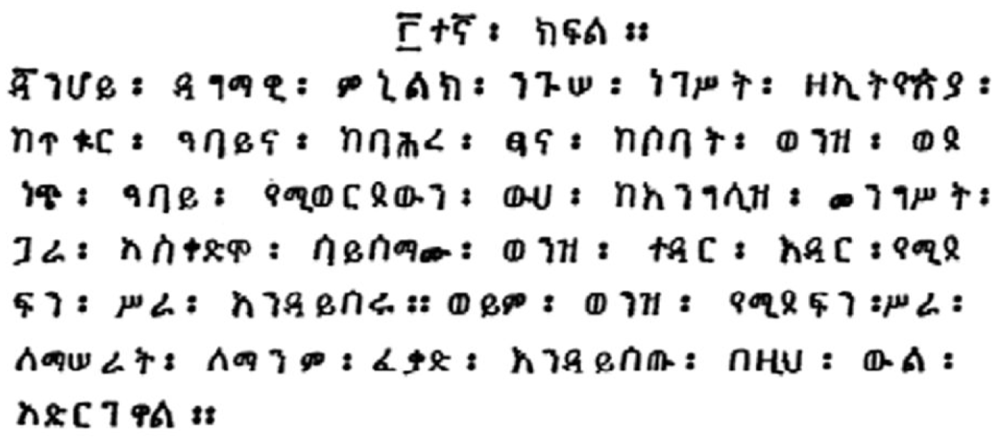
Excerpt: The Amharic version of Article III of the 1902 treaty. This Amharic version obligates Ethiopia to reach an agreement with the Britannic government before undertaking any projects on the Nile.
Ethiopia raises a second argument stating that this agreement does not prohibit Ethiopia from harnessing the Nile as long as it does not ‘arrest’ the water. It argues that hydroelectric dams such as GERD only use the water to generate electricity by rotating turbines, and once the water has been used, it continues to flow downstream. Accordingly, to Ethiopia, this agreement allows it to harness the river, as long as it does not completely impede the flow of water (Ashebir, 2009; Hailemichael, 2019; Kasimbazi, 2010; Kassa, 2015; Shih and Stuz, 2012; Waterbury, 1987).
The other justification given is related to the fact that this agreement was never ratified by Ethiopia or Great Britain. Although it was expected that both the Ethiopian and British parliaments, or other concerned state organs, would ratify the treaty, neither party endorsed or ratified it. In other words, the treaty was not ratified by the Ethiopian Crown Council or the British parliament. Therefore, Ethiopia argues that a treaty that has never been ratified by authoritative councils should not be considered binding (Kasimbazi, 2010; Kassa, 2015; Kendie, 1999; Waterbury, 1987).
One more justification raised by Ethiopia to nullify the 1902 agreement relates to Great Britain’s denial of Ethiopia’s sovereignty. Ethiopia argues that the 1889 Treaty of Wuchale between Italy and Ethiopia had become obsolete due to variations in the Amharic and Italian versions of Article 17. However, European powers accepted the Italian version and considered Ethiopia to be de facto, a ‘protectorate’ of Italy. Scholars point out that Great Britain entered into the 1891 and 1925 agreements with Italy even though the issues addressed in these agreements were concerned with Ethiopia and colonies of Great Britain. These agreements suggest that Great Britain denied Ethiopia’s independence, which should be taken into consideration to abrogate the 1902 treaty (Kasimbazi, 2010; Kassa, 2015; Kendie, 1999; Waterbury, 1987).
The 1925 Rome agreement between Great Britain and Italy was an exchange of notes that aimed at securing Great Britain’s water rights to the Nile and fending off any interest to construct any project to the source of the Blue Nile, Lake Tana. However, it is important to note that though this agreement only focused on projects related to Lake Tana in Ethiopia, Ethiopia was surprisingly excluded from the negotiation process and was only sent a copy of the agreement. In response, Ethiopia sent a letter to Italy and Britain expressing its intention to take the matter to the League of Nations, as the agreement didn’t involve it. The League of Nations found the agreement not binding to Ethiopia (Abdalla, 1971; Abdo, 2004; Shih and Stuz, 2012).
The 1929 water treaty came after Great Britain realized that its attempt to control Lake Tana in the 1925 Rome agreement was unsuccessful. This treaty, which involved Egypt and Anglo-Egyptian Sudan, allocated 48 billion cubic meters of water to Egypt and 4 billion cubic meters of water to Sudan, leaving nothing for the other riparian countries. Unsurprisingly, this treaty grants Egypt the power to veto any Nile-related projects in the upper riparian countries and the right to develop Nile projects that it deems beneficial to its own interest (Abdo, 2004; Ashebir, 2009; Shih and Stuz, 2012).
The 1959 Nile Water Agreement, which is seen as an extension of the 1929 agreement, was signed between Sudan and Egypt. It allocated 55.5 billion cubic meters of water to Egypt and 18.5 billion cubic meters to Sudan, while excluding other riparian countries from receiving any water allocation. Importantly, this agreement was reached without the involvement of the other riparian states. Egypt and Sudan maintained the authority to approve or veto any projects on the Nile. Consequently, the construction of the Aswan High Dam, capable of storing the entire flow of the Nile, was authorized under this agreement (Abdalla, 1971; Abdo, 2004; Ashebir, 2009; Mekonnen, 2010; Shih and Stuz, 2012).
These colonial treaties on the Nile have become a source of tension in the management of transboundary water in modern times (Abdo, 2004; Lautze and Giordano, 2005; Shih and Stuz, 2012). In line with this, Lautze and Giordano (2005: 1059) concur that: As the United Kingdom was signatory to all Nile Basin agreements in the colonial period, one could make the case that no more than one true Nile riparian is included in any single treaty. Since core elements of at least some of these bilateral agreements concerning the Nile still apply, it should come as no surprise that tensions exist between the watershed’s ten current riparian states surrounding the allocation and management of the basin’s waters.
Similarly, Abdo (2004: 64) argues that ‘[t]he UK had a deep-rooted interest in controlling the water of the Nile, which was to provide irrigation for cotton plantations in the area which could provide raw material for its industries in Europe. This laid the foundation for water utilization patterns that favored Egypt at the expense of the interest of other riparian states’. In line with this, Shih and Stuz (2012: 16) also affirmed that the majority of these colonial agreements ‘favor Egypt because of its favored role to Great Britain’. Thus, Great Britain entered into different treaties to secure Nile water for Egypt because Egypt’s stability was more important to Great Britain than that of the other riparian states; and the most crucial factor for stability in Egypt was access to water.
These colonial treaties are categorically rejected by the riparian states except for Egypt and to a certain degree Sudan. In this regard, Kimenyi and Mbaku (2015: 2), for example, wrote: Today’s Nile River riparians, except for Egypt and the Republic of Sudan, consider these agreements anachronistic holdovers from the colonial era and want them abrogated and replaced by a new international watercourse legal regime that enhances equity in the allocation of the Nile River’s waters. Egypt and Sudan, however, insist that the existing Nile Waters agreements be maintained or that, in the event a new legal regime is established, Egypt’s historical rights—those granted by the original agreements—should be honored.
This interest of Egypt to maintain these colonial treaties has also been manifested in its position toward the Cooperative Framework Agreement (CFA). The CFA document annexed the following attachment: [Article 14b]: Attachment At the end of the negotiations, no consensus was reached on Article 14(b) which reads as follows: ‘not to significantly affect the water security of any other Nile Basin States’. All countries [Burundi, DR Congo, Ethiopia, Kenya, Rwanda, Tanzania and Uganda] agreed to this proposal except Egypt and Sudan. To this effect, Egypt proposed that Article 14(b) should be replaced by the following wording: ‘not to adversely affect the water security and current uses and rights of any other Nile Basin State’ (NBI, n.d.: 70).
Egypt’s insistence on replacing Article 14(b) with ‘not to adversely affect the water security and current uses and rights of any other Nile Basin State’, clearly depicts their interest in maintaining the colonial treaties, which put it in a favorable position.
Mass media and post/colonial studies
Throughout much of its history, research examining the nexus between mass media and post/colonialism has been limited. The majority of postcolonial theorizations have been primarily rooted in literature. To this end, Shome (2016: 14), for example, wrote: ‘Postcolonial studies, for the most part, has been squarely situated in the disciplines of English and Comparative Literature. It has hardly addressed, in any expansive way at least, the importance of media, popular culture, and technology, for engaging and understanding colonialism’.
However, for Shome (2016: 14), a focus on media has ‘much to add to our understanding of colonialism and contemporary global inequalities’ because more people have better access to mass media over literature in the contemporary new/media age. We are witnessing greater access to and preference for television, tabloids and mobile technologies, the internet and social networking platforms, among others, than literature. Mass media not only offer wide circulation, ease of accessibility, and simplicity in expressing and understanding postcolonial dilemmas, but it is also considered effective in traversing and impacting various power structures in society today. However, it is not only the preferred nature of mass media that matters, the role of mass media in postcolonial studies must also be tied to issues of postcolonial justice (Alhassan and Chakravartty, 2011; Kumar, 2014; Kumar and Parameswaran, 2018; Shome, 2016; Soo-Hyun Mun, 2019).
Studies (Alahmed, 2020; Jansson, 2003; Leezenberg, 2021; Schein, 2020; Serrão, 2022), for example, pointed out that colonial and oriental sentiments are not only received from Western colonial hegemonic discourses toward the postcolonial Africa, but also are perpetuated by the colonized people themselves. In other words, the North’s colonial politics which produced the South as orient are internalized and reproduced by the postcolonial societies of the South, resulting in ongoing forms of colonization. This concept, which is referred to as ‘internalized orientalism’, suggests that the media in colonized Africa play a crucial role in the reproduction and perpetuation of structural legacies of colonialism. In this regard, it is argued that, ‘Orientalist discourse in media content reflects and reproduces Western colonial constructions of the global South by the Southern people themselves’ (Alahmed, 2020: 423). Therefore, examining how colonial and oriental discourses are reproduced and perpetuated in the news media of postcolonial states is crucial to understand the impact of colonialism and its legacies in postcolonial Africa.
Analysis of the media representation of issues connected to colonialism or colonized-colonizer affairs should be assessed from a postcolonial theoretical perspective. Media content on issues directly related to colonial affairs reflects colonial sentiment even in the contemporary period. The postcolonial approach allows researchers to critique existing media content and the context in which it is produced, enabling them to uncover the reproduction of knowledge regulated by dominant media discourse (Alam, 2021; Imre, 2014; Luthra, 2020; Rao and Wasserman, 2007; Sanz Sabido, 2015, 2016).
Theoretical framework
This article is guided by the postcolonial theory. Postcolonial theory deals with the impacts of colonization and colonial actions on cultures and societies in the contemporary world. Postcolonial theory is a complex and debated concept, but one point that postcolonial theorists generally agree on is that it does not propose a completely new world devoid of the negative impacts of colonialism. Instead, it suggests both continuity and change (Arora, 2007; Ashcroft et al., 2013; Hawley, 2010, 2015; Said, 1979) In other words, quoting Sanz Sabido (2015: 91), ‘what is known as postcolonialism is, in fact, still a form of colonialism’. As Arora (2007: 30) puts it, to the postcolonial theorists, ‘though colonialism is over, it has its aftereffects in postcolonial countries notwithstanding their vigorous political sovereignty’.
Postcolonial theory is ‘a set of theoretical approaches which focus on the direct effects and aftermaths of colonialism’ (Arora, 2007: 330), which is ‘an always present tendency in any literature of subjugation marked by a systematic process of cultural domination through the imposition of imperial structures of power’ (Mishra and Hodge, 2005: 382). Postcolonial theory studies the aftereffects of the response and ‘resistance to the legacy of colonialism’ (Arora, 2007: 330).
Developed by pioneering scholars such as Homi Bhabha, Gayatri Spivak and Edward Said, postcolonial theory posits that the effects of colonial actions, as well as the atrocities committed during colonization, did not come to an end with the cessation of direct colonization. In this regard, Hamadi (2014: 70) asserts that ‘[t]he consequences of colonialism are still persisting in the form of chaos, coups, corruption, civil wars, and bloodshed, which pervade many of these countries, mainly because of the residues of colonization’. Postcolonial theory, thus, is used to ‘conceptualize the complex condition which attends the aftermath of colonial occupation’ (Gandhi, 2020: 4). As a result, argues Gandhi (2020: 4), postcolonial theory is a ‘disciplinary project devoted to the academic task of revisiting, remembering and, crucially, interrogating the colonial past’.
Although postcolonial theory initially had its roots in literature and philosophy, it has gradually evolved into an interdisciplinary field, ‘at least as comfortable in the social sciences as it is (sometimes controversially) in the humanities’ (Hawley, 2015: 2). Postcolonial theory, as an interdisciplinary theory, is currently used in various contexts to encompass the examination and analysis of European territorial conquests, the different institutions of European colonialism, the ways in which empire operates through language and communication, the complexities of constructing identities within colonial discourse, and the resistance demonstrated by individuals within those contexts. Additionally, it focuses on the diverse reactions to such incursions and the enduring effects of colonialism in both nations and communities, both before and after their independence (Ashcroft et al., 2013; Hawley, 2010; Luthra, 2020).
Postcolonial theory has often been overlooked in media and communication studies, despite its significant presence in cultural studies – an area that holds great importance within the field of communication studies. Similarly, scholars in postcolonial studies rarely give importance to investigating communication or mass media, even though platforms like newspaper, radio and television have played significant roles in the formation, growth and sometimes decline of modern nation-states in the postcolonial era (Kumar, 2014; Kumar and Parameswaran, 2018; Merten and Krämer, 2016; Shome and Hegde, 2002). In this regard, Shome (2016: 1) asserts that ‘postcolonial studies has paid minimal attention to the role played by media in the context of transnational, colonial, and nationalist relations. It has also paid limited attention to the ways in which media cultures intersect in, and inform, many contemporary postcolonial sensibilities’.
However, these scholars agree that postcolonial theory is more relevant to media and communication theory because it introduces and develops a matrix of interrelated concepts like otherness, subalternity, marginality and hybridity, which are central to the terms and arguments that shape current debates about the globalization of communications, mass media, cultures and identities.
Media studies have always been concerned with issues of representation, stereotyping, identity formation, and ideological influences of popular media cultures (Cere, 2011; Merten and Krämer, 2016). In some instances, these representations, stereotypes, identity formation and ideological workings in the media can be traced back to colonial actions and their impacts. This junction makes postcolonial theory relevant to the interpretation and study of contemporary media discourse, especially if the issue at hand has something to do with colonial actions. On top of that, as Sanz Sabido (2016: 92) put it, postcolonial theory ‘provides a useful theory of meaning to contextualize the application of CDA, whenever the objective is to examine discourses produced in postcolonial milieus’. To this end, Sanz Sabido (2016: 92) argues that postcolonial theory ‘can offer useful insights and tools for the analysis of media representations’.
Riparian countries often refer to colonial treaties in their debates over the construction of GERD. Egypt, in particular, has been asserting its ‘historic right’ to the Nile, citing these treaties to support its claims. On the other hand, Ethiopia consistently argues that it had no involvement in these colonial treaties and therefore should not be bound by their terms. The significance of postcolonial theory lies in its ability to shed light on the impact of these colonial treaties and agreements in shaping the media discourse on the fair use policy of the waters of the Nile and negotiations on GERD among riparian countries. Thus, this research article employs postcolonial theory as a guiding framework.
Approach and methods
This study employs the postcolonial critical discourse analysis (PCDA) method. According to Sanz Sabido (2015: 200), PCDA is a methodological and theoretical approach that draws on postcolonial theory and critical discourse analysis, aiming at ‘exploring past and contemporary discourses that are impregnated with postcolonial political, economic and social structures’. This methodological approach, as explained by Sanz Sabido (2015: 200), ‘concentrates on the connections between the media and colonial legacies’. PCDA is used as an analytical tool to investigate how past colonial events are portrayed in contemporary media discourses (Darko, 2023; Sanz Sabido, 2015, 2016; Sarfo, 2021). PCDA provides a multilevel analysis, which includes analysis of texts, discourses, and the broader relationship between text production and socio-political and historical contexts (Chen, 2024). The PCDA is constituted by postcolonial theory (PT) and critical discourse analysis (CDA) due to the shared objectives of these two fields. Both PT and CDA address issues of ‘power’ with each aiming to expose oppression and power inequalities: ‘While CDA deconstructs discursive strategies to uncover the ways in which power is reproduced in media discourse, PT focuses on the power imbalances derived from (post)colonial conditions, practices, and structures, which are perpetuated in contemporary societies’ (Sanz Sabido, 2016: 91). In other words, while CDA is concerned with unveiling the production of power imbalances, PT is concerned with imbalances of power driven from colonial encounters. As a result, PT ‘provides a useful theory of meaning to contextualize the application of CDA, whenever the objective is to examine discourses produced in postcolonial milieus’ (Sanz Sabido, 2016: 91).
Though postcolonial theory offers valuable insights and tools to analyze media representation, it is a broad field of study that requires a context-specific perspective to be applied to specific case studies. As a result, PCDA provides ‘a useful approach to the analysis of media content insofar as it focuses predominantly on the postcolonial relations of power that underpin the production of that content’ (Sanz Sabido, 2016: 9). CDA is crucial here because it aims to expose the socio-cultural and political injustices embedded in specific discourses and their impact on a given society (Carvalho, 2008). Besides, the postcolonial rubric within CDA helps to identify studies that examine discourse in relation to the power relations inherited from postcolonial backgrounds (Carvalho, 2008; Darko, 2023; Sanz Sabido, 2015, 2016). Therefore, PCDA is an ideal approach because it ‘helps to expose some of these causes and consequences by recognizing that postcolonial legacies are at the center of some of the existing power imbalances in the world’ (Sanz Sabido, 2016: 102).
In this particular study, PCDA as an analytical framework is an adaptation of CDA, especially the discourse historical approach (DHA). This approach places due emphasis on the impact of historical and socio-political contextual factors on discourse (Reisigl and Wodak, 2015; Sanz Sabido, 2016). DHA aims at examining how a phenomenon is referred to, the features attributed to the phenomenon, the arguments employed, the perspectives to which these arguments are attributed, and the intensification or mitigation of the phenomenon (Reisigl, 2018; Reisigl and Wodak, 2015; Wodak, 2001). DHA is useful in the context of the current study because it takes into account the historical and socio-political contexts within which texts about Nile colonial treaties are produced. Thus, the study employs PCDA to qualitatively examine the representation of the Nile colonial treaties in reference to the construction of GERD in the Egyptian, Sudanese and Ethiopian media.
In terms of data collection, news stories about GERD spanning from January 2017 to December 2022 were collected from the online archives of Ahram Online (https://english.ahram.org.eg), The Ethiopian Herald (https://press.et/herald) and the Sudan Tribune (https://sudantribune.com/). A total of 1235 news stories (783 from Ahram, 370 from The Ethiopian Herald and 82 from Sudan Tribune) were retrieved. This time period was purposively selected because it witnessed significant events relating to the dam’s progress and negotiations. However, due to the large number of news stories available, a total of 310 news stories (196 from Ahram Online, 21 from Sudan Tribune and 93 from The Ethiopian Herald) were initially selected using purposeful random sampling. Purposeful random sampling is a technique that locates primary data on a topic and then randomly selects a subset for in-depth discussion (Suri, 2011). This technique allowed for effective management of data by reducing it to a manageable size for analysis. According to (Patton, 2015: 241), purposeful random sampling aims to ‘reduce suspicion about why certain cases were selected for a study, but such a sample still does not permit statistical generalization’.
Once the 310 news stories were identified using purposeful random sampling, news stories that made explicit or implicit reference to colonial treaties were purposively selected. To do this, we first identified news stories that explicitly dealt with colonial treaties using key words such as colonial treaty/ies, colonial, colonialism, Great Britain, Italy, and years such as 1902, 1906, 1925, 1929, 1934, 1949, and 1959. These years are the significant times in which various colonial treaties concerning the use and management of the Nile were signed. In addition to the explicit words and years, we carefully reviewed the contents of the news stories to include those that implicitly referred to colonial treaties. This selection process resulted in a total of 114 news stories (56 from Ahram Online, 46 from The Ethiopian Herald and 12 from Sudan Tribune). These news stories were then used for the final analysis.
Once we identified the news stories to be used for the analysis, we read them carefully and continuously to understand ‘the postcolonial relations of power that underpin the production of that content’ (Sanz Sabido, 2016: 9). Moreover, we related the content of the news stories with research and literary works on the socio-economic, historical and cultural contexts of the Nile to figure out the historical and socio-political contexts within which texts about the Nile colonial treaties were produced. We also held reflection sessions during which we examined and commented on each other’s patterns and themes. Finally, we interpreted the major themes qualitatively and analyzed them as follows.
Analysis and discussion
This section examines how the three newspapers in focus discursively portrayed the Nile colonial treaties. The analysis reveals that Ahram Online, Sudan Tribune and The Ethiopian Herald discursively portrayed the Nile colonial treaties in line with the construction of GERD as binding, alternative and obsolete, respectively. The three newspapers also offered their justifications to cement their argument of the portrayal of the Nile colonial treaties as binding, alternative and obsolete. Besides, their news stories offered detailed accounts of the consequences riparian states faced due to their failure to comply with their portrayals of the Nile colonial treaties and potential solutions.
The comparative analysis of these variables (‘portrayal’, ‘rationales’, ‘implications’, and ‘solutions’) depicts the overall impact of the Nile colonial treaties on the discursive representation of GERD, the yielding nature of ongoing negotiations, and the media’s overall contribution to either cooperative or conflictive terms for the Nile basin region. Apart from the news stories from the three newspapers, research findings and official documents have also been incorporated to bolster the analysis and discussion. Therefore, after discussing the trichotomic portrayal of colonial treaties in the three newspapers (binding, alternative and obsolete), we delved into the justifications and rationales presented or omitted by the newspapers to support their arguments. Finally, we explored the consequences and solutions discussed by the three newspapers.
Portrayal of Nile colonial treaties in the news media: The binding, alternative and obsolete trichotomy
The three newspapers portrayed the colonial treaties in different ways, providing their justifications and rationales. Ahram Online presented the colonial treaties as ‘binding’ agreements that seal Egypt’s historical rights over the Nile. The Ethiopian Herald, on the other hand, deemed these treaties as ‘obsolete’ and invalid. Sudan Tribune emphasized the importance of seeking ‘alternative’ solutions that align with the current world and reality.
Ahram Online emphasizes that colonial treaties are binding treaties that should govern contemporary Nile water use. According to Ahram Online, the 1902, 1929, and 1959 treaties are international agreements that should unquestionably govern the current use and allocation of the Nile waters. In line with this, an excerpt from Ahram Online (31 December 2021) states: ‘What has become increasingly clear during the course of the dispute is that it is not simply about the filling and operation of GERD. Ethiopia also objects to Egypt’s historic right to 55 billion cubic meters (bcm) of Nile water annually, as stipulated in international agreements signed in 1929 and 1959’. This news story suggests that the 1929 and 1959 ‘international’ agreements, which establish Egypt’s ‘historic right’, should not be questioned during negotiations. Instead, they should be considered as binding agreements to regulate the use and distribution of the Nile waters.
As shown in the following news story, Ahram Online affirms that Ethiopia is prohibited from building a dam on the Blue Nile as per the provisions of the colonial-era agreements, and that these agreements should be respected: ‘The colonial-era deal between Ethiopia and Britain effectively prevents upstream countries from taking any action – such as building dams and filling reservoirs – that would reduce the share of Nile water to downstream countries Egypt and Sudan’ (15 August 2020). To this end, according to Ahram Online, ‘[t]he Ethiopian claim that the relevant agreements [the 1902, 1929, 1959 agreements] are an insignificant colonial legacy is an explicit fallacy of historical facts’ (13 June 2021). As a result, Ahram Online argues that Ethiopia’s attempt to label these colonial treaties as obsolete and non-binding doesn’t hold water.
Touting the binding nature of the Nile colonial treaties does not seem to be limited to the Egyptian media; it is also stipulated by their Constitution. Article 44 of the Arab Republic of Egypt Constitution (2014) stipulates: ‘The state commits to protecting the Nile River, maintaining Egypt’s historic rights thereto [emphasis ours], rationalizing and maximizing its benefits, not wasting its water or polluting it’. This same position is reflected in its request to reword Article 14 of the CFA (NBI, n.d.), where they requested the substitution of ‘not to significantly affect the water security of any other Nile Basin States’ with ‘not to adversely affect the water security and current uses and rights [emphasis ours] of any other Nile Basin State’. It is important to note that Egypt’s claim of ‘historical rights’ refers to the 1929 and 1959 colonial treaties (Kasimbazi, 2010; Kimenyi and Mbaku, 2015; Lautze and Giordano, 2005).
The perpetual portrayal of the Nile colonial treaties as binding legal regulations in Ahram Online’s news stories as well as other Egyptian policy and legal documents appears to affirm the exercise of ‘internalized orientalism’. Scholars (Alahmed, 2020; Jansson, 2003; Leezenberg, 2021; Schein, 2020; Serrão, 2022) argue that when postcolonial countries and people embrace colonial and oriental sentiments, they internalize and reproduce these beliefs, leading to ongoing forms of colonialism. This concept, known as ‘internalized orientalism’, suggests that the media in colonized countries play a crucial role in the reproduction and perpetuation of colonialism’s structural legacies. Consequently, it is reasonable to argue that Ahram Online’s persistent emphasis on the binding nature of the Nile colonial treaties, as well as the treatment of these treaties as red lines that define the use and governance of the Nile in various Egyptian laws, including the constitution, highlights the internalization and perpetuation of these colonial and oriental sentiments.
The Ethiopian Herald, in contrast to Ahram Online, argues that colonial treaties should not be considered valid in contemporary African states. According to the Herald, these treaties are outdated colonial relics and no longer hold any legal significance. In a news article published on 12 June 2020, The Ethiopian Herald states: ‘Ethiopia had not been part of the previous agreements which Egypt touted most of the time about, it even protested such colonial and bilateral agreements. These agreements were not inclusive nor did they were fair and legitimate. In fact, the fact that Ethiopia had not been a party to the agreement makes the agreements nullified and non-binding’. According to The Ethiopian Herald, ‘As Ethiopia is not signatory of the 1929 and 1959 Nile water agreements, both are not binding’ (27 May 2020). According to the Herald, the colonial treaties that date back to the colonial period should not be mentioned at all in the modern age.
Sudan Tribune, on its part, emphasizes the need to consider alternatives that take into account contemporary realities. Contrary to Ahram Online and The Ethiopian Herald, Sudan Tribune stresses the need for both countries to be courageous in coping with the new realities facing the negotiations on GERD, as can be seen in the following excerpt: Both countries have to struggle to cope with the new reality facing the negotiations on the GERD. As much as Egypt and Sudan see this process as a violation of international law and thus appear to lose interest in a negotiated settlement, they would also see that the possibility of securing the type of agreement that could even remotely recognize existing water use aka historical rights may have been lost. Ethiopia may also have increasingly little or no incentives left to ink a binding agreement on a project that nears completion. (Sudan Tribune, 20 July 2021)
Overall, it is evident that the three newspapers presented differing and opposing viewpoints regarding the legality of the colonial treaties. According to Ahram Online, the colonial treaties are regarded as legally binding and sacrosanct. Conversely, The Ethiopian Herald considers them to be outdated remnants of colonialism with no legal basis for governing present-day transboundary issues in the postcolonial era. On the other hand, Sudan Tribune advocates for alternative solutions that take into account the current realities on the ground, rather than getting caught in an endless loop of debate between historical rights and tributary claims.
The polarized portrayal of the Nile colonial treaties, especially the binding-obsolete dichotomies of Ahram Online and The Ethiopian Herald, reflect the hegemonic and counter-hegemonic power dynamics between Egypt and Ethiopia. According to scholars (Beyene et al., 2018; Degu Belay, 2014; Kasimbazi, 2010; Obengo, 2016), Egypt and Ethiopia have become entangled in hegemonic and counter-hegemonic hydro-discourses in recent years. While Egypt seeks to maintain its historical hegemonic power over the Nile, significantly supported by the Nile colonial treaties, Ethiopia has recently begun to challenge this dominance. Consequently, it is reasonable to argue that the dichotomous binding-obsolete portrayal of the Nile colonial treaties by Ahram Online and The Ethiopian Herald reflects the hegemonic and counter-hegemonic movements of the two countries.
Rationales to justify the binding, alternative, obsolete trichotomy
News media never portray crucial issues without offering justifications that they believe will help solidify their portrayals and persuade their readership. Similarly, the three newspapers’ portrayals of the colonial treaties are not without justifications in support of their respective arguments.
Ahram Online offers various justifications to support the binding nature of colonial treaties in the contemporary management and use of the Nile. One frequently raised justification is Ethiopia’s participation as an independent signatory state in the 1902 agreement. According to Ahram Online, this colonial treaty should be binding because Ethiopia was an independent state when it signed the 1902 agreement with Great Britain (on behalf of Sudan). In this regard, the news story by Amir Kandil (Ahram Online, 5 December 2021), for example, reads: ‘The Anglo-Ethiopian treaty was signed in 1902 between the United Kingdom – representing Egypt and Sudan – and Ethiopia – represented by Emperor Menelik II of Abyssinia. In May, Sudan denounced the Ethiopian rejection of accords on Nile water shares and urged Addis Ababa to commit to the international agreements it signed as an independent state’.
Ahram Online argues that Ethiopia was only asked to commit itself to the 1902 agreement, to which it was a signatory, as an independent state; Sudan and Egypt never asked Ethiopia to bind to other colonial treaties to which it was not a party. Ahram Online (6 May 2021) writes the following in this regard: Egypt and Sudan have never asked Ethiopia to commit to the provisions of the 1929 agreement on the White Nile or the 1959 agreement that Egypt and Sudan signed after the end of the colonial era in both countries. However, Addis Ababa is still obligated under international law to fulfill the terms of the treaty it signed as a fully sovereign and independent nation in 1902. Under this treaty, Ethiopian emperor Menelik II pledged that his country would not construct or permit the construction of any structures on the Blue Nile, Lake Tana, or the Sobat River that would impede the flow of Nile water to Sudan and Egypt.
However, although Ahram Online accentuates that Egypt and Sudan wanted Ethiopia to uphold the 1902 agreement to which it was a signatory as an independent state, most of its news stories refer to the 1929 and 1959 agreements and urge Ethiopia to adhere to these agreements, even though Ethiopia was not a party to them. For instance, the 55.5 billion cubic meter quota, which Ahram Online frequently discusses, is not mentioned in the 1902 water agreement, the only colonial agreement to which Ethiopia was a signatory. Nevertheless, most of Ahram Online’s news stories urge Ethiopia to comply with Egypt’s historic quota of 55.5 billion cubic meters and infuse this quota with the 1902 agreement, as noted in the following statement: ‘Under two water treaties dating back to 1902 and 1929, Egypt’s share of the Nile stands at 55.5 billion cubic meters’ (11 April 2021). These news stories are misleading for two reasons. First, the 1902 agreement does not mention anything about water shares. Second, in the 1929 agreement, Egypt’s water share was not 55.5 billion cubic meters, but 48 billion cubic meters, while Sudan was allocated 4 billion cubic meters of water (Lautze and Giordano, 2005; Shih and Stuz, 2012).
As discussed in the literature review, Ethiopia was a party to the 1902 treaty (Lautze and Giordano, 2005; Shih and Stuz, 2012; Waterbury, 1987). However, that treaty did not allocate water shares, except for prohibiting Ethiopia from ‘arresting’ the flow of the river. Otherwise, Ethiopia was not a party to any colonial agreement that allocated Nile water to Egypt and Sudan. Scholars argue that it is practically difficult to force transboundary riparian states to enter into a binding agreement over water allocation, let alone argue about the binding nature of an agreement to which a nation was not a party. Studies indicate that reaching a basis for actual allocations can be challenging due to the opposing principles that riparian states often adopt in negotiations. For example, Lautze and Giordano (2005: 1060) argued in this regard that ‘[w]hile it has been asserted that the inclusion of flexible water allocation principles is integral to resilient transboundary water law, arriving at a basis for actual allocations can prove difficult because of the opposing principles that riparians often adopt in negotiations’.
As a result, Lautze and Giordano (2005: 1060) further argue that ‘actual negotiations tend to move away from these two extreme principles and instead result in a vague compromise position known generally as limited (or restricted) territorial sovereignty, which allows for the “reasonable and equitable use” of international waters so long as “no appreciable harm” is inflicted on co-riparians’.
Ahram Online’s justifications about the binding nature of the Nile colonial treaties and Ethiopia’s obligation to abide by them is a reflection of Egypt’s fixation on these colonial agreements to date. However, scholars (Abdo, 2004; Lautze and Giordano, 2005; Shih and Stuz, 2012) argue that these treaties were designed to serve Great Britain’s interests in the Nile region. To this end, Abdo (2004: 64) argues that ‘[t]he UK had a deep-rooted interest in controlling the water of the Nile, which was to provide irrigation for cotton plantations in the area which could provide raw material for its industries in Europe. This laid the foundation for water utilization patterns that favored Egypt at the expense of the interest of other riparian states’. As a result, all the riparian countries, except Egypt, rejected these colonial treaties following their independence, citing their unfairness toward the other riparian countries. These countries even blame these colonial treaties for the lack of consensus in establishing a fair and reasonable framework that governs the use of the Nile. This overall scenario shows the lasting impact of colonialism and colonial agreements on postcolonial nations, of which one is its impact on the Nile region for failure to reach an agreement on the use of the Nile waters despite numerous efforts by the riparian states and other regional and international intermediaries.
The Ethiopian Herald, on the other hand, argues that the colonial treaties are obsolete and nullified. The newspaper supports this claim by pointing out that Ethiopia was not a party to these treaties. Additionally, it highlights that the riparian states, with the exception of Egypt, have already denounced these colonial treaties. Furthermore, it argues that these treaties contradict international water governance laws.
The Ethiopian Herald labels the colonial treaties as obsolete and nullified. One of the justifications raised by the newspaper is the fact that Ethiopia was not a signatory to them. For example, Desta’s news story from The Ethiopian Herald (12 June 2020) noted: ‘Ethiopia had not been part of the previous agreements which Egypt touted most of the time about, it even protested such colonial and bilateral agreements’.
However, as discussed above, Ethiopia was a signatory to the 1902 Nile colonial agreement (Lautze and Giordano, 2005; Shih and Stuz, 2012; Waterbury, 1987). The Ethiopian Herald, acknowledging that Ethiopia was a signatory to it, tries to justify its abrogation, as could be seen below: To start with the 1902 treaty, this was a colonial time treaty and there is a general rejection of colonial agreements except for those demarcating borders. The reason for this is that those colonial treaties were concluded at the time when colonies did not have say in the content of the treaties and that the colonial powers exercised undue influence in the process. So, when it is seen from this perspective, the 1902 treaty does not have any legal force. However, even assuming that it is a valid one, Egypt’s invocation of the 1902 treaty, does not require Ethiopia to get prior approval to use its natural resources. In that treaty, Ethiopia undertook to refrain from completely stopping the flow of the river, and GERD, as a hydropower dam, does not completely arrest the flow of the water. (The Ethiopian Herald, 25 June 2020)
The Ethiopian Herald also argues that the fact that Egypt is the only country that cites colonial treaties as supporting documents should be seen as a justification to nullify them: ‘Egypt is an only African country which cites unfair colonial agreements as a supporting document to a so-called “historical right” though none of the other riparian countries recognize the old-fashioned agreements. Egypt has been the staunch supporter of the so-called colonial deal as it exclusively benefits the country. In fact, the country is the sole proponent of colonial-era impositions. However, the majority of Nile riparian countries had already nullified the documents immediately after independence’ (27 June 2020). The argument here is that if only one of the 11 riparian states supports colonial treaties, it should be considered nullified automatically.
Furthermore, in the Herald’s news stories, the colonial treaties have been labeled as agreements that contradict international law on transboundary water management. For The Ethiopian Herald, ‘the two colonial era water sharing agreements made in the 1900s and 1959 on the utilization of Nile water were unjust as they contradicted with Transboundary Water Governance Laws and did not consider the water needs of riparian countries’ (1 April 2020). In a similar vein, another news story from The Ethiopian Herald (12 June 2020) reiterates: ‘There is no agreement that gives one country to fully control common resources except for the colonial era ones such as the 1929 and 1959 agreements. Working to perpetuate unfair and historical injustice is an absurd move. For that matter, international laws do not allow the perpetuation of historical rights that only favors a single country’.
Sudan Tribune, in its turn, argued that riparian states should seek alternative solutions that take into account the current situation and new realities. According to Sudan Tribune, unless new alternatives are sought, it will be challenging to reach an agreement within the current conflict over ‘historic right’ versus ‘tributary right’. Sudan Tribune (20 July 2021), in this regard, stresses, ‘Throughout the years-long process, the main obstacle to reaching an agreement has proven to be the issue of the conflict over historical rights versus tributary rights. This will continue to be a major impediment to reaching any agreement’.
In general, the three newspapers provided their justifications for labeling colonial treaties as binding, alternative or obsolete. Ahram Online argues that riparian countries, especially Ethiopia, should adhere to the general provisions and water allocations of the Nile colonial treaties because Ethiopia has been an independent signatory to the 1902 colonial treaty. According to Ahram Online, let alone the 1902 treaty to which Ethiopia was a signatory as an independent state, the colonial treaties should not be violated since they are international laws that govern the use and allocation of the Nile waters. On the other hand, The Ethiopian Herald emphasizes that colonial treaties should be nullified for at least three reasons. Firstly, Ethiopia was not party to these treaties. Secondly, most riparian states, with the exception of Egypt, have denounced these colonial treaties. Finally, the Herald argues that these colonial treaties should be abrogated because they contradict international water governance laws. Sudan Tribune, on the other hand, calls upon riparian states to seek alternative solutions that take into account the current situation and new realities.
Implications of colonial treaties for GERD negotiations and suggested solutions
The three newspapers also take pains to explain the implications of riparian states’ failure to adhere to the binding, alternative and obsolete nature of the colonial treaties. Furthermore, they provide suggestions for potential remedies that the states should consider in order to reach an agreement on the ongoing dispute concerning GERD. Ahram Online highlights that if Ethiopia refuses to comply with the colonial treaties and rejects their binding nature, Sudan should respond by questioning Ethiopia’s sovereignty over the Benishangul Gumuz Regional State, where GERD is being constructed. Ahram Online frequently remarked that the Benishangul Gumuz region of Ethiopia was demarcated to Ethiopia with the 1902 colonial agreement: ‘While the agreement [1902 treaty] has prohibited the Ethiopian construction of any waterworks across the Blue Nile that would affect the river’s natural flow, it has granted sovereignty of the then Sudanese Benishangul region to Ethiopia’ (Ahram Online, 5 December 2021).
Similarly, Ahram Online also used Ethiopia’s categorical rejection of the colonial treaties as a means to incite Sudan to lay claim to the Benishangul Gumuz Regional State. According to the newspaper, this region was supposedly granted to Ethiopia in the 1902 agreement between Ethiopia and Great Britain. In this regard, Ahmed Amal (Ahram Online, 6 May 2021) writes the following: Khartoum was also forced to give Ethiopia a lesson in its own history. Ethiopia was an independent state at the time it signed the treaty between Great Britain and Ethiopia of 15 May 1902 governing the use of the Nile. Furthermore, if Ethiopia repudiates its obligations under that agreement, then it also renounces its sovereignty over the Benishangul region. As the Sudanese Foreign Ministry statement put it, ‘Sudan does not need to remind Ethiopia that its unwise usage of such misleading claims and its disavowal of previous agreements undermines Ethiopian sovereignty over the Benishangul region, sovereignty over which was transferred from Sudan to Ethiopia in accordance with the agreements under this treaty in particular.’
Treaties between Great Britain and Ethiopia, and between Great Britain, Italy, and Ethiopia, relative to the frontiers between the Anglo-Egyptian Sudan, Ethiopia and Eritrea, aka the 1902 Treaty, consists of two articles that specify the demarcation of the borders between Sudan and Ethiopia. Article I of the Treaty stipulates: The frontier between the Sudan and Ethiopia agreed on between the two governments shall be: the line which is marked in red on the map annexed to this Treaty in duplicate, and traced from Khor Um Hagar to Gallabat, to the Blue Nile, Baro, Pibor, and Akobo Rivers to Melile, thence, to the intersection of the 6th degree of north latitude with the 35th degree longitude east of Greenwich.
Article II of the Treaty also states: ‘The boundary as defined in Article I, shall be delimited and marked on the ground by a Joint Boundary Commission, which shall be nominated by the two High Contracting Parties, who shall notify the same to their subjects after delimitation’.
As can be seen, these articles stipulate the demarcation of boundaries between the two countries that share a large border area. However, none of the articles discuss the transfer of land from one country to another, as claimed by Ahram Online. Therefore, it can be argued that Ahram Online’s attempt to link Ethiopia’s rejection of the Nile colonial treaties with the sovereignty of its region is wide off the mark. In this regard, Kassa (2015) corroboratively argues, ‘Judging by contents of the texts of the Treaty, the arrangement was initiated to address frontier issues. From the provisions of the Treaty and related legal and historical chronicles, it could be gathered that the most important object and purpose of the accord, the design that prompted the parties to conclude the agreement had been to settle and delineate longstanding boundary issues between the Anglo-Egyptian Sudan and Ethiopia’.
Studies (Beyene et al., 2018; Cascão, 2009; Cascão and Zeitoun, 2010; Darwisheh, 2018 reveal that Sudan’s diplomatic and foreign policy toward the Nile has been shadowed by the supremacy of Egypt. To this end, Darwisheh (2018: 3) notes, ‘Even after its independence Sudan remained within Egypt’s sphere of influence in the Nile Basin’. Oftentimes, Egypt systematically extracted Sudan’s compliance with occasional threats to use military force, boycott Sudanese exports, and worsen the living conditions of Sudanese residents in Egypt, among others, to maintain the status quo. At other times, Egypt has been using other soft power techniques such as diplomatic, cultural and economic relations (Darwisheh, 2018) to extract Sudan’s acquiescence. Given this experience, it is safe to argue that Ahram Online’s attempt to instigate Sudan to claim the Benishangul Gumuz region as a response to Ethiopia’s categorical rejection of Nile colonial treaties is a reflection of Egypt’s culture of using Sudan as a weapon to protect its interest.
The attempt by Ahram Online to convince the Ethiopian side about the binding nature of colonial treaties even goes so far as to claim that rejecting the binding nature of the 1902 colonial treaty could be seen as disregarding the achievement of Menelik II, the King of Kings of Ethiopia during the 1902 treaty. Ahram Online (6 May 2021) writes: ‘It is an irony that the Amhara, who monopolize the conduct of Ethiopian diplomacy, are spearheading a campaign targeting an accomplishment of one of their most powerful historical figures, Ethiopian emperor Menelik II’. The news story goes on to argue that ‘Ethiopia’s pitiful attempts to wriggle out of its international pledges are revealing. On the one hand, they betray the current government’s blurred view of Ethiopian history. If the 1902 treaty with Britain exacted “concessions” from Addis Ababa, it also rewarded Ethiopia with major gains that were crucial to the survival and prosperity of the Ethiopian state at the time that Menelik II signed it’.
According to Ahram Online, the only way to achieve a binding agreement on GERD negotiations is by recognizing the colonial treaties and the ‘historic water share’ quota that they guarantee. Ahram Online states that Ethiopia’s demand to include articles on water sharing in the current GERD negotiations is seen as absurd and could potentially complicate the negotiation process. An excerpt (4 May 2021), for example, reads: ‘While Sudan and Egypt upheld the historic agreements as points of reference in the negotiations, Ethiopia has been trying since last year to include a new water shares agreement in GERD negotiations, claiming that the previous agreements date back to a colonial era’. Similarly, the news story by Ahram Online (22 June 2020) claims that ‘[a]fter the end of talks on Wednesday, Sudan’s irrigation minister said his country and Egypt rejected Ethiopia’s attempts to introduce articles on water sharing in the dam deal. Egypt has received the lion’s share of the Nile’s waters under decades-old agreements dating back to the British colonial era. Eighty-five percent of the Nile’s waters originate in Ethiopia from the Blue Nile’.
From these news stories, it is evident that Ahram Online takes the candid position that there should not be negotiations regarding equitable and reasonable water sharing. According to Ahram Online, the colonial treaties should be the alpha and omega concerning Nile water allocation and use. However, various scholars (Abdo, 2004; Lautze and Giordano, 2005; Shih and Stuz, 2012) have argued that these colonial treaties lack fairness in allocating the Nile’s resources to riparian countries. For example, none of the colonial treaties that allocate water shares to riparian countries included Ethiopia, despite its 86% contribution to the Nile’s water flow. Ahram Online, however, intentionally avoids discussing solutions to address the concerns of riparian countries regarding fair and equitable use of the waters. This clearly indicates that Ahram Online’s argument is based on Egypt’s position of maintaining its historical hegemony over the Nile through power and other strategies, rather than on reasonable principles of fair and equitable use. This position of Egypt has been reflected in various circumstances, including President Abdel Fattah El-Sisi’s warning of ‘unimaginable instability if a drop of Egypt’s water is touched (Alemayehu, 2024; Degu Belay, 2014; El Damanhoury, 2024).
The Ethiopian Herald, on the other hand, argues that Egypt’s fixation on colonial treaties is to blame for the failure to reach an agreement in the tripartite negotiations about GERD. The newspaper highlights that Egypt’s approach in the GERD negotiations is centered round upholding colonial treaties. This unwavering stance by the Egyptians is also identified as one of the main causes for the lack of agreement in the GERD negotiations, as can be seen in the following excerpt: ‘Egypt has been relentlessly putting efforts to maintain a self-claimed colonial era-based water allocation and veto power on any project in the Nile system while Ethiopia is in an attempt to redress a historic imbalance in exploitation of the Nile’s waters’ (The Ethiopian Herald, 10 March 2020). Similarly, in another news article, The Ethiopian Herald writes: ‘I think they can reach an agreement on this [filling of the dam], but the issue is not about how to fill the dam, but about them trying to hang on to a colonial-era agreement’ (The Ethiopian Herald, 8 April 2020).
The Ethiopian Herald affirms that Egypt’s preoccupation with colonial treaties is the primary factor that impedes negotiations. Here is an excerpt that exemplifies this: ‘Egypt has been making an effort to resuscitate the colonial-era Nile River treaties at different times. That is why the trilateral talks failed to achieve the intended target over and over again’ (The Ethiopian Herald, 22 May 2020). In a similar tone, the Herald is of the opinion that ‘Egypt’s colonial era attitude has been hindering the progress of GERD talks as it totally violates principles of international negotiation. . . .Colonial era mentality orders hegemony over a possession whatever the source of the property belongs to. . . .Egypt appears in the negotiation with this mentality to own 90% of the Nile ignoring the rest 10 riparian countries including Ethiopia’ (21 July 2020).
The Herald further laments that any agreement that mentions colonial treaties should be rejected based on the Nyerere Doctrine. In this regard, an excerpt from the Herald notes: ‘Any agreement between the three countries (Ethiopia, Egypt, and Sudan) will not be acceptable if it includes treaties of colonial legacy’ (11 June 2020). The Ethiopian Herald also further argues that the frequently attributed ‘historic right’ claim of Egypt has been used to perpetuate a historical injustice which uses the 1929 and 1959 agreements as reference points. Here is a sample excerpt: For centuries, Egypt has been digging its heels on the colonial era agreements which lavishly provide the country to sustain a monopoly control over the shared river Nile, and experts say the issue of ‘historic right’ holds no water other than running contradiction against modern thinking as it perpetuates years of historical injustice. The so-called historical rights which Egypt claims in reference to the 1929 and 1959 agreements have been the major bargaining chip of Cairo and it has for long tried to sugarcoat these exclusionist agreements as permanently binding sacred deals. (The Ethiopian Herald, 12 June 2020)
Furthermore, the Herald emphasizes that the colonial treaties and Egypt’s obsession with them should be blamed for the failure of the negotiations between the riparian countries with regard to GERD: ‘Some of the disagreements and obstacles we see these days among Nile basin countries trace back to the legacy of colonialism. . . .Egypt is dragging its feet and cannot unshackle the colonial legacy; it finds it difficult to new and modern thought of mutual growth and cooperation which is why it has become the great disrupter in GERD negotiation’ (The Ethiopian Herald, 12 June, 2020).
The Ethiopian Herald also takes great pains to suggest potential remedies the riparian countries should consider to reach an agreement regarding GERD. One of the solutions, according to the Herald, should be Egypt’s readiness for a win-win approach: ‘Egypt needs to engage more actively in a give and take than sticking to the unfair and nullified colonial-era-treaty in order to revive the stalled negotiations over the Grand Ethiopian Renaissance Dam (GERD)’ (3 June 2020).
The Herald also advised that Egyptian politicians should realize that times have changed and so have the colonial treaties. Therefore, they need to stop asking Ethiopia to comply with these outdated agreements. In this regard, here is what the Herald had to say: ‘The colonial era exclusive deals that gave Egypt veto over the waters of the Nile had gone never to return. It is such kinds of belligerent attitude that blinded Egyptian politicians from realizing times have changed. This is manifested in the unacceptable demands by Egypt – that is tantamount to asking Ethiopia to completely handover the operation of GERD to it that led to the failure of the talks in Washington DC’ (10 April 2020).
The Herald underscores that attaining a win-win and equitable water share among the riparian states could provide an ideal solution to tear down colonial treaties and promote pan-Africanism. A news story, for example, notes: ‘The effort to build “inclusive” and “equitable” water share among nations is fundamental in letting practice Pan-Africanism and tearing down the old colonial era treaties’ (3 April 2019). The Cooperative Framework Agreement (CFA) for the Nile is commended as an ideal framework to substitute for the 1929 and 1959 colonial accords. In this regard, an excerpt from The Ethiopian Herald (17 August 2019) noted the following: ‘The agreement [CFA], which seeks to promote equitable use and access to the Nile waters, replaced the 1929 and 1959 colonial treaties that required countries in the upstream to seek permission from Egypt before undertaking any projects on the trans-boundary resource’. In a similar vein, another news story concurred that ‘[t]he CFA is perhaps the greatest success of the Nile Basin Initiative which entails the official nullification of the colonial era treaties which were biased in favor of Egypt’ (The Ethiopian Herald, 10 April 2020).
The Ethiopian Herald’s recommendation of the CFA as an ideal framework to replace the colonial Nile treaties reflects Ethiopia’s recent counter-hegemonic movement and success regarding the Nile through a basin-level framework. Various studies (Beyene et al., 2018; Cascão, 2009; Darwisheh, 2021; Shahbazbegian and Dinar, 2023) indicate that one of Ethiopia’s achievements in its counter-hegemonic movement concerning the Nile is the endorsement of the CFA, a framework that proposes ‘equitable utilization’, while downplaying past Nile water agreements, by six riparian countries. Consequently, it is clear that The Ethiopian Herald’s suggestion of the CFA as an ideal replacement for colonial treaties stands in contrast to Ahram Online’s proposal of colonial treaties as binding agreements regarding the Nile. The differing perspectives on the colonial treaties versus the CFA as binding frameworks from the two newspapers reflect the hegemonic and counter-hegemonic movements of the two riparian countries.
Sudan Tribune argues that Sudan’s and Egypt’s insistence on signing a binding agreement aims to ensure their historic right: ‘Egypt and Sudan still insist on a legally binding agreement with Ethiopia on the overall operation of the dam, to ensure their historic water shares from the Nile’ (10 December 2022).
However, for the Sudan Tribune, Egypt’s insistence on considering the 1959 colonial agreement has hindered negotiations on GERD. It had the following to say: ‘The three delegations [from Egypt, Ethiopia and Sudan) were about to sign an agreement after a 17-hour meeting when Egypt raised the disputed Nile Water Agreement between Cairo and Khartoum of 1959 which the three parties had agreed to not include in the discussions over the GERD’ (12 April 2018).
Another news story by Sudan Tribune also discloses the fact that Egypt’s refusal to include a provision stating that Ethiopia is not concerned about the 1959 deal caused the collapse of the attempt to reach a binding agreement: ‘Ethiopia and Sudan said Khartoum meeting had been undermined by Egypt because it refused to include a disposition providing that Ethiopia is not concerned by 1959 deal which is a bilateral agreement between Cairo and Khartoum, despite a previous understanding over this point’ (19 April 2018).
Sudan Tribune reports that Egypt and Sudan have rejected the services of BRL Ingenierie (BRLi) and Artelia (the two firms that were contracted to study the potential impact of GERD on Sudan and Egypt) because the firms didn’t take into consideration the 1929 and 1959 colonial treaties, as can be seen in the following excerpt: ‘According to the Sudanese side, the two firms, BRL and Artelia, in their study on GERD’s impact on Egypt and Sudan didn’t observe the 1959 agreement between Sudan and Egypt over the Nile water based on the 1929 treaty’.
As a solution, Sudan Tribune argues that a series of step-by-step actions need to be taken in order to weaken the strongly held polarized positions of Egypt and Ethiopia regarding the Nile to bring about lasting solutions to the issue of GERD. An excerpt from Sudan Tribune, for example, counseled the two countries to ‘candidly recognize the difficulties attached to resolving this real and present dilemma and the political, economic, and psychological consequences attached to it coupled with a series of steps that weaken this strongly held position should be the first steps in addressing the survival versus survival dilemma’ (20 July 2021). The same news story goes on to recommend that ‘[t]he trilateral negotiations have to be redefined in terms of scope, objective, and content. Such an approach shall begin with the recognition that any agreement on GERD is not a conclusive deal that can resolve the Nile quagmire. Any deal on the Nile necessitates frequent adjustments and follow-up that requires a friendly atmosphere for cooperation among the parties. For such a relationship to be established and thrive the three parties must, even if slowly, engage in trust-building’.
Overall, the positions held by the news media from the three conflicting Nile basin states, particularly Ahram Online and The Ethiopia Herald, regarding the binding/non-binding nature of the colonial treaties, the justifications provided for these positions, the implications discussed, and the solutions proposed all reveal the impact of the colonial treaties on the ongoing GERD dispute. As discussed earlier, the national newspapers from Egypt and Ethiopia held polarized and divergent views on whether these colonial treaties were binding or non-binding. The justifications offered for these views were also polarized and divergent, thus failing to facilitate a middle ground and lasting solutions for the tension and hostility in the eastern Nile basin following the commencement of GERD. Furthermore, The Ethiopian Herald and Ahram Online’s analysis of the implications of the nations’ failure to commit to their respective positions did not contribute to resolving the conflict. Similarly, their suggested solutions remained aligned with their own positions and failed to propose reconciliatory mechanisms that could help the competing states find common ground. These conditions prevented the news media from playing a crucial role in bringing the conflicting basin states together and achieving successful negotiations on GERD.
However, it is important to note that Sudan Tribune, the privately owned newspaper from Sudan, has been an exception in the overall dynamics here. The newspaper called on the concerned bodies to look for alternative solutions that were compatible with the realities on the ground. Although Sudan Tribune provided limited coverage of the issue compared to the other two newspapers (Sudan Tribune only produced 82 news stories, while Ahram Online and The Ethiopian Herald produced 783 and 370 news stories, respectively over the 6-year period), it maintained a relatively neutral position regarding the binding/non-binding nature of colonial treaties and potential solutions to the GERD disputes.
Overall, it is evident that the Nile colonial treaties have had a significant impact on the current GERD conflict. Unfortunately, the national media has become entangled in these treaties, exacerbating the GERD disputes rather than helping to resolve them.
Conclusion
This article examines how Ahram Online, Sudan Tribune and The Ethiopian Herald portrayed the Nile colonial treaties in their news discourse about the construction of GERD. The three newspapers presented different perspectives on the binding/non-binding nature of the colonial treaties, categorizing them as binding, alternative or obsolete, respectively. Ahram Online’s news stories referred to the colonial treaties as binding and emphasized the importance of adhering to them in order to reach an agreement on GERD negotiations. In contrast, The Ethiopian Herald considered these treaties to be obsolete and nullified, arguing that they should be regarded as irrelevant since colonialism has ended. Sudan Tribune, on the other hand, urged both Ethiopia and Egypt to acknowledge the current reality and explore alternative solutions instead of getting caught up in debates about historic rights versus tributary rights.
The three newspapers also provided different justifications to cement their portrayals of these colonial treaties. Ahram Online’s justification for labeling the colonial treaties as binding is related to Ethiopia’s taking part in the 1902 agreement as an independent signatory state. On the other hand, The Ethiopian Herald raised the fact that Ethiopia was not party to the colonial treaties except for the 1902 treaty, the denouncement of these colonial treaties by all the riparian states except Egypt, and the fact that the colonial treaties went against international water governance laws, among others, to support its portrayal of the colonial treaties as obsolete and void. In contrast, Sudan Tribune argued that alternative solutions should be sought to ensure that the interests of all the riparian states were taken into account. It emphasized that the current stance of Ethiopia and Egypt would not lead to collaborative and cooperative use of the Nile, which is a vital resource for both countries as well as other riparian nations.
The three newspapers also pinpointed the implications and consequences the Eastern Nile basin countries face for failing to comply with the binding, obsolete or alternative nature of the Nile colonial treaties. Ahram Online, in this regard, stressed that if Ethiopia does not respect the 1902 colonial treaties, it might backfire on itself and complicate its sovereignty over the Benishangul Gumuz Regional State. The newspaper unequivocally made it clear that Ethiopia should adhere to the 1902 agreement, which allegedly granted it the Benishangul Gumuz region in exchange for its commitment not to construct any project on the Nile tributary rivers. The newspaper also argued that rejecting the binding nature of the 1902 colonial treaty could be seen as disregarding the achievements of Menelik II, the King of Kings of Ethiopia during the 1902 treaty negotiations. In contrast, The Ethiopian Herald firmly argued that Egypt’s obsession with the colonial treaties was the main obstacle that was hindering the negotiations. Meanwhile, Sudan Tribune highlighted that the highly polarized and inflexible positions held by both countries (historic rights vs tributary rights) were hindering the effectiveness of negotiations among the riparian states regarding GERD.
The three newspapers also provided their solutions, recommending how the riparian countries should act regarding the Nile colonial treaties in relation to GERD. As per Ahram Online, the only solution to reach a binding agreement on the negotiations was to acknowledge the colonial treaties and the ‘historic water share’ quota guaranteed by them. On the other hand, The Ethiopian Herald rooted for the achievement of a win-win and equitable water share among the riparian states as an ideal solution. To achieve this, the Cooperative Framework Agreement (CFA) for the Nile or other agreements that strive for ‘fair’ and ‘equitable’ use were suggested as ideal frameworks to replace the 1929 and 1959 colonial accords. Sudan Tribune also underscored the need to search for solutions that take into account contemporary conditions and realities on the ground rather than sticking stubbornly to polarized and unrealistic demands.
Different studies (Kasimbazi, 2010; Kassa, 2015; Kimenyi and Mbaku, 2015; Lautze and Giordano, 2005; Waterbury, 1987) have argued that the Nile colonial treaties generally lack fairness and equity because they were designed to protect the interests of the colonial countries in the region. Particularly, Great Britain entered into various colonial treaties to tip the balance in Egypt’s favor and benefit Great Britain. The unfairness of these treaties led the riparian countries, except Egypt, to unconditionally reject these colonial treaties upon gaining independence. Given this context, it is reasonable to argue that the differing perspectives on these colonial treaties presented by Ahram Online and The Ethiopian Herald (binding vs obsolete) can be attributed to the positions of their respective countries. Sudan Tribune’s relatively neutral view (seeking alternative solutions compatible with the contemporary world and the reality on the ground) may be explained by two factors. Firstly, Sudan Tribune, unlike Ahram Online and The Ethiopian Herald, is a private newspaper, which may enable it to take an impartial stance. Secondly, although the colonial treaties did not secure Sudan complete ownership like Egypt, they did provide some allocation of water resources. The 1929 water treaty allocated 4 billion cubic meters, and the 1959 treaty raised this quota to 18.5 cubic meters. Hence, these water shares guaranteed by the colonial treaties may have contributed to the Sudan Tribune’s neutral position on the colonial treaties.
Apart from following their respective nations’ divergent and polarized trichotomic discourses, it could also be safe to argue that the three newspapers have been directly affected by colonialism and its aftermaths, as evidenced by the Nile colonial treaties in the context of this study. The trichotomic discourses by the three newspapers can be attributed to the positions of the Nile colonial treaties toward these three important riparian states. Ahram Online, the newspaper representing the nation favored by the colonial treaties (Erlich, 2002; Hailemichael, 2019; Lautze and Giordano, 2005), discursively highlights the binding nature of the colonial treaties. On the other hand, The Ethiopian Herald, representing the nation unfairly victimized by the Nile colonial treaties (Erlich, 2002; Hailemichael, 2019; Kimenyi and Mbaku, 2015), extensively calls for the rejection of these treaties. Sudan Tribune, representing the nation that has been neither ignored nor favored by the Nile colonial treaties, calls for alternative solutions.
Media discourses on transboundary rivers can influence the development of cooperative or conflictual terms (Deka et al., 2023; Delang, 2020; Dieperink, 2011; Wei et al., 2021). In light of the findings of this study, it can be argued that the polarized and divergent media discourses on the Nile colonial treaties, especially that of Egypt and Ethiopia, contribute to conflictual terms. This is evident in the failure of the riparian countries to reach a binding agreement on GERD despite extensive efforts. The impact of the structural legacies of colonialism and colonial treaties can also be observed in contemporary Africa, where conflicts, disagreements, and hostilities are evident in various aspects, including the use and management of transboundary water resources. This calls for consideration of the multifaceted impact of colonialism and its aftermath in searching for lasting solutions to emerging problems that have their roots in colonialism and colonial treaties.
Footnotes
Acknowledgements
We would like to express our sincere gratitude to all individuals and institutions whose support was instrumental in the successful completion of this study. This work would not have been possible without their invaluable contributions.

Funding
The authors received no financial support for the research, authorship, and/or publication of this article.
Declaration of conflicting interests
The authors declared no potential conflicts of interest with respect to the research, authorship, and/or publication of this article.