




Abstract
Drawing from nation-branding as a recent development in contemporary globalization, and new middle power theory that examines hierarchies of nations, we used thematic textual analysis to examine business press coverage of the IBSA (India, Brazil, South Africa) consortium for business news representations and the positioning of IBSA nations in the global arena. Analysis of coverage in India’s The Financial Express, Brazil’s Valor Econômico and South Africa’s Business Day revealed that regional economic leadership, strengths in trade and technology, development aid and the consortium’s collective engagement in global activism inform the business press’ positioning of the IBSA countries as new middle powers.
Introduction
In most Global South countries, unlike the changing media trends in news consumption in advanced economies, the daily press continues to serve as the principal source of information concerning local, regional, national and international affairs. The largely understudied business press is a journalism genre that frequently writes about emerging business trends, and in general represents a nation and its economy as a package to (inter)national audiences and, more specifically, elite global audiences, among whom many are also decision makers in government and industry. In so doing, it acts as a barometer for national economic and related political developments, thereby becoming a creator of and vehicle for nation-branding (Dinnie, 2016; Volcic and Andrejevic, 2011; Volcic et al., 2014).
This study examines three leading business dailies’ treatment of a tri-national cooperation among Global South countries. Representing a collective voice for the Global South, the cooperation was formalized in 2003 by member countries India, Brazil and South Africa (IBSA) – all economic leaders in their respective regions (Husar, 2016). These countries have been cast as emerging economies, and as such, this status denotes a significant rise in their state of development. Scholars now position IBSA nations as ‘new middle powers’, a status that recasts the national brand for each of the IBSA member countries (Andrade et al., 2010; Chevallier et al., 2008; Flemes, 2007, 2009; Vieira and Alden, 2011). IBSA is not to be confused with BRICS (Brazil-Russia-India-China-South Africa) since both consortia have separate agendas, and IBSA predates the BRICS’ complete formation by 7 years (Stuenkel, 2015). Examining representations of these three nations’ national brands as new middle powers in their respective business presses will shed light on what is entailed in a new middle power status in the world today, and how national and collective representations of this new middle power status informs and is informed by nation-branding in a public arena such as the business press (Patience, 2014; Schoeman, 2000).
In this study, the concept and category of new middle powers inform the business press’ identity constructions of IBSA, suggesting a change in focus from the economic core to countries more in the periphery as upcoming global actors of importance. Through the creation of both a singular national brand as well as one that derives from a shared status among the IBSA members, the business press in these three nations engage in nation-branding at the intersection of national and regional definitions of the IBSA countries. More precisely, each indicator that surfaced through the business press analysis – (1) regional economic leadership in the self-representation; (2) strong trade and technology relationships; and (3) the collective’s engagement in global activism – forged a national brand for each of these nations as regional leaders. Ultimately, the business presses’ representations of the new middle power status signal in the mediated public sphere each IBSA nation’s growing importance, thus showing citizens a place and stance for their country in the global hierarchy of nations.
Studies on communication aspects to trade and other regional agreements among groups of nations in recent years have tended to address mainly structural, industrial and technological issues, with the occasional study on culture and representation. For example, scholars have examined the impact of the North American Free Trade Association (NAFTA) on culture industries (McAnany and Wilkinson, 2010), regulation of communication industries (Gómez, 2015) and the creation of specific markets (Dávila, 2012). Less is available on such consortia in Africa, with exceptions such as Mimbi and Lehong’s (2017) study of the websites of the South African Development Community (SADC). A similar scenario is apparent in the South Asia region as well. A recent study (Ahmed et al., 2016) has examined information and communication technology relations among countries of the South Asian Association for Regional Cooperation (SAARC). While these studies have dealt with media and trade consortia in a larger sense, a focus on journalistic representations of their presence and activities is largely absent. The exception to this picture is the work on the BRICS consortium (Li and Marsh, 2016; Nordenstreng and Thussu, 2015; Pasti and Ramaprasad, 2015; Wasserman, 2014, 2015, 2016). Comparatively, the IBSA consortium has received little attention in journalism research. Similarly, the role of the business press in nation-branding from the standpoint of developing economies needs further research. This study thus seeks to answer some broad questions such as how IBSA-related activities are represented in the business press of the member nations, what aspects of the new middle power status are emphasized in the coverage, and how the coverage confers new middle power status to the IBSA nations during the study period.
The business press and nation-branding
The business press follows closely trade, economic and related foreign policy issues in international news, besides news on capital, labour and consumption (Roush, 2010), serving as an ‘information intermediary’ (Bushee et al., 2010). Providing in-depth news and features about issues facing industry, government and policy can assist business and government leaders in making the hard decisions that influence monies’ ebb and flow, which in turn affect citizens’ living conditions and opportunities. Economic and financial health also serve as a source for deriving cultural markers such as a sense of national identity, and more, a sense of pride and belonging.
The need to engage in nation-branding arose with increasing globalization and also changes such as the creation of new nation-states in Eastern Europe (Dinnie, 2016). Distinction to stand out from the crowd, emphasis on positive attributes to cultivate brand loyalty and the training of government officials in the art of image management for the nation took on new urgency at about the end of the first decade of the 2000s, when securing economic and political capital in the global marketplace required the establishment of national brands (Volcic and Andrejevic, 2011).
In this context, (business) journalism contributes to nation-branding for both internal and external publics (citizens and foreigners, respectively) (Volcic and Andrejevic, 2011). It is not a vehicle for brand promotion in the marketing sense of the term (though it could be that too in authoritarian states), but (business) journalistic practices of sourcing and writing for national audiences, especially during times of war and crisis, have often interested scholars in studying journalism’s contributions to constructing national identity. When extended, this practice contributes to the creation of nations as singular, as special or as standing out from among a group of nations.
Since the IBSA members’ relationship is foregrounded in economic and trade negotiations (Research and Information System for Developing Countries, 2008), the business press becomes an appropriate observational site where the member countries can acquire brand capital as a league of leading nations in the Global South. Topics of commerce, trade, economic development, markets and related political and military issues are treated more closely and in greater depth (Roush, 2009, 2010) as compared to the business pages of general national dailies.
IBSA, the ‘new middle powers’ in the contemporary global context
IBSA countries are comparable in their regional leadership presence in their respective geographical areas of South Asia, South America and Africa. Politically, the three nations are comparable as democracies with elected leadership, and their respective political economic arrangements, positions and goals have drawn these three countries together in partnership. Andrade et al. (2010) bring to attention IBSA countries’ creation of a Fund for Alleviation of Poverty that has prompted them to view the consortium as a development cooperation mimicking such arrangements formed traditionally among countries in the Global North. As regional powers in the Global South, IBSA nations exercise limited power over global politics and economics, but have acquired sufficient freight to exercise soft power, as for example with temporary and rotating leadership roles in strategic international forums like the Group of 20 (G20) nations’ meetings.
In the post 9/11 world, as countries in the South were looking within and among themselves to tip the scales of global leadership, IBSA nations were among those who assumed this role, and they began to be seen as new middle powers (Flemes, 2007, 2009; Vieira and Alden, 2011). The new middle powers are new democracies and emerging economies located in the semi-periphery, unlike traditional middle power countries that were considered developed economies and therefore located in the core of the world system (Jordaan, 2003). IBSA countries speak out for and on behalf of developing countries in global affairs beyond their regional purview, acting as activists and cooperating with ‘like-minded’ states (Jordaan, 2003: 167). However, despite these developments and changes, the IBSA countries’ global power and influence are contained; while new middle powers advocate passionately for positions for the South, they have not yet disrupted significantly the existing and deeply entrenched international hierarchy (Alden and Vieira, 2005). Still, the size of the markets of the three IBSA countries, their status as regional hegemons, and the resulting potential political clout they could develop in the global arena position them for new global leadership (Özkan, 2011).
As new middle powers with similar outlooks on plans for upward mobility in the international hierarchy, a strong case can be made for a comparative study of this group’s business press. That countries are considered powers to reckon with is measured mainly from their levels of economic development. The business and financial press track, report and follow up on such stories. Therefore, the business press becomes a site for observing manifestations of nation-branding and the new middle power status among IBSA countries. To this end, examining a leading business daily in each of the member nations, the study set out to explore these two main interrelated research questions that address the IBSA countries’ self-positioning as rising powers more broadly in the global arena, and more specifically as the emerging voices that speak on behalf of the Global South:
How has the business press in each of the IBSA countries positioned both the home country and the other two members in the consortium as new middle powers in the contemporary global arena?
What are the main themes in the business press coverage that distinguish IBSA nations as mobilizing their emerging economies status to serve as voices for the Global South?
Method
Given its focus on business, finance, stock markets and economic news, the business press could serve as a bellwether for national, regional or group economic standing in the global arena, an important indicator of the new middle power status. Three business news sources were selected for this study, one from each IBSA member country. They included The Financial Express (India, hereafter referred to as FE), Valor Econômico (Brazil, hereafter referred to as VE) and Business Day (South Africa, hereafter referred to as BD).
India’s vibrant journalistic world consists of both the English language press as well as vernacular language dailies. Historically, the language press has tended to focus more on local affairs, with an eye to national development. The English language press has shared this concern with national development, but for a different readership (urban, anglicized, more globalized) that has also led it to look outward to foreign policy, foreign affairs and India’s engagement with other countries (Jeffrey, 2001). FE is an English language business newspaper published by the Indian Express Group, and carries several regional editions (Crunchbase, n.d.). Part of the Express Group of publications and established in 1961, FE bills itself as ‘a business paper that is closest to the people who are in the business of business’ (Indian Express Group, 2019). Content is contributed by in-house staff as well as global experts and economists.
Issued from São Paulo in Brazil, VE is Brazil’s largest financial newspaper and is published jointly by the two biggest media groups in Brazil – Grupo Globo and Grupo Folha. Formed in 2000, it rapidly became the leader in the print segment on economy, finance and business (Media Ownership Monitor: Brazil, 2019). Enjoying an ‘influential’ readership despite small market penetration, VE claims to be ‘the best and most qualified content of economical journalism in the country’ (Media Ownership Monitor: Brazil, 2019).
South Africa’s BD was launched in 1985 and is distributed daily on weekdays. Arena Holdings, formerly the Tiso Blackstar Group, publishes BD. It covers the economy, business, financial markets, government and policy-related developments. Although focused mainly on South Africa, BD also includes international content (Business Live, 2016).
The IBSA consortium was formed in 2003. The interest in this study was to examine coverage in the decade after the establishment of the consortium. Therefore, the dates for the study were 1 January 2011 to 31 December 2018, covering the years of data available for most of this decade in a combination of databases such as Nexis Uni (formerly Lexis Nexis Academic), Access World News and one individual news source’s online archives. This combination of sources was used for different reasons. The online archives for FE and BD did not contain news items archived fully for the time period examined in this study. VE stories were not available in the databases and could only be accessed through their online archives. Therefore, both Nexis Uni and Access World News databases yielded the stories for FE and BD. In the case of VE, special permission was obtained to use their online archives to conduct the search for the data.
Since IBSA is a unique acronym and the goal was to examine the comprehensive coverage of IBSA in these three news sources in the time period under study, we used the broad search term ‘IBSA’ in all instances except for VE, for which we used the Portuguese version of the acronym, ‘IBAS’. Adding keywords to the acronym, such as economy, technology or bilateral relations, yielded fewer stories pertaining to only those topics. Since the new middle power definition encompasses these areas and more as specified in the research questions, we reasoned that the acronym ‘IBSA’ as the main search term would yield the largest number of stories. A sweep of all these sources yielded the following data for this study: for FE, a total of 18 items spread unevenly across these years, for VE, 20 items, and for BD, 22 items. A total of 60 items constituted the dataset for this study. We attribute this small sample to two reasons. The first is the limitation of available stories in the databases and archives for various reasons such as subscription agreements between the news source and the database and VE’s own preferred and selective archiving. Secondly, given the panoply of foreign affairs, international relations, and a series of other domestic business and finance topics vying for coverage in these news sources, IBSA is one among various international relations in which each of the three member countries engages. This may limit coverage around various international meetings where the three members play a role, or coverage in relation to new agreements and accords signed among themselves. Prioritizing journalistic representations of nation branding of the IBSA group as new global middle powers shifted study dynamics, favouring findings from the specialized news outlet – the business press – while minimizing possible concerns of coverage density.
We studied the coverage for this period using thematic textual analysis of the data. In their work on developing qualitative methods and analysis techniques for textual data, Altheide and Schneider (2013) explain that themes are main ideas culled from the conceptual bases for the study that emerge through a reading of the data because of their recurrence in the stories over a period of time. These themes are captured through iterative readings. Guest et al. (2012) explain that thematic analysis is primarily interpretive, and point out further that it helps to capture ‘complexities of meaning’ through an ‘iterative process of identifying features (i.e., themes)’ until units of meaning emerge through their repeated appearance in the data. The themes for this study emerged from iterative readings of the news items. While one author translated the VE articles from Portuguese to English prior to analysing them, both authors discussed the translated version to ensure that the meanings captured in the translation were within the parameters of IBSA coverage, similar to the other two sources, and primed for thematic analysis. This cross-checking of translated data is in keeping with Guest et al.’s (2012) advice on textual data translations necessary for research in international contexts.
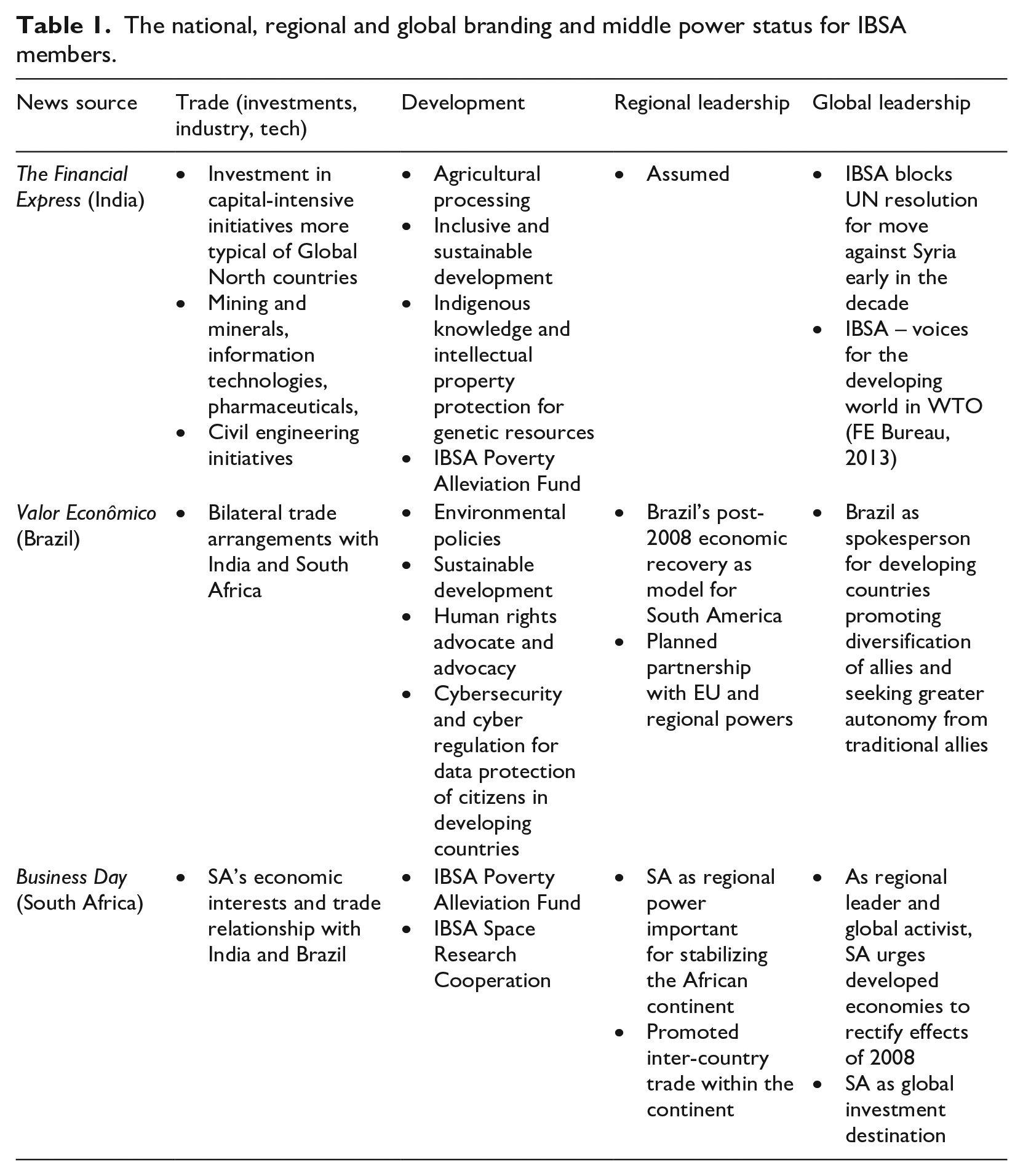
Overall, the themes read in the data included, broadly, regional economic leadership, trade and technology partnership for development and international activism. These themes reflect broad descriptors of the new middle power nation status as developed by scholars such as Alden and Vieira (2005) and Carr (2014). Not all these themes were necessarily present in all the news sources read for this study, and manifestations of these themes were at times different for the different publications. Given that each news source is also invested in national affairs, this variance is to be expected. As part of reportorial practice, journalists for the business press draw on expert sources in many areas of economics, finance, trade and markets. In the process, such experts also contribute to shaping news narratives about IBSA in specific ways (Entman, 2005). The main emphases of the coverage that addressed the emerging economy status for each news source are presented in Table 1. This dialogic relationship between journalists for a specialized news source and the experts on whom they draw for corroborations, comments and evidence together work to create what Price (2012) has termed elsewhere as a ‘discursive environment’ within which the status of each of the nations as a new middle power is positioned for its readership.
The national, regional and global branding and middle power status for IBSA members.
Analysis
The Financial Express
Most of the stories in FE were covered by staff reporters and writers, with the exception of one lengthy interview with the Minister of Commerce and Industry that was moderated by staff from the parent company, The Indian Express. The ‘FE Bureau’ (a general designation for authors as recorded in the database, with no further reference) also provided some of the news items. News items seemed to focus mostly on the theme of IBSA partnerships in trade, technology and other domains for development, with references to bilateral and multilateral relations among IBSA members for this purpose. India’s, and IBSA’s, leadership in global activism also figured in the coverage. FE coverage did not overtly assert India’s leadership in the region to differentiate itself from smaller neighbouring powers. A partial explanation for this could be that FE assumes India’s regional power standing and emerging economy status are a given. But FE’s positioning of India as a clear and singular leader is apparent within the theme of global activism, where India is positioned as a voice for the Global South and for developing nations in general.
Trade, technology and development together formed an important marker of the new middle power status (Chevallier et al., 2008), and figured in at least 8 of the 16 stories in FE. The recession of 2008 provided an opportunity for IBSA members to renew commitments to invest in capital-intensive initiatives as part of the trade and development agenda among the three countries, especially in areas that are most often associated with the Global North. Brazil’s desire to strengthen trade relations with India was apparent in a report and, a few years later, in an opinion piece listing among other items India’s investments in Brazil in the areas of mining, oil and civil nuclear energy (Bhojwani, 2018; Siddiqui, 2011). South Africa evidenced a similar interest in India’s investments in capital-intensive sectors such as information and communication technology, pharmaceuticals, agricultural processing and others under the bilateral Investment and Trade Initiative (ITI) (Siddiqui, 2013a). In the period examined for this study, one report (Siddiqui, 2016) is noteworthy for its strong emphasis of the combined middle power strength of these three countries. In the words of an official of the Indian Ministry for External Affairs: ‘IBSA brings together like-minded countries . . . committed to inclusive and sustainable development [for the] well-being [of] their [and] other developing economies’ (Siddiqui, 2016). The report also noted the IBSA Facility Fund for Alleviation of Poverty and Hunger to which the three countries contributed annually and managed among themselves, under the aegis of the United Nations Development Programme (UNDP). This IBSA fund ‘contributed to development interventions and capacity building in several countries in Asia, Latin America and Africa’ and was ‘recognised as a successful experiment of South-South cooperation’. This financial support that IBSA, as a South-South cooperation, has provided for other Global South countries further solidifies these three nations’ new middle power status in the global arena, as cast by FE.
More than a third of the news items (6 out of 16) in FE addressed the leadership of this consortium in terms of global activism. Some major concerns included the protection of indigenous knowledge and related issues of intellectual property, a resolution against the Syrian government that had made its way to the UNSC for approval and food security for the Global South. IBSA members expressed the need to protect indigenous knowledge systems from misappropriation and exploitation, especially where genetic resources and related traditional knowledge were concerned (FE Bureau, 2011a). Later that year, a report quoted Prime Minister Manmohan Singh as saying that the member countries had begun cooperating across a ‘wider canvas’, and that this was a sign that the forum had ‘matur[ed]’ considerably: ‘Above all, the idea of three huge developing democracies – Brazil, India and South Africa – working together in a highly complex global environment has taken root’ (FE Bureau, 2011b). IBSA members also reflected on a recent victory of sorts when their joint position to block a resolution against the Syrian government had prevailed over the ‘Western world[’s]’ push for the United Nations Security Council’s (UNSC) approval (FE Bureau, 2011b). A similar positioning of India, and IBSA, as a collective voice for the developing world in the World Trade Organization: ‘The development dimension cannot be diluted . . . India will oppose such dilution . . . with coalition partners’ – was apparent in an opinion and analysis item (quote from Bhattacharjee, 2013; on the IBSA coalition). First-hand reports and expert opinions alike positioned IBSA as a unified voice advocating for the Global South. In this context, the IBSA group has been exercising the soft power that is leveraged for branding (Dinnie, 2016; Volcic and Andrejevic, 2011).
The themes read in the FE reports demonstrate an enduring relationship among the IBSA members, with partnerships for mutual help with economic development and global leadership as the principal goals. Interestingly, while not much reference has been made to BRICS in the reports, one of the latest reports among the items read for this time period acknowledged that the 2016 BRICS meeting would ‘reactivate the [IBSA] group in the shadow of the more powerful BRICS’ (Siddiqui, 2016). It reaffirmed IBSA’s focus on development and change and differentiated IBSA from other countries of the Global South as a special grouping in that all three nations were ‘large pluralistic, multicultural and multiracial societies from three continents’, and that they were a ‘South-South grouping of like-minded countries’ (Siddiqui, 2016).
Valor Econômico
While specific journalists, particularly Sergio Leo, covered most of the VE stories for the period of the study, three of the 20 sampled articles were from the Brazilian wire service Agência Brasil. The longest article at 2701 words (Klein, 2012) was an interview: seasoned VE editor Cristian Klein spoke with Matias Spektor, a highly respected subject specialist for Brazil’s leading daily, Folha de São Paulo. And, one article, submitted by Elena Lazarou, a colleague of Spektor at the Getúlio Vargas Foundation’s International Relations Center, appeared as an opinion piece (Lazarou, 2012). Perhaps given the articles’ lengths as well as their chief sources or writers, these two articles contribute heavily to the themes arising from VE’s IBSA coverage. Similar to FE, that reporting provided perspective on three themes, namely Brazilian regional leadership; IBSA partnerships in trade, technology and other domains for development; and global activism. Of the three themes, VE gives the most attention to the last, that of Brazil’s role as a global activist.
For the first theme, that of Brazilian regional leadership, VE coverage was similar to that of FE in that Brazilian regional leadership was mostly assumed rather than overtly asserted. However, VE did emphasize Brazil’s post-2008 economic stability and suggest that as a source of credit and investment for much of South America, neighbouring nations ‘have more to gain by following Brazil than by resisting’ (Klein, quoting Spektor, 2012). This is because, as VE coverage evidenced, the Brazilian economy, at least during the majority of the sample time frame, had seemed resistant to external shocks due to its strong reserves (Exman, 2013a). Further, VE coverage highlighted how Brazil had become a spokesperson for developing countries, largely through diversifying partnerships and seeking greater autonomy from traditional allies, which is very much in line with new middle powers and their behaviours (Jordaan, 2003). It summarized the process, noting how in less than a decade the Brazilian government had relaunched regional integration projects like UNASUR, or the Union of South American Nations, which, as a move toward economic and military integration, was a priority for Brazilian diplomacy; established multilateral partnerships like IBSA and BRICS, initiated a Brazil-EU planned partnership, and adopted strategic, bilateral agreements with regional powers (Lazarou, 2012). The latter point gave rise to VE’s support of this study’s second theme.
For the second theme, that of trade and technology partnerships for development among the three member nations, VE’s coverage indicated that IBSA is a more defined, cohesive entity than other alliances like BRICS. It did this by not only highlighting Brazilian agreements with both India and South Africa, but also areas where tensions exist or more attention is needed. For instance, reports highlighted how Brazil had quadrupled trade with India by 2012 (Lazarou, 2012). Concurrently, Brazil recently (2016) felt concerned about various Indian actions. These included a bid to join the Nuclear Suppliers Group (NSG), although Brazil sided with India, pitting them both at odds with China, as well as a stated claim to ‘retake the IBSA Forum’, particularly since the IBSA fund for innovation had not received the ‘few million dollars’ that Brazil had promised (Moreira, 2016). With regard to trade with South Africa, VE noted how South Africa is but one of Brazil’s African bilateral trading partners and, in one instance, dedicated an entire story to chicken: Although Brazil exports poultry meat to 150 countries, its ‘. . . government has classified as “unfounded” and “technically poor” the South African resolution that imposed on Brazilian chicken exports a surcharge of 47% to 63% as an anti-dumping measure’ (Leo, 2012). As another tension, at least until 2013, no Brazilian airline had flights to Africa, despite almost 2% of Brazilian international air traffic being African and an IBSA effort resulting in a Brazil-South Africa air-freight-and-cargo-transport agreement (Fé, 2013). Still, VE noted improved trilateral cooperation through such measures as environmental policies as well as increased trade growth through such endeavours as a trilateral meteorological satellite to be built by South Africa with Brazilian materials and launched from India (Leo, 2011). Overall, VE emphasized the cooperation of the three nations to represent a collective and united front on the global stage, again indicating how Brazil, through IBSA membership, can be classified a new middle power with potential political clout (Özkan, 2011).
For the third theme, that of global activism, news reports echoed then-Brazilian President Dilma Rousseff’s repeated calls for global governance needing ‘urgent and profound change’ (Exman, 2013a), largely because of concerns for human rights and lives as well as information. VE articles positioned Brazil as an activist prepared to lead globally in at least three ways. One was its pronounced role with regard to human rights abuses by a head of state, referring to Syria. The news reports repeatedly state Brazil’s new foreign policy position of humanitarianism and protectionism, using the words ‘responsibility to protect’ – marking a distinct political shift from Rousseff’s predecessors and for Brazil on the global stage. Another was publicly stated concerns about practices of illegal interception of communication and compromised data of Brazilian citizens, businesses and governments by foreign companies and governments – namely, the United States. Recognizing the lack of international cyber regulation, Brazil used the ‘opportune moment’ (Exman, 2013b) of Brazilians being spied on as a platform to unite with its IBSA partners in defence of the exercise of any citizenship and, as stated, ‘build a new agenda for sustainable development’ (Agência Brasil, 2013), among other key actions. Third, and combining the first two points, VE reported Brazil consistently calling for reform of the United Nations and rotating leadership within its Security Council, using both the lack of decisive, united international action against Syrian injustices as performed by a head of state upon his own people and international cyber regulation to evidence its resolve to provide leadership. In other words, in a called-out vacuum of seeming international, moral leadership, Brazil stood ready to act, ‘to pursue the mission’ (Exman, 2013b). Taken further, Brazil was presented as a force that advocates passionately on serious issues for itself and other Global South nations in attempts to disrupt a deeply entrenched, international hierarchy, thereby branding itself more so as a new middle power (Alden and Vieira, 2005).
Business Day
Business Day carried the most number of articles among the three business newspapers examined for this study. The coverage of IBSA was robust and comprehensive, with many reports and opinion pieces providing depth and detail. Most of the articles appeared in the Economy, and Business and Finance sections, followed by stories mainly in Politics, Opinion and Editorial, and Science and Technology sections. Three of the items did not have an identifiable section. Authors of stories included the Trade and Diplomatic Correspondent for BD, faculty members of universities who contributed to the opinion/editorial section, the Indian High Commissioner for one item, and others on the staff of BD. Trade and technology for development, and bilateral and multilateral relations constituted the main themes during the period examined in the study. South Africa’s brand as a regional leader emerged in two ways as a secondary theme – one was the positioning of South Africa as a regional leader in the continent, and another was South Africa as an emerging power both globally and within IBSA. South Africa’s role in global activism did not emerge as prominently in this reading of the coverage beyond urging the Western economies to rectify the global economic downturn following 2008 (Langeni, 2011c, citing IBSA leaders to highlight their solidarity in their view of the crisis), and urging the UN Security Council members to adapt to the changing times to ‘reflect the realities of the modern world’ (Langeni, 2011c). There was heightened consciousness of South Africa’s new membership in the BRICS community in BD, and at times IBSA was presented as a foil to BRICS. Nonetheless, substantial engagement with the IBSA consortium is apparent in the coverage, with more detail than was apparent in the FE and VE coverage.
BD’s theme of South Africa’s leadership position and role in the region and beyond formed the focus of articles within the first 3 years of the period examined for this study. Its leadership position is carefully nuanced, particularly in the opinion pieces and longer articles. Brand South Africa emerges clearly in this section of the coverage. One article noted in the context of reporting on a UN award for the IBSA Fund South Africa’s efforts to direct its foreign policy toward ‘stabilis[ing] the continent’ in addition to its own national interests (Langeni, 2011a). Another story noted that within the IBSA group, South Africa had contributed substantially to inter-country trade in 2010 and 2011. Quoting then President Jacob Zuma, the article pointed out that although South Africa had the lowest GDP among the three countries, its trade contributions were the largest at 38% in 2009 and 25% in 2010 (Langeni, 2011c). An article appearing in the Opinion and Editorial section focused on China’s presence, particularly Hong Kong’s, in South African business and trade. Positioning South Africa as ‘Hong Kong’s global investment destination’ (Majokweni, 2011), this report used the visit of a delegation of Hong Kong Young Industrialists to position South Africa as ‘a . . . stepping stone to the rest of Africa’ and a ‘gateway to the rest of Africa’. BD also tracked South Africa’s continental leadership position in the country’s dealings with European nations. In an article that focused more on BRICS and trade with Europe, the author observed that the IBSA grouping also represented a set of ‘fast-growing economies expected to set global economic trends’ in the future, and within this consortium, South Africa would be an attractive investment destination for Europe (Hedley, 2012). BD evoked the approval by large intergovernmental lending agencies such as the International Monetary Fund and consortia such as the World Economic Forum, pointing out that they had ranked South Africa’s banking and auditing systems ‘among the best in the world’, as ‘lead[ing] the African frontier’ in the eyes of the Swiss. This further contributed to establishing South Africa’s leadership image both in the region and as an emerging economy on the global stage (Hedley, 2012).
In contrast to such positive framing of South Africa’s leadership, one article published in 2013 warned that South Africa’s attempts to set up its own official aid agency would be seen by neighbouring countries as ‘trying to take on a Big Brother role’. The report warned that if South Africa were to be seen as a donor in its own right, it would also change its relationships with ‘the developed world’ (Magubane, 2013). Instead, the article advised South Africa to focus on internal poverty alleviation. This article points to the nature of an emerging economy, where alongside growth, problems associated with the developing world continue to occupy the foreground in national concerns. The focus on leadership tapered off in the coverage after 2013, but emerged later in other contexts, especially in the coverage on trade partnerships and bilateral and multilateral arrangements.
The IBSA brand and, by extension, brand South Africa emerged in multiple nuanced ways in the coverage of trade, technology, development and finance among the three countries. Agreements and partnerships for trade and technology cooperation for development, and, in related discussions, occasionally financial cooperation among the three countries for aid purposes emerged early in the coverage examined for this period. BD listed some key IBSA-funded reconstruction projects in various developing countries, including Haiti, Cape Verde, Burundi, Palestine and Cambodia in the years since the joint aid fund was established (Langeni, 2011a). This news story suggests that such cooperation mimicked aid cooperation among developed countries, and frames IBSA as a donor entity. Another report (Langeni, 2011a) pointed out the prestige and recognition that the IBSA fund had earned through the United Nations Development Programme’s Millennium Development Goals Award for financing projects to build resilience in post-conflict contexts. One article noted the space research cooperation among the three nations that serves to highlight their middle power status – as emerging nations in the area of advanced science and technology (Wild, 2012). An article on the 2008 crisis (Anderson, 2012) cast the IBSA nations as ‘survivors of the Eurozone crisis’ and therefore capable of setting global economic trends in the coming decades.
Bilateral and multilateral trade relations provided more opportunities for BD to portray the IBSA relationship in a positive light. A major article in the Business, Economy and Finance section titled ‘Vibrant Interaction’ (Naidoo, 2011) reported that business agreements between South Africa and India, and among all three IBSA partners, were ‘signed to promote south-south cooperation and co-ordination on global issues’, thus setting the stage for IBSA members to emerge as global powerhouses in the future. Such developments led the financial correspondent Langeni (2011b) to conclude that despite the increasingly dominating presence of the more recent BRICS in this regional landscape, the IBSA consortium was slated to continue business.
Conclusion
The business press is a modern global journalistic niche and genre, and therefore shares common interests and approaches across nations, but in each case, the national context shapes the press and the press in turn shapes or has the potential to shape public opinion both at home and abroad for national interests. Navigating global markets and political powers entails establishment of a national brand, and in the case of IBSA, a brand denoting a set of new middle powers from the Global South. In the context of emerging economies, the business press contributes indirectly to development. Its focus and purpose are clear (Roush, 2010), and its interpretations of the global climate have become necessary for leaders looking to legitimize their national development discourses. In its focus on economics and related areas, the business press translates the economic standing of the nation to its national and global readership. For this purpose, most often, leaders look to elite business news, and this site plays an important role in shaping the dominant narratives and communicating the national brand.
In this study, we examined the business press in India, Brazil and South Africa for representations of the IBSA consortium as a group of new middle powers in the global arena. The following indicators emerged in our reading of the news stories: (1) regional economic leadership in the self-representation; (2) strong trade and technology relationships; and (3) the collective’s engagement in global activism. In each of these indicators, the coverage forged a national brand for each of these nations as regional leaders. The coverage in Business Day noticeably built the South Africa brand within the consortium as well as outside of it.
Business news in each of these countries positioned the nation as a regional leader with the standing to act as a spokesperson for developing countries. In the case of India, FE’s coverage focused more on IBSA’s collective commitment to economic development and the group’s growing power globally rather than India’s regional power status. An explanation for FE building global rather than regional standing could be that as India is the largest country and a dominant power in South Asia, it did not see the need to reinforce its regional standing. VE framed Brazil as a powerful nation that represented a voice for the Global South. Its promotion of Brazil as a powerful country to contend with globally was more apparent than a concerted positioning of Brazil as a regional leader. Similar to FE, VE also represented IBSA as engaged in economic and technological advancement. BD’s coverage demonstrated its acute awareness of South Africa’s continental leadership, both in positive coverage as well as in cautioning that South Africa had to play a balanced role in Africa because of this position of power. BD also portrayed South Africa as invested in bilateral and trilateral partnership with IBSA countries and its belief in the collective voice of IBSA serving as an advocate for the Global South.
A greater concentration of coverage was apparent in the first 3 years of the study period, although the few news items in the later years also demonstrated in various ways the new middle power status of these countries. One reason for this could be the excitement surrounding the consortium’s formation across the three emerging democracies located on three different continents. Another could be attributed to the questioning and reaffirmation of IBSA’s formation coinciding with that of BRIC, changing to BRICS when South Africa became a member in 2010, coinciding around that time frame. That the coverage reduced significantly later on could also be attributed to BRICS increasingly replacing IBSA coverage, but this development needs empirical examination comparatively that was beyond the scope of this study.
Overall, the business press constructed the IBSA countries’ new middle power status in the public sphere without necessarily evoking the term but confirming it in ways as demonstrated in the analysis. In characterizing the IBSA bloc as a growing power to contend with, the business press in the member countries actively positioned each country in the global arena as leaders of the region. Thus, nation-branding in relation to the middle power status and all that that status encompasses was fully evident in the national business press. Although questions and doubts about IBSA’s power and relevance against the more recent power bloc BRICS surfaced in the coverage from time to time, the business press saw this consortium as here to stay for various reasons. BD reminded readers of the continued relevance of IBSA (Naidoo, 2011), ‘Unlike the India-Brazil-SA (Ibsa) forum that it will supplant, however, the Bric [sic] grouping has no clear underlying logic’. Another opinion piece in BD advised continuing to cultivate the IBSA relationship as a ‘countervailing’ force for BRICS (Butler, 2011). The need for such periodic affirmations, especially in global public venues such as leading national business news sources, suggests IBSA nations’ move upward is still not secured in the global hierarchy, and that these new middle powers’ national brand development vis-à-vis their respective positions is a continuing project.
Footnotes
Acknowledgements
We are grateful to the reviewers of this article for their helpful feedback.
Funding
The author(s) received no financial support for the research, authorship, and/or publication of this article.
