




Abstract
International broadcasting services are typically designed to serve public diplomacy and soft power objectives. Traditionally, Western powers have explored and benefited from this state-sponsored media category. However, countries in the Global South, like Brazil, have endeavoured to establish cross-border television services to bolster their international presence. This paper scrutinizes TV Brasil Internacional as a case study, examining its designated functions, management, and funding models. The research illuminates through document surveys and semi-structured interviews that while the channel initially reflected Brazil’s external policies and public service ideals, structural alterations enabling increased governmental intervention alongside budget cuts rendered the international service dormant.
Keywords
Introduction
A country’s prominence in international affairs is determined not only by hard power policies but also by its ability to produce soft power through, among other means, public diplomacy strategies (Nye, 2010). Among the instruments of public diplomacy, international broadcasting has been used by various countries with the general purpose of promoting attractive images of themselves and exerting influence on the agenda of targeted nations (Cull, 2008; Hacker and Mendez, 2016; Hafez, 2007). Despite their common strategic purpose, state-funded international broadcasting networks may vary greatly in terms of management model, funding system, or the approach they adopt to make their programming resonate abroad. The differences in the realm of international broadcasting are also attached to the Western centrism that prevails in the global mediascape (Boyd-Barrett, 2010; Price, 2016; Thussu, 2018). It is no coincidence that European networks, such as BBC World Service (United Kingdom) and Deutsche Welle (Germany), have become major references for other countries interested in establishing cross-border media outlets (Hafez, 2007).
Within this context, cases of international broadcasting networks from the Global South are especially relevant because they demonstrate under what conditions non-Western nations have used cross-border media to strive for space in the asymmetric dynamic of global communication and to promote their image and perspectives abroad (Rawnsley, 2015). Among the international broadcasters from the South, Qatar’s Al Jazeera network is undoubtedly the most well-known case, given the significant visibility it gained after the attacks on 11 September 2001 (Sakr, 2007; Samei, 2016). Additionally, rising powers, such as China (via CGTN) and Russia (via RT), have increasingly developed their mediated communication with the rest of the world by providing multilingual news content to convey domestic and foreign issues through their own lens (Rawnsley, 2015; Wang, 2020).
This study particularly pays attention to Brazil’s experience in international broadcasting. The relevance of the country in the global scenario resides in the fact that, together with other BRICS members, it has been a crucial representative of the Global South in terms of economic and political power (Stuenkel, 2016; Thussu and Nordenstreng, 2015). When it comes to Brazil’s soft power resources, entertainment products created by private media corporations have played a substantial role in projecting the image of the country beyond borders (Straubhaar, 2020). What is little discussed within this framework are the actions of the Brazilian state in using international broadcasting as an instrument with the potential to add to its external policy and visibility. In 2010, via the Empresa Brasil de Comunicação (EBC, Brazil Communication Company), the federal government established a cross-border channel, TV Brasil Internacional, to promote the image of the country around the world and communicate with Brazilian communities abroad. Despite the government’s apparent intent to use TV Brasil Internacional for the benefit of the country’s public diplomacy and soft power, the service did not stay on air for more than seven years due to budget cuts and other circumstances associated with the fragility of the public service broadcasting headed by the EBC. Another point to note is that although extensive literature on the Brazilian media system has been published, there is a paucity of studies investigating the country’s practices in the realm of international broadcasting.
With this in mind, this research sought to address the question: what are the defining characteristics of TV Brasil Internacional in terms of function, service, management model, and funding model? The focus on the four aspects included in the research question is justified by the fact that they provide a systematic overview of the core principles around which media organizations – and media systems – are built (Valente, 2009). The description of these four elements helps clarify the role home states play in regulating their international broadcasting networks, thereby allowing us to systematically assess how such state-sponsored media outlets are organized to serve as soft power resources. To answer the question, the empirical work consisted of a document search combined with two supplemental semi-structured interviews with professionals who used to be in charge of the channel. Overall, this study concentrates on the development of the concept of international broadcasting in Brazil with the purpose of expanding the debate on the country’s broadcasting system and attitude towards the use of media as an instrument of public diplomacy.
Contextualizing international broadcasting
International broadcasting has been traditionally described as ‘a complex combination of state-sponsored news, information, and entertainment directed at a population outside the sponsoring state’s boundaries’ (Price, 2002: 200). Its origin dates back to the 1920s when Russia launched radio stations aimed at spreading political propaganda beyond its borders. Thereafter, international broadcasting became a strategic instrument for various countries disputing ideological clashes during World War II and the Cold War (Połońska-Kimunguyi and Gillespie, 2016; Price, 2002). Current major international broadcasters arose amid these conflicts, such as the BBC World Service (United Kingdom), Voice of America (United States) and Radio France Internationale (France).
Scholars observe that, after the end of the Cold War, international broadcasters underwent a process of reformulation in an attempt to distance themselves from the propagandistic approach and redefine their significance in a world marked by a new political conjuncture and increasing competition in the global media market (Hafez, 2007; Price et al., 2008). That is, they had to strive – and still do – for credibility and recognition while continuing to comply with the strategic interests of their respective sponsoring countries. Within this framework, contemporary international broadcasting is acknowledged as a component of public diplomacy initiatives, which are essentially committed to engaging with and attracting foreign publics with the goal of, for instance, enhancing a nation’s soft power (Hacker and Mendez, 2016; Samei, 2016; Wang, 2020). Thus, rather than mere persuasion, the role of international broadcasting as an effective instrument of public diplomacy presupposes establishing dialogues and long-term relationships with foreign audiences based on a core element: credibility (Nye, 2010). However, one should be sceptical about the complete abandoning of the propagandistic approach, especially given the existence of different models of international broadcasters, which may be more or less susceptible to governmental interference and whose content does not always present an apparent ‘dissociation from classic propaganda or public relations’ (Hafez and Grüne, 2021: 119, my translation).
Another point to observe is that the operation of state-funded media is a phenomenon that also needs to be explained through the lens of the well-acknowledged Western centrism that prevails in the global media landscape (Boyd-Barrett, 2010; Thussu, 2018). Notably, nations from the Global North dominate the field of international broadcasting and ‘European broadcasting concepts in particular are becoming trendsetters, because they obey the laws of globalization and create models for a utopian vision of global dialogue’ (Hafez, 2007: 119). Against this backdrop of asymmetry, the Global South has historically been the target within the international broadcasting dynamic, as seen in the classic cases in which Western countries used or still use international media to engage with their former colonies (Price, 2016). Some signs of potential contra-flow, however, have been observed in recent years. According to Rawnsley (2015: 275), ‘while many Western television networks are closing their foreign bureaus, and international radio broadcasting, offering ever-diminishing numbers of language services, is shifting to the internet, the new entrants to the field are investing heavily in expansion’. The foremost examples include the Qatar-based Al Jazeera network, the China Global Television Network (CGTN) and the Russian RT (formerly Russia Today), which have continuously expanded their multilingual production and established new offices around the world (see more in Rawnsley, 2015; Sakr, 2007; Wang, 2020). Stuenkel (2016) stresses that the emergence of such non-Western networks is indeed remarkable, but as expected, they still struggle to establish themselves as news sources capable of challenging the dominance of Western media companies.
Of particular relevance in this discussion, especially when considering the case of TV Brasil Internacional, is also the relationship between international broadcasting and public service broadcasting (PSB). The latter refers to a non-commercial form of communication committed to the diversification and pluralization of the national public debate, which is primarily achieved when broadcasting networks are operated with respect for public interest and simultaneously shielded from market and governmental interferences (Matos, 2012; Valente, 2009). As UNESCO (2001) defines it, PSB should comply with four basic principles: universality, diversity, independence and differentiation. 1 In the classic case of the United Kingdom, the national public service broadcasting (BBC) and the international broadcaster (BBC World Service) are intertwined and administered based on PSB principles. In contrast, in the United States, public service broadcasting is ‘legally separate from U.S. international broadcasting, a technical firewall that inhibits effective collaboration between the two entities’ (Powers, 2011: 138). The approximation between the concepts of international broadcasting and PSB is particularly relevant because if the intention of such cross-border networks is de facto to acquire credibility abroad in order to gain soft power (Nye, 2010) and establish a certain degree of transnational dialogue, ‘this requires some form of public broadcasting and a transformation of the model of state ownership’ (Hafez, 2007: 19). The fact is that the intersection of state and international media is materialized in different modes as described in the next section. While the structural characteristics of certain international broadcasters indicate they entertain the concept of public service broadcasting, others comprise elements of government-run media outlets.
Structural characteristics of international broadcasting
There are key standards that have been explored in studies aimed at characterizing the operation of state-funded broadcasting networks, including aspects concerning the service provided, the governing structure, and the financing mechanism (Mendel, 2011; Valente, 2009). In the case of international broadcasting, regardless of the sponsor country, certain networks may share similar organizational structures. The accurate description of these features is thus relevant because it reveals the conditions likely to guide or influence the operation modes of international broadcasters. In this study, the focus is on four aspects that help in understanding, first, the regulatory framework in which such networks are based and, second, the strategic role they are envisaged to play abroad: (1) the function of the broadcaster; (2) the character of the service (genre, platforms and languages); (3) the management model; and (4) the funding model.
Firstly, international broadcasters perform functions commonly centred on diasporic and/or foreign audiences. The orientation they choose to follow is not only perceptible in their mission statements but also in their editorial lines and practices. Thus, one of the trends in this field is the diasporic function, which concerns the objective of communicating with emigrants in order to maintain cultural ties and fill information gaps (Price, 2016). Moreover, Hafez (2007: 123) points out four other recurrent functions performed by international broadcasters:
Self-representation function: distribution of content designed to promote the state-sponsor; nation (re)branding purposes;
Compensatory function: the offering of news programmes to authoritarian countries in order to enhance the plurality degree of national mediascapes;
Dialogue function: coverage of issues and events of the target country as an attempt to establish direct communication and promote intercultural dialogue; and
Crisis intervention function: news services directed at countries in crisis or war zones driven by the attempt to act as peacekeeping or peacemaking instruments.
Secondly, the character of the service – that is, the nature of the content – varies in accordance with the functions pursued by the networks and their respective budgets. The genre of international broadcasting services is, for the most part, either news-centred or generalist. While the former only offers informative content (e.g. news bulletins, documentaries and newscasts), the latter combines news with other forms of content, such as entertainment. In terms of platform, shortwave radio marked the first decades of state-sponsored transnational communication (Price, 2002) and remains relevant to organizations interested in reaching communities with limited access to modern technologies. For instance, BBC World Service has maintained global shortwave transmission for parts of Africa and Asia. Television is, nonetheless, the medium that prevails in international broadcasting, particularly because of its prominence as a news source in several countries and its technical potential to reach across territorial boundaries via satellites and streaming operations (Eswari, 2014; Price et al., 2008; Wang, 2020). In recent years, international broadcasting services have also evolved into multiplatform networks in an effort to adapt to and compete in the contemporary media landscape (Rawnsley, 2015). Another key element regarding the output in the realm of international broadcasting is the production of content in multiple languages (Hafez, 2007). The official language of the network’s home country is typically utilized to reach diasporic communities and nations with cultural or/and colonial connections. English is the recurrent second language of international broadcasters, given its status as lingua franca. Other languages may be adopted in line with the purposes and budget of the media organization (Vicente and Santos, 2016). According to Hafez (2007: 18–19), ‘because it [international broadcasting] has strong linguistic capacities and is tailored to foreign broadcasting areas, it is in fact far better at reaching a mass audience than many new media’.
Subsequently, international broadcasters may range from autonomous to totally government-controlled networks. In this sense, the management and funding models can serve as indicators of the extent to which a media network may be susceptible to governmental interference (Mendel, 2011; Valente, 2009). The administration of international broadcasting services often falls under the purview of state-owned companies, which may be supported by mechanisms designed to shield them from authoritarian commands (Valente, 2009). For instance, networks like Deutsche Welle have decentralized decision-making processes, establishing oversight through a board composed of civil society representatives (DW, 2005). Another point to consider is the appointment procedure for the heads of these companies. In some models, the heads of state or government may make such a nomination directly, while in others, this decision depends on the approval of representative bodies, such as Congresses or Parliaments. On the other end of the spectrum, there are management structures under totally state-controlled agencies, whose relationship to the ruling government is kept under wraps from the public (Valente, 2009).
Concerning the funding model, state-provided financial resources are a defining feature of international broadcasting. Nonetheless, the funds of certain networks are derived not only from the home country’s federal tax budget but also from other funding sources, such as licensing fees, advertisements and profit shares (Santos, 2017). That is to say, some international broadcasting networks rely solely on state funding while others combine different types of revenue sources. A pivotal point to consider is how each broadcaster allocates its budget. For instance, the annual budget may be subjected to deliberation in legislative assemblies, and the allocation of the passed budget is assigned to the agencies responsible for operating the media outlets. In other cases, the amount may be directly handed over to the international broadcaster.
Table 1 illustrates the aforementioned structural characteristics by presenting five cases: RTP Internacional (RTPi), BBC World Service, Deutsche Welle, Voice of America and CGTN. The first one is a relevant point of reference in this study because its service is similar to that developed in Brazil. BBC World Service, Deutsche Welle and Voice of America are some of the most prominent Western networks, while CGTN is an emerging example from the Global South. Together they offer a panorama of the existing conditions within this state-sponsored media category. It is important to note that these examples are for illustrative purposes only – that is, it is not the objective of this research to conduct a comparative analysis.
Panorama of structural characteristics of international broadcasters.
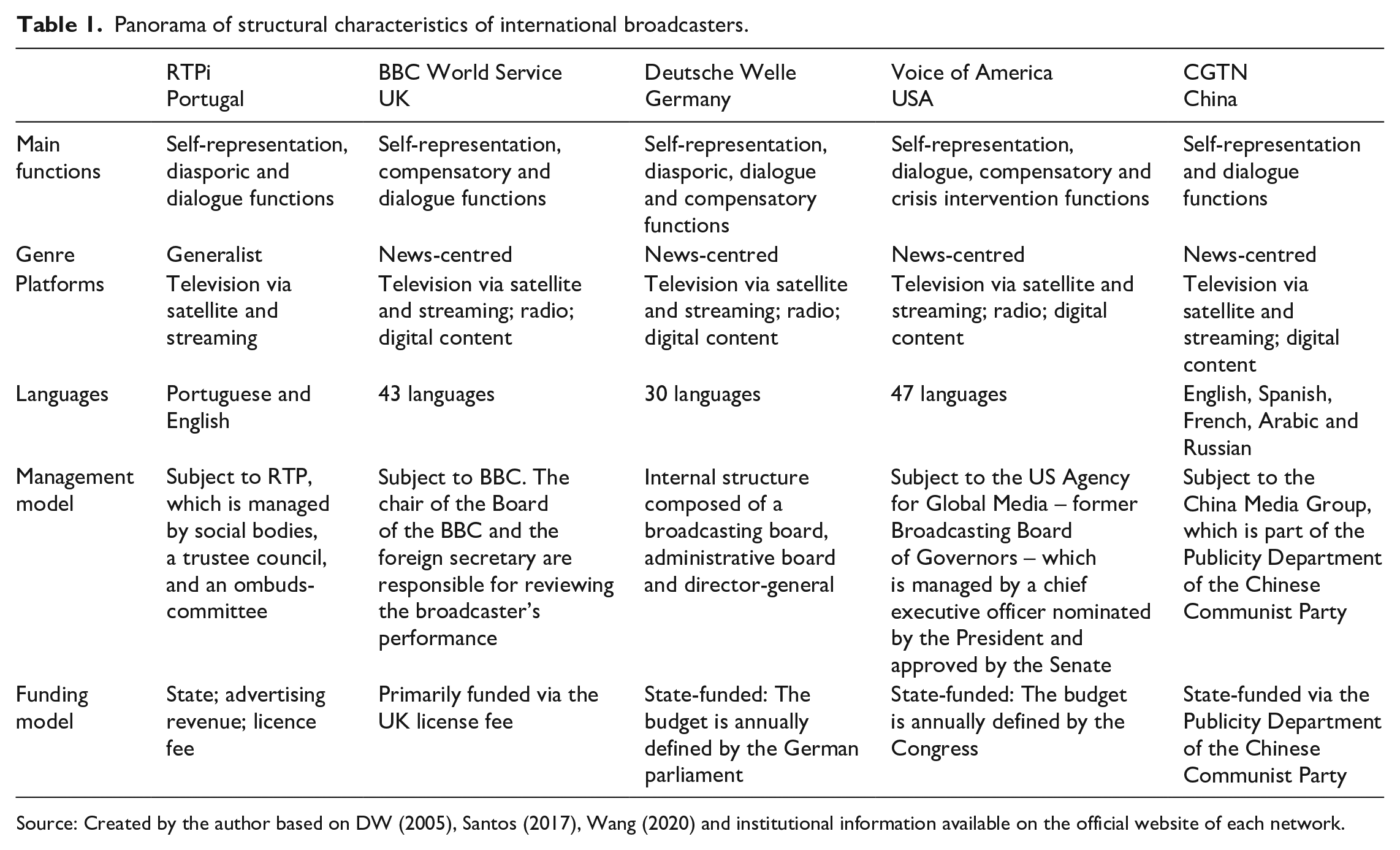
Source: Created by the author based on DW (2005), Santos (2017), Wang (2020) and institutional information available on the official website of each network.
The structural features of international broadcasting are, as demonstrated, defined at the national level. Hence, the operating model of each network is also shaped by the conditions of their respective media systems (Flew and Waisbord, 2015; Hafez, 2007). Despite the deterritorialization of media organizations and the increasing transnational flow of symbolic content, nation-states remain the sovereign force in directing the course of what has been named as media globalization, particularly in terms of regulation (Flew and Waisbord, 2015; Hafez, 2007). With this in mind, the next section focuses on core aspects of Brazil’s media system in order to demonstrate the context in which TV Brasil Internacional was established.
An overview of the Brazilian media system
Considering that international broadcasting operations are subject to regulation defined by state sponsors, it is thus necessary to zoom in on the main characteristics of the media systems from which these cross-border media outlets emerge. In particular, by taking a closer look at the Brazilian media system, this study will be able to relate the country’s overall model of mass communication to the creation and structural aspects of TV Brasil Internacional.
It is worth noting that television stands out as the most popular form of traditional mass communication in Brazil, continuing to be an important source of news for the country. Newspapers, by contrast, have a low rate of circulation and a more elite-oriented focus (Albuquerque, 2011). Despite the popularity and significance of broadcasting in the Brazilian public sphere, the sector ‘has been largely built on a combination of political control and limited regulation’ (Matos, 2016: 167).
The legislation on traditional mass communication in Brazil was created under liberal values, privileging the growth and dominance of privately-owned media corporations (Bolaño, 2007; Lima, 2011). The specific issue lies in the fact that no adequate regulatory framework has been established to ensure that the country’s media system develops on the basis of pluralism and diversity, despite the Constitution providing the foundation for both principles (Napolitano and Santos, 2016; Paulino and Guaniza, 2020). Consequently, the concentration of media ownership in Brazil has expanded to the extent that a few families control the major news outlets (Lima, 2011). According to Paulino and Guaniza (2020: 79), ‘of the more than 500 television channels on air, around 80 per cent are connected to large media conglomerates’. Historically, the formation of media oligopolies is embedded in the patrimonial logic inherited from the colonial period, which has been perpetuated in the political and economic spheres ever since (Paiva et al., 2015).
While a few colossal private corporations – for example, Globo Organization, RecordTV, SBT – own the leading free-to-air television and radio stations, public service broadcasting still lacks incentives to develop and thus contribute to the flourishing of a pluralistic media environment in the country. The weakness of the public sector arises from media market pressures and the blurred lines between public management and state control (Bolaño, 2007; Matos, 2012). That is to say that although regional and national governments have created cultural and educational television channels, their independence from political interests is dubious, contradicting public service broadcasting principles. For instance, TV Cultura – established by the state of São Paulo in 1960 – is usually referred to as an example of a strong public media platform in Brazil. However, increasing administrative changes have diminished the public-independent nature of the channel over the past few years (Matos, 2012).
As Moyses et al. (2009: 307) stress, Empresa Brasil de Comunicação (EBC, Brazil Communication Company) was the first ‘embryo’ of a national public service broadcasting system. As a result of calls for media democratization, the federal government established the EBC in 2007 to fulfil the constitutional principle of ‘complementarity’ – article 223 – which presupposes the coexistence of a private, state and public broadcasting system (Lima, 2011). Thus, the company envisioned a concept of national public media in Brazil based on the practices of public service broadcasting undertaken in Western Europe (Lima, 2011; Moyses et al., 2009). However, continuous structural changes have shifted the company’s public role towards greater government control (Leal Filho, 2016). This point will be expanded upon later.
EBC oversees a network of radio and television stations (with its flagship being the nationwide channel TV Brasil) and the news agency Agência Brasil. Fundamental to this study is that EBC has also put effort into cross-border services aimed at promoting the country’s image abroad and connecting with Brazilian communities scattered around the world. The launch of TV Brasil Internacional not only put this purpose into practice but also represented a turning point in the history of the country’s media system. For the first time, the country possessed a state-sponsored broadcaster operating worldwide and relatively dedicated to public diplomacy purposes.
In sum, public service broadcasting has not thrived in Brazil – for this to happen, it remains essential that the country tackles, as Matos (2012) underlines, three main challenges: the creation of a regulatory framework in compliance with UNESCO’s principles for public service broadcasting; the enhancement of professionalism in journalism; and the intensification of the public debate on aspects of public broadcasting, such as social function and quality.
Brazil’s image goes global: Telenovelas, mega-events and broadcasting
From a soft power perspective, how a country is represented abroad contributes to its ability to exert influence on international relations (Nye, 2010). According to Straubhaar (2020), the set of resources capable of attracting foreign publics and generating soft power includes not only state-coordinated activities, such as international broadcasting, but also symbolic products produced by private corporations. In this vein, Straubhaar (2020: 173) argues that ‘soft power from Brazil is primarily created and exercised by commercial cultural industries, like TV Globo, which has massively exported Brazilian culture abroad’. More specifically, TV Globo has been the leader in the telenovela – prime-time soap opera – industry as a result of dramatic investment to create engaging storylines with high technical quality (Rego and La Pastina, 2007). Internationally, Brazilian soap operas provide a window into socio-cultural representations of the country. Nationwide, they have contributed to constructing an imagined national identity by recalling, for instance, historical events of the country (Ortiz, 2000; Porto, 2011). In order to break into new markets, TV Globo has released telenovelas with cross-national narratives as a strategy to make them more likely to penetrate foreign territories. A case in point is India: A Love Story (originally Caminho das Índias) (Rai and Straubhaar, 2016). This telenovela was launched in 2009 during a favourable period in Indo-Brazilian relations, coinciding with the rise of the BRICS grouping. Notably, it gained global acceptance, being exported to more than 89 countries (Rai and Straubhaar, 2016).
Given that the Brazilian media system is characterized as market-oriented, it is no surprise that the country’s soft power resources – in the realm of media – are also concentrated in the hands of the few colossal private corporations mentioned in the previous section (Bolaño, 2007; Lima, 2011). This becomes apparent when looking at cross-border broadcasting. Brazil’s two main privately-owned television channels – TV Globo and TV Record – are retransmitted internationally via satellite under the labels TV Globo Internacional and RecordTV Internacional. Both are directed at Brazilian communities abroad and offer programme schedules akin to their national versions. Despite the cross-border reach of these TV channels, it is essential to underline that they do not fit the criteria for international broadcasting as defined above.
Among the strategic actions of the Brazilian state to enhance the prestige of the country abroad, one of the main efforts in recent years has been the hosting of mega-events (Buarque, 2015; Cazzamatta, 2020; Stuenkel, 2016). Brazil hosted, for instance, the World Youth Day 2013, the Rio+20, the 2014 FIFA World Cup, and the 2016 Summer Olympics and Paralympics. However, little discussed within this framework is the interest of the Brazilian state in international broadcasting. As a first move towards establishing a cross-border media outlet funded by public resources and committed to promoting the image of Brazil, the Senate presented a bill in 2003, the PSL 198, calling for the creation of an international TV channel. The bill, however, died in 2005 when President Luis Inácio Lula da Silva (Workers’ Party) signed a decree to institutionalize a special committee in charge of the launching of another international television channel, TV Brasil – Canal Integración.
Canal Integración was established under the umbrella of Radiobrás, a former media agency directly controlled by the Presidency of the Republic. This initial venture into international broadcasting targeted South American countries, aiming to promote greater integration of the subcontinent. The creation of the channel took place during a period in which Brazil’s external policies sought to strengthen relations with neighbouring countries and the rest of the Global South (Vicente, 2009). Thus, Canal Integración received support not only from Brazil’s Ministry of Foreign Affairs but also from the technical and logistical assistance provided by broadcasters, cultural foundations and independent producers from six South American countries. This TV channel was available in both Portuguese and Spanish and, at its peak, was transmitted by 160 cable operators. Additionally, it functioned as a news agency for associated broadcasting networks abroad by providing them with information on Brazil-related events and issues. The annual budget of the channel reached about nine million reais, which was jointly provided by the Rádiobrás, Senate, Congress and the Supreme Court (Vicente, 2009).
As a consequence of the shutdown of the Radiobrás in 2008 and the establishment of EBC, Canal Integrácion closed down in 2010. The decision was based on EBC’s intention to expand the broadcasting reach of the channel beyond South America and create a medium dedicated, among other objectives, to promoting Brazil’s image. Hence, TV Brasil Internacional was founded to replace Canal Integrácion and meet the company’s purposes meant to give rise to a public broadcasting system in the country.
TV Brasil Internacional
The establishment of TV Brasil Internacional resulted from a confluence of three primary factors. First, the creation of the EBC based on constitutional provisions for implementation of a national public broadcasting system. Second, the expansion of Lula’s external policies towards the Global South with a particular focus on the African continent. Lastly, the demands that emerged during the 2008 and 2009 Conference of Brazilian Communities Abroad. These demands called for the development of an international television channel dedicated to providing information on domestic issues, with a subscription price that would not be as costly as the cross-border services offered by Brazilian private networks (Santos, 2017).
Within this context, the federal government launched TV Brasil Internacional in May 2010 as part of the broadcasting system overseen by EBC. During its peak years, the channel was available in 66 countries, of which 49 were in Africa. The emphasis on Africa was not only driven by international affairs but also justified by the increasing audio-visual marketplace in the continent and the historic links between Brazil and various African countries (EBC, 2010). Portuguese-speaking countries, such as Angola, Cape Verde, Guinea-Bissau, Mozambique and São Tomé and Príncipe, received special attention. Furthermore, the TV channel targeted a substantial number of Brazilian residents in Portugal, Japan and the United States.
TV Brasil International envisaged the expansion of its output, aiming to reach a wider array of countries, provide news services in English and Spanish and develop more internationally oriented programmes. Nonetheless, the channel’s apparent promising future did not come to pass due to obstacles put in place by its management and funding structure. Over the years, TV Brasil Internacional lost its international identity as a consequence of budget cuts and administrative resolutions, ultimately leading EBC to terminate the operations of the Brazilian international broadcasting service.
Material and method
This study firstly employed desk research based on Mendel (2011) in order to address the question: what are the defining characteristics of TV Brasil Internacional in terms of function, service, management model and funding model? The document search sought to identify the existence of legal guidelines and official reports regarding the operation of international broadcasting from Brazil. At this stage, it was verified that, apart from the aforementioned presidential decree signed to create Canal Integrácion, there are no specific legal provisions in the country that address international broadcasting. Therefore, the characterization of TV Brasil Internacional presented in this study is based on the examination of the law governing the EBC, specifically law 11.652/2008, the activity reports produced by EBC, and the minutes of the Conference of Brazilian Communities Abroad.
Secondly, to supplement the desk research, two semi-structured interviews also underpinned this study. These interviews were conducted in March 2017, in Brasília, with Max Gonçalves (former general manager of TV Brasil Internacional) and Pedro Cardoso (manager of promotion for TV Brasil). The formulated questions aimed at gathering insights into the internal organizational structure, content production and distribution, and the objectives of the international channel. The relevant information obtained from the interviews is presented in the form of quotations in the subsequent sections of this article.
Structural characteristics of TV Brasil Internacional
The data and information collected from the desk research and interviews are described below in light of the objective of this article: to characterize the Brazilian case in international broadcasting on the basis of the four pre-established categories: (1) the designated function for the TV channel; (2) the character of the service; (3) the management model; and (4) the funding model.
Functions
The core mission of TV Brasil Internacional was to promote the image of Brazil abroad. During the channel’s launching event in 2010, Tereza Cruvinel, the former head of EBC, pointed out that the objective of the Brazilian international broadcasting service was to showcase the diversity of Brazilian culture (EBC, 2010). On that same occasion, president Lula underscored that the channel’s purpose was to introduce Brazil to the world, rather than serve as a platform for his self-promotion (EBC, 2010). Beyond promoting the country’s image, TV Brasil Internacional targeted countries with large numbers of Brazilian emigrants in an attempt to connect them with their home country. This specific objective emerged from discussions at the 2008 and 2009 Conference of Brazilian Communities Abroad. The participants called for improved communication channels between the Brazilian government and Brazilians abroad, including the production and distribution of quality news and content that could combat stereotypes associated with Brazil. Therefore, the international channel was designed to meet both self-representation and diasporic functions.
The character of the service
Unlike prominent international broadcasters, such as Deutsche Welle, BBC World Service, Voice of America and CGTN, which offer multiplatform services, TV Brasil Internacional established television as the primary medium for its operation. Satellite transmissions initially made the channel accessible to a worldwide audience. Nonetheless, in late 2016, the satellite operations had to be interrupted due to spending cuts. Consequently, from that point forward, TV Brasil Internacional was only available via open-access streaming (Cardoso, interview).
The most appropriate classification to refer to the genre of the channel is ‘generalist’ since the its programme schedule was designed to combine news and entertainment content. During its initial operations, special programmes were tailored for foreign audiences and Brazilians living abroad. Examples include the programmes Brasileiros no mundo, Brasil hoje, Aqui tem Brasil and Brasil no mundo. Despite the production of exclusive content, the schedule of TV Brasil Internacional largely comprised programmes sourced from TV Brasil, the national channel of EBC. According to Cardoso (interview), over time, the company started suspending the creation of internationally oriented programmes, and at a certain point, it only retransmitted the national programme schedule.
In contrast to Canal Integrácion, which relied on programmes in both Portuguese and Spanish, TV Brasil Internacional represented a step backwards in terms of language since it was only broadcast in Portuguese. Although the channel’s course of action comprised the production of content in English and Spanish, the company failed to deliver multilingual output. In other words, the channel’s reach was essentially restricted to Lusophone countries and Brazilian communities abroad. Furthermore, TV Brasil Internacional was never dedicated to teaching Portuguese, unlike international broadcasters – for example, Deutsche Welle and Voice of America – which offer content designed to teach the official language of their respective home countries and thus engage with the public interested in their cultures.
Management model
The management of any media outlet within the EBC network is subject to law 11.652/2008, which establishes the principles and objectives of public broadcasting services operated directly or indirectly by the federal executive power. Thus, under the umbrella of the EBC, the initial administration of TV Brasil Internacional relied on a board of directors, executive board, supervisory board and a trustee council. The latter included representatives from civil society, government and the EBC staff as a mechanism to validate the public concept pursued by the company. In other words, the trustee council was conceived to enable different sectors of society to participate in the corporation’s management and editorial decisions, seeking to incorporate citizens’ viewpoints and thereby reinforce EBC’s public service dimension.
The original administrative configuration of EBC has undergone considerable changes since 2016. During the impeachment process of Dilma Rousseff that year, the interim president of the country, Michel Temer, issued a provisional measure to modify the company’s management structure. Later, as the official president of Brazil, he signed it into law. The main shifts brought about by this law were the elimination of the trustee council and the creation of a Programming and Editorial Committee comprising 11 society representatives without the legal right to interfere in the company’s decisions. In addition, the new legal framework determines that the president of Brazil has the discretion to appoint the president director of EBC without requiring the Senate’s approval, as was previously mandated. In view of these and other alterations, scholars have underscored that the new management structure of EBC made room for governmental interference, deviating from the company’s initial public service purpose (Fraga and Hermann, 2021; Leal Filho, 2016; Lopes, 2018).
In relation to the internal organization of TV Brasil Internacional, it was initially part of EBC’s international board. Subsequently, in 2012, this international sector was dissolved, and TV Brasil Internacional’s management was incorporated into EBC’s general board. According to Gonçalves (interview), during that period, the EBC’s internal organization was restructured, which meant the establishment of a production and management centre based on platforms (TV, radio, web), instead of separated teams responsible for each media outlet. Therefore, TV Brasil Internacional’s staff was diluted and transferred to the TV team. From Gonçalves’ perspective (my translation), the new internal configuration ‘optimized the workflow, but it also contributed to the loss of identity of the channel’.
Funding model
The budget of the EBC is provided by the annual appropriation bill voted by Congress. The financial resources derive from the national treasury and are managed by the company’s general board, which determines how much they will invest in each media outlet. In the case of TV Brasil Internacional, EBC drastically reduced the channel’s budget between 2010 and 2017. In the initial years, the company allocated, as Gonçalves affirmed, around six million reais to the international broadcaster. However, in 2017, the only budget allocated to TV Brasil Internacional, according to Cardoso, was for the payroll of the team responsible for the TV programme schedule.
The gradual reduction of funding resources had a decisive impact not only on the ceasing of internationally focused productions but also on the shift in the mode of transmission of the channel. According to the 2015 report of activities of EBC, the company intended to renew contracts with satellite operators in Latin America, as well as to negotiate with new operators overseas to expand the broadcaster’s reach. However, as Cardoso stated, the channel’s financial condition allowed neither the renewal of ongoing contracts nor agreements with new operators due to the high costs involved. For instance, the company reduced its annual expenditure by US$393,000 by discontinuing transmissions to Japan via IPTV. Cardoso also noted that the last contract with satellite operators expired in September 2016, marking the point when the channel transitioned to being available online only (see Table 2 for an overview of the structural aspects of TV Brasil Internacional).
Structural features of TV Brasil Internacional.
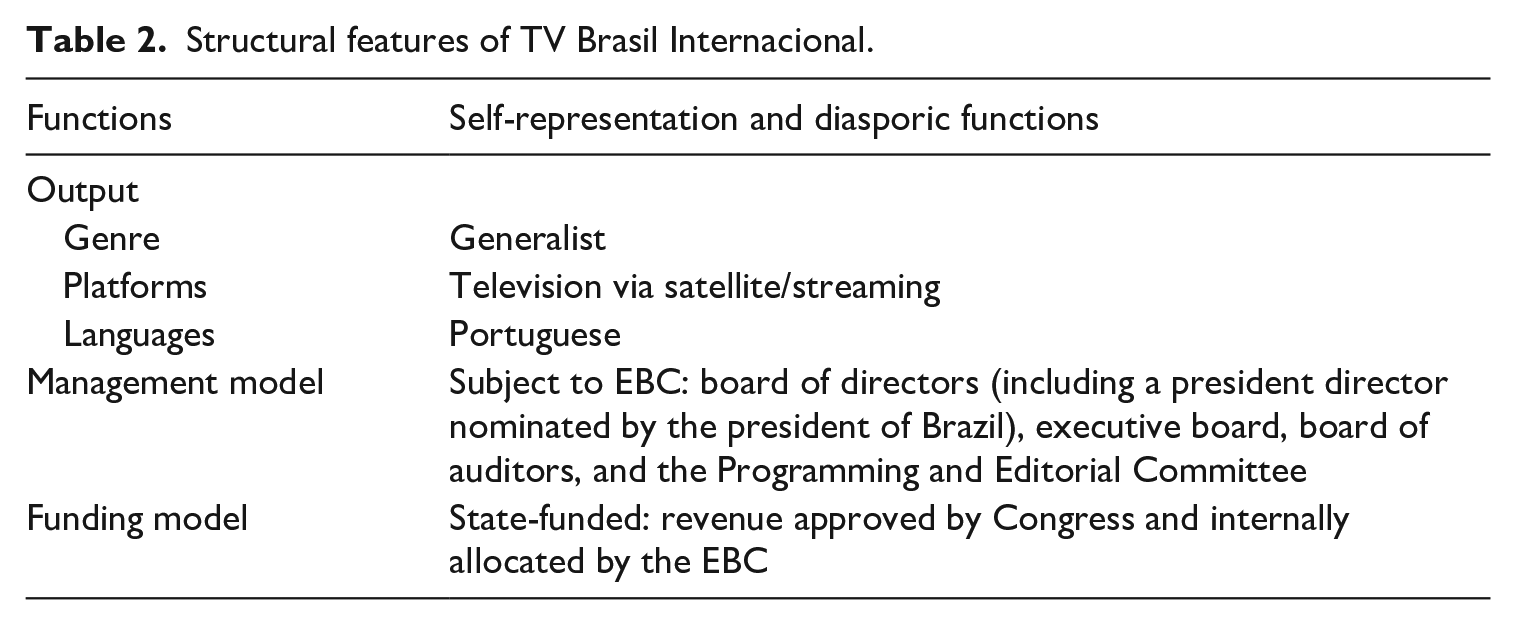
In sum, the identified structural characteristics of TV Brasil Internacional demonstrate that the channel lost its international identity over the course of its existence. After the discontinuation of satellite transmissions in 2016, the label TV Brasil Internacional remained present on the streaming webpage before eventually being removed. Therefore, the international service currently finds itself in a dormant state with the potential for re-establishment in the future, as articulated by the federal government. For instance, during Bolsonaro’s administration, as reported in July 2020 by the quality newspaper O Estado de S. Paulo, then minister of communication, Fábio Faria, outlined plans to revive TV Brasil Internacional via streaming, providing content tailored for international audiences (Soares and Monteiro, 2020). It is worth noting that this announcement emerged amidst several negative domestic events – for example, the weakening of environmental policies and the federal government’s mishandling of its response to the COVID-19 pandemic – which held the potential to tarnish the country’s worldwide reputation.
Discussion
The present research was designed to characterize the Brazilian case in international broadcasting underpinned by the description of its structural aspects, providing a systematic overview of the core principles around which TV Brasil Internacional was organized. The findings indicate that the Brazilian federal government has made efforts to create media services dedicated to boosting the image of the country internationally in tune with public diplomacy and soft power purposes. Within this framework, this study suggests that the Brazilian case in international broadcasting unfolded in three stages: (1) the launching of Canal Integración for the sake of greater integration in South America; (2) the establishment of TV Brasil Internacional as a branch of the country’s public service broadcasting system; and (3) the gradual dilution of TV Brasil Internacional in terms of content production and transmission, ultimately leading to the discontinuation of the channel.
The mission defined for TV Brasil Internacional demonstrates a commitment to self-representation and diasporic functions, primarily focusing on African Portuguese-speaking countries, which were, in the early 2010s, one of the priorities of Brazil’s Ministry of Foreign Affairs. Thus, the fact that the channel was strategically operated in line with the country’s international policy signals the government’s intention to explore it as an instrument of public diplomacy. Based on the mission statement of TV Brasil Internacional, it is also plausible to assume that its initial objective was not to serve as a counter-hegemonic source of information in the international media landscape, as seen in the case of other international broadcasters from the Global South (e.g. RT). Instead, the Brazilian international channel was more inclined to promote the country’s image and report daily events to meet – without confrontations – foreign policy aspirations. The first hurdle to the accomplishment of this objective involved the nature of the content delivered by the channel. The generalist programme schedule of TV Brasil Internacional was entirely in Portuguese. Although it was in the initial interests of the channel to concentrate on the Lusophone public of Africa, the content could not be consumed in other countries where the channel was available. Compared to Canal Integrácion, which offered content in Spanish and Portuguese, the monolingual productions represented a step backward. Therefore, there was a lack of output designed to effectively communicate with foreign audiences, hindering the initiation of a process to promote the image of Brazil.
As stressed in this study, international broadcasting operations can vary from autonomous to government-controlled networks. With this in mind, and based on the description of the management and funding models of TV Brasil Internacional, it becomes evident that the channel, and the whole EBC, became increasingly vulnerable to government interventions (Fraga and Hermann, 2021; Leal Filho, 2016; Lopes, 2018). Paradoxically, TV Brasil Internacional was created within a company – EBC – founded to develop a public service broadcasting system in the country. Understanding this framework, alongside the main characteristics of the Brazilian media system, matters a great deal if we are to assess the country’s experience in international broadcasting. First, the association of international broadcasting with the principles of public service broadcasting, independence in particular, is a pathway to establish transnational interactions and build credibility, a necessary cornerstone of public diplomacy strategies and soft power resources (Hafez, 2007; Nye, 2010). More specifically, by showcasing to the world that TV Brasil Internacional operated within an autonomous structure, the Brazilian state could signal the distance of the TV channel from a propagandistic approach, underlining that it was not intended to act as a mouthpiece for the government. In this sense, it was no coincidence that President Lula stated in 2010, when TV Brasil Internacional was established, that the channel was not created to convey his image or perceptions. However, as described in this study, EBC has been shown to be inadequately shielded against modifications prone to increasing governmental interference. This leads to a second point: the challenges that Brazil still needs to tackle to succeed in the realm of public service broadcasting (Matos, 2012) and their consequent impact on the dissolution of TV Brasil Internacional. The relatively brief experience of Brazil in international broadcasting is thus rooted in the fragility of the EBC, primarily attributed to the well-acknowledged absence of regulation and government support for the pluralization of the market-dominated media system. Consequently, funding cuts alongside the backsliding of EBC in terms of management organization diverted TV Brasil Internacional and the other media outlets overseen by the company from the envisioned public service system.
Another critical point this study can relate to the frangibility of TV Brasil Internacional is the absence of regulation vis-à-vis the operation of cross-border communication services. Neither the law that created the EBC nor any other legislation directly establishes a normative basis in this regard. In this vein, it seems reasonable to affirm that a regulatory framework for public communication in Brazil should also encompass legal and practical directives regarding the operation of international broadcasting, as seen in the case of Deutsche Welle and its Deutsche Welle Act. 2
Conclusion
The establishment of TV Brasil Internacional represented a milestone for the Brazilian media system, mainly because it aimed to integrate the concepts of public broadcasting and public diplomacy for the benefit of the country’s international relations. At the same time, TV Brasil Internacional highlighted the vulnerability of public service broadcasting in the country, reinforcing the argument of Brazilian corporatist soft power introduced by Straubhaar (2020). As detailed in this study, the Brazilian state failed to deliver a continued project of international broadcasting that could, in the long run, enhance the country’s public diplomacy and, more broadly, its image abroad. Thus, despite the state’s efforts to enter the global media landscape, the entertainment content produced by the Brazilian cultural industry has remained one of the nation’s most significant sources of soft power (Straubhaar, 2020). Through the lenses of public diplomacy and soft power (Nye, 2010), credibility emerges as an essential element for the Brazilian state to consider if it intends, in due course, to (re)invest in taking part in global conversations through international broadcasting. In this vein, this would imply formulating an international broadcasting service independent of the government and capable of enabling the participation and projection of different sectors of Brazilian civil society in the international arena – that is, a model of international broadcasting that is de facto aligned with principles of public service broadcasting.
Overall, the findings described in this study might assist others in better understanding under what conditions Brazil has endeavoured to globalize by utilizing state-funded media. Moreover, this research contributes to the existing literature on the participation of non-Western countries in the transnational media landscape and offers insights for future comparative studies on international broadcasting. Looking forward, it is crucial to observe whether TV Brasil Internacional will be reactivated – as already indicated by the federal government – and, if so, what new configuration will be implemented.
Footnotes
Funding
The author disclosed receipt of the following financial support for the research, authorship, and/or publication of this article: This work was supported by São Paulo Research Foundation – FAPESP (grant number: 15/11783-1).
