




Abstract
Participating in social networks has become a controversial phenomenon. In this study, we explore the relationship between the type of social network used by citizens of 18 Latin American countries (moderated by age) and satisfaction with democracy, based on the mediation carried out by satisfaction with life and economic self-placement. To do so, we have prepared a moderated mediation analysis with the survey carried out by Latinobarómetro in 2018 and in 2020. The results confirm an indirect effect between the networks included and satisfaction with democracy, mediated by the proposed variables, in a majority of the cases.
Keywords
Introduction
The 2016 elections in the United Kingdom and the United States represented a point of divergence on the role of social networks in the expansion of democratic expression. In both cases, social groups that were considered marginalized from the public debate were energized through emotional messages rather than rational arguments. In addition, users’ personal data was used – without their consent – to strengthen the electoral strategy of Donald Trump’s campaign (Barredo Ibáñez, 2021; Bethlehem, 2017; Kaiser, 2019; Mancosu and Bobba, 2019).
Political polarization, which contributes to deepening political divisions, is reinforced through social media, to the point that some specialists from Mexico and Spain consulted by De la Garza and Yllán (2020) confirm that such media went from being a promise of political participation to an unknown variable in civic involvement. This is because people find other users who share the same ideas as themselves on platforms such as Facebook. In this way, collective exchange contributes to reinforcing preconceived ideas (Sunstein, 2018). In this regard, Moravec et al. (2019) demonstrate users’ tendency to trust the media that coincides with their way of thinking. In contrast, they tend to distrust headlines with opposing ideology.
Social media threats to democracy are linked. The first such link is to disinformation (O‘Connor and Owen-Weatherall, 2019): factors such as instantaneity – and the phenomenon of selective attention, which makes some groups more vulnerable than others – can modify the perception of events that are significant in public opinion (Mcintyre, 2019). However, the second link, the lack of knowledge on numerous aspects of how social networks function internally (Margetts, 2019), introduces a variable of uncertainty into how these spaces are introduced in the collective.
On the other side, there are authors who underline the importance of social media in collective decisions, such as in an electoral process, above all because they support more effective communication for citizens who feel distanced from the political system (Zito and Todd, 2018). Similarly, disinformation can be easily contrasted to tangible facts (Walters, 2018), while this entails a greater individual commitment by fact-checkers for users, who would need to follow accounts of people who hold opposing opinions (Vraga, 2019).
The following article aims to test the moderating effect of age in the relationship between the type of social network used and satisfaction with democracy, through the mediation carried out by both the degree of satisfaction with life as well as with self-placement on the wealth scale. To do so, age group is especially significant (Digital Report, 2020), since most social network users are young people: 59 per cent of Facebook users and more than two-thirds of Instagram users are between 18 and 34 years old. Twitter seems to have a different pattern because half of its users are between 25 and 49 years old. Before approaching the hypothetical model, the theoretical framework will explore the relationship of social networks with democratic participation, the alternatives for participation in these media, as well as the effect of other variables.
State of the art: Democratic participation and social networks
The democratic potential of social media was evident during the overthrow of the authoritarian regimes of Tunisia and Egypt in 2011: thousands of dissatisfied citizens managed to use digital tools to call for mass protests that surprised the world (Ghonim, 2013). Perhaps due to its effects on these incidents, different academic studies found a positive relationship between social network use and civic involvement (Condeza et al., 2014), to the point that online political participation became a method of implication in itself, which seemed to widen the scope for the exercise of fundamental rights (Soengas, 2013; Wiest and Eltantawy, 2012). Therefore, participation through these same spaces (Bossetta et al., 2018; Oñate and López-López, 2020) yields two noteworthy aspects. First, educated young men (between 26 and 35 years old) are found to participate the most, even with low volume through what is known as clicktivism (Grasso, 2018). Also, the space for offline actions and participation is much broader and can be carried out indistinctly because sharing, commenting and discussing on social networks is usually done jointly, where consuming political news promotes this participation (Gil de Zúñiga et al., 2014).
This historical transition became a turning point in political communication because social media can contribute significantly to citizen participation in an institutional way (Keating and Melis, 2017). In addition, the use of social networks to obtain political information as compared to traditional media, and as spaces for collective organization, is extended to other sectors of the population in addition to young people (Pizarro-Hofer, 2020). In addition, (1) the consumption of information on social networks enshrines characteristics that differentiate it from what occurs offline and which especially affects the younger age groups (Bode, 2016; Oñate and López-López, 2020), the passive learning process; (2) the different parameters in constructing the agenda, with more news and fewer impressions of it; (3) the models of voluntary or involuntary exposure, with the resulting effects of dissonance and the impulse to seek similar political content in their communities (Weeks et al., 2017); and (4) finally, the awareness of a less reliable media environment when it comes to (fake) political news.
However, over time, it became clear that some authoritarian regimes learnt to manage to coexist without these platforms representing a serious threat to their permanence in power (Zeynep, 2018). The rise of disruptive alternatives has become one of the most important challenges for Western democracies (Eatwell and Goodwin, 2018), which corresponds equally to Left and Right options (Judis, 2016). Those candidates whose relevance in elections can be explained as a consequence of their presence in social media could be defined as 2.0 candidates. They often use social media to reject political plurality, the public space for discussion, as well as to promote an apology for the past, in order to re-establish an ideal order that has allegedly been violated (Robin, 2017; Stanley, 2018). In fact, Marantz (2019) explains that social media enhance the message of marginal and radical groups, which in other times did not have such wide access to the informative media. Putin (2019) agrees with this view, arguing that social media has the ability to position anti-system alternative messages that, even when rejected by the majority of citizens, may end up appearing to have a greater acceptance than corresponds to reality.
The political platform of these populist candidates has ended up outlining proposals that, if they become institutional changes, would end up representing a regression in terms of social coexistence (Eichengreen, 2018; Galston, 2018).
Examples of the above are the electoral processes that were held in 2018 in the two Latin American countries with the largest economies in the region, Mexico and Brazil (Bacha and Bonelli, 2016). In Mexico, the candidate from the Mexican Left in 2018, Andrés Manuel López Obrador, ran for the third time. In that election, unlike in the two previous processes, the political conditions were favourable for López Obrador’s victory – first, the two main political forces in the country were at odds with each other, and second, the candidate’s disruptive speech had a positive response from an electorate that felt disenchanted with the political system (Crespo, 2019; Mattiace, 2019). In this case, social networks constituted an important platform to disseminate the political platforms of the then-candidate during the presidential campaign.
In Brazil, the Left-wing party that had governed since 2016 was quickly eroding, and the traditional Right parties did not enjoy any prestige. In that scenario, Jair Bolsonaro became an anti-establishment candidate who surprised people with his inflammatory rhetoric, far removed from any notion of political correctness (Chagas-Bastos, 2019; Knoll, 2019). Social networks also played a prominent role in Bolsonaro’s victory. On platforms such as WhatsApp, citizens shared the candidate’s most controversial statements or attacks on his Left-wing opponents. Some of the most radical religious expressions were also shared, similar to the candidate’s speech (Carvalho, 2019), which contributed to impacting the Right’s electoral base.
Constructing the indirect effects conditional analysis hypothesis model
Despite the above, some studies present a more positive view of social networks. For example, Zurutuza and Lilleker (2018) concluded that Facebook can be an effective tool for citizens to express their opinions about certain political actors. In some cases, these contributions even affect the public debate. Thus, they are a way of making participation in public matters visible (Tincheva, 2019).
In contrast, Twitter can become a citizen channel to disseminate important information in an authoritarian context (Dendere, 2019). However, in the context of democratic power, it can be a channel used by populist candidates to spread their political communication strategies. This is due in part to the character limit on this social network, which does not allow for extensive communication, and because of which Twitter depends on comments that have an impact among users (Alonso-Muñoz and Casero-Ripollés, 2018).
As on Facebook, opinions published on Twitter not only contribute to enriching public debate but also motivate other users to participate in political activity (Pérez-Martínez et al., 2017). One of the main differences between the two social networks, according to Valenzuela et al. (2018), is that, on Facebook, whoever receives the message may have a greater emotional connection with the sender than on Twitter, where the most followed users are public figures.
On the different social networks, in addition to a different pattern of consumption based on socio-demographic variables, a distinctive ‘political’ use is apparent among citizens. Facebook can be a predictor variable of citizens’ civic participation since it allows users to share their opinions (Mahmood et al., 2019), to the point that, based on their community impact, it can be as important as traditional media (Lie, 2018). Twitter is constructed as a more specialized platform where the process of ‘political communication’ (Campos-Domínguez, 2017) occurs in a much cleaner fashion. On this network, political parties tend to have their own profiles, with a more advertising, propagandist or strategic nature (Ahmed et al., 2016) instead of using it to socialize, share ideas, or democratic debate. The media and journalists use it as an information source and as a platform to spread their news, including political information, although from an infotainment and low-quality democratic perspective (Conde-Vázquez et al., 2019). Finally, public opinion assumes a passive role or, where appropriate, one of diffusion (Brosius et al., 2019), or of propagating ideas (Calvo and Aruguete, 2018). The above are characteristic elements after changes to information production processes (Goyanes et al., 2021) and, as a result, in how we understand and value democracy. From this theoretical context, this article is guided by this general hypothesis: The types of social networks that Latin Americans use influence their levels of satisfaction with democracy, but this relationship is mediated both by their degree of satisfaction with life and economic self-placement, and moderated, at a general level, by their age.
To better understand the proposed hypothesis, please see Figure 1:
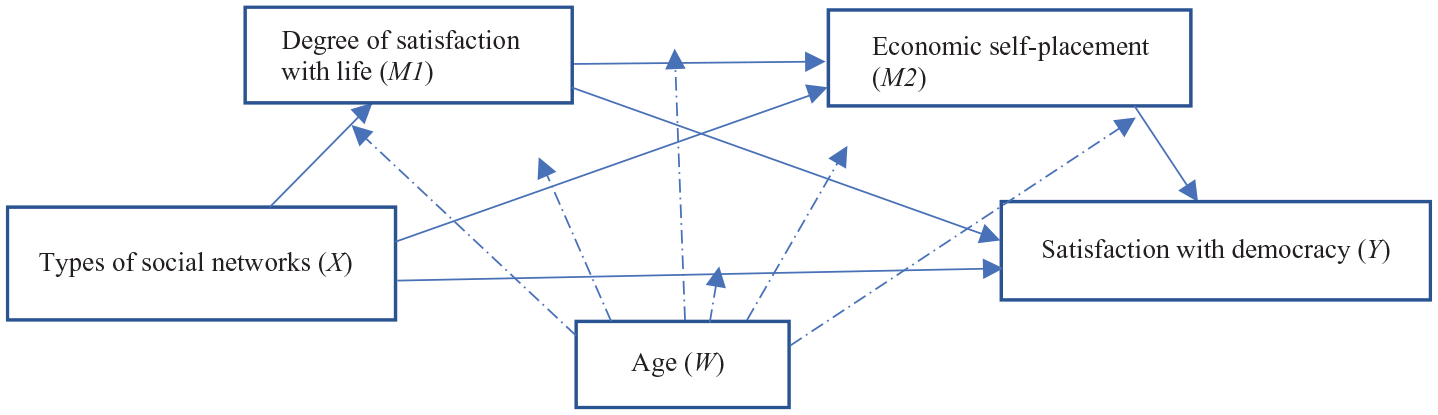
Indirect effects conditional analysis hypothesis model.
In terms of types of social networks, evidence from other studies is key to understanding the profile assumed by each platform. Facebook, for example, has a higher penetration rate in Latin America (Digital Report, 2020) and generates community models with much more interaction and with the capacity to organize and mobilize online (Alshareef, 2017). An example of this is the Arab Spring or other political expressions in the Global South, although the important thing is not the technology itself, but what was transmitted on the platform (Bimber, 2000). Facebook has a great impact on advertising and marketing, whereas Twitter takes on a much more dialogic dimension (Enli and Skogerbø, 2013). This same platform, however, has seen a decrease in its audience, which is mainly male and not as young: most of its users are between 25 and 49 years of age (Digital Report, 2020). WhatsApp, known for being a more ‘interpersonal’ network, has established itself as a propitious space to spread fake news (Farooq, 2018), with its political use very focussed on the principles of organization and online activism (with its resulting influences on democratic perception) that is related to its use (Resende et al., 2018) and that differentiates Generation X from previous generations (Gil de Zúñiga et al., 2021). Other less used networks in Latin America play a self-expression role. Instagram is an example of this since this platform tends to create and represent citizens’ ‘political self’ (Mahoney et al., 2016), focussed on constructing one’s image from the most explicit appearance. Finally, YouTube, as a repository, performs a complementary function, with uses such as the dissemination and distribution of content.
Age is a socio-demographic and socio-economic variable that has the most explanatory potential when describing the patterns of use and consumption on social networks: a large generation gap has been created that is narrowing slowly but steadily (Altuna-Urdin et al., 2013). According to the 2020 Digital Report (which only considers those more than 13 years old), the penetration rate of social networks worldwide is 49 per cent. Rates of use and activity over the total population in the region are above average and, comparatively, is experiencing the largest increases: 67 per cent in South America (+8), 64 per cent in Central America (+6.8) and 51 per cent in the Caribbean (+11). The report indicates that another socio-demographic variable such as sex does not show vast differences in Latin America, as percentages among both men and women remain similar. In the area of political participation, especially online, age is a decisive variable, since groups such as young people naturally adapt to the digital space and applied technologies. However, the previous literature does not show substantial and perceptible changes in apathy, disaffection or scepticism – foundational elements when assessing democracy as a whole (Catalina-García et al., 2018). Therefore, we have established the following secondary hypotheses:
H1: There is a direct effect between the type of network used and satisfaction with democracy.
H2: The type of network used influences the degree of satisfaction with life.
H3: The type of network used influences self-placement on the poverty–wealth scale.
H4: The degree of satisfaction with life is related to self-placement on the poverty–wealth scale.
H5: The degree of satisfaction with life is related to the degree of satisfaction with democracy.
H6: Self-placement on the poverty–wealth scale is related to satisfaction with democracy.
Both to the Left and the Right, there is evidence of the birth of a new form of politicizing demands through young people’s promotion of groups that encourage mobilization and commitment (De la Fuente, 2010), adopting practices such as the ‘self-mediation, monitoring, and the reverse setting of the agenda’ (Casero-Ripollés, 2015: 546). In Latin America, this research results in great debates around the pessimistic and optimistic view of social networks as a tool for political participation, noting a large role in the public sphere, but especially in the daily lives of young people (Barredo Ibanez et al., 2017; Bianchi et al., 2016; Pozos et al., 2017; Sola-Morales and Hernández-Santaolalla, 2017).
However, as far as support for democracy is concerned, socio-economic variables have the highest levels of explanation, notably in Latin America. In general, the previous literature focuses on two general ideas (Carlin, 2006). From the macroeconomic point of view, development and growth promote democratic stability and a belief in institutionality; second, education and wealth generate support for democracy (Barredo Ibáñez, 2018), whereas inequality and poverty have negative effects. Several studies have been conducted along these lines, pointing specifically to poverty (and not so much inequality) as the most important variable: ‘lower poverty rates coincide with higher levels of citizen support for democracy’ (Valdés Gutiérrez, 2015: 220).
Methodology
Participants
This study uses a correlational scope and was designed using a non-experimental, longitudinal approach. This began by downloading the data provided in SPSS format by the Latinobarómetro Corporation (https://www.latinobarometro.org/), corresponding to the years 2018 and 2020. This non-governmental organization has been conducting periodic surveys since 1995 related to assessing and evaluating issues of interest to Latin Americans. Its freely accessible data have been used in some studies that have focussed on a regional-scale assessment (Barredo Ibáñez, 2018; Ergun et al., 2016; Monsiváis, 2017), similar to the one proposed.
As explained in the fact sheet (Latinobarómetro, 2018, 2020), the survey included 18 countries, with a global sample of 20,204 data points in 2018 and 20,205 data points in 2020 (Argentina, 2018n = 1200, 2020n = 1200; Bolivia, 2018n = 1200, 2020n = 1200;; Brazil, 2018n = 1204, 2020n = 1204; Chile, 2018n = 1200, 2020n = 1200; Colombia, 2018n = 1200, 2020n = 1199; Costa Rica, 2018n = 1000, 2020n = 1000; Ecuador, 2018n = 1200, 2020n = 1200; El Salvador, 2018n = 1000, 2020n = 1000; Guatemala, 2018n = 1000, 2020n = 1000; Honduras, 2018n = 1000, 2020n = 998; Mexico, 2018n = 1200, 2020n = 1202; Nicaragua, 2018n = 1000, 2020n = 1004; Panama, 2018n = 1000, 2020n = 1000; Paraguay, 2018n = 1200, 2020n = 1200; Peru, 2018n = 1200, 2020n = 1200; Dominican Republic, 2018n = 1000, 2020n = 1000; Uruguay, 2018n = 1200, 2020n = 1200; Venezuela, 2018n = 1200, 2020n = 1198). The surveys were selected using probability sampling, based on the indicated source. All have a 100 per cent level of representativeness in each country, with a sampling error that ranges from ±2.8 to ±3.5.
In both years (2018 and 2020), we found exactly the same representation of respondents according to their ages. Slightly more than half of the respondents could be considered young: 52 per cent of the participants were 39 years old or younger, compared to middle-aged adults (between 40 and 59 years old), who represented 31 per cent of the population sample. Older adults (60 years and over) were 17 per cent of those surveyed.
Measurements
The following variables were selected for the hypothesis model: age, a scalar, open and numerical variable. The variables of satisfaction with democracy and degree of satisfaction with life were measured using a Likert scale, with the items: ‘Very satisfied’, ‘Mostly satisfied’, ‘Not very satisfied’, ‘Not at all satisfied’ and ‘No answer/declined’. The self-placement on the poverty–wealth scale variable: personal, measured on a scale of 1–10 points, where 1 represented ‘poorest’ and 10 was ‘richest’. In the latter cases, and to facilitate their interpretation, the variables were standardized so that the measurement scales reversed the order proposed in the data collection on the Likert scales. That is, with the measurement standardization process, 1 indicates ‘Not at all satisfied’ and, as the scale progresses, 4 represents ‘Very satisfied’. Similarly, in the self-placement variable, items 1–2 were connected with the label ‘Very poor’, 3–4 with ‘Quite poor’, 5–6 with ‘Not clear/neutral’, 7–8 with ‘Quite rich’ and 9–10 with ‘Very rich’. The neutral section of all the resulting scales was considered a missing value, given its difficulty of interpretation. Finally, the ‘social networks used’ variable was measured by the Latinobarómetro (2018, 2020) with only a dichotomous option, ‘Mentioned’ and ‘Not mentioned’. That is, this question asks if the user has an account on the platforms evaluated (Facebook, Twitter, YouTube, Instagram and WhatsApp). The study originally also included other social networks (Snapchat, Tumblr, LinkedIn), but these networks have a minority use in Latin America and, therefore, we decided to discard them. In the case of TikTok, it was only consulted in the survey of 2020, so we were unable to compare it with the data taken in 2018. Therefore, we excluded this platform as well.
To test our hypotheses, we used a moderated mediation analysis, a type of regression used to examine the effect of external variables in a given relationship. This analysis was conducted with support from Macro Process version 3.0 (model 92) for SPSS (version 25), with 10,000 bootstraps and a confidence level of 95 per cent, which is recommended for this type of study (Hayes, 2018).
Results
Correlations and associations between variables
Table 1 presents the correlations between the model’s ordinal and scalar variables. In this case, we have not included the profile of the type of social network used, as it is a dichotomous variable. Overall, both samples presented similar patterns. As can be seen, the degree of satisfaction with the functioning of democracy is significantly correlated with both self-placement on the poverty–wealth scale (2018n, r = 0.150; p < 0.001; 2020n, r = 0.105; p < 0.001) and with the degree of satisfaction with life (2018n, r = 0.114; p < 0.001; 2020n, r = 0.134; p < 0.001). However, we found no evidence connecting it to age (2018n, r = −0.003; p > 0.05; 2020n, r = 0.013; p > 0.05). Thus, higher perceived satisfaction with democracy tends to be related to higher satisfaction in life, and vice versa, but age is not necessarily identified with satisfaction with democracy.
Spearman correlations between ordinal and scalar variables.
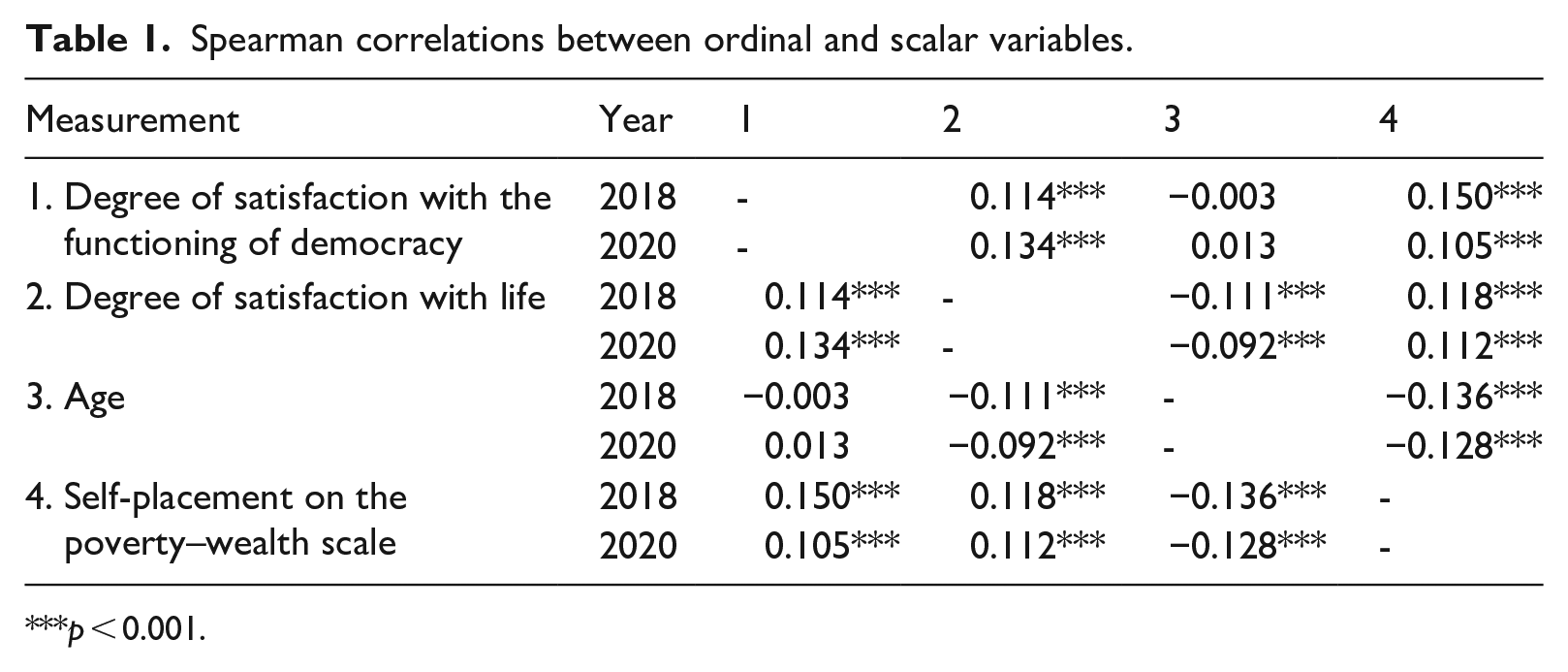
p < 0.001.
In addition, we find intriguing positive correlations between self-placement on the poverty–wealth scale both with the degree of satisfaction with life (2018n, r = 0.118; p < 0.001; 2020n, r = 0.112; p < 0.001) and negative correlations with age (2018n, r = −136; p < 0.001; 2020n, r = −128; p < 0.001). In other words, based on the previous evidence, we note that people with more resources tend to show greater satisfaction with democracy and with life in general, whereas younger people tend to have fewer resources.
To test the associations between the type of social network used (nominal variable) and the ordinal or scalar variables, the Pearson χ² test was used. As shown in Table 2, we found significant associations in all cases, but especially strong with respect to age on Facebook (2018n, χ² = 4,436.946; p < 0.001; 2020n, χ² = 1,757.581; p < 0.001) and WhatsApp (2018n, χ² = 3,725.872; p < 0.001; 2020n, χ² = 2,784.310; p < 0.001), in addition to respondents’ self-placement on the poverty–wealth scale, on WhatsApp (2018n, χ² = 736.558; p < 0.001; 2020n, χ² = 877.605; p < 0.001) and, again, on Facebook (2018n, χ² = 601.574; p < 0.001; 2020n, χ² = 662.786; p < 0.001):
Associations (Pearson’s X²) between social media profiles and proposed measures.
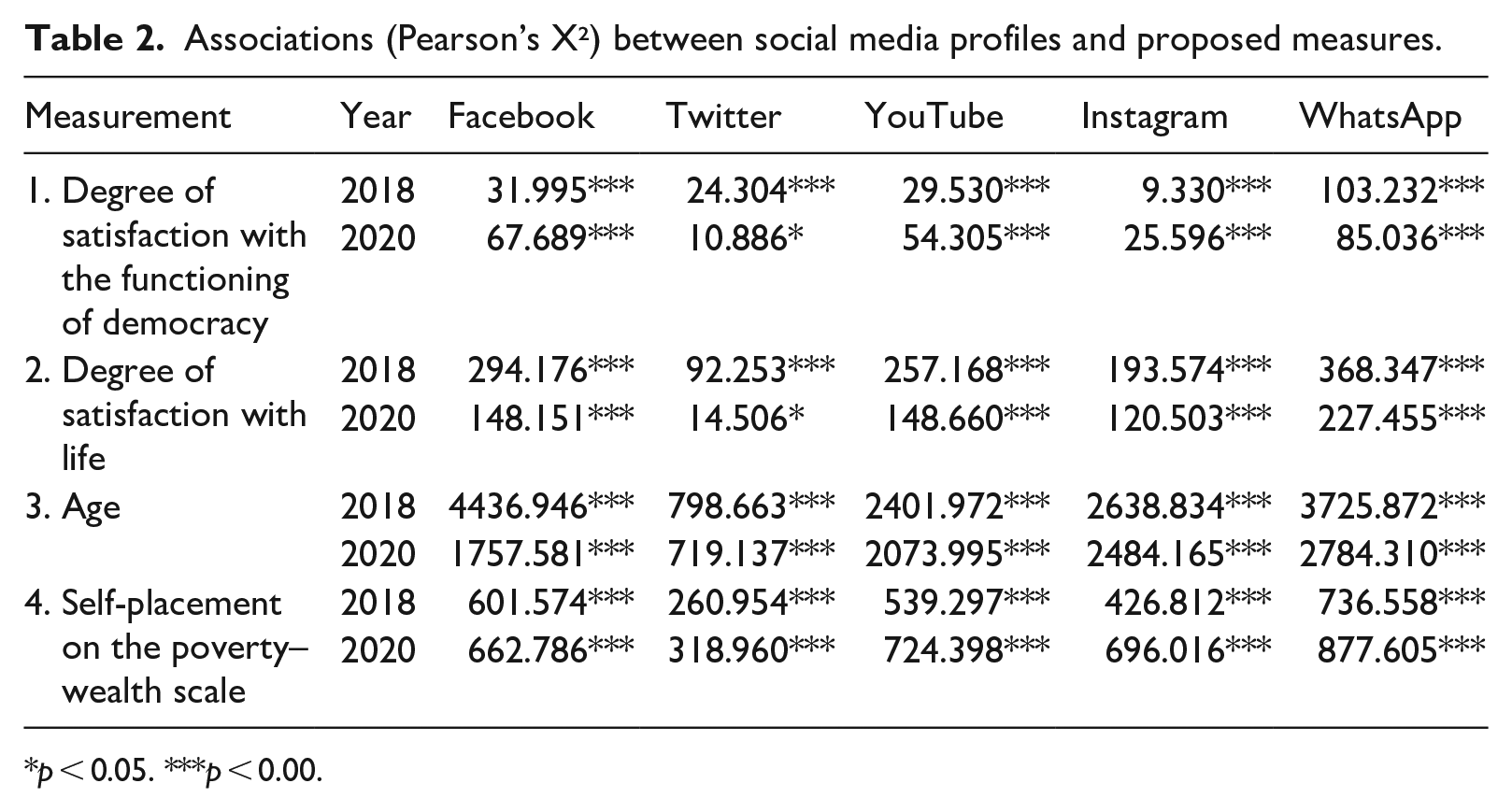
p < 0.05. ***p < 0.00.
The weakest associations found are related to the degree of satisfaction with the functioning of democracy, particularly on Instagram (2018n, χ² = 9.330; p < 0.001; 2020n, χ² = 25.596; p < 0.001) and on Twitter (2018n, χ² = 24.304; p < 0.001; 2020n, χ² = 10.886; p < 0.05), as well as satisfaction with life, which reaches the lowest associations on Twitter (2018n, χ² = 92.253; p < 0.001; 2020n, χ² = 14.506; p < 0.05) and on Instagram (2018n, χ² = 193.574; p < 0.001; 2020n, χ² = 120.503; p < 0.001).
Moderated mediation analysis model
As shown in Table 3, the model proposed in the general hypothesis is confirmed in the majority of the cases, except the following from the data of 2020: respondents who were 24 years old who access Facebook, Twitter, YouTube and Instagram; and respondents who were 40 years old who access Twitter. That is, with the exemptions indicated, we have confirmed that there is an indirect effect between the type of social network used and satisfaction with democracy, through the mediation demonstrated both by perceived satisfaction with life and with self-placement on the poverty–wealth scale, and moderated by age. This happens in all the social network profiles tested (Facebook, Twitter, YouTube, Instagram and WhatsApp), although the greatest indirect effect is in the use of WhatsApp among 24-year-olds in 2018 (B = 0.0029; BootSE = 0.0006; IC = 0.0018–0.0043) than in 2020 (B = 0.0012; BootSE = 0.0005; IC = 0.0004–0.0023), as well as on Facebook in this same age profile in 2018 (B = 0.0028; BootSE = 0.0006; IC = 0.0018–0.0042), while in 2020, we do not have enough evidence to confirm the effect (B = 0.0003; BootSE = 0.0004; IC = −0.0003–0.0004). In third place, the higher indirect effect is identified with the use of Twitter among 60-year-olds in 2018 (B = 0.0027; BootSE = 0.0011; IC = 0.0008–0.0050) and that of Facebook (B = 0.0024; BootSE = 0.0004; IC = 0.0017–0.0032) and WhatsApp (B = 0.0024; BootSE = 0.0004; IC = 0.0017–0.0032) among 40-year-olds. In 2020, we found a similar pattern, but with a lower indirect effect among 61-year-olds in Twitter (B = 0.0011; BootSE = 0.0006; IC = 0.0000–0.0024), Facebook (B = 0.0009; BootSE = 0.0004; IC = 0.0003–0.0016) and WhatsApp (B = 0.0009; BootSE = 0.0004; IC = 0.0003–0.0017), while the maximum indirect effect among 40-year-olds is concentrated in WhatsApp (B = 0.0011; BootSE = 0.0003; IC = 0.0003–0.0017).
Regression coefficients and summary of the model with two mediators and the moderation of age (Process Model 92) on satisfaction with democracy in Latin America (2018).
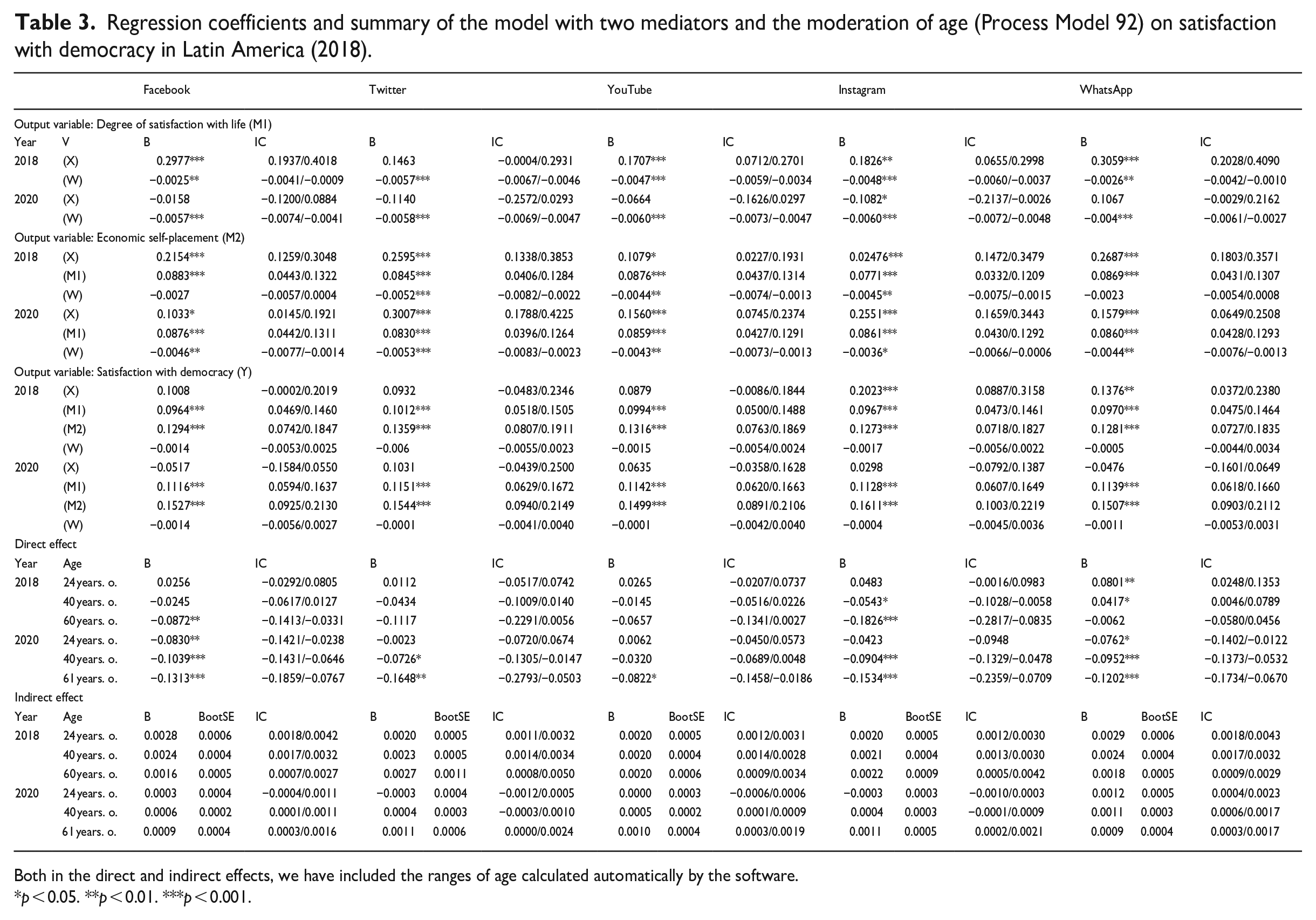
Both in the direct and indirect effects, we have included the ranges of age calculated automatically by the software.
p < 0.05. **p < 0.01. ***p < 0.001.
With regard to the secondary hypotheses, in H1, we proposed the existence of a direct effect between the type of social network used and support for democracy. But the evidence is not conclusive in most cases. At a general level, in 2018, we find a positive relationship between satisfaction with democracy on Instagram (B = 0.2023; p < 0.001; IC = 0.0887–0.3158) and WhatsApp (B = 0.1376; p < 0.01; IC = 0.0372–0.2380) in such a way that having an account on these platforms indicates greater conformism with the democratic system. In 2020, on the other hand, the evidence is non-conclusive of the overall direct effect from one variable to the other. When we focus the analysis on the age ranges, in 2018, we found a direct negative effect between one variable and another in 60–61-year-olds for Facebook (2018n, B = −0.0872; p < 0.01; IC = −0.1413 to −0.0331; 2020n, B = −0.1313; p < 0.01; IC = −0.1859 to −0.0767), on Instagram, among 40-year-olds (2018n, B = −0.0543; p < 0.05; IC = −0.1028 to −0.0058; 2020n, B = −0.0904; p < 0.01; IC = −0.1329 to −0.0478), and a stronger effect among 60–61-year-olds (2018n, B = −0.1826; p < 0.001; IC = −0.2817 to −0.0835; 2020n, −0.1534; p < 0.001; IC = −0.2359 to −0.00709). In other words, in the cases above, dissatisfaction with democracy decreases as the people surveyed acknowledge having an account on those platforms. However, in 2018, the direct effect is positive in WhatsApp among 24-year-olds (B = 0.0801; p < 0.01; CI = 0.0248–0.1353) and 40-year-olds (B = 0.0417; p < 0.05; IC = 0.0046–0.0789), in which having an account on this platform is linked to greater satisfaction with democracy in these age groups. In 2020, the 11 detected direct effects have a negative sign, that is, having an account on these platforms is linked to a lesser satisfaction with democracy in these age groups.
In H2, we suggested the existence of a possible influence on the type of network used with respect to the degree of satisfaction with life. This is true on WhatsApp in 2018 (B = 0.3059; p < 0.001; IC = 0.2028–0.4090), Facebook (B = 0.2977; p < 0.001; IC = 0.1937–0.4018), YouTube (B = 0.1707; p < 0.001; IC = 0.0712–0.2701) and Instagram (B = 0.1826; p < 0.01; IC = 0.0655–0.2998). In this way, in all the cases – with the exception of those who have a Twitter account – there is sufficient evidence to highlight greater satisfaction with life if users have accounts on these platforms. In the case of 2020, there is not enough evidence to confirm this positive effect. We only detected an effect, but it was negative on Instagram (B = −0.1082; p < 0.05; IC = −0.02137 to −0.0026). So, having an account on this platform was associated with lesser satisfaction with life. And, in both 2018 and 2020, the degree of satisfaction with life decreases in all cases based on age: younger individuals tended to show less satisfaction with life. Thus, the moderating role of this variable in the proposed relationship is verified.
Another interesting interaction that we found, which correlates with H3, is that between the type of social network used and self-placement on the poverty–wealth scale. In all cases, respondents who have an account on these platforms tended to position themselves at a higher level of wealth in the two periods examined. H4 is also fully verified, as higher satisfaction with life corresponds to higher wealth self-placement. But, according to the data analysed, there is no evidence on the moderating role played by age on self-placement on the poverty–wealth scale in 2018 in the case of Facebook (B = −0.0027; p > 0.05; IC = −0.0057 to 0.0004) and WhatsApp (B = −0.0023; p > 0.05; IC = −0.0054 to 0.0008). This may be because these are the most used platforms in Latin America and their transversal nature limits this aspect. In 2020, we found a negative moderation of age in all the social media platforms analysed. The younger the person, the less the financial comfort they perceive.
Additionally, we fully verified H5, that is, there is a general consensus between satisfaction with life and satisfaction with democracy. Both perceptions are positively connected to all types of networks analysed, so users of these platforms who acknowledge greater vital conformity also tend to manifest greater political conformity.
H6 is also fully confirmed since there is a direct positive relationship between perceived wealth and satisfaction with democracy in all account types analysed. From that perspective, the perception of having more resources is equivalent to greater satisfaction with the democratic political system. But age does not play a moderating role with respect to satisfaction with democracy. In no case did we find conclusive evidence in this regard. Instead, age intervenes with a moderating role to the extent that there are external variables related to satisfaction with democracy, but not directly.
Conclusions
In the preceding pages, we have shown empirical evidence that helps to explain the relationship between the type of social network account (moderated with age) and the degree of satisfaction with the functioning of democracy. Previous literature indicates that the different typologies of technological platforms offer different participation identities: Facebook carries out a mobilization process; Twitter coordinates it; and YouTube narrates it (Arafa and Armstrong, 2015). In this sense, the novelty of this study lies in the proposed and validated model, which confirmed – in the majority of cases and with data from two different years – the existence of an indirect effect between the type of network used and satisfaction with democracy but using the moderating role of age and the mediation of two variables: degree of satisfaction with life and self-placement on the poverty–wealth scale. This means that the contribution of social networks to democracy in the Latin American countries examined – and possibly other parts of the world – cannot be linked merely to use. Instead, the socio-economic aspects determine and encourage the suitability of the democratic system in the imaginaries of the networks’ users, with different levels of appropriation depending on people’s age and their type of account, as has been proposed in other studies on the macroeconomic approach (Carlin, 2006), the link between poverty and democracy (Valdés Gutiérrez, 2015) or subjective income (Barredo Ibáñez, 2018).
Thus, we found partial compliance with the direct effect of the type of social network used with regard to satisfaction with democracy. In 2018, there is a positive relationship between these variables with Instagram and WhatsApp, platforms associated with self-expression (Mahoney et al., 2016), while in 2020, the overall evidence is non-conclusive. Closely analysing the reaction of age groups, in 2018, we see that 40- and 60-year-olds using Instagram and 60-year-olds using Facebook have a negative association. But in the data of 2020, the 11 detected direct effects have a negative sign. In this way, when users have an account on these platforms, they perceive less satisfaction with democracy, unlike what happens with WhatsApp users in 2018 who are 24 and 40 years old (young people), who indicate higher levels of satisfaction with this political system. The indicated controversial result presents a possible evolution of social media in the Latin American countries included in the sample. That is, in the data of 2018 we have observed more homogenous patterns in all ages, while 2 years later, in 2020, there is a wider diversity of recognized preferences among the younger respondents. To explain this phenomenon, from 2018 to 2020, there were some new social media, as TikTok, which concentrated the access among young users. Likewise, social media should be considered a source of information, then users who have access can be more critical of the reality.
In the results presented, we find the consensus among all users of these platforms interesting. There is a relationship between the type of social network used and self-placement on the poverty–wealth scale, as well as between self-placement on the poverty–wealth scale and satisfaction with democracy. However, age is not conclusive with regard to satisfaction with democracy, as Catalina-García et al. (2018) found; we must review other aspects to understand this connection more deeply. The happiest Latin Americans, according to the countries included in the sample, will be the most satisfied with the democratic system, although the happiest will also acknowledge having more resources. One element to consider is that young Latin Americans show less satisfaction with life, perhaps due to aspects such as youth nonconformity, having fewer resources or opportunities, or even the under-representation of this age profile in the region’s institutional framework.
In 2018, the use of different social networks, except Twitter, tends to be linked to greater satisfaction with life. This may be because those were platforms that helped to expand individuals’ social possibilities, their knowledge of the world, new mechanisms of cultural or educational appropriation, among others. But 2 years later, we observed non-conclusive evidence and even a negative effect associated with Instagram. From 2018 to 2020, then, users could have adopted a more critical approach to social media. In the last years those social platforms have been colonized by fake news and cyber-troops (Barredo Ibáñez, 2021), which also help to explain the negative or non-conclusive perceptions.
However, the use of these accounts is connected to greater financial comfort, as perceived by the individuals. And with good reason, in a context such as the Latin American countries evaluated, accessing these networks requires both having a device and an internet connection, something that is not available to all individuals.
Despite these interesting conclusions, this study has some limitations. The most important is the one-dimensional measurement of the variables. Thus, it would be interesting to address users’ perceptions of the phenomenon in a multidimensional way. Another limitation comes from the data extraction. Since the study only uses surveys collected in 2018 and 2020, we cannot verify a major evolution of the effects after the COVID-19 pandemic, as well as the interactions between the model’s variables. At the same time, other social media platforms should be included in a future study, for example, TikTok. But we did not have data in 2018 to include this platform in our analysis. In any case, rather than being considered limitations, we think that the foregoing can become an opportunity to continue exploring a relationship that may be decisive in the coming decades: the influence that the type of social network used has, and the corresponding socio-economic aspects, on satisfaction with democracy.
Footnotes
Funding
The author(s) disclosed receipt of the following financial support for the research, authorship, and/or publication of this article: This article has been co-financed by the research project, ‘App-Andalus’, reference number EMC21_00240, funded by the General Secretariat for Research and Innovation, Government of Andalusia (Spain), thanks to the Emergia Program. The article also had the support of the Political Research Team (ED431C 2022/36) and Network on Innovation in Digital Political Communication, DIGI-COMPOL. RED2022-134652-T funded by MCIN/AEI/10.13039/50110001103
