




Abstract
Based on the methodological approach to responsibility-related discourses in critical discourse studies and the theoretical understanding of the notion of responsibility in international relations and political studies, this paper proposes an integrated theoretical and methodological framework for responsibility-related discourses in the political realm. It evidences the applicability of the proposed framework in discourses of China-US trade conflicts constructed by China’s state-run news media in both traditional and social media platforms in 2019 and 2020. The proposed framework extends the explanatory power of the notion of responsibility in constructing the ‘us’ and ‘them’ dichotomy.
Keywords
Introduction
Scholars dedicated to critical discourse analysis (CDA) have been fascinated by the topos of responsibility in constructing and normalizing the pattern of the positive ‘us’ (I and/or my allies) and the negative ‘them’ (the opposing group and/or their allies) in politics-related discourses (e.g. Blackledge, 2005; Boukala, 2016; Koca-Helvacı, 2017; Majstorović, 2007; Reisigl and Wodak, 2001; Wright and Brookes, 2019). Similarly, scholars in political science, especially in international relations and politics (IRP), have also been exploring the idea of responsibility in dividing ‘us’ and ‘them’ in the political realm (e.g. Bukovansky et al., 2012; Erskine, 2003a; Loke, 2016). Nevertheless, both strands of scholars focused extensively on the discursive strategy of using the notion of responsibility to construct a negative ‘them’ and seldom on how it has been used to construct a positive ‘us’. Therefore, the explanatory power of the notion of responsibility in the ‘us’ and ‘them’ ideological confrontation has not been fully uncovered. With the aid of van Dijk’s (1998) theoretical framework of the ideological square, this paper proposes an integrated theoretical and methodological framework to study responsibility-related discourses, aiming to extend the explanatory power of the notion of responsibility in the dichotomy of ‘us’ and ‘them’. It will test the applicability of the proposed framework in discourses of China-US trade conflicts constructed by China’s state-run news media in both traditional and social media platforms in 2019 and 2020.
The notion of responsibility in CDA and IRP
In the discourse-historical approach of CDA, the topos of responsibility is viewed as a scheme of argumentation that aims to justify the positive or negative attributions of certain actors (Wodak, 2001), and thus to reproduce the positive self-presentation and negative other-presentation (Reisigl and Wodak, 2001). The application of the topos follows the logic that ‘because a state or a group of persons is responsible for the emergence of specific problems, it or they should act in order to find solutions of these problems’, and thus to justify the ‘us’ and ‘them’ division (Reisigl and Wodak, 2001: 78; also see Blackledge, 2005). To examine the logic of the topos of responsibility more closely, we can further dissect it into two dimensions: the first indicates that the agency is held responsible for something wrong, that is, the notion of responsibility being connotated as blame, while the second indicates that the agency is requested to fulfil its duties, that is, the notion of responsibility being connotated as duties requested by others. Both dimensions have negative indications for the corresponding agency.
Some empirical studies have applied the topos of responsibility in different discourses by explicating the above two dimensions. Blackledge (2005) applied both dimensions in his analysis of British government and media discourses around the ‘race riots’ of Summer 2001 in the UK. The study found that political reviews used the notion of responsibility to blame others – for example, blaming Asian people who did not speak English as the cause of social ills in the UK. Moreover, media language used it as requested duties as in ‘surely the Asian community has sufficient English speakers to provide voluntary translation services’, thereby indicating that there was no need for Asians to be provided with special welfare treatment, which was a burden on the taxpayers (Blackledge, 2005: 72, 87). Wright and Brookes (2019), in examining the discourses used in British newspapers, found that the topos of responsibility was applied to request immigrants to learn to speak English by themselves or request immigrant parents to teach their children to speak English. Moreover, immigrants were also blamed for their children’s isolation in society, the resources that their children took from the education system, and the job opportunities that their children took from the natives (Wright and Brookes, 2019). Similarly, immigrants were also blamed for social issues such as overcrowded houses and delinquency in Catalan political discourses (Rubio-Carbonero and Zapata-Barrero, 2017). Other studies did not detail the application of the topos of responsibility in their analysis of various discourses, let alone examining this topos from a critical perspective, although they acknowledged its importance in formulating arguments in politics-related discourses (e.g. Boukala, 2016; Koca-Helvacı, 2017; Majstorović, 2007).
The debate on the responsibilities a nation-state should shoulder in international affairs, such as international trade, environmental protection, and pandemic mitigation, relies heavily on different perspectives of the notion of responsibility (Zhao, 2020, 2021). The application of the notion of responsibility as blame and requested duties has already been a practice of IRP (Erskine, 2003b). The notion of responsibility is viewed as ‘a notoriously awkward concept’ in IRP (Erskine, 2003b: 7). The complicated connotations of the notion of responsibility grant state actors the space to strategically manoeuvre it to legitimize their international stances and behaviours against others (Roselle et al., 2014). The notion can be understood from either a ‘prospective’ or a ‘retrospective’ perspective (Erskine, 2003b: 8). Loke (2016: 854) further interpreted the prospective nature as being ‘prescriptive (what actors should do)’ and the retrospective nature as being ‘evaluative (a basis upon which evaluations can be made)’. Specifically, being prospective refers to ‘assign and distribute moral burdens’ and being retrospective to ‘point fingers and apportion blame’, which ‘is already a prevalent part of the practice of international politics’ (Erskine, 2003b: 8, emphasis in original).
The logic of the topos of responsibility as explained by Reisigl and Wodak (2001) and the following empirical studies in CDA, as well as the academic discussion on responsibility in IRP, mainly focused on the agency of others. While the discursive strategy of attributing blame to and requesting duties from others in reproducing the ‘us’ and ‘them’ division has been extensively studied, there is a lack of focus on the function of the notion of responsibility in constructing the positive attributions of me/us. That is to say, the potential of the notion of responsibility has not been exhausted to comprehensively understand how it can legitimize the positive or negative attributions of certain agencies (Wodak, 2001) and thus construct the positive self-presentation and negative other-presentation (Reisigl and Wodak, 2001).
In constructing the ‘us’ and ‘them’ division, ‘them’ are often depicted along with ‘us’ (van Dijk, 1998). In studying the discourses concerning ‘group conflict or competition’ (p. 275), van Dijk (1998) proposed the theoretical framework of the ideological square to study the discursive reproduction of the ideology of the positive self and the negative other. Specifically, the ideological discourse structure (van Dijk, 1998: 267) was detailed as:
Express/emphasize information that is positive about us;
Express/emphasize information that is negative about them;
Suppress/de-emphasize information that is positive about them; and
Suppress/de-emphasize information that is negative about us.
Different discursive strategies can be utilized to realize the ideological square, for example, the explicitness or implicitness, manifestation or concealment, and levels or details of description used in the language in terms of the different squares (van Dijk, 1998). Van Dijk (1998: 276) also pointed out the strategy of ‘the distribution of agency, responsibility or blame’ in fulfilling the ideological square, but he did not specify how.
The explanation of the topos of responsibility in the discourse-historical approach of CDA (Reisigl and Wodak, 2001) coincides with parts of van Dijk’s (1998) theoretical landscape, that is, those about the negative ‘them’. The dimension of blaming others for wrongdoing and/or faults in the topos of responsibility (Reisigl and Wodak, 2001) is consistent with the second aspect of the ideological square, that is, expressing/emphasizing information that is negative about ‘them’ (van Dijk, 1998). Previous research has extensively studied the application of this aspect in constructing and normalizing the ‘us’ and ‘them’ division, such as othering the im/migrant(s) from the European Union by blaming them as threats to the security and well-being of the UK in British right-wing newspapers (Tong and Zuo, 2019), othering Iraq by blaming it as a threat to the national security of the US in George W. Bush’s public speeches (Abid and Manan, 2016), othering the Ahmadiyya sect (a self-defined sect of Islam) by blaming it as the hijacker, traitor, and enemy of Islam in the texts by the Indonesian Islamic Defender Front (Irawan, 2017), and othering Trump’s America by blaming the US’ protectionism and anti-globalization in China’s state-run English newspaper China Daily (CD) (Pan et al., 2020).
When others, such as immigrants, were requested to solve their own issues (e.g. learning to speak English), they were assigned as accountable actors who needed external motivation, such as pressure, regulation, or even praise, to comply with certain standards of performance (Bivins, 2006). Nevertheless, accountable actors are viewed as people still possessing ‘a developed moral sense and a fair idea of social conventions and moral principles’ (Bivins, 2006: 23). Therefore, the nature of being requested or regulated suppresses the positive connotation of accountability, echoing the third element of the ideological square (van Dijk, 1998).
The notion of responsibility is also powerful in constructing the positive ‘us’. Different from accountable actors, responsible actors are highly self-motivated to achieve the appropriate level of moral criteria (Bivins, 2006). Portraying ‘us’ as responsible, instead of accountable, actors emphasize the positive side of ‘us’, coinciding with the first aspect of the ideological square (van Dijk, 1998). This discursive strategy was also extensively uncovered in politics-related discourses, for example, highlighting the initiatives of the US in providing humanistic care and advancing democracy in the world through the words ‘committed’, ‘determined’, and ‘willing’ in Bush’s speeches on America’s military actions in Iraq (Abid and Manan, 2016), and emphasizing the proactive stance and measures taken by the central government of China in dealing with China’s air pollution issues in CD (Liu and Li, 2017) and the HIV and AIDS prevention and treatment in Xinhua News Agency (XH) (Wu, 2006). Interestingly, in responding to the thesis of ‘responsible great power’, China’s policymakers tried to gain an upper hand by interpreting the idea of responsibility as China’s self-acknowledged commitment to international security, trade, humanity, and other issues, but to avoid admitting international duties merely as a response to other countries’ exhortations (Yeophantong, 2013).
Positive self-presentation can also be achieved through blame avoidance (Hansson, 2015) or denying blame (van Dijk, 1992), echoing the aspect of suppressing what is negative about ‘us’ in the ideological square (van Dijk, 1998). In other words, actors in power, such as governments, can deny their responsibilities, such as accusations of wrongdoing or faults, to construct a positive self-image. Strategies of denying accusations include ‘act-denial’ (‘I did not do/say that at all’) and ‘intention-denial’ (‘I did not mean that’ or ‘You got me wrong’) (van Dijk, 1992: 92). IRP studies also identified that nation-states usually apply the discursive strategy of defensive denial, which refers to ‘resisting or denying negative discourses about the Self’, to manage a positive international image (Pan et al., 2020: 58).
Based on the above critical literature review, this study proposes the following integrated framework to study responsibility-related discourses in the political realm:
Express/emphasize information that is positive about us: duties claimed by me/us as a result of self-motivation;
Express/emphasize information that is negative about them: others’ faults;
Suppress/de-emphasize information that is positive about them: others’ duties upon request; and
Suppress/de-emphasize information that is negative about us: exemption of my/our faults.
The proposed framework centres on the notion of responsibility in constructing the positive ‘us’ and negative ‘them’ dichotomy, or the ideological square. It integrates the theoretical understanding of the notion of responsibility in IRP (Erskine, 2003b; Loke, 2016) with the methodological approach to responsibility-related discourses in CDA (Reisigl and Wodak, 2001; van Dijk, 1998). Since the foundations of the proposed framework, including the topos of responsibility (Reisigl and Wodak, 2001), the understanding of responsibility in IRP (Erskine, 2003b; Loke, 2016), and the ideological square (van Dijk, 1998: 275), all focus on conflictual discourses between groups, this paper will test the applicability of the proposed framework in the discourses of China-US trade conflicts in China’s state-run news media in both traditional and social media platforms.
China-US trade conflicts and China’s media discourses
China and the US have a long history of rivalry and mutual distrust. The conflicts between the two countries in the areas of currency and maritime activities (Ooi and D’Arcangelis, 2018), human rights (Yin, 2007), the COVID-19 pandemic (Jaworsky and Qiaoan, 2021), and more general areas such as foreign policy (Lee, 2002) and political slogans (Wang, 2016) have been manifested in both countries’ political and media discourses.
The conflicts between the two countries, the world’s top two economic giants, have been exacerbated by their trade issues, especially after Donald Trump’s inauguration as president in 2017 (Wei, 2019). Several rounds of threats issued by Trump in 2017 were viewed as brewing a potential trade war (Iyengar, 2018). Then from January 2018, the trade relations between the two countries deteriorated abruptly after the US announced a 30 per cent tariff on imported solar panels, most of which came from China, and taxes on large residential washing machines starting at 20 per cent (Iyengar, 2018; Wei, 2019). Several rounds of negotiations from May 2018 yielded no concrete results (Bloomberg News, 2018) and a trade war was launched on 6 July 2018 when the new tariffs announced by both the US and China in June came into effect (Palumbo, 2018). The short period of relative amity resulting from a temporary 90-day trade truce on December 2018 was interrupted by continuous threats, bans, and tariff announcements (Wong and Koty, 2020). The year 2019 witnessed the breaking of trade negotiations between the two countries, and also efforts to reinvigorate trade relations later that year, which continued during 2020 with the two sides signing the phase one deal in January (Wong and Koty, 2020). Nevertheless, the conflicts still existed in 2020 and were complicated by yet another challenge, the COVID-19 pandemic (Boylan et al., 2020; Zhao, 2020).
Extant research found consistent evidence of positive self-presentation and negative other-presentation of the China-US trade confrontation in the discourses constructed by China’s state-run news media (e.g. Ha et al., 2021; Liu, 2017; Murphy and Vilceanu, 2014; Zeng and Sparks, 2020). Scholars have touched upon the notion of responsibility in constructing the ‘us’ and ‘them’ confrontation, but none of them have explicated the explanatory power of the notion of responsibility. For example, Zeng and Sparks (2020) identified prevailing cases of the application of the four dimensions of the notion of responsibility in their examination of the media discourses of the China-US trade war in China’s state-run English newspaper Global Times (GT) in 2018, but they did not explicate the notion of responsibility. For instance, GT represented China as the determined defender of the international free trade structure (i.e. duties claimed by me/us as a result of self-motivation), exempted China from blame for initiating the trade war (i.e. exemption of my/our faults), blamed Trump for starting the trade war (i.e. the other’s faults), and highlighted American farmers’ demand for Trump to consider their losses (i.e. the other’s duties upon request). In keeping with this strand, Murphy and Vilceanu (2014) found the employment of these discursive strategies by China’s state-run CD and XH when representing American business and China-US economic relations from 2003 to 2011. For example, both news media highlighted China’s proactivity in intellectual property protection and opening its market to foreign companies (i.e. duties claimed by me/us as a result of self-motivation), refuted America’s currency manipulation accusations against China (i.e. exemption of my/our faults), blamed the US for trade protectionism and xenophobia (i.e. the other’s faults), and demanded that the US liberalize its structures on new technology disclosure and treat fairly Chinese-made products (i.e. other’s duties upon request). Moreover, the strategy of emphasizing others’ faults was also found by Ha et al. (2021) in China’s state-run television channel CCTV and the social media accounts of the state-run newspapers, People’s Daily and GT, which used emotive expressions, such as ‘bully’ and ‘violating free trade’, to blame the US for imposing tariffs on Chinese products in 2018.
Based on the above scholarly works, this study aims to further verify the applicability of the proposed theoretical and methodological framework for the notion of responsibility in constructing the ‘us’ and ‘them’ division. The study starts the examination with discourses from China’s state-run news media on the China-US trade conflicts in 2019 and 2020.
Methodology
This study focuses on the media discourses on the China-US trade conflicts in 2019 and 2020 carried in two China state-run English-language news media, XH and GT, for the following reasons. First, both news media function as the mouthpiece of the Chinese central government to the outside world. They may transfer the ideological division embedded in the governmental stances to the media discourses, which has been reported by multiple studies (e.g. Hatef and Luqiu, 2018; Ha et al., 2021; Murphy and Vilceanu, 2014; Zeng and Sparks, 2020). Second, their news archives are available at the author’s institution.
Third, this study also aims to triangulate the findings from the two news media with each other to enhance the validity of this study. Triangulation with ‘a variety of empirical data’ (Wodak, 2001: 65), especially those with possible contradictions (Scollon, 2001), is recommended in CDA studies. Compared with XH, GT is more audience-oriented and sensational in its reportage (Hatef and Luqiu, 2018; Zeng and Sparks, 2020). This study aims to see the applicability of the proposed framework in news media with different reporting styles.
In addition, this study adds another layer of triangulation by studying the Facebook presence of the two news media on the same topic. China’s state-run news media, including GT and XH, have been amplifying their Facebook presence since 2015 (The Economist, 2019). Their audience orientation might be different from those of traditional platforms, which may result in differences in the construction of relevant discourses. This study chooses relevant content from the Facebook accounts of both outlets because the search feature of Facebook enables convenient retrieval of data.
As to the traditional news media, this study searched with the keywords ‘China’, ‘United States’, and ‘trade’ in XH and GT in 2019 and 2020 separately from the Gale online news archive. The located news articles were listed by relevance. The study chose the first 10 relevant articles, written by each media outlet’s own journalists/editorial boards instead of from other sources for each year. The study skipped news bulletins and duplicate and irrelevant articles, such as those focusing on the relations between China and the US not related to their trade conflicts, the trade conflicts of countries other than China and the US, defining responsibility of individual companies (e.g. Huawei), institutions, or others instead of the two countries, and without indicating the duties and/or faults of China and/or the US when mentioning their trade conflicts. A total of 40 articles were retrieved. The same keywords were used to locate relevant social media content. This study again retrieved the first 10 relevant posts or all relevant ones if less than 10 were located. The distribution of articles and social media posts in each month of the 2 years is recorded below in Table 1.
Numbers of samples.
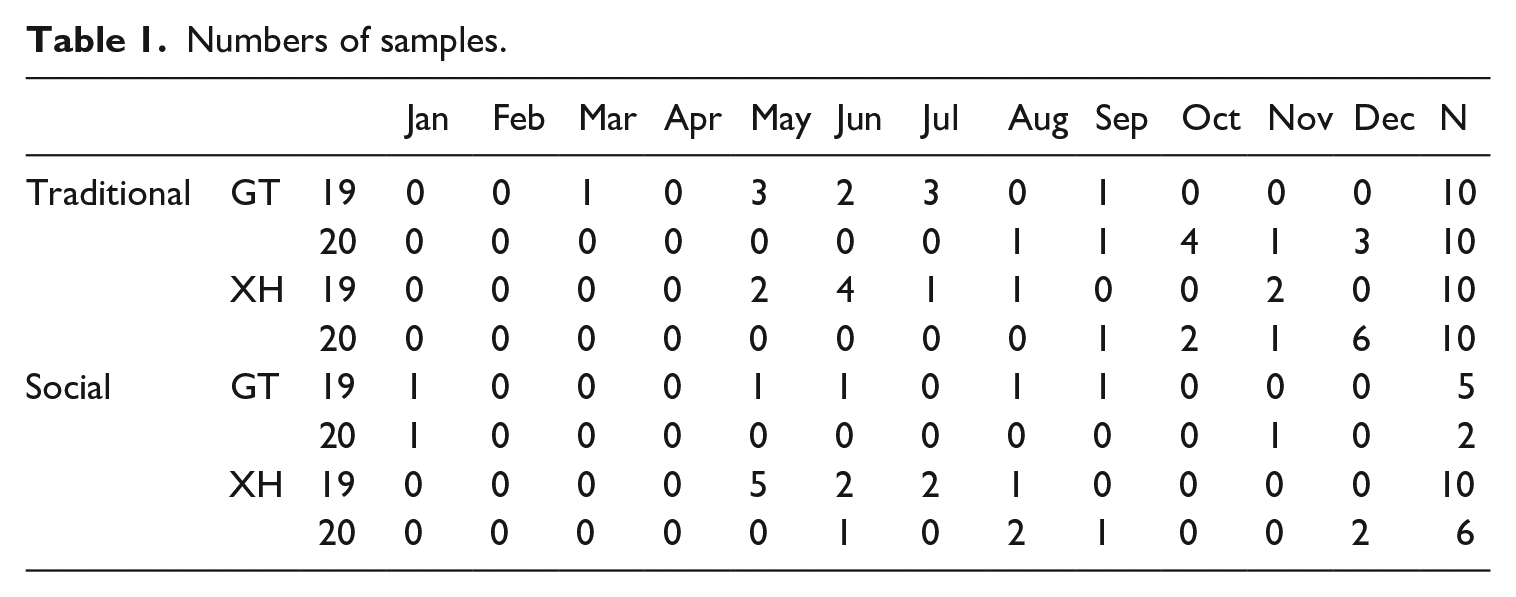
Because the applications of the proposed framework were recurrent, as demonstrated in the Findings section, the study did not retrieve more data to conduct an article-by-article CDA (Carvalho, 2008).
Findings
The critical discourse analysis found a consistent and recurrent application of the proposed framework for the notion of responsibility across traditional and social media content and across the two news media. Some of the social media content are shortened versions of the full-length news articles broadcast on traditional platforms. It is interesting to see that both media tended to present the responsibility-related parts of the full-length articles on their social media platforms. The illustrations of the social media content below try to include the non-duplicates to further evidence the consistency of the discursive strategies used on both media platforms by both news media.
Duties claimed by me/us as a result of self-motivation
The news media reported that China had proactively acknowledged its duties in dealing with the trade conflicts between the two countries and the collateral consequences. Both news media reported China’s willingness to participate in the trade negotiations, for example:
China ‘will negotiate in a. . .proactive manner’ (GT, ‘October China-US’);
‘China is willing to solve problems calmly through consultations and cooperation’ (XH, ‘China has sufficient’); and
China ‘expressed sincerity towards continuing economic and trade talks with the United States (XH, ‘Trade tensions between’).
Consistently, on Facebook, XH quoted a foreign ministry spokesperson’s statement reiterating China’s insistence on mutual dialogue and consultations and its sincerity in reaching an agreement with the US (Figure 1).
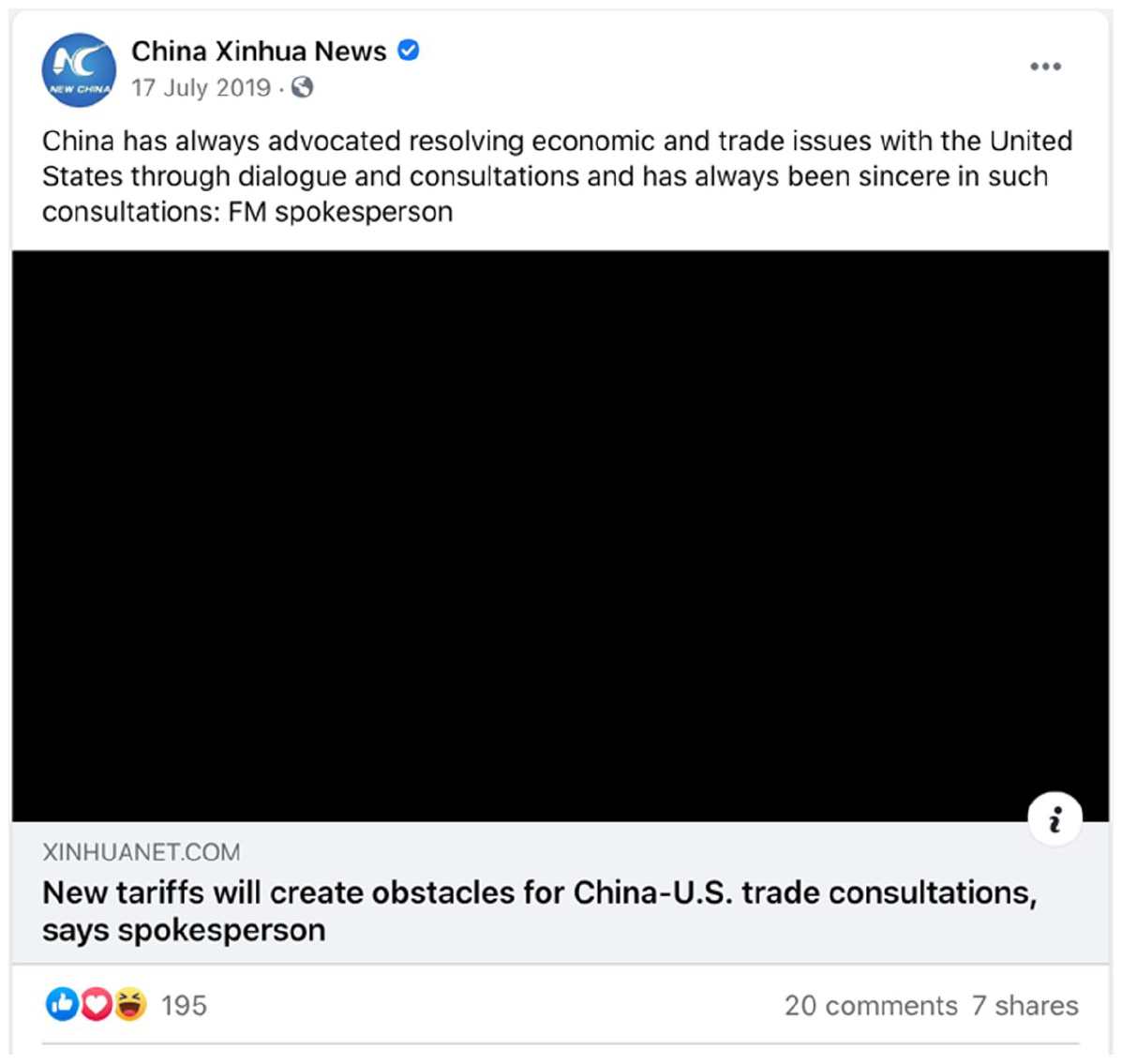
Screenshot of @XinhuaNewsAgency’s Facebook post.
Facing the trade war, GT reported that the Chinese government ‘is obviously more realistic’ in acknowledging the challenges to the Chinese domestic economy resulting from the trade conflicts, in comparison to the US who covered up the detrimental consequences caused by the trade war to its own people (GT, ‘Tall tales’).
After the agreement of the phase one trade deal, using the same strategy of emphasizing the duties willingly claimed by China for itself, GT said that ‘China was willing to work with the US to. . .jointly implement the trade deal’ (Wang, ‘China likely to increase’). The news media also covered China’s proactive stance and moves in specific areas, for example:
The imports of rice from the US show ‘the determination of Beijing to implement the phase one trade deal’ (Zhang & Shen, ‘US rice’);
‘it [China, added by the author] welcomes US firms’ participation in sectors such as 5G and new-energy vehicles’ (GT, ‘Beijing will’);
‘Chinese officials said China had completed 37 Customs quarantine protocols that allow more US agricultural products. . .into the Chinese market. While China will continue the deal as a goodwill gesture for the new US administration. . .’ (Wang & Ma, ‘China eyes’); and
‘China is likely to further increase purchases of US agricultural produce. . .and it continues to carry out the phase one trade deal with the US. . .’ (Wang, ‘China likely to increase’).
Generally, the two news media also highlighted China’s commitment to international trade in an overall sense, as, for example, ‘honoring its promises to open its market to the world’ (XH, ‘Commentary: U.S.’) and ‘resolutely safeguard[ing] multilateralism’ (XH, ‘Complete “decoupling”’).
Others’ faults
XH described the US’ overall trade policies with China as ‘vicious’ (XH, ‘Interview: U.S. vicious’). The two news media said that the trade war between the two countries was launched by the US and condemned that country’s hegemonism, protectionism, and unilateralism (XH, ‘Interview: U.S. vicious’; Yan, GT, ‘Flailing against’). They also blamed the US for escalating the trade war by suddenly announcing new tariffs on Chinese goods (GT, ‘October China-US’) and threatening to block exports of high-tech products to China (XH, ‘Interview: U.S. vicious’). To reiterate the negative representation of the US, XH depicted the US’ new additional tariffs on Chinese goods as ‘an irrational act’, the aim of which was to ‘blackmail China’ (XH, ‘Commentary: U.S.’). The blame was further justified by reporting the WTO’s decision on the unlawful tariffs imposed by the US on Chinese products (Wang, ‘Expectations for’). Moreover, XH directly used the notion of responsibility to blame the US for the detrimental consequences of the trade war, saying, ‘The United States is fully accountable for harming both sides and the world’ (XH, ‘MOC responds’).
Although 2020 began with the signing of the phase one trade deal between the two countries, XH still termed the US’ policy of linking trade issues to national security as ‘erroneous’ in a news article (XH, ‘China urges U.S. to stop politicizing’), and stated on Facebook that US’ measure of adding Chinese entities to export control list is a ‘wrongful action’ (Figure 2).
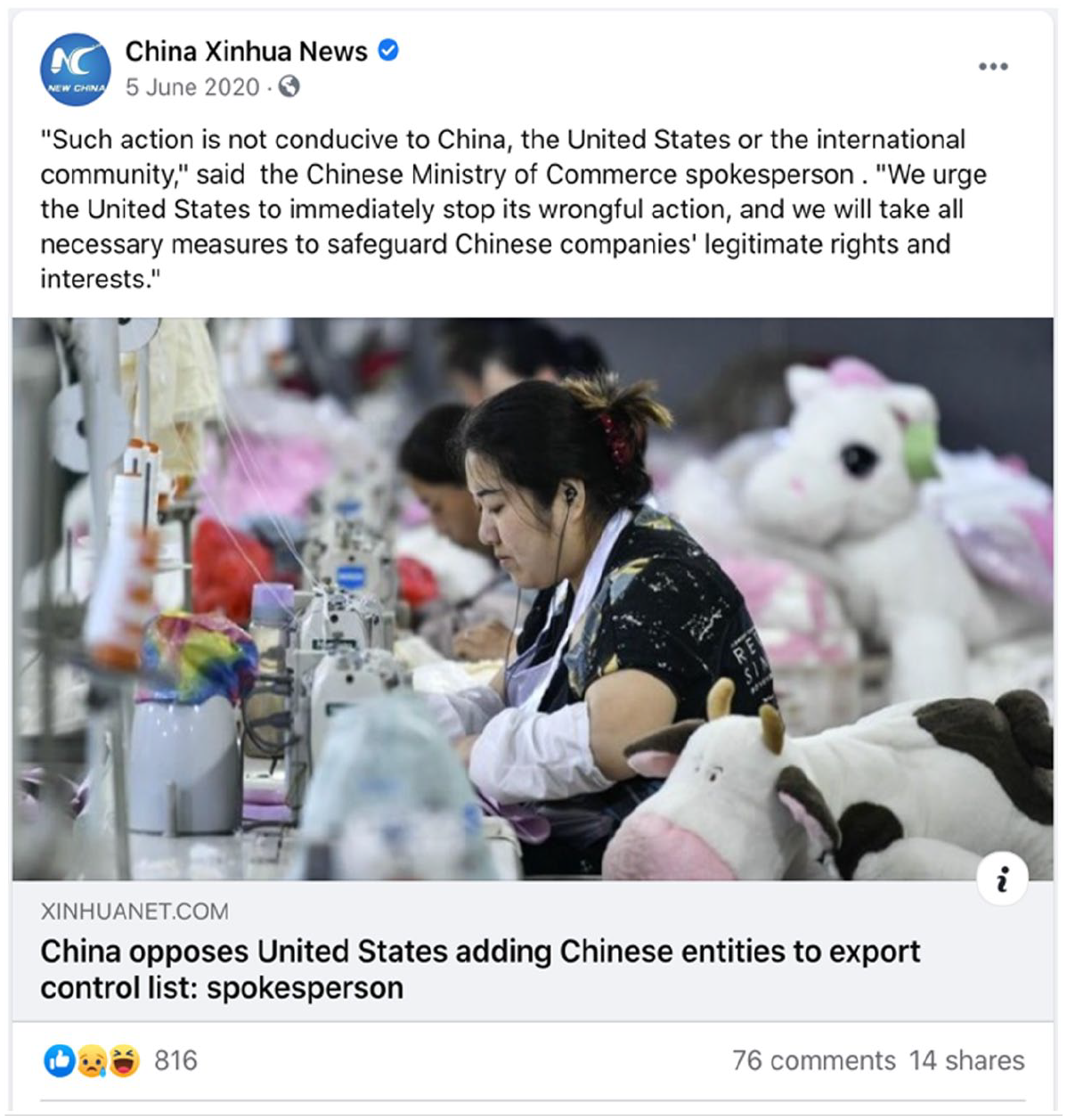
Screenshot of @XinhuaNewsAgency’s Facebook post.
Both news media also blamed the US’ problematic domestic and international policies as leading to its initiation of the trade war. For example, GT evaluated that ‘the US government has been misleading its people’ by masking the ill effects the trade confrontation could heap on the US economy (GT, ‘Stock drop’). It also depicted the false trade, as well as other, policies adopted by the Trump administration as a ‘drama’ (Li, GT, ‘Patience and endurance’). Moreover, XH also linked the trade war to the US’ ignorance of ‘international duties and responsibilities’ (XH, ‘MOC responds’).
In terms of the trade negotiations, the media reported that Chinese officials blamed the US for its continued ‘bullying tactics’ and ‘tough rhetoric and actions against China’ (Wang, GT, ‘China remains firm’), its lack of sincerity in continuing trade negotiations (Wang, GT, ‘China cautious over’), using unilateral measures in negotiations (GT, ‘Equality key to’), and being ‘arrogant and unreasonable’ in trade negotiations (XH, ‘Commentary: U.S.’). GT also condemned Trump for ‘making contradictory statements about the China-US phase one trade agreement’ (GT, ‘Trump contradicts’), indicating the hurdles imposed by the US on reaching a trade agreement. Consistent discourse also appeared on Facebook where XH quoted a Chinese diplomat’s accusation of ‘U.S. trade bullying’ even as the trade negotiations were taking place (Figure 3).
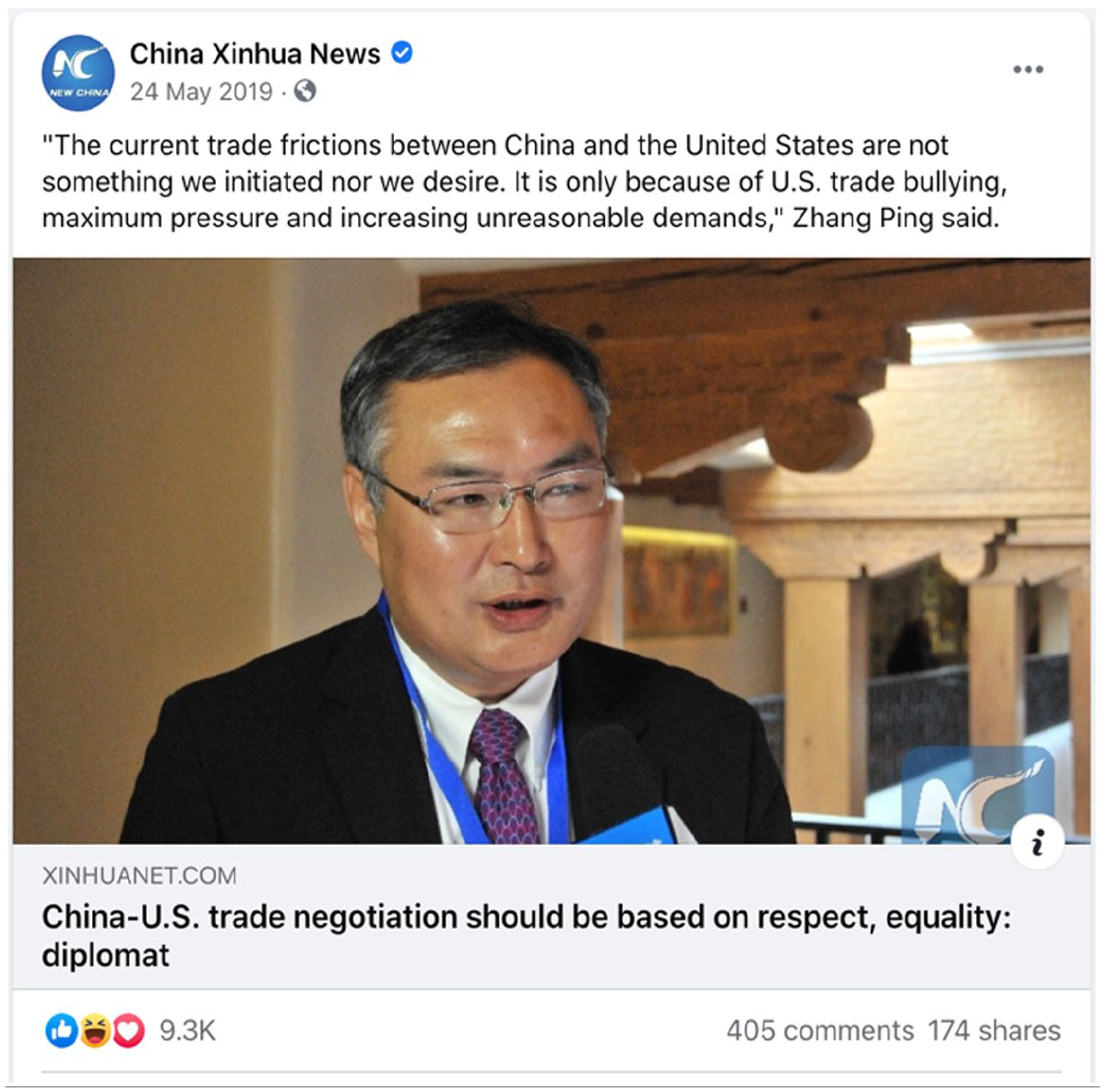
Screenshot of @XinhuaNewsAgency’s Facebook post.
In addition, the news media blamed the Joe Biden administration for ‘dimming prospects for a timely resolution of the ongoing tariff war’ because he did not remove the tariffs on Chinese products immediately on assuming office (Wang, ‘China likely to raise’).
Others’ duties upon request
The news coverage portrayed the US government as an accountable actor (Bivins, 2006) which needed to/could only fulfil rightful policies and behave reasonably under the request of others, such as other countries and its own economic sectors. At the height of the trade war, XH, combining with the strategy of placing blame on the US, quoted the China Foreign Ministry spokesperson as saying, ‘We urge the United States to abide by international law and the basic norms governing international relations, take practical actions to correct mistakes. . .’ (XH, ‘China urges U.S. to lift’).
The articles also depicted a US that was being urged to take measures to deal with its own trade problems. For example, quoting those in power in the US, such as a California state lawmaker, XH said that the US was requested to ‘not lose sight of the future’ in terms of trade relations with China (XH, ‘Absence at CIIE’). To remedy the US’ trade imbalances with China, XH reported that it had been suggested to the US that it should deal with its own issues in the financial sector and in technological innovations (XH, ‘Experts call for’; XH, ‘Interview: U.S. vicious’).
When the two countries were in the middle of reaching an agreement, GT’s editor-in-chief said on Facebook that the result of the agreement ‘depends mainly on the US’ sincerity’ (Figure 4), indicating a request to the US to be an accountable actor.
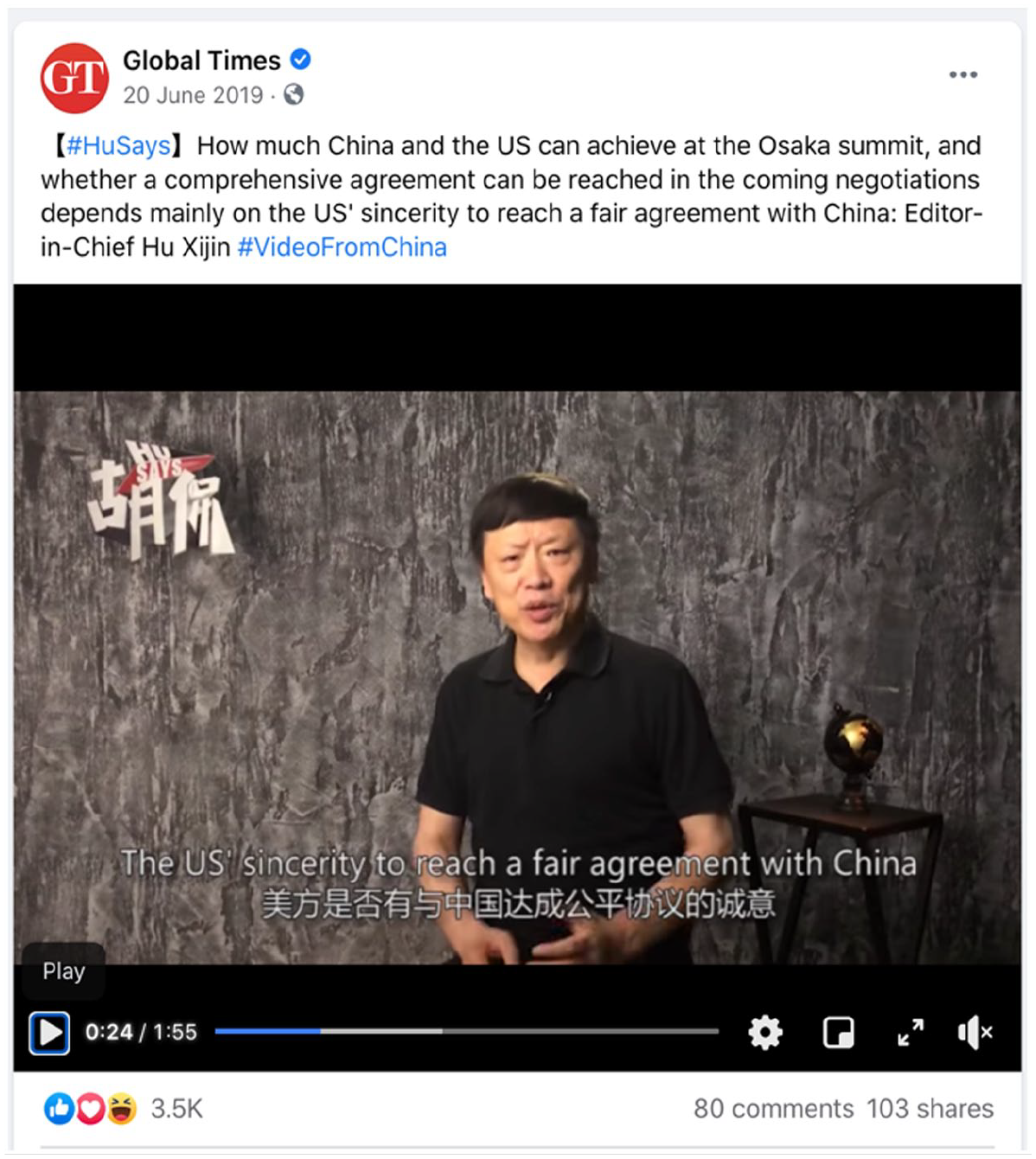
Screenshot of @globaltimesnews’ Facebook post.
When the US made progress in resolving the bilateral trade issues, the news media suppressed its positive moves. For instance, GT reported the phone call between the political leaders of the two countries as a result of the fact that ‘[t]here is uneasiness in global market about the trade talks and US officials are feeling the pressure’ (Wang, GT, ‘China, US trade’). In other words, the progress made by the US was merely a response to outside pressure rather than self-motivation, thus suppressing its positive moves.
After the signing of the phase one trade deal, analysts quoted by GT requested the US to ‘ensure steady supplies and remove hurdles’ and fulfil the trade agreement (Wang, ‘China likely to raise’). Moreover, pointing to the new US administration, GT said that one of its ‘top priorities. . .should be rebuilding confidence in US-China economic and trade ties’ (GT, ‘Next US govt’).
Exemption of my/our faults
Both GT and XH employed the strategy of ‘act-denial’ (‘I did not do/say that at all’) and ‘intention-denial’ (‘I did not mean that’, ‘You got me wrong’) (van Dijk, 1992: 92) to defend China against US’ accusations that it was ‘reaping benefits from the developed US economy’ (Zhang, ‘Trade war may’). XH reiterated that ‘the US accusations were totally unwarranted’ (XH, ‘MOC responds’), showed ‘a gross lack of common sense’ (XH, ‘Interview: U.S. protectionism’), and that the logic behind it was outdated (XH, ‘Expert refutes’). Instead, both news media argued that the US was benefitting from trade with China (XH, ‘Expert refutes’; Zhang, ‘Trade war may’).
In terms of the specific areas of trade confrontation, XH reported that China opposed the accusations from the US about the military nature of its enterprises (XH, ‘China firmly’). Combining with the strategy of blaming the other’s faults, XH quoted a China foreign ministry spokesperson condemning the US’ ‘groundless suppression of Chinese enterprises’ and its violation of trade principles and rules (XH, ‘China firmly’). As to the currency dispute, GT said in a Facebook post that ‘the label of “currency manipulator” is only bluff and bluster’ (Figure 5), while XH defined the US’ accusation as ‘mostly a symbolic gesture’ (Figure 6).
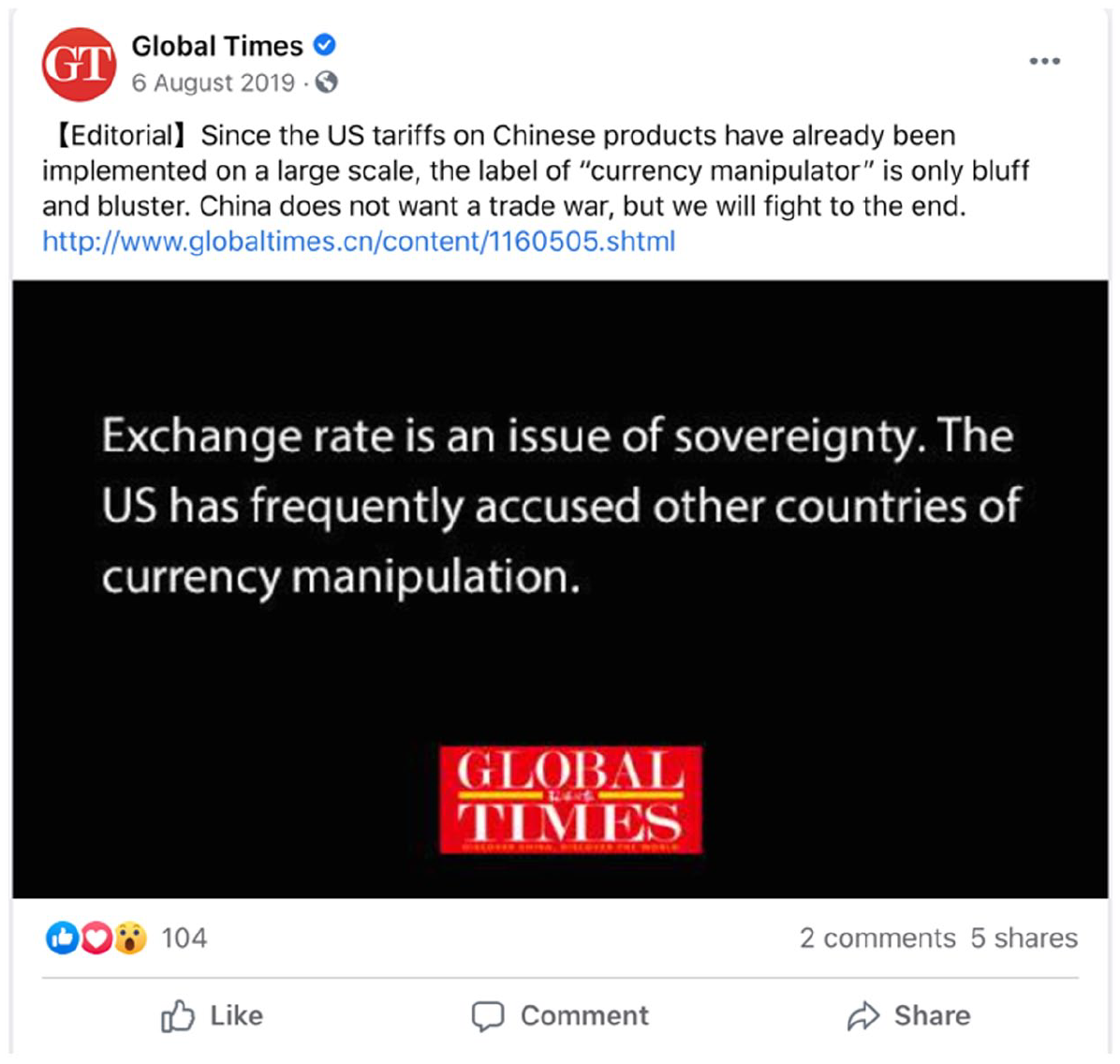
Screenshot of @globaltimesnews’ Facebook post.
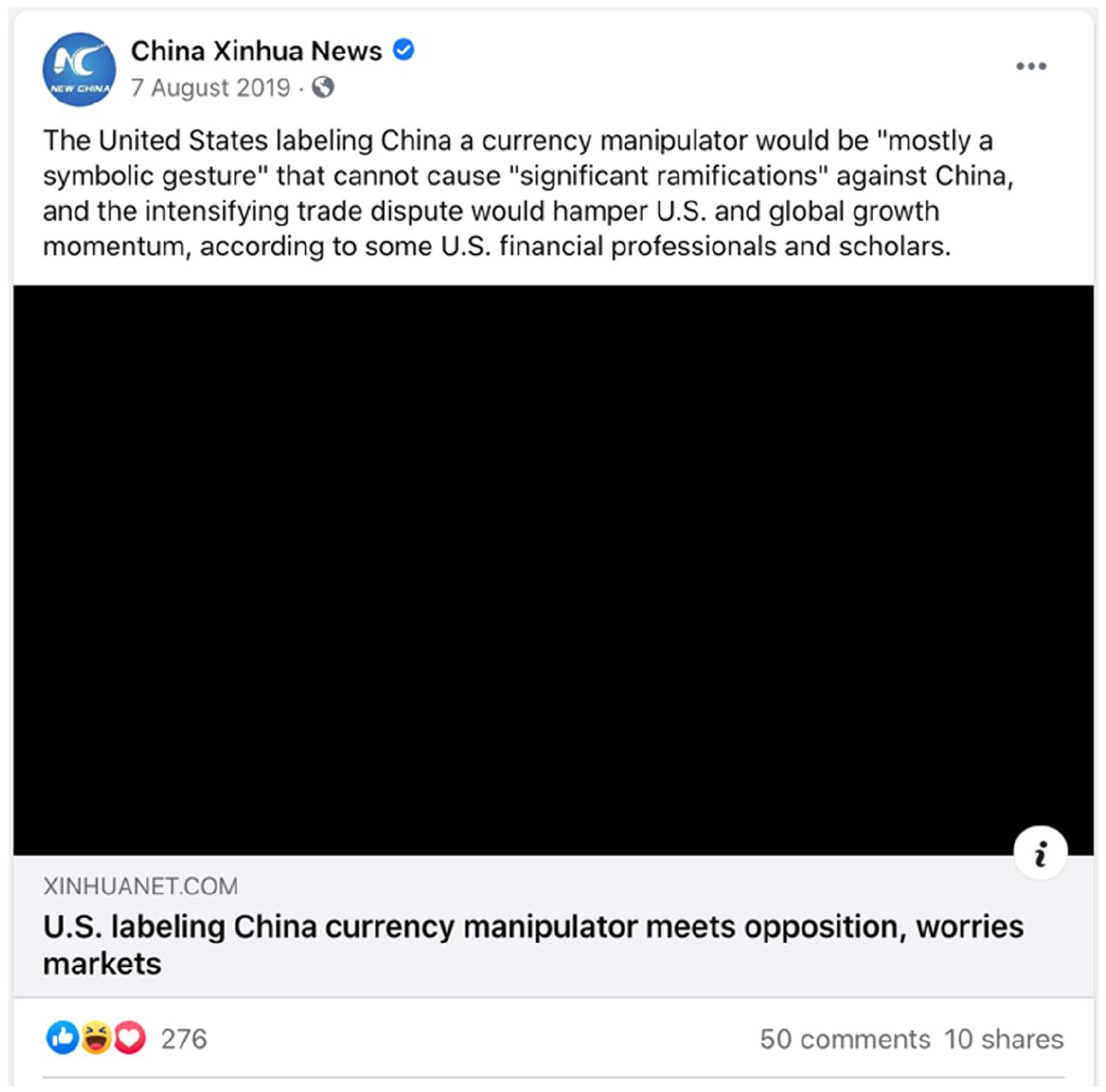
Screenshot of @XinhuaNewsAgency’s Facebook post.
Both news media also applied the strategy of blame avoidance when covering the trade negotiations. XH refuted the ‘US accusations of China backpedalling in the consultations’ and defended China’s practice of making adjustments to the trade documents, saying this was common in international negotiations (XH, ‘MOC responds’). XH also denied that China was forcing technology transfer and blamed the US for using this rhetorical trick to deter the trade negotiations (XH, ‘Commentary: U.S.’).
In general, XH, quoting a China foreign ministry spokesperson, refuted the China threat theory in areas including international trade circulated by the US, saying that this was only because of the US’ ‘Cold War mentality of ideological bias’ (XH, ‘China urges U.S. to stop suppressing’).
Conclusion
This study proposes a theoretical and methodological framework to study the notion of responsibility in the construction of the positive ‘us’ and negative ‘them’ dichotomy. This study formulates the framework by extending the methodological approach to responsibility-related discourses in CDA (Reisigl and Wodak, 2001; Wodak, 2001) and the theoretical understanding of the notion of responsibility in IRP (Erskine, 2003b; Loke, 2016) with the aid of van Dijk’s (1998) theoretical framework of the ideological square. It demonstrates the applicability of the proposed framework in discourses of China-US trade conflicts constructed by China’s state-run news media GT and XH on both traditional and social media platforms. The findings evidence the explanatory power of the proposed framework. Both news media, although with different reportage styles and orientations to different audience groups through two different platforms, consistently manoeuvre the notion of responsibility to construct the discourse of a positive ‘us’, that is, China, and a negative ‘them’, that is, the US, thus formulating the ‘us’ and ‘them’ division. Consistent with those identified in CDA and IRP studies (Erskine, 2003b; Loke, 2016; Reisigl and Wodak, 2001; Wodak, 2001), both news media used the strategy of emphasizing the other’s faults and requesting the other to fulfil its duties in order to depict a negative ‘other’, that is, the US. Furthermore, both news media also highlighted China’s fulfilment of duties as the result of self-motivation and avoided blame by others to construct a positive China. On the whole, both news media strategically applied the notion of responsibility, its connotations of duties and blame to be specific, to construct the positive ‘us’ and negative ‘them’ division. The findings are also consistent with those found in existing empirical studies on similar topics (e.g. Ha et al., 2021; Murphy and Vilceanu, 2014; Zeng and Sparks, 2020).
This study points to the importance of the nuanced understanding of the notion of responsibility in politics-related discourses. It tests the applicability of the proposed framework with media discourses from China’s state-sponsored news media, with a sole focus on the issue of China-US trade conflicts. Future studies could further test the applicability of the proposed framework in other politics-related discourses and in discourses focusing on other conflictual issues. Recent years have witnessed many divisions between countries and regions, such as Brexit and the US-Mexico border barrier. It is important to examine how those in power, such as politicians, legitimize their stances and behaviours through the discourse of responsibility and thus (re)inforce political, economic, and social divisions.
Footnotes
Appendix: List of cited media content
Global Times (20 October 2020) Beijing will continue to create impartial, fair market: official.
Global Times (26 July 2019) Equality key to China-US trade talks.
Global Times (5 November 2020) Next US govt needs to value trade relations with China.
Global Times (6 September 2019) October China-US trade talks worth the wait.
Global Times (15 May 2019) Stock drop reveals US trade war lies.
Global Times (14 May 2019) Tall tales won’t help US win trade war.
Global Times (20 August 2020) Trump contradicts himself over phase one trade deal.
Global Times [globaltimesnews] (6 August 2019) [Editorial] Since the US tariffs on Chinese products have already been implemented on a large scale. . . [Facebook status update]. Available at: https://www.facebook.com/globaltimesnews/posts/2467637059983846
Global Times [globaltimesnews] (20 June 2019) [#HuSays] How much China and the US can achieve at the Osaka summit. . . [Facebook status update]. Available at: https://www.facebook.com/globaltimesnews/posts/2379675825446637
Li Q (17 July 2019) Patience and endurance best for China amid trade war. Global Times.
Wang C (11 July 2019) China cautious over trade talks with the US. Global Times.
Wang C (26 October 2019) China likely to increase imports of US farm goods: expert. Global Times.
Wang C (9 December 2020) China likely to raise US agricultural product purchases in 2021: analysts. Global Times.
Wang C (21 June 2019) China remains firm on trade talks with US. Global Times.
Wang C (13 March 2019) China, US trade talks move to key text issues. Global Times.
Wang C (4 December 2020) Expectations for Biden lifting US tariffs dims after clear signal. Global Times.
Wang C and Ma J (2 December 2020) China eyes Biden team for trade talks. Global Times.
Xinhua News Agency (15 November 2019) Absence at CIIE means loss to US: California state lawmaker.
Xinhua News Agency [XinhuaNewsAgency] (17 July 2019) China has always advocated resolving economic and trade issues. . .[Facebook status update]. Available at: https://www.facebook.com/XinhuaNewsAgency/posts/3224671840893571
Xinhua News Agency (4 December 2020) China firmly opposes US designation of Chinese companies as ‘military enterprises’: FM.
Xinhua News Agency (29 August 2019) China has sufficient countermeasures, opposes mouthing trade war: MOC.
Xinhua News Agency (1 December 2020) China urges US to lift sanctions on Chinese enterprises.
Xinhua News Agency (14 December 2020) China urges US to stop politicizing economic issues.
Xinhua News Agency (23 December 2020) China urges US to stop suppressing Chinese companies: FM spokesperson.
Xinhua News Agency (16 May 2019) Commentary: US trade blackmail irrational, short-sighted.
Xinhua News Agency (30 October 2020) Complete ‘decoupling’ between China, US unrealistic: official.
Xinhua News Agency (13 June 2019) Experts call for US-China cooperation, end to trade disputes.
Xinhua News Agency (9 July 2019) Expert refutes rhetoric of U.S losing in trade with China.
Xinhua News Agency (30 September 2020) Interview: US protectionism violates WTO rules: Chinese political advisor.
Xinhua News Agency (14 June 2019) Interview: US vicious approach on trade to cost itself opportunities: economist.
Xinhua News Agency (4 June 2019) MOC responds to US statement on China white paper.
Xinhua News Agency [XinhuaNewsAgency] (5 June 2020) ‘Such action is not conducive to China, the United States or the international community’. . . [Facebook status update]. Available at: https://www.facebook.com/XinhuaNewsAgency/posts/4039582702735810
Xinhua News Agency [XinhuaNewsAgency] (24 May 2019) The current trade frictions between China and the United States are not something we initiated nor we desire. . . [Facebook status update]. Available at: https://www.facebook.com/XinhuaNewsAgency/posts/3111178268909596
Xinhua News Agency [XinhuaNewsAgency] (7 August 2019) The United States labelling China a currency manipulator would be ‘mostly a symbolic gesture’. . . [Facebook status update]. Available at: https://www.facebook.com/XinhuaNewsAgency/posts/3268912136469541
Xinhua News Agency (7 May 2019) Trade tensions between China, US would weaken global investments: Juncker.
Yan Y (28 June 2019) Flailing against the world, US may risk losing everything. Global Times.
Zhang H and Shen W (29 October 2020) US rice imported to China. Global Times.
Zhang Y (23 May 2019) Trade war may further worsen US local infrastructural woes. Global Times.
Funding
The author(s) disclosed receipt of the following financial support for the research, authorship, and/or publication of this article: This work was partially supported by Guangdong Province 2019 Innovation and Enhancement Project [grant number R5201913].
