




Abstract
This article aims to determine how digital nationalism influences gender politics in the context of gender-issue debates on Chinese social media platforms. To this end, I present an original case study, collecting empirical data from the most popular Chinese community question-answering (CQA) website, Zhihu. By using a mixed-method research design, consisting of content analysis (CA) and critical discourse analysis (CDA), I explored gender-issue debates between Chinese internet users. The analysis reveals how such debates inform divided opinions between women and men internet users, and how misogynistic men invoke a nationalist discourse to distort the debates.
Introduction
Across the entire world, populist nationalism has been experiencing a renaissance (Deckman and Cassese, 2021; Flew and Iosifidis, 2020; Postill, 2018). This political trend is also to be found in China, where populist nationalism is shaped by a socio-political process specific to the modernization of the East Asian superpower (Talmacs, 2020; Tang and Darr, 2012; Zeng and Sparks, 2020). Nowadays, the internet has become a major venue for the practice of populist nationalism in China (Leibold, 2010; Yang, 2017b; Zhang and Chib, 2014). This phenomenon is referred to as digital nationalism and it is based on Chinese internet users’ circulation of ‘their own nationalist narratives, interpretation, and voices’ on social media platforms (Zhang, 2021: 16). A better understanding of Chinese digital nationalism is required by the international community because it has the potential to influence a wide range of sectors outside the country (Flew and Iosifidis, 2020; Thussu, 2018; Thussu et al., 2018). Such influences are, to a certain extent, manifested by the Chinese Communist Party’s (CCP’s) firm stand on territorial disputes, which is arguably engineered by domestic pressures (Hyun et al., 2014).
Existing literature on Chinese digital nationalism focuses mainly on the state politics behind it (Leibold, 2010; Schneider, 2018; Tang and Darr, 2012), with only a few recent studies touching upon the gendered nature of nationalism in the Chinese context (Fang and Repnikova, 2018; Huang, 2016). Yet, mirroring Western nationalism, Chinese digital nationalism is predominantly popular with men internet users and is influenced by the gendered discourse of politics (Fang and Repnikova, 2018). Thus, a masculine nature surfaces in Chinese digital nationalism, showcasing its potential to influence indigenous gender politics (Huang, 2016). The intersection of digital nationalism and gender politics is a much-needed intellectual intervention, as it helps to foreground the compatibility between populist nationalism and patriarchal values (Deckman and Cassese, 2021). This compatibility has been identified outside of the Chinese territory, and it has facilitated the global amplification of misogynist voices, which has grave implications for the progress of gender equality today (Banet-Weiser, 2018; Koulouris, 2018; Zuckerberg, 2018).
To address the knowledge gap highlighted above, this article examines the interplay between digital nationalism and gender politics in the context of gender-issue debates among Chinese internet users. Using a case study conducted on the most popular Chinese community question-answering (CQA) website, Zhihu, I analyse whether debates on gender issues may cause a divide between women and men internet users, and how such debates may be influenced by the masculine nature of digital nationalism. In doing so, this article contributes to a better understanding of the current rise of anti-feminist, misogynist voices across the globe, and its reflection in China in relation to digital nationalism. The outcomes of the discussion add insights into the interplay between gender, state politics and popular discourses in the context of internet users’ communicative practices.
In the following sections, I first discuss the dynamics between feminism, businesses, digital nationalism and gender politics in contemporary China. This is followed by an explanation of the rationale behind the case study, in which I clarify how different research questions are answered by using different research methods. I then detail the analysis of the case study, focussing on how nationalist rhetoric is invoked in gender-issue debates between women and men internet users on Zhihu. I conclude by summarizing the principal research findings, and by discussing the illuminating intersection of digital nationalism and gender politics in Chinese digital cultures.
Literature review
Chinese digital nationalism
Chinese nationalism is constructed upon an indigenous historical view, which emphasizes the national humiliation caused by foreign invasions (Tang and Darr, 2012). Today, China has unquestionably become a powerful country with significant international influence. Yet, the nationalist sentiment encourages people to keep past humiliations alive in their memories (Riyun, 2009). Since the reform of the Chinese economy under Deng Xiaoping’s leadership, this nationalist sentiment has been exploited by the CCP’s populist politics (Song et al., 2021). The economic growth of the post-reform era comes at the cost of increased official corruption, wealth concentration and social stratification, which weaken the government’s authority. While the national sentiment emphasizes the country’s renaissance on the world stage, national pride represents an ‘important value shared by the regime and its domestic critics’ (Steele and Lynch, 2013: 443). Against this backdrop, nationalist propaganda is deployed by the CCP as a unifying strategy to reaffirm its authority, and it has been evidently well received by more and more Chinese people (Zhang and Chib, 2014).
The effect of the CCP’s nationalist propaganda is best exemplified by the emergence of digital nationalism. As Schneider (2018) observes, digital nationalism concerns Chinese people’s expression of national sentiments on the internet, and it is found on almost all major Chinese social media platforms, such as Weibo (Zhang, 2021), Tik Tok (Chen et al., 2021) and Zhihu (Zhang, 2020). Despite the CCP’s censorship (van Dijck et al., 2018), social media platforms create ‘channels for more pluralistic and critical discourses to emerge and spread’ (Fang and Repnikova, 2018: 2, 164), comprising the potential for digital civic engagement in China (Zou, 2020). Against this backdrop, digital nationalism becomes ‘marred in contradicting forces of globalization, cosmopolitanism, and China’s complex history and culture’ (Fang and Repnikova, 2018: 2, 166). Its participants include not only paid commentators employed by the government but also self-organized grass-roots internet users (Zhang, 2021). As such, the emergence of digital nationalism presents a ‘double-edged sword’, which not only fuels support for the CCP, but may also turn against it if and when the government ‘fails to meet the radical demands of nationalistic voices’ (Fang and Repnikova, 2018: 2, 163).
Existing studies on Chinese digital nationalism mainly focus on its implications for state politics (Guo, 2019; Hyun et al., 2014), with little scholarly attention being paid to how digital nationalism intersects with gender politics in the Chinese context. This is a major omission, as such an intersection has been identified as an important factor that amplifies misogynistic voices in the current global political climate (Banet-Weiser, 2018). This is evidenced by a series of recent anti-feminism movements aligning with Right-wing groups in major Western democracies and Latin America (Correa, 2017). To address this omission in existing literature in the Chinese context, it is necessary to fully account for the engineering of indigenous gender politics therein.
Post-reform gender politics
Using the term, post-reform (post-socialist) gender politics, Wallis (2015) foregrounds the historical and socio-cultural contingency of gender power relations in Chinese society. In China, progress in gender equality started in the 1900s when socialites returning from the West introduced early feminist thoughts to the East Asian country. This accelerated during Mao Zedong’s leadership when socialist women’s movements were considered a crucial part of the CCP’s political manifesto (Wu and Dong, 2019). Yet, contemporary scholarship indicates that patriarchy is experiencing a revival in Chinese gender politics because of the post-reform labour market restructuring (Evans, 2008). Since the late 1970s, the CCP has launched a series of policies, which are primarily based on the marketization of industries, to reform China’s economic sectors (Wallis and Shen, 2018). Rooted in a confusion between socially constructed gender differences and biologically determined sex differences, women are considered to be lacking in the technical skills highly prized in the labour market (Evans, 2008). Claims that women’s liberation had ‘outpaced’ China’s capacity for productivity are publicly used to argue against the improvement of women’s status in the labour, and thus broader market economy (Liu, 2014).
Certainly, there are women’s organizations and feminist activists advocating for the improvement of women’s socio-political status (Han, 2018; Li and Li, 2017; Zheng, 2015). Yet, having distanced itself from a revolutionary identity, the CCP tends to suppress such initiatives to avoid the spread of critical discourses of gender in Chinese society (Wallis, 2015). This governance strategy is, in part, due to the repercussions of such discourses, which potentially encourage wider criticisms of the CCP’s reform policies that effectively legitimize gender inequality (Evans, 2008). The CCP’s avoidance of critical discourses of gender is in line with its appropriation of management philosophies deeply rooted in Western capitalism, which shifts the responsibility of people’s well-being from the state onto individual citizens (Peng, 2020). Within this political climate, the understanding of gender as a ‘category of meanings that interrogates established norms of gendered and, therefore, social relationships’ becomes marginalized (Evans, 2008: 364). This tendency is well documented in the popular representations of women promoted by China’s cultural industries, which display ‘overt sexuality as expressions of urban, globalized modernity’ (Wallis, 2015: 227). It marks the revival of patriarchy in Chinese society.
However, the revived patriarchy does not always provide men with privileges in post-reform gender politics. Compared to men in powerful positions, ordinary men face a masculine crisis, caused by the growing pressure to be sexually attractive to women (Song and Hird, 2014). The masculine crisis started in the early reform period at the time of significant lay-offs of men employees in state-owned enterprises, which resulted in the socio-economic positions in the domestic space weakening for large numbers of unemployed men labourers (Peng, 2021). Since the 1990s, this masculine crisis has shown increasing blending/interweaving with wedding norms, which require men to be responsible for purchasing a property and taking on the role of financial provider in order to get married (Yang, 2017a). With the rapid growth of real estate prices, these wedding norms have placed huge economic burdens on Chinese men, causing increased anxiety about women’s appraisal of their worth (Song and Hird, 2014).
Post-reform gender politics, therefore, provides women and men with different (mis)perceptions of gender inequality, which are informed by their own, differing experiences of gender-power relations (Meng and Huang, 2017). The CCP’s neo-liberal governance strategy, which has distracted its attention from the structural, social problems, encourages the formation of divided opinions between women and men on gender-issue debates (Peng and Talmacs, 2022). In this period, misogynist voices have been on the rise, as identified by existing literature (Feldshuh, 2018; Han, 2018). Similar to their Western counterparts (Banet-Weiser, 2018), such misogynist voices generally present themselves as a backlash against feminism, reflecting the male cohort’s anxiety about the threats to their dominance in the socio-political sphere (Huang, 2016; Xu and Tan, 2020).
Women-focused KOLs
A unique phenomenon specific to post-reform gender politics is the constant reference to women-focused key opinion leaders (KOLs) by misogynistic men in gender-issue debates (Erguang, 2017). KOLs, known as ‘self-media practitioners’ (自媒体) or ‘big Vs’ (大V), are key opinion leaders who use social media to engage with followers for profit (Peng, 2020). Reflecting the increase of women’s purchasing power (Meng and Huang, 2017), the changing structure of the post-reform consumer market has created many iconic KOLs, such as Mimeng and Ayawawa, whose target audiences are women (Peng, 2020; Wu and Dong, 2019). In general, women-focused KOLs promote different ideologies based on the characteristics of the audiences with whom they engage daily. Yet, common to all is that they brand themselves as ‘feminists’ who speak on behalf of women (Wu and Dong, 2019).
As with their Western counterparts, feministic language is merely exploited as a self-branding technique by Chinese KOLs to target women followers. For instance, Wu and Dong’s (2019) analysis of Ayawawa’s social media posts shows that the digital influencer often promotes a set of gender norms by linking women’s performance of sexuality to their economic security. Similarly, Peng’s (2020) analysis of Mimeng reveals a tendency, when posting, to repack the exercise of consumer power as a form of women’s liberation. A pseudo-feminist manifesto, which largely centres round the building of interdependent gender relationships, surfaces from these women-focused KOLs’ discourse strategy (Peng, 2020). This pseudo-feminist manifesto is constructed upon the traditional notion of yin-yang balance between women and men (Liu, 2014). It is achieved through women’s management of a home–work balance, which does not alter China’s patriarchal socio-economic structures (Wallis and Shen, 2018). It can, therefore, be argued that women-focused KOLs, who merely encourage women to ‘indulge in the possibilities and pleasures of feminine expressions’ (Liu, 2014: 20), are nothing but accomplices of patriarchal capitalism (Meng and Huang, 2017). Their existence appears to appeal to their women followers, who frequently experience various forms of gender discrimination in Chinese society. However, at the same time, they pose no fundamental challenge to the patriarchal status quo.
Arguably, there are ‘authentic’ feminist practices which are advocated by activist feminist scholars and women’s organizations (Han, 2018; Wang and Driscoll, 2019), and which have become more widespread due to the recent MeToo Movement (Xu and Tan, 2020; Zhou and Qiu, 2020). However, due to their promotion of critical discourses of gender (Evans, 2008), the influence of such feminist practices is restricted by the CCP’s censorship (Zheng, 2015). This has given rise to the voices of women-focused KOLs in Chinese society today. Given the feministic veneer with which they are masked, women-focused KOLs have become popular objects of criticism, which are often invoked by misogynist voices in order to extend their assault on feminism and women’s organizations (Erguang, 2017). In this process, a (mis)perception of ‘undifferentiated’ feminism proliferates (Wu and Dong, 2019: 471), paving the way for misogynistic men to achieve an advantageous position in gender-issue debates.
Nationalist discourse in gender politics
In gender-issue debates, nationalism may come to the fore because nationalist discourse is inherently masculine (Deckman and Cassese, 2021) as a result of national identity being constructed through ‘masculinized memory, masculinized humiliation and masculinized hope’ (Enloe, 1989: 44). According to McClintock (1993): 61–62), ‘women are typically constructed as the symbolic bearers of the nation but are denied any direct relation to the national agency’. There is no nation that provides women and men citizens with the ‘same access to the rights and resources of the nation-state’ (McClintock, 1993: 61). The achievements of a nation, measured in terms of relative economic and military strength, are also associated with its national institutions, which across the world are generally dominated by men (Enloe, 1989). In this way, nationalist politics is shaped into a ‘major venue for accomplishing masculinity’ (Nagel, 1998: 251), as evidenced in the gendered basis of the Scottish Nationalist Party in British politics (Johns et al., 2012), Donald Trump’s victory over Hillary Clinton in the 2016 US presidential election (Deckman and Cassese, 2021), and differing representations of men and women in the Catalan independence movement (Iveson, 2017).
Although there seems to have been an increase in women’s participation in Chinese digital nationalism, a recent study conducted by Fang and Repnikova (2018: 2164) reveals that this increase relates to a ‘mythologized label that was deployed by other [. . .] groups to challenge and rebuke [male nationalists]’. Mirroring the masculine nature of nationalism, Chinese digital nationalism is still predominantly associated with male internet users and entwined with gender power relations (Fang and Repnikova, 2018). Cheng’s (2011) case study of digital racism on Chinese-language blog platforms, for instance, has touched upon the manifestation of nationalist rhetoric in male internet users’ invectives against African migrants living in the country. This nationalist rhetoric invokes the masculinity of nationalism by defining transnational marriages between a Chinese woman and a non-native man as a form of foreign invasion and calls for the preservation of ‘Chinese racial stock’ (Cheng, 2011: 567). These findings provide vivid examples instantiating the potential of digital nationalism to distort gender-issue debates.
In particular, feminism is widely considered as an imported Western concept in the Chinese context (Huang, 2016). As such, assessments of feminism by Chinese people often fall into what Rofel (2007: 111) refers to as ‘cosmopolitanism with Chinese characteristics’, which is based on a Western–Chinese dualist world-view. This world-view engenders contextual, ambivalent Chinese attitudes towards the West, which are based on a socio-economical hierarchy in which the West represents an aspirational fantasy, while China represents undesirable traditions (Gao, 2016). While men are understood to lead the Chinese economy, the socio-economical hierarchy encourages women to evaluate the ‘quality of Chinese men’ against that of Western men (Liu, 2019: 298). As part of the masculine crisis, this evaluation further encourages Chinese men’s acceptance of misogynist voices by providing them with a perception of being discriminated against by their women compatriots. In this way, the debates on gender issues between women and men are complicated, paving the way for the intersection of digital nationalism and gender politics in Chinese society.
Research questions and methods
Considering the intersection of Chinese digital nationalism and post-reform gender politics, I explore the following research questions:
To what extent do gender-issue debates create a divide between female and male internet users?
How do misogynistic men capitalize on the feministic veneer of women-focused KOLs to distort the gender-issue debates?
How does a nationalist discourse converge with misogynist voices in the gender-issue debates?
To answer the research questions, I collected original data from Zhihu, the most popular Chinese CQA site. CQA sites are an emerging type of social media platform, which allow internet users to post answers to questions asked by their peers (Peng and Talmacs, 2022). Similar to its English-language equivalent, Quora, the technological properties of Zhihu encourage Chinese internet users to provide ‘more quality, argumentative and information-rich postings’ on trending socio-political topics, rather than simply socializing with each other (Zhang, 2020: 96). In particular, statistics show that the female–male ratio of Zhihu users is generally balanced, though the educated middle-class remains the largest group of users on the site (Peng and Talmacs, 2022). The middle-class population not only upholds social stability (Goodman, 2014) but also leads socio-cultural trends in China (Denemark and Chubb, 2016). As such, their attitudes towards gender issues undeniably influence wider public opinion in the country. Zhihu is not exceptional in the CCP’s internet censorship. Yet, given its importance in the formation of public opinion, the CQA site has been proven by existing studies to be a valuable data repository for exploring socio-political trends in China today (Peng and Talmacs, 2022; Zhang, 2020).
To collect empirical data, I employed a case-study method, which is suitable for exploratory research projects (Yin, 2017). The present case study is an incident in which two influential male Zhihu users asserted in March 2018 that they had discovered a women’s organization that ‘deploys feminism to brainwash women’ and was involved in ‘Sino-foreign prostitution businesses’. The influence of these two users is attested by the fact that they both have approximately 20,000 followers on Zhihu. The term, ‘women’s organization’, is a label used by the two influential Zhihu users in their posts. While there is no evidence that the accused entity was a registered women’s organization, their claimed discovery directed internet users’ attention to feminism and created nine related questions, leading to a flood of posts circulating on Zhihu.
I sampled two of these questions, both of which attracted thousands of followers and hundreds of posts. The two questions are:
‘What do you think of [one of the influential Zhihu user’s] article on 15th of March entitled “‘It Seems I Pissed Them Off: Are They Fake Feminists or Brothel Owners’’’ (213 posts; 1300 followers); and
‘Why did no feminists condemn the women’s organization for their involvement in prostitution businesses? Some [feminists] even defended the organization, and smeared Chinese men by suggesting that they are sexually incapable in comparison to foreign men?’ (944 posts; 5254 followers).
The other questions, which received few if any posts, were excluded from the data set. The data collection was conducted between 21 and 28 June 2018, resulting in a total of 1157 posts collected. Of these posts, 254 were excluded from the analysis, as I was unable to determine the gender of the users from their Zhihu profiles.
I employed a mixed-method approach to analyse the sampled posts by means of content analysis (CA) and critical discourse analysis (CDA). CA is a quantitative, replicable data-reduction method used for compressing large volumes of text into specific categories (Zhang, 2021). I used CA techniques to code all the 903 sampled posts and then analyse the users’ opinion on the incident to determine the relationship between their gender and opinion. With the aim of categorizing each post based on unambiguous criteria, the coding scheme focused on the targets of criticism involved in Zhihu users’ posts. By considering the users’ gender as an independent variable, the CA results helped answer the first research question, which asked whether women and men’s opinions on gender issues are divided in the present case study.
CDA is a qualitative research method that scrutinizes the power relations established in the production of texts from a critical perspective. Fairclough (2003), one of the co-founders of CDA, provides a three-dimensional model to analyse textual data at the textual, discursive and socio-cultural levels. The textual analysis unpacks the features of the textual data, focussing on the use of linguistic devices, such as lexical choice, referential strategy, metaphorical framing and predicational association. The discursive analysis addresses the interplay between the text and discursive practice by identifying the patterns in the textual data. The socio-cultural analysis then examines the relationship between the discursive practice and socio-cultural processes, uncovering how discourse is contextually shaped by the wider society. Adopting Fairclough’s (2003) three-dimensional CDA framework, I analysed 100 most-liked posts amongst the data set (20 retrieved from Question 1; 80 retrieved from Question 2). The CDA process focused on the ambiguous discursive practice embedded in Zhihu users’ posts. It provided insights into the second and the third research questions, discerning how a nationalist distortion is manifest in the present case study. Users are provided with pseudonyms in the analysis below.
CA research findings
Measures
The CA coding scheme consisted of six variables, including the Zhihu user’s gender, criticizing patriarchy, criticizing men, criticizing feminism, criticizing women, and criticizing women-focused KOLs. Users’ gender was based on how they identified themselves in their Zhihu profile (0 = woman; 1 = man; 2 = anonymous; 4 = business profile). As the research was interested in comparisons between female and male internet users, I excluded those anonymous users whose gender was unknown (252) as well as business profiles (2). This resulted in a sample with 903 Zhihu posts, including 136 from women internet users (15%), and 767 from men internet users (85%). I further coded whether or not criticisms of patriarchy were present in each comment (0 = no; 1 = yes). A total of 24 comments (2%) were in some way critical of patriarchy. Each comment was also coded for the presence of criticisms of men (0 = no; 1 = yes), which was the case in a total of 54 comments (5%). I then coded whether or not a comment included criticisms of feminism (0 = no; 1 = yes) and, in total, 526 comments (46%) encompassed criticisms of feminism. For the fifth variable, ‘criticizing women’, I coded whether or not a comment was critical of women (0 = no; 1 = yes). Such criticisms were present in a total of 185 comments (16%). Finally, I coded for the presence of criticisms of women-focused KOLs (0 = no; 1 = yes). A total of 329 comments (28%) included such criticisms.
Coding process
Inter-coder reliability was verified by having a random sub-sample of 50 answers independently coded by two coders. Cohen’s kappa statistics were calculated to measure the level of agreement between the coders, with the following results: ‘criticizing men’ (κ = 0.810), ‘criticizing feminism’ (κ = 0.786), ‘criticizing women’ (κ = 798), ‘criticizing patriarchy’ (κ = 1.00) and ‘criticizing women-focused KOLs’ (κ = 0.85). These values were considered satisfactory enough for the remainder of the coding to be performed by one coder.
Results
Chi-square tests of independence were conducted to analyse whether internet users’ gender corresponded with the extent to which they included the various criticisms in their answers.
As can be seen in Table 1, the analysis showed notable connections between gender and the targets of criticism. Specifically, the analysis showed that a user’s gender and criticisms of men are significantly associated (χ2 = 13.879, df = 1, Pp < 0.001). Women internet users’ posts more often included criticisms of men (10%) than did men internet users’ posts (3%). Further, the analysis showed that there is a significant relationship between a user’s gender and criticisms of feminism (χ2 = 62.131, df = 1, Pp < 0.001). Male internet users more often included criticisms of feminism (52%) than did female internet users (15%). The analysis also revealed a meaningful association between a user’s gender and criticisms of feminism (χ2 = 19.289, df = 1, Pp < 0.001), demonstrating that male internet users more often included criticisms of feminism (18%) than did female internet users (3%). Finally, the analysis showed that a user’s gender and criticisms of women-focused KOLs are significantly associated (χ2 = 83.478, df = 1, Pp < 0.001). Women internet users more often included criticisms of women-focused KOLs (60%) than did men internet users (22%). The only pair with no significant association is that of a user’s gender and criticisms of patriarchy (χ2 = 0.971, df = 1, ns.). Neither women (3%) nor men (2%) were likely to touch upon patriarchy in their answers.
A summary of chi-square tests of independence results.
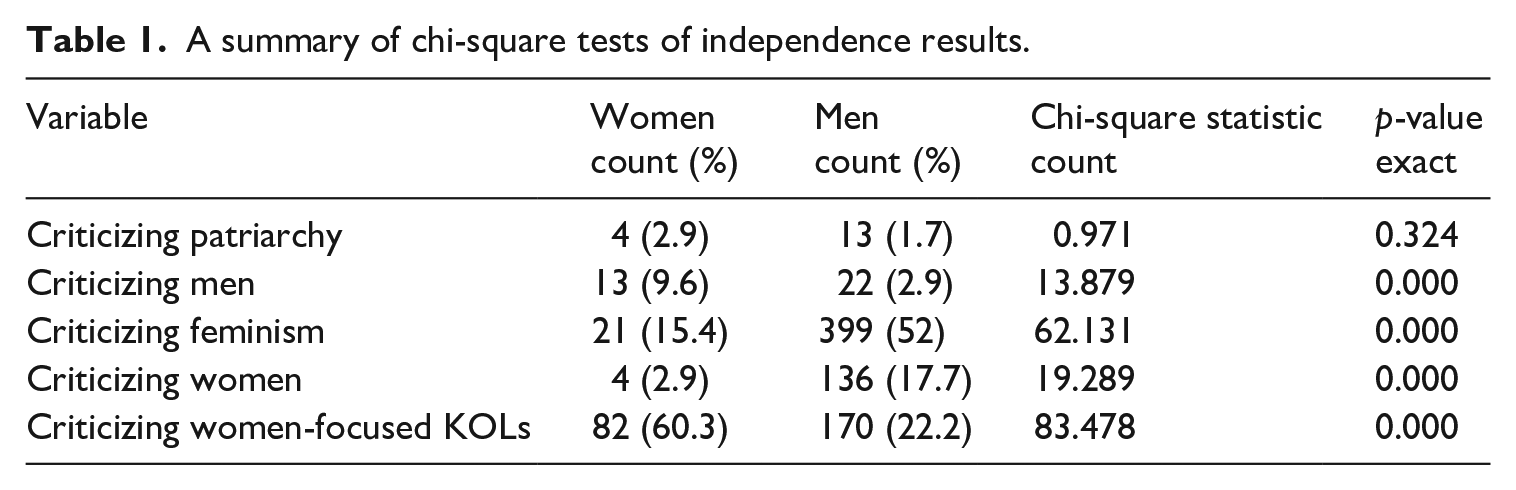
Through the CA process, it became apparent that the gender-issue debates in the present incident have largely created divided opinions between women and men internet users on Zhihu. Such a divide is most prominent in terms of female and male internet users’ evaluations of feminism and women-focused KOLs.
CDA analytical discussion
Women’s defence
The present debates were sparked by questions which explicitly referenced the two influential Zhihu users’ criticisms of the supposed wrongdoings of a women’s organization. While the women’s organization in question was labelled as a ‘feminist’ one, the posts were largely directed at Zhihu users expressing their opinions on gender issues in general, with the abstract concept of feminism being placed under the spotlight. Little attention has been paid to whether or not the claims made by the two influential Zhihu users are true. From a CDA perspective, I noted that many women internet users’ posts involved an attempt to defend their support for feminism and feminist initiatives. This discursive pattern becomes apparent when they distinguish between feminism and women-focused KOLs.
Is it a bigger mistake to indiscriminately accuse feminists without differentiating them? Rural [dog] feminists are the enemy of the whole society, yet authentic feminists are always fighting against gender inequality. (Meimei, woman, answer to Q1)
As the above remark shows, the woman user Meimei employs a referential strategy by referring to self-proclaimed ‘feminist’ KOLs as ‘rural [dog] feminists’ (中华田园女权). Rural dogs (中华田园犬) are a particular mixed breed widely kept by rural households as guard dogs in China. The term, ‘rural dogs’, has no literal connection with the concept of feminism. However, through its partial homonymy, it is phonetically related to the word ‘feminism’ (女权 – 女犬). Such a phonetic relationship is linked to the commonness of the breed and its association with rural households. In China, rural households are generally low-income due to the government’s concentration on urban development. As a result, the word, ‘countryside’, holds a range of negative connotations which conflict with the cosmopolitan lifestyle and social values appreciated by Chinese people today (Rofel, 2007). By exploiting the socio-cultural and phonetic entanglement of ‘rural dogs’ and ‘feminism’, the woman user has invoked a representative stigma established in Chinese digital cultures to differentiate between women-focused KOLs and feminists to underline her support for the latter.
In China, women-focused KOLs represent an implicit form of patriarchal values, evidenced by their promotion of a pseudo-feminist agenda, which encourages women to tame their husband or partner to serve their seemingly privileged status in the home (Peng, 2020). Such an agenda seems to be apolitical, as it deviates from the objectives of feminism, which are based on collective mobilizations to challenge the patriarchal status quo (Wu and Dong, 2019). The above-cited woman user’s employment of the dichromatic frame is part of a discursive pattern in which women supporters of feminism engage in gender-issue debates by pointing to the emergence of women-focused KOLs as an unwelcome consequence of the capitalization of feministic rhetoric by patriarchal capitalism in China.
Men’s criticisms
Being masked with a feministic veneer, the emergence of women-focused KOLs has a twofold impact on gender-issue debates in Chinese society. On the one hand, the pseudo-feminist agenda they promote is indeed appealing to some women, whose understanding of their own disadvantaged status is confirmed by their life experience and shaped by consumerist values (Wu and Dong, 2019). On the other hand, it diverts public attention from the gender inequality in the socio-economic structures, amid the spread of the masculine-crisis discourse that challenges their hegemony in Chinese society (Song and Hird, 2014). This diversion leads to many men’s intentional or non-intentional misinterpretations of women’s movements. Such misinterpretations are often invoked by misogynistic men, as demonstrated in male user Xiaoming’s post below: Chinese rural [dog] feminists’ flake of [men’s] virginity obsession discourages men from taking responsibility and getting married. [. . .] Marriage is rooted in male’s sexual desire; [. . .] and it addresses a family’s need for offspring and [parents’] needs for late-life caring. (Xiaoming, man, answer to Q2)
As a general trend, men’s criticisms of feminism also acknowledge the capitalist logic behind women-focused KOLs by using the same referential strategy, that is, the Chinese rural dog to describe women-focused KOLs. However, these men often intentionally blur the boundaries between these KOLs and feminist activists or women’s organizations by capitalizing the word, ‘feminism’, used in the stigmatized term. In this way, the feministic veneer of women-focused KOLs is capitalized in this discourse strategy, with the differences between the two being repainted as an internal, insignificant divergence between two subgroups. What results is a conspiratorial frame, which implies ‘feminists’ of any kind share a ‘secret’, ultimate objective, which is to gain women greater privileges than men. Following this unitary idea, feminism is conspiratorially accused of causing the divide between women and men in Chinese society.
I must acknowledge that exceptional cases do exist in the data set. There are occasionally women misogynists vocally defending anti-feminism movements, and men feminists enthusiastically arguing against patriarchal values. Yet, the general trend established in the present debates is still men critics of feminism engaging in disputes with women supporters of feminism. In the absence of reconciliation between the two camps, multiple portrayals of feminism are discursively constructed on Zhihu, leading to divides between women and men internet users’ posts. In particular, the anti-feminism male cohort generally dominates the direction of the debates, evidenced by the volume of men misogynists’ posts discovered in the present data set. This phenomenon echoes research findings in the context outside of the Chinese territory, showcasing how the spread of misogynistic voices has been facilitated by the emergence of social media platforms across the globe (Zuckerberg, 2018).
A Western-Chinese world-view
A divide between women and men internet users in gender-issue debates is not particular to the Chinese context but is also found in Western societies (Banet-Weiser, 2018; Zuckerberg, 2018). Yet, what makes the present case study significant is that the women and men internet users’ engagement with the debates on Zhihu has been markedly complicated by a Western–Chinese binary frame of reference. As the below quote from woman user Lili shows, this dualistic way of thinking frequently references the uniqueness of the Chinese context, pointing towards an interplay between the debates on gender issues and a discursive separation of China from the rest of the world, especially the West: In the 1990s, [Chinese] feminists fought for [women’s] basic human rights [. . .]. At that time, many women did not even have basic human rights; female infanticides and domestic violence against women were serious social issues. [Chinese] women’s status has certainly improved in recent years. However, do you not see the imbalanced sex ratio of second children, the discrimination against women in the workplace, and sexual harassment at universities? (Lili, woman, answer to Q2)
By referring to grave wrongdoings, such as ‘infanticides’ and ‘domestic violence against women’, woman user Lili’s post highlights the discrimination against women deeply held in Chinese traditions. This emphasis corresponds with the contemporary structural oppression of women and forms a socio-geographical frame, in which the ongoing gender inequality of contemporary Chinese society is captured. This socio-geographical frame is supported by rhetorical questions which emphasize the localness yet ubiquity of gender inequality in China, a problem that is overlooked by the general public at an emotional level. Such a discourse strategy strategically facilitates a comparison between China and the outside world.
In foreign countries, feminists and career women have together pushed the revolution of the [once patriarchal] workplace. Taking Australia as an example, many mothers choose to work in a part-time position [. . .]. Feminism indeed originated in Western societies. (Fangzi, woman, answer to Q2)
In remarks that develop those of woman user Lili, her woman peer, Fangzi, explains the origin of feminism by explicitly referring to the West. This explanation is again accomplished referentially by citing Australia as an example of a country where ‘authentic’ feminism is practised. In this way, a progressive imaginary of the West is depicted. As noted previously, the modernization of Chinese society is inseparable from Western military invasions in the 19th century, which collaterally encouraged its cultural exchanges with the outside world (Tang and Darr, 2012). As progressive, aboriginal concepts, feminism and feminist movements are also perceived to be imported from Western thinking through a Chinese lens (Rofel, 2007). Such a perception reiterates the Western-Chinese world-view as a way to reaffirm the necessity of tackling indigenous gender issues by learning from the Western experience. The mythologized imaginary of the West supports a Western–Chinese dualistic frame, which is constantly invoked by the women internet users, who lean towards advocating feminism, to criticize the patriarchal status quo in China.
A nationalist distortion
Unsurprisingly, the Western–Chinese dualist frame used by the above-mentioned women internet users is simultaneously exploited by their men opponents to rationalize their criticisms of feminism. In this process, a nationalist distortion of the debates often emerges when the misogynists’ argument against feminism is scrutinized, as the quotation below exemplifies: Feminists are hideous: It is alright if you hate men or hate getting married because this is your personal choice. The disgraceful aspect is that [some women] feel they become more valuable when they are together with a foreign man. [. . .] This is the hatred of men from their own country [. . .]. It is a form of reverse nationalism. (Liming, man, answer to Q2)
Employing a labelling technique, man user Liming describes Chinese women who are in favour of feminism as unpatriotic. The logic behind this accusation, in the man user’s terms, is that women supporters of feminism always show a tendency towards ‘selective misandry’, which is characterized by their prejudiced assessments of men and manhood. Such a labelling technique underscores the national boundary of Chinese feminists’ misandry in the context of cross-cultural romantic encounters. Specifically, it metaphorically relates Chinese women who date foreign men to the act of being submissive to Western masculine power. In the present debates, this discourse strategy may effectively invoke the nationalist sentiment of the male cohort through the intersections of sex, gender, and the collective memory of the national humiliation long established in the narratives of Chinese history.
Sex always represents a masculine achievement, which is connected to a man’s wealth and social status (Song and Hird, 2014). In this way, gender hierarchy and national identity are entangled in a discussion of cross-cultural romantic encounters in Chinese society. Pairing a foreign woman and a Chinese man is often perceived by the male cohort as a form of national pride, as it embodies the attainment of the man. On the other hand, pairing a foreign man and a Chinese woman is regarded as a belittlement of Chinese men’s sexual attraction to the opposite sex (Cheng, 2011). This gender–politics nexus is an extension of patriarchal values in which women are objectified as the property of men, who themselves are assumed to possess the ownership of both the nation and the bodies of the women who live in the nation.
In line with man user Liming’s argument, the way in which his man peer Lintao constructs his criticisms of feminism also highlights an imaginary of the alliance between Chinese feminists and Western nations in order to paint the former as threats to Chinese men’s ‘sovereignty’: This proves that women’s organizations are anti-Chinese. They have three characteristics: 1) reactionary, depicted as working closely with other external enemies to serve their anti-Chinese boss. (Lintao, man, answer to Q2)
Interestingly, Lintao’s post draws parallels with the CCP’s political propaganda campaigns. Moving beyond the context of cross-cultural romantic encounters, feminism, which challenges men’s ‘sovereignty’ over their women compatriots’ bodies, is rhetorically painted as an accomplice of the masculine invasions from the West and, by extension, becomes a threat to the very existence of the Chinese nation-state. This discourse strategy conspiratorially validates a linkage between the operation of women’s organizations in Chinese society and the plotting of foreign forces from the outside. It is accomplished by a lexical choice, using the term, ‘external enemies’, which is often used in the CCP’s propaganda campaigns (Song et al., 2021) to portray Western hostility towards China’s renaissance on the world stage. This discourse strategy is also found in the quote below from man user Yizhao: Chinese rural [dog] feminism and the hatred between Chinese men and women etc. [. . .]. The enemies with whom you fight are no longer a few Chinese rural [dog] feminist ‘big Vs’ but organized gangs whose members share the same interests with external enemies. (Yizhao, man, answer to Q1)
From the above extracts, it becomes apparent that a nationalist discourse which links Chinese women’s organizations to the ‘external enemies’ of the nation has been explicitly invoked by many men internet users to boycott feminism in the current gender-issue debates on Zhihu. Based upon the narratives of Chinese history, populist nationalism in the Chinese context is generally characterized by its enthusiasm for restoring the country’s once-leading role in international politics (Tang and Darr, 2012). This nationalist sentiment is still built upon a hierarchical Western-Chinese world-view, which uses Western democracies as a benchmark of modernity. However, it also comprises highly ambivalent attitudes towards them, which may contextually reverse the hierarchy.
While acknowledging that Western democracies are comparatively advanced in terms of industrialization, nationalist men internet users often believe that China has its own rich history and prosperous present, which have created a unique, superior cultural system that best suits the indigenous community (Riyun, 2009). These ambivalent attitudes towards the West have been exploited by the CCP to portray the West as being hostile to China’s renaissance in its political propaganda, which in turn is based on an assumption that this renaissance carries threats to Western supremacy in the international political arena (Song et al., 2021). In this way, the notion of ‘external enemies’, whose influences are not only dangerous, but also pervasive, becomes mythologized. It is well-received by nationalist men Chinese internet users, evidenced by their frequent usage of the term in pro-regime demonstrations on social media platforms (Song et al., 2021). Given the overlapping of men misogynists and nationalist internet users, the concept has also persisted into gender-issue debates on Zhihu. It has been adapted by men internet users to position feminists and women’s organizations as opponents of the entire Chinese society. In doing so, a nationalism-characterized misogynistic discourse is constructed. This allows the critics of feminism to unify the male cohort, who are facing mounting pressures from the masculine crisis in the post-reform era, to collectively boycott feminist initiatives of any kind.
Conclusion
In this article, I have answered the proposed research questions through a case study of the distortion of gender-issue debates by Chinese digital nationalism on Zhihu. Specifically, the CA results show that female and male internet users often share dramatically different opinions when they participate in gender-issue debates caused by the case-study incident. Such differences are revealed by the differing targets of criticism contained in their posts. In gender-issue debates, the division of female and male internet users is unsurprising. Running parallel to the rise of consumerism in Chinese society (Meng and Huang, 2017), the revival of patriarchy not only discriminates against women, but also exploits their men counterparts (Liu, 2019). Women-focused KOLs, who often promote a set of gender norms that reinforce the pressures faced by Chinese men, are highly visible in this process (Peng, 2020). By highlighting the feministic veneer of these gender norms, many men internet users have effectively exploited the male cohort’s aversion to women-focused KOLs to induce their peers’ boycott of any threats to male dominance in Chinese socio-economic structures.
Beyond the gendered division of the opinion in both camps, the CDA scrutiny also reveals notable differences in the discourse strategies adopted by women and men internet users in the current gender-issue debates. While women tend to differentiate between the contrasting agendas of feminism and women-focused KOLs, men often strive to confound the two, whether intentionally or not. The discourse strategy invoked by the male cohort feeds into a conspiratorial frame which stigmatizes all feminist initiatives by associating them with business interests. Such a tendency, identified in this case study, echoes many recent studies, which have also noted the misogynistic dimension of Chinese digital cultures today (Han, 2018; Peng, 2020; Peng et al., 2022; Wallis, 2015; Zhang, 2020).
In particular, in the present case study, male internet users’ conspiratorial framing of feminism has notably coincided with the nationalist discourse, pointing towards the nationalist distribution of post-reform gender politics in the Chinese context. As Liu (2019: 298) notes, with China’s return to the world stage, the political and economic position of the country in the international political arena is understood to be ‘once again constructed upon the quality of Chinese men’. This encourages a renewed search for masculine men in Chinese popular cultures, which in turn leads to the masculine crisis that often causes Chinese men’s anxiety in their everyday lives (Song and Hird, 2014). A nationalist discourse capitalizes this anxiety of Chinese men by forming an ideological tool that facilitates misogynistic voices’ unification of the male cohort in the debates. It provides a glimpse into the process through which nationalist sentiment is infused into post-reform gender politics in today’s Chinese digital cultures.
The nationalist distortion of the gender-issue debates on Zhihu reflects the changing political climate in the post-reform era. By means of promoting nationalist sentiment amongst the population, the CCP has sought to direct the attention of the general public ‘from internal difficulties towards perceived external threats’ (Tang and Darr, 2012: 811). This governance strategy showcases how the CCP redefines itself as the ‘guardian of national pride’, which promises to enhance the ‘collective image of Chinese society while providing political stability and economic prosperity’ (Steele and Lynch, 2013: 443). Against this backdrop, a nationalist colouring of political discourse is on the rise in Chinese digital cultures, despite it being a complex socio-cultural phenomenon, which is by no means fully controlled by the government (Leibold, 2010; Schneider, 2018; Zeng and Sparks, 2020; Zhang, 2021). Thus, the nationalist distortion of gender-issue debates, to a certain extent, sheds light on the nationalist colouring of political discourse in the context of post-reform gender politics, which is a socio-political phenomenon that requires further intellectual intervention.
The original study serves as a basis for future research to explore the interplay between digital nationalism and gender politics in the context of Chinese internet users’ communicative practice. Given the case-study nature of the present research, the findings are not intended to be generally applied as a grand narrative of all forms of gender-issue debates in Chinese society. The sampled posts were retrieved from a single CQA site, from which I selected two questions, which by their nature imply an aversion to both feminism and the West. Such a purposive sampling procedure potentially excludes the opinions of some internet users, who are either in favour of feminist thinking or against nationalist politics. Accordingly, the research findings may not fully account for every possible view possessed by internet users across gender and political spectrums. As such, I propose two distinctive approaches for future research: a quantitative CA research to analyse a larger sample of Zhihu posts, which would be followed up by interviews with the Zhihu users who posted them, and investigation into the extent to which the intersection of digital nationalism and gender politics has formed a general trend in the Chinese context and beyond.
Footnotes
Funding
The author received no financial support for the research, authorship, and/or publication of this article.
