




Abstract
Political leaders are often associated with violence. There does not seem to be a century when political leaders have not unleashed violence on their external or internal enemies or have themselves been attacked. But is there an affinity between political leadership and violence, and if so what kind of relationship is that affinity? Are all political leaders prone to violence all the time or just some of them some of the time? This article poses that relationship in terms of an ‘elective affinity’ between the two: some political leaders choose violence, and some choose to avoid it; some give their followers permission to inflict violence, and some prohibit it; some look the other way when violence is deployed, and some stop it. I conclude that there is a strong relationship with violence, but it lies more with ‘command’ rather than ‘leadership’ and is increasingly visible when the situation is either a crisis or infused with elements of the sacred. There are lots of potential examples to draw on, but we can learn more from an extreme case and there are few more extreme than the English Civil Wars. In this case violence was used by a king against some of his own subjects, and those followers responded first with violence and then, most unusually, put the king on trial and executed (sacrificed) him. Desacralizing violence was subsequently inflicted upon the regicides by the new king to resacralize the monarchy. I conclude with some reflections about the contemporary political situation.
Keywords
Introduction
In Goethe’s Elective Affinities (1809), the marriage of two aristocrats, Eduard and Charlotte living in Weimar, is undermined when they invite Eduard’s friend Captain Otto, and Charlotte’s orphaned niece, Ottilie, to live with them. It is an experiment (and is described as such) and results in strong mutual attraction between Eduard and Ottilie, and Otto and Charlotte. Goethe borrowed the term from the chemistry experiments of Boyle and Newton in which chemical reactions generate more energy from new bonds than are used to maintain the bonds of the original elements. Max Weber read Goethe but would also have known about elective affinities from his knowledge of 18th century chemistry (Howe, 1978: 367). Weber (1905/2002) shifts the connections from chemicals and individuals to cultural forms that have a relationship of reciprocal attraction and influence. In his case the elective affinity is between the Protestant religion and the rise of capitalism (Protestant Ethic & the Spirit of Capitalism - PESC). Weber only uses the term ‘Elective Affinity’ three times in PESC, though it does appear elsewhere in his writings on the sociology of religion. In fact, he never really defines it, though we might take Löwy’s (2004: 6) reconstruction as the most likely approach: ‘elective affinity is a process through which two cultural forms – religious, intellectual, political or economic – who have certain analogies, intimate kinships or meaning affinities, enter in a relationship of reciprocal attraction and influence, mutual selection, active convergence and mutual reinforcement.’ For Gerth and Mills (1946: 62), elective affinity is ‘the decisive conception by which Weber relates ideas and interests.’ In Weber’s PESC, the Calvinist variant of Protestantism spoke of predestination for true believers, in contrast to the Catholic church that encouraged its adherents to seek entry to heaven through good works and repentance. But for Calvinists, the psychological anxiety embodied in not really knowing whether you were amongst the ‘elect’ – those predestined for heaven – encouraged its adherents to seek confirmation of election in material success. However, that material success in business could not be transformed into personal luxuries because of the related Calvinist demand for asceticism, which meant that all the accumulated wealth of successful Calvinist businesses was instead reinvested in the business, generating ever-greater profits and growth. Weber’s claims about this being the springboard to the rise of capitalism in Calvinist Europe is empirically unproven (Scotland did not outperform English capitalism despite the former being much more Calvinist), but it does not invalidate the conceptual framework that certain cultures and ideas do seem to be mutually supportive, even if the causal relationship is weak (Jost, 2009).
This article does not focus on violence generally, but questions whether is there an elective affinity between political leadership and violence, that is, do political leaders have a default preference for the use or threat of violence against their opponents, or is the relationship rather more one of volition? In effect, and recognizing that this does not imply political leadership and violence are necessarily or causally connected, do political leaders have a penchant for violence that is significantly less visible when we consider the leadership of other forms of organization, such as most businesses, schools, hospitals and the like? Clearly, there are business leaders who do engage in violence, but if we exclude those involved in illegitimate business (illegal drugs, protection rackets etc.), the affinity between leadership and violence in the domain of business is significantly less (rather than completely absent) than that of political leadership. Indeed, there do seem to be some cases where violence is related not to political leadership, but to a perceived absence of leadership by politicians. For example, the Christmas market attack in Magdeburg in 2024, may have been a demonstration against political leadership in Germany (Malik, 2024).
In what follows I first discuss the links between violence and political leadership, as well as violence and command, before differentiating between different aspects of that relationship. I argue that violence is actually closer to ‘command’ than ‘leadership’, primarily because it is related to – or rather justified by – the connection to an apparent crisis. This relationship is modelled on an amended concept by Mitchell (2004), who suggested that violence is conventionally related to the threat posed to leaders, but in reality there are multiple cases where violence bears no relationship to the threat.
At the time of writing (September 2025–January 2026) parts of the world seems either engulfed in political violence, such as in Ukraine to Gaza, or hovering on the edge of sustained political violence, such as in the USA in the shadow of the murder of Charlie Kirk, or lurking on the border of Venezuela, but we cannot know how any of these situations will unfold. We do know how events in the past turned out, and here I want to focus on the lessons we can learn from an extreme and unusual case of political violence: the execution of the monarch by the English regicides after the second civil war in 1649. Violence surrounding monarchs and between contenders for the monarchy are common, but the English civil wars embodied something almost unique: citizens, or rather subjects, holding their monarch to account and eventually executing him and establishing a republic. This case, then, embodies all the key ingredients: leadership, command, violence, a crisis, and a sacred context. I consider first the relationship between the king, parliament and the New Model Army before examining the execution of the king – his desacralization – followed by the revenge of his successor to resacralize the monarchy. I conclude by suggesting that the stronger link is not between political ‘leaders’ and violence but between political ‘commanders’ and violence, and that in the case study violence relates to the way both sides misunderstood their opponent. Finally, I discuss why this relationship might help us understand the current state of political leadership and violence.
Violence and political leadership
The most orthodox definition of violence suggests it is ‘an intentional encroachment upon the physical integrity of the body.’ (Spierenburg, 2008: 17) A wider definition is used by the World Health Organization, which suggests that violence is ‘the intentional use of physical force or power, threatened or actual, against oneself, another person, or against a group or community, that either results in or has the high likelihood of resulting in injury, death, psychological harm, maldevelopment, or deprivation.’ (Quoted in Dwyer, 2022: 3) This wider definition excludes theriocide – the killing of animals 1 (foxhunting, or the meat industry for example) or violence against objects (such as slashing the tyres of a bus transporting immigrants to places of exclusion or forced repatriation).
But what counts as violence is subjective, because not all societies, cultures or individuals view the same act in a similar way. Indeed, violence is what Gallie (1955/56: 187–188) might have called ‘an essentially contested subject’ – as indeed is ‘legitimate authority’ (Wolff, 1999: 12). Thus, the reason non-state violence poses such a threat to the state is because that same state claims the legitimate monopoly of violence, and so, for example, while the right to strike may be considered legitimate, a general strike threatens the state and is therefore considered illegitimate. This, though, is to assume the context is objective and independent of the actors, when it is self-evident that actors, and especially political leaders, are prone to construct ‘situations’ based on evidence (fabricated or not) to justify whatever their goal is. For example, the invasion of Iraq in 2001 was premised on the presence of Weapons of Mass Destruction that turned out not to exist.
But what about action or inaction that is not in itself violent but facilitates the deployment of violence at a different level? Nixon (2011) calls this the difference between ‘slow’ and ‘instantaneous’ violence, where the former relates to the incremental and often invisible acts that accumulate over time to leave immense damage in their wake, while the latter concerns the immediate, visible and often sensational acts of bloodshed. For example, state sponsored austerity or suppression can lead, often years later, to outbursts of physical violence by citizens that the same state punishes as illegal and unwarranted acts of errant individuals.
Here we can also see how Arendt’s (1951/2006) arguments about the banality of evil are important and another refraction of the apparent affinity between political leadership and violence, for Eichmann denied any role in the physical violence of the Holocaust and regarded himself as ‘just’ an administrator.
Between 1 July 2023 and 30 June 2024 almost 200,000 people died from violent political events, with the greatest increase in the Palestinian Territories (from 321 to 40,000).
2
On 10 September 2025 the right-wing influencer and provocateur Charlie Kirk was killed at Utah Valley University in an event predicted by many to lead the USA ever-closer to increased political violence (Pilkington, 2025: 20). When asked by Fox News whether he would call for the country to come together in the face of the political violence, President Trump said that he ‘could not care less.’ (Quoted in Freedland, 2025: 1) Some have suggested that political leaders’ rhetorical violence facilitates ‘stochastic terrorism’, where coded language by leaders creates statistically predictable but individually unpredictable acts of violence (Angove, 2023). In fact, most political violence in the US is committed by people who do not belong to any particular organization, even if historically that was not the case: most of the violence of the 1960s and 1970s was from the political left, since then it has shifted towards the political right (Kleinfeld, 2021). Post 1990 it has been the right that has been responsible for the overwhelming number of political violent attacks, though, of course, 9/11 generated more victims and that was inspired by Islamic terrorists (The Economist, 2025). As Walter (2025) suggests, Political violence is not random. Research shows it becomes far more likely under four conditions: when democracy is declining rapidly, when societies are divided by race, religion or ethnicity, when political leaders tolerate or encourage violence, and when citizens have easy access to guns.
All of these conditions seem to prevail when Nicholas Maduro, President of Venezuela, was kidnapped by American special forces at the behest of President Trump, killing 30 Cubans in the process (Wilson, 2025). And violence is exacerbated when political parties become personalised, that is, their main function is to further the career of the leader rather than promote a particular set of policies (Frantz et al., 2024). The fear of escalating internal political violence is not restricted to the USA. On 13 September, Elon Musk told British protesters in London at the ‘Unite the Kingdom’ led by the right-wing leader Tommy Robinson, to ‘prepare for revolutionary government change.’ (Simpson and Tapper, 2025: 7) So what do we know about violent social or political change?
In Scheidel’s (2017) account, violence is the precondition for significant changes to patterns of social inequality across human history, whether that is through revolutions, mass-mobilization warfare, state collapse or catastrophic plagues. To paraphrase Orwell, all societies are violent, but some societies are more violent than others. As Adshead (2024) suggests, anyone of us can engage in violence when sufficiently provoked, and there is no such thing as a typical killer. If we take a longer historical and global overview of violence, we might start by noting that evolutionary biologists suggest that humanity and violence are irredeemably connected, and Keeley’s (1997) overview implies that there never was a peaceful era in human history. This is in distinct contrast to Engels’ (1884/2010) claim that hunter-gatherer societies exhibited Primitive Communism in their egalitarian structures and peaceful co-existence. Elias’s (2012) claim is that the rise of the modern state is coeval with the decline of interpersonal violence, in much the same way that Pinker (2012) has proclaimed. Foucault (1979) also noted that the use of extreme and very public violence against individual transgressors in the pre-modern state was, in and of itself, influential in the decline of public violence and its displacement by disciplinary systems that encouraged internal self-control over external violence, especially through imprisonment. Indeed, the decline of violence and the apparent growth of a world of pacified nation states sits at the heart of much early sociological theory (Ray, 2018). But we should be wary of linking the decline of performative terror by the state to any whig notion of increasing civilization, for the examples of Hitler, Mao, Pol Pot, Stalin, and Putin should be sufficient warning that the trajectory of political leaders and violence is anything but the incremental humanization process suggested by Elias (2012) and Pinker (2012). Indeed, if we delete ‘politics’ from its association with violence, then we are still left with trying to explain the rash of school-shootings and knife attacks by individuals (almost always boys and young men) for whom violence ‘is self-serving rather than political or ideological – the violence is the point’ (Cody Zoschak, quoted in Dearden, 2025: 24). 3
Nor should we absolve followers or citizens of responsibility for the perpetuation of state violence: for example, public executions in Britain regularly attracted mass crowds, sometimes as many as 100,000, and they only became private events in 1868 after the crowds became too rowdy to control (Dwyer, 2022: 56–57). 4 Indeed, as Snyder (2017: 17–18) suggests, one of the reasons why there is not more violence than there is relates to the ‘anticipatory obedience’ of people who act in alignment with political authority before any violence needs to be deployed. As he states: ‘Most of the power of authoritarianism is freely given.’
For Hobbes (1651/1982), writing during the English Civil Wars, the endemic nature of violence made a leviathan, an absolute sovereign, essential, for without a centralised authority able to contain the violence then life would be brutish, nasty and short for everyone. But this, for Rousseau (1762/1968), was to confuse cause with effect, because it was the very presence of the leviathan that undermined the peaceful nature of pre-modern society. Max Weber (1919/1965: 155–156) regarded the centralised state as the harbinger of a more rational-bureaucratic society that would replace the absolute sovereign, but it also embodied a monopoly of legitimate force to ensure that the rest of society remained relatively pacified. This implies that political leadership is, by definition, associated with, if not determined by, the use of violence. For Weber, following Clausewitz, power was ‘an act of violence to compel the opponent to do as we wish,’ though for Arendt (1999: 3–4), ‘when the essence of power is the effectiveness of command, then there is no greater power than that which grows out of the barrel of a gun.’
Violence is sometimes justified by political leaders on the basis of a sacred endeavour, a ritualised social ‘cleansing’, that will purify the country and/or those involved, and that trope has been deployed from the extreme right, such as the Italian Futurists (Adamowicz and Storchi, 2017) around the time of the 1WW, the Nazis, the Serbian army in the war in the former Yugolsavia (where rape of Bosnian women was systematic), and remains the rhetoric associated with the Proud Boys in the US and Trump (Applebaum, 2024; Campbell, 2022; Seifert, 1999: 150–153). The role of ritual in the construction of both the sacred, and the very notion of a community, is also key to both Durkheim (1912/1995) and Rappaport (1999), and its link to purification is a critical element of René Girard’s (1972, 1982) approach. In the latter, violence is both an essential part of humanity and can only be controlled by displacing it through the scapegoating of individuals. Girard suggests that mimesis – the desire of all humans to imitate each other – leads inevitably to the expropriation of others, a consequential rivalry and aggressive response, and a subsequent circle of generalized social violence. Hence the ritual murder of scapegoats cleanses the community of social violence and produces a temporary peace – until the next cycle of mimetic rivalry and violent contagion demands another scapegoat. In effect, the only solution to the Hobbesian ‘war of all against all’ is the ‘war of all against one’, and that ‘one’ must be both like us, yet different from us, so that the victim can embody many of the society’s attributes but simultaneously represent the most extreme archetype or prototype of the group (Haslam, 2001). For instance, after the September Massacres of 1792 during the French Revolution, it was argued by members of the Convention that they had inaugurated the ‘terror’ precisely to avoid the levels of violence they assumed would recur without such symbolic bloodletting (Linton, 2006). But public executions are more than just ritualised displays of ultraviolence on the part of the powerful, they are, as Cohen (1989: 408) suggests, ‘intricate rituals displaying atonement punishment and, most of all, the authority of the government to administer justice.’ This element of the state is precisely that which Weber suggested marks it out as unique, and simultaneously a way for a new government to demonstrate to all that a new power was ensconced.
If the French revolutionaries were Machiavellian in their deployment of political violence, what did Machiavelli actually say about the topic? The Prince suggests that sometimes political leaders needed to act immorally in an immoral world for the greater good. Thus, The fact is that a man who wants to act virtuously in every way necessarily comes to grief among so many who are not virtuous. Therefore, if a prince wants to maintain his rule, he must learn how not to be virtuous, and to make use of this or not according to need (2008: 91).
This is often interpreted as ‘Machiavellian’ in the sense of doing whatever is necessary to obtain and retain power, such as the actions within the Ottoman Empire of Mehmed III (1566–1603) who had 19 of his brothers killed on assuming the throne (De Bellaigue, 2025). But Machiavelli’s phrase also suggests that there are good reasons to be virtuous if the situation requires that behaviour. Hence, if the threat level was low then decision-makers should avoid violence since that would undermine the voluntary support of their followers. But is the propensity to engage in violence correlated with the level of threat so that violence is associated with particularly critical situations?
Walzer (1977) argued that a ‘supreme emergency’ (what Schmitt (2007: 5) called a ‘state of exception’) could justify ostensibly immoral acts, but as Benjamin (1940: 8) suggested, ‘The tradition of the oppressed is that the “state of emergency” in which we live is not the exception but the rule.’ There are two ways to understand this: first, that the state of emergency becomes a necessary response to an ongoing critical situation, or second, that the authorities construct the situation as if it were a permanent crisis, so that they can claim that the state of emergency is merely a necessary but contingent response to an object situation over which they have no control. The latter has been used twice by President Trump in 2025, first to expel hundreds of Venezuelans in March 2025 on the basis of the 1798 Alien Enemies Act which allows for such executive action for ‘whenever there shall be a declared war […] or any invasion or predatory incursion shall be perpetrated, attempted, or threatened’ against the US, all ‘subjects of the hostile nation or government’ could be ‘apprehended, restrained, secured and removed, as alien enemies.’ (Quoted in Santos, 2025) And second, when Trump called in the National Guard and the Marines to quell ‘the riots’ in Los Angeles in June 2025. In the latter case we might consider whether Trump’s analysis is more objectively accurate than that of the state’s Democratic Governor, Gavin Newsom, who claimed it was just a peaceful protest and the president was simply trying to stoke up local anger to legitimise his assault upon the constitution (Kaufman, 2025). Either way the point is that what counts as a crisis – and therefore what legitimizes violence by the agents of the state – is a subjective not an objective phenomenon.
Relatedly, political leaders have often claimed legal immunity for actions taken on behalf of the state, an argument originally founded in the divine right of kings that King Charles I – like his father James I 5 - claimed, and one supported not just by monarchs but by writers like Bodin (1576/2009: chapters viii & X of Book 1) who traced it back to Roman Law and described sovereign monarchs as ‘mortal Gods’ who ‘could do no wrong’. As Cooke, the prosecutor of Charles I insisted, the legal maxim that the king can do no wrong implied ‘that if he kill or rape it is neither murder nor felony. I say it is against reason and therefore against law.’ (Quoted in Robertson, 2005: 98). That tradition of sovereign immunity was supported by the likes of Alberico Gentili (1552–1608), tutor to Queen Elizabeth I, Hugo Grotius (1583–1645), and Emer de Vattel (1714–1767). As Bankas (2022) notes, after the Glorious Revolution in Britain in 1688, followed by the revolutions in America and France, sovereign immunity rather slipped from view, but it can still be glimpsed in the words of President Trump, supported by the 2024 decision of the US Supreme Court in defence of his actions as president. As it ruled in a majority decision on 1 July 2024, ‘Presidents and former presidents have broad immunity from criminal prosecution for official acts they took while in office.’ 6 Indeed, Trump stated on 15 February 2025, ‘He who saves his Country does not violate any Law.’ (Quoted in Sherman, 2025).
Sometimes political leaders argue that the violence of their own supporters or soldiers is beyond their control because it is an inevitable aspect of politics and especially of war. But Mitchell (2004) rejects the very idea of context generating non-responsible leadership by comparing leaders in situations of extreme violence – civil wars and the like. Conventionally the atrocities committed by victorious soldiers against ‘enemy’ civilians are laid against the contextual situation – ‘what could we, as mere leaders, have done when our troops get “out of control?”’ The answer, according to Mitchell, is plenty, and he provides examples where similar situations have led to markedly different results, depending on whether the leader gives or withdraws permission for troops to take their revenge on the survivors. Hence, Germans occupying the USSR were involved in mass murder and rape, as were Soviet troops who occupied Germany. Indeed, rape has become a tactic of many wars, but it is categorically not one of the ‘regrettable side effects’ of war, as the German Ministry of Defence suggested in 1993 (Seifert, 1999: 147). For example, whereas most English Parliamentary armies in the English Civil Wars – like their Royalist opponents – engaged in the slaughter of, and attacks upon, civilians, those in the New Model Army were forbidden from such action (except when in Ireland). 7 In sum, the bestiality of the situation does not necessarily invoke bestial behaviour by soldiers, but it does if the leadership permits it or ignores its existence. Moreover, political and military leaders are perfectly capable of justifying the mass murder of civilians, not because they pose a catastrophic threat to the community but because they hold the ‘wrong’ ideology.
But when we are considering cases like these, involving pre-planned systematic violence against civilians, are we looking at leadership or command? If ‘leadership’ is a catch-all word to describe any kind of decision-making by formal decision-makers, then ‘leadership’ embodies both violent psychopaths and pacifist humanitarians, and we perhaps overburden the capacity of the word. If, instead, and accepting that this a normative conceptualization, we differentiate between ‘leadership’ as the actions and processes involved in trying to mobilise a collective to address a complex (Wicked) problem, then there is no assumption that significant coercion is involved, though there might be. Here, collaboration is essential because the leader cannot know the solution to a Wicked problem (if they do then it isn’t a Wicked problem). On the other hand, if we use ‘Command’ as the concept to describe the action taken by a decision maker in a crisis, then we are far more likely to assume some degree of coercion is involved, and that may include violence or threats of violence. The precise demarcation of leadership from command and from management is subjective because while management, in this trilogy, is a decision style related to the processes known to resolve a soluble (Tame) problem, what counts as a Tame problem, or indeed a crisis, is essentially contested. In other words, we should not look at the context to see which term and decision style is appropriate but at the narratives of the actors involved and assess their claims to legitimacy. Thus, when decision-makers claim that the situation is ‘a crisis’ that requires the coercive actions of a commander, it fits within the framework of political leaders deploying violence against their alleged ‘enemies within’ to sustain their own support and deflecting attention from one set of grievances to one set of scapegoats. Similarly, when decision-makers suggest that ‘the situation’ is not a crisis or a Tame Problem but a Wicked Problem, requiring the collective response of the whole organization or city, then we might question whether that assessment is rooted in a determination to avoid making a decision, rather than in the context itself. In other words, the issue is not where do the boundaries between Leadership, Management and Command lie, but how – and why – do the various agents involved claim that their interpretation is the only legitimate one? It may be, then, that the ability to govern a society requires not just the traditional skills of leading, managing and commanding, but the skill to articulate a coherent narrative that justifies the switch from one decision-mode to another – and all against oppositional counter-narratives rooted in different understandings – or constructions – of the ‘same’ context.
We might also introduce Enzensberger’s ‘Heroes of Retreat’ (1997: 209–210) here because he shifts the debate from crisis decision-makers (commanders) as heroes, often deploying violence to defend their followers, to decision-makers (leaders) who undertake the extremely unheroic task of telling their followers unpopular truths that may well include abandoning violence in defence of collective self-interest. As he suggests, we need a new breed of hero, a hero of retreat who represents not victory, conquest or triumph, but resignation, withdrawal, and devolution… The greatest classical strategist Clausewitz showed that retreat is the most difficult manoeuvre in war. It is the same in politics. The ultimate act in the art of the possible is being able to surrender an untenable position. If the greatness of a hero is measured by the difficulty of the task he faces, then we must not only revise our notion of heroism but reverse it.
Enzensberger’s heroes of retreat include Khrushchev denouncing Stalin at 20th Party Congress in 1956, Françoise Fillon (ex-French PM) who told conservatives to vote for Macron not Le Pen, and F. W. de Klerk who persuaded most White South Africans to abandon the violence of apartheid, and instead accept a democratic transition from apartheid to the new regime under Mandela’s African National Congress (ANC). Hence, while we normally attribute that last political transition to the heroic leadership of Mandela (who did use violence against the state but later stood down the military wing of the ANC 8 ), Enzensberger’s point is that without F. W. de Klerk sacrificing his own career to persuade the White South Africans not to resist, the fate of the country might have been much bloodier. The same can be said of political leaders like John Hume, then the leader of the Northern Irish Social Democratic and Labour Party, who did so much to secure the ‘Good Friday’ Belfast Agreement in 1998 that saw the end of major conflicts, and personally suffered much abuse from his detractors on both sides of the political debate but won the Nobel Peace Prize for his efforts (Murphy, 2020, 2024). In short, the relationship between violence and leadership is not simply one that considers the propensity of ‘commanders’ to inflict violence on their enemies but also the skill and bravery with which ‘leaders’ can sacrifice their own well-being by speaking out against violence while maintaining a sense of hope for a better future (Hayden, 2024; Jaser and Tourish, 2024).
We can summarise much of the previous debate in Figure 1 below, based on the original work of Mitchell (2004: 40). Here, the vertical axis increases with violence, while the horizontal axis increases with threat, so the diagonal Machiavellian line suggests a clear increase of violence as the threat increases. However, the Tolerator/Pacifist box (embodying the likes of Martin Luther King and Gandhi) suggests that violence is to be avoided, irrespective of the level of threat, while the Inquisitor/Ideologue box suggests the opposite: violence is deployed irrespective of the threat level to the leader. We can see that in the actions of both Robespierre and the Jacobins in the French Terror, and in the leaders of groups like Islamic State. I have amended Mitchell’s original figure to incorporate the relationship between Leadership and Command, with the latter embodying the more coercive elements of decision-making. Political leadership and violence.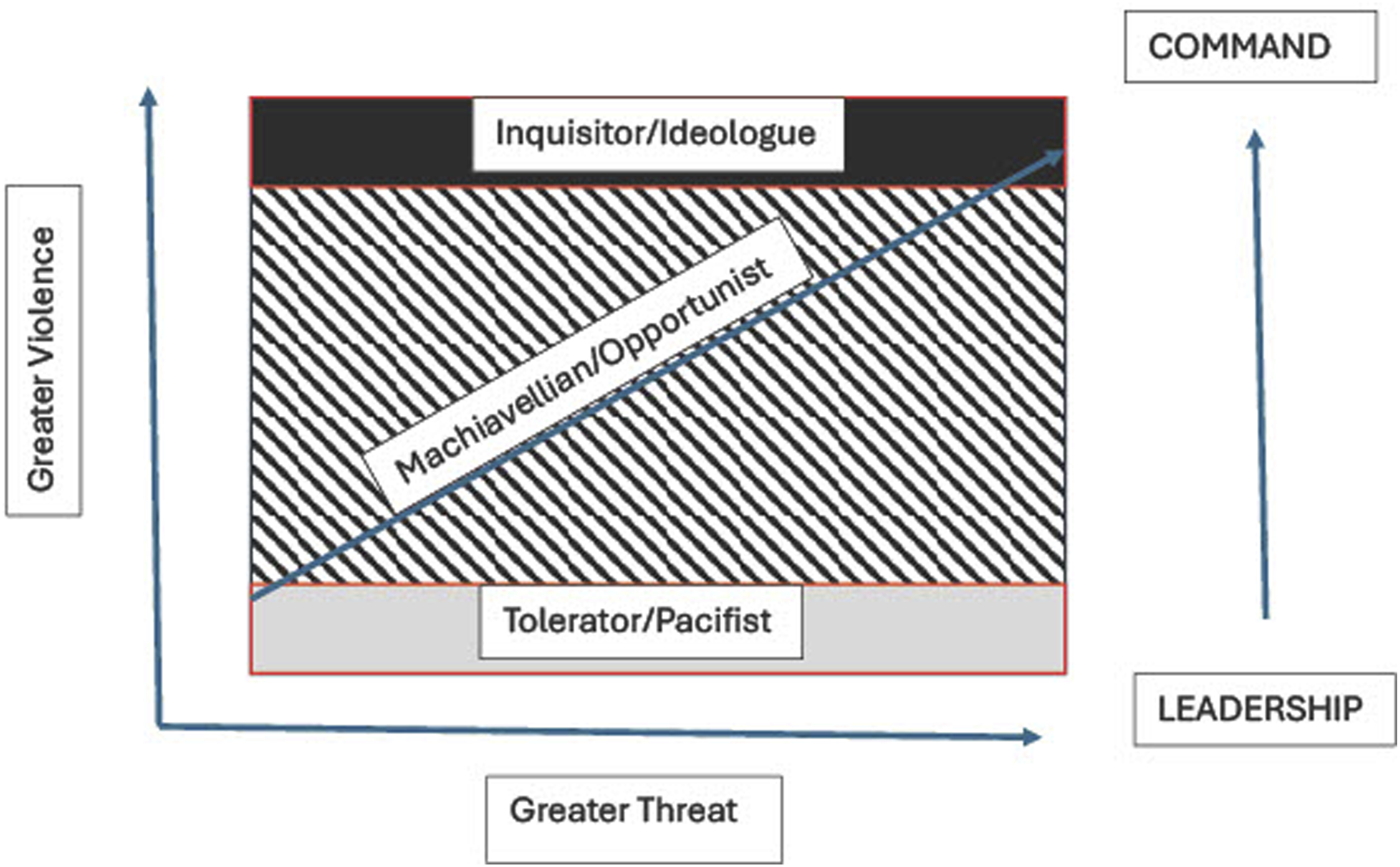
It is also important here to understand where political opponents lie on Mitchell’s figure. As Sun Tzu (Sun, 2010) suggests in chapter three of his Arts of War, If you know the enemy and know yourself, you need not fear the result of a hundred battles. If you know yourself but not the enemy, for every victory gained you will also suffer a defeat. If you know neither the enemy nor yourself, you will succumb in every battle.
In this context we will see how the leaders of the New Model Army consistently misplace King Charles I along the Machiavellian line and assumed that he would respond positively to their military power and acquiesce to their demands. But, in reality, Charles sat in the Ideologue box: he was never going to comply with the demands of his opponents because he believed he had a God-given right to rule, and nothing could change that. Only at the very end of his trial did the king recognize the danger and shift from the Ideologue box to the Machiavellian line but by then it was too late because his opponents had made the opposite last minute switch and were no longer interested in any kind of compromise or negotiated settlement.
In the next section I expand on the issues of elective affinities between leadership, command and violence in the case of the English regicides in 1649. I start by outlining the background, adumbrating the role of the king, parliament and the leadership of the New Model Army, before considering the execution of Charles I, and the subsequent restoration of the monarchy and the revenge of the new king, Charles II, on the regicides.
The English regicides
Disputes between King Charles I and parliament long predated the civil wars and were primarily related to three issues: his demand that parliament should be subordinate to his allegedly divine personal rule; his profligacy with the country’s finances (the royalist management of resources was always their weakest point in the civil wars); and through his insistence that his version of Protestantism, rooted in the Episcopalian institutions of the bishops, should prevail throughout England, Wales, and Scotland. The king’s parliamentary opponents based many of their initial arguments on a different interpretation of the status and history of monarchy: for them the country had never been the absolute monarchy that Charles seemed to embody, so they could justifiably remain both pro-(constitutional) monarchy but antagonistic towards Charles personal rule.
In 1626, the year after his accession to the throne, Charles dissolved parliament to prevent the impeachment of his personal favourite, George Villiers, the Duke of Buckingham, but needing funds to support his war with Spain he began raising taxes without parliamentary approval through a ‘Forced Loan’. Over 70 people were jailed for refusing to pay, and five of them sued for habeas corpus – unlawful detention, that had been sanctioned by the Magna Carta in 1215 which limited the power of the monarch. But in a response still in operation by authoritarians everywhere, the king leant on the judges involved in the case and unsurprisingly they decided that though it was unclear what the five were charged with, they could not be released on the grounds of public safety. However, the legality of the loans was thrown into doubt and Charles was forced to recall parliament in 1628 but imposed martial law – on the grounds of an alleged foreign threat – and demanded the right to take anyone’s property or liberty at will. 9 Parliament responded with the Petition of Right, demanding that only parliamentary-sanctioned taxation was legal, and detention for not paying illegal tax was itself unlawful. In turn, Charles insisted that he must retain the right to detain anyone, and that parliament should stop insulting his ministers, specifically Buckingham. But, needing money again, Charles eventually capitulated but then began to extend the demand for Ship Money – a tax normally restricted to coastal areas during times of external threat – across the country. In the absence of any apparent threat from abroad, and in the light of the previous Petition of Right, Ship Money generated further resistance across the country, and when Buckingham was murdered in 1628 his funeral was held at night to prevent popular celebrations. However, when the war with the French ended in 1629, Charles, no longer needing military finances, dissolved parliament and let it be known that parliaments were ‘of the nature of cats, that ever grow cursed with age.’ (Quoted in Healey, 2025: 56).
The king’s next serious conflict with parliament followed his attempt to impose his church reforms upon the Church of Scotland which led to the two Bishops’ Wars (1639 and 1640), the second iteration of which witnessed a Scottish army occupying parts of northern England – until Charles agreed not to impose his bishops on the Church of Scotland and to pay the expenses of the Scottish army. In turn, the costs of the latter forced Charles to recall parliament again (the so-called Long Parliament 10 ) to raise the tax necessary to pay off the Scots. Taking advantage of their new found influence, parliamentarians sought to rein in Charles, and his most despised adviser Strafford, who had called on Charles to use an Irish army against parliamentary resistance. The Commons responded first by impeaching Strafford and forcing Charles to sign his death warrant as a prerequisite for financial support, and then, under John Pym’s leadership, on 1 December 1641, by publishing the Grand Remonstrance that listed 204 objections to Charles’ policies. Amongst other things, it called for the expulsion of the bishops from parliament, and for parliament to have the right of veto over Charles’ appointments. Charles (having plotted to use the garrison in the Tower of London to threaten the rest of London), rejected the demands out of hand, and on 4 January 1642 he (along with 400 soldiers) attempted to have five MPs, including Pym, arrested in the House of Commons, but they had been forewarned and fled. At that point Charles and his leading supporters, fearing for their own lives, left London, and the first civil war ignited.
In the ensuing civil wars, in which 1/5th of adult males in England and Wales had fought, around 180,000 people died, almost ½ in combat and the rest from diseases including cholera, dysentery, malaria, plague, smallpox, typhoid, and typhus. That number included 4%–5% of the English population, 6% of the Scottish, and perhaps 20% of the Irish (Mortlock, 2017). This was killing on an industrial scale, or democide, in which life and death decisions became, at best, the mundane or everyday acts of violent normality. In other words, what counted as mundane depended not on the act itself but the context and the way the act of violence was understood by those involved. 11 The war also turned the world upside down in terms of political ideas and social norms 12 (Como, 2018).
Ironically, then, many in parliament had engaged in the civil war not to overthrow the monarchy but to protect the constitution – and that included retaining the monarchy – indeed many parliamentary claims suggested they were fighting for parliament and the office of the king (not necessarily King Charles I). Such a distinction followed some English Tudor writers who differentiated between the person of the monarch and the office of the monarchy, or, in the words of Kantorowicz (1957/2016), between the two bodies of the king: one political (representing the institution of the monarchy), and one corporeal (the physical body of the king). 13 Thus, the common cry at the death of a king ‘The king is dead; long live the king!’ And while Charles appeared to have believed that the king as a person and the king as the office holder were one and the same thing, this was not how many of his opponents envisaged the constitution.
Nevertheless, for many the king was above the law, and thus legally blameless, and certainly at the beginning of the war(s) only one MP – Henry Marten – articulated a vision of the future as a republic, though he was subsequently joined by Thomas Chaloner, Thomas Rainsborough, Alexander Rigby and William Strode. Hence, attempts to resolve the first civil war and restore the pre-Stuart constitution by negotiated settlement began within the first 6 months of the conflict, with the Nineteen Propositions proposed by parliament on 1 June 1642. These demanded a greater say in the governance of the kingdom, parliamentary control over the army, and church reform. Needless to say, after over 20 years of refusing to see any of his royal privileges diluted, and 11 of these years ruling without parliament, Charles I dismissed the propositions, declaring that they would reduce England to a republic and him to ‘a duke in Venice.’ (Quoted in Hammersley, 2025: 10).
The reluctance of some on the parliamentary side to fight the king until he was defeated was both obvious and self-evidently disabling the parliamentary war effort, even though the combined forces of parliament, aided by the newly allied Scottish army, eventually defeated the royalists at the battle of Marston Moor (8 miles west of York) on 2 July 1644. The north of England (which had been royalist in the main) now came under parliamentary control. But at a subsequent debate in parliament, General Thomas Ireton (Oliver Cromwell’s deputy and son-in-law) berated the Earl of Essex (Chief Commander of the Parliamentary Armies) for acting as if the war could be won by accommodation rather than arms. Essex responded: Gentlemen, I beseech you, let’s consider what we do; the king need not care how often he fights, but it concerns us to be wary, for in fighting we venture all for nothing. If we fight 100 times and beat him 99 [times], he will be king still, but if he beats us but once, or the last time, we shall be hanged, we shall lose our estates and our posterities be undone. (Quoted in Farr, 2006: 48)
That stung Cromwell into responding, ‘if this be so, why did we ever take up arms at first?’ (Quoted in Farr, 2006: 48) This reluctance of the Presbyterian (conservative) or Peace faction in parliament to prosecute the war against the king, encouraged the Independent (radical) or War faction – led by Cromwell and Waller - to force the ‘Self-Denying Ordinance’ through parliament in April 1645. This effectively prohibited MPs and Lords from retaining military positions and thus stripped the parliamentary Presbyterians of political control over the parliamentary army.
In turn, the legislation facilitated the rise of the country’s first professional army, the New Model(led) Army (NMA) and the decline of regionally-based armies. 14 As new Commander in Chief of the NMA, General Sir Thomas Fairfax was allowed to ignore the Self-Denying Ordinance and insisted that his deputy Cromwell have the same status. Fairfax was authorised by Parliament through the New Model Ordinance, to recruit 22,000 troops (including 14,000 foot soldiers and 6000 cavalry) from the three existing parliamentary armies in the south and east, where parliamentary support was strongest. Run on professional lines with far better management of resources than ever achieved by the royalists, the NMA recruited both volunteer veteran soldiers from the existing armies, especially with radical political beliefs and puritan values, as well as regular conscripts. The cavalry, who were mainly volunteers, were often yeomen or independent craftsmen, that is a higher social class than the foot soldiers who were mainly pressed, often illiterate, and sometimes had previously fought for the king (Woolrych, 2001: 54). And in sharp contrast to the conventions of most armies at the time, ‘the evidence for devoutness and piety in the New Model Army is overwhelming from beginning to end.’ (Gentles, 2022: 47) Indeed, it became known as ‘the praying army’, but it was held together as much by management, by the care for logistics that Cromwell embodied, as by the sinews of Puritanism. Yet that unity did not just rely upon the management of resources or the leadership of religiously inspired leaders, but also through the coercive command systems which were ferocious in the first 3 months of its existence (the spring of 1645): blasphemers had their tongues bored through with a hot iron, drunks rode the wooden horse, adulterers and ‘fornicators’ were whipped, and mutineers, deserters, and thieves were shot. The result was a drastic reduction in desertion and disciplinary offences to the point where there are no accounts of rape by NMA soldiers in England and only one of attempted rape in Scotland (Gentles, 2022: 56–57). That was definitively not the case in Ireland, where the NMA was involved in numerous atrocities against civilians. This uniqueness (outside Ireland), which was not replicated either among the other parliamentary armies nor any royalist force, also generated a separation from the rest of society and fed the common assumption amongst the NMA (especially its cavalry core) that it was not just atypical, but on a divine mission to set the country on a righteous path – as manifest in its military successes against the royalists.
If we revisit Figure 1, Figure 2 below maps the violence/threat, and we can see how both sides seemed to have assumed that their opponents initially sat somewhere along the Machiavellian/Opportunist line, and while this might be accurate for the parliamentarians, the king was actually firmly in the Inquisitor/Ideologue arena, completely unprepared for compromise or willing to recognise the threat posed to the monarchy by his intransigence to parliament. Moreover, the early parliamentary armies under Essex and Manchester remained perilously close to the Tolerator line in their reluctance to inflict significant violence upon the king’s armies. However, when they were displaced by the NMA it operated in a much clearer Machiavellian line – at least when in England, Wales and Scotland. But once it moved into Ireland it shifted up into the Ideologue box, for now it confronted opposition that was both royalist and Catholic, and it’s that which denuded the NMA of its proportional violence and unleashed the kind of massacres of surrendered soldiers and civilians in Drogheda and Wexford that to this day are remembered in the island of Ireland. Positions of the warring parties.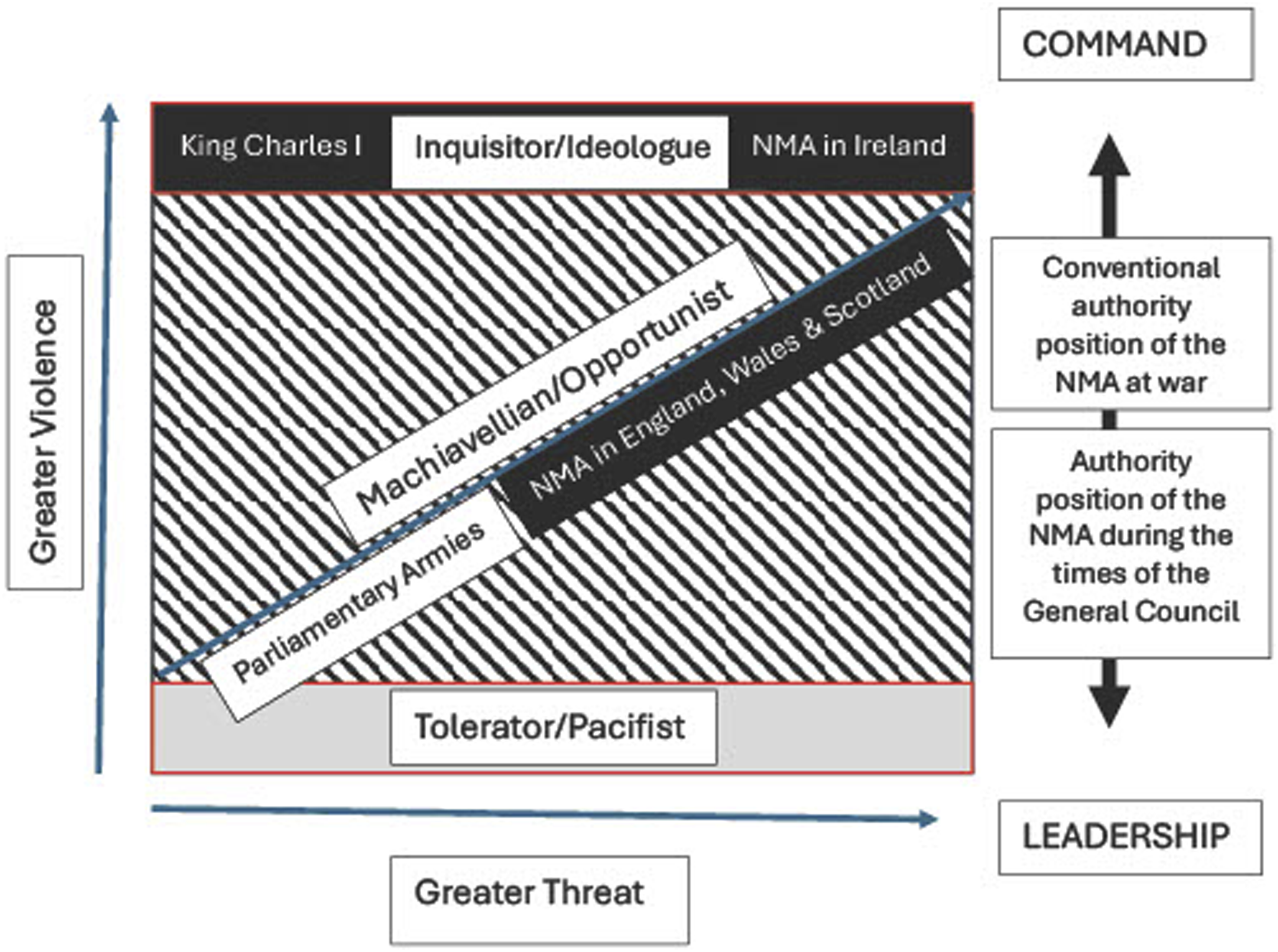
In July 1646, after a series of defeats by the NMA, the king surrendered to the Scottish army (then still allied to the parliamentary forces), and with the royalist threat diminished, parliament seemed content to restore the status quo ante, demobilise most of the army, and send the remainder to Ireland to put down a revolt, without addressing its demands for arrears of pay or legal protection. At this point the discontented voices within the NMA, supported by the radical civilian Levellers, responded by demanding a justice that included addressing the problems of the soldiers’ pay arrears (a management responsibility that parliament avoided whenever possible), as well as the removal of legal threats of prosecution for acts undertaken during the war. But the NMA wanted more: it also insisted on a settling of accounts with the king, and a new participative constitution. Rather than accept defeat, Charles began secret negotiations with Irish sympathisers, Scottish Presbyterians, the English Presbyterians, Denmark, France, the Netherlands, Sweden, and even the Pope (Robertson, 2005: 111).
A series of attempts were then made by radicals in parliament and the leadership of the NMA to persuade the king to accept some constitutional limits to his power, and these proposals or the Heads as they became known, eventually morphed into the Solemn Engagement in June 1647, probably written by Ireton with help from Cromwell and John Lambert. It described a new constitutional settlement and began by insisting that the soldiers ‘were not a mere mercenary Army’ and were intent on securing ‘our own and the peoples’ just rights and liberties’ (quoted in Taft, 2001: 177). To that end, all arbitrary power would be resisted, including that of the king and parliament, and the latter would be purged of malcontents and be regularly elected via a larger suffrage and a more egalitarian constituency system. In addition, religious toleration would be established and indemnities for actions undertaken by parliamentary soldiers provided (Taft, 2001: 178). Most of the Army appeared to support the Solemn Engagement and pledged that they would not disband until all their demands were met and parliament rid of those prejudiced against them. If and when the king agreed to this programme, he would be restored to his prior position (De Krey, 2017: 118-18; Woolrych, 2001: 59–61).
To hold the NMA together in the face of its enemies, the senior leadership of the NMA, the grandees as they became known, acquiesced to the demands of their radical critics within the army and authorised the establishment of a democratic forum– the General Council of the Army. It was composed of the grandees, plus two representatives from each of the regiments, in addition to some radical civilian Levellers. Initially they had agreed (though Cromwell and Ireton voted against it) to the Agreement of the People, a radical Leveller-inspired document that demanded significant changes to the constitution and it made no mention of the Lords or the king. But this was subsequently watered down by the grandees to the Remonstrance, which was used in November 1647 to persuade the then mutinous NMA to pull together in the face of two common enemies: the royalists and the Presbyterian parliament. We can see here how with the General Council, the NMA shifted away from the Command line down towards the Leadership line on the right of Figure 2 above.
The king, fearing the threat posed to the monarchy by the NMA’s increasing radicalization, escaped from custody to the Isle of Wight on 11 November 1647, and parliament responded with four bills that placed the Army under their control for 20 years, barred the king from creating peerages, and demanded that seven – but only seven - royalists face execution. When the king was then exposed as negotiating with the Scots to invade England, parliament responded with a Vote of No Address terminating all negotiations with the king. It was at this point that Charles’ enemies stopped pretending that the king’s errors were caused by evil counsellors, and his rejection of all seven previous settlements confirmed the conclusion that Charles Stuart was, himself, malignant (Robertson, 2005: 102; 110–112).
When the Presbyterian-dominated parliament then revoked the Vote of No Address in April 1648, royalists occupied Berwick and Carlisle and a Scottish army – now allied to the king - gathered on the border of England ready to invade in what became the Second Civil War. As usual the senior officers of the NMA, held a prayer meeting at Windsor Castle on 29–30 April 1648 to seek evidence that God was on their side, and the victories over the royalists in Wales and the north of England were taken as confirmation (De Krey, 2017: 176–179).
In November 1648 the last democratic General Council of the NMA approved Ireton’s seventy page Remonstrance which suggested that keeping the king would require the country to pay for the upkeep of a large army – to prevent him from starting another war – and it would be wrong to punish the king’s advisers when ‘the capital and grand author of our trouble was accorded impunity.’ (Quoted in Robertson, 2005: 116) It did not necessarily suggest the removal of the king but rather his trial – which, in theory, could result in a not-guilty verdict, though Ireton very much doubted that possibility, especially since God had apparently demonstrated the withdrawal of his support from Charles by his demonstrable defeat in both wars. As the Remonstrance suggested, it was theoretically possible that the king would have a change of heart, but Charles had shown ‘many particulars of hypocrisy, dissimulation and treachery… [that] exemplary justice being done in capital punishment upon the principal author… and thereby the blood thereof expiated… [and] no such person whatsoever may be exempt from such an account or punishment’ (quoted in Farr, 2006: 148–149). 15
As news of the progress of the Remonstrance spurred on the negotiations between the king and 15 parliamentary commissioners, led by Denzil Holles, the proposed Treaty of Newport required Charles to accept responsibility for the war, abolish the bishops, allow parliament to control military and civil appointments for 20 years, and cede control over Ireland until the rebellion was put down. Charles – despite the advice of 42 experts - refused to agree to the total abolition of the episcopacy or to see his closest friends and allies lose their lands, but he seemed reluctantly acquiescent to the rest (Robertson 2005: 129). In fact, Charles had already informed James Butler (Duke, then Marquess, of Ormond and Commander of the Irish royalist army) that he would not abide by any agreement, whatever his public statements. If ever there was a statement from an Ideologue, this was it – and even though it was not made public at the time, it was already clear to the senior leaders of the NMA, and their supporters amongst the radical Independents or ‘commonswealthmen’ (Robertson, 2005: 111) in the House of Commons, that violence against the king was the only method to contain further violence in the country. There followed a discussion about whether the Army should follow protocol according to the rules of war and have the king – as a defeated enemy commander legally responsible for the actions of his soldiers - court-martialled and shot immediately, as had happened to senior royalist commanders. Or even whether there should be a trial by jury – but since that might return a ‘not guilty’ decision, both options were turned down. This trial would be in public, not in the shadows, but the ‘jury’ would be handpicked. Moreover, while the king’s legal team had toyed with the idea of claiming habeas corpus – illegal detention – that would legitimate the assumption that the king was indeed subject to the law, so the idea was abandoned (Robertson, 2005: 132–133, 164).
On 5 December 1648 parliament voted again to continue negotiating with the king, and the grandees of the NMA responded with the Declaration of his Excellency the Lord General Fairfax and his General Council of Officers which demanded parliament purge itself and, when they demurred, a military coup, or Pride’s Purge as it became known, took place on 6 December 1648, which removed 231 MPs with 45 arrested and 186 excluded. What remained became known as the Rump Parliament and it annulled the Treaty of Newport, passed the Agreement of the People which proposed that only those signed up to the Agreement would be allowed to participate in the politics of the country, and biennial parliaments with fixed dates would operate with the wider franchise (the Lords were not mentioned). At this point although the Levellers wanted other radical social measures, such as the use of English in court, the right to a jury trial, the right not to incriminate oneself, and an end to jail for debt and church tithes, they agreed to leave these to the first of the new parliaments under the new constitutional framework and locally redrawn parliamentary constituency boundaries (De Krey, 2017: 209–210).
On 22 December Hugh Peter, the NMA’s lead chaplain, preached in front of both the Commons and the Lords and demanded that they ‘bring the king to condign, speedy and capital punishment’, and the next day the king was brought to Windsor Castle on the order of Cromwell and Ireton, with instructions that ‘nothing be done upon the knee’ (quoted in Farr, 2006: 185).
By this point, if we revisit Figure 2 above, it should be clear that Cromwell and Ireton had, at last, understood the unwavering position of the king, and, ironically, fallen in line with the persistent demand of the Levellers that the war was not about the person of the king but the very idea of the monarchy. Each time the grandees, particularly Ireton, had moved to compromise with the king they had operated on the assumption that Charles would recognize their dominance and acquiesce accordingly – as predicted by the Machiavellian line. But rather than secure compliance, the willingness of parliament and then the grandees to negotiate with the king simply emboldened his intransigence because he assumed their action legitimised his position as the deified leader. Only at the very last minute did Charles recognise he had forced his opponents into the same inquisitor/ideologue area: the time for compromise was over. Indeed, the time for ‘leadership’ of the collective General Council had run out and it was abandoned; the time for ‘command’ had returned.
The regicide and beyond
Cromwell had wanted to try the Duke of Hamilton (who had led the disastrous invasion of England by the Scottish army in the second civil war) before the king, 16 as one element of a continuing negotiation with the king that persisted right through December, just before the trial began - if only to coerce the king into an agreement (Gardiner, 1893). But Ireton and the radicals were now implacably set against the king, and Charles would go first. Kelsey (2007) suggests that the negotiation continued throughout the trial in a desperate attempt to find a compromise and avoid regicide, such that if the king accepted the legitimacy of the court, then by definition he would recognize the superordinate status of parliament over the monarchy. That, according to Kelsey, explains the number of times Charles was given the opportunity to engage with the court. In effect, Charles’ refusal to acquiesce led him to an unnecessary death. But Holmes (2010) analysis of the proceedings of the court, and those who attended as commissioners, suggests the opposite: by the time of the trial, the king was already doomed. The costs of the king remaining in the Ideologue box were about to become clear.
There was no existing legal instrument for trying the monarch and the king claimed he was the law (Rex is lex) so Rex v. Rex made no legal sense. Yet since parliament had already decided that King Charles I’s implementation of the Ship Money tax was illegal, the monarch could not be above the law, especially when accused of tyranny against his own subjects. Even this did not imply that if Charles was found guilty then the monarchy would be replaced by a republic (Robertson, 2005: 112, 126).
Proceedings began on 1 January 1649 with the Rump declaring that the attack by the king on parliament and the kingdom was treasonous. The Ordinance (a bill that does not require royal assent) was passed 26 votes to 20 and sent onto the Lords, and the dozen Lords in attendance rejected it as a retrospective definition of treason. They also dismissed the proceedings for the king’s trial before adjourning for a week in an attempt to delay proceedings, but the Commons turned the ordinance into an Act without the Lords’ agreement, to prevent the king ‘raising commotions, rebellions and invasions’, and declared that the Commons – the peoples’ representatives – ‘held the supreme power in this nation’ (Quoted in Hunt, 2025: 8). The Lords were then locked out of their building to enable the Commons to inaugurate ‘the High Court of Justice for Trial of the King’, whose powers were limited to 1 month (Robertson, 2005: 136–137).
The charges began with this statement: Whereas it is notorious [that Charles] hath had a wicked design totally to subvert the ancient and fundamental laws and liberties of this nation. And in their place to introduce an arbitrary and tyrannical government … besides other evil ways and means to bring this design to pass hath prosecuted it with fire and the sword… it is Treason in the King of England, for the time being, to levy war against the Parliament. (Quoted in Holmes, 2010: 301)
It then listed the battles that Charles had personally engaged in and argued that this was self-evidently treasonous because he was leading his army against parliament and, in the summer of 1648, he had already admitted (as a pre-requisite of negotiations with parliament) that ‘parliament had been necessitated to undertake a war in their just and lawful defence.’ (Quoted in Holmes, 2010: 302) The fine print also included this statement: The Commons of England assembled in Parliament declare that the people under God are the origin of all just power. They do likewise declare that the Commons of England assembled in Parliament, being chosen by and representing the people, have supreme authority of this nation. (Quoted in Spencer, 2015: 30)
17
On 6 January, 135 commissioners were appointed to the High Court, including all the senior officers of the Army (though Fairfax only attended the trial on day one), with the quorum set at 20 commissioners.
The trial was held in the huge Westminster Hall, at the centre of which was the King’s Table and across from which was a barrier set up and lined by soldiers to keep the public at bay. On the first day, in a ritualised display of ceremony and authority, Lord President Bradshaw arrived with 16 halberdiers, followed by the king under a guard of 20 of Col. Hacker’s infantry regiment. The king refused to remove his hat – a mark of disrespect to the court – and the commissioners refused to doff theirs in response to the insult. As the names of the commissioners were read out each one responded, except when Fairfax’s name was shouted a woman (probably his wife) interrupted from the gallery: ‘He had more wit than to be here!’ (Quoted in Spencer, 2015: 42). After Bradshaw had read out the preliminary indictment – which the king tried to interrupt with ‘By your favour hold!’, Bradshaw nodded to Cooke to read out the details, and it was at this point that the king hit Cooke three times with his staff to try and prevent the reading, eventually breaking the silver tip on the third attempt. When Charles indicated that Cooke should retrieve the tip for him, Cooke ignored him, forcing Charles to pick it up himself. For many commentators, spectators, and the king himself, this moment appears to be the point when the customary obsequiousness of subjects to the monarch disappeared, and the spell of royal divinity was finally shattered. It was, to quote both the royalist newspapers and the king (who blamed Peter for tampering with his staff), ‘an ominous sign’ (Quoted in Robertson, 2005: 155).
The king rejected both the charges and the legality of the trial itself, demanding to know, ‘by what authority’ he was being charged, enticing Bradshaw to respond: ‘in the name of the people of England, of which you are elected King.’ Charles responded that, since it was not an elective monarchy nor ever had been 18 , he saw no legitimacy in their proceedings. ‘Remember I am your lawful king, and what sins you bring upon your heads, the judgement of God upon this land; think well upon it I say… before you go from one sin to a greater.’ (Quoted in Spencer, 2015: 44) In Robertson’s (2005: 141, 159) opinion, the king would have survived with ‘A dignified defence, an apology, a show of remorse for the bloodshed on both sides, an offer to share power according to the Nineteen or the Newcastle propositions, or to stand aside in favour of Charles II or Henry IX.’ But the king chose to deny it any legitimacy – 13 times - and ultimately doomed himself. In his own apparent words, ‘I would not give any answer. If they put me on trial I will die patiently, like a martyr.’ For his enemies, Charles I died to save the country from further violence, but for Charles his death was his attempt to save the monarchy.
Bradshaw’s response to the king’s claim to be above the court and answerable only to God, was to send him out, and the commissioners decided that should Charles continue to refuse to enter a plea or recognize the court, they would take it as pro confesso – as though he had confessed (Barber, 1998: 124). On Monday 22 January, the second day of the trial, the king again rejected the authority of the court, repeated his physical assault on Cooke with the now-repaired staff, and Cooke responded by explaining to the king that his refusal to answer the charges amounted to a confession of guilt. Charles responded that ‘A king cannot be tried by any superior jurisdiction on earth’ and then went on at length to deny the legitimacy of the court, leading Bradshaw, after several interactions, to shout, ‘Sergeant, take the prisoner away!’ (Quoted in Robertson, 2005: 167) As Charles was taken away at the end of the second day, he made the mistake of telling his escorts that he was ‘untroubled by any of the thousands of deaths that had been laid to his charge except for that of one man, the Earl of Strafford.’ (Quoted in Robertson, 2005: 168) 19 That confession was immediately reported to Cooke whose was now convinced that the king was incorrigible and had to die. On Tuesday 23 January, the third day of the trial, the king again refused to recognize the court and Cooke’s impatience led him to call for a ‘speedy judgement’ since the pro confesso process had already found the prisoner guilty. Bradshaw demanded a ‘positive and final answer’ from the king as to whether he pleaded guilty or not guilty to the charges and Robertson (2005: 171) suggests that since Charles knew Cooke would condemn him for treason, he again refused to acknowledge the court. When the king began one of his long diatribes, Bradshaw shouted him down, ‘Sir, this is the third time you have publicly disowned this court and put an affront to it… You have written your meaning in bloody characters throughout the whole kingdom… Clerk, record the default. And gentlemen, you that brought the prisoner, take him back again!’ (Quoted in Robertson, 2005: 172).
Charles’ continuing adherence to the Ideologue line of Figure 2 forced the court to join him in that space and follow the procedures it had agreed, should he continue to ignore them. On Wednesday 24 January a Committee of Examinations was ordered to take evidence from the large number of witnesses against the king, and 30 did so, especially with regard to his ordering attacks upon his own subjects. Thus, one witness from Newark Fort recalled how the parliamentary forces had surrendered to the king in June 1645 on condition that no harm was done to the parliamentary soldiers, but they were ‘stripped, cut and wounded, many of them.’ Then, when a royalist officer admonished his own troops for their abuse of the rules of war and terms of surrender, the king, ‘on horseback in bright armour’, ordered the abuse to continue, ‘I do not care if they cut them three times more, for they are mine enemies’ (Quoted in Robertson, 2005: 174–175). 20
Thomas Chaloner gave a summary report to the Court on Thursday 25 January that focused on the stash of letters discovered which implicated the king’s hand in recruiting foreigners to attack his own country – an overtly treasonous act according to the prosecution. General Ludlow then read from the bible’s Book of Numbers 33: ‘So ye shall not pollute the land wherein ye are: for blood it polluteth the land; and no expiation can be made for the land for the blood that is shed therein, but by the blood of him that shed it.’ ‘And therefore’ he continued ‘I could not consent to the counsels of those who were contented to leave the guilt of so much blood upon the nation, and thereby to draw down the just vengeance of God upon us all.’ (Quoted in Spencer, 2015: 47).
Cromwell may have been a reluctant regicide, waiting to see the hand of God in all this, but Ireton was convinced of the righteousness of the decision: the king would die. After all, exclaimed Peter, had not Genesis (9:6) noted that ‘Whoso sheddeth man’s blood, by man shall his blood be shed.’ (Quoted in Farr, 2006: 200) The commissioners were now faced with the reality that if they let the king go, his recalcitrance suggested he would seek his own vengeance against them, and in that sense were pressed into backing Ludlow and the others intent on executing the king: there was no longer space for a compromising third way. However, although they resolved to sentence the king, they deferred the issue of whether they should remove Charles – or all the Stuarts – to the Commons and left the drafting of the sentence and manner of his execution to a small committee (Harrison, Ireton, Love, Marten, Say, and Scot). That committee debated whether they should deprive Charles of his title as King before the execution – which would mean he would be hanged, drawn and quartered as a commoner found guilty of treason – or whether he should executed as a king – by beheading (Robertson, 2005: 175–176).
On Friday 27 January, following a demand that all the commissioners attend, they drew up the death sentence and all 62 agreed that, since he had already refused to offer a plea or recognize their legitimacy, Charles would not be allowed to speak again. The next day they agreed that if the king came back to court with a proposal – including his abdication – then President Bradshaw would withdraw to consider it, but if he remained unyielding then they would proceed to the verdict and, unusually, all the commissioners would stand as it was read out to note their collective assent.
Two days later, on Monday 29 January, Charles was brought back to court and Bradshaw told him that sentence was about to be announced, but if the king had something to say – other than repeating his ‘contumacy’ – he would be allowed to speak. On seeming to recognize what was about to happen, Charles insisted that he could ensure a settlement if released and allowed to speak before a combined meeting of the Commons and the Lords. But, when he did not explain what he would say, Bradshaw interrupted him and said the court (as previously agreed) would retire to consider his request. One of the Commissioners, John Downes, spoke against the death sentence, but was rebuked by Cromwell who reminded him that they were not discussing the sentence but the plea for recess to consider the king’s request to address the Commons and Lords. 21 Finally, at the very last minute, then, Charles left the Ideologue box and tried to resuscitate a rescue by adopting a position on the Machiavellian line on Figure 2, but it was too late.
After a 60 minute debate, combined with a verbal onslaught by Cromwell on Downes’ intervention which had received no support, the court reassembled. In Bradshaw’s summing up he rounded on the king’s claim to be above the law, ‘for there is a contract and a bargain made between king and his people, and the oath is taken for the performance, and certainly, Sir, the bond is reciprocal… is this bond be once broken, farewell sovereignty!’ (Quoted in Robertson, 2005: 185) Then declaring his government a tyranny, and insisting his acts were treasonous, and ‘for all the bloody murders which have been committed since the time of the division between you and your people’ Bradshaw called on Andrew Broughton, the Clerk of the Court, to read the sentence while all 67 commissioners stood. Broughton read it out: ‘The court does adjudge that the said Charles Stewart, as tyrant, traitor, murderer and public enemy to the good people of this nation, shall be put to death by the severing of his head from his body.’ (Quoted in Robertson, 2005: 187) The king tried to speak but was denied and he was taken away while the death warrant was signed by 59 people of the 67 commissioners, including Bradshaw, Cromwell and Ireton. 22
Five Army officers were charged with organizing the execution itself to occur on 30 January 1649, on a scaffold erected outside the Banqueting House in Whitehall in a very public and ritualised display of justice. Three other officers were ordered to make the necessary preparations for the execution process between 10.00 in the morning and 5.00 in the afternoon, including the provision of a ‘bright execution axe for the execution [of] malefactors.’ Lt. Col. Goffe was ordered to provide preachers to be with the prisoner at the moment of his death, though Charles ended up choosing his own royal chaplain, William Juxon, Bishop of London. On 29 January, Fairfax called a Council of War to try and persuade his senior officers that the execution should be postponed but his suggestion was turned down (Spencer, 2015: 51–52). To facilitate the execution a hole was knocked into the wall of the Banqueting Hall on Whitehall to give direct access to the scaffold, which was covered in black cloth, as was the coffin.
On 30 January 1649 at 10.00, on a morning that was so cold that the River Thames froze over, Charles was taken from the Palace of Westminster to Whitehall. He wore two shirts so as not to appear to tremble but initially refused to eat lunch, but the execution was delayed while an emergency bill was passed in the Commons, under Marten’s direction, making it illegal for anyone to proclaim a new king. Then, at 14.00, led by Col. Hacker through the hole in the Banqueting Hall Whitehall and announced by a drum roll, Charles was taken out to the scaffold. He complained about the low height of the block (it was about six inches from the floor) – which would force him to prostrate himself before the executioner, rather than just kneel as was normal, but was ignored, though he made no comment about the four pins placed around the block to hold him still should he refuse to accept his fate at the last minute. To prevent public disquiet the whole area was flooded with soldiers, and the king gave a brief speech from notes to Bishop Juxon, in which he proclaimed his innocence, insisted that he did not start the civil wars, forgave his executioners but warned them that they committed ‘a great sin’ and that ‘a subject and a sovereign are clean different things’, and finally stated that he was ‘a martyr of the people.’ (Quoted in Robertson, 2005: 199) Few could have heard him, given the size of the apparently hushed crowd, but he then asked Col. Hacker to ensure the cut was clean (unlike that of his grandmother, Mary Queen of Scots whose death had taken three blows of the axe). He then turned to Juxon and told him to ‘remember’ and informed the main executioner that he would be ready once he thrust out his arms. He tucked his own hair into his nightcap, took off his doublet, lay down with his head upon the block, said a prayer, and then thrust out his arms. Charles was executed with a single blow of the axe and the second executioner held his severed head up high, to an alleged groan from many of the civilians in the crowd according to one account, by Philip Henry – a royalist writing years after the event. But no-one else mentioned such a response, not even Samuel Pepys who was there (Robertson, 2005: 200). A few spectators then ran forward to dip their handkerchiefs in the king’s blood. His head was then sewn back onto his body which was embalmed and placed in a lead coffin which was buried in the Henry VIII vault in St George’s chapel in Windsor Castle on 9 February 1649.
Immediately after the execution, the surrounding streets were cleared by cavalry troopers who warned that anyone who questioned the execution would themselves be executed. Few MPs or grandees were present because most were either still working in the Commons or at a prayer meeting held by Peter. A year later all the documents pertaining to the trial and execution were taken away and filed. They were to prove of immense value to Charles II seeking revenge on the regicides (Spencer, 2015: 54–56).
Ten days after the execution, an alleged autobiography of Charles I appeared under the fore-title Eikon Basilike (‘Royal Portrait’) and with the main title The Portraiture of his Sacred Majesty in his Solitudes and Sufferings. Whoever the author was, it represented the king as a martyr, along with a justification for royalty, and was so popular (going through 36 editions in the first year) that parliament attempted to ban it, along with Gilbert Mabbot’s account of the king’s trial. John Milton, soon to be given the post of Secretary of Foreign Tongues, wrote a response at the behest of parliament entitled, Eikonoklastes (icon-breaker), which was just as popular and accused the king of trying to portray himself as a God and depicting defeats as ‘triumphant sacrifices’ or ‘elegiac canonisation’ which had been concocted by Charles I long before his execution (Brady, 2006).
On 7 February the monarchy was abolished by the Rump parliament, and the new executive leadership of the country was embodied in the 41-person Council of State of the Commonwealth (which included Cromwell and Fairfax but not Ireton) (De Krey, 2017: 215–216). That was followed the next month by a declaration that the dead king’s sons, Charles and James (who would become Charles II and James II) were to be executed. The eldest of the two, Charles, had been crowned in Scotland as Charles II just after the regicide, on condition that he supported the imposition of a Presbyterian Church over both England and Scotland. The result was the reignition of the civil wars in the so-called 3rd Civil War, also known as the Anglo-Scottish War, that ended with the defeat of the Scottish/Royalist army at Worcester on 3 September 1651. It was the last battle of the civil wars, 9 years after the first. 10,000 royalists were made prisoners, but Charles escaped to France, one of many countries that refused to engage in trade or diplomacy with the new republic (Spencer, 2015: 58–59). The English POWs were conscripted into the NMA but most of the 8000 Scottish POWs were deported east to Bermuda, New England, or the West Indies to work as indentured labourers. Ireton, who had accompanied Cromwell to Ireland for the campaign against the Irish and royalist army in 1649, took sole command there when Cromwell returned to England in May 1650. In November 1651, after the successful siege of Limerick, Ireton fell ill, possibly from the plague, and he died on the 26 of that month. He was buried – if only temporarily - in Westminster Abbey.
On 4 July 1653, Cromwell turfed the Rump Parliament out, after it had failed to pass the reforms that he demanded of them. Cromwell and the grandees then hand selected 144 ‘godly’ MPs for what became known as the Barebones Parliament or the Parliament of Saints. Six months later, on 12 December 1653, General John Lambert and supportive MPs took the opportunity while the rest were at prayer to vote to dissolve that parliament too. It was replaced with the Instrument of Government (designed by Lambert), and 4 days later Cromwell became Lord Protector of the Protectorate. Cromwell did not take the title of ‘king’, probably because his retinue of senior military officers would not have supported it, though the hostility of most to the previous monarch had been more about Charles I than the monarchy in principle. Yet for many republicans, for Cromwell to take the crown after all the blood shed to remove one tyrant was a step too far.
The First Protectorate Parliament (1654) also failed to pass any of Cromwell’s 84 bills and was itself replaced by military rule and supported by the Second Protectorate Parliament, which made the Lord Protector a hereditary position in 1657. On Cromwell’s death, on 3 September 1658, his son Richard became the Lord Protector, but he had little influence or control over the army and after 9 months he renounced power in 1659. The re-installed Rump Parliament was almost toppled by a royalist coup but that was undermined by General John Lambert who, together with General Fleetwood, formed a Committee of Safety to see off the invasion of English forces in Scotland under the command of General George Monck. However, Lambert’s troops – being unpaid and many still smarting from selling their Irish land debentures (provided instead of pay) to avaricious officers for less than half the value, deserted (Gentles, 2022: 193–204; Reece, 2024). Monck’s army – generously paid by comparison, oversaw the restoration of the monarchy in Charles II in May 1660, 11 years after his father was executed, and on 29 May 1660 Charles II entered London (Farr, 2006: 244–247).
From this point on, Charles II set about not just restoring royal power but resacralizing it, and he did that from a position that sat along both the Machiavellian line and within the Ideologue’s box. For most who had fought against the monarchy, the new king’s position was that he would withhold violence against them, providing they acquiesced to his new rule. But for the regicides and a few others he deemed the guiltiest, the new king sat firmly within the ideologue box: violent revenge would be meted out irrespective of any pleas for mercy. As Zaller (1998: 757) reminds us, the conventional phrase used by royalists in support of the divine nature of the king - ‘Touch not the Lord’s anointed’ - also suggests that the impending desecration of the bodies of Bradshaw, Cromwell, and Ireton in 1660 was a way of resacralizing the nature of the monarchy. Charles II’s 1660 Indemnity and Oblivion Act granted an amnesty to the opponents of the royalists, except 104 people, 51 of whom were to be executed (49 regicides plus two unknown executioners of Charles I). 24 of the 59 regicides who signed the death warrant of Charles I were already dead. Ireton had died in 1651, Cromwell and Pride in 1658, and Bradshaw in 1659.
On 15 May 1660, at the request of King Charles II (and especially the widow of Charles I, Henrietta-Maria 23 ), the Convention Parliament ordered that the bodies of four regicides, John Bradshaw, Oliver Cromwell, Henry Ireton, and Thomas Pride, should be dug up (Bradshaw, Cromwell and Ireton had been buried in Westminster Abbey, but Pride’s body was not disinterred, probably because they could not find it), taken by hurdle to the traditional place of execution, Tyburn, hanged, decapitated and disembowelled before their heads were publicly displayed and their bodies thrown into a pit under the gallows. 24
Ten other regicides were executed, including nine that were hanged, drawn, and quartered. That gruesome penalty involved being temporarily hanged but cut down while still conscious, then having one’s genitals cut off, followed by the removal of one’s entrails with a red hot knife and having them burnt in front of the (now barely conscious) victim, before being decapitated with the remaining torso cut into four pieces. Francis Hacker, who supervised the king’s execution and signed the execution order, was ‘just’ hanged. When Harrison was approaching the place of his execution on 13 October 1660, he was barracked by someone in the crowd: ‘Where is your good old cause?’ He replied stoically, clasping his hand to his heart, ‘Here it is, and I am going to seal it with my blood.’ (Quoted in Farr, 2006: 7) Cooke was charged with ‘imagining the death of the king’ (a crime in and of itself) and then conspiring with others to procure it. Cooke was hanged, drawn, and quartered alongside Hugh Peter on 16 October that year, 3 days after Harrison, and on his way to Tyburn Cooke was tied face down on the hurdle, with Harrison’s decapitated head facing up at him. Even a man called Tench, the carpenter who built the platform upon which Charles I was beheaded, was executed in revenge (Farr, 2006: 3–7).
Despite the attempt by the royalists to subject the regicides to both public humiliation as well as egregious pain, the succession of executions in front of a baying mob eventually led to their suspension, because the stoicism and bravery of the victims, in contrast to the bloodlust of the executioners, began to turn the crowds against the whole process of revenge and threatened to reignite support for the republican’s ‘Good Old Cause’. And in contrast to the sacred and respectful execution of the Charles I, Charles II seemed intent on the most profane display of cruelty in order to desacralize the regicides and resacralize the monarchy. All of this sacrificial violence was in sharp contrast to the violence displayed in the civil wars themselves, when the deaths of so many looked closer to the mundane actions of robust killing machines than the ritualised executions of the king and regicides. 25 Indeed, while the killings during the wars could be regarded as democide – the killing of people – and the killing of the king was regicide, the killing of the regicides was closer to butchery than execution, nearer to theriocide (the killing of animals) than the killing of humans. Some republicans were imprisoned for life without trial, but not in England, since that offended the habeas corpus rules, so the Lord High Chancellor, Edward Hyde, 1st Earl of Clarendon, had them all jailed in Jersey, the Isle of Man, and England’s new colony, Tangiers. Others simply fled to Germany, the Netherlands, Switzerland or the colonies.
Review and conclusion
Perhaps we can start with reviewing what this discussion implies about the nature of violence in the civil wars. Charles I saw his opponents as radical revolutionaries attempting to subvert his monarchy, while many of those same opponents regarded themselves – initially at least - not as radicals trying to install a totally different constitution but as conservative ‘revolutionaries’ trying to restore the pre-Stuart constitutional monarchy. Only towards the very end of the crisis did the radical approach, that led to a republic, become a significant element of the king’s opposition.
In terms of the issue of violence in the civil wars, the figure below attempts to summarize the debates by embodying both the three forms of decision-making described (Leadership, Management and Command), along with three different descriptors of the forms of violence (Profane, Mundane and Sacred). For the most part the NMA acted within and across all these categories: much of the combat was ‘managed’ in terms of the deployment of troops and the supply lines etc, while the actual combat seems to combine the traditional coercion of command alongside the collective purpose that leadership supplies. Generally speaking, that violence is, or through repetition becomes, mundane – the routines of war that control and contain the violence on the field – but it also profane in the appalling acts that always seem to accompany war, especially when casualties are very high.
The teardrop shape in Figure 3 below represents this complex position. In this case the NMA only really engaged in these bestialities that its enemy routinely used, when it was deployed in Ireland, where the enemy became dehumanized through its association with Catholicism. But outside of Ireland the NMA was constantly reminded of its sacred role in stopping the king and royalists, and generating the post-war justice that their collective religion and culture promised. But within the wars we can also point to significant differences. For example, when the NMA mutineers were executed, there was an important degree of the sacred implied by the selection of scapegoats under the coercive command of the senior officers. And when the NMA fell apart at the restoration, many of the original soldiers had either retired or died, and its identity had been corrupted by the persistence of poor pay and the actions of many senior officers who had bought their soldiers’ debentures for a pittance and made themselves wealthy in an organization that had always prided itself on its egalitarianism. Many soldiers had followed the NMA in its journey from parliamentary to republican governance, but when the latter began to imitate the very monarchy that so many had died to displace, their enthusiasm was inadequate to protect the fledgling republic. As Starmer’s British Labour government has discovered in the UK, if changes to the state do not reflect the radical reconstruction originally envisioned by the governing party, then popular support withers in line with policy failures (Diamond et al., 2024). Violence in the Civil Wars: Regicide, Democide, & Theriocide.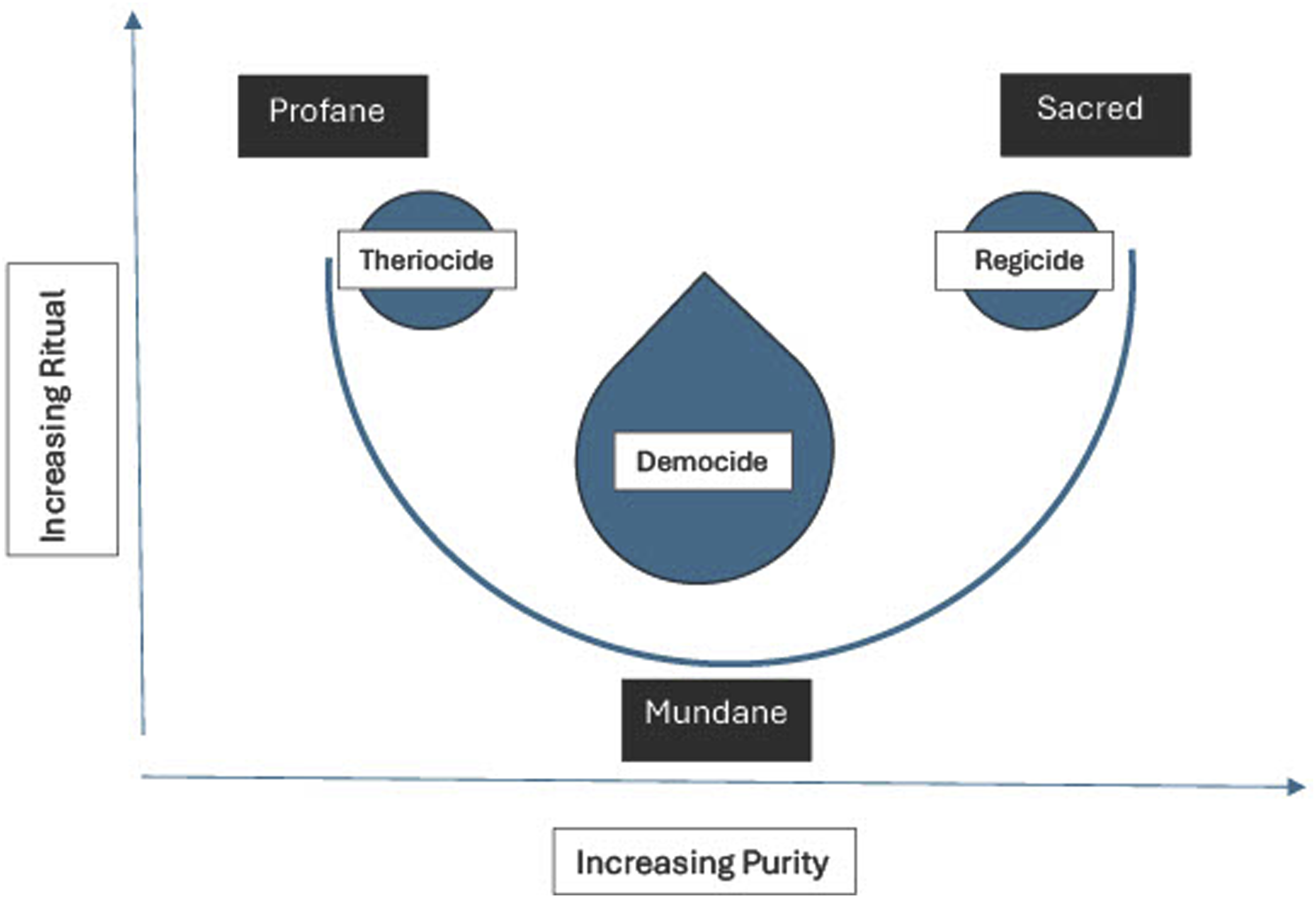
When we come to the regicide itself, it is clear that we slip deep into the realm of the sacred, both in the nature of the trial and the performative rituals of the sacrificial execution itself, as well as the king’s claims to a purity (Douglas, 1966) of motive and action that only a deified martyr could legitimately claim. In contrast, the revenge on the regicides was equally ritualised but self-evidently profane, both in its aim and methods, for the victims needed to be shown to harbour an impurity that was beyond the pale for civilised behaviour, and for their punishment to be a ritualised sacrifice of ostensibly justifiable, grotesque and inhumane proportions. Indeed, their crime was regarded by the royalists as so disgusting that their punishment was the equivalent of killing animals: theriocide. And all of that was organized by the coercive command of the new king, rather than the collective leadership of the country.
In effect, the execution of Charles I, and the revenge visited upon the regicides by Charles II, captures the extreme end of the relationship between leadership – or rather command - and violence, with the initially hesitant opponents of Charles I finding themselves with little option after years of civil war not only to visit violence upon the king, to sacrifice the monarch in order to save the country from further bloodshed, but to do it in a performative display of ritualized violence to increase the cohesion of the NMA and simultaneously undermine the cohesion of the royalists. In Girard’s (1972, 1982) perspective, the ritual sacrifice of the king (and his self-martyrdom), as the embodiment of both similarity to and difference from the NMA regicides, was always going to be the only solution to the collective violence that the king had apparently imposed upon the country. And the efforts of Charles II to resacralize the monarchy by desacralizing the regicides speaks to the affinity between political leadership – or rather command - and violence, and the role of ‘cleansing’ in the territory of the sacred. The inverse of this occurs when the regicides were either dragged from their coffins and ritually hanged, drawn and quartered, or for those unfortunate enough to still be alive, to have the same procedure applied to their living bodies. In this case the performative violence was designed as an act of profanity for traitors with the rituals performed not in silence but before a jeering mob.
Beyond the case study there are clearly lots of political leaders that appear to have no affinity to violence but partly this might be because of our elastic definitions of violence (an essentially contested term), partly because the coercion deployed is obscured, and partly because of our definitions of ‘Leadership’. In sum, is it possible to lead without power or coercion? If we can detach power from coercion then the answer must be yes, though Weber’s association between the state and power implies that political leaders might always be prone to violence. But the ‘elective’ aspect of the affinity is preserved by reinforcing the choice involved in the deployment of violence by political leaders. However, perhaps the better solution is to differentiate between ‘leadership’ and ‘command’, so that the coercive element of decision-making that appears to be essential when dealing with crises does appear to have an affinity that is beyond that of an elective, especially in the land of the sacred. Hence there does appear to be an affinity between political decision-making and violence, but it is with command not leadership. That, of course, then implies that we interrogate the way political leaders construct situations as crises so that they can deploy the violence they always intended but legitimate it on the basis of a ‘situation’ that was (allegedly) beyond their capacity to create and was simply one they were forced to face by dint of their hierarchical position – as commanders.
Weber’s suggestion that legitimate violence is the monopoly of the state does not really help us in this particular case because at the centre of the civil wars are two or more contending claims to the legitimate state. Rather more interesting is Zizek’s (2009) suggestion that ameliorating violence merely serves to exacerbate the problem, and we can see how the Presbyterian response to the first civil war – which is to try to compromise with the king – simply encouraged Charles to further recalcitrance. In Robertson’s (2005: 95) words, the king ‘cared little about the killing of his countrymen; their deaths were the tribute paid by his subjects towards the restoration of his former powers.’ Similarly, the failure of France and Britain to challenge Hitler’s consistent breaking of international law in the run up to the 2WW actually fed, rather than satisfied, the Nazi appetite for violence. Moreover, it could be argued that the west’s failure to respond adequately to Putin’s assaults upon Chechnya, Georgia, and Crimea led him to consider Ukraine as just another easy target without significant political consequence. Whether Trump’s violent attack upon Venezuela further encourages Putin to continue the war in Ukraine or Xi Jinping to invade Taiwan remains to be seen.
This appears to be a common problem with liberal or social democratic political parties today: their pandering to right-wing scapegoating of immigrants for example, rather than generating a positive counter-narrative, might well be seen in issues like Brexit or the riots against refugees, and ultimately in the resurgence of right-wing political parties across the west (Bienkov, 2025). Hence the social construction of a violence ‘crisis’ to legitimate a repressive ‘response’. Thus Farage, leader of the Reform UK party, insists that refugees arriving by boat represent ‘an invasion’ that requires mass deportations (Lynch and Howie, 2025). Moreover, the presence of migrants in and of itself poses an existential threat to women’s safety, according to Reform MP Sarah Pochin, because they have a ‘warped view of their right to sexually assault women.’ But the real threat to women in the UK is from much closer to home, literally, because most rapes are carried out by current or former partners. 26
Similarly, Trump deploys violence against his political opponents by calling out the National Guard, in conjunction with his claims that crime is ‘out of control’ in Washington, Chicago and Los Angeles. That the claims about rising crime are dubious at best is less relevant than that Trump’s supporters continue to facilitate his actions (Horton and Gilder, 2025). When we don’t hold political leaders to account, we are complicit in their violence, and if we are unwilling to sacrifice their position for our collective safety then the inverse may occur. If you feed a crocodile, it doesn’t stop wanting to eat you. Instead, as Churchill said in 1940 while still First Lord of the Admiralty, ‘an appeaser is one who feeds a crocodile hoping it will eat him last.’
What then, in conclusion, is the contribution of this paper? First, it shifts the focus from leadership and violence to command and violence. Second, it suggests that the affinity between decision-makers and violence is contingent and a matter of choice, not an issue of inevitability and determinism. Third, it highlights the relationship between decision-making, violence, and the role of the sacred in one of the first examples of subjects holding their monarch to account and eventually replacing the monarchy with a republic. Ultimately, the solution to the problem of violence for the NMA was to execute the king, but this too failed because, as Arendt suggested, while violence can destroy power, it cannot build power. Ironically, this was precisely the argument made by the Levellers: long term peace required the assent of the people, rather than just the sacrificial destruction of the prime architect of that violence: King Charles I. To think otherwise is to fall into the trap that Putin in Ukraine, Netanyahu in Gaza, and Trump in the USA have fallen: violence may produce a temporary quiescence amongst the targeted group, but that same violence often generates a longer term resistance that proves more difficult to suppress. Moreover, violence appears to create an appetite that seems to be insatiable because it frequently transmutes from a means to an end, to an end in and of itself: from an elective affinity to a bloody adhesive, because the enemies it consumes are ideological not material and ideas are more difficult to destroy.
Footnotes
Acknowledgements
I would like to thank my two anonymous reviewers for their patience and criticisms; I hope this is a better paper as a consequence of their input. I would also like to thank Suze Wilson, Associate Editor of Leadership, for her continuing support, and Neil Mitchell for permission to use a diagram from his book, Agents of Atrocity. Finally, a big thank you to Joanne Murphy, David Collinson and anyone else who suffered a presentation based on this at the 22nd International Studying Leadership Conference at Birmingham University in December 2024, or the online Best of the International Leadership Association and International Studying Leadership Conference in March 2025.

Funding
The authors received no financial support for the research, authorship, and/or publication of this article.
Declaration of conflicting interests
The authors declared no potential conflicts of interest with respect to the research, authorship, and/or publication of this article.