




Abstract
Crisis leadership is typically constructed as a manly endeavor, both in popular culture and much research. These accounts celebrate and reinforce a crisis leader prototype that emphasizes manliness, toughness, dominance, risk-taking, and vengeance as key to leading through crisis. Because women and attributes associated with femininity are incongruent with this prototype, its influence impedes women’s leadership. Further, by preferencing behaviors associated with masculinity, rather than embracing the best of human attributes, the prevailing crisis leadership prototype offers limited insights into what ethical and effective crisis leadership entails. To address these concerns, we examine the crisis communication of 12 women Heads-of-Government, focusing on their use of virtues-based language. Processes of socialization make women less likely to reproduce prototypically masculinized approaches to crisis leadership. Analyzing these leaders’ virtues-based language during the first wave of COVID-19 informs our theorizing of the role of such messaging in leaders’ crisis communications. Our findings reveal virtues-based crisis leadership language practices that can be adopted by leaders of any gender. We propose such an approach can help leaders transcend the amoral and masculinized crisis leader prototype and provide a reimagined approach to crisis leadership that centers ethical considerations.
Introduction
Our modern era has been dubbed ‘polycrisis’ (Henig and Knight, 2023; Tooze, 2021), suggesting leaders everywhere increasingly face multiple, complex, and overlapping crises. In popular culture, the dominant prototype (Eagly and Karau, 2002) of a leader facing down a crisis is a man whose heroic endeavors reflect and reproduce hegemonic and traditional ideals of masculinity (Connell and Messerschmidt, 2005; Harriger et al., 2022; Levant and Richmond, 2016; Valsecchi et al., 2023). This is unsurprising given the leader prototype more generally is culturally romanticized as masculine (Collinson et al., 2018; Eagly and Johnson, 1990; Eagly and Karau, 2002; Koenig et al., 2011; Schein, 1973). This same masculinized underpinning is found in much crisis leadership research and theorizing, where the favored approach is one that is directive, domineering, heroic, and coercive (O’Rielly et al., 2015), consistent with hegemonic and prevailing notions of masculinity (Connell and Messerschmidt, 2005; Levant and Richmond, 2016). While prototypes do not directly dictate how individual leaders behave, they are powerful in shaping leadership expectations and norms.
Relatedly, dominant approaches to crisis leadership routinely fail to engage seriously with the ethically laden nature of crises (Knights, 2021; Riggio and Newstead, 2023). Much research and popular culture accounts of crisis leadership, for example, emphasizes speedy decision-making, a command-and-control approach, and reliance on calculative rationality. This orientation, we argue, comes at the expense of ethical considerations such as acting with humanity, justice, and prudence.
The COVID-19 pandemic prompted great concern about the ethics and effectiveness of how leaders responded to such a crisis, with different policy choices resulting in huge variances in death rates and economic and social impacts (Garikipati et al., 2024; Ladkin, 2020; Tourish, 2020). It also prompted a greater appreciation of stereotypically feminine behaviors, such as caring for others, as of value to crisis leadership (Johnson and Williams, 2020; Simpson et al., 2022; Tomkins, 2020). Given the crisis-prone nature of our contemporary context, and the persistence of the masculinized, amoral crisis leader prototype, it is imperative we seek out alternative approaches to leading through crises.
In this paper, we critique conventional crisis leadership and offer a reimagined approach to leading through crises, as called for by O’Reilly et al. (2015). Below, we argue that conventional approaches reflect and reproduce a hegemonically masculinized crisis leader prototype, thereby impeding those who do not ‘fit’ its limiting prescriptions. We also argue that the prototype is amoral, due to its failure to consider the ethical features and implications of crises (Alsplan and Mitroff, 2021), which hinders the ethics and effectiveness of crisis responses. We suggest a virtues-based approach can help transcend these problems. To explore this, we adopt a virtue ethics lens to examine speeches given by 12 women Heads-of-Government during the first wave of COVID-19. Processes of gendered socialization (Butler, 1999) mean women leaders are less likely to perpetuate the dominant masculinized crisis leader prototype. Accordingly, analysis of how these women deployed virtues-based language can offers insights into a new approach to leading through crises that is both attentive to ethical considerations and an alternative to the masculinized prototype. Based on this analysis, we theorize the practices involved in virtues-based crisis leadership. This approach transcends the limiting nature of the dominant, masculinized, amoral crisis leadership prototype and advances a gender-inclusive approach to leading through crises that centers ethics.
The remainder of the paper unfolds as follows. First, we problematize conventional understandings of crisis leadership in terms of both gender and ethics. We then outline the context and methods of our study and explain how virtues-based language use provides a gender-inclusive, ethically grounded analytic frame with which to examine crisis communication. Our findings detail how each virtue in the framework we draw on was deployed in the speeches we analyzed, including how virtues were combined and directed to specific stakeholder groups. We conclude by considering the limitations and implications of our study for research and practice related to issues of gender, ethics, and leading through crises.
The masculinized prototype of (crisis) leadership
The idea that a crisis necessitates ‘strong’ leadership is as old as antiquity. For millennia, understandings about what leadership involves and who is best suited to lead have been tightly interwoven with contemporaneous ideals of masculinity (Johnson and Williams, 2020; Sinclair, 2005, 2007; Wilson, 2016). The story of the ‘strong’, heroic crisis leader – almost always a man – is endlessly retold: he is physically and mentally tough, brave, dominant, decisive, emotionally contained, and determined to ensure that his will prevails, whatever the odds (Allison and Goethals, 2011, 2013; Harriger et al., 2022; Wilson, 2016). Even today, these ways of understanding and enacting leadership and crisis leadership continue to give rise to a widely held leader prototype that is deeply entwined with hegemonic notions of masculinity (Eagly and Karau, 2002; Koenig et al., 2011). In times of crisis, when people are feeling fearful, so called ‘strongman’ leaders appear to hold a special ‘allure’ (Gabriel, 2024).
The link between attributes and behaviors typically associated with men and masculinity and those seen as important for leadership has been documented in studies of organizational and political leadership since at least the 1970’s (Hedlund et al., 1979; Schein, 1973). It is also noted as a common feature of news media reports and popular texts, which routinely reflect and reproduce dominant social norms regarding leadership and gender (Crasnow and Waugh, 2013; Harriger et al., 2022; Mavin et al., 2010; Stead and Elliot, 2009). The strength of the association between leadership, men, and masculinity has declined somewhat over time, perhaps reflecting feminist efforts to advance gender equity (Powell et al., 2021). Empathy, collaboration, and communication, attributes linked to stereotypes of women and femininity, are increasingly seen as being important for leadership (Sinclair, 2007; Valsecchi et al., 2023), with some analysis revealing the importance of collaborative, relational processes in crisis-construed social movements (Eslen-Ziya and Erhart, 2015). However, despite this progress, women remain underrepresented in leadership roles and gender biases remain a significant barrier to women’s leadership (Liu, 2020; Madsen, 2017; Newstead et al., 2023; Sinclair, 2005). The prevalence of the masculinized leader prototype means women and behaviors deemed stereotypically feminine are often seen as being ‘incongruent’ with leadership and what people expect of leaders (Eagly and Johnson, 1990; Eagly and Karau, 2002). This problem intersects (Crenshaw, 1994) with racism for Indigenous women and women of color, as both popular and formal understandings of leadership are also frequently imbued with notions of white superiority (Ladkin and Patrick, 2022; Liu, 2020). These persistent stereotypes create ongoing challenges for women to secure leadership roles and be treated fairly when holding such roles (Eagly and Carli, 2007; Madsen, 2024; Sinclair, 2005).
Crises are constructed by characterizing a suite of contingencies that, “taken together are assumed to pose an immediate and serious threat” (Spector, 2020: 304). The masculinized nature of leadership in general is magnified in such contexts, with claims of urgency used to legitimate positional authority (O’Rielly et al., 2015) and a command-driven approach to decision-making (Grint, 2010; Spector, 2019, 2020). Traditional, hegemonic understandings sanction the use of strongly masculinized behaviors, such as displays of strong language, dominance and even aggression (Connell and Messerschmidt, 2005; Levant and Richmond, 2016). Other masculinized attributes, such as being physically robust, brave, risk-taking, and showing only a restricted range of emotions, such as anger but not compassion, also feature regularly in how crisis leadership is portrayed in popular culture (Harriger et al., 2022; Scharrer and Blackburn, 2018).
Researchers are not immune to such hegemonic norms. One of the most widely cited crisis leadership papers, for example, boldly states that “successful performance in times of collective stress (crisis) turns leaders into statesmen” (Boin and t’Hart, 2003: 544) and contains multiple examples of strong, brave men who led through crises, and precisely zero examples of women crisis leaders. The crisis leadership literature also routinely emphasizes planning, prevention, and containment (Pearson and Mitroff, 1993), a narrowly rationalist orientation (see also Wu et al., 2021) that reflects traditional, hegemonic notions of masculinity, in which emotionality is equated with weakness and femininity (Connell and Messershmidt, 2005; Levant and Richmond, 2016).
There are, however, nuances in all this: the chance of a woman securing a leadership role has been found to increase when an organization is facing a crisis (Ryan and Haslam, 2005). While at first glance this might seem encouraging, in reality it renders women’s chances of success as leaders precarious: they are metaphorically put at the top of a ‘glass cliff’, where their actions will be intensively scrutinized and the risk of failure is extremely high (Haslam and Ryan, 2008; Ryan et al., 2011; Ryan and Haslam, 2005). Relatedly, women’s leadership has been idealized as an ethical alternative to the amoral, masculinized leadership that led to the Global Financial Crisis. While promising, this trend simultaneously binds women leaders in a gender-paradox where ‘feminine capital’ is used to simultaneously promote and constrain the potential of women leaders (Elliot and Stead, 2018). Recent experimental research has now found that women’s perceived suitability for crisis leadership varies depending on the nature of the crisis; those related to relationship problems are seen to benefit from the communal behaviors associated with femininity, while financial crises are seen as benefitting from the agentic behaviors associated with men and masculinity (Kulich et al., 2021). Accordingly, while femininized behaviors may at times be seen as suitable for dealing with certain types of crises, the traditional masculinized prototype remains dominant.
Today, both scholarly and popular understandings of crisis leadership remain tied to the hegemonic, masculinized prototype. This is despite evidence showing the importance of crisis response capabilities such as compassion (Simpson et al., 2022), collective sensemaking and decision making, teamwork, and effective communication (Riggio and Newstead, 2023), which challenge the masculinized prototype. In this study, we aim to extend this challenge by offering a novel approach to crisis leadership that seeks to transcend gendered prototypes and center ethics. We do so by analyzing the use of virtues-language in the speeches of 12 women Heads-of-Government during the first wave of the COVID-19 crisis. Because women are socialized in ways that make them less likely to reproduce the masculinized crisis leader prototype (Butler, 1999), studying how women lead in a crisis context can help us identify an alternative approach. Before explaining the current study, however, we provide a brief overview of the amorality that is common to accounts and examples of crisis leadership, something we contend is closely related to the masculinized prototype and which might also be transcended via a virtues-based approach.
The amorality of conventional approaches to crisis leadership
Amorality comprises “a failure to respond to issues that have ethical implications” (Quade et al., 2022: 274). This ‘moral myopia’ results from not mastering the practices that enable the formation of an ethical character (Ladkin, 2021). It is unsurprising that leaders often lack ethical attunement, given much leadership education and development is instrumental in nature (Wilson et al., 2021, 2022). Crises, however, routinely cause unequal harm among different groups (Spector, 2020), meaning leading through crises entails making morally laden choices that will be shaped by a leader’s underpinning values and priorities (Alpaslan and Mitroff, 2021). The inevitability of harm-inducing effects that crises give rise to provides “morally, rationally and intuitively defensible reasons” (Alpaslan and Mitroff, 2021: 3) for ensuring ethical considerations play a central role in how leaders think and act in crisis contexts. This is magnified in complex, protracted crises such as the COVID-19 pandemic, where “leadership can be, literally, the difference between life and death” (Uhl-Bien, 2021: 1). Yet, conventional approaches to crisis leadership typically pay scant attention to ethics, thereby assuming an amoral orientation, something we argue is related to the masculinized prototype noted above.
In crises, leaders must frequently make trade-offs between varying interests, often with limited information and an incomplete understanding of the implications or ramifications of their decisions (Boin and t’Hart, 2003). However, we contend that how they do this is often ethically wanting, at least in part because dominant frames of reference simply do not center ethical considerations in crisis leadership. Rather, their orientation is typically on controlling and stabilizing the disruptive crisis event via a narrowly rationalist and calculative orientation, on the presumption that a return to the pre-existing state of affairs is the goal (Boin and t’Hart, 2003; Pearson and Mitroff, 1993). Amorality in crisis leadership means that time and again the most vulnerable are left to face the worst consequences of a crisis, with the least resources or support. In the GFC, lower ranking employees were laid off while banking sector CEOs got paid off, yet still sought to disclaim any responsibility for what took place (Hargie et al., 2010). In Hurricane Katrina, or the horrific Canadian wildfires of 2023, it was poor, Black, and Indigenous communities who were most adversely affected (Henkel et al., 2006; McDonald et al., 2023). Failing to account for these ethical implications means leaders repeatedly respond to crises in ways that tend to compound rather than alleviate preexisting injustices (Laster Pirtle and Wright, 2021). These crisis responses often lack in their compassion and humanity, indicate moral myopia (Ladkin, 2021), and show an absence of courage in confronting the deeply rooted systemic problems of the imperialist white supremacist capitalist patriarchy (hooks, 2015) that often generate the conditions precipitating crises.
Too often, crisis responses reflect decision-making that is short-sighted and merely reactive, thus lacking in the virtues of prudence, temperance, and wisdom. By decentering ethical considerations, conventional approaches to crisis leadership facilitate amoral (and sometimes immoral) practices. We challenge these dominant understandings and draw on the philosophy of virtue ethics to underpin a reimagined approach to leading through crises that centers ethics and seeks to dispel the masculinized crisis leader prototype. In doing so we build on recent research suggesting that what leaders say in times of crises – especially in relation to virtue – can have a profound impact on the ethicality and effectiveness of their crisis leadership (Sadler Smith and Akstinaite, 2023; Wilson and Newstead, 2022; Yeo and Jeon, 2021).
Having briefly outlined our concerns with the prevailing amorality and masculinized nature of conventional crisis leadership, we now explain the current study.
The current study
Study context
Our data is comprised of 67 speeches made by 12 women Heads-of-Government in the early days of the COVID-19 pandemic. At this time, fear gripped the world and actions previously considered unthinkable, such as nationwide lockdowns, were rapidly imposed. This context was widely constructed as a crisis, with much attention focused on the varying responses adopted by leaders (Spector, 2019; Tourish, 2020). Accordingly, “narratives of the powerful” played pivotal roles in processes of “crisis identification, definition and constitution” (O’Reilly et al., 2015: p. 387). Our aim here is not to evaluate the overall effectiveness of those responses, but contemporaneous commentary frequently remarked on how women leaders were emphasizing care, compassion and collective effort to good effect at this time (Coscieme et al., 2020; Henley and Ainge Roy, 2020; Sergent and Stajkovic, 2020; Somvichian-Clausen, 2020; Taub, 2020; Wilson, 2020; Wittenberg-Cox, 2020a, 2020b). This indicates to us their deviation from the prevailing amoral and masculinized crisis leader prototype, making them a purposive sample from which to analyze the role and function of virtues-based language in leading through crises.
Virtues: A gender-inclusive, ethically-grounded analytic lens
Virtues are morally good attributes that are learned and developed throughout life, and which foster both individual character development and collective flourishing (Annas, 2015; Audi, 2012; Newstead et al., 2020; Solomon, 1999, 2004). For millennia, the scholarly discourse on virtues has argued that virtues have both practical and ethical value, and are developed through practice such that they become deeply embedded within a person’s character (e.g. Aristotle, 350BCE/1962; Ladkin, 2021). The formulation of certain attributes or behaviors as being virtuous in character is a socially constructed process as, over many centuries, shared understandings have come to be developed as to what is deserving of the special status of being deemed ethically or morally ‘good’ (Foucault, 1986). The ‘inherent’ or ‘intrinsic’ goodness that has come to be attached to the notion of virtue thus derives from these centuries of debate about what constitutes morally or ethically good conduct.
Virtues are contextually reflexive (Newstead et al., 2018), meaning their appropriate enactment and attribution varies across culture and history. For example, crucifixion was an appropriate enactment of the virtue of justice in Ancient Rome, while it is no longer so in modern Rome. This helps explain that while ancient accounts of virtue – including from Aristotle himself – were blatantly sexist and classist, contemporary models and frameworks reflect the influence of current concerns about gender and cultural inclusivity. To inform our analysis we draw on one such contemporary virtue framework that synthesizes a range of these modern models, which we explain in our methods section below.
Within the Aristotelian 1 tradition, virtues are regarded as a golden mean between vices of deficiency or excess. For example, courage represents the golden mean between cowardice (deficiency) and recklessness (excess) (Annas, 2015; Aristotle, 350BCE/1962; Crossan et al., 2017). Discrete virtues, such as courage or justice, arise from an internal inclination towards that which is ennobling and are given effect through behaviors and actions that are consistent with their defined qualities (Newstead et al., 2018). Phronesis, or practical wisdom, has to do with thoughtfully judging how to deploy the right virtues in the right way, for the right reason, at the right time, fostering an approach that is both ethical and effective, although of course not beyond reasoned critique (Shotter and Tsoukas, 2014). The emergent nature of virtues is congruent with the emergent nature of leadership, which also begins as an internal motivation that is then reflected and demonstrated by way of leaderful communication and behavior (Klimoski and Amos, 2014). Virtues and leadership intertwine as ‘good leadership’ when virtuous intent is enacted as virtuous behavior (Newstead, 2022), giving rise to leadership that is ascribed as both effective and ethical (Ciulla, 2004). Overall, the inferences to be drawn from the literature are that the emergent, practically wise nature of virtues-informed leadership can give rise to ethical and effective (i.e. good) crisis leadership, but we currently lack evidence and theorizing of how this happens. Therefore, through our analysis, we seek to answer the question, how are virtues deployed in leaders’ crisis communication, and what effects do their deployment appear to generate? Addressing this question advances our aim of challenging the masculinized, amoral crisis leader prototype and developing an alternative approach to leaders’ crisis communication that is not confined by gendered stereotypes but, rather, grounded in virtues-based language use.
To explore this question, we adopt an approach with lineage in Aristotelian virtue ethics (Annas, 2015; Aristotle, 350BC/1962; Audi, 2012; Ciulla, 2005), to analyze the ways 12 women Heads-of-Government (hereafter HoG) deployed virtues-based messaging in speeches addressing their nations during the first wave of COVID-19. Because virtues comprise the best of human potential, we argue that the virtue ethics framework we rely on (adapted from Newstead's (2022) presented in Table 2 and explained further below) constitutes a gender-inclusive approach to crisis leadership that simultaneously centers ethical considerations. Leader communication during crises plays a vital role in providing direction and making meaning of the crisis by contextualizing it for constituents (Davidson-Schmich et al., 2023; Spector, 2020). As a consequence, the discursive choices leaders make can have positive – or harmful – effects.
Adopting a virtues lens to analyze leader speeches allows us to analyze and theorize the role of virtues in good crisis leadership and how this might constitute a more inclusive form of crisis response than the amoral masculinized prototype. Notably, the gender-inclusive nature of virtues means we do not simply seek to replace the masculinized prototype with a feminized one. Instead, a virtue ethics lens offers an inclusive and transcendent alternative frame of reference that aims to help liberate leaders of all genders from the constraints and injustices associated with the masculinized crisis leader prototype and its associated amorality.
Methods and analysis
Guided by influential arguments that language informs the construction of a shared reality (Potter and Wetherall, 1987) and that leadership involves “a process of defining reality in ways that are sensible to the led” (Smircich and Morgan, 1982, 259), we treat the national speeches given by the HoG we studied as being meaningful communicative acts designed to shape citizens’ (followers) perceptions of and responses to the COVID-19 crisis. This premise builds on the constructed nature of crises (Spector, 2019, 2020) and the profound influence of leaders’ language in determining the effectiveness of crisis leadership (Davidson-Schmich et al., 2023; Sadler Smith and Akstinaite, 2023). Employing a virtues-lens as our analytic framework extends work exploring the potential of virtues-language in leadership (Manz et al., 2006; Newstead et al., 2020; Whetstone, 2003) to the context of a crisis.
Heads-of-government (HoG) included in our sample.
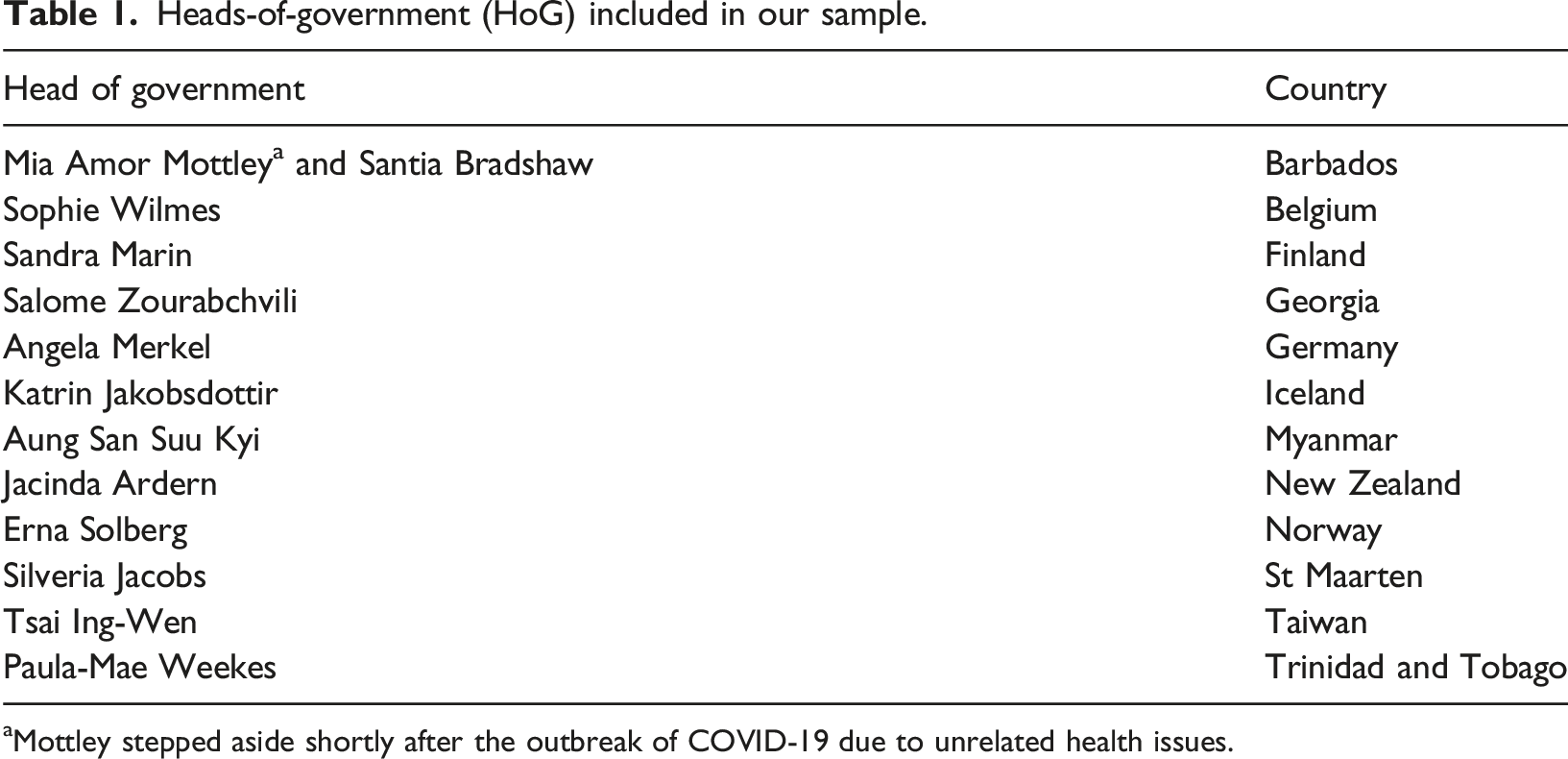
aMottley stepped aside shortly after the outbreak of COVID-19 due to unrelated health issues.
Our analysis focused on identifying which virtues the HoG directly and indirectly evoked in the language used in their speeches. We employed NVIVO qualitative analysis software to conduct our analysis in two phases. Phase 1 consisted of a deductive analysis (Azungah, 2018), assessing which virtues the HoG deployed in their speeches imposing and then easing COVID-restrictions. We used Newstead's (2022) virtues-framework for this step because it provides a contemporary synthesis of prominent but previously unintegrated virtues catalogues as applied to leadership (e.g. Peterson and Seligman, 2004; Riggio et al., 2010; Wang and Hackett, 2015). It therefore provides a robust, theoretically informed analytic tool for assessing which virtues the HoG invoked explicitly, by stating them directly, or evoked indirectly, through messages whose meanings promoted, implied, or solicited virtues.
Higher-order virtues, our analytic framework a .
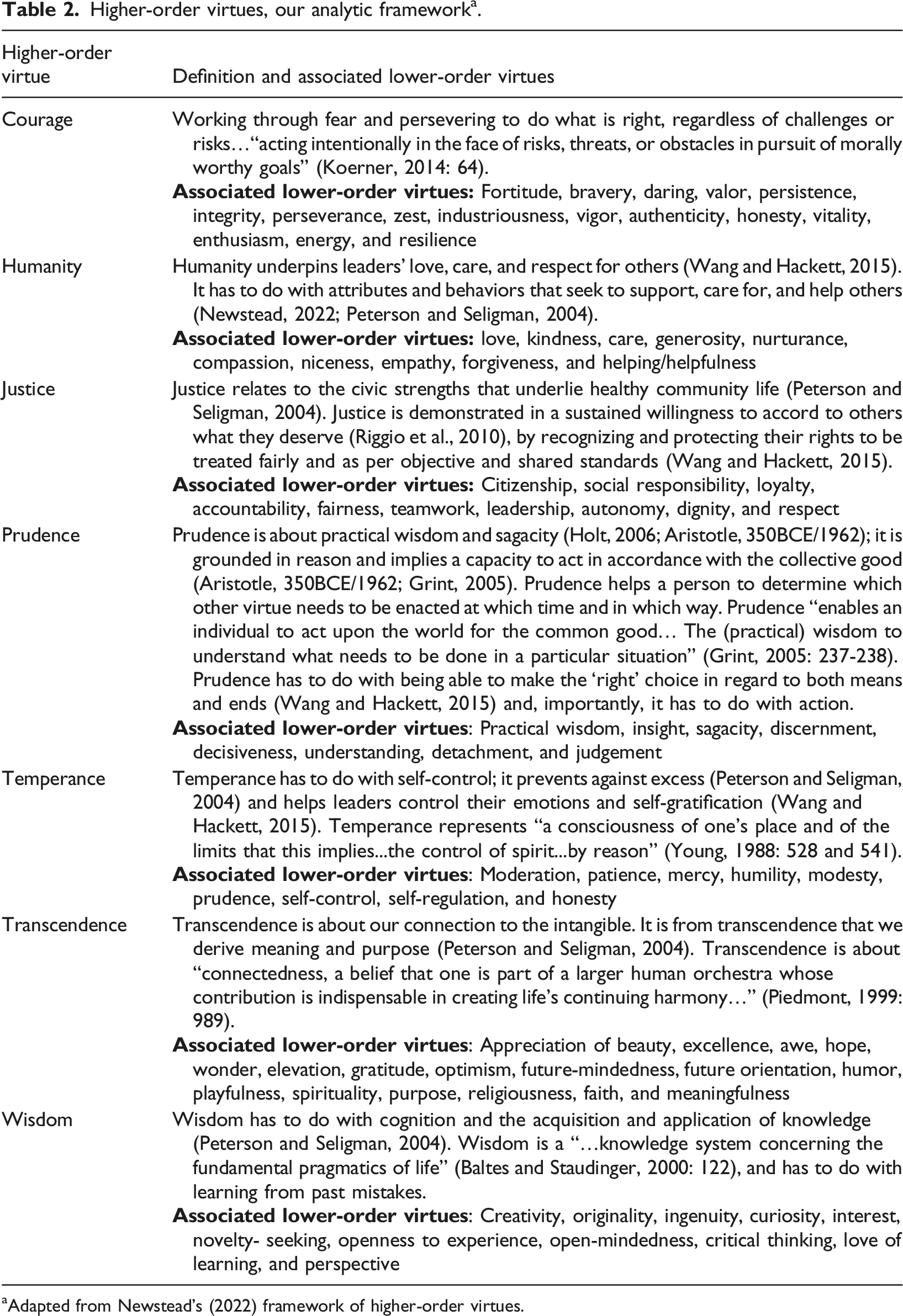
aAdapted from Newstead's (2022) framework of higher-order virtues.
Having deductively mapped our data against this framework, we then inductively identified themes about the role or function each virtue played in crisis leadership messaging, which we report below.
Phase 2 of our analysis comprised an abductive analysis (Blaikie, 2007) of our coded material. Through looking for patterns of use and meaning in the data coded to each higher-order virtue (Bell et al., 2019) and employing cyclical processes of moving back and forth between the data and theory i.e. Newstead's (2022) framework (Alvesson, 1996; Blaikie, 2007), we identified two further discrete but interdependent patterns of virtues-language use. Through phase 2, we were able to discern (1) how virtues tended to be deployed in particular combinations, and (2) how HoG directed their virtue-based messaging towards three distinct stakeholder groups – either herself or her government (me/my government), her citizens (you), or towards her entire nation, encompassing both the leaders and her citizens as one collective group (we).
In what follows, we report the findings arising from these two phases of our analysis, including drawing out their gendered implications. Our subsequent discussion theorizes how virtues-based crisis leadership language might constitute a gender-inclusive, ethically grounded approach to crisis leadership.
Findings and implications
Individual deployment of each higher-order virtue
The function of each virtue in crisis leadership language, with illustrative quotes.
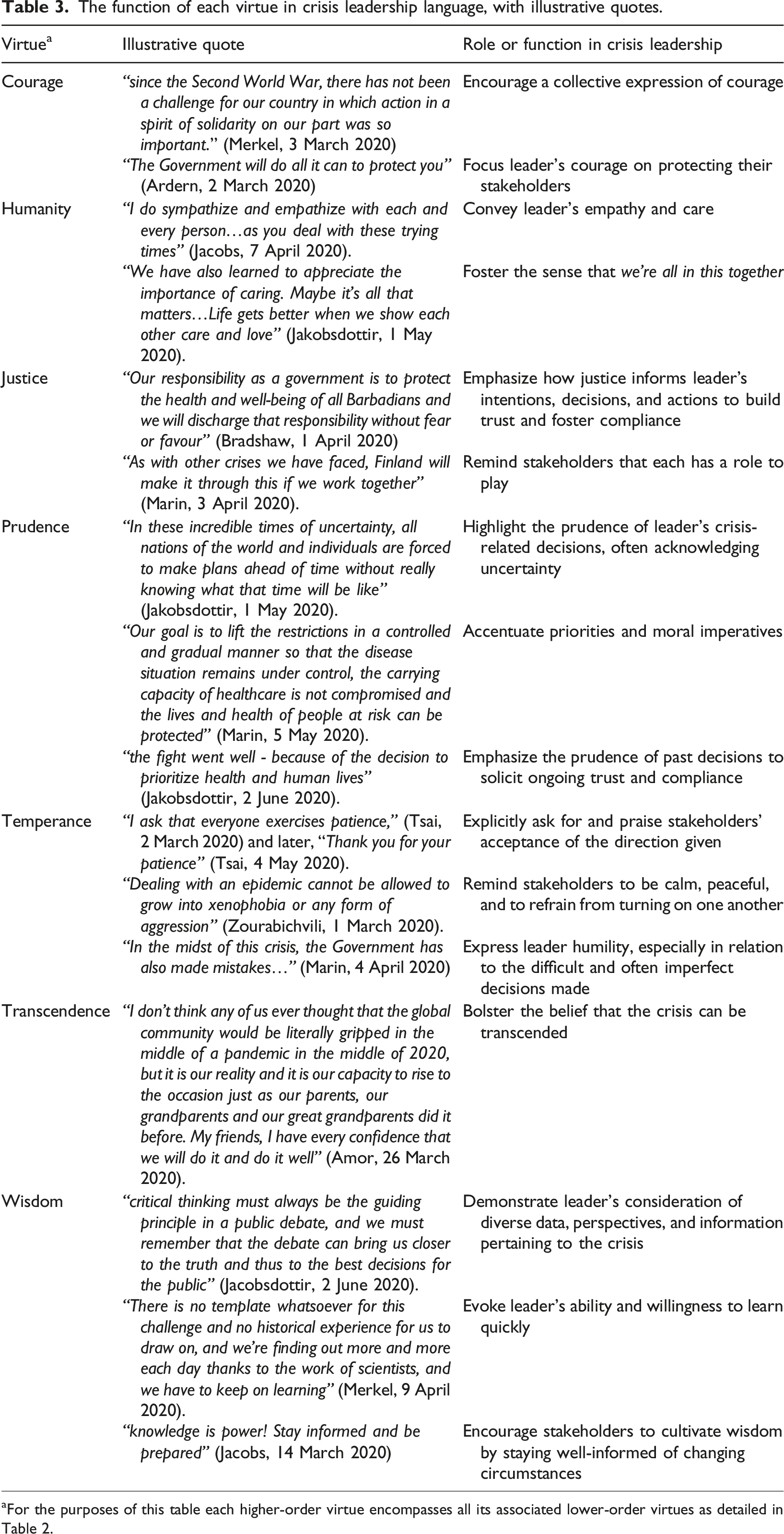
aFor the purposes of this table each higher-order virtue encompasses all its associated lower-order virtues as detailed in Table 2.
As Table 3 illustrates, the women HoG encouraged a collective – rather than individual – expression of courage and referenced their own courage only in ways that emphasized their focus on protecting others from harm. They expressed their humanity by conveying empathy and care for their citizens and, also, by fostering a sense of shared humanity through messaging ‘we’re all in this together’. Justice was deployed by the HoG to express their intentions, decisions, and actions to build responsibility, trust, and compliance. They also spoke of justice in their reminders to their nations that everyone had a role to play in the crisis response. The HoG used language that spoke to the prudence of their crisis-related decisions, often acknowledging uncertainty, and inferred prudence by accentuating the ethical priorities and moral imperatives informing their decisions. They also emphasized the prudence of past decisions to solicit ongoing trust and compliance among citizens. Temperance was evidenced in messages explicitly asking for and praising stakeholders’ acceptance of the direction given, and language reminding stakeholders to remain calm, peaceful, and refrain from turning on one another. Temperance was also voiced by the women in relation to their own humility, especially in relation to the difficult and often imperfect decisions made. Transcendence appeared less frequently in the HoG messaging than the other virtues, but came through as attempts to bolster the collective belief that the immense challenges of the pandemic could and would be overcome or transcended. Wisdom was evidenced in the HoG language that referenced their consideration of diverse data and multiple perspectives pertaining to the unfolding pandemic. It was voiced in relation to the HoG’s ability and willingness to learn and adapt, and they encouraged wisdom in their citizens by insisting they stay well informed.
In terms of gender, the finding that each individual higher-order virtue plays one or more roles or functions in the overall crisis leadership approach has several implications. Firstly, it helps demonstrate the impact that two particular virtues often associated with femininity – humanity and prudence – can bring to crisis leadership communications. Humanity involves care for others, which is stereotypically regarded as a feminine characteristic. Prudence entails a more precautionary, deliberative approach to dealing with risks and a concern with the collective good, and so has ties to dominant norms that purport women are risk averse and communally oriented. Our findings show that both these virtues are crucial for effective crisis leadership, thereby challenging the masculinized crisis leader prototype. Second, by demonstrating that all the higher-order virtues contribute to effective crisis leadership communications in particular ways we offer an alternative to the masculinized prototype. And third, the alternative we identify offers the opportunity to transcend the limitations of dominant social norms regarding gender, which has liberatory potential for crisis leaders of all genders. These findings and implications are further developed via our Phase 2 analysis, which examined how the HoG combined virtues and directed different virtues-based messages to different stakeholders.
Combining virtues to generate a better crisis response
As illustrated in Table 3, each higher-order virtue plays a discrete and distinctive role or function in leading through crisis. We also found that virtues-based messages were frequently deployed in particular combinations, where one virtue offered support to and/or balanced one or more of the other virtues. Consequently, we contend that the combined deployment of multiple virtues-based messages is central to effective crisis leadership communications. Our analysis surfaced three key patterns in the ways this occurred.
First was the prevalence with which humanity was deployed in combination with each other virtue. Humanity, which involves the care, compassion, and nurturance often associated with norms of femininity, was the most frequently deployed virtue, with constant evocations of the HoG’s empathy and calls for citizens to care for one another. But when we looked at patterns in the combining of virtues it became clear that humanity was often spoken about in support of other virtues, particularly justice. Containing COVID-19 often relied on citizens adhering to unprecedented and extreme restrictions on their movements, requiring HoG to make strong demands of followers. These demands required citizens to practice justice – being responsible, fair, and accountable – but in our data the rationale for so doing was often derived from humanity – citizens care for and of others. Deploying humanity, with its conventionally feminized focus on empathy, care, and nurturance, served to strengthen the appeal to justice, helping to foster acceptance of government policies. Arguably, justice is often given expression in a masculinized manner, via rhetoric that draws on the ‘objectivity’ associated with hegemonic notions of masculinity. But, by deploying messaging that combined humanity and justice the HoG discursively transcended exclusively femininized or masculinized orientations and, simultaneously, communicated a more persuasive and ethically grounded crisis response.
The second pattern related to the combining of virtues was the way transcendence was often used to bolster courage. The HoG spoke about prior transcendent experiences to bolster courage in the present, exemplified by Marin’s statement, “as a nation, we have survived many trials over the course of history. We will get through this, too” (29 April 2020). This combination arguably ameliorated the often-masculinized expression of courage through interweaving its expression with more transcendent considerations and so guiding people on how to avoid the excesses of recklessness and the deficiency of cowardice. The third pattern in combining virtues emerged between wisdom and prudence. Given some national leaders displayed reckless behavior, dismissing scientists’ calls to take the virus seriously or advocating unproven or even dangerous ‘remedies’ (e.g. drinking bleach), it is noteworthy how frequently the women HoG explicitly stated the role of wisdom – learning, curiosity, perspective-taking – in fostering a prudent course of action. For example, Jakabsdottir stated ‘When decisions are based on research and data, they become better’ (17 June 2020).
Combining virtues in their messaging in these ways seemed to help the HoG foster citizen (follower) compliance and demonstrated a balanced, thoughtful approach. In so doing they again challenge the masculinized crisis leader prototype and offer an alternative crisis response which transcends traditional gender norms and centers ethical considerations. The combined deployment of virtues demonstrated the HoG’s capacity to go beyond binary norms, weaving together stereotypically feminized attributes (e.g. care, empathy) with stereotypically masculinized attributes (e.g. brave, strong directives) to communicate a compassionate and considered, yet firm approach. In so doing they transcend both masculinized prototypes of conventional crisis leadership and assumedly ‘soft’ feminized approaches, while retaining ethics as central to their decisions and actions.
Directing virtues to specific stakeholders
Our analysis also identified that the HoG directed virtues to three distinct groups: either herself and her government (me), her citizens (you), or her entire nation (we). For example, Marin references the wisdom and prudence of herself and her government (me) when she stated, ‘The best way to prevent and manage an epidemic is to rely on the evidence-based information, trust experts and carefully follow the instructions given’ (27 Feb 2020). In contrast, Bradshaw references the temperance of her citizens (you), when she stated, ‘We once again take this opportunity to appeal to all of you...to follow the rules and the advice that have been given, exhibit the discipline and the kindness for which Barbadians have become known’ (2 April 2020). And Ardern was celebrating the courage of her entire nation (we) when she said, ‘Kiwis from all walks of life were resolute and determined’ (7 May 2020). Identifying the different recipients of virtues-messaging provides further insights into virtue-based crisis leadership, by identifying which virtues leaders deploy in their messages most often and towards whom.
Humanity-based messages were spread evenly across all three stakeholder groups (me, you, we). This indicates that the HoG emphasized their own humanity, called on the humanity of their citizens, and celebrated the nation’s collective humanity in equal measure. However, other virtues showed significant variance as to which groups they were directed. For instance, most references to temperance were directed at ‘you’, the HoG’s citizens. HoG asked their citizens to remain patient, stay calm, accept restrictions, and be peaceful with far greater frequency than they spoke of their own temperance. On the other hand, invocations of prudence were almost exclusively directed to the HoG and her government, seemingly to help build confidence in the legitimacy of their decisions. And courage tended to be directed at the entire nation (we), to galvanize collective fortitude, solidarity, and perseverance.
Key virtues-based messaging by stakeholder group (me/you/we).
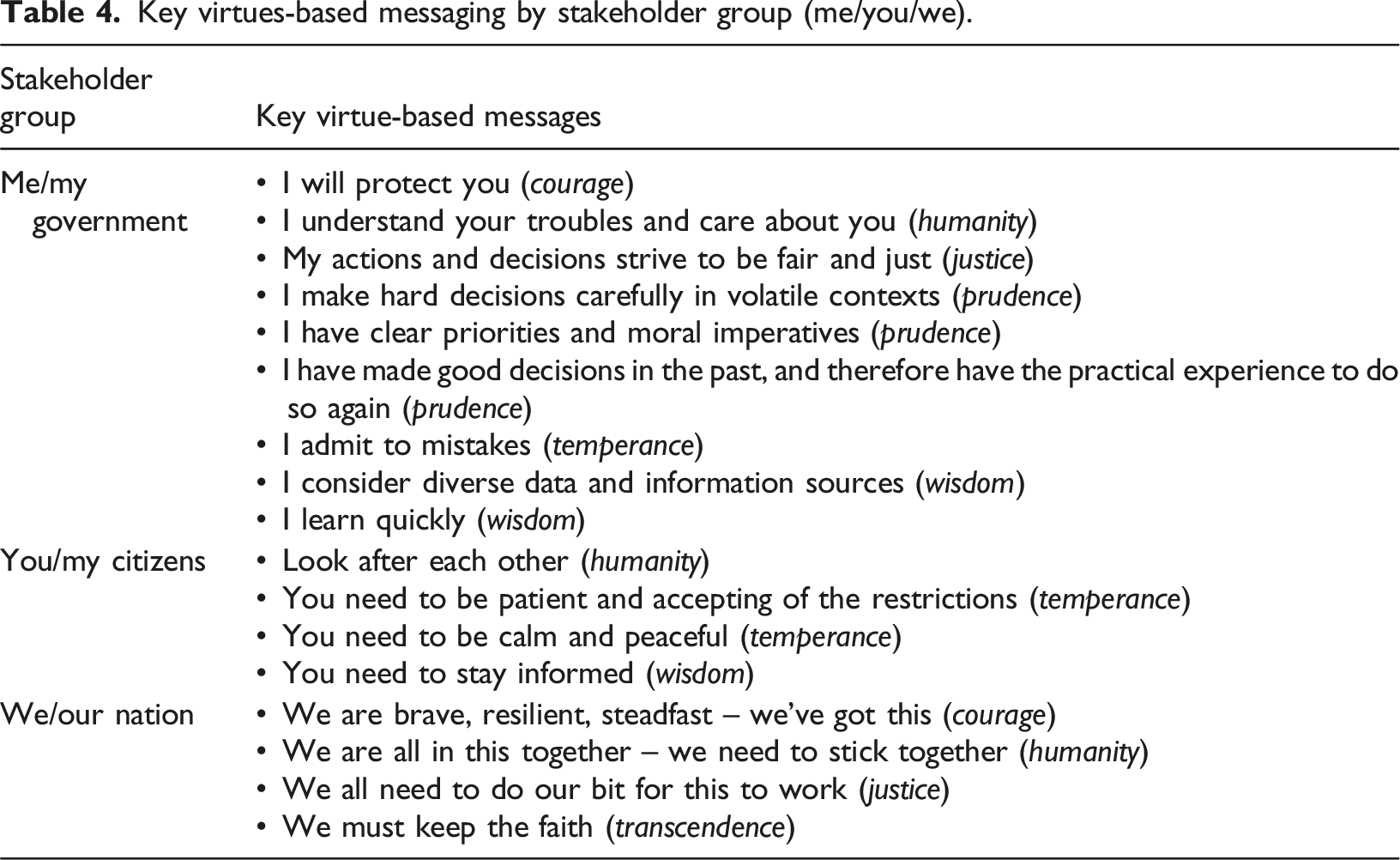
Deploying virtues to secure objectives that contribute to crisis leadership.
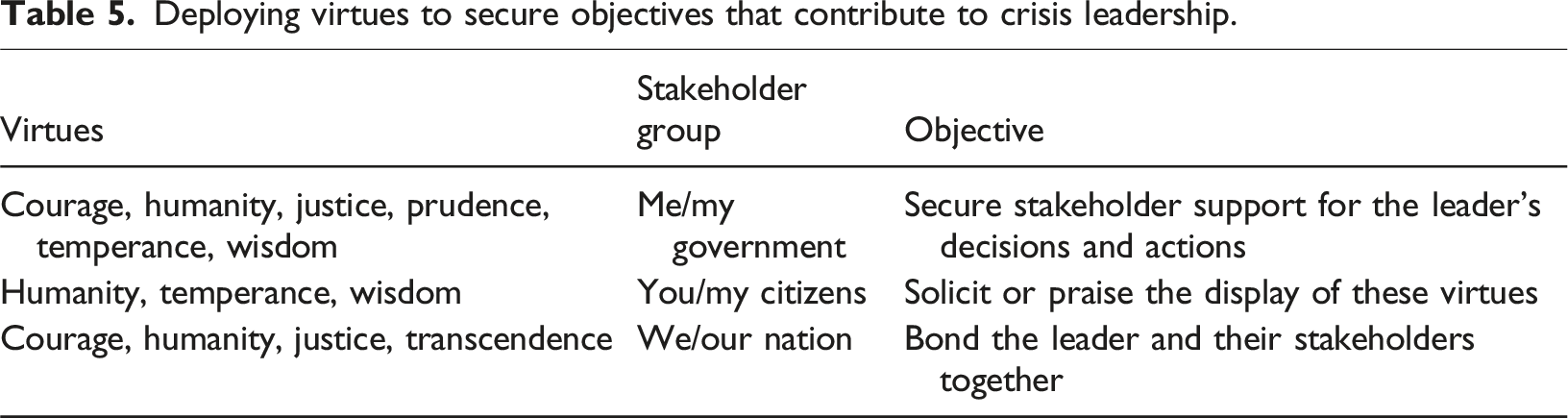
These findings further support the notion that each individual virtue plays a crucial role in good crisis communication, especially when combined and directed in particular ways. The practice of combining and prudently directing virtues in crisis leaders’ messaging challenges the masculinized crisis leader prototype and provides a viable alternative for crisis leaders of all genders to deploy the full suite of higher-order virtues to bolster the effectiveness and ethicality of their crisis leadership. The deployment of virtues in crisis leaders’ communications thus appears to provide a means of transcending entrenched gendered norms in ways that encourage both liberation from their constraints and better crisis leadership.
Conclusion
The COVID-19 pandemic generated multiple ongoing forms of harm and exposed a crisis of leadership, both in terms of practice and the paucity of theoretical resources to explain what good crisis leadership entails (Tourish, 2020). Through the first wave of the pandemic, vastly different approaches were adopted by different national leaders. Masculinized approaches to crisis leadership were evident in some instances, proving to be extremely ineffective and even destructive (Sadler Smith and Akstinaite, 2023). Bolsonaro (Brazil), for example, aggressively dismissed fears about the virus as ‘hysteria’ (Darlington, 2020), itself a gendered slur, while Trump (USA) repeatedly made heroic promises that the virus would just ‘disappear’ (Wolfe and Dale, 2020). These masculinized responses were ethically troubling, demonstrating a lack of care and poor judgement. In contrast, women HoG were widely lauded for their good crisis leadership at this time. Our proposition, however, is not that these different approaches were determined by a given leader’s gender. Rather, our data and analysis points to the potential of virtues-based messaging to enable better crisis leadership.
It could be argued that the speeches we analyzed evidence good speech writing more than good crisis leadership – and no doubt speech writers were used in at least some of the speeches. Even so, leaders retain ultimate responsibility for the messages they convey to their followers and the language they use to do so. The speeches also reflect and convey policy decisions made by those leaders – decisions which contributed to the finding that countries led by women secured “systematically and significantly better” results in terms of cases and fatalities during the first wave of the pandemic (Garikipati and Kambhampati, 2021: 415). So, while future, multi-method, longitudinal explorations are needed to further assess the role of virtues in crisis leadership, our insights help identify a better way to lead through crisis by adopting virtues-based messaging as a means of transcending the gendered, amoral crisis leader prototype.
By adopting a virtues-lens to analyze how HoG spoke to their citizens through the first wave of the COVID-19 crisis, we have identified the role each higher-order virtue – courage, humanity, justice, prudence, temperance, transcendence, and wisdom – plays in informing leader communication during crisis. Extending on this theoretical foundation, our analysis identified how virtues can be deployed in both combined and directed ways to enhance their effectiveness, thus offering further insight into the practices involved in virtues-based crisis leadership. In sum, our reimagined approach to crisis communication illustrates how virtues language can inform a better way to lead through crisis, which centers ethics and is accessible to leaders of all genders and in all forms of organizations.
Footnotes

Author contributions
Funding
The authors received no financial support for the research, authorship, and/or publication of this article.
Declaration of conflicting interests
The authors declared no potential conflicts of interest with respect to the research, authorship, and/or publication of this article.
Data Availability Statement
All data considered in this study is publicly available.