




Abstract
This study explores the relationship between organizational leadership identity, defined as “who we are” and “what we value related to leadership”, and leadership development practices in five Swedish companies. Through the analysis of their narratives, the study reveals five distinct organizational leadership identities, ranging from individual leadership excellence to collaborative self-leadership. These identities significantly influence the shaping of a leadership development system (LDS) in practice. The study highlights three critical aspects— coherence, continuity, and comprehensiveness—that define the interdependency between leadership identity and an LDS. A closer linkage creates high interdependency, resulting in a stronger and more effective system, while weaker linkages reduce this interdependency and its potential to support organizational objectives and manage change. This research challenges traditional, linear models of leadership development, emphasizing the interaction and interconnectedness of practices within an organized “place”. This place serves as a site of integration, activation, and interconnection between people, things, and experiences. By integrating concepts of organizational identity, historical context, and values, the study provides a more holistic theoretical framework for understanding how effective leadership is developed within organizations.
Keywords
Introduction
Intervening to develop leadership ability is mainstream in modern business schools, since these schools consider leadership vital to organizational success (Lacerenza et al., 2017). In fact, the leadership training market was one of the fastest-growing segments in the learning and development industry in the past decade (Vrongswasdi et al., 2024). However, there seems to be limited understanding of what constitutes evidence-based leadership development (Leroy et al., 2022), and in practice, leadership development programs often prioritize convenient and cost-effective methods over those grounded in scientific evidence (Reyes et al., 2019: 10).
Critics argue that the literature on leadership development fails to present it as a cohesive system (Avolio and Drummey, 2023) and leaves us with fragmented insights and a lack of holistic understanding of the field (Day, 2024; Vogel et al., 2021). Moreover, many leadership development approaches have been criticized for being too focused on individuals and programs (Day and Dannhäuser, 2024; Haslam et al., 2024; McCauley and Paulus, 2021). There tends to be a dominant “entity” perspective on leadership—that is, that leaders are the source of leadership and, thus, developing leadership must be about developing individuals (McCauley and Palus, 2021). Moving beyond individual leadership is challenging (Eva et al., 2021; Gilani et al., 2022; Schweiger et al., 2020). Eva et al. (2021) argue that collective leadership development still centers on coaching and competency development, which suggests an extension of the person-centered perspective rather than its reconsideration. Thus, although organizations spend significant resources on leadership development practices, practitioners can be confused about what methods, models, and theories to include in leadership development initiatives (Eva et al., 2021) and the best way to organize development interventions (Lacerenza et al., 2017).
In this study, we address the call for viewing leadership development through a systems lens (Day and Dannhäuser, 2024; Fabisch et al., 2024) and ensuring alignment between leadership development initiatives and broader organizational systems (Edwards et al., 2013; Garavan et al., 2021; Hanson, 2013). Organizational systems perform a strong persuasive function in convincing employees of their organization’s identity (Bolden et al., 2008). Thus, organizational systems can work effectively by articulating to employees, explicitly or implicitly, “who they are” and “what we value” rather than by telling them what to do and how to behave (Bolden et al., 2008: 8). Therefore, attempts to control behavior through, for example, rewards and punishment may be less effective than the symbolic values of employees’ belonging to and identifying with a group or organization. The view of organizational identity as a social construction (Gioia et al., 2013) highlights the labels and meanings that employees use to describe themselves and their core attributes. In this view, organizational identity is not a fixed set of characteristics but a dynamic and evolving construct influenced by both internal and external factors. According to Gioia et al. (2013: 164), “Internal resources include founders’ and leaders’ beliefs and values, past experiences of organizational members, and organizational narratives,” while the most influential external factor has been identified as the institutional context and the organization’s ability to obtain and maintain legitimacy in its environment. Therefore, it is worthwhile to think of development beyond the individual as part of leadership development and that organizational identity and culture influence what people understand as effective leadership.
While there is a recognized lack of contemporary research on leadership development in general (Day et al., 2021; DeRue and Myers, 2014; Vogel et al., 2021), this gap is particularly pronounced regarding development practices in Sweden, where this study was conducted. Thus, exploring leadership development in Sweden offered a chance to examine leadership practices in an underrepresented setting. Sweden is also a distinct setting, as most businesses in this country are small to medium-sized (Statistics Sweden, 2022), whereas most previous leadership development studies focused on large global corporations, particularly in the United States (Garavan et al., 2016; Linkage Inc., 2009; Nolan and Garavan, 2016). Research has acknowledged that company size significantly shapes the framework of and approach to leadership development, including the selection of methods and practices (Gray and Maybe, 2005; Hanson, 2013; Mabey, 2002; Oc, 2018).
Aim
The aim of the present study was to explore the relationship between organizational leadership identity and leadership development practices. The following questions are addressed: (1) How is the organizational leadership identity conveyed in the organizational narrative? (2) How can the organizational leadership identity be understood in the shaping of a leadership development system (LDS)?
This study presents narratives from five organizations in Sweden, offering empirical insights into the relationship between organizational leadership identity, defined as ‘who we are’ and ‘what we value related to leadership,’ and the arrangements (activities, methods, processes, and roles) that organizations set up to develop their leaders, leadership capabilities, and overall performance, which together constitute an LDS. This study contributes to the understanding of organizational leadership development by identifying five distinct leadership identities within Swedish companies. It highlights the importance of aligning leadership development practices with the organization’s strategies, values, and history to effectively support organizational goals and manage changes. By integrating concepts of organizational identity, historical context, and values, the study offers a holistic theoretical framework for understanding how leadership develops within organizations.
A systems theoretical view of leadership development
Our approach to LDSs is influenced by McCauley and colleagues’ (2010) representation of a leader development system as encompassing organizational arrangements or methods that enhance an individual’s ability to effectively handle various leadership responsibilities and tasks. In our approach, we recognize the significance of improving individual skills and knowledge while acknowledging systems-level organizational learning. Both ‘leader’ and ‘leadership’ development are incorporated into the system. Thus, in line with Clarke (2013), we emphasize that leadership development must consider the need to address network dynamics, shared leadership, and organizational learning at the systems level while maintaining recognition of the importance of enhancing individual skills and knowledge. Furthermore, this approach moves beyond isolated methods toward an alignment between individual leaders, their organizations, and the market they operate in.
We must also consider research that highlights individuals’ different ways of making meaning of leadership development in terms of creating effective leaders, personal growth, and alignment with organizational strategies (Kjellström et al., 2020; Vongswasdi et al., 2024). Human beings are naturally involved in creating meaning, which suggests that leadership development is a social construct influenced by individuals’ meaning-making processes (Gioia et al., 2013). People working together toward a common goal inevitably form a common identity. This collective identity may either develop organically, or organizations can intentionally steer the process and enable control of the narrative through, for example, organizational systems (Bolden et al., 2008), such as an LDS. Either way, individuals’ meaning-making naturally impacts an LDS. Fabisch and colleagues (2024: 105) argued that “Leadership development systems change over time in response to the ever-changing environment, but also in relation to the beliefs and understandings of leadership development among those who are involved.”
In this paper, we attempt to apply a place-based approach that incorporates reflective judgment to explore organizations’ understanding of their identity. In comparison to contexts that focus on how contextual factors can either lessen or enhance the effectiveness of leadership practices (Oc, 2018: 219), the concept of ‘place’ shapes our meaning-making and reasons for behavior (e.g., choosing certain leadership development practices) rather than directly affecting leadership outcomes (Newstead et al., 2024). The idea of ‘place’ as a site of integration, activation, and interconnection between people, things, and experiences (Newstead et al., 2024) may offer us a perspective for understanding the local narratives that shape an organization’s leadership identity as a unique community with its own history and value system, which identity in turn relates to the shaping of their LDS.
Finally, we follow the call to make leadership development research a joint venture between researchers and practitioners so that researchers can access data from practitioners and their research can become more scientifically insightful and meaningful for practice (Eva et al., 2021; Gubbins and Rousseau, 2015; Vogel et al., 2021). In Sweden, there is a strong research tradition of coproducing knowledge through a joint learning process between researchers and professionals (Ellström et al., 2020). This and other collaborative approaches also facilitate longer-term evidence-based practice through contemporary insights and creative research approaches (Vogel et al., 2021). In terms of empirical investigation of the topic in focus, we take a narrative approach (Bolden et al., 2008) to explore how organizations express their identity and what role these expressions play in the shaping of an LDS.
Methods
The cultural place: Sweden
The Nordic and Scandinavian countries foster a culture of collaboration between employers and employees, emphasizing codetermination, participation, open communication, flat organizational structures, and democratic principles in the workplace (Andersson et al., 2021; Lindeberg et al., 2013). This organizational ethos in Nordic and Scandinavian countries supports empowerment practices and the concept of ‘employeeship’ or ‘coworkership’ (Humborstad, 2012; Kilhammar, 2019; Møller, 1994), with some scholars proposing that coworkership can be considered a form of collective leadership (Andersson et al., 2021). Coworkership is about taking responsibility, being engaged, and contributing to a positive work environment. It focuses on a mutual relationship between employees and management, where both parties contribute to the workplace’s development and success. Culture influences the external environment, including employment laws and desired workplace behaviors, and research has shown that business performance improves and employee withdrawal decreases when management practices align with the national culture (Tenhiälä et al., 2016). Many organizations in Sweden operate with a flat organizational structure characterized by ambiguous roles, minimal specialization, short-term objectives, a focus on day-to-day activities, and limited external engagement, fostering an entrepreneurial mindset and adapting flexibly to constraints imposed by their resource limitations (Ates et al., 2013). Furthermore, owner–managers are common (Coetzer et al., 2017), and the outsourcing of competence development, including leadership development, is notably higher than in other countries, especially within Europe (Centre for Global Human Resource Management, 2022).
The local ‘organized’ place
The five companies engaged in this study were approached during the development of the research proposal. While additional companies were approached to explore potential collaborations, the selection process was considered complete once these five companies agreed to formally participate in this study. These companies formed the basis of a research–practice partnership (Vogel et al., 2021), reinforced by the informed consent of all the professionals involved (both managers and staff).
As already stated, the five companies vary from the large for-profit companies that are often featured in descriptions of leadership development (Linkage Inc., 2009; McCauley and McCall Jr, 2014). They also differ from each other in terms of size, strategies, markets, processes, products, histories, and ways of organizing their businesses. However, they all operate in the private market in Sweden and are all interested in how to develop a more systems approach to leadership development.
A narrative approach to leadership development
To address our question of how organizational narratives can convey organizational leadership identity, we used various data sources to uncover organizational values embedded and communicated in our subject organizations to enhance leadership. A narrative logic of leadership development emphasizes the sense-making aspect of arrangements (i.e., practices that develop leadership) and allows for examination of underlying assumptions of leadership and leadership development (Alvesson and Spicer, 2012). Gioia and colleagues (2013) described how narratives are shaped and enhanced by institutional, cultural, and historical factors, not only by the creations of individuals’ imagination. Narratives foster relationship building and networking, and signal to employees that they are part of a community, with associated responsibilities and values. According to Bolden and colleagues (2008), an organization’s leadership development efforts should aim to help individuals embrace their identity as leaders and form meaningful connections with other leaders in the organization. The essence of ‘who we are’ and ‘what we value’ is embedded in how organizations express their identity and values, shaping leadership development practices that align with their uniqueness.
Data collection
Sources of empirical data in this study.
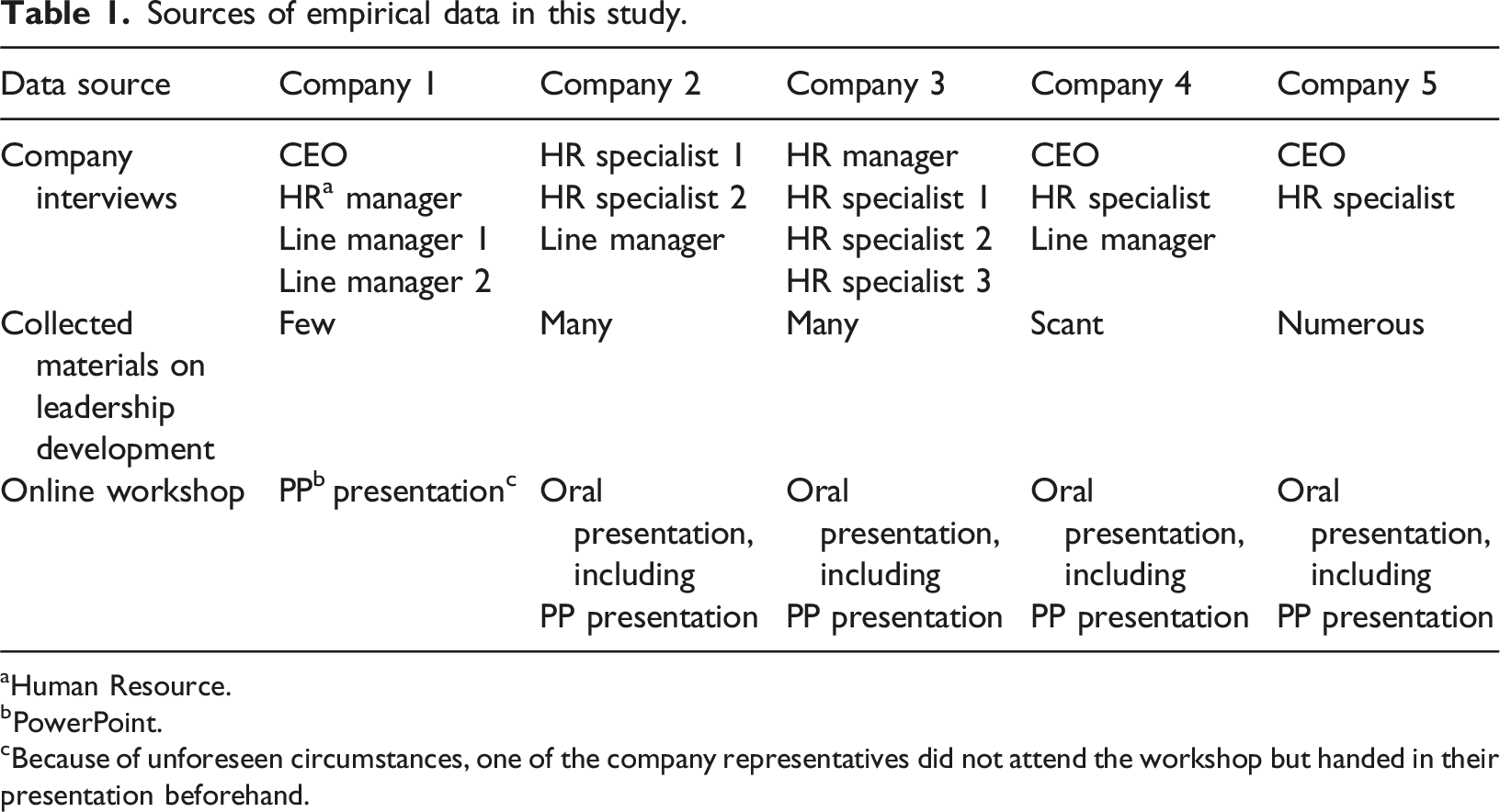
aHuman Resource.
bPowerPoint.
cBecause of unforeseen circumstances, one of the company representatives did not attend the workshop but handed in their presentation beforehand.
The interviews served as initial sources of data for analysis. For the semi-structured interviews (Bryman, 2016), we used an interview topic guide that aligned with the didactical questions commonly considered in developmental and learning activities (Karlström and Hamza, 2021), which are also applied in leadership development to varying degrees (Killian, 2010; Kroll et al., 2024). The questions posed were as follows: What is leadership development? What is it for? For whom is it? How is it implemented? The company interviews lasted 60–150 min. The participants were also prompted to consider the challenges and tensions that they believed influence leadership development practices. The interviews were audiotaped and transcribed verbatim to facilitate subsequent data analysis.
The documents proved particularly valuable for constructing a historical understanding of emerging leadership development and the broader setting in which leadership development took place (i.e., the organized place). The amount of materials and information on leadership development varied significantly between the companies. However, the companies were asked to not merely present the materials at face value but to actively analyze it by critically examining the documentation itself and considering its purpose and limitations. This analysis offered a critical voice by asking questions such as What assumptions underlie this documentation? and What does the overall documentation convey? (Appendix 1), which contributed to the narrative.
In the companies’ presentations at the online workshop, we learned more about their organizations, histories, core businesses, and current leadership development practices. The workshop gave us a fuller understanding of the relationship between organizational leadership identity and leadership development practices. We believe that the workshop data played a crucial role in shaping our research focus, as it sparked our curiosity about how organizations express leadership and its development. During the workshops, participants articulated their leadership development practices implicitly in terms of “who they are” and “what they value”. Thus, while the workshops provided valuable context and inspiration for our analysis, the core empirical insights in our results section are primarily drawn from more structured data sources, such as company interviews and documents. These sources offered deeper, more detailed evidence on how leadership identity and development are embedded within organizational practices.
Our goal in using different data sources was to move away from reliance only on people’s interview talk, which has been criticized for not actually mirroring reality but rather representing the behavior of individuals during interviews (Alvesson and Sandberg, 2024), and instead, to uncover and highlight the implicit beliefs and perspectives in the companies’ leadership development strategies—an approach that has been shown to justify such strategies (Alvesson and Spicer, 2012; Fabisch et al., 2024).
Analysis
We analyzed the data in several steps. First, we read the interview transcripts thoroughly to familiarize ourselves with each company and to develop the organized place, including cultural and historical factors. Second, we searched for expressions of identity and values in all three data sources through a highly iterative and reflexive process to move away from a chopped-up way of relating to empirical material, develop narratives of the LDSs, and gain a more holistic understanding of the place in which the leadership development was organized (Newstead et al., 2024). This provided a more relevant portrayal, because phenomena such as leadership development are social constructs and do not exist independently but are shaped by individuals’ meaning-making (Gioia et al., 2013; Kjellström et al., 2020). Through this process, an image of an organization’s identity and values in relation to its arrangements for leadership development could emerge, which may be regarded as a more creative way of defining the phenomenon in focus (Alvesson and Sandberg, 2024).
The company-selected documents were used in collaborative discussions with the company representatives. These discussions provided valuable insights into the rationale behind the inclusion of specific documents. Each narrative was shared with the respective company representatives to ensure its accuracy and relevance. These narratives then became the basis of follow-up conversations with these representatives, where they were asked to reflect on and refine the content to enhance the trustworthiness of the results (Smith et al., 2023). This collaborative approach, with regular partnership discussions, not only facilitated deeper understanding of the findings but also ensured that they were meaningful and potentially actionable for the participating companies (Ellström et al., 2020).
Research quality
The project was overseen by a steering committee where all participating companies were represented. This committee approved both participation and the interpretation of the data presented in this paper. The study does not fall under the domain of the Swedish Act concerning the Ethical Review of Research Involving Humans (Swedish Government, 2003), as no sensitive personal data was collected or processed. Nonetheless, ethical considerations and principles played a central role in the research design. An informed consent process was established through mutual communication and agreement between the researchers and participants, ensuring voluntary participation throughout the study.
The HR professionals served as both key respondents and gatekeepers for other participants. This dual role was acknowledged and handled with care to avoid ethical and power-related issues. They were selected for their central responsibility in leadership development and their strategic and operational insights into the field. To mitigate power asymmetries and ensure voluntariness, participation was based on informed and voluntary consent, with no pressure exerted on employees. The research team maintained an open dialogue with all participants and emphasized the voluntary nature of participation. The dual role of HR was therefore managed transparently and ethically, in line with established guidelines and good research practice. Ethical approval and adherence to these principles underscore the study’s integrity and validity.
Results
Organized place of each of the participating companies, encompassing its organizational leadership identity.
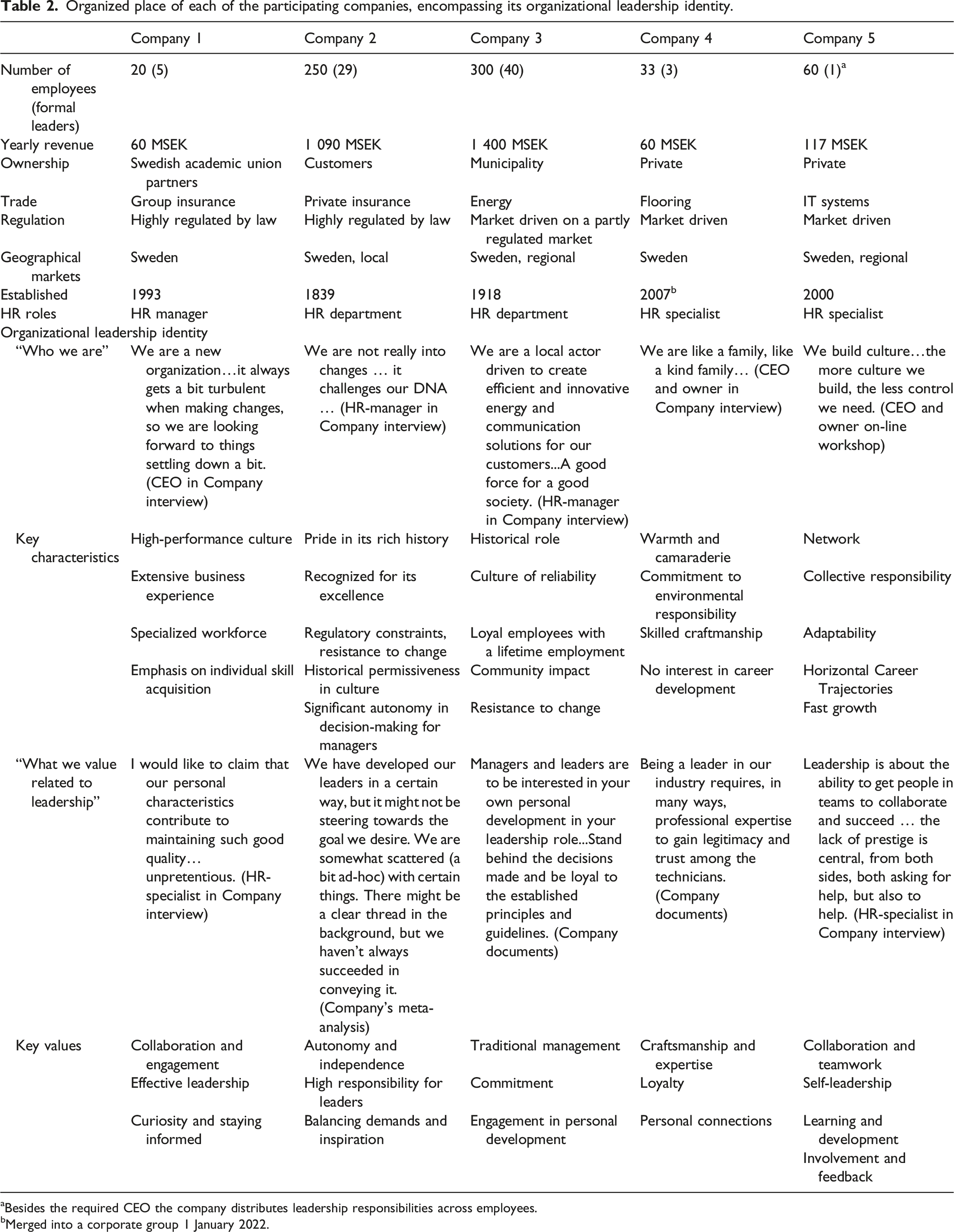
aBesides the required CEO the company distributes leadership responsibilities across employees.
bMerged into a corporate group 1 January 2022.
Company 1
This medium-sized, member-owned insurance brokerage operates nationwide and holds a significant position in its industry, thanks to its longstanding commitment to providing insurance solutions tailored to union members. Despite its prominence in its industry, it maintains a relatively small number of employees. Notably, the management team constitutes a substantial portion of the workforce. According to the CEO, “I don’t believe in manager-less companies; a certain structure is necessary for accountability, among other things.” Apart from the CEO, all managers are relatively new to their managerial roles. However, they collectively bring extensive business experience to the table, said a line manager of the company: “Like many managers, I struggle with the fear of making mistakes … [but] I don’t need to bear these fears alone…. [W]e have created a sense of security in the jungle, in the difficult situations.”
The high staff turnover in recent years has been a cause for concern. The resulting influx of new employees has prompted a strong emphasis on individual skills acquisition primarily focused on learning the trade. The legislation requires insurance brokers to offer their counselors a minimum of 15 h of competence development annually; but in this company, the counselors are offered 30 h. While much attention is given to enhancing individual skills, there is comparatively little emphasis on collective learning activities. However, the management team actively engages in collaborative reading of diverse materials, such as research papers, reports, and trend analyses, with a strong focus on leadership and related topics: We have a common exchange of experience[s] with each other, across departmental boundaries, for joint learning.… [W]e do a lot [of this] informally.… [A]s a working group, … we are very curious about our work, follow new trends [and] findings, and gather a lot of unstructured knowledge that we discuss over a cup of coffee.… [Much] of what we come across, we take on[,] and [we] do something beyond ourselves that is beneficial to our owners’ associations. (HR specialist, Company 1 interview)
This proactive approach to continuous learning and reflection underscores the managers’ dedication to staying informed and adapting to contemporary leadership theories and strategies. Leadership development has an emergent approach, utilizing nonformalized forms of learning at the workplace, among the managers: We see the value [of] filtering … knowledge together and are strengthened [by it] together.… [We] are leadership-training ourselves…. [It’s] without demands; when it is structured, the demands come.... [This] is playful, lighthearted, [and] positive ... without putting pressure on us.... [It’s] the playfulness that makes it fun. (Line manager, Company 1 interview)
The management team is dedicated to achieving excellence not only in business operations but also in leadership practices. Their personalities are perceived as integral components of their leadership and their well-functioning team. They actively cultivate a culture of high performance, emphasizing the importance of effective leadership in driving the organization forward. They acknowledged that this relentless pursuit of excellence may lead to an overemphasis on the individual personalities of the leaders and may create a distance between them and the workforce.
The organization uses consultants to facilitate cultural change and introduce eclectic methods, such as coaching and mentoring. The managers also attend formal trainings, such as university or management programs, but these trainings are conducted individually to fit the individual’s particular development needs. A specific characteristic of the company’s leadership development is the integration of formal training with informal learning in practice, which aligns well with the company’s Strategic Competence Development Policy: “Continuously evolving through daily learning is important to us, and we learn through challenging assignments, collaboration, and education.”
Company 2
This company, a customer-owned corporation, operates through a unique structure consisting of 23 locally independent companies. These subsidiaries collectively own a parent company, which assumes responsibility for managing common issues across the organization, including on product development, information technology (IT), and training programs. With an almost 200-year legacy, the company takes pride in its rich history of providing individuals with safety and security through a diverse range of insurance solutions. Over the years, the company has evolved beyond its initial focus on insurance, expanding its operations to include banking services. Today, it is a comprehensive provider of financial and insurance services, catering to the diverse needs of its customer base. It is also recognized for its excellence—a survey by the Nordic Brand Academy attests to its high reputation among entities engaged in banking and insurance. Despite its esteemed standing, the company acknowledges the challenges inherent in the insurance industry, which are characterized by regulatory constraints and resistance to change: The insurance industry is quite sluggish because we are [regulation] driven … not really into changes.… [This] challenges our DNA.… [We] have been a rather kind employer … evoking a pathos of justice … but now, we need to put our foot down and actually dare to say that we have to change. (HR manager, Company 2 interview)
This insight underscores a pivotal moment for the organization. The historical permissiveness in its culture, where tangible consequences are rare, has given managers significant autonomy in decision-making in their respective business units. Although this autonomy has fostered a sense of independence, it has also led to occasional misalignments with the company’s overall business objectives. Now, in the face of industry challenges and evolving market dynamics, there is a recognized need for a shift in this cultural paradigm. The organization is gearing up to instigate change, encouraging a more aligned and decisive approach to addressing the demands of the contemporary business landscape. This signifies a departure from the familiar ethics of justice toward a more assertive stance, where change is not simply acknowledged but actively pursued. However, these change efforts do not easily fit into the company’s regulation-based business.
The company’s leadership development is focused on increasing leadership skills and abilities through education, via courses, lectures, and programs. These courses and programs are run mostly by external consultants. No cohesive leadership program is offered, apart from the first-time line manager training given through the mother company. To meet the challenges in the changing business landscape and the increasing market competition, the company has developed an action-based value platform entitled “‘Engaged Leadership’ Speak up! Be brave! Get it done!” (from the company’s report entitled “Company Values”). The platform specifies the leader as a role model, with a specific responsibility to create rich ground for the realization of company values. However, transfer problems are a reality: “The most difficult thing is to actually make it happen in practice… after the education has been completed, I am swallowed up in everyday work” (line manager, Company 2 interview). Trust in educating leaders is legitimized through a belief in traditional upskilling methods: There is no evidence supporting the thesis that the ability to lead is innate. Leadership is learned. Leadership is a visible pattern of methods and behaviors and a specific set of skills and abilities. You can learn to lead and become a better leader over time. (Information on leadership)
However, practice-based methods, such as mentoring and coaching, have been tested locally, but they tend to fade away and have not been fully embraced by the leaders. Multiprofessional action teams with leaders have also been formed to foster the necessary cooperation across units, and initiatives to develop more formalized feedback processes have been tested, but their transfer into active feedback practice and working across borders has yet to be realized. It is difficult to get to cross-border work.… [We] talk a lot about working together more … to bring together employees to work together, but we are not very successful in doing it ourselves … thinking that it will happen in everyday work, and then, it does not happen. (HR specialist, Company 2 interview)
A challenge is to distribute leadership in the organization and include in leadership development efforts employees with leader positions who do not have staff responsibility or other customary managerial duties, such as appointed improvement leaders who support the practice of working with continuous improvement.
Company 3
This company, steeped in a traditional business structure with distinct divisions overseeing various production areas, has been a stalwart provider of effective infrastructure for power supply and of exemplary working conditions for over a century. Throughout this extensive period, the company has fostered a culture of reliability, which has resulted in a cadre of loyal employees, an impressively low turnover rate, and a considerable number of employees enjoying lifetime employment. However, the evolving market landscape necessitates a transformative shift for the organization. Rather than adhering solely to its historical role of managing and maintaining electricity power infrastructure, the company is embracing a new direction—toward being a sustainable and comprehensive service provider. This strategic pivot entails adapting business processes not only to remain competitive but also to explore and capture new market segments. The envisioned outcome is a fundamentally different company that is poised to deliver enhanced value to its customers. This paradigm shift demands a departure from established norms and a broad investment in human capital. The HRM-strategy is updated, and all managers who aspire to stay on board are required to reapply for their position based on the following newly established Leadership and employee policy: “Our expectation for managers and leaders is to be interested in your own personal development in your leadership role” (Guidelines for Leadership and Employee Roles). The managerial focus is obvious in the new orientation.
External consultants have been appointed to support the transformation of the company by delivering an extensive leadership development program. The program introduces the concept of a ‘learning organization’ that covers five themes or value-based expressions: ownership, transparency, a developmental approach, curiosity, and collaboration (Goal and Result Management). At the same time, methods and practices such as 360-degree leadership, mentoring, and coaching have been initiated. The organizational metamorphosis involves cultivating a service- and goal-oriented business, uncovering cross-boundary solutions, and nurturing a culture conducive to continuous learning. We need leaders because we have to make a transition; change management is really the cornerstone of leadership, that you have to lead somewhere, move somewhere, make some kind of transfer … but also self-leadership, to lead yourself.… [S]tructure and culture are integrated.… [W]e believe that our structure will foster the culture we strive for. (HR manager, Company 3 interview)
Today, the methods and practices initiated are gradually settling, and the organization is working to reinforce practice-based learning approaches, for example, by appointing coaches who will support the new working processes, arranging forums for reflection, and holding workshops and training sessions on topics that are relevant for the transition.
Company 4
This company began as a modest flooring enterprise and, over the course of only a few decades, has evolved into a comprehensive supplier in the flooring industry. Remarkably, it has garnered substantial respect within the business and achieved consecutive recognition as the recipient of the sector prize for Sweden’s most sustainable company. This attests to the company’s commitment to environmentally conscious practices, a testament to its growth and influence in its industry. Renowned for its personal and amiable approach, the company has built its reputation on the shoulders of its skilled craftsmen. Its organizational structure reflects a close-knit ethos, with a flat hierarchy managed by two owners and three foremen. Described as being akin to a family, the company maintains an atmosphere characterized by warmth and camaraderie, suggesting an informal approach to business. However, a merger with a corporate group is currently taking place, which is assumed to professionalize the leadership role, management, and supervision: “It has been like a family, like a kind family.… [T]here is a lot of good in it, but now, we are part of something else, something bigger, and the company is subject to other demands” (CEO and owner, Company 4 interview).
This evolving landscape has brought about changes that have led to a high turnover over the past few years. Because the company’s workers are highly attractive in the market, many of them choose to leave in favor of a more permissive work life. However, the growth of the business has put pressure on the organizational structure and requires the expansion of the management team, but there are no clear career pathways, and the craftsmen do not show much interest in career development or leadership responsibilities: “What are our career ladders[?] … [W]hat is the next natural development … to become a supervisor.… [W]hat tools do we have?” (HR specialist, Company 4 interview).
The company’s view of leadership development tends to focus on the importance of industry-specific knowledge and is often linked to competence development. Thus, leadership tends to be self-taught, earned by being anchored in the business, and tied to professional expertise. Leaders appear “naturally” in the course of practice, from ordinary everyday work and decision-making. An excerpt from the company’s Policy for apprentice education and mentorship states: “Being a leader in our industry requires, in many ways, professional expertise to gain legitimacy and trust among the technicians…. [S]upervisors without professional certificates are offered to undergo a competence test.”
There has been a clear master–apprentice culture, suggesting that competence and leadership development mainly takes place in practice, even if often unnoticed. The company’s HR specialist commented on this: We need to improve the working environment and achieve better and clearer leadership.… [W]e will implement teams that the leader will convene once a month.… [A]lso, we have developed a report template where supervisors and apprentices are required to reflect on competency development needs and progress in the apprenticeship training every month.
Supervisors and foremen are also given opportunities to participate in external training, although not to develop their leadership skills but to improve their performance as supervisors and foremen, as specified in the company’s Action Plan 2021.
Company 5
This company distinguishes itself through a nonhierarchical business structure that fosters collective responsibility among its employees to deliver efficient IT solutions. Operating as a complex network without formally appointed managers, except for the legally mandated CEO, the organizational ethos prioritizes boundary-crossing horizontal tasks, collaboration, and networking. In this system, managerial responsibilities are distributed across the workforce, and employees head various functions. The organizational structure is more of a network of responsibilities than a traditional hierarchical model. A strong organizational culture, characterized by shared values, norms, and practices, cultivates a sense of ownership and accountability among employees, thereby reducing the need for centralized control mechanisms. Teams are structured around clients and projects, utilizing practice-based tools to manage and control work processes. Although this flexible, bottom-up approach enhances adaptability, it necessitates ongoing structural changes and the formation of new social teams. The company faces challenges in adjusting to a volatile market without losing direction and in attracting new members. The following excerpt from the company’s Maintaining Our Values in Growth blog further describes this process: We work systematically on a part of our organizational development at a time … an agile method where we involve all employees very early in an iterative process. The challenge in this is that it is not possible to present a finished picture of exactly how our new organization will look—it evolves gradually.
As the business evolves, so does the pressure on leadership. Here, leadership development takes place in everyday practice and is a joint commitment that presupposes that the organizational members take turns in assuming the team leader’s role. Leadership is not limited to a position or title but is conceptualized and integrated into general competence development and largely aligned with other business strategies and processes, such as with decision-making and action planning. Much leadership development takes place in everyday work: Learning is a crucial success factor for us. However, it means shifting the focus from “attending courses” to “developing every day” and viewing learning as a 70–20–10 pyramid: 10% of your learning occurs by “attending a course” in some form; 20% of your learning occurs by participating in interest groups [and] labs, having a mentor or coach, or in other ways [of] learning from colleagues; [and] 70% of your learning occurs on the job by receiving new exciting assignments that are more challenging than what you have done before. (Company 5 Learning policy)
A notable characteristic of this company’s leadership development practice is its shift from having the CEO change into a “chief guiding officer [or CGO] responsible for leading the company’s continued evolution and designing a functional organizational model” (CEO/CGO, online workshop). Career pathways are characterized by their nonlinearity, appearing less defined and potentially slower than in traditional structures. Careers lean toward a horizontal trajectory driven by self-direction and self-discovery among employees: I believe that you [can] potentially … grow faster as a human being [here], but it is a challenge to offer people who have high goals a career.… [Q]uite a lot of responsibility has been distributed to the employees, together with trust and mandate.… [I]f we build our work on trust, we do not need to build certain structures … if we believe that employees want to do their best.… [S]elf-leadership cannot begin with the individual but must begin with the organizing of the business. (CEO, Company 5 interview) Leadership is implicit in the organization and focuses instead on supporting and guiding a competent and motivated group of employees: “Leadership is about the ability to get people in teams to collaborate and succeed.… [T]he lack of prestige is central, from both sides, both asking for help, but also … [helping others]” (HR specialist, Company 5 interview).
The organization currently runs a comprehensive leadership development program focusing on feedback and coaching, which allocates additional time and specialized activities to employees who have been assigned leadership roles.
Relationship between the organizational leadership identity and the leadership development system
Relationship of organizational leadership identities to leadership development systems.
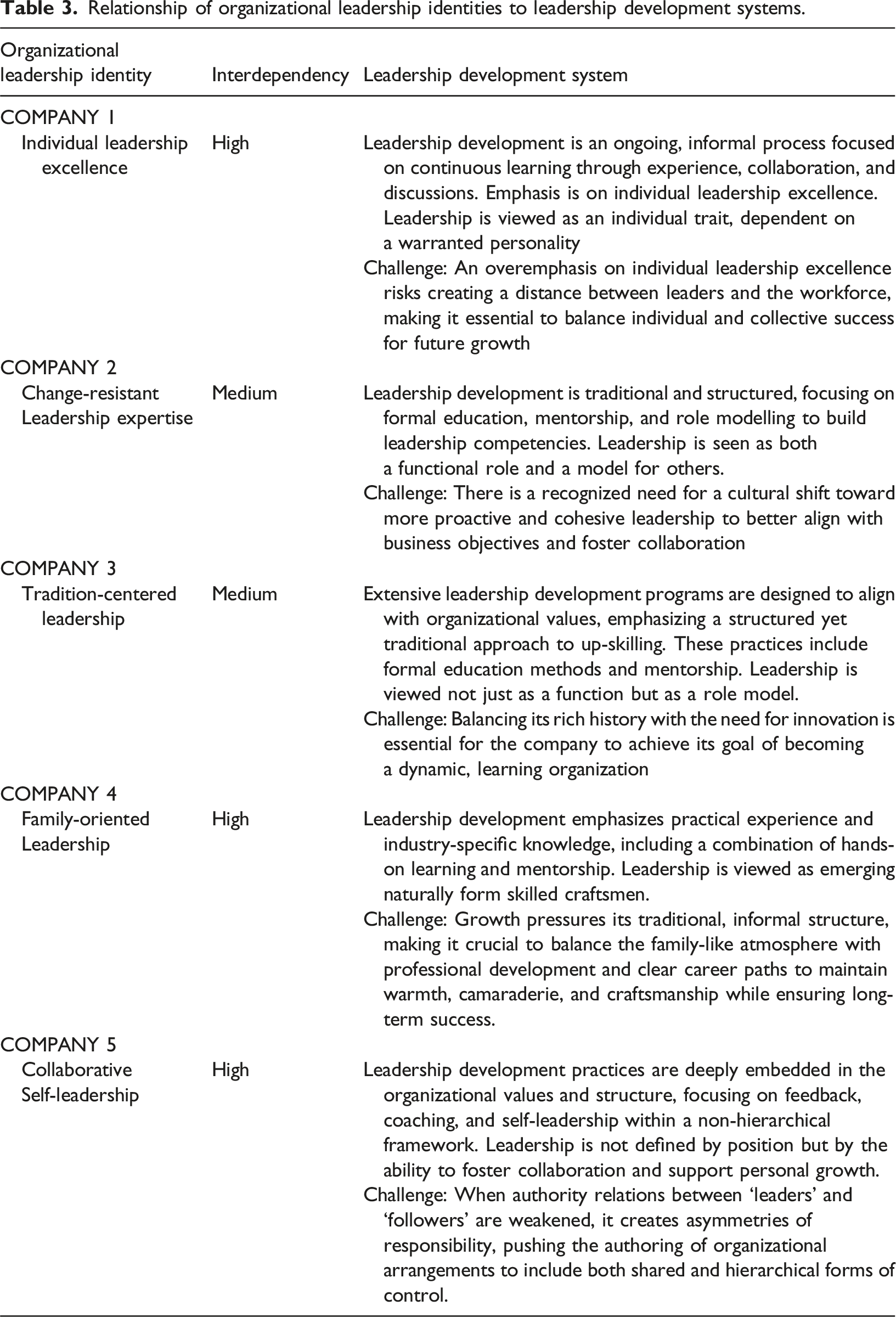
Company 1’s representatives described the company as a forward-thinking organization committed to excellence. It prioritizes leadership that drives progress, encourages creativity, and fosters a collaborative environment. It believes that personality is a crucial component of leadership, particularly emphasizing traits such as engagement, curiosity, and staying informed. Its organizational leadership identity is Individual Leadership Excellence, which, in turn, influences how its leadership development practices are shaped. Courses and programs are conducted individually, but in the management team, a playful and pressure-free learning approach is acknowledged. External expertise is sought when needed to maintain high standards.
Company 2 is characterized as a customer-focused company dedicated to providing top-quality service and products. Its leadership values revolve around customer satisfaction, upholding integrity, and maintaining high standards. It values autonomy and independence and assigns substantial responsibility to leaders, and its characteristics are rooted in pride and recognition of its excellence. Its organizational leadership identity is Change-resistant Leadership Expertise. External consultants play a crucial role in delivering high-quality training, ensuring that the leaders are exposed to the trends and best practices in leadership.
Company 3 is a results-oriented business with a strong emphasis on performance and accountability. Its leadership values revolve around being goal-driven, efficient, and capable of inspiring teams to achieve high performance. Its characteristic values are traditional management, commitment, and engagement in personal development, which constitute a Tradition-centered Leadership identity. Its leadership development programs and practices are designed to align with its identity and values, while the business progresses into a learning organization.
Company 4 is a community-centric organization that believes in social responsibility. Its employees describe themselves as a family, where leadership is about building strong relationships, fostering teamwork, and making a positive impact on the community. The company places a strong emphasis on loyalty, craftmanship, and personal relationships, reflecting its long-standing commitment to tradition and a close-knit family-like culture. It exhibits a Family-oriented Leadership identity. Its approaches to leadership development are framed by a master–apprentice culture, ensuring that leadership skills are passed down through hands-on experience, developed through everyday work, and emerge naturally from skilled craftsmen.
Company 5 is an agile and adaptable company that thrives on change and continuous improvement. Its leadership values highlight the importance of flexibility, openness to new ideas, and commitment to both personal and organizational growth. The company is open and amenable to learning on the job. Its employees are given challenging assignments, and leadership roles are regarded as fluid and dynamic, alternated among team members. The company has a clear focus on developing the collective to reach common goals, which is characteristic of a Collaborative Self-leadership identity. The company’s leadership development practices are deeply embedded in its values and organizational structure, focusing on feedback, coaching, and self-leadership within a non-hierarchical framework.
Discussion
This study explored the relationship between organizational leadership identity, defined as ‘who we are’ and ‘what we value related to leadership,’ and leadership development practices. The analysis of five company narratives revealed five distinct organizational leadership identities, ranging from individually oriented to collaborative self-leadership-oriented identities. These findings suggest that the local narratives, which define the organization’s leadership identity as a unique community shaped by its history and value system, are indeed related to the shaping of the organization’s LDS.
The value of recognizing leadership development as a system
Drawing on the insights of Day and Dannhäuser (2024), Avolio and Drummey (2023), Fabisch and colleagues (2024) and Garavan and colleagues (2021), we advocate for integrating leadership development into the broader organizational framework, thereby offering a systems approach that enhances the overall organizational effectiveness. By conveying the organizational leadership identity expressed in this study through narratives, we foster a sense of wholeness that transcends individual training or programs. This holistic approach to leadership development can potentially be more seamlessly integrated into the organizational frame and highlights comprehensiveness as one of the three aspects of the interdependency between the organizational leadership identity and the LDS.
The diverse leadership development practices observed across the five organizations illustrate significant variations and the unique meanings they generate, highlighting the complexity of interactions within different environments and their alignment with business strategies and values. Viewing leadership development as a system entails recognizing the interaction and interconnection of practices within a given context or, as we have done in this study, a ‘place,’ a site of integration, activation, and interconnection between people, things, and experiences (Newstead et al., 2024).
The use of ad hoc (i.e., improvised or temporary) leadership development methods raise concerns because of the increased risk of misalignment. Crucial to maintaining an alignment is continuity, the second aspect of the interdependency between the organizational leadership identity and the LDS. Although experimenting with different methods can be beneficial because there is typically no one-size-fits-all solution, the ambiguity of a company’s underlying values and strategies may create stress in the organization (Fabisch et al., 2025). Previous research indicated that organizations often succumb to trends and packaged leadership development interventions (Lundgren and Poell, 2023), further emphasizing the need for a continuous and cohesive approach.
This brings into focus the last aspect of the interdependency between the organizational leadership identity and the LDS: coherence. Both Company 2 and Company 3 demonstrated how their historical roots influence their organizational leadership identity and values. For example, Company 2 emphasized safety, security, closeness, care, and family—epitomized by its motto, “We are there when you need us.” This is further demonstrated by the company’s many regional offices, one in every town. This unique historic legacy provides an example of the time-sensitive nature of leadership when an organization is attempting to adapt. As shown by Wallo and colleagues (2013), ‘new’ leadership ideas might clash with the understandings of leadership that are prevalent in organizations, which highlights the importance of aligning leadership development with the organization’s legacy and cultural values.
Adaptive leadership and organizational transformation
The adaptive processes found in the analysis of the five companies imply new ways of organizing business, such as by transitioning from small traditional structures to larger professional ones. These processes require acquiring new knowledge and competencies to make the organization more apt to the environment (Uhl-Bien and Arena, 2018). Impeding issues concerned matters such as persuading employees of the benefits of new work methods, attracting and retaining relevant talent, and identifying clear career pathways. Paradoxes that arose included the need to balance business expansion with preserving a familiar and entrepreneurial culture (Company 4), and the need to balance shared leadership and hierarchical forms of control with maintaining coherence and effective organizational arrangements (Company 5), or balancing the ambition of becoming a dynamic, learning organization with a long-standing history of traditional management (Company 3). Adjustments in organizational structures are often seen as means of implementing these changes, but they are typically insufficient on their own. However, as Pettigrew (1987: 650) argued nor is there a “simple-minded link between leadership and change … rather, leadership is both context and time sensitive.”
Thus, we believe that for an LDS to drive change effectively, its practices must be closely aligned with the organized place, including interconnections between people, things, and experiences (Newstead et al., 2024) that shape an organization’s leadership identity as a unique community with its own history and value system. Leadership should be treated as a continuous process within the place, encompassing antecedent conditions of change, internal structure, cultural and political contexts, and the broader external environment from which the legitimacy of change is derived (Pettigrew, 1987). From previous research, we know that professionals’ beliefs about interpersonally oriented HR practices, such as management, are culturally sensitive (Teniälä et al., 2016).
Individual and collective values ingrained in the leadership development system
Analysis of the findings from this study in terms of the distinction between leader and leadership development (Day, 2000) revealed differences in the methods used (Gilani et al., 2022; Kjellström et al., 2020). A manager-oriented LDS prioritizes the development of managers through formalized interventions, such as manager meetings, courses, and programs. We found that Company 1, Company 2, and Company 3 frequently address managers in their narratives, in contrast to the other companies. Company 1 does not believe in ‘manager-less’ companies, while Company 2 struggles with including in leadership development employees with leader positions but without customary managerial duties. In contrast, collectively oriented LDSs target the entire staff, emphasizing issues such as competence development and career paths, as seen in Company 4 and Company 5. An individual approach may strengthen leadership at the individual level as part of a system, but it does not function as an isolated component without a collective approach. We propose that these two approaches must interact to align; otherwise, there is a risk of misalignment with, or even disconnectedness from, the system, which, in turn, will result in a less robust system, that is, will increase vulnerability and lack of comprehensiveness.
An interesting finding is that the collectively oriented approach explicitly was aligned with the core values in the two companies. In Company 4, the organizational structure reflects a close-knit ethos, with a flat hierarchy managed by two owners and three foremen. Described as being akin to a family, the company maintains an atmosphere characterized by warmth and camaraderie, suggesting an informal approach to business. Company 5 nurtures a self-leadership culture that challenges traditional divisions of labor, roles, and responsibilities but that seems to present collective leadership as emerging from among the teams. However, these alternatives to hierarchy can cause difficulties. Koistinen and Vuori (2024) found that more self-managing practices create asymmetries of responsibility, pushing the creation of organizational arrangements that include both shared and hierarchical forms of control, while Puranam and colleagues (2014) found that alternatives to hierarchy are technical and quite managerial, frequently imposing predetermined solutions rather than supporting locally developed, self-organizing methods.
Company 5 is particularly interesting to analyze through an emergent lens. Organizations are continuously moving; and as an organization expands in size, it tends to incorporate additional methods of leader and leadership development. When Company 5 first became aware of leadership development as a system, it started to deliberately talk about and list how activities integrated in the workday could be acknowledged as developmental opportunities while realizing that there are informal leaders who are not provided support for their tasks and roles. Thus, Company 5 strengthened both its leader and leadership development (cf. Day, 2000) and started to use informal on-the-job activities as deliberate means of leader and leadership development. This suggests that a collective view facilitates the use of everyday work practices in this development, moving away from the more formalized approaches to L&D initiatives. Company 5 illustrated that it could tailor its leadership development activities to its organizational values, strategies, and structures to allow its LDS to fit its needs and resources in an increasingly evolving business world. In a similar study, the use of systems thinking enabled a move from a focus on individual leader development and programs to system-based thinking on customer-oriented quality development, where developmental efforts are integrated into regular meetings (Fabisch et al., 2024).
Study limitations and future research
Future research would benefit from including a wider range of organizational actors across multiple levels and roles, to capture a more nuanced and collective understanding of leadership development processes. Such an approach could complement the HR perspective and further illuminate the relational and embedded nature of leadership in everyday organizational practice. We believe that the use of multiple data sources enabled us to move beyond a purely instrumental view of leadership development, such as that found in policy documents. The inclusion of an online workshop added another dimension to our analysis, while extensive data collection across diverse sources, combined with a strong research–practice partnership, further enriched our understanding. This comprehensive approach provided a more nuanced perspective on each company’s LDS and enhanced the validity of our conclusions. Importantly, we believe that our attempt to identify the relationship between the organizational leadership identity and chosen leadership development practices is a new, unpaved path to gaining a better understanding of the concept. Future research should further investigate the interdependency between leadership identity and LDS, particularly regarding the roles of coherence, continuity, and comprehensiveness. Also, to deepen our understanding of how these aspects shape LDSs, we suggest adopting a systems approach to identify patterns across different organizations. Finally, future research could examine how HR professionals influence leadership development strategies, the extent to which their involvement shapes leadership identity within organizations, and potential variations across different organizational contexts.
Conclusion
This study contributes to the understanding of organizational leadership development by identifying and analyzing five distinct leadership identities within Swedish companies. The findings underscore the importance of aligning leadership development with an organization’s strategies, values, and historical context to effectively support organizational goals and manage changes. By challenging traditional linear models of leadership development, this research promotes a systems approach that considers the interconnectedness of practices and experiences within organizations. This approach not only enhances the effectiveness of LDSs but also ensures their alignment with the organization’s core values and strategic objectives.
In conclusion, this study provides valuable insights into the relationship between organizational leadership identity and leadership development, emphasizing the importance of a coherent, continuous, and comprehensive approach. By doing so, it offers a robust foundation for future research and practical applications in the field of leadership development.
Supplemental Material
Supplemental Material - Continuity, coherency, and comprehensiveness in the shaping of leadership development systems in Swedish companies
Supplemental Material for Continuity, coherency, and comprehensiveness in the shaping of leadership development systems in Swedish companies by Gunilla Avby, Ingela Bergmo Prvulovic, Annika Engström and Sofia Kjellström in Leadership.
Footnotes
Declaration of conflicting interests
The author(s) declared no potential conflicts of interest with respect to the research, authorship, and/or publication of this article.
Funding
The author(s) disclosed receipt of the following financial support for the research, authorship, and/or publication of this article: This was supported by Stiftelsen för Kunskaps- och Kompetensutveckling (20210019).

Supplemental Material
Supplemental material for this article is available online.
Author biographies
References
Supplementary Material
Please find the following supplemental material available below.
For Open Access articles published under a Creative Commons License, all supplemental material carries the same license as the article it is associated with.
For non-Open Access articles published, all supplemental material carries a non-exclusive license, and permission requests for re-use of supplemental material or any part of supplemental material shall be sent directly to the copyright owner as specified in the copyright notice associated with the article.
