




Abstract
Leadership development (LD) plays a significant role in achieving high-quality performance and business results, but there is little research on how leadership development itself evolves as the organization develops. This study explores how a leadership development system evolved over 30 years, during a time when the organization became increasingly high performing. Through reflexive thematic analysis of organizational documents and interviews with top managers and practitioners, the study provides a rich longitudinal description of the evolvement. The results revealed three pervasive changes of the leadership development system: 1) from a system for business-specific learning to one for system-wide learning; 2) from a system for personal development to one for customer-oriented quality development; and 3) from a leadership development system consisting of leadership development programs to one that is integrated into regular meetings and uses simple rules. These changes supported the gradual transformation of the leadership development from being independent to becoming integrated in the wider system, supporting the business system. The findings offer a unique insight into how an organization transitioned from individual leader development towards promoting collective aspects of leadership development. The study provides two main theoretical contributions that support the perspective of viewing leadership development as integrated within organizational development. Firstly, we present a more multifaceted way of understanding leadership development, wherein managers and employees, customer outcomes, and business advancement are seen as mutually developing. Secondly, we introduce two new critical points that complement previous descriptions of an advanced leadership development system: It is system wide (not only business specific) and customer oriented (not only leader/participant oriented).
Keywords
Introduction
Leadership development is presumed to hold a significant role in ensuring and improving high-quality performance and business outcomes (Boaden, 2006; West et al., 2015). Both public and private organizations invest time and resources in leadership development practices (Mercer Mettl, 2019; Vårdanalys, 2017). To comprehend how organizations employ leadership development, it is vital to perceive all these leadership development practices as a cohesive system rather than as isolated initiatives. We posit that a leadership development system encompasses all activities, methods, processes, and roles that an organization sets up with the intention of improving both collective and individual aspects of leadership capacity. This approach expands upon previous definitions that primarily focus on aspects of the organization that contribute to producing effective individual leaders (Van Velsor et al., 2010). Leadership development systems change over time in response to the ever-changing environment, but also in relation to the beliefs and understandings of leadership development among those who are involved. However, there are few studies that explore how leadership development systems evolve over time, and even fewer that empirically outline the evolvement during a time when the organization becomes increasingly high performing.
This paper is based on a case study of a public organization, Region Jönköping County, in Sweden. The organization began to be high performing in terms of for example customer satisfaction and cost-effectiveness from the 2000s onwards, and has an excellent track record in national quality incentive schemes and surveys within healthcare and welfare (Dagens Medicin, 2020; The Swedish Association of Local Authorities and Regions [SALAR], 2021a, 2021b). The aim of the study was to explore the evolvement of the leadership development system. The questions addressed were: How did leadership development beliefs and practices change? What factors promoted the change?
The results offer two main theoretical contributions: Firstly, our findings provide a more multifaceted way of understanding leadership development, wherein managers and employees, customer outcomes, and business advancement are seen as mutually developing. This contrasts with the conventional understanding where the effects of leadership development are thought to evolve linearly through the training of leaders, which are then expected to influence employees to enhance processes, subsequently impacting customer outcomes and business advancement (Crethar et al., 2011; Kirkpatrick, 1998). Secondly, our study confirms that advanced leadership development systems align with business strategies, address long- and short-term challenges, and utilize a multitude of methods to improve leadership (Van Velsor et al., 2010), but with the addition of two critical points: an advanced leadership development system is system wide (not only business specific) and customer oriented (not only leader/participant oriented). Overall, our study highlights the necessity for future research to shift focus towards studying leadership development systems encompassing collective aspects of development integrated within organizational development, rather than focusing solely on single leadership practices or individual leader development (Van Velsor et al., 2010). This finding aligns with the emerging view that leadership development is a multilevel phenomenon, situated within organizational development (Batistič et al., 2017; Bolden, 2010; Vongswasdi et al., 2023).
Theoretical framework
Human beings are inherently engaged in the processes of meaning-making. Phenomena like leadership development (LD) are social constructs; they do not exist independently but are shaped by how people make meaning of experiences. Our theories play a role in shaping this reality, as we interpret reality through them and our actions are in some way influenced by them (Meindl, 1995). Studies have shown the multifaceted nature of people’s understanding of leadership development, where the predominant narratives or logics relate to creating effective individual leaders, promoting personal development, and aligning leadership development with organizational strategies (Kjellström et al., 2020; Vongswasdi et al., 2023). While these studies relate to individuals’ beliefs on leadership development in general, our study addresses how stakeholders within an organization understand the leadership development work over time through the analytic lens of beliefs and practices (Drath et al., 2008). We situate our study within critical research that explores and exposes underlying assumptions and understandings in leadership activities (Alvesson and Spicer, 2012; Mabey, 2013).
Leadership development beliefs and practices
Studying both beliefs and practices seems to be important because beliefs influence practices, even though not all beliefs may result in actual enacted practices (Drath et al., 2008). Leadership development (LD) practices tend to be based on traditional designs, such as programs used for formal training and education (Turner et al., 2018). Previous research suggests that LD practices that incorporate a combination of activities and methods, tailored to the leaders’ developmental needs and matched with managerial roles and organizational structures, have a better chance of success (Day et al., 2014; Lacerenza et al., 2017).
While LD practices within an organization encompass all activities, methods, and arrangements that the organization sets up with the intention of improving leadership capacity, the beliefs or assumptions are more discreet. Beliefs consist of ways of understanding a phenomenon, and they give meaning and ascribe causes and consequences to experiences and practices. A belief never stands on its own; it is always justified and supported by other beliefs, and together they form underlying structures of webs of beliefs (Drath et al., 2008). People make sense of a situation or experience by organizing various inputs to make the world more understandable and orderly (Weick et al., 2005). LD beliefs, for example, include assumptions regarding the formability of leadership (e.g., innate and/or learned), where and how leadership develops (e.g., informal programs and/or throughout life), and the emphasis of LD initiatives (e.g., specific individual competencies and/or whole person attributes, co-workership, and shared sensemaking) (Vogel et al., 2021).
In organizations where people with different beliefs come together in social interactions, a collective structure of similar beliefs emerges. Patterns of overlapping assumptions are enough to foster agreement within a group about the main features, even though individuals have their own ways of understanding (Dickson et al., 2006; Schein and Schein, 2017). Individuals thus become socialized into expected meaning-creating activities, and their behavior is influenced by prevailing norms and expectations from others and society (Day et al., 2014). Beliefs within an organization constitute more or less stable patterns in the collective’s assumptions, embedded in its culture (Drath et al., 2008; Probert and Turnbull James, 2011) and embodied in spoken and written language (Crossan et al., 1999; Gioia et al., 1994). Larger organizations have a greater variety of beliefs, but still appear to be influenced by the mindset of the CEO (Giberson et al., 2009).
Transformation of LD beliefs
The longitudinal design of this study enables the exploration of changes in beliefs and their underlying structures. When we learn new things, we initially encounter the new information by interpreting it in terms of our existing beliefs. In this process, we fit the new information into our existing understanding of the phenomenon. When we instead encounter information that does not fit with our current understanding, it can be explained as our underlying structures of beliefs are changing. This occurs when we have limitations in our current way of constructing meaning and need a more complex way of understanding (Drath et al., 2008). When beliefs are restructured, they change how we understand and know a phenomenon, rather than what we know about it (Kegan, 2018). In this paper, we use the term transformation to refer to this more comprehensive change. A transformation seems to occur in specific sequences, with each successive stage including and transcending the previous one. Because later stages include all earlier stages as special cases, the later stages are more complex and support more comprehensive and abstract understanding (Dawson and Heikkinen, 2009; McCauley et al., 2008).
According to McCauley and Palus (2021), collective beliefs about LD can transform along three threads: 1) from understanding LD as the sole development of individuals to also viewing it as the development of collectives; 2) from understanding LD as universal and generic to seeing it as local and highly contextualized; and 3) from enhancing conformity to disrupting and questioning status quo and existing norms.
A central element in more critical studies is the exploration of underlying beliefs and assumptions regarding leadership and leadership development. Probert and Turnbull James (2011) even propose that the role of leadership development is to renew leadership beliefs, so that the beliefs reflect the new challenges facing the organization. In this study, we seek to explore the underlying assumptions in an organization that has considerably changed its way of working with leadership development.
Setting
We conducted this study in Region Jönköping County, which is one of Sweden’s 21 decentralized regions. Region Jönköping County is responsible for welfare services within several business areas such as primary care, specialist care, dental care, public transport, some areas of culture and education, and regional development. The organization has approximately 11,000 employees, including 550 managers, and serves a population of 360,000 residents. Regions are mainly financed by tax funds, which implicate that success is measured by value standards rather than financial growth.
The organization began to be recognized as high performing from the 2000s onward. Since then, it has maintained an excellent track record of results in areas that exemplify sustainable success (Hallencreutz et al., 2020), as defined by the Swedish counterpart of the Malcolm Baldrige National Quality Award: satisfied customers, engaged and satisfied employees, environmental sustainability, social sustainability, and economic sustainability (Swedish Institute for Quality, 2022). For example, the organization has an excellent track record in national quality incentive schemes and some of the best results among similar organizations in terms of clinical results, customer satisfaction, and cost-effectiveness (Dagens Medicin, 2020; SALAR, 2021a, 2021b).
It is important to bear in mind that no organization can be understood outside of its wider social and cultural context (Scott, 1995). During the 1980s, quality improvement began to be applied in American health care (Berwick, 1989) and soon also in Sweden. In the 1990s, Region Jönköping County applied the vision “For a good life in an attractive region” and “Quality as strategy” with the ambition of handling financial challenges and services developments by using methods for quality improvement (Andersson-Gäre and Neuhauser, 2007; Bodenheimer et al., 2007; Staines et al., 2015; Øvretveit and Staines, 2007). “Quality as strategy” suggests that resources for new development areas can be released by better and more efficiently meeting customers’ needs and by continuously developing and streamlining existing working methods (Gray et al., 2016; Ham et al., 2016). This study explores how the leadership development system evolved during this period.
Methods
We conducted this case study by following the step-by-step guide developed by Rashid et al. (2019). We collected and analyzed a versatile empirical material, which included internal documents concerning LD practices during the years 1990–2020, along with interviews conducted with all top managers (n = 4) formally responsible for the leadership development system and all LD practitioners (n = 5) accountable for the implementation of formal LD practices during the same period. Both top managers and LD practitioners had been employed in the organization for a significant amount of time, frequently spanning the entire studied period, and had held their roles as top managers or LD practitioners for an average of about 10 years. The COREQ 32-item checklist for qualitative studies (Tong et al., 2007) and the International Standards for Authors (Wager and Kleinert, 2011) were used to assure quality and ethical standards.
Data collection
We obtained digital and written documentation from 1990 to 2020, such as governing documents, invitations, qualitative and quantitative evaluations, schedules, and presentations from LD programs (printed papers and PowerPoints), from the organization’s stored binders and data server, resulting in a total of 180 documents.
The interviews were held in 2020–2021 by the first author (A.F.), who was an inside researcher working as a development leader and PhD student. Case studies require the researcher to be involved in the process of generating and interpreting the empirical material (Rashid et al., 2019). Acting as an inside researcher enabled a smooth data collection process, granting access to participants, including those who had retired. The researcher’s own experience as a manager and development leader in the organization for over 15 years provided a solid understanding of the context. However, this also demanded a high level of reflexivity. A logbook and frequent discussions within the external research group were used to improve reflexivity on the findings and the researcher’s role, as well as to emphasize various interpretive possibilities.
The informed consent process began by contacting the respondents using contact information from the organization and providing information about the study design, research ethics, and requirements in terms of the time needed for participation. Everyone who we asked chose to participate. All participants signed an informed consent letter. The semi-structured interviews were conducted in a place chosen by the respondent and lasted between 1 and 2 h. The authors developed the interview guide, and all interviews were recorded and later transcribed by one external resource, replacing personal names with pseudonyms.
Data analysis
We analyzed the documents and the transcripts of the interviews separately by using thematic analysis (Braun and Clarke, 2022) before merging them into a joint analysis. We read them several times while noting initial codes based on features and patterns that emerged as significant in relation to the study aim and research questions. A.F. mainly conducted the initial analysis, with the second author (S.K.) reading the transcripts and a sample of documents for coding in order to ensure a richer and more nuanced reading. Throughout the analysis process, we reanalyzed and discussed the codes and themes within the research group.
To explore how leadership development beliefs and practices changed over time, we initially sorted the codes based on the feature of the leadership development system they addressed. This resulted in three themes. Within each theme, we found two central organizing concepts, one at the beginning of the studied period and one towards the end. The codes surrounding these two central organizing concepts contained meanings and interpretations that differed qualitatively, which we interpreted as a transformation (Figure 1). Within each theme, there were also codes that related to both of the central organizing concepts and described factors that accelerated the changes of the beliefs or the practices. We interpreted these codes as promoting factors for the changes (Figure 1). Methodological underpinnings of the three transformations in the leadership development system (LDS), based on changes in leadership development (LD) beliefs and practices. The transformations (themes) are shown by describing earlier and later stages (central organizing concepts) of LD beliefs and LD practices, along with the promoting factors for change (codes). The later stages incorporate beliefs and practices from the earlier stages.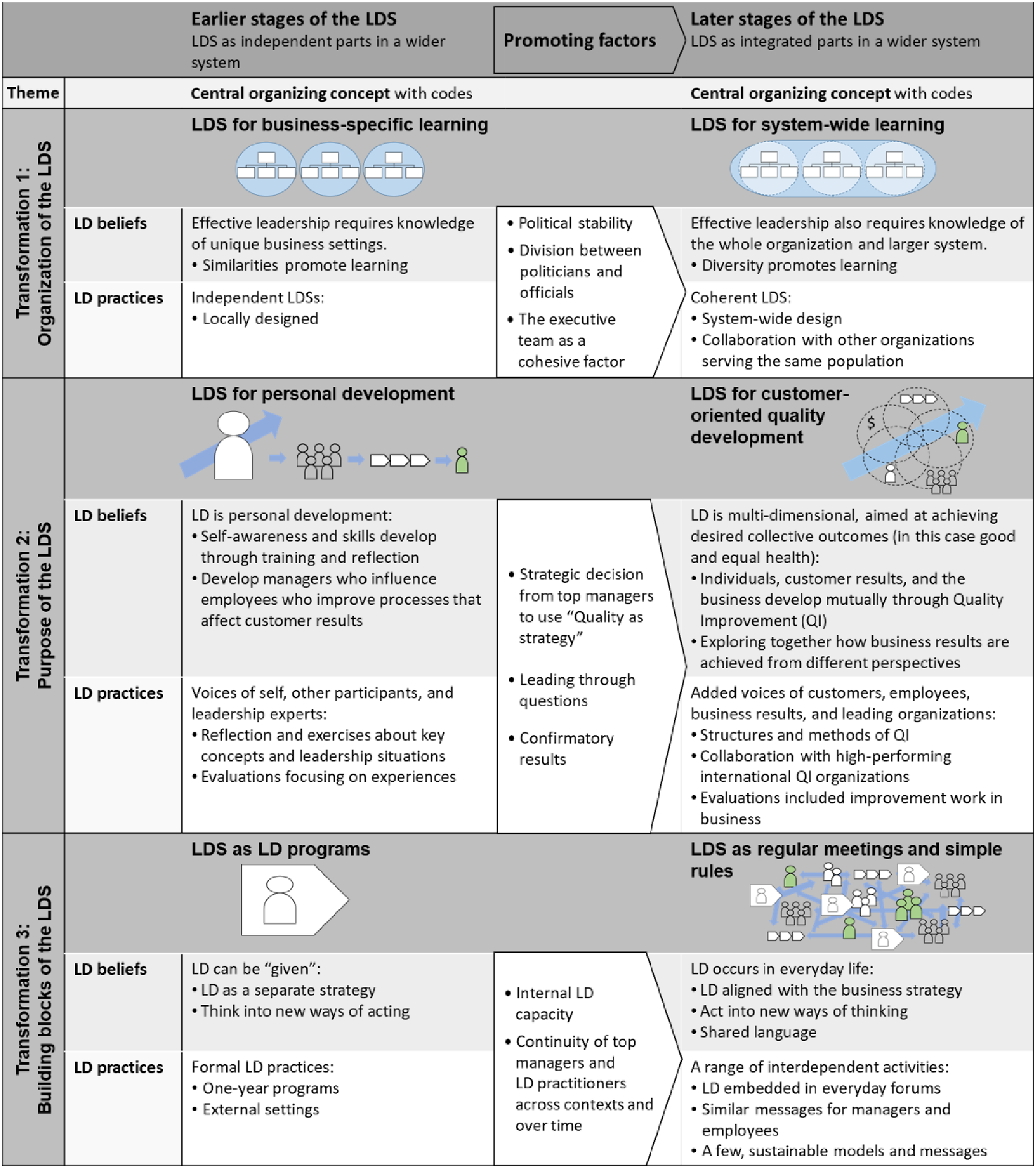
To validate the findings and gather additional perspectives, we presented and discussed the preliminary results at analytic seminars: two with the respondents (n = 9, divided into two groups) and one with internal stakeholders responsible for other parts of the organization (e.g., from HR, Communication, Working Environment, and Education & Research; n = 4) (Figure 2). The participants confirmed the overall results and contributed with more examples and descriptive data. A.F. and S.K. held these occasions jointly and recorded and listened to them afterwards to ensure that no new data was missed. The process of data analysis.
Thereafter, all authors revisited all themes and codes to clarify the differentiation in themes and assure that they reflected the data as a whole. The connections between the codes, the central organizing concepts, and the themes are illustrated in Figure 1. Finally, the overarching theme was identified.
Results
The results revealed three pervasive transformations in the leadership development system, based on changes in both beliefs and practices: 1) from business-specific learning to one for system-wide learning, which changed the organization of the LD system; 2) from personal development to one for customer-oriented quality development, which changed the purpose of the LD system; and 3) from leadership development programs to integrating leadership development in regular meetings and using simple rules, which changed the building blocks of the LD system (Figure 3). The transformations began at different times in a successive and concurrent manner, with the overarching theme that the leadership development system gradually changed from being independent parts to becoming integrated in the wider system, supporting the business system. Three transformations that began at different times.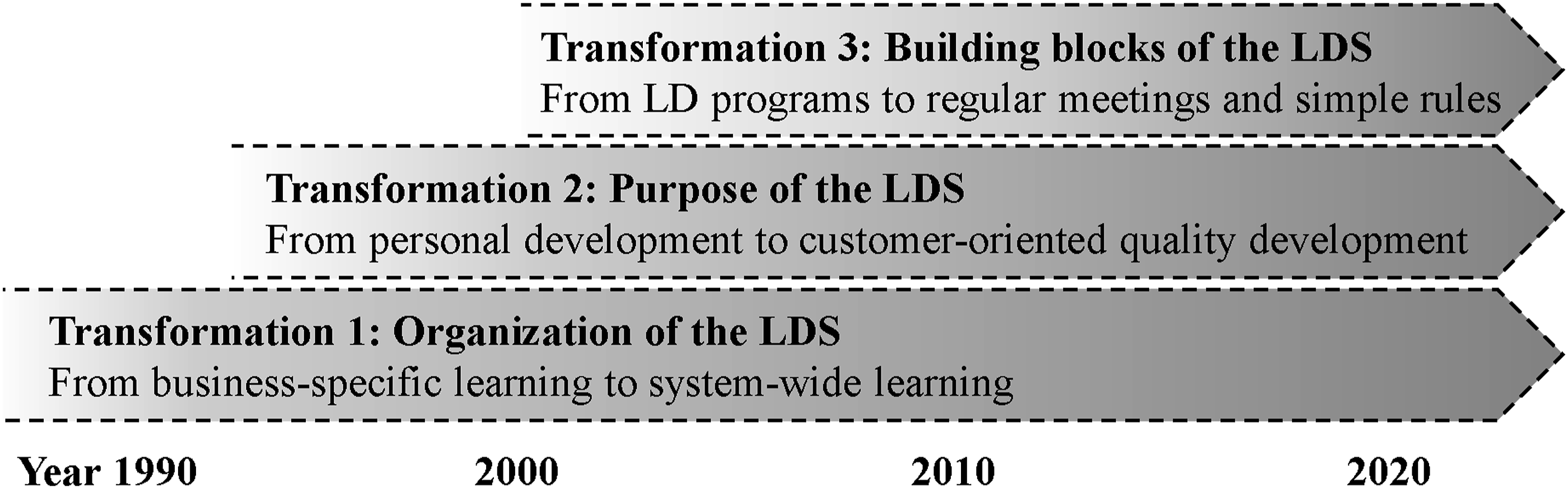
Transformation 1: From business-specific learning to system-wide learning
In the first transformation, which began in the early 1990s, the understanding of how to organize a leadership development system changed.
LD beliefs
Before the transformation, the leadership development system relied on the belief that effective leadership requires knowledge of unique business settings. Thus, LD was organized by gathering managers from the same type of business, built on the assumption that similarities promote learning.
Gradually, the assumption emerged that system-level knowledge was crucial for effective leadership and successful business outcomes. In later stages, learning was believed to be promoted by through diversity, challenging one’s current understanding. For example, a description in a document from 2001 concluded: The County Council shall actively contribute to the exchange of experiences among managers, management teams, and project groups at various levels and between different units.
LD practices
The many independent leadership development systems that were a reality in the early 1990s operated within decentralized business areas and hospitals, and were built on locally designed programs. At that time, there was one program in Jönköping’s healthcare area, one in Värnamo’s healthcare area, one in the highlands’ healthcare area. And as I mentioned earlier, they were far from being integrated into the same system. (Interview with LD practitioners 8)
The transformation successively involved a change towards coherent and system-wide designed programs for managers. Initially, the programs separated unit managers and senior managers, but in 2010 every other seminar was run together. Another sign of change was mandatory facilitated networking groups for managers, with the purpose of discussing leadership related to the organization’s values and strategies. Networks of a similar kind had previously appeared locally, but were now composed of managers from different areas of the organization. Also, more and more temporary LD practices were organized in collaboration with other organizations serving the same population, for example with municipalities. We should design to bring it all together, based on the system. (…) It’s a new time for collaboration across boundaries. (Interview with LD practitioner 6)
Tensions during the transformation
Initially, the business-specific LD practices were sometimes perceived to be competing with the system-wide LD, and seen as a sign of failure to create a system-wide approach. However, the tension gave opportunity for learning and adjustment. The interviewed LD practitioners, after negotiation, viewed both business-specific and system-wide learning as important and interdependent. These tensions still arise when specific business areas create their own leadership development practices, but today it is managed as a fluctuating and natural variation where power over the leadership development system needs to be both centralized and decentralized.
Promoting factors
The first transformation was possible due to the political stability brought about by the political parties reaching consensus about long-term goals. In addition, divisions between politicians and officials emerged and their different responsibilities became clearer, which offered stable conditions for the officials to work with long-term strategies. And this led to the public servants’ responsibilities becoming very clear and the politicians’ responsibilities becoming very clear. (…) That is still a very central question. (Interview with Top manager 5)
Concurrently, the organization’s executive team began to work with the organizational vision “For a good life in an attractive region” and general strategies. Serving as a cohesive factor for various business areas, the executive team gradually assumed responsibility for the leadership development system.
Transformation 2: From personal development to customer-oriented quality development
The second transformation began in the mid- and late 1990s, and was related to the purpose of the leadership development system and the increased use of quality improvement methods in the organization.
LD beliefs
Initially, the purpose of LD within the organization was understood as personal development. Individual abilities, such as self-awareness and skills, were expected to be developed through training and reflection. Effects of LD were predicted with a linear logic; thus, by developing the managers’ abilities, employees will be influenced to improve processes that in the end will affect customer results. These beliefs were replaced by understanding LD as customer-oriented quality development to improve what the organization exists for (in this case good life and an attractive region), and the core business. It meant that LD became multi-dimensional, aiming to achieve desired collective outcomes. Personal development has always been important, but it had more focus in earlier programs. A shift took place from personal development to systems, measurements, and results. (Interview with LD practitioner 8)
Quality improvement work was assumed to mutually develop individuals, customer results, and the business. Exploring together how business results were achieved from different perspectives—such as customer satisfaction, employee wellbeing, process safety and efficiency—would promote this development, as would learning together from the impact of actions. It wasn’t the idea of a formal, structured program. It wasn’t about checking off all these points, ‘you must be knowledgeable about all of these, and there will be an exam afterward.’ It wasn’t that setup at all. It was more about ‘How do you get people engaged and willing to do something for the residents?’ Their willingness should be to contribute to what the region’s outcomes are about. (Interview with LD practitioner 3)
Personal development was still considered important, but now it was assumed to also take place by contributing to the business results. The theme of personal leadership was deliberately placed last in LD programs because the LD practitioners considered it necessary for managers to first understand the customers, the system, the processes, and the employees before identifying their personal needs.
LD practices
Before the second transformation, the LD programs primarily employed methods that highlighted the voices of self, other participants, and leadership experts such as through literature and lectures. The focus was on exercises to increase individuals’ ability to handle different leadership situations, for example by using real-world case discussions and tasks in between the seminars to promote action-based learning, and reflection upon key concepts like power and leadership. Decision-making, power, authority, and so on. How do I view these concepts and how do I relate to them? It was a lot of self-reflection. (Interview with LD practitioners 8)
Recurring themes included communication, teamwork, and the working environment. Evaluations focused on experiences, primarily the participants’ opinions about the program.
During the transformation, the organization successively used LD practices to explore structures and methods of quality improvement. Gradually, some quality improvement methods became recurrent and since 2012 all LD programs were built on five themes: customer orientation, system-thinking, process orientation, involving employees, and personal leadership. The LD practices added voices of customers, employees, and business results. For example, a preparatory assignment used in the programs during the years 2017-2020 instructed:
To prepare: An example where a change has improved results across all aspects of the Balanced Scorecard: customer satisfaction, process quality and safety, employee wellbeing, costs, and learning.
The unit for quality development was made responsible for the formal LD practices in the late 1990s, and the LD practices were co-created together with other internal divisions, such as HR. A common feature was an ongoing collaboration with high-performing international quality improvement organizations. All LD programs included practical quality improvement work with the support of a quality improvement coach and ended with a learning seminar together with the CEO. Evaluations included questions about improvement work in business as well as the managers’ experiences of the programs.
Tensions during the transformation
During the transformation, a tension appeared between individuals with strong beliefs of LD as personal development and those who promoted LD as customer-oriented quality development. The tension became quite notable when managers who participated in the LD programs, often doctors, opposed and requested the content to focus more on traditional leadership training and measurements of individual development. The contradictions were most obvious during the first decade of the 2000s, but relevant also in later discussions with new top managers, external consultants, and researchers. By collaborating with top managers and hiring doctors as LD practitioners, the professional authority over the matter was balanced, and the tension weakened. However, throughout the years, LD practitioners handled the expectations of measurable personal development differently. Some prepared concrete individual behavioral and knowledge goals for the program to meet such expectations, while those who strongly believed in viewing LD as customer-oriented quality development omitted these practices.
Promoting factors
The interest in quality improvement arose during the financial recession as managers made efforts to lead the organization in new ways. The strategic decision from the CEO and the top managers to commit to “Quality as strategy” laid the foundation for the second transformation. Through an exploratory approach characterized by both top managers and LD practices leading through questions, the organization’s direction was guided. This is exemplified by the following questions used in a preparatory exercise during the years 2013-2014:
How do you identify customer needs? How do you take these needs into account in your work methods and your processes?
Evidence of the organization’s own success was found in national measurements, judged as confirmatory results, sufficient to continue with the alignment of LD and “Quality as strategy.” Then this rolled on, and we also saw that we got good results. (Interview with Top manager 9)
Transformation 3: From LD programs to regular meetings and simple rules
The understanding of useful practices for LD changed during the third transformation, which started during the 2000s. It meant a shift from LD programs as the building blocks of the leadership development system to a broader set of LD practices where various forums and regular meetings were understood as opportunities for LD.
LD beliefs
Before the transformation, there was an assumption that LD could be “given” via formal LD practices, especially through programs for managers. LD was seen as a separate strategy, packaged and delivered into LD practices, were managers were expected to think into new ways of acting. In a way, it became like a school for the participants. (Interview with LD practitioners 8)
These assumptions were challenged by the belief that LD mainly occurs in everyday life. It became important to also use regular meetings and it was assumed to be more effective to use short, formal LD activities for all managers several times a year than to just send a few managers on a program from time to time. Employees were supposed to understand the same messages to be able to lead and contribute to quality improvement themselves.To attempt to promote a shared language and guidelines while simultaneously allowing creativity, flexibility, and engagement, a few recurring models and messages were utilized. Some examples were the vision “For a good life in an attractive region” (why the organization exists), the organization’s values (highlighting success factors for quality improvement), and three simple rules: “What is best for Esther” (the customer),“I take responsibility for my own tasks, give feedback to the step before and facilitate the step after,” (emphasizing process-thinking) and “We do it together” (emphasizing system-thinking). In this way, LD was integrated into daily work, and individuals were expected to act into new ways of thinking. It’s the same images and concepts that we will continue to immerse ourselves in. Because we are constantly getting new generations. Both managers and employees. So, we can’t stop immersing ourselves in it. (…) To be in that simplicity. (Interview with Top manager 7)
LD practices
Initially, the LD programs ran often for 1 year and were held at an external setting, such as inns and hotels. It was 2-days courses with overnight stay at the rectories in the county where we trained in teamwork and communication, among other things. (Interview with Top manager 5)
Later, the leadership development system was built on a range of interdependent activities, mainly not named LD but used to promote LD embedded in everyday forums and activities. For example, monthly meetings led by the top managers were permeated by the same models and messages as the LD programs. The programs are just a support system for the whole. (…) Designing programs that are not backed by a complete system is pointless, you may switch them constantly without any consequences because they won’t match up with the day-to-day work. It is essential to have the same philosophy and build on the same strategy as the rest of the organization. (Interview with Top manager 4)
The organization arranged internal mass education for employees and annual conferences to offer opportunities to learn from one another and connect with international experts. Elements of quality improvement were also included in existing education, such as courses for physicians and administrators. A center for practice research and education in quality and safety was started in collaboration between the region, the university, and the municipalities to promote higher education in quality improvement and leadership, including a master’s and a PhD program. In the middle of the 2010s, employees interested in leadership began to be used as facilitators at dialogue meetings for managers, which was described as LD for both the employees and the managers.
Tensions during the transformation
LD programs that ran over a 1-year period continued to be an important part of the leadership development system. While all LD practitioners and top managers supported the integration of programs and on-the-job learning, some emphasized the significance of the programs, while others underscored the importance of regular meetings and simple rules. This tension became evident when new managers sought to influence the organization with novel leadership concepts through new programs, while experienced top managers stressed the necessity of preserving and evolving the existing strategy.
Promoting factors
The managers encountered problems when they tried to apply what they had learned during the LD programs. This transfer problem triggered the development towards working with a similar content in various forums throughout the organization. It became increasingly important to build internal LD capacity with internal competence and practitioners who had insight into the organization and knowledge of quality improvement. The continuity of top managers and LD practitioners across contexts and over time made it easier to link messages between different forums. For example, the LD practitioners had meetings and programs for different professionals and most of the top managers were the same individuals over time. I believe that by coordinating ourselves even more internally, we already have the resources in the region, with existing payroll costs. By preparing programs together, we educate each other on ‘what do we stand for’ and what support resources we have for that. (Interview with LD practitioner 1)
Discussion
This study shows how a leadership development system evolved over a 30-year period, during which the organization became increasingly high performing (Dagens Medicin, 2020; SALAR, 2021a, 2021b). The setting was a public organization, mainly within the health and welfare sector, with what was perceived as an excellent track record on national quality incentive schemes (Dagens Medicin, 2020; SALAR, 2021a, 2021b).
Our results revealed three pervasive transformations of the leadership development system, which began at different times in a successive and concurrent manner, rather than a processual and linear change. Thus, we found the changes to influence and strengthen one another. Former beliefs were transcended and included in the new beliefs, which were considered to better explain what effective LD is and how LD works. These changes supported the gradual transformation of leadership development from being independent to becoming integrated in the wider system, supporting the business system.
Our study is related to leadership development, but our findings share similarities with earlier descriptions of how leadership culture transforms in three stages: from dependent to independent, and then to interdependent (McCauley et al., 2008). Dependent leadership cultures are characterized by the belief that individuals in positions of authority are responsible for leadership, and therefore the only ones who require leadership development. Independent leadership cultures, in the next stage, are broadly characterized by the belief that various individuals can take on leadership roles when needed, based on their expertise and abilities. Finally, in interdependent leadership cultures, it is assumed that leadership is a collective activity that requires mutual inquiry and collaboration (McCauley et al., 2008). Similar to our study, differences are perceived as an asset in this stage, just as the widespread use of dialogue, horizontal networks, and the involvement of employees in leadership development practices. In our case, this was exemplified when employees were engaged as facilitators during dialogue meetings for managers, which was understood as leadership development for both. Interesting to note, the studied organization does not explicitly use a collective leadership development view, but it can be seen as an underlying assumption since our findings encompass both collective and individual aspects of leadership development.
Organization of the leadership development system
The change from multiple business-specific leadership development systems to one organization-wide system created a platform for the top management to reach people throughout the organization. The various business areas were integrated into the LD practices. This enabled managers and employees to explore their own understandings in the encounter with other people’s interpretations, questioning their own beliefs and the norms in their own workplaces. This finding confirms previous research showing that LD beliefs tend to transform from enhancing conformity to disrupting and questioning status quo and existing norms (McCauley and Palus, 2021). As part of this development, the organization collaborated with other organizations serving the same population. Leadership development systems that extend across organizational boundaries and become “system wide” are assumed to become more common in the future (Van Velsor et al., 2010).
Our study thus also confirms and challenges that the understanding of LD develops from viewing LD as universal and generic towards becoming more contextualized and thereby closely linked to the delivery of core business (McCauley and Palus, 2021). In addition, the contextualization is broadened to a system-wide approach that relates to the overall purpose of the organization, in this case good and equal health for the population. This broadening can be assumed to be necessary to make it possible to include other organizations serving the same population and thus become system wide. A more narrow, business-specific arrangement can make cooperation more difficult and prevent desirable system-wide effects.
Purpose of the leadership development system
The top managers and LD practitioners went from understanding LD as personal development to a customer-oriented quality development orientation. The content of the LD programs changed from dealing with individual reflection and training towards mainly focusing on quality improvement. Personal leadership continued to be an important part of the leadership development, but was assumed to occur when individuals acted and reflected together to improve the business. It is important to point out that this study only explores the beliefs of a few top managers in the organization, not all managers. The leader-centered belief has proven difficult to change (Schweiger et al., 2020), which also is noted in our results.
Understanding LD as an essential element, integrated with organizational development, is rare (Kjellström et al., 2020). Researchers have long suggested that business results are a by-product of learning and transfer because improvement of individual knowledge and behaviors can trickle down to affect employee performance (Kirkpatrick, 1998; Lacerenza et al., 2017). This traditional and linear way of understanding leadership development has led to the praxis that outcomes of LD are often only measured in improved knowledge or changed behaviors of the leaders. When the purpose of LD is understood as directly improving the customer-oriented quality and the core business, such specific outcomes can be misleading if they are not supplemented with measurements from other relevant perspectives such as customer results, process measurements, employees’ experiences, and costs. Thus, our results strengthen previous arguments that leadership development needs to become more multifaceted in order not to limit the development to selected personal behaviors (Bolden and Gosling, 2006), and evaluations need to include several aspects in order to be able to show a broader picture of both negative and positive effects (Gilani et al., 2022).
Building blocks of the leadership development system
Initially, the leadership development system consisted of LD programs for managers. During the introduction of “Quality as strategy,” extensive training in quality improvement began to be carried out for all employees, with content similar to the LD programs. Successively, the belief in LD programs decreased, but remained important to the people who participated. Instead, to allow employees and managers to explore the same message, more focus was placed on using forums in the daily work, such as recurring meetings, information channels, and mixed networking groups. The use of a few recurring messages with minimal specifications, like “simple rules” (Plsek and Wilson, 2001; Sull and Eisenhardt, 2015), enabled the spread to many people throughout the organization. An illustration of a simple rule was to consistently begin with the question “What is best for Esther?” (the customer), a concept originally used in the care of elderly patients, but which gradually developed to include the entire organization and spread around the world (Gray et al., 2016; Persson et al., 2021; Vackerberg et al., 2016, 2023; Vincent and Staines, 2019). Thus, this study is an empirical example of how the use of simple rules is integrated in LD practices.
“Both/and”—a balance between contradictions
Various factors promoted the transformations. A crucial success factor seems to have been the continuity of the vision and “Quality as strategy” (Staines et al., 2015; Øvretveit and Staines, 2007). The stability was, however, constantly challenged by different and independent business areas, external collaboration with international quality improvement organizations, and internal transfer problems. Thus, the results of this study show the importance of handling various kind of power and contradictory aspects, involving “both/and” rather than “either/or.” For example, both top-down management and bottom-up engagement were important, as were both stability and disturbance. This finding confirms theories that organizational development is about finding a balance between contradictory perspectives (Rosing et al., 2011; Rosing and Zacher, 2017), particulary for multilevel heathcare systems (Bolden et al., 2023). According to our result, the top-down management worked as a cohesive factor (Transformation 1) that made decisions (Transformation 2) and linked different parts within the organization and also other organizations serving the same population by being present in many contexts (Transformation 3). At the same time, they led by using questions and utilized LD practices to promote bottom-up engagement. This was exemplified by authorizing managers and employees to learn from one another (Transformation 1), enabling everyone to contribute to improving business (Transformation 2), and making their own decisions in line with the simple rules (Transformation 3). The importance of management commitment is confirmed in other studies of the same organization (Øvretveit and Staines, 2007; Persson et al., 2021; Staines et al., 2015; Vackerberg et al., 2023) and is described as an important factor for successful leadership development (DeRue and Myers, 2014). The combination of top-down management (exploitation of “Quality as strategy”) and bottom-up engagement (exploration of one’s own and others’ understanding, making decisions, and improving business) was promoted through LD practices including methods and activities for both sensegiving and sensemaking, which integrates processes that are important for organization development (Gioia and Chittipeddi, 1991; Weick et al., 2005).
Our intention is not to paint a rosy picture; the evolvement of the leadership development system has not been without tensions. Even now, there is negotiation when new leaders and employees join the organization, seeking to comprehend the intricacies of leadership development. We observe that individuals grapple with making sense of the organization’s approach to leadership development, which shares similarities with the challenges participants face in dealing with leadership programs (Larsson et al., 2020a, 2020b).
In summary, this study adds two pivotal dimensions to previous descriptions of an advanced leadership development system (Van Velsor et al., 2010): it is advantageously system-wide (not only business-specific) and customer-oriented (not only leader/participant-oriented). Our findings provide a more multifaceted way of understanding leadership development, wherein managers, employees, customer outcomes, and business advancement are seen as mutually developing. These theoretical contributions resonate with contemporary notions of system leadership, addressing complex challenges marked by interdependencies where solutions are not clear and fall outside the responsibility of any single organization (Evans et al., 2021) providing valuable insights in terms of developing leadership and welfare within an increasingly complex world.
Practical implications
• Broaden the view of leadership development to include personal, collective, business, and organizational development with the purpose of customer-oriented quality development. • Integrate the leadership development system with organizational development by using methods for quality improvement, and building internal leadership development capacity. • Focus on understanding how leadership development can be promoted in everyday work and see leadership development programs as one of many building blocks in a leadership development system, coherent and guided by simple rules. • Gradually build a leadership development system for the entire organization and collaborate with organizations that serve the same population. Promote development of relationships and the ability to collaborate within a larger system. • Build a leadership development system that facilitates both top-down management (exploitation) and bottom-up engagement (exploration) by leading through questions and using activities, structures, and methods for both sensegiving and sensemaking.
Limitations
Our study captures a fraction of a complex reality and does not give a complete picture of the changes in the leadership development system. We are focusing on the LD beliefs of top managers and LD practitioners who primarily influenced the leadership development system, but other LD beliefs likely existed within the organization (Dickson et al., 2006). The transformations were followed by tensions, indicating the presence of alternative understandings and viewpoints that continuously needed negotiation, but also gave opportunities for learning and adjustment. However, these alternative viewpoints were not the primary focus of this study. The selected documents were all from the organization’s data server and stored documents in binders, which may have affected the content since informal notes and work in progress were not included. That the document analysis, interviews, and analytic seminars contribute to the same result strengthens the study’s credibility.
Our study does not provide evidence of the transformations’ effects on the organization’s results, neither positively nor negatively, but the transformations occurred during a time when the organization became more successful. By describing the local settings in detail, and reproducing quotes from the respondents, the transferability will increase. The many other descriptions and studies about the same organization by other researchers make it possible to understand the context even better (Andersson-Gäre and Neuhauser, 2007; Bodenheimer et al., 2007; Gray et al., 2016; Kjellström et al., 2017; Øvretveit and Staines, 2007; Persson et al., 2021; Staines et al., 2015; Vackerberg et al., 2016). An inside researcher creates a risk for bias. At the same time, being familiar with the context from “within” is irreplaceably helpful when performing this kind of study. It gave good data access and contributed to trust in the in-depth interviews. The pre-understanding and connection to the local practice can also strengthen the accuracy in identifying and interpreting the data. To minimize the risk of bias from partial views, the inside researcher and outside researchers continuously discussed data sampling and analysis to prevent selective or unbalanced reporting. The research group has both practical and theoretical knowledge of LD, and experience from various research fields, which enriched the analysis work.
Future research
Further research needs to explore transformations and developmental stages for other leadership development systems to be able to answer whether these three transformations are general and whether the sequential order may vary in other organizations. There is also a need for further studies on the potential connection between business results and different stages in the development of leadership systems, and the ability of organizations to transform them.
Footnotes
Acknowledgements
The authors thank all participants who contributed to the study. Special thanks to Cindy McCauley, Center for Creative Leadership, for critical and helpful input during the analysis and writing process.
Declaration of conflicting interests
The author(s) declared no potential conflicts of interest with respect to the research, authorship, and/or publication of this article.
Funding
The author(s) disclosed receipt of the following financial support for the research, authorship, and/or publication of this article: This work was supported by Funding for dedicated research time for A.F. was provided by Region Jönköping County. The underlying research material and data can be accessed by the corresponding author.
