




Abstract
When in 1998, the historic Belfast/Good Friday Agreement marked the end of the 30-year violent Northern Ireland conflict often referred to as the ‘Troubles’, many commentators regarded it as the culmination of the life’s work of one man: John Hume. Hume was seen by many as a man of peace, but for others he was a trojan horse for violent Irish nationalism. This paper explores these contradictions through the lens of liminality and argues that central to Hume’s ability to create change in a schismogentic environment of conflict was his own ‘inbetweenness’: a leader of nationalism, but not a nationalist, a believer in non-violence, who engaged actively with men of violence, an MP elected to a British parliament, who worked hand in hand with the Irish Department of Foreign Affairs. In doing so it proposes a typology of five liminal leadership approaches which allowed for the untangling of the conflict over time: Reframing the Problem; Stakeholder Cultivation; Opening Linguistic Space; Practicing Disruption; and Acceptance of Sacrifice. This paper makes three contributions: to our understanding of leaders who inhabit and utilise liminal spaces, to leadership approaches in zero sum environments including those riven by ‘wicked’ conflicts, and to an understanding of Hume himself and his legacy.
Introduction
to know there is one among us who never swerved from all his instincts told him was right action who stood his ground in the indicative, whose boat will lift when the cloudburst happens. (Heaney, 1987)
1
.
When in 2011 the people of Ireland were asked by its longest running TV show to vote for the greatest ever Irish person, the result was not one of its historic revolutionary leaders, its writers, artists or even a president of the modern Irish state. Instead, it was a relatively recent political figure, one born outside the boundaries of the Irish Republic in the troubled North and associated not with Ireland’s often romanticised struggle for independence, but with its more recent and brutal internecine northern conflict. Depending on your perspective, John Hume has been styled as a leader of civil rights, a colossal moral force against violence, the person who ‘took the gun out of Irish politics’ the architect of the Good Friday Peace Agreement and recipient of the three global peace prizes – the Nobel, the Mahatma Gandhi Peace Prize and the Martin Luther King Junior Non-Violent Prize. Alternatively, he has been understood as an old style constitutional nationalist, a duplicitous man determined to destroy the union between Northern Ireland and Great Britain, a collaborator with IRA terrorists, a ‘philosopher-king’ (Bloomfield, 1994) who had neither the interest or the skills required to build a political organisation, and a political bore whose actions to bring violent republicanism into the body politic led to the fall of his own political party.
These contradictions and alternative perspectives speak to not only Hume’s long political career and his central position in Irish politics but to his frequent habitation of ideological, geographic, and politically liminal spaces, betwixt and between nationalism and social democracy, between Britain and Ireland, between the nation state and the European ideal. Ideologically committed to non-violence as a way to deliver change, he engaged in protracted, detailed and intensely controversial talks with those engaged in paramilitary outrages, even as violence escalated. An elected Member of the British parliament, he eschewed Westminster to work symbiotically with the Irish Government and Department of Foreign Affairs over decades - defining and refining Irish government policy and its enactment. The acknowledged leader of Irish nationalism, he declared national allegiance an accident of birth and famously professed ‘you can’t eat a flag’. This paper uses the experience of Hume to explore the utility of cultivating liminal ‘space’ to leadership theory, leadership practice and the untangling of wicked problems. It contends that Hume, through his own liminal characteristics and approaches, was distinctively placed to untangle the wicked problem of the Troubles and proposes a typology of five liminal leadership approaches which allowed for the untangling of the conflict over time: Reframing the problem; stakeholder cultivation; opening linguistic space; practicing disruption; and acceptance of sacrifice. In doing so, it speaks to the recent call by Tourish (2017) for leadership contributions which seek relevance with the problems of our time and makes three contributions: to our understanding of leaders who inhabit liminal spaces, to leadership practices in zero sum environments including those afflicted by wicked problems and to an understanding of Hume himself and his legacy.
Two perspectives on liminality
The concept of liminality has recently received significant attention from organisational scholars (Söderlund and Borg, 2018). Long used by anthropologists to describe and understand situations that sit betwixt and between one state to another, liminal transitions, if traversed successfully, allow the ‘limner’ to ‘transform’ to a new situation in both understanding and sometimes status (Turner, 1979; Van Gennep, 1960). Two perspectives on liminality are of interest to us in relation to this case. The first is the concept of the liminal more generally – as a ‘threshold’ state, temporally or permanently and one which contains within it the metaphorical inhabitants of the ‘host’ and the ‘trickster’. The second is the idea of liminality as it relates to environments of challenge, especially those that become stuck because of resilient and self-perpetuating liminal dynamics. We will look at each of these in turn before exploring the potential links between liminality and leadership, with a particular concern for ‘wicked problems’ which defy traditional approaches to resolution.
Liminal spaces
In general terms, liminality has been understood as a set of moments of ‘in-betweenness’, which are resolved when the liminal subject or ‘liminar’ is reincorporated into social structures, often with a higher or renewed status (Turner, 1979; Van Gennep, 1960). This journey through the liminal space of change and transition has been described as ‘liminality as process’ (Söderlund and Borg, 2018: p. 884). Liminal processes are not necessarily pleasant and may present difficulties, stressful environments and significant self-doubt (Douglas, 1988; Hawkins and Edwards, 2015; Horvath and Szakolczai, 2019). Such processes of change can also result in a feeling of heightened solidarity or ‘communitas’ (Turner, 1969). Within understandings of liminality are connected concepts which help us understand how individuals and groups engage with liminal spaces in both positive and potentially negative ways.
Liminal spaces are not empty of other occupants and dynamics. Edwards et al. (2021) are among those who have written about metaphorical inhabitants of liminal space such as the ‘host’ and the ‘trickster’ – archetypes who can alternatively guide or lead astray those in transition. Both are of interest. The ‘Host’ or ‘master of ceremonies’, is generally regarded to play a role which supports the liminal subjects in their travels through liminal space and ‘maintain order once the stabilities of everyday life are dissolved in the separation’ (Horvath and Thomassen, 2008: p.13). Hawkins et al. have identified leadership educators as ‘hosts’ for those undergoing leadership development programmes who ‘make learning possible’ (2015, p. 27). Others (Wheatley, 2004) have also explored the role of the host in leadership practice and noted its significance in environments of complexity, uncertainty and doubt (Edwards et al., 2021). Hosts also engage in leadership activities which are well known within leadership literature more generally, such as asking questions and querying assumptions (Grint, 2005; Heifetz et al., 2009), developing situational awareness of complex contests (Kempster and Stewart, 2010), and highlighting historical concerns and hidden agendas (Pettigrew, 2012).
By guiding liminal subjects through what can be painful, confusing and dangerous journeys to a ‘reincorporation’ (Turner et al., 1969) into society or a post liminal state, the host facilitates the process of sensemaking (Weick, 1988) in order to discern a path forward. Interestingly, Edwards et al. note that this conceptualisation of the host can indicate that the host themselves understands being on the ‘threshold’, perhaps from having already experienced the journey, or because they have a particular insight into the challenges ahead (2021). This process of challenge and support around the interrogation of threshold concepts, old certainties and previous beliefs carries its own dangers for hosts and liminal subjects: introducing the significant uncertainty, instability and doubt that is characterised by liminal spaces (Edwards et al., 2021; Meyer and Land, 2003). But the host is not the only metaphorical inhabitant of liminal space: the ‘trickster’ is also present. Szakoczai comments “The trickster … is only interested in maintaining liminality, as they can only gain influence under such conditions of confusion and distress” (2017: p. 234). Tricksters have been said to distort and take advantage of the vulnerability of liminal subjects (Douglas, 1966) and in doing so, seed confusion and anxiety (Horvath and Thomassen, 2008) thereby encouraging and perpetuating particular dynamics in liminal environments. They do this by exposing and exploiting points of weakness, insecurities and existing schisms (Radin, 1972), causing dangerous imitative processes to proliferate and negative and destructive dynamics to develop. Ladkin (2017) conceptualises the trickster archetype more positively - as a force which provides space for change, through disruptive energy and a radical challenge to the status quo.
Another connected concept and one which has attracted significant scholarly interest is that of permanent liminality. Turner (1979) argues that is its very impermanence that gives liminality such power and significance and that no subject or society could exist in a permanent state of liminality because of its disrupting force. Others have begun to explore what happens to people and societies when they are stuck in a kind of liminal ‘neverland’ – betwixt and between one stage and another, stranded, trapped or unwilling to leave liminal space. Interesting work explores these states in relation to the experience of individuals (Bamber et al., 2017; Beech, 2011; Clegg et al., 2015; Hay and Samra-Fredericks, 2016; Ibarra and Obodaru, 2016; Sturdy et al., 2006) and also of societies – especially those undergoing trauma and dislocation (Krasniqi, 2018; Marijan, 2015; Murphy and McDowell, 2019; Tešan and Davison, 2020). These processes of uncertainty which have no clear end state may be more accurately described as limonoid – in which meaningful social structures, rules of engagement and social norms are no longer in operation (Edwards, 2011; Turner et al., 1969). More concerning, such environments are particularly vulnerable to the trickster and associated attempts to foster disruption and confusion. Taken to their extreme, they cultivate ‘schismogenesis’ – literally ‘the creation of division’: an unstable, sometimes violent imitative and difficult to resolve dynamic of negativity and destruction in which parties are mutually aggravating and mutually aggrieved (Bateson, 1972).
Leadership, wicked problems and liminal environments
The role of leaders in such environments is obviously crucial and scholars have explored leaders and citizens embodying the characteristics of both hosts and trickers within liminal polities (Krasniqi, 2018) and environments of conflict (Tešan & Davison, 2020). Others have looked at leadership more generally in liminality and the role of leaders to act as reinforcer of overriding values (Pontefract, 2014). Similar to conceptualisations of the host, these practice orientated perspectives assert that leaders themselves need to understand and experience the liminal ‘threshold’ conditions of change to understand and be able to guide others through frightening and destabilising processes. It has also been noted that within contexts of violent contestation, leaders need to reach beyond their own social identity to outgroups in an inverse process, in order to establish progress (Khalil and Hartley, 2022). Such advice is similar to the type of leadership required and identified as significant to moving wicked problems to less dangerous states. However, there are few empirical examples of leaders engaging successfully with schismogentic spaces and utilising their own experiences and understanding of ‘threshold’ conditions to leverage change.
There is also increasing scholarly interest in the connections between leadership and the untangling of ‘wicked problems’ (Grint, 2010; Rittel and Webber, 1973). Wicked problems “are issues which ‘are ‘ill-defined’ and ‘malignant’. They cannot be ‘solved’ but are reliant instead upon ‘elusive political judgment for resolution...over and over again” (Rittel and Webber, 1973: p. 160). Much of the leadership discussion centres around the better management of unstable environments, intractable difficulties and unreliable assumptions about the world or events within it (Grint, 2005). Wicked Problems are complex, poorly formulated, boundary spanning issues with multiple stakeholders and a ‘no stopping rule’ with the probability that any outcome is unlikely to satisfy all parties to the problem (Batie, 2008; Rittel &Webber, 1973; Weber and Khademian, 2008). As Waddock et al. (2015; p. 997) suggest “Wicked problems are characterized by uniqueness, complexity and the interactive dynamism of issues, making each one unique and definitive problem definition impossible”. Scholars have suggested that such problems require leadership which adopts an approach of ‘bricolage’ and looks to fashion solutions within its environment in new and innovative ways (Grint, 2007). While problems may not be entirely solvable, they can be ameliorated if enough participants can be mobilised to mount a collective response. Of course, one of the core requirements of leadership is the ability to navigate never before encountered terrain, whether that be political, environmental or organisational – a common attribute of problems that might be considered ‘wicked’ (Grint, 2008). This speaks strongly to the need to orientate towards practice that encourages and animates collective action, and away from individual and heroic notions of what leadership can achieve (Edwards and Bolden, 2023).
We now turn to our illustrative case and to one example of leader practice on the threshold in the chaotic ‘wicked’ context of the Northern Ireland conflict and peace process.
Research approach, methods, data and analysis
This paper arose not from an initial study of Hume himself, but rather as a finding in another project which looked at broader actor engagement in the Northern Ireland conflict and peace process. While Hume’s centrality to this process was not a surprise, data identified engagement which was dominant in its length, depth, breath, and impact. The in-depth interviews of the project and the significant amount of secondary literature also allowed for an analysis of Hume’s strategic leadership practices over time, and in context (Pettigrew, 2003). Therefore, while some of the analysis below is drawn from secondary sources, this paper primarily relies on an extensive empirical study of role of the Anglo-Irish Division of the Irish Department of Foreign Affairs and its engagement with the Northern Ireland conflict and peace process. The period of enquiry stretches from the beginning of the NI Troubles in 1969 to 2017. The data set includes 71 extended interviews with diplomats, political actors and commentators on the conflict. These were individuals who had significant contact with Hume over a 30-year period either because they were operating as diplomats, senior civil servants, political colleagues, political opponents or journalists. This data set also included Hume’s wife Pat but did not include Hume himself who was at that point very unwell and unable to participate. Many of these interviews were carried out on the record, others were conducted anonymously to preserve confidences especially when individuals are still politically or professionally active. Many interviewees also contributed personal records and correspondence. The interview protocol focused on events through the period of the conflict and peace process, looking in particular for ways in which the intractable problem had been positively impacted upon. Interviews were recorded and transcribed. The interview protocol did not specifically ask interviewees to reflect upon Hume, but within the transcripts his activities are omnipresent and his influence central.
In order to better understand Hume’s role, the data was reanalysed to focus on Hume rather than the wider process. This involved the construction of a detailed mapping of the key events in the conflict and peace process, including episodes of significance as defined by respondents. The timeline was temporally bracketed to make sense of its breadth (Langley, 1999) and a comprehensive narrative constructed. Primary data was inductively coded to aid the process of identifying patterns of behaviour and activity (Naeem et al., 2023). Initial open codes were developed in relation to Hume and his engagement in different areas of activity. These broad codes included ‘Hume/IRA’, ‘Hume/Dublin Government’, ‘Hume/London Government’, ‘Hume/Department of Foreign Affairs’, ‘Hume/Washington’, ‘Hume/Multi-Party Talks’ etc to form the basis of the analysis. These initial codes were often sub divided to better identify relationships. For example, ‘Hume/IRA’ was sub divided into ‘Condemnation’, ‘Talks’, ‘Hume Adams’, ‘Ceasefire 1’, ‘Ceasefire 2’. Where gaps in the data exist, these were checked and supplemented with secondary data from a number of sources – in particular both the Irish Times and the London Times, the national broadcasters (BBC and RTE) as well as existing academic sources including existing commentary and analysis of Hume. Publicly available archives such as CAIN 2 were utilised. In some instances, and where available, documentary archives were accessed. The ‘five approaches’ identified within the findings of this paper emerged from this coding process, specifically in relation to attempts over time to stem violent activity, bring paramilitary actors into a viable peace process and positively impact the wider conflict. Both the temporally bracketed phases and the five liminal leadership approaches which constitute findings were ‘sense checked’ with a range of participants from different engagement groups to ensure coherence.
The analysis approach adopted takes account of the “layers of nuance, detail, and complexity” (Sutherland et al., 2022: p. 6) present in such an entangled case and makes the most of the ‘thick description’ (Geertz, 1973) evident in the primary data. The approach acknowledges that Hume’s contribution inevitably occurred within a complex context, with multiple variables interacting over decades and that heroic conceptualisations of leadership are inevitably misplaced. However, it also recognises in the words of Wilson (2020) that good and bad leaders influence organizations and societies, and that a better understanding of that influence is required if we are to address the myriad problems facing societies locally and globally.
Given the length of Hume’s political career and the complexity of the context, it is not possible to present a full account of either the conflict or his role within its transformation. Instead, this paper offers an abridged, temporally bracketed (Langley, 2013) case description and within that a summary of Hume’s actions and focus as it developed through the different phases. It seeks to uncover Hume’s key approaches.
Hume and the Northern Ireland conflict
“On one side, what use is one man, one vote, if you are not there to exercise it? And on the other side, what is the use of maintaining a situation of privilege and power over a desert? The price of no solution is total destruction”
3
The Northern Ireland conflict or the ‘Troubles’ as it is often referred, was a nearly 30-year period of internecine violence in which over 3700 people lost their lives and countless more were injured, displaced, bereaved and traumatised. The period of active conflict is generally identified to have been between 1969 and 1998, but the periods preceding and immediately after this timeframe also saw unrest and sporadic violence. The destruction was not confined to Northern Ireland but also occurred in Britain, mainland Europe and in the Irish Republic (Hennessey, 1999). The conflict itself is recognised as one of the longest violent periods in Europe’s recent past (Fay, 2001; Smyth and Moore, 1996) and was for most of its history regarded as ‘zero sum’ in which any resolution would inevitability mean victory or defeat for one of the parties involved. There was little agreement on the nature of the conflict, or what could be done to fix it. For this reason, it was also a ‘wicked problem’, along with its other deeply divided counterparts of South Africa and Israel/Palestine and shared a set of common characteristics: colonialism, settlement of new populations, partition, dominate/subordinate relationships, the uneven application of policing and justice and endemic political violence (Guelke and Milton-Edwards, 2000). The conflict was deemed to be intractable because of its historic nature, its complexity – with a multiplicity of entrenched stakeholders diametrically opposed to any obvious solutions, and zero sum – with few participants even in agreement about the origins of the conflict itself. The outbreak of self-perpetuating violence lends an additional dimension of sunk costs on both sides, developing exponentially over the conflict’s 30-years duration. The dynamic of this violence might be described as schismogentic – a state of perpetual crisis associated with liminal spaces, and which is characterised by uncertainty and chaos (Tešan and Davison, 2020).
The specific origins of the Troubles are complex. The partition of Ireland in 1921 and the retention of six northern counties within the United Kingdom was designed to create a permanent political majority for the Protestant, Unionist and British identifying community in the North, and a permanent minority position for the Catholic and Nationalist community who generally regarded themselves as Irish. The reality of unionist political domination over the decades post partition came under intense pressure in the 1960s when the Northern Ireland Civil Rights movement taking inspiration from the US based African American movement, sought to address discrimination against the minority Catholic community particularly with regard to voting rights, housing and jobs. Increasing unrest on the streets was brutally suppressed, resulting in a breakdown of civil order and widespread violence 4 . Paramilitary activity increased, British army troops were deployed in 1969 and the collapse of local devolved political institutions and the failure of attempts at power sharing resulted in the imposition of direct rule from London in 1972. The Anglo-Irish Agreement of 1985 saw the role of the Irish government recognised for the first time and the Downing Street Declaration of 1993 paved the way for the paramilitary ceasefires the following year. These inflection points created the legislative and political foundations for the Belfast or Good Friday Agreement of 1998 which is generally regarded as marking the end of the conflict in a violent form.
Main stages of the Northern Ireland conflict.
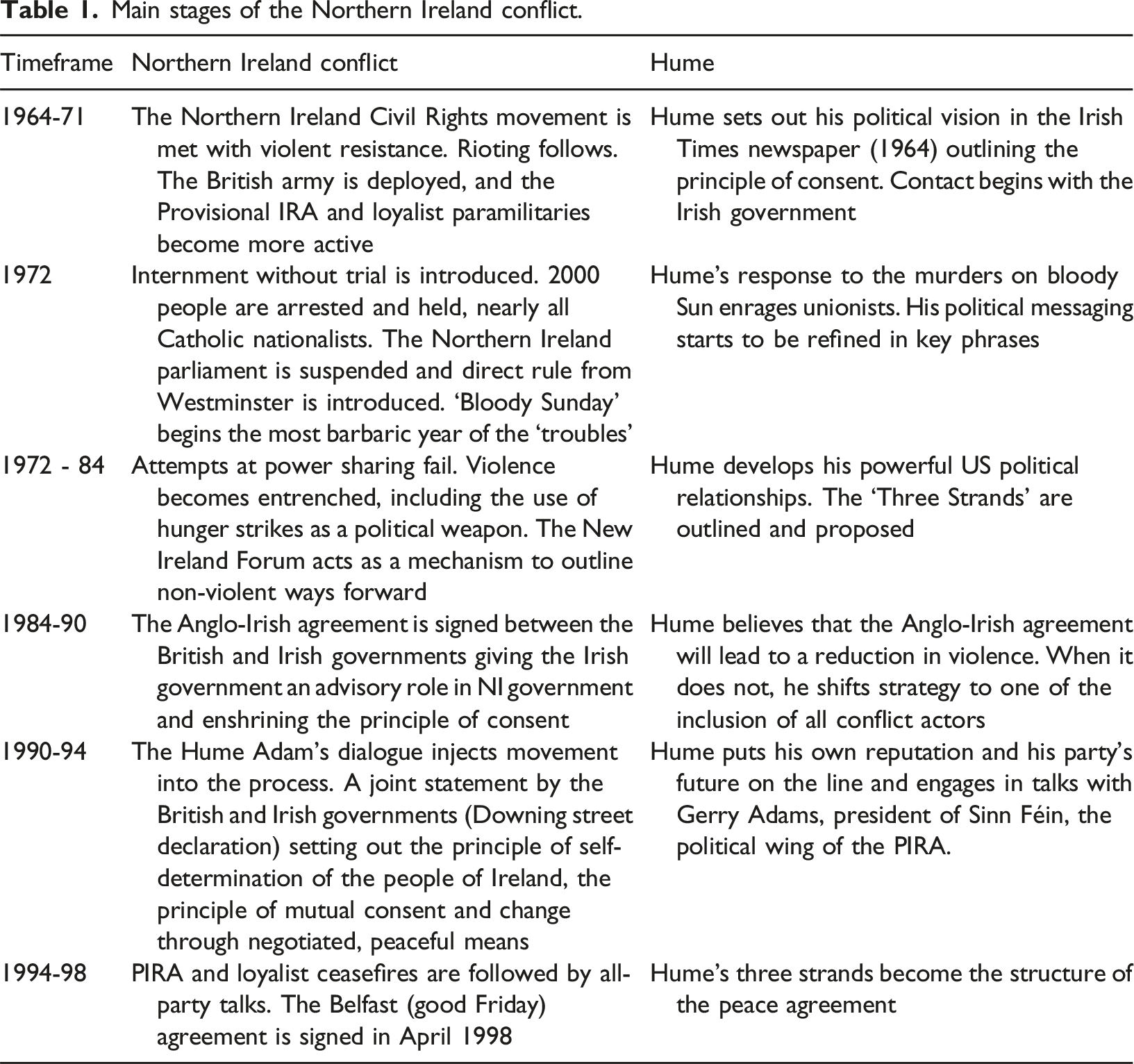
Phase 1 A reframing of Irish unity, the civil rights movement and the outbreak of the troubles 1964-72 (Troubles related deaths - 693)
This phase begins with increasing unrest in Northern Ireland, agitation by the Catholic nationalist community for change, ineffective political leadership from the existing Nationalist party and intransigence from the unionist establishment. Hume, who has established himself as a significant northern voice, sets out the basis of a new political position in the Irish Times in 1964, against this backdrop of unrest. He outlines a radical agenda for change, ripping up the existing nationalist political consensus 5 . This includes the most prominent articulation to date of what was to become known as ‘the principle of consent’: a denunciation of violence as a means to achieve change and a redefining of any future united Ireland as one based on agreement and consensus, with a focus on ‘rights’ but also ‘duties’. What is striking about these articles is Hume’s focus on economic activity, employment and the powerfully radical acceptance of the constitutional position and partition. Hume is building on a range of new thinking in Northern Ireland and distilling it for a southern audience. At this point he has given up his studies for the priesthood, switched to teaching, established Derry’s Credit Union – the first in NI, and founded ‘Atlantic Harvest’ – a fish smoking business in which he sold his half share when he is first elected to the NI parliament in 1969. As this phase progresses, we see the emergence of the NI Civil Rights campaign, the outbreak of violence, the appearance of a new generation of paramilitary actors – republicans and loyalists, and the deployment of British troops in August 1969. It is also Hume’s first engagement with one of his most significant symbiotic external networks - the Irish Department of Foreign Affairs (DFA). As the situation in NI deteriorates in 1969, DFA official Eamonn Gallagher starts to make unofficial forays into the North from his sister’s home across the border in Donegal. Gallagher begins the process of gathering information and in doing so serendipitously establishing “the bridge out to Hume that was so defining in subsequent decades” 6 . Hume is therefore at the centre of both the civil rights campaign and the developing relationship with Dublin. Tragically, he is also in the place of one of the defining atrocities of the beginning of the Troubles – the deaths of 13 men who were shot in 1972 by the British army in Hume’s hometown of Derry 7 . Hume declares that for many in Derry now, it is a united Ireland or nothing 8 . These remarks haunt him politically for decades and mark him for unionists as an unredeemable Irish nationalist and an ‘agent of division’ (Dolan, 2023: p. 244). This phase also sees the emergence of what came to be known as ‘Humespeak’ (McLoughlin, 2008) - his distinctive and eventually derided communication style. Examples of ‘Humespeak’ include the phrase ‘You can’t eat a flag’ 9 .
Phase 2 – Attempts at consensus 1972 – 84 (Troubles related deaths 1877)
This period sees both acute unrest and early attempts at peacebuilding. The introduction of internment without trial in 1971 was directed at the nationalist community and acted as a recruiting agent for republican paramilitary groups – just as Bloody Sunday would a year later 10 . 1972 was the worst year of the Troubles in terms of loss of life, injuries and damage to property. The establishment of the ‘Sunningdale’ power sharing executive in 1973 after an election to a new NI Assembly that same year, saw Hume hold the position of Minister for Commerce. Its collapse after the loyalist Ulster Workers Council general strike in May 1974 led to political drift and high levels of violence. With it came a change in Hume’s strategy. He begins to look outside the UK and Ireland and shifts focus to the USA and Washington. This comes from a realisation that in order to fix the increasingly intractable problem of rising levels of violence, more actors and resources needed to be drawn into the problem orbit. He comments to his wife Pat “this whole problem has to be broadened out ” 11 .
Hume becomes leader of the Social Democratic and Labour Party (SDLP) in 1979 which acts as a local organisational base to complement his external DFA network. He is, however, mostly uninterested in organisation or the building of a political movement. He pens an article on the NI situation in a 1979 edition of the influential magazine Foreign Affairs 12 and is elected to the European parliament in the same year. A committed Europhile and a fluent French speaker, the European Union comes to symbolise for him a conflict resolution example of union in diversity and economic ties which NI can follow. Hume’s relationships with US politicians are also formed and developed in this phase, powerfully facilitated by the DFA – the so called ‘greening of the White House’ (Cochrane, 2010). He soon develops unprecedented access to successive US presidents from Carter onwards and ‘drives US foreign policy on Ireland for three decades’ 13 . Hume consistently and successfully lobbies for inward investment, often building on the ancestral heritage of US politicians and the business community. The most significant and dominant US influencers become known as the ‘four horsemen’ – Senator Edward Kennedy – who first reached out to Hume in 1972 and quickly aligned himself to Hume’s agenda, Speaker of the US House of Representatives Tip O’Neil, Senator Daniel Patrick Moynihan and New York Governor Hugh Carey 14 - all united by Hume’s assertation that progress can only be achieved by peaceful means. In Northern Ireland, Hume has become a hate figure for unionists who regard him as nothing more than a duplicitous agent of division and an old-style nationalist (Dolan, 2023; McLoughlin, 2010a). He is also despised by Irish republicans because of his denunciation of ‘the armed struggle’ and articulation of the principle of consent while IRA hunger strikers starve themselves to death in an attempt to achieve ‘political status’ (O’Malley, 1990). Hume’s own personal safety is precarious - the IRA seriously consider killing him in the early 1980s and his home and family are attacked many times (Walker, 2023) 15 . This phase also encompasses the establishment of the New Ireland Forum – a consultation conference established by Irish Taoiseach Garret Fitzgerald in 1983 under the influence of Hume and others (Fitzgerald, 1991), to explore the ways in which lasting peace and stability could be achieved in a new Ireland. This Forum which was broadcast on national TV set the tone for Irish political policy on the North for a decade. It provides Hume and others with a platform to outline their agenda and the first widespread public articulation of an understanding of the conflict as an outworking of three sets of relationships: between the communities within Northern Ireland, between the Irish Republic and Northern Ireland, and between Britain and Ireland. Hume had put these ‘three strands’ to the British government as early as 1980 16 .
Phase 3 The Anglo Irish Agreement and its outworking 1984 – 90 (Troubles related deaths - 546)
The enormous violence, hunger strikes and political stalemate of the early 1980s begins to give way to some progress as connections between the British and Irish governments and pressure from the USA moves the process towards a significant breakthrough – the Anglo-Irish Agreement of 1985. This agreement was of huge consequence, and established for the first time a role for the Irish Government within Northern Ireland and a new approach of inter - governmentalism between the two states. Negotiated in secret over thirty-five inter-governmental sessions to the fury of unionists and the Northern Ireland civil service who were blindsided, Hume was the only external political figure with sight of every draft 17 . His engagement was critical as the governments had to demonstrate support from Northern nationalism if the arrangement was to achieve its objective of drawing support away from the IRA campaign. During the last stages of the negotiation, the initiative could have been derailed by one of the most outrageous attacks of the Troubles – an attempt to kill British PM Margaret Thatcher and others in the Brighton bomb of 1984. Michael Lillis, one of the key architects of the agreement on the Irish side reflected on the impact of the attack on the negotiating process “I did fear that might actually have overturned it…but again, take your hat off to that bloody woman, she rose to it like a lioness. And we also thought, frankly, that she would have had, not an adequate, but a coverable excuse…to stop it, you know, it wouldn’t have been morally adequate, but it would have been presentable. And she didn’t. We went on” 18 .
Hume’s DFA facilitated network building in the Washington also kicks in at this juncture with British PM Margaret Thatcher reported as commenting on the Anglo - Irish Agreement ‘It was the Americans that made me do it’ (Kelly, 2016). He was also involved in initiating work in the US that resulted in the International Fund for Ireland – a billion-dollar investment strategy (Cochrane, 2010). The Anglo-Irish Agreement did not have the outcome that many had hoped in that it did not diminish IRA violence. It also created an enormous backlash against the British government from both unionism and the Northern Ireland Office who had been outside the circle of trust (Hennessey, 1999). This phase sees Hume shift approach as he concludes that the only way to stop the violence is to bring Sinn Fein and therefore the IRA, into the political process. He returns to his engagement with them and in 1985, arranges to meet the IRA to discuss an end to their armed campaign. During the encounter he is bundled into the back of a lorry and blindfolded. The IRA wants the conversation videotaped and Hume, concerned that the tapes would be edited, refuses. He was held for several days before being released (Fitzpatrick, 2017). The meeting soon emerges into the public domain and Hume is condemned by all sides of the political spectrum - his commitment to non-violence called into question.
Phase 4 Hume/Adams and the Downing Street Declaration 1990 – 94 (Troubles related deaths - 418)
This phase marks the birth of what has become known as the modern day ‘peace process’, the Hume-Adams Dialogue, the ‘Downing Street Declaration’ of 1993 and the momentum which followed. In it we see a concerted effort by Hume to bring IRA violence to an end through a new series of secret and intensely contentious talks with Gerry Adams, leader of the IRA’s political wing Sinn Féin, facilitated by local priests in a Belfast monastery. These talks remained secret until April 1993. Hume again engages alone, without his party colleagues. When they become publicly known, he was lambasted and denounced by every other party on the political spectrum, Sinn Féin aside, and severely criticised within his own political party, the SDLP. He famously declares that he doesn’t give “two balls of roasted snow” for the criticism and will talk to anyone, anytime, if it stopped the killing. Some newspapers go as far as running an active campaign against him 19 asserting that he has legitimised the IRA’s campaign. He is dismissed as foolish and naive. Loyalist paramilitaries declare his engagement part of a ‘a pan nationalist front’ leading to threats and physical attacks on Hume and his colleagues (Dixon, 2006). Hume is more and more personally and politically isolated. An IRA bomb in October 1993 on Belfast’s Shankill Road kills 10 people including two children and one of the bombers. President of Sinn Féin and Hume’s interlocutor Gerry Adams carries the Bombers coffin at his funeral. A loyalist retaliatory mass shooting days later, kills eight. Hume is under intense pressure to end his dialogue with paramilitaries, and more marginalised than ever. Even his wife asks him to think again. He is filmed visibly breaking down at one of the funerals after speaking to a member of the victim’s family 20 . He later reveals “She told me that her family prayed for me around the coffin of her loved one the night before and they prayed that I would be successful in my work to get the violence ended so that no other family would suffer what they had suffered” 21 . He continues the dialogue.
Hume’s conviction that the IRA could be persuaded to give up their campaign and his articulation of this conviction publicly and privately makes a significant contribution to an important outcome: a change in the position of Sinn Féin’s declared policy away from ‘armed struggle’ (Shirlow and McGovern, 1998). This in turn and the political activity around it triggers a statement by the NI Secretary of State Peter Brooke that Britain had no ‘selfish strategic or economic interest’ in remaining in Northern Ireland 22 . Inter-party talks are started but Sinn Féin are excluded because of ongoing IRA violence. These talks fail. Hume is unyielding in his belief that to end the violence, any process had to be inclusive of Sinn Féin. The then Head of the DFA’s Anglo-Irish Division Sean O hUiginn recalls that at that time many had concluded that there was a four letter explanation for the failure of the talks -“H-U-M-E”. He goes on to note that this was an unfair categorisation as Hume’s belief that the republicans could be brought beyond violence was now becoming more accepted “because all of us … we saw them (the talks) as potentially complementary, in other words, we’ll take these as far as they can go, if the peace process actually proves doable, that is to say, that the Provisionals come in from the cold” 23 .
Bringing republicans ‘in from the cold’ also included utilising leverage to persuade the US to grant Gerry Adams a visitor visa – to the fury of the British government 24 . Hume is also successful in this phase in bringing US firm Seagate to Derry – securing an investment of £722m and nearly 1500 jobs. However, he rejects an attempt to make US investment contingent on demonstrable measures of equality between both communities in NI (the so called ‘Mac Bride principles’), fearing they will hurt investment (McNamara, 2013). Meanwhile, the Hume-Adams talks lead to a public acceptance within violent republicanism of the need for unionist consent, and the two governments move forward with another significant constitutional statement – the Downing Street Declaration. In this declaration the British government agree that the future of Northern Ireland would be decided by its people and the Irish Government accept that a united Ireland had to have majority consent within Northern Ireland. The British are now also talking secretly to the IRA. These interlocking processes and statements lead to the IRA ceasefire of August 1994 and loyalist ceasefires soon after.
Phase 5 The paramilitary ceasefires and the Good Friday Agreement 1994-1998 (Troubles related deaths - 113)
The IRA ceasefire started a train of events which led to the development of additional structures for talks and new political institutions. The process faltered on a number of occasions including a breakdown and restoration of the ceasefire itself. Irish government archives indicate that Hume helped draft the new IRA ceasefire declaration to ensure it was sufficient to move the process forward 25 . Again, he engaged in these activities without his political party, whose organisational, ideological and leadership vulnerabilities were exposed (McGlinchey, 2019). Multi-party talks were convened under the chairmanship of US Senator George Mitchell and culminated in the Belfast ‘Good Friday’ Agreement of 1998, so called because settlement was eventually reached on the day of Good Friday. The agreement was designed around Hume’s often articulated three strands. He himself was not actively engaged in the negotiated detail. One of his colleagues reflected of that time “John did not involve himself in the day to day of the talks. He operated at a different level…His presence was much more profound than that. He was the path finder. It was his vision. It was work he had done 10, 15, 20 years previously that was determining our approach to this” 26 . Hume himself returned to familiar themes “Whatever our anxieties, we have to seize this opportunity. And the opportunities which lie before us are vast - to create a new partnership between our divided people; to banish guns and bombs from our streets forever; to secure economic, social and cultural equality and progress, to build a New Ireland for our children” 27 .
The Agreement was endorsed in joint referenda in Northern Ireland and the Irish Republic. Both the USA and the EU acted as international guarantors, providing support and in the case of the EU a package for peace amounting to 2.3 billion euros 28 . In the years since, the dominant position of Hume’s political party the SDLP has been almost entirely eclipsed by Sinn Fein within the nationalist community – an outcome many blame on Hume’s rehabilitation of the republican movement into the political mainstream (McGlinchey, 2019).
Hume, leadership and liminal space
Hume’s political journey through conflict and peace was complex. Throughout his career he adopted positions and opinions which went firmly against the consensus of his own party, his own community and the wider body politic. In doing so, he strategically inhabited liminal spaces, pushing himself, his party and accepted understandings of the conflict into a state of flux, in an effort to create change. As we have seen above, he was often heavily criticised – personally for his lack of engagement with his own colleagues and politically for bringing those who supported and represented violent change into the body politic. At times his decision making was characterised as deliberately obstructive, at other times dangerously naïve. Through this period, he was the key interlocutor between northern nationalism and Dublin, Washington, and Brussels. For these reasons, and the eventual success of his endeavours, his approach to leadership and leading are of interest. This section will attempt to make sense of Hume’s contribution and its power by situating it within an understanding of liminality and leadership in the context of seemingly, intractable problems. It also seeks to gently assert the relevance of these approaches to leaders in other complex, zero-sum environments. In doing it outlines a typology of five liminal approaches employed by Hume to create transformative change. These approaches have at their heart the formation of threshold space: producing frightening uncertainty but with it the possibility of transformation.
Reframing the problem
Hume’s initial analysis of the problem which he set out in two articles in the Irish Times in 1964 approaches the northern dilemma in a way which is fresh, radical and embedded in an uncomfortable reality for the nationalist community. It was also the first indication of a different problem analysis. By recognising the existence of Northern Ireland as an entity, articulating the principle of consent and the economic and political challenges, Hume outlined a new approach, but also posed a radical challenge to both sides of the conflict. Reframed away from a zero sum, unionist versus nationalist conflict to a wider issue of relationships, rights, and responsibilities, Hume drew heavily on history, context and symbolic understandings of identity (Bolman and Deal, 2014). Reframing is accepted as a powerful change mechanism in its own right (Campbell, 2004; Evans and Kay, 2008; Murphy et al., 2020). However, Hume’s approach was as much a challenge to the existing nationalist consensus as it was to unionist intransigence. In carving out a new path for both communities and broadening the problem framing (from two tribes to three strands) he introduced more complexity into the analysis but also created ‘malleability’ in how the quandary could be unlocked (Murphy et al., 2020).
We understand from the framing literature more generally that how problems are presented to audiences, influences choices and cognitive approaches (Campbell, 2004), and that such framing impacts actors sensemaking and ability to engage (Evans and Kay, 2008; Mead, 1967; Thornton et al., 2012). What is interesting in Hume’s articulation of the new problem frame was that it is holistic rather than partial – he challenges both sides of the conflict to change their approach and their understandings. This ‘holistic’ framing is uncomfortable for everyone (indeed it slaughtered the most sacred cows of Irish republicanism) and goes beyond many of the current examples of ‘rights based’ framing that we may be more familiar with in the academic literature (Gray et al., 2015; Zietsma and Lawrence, 2010; Phillips et al., 2004). However, if there is one takeaway from it for leaders, it is that radical visions create paths – even if they seem far too uncomfortable for existing followers.
Stakeholder cultivation
As Hume’s reframing develops, the political environment deteriorates and schismogentic, self-perpetuating violence takes hold. Hume accepts that the scope of the problem, even with the new broader framing, is reinforcing the tightly coupled cycle of violence. He seeks to introduce new actors and new resources in the problem mix. The first significant group are the Irish Department of Foreign Affairs who seize upon his approach and provide both a direct line to the Irish government and global reach into the Irish diaspora. The second development occurs in tandem and is the establishment of Hume’s relationships with the most powerful US political figures over a 30-year timeframe. This provides him with access, support and most importantly influence to be exerted at key stages. He also extended his reach into Brussels and the EU – which he believed to be the greatest conflict resolution example in the world. However, this engagement was necessarily unsettling and created new challenges for all stakeholders in relation to their engagement. It altered the relationships of all with NI and often caused conflict and uncertainty in what had been previously settled understandings with other conflict actors (especially the British government). In this process, Hume acts as the archetypal host (Hawkins and Edwards, 2015) informing, guiding, and defining a path through changing affiliations. In doing so he makes the problem more significant internationally, but also steps into uncertain space and away from his own base.
There are two implications for this. This first is around the bridging potential of place-based leadership and change. Hume was fundamentally a place-based leader (Collinge et al., 2010) – wedded to his home city and often criticised for seeing the whole of Northern Ireland through the prism of Derry (Dolan, 2023). But by stepping into more uncertain space, he acted as a conduit between Derry (and NI) and the wider world – reinterpreting the place-based nature of his focus and drawing others, previously disengaged, into the geographic and symbolic space he so comfortably inhabited. The second implication is around understandings of the metaphorical inhabitants of liminal space we have encountered above. We understand that leaders can and do act as ‘liminal hosts’ – guiding others through change. While this role of the host is well established in understandings of liminal leadership (Edwards et al., 2021; Hawkins and Edwards, 2015; Wheatley, 2004), this role seems particularly important in the context of wicked problems with the ‘host’ maintaining a steady course, introducing some fundamental principles for moving forward, even when past stabilities and understandings are dissolved (Horvath and Thomassen, 2008: p. 13). There is a need for a better understanding of this leadership role and how it practically operates and can be fostered within contested problem environments. The behaviour we see in the Hume example – of sensemaking through difficulties and questioning of accepted understandings, provides a roadmap of sorts for other contexts.
Opening linguistic space
The freshness of Hume’s language and analysis that is evident in his early career begins to give way to a widespread frustration with him as the conflict develops but the language itself does not change. Obviously, the ability to communicate clearly and compellingly is a key leadership behaviour (Fairhurst and Connaughton, 2014). However, while Hume’s language begins as a radical exposition of a New Ireland, over decades it becomes stale and repetitive. But it also begins to be co-oped by others who having initially denounced the shift from a ‘United Ireland’ to an ‘Agreed Ireland’ using the very terms they had once derided. This should be interesting to scholars of leadership since the established understanding is that leaders use language as a process of ‘rhetorical negotiation … trying out words, phrases, and literary constructions to better and more convincingly communicate their vision’ (Cuno, 2005: p. 205).
Hume’s ‘static’ language seems to contradict this active and iterative process of sensemaking and sense giving (Ruben and Gigliotti, 2016; Weick, 1988). Rather than seeking to experiment, Hume’s approach privileged conceptual clarity and stability of purpose. He himself defined this approach as a ‘teaching strategy’ which he had deployed briefly in the classroom and one which ensured that lessons was being learnt. The distinct language of ‘Humespeak’ articulated in a simple, repetitive style was easy to understand and therefore to adopt. As McLoughlin (2010a; 2010b) has commented, it also helped to “construct within the chaos of conflict, conceptual space for non-violence and potential agreement between moderate and extreme positions” (p. 16) and allowed for constant course correction back to fundamental principles – ‘An Agreed Ireland’, ‘Taking the gun out of Irish politics’, ‘People not territory’. When the creation of this conceptual space became politically costly, Hume continued anyway, keeping focus and protecting the space until it was almost universally adopted. Leadership communication became not a shifting vehicle for everyday persuasion but a way of defining and protecting the bigger political project of peace, until it was adopted by the wider body politic. It was only post Good Friday when Hume, who was by then unwell and considerably passed him prime, shifted his language to talk about an era of ‘post nationalism’ – sparking a storm of fury from his republican opponents reminiscent of that which had engulfed him 30 years previously. This dissident use of language and communication call for further enquiry into how leaders can best communicate when seeking to engage in wicked problem management. It reminds us that language doesn’t just persuade, it establishes principles which remain stable in the chaos of change.
Practising disruption
It is a characteristic of wicked problems, that to improve their prospects, those affected by the problem need to be part of its resolution (Grint, 2007). It is also one of the most difficult conditions to put in place. In environments of violent ‘wicked’ conflicts with state and non-state actors, governments are often adamant in their refusal to ‘talk to terrorists’. Hume, throughout his political career, engaged with those who advocated for and indeed acted within, what was often called the ‘armed struggle’. This approach actively disrupted established relationships, broke the political consensus, and reset ‘the rules of the game’ – orchestrating conflict in a way more dangerous than probably envisaged by most leadership scholars (Heifetz et al., 2009). It was often an approach which sought to ensure that attempts at conflict transformation were inclusive, rather than partial. There are numerous examples of this in Hume’s interactions – from his reframing of Irish nationalism to his refusal to engage effectively in a limited political talks process and most significantly, his engagement with the IRA leadership. It should be noted however, that this disruptive approach created enormous tension, danger and conflict. It also occurred with no certainty of outcome and at the risk of undermining established principles of non-violence. By adopting such an approach, Hume could be interpreted as moving outside the role of the ‘host’ and exhibiting aspects of the ‘Trickster’ archetype identified by Ladkin (2017) as a disruptor of the established consensus and an injector of creative energy into a stale environment. However, this tips easily into the negative architype of Horvath and Szakolczai (2019), bringing chaos, uncertainty and perpetual distrust.
This destabilisation formed a crucial part of moving the NI conflict away from its violent condition and ‘tipping’ it into a liminal space which allowed for questions to be asked about the utility of violence as a change agent and the position of those who perpetuate it. Leadership practice of this sort necessarily comes with an understanding and acceptance of risk and a willingness to try something different (Grint, 2010). In this sense, it steps outside the shared understandings, institutional norms and established principles of what was acceptable (Scott, 1994) and goes further than the reaching beyond social identity to outgroups in an effort to establish progress (Khalil, 2022). Indeed, it speaks more strongly to conceptualisation of leaders as ‘bricolours’ engaging of the mechanisms of ‘bricolage, diffusion, translation’ (Campbell, 2004), where existing principles and practices are utilized and amended to achieve change objectives. Better understandings of these processes of bricolage and translation and their interaction with wicked problems should give us an insight into how leaders can shift intractable problems into disruptive liminal space where meaningful change is possible. This could be termed ‘bricolage on the edge’. For leaders grabbling with intractable difficulties, doing what is intrinsically forbidden (saying the unsayable) is a way of creating instability and opening up space.
An acceptance of sacrifice
There are few challenges in leadership as difficult or as significant as the saving of human life. Hume existed as a leader within an environment of ongoing, chaotic, unpredictable violence in which he was himself a clear target. He was by no means the only leader in such circumstances, and neither was he the only leader to espouse non-violence, but he was the only one to publicly traverse the threshold and engage with those defined as terrorists even while the numbers of the dead climbed. In doing so, he put his own reputation at risk, as well as the future of his political party and what he had sought to build over decades. This came at enormous cost to his reputation, the physical safety of himself, his family, and his colleagues, and the political future of his political party. There is considerable evidence that Hume understood that cost – and engaged anyway, carving out the ideological, political and temporal space to stop the killing and build the peace. Such a stance – controversial as it was, is reminiscent of Enzensberger’s “heroes of retreat” 29 and comes with enormous jeopardy. This is one aspect of leadership literature which is relatively unexplored and unappreciated and yet it is central to any reading of the Northern Ireland peace process and to the reality of better management of wicked problems. As Grint notes “here is the thing: even democratic leadership is not necessarily about popularity. It is about doing what is right, even if that means sacrificing your own popularity and career” (Grint, 2020: p. 315). This is undoubtedly a challenge for leaders and represents the most difficult, but the also the most meaningful contribution to problem transformation.
Conclusion
As we know, leadership is necessary but not sufficient if we are to make serious and meaningful inroads into the problems that beset us, locally and globally (Tourish, 2019). All successful processes are by their nature, multi-actor and multi variable. This article has sought to provide a perspective of one such process and arguably the most important leader within it and to provide an analysis of the leadership practiced by him and its liminal characteristics.
There are of course, limitations to this study as well as implications for future research. While the data utilised for this work is extensive, it is not exhaustive and a fully developed understanding of Hume and the NI peace process would run to volumes rather than one research paper. Respondents for this study also tended to be those who had close engagement with Hume over time and this will have impacted objectivity – although many would have styled themselves as critics, just as others would have supporters. Just as the NI conflict was contested, Hume’s role in its transformation is equally argued about. It should be noted that some have attributed his impact to his ability to influence opinion formers – particularly in the USA (Devlin, 1993), and former colleagues have been quick to point out his ability to pick up and run with the good ideas of others, which were then often attributed to him (McLoughlin, 2010b).
As for Hume himself, undoubtedly, his ‘lone wolf’ approach to engagement with the republican movement was enormously damaging to his political party, which was left exposed, organisationally weak and unable to reinvent itself, post conflict. Factors such as serendipity, luck and a genuine desire for change also played important roles in placing Hume at the centre of an intricate and carefully choreographed peace process. However, it is generally accepted that the leadership strategies, approaches, and tactics he adopted played a role in shifting a wicked conflict out of its violent phase and into what may be described as a ‘negative’ conceptualisation of peace (Galtung, 1969). There is considerable room for further academic enquiry into the relatively rare examples of leadership in liminal or wicked contexts which have proved – if not successful, then at least less ‘unsuccessful’ in an increasingly complex world. The approaches outlined here – of reframing the problem, cultivating powerful stakeholders, opening up linguistic space, practising disruption in stalled processes and perhaps most of all, an acceptance that sacrifice will be painful, damaging and necessary provide a crude roadmap for others engaged in intractable conflicts. Despite is flaws, Northern Ireland represents a rare example of success, amidst much failure.
As we know, wicked problems cannot be solved, only made better. On the 5th of January 2024, 26 years after the Good Friday Agreement, Northern Ireland marked its first calendar year since police records began when there were no conflict related deaths. As this paper is being written the world is confronting not just a resurgence in conflict, but a dearth of leadership. Hume’s strategic use of liminal space is one example of how leaders can act adaptively and creatively to build change, if they have the courage required to operate on the threshold.
A closing note
John Hume died on the 3rd of August 2020 in his hometown of Derry. For the last years of his life, he suffered from a rare form of dementia thought to have been exacerbated by the years of stress and the strain of the peace process. His funeral, in the midst of the COVID-19 pandemic was necessarily small and socially distanced. His wife Pat and family asked that the public not attend in keeping with COVID regulations, and instead to light a candle in their window for peace. Tributes were made by prime ministers, presidents, and church leaders. At the service itself, messages were read to mourners from Pope Francis and the Dalai Lama, from former US President Bill Clinton and his wife Hillary, Prime Minister Boris Johnson, and U2 frontman Bono. The Irish government lowered the tricolour to half-mast at government buildings, the Irish Times newspaper issued a special commemorative edition with the banner headline ‘John Hume, the man who built the peace’, Irish and English cricketers donned black armbands and numerous books of condolence were opened as Hume was described by Taoiseach Micheál Martin as a “great hero and a true peacemaker” 30 . Outside the funeral, which was broadcast live, one man who stood alone in the rain was asked by local media why he had come. He mentioned peace but then he said “I’m not from Derry but John Hume brought jobs here – and they were good jobs. That job paid my mortgage and put my three boys through university. Coming here today was the least I could do for him after what he had done for me” 31 . A suitable tribute to someone who knew that you can’t eat a flag.
Footnotes
Acknowledgements
The author would like to thank those who read and commented on a pre-publication version of this manuscript. They include Prof Feargal Cochrane, Dr Dan Keenan and Prof Dennis Tourish, as well as the anonymous reviewers and editor. Thanks also are due to Prof Keith Grint who drew my attention to Enzensberger’s “heroes of retreat”.
Declaration of conflicting interests
The author(s) declared no potential conflicts of interest with respect to the research, authorship, and/or publication of this article.
Funding
The author(s) disclosed receipt of the following financial support for the research, authorship, and/or publication of this article: This work was supported by the Peace and Reconciliation Scheme, Irish Department of Foreign Affairs (23754).
