




Abstract
Collective action failures are often attributed to inadequate organisation and leadership. Protest movements – including recent state-level protests and revolts, from the “Arab Spring” to the square occupations and Black Lives Matter, and transnational ones like the World Social Forum and recent expressions of the environmental movement such as Fridays for Future and Extinction Rebellion– have been arenas of conflicts over organisational structures and leadership. Activists consider leaders along a spectrum from representatives of the group interests, values and identity, through seductive manipulators of individuals and discourses, to illegitimate undemocratic usurpers. Some activist collectives reject leadership’s emancipatory claims and (cl)aim to prefigure horizontal political relationships. For others, leaderlessness (re)produces structures of domination that cause the collapse of collective action. I propose that a) groups appoint leaders (formal or informal) when they feel unable to ensure their survival (due to oppression, challenges to lifestyle or livelihood) or to prevent the spread of unbearable feelings (helplessness, frustration, anxiety), b) leaders do not (mostly, often at all) represent the group’s conscious will, but its underlying emotions and beliefs, and c) leadership and individual autonomy are inversely proportional and so are leadership investments and group-wide political creativity. Drawing on critical leadership studies and the psychoanalytic study of groups, I introduce some aspects of the relationship between leadership and anti-leadership and, on the other hand, politics and anti-politics. The argument presented applies to any group, formal, informal and unconscious.
Keywords
Introduction. Leadership contentions in the global justice movement
Rallied by its slogan “We are the 99%”, Occupy Wall Street (Occupy) became the largest protest in the United States since the anti-Vietnam war movement. Inspired by the “Arab Spring”, it occupied Zuccotti Park to denounce global financial capitalism and government responses to the 2008 financial crisis. 1 Alongside other so-called square movements like M15 and Gezi Park, Occupy made radical anti-representational and anti-leadership claims. Some critics attribute its political failure to this stance. However, understanding Occupy solely as anti-leadership is misleading as the ubiquity of leadership relations within it signals only a rejection of dominant, bureaucratic and charismatic leadership (Gerbaudo 2017; Graeber 2013; Hayat 2022; Nunes 2021; Sutherland et al., 2014; Teivainen 2016; Van de Sande 2020). Similarly, the World Social Forum introduced an ‘open space’ methodology eschewing leadership and hierarchy. This approach drew inspiration from feminism, liberation theology, indigenous activism, and the libertarian globalisation protests at the turn of the millennium (Caruso 2012, 2017; Conway 2013; Juris 2008; Maeckelbergh 2009; Pleyers 2010; Teivainen 2012). Since 2001, the World Social Forum convened millions of participants in global, regional, and local events becoming the largest social movement and civil society initiative in history. More recently, however, its perceived inability to effectively respond to global crises (such as the 2008 financial crisis and the COVID-19 pandemic), has led to scathing criticisms of its open space organisational approach. Similarly to Occupy, the World Social Forum’s inability to foster its vision for global change was attributed to its uncompromising rejection of symbols of organisation, structures of representation, formal institutionalisation, and leadership in favour of rhizomatic spontaneity. A paradigmatic example among recent movements, Black Lives Matter too advocates distributed leadership. Drawing from the experience of civil rights activists, especially Ella Baker, Black Lives Matter recognises the vulnerability inherent in relying on charismatic leadership (Ransby 2018).
The tension between advocates and critics of leaderlessness reverberates across time and space within social justice movements. Recently, Zizek (2014) and Mouffe (2013), from a Lacanian perspective and following a long tradition in the global Left, have argued that the limitations of recent protests stem from their rejection of leadership and organisational structures. However, for activists who champion spontaneity and horizontality, radical democracy requires avoiding the replication of undemocratic relationships prevalent in wider society. According to proponents of open spaces, transformative decision-making and the emancipation of all participants thrive only in an environment of internally persuasive argumentation and individual autonomy. They contend that the spontaneous creativity of networked multitudes becomes stifled by formal organisation (Simsa and Trotter 2020; Hardt and Negri 2017, Tormey, 2015). Contrary to claims of leaderlessness, experiences within activist groups reveal that informal structures emerge in self-declared horizontal organizations (Sutherland et al., 2014) 2 . Teivainen shows how statements of leaderlessness sometimes mirror the symbolic and material structures that activists revolt against: “In the WSF [World Social Forum], the analogy with the illusions about a ‘free economy’ is evident in accounts that explicitly or implicitly consider the WSF an unregulated ‘marketplace of ideas’” (2012:190). Such illusions expose activists to inevitable frustration resulting from unrealistic investments in otherwise reality-based emancipatory politics. Those investments undermine political action by saturating it with unrealistic thinking. Escalation of these dynamics may lead to authoritarian claims and practices. Teivainen summarises the predicaments of open space activism, The democratic coexistence in the open spaces created by the movements has been refreshing and empowering. At the same time, its relativistic undertones can become frustrating in devising effective strategies to change the world. As frustrations have become more evident in and around the open spaces in the WSF and elsewhere, a new enthusiasm for explicit, and also hierarchical, forms of leadership has gained ground among some participants (2012:182).
Cycles of enthusiasm, frustration, disappointment, and depression recur in groups and influence their organisational structures and leadership practices. During crises, the global justice movement experiences tensions between claims to horizontality and demands for organisation and leadership. The adoption of open space methodologies and the formation of assemblies in squares occupations generated sometimes vast but partly unrealistic enthusiasm and expectations. As pressure to sustain the initial momentum increases, matters of strategy cause disagreements and conflicts (re)surface, overshadowing the group’s main goal. Frustration ensues, leading to calls for organisation and formal leadership, and criticism of informal leaders. Simultaneously, a generalised impatience grows against the very idea of leaderlessness. Competing leadership claims – whether advocating for or against leaderlessness – often collide, resulting in organisational impasses. These emotional cycles often drain the movement of its vitality or lead to its demobilisation (Caruso 2022). Critics of leaderlessness argue that presumptions of horizontality reinforce political imbalances, favouring those who possess greater material or symbolical resources. Consequently, a de facto leadership often emerges, frequently composed of men from relatively privileged backgrounds. At the same time, the advocates of leadership contend that horizontality idealises a democratic decision-making situation that is practically unattainable, one in which all affected parties would be present, equally involved, and influential. Activists who prioritise organisation, view political action as opposed to what they perceive as aimless deliberation and purposeless activity in allegedly open spaces. They argue that effective political action relies on independent leadership mandates from recognised constituencies. From the present perspective, debates surrounding leadership, made in the name of democracy, often manifest a displacement of underlying conflictual group dynamics onto individuals (leaders) or ideas (leaderlessness).
Over the past decades, social movement scholars have emphasised structural approaches to social change and political action, often relegating leaders and individual agency to a marginal (sometimes even destructive) role. Despite reservations about leadership, an important theoretical undercurrent has traversed the collective action literature emphasising the importance of leaders as claim-makers, mobilisers, organisers, proponents of strategies, and shapers of identities, frames, and narratives (Barker et al., 2001; Ganz 2010; Ganz and McKenna 2019; Morris and Staggenborg 2004). This literature is largely rooted in behaviourist and cognitivist assumptions. In what follows, I combine a psychoanalytic perspective, grounded in the study of unconscious motivations, with critical leadership studies. To be sure, a paper discussing potential convergences across diverse scholarly traditions – each inherently pluralistic and nuanced – cannot do justice to the breadth and the inspiring depth of social, political and psychoanalytic approaches to collective action, organisation, and leadership. Nevertheless, this interdisciplinary combination aims to be mutually enriching and in the spirit of critical traditions that trace back to Frankfurt school thinkers and continue through contemporary scholars like Axel Honneth, Joel Whitebook and Amy Allen and includes also Lacanian and post-structuralist research drawing on Zizek and Laclau. I study the repeated patterns in leadership dynamics that both academics and activists recognize as persistently recurring and seemingly unending. By doing so, I offer a renewed attempt to delve into the underlying foundations of these apparently unpredictable shifts in group formation, consolidation, and fragmentation.
I make the following claims. Groups appoint leaders through processes that are both manifest and conscious, as well as hidden and unconscious. These leaders may exhibit varying degrees of authoritarianism, while followers subject themselves to a greater or lesser extent. This submission is directly proportional to the perceived existential threat to the group or to the prevalence of unbearable emotions among group members. Importantly, leaders do not represent (primarily or at all) the conscious will of the group; instead, they embody shared underlying emotions and beliefs. In prevalently cooperative groups, work-oriented facilitators emerge, and formal rules and procedures are established to turn to in critical moments. The relationship between leadership and, on the other hand, group cooperation and individual autonomy, is inversely proportional. Claims of leaderlessness are leadership claims. Finally, I study political leadership in relation to its ability to promote reparative dynamics when crises disrupt the fabric of a group. These reparative dynamics manifest the prevalence of thoughtful political action over social enactments (anti-politics). Contrary to misconceptions, aspirations for leaderlessness are not groundless or naive. Rather, they resonate with sophisticated understanding of group dynamics. However, achieving and sustaining leaderless groups is difficult – they do not emerge spontaneously and leaderlessness is not “natural”. Instead, it results from painstaking collective work. To enable leaderlessness, we need to understand the reasons behind the emergence of leadership (in its different forms) and how it is worked through.
In sum, I propose that leadership forms are symptoms of underlying group dynamics. Addressing these manifestations requires moving beyond symptomatic formulations that focus solely on leaders’ individual personality, skills, and behaviour. Such limited approaches hinder our understanding of the underlying group dynamics and our ability to effect meaningful change. While I highlight the contributions of psychoanalysis to a critical theory of leadership, it is worth recalling that Freud himself drew imagery not only from medicine and neurology (his areas of expertise) but also from philosophy, sociology and political studies. In fact, psychic conflicts are often described in political terms and in the context of personality organisation. Therefore, I advocate for trans-disciplinary cooperation in the spirit of the argument presented below. The remainder of the paper unfolds as follows: section 1 introduces some critical perspectives on leadership. Section 2 discusses leadership through psychoanalytic lenses. Section 3, introduces the distinction between political and anti-political leadership. Section 4 concludes. The argument presented here applies to any group – whether formal, informal, or unconscious.
Critical perspectives on leadership
Current approaches to leadership span a spectrum encompassing its authoritarian, charismatic, heroic, participatory, distributed, and transformative qualities. These discussions often straddle the divide between individualistic and relational perspectives. While some scholars are acutely aware of the limitations inherent in such divided discourse, they also emphasise the delicate yet constructive tension between individual needs and collective goals, as well as the interplay between individual and group identity. These themes resonate across various domains, including activism, corporate settings, government, and administration. Recurring questions include, is democratic leadership more effective and, therefore, more justified than charismatic or authoritarian leadership? What characteristics define a democratic leader within a democratic organisation? Conversely, how does a transformative leader operate within a non-democratic context? Does democratic leadership lose relevance as its work becomes increasingly shared in cooperative groups? Alternatively, does leadership decay from democratic to authoritarian over time?
From the perspectives of this paper, leaders – individuals, groups or ideas – symbolise and enact collective unconscious drives within organisational and social dynamics. Consequently, leader-centred approaches to organisation and social processes oversimplify the complex interplay of structures and dynamics inherent to social groups. In these conceptions, without leaders there would be no group, no organisation, no co-ordination, or work. However, recent research studies the multifaceted influences on the organisation of collective activity beyond the contributions of single individuals, no matter how influential (Denis et al., 2012). Anti-heroic, anti-individualistic, and feminist perspectives on collective leadership challenge the personalistic biases in leadership studies. According to these perspectives, leadership is the driving force behind organisational and social dynamics – a life force transcending mere attribution to specific individuals. Instead, it possesses collective characteristics specific to networks and fields. Less attention is given to what I call anti-leadership. By anti-leadership I do not mean forms of ineffective leadership or activists’ statements in favour of organisational horizontality, but attacks – whether individual, collective, material or discursive – on individuals’ ability to cooperate. It is a force driving organisational and social processes to fragmentation rather than integration akin to an anti-group or a social death drive (Freud 1920, 1921; Green 1999; Nitsun 1996). The pernicious effects of anti-leadership partly elude the otherwise astute research on the counterproductive, paradoxical and unintended consequences of leaders’ activity (Alvesson and Spicer 2014; Larsson and Alvehus 2023; Learmonth and Morrell 2021). Finally, I view leadership claims as individual or collective behaviours that aim to constitute groups as integrated agents or constituencies.
Mainstream approaches to leadership have traditionally focused on specific leadership traits and behaviours, on situations and contexts eliciting specific leadership styles, and on their relation to power and autonomy, influence and seduction. In charismatic, heroic, and “guru” theories, visionary leaders are seen as responsible for framing organisational actions and inspiring their members. Followers’ responses are limited to acceptance or rejection of leaders’ claims (Ford 2005). However, the realisation that leaders represent only one aspect of complex group dynamics, has prompted a shift towards considering leadership within broader social contexts that leaders are seen to represent. Denis et al.’s influential work (2012) on plural leadership, instigated a widening and deepening research agenda, emphasizing how studying leadership can illuminate broader social forces and organizational structures. Indeed, contemporary political theory on democracy and representation studies whether representatives (leaders) act as agents of their constituencies or as claim-makers shaping the constituencies that they stand to represent and whose members’ contribution is limited to acceptance or rejection of those claims (Rohrschneider and Thomassen, 2020, Disch et al., 2019, Castiglione and Pollack 2019; Brito-Vieira 2017). Collinson shows the scope of a critical study of leadership by situating it in the tradition of Hegel’s, Marx’s and Derrida’s investigations on global society (2020, 2012). Zizek (2014), drawing on Hegel and Lacan, delivers a powerful critique of weak leadership in social movement.
While I cannot cover the extensive literature on collective leadership comprehensively, I mention its key achievements (Empson et al., 2023, Fairhurst et al., 2020, Ospina et al., 2020; Empson and Alvehus 2020, Holm and Fairhurst, 2018). Post-heroic (Eslen-Ziya and Erhart 2015), distributed (Drath et al., 2008; Spillane et al., 2023) and inverted (Hardt and Negri 2017) conceptions of leadership, highlight the creativity of flat structures and collaboration in groups. They emphasise leadership’s ability to promote democracy and effectiveness in organisations, including social movements (Ganz 2010; Western 2014). However, critics have noted that distributed and post-heroic conceptions often develop patronising narratives about “giving voice” and despite being presented as gender and power neutral, they are neither (Collinson 2018; Fletcher 2004; Raelin, 2003). These models tend to reproduce top-down discourses rather than describing diffused horizontal engagements and are saturated with underlying paternalism (Ford 2005). Moreover, as long as participatory leadership exists within hierarchical organizations, it can be adopted by leaders seeking to increase efficiency while continuing to provide direction and steer expectations (Gronn, 2011).
Whilst advancing our understanding of leadership and the relative currency of diffused, shared, and distributed leadership, these practices are still often associated with specific individuals rather than being performed by all group members (Sutherland et al., 2014). Critical leadership scholars argue that shared leadership is essential to achieving democracy within groups. They view leadership as ubiquitous, systemic, and a distributed activity involving all members. Like open space and direct action activists, these scholars contend that political investments in individual leaders hinder the realisation of the group’s collective aspirations. Critical leadership studies (CLS) emphasises the relational, socially constructed, and culturally specific aspects of leadership highlighting its potentially destructive effects on groups. Indeed, leadership can alienate, disempower, and enforce domination through coercion or seduction – by demanding conformity or eliciting dependence (Alvesson and Spicer 2012; Carroll et al., 2022; Collinson 2018; Fairhurst 2010; Sutherland et al., 2014). CLS views leadership as an “emergent phenomena within leaderful situations” to which all members contribute (Wood, 2005:1103). A narrow focus on leaders prevents a comprehensive analysis of systemic dynamics and power structures.
Sutherland et al. (2014), emphasise how while leadership dynamics are ubiquitous in social groups, concentrating leadership is detrimental to group development. While I sympathise with this approach, I view ubiquitous leadership by (relatively) autonomous individuals as an outcome of increasingly collaborative groups, rather than a precondition. On the other hand, open space activists identify leaderlessness as a condition for initial cooperation during successful occupations, protests, or forums. In these situations, activists converge around a shared desire for togetherness and revolt. These shared feelings do not yet constitute a group, but they serve as drivers of group formation. The future development of the group depends on the kind and intensity of these constituent feelings. When manic, over-excited and unrealistic, feelings prevail, they constitute collectivities that are stronger in the short term but more brittle. To address their fragility (sometimes exacerbated by inexperience), such groups tend to develop strong leadership structures. Open space activists, however, view the emergence of authority as an aberration promoted by specific individuals, rather than the manifestation of underlying dynamics reflecting the group’s emotional constellation. By discounting the widespread contribution of group members to those dynamics, they also limit the group’s ability to develop the diffused autonomy they advocate. Ultimately, this hinders their political effectiveness. I contend that achieving true effectiveness require working through the underlying group dynamics from which leaders emerge, allowing relatively autonomous individuals to develop in the process.
The leaderless situation, as advocated by activists promoting horizontality, and the ubiquity of leaderfulness (the emergent circulation of ideas among group members who collaborate on equal grounds) advocated by CLS, converge in viewing the free flow of ideas in a group as essential to fulfil its objectives. These positions seem to differ in terms of the analytic work they ask the concept of leadership to perform. For direct action activists, leadership impedes the expression of individual autonomy, while for CLS, leadership indicates a process of relational individuation emerging within the matrix of the group. In this context, the meaning of “leaderfulness” seems to coincide with that of cooperation. However, radical critics deny leadership any creative or emancipatory role (Calás and Smircich, 1993; Smircich and Morgan, 1982). These authors (Spicer and Alvesson, 2012) contend that leadership claims are either fantasies (Sveningsson and Larsson 2006) or myths (Gemill and Oakley 1992).
Gemmill and Oakley view leadership as “a serious sign of social pathology” (1992:114), a failed relationship that infantilises group members. Similarly, direct action activists believe that leadership hinders organisational and group development, and their ability to achieve their purposes. Paradoxically, however, leaderlessness claims are a form of leadership claims and like leadership claims they “represent” a group’s prevalent anxieties. To better understand my contentions – that a) leadership structures represent groups’ underlying emotional constellations, and that b) leaderlessness claims themselves constitute leadership claims – I now turn to the psychoanalytic study of groups in the tradition of Melanie Klein and Wilfred Bion.
The psycho-dynamics of leadership
Experiences of injustice and inequality can inspire the formation of cooperative groups with a shared task and convergent motivation – to imagine and work towards another, better, world (to paraphrase the World Social Forum slogan). Sometimes, following an igniting event, rapidly developing activist convergences generate a shared sense of exhilaration and confidence in the strength of the forming group. At this stage, sometimes, the (proto)group becomes emotionally invested with growing infatuation and, consequently, expectations. As these shared emotional investments increase, energy is partly divested from the initial task. When both internal and external pressure (mounting expectations and adversarial confrontations) on the forming group intensify, individual and collective anxiety grows, and the cooperation among group members falters. Responses to these pressures vary – from the dis-integration of the group to its congealment around leadership manoeuvres that concentrate influence, alienate agency, or give the group a stifling bureaucratic structure. Concentrating agency hinders the group’s development and harms its members. However, it can also lead to further demands for democracy and participation. When this does not occur, demoralisation sets in among group members and their political investments decline. This often results in demands for an authoritarian, bureaucratic or charismatic leader or even the outright demise of the group or organisation. The former outcome requires mourning the loss of the group’s ideal(ised) self-image and establishing a reparative process; the latter is a consequence of blaming informal elites and denying the wider dynamics underlying the criticised leadership structures.
As critical leadership studies expanded its investigations, including of the group dynamics underlying leadership, it reached its psychological roots. It soon became evident that mainstream psychology fell short in explaining collective dynamics and motivations – not because it portrayed human behaviour inaccurately, but because its depictions were incomplete. Islam, for instance, posits that “psychoanalysis can inform theoretical lacunae created by social cognitive views” (2014:345). Collinson’s critique is even starker when it comes to positive and “prozac” psychology approaches to leadership (2012). I concur that psychoanalysis can offer insights on unconscious motivations and their impact on group dynamics that elude behavioural and cognitive psychology. Freud’s work and its Lacanian interpretation, complemented by Kleinian and Winnicottian inspirations, along with Bion’s seminal work on groups, have influenced critical discourses on leadership (Driver 2013; Ford 2010; Fotaki and Foroughi 2021; Simpson et al., 2002; Western 2014). Notably, Lacan’s psychoanalysis, indirectly through its impact on French post-structural and feminist literature, has contributed to constructivist (Grint 2005, 2020; O’Reilly et al., 2015), performative (Alvesson and Spicer 2012; Ropo et al., 2015), and discursive (Martin and Learmonth 2012) approaches to leadership. These perspectives show the limitations of “great man” theories (Mouton, 2019; Popper and Castelnovo 2017, Spector 2016, Cluley, 2008; Pullen and Rhodes 2008). Additionally, French and Simpson (2015 and 2010) ground leaders’ generative potentiality in Bion’s concept (inspired by Keats) of negative capability – the ability to tolerate uncertainty, frustration, and anxiety without foreclosing their creativity with rationalization and bureaucratisation. These enactments aim to address group difficulties by defensively attacking the present for getting in the way, as it were, between past planning and future goals (Hirsch et al., 2023, see also Collinson 2014). Furthermore, recent contributions of the American relational school, particularly through Benjamin’s work, have complemented British object relation psychoanalysis (Tomkins, 2020; Yates, 2019; Ford and Harding 2015). Psychoanalytic perspectives on identification with the leader are also studied by the scholarship on leadership and identity (Ford et al., 2008; Harding 2007; Islam 2014). Schedlitzki et al. (2018) conduct a Lacanian investigation into the construction of leaders’ and followers’ identity construction building on the work of Arnaud (2002), Driver (2016, 2015, 2013) and Harding (2007). They advocate for critical scholarship “that challenge[s] the hegemonic assumptions within mainstream leadership discourse born out of romantic fantasies of the omnipotent leader” (Schedlitzki et al., 2018:484).
Psychoanalytic approaches to groups (Bion 1961; Jacques 1975; Menzies 1960; Rey 1994; Tuckett 2011) study how, sometimes, the aggregate effect of individual unconscious motivations produce either the projection or the alienation of individual agency, or its concentration in leading individuals or ideas. Inspired by Klein and Bion, my approach describes leadership roles along a spectrum – from containing emotions (especially anxiety) through meaning-making, to colluding with the group members’ denial of prevailing emotional states, to actively contributing to their disavowal. Based on the study of the contributions (however unequal) of all members to group dynamics, Bion’s work has spawned a thriving tradition in organisation and leadership studies (Gabriel 2011; Kernberg 1998; Kets De Vries et al., 2013; Obholzer 2021; Obholzer and Zagier Roberts 2019; Rudden et al., 2008; Skogstad and Hinshelwood 2000; Turquet 1975). Bion framed his theory of groups within the tradition of classical political philosophy including Plato, St Augustine, Hobbes, Nietzsche (1961:129-30). He drew on Aristotle’s conception of humans as political animals and adds, “in so far as I understand his Politics, I gather that he means by this that for a man to lead a full life the group is essential. (…) The point that I wish to make is that the group is essential to the fulfilment of a man’s mental life” (1961:53). However, he also noted the ambivalence individuals experience within groups, the individual cannot help being a member of a group even if his membership of it consists in behaving in such a way as to give reality to the idea that he does not belong to a group at all. (…) The individual is a group animal at war, not simply with the group, but with himself for being a group animal and with those aspects of his personality that constitute his ‘groupishness’ (1961:131).
We are familiar with this experience. When we become entangled with others, intoxicated by togetherness, we may gradually feel as though losing our identity and autonomy. We might then yearn to disentangle ourselves from those groupish dynamics to recover a clearer sense of our self. However, if we pull too far away from the group we risk feeling lonely and isolated. Thus, we return to a group. When this is achieved, feeling now grateful and excited, we immerse ourselves in its life. Rey (1994) called this the claustro-agoraphobic dilemma. Rooted in the infant’s early relations with its main carers, it affects, more or less prominently, their future relationships. It manifests as the struggle to keep an optimal distance from others. Members of successful collective actions, often describe the exhilaration – an emotional intoxication – experienced as the powerful energy of group convergence unites them. Equally powerful are their descriptions of the disappointment when conflict and discrimination (re)surface among them and they are overlooked ostensibly to protect the group as a whole.
Groups come together for various purposes – whether practical tasks like growing crops or building houses, or complex goals including social change and the pursuit of autonomy and emancipation. Cooperation helps groups think through reality and transform it by effective action. Members cooperate to achieve their individual and collective goals but, more importantly, to realise their own humanity. This is what Bion calls a “work group” culture. He writes that a “[work group] activity is geared to a task, it is related to reality, its methods are rational, and, therefore, in however embryonic a form, scientific. Its characteristics are similar to those attributed by Freud to the ego” (1961:143). In groups where cooperation is limited to ensuring the survival of the group, a “basic assumption” culture prevails. These groups withdraw from reality into a quasi-hallucinatory state in which internal conflicts divert most or all of the group’s attention and energy from their collective objective. There exist three basic assumptions: fight/flight, pairing, and dependency. In each, a specific mode of relating prevails among members and with the outside. These modes of relating build on the infant’s primary relationships and help her deal with her anxieties about survival. Bion translated to the group context Melanie Klein’s description of early dynamics. When a fight-flight assumption prevails within a group, it believes that its only options for maintaining its integrity are either to fight or flee. This mindset tends to divide the world into opposing camps – friends and foes. Aggression is directed not only outward at external enemies, but also inward against the self and other group members. Flight reactions manifest as avoidance or exit strategies. In such circumstances, leaders gain ascendancy who represent this divided and persecutory worldview and confront external threats claiming to protect the in-group or conquer the out-group. Leadership claims that do not revolve around fight or flight are misunderstood, vilified, and rejected. On the other hand, the pairing assumption frames survival in terms of salvation and locates it in the future coming of a saviour – an idea, a Utopia – fruit of a coupling observed in the present. This coupling can involve individuals, entire groups, or ideas. Bion suggests that even in the absence of any other specific indication, a prevailing feeling of hopefulness within a group indicates the prevalence of a pairing culture (1961:152). Bion maintains that the pairing group is represented in beliefs such as that group therapy would revolutionize society when it had spread sufficiently; (…) that some new kind of community—an improved group—should be developed, andc so on. These expressions tend to divert attention to some supposedly future event, but for the analyst the crux is not a future event but the immediate present—the feeling of hope itself (1961:151).
The messianic content of hope is its own persistence, because only by remaining unfulfilled it can play its role. Its fundamental task lies in denying present unresolved destructive feelings – such as anger, anxiety, alienation, and despair. Consider the slogan of the World Social Forum – “Another World is Possible”: during crises it can align with a pairing group disposition. Finally, to avoid the fight-flight and pairing emotional constellations, groups organise around a dependent basic assumption. In such groups, interpersonal relationships tend to be immature and overall efficiency suffers. Emotions are generally muted, and even when expressing anger, it is done avoiding overly confrontational attitudes. From the present perspective, this is particularly relevant because the belief exists that an individual – the leader – will shield the group and its members from overwhelming feelings of helplessness, inadequacy, and vulnerability. In the shared unconscious fantasies, leadership is rewarded with gratitude, taking the form of adoration for a deity or ideology (or their representative within the group). Due to this devotion to a person, god or idea, the dependent group is hostile to the autonomous individual. Before proceeding, let me clarify three aspects of the articulations between work group and basic assumption dynamics. First, basic assumptions transition from one to the other depending on the challenges facing the group. Second, they always co-exist with work group dynamics. In other words, work group dynamics are ever-present in groups. Third, basic assumptions can hinder the pursuit of the group’s goal, but they can also assist with it. For instance, fight-flight dynamics in war.
When basic assumptions prevail, a belief exists that a leader (like a primary carer) will provide for the immature group (dependency), that a mythical couple (symbolising the parental couple) will give birth to a saviour (pairing), or that the group has convened under a warring leadership to fight or flee from an enemy threatening its survival. In all basic assumptions, ensuring the group’s survival takes precedence over the needs of individual members. Leaders need not be identified with a living individual. They may be unborn, represented by an idea (like the concept of “open space”, or the slogan “We are the 99 %”), an abstract object (like a “Charter of Principles”), or by the historical legacy of the group (such as the tradition of the workers movement or the anti-colonial struggles). The leader of a basic assumption group is appointed “by virtue of his capacity for instantaneous, involuntary (maybe voluntary too) combination with every other member of his group” (Bion 1961:177-8, see Bourdieu 1991). In contrast, the leader of a work group engages with external reality. Whereas, “no such qualification is required of the leader of the basic-assumption group”, “the work-group leader is either harmless through lack of influence with the group, or else a man whose grasp of reality is such that it carries authority” (Bion 1961:178). Importantly, shortly after he adds “[m]y view of the basic-assumption-group leader does not rule out the possibility of identity with the work-group leader” (1961:178).
Work groups rely on verbal language, unconscious communication, and intuition to creatively pursue their objectives (Bion 1961). Basic assumption groups, instead, employ verbal communication in a performative and expressive manner and, “[i]nstead of developing language as a method of thought, the group uses an existing language as a mode of action. This ‘simplified’ method of communication has none of the vitality of primitive or early language. Its simplicity is degenerate and debased” (Bion 1961:186). Basic assumptions become prevalent through unconscious communication, with all members contributing anonymously. Their development is susceptible to escalation. Sometimes, successful features of work group dynamics generate a positive feedback, leading to an exaggerated emphasis on those qualities and a shift toward basic assumptions. For instance, courage and optimism may transform into reckless conviction, determination may become obtuse, caution and patience may paralyse the group, and firmness and boundedness may become insensitive or even cruel. Excitement for successfully conveying a political message (like the “open space”) can turn into the belief that the group has discovered the political Holy Grail, and the feeling of satisfaction with collective work leads to unrealistic expectations. When these phenomena take hold of a group, it is said to have collapsed under the weight of its own success. Bion attributes the communication underlying basic assumptions to “a spontaneous, unconscious function of the gregarious quality in the personality” that he called “valency” (134). Freud had in mind something similar when he referred to ‘suggestion’, ‘imitation’, and ‘contagion’ in the context of the relationship between group membership and individual identity (1921). Janis’s theory of groupthink (1982) resonates with these models, although it is better reframed beyond its cognitive focus. Tuckett (2011) introduced the concept of groupfeel to stress how emotional states may be contagious within groups – beyond members’ awareness – significantly influencing group-wide behaviour.
Bion’s approach, although rooted in Freud’s study of groups, diverges in some ways due to his emphasis on pre-Oedipal dynamics in group development. First, Bion de-centres Freud’s dominant leader by introducing a potentially containing one. Second, he challenges the notion that groups are uninterested in the pursuit of truth and shows how the work group “through its concern with reality is compelled to employ the methods of science in no matter how rudimentary a form” (1961:135). Third, Bion “do[es] not in the least believe that there is a reduction of intellectual ability in the group” (1961:175). Fourth, and consequently, he is relatively optimistic about groups, for “despite the influence of the basic assumptions, it is the W[ork] group that triumphs in the long run” (1961:135). There is one more key difference. Whereas Freud states that the relationship between followers and group is mediated by an identification with the leader, Bion’s view is that the process involves a two-way unconscious communication. Additionally, while Freud’s view of identification describes it as “almost entirely a process of introjection by the ego” (1961:177), Bion, instead, shows that the process of identification between group members and leader depends on a simultaneous process of projective identification (Melanie Klein, 1946) as well. The leader, on the basic-assumption level, does not create the group by virtue of his fanatical adherence to an idea, but is rather an individual whose personality renders him peculiarly susceptible to the obliteration of individuality by the basic-assumption group’s leadership requirements (1961:177).
The concept of projective identification, as introduced by Klein and later developed by Bion, links communication and action and serves as the first psychic bridge between the internal and external worlds, connecting the self and the other. By understanding projective identification, we gain insight into how social structures manifest in relationships, organizations, and large groups—such as the global justice movement or even global society. It allows us to appreciate how we can comprehend the needs of others and recognize the impact of our actions on them (Hinshelwood and Caruso, forthcoming). Bion asserts that groups have the capacity (and occasionally succeed) to relinquish their belief in the magical powers of leaders. His formulation resonates with statements about leadership made by generations of libertarian activists. Wilfred Trotter’s influence on Bion further underscores this similarity. Trotter contends that, “[s]usceptibility to leadership is a characteristic of relatively primitive social types, and tends to diminish with increasing social complexity” (1916:248) (in Torres 2003:94). Contrary to the prevailing consensus in leadership studies, Bion views leaders as always appointed by the group, regardless of the group’s awareness of this choice. Indeed, even when a leader is consciously appointed by the group, crucial unconscious dynamics remain involved. This perspective aligns with Ella Baker’s consideration that “the movement made Martin [Luther King] rather than Martin making the movement” (in Benjamin 2021). Similarly, from a psychoanalytically informed perspective within critical leadership studies, Mouton writes that, “it is not the leader who magnetizes the followers, but the followers who make the leader (…). The few Great Men are talked into Greatness by their many little followers” (2019:83 see also Spector 2016). Conversely, if a group does not disavow a leader, it effectively endorses her actions. These dynamics operate at an unconscious level and are particularly powerful because they resist merely cognitive appraisal. Unfortunately, the extensive and exclusive focus of activists and scholars on the figure and role of the leader neglects the submerged part of the iceberg and the force that pushes it underwater.
When some individuals become more visible and influential within “open space” and direct action groups, they often face increasingly assertive claims of horizontality and leaderlessness. These claims, however, do not address the underlying group malaise. They blame, instead, specific individuals, constituting a defensive behaviour (denial) that, in turn, provides the conditions for the further development of leadership structures. More significantly, this defensive behaviour reinforces a culture of blame and neglect. The former denies responsibility for the criticised dynamics, while the latter overlooks the underlying difficulty experienced by both the group and its members. Over time, these dynamics can lead to either the dis-integration or to the bureaucratisation of the group. In either case, group members internalise the overall group difficulties as their own failure. This phenomenon has been observed in the global justice movement and is sometimes referred to as “left-wing melancholia” (Brown 1999; Nunes 2018; Traverso 2016).
As we saw, the concept of “open space” can represent either an aspiration to Bion’s co-operative work-group or, if a basic assumption dynamic prevails, a leadership claim. Identifying the prevailing underlying dynamic is crucial for assessing the group’s circumstances and predicaments. Simultaneously, the development of consolidated leadership provides an opportunity for the group to become aware of its underlying emotional dynamics. Denying them – whether by vilifying or idealising leadership – hinders the group’s ability to work through its difficulties. On the other hand, these relationship patterns serve as expressions (or symptoms) of the underlying basic assumption, therefore they also hold the potential to be harnessed for group development. In the next section, I delve into how this might be achieved.
Reparative political leadership
As the emotions associated to basic assumptions grow in intensity, the need for their containment increases. Effective leadership involves containing difficult emotions and nurture the group work disposition. This formulation may require a leader to act against the forces that appointed her. How could leaders invested with authority by regressing groups provide them with the containment they need? How could troubled groups entrust themselves to capable leaders? Some groups, those including more experienced members, set up containing leadership processes (including the possibility to employ human relation consultants) to be activated in critical times and prevent the development of informal leadership. In some activist groups, this is unacceptable due to the association of such moves with authoritarian institutionalisation. However, feminist and direct action groups have experimented for decades with entrusting one or more experienced members with the roles of facilitators and mood checkers during meetings, campaigns or actions. These individuals perform the emotion work that could allow the group to become aware of its underlying dynamics while also remaining engaged with the task at hand.
The approach to leadership I propose helps us make sense of and reframe some key aspects of the debates discussed above. The most effective leadership addresses the emotional needs of a basic assumption group and contributes to its recovery of a work disposition. A struggling group requires that the obstacles to collaboration be removed so that it can (re)turn to its task. This cannot be achieved through merely cognitive, prescriptive, and directive leadership that views the group as if a work mentality prevailed. On the other hand, seductively charismatic leaders may manipulate collective emotions to foster populist, authoritarian or even totalitarian dynamics. These charismatic leaders are often sought not to address problems directly but to facilitate denial and transference, which can relieve the overwhelmed group. Interestingly, charismatic leaders also offer themselves as ideal scapegoats. Decoupling technical and emotional aspects of leadership, reparative leadership foregrounds the latter in both existential and creative group tasks. This is how Rudden and colleagues describe the role of leaders when basic assumptions prevail. A leader constructively expressing a pairing fantasy might be one who poetically articulates a group’s longing for a Messiah to take away the pain of living with death, isolation and uncertainty, while at the same time encouraging the group united around this fantasy to work out additional, realistic ways of addressing problems of illness, food shortages or anomie. In contrast, exploitation involves manipulation of the fantasies toward the leader’s end, though regressive groups themselves may misperceive what is to their benefit and powerfully influence the leader in this direction (2008:995).
Sutherland et al. (2014), advocate a form of containment as the meaning-making task of distributed leadership. This approximates the open space idea of cooperation among (relatively) autonomous individuals, where leadership circulates freely among all group members as a diffused creative drive. I add that group containment involves a collective engagement with unconscious motivations, underlying feelings, and unaware behaviour. In work groups, different members lead on various tasks at different times. In basic assumption groups, instead, one task can become overwhelming – the evacuation of survival anxiety. The more challenging it is to deny reality, the more fantastic leadership needs to be to succeed. Reparative political leadership, instead, aims to establish contexts of trust and creativity based on truthfulness. This approach accompanies cognitive thinking with an appreciation of the importance of working through the unconscious states of mind informing motivation and behaviour within groups. Self-awareness allows individuals to recognise aspects of their personality that make them susceptible to receive the projections of groups in crisis. Leveraging this potential liability in a containing and creative way may benefit both themselves and the group. Reparative work, both deliberate and unconscious, enables groups to develop contexts of commonality and mutual trust necessary for working through conflicts and nurturing shared lives and worlds.
Group awareness of underlying emotional dynamics could alert them to the onset of anti-developmental tendencies. It can also provide containment (meaning) to the emotions igniting them (and ignited by them). Leaders entrusted by the group with this task, play a crucial role. Over time, the meaning-making task of leadership would be reclaimed by all members as they collectively work through the group crisis. This would mean not only relying on experienced leaders with a great degree of self-awareness and extensive training, but also establishing containing institutions and designing learning experiences for all. These efforts become a shared priority towards collective political development. Such institutions provide, through rules and boundary setting, safety and security to help contain anxieties during crises. They could also, however, stifle individual and group creativity. In such cases, institutional frames themselves become basic assumption leaders. Their working-through, however, allows the group to develop robustness and experience. These processes also shape relationships within groups, enabling individuals to develop fulfilling and rewarding lives. As Bion and Aristotle suggest, creative relationships in groups allow individuals to fulfil their (inherently political) humanity – an intuition widely shared among open space and direct action activists.
The divisive conflict in the global justice movement between advocates of leadership and leaderlessness represents a split between seemingly incommensurable ideas. These tensions illustrate the workings of the opposing drives towards (emancipatory) political action and (enslaving) social enactments. Polarization hinders groups (as well as individuals and whole polities) from pursuing their objectives perpetuating cycles of enslaving enactments. The activists’ enactment of these oppositions and their attempts to work them through are among their most relevant contributions to global politics. Global justice activism raises a key question: what distinguishes political action from social enactments? Their (enacted) answer suggests that rather than sorting the either/or matter of leaderlessness or leaderfulness, polarizations can fracture potentially creative endeavours. The recurrence of leadership conflicts could prompt activists to investigate their underlying dynamics, rather than merely focus on their manifestations. This could create sufficient distance from the heat of the conflict and allow to reflect upon it. This is, to be sure, not easy to do as, during conflict, unthinking prevails. Adhering to shared democratic principles enables movements to maintain accountability, ensure efficacy, and prevent the formation of informal power structures. To prevent authoritarianism, deliberate leadership is necessary that is accountable and transparent. However, as group dynamics unfold mostly beyond the members’ awareness, their hidden undercurrents need to be brought to light. For this, a mere deliberative disposition is not only unhelpful but counterproductive as it may exasperate the feelings of helplessness and defeat. Such attempts, in fact, are further enactments of anti-thinking and further entrench the conflict. Psychoanalysis, with its attention to group anxieties, collective defences, and structures of (un)thinking, can help us understand and address group difficulties. It can help us divert our attention from the symptom to its underlying circumstances.
From my perspective, leaders represent the needs (and unconscious fantasies) of the group members and leadership dynamics express convergent emotional states. Groups appoint leaders – whether individuals or ideas – representing their prevailing anxieties. The consolidation of a leadership structure arising from a diffused performance of leadership actions, indicates a difficulty in group dynamics. Essentially, it serves as a symptom signalling group malaise. However, if the group collectively works through this difficulty, a creative group dynamic is (re)gained and the group members reclaim what they had initially projected onto the leader (such as drive, autonomy, capability). Reparative leaders play an important role in this process. They can enable groups to explore both their internal dynamics and their objectives. They are aware of, and open to, group projections and role demands – yet they do not introject them, especially during high-stress situations. Their work, therefore, can counter emotional escalations and the entrenchment of unthinking. Their leadership is contextual, task oriented, and responsive. Drawing inspiration from Alford’s (1994) work, and in a manner that resonates with the argument I present here, Burack proposes six tasks for leadership, “telling the group’s story, managing boundaries, interpreting intragroup defences, identifying threats, identifying strengths, and mourning losses” (2004:63).
Reparative leadership, aims to restore political relating within groups. It stands in contrast to anti-political leadership, which, by undermining the political capacity of groups, perpetuates the dominion of anti-politics. Reparative leadership, grounded in thinking and facilitating cooperation, is (an attribute of) political action. Conversely, reactive behaviour of the kind practised by leaders of basic assumption groups is anti-politics. Drawing inspiration from Bion (1961), I denote the political dimension of group dynamics as “P” and the leadership processes as “l”. Additionally, I use “–P” and “–l” to represent anti-politics and anti-leadership respectively. The minus sign does not imply absence; rather, it signifies negation – an attack driven by a destructive drive, aimed at the political capacity of groups. When -l emerges, it represents a leadership whose activities undermine the ability of the group to think and collaborate, ultimately jeopardising its survival. In Bion’s terminology, P and –P represent the prevalence of work or basic assumptions, while l and –l indicate the direction of movement of the group dynamics – toward P or –P.
Consider a prevalently work group, in critical moments it can reverse to demands for and practices of –l. When –l prevails in a context primarily characterised by a culture of –P, the group tends to fragment further, potentially activating totalitarian defences against annihilation anxieties. However, when –l operates in an otherwise sophisticated P context, it can be countered by appropriate institutions (such as, democratic checks and balances). Leadership as l can develop in –P contexts. Here, l drives the group’s politicisation. In so doing “l” represents the direction of movement between –P and P (see Figure 1). The table shows the relation between P/-P (Politics/Anti-Politics) and l/-l (leadership/anti-leadership). The arrows indicate the direction of development of political dynamics in a group or society at large, they point either backwards or forwards to indicate relative regress or progress.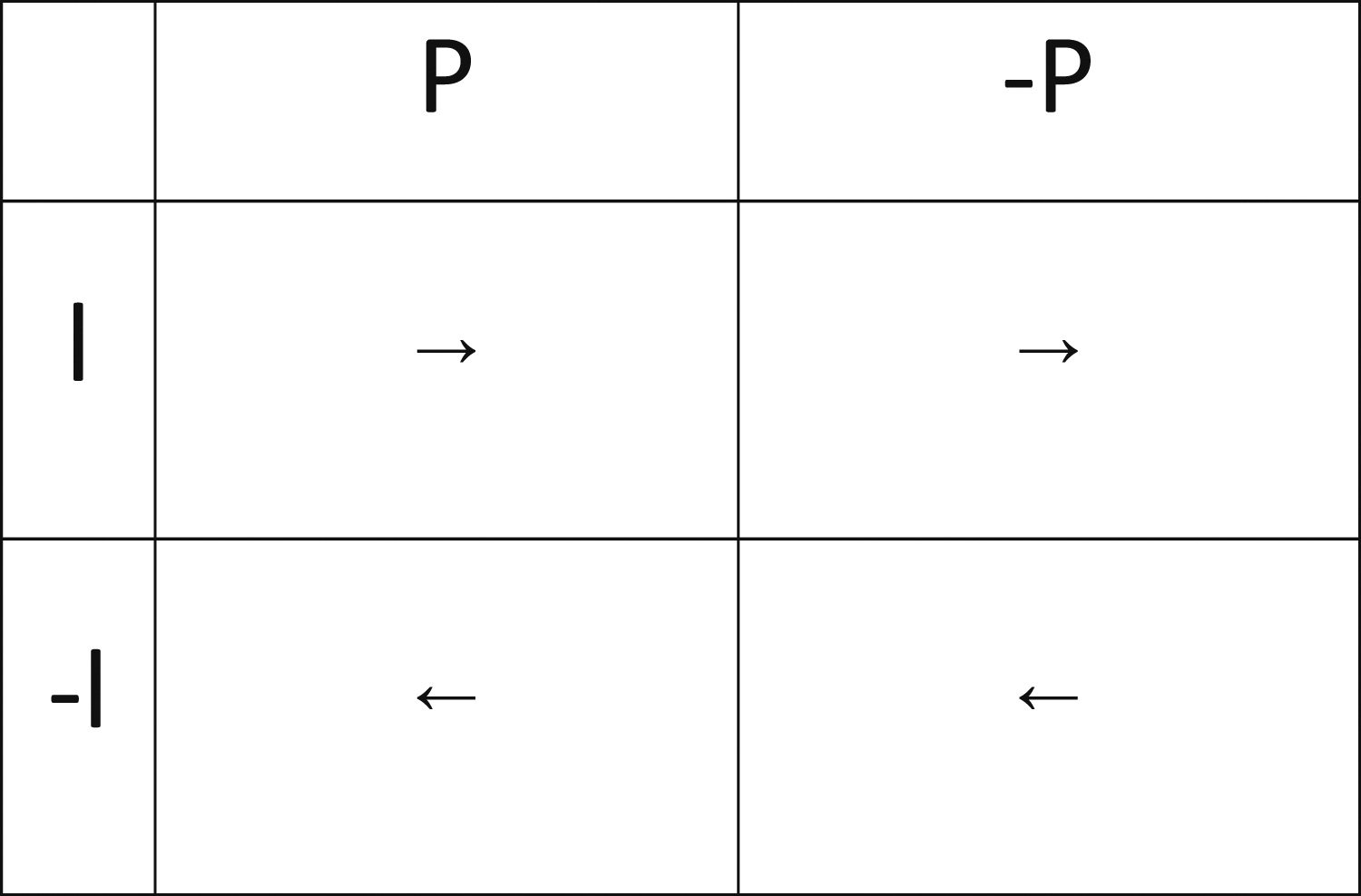
This last situation illustrates Bion’s intuition that basic assumption dynamics can contribute to establish work dynamics when they allow a group to survive an existential threat and, in time, allow it to establish itself in (and as) a less threatening reality. As this process deepens, the work group establishes itself more securely while the basic assumption group recedes into the background. While some might frame this transition as analogous to historical shifts from primitive a- or pre-political groups to sophisticated political ones, I find such developmental approach unsatisfying. These groups features are never fully surpassed, they persist concurrently (see Figure 2). This figure shows the continuum between -P/-l and P/l. As we move to the right reparative leadership prevails and so do political action, collaboration and autonomy among members of a group or society at large. Both extremes are hardly imaginable, reality always presents a mix of l and -l dynamics in groups and society at large.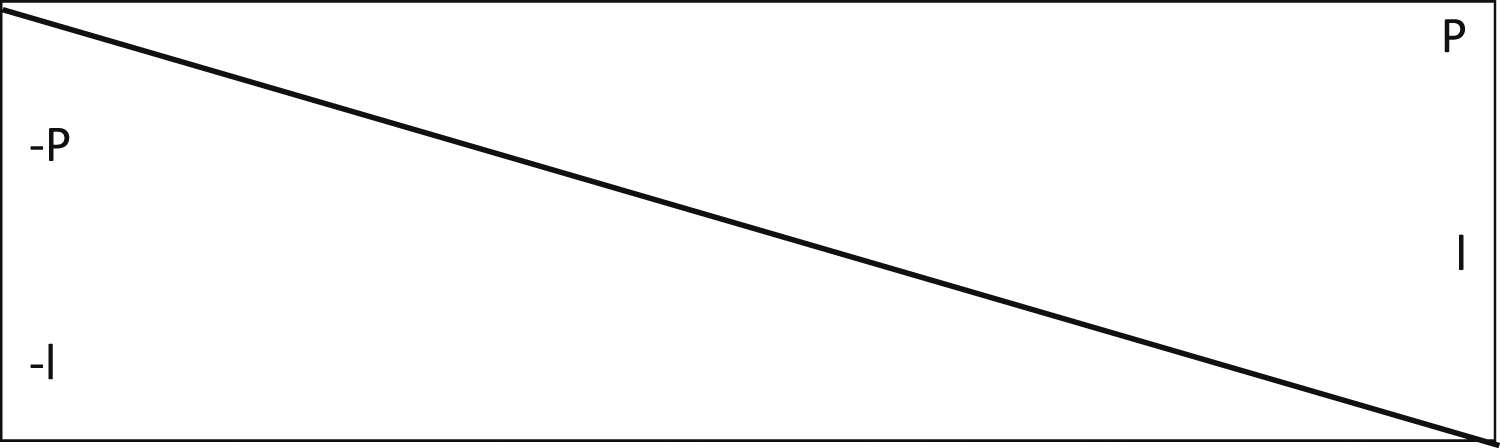
Even the most seemingly anti-political group or society possesses a political capacity that can become prominent. This is indeed a constitutive quality of human groups. This foreground/background movement continues over time, with emotional configurations based on basic assumptions resurfacing in response to groups crises. The intensity and duration of malaise can significantly impact the entrenched dynamics within groups and their potential to transform their prevailing culture. Less established groups are particularly vulnerable to these challenges, though the intensity of the stressors contributes to the prevalence of reactive behaviour and drifts towards fragmentation. In contrast, more consolidated groups often have formal structures arrangements and established practices to address demands for authoritarian and delegated leadership. Within a group under the sway of basic assumptions, struggling with a severe crisis or that has formed in a challenging environment (for instance, a moment of social upheaval or natural disaster), “l” forms of leadership can emerge that facilitate the (re)introjection of individual autonomy by mobilising the (unconscious and conscious) reparative attitude of its members. This reparative orientation toward the group fabric is political action, aimed at both individual and collective emancipation.
Conclusions
Conflicts frequently erupt among political allies. This is evident in the global justice movement, where clashes occur between supporters of a leaderless approach and those who favour a representative structure. These conflicts can often fragment even very creative and potentially effective political movements. It is only apparently paradoxical that some of these movements often embody and perform the conflicts and divisions against which they stand. The reason lies in the introjection of the political adversary – especially during critical moments – in the form of a split-off subgroup (often referred to as the enemy within). When the global justice movement faces crises (such as repression, an identity crisis, or a significant setback), (relative) cooperation wanes, and the concept of leaderlessness transforms into a de facto leadership claim. This denial of leadership, inevitably leads to its failure. In these circumstances, the failure of the movement’s driving principles (openness and horizontality) leads to disappointment and demands for directive, even authoritarian, leadership. Although leaderlessness is not an unrealistic aspiration, understanding leadership enables us to recognise the underlying dynamics driving social behaviour (reactions, enactments, acting-outs). By understanding these dynamics, we can better grasp the factors that hinder political action and the reclaiming of leadership by the whole group. As we have observed, distinct unconscious dynamics shape various group configurations, resulting in the selection of different leaders. These leaders, in order to effect transformation and avoid reinforcing anti-political ideological stances, must counter the very dynamic that propelled them to leadership positions. However, if they were to do so, they would betray the group mandate. Consequently, this counter-intuitive process may not readily find support among either the leaders themselves or the groups who appointed them.
This raises questions about mandate and leaders’ independence. Should leaders fulfil imperative mandates, or should they act based on their understanding of the group’s needs and interests? Activists’ hesitation is understandable, as radical representative independence is sometimes associated with Burkean paternalism and surrogate representation. Perhaps this dichotomy could be resolved (dis-solved or, perhaps, worked through) by holding leaders accountable to a mandate established by the group before the crisis struck that the leaders were then appointed to solve. The opacity of leadership in activist groups also raises concerns about decision-making transparency and democracy. Ideally, the prominence of leaders should be contained within institutional provisions for leadership management. Often, these mandates are set in charters of principles, constitutions, mission statements and other such documents which enshrine group’s collective learning (and conveniently prevent the need to reinvent the wheel with each iteration of a justice movement). Finally, contrary to Laclau’s perspective (2005), leaderless situations do not necessarily signal the absence of political action; rather they manifest its momentary prevalence. Bion emphasised the coexistence and alternative prevalence of work and basic assumptions dynamics. In this context, a political mentality coexists with, and at times prevails over, an anti-political one. Observing the way in which groups move between political action and anti-political enactments can be analytically and practically useful. It can contribute to self-reflection in activist groups (and in any other group and organisation). Such processes and such facilitating leadership are observed in the global justice movement when defensive reaching for managerial efficiency and rationalisation based on an instrumental disposition towards groups and the social are resisted and, on the other hand, when seductive and authoritarian relationships are contained. The polarization between supporters of either leaderlessness or leadership expresses a difficulty that the global justice movement, as well as groups in the wider society, struggles to negotiate. Rather than a conversation on forms of leadership, this polarization is the enactment of an underlying leading difficulty – an impasse in the mediation of two aspects of group life, leaderlessness and leaderfulness, between which a possibility to choose may not be given.
Footnotes
Declaration of conflicting interests
The author(s) declared no potential conflicts of interest with respect to the research, authorship, and/or publication of this article.
Funding
The author(s) disclosed receipt of the following financial support for the research, authorship, and/or publication of this article: This work was supported by the Research Council of Finland.
