




Abstract
Multiple theories of leadership postulate specific capability requirements with an expectation that leaders recognize the need for such capabilities and become motivated to develop them. In the workplace, leaders’ development is also expected to respond to the immediate demands of the organizational context. However, what leaders end up learning in the workplace remains largely unexplored. Hence our inquiry is into what leaders choose to learn, when they are in role and face the realities and demands of their immediate and wider environment. In line with Vygotsky’s sociocultural theory and concept of ‘perezhivanie’ we explore what actually becomes important for leaders to learn when they receive developmental support from a coach. We do this by identifying the content of coaching conversations: what is demonstrably discussed in coaching - the main themes of the actual coaching conversations and how the predominance of different themes changes over the coaching engagement. Based on the analysis of the sequencing of coaching themes in 153 organizational coaching engagements we discuss the dynamic interplay of the personal and the organizational agendas in the changing foci of leader learning. We propose a novel and theoretically-grounded explanation of leaders’ choices for learning in real complex environments. The results of uniquely gathered data and analysis challenge some current trends in the scholarship and praxis of leader development.
Introduction
When leaders’ learning is discussed, it is generally assumed that leadership theories will play a pivotal role. However, as argued by Alvesson et al. (2017), for acting leaders, “theoretical ideas and concepts are often abstract and cleansed of real-life complexities and complications” (p. 143) - an issue also acknowledged by other scholars (e.g., Gioia, 2022; Kjellstrom et al., 2020). Theories often imply more order and control over situations than is possible for leaders in the real and messy contexts of organizations. Moreover, a great deal of dominant leadership theories are about heroic leaders and passive masses, named by Haslam et al. (2024) as zombie theories; they do not make leaders’ life easier. In a workplace not all leaders enjoy “their sense of superiority that is at the same time both comfortable and comforting” (Haslam et al., 2024: 2), but struggle under the pressure of high expectations and demands of difficult situations (Hay, 2014; Kark et al., 2021; Petriglieri et al., 2011; Thomas and Linstead, 2002).
Leaders’ initial choices of what to learn are potentially limited by leadership education programmes which could also be under the spell of ‘zombie ideas’ (Fatien Diochon and Nizet, 2019; Haslam et al., 2024). Even recognising the difficult contextual conditions of leadership may not be sufficient to make leadership ‘teachable’ according to views that the challenges facing contemporary leaders are simply too complex and ill-defined to be successfully taught (Day et al., 2014; Oc, 2018; Vogel et al., 2021). Leader development strategies in organisations that are products of the same zombie ideas carrying high expectations coupled with the pressure to sort out everyday problems may provide no constructive avenue for leader development either.
Considering the difficult relationship between the ideals, expectations and contextual complexities it remains unclear what leaders see as their resources to meet these challenges and what they are really motivated to learn (Gioia, 2022). For example, a call to become more charismatic, or to develop strategic thinking as a solution for problem for leaders who find themselves in the midst of consistent crises, with low resources or lack of buy-in by the teams, might be quite far from their immediate focus of learning. Although the topic of leader learning is consistently recognized as important in the field of organisation and leadership studies (Day, et al., 2021; Leroy et al., 2022; Passarelli et al., 2022; Petriglieri et al., 2011), it remains largely unexplored how leaders respond to the pressure of expectations and the realities of their everyday challenges and what, under these circumstances they chose to learn.
This situation, we believe, suggest a need for both further theoretical understanding of what triggers leaders’ learning and research into what leaders in the workplace ‘end up’ wishing to engage with and learn (Benjamin, 2011; Gioia, 2022). However, both of these are challenges of tall order and here we address why this is the case. A theory of learning needs of leaders in the workplace should be able to meaningfully integrate quite separate factors influencing such learning, factors that are usually explored in different literatures discussing: • the external enablers and constraints in leader development that include dominant zombie ideas (Haslam et al., 2024) and those determined by the complex and dynamic workplace environment (Oc, 2018; Ayman and Adams, 2012); • ‘the internal’ (personal characteristics of the leader) that define individual leaders’ perception of their response to the demands of such ideas and environment (Athanasopoulou and Dopson, 2018; Vogel et al., 2021), also in the context of inevitable diversity of leaders; • the resultant motivation of leaders to engage in learning and development in a workplace (e.g. Kwok, et al., 2021).
Only with consideration of the interplay between these factors can we approach the first question in our study: what are the mechanisms through which external and internal factors interact in influencing the desire of leaders to learn in a workplace?
To address this question, we approach this investigation through the lens of a theoretical position that can accommodate the multiplicity of aspects that play various roles in leaders’ learning in the workplace. Vygotsky’s (1971, 1994) sociocultural theory (VST), which is increasingly applied in many complex contexts beyond learning and education (Cole and Gajdamschko, 2016; Cong-Lem, 2022; Denis et al., 2007; Feryok, 2020), affords such an analysis. As a theoretical lens, VST provides an opportunity to avoid the extremes of the positions that privilege the role of ‘the external’ (opportunities and demands of the environment) or ‘the internal’ (personal characteristics of the leader) in influencing important learning. Instead, VST recognizes that learning is co-emerging and the concept of ‘perezhivanie’ (Vygotsky, 1971, 1994) is particularly useful when investigating leaders’ learning in the workplace. Perezhivanie, which can be translated as ‘living through’ (Veresov, 2016) or ‘experiencing’ (Cong-Lem, 2022), indicates the experiences that are influential in the individual’s learning and development.
In terms of empirical investigation of this topic we are responding to the call for research on leader learning in the workplace with actual leaders and in the natural environment of organisations (Gioia, 2022; Benjamin, 2011; Day et al., 2021; Oc, 2018; Vogel et al., 2021). This defined our second research question for empirical investigation: what types of developmental needs arise in the dynamics of coaching engagements that reflect the dual consideration of both external and internal factors for leaders in the workplace. We applied a pragmatist multi-method methodology and a two-stage sequential design to investigate the coaching themes. Stage 1 consisted of three steps and resulted in a taxonomy of coaching themes. First, we conducted a qualitative pilot study which served to inform the design of data collection methods. Second, we conducted a survey to gather qualitative data on the themes of coaching at three points of the coaching engagements in the way that coaches describe them. Third, the records of 86 coaching engagements collected at this phase were used to create a taxonomy of coaching themes. In Stage 2, the taxonomy was used to conduct a wider exploration in which the themes at the three points of 153 coaching engagements were recorded and analysed.
The first contribution of this study is a theory of leader learning and development based on the ideas and concepts of VST, a theory that resolves an important predicament of disconnect between external and internal influences on leaders’ learning in the workplace. Second, our unique approach to data collection resulted in the taxonomy of coaching themes that offers an empirically based classification of leaders’ learning needs. This classification indicates that leaders’ needs are much wider than the topics covered in conventional leadership training and development. Third, the exploration of the dynamics of leaders’ developmental needs during workplace learning provides an important insight into the current status of ‘the personal agenda’ in leader development. The latter is an important addition to understanding of leader learning in the workplace which has substantial implications for the practice of planning and delivery of leader learning interventions.
Theoretical background
Leadership development theories have over time shifted their focus back and forth between the internal (the personal qualities of the leader) and the external factors (situations and social factors), often addressing them separately. Leader development approaches have also been critiqued for the aggrandised expectations of leader role, limited attention to the actual challenges that leaders experience in relation to work contexts, dominant organisational discourses, personal diversity and resultant motivation for learning (Haslam et al., 2024; Day et al., 2021; Leroy et al., 2022; Petriglieri et al., 2011; Passarelli et al., 2022; Gioia, 2022). Even being conceived as co-constructed and co-oriented (Cooren, et al., 2011) through the lens of a communication-as-constitutive (CCO) perspective (Cooren, et al., 2011; Schoeneborn et al., 2019) leader learning was seen as exclusively cognitive sensemaking stripped of the emotions and struggles that leaders experience. In light of this critique, VST offers an alternative phenomenologically rich explanation of leaders’ experiences in situations affected by multiple factors and leading to their desire to learn.
VST has been experiencing a renascence in its original field of developmental psychology and has been found useful in other disciplines (Cole and Gajdamschko, 2016; Cong-Lem, 2022; Feryok, 2020; Veresov, 2016). Following recent comprehensive clarifications and adaptations of VST (Backhurst, 2019; Cong-Lem, 2022; Veresov, 2016) we apply the theoretical concept of perezhivanie and the methodological principles advocated in VST to enrich an understanding of what leaders want to learn.
The concept of perezhivanie
The concept of perezhivanie brings together consideration of wider context, concrete situation and particular characteristics of the person, all of which become significant in the way the events are lived through (Vygotsky, 1971, 1994). It involves both emotions and cognition of the person as agent.
Although the meaning of perezhivanie is complex and not easily translatable into English (Cong-Lem, 2022; Veresov, 2016), Backhurst (2019) has argued that the concept of ‘experience’, if properly understood, is a satisfactory equivalent of perezhivanie. In this sense, all experience contains the same dimensions attributed to perezhivanie: the emotional, evaluative and agential. However, later he discusses two types of experience: ‘thin’, or the ordinary everyday type, and ‘thick’ experiences that are not as trivial, because of their significance for learning and development. It is specifically ‘thick’ experience that is therefore comparable to perezhivanie. This clarification highlights that in VST, perezhivanie is discussed in the context of learning that is formative for development rather than any everyday experiences. Therefore, for the purpose of our study - to understand how leaders learn while encountering the demands and challenges of the workplace - it makes sense to use the term perezhivanie as originally suggested by Vygotsky (1994).
The concept can be used in two different ways, each applicable to leaders’ learning in coaching engagements which is the focus of this study: (1) as a theoretical concept representing the relation between an individual and their environment in the process of development; (2) as a psychological phenomenon of lived experience within specific situations which can be observed and studied (Veresov, 2016).
Theoretical significance of perzhivanie as a concept
The first use of perezhivanie is important as this concept exemplifies how inseparable environmental factors and leaders’ characteristics are when they learn in the workplace. For example, in coaching conversations leaders’ experiences are processed through raising awareness, recognising emotions, engaging in meaning making and drawing wider implications for action (Cox et al., 2014). All the above are also recognised as ingredients of the process of learning (Hammond et al., 2017; Leroy et al., 2022) and as such provide an insight into how leaders learn.
VST looks at the social and the individual as a dialectical unity. The person is positioned as part of a social situation and their relation to this situation occurs through perezhivanie. The factors and forces of the environment acquire a controlling significance (Vygotsky, 1994: 346) because the person ‘lives through’ them. The social environment as a source of learning and development of the individual is not something which exists outside the individual. It exists only when the individual actively participates in this environment, by acting, interacting, interpreting, understanding, recreating and redesigning it (Veresov, 2016).
It is impossible to predict which element of the situation in combination with which personal characteristics would trigger a particular perezhivanie and the nature of the influence it might have on the person’s learning and development. This highlights both the difficulties of generalising what factors of the environment are most influential, as well as postulating the significance of particular types of personalities on the way people learn and what they want to learn. Hence attempts to capture general patterns of the contextual influences on leadership are jeopardized by underestimating the diversity of leaders (Athanasopoulou and Dopson, 2018; Bolden and Gosling, 2006; Fatien Diochon and Nizet, 2019; Vogel et al., 2021).
Another nuanced aspect of perezhivanie is explained by an important methodological idea of Vygotsky (1994). He argued that if we are concerned with the study of a complex whole, such as learning and development, we must comprehend the necessity of analysis by units and not elements (1987: 47). In other words, we need to identify those units in which the characteristics of the whole are present. For example, if in studying an object we choose to focus on its components such as atoms, this will not allow us to understand all the aggregate features of this object. On the other hand, a molecule, as a unit, being reasonably small but exemplifying these aggregate features, might be productively analysed (Veresov, 2016). According to Vygotsky (1987), perezhivanie is such an indivisible unit that can allow a meaningful investigation of learning and development.
Perezhivanie as a psychological phenomenon
In the second use of this concept, perezhivanie can be explored as a psychological phenomenon that can be described in terms of both the process and as content of the individual experience. For example, a leader experiences a significant setback and loss of reputation as a result of a failing relationship with an important stakeholder. Perezhivanie of this leader can be explored as a process of recognising a range of mistakes made, dealing with feeling of guilt and disappointment, identifying the meaning of what has happened and the learning from the consequences followed by planning for relevant action. The content of the perezhivanie for this leader, on the other hand, would be the topic of ability to engage with stakeholders.
This nuanced description can be illuminated by the metaphor Vygotsky (1994) applies to each perezhivanie saying that it functions as a prism which refracts the dialectical relations of social and individual. The principle of refraction indicates how the same social environment differently affects the unique developmental trajectories of different individuals (Veresov, 2020). Now, if we consider what happens in a coaching session, we can see it as a place where the leader can discuss the ongoing series of perezhivanye (as refraction prisms) with an opportunity to generate important learning. These sessions serve leaders by creating conditions that are useful for processing their relevant perezhivanie through raising awareness, recognising emotions, engaging in meaning making and drawing wider implications for action (Cong-Lem, 2022), developing at the same time an individual attitude to social reality (Vygotsky, 1987). As attitude is defined as a relatively enduring organisation of beliefs, feelings and behavioural tendencies towards socially significant objects, groups, events or symbols (Vaughan and Hogg, 2017: 154), these longer term beliefs, and conceptualisation of identity become additional internal elements of the following perezhivanie.
Role of perezhivanie in individual learning and development
In VST, development is seen as the result of a qualitative reorganisation of the whole system of functions, a new type of construction of consciousness and mental functions (Vygotsky, 1998: 190). This qualitative change of the whole system implies that each new component brings reorganisation to the whole system in such a way that the new (reorganised) system becomes a unit of a higher order and begins to act according to new laws (Veresov, 2020).
It is important to note that in applying VST to the learning and development of adults we need to account for their potentially higher agentic capacities (Boyce et al., 2010; Cox et al., 2014; Murphy and Young, 1995) as they develop reflective skills and become intentionally pro-active in terms of the choices about what to learn. As argued by Boyce et al. (2010) and Murphy and Young (1995), leaders might initiate, sustain, and evaluate their growing leadership capacities in their own conceptual frames. This could create a layer of their own expectations in terms of the ongoing process and content of learning during coaching. Such expectations and evaluations of learning will influence the interaction with a coach, thus creating another conceptual loop in the interplay of the internal and external.
In aiming to address our first research question – understanding the mechanism of how leaders’ learning in the workplace is triggered and processed - VST already provides important insights and valuable conceptualisation through the use of perezhivanie. The framework in Figure 1 models the VST perspective on leadership development through coaching as argued above, showing on the one hand, the environment in the context of leader learning that is multifaceted and varied for every leader. The environment in this sense includes the ongoing demands of their role aggravated by the ideas of ‘heroic leaders’ and the expectations of the organisations about particular ways of meeting such demands. The support provided by the coach, which is also varied in terms of the coach characteristics, is also part of that environment. The goals of coaching, negotiated and agreed with the organisational sponsor, become additional features of ‘the external environment’ in the process of learning. On the other hand, the individual or ‘the internal’ in this process is the leader’s characteristics, values and attitudes. They play an important role in perezhivanie when it acts as a prism that refracts ‘the external’. Leader learning in the workplace through the VST lens.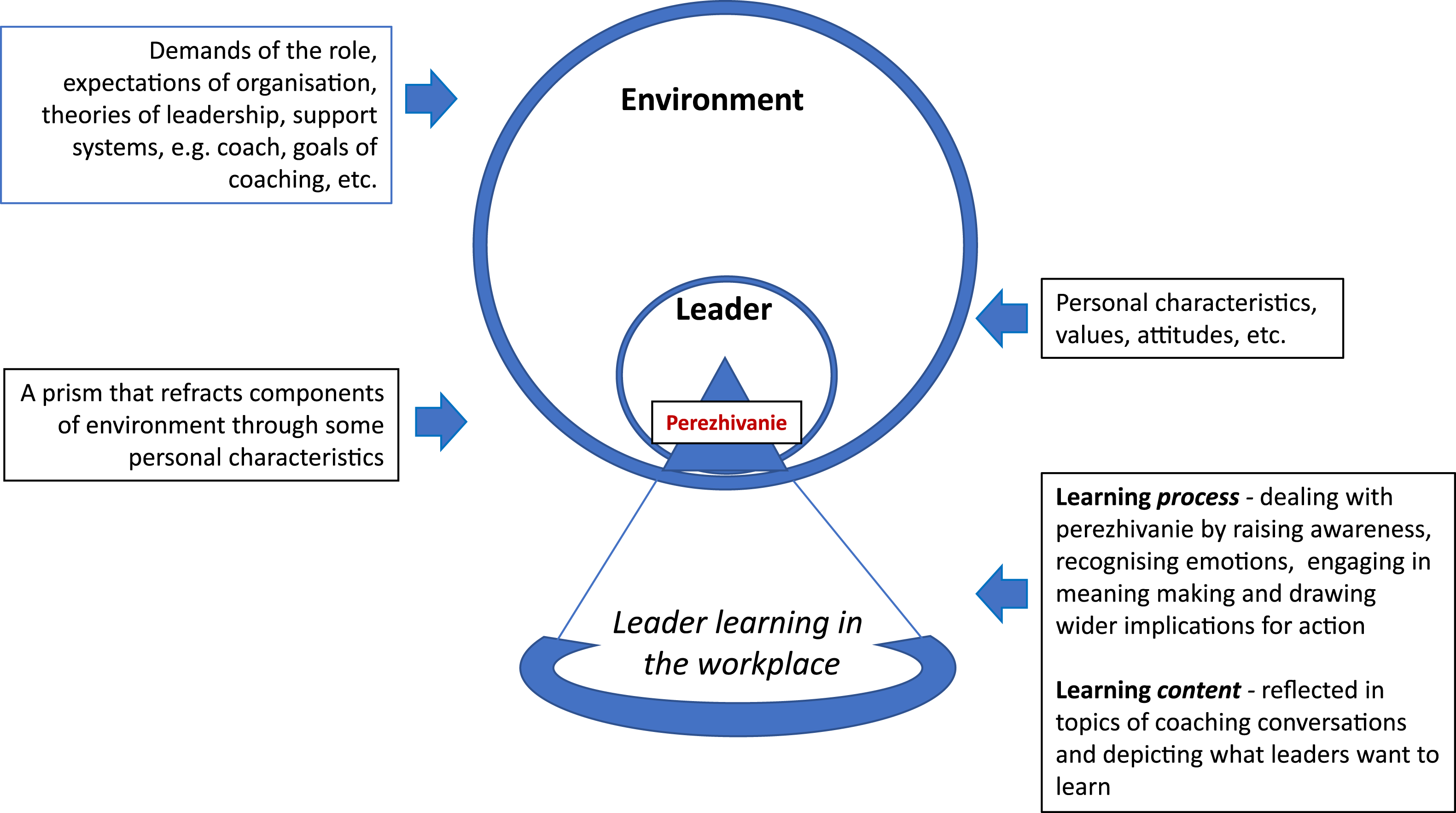
Our second question, on the other hand, requires an empirical investigation as we aim to identify the content of perezhivanie for leaders: what leaders end up wishing to learn. The conceptualisation of leader learning according to VST (presented in Figure 1) implies that the environment is not static, as the leader also changes this environment by acting on it and engaging in learning. Leaders’ characteristics also change in the process of learning. In perezhivanie, both the environment and personal characteristics amalgamate to indicate what becomes the topic of learning for the leader in coaching at each point in time. It is inevitable that these topics are unique and dynamic, which in turn influence each new step in the learning of the leader. This clearly presents substantial challenges to any generalisation that the main question of our inquiry might suggest: i.e. some universality of what leaders want to learn in a workplace. Engaging with this question empirically under conditions where leaders are explicitly given an opportunity to learn, we set out to explore the effects of the complexity of situated learning processes on the coaching agenda.
We believe that it is possible to do this by registering what the coaching conversations are about – their content - which is very rarely addressed. The content of perezhivanie can be hypothesized to be a reasonable reflection of the leaders’ perception of their own learning needs, which can be studied as a unit of analysis.
Method
In this section we describe our approach to the second question of our study: what types of developmental needs arise in the dynamics of coaching engagements that reflect the dual consideration of both external and internal factors for leaders in the workplace? We asked organisational coaches to record session by session the actual topics of conversations at the beginning, middle and the end of their coaching engagements, recognising that the initial goals in leadership coaching, even when individually determined by the leader, are regularly adjusted during coaching (e.g., Athanasopoulou and Dopson, 2018). As coaching engagements usually last between 6 months and 1 year, we were able to monitor the shifts between the topics of conversations and identify important patterns in the change of the leaders’ attention to their specific areas of learning.
Although the data for our study was gathered by coaches we would argue that it is not only a fair but also a better representation of leaders’ perezhivanie followed by actual choices for learning. First of all, the data is not based on the survey of coaches’ general opinions, but on the observation and reporting of the actual coaching engagements. Although coaches were parts of these engagements, there is a strong ‘good practice’ imperative for coaches ‘not to bring their own agenda’ in terms of the content, but to work with what is important to the leader (Bono et al., 2009; Ely et al., 2010; Grant et al., 2009; Ladegard and Gjerde, 2014). This minimises the effect of coaches ‘pet theories’ and preferences on the process of coaching. Second, we believe that the recording of the actual themes of coaching by coaches gives more grounded impression of leaders’ needs than asking them to share their opinions or recollections of their needs. A third, and more pragmatic consideration, is that this approach to data collection allowed us to keep the utmost respect for confidentiality that is expected in the coaching process.
The study adopted a pragmatist multi-methods design, consisting of two main stages. Stage 1 consisted of an inductive qualitative study to establish a framework of common coaching topics reflecting their perezhivanie. Stage 2 consisted of an exploratory analysis of a wider population of records against the framework thus established and reflecting therefore the types of developmental needs that arise from the dual consideration of both external and internal factors for leaders in the workplace.
Stage 1 of the study: Pilot and survey
The purpose of this stage was to generate an extensive set of coaching themes that emerge in coaching conversations in the natural context of the organizational coaching engagements. The outcome of this stage was a structured taxonomy of coaching themes to form a template for Stage 2 which aims to provide an analysis of the patterns and dynamics of those themes using a more extensive data set.
The coaching clients were in different leadership roles in a wide range of organisations. In this study we focus on one-to-one contracted leadership-oriented/executive coaching with an external coach as this form of coaching is typical for working with different levels of managers in organisations.
This stage was initially piloted with 6 experienced coaches to test if our questions generated the expected quality of responses. As the next step at this stage, a survey was designed to run on a simple and accessible platform. Its design allowed participants to return to the survey at a later date to record their ongoing client interactions so that they would not be solely reliant on memory or notes from fully completed client assignments. Questions that may lead to the identification of either coaches or clients were avoided, and although demographic data only on coaches was collected, participants could record the data about their coaching topics unlinked to this data.
The survey was publicized through professional and academic networks including various specialized LinkedIn groups, and through announcements at conferences and events. Contacts with similar networks in other countries were asked to publicize, particularly in Australia, USA, Europe and SE Asia.
Analysis of stage 1 survey
The survey produced 86 valid records of coaching engagements by 70 participating coaches. Although we were not intending to look for correlations relating to demographic data, we were keen to check that the sample participants were likely to represent the target population of the Stage 2 observation-based survey. Gender was recorded as female on 45 records (64%) and male on 25 records (36%). Other options were not used by participants. This is very close to the 67% to 33% split recorded on the 2016 ICF Global Survey (ICF, 2016: 9) and therefore appeared representative of the target population in relation to gender.
The ages of participants ranged from 28 to 73 with a distribution slightly skewed above a peak in the late 40s, early 50s. Similarly, the ICF Global Survey (ICF, 2016) showed the largest concentration of practitioners in the 45-50 age range. All major territories where coaching may be delivered in English were represented, predominantly the Americas, Western Europe, Australasia, with some representation from Asia, South America and South Africa.
Creating the taxonomy of themes
Having established that the data were reasonably representative of our target population, the topics recorded were analysed with the aim of producing a taxonomy of coaching topics as manifestation of leaders’ perezhivanie, for use in Stage 2. The taxonomy needed to be comprehensive (to represent as wide a range of possible topics), whilst also parsimonious, i.e., concentrating the broad range of possible descriptions into a restricted set of labels that would be easily understood and accepted by participants in Stage 2.
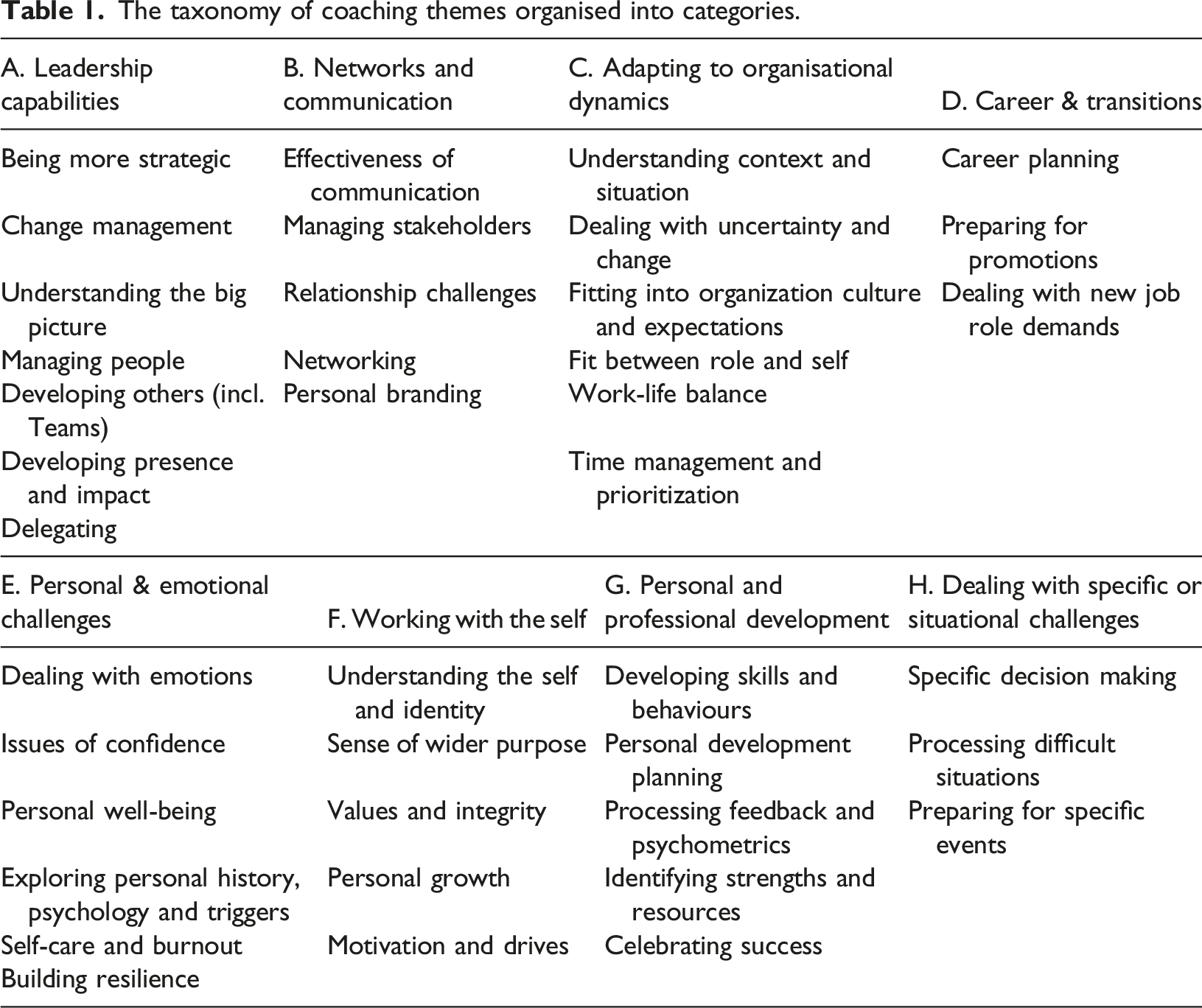
The taxonomy of coaching themes organised into categories.
Stage 2 of the study: Observation-based survey
The purpose of the Stage 2 survey was to collect a broader set of data, using more structured categories than in Stage 1, in order to enable a more descriptive analysis of the types of developmental needs that arise during coaching interaction representing leaders’ perezhivanie that triggered their motivation to learn. The survey was hosted on a bespoke secured website where participants were invited to login using pseudonymized credentials and coded references to clients. Website maintenance and administration was carried out by a specialized technician separate from the research team.
The wording of the instructions for the Stage 2 survey was piloted again with 10 working practitioners. Similar to Stage 1, the project was publicized through professional and academic networks. 158 coaches responded, generating 153 valid client records of which 138 recorded themes for both T1 and T2, and 125 had a valid theme for all three timepoints. Age and geographic split reflected similar patterns as in Stage 1.
Analytical methods
As noted above, the research team were aware of making a choice to maintain ecological validity (to reflect to some degree the richness of participants’ experience) over the opportunities of appropriate reduction. Having identified key points of interest, two researchers, each with 20 years’ experience in the organizational coaching field, including coaching, supervision and coach education and assessment, independently generated what they respectively saw as key narratives emerging from the data. In doing so we favoured broader interpretation, looking at the details in the context of the entire data set and aiming to arrive at a richer, more holistic understanding (Alvesson and Sköldberg, 2018; Cornelissen, 2017).
Results
Results of stage 1: Taxonomy of coaching conversation topics
Table 1 sets out the taxonomy of coaching topics that resulted from a qualitative analysis of the primary and secondary topics of conversations that leaders had with coaches during their coaching engagements. Through the VST lens we see these topics as a representation of leaders’ perezhivanie in real-life situation in their workplace.
40 topics were derived from the analysis of 86 coaching engagements that were judged to describe the breadth of leaders’ perezhivanie and resultant motivation to learn. The groupings into which they were categorized were seen as a fair description of what the topic areas held in common and again would be recognizable to coaches. To expand: under Leadership Capabilities we categorized those topics that reflected the functional activities of day to day and strategic leadership. This category would therefore reflect discussions around the leader’s performance. Networks and Communications represents a set of influencing and communications capabilities that enable the leader to perform their functional tasks effectively. Adapting to Organizational Dynamics reflects the leader’s need to understand their context and their fit with it. Career Transitions are discussions that are more personal about navigating the organization for their career objectives rather than their work objectives. Personal and Emotional Challenges are concerned with the leader’s personal reaction to their circumstances and how they want to choose to deal with them. We categorized a set of topics as Working with the Self as they reflect a more personal exploration about the leader themselves as an individual. Personal and Professional Development are the issues that organize and progress the leader’s development. Finally, Dealing with Specific or Situational Challenges reflects the leader’s immediate need to problem-solve on specific issues.
A number of observations of these data can be made at this point. First, it is notable that the taxonomy represents a very broad range of topics – an illustration of the complexity of the leaders’ external factors of contexts and internal factors - their perception of own values and capabilities. Leadership competency frameworks typically used in organisations, for example for framing 360 feedback, usually focus on a small number of capabilities and attributes of leaders (e.g., Segers et al., 2011). In our taxonomy these competences might, very generally, be located somewhere in our A and B categories. What emerged, however, shows that the leaders’ contents of perezhivanie are more varied and granular in response to their changing organizational situations and in line with their individual characteristics, the process of perezhivanie and ways of engaging in these situations. For example, topics in Categories E and F in particular include issues of confidence, well-being, identity, purpose and values which would not normally be part of an organizational performance agenda (Dagley, 2006; Segers et al., 2011). The finding of the issues of confidence is also a significant differentiator to the typical discourses around leaders specialness (Haslam et al., 2024) and we will return to it after considering what place this developmental need has in the dynamics of leaders’ developmental work captured at stage 2 of the study.
On the whole, the results of this stage indicate a shift beyond classical competencies, towards the person behind that performance. Indeed, the categories in the taxonomy could be plotted on a continuum from task and organisation at one end (Leadership capabilities; Networks and communications) to a concern for the self at the other (Working with the self; Personal and emotional challenges). Dealing with organizational dynamics, personal and professional development and career management sit somewhat at the interface between organization and person. (The last category - Dealing with Specific or Situational Challenges - represents tactical and immediate issues rather than longer term development – something that leads to perezhivanie but not necessarily on the radar of competences frameworks.) In relation to our second research question the results of this stage of the study illustrate a wide range of developmental needs that arise for leaders in the workplace from the interplay of external and internal challenges. Additionally, this taxonomy is used to conduct the next stage of the study allowing coaches describe the dynamics of leaders’ topics brought to coaching as being triggered by different kinds of perezhivanie at the time of coaching engagements.
Results of stage 2: Changing themes in leadership coaching
The results of this stage demonstrate what types of leaders’ developmental needs take priority at different stages of coaching engagements. In this section we will first describe the nature of the data collected. Then we will make observations on the frequencies of different topics that emerge most commonly in the coaching conversations at different stages in response to perezhivanie of leaders. We recognise that in doing so, we are aggregating what is, importantly, an individualised process. In the discussion that follows, however, we will demonstrate both that the expressions of perezhivanie are more varied than a leadership competency approach allows for, and that there are themes outside those competencies that appear sufficiently commonly to warrant further attention.
Description of the data
The core data of our data base consist of primary and secondary topics of discussion, as recorded by the coach at three time points of the coaching intervention: the beginning, middle and end (T1, T2, T3). Each full client record therefore consists of a primary and secondary topic selected by the participants from the taxonomy at each of the three time points. Participating coaches could create records for multiple clients.
In this paper we are looking at the data set as a whole in terms of frequencies of the topics which provide an overview of what topics are discussed in general. In presenting and analysing frequencies, we have chosen not to differentiate between ‘primary’ and ‘secondary’ topics as a general view of what topics were ‘on the radar’. The frequency of the different topics at each of the three time points are set out in Figure 2. The topics are shown in descending order of their frequency at T1. A number of observations emerge from the relative frequencies at different points of the coaching intervention. Frequency of agenda items (Primary and Secondary aggregated) across T1, T2, T3, ordered by T1 total.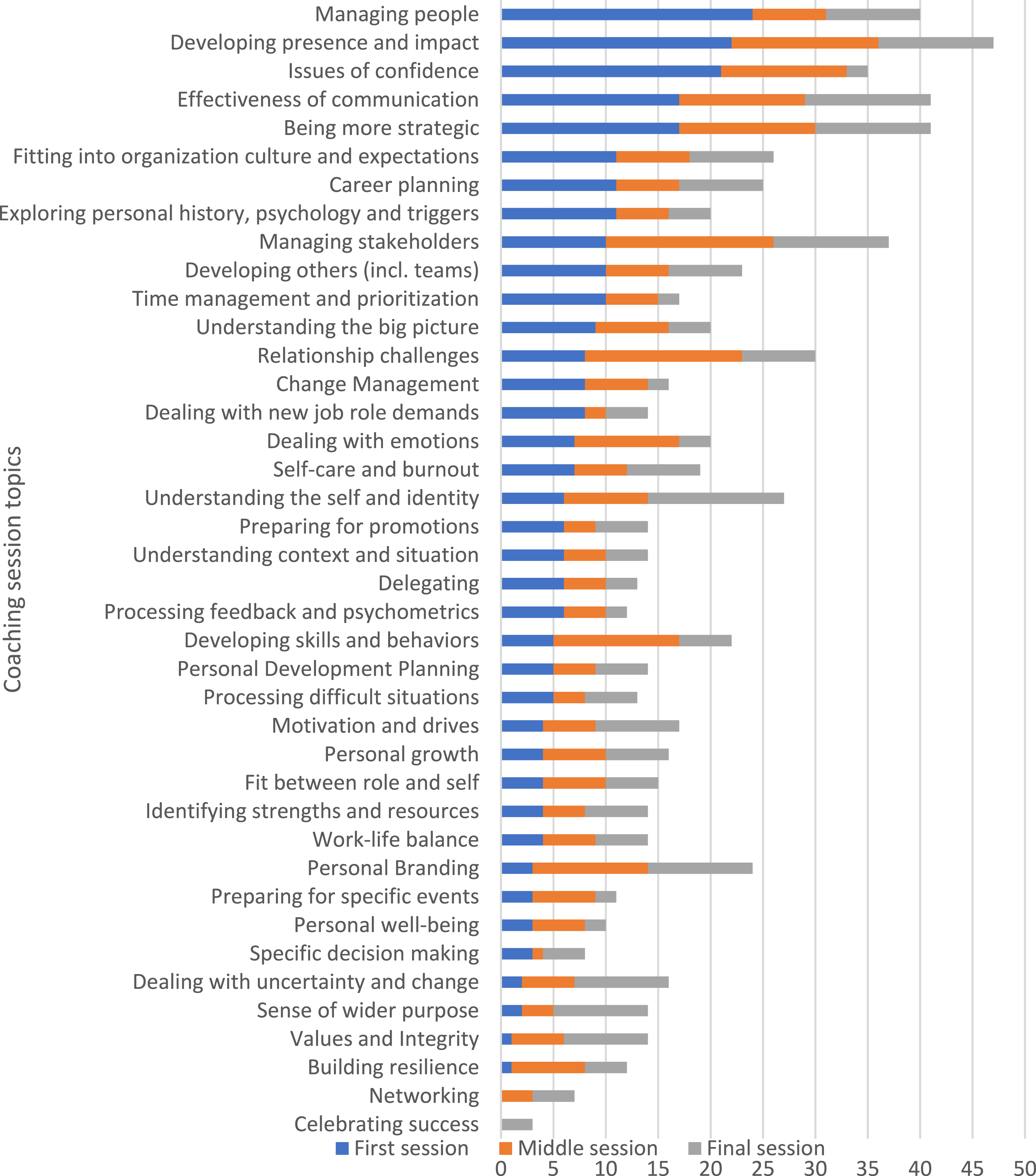
Ranked frequencies of topics at T1, T2, T3.
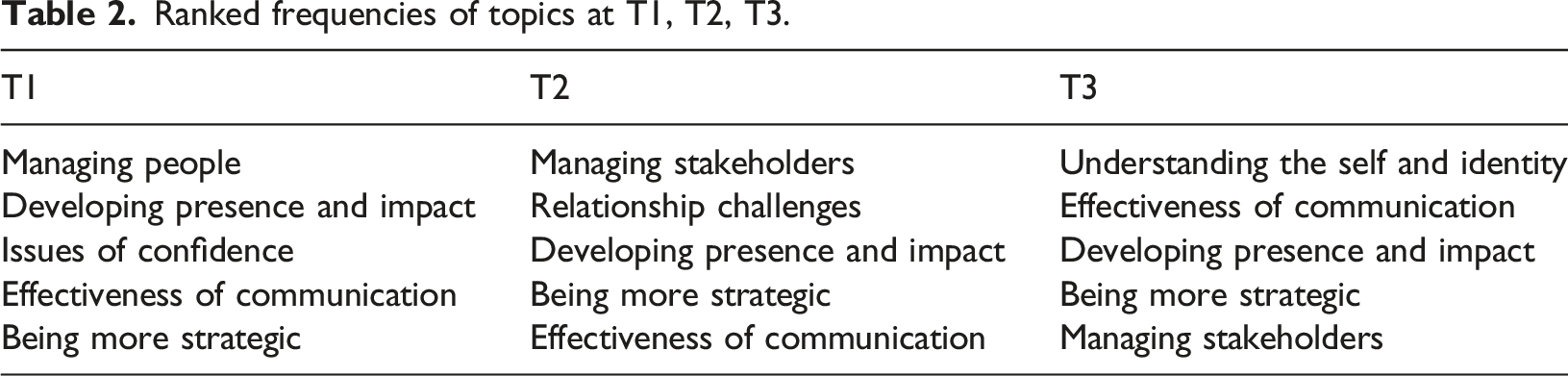
At T2, three of these topics are still amongst the top five cited (Developing presence and impact, Being more strategic, Effectiveness of communication). However, the two most prevalent at T2 are Managing stakeholders and Relationship challenges. The top five topics at T3 are Understanding the self and identity, Effectiveness of communication, Developing presence and impact, Being more strategic, and Managing stakeholders (see Table 2). Some specific observations include that Managing people – a core leadership function - while top-ranked at T1, is 11th ranked at T2 and 7th ranked at T3.
Also of note is that some specific topics that appear very low in the rankings at T1, but then are in the top 10 of occurrence at T3 (these appear towards the bottom of Figure 2 but have a relatively high frequency at T3 represented by the third section of the bar in the chart). Understanding the self and identity fits this description and, as has already been mentioned, is the top-ranking topic at T3. Also, in this grouping are Personal branding; Dealing with uncertainty and change; Sense of wider purpose; and Values and integrity. As a general grouping, these appear to be indicating the need for an opportunity to process perezhivanie and the important role of these developmental needs that reflects a much more personal nature of the leaders’ struggle to reconcile the external expectations and demands with their internal perceptions and processes.
More specifically, it is possible to speculate (a) that these shifts to topics of a personal nature reflect the process of discovering underlying factors behind the initial presenting needs for learning; (b) that the presenting needs are rapidly addressed; or (c) that more personally meaningful topics emerge only once the relationship is established. As a case in point, Issues of confidence drops from a high ranking at T1 to equal lowest ranking at T3. This might indicate whether confidence is a surrogate for other needs or an issue very successfully resolved by coaching. The position of Understanding the self and identity as the most frequent topic at T3 – and the turn to personal concerns described above – might suggest that coaching experience enables a deeper consideration of personal meaning. Perhaps both effects are at play, thus requiring attention to addressing these kinds of leaders’ perezhivanie in the learning and development interventions.
In summary, we highlight two surprising elements of the findings concerning what leaders wish to engage with under the condition of the duality of external and internal factors influencing them in the workplace. The first developmental need reflects leaders’ perezhivanie of their level of confidence as a central theme at the start of coaching. The second need is understanding the self and identity that became very prominent at the later stage of their developmental work.
Discussion
We have argued that the topics of coaching conversations represent the content of leaders’ perezhivanie and the types of developmental needs emerging in the workplace. We asked two questions at the start of the study: (a) what are the mechanisms through which external and internal factors interact in influencing the desire of leaders to learn in a workplace and (b) what types of developmental needs arise in the dynamics of coaching engagements that reflect the dual consideration of both external and internal factors for leaders in the workplace.
On the level of the theory, the use of VST (Vygotsky, 1971, 1994, 1998) brings together two otherwise separate literatures: • on the complexity and unpredictability of the contexts in which leadership takes place and the challenges these conditions present for leaders’ development (Ayman and Adams, 2012; Day et al., 2021; Leroy et al., 2022; Oc, 2018). • on the essential psychological qualities of leaders and how these could be developed in leader development interventions (Athanasopoulou and Dopson, 2018; Day et al., 2014; Hammond et al., 2017; Hay, 2014; Ladegard and Gjerde, 2014; Kark et al., 2021; Petriglieri et al., 2011).
We believe that the use of VST helped to crystallise the mechanism of the dialectical relationship between the external and internal in the leader’s learning and development in the workplace. It also provided a tangible explanation of how perezhivanie is expressed in the topics of coaching conversations. Our taxonomy of themes demonstrates that what leaders want to learn, when they have support in their development in the workplace, is richer and more nuanced than suggested in typical classifications of leadership competences (e.g. by Hollenbeck et al., 2006) and in the theories of leadership that are now strongly critiqued by for example Haslam et al. (2024). The novelty of this analysis is not in the indication of the complexity of leadership tasks, but in what makes this complexity unique by the leaders’ refraction.
The implications that follows from this conceptualisation is that leaders’ learning needs have more personal and emotive nature, which require a meaningful inquiry about ‘living through’ their various experiences rather than the organisational rhetoric about leadership skills (Fatien Diochon and Nizet, 2019; Hay, 2014; Kark et al., 2021; Petriglieri et al., 2011). In particular, constraining the content of learning according to pre-existing competency frameworks, as is often attempted by the coaching sponsors (e.g., Segers et al., 2011), may be counterproductive from a VST perspective.
In terms of the implications for the coaching discipline and practice, the concept of perezhivanie and the findings of this study suggest an opportunity to help resolve a consistently thorny issue of where the allegiance of the organisational coach should be: with the sponsoring organisation or the individual client (Bachkirova, 2024). If coaches see their role in processing the individual client’s perezhivanie as suggested in VST, they will be already serving the organisation by dealing with the client’s environmental challenges because they include organisational expectations refracted through individual characteristics. Hence there is no split loyalty: the allegiances are one and the same.
Issue of confidence and working with the self
In relation to our second research question, our findings highlight several types of developmental needs that arise in the dynamics of coaching engagements and reflect the dual consideration of both external and internal factors for leaders in the workplace. Although each of these types being reflected in leaders’ perezhivanie deserves a separate discussion, in this paper we focus only on one most striking finding this study: the topics of confidence and work on the self in what appears important for leaders to engage with in the workplace.
Although leader identity has been argued to be foundational to leader development (Day et al., 2014; Petriglieri et al., 2011; Conroy and O'Leary-Kelly, 2014; Ibarra and Barbulescu, 2010; Miscenko et al., 2017; Hammond et al., 2017), there is still only limited evidence-based discussion about the intra-individual developmental processes that are experienced by leaders (Brown, 2022; Kwok et al., 2021). In this regard, VST provides a theory-based explanation for the role of ‘the personal’ in refracting the challenges of leadership and therefore for perezhivanie being formative for leader development. In our study this proposition is strongly supported by the finding that in the real life context leaders’ personal agenda is as prominent as the organizational agenda in their coaching conversations.
The role of the topic, Issues of confidence, is a first significant surprise, particularly at the beginning of the coaching engagement, and is in stark contrast to the lack of explicit attention to confidence in both coaching and leader development literature (Hay, 2014; Kilpatrick, 2022; Miscenko et al., 2017; Thomas and Linstead, 2002). Although self-efficacy and identity are researched (e.g., Kwok et al., 2021) they are assessed by traditional instruments in relation to specific tasks and usually, somewhat speculatively, in a student rather than a leadership population. There is some emerging academic literature on ‘impostorism’ in leaders (Kark et al., 2021), but it is concerned with rare, consistent and often debilitating feeling of being a fraud in their role rather than what appears to be a more common phenomenon of self-doubt and lack of confidence that can be addressed and alleviated.
The lack of explicit attention to leaders’ confidence in the organizational context, both in the literature and in organizational practice is unfortunate, considering the high cost of failure in leadership transitions (Manderscheid and Ardichvili, 2008; Terblanche et al., 2018) and the effect on leaders’ wellbeing (Kilpatrick, 2022). One of the reasons for the lack of attention to this topic is that confidence or lack of it might be seen as an internal state which does not explicitly affect one’s behaviour and performance – the latter being of more obvious concern to organisations. Second, recognizing a lack of confidence in the leader goes against the image of the leader in popular discourses (Haslam et al., 2024), which might be affecting the literature and practice of leader development. Instead of focusing on this as a ‘weakness’ incompatible with an image of the leader, it seemed to be more ‘respectable’ to address this as ‘identity work’ (Huber and Knights, 2022) or ‘changing mindset’ (Leroy et al., 2022).
Advocating a more nuanced understanding of leaders’ perezhivanie we draw attention to the timing of Issue of confidence in our findings. It is most noticeable at the very beginning of the coaching engagements. We see it as a response to the genuine intention of the coach to understand leaders’ concern and the relief that leaders may feel as they realise they do not need to hide it (Kilpatrick, 2022). It is also significant that Issue of confidence ‘disappears’ from being a priority in the middle and the end of engagements, which could be interpreted as coaching being successful at addressing this perezhivanie. However, the findings suggest that work on confidence is transformed into more in-depth work with the self once the immediate concern has been brought into the open. Understanding the self and identity gradually becomes a priority by the end of coaching engagements. Together with Self-care and burnout, Personal well-being and Building resilience, which are also on the increase in terms of their importance for leaders, these themes indicate a strong concern for the self and the individual’s personal resources, including a sense of wider purpose, values, and integrity. This marked switch towards the leader’s personal developmental issues in the course of coaching provides support for a growing interest to the leaders’ identity and self-views related to leadership (e.g., Brown, 2022; Day et al., 2021; Leroy et al., 2022).
One potential explanation for this dynamic is that leadership training programmes, being part of the external influences on leaders, expose them to many examples of ‘ideal leadership’ (Alvesson and Willmott, 2002; Haslam et al., 2024). Making comparisons against such ideals could inspire but also impair the leader who doubts their ability to rise to that level (Alvesson and Willmott, 2002: 626). The complex reality of leadership and the process of sense-making when in role, escalate these doubts and complicate the development of a new identity as a leader (Hammond et al., 2017; Kark et al., 2021; Kjellstrom et al., 2020; Kwok et al., 2021). With the support of the coach, however, and when the immediate perezhivanie is processed, the leader engages in more complex and meaningful developmental work for understanding their own self and enacting a new identity. On the basis of this finding we consider the work with leader confidence as a precursor of identity work, without which any discussion of leader identity may remain potentially too negative or too abstract. What seems most significant is that there should be support for leaders in considering the dual relationship between their actual external conditions and how they perceive their self and capabilities. In this way, the leader is supported in constructing a self that is ‘more open-ended and less culturally rigid’ (Gagnon and Collison, 2014: 659) and at the same time developing their reflexivity and agency (Huber and Knights, 2022).
In terms of the implications of the findings about leaders’ issues of confidence, we want to emphasise first a change in the attitude to this phenomenon. Joining Haslam et al. (2024) in debunking zombie leadership ideas in the scholarly arena, we advocate seeing the majority of leaders as much as victims of such narratives as everybody else, since these ideas are partially responsible for their issues of confidence (Alvesson and Willmott, 2002). This attitude requires refraining from seeing leaders as heroic and special figures ‘doing leadership’, but instead as human beings doing their best under difficult circumstances that often stretch them to their limits. It implies ‘normalising’ issues of confidence’ as a first step in helping leaders in their developmental work. Further implications are concerned with coaching scholars and practitioners prompting them to give more attention to better understanding the signs, dynamics, instruments and conditions for productive support of leaders in the workplace in identifying and addressing their developmental needs.
Limitations and suggestion for further research
Recognizing the complexity of our design we acknowledge inevitable issues that could be seen as limitations of our study. For example, more detailed information about the leaders such as gender, age, experience in the role, would be useful to consider in our analysis. These data were not collected both for reasons of client confidentiality, as noted earlier, and because analysis against these variables with our dataset would lead to an over-complex disaggregation. We hope that future studies meet this challenge using different methodologies. We also acknowledge that the number of data points at this stage are insufficient to produce statistical support or otherwise for any predictive hypothesis regarding patterns in the frequencies of content themes. However, being a qualitative study, it is consistent with its broad exploratory aim, demonstrating at the same time that statistical analysis on specific questions of inquiry is not impossible.
Following our conceptual propositions on the use of VST and more specific empirical observations, further hypotheses to test or explore can be generated. For example, using perezhivanie as a theoretical tool it would be useful to research: • what key components and specific aspects of social, cultural and environmental contexts are particularly influential in perezhivanie of leaders; • what personal characteristics are significant in refracting typical events in leader transitions; • what kinds of leader perezhivanie influence the process of developing of leader identity; • what the outcomes of refractions are in terms of individual trajectories of developing leader identity.
In relation to further research on the topics of confidence we would like to see more attention to this topic in order to explore: what mechanisms, such as self-deception, are involved when leaders avoid facing this issue; what types of leaders are more prone to have this issue; what is required from the coach as an instrument of practice (Bachkirova, 2016) in order to provide more than adequate support for leaders dealing with this developmental need.
Conclusions
Adopting VST and its key theoretical concepts we explored the themes of actual coaching conversations as an opportunity to investigate the range of leaders’ perezhivanie in the workplace reflecting the complex interplay of the external and internal factors. On the basis of our findings we argued that the concept of perezhivanie helps to add an important emotional dimension to understanding what triggers leaders’ learning in the workplace and determines the choices leaders make about their learning. The content of perezhivanie expressed in the topics of coaching conversations provided empirical evidence that there are patterns in what leaders wish to learn when they face the complexity of leading. These patterns extend beyond traditional competences and indicate useful avenues for further research.
In relation to practice, adopting VST as a lens for understanding the developmental needs of leaders elicits conditions that should be in place for productive learning in their organizational environment. This is particularly relevant for practitioners supporting leaders who choose to address their needs associated with issues of confidence and working with the self.
Footnotes
Declaration of conflicting interests
The author(s) declared no potential conflicts of interest with respect to the research, authorship, and/or publication of this article.
Funding
The author(s) disclosed receipt of the following financial support for the research, authorship, and/or publication of this article: This work was partially supported by the Institute of Coaching, McLean Hospital/Harvard Medical School Affiliate.
