



Abstract
One of the main tasks for leaders is to make work purposeful for others. As the promotion of purpose through leadership is often context-specific and dependent on interpersonal relations, this study explores the relation between humanistic leadership, existential reflections, and the Jungian theory on ‘individuation’ among non-profit sports leaders in Europe. To that end, the research questions in this article are (a) what kind of existential learning sports leader veterans have gained through their positions, (b) how it has enabled them to grow as persons and leaders, and (c) how these experiences may be helpful to other leaders. To explore these questions, this study drew upon the principle of episodic inquiry and qualitative interviews with highly experienced Norwegian sports leaders (N = 16). Through an episodically based recollection of life experiences, the study specifies eight qualities that enable today’s leaders in European sport to develop a humanistic leadership practice.
Introduction
For centuries, existential reflections have given people a sense of meaning in life (Reker and Chamberlain, 2000). That is an important reminder for leaders as one of their main tasks is to make work purposeful for others (Ashman and Lawler, 2008; Lawler, 2005; Todnem By, 2021). To that end, Ladkin et al.’s (2018) coupling of Swiss psychiatrist C.G. Jung’s concept of ‘individuation’ (1939) with authentic leadership has opened new vistas on how leaders develop as persons. At the same time, being a conceptual study, Ladkin et al. (2018) conclude that much is yet to be done: Jung’s ideas emphasize the necessity of others in order for individuation to take place. This notion opens up the ground for further consideration of how individuation could inform theorizing concerning collaborative and distributed forms of leadership more explicitly (Ladkin et al., 2018: 429).
This article responds to this call by exploring empirically the role of individuation among sports leaders, defined as people who are appointed to formal positions of authority within an organization (Rowe and Guerrero, 2011: 1). While the sport sector has received increasing interest among leadership researchers since the 1980s (Welty Peachey et al., 2015), it is only recently that sport leadership has evolved as a distinct discipline (Ferkins et al., 2018). At the same time, leadership concepts developed for the business sector are not necessarily suitable for balancing trends of commercialization, professionalization, and globalization with traditional values, identity and meaning in non-profit sport (Nagel et al., 2020).
In Europe, most non-profit sports are organized through national confederations. These federations, which coordinate 700,000 European sports clubs with an estimated 60 million members (Seippel et al., 2023: 204), adhere to ‘the European Model of Sport’. Key value elements of this model are a member-based structure, financial solidarity schemes, voluntarism, driving social cohesion, an emphasis on public health, and seeing grassroots sport as of equal value to elite sport (Nagel et al., 2020). This article uses Norwegian sports leaders as representatives of this model. In Norway, the model and its principles are operationalized through the Norwegian Olympic and Paralympic Committee and Confederation of Sports (NIF) which coordinates 55 national sports federations, about 10,000 clubs, and 1.9 million members in a population of 5.4 million.
Considering this context, the aim of this study is therefore to explore how existential reflections among sports leaders can lead to humanistic leadership practices. Humanistic leadership is understood here as a capacity to work for a common good by emphasizing ‘the development of human virtue’ (Melé, 2003: 79), as well as ‘oriented to developing meaningful and purposeful human experience, guided by basic values and focused on the common good’ (Rodríguez-Lluesma et al., 2014: 86). By taking this position we are not denying the potential for creating purpose by following other leadership ideals in sport, such as transformational leadership (Malloy and Kavussanu, 2021), but in this exploratory study, humanistic leadership was assumed to be a relevant approach for the following reason: development of people’s self-understanding as sports leaders requires a capacity to reflect existentially about the humanistic principles of both leadership and sport, the latter understood as ‘the establishment of truly humane relations among people’ (Stoljarov, 1977: 75).
This assumption was explored through three research questions: (a) what kind of existential learning sports leader veterans have gained through their positions, (b) how it has enabled them to grow as persons and leaders, and (c) how these experiences may be helpful to other leaders as learning material. This article seeks to answer these questions by exploring how humanistic leadership capacity in sport can be developed through what Jung (1939) termed ‘individuation’, the process where individuals ‘become as whole or complete a human being as one’s personal circumstances would allow’ (Stevens, 1998: 53) by integrating conscious (‘ego’) and unconscious (‘the shadow’) aspects of the self. We utilize the Symbolic Growth Experience (SGE) framework (Frick, 1987, 1990), which draws upon Jung’s theoretical universe, to discover these processes through qualitative interviews. The SGE framework ‘refers to those significant moments in life when we create personal meaning by symbolizing our immediate experience in the interest of heightened awareness and personal growth’ (Frick, 1987: 406). 16 informants with long experience as sports leaders were strategically recruited to take account of our assumption that people’s engagement in sport affects them dynamically with age and accumulation of experience.
Against this backdrop, the article proceeds as follows. The next section introduces the principles of humanistic leadership before another section outlines how these relate to Jung’s individuation theory and the SGE framework. The next section is on data and methods, where the research design is justified and the rationale for utilizing qualitative interviews with Norwegian sports leader veterans is explained. In the subsequent section, we categorize findings according to two types of personal development from the SGE framework: (1) Integration, order and stability and (2) differentiation, change and growth (Frick, 1990: 71). Based on these two types, eight humanistic leadership qualities are identified that are relevant to handling contemporary challenges in sport. These qualities are not individual attributes but collective representations of ‘an interactive relationship and dialogue between the leader and his or her followers and the concern of the leader for the followers’ needs and personal growth and, at the same time, awareness of what is required for the community’ (Melé, 2016: 51). Although not an exhaustive list, the qualities from which these individuation experiences are drawn represent a knowledge repository for humanistic leadership, which is discussed in the penultimate section. Finally, a conclusion is drawn and key implications from this study are presented.
Existentialism, humanism and leadership
The connection between existentialism, humanism and leadership is rare in sports leadership research. However, considering this connection makes it possible to avoid some of the objectivist fallacies of earlier leadership studies, where ‘the “being for itself” of participants in the dynamic relationship which might or might not contain some or all the elements indicated as necessary for effective leadership’, is less explored (Lawler, 2005: 228). Many theorizations of leadership tend to assess both individuals and the objectives of the organization within an economistic paradigm, which has ‘largely neglected any ethical concerns, and has gradually removed social embeddedness and reduced concerns for the future to cost–benefit analysis that heavily weights the present’ (Pirson, 2019: 41). A humanistic leadership perspective, however, is characterized by four unique motivational drives: the drive to acquire; the drive to defend; the drive to bond; and the drive to learn (Caulfield et al., 2023: 604). Unlike the economistic paradigm, which focuses on profit and quantifiable results, a balancing of each of these drives is essential to humanistic leadership (Caulfield et al., 2023: 604).
Whereas investigations of humanistic leadership often refer to dignity as a core concept and focus on the business sector (Pirson, 2019), this study chose to examine purpose, defined as ‘a stable and generalized intention to accomplish something that is at once meaningful to the self and of consequence to the world beyond the self’ (Damon et al., 2003: 121). The reason is that, compared to the sectors of businesses or politics, non-profit sports organizations operate by a different institutional logic, i.e. ‘patterns of and interplay among symbols, beliefs, norms, and practices’ (Reay and Jones, 2016: 441). Considering the European Model of Sport, its stakeholders expect non-profit sports organizations to deliver ‘sport for sport’s sake’ on the one hand and to be drivers of social cohesion on the other (Seippel et al., 2023). This dual responsibility affects the ways in which leadership becomes legitimate and meaningful by reaching for the purposes of sport. These purposes refer to social rather than financial gain in various forms (Nagel et al., 2020; Stoljarov, 1977) and outcomes that are less graspable by ‘rather meaningless short-term, reward-triggering and crowd-pleasing targets as measured by Key Performance Indicators (KPIs)’ (Todnem By, 2021: 35). In that sense, humanistic leadership have similarities with explorations of how purposeful leaders seek ‘to manage the meaning of follower experiences towards sustaining virtues to develop internal goods of personal excellence in order to achieve telos – a good for humans’ (Kempster et al., 2011: 325). At the same time, Kempster et al. (2011: 328) underline that this is only possible by ‘considerable appreciation of the context in which it is to become manifest’.
Existing research emphasize that non-profit sports organizations require a form of leadership that is less typecast – be it transformational or servant – and more attuned to their sectoral specifics (Ferkins et al., 2018). Critical of the totalizing tendencies and vague humanistic approaches in leadership research, Knights (2021) advocates a neo-humanist approach. In opposition to unrealistic and even undesirable ideals of leadership in the hands of some selected individuals (Alvesson and Einola, 2019), this approach translates into interpretations that not only ‘revolve around a cognitive evaluation of options but entail a fully embodied and ethical involvement in the nuances as well as the broader issues of any problem’ (Knights, 2021: 675). Taking note of this clarification, this study sets out for itself the Hegelian idea of ‘becoming’ as a mix of personal and professional individuals (Lawler, 2005: 216). This is an interpretative exercise because, as underlined by Berenson’s (1982: 82) discussion of Hegel’s view on self and the others, ‘We have to connect talk about reality with procedures by which reality could be known as real by us.’
Contrasting some humanist theories of leadership, which essentialize identity by seeing the Leader’s Self as a more or less integrated whole waiting to be found through self-actualization and then utilized in practice as e.g., authentic leadership (Clifton, 2018: 623), our study emphasizes the empathic element of humanist approaches to leadership. For example, although Jung commented on leadership ‘in a desultory manner’ (Corlett and Chisholm, 2021: 6), his skepticism towards the ‘guru-disciple’ relationship found in contexts of authority, power, and influence (Jung, 1953: 263–264) encourage us to pursue a reciprocal perspective in touch with Ladkin et al.’s (2018) emphasis on leadership as a relational process. By understanding how this relationality works, such as through communicative practices because they are ‘about encounters and relationships as much as it is about the transmission of information’ (Ashman and Lawler, 2008: 254), it can bring new insight to the often-troubled relationship between external leader role expectations and internal leader role identities (Gjerde and Ladegård, 2019: 44).
Theoretical framework
This study departs from a widely used adaptation of Jung’s theories to modern work life, the personality test known as the Myers–Briggs Type Indicator (MBTI). Despite becoming a popular tool in business and research to assess the link between leadership styles and personality types (Stein and Swan, 2019), it has also been criticized for lack of scientific rigor (Stein and Swan, 2019) and stereotyping tendencies (Coe, 1992). What is more, Dare (2021: 3) argues, ‘despite investments the size of small nation GDPs spent each year through extensive skills training and use of tools like StrengthsFinder and the Myers-Briggs Type Indicator there is still something missing: Who are leaders as persons?’. With the intention of enriching the understanding of leadership in sport by exploring leaders’ maturation as individuals, this study instead applies the following theoretical flow (Figure 1) where individuation is the key concept: The theoretical flow of the study.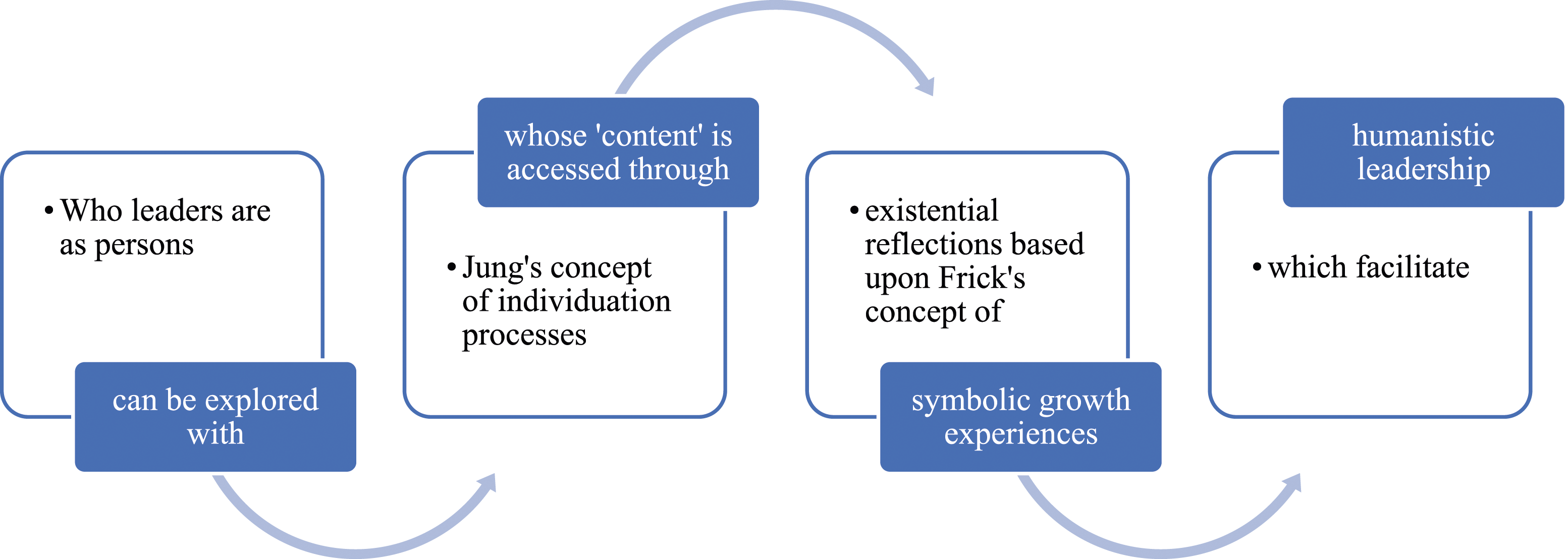
According to Jung, the essence of life is individuation, where the individual becomes a ‘single, homogeneous being, and in so far as “individuality” embraces our innermost, last, and incomparable uniqueness, it also implies becoming one’s own self’ (Jung, 1953: 183). Individuation can therefore be translated as ‘coming to selfhood’ or ‘self-realization’ (Hewison, 2003: 686). Two aspects of the human psyche interact in this process. On the one hand, there is the conscious, with ‘the ego acting as the main organizer for managing external and internal stimuli’ (Fawkes, 2010: 216). On the other hand, there is the shadow, which ‘personifies everything that the subject refuses to acknowledge about himself’ (Jung, 1959, para 513). It can be understood an individual’s less attractive traits which are turned from unconscious to conscious aspects of the Self through reflections on critical incidents in life. This process of self-actualization through an integration of the ego and the shadow can be natural or deliberate. The natural individuation process happens as people struggle through their lives, without the individual being aware of the process. The deliberate individuation process, however, happens through a conscious intervention where the individual reflects on her life and personality development (Jacobi, 1965).
Schematically, Jung (1939, 1953) suggested that the individuation process consisted of separate stages. Analytically, however, his interest was mainly in the process of the second half of life where ‘many people’s psyches start to become less interested in the ego’s quest for happiness and mastery and more in the question of what one’s life really means’ (Beebe et al., 2001: 236). At this stage in life, individuals move from being unconsciously defined by society, to being able to participate more fully in these societies through their own conscious choices and to develop a deeper sense of meaning and purpose (Barrett, 2023; Jacques, 1965). Along the way, reflections about this development involve encounters with ‘the shadow’. Whereas reflections about the relation between the ego and the shadow as compensatory may lead to shame and feelings of guilt it can also create a richer sense of self-understanding. One accepts one’s limits and may even use them to improve on all areas of life (Perry and Tower, 2023). Confronting the shadow is pivotal for the development of leaders as it ‘forces us to face our own fears and self – imposed limitations and in doing so perhaps discover new potential’ (Barrett, 2023: 58). Focus on the deliberate individuation process, which is central to this study, thus calls for existential reflection because ‘at the core of both existential and analytical psychology (i.e., Jung) lies a notion of awareness and gathering of the separate parts of one’s existence into an interconnected reality’ (Minier, 1997: 44).
This connection can be explored through the framework of Symbolic Growth Experiences (SGE) (Frick, 1987). This combines Jung’s theories with existentialism and consists of three parts: episodes, learning and meaning, which come together to form transformative moments where ‘we become profound and sensitive interpreters of our innermost lives and creative agents in our growth’ (Frick, 1983: 108). SGEs have an integrative function, in three parts. First, there is an integration of self-actualizing trends and cognitive functions (Frick, 1990: 72), where preconceptual, unarticulated growth forces conjoin with the more cognitive and conceptual powers of consciousness. By integrating self-actualizing trends and cognitive functions, an SGE of this kind provides energy through a heightened sense of purpose – which in turn leads to personal development. Second, there is an integration of life’s time dimensions (Frick, 1990: 72), where the importance of the present is heightened through a synthesis of the past, present and future, contained within one unique moment of experience. Third, there is an integration of the person and environment (Frick, 1990: 73), where the artificial barriers, disharmony and distance we have created between ourselves and the environment diminish.
The SGE also consists of corrective and enhancement functions, in which two major processes are involved. First, the corrective role of the SGE becomes evident by giving attention to unhealthy trends or individual development that is out of harmony. Consequently, the SGE provides an ‘essential corrective experience when one’s life is of course, immobilized by conflict, or when, for any reason, the integrity of the personality system is threatened’ (Frick, 1990: 74). Second, the enhancement function is a positive episode that creates development and learning through expanded awareness and self-discovery. Overall, the SGE ‘serves as a bridge to unify these two contradictory forces’ (Moustakas, 1990: 100), creating a more ‘total reality’ (Frick, 1990: 73).
The combination of SGE with sport thus offers an original theoretical supplement to research on individuation and leadership. Whereas one group of authors relies on quantitative indicators, sometimes in combination with the abovementioned MBTI indicators (Brown and Reilly, 2009; Myers, 2016), another group discusses its conceptual value in relation to leadership traits (Dare, 2021; Ladkin et al., 2018). In one of the most thorough attempts at coupling Jung’s concept with theories on authentic leadership, Ladkin et al. (2018: 419) argue that given ‘how central the notion of the self is to authentic leadership theorizing, it seems vital to explore theories of how the self develops into a differentiated individual’. But although Ladkin et al. (2018) clarify individuation’s relevance for authentic leadership studies, the current study instead emphasizes humanistic investigations of how ‘the character of a leader grows out of the profoundly difficult, lifelong work of learning about and embracing the complexities of the personal psyche’ (Corlett and Chisholm, 2021: 12). We thus draw inspiration from Ladkin et al. (2018) and others to analyze the SGEs of sports leaders and how they have affected their individuation processes in life.
Data and methods
Our interest in Jung’s theories preceded the data collection. Consequently, this study is based on an abductive approach, where the research process ‘alternates between (previous) theory and empirical facts (or clues) whereby both are successively reinterpreted in the light of each other’ (Alvesson and Sköldberg, 2018: 5). As a theory-based interview study, the data collection was structured, but not determined, by the theoretical framework (Francis et al., 2010). Findings are ‘conceptualized within the context (“framework”) of a particular theory, on whose vocabulary they are at least partially dependent’ (Givón, 1989: 289).
Interviewee sample.
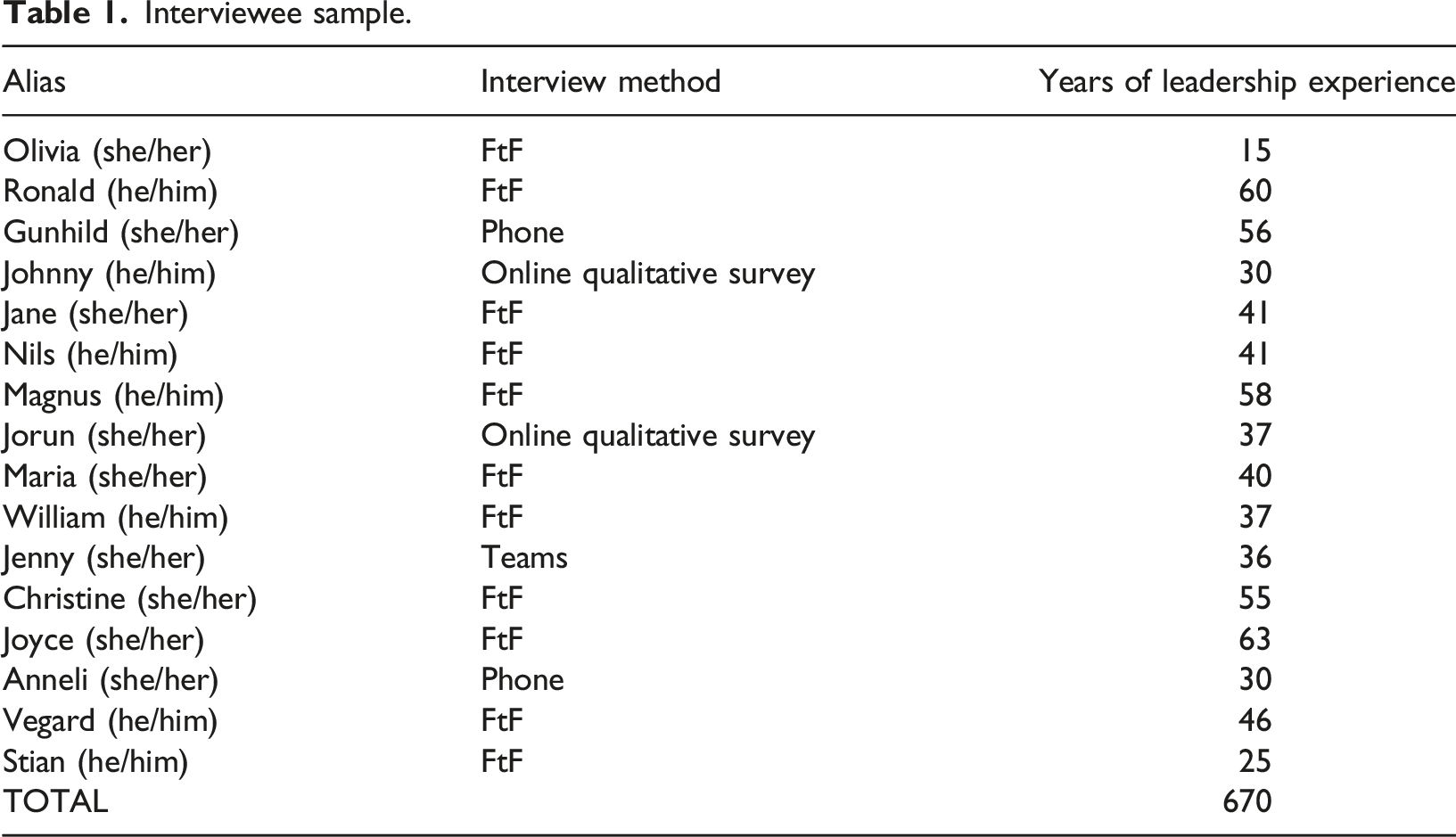
Interview was chosen as the method because interviews can assist people in recollecting the past through ‘magnified moments’, that is, episodes ‘that resonate in memory and give meaning to the flow of a life’ (Lamont and Swidler, 2014: 159). Accordingly, a semi-structured interview guide with eight open-ended questions was created and distributed to the participants through either a web-based data gathering tool called Nettskjema or used in direct interviews (face to face, through digital conference call programs, or by telephone). The rationale for using different tools in the data gathering process was that some people are better at formulating their views in writing, whereas others prefer to reflect on their experiences verbally (Handy and Ross, 2005). Data gathering was conducted in the autumn of 2022 and spring of 2023. To strengthen the credibility of our findings, we developed a shared theoretical guideline before doing the interviews based upon the SGE framework and used an identical interview guide.
Utilizing the technique of episodic inquiry, interviewees were asked to narrate their life as leaders in episodes at the same time as they were encouraged to provide a contextualized account of their experience (Mueller, 2019). We decided not to include the questions here because of the risk of losing the content in translation. While conducting the interviews, inter-rater reliability (Smith and McGannon, 2018) was sought by comparing transcripts and our interpretation of them when it came to coding and, in the next phase, the findings were placed into analytical categories. Due to the abductive design of this study, these codes, defined as ‘a pithy label that you apply to a segment of data, which captures the content and its analytic relevance’ (Braun et al., 2016: 196), were categorized according to Frick (1990) as; (1) integration, order and stability, and (2) differentiation, change and growth. As both processes enhance identity, selfhood and learning at the same time (Moustakas, 1990: 101–102), rather than only being a conflict between ‘dynamic principles of development’ (Frick, 1990: 71), episodes from each of them were analyzed as two co-existing aspects of individuation. Codes within each characteristic were sorted into themes, which ‘represents some level of patterned response or meaning within the data set’ (Braun and Clarke, 2006: 82).
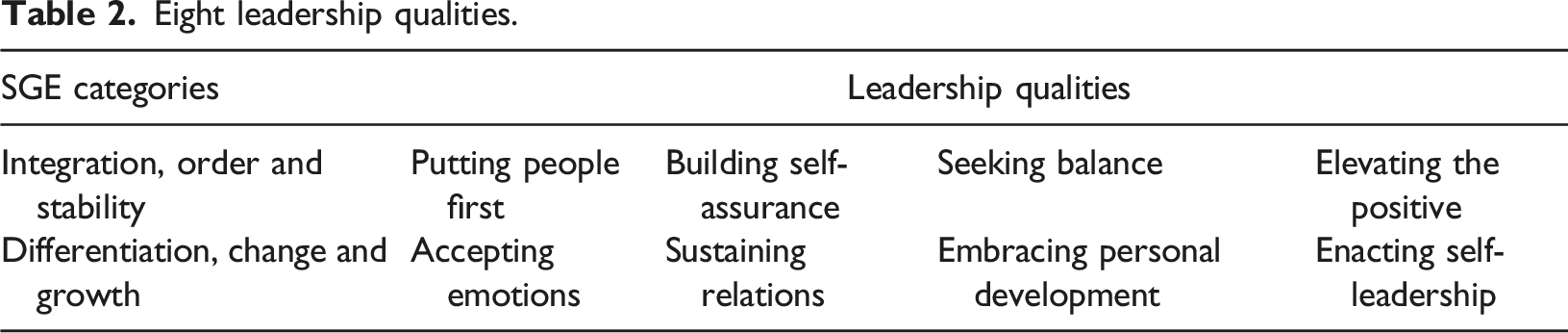
Eight leadership qualities.
Findings
The first four of the eight leadership qualities belong to the integration, order and stability category, whereas the last four belong to the category of differentiation, change and growth. These qualities are placed in vertical pairs to illustrate the overlap between Frick’s (1990) categories, which we will return to in the Discussion. In the remainder of this section, these qualities will be discussed in relation to the theoretical framework outlined above.
The first leadership quality is to see people as people. Informants share, albeit in different wording, a view on leadership based on what Melé (2016) calls ‘homo integralis’, where rational, spiritual and emotional motivations interweave. However, the informants pointed to different episodes which revealed the extent and the nature of this view. Nils said it like this: ‘There are other things in life than racing on cross-country skis and it is my responsibility to enable athletes to master the life they live.’ William described the value of seeing the other person as a whole person by telling a story about a couple of friends he knew a long time ago. One of them was a real talent, the other one was a mediocre player. But the latter did not quit; he trained like a madman and eventually became the team’s best player, while the talented person left the sport for gaming. ‘This force of development,’ William says, ‘shaped my perspective on how to treat people at large. I don’t think much about whether people are charismatic or a good talker, but whether the good in these people is allowed to be released, and how we can do something good for each other.’ These episodes, where informants saw others as whole persons, shaped their own perspective on leadership. This quality relates to what Frick (1990) calls the enhancement function where many of the SGEs of less intensity and more positive notes are found. Gunhild summarized how this function works in real life: ‘Someone always gets the blame and when you care about people it is hard, even if you learn how to deal with it with age. We are not selling soap here, you know.’
Ups and downs in life, however, affect us in different ways. The second leadership quality is self-assurance - to search for what one believes in and stand up for oneself. Maria explained that it often comes with an initial cost, but also with a reward. ‘I dared to speak my mind when I felt the leadership did not treat other people right. Those who disagreed with me became very upset by my opinion, but at the same time I received a lot of support from others afterwards.’ This story is interesting because the resistance Maria got not only made her rethink her own values and position, which often happens because of the many debating arenas in the Norwegian sports democracy (Seippel et al., 2023), it also reinforced her belief in her viewpoint because of the backing she received which probably would not have come unless she had spoken her mind. William shared a similar story: I have on at least one occasion said to the board that either you let me run this organization the way I think it should be done, or else we need to find a different solution for all of us. For me, this resulted in a comfort that I am ready to take the consequences if a similar episode should occur.
William’s story represents potential leadership career discoveries where ‘we begin to realize that we are becoming the authority figures that others expect to ask the questions that they in turn can answer’ (Barrett, 2023: 40). One of the conditions for doing so, it seems, is to have been in situations where, as several informants claimed, they would do things differently if they got in that position again. Jane remembers: …one of my first meetings [on top level] in the 1980s, where I heard so many strange things. These men, there were almost only men, talked nonsense. I remember sitting there thinking; should I dare say something? After a while I shared my opinion about it, because I felt that could not say anything dumber than them.
Both William’s confrontational approach and Jane’s careful interpolation illustrate what Frick (1990: 72) calls integration of self-actualizing trends and cognitive functions. A big part of this quality is shaped by a mentor or at least support from a senior. Jenny underlined that it was decisive for her belief in herself when somebody with authority listened and openly stated support for her view. In William’s case, he was taken under the wing of a senior figure in Norwegian leadership circles early in his leadership career: ‘I think he saw something atypical in me as a leader, not afraid to expose vulnerability and flaws, in addition that he managed to grasp my burning desire to learn more.’ Comments relating to the second leadership quality thus demonstrate that individuation is a relational process and, according to Ladkin et al. (2018: 426), ‘without others to reflect back “who we are” it is impossible to approach knowledge of one’s self’. This relationality is, however, not a given in a sector with many demands and decision organs.
This brings us to the third leadership quality, which is to look for a balance between giving and wanting. According to Jung (1977: para. 1096), individuation is by default a relational process and ‘remains a pose’ so long as no collective values are created. For Norwegian sport, which in line with the European Model of Sport is composed of a complex network of stakeholders and representative organs, this co-creating balance is of utmost importance to maintain the value of sports democracy. Gunhild says that ‘to lead in sport is to compromise. Every corner of the country and every type of representative organ are represented in a board and then it becomes difficult to make radical changes.’ The solution to not being drowned in responsibility is to delegate. Yet the very practice of delegation – or ‘anchoring’, as most of the informants phrased it – depends on the leader’s ability to exploit the system. In the face of national demands, compromise is one type of challenge, but sport also needs to cater to what William called ‘mega-trends’ and, as a leader, you must ‘make the organization understand that in these areas like sustainability we don’t have any other option than to accept that tomorrow, this is going to be a part of our everyday.’ To handle these compromises, and simultaneously deal with the board, the capacity to lean on the norms and regulation of Norwegian sport is what creates results. According to Jenny, one of the revelations came when a senior figure in sport changed his mind: ‘When he told me that I had managed to get him to see the bigger picture, I was so proud, because as a board member in a sport federation you need to have a heart for sport, not only business experience.’ This sentiment of having a heart for the sport was repeatedly put forward by other informants, too, for example by Olivia: ‘To me it is essential that you get to know the organization and spend time talking to people. Especially if you consider the difference between urban areas and other places in Norway, the organizational machinery is completely different.’ This context sensitivity for sports leaders has been underlined in earlier research (Seippel et al., 2023), but here, this dimension illustrates how this heartfelt engagement may grow reciprocally if shared among, for example, board members.
The fourth leadership quality is to elevate the positive – to flip episodes which could have been upsetting into a strengthened self-consciousness. This is especially so when it comes to your own mistakes, which according to Jung must be taken into the bargain – ‘life would not be complete without them’ (Jung, 1995: 328). A part of this is to deal with your own psyche, according to Nils: ‘When I was younger, I could be more temperamental but over the years I have become – hmm – pragmatic, if you like. I like to say that I now avoid running into conflict zones.’ Similarly, Vegard explained that he had often been wrong in his judgement of people and his communication strategies. However, he also explained that: this is why I am so much ‘out there’ [visiting the local handball teams], to learn about people. I guess that is what I experience the most, that I misjudge people. But maybe that’s natural? But I have become much better at being careful, because I am a quite direct person and I like to talk. So, I think I have grown much bigger ears and bigger eyes, and I was not there forty years ago.
In other words, the learning potential of these reflections connects with the second integrative function of an SGE, which according to Frick (1990: 73) concerns an integration of life’s time dimensions. A central aspect of this integrative function is a heightened awareness and an ‘appreciation of the “here and now” of life’ (Frick, 1990: 73). Both Nils and Vegard show this by their current reflections regarding their previous weaknesses, but also in their perception of their current self as ‘superior’ to their previous selves. The importance of having to struggle to understand oneself better was also illustrated by Stian. He explained how his motivation for being a sports leader was ‘all about creating something and seeing visible results’. However, he also acknowledged that being a sports leader: brings with it a lot of politics towards the municipality and so on, and that is the worst thing I am doing. I tried to spend four years in local politics, but I became so frustrated that I could not be a part of it any more. There is no power to move forward, the system is so slow, and I don’t have that patience.
Stian’s struggles seemed to make it clear for him what his unique strengths and motivations are, and how he should focus on creating results within his organization, instead of continuing to struggle with the political system around him. Accordingly, an experience that could have been interpreted as a failure, became an educational synthesis of the past, present and future (Frick, 1990), which in turn gave Stian a heightened consciousness of what was important to him. Looking back in time as the best option to go forward in stressful times was mentioned by several other informants. Magnus told us about an episode prior to the 1994 Lillehammer Winter Olympics, which taught him something about how the benefit of avoiding conflict is as important to a leader as handling. ‘This guy was my type of leader, because he said that “I have never improved by getting yelled at”. I mean, at some point you need to put people in place, but ranting has never done anyone any good.’
The fifth leadership quality is to take care of oneself by accepting human emotions as part of a behavioral response to a situation. Barrett (2023) relates this in a leadership context to Jung’s idea of thresholds of transformations in life, especially the midlife altercations, where the questions of identity ‘that defined adolescence which we thought were resolved now return, but without their heroic and hopeful energy’ (Barrett, 2023: 39) often coincide with the transition to more senior leadership responsibilities. Jane expressed this idea as follows: ‘I have never spent so much emotion as in sport. I have been as angry and as happy as I can be. Sometimes I have thought; “why in heaven’s name do I do this?”’ However, to be able to use this process for self-reflection, a person needs to have experienced both ups and downs and to be able to use them for something other than feeling, for example, bitterness. Furthermore, it is demanding to accept new sides of oneself as necessary for personal growth. Reflecting on her days in a media storm, Olivia says that one of the worst experiences was to be held responsible for problems in sport due to a lack of personal competence and character: I went down to the basement of our house and screamed like a primate. I cried; it was horrible. All the media stories and characteristics of me as a person makes you think. But I learned how to take small breaks and take care of myself. I was given space by my husband who also ensured that we had some time together, just the two of us.
Later, this experience would prove valuable to Olivia when a new situation occurred, and she resigned from her position on the spot. ‘They tried to convince me to continue, which was dramatic in way, but I had made up my mind. I sat the night before alone and thought “I simply don’t want to do this anymore”’. In Frick’s terminology (1990), episodes like Olivia’s reveal the corrective function of SGEs by alerting a person about threats to their integrity. In the individuation process, the courage to say no or accept one’s limits maps onto what Jacques (1965) calls ‘sculpted creativity’ towards difficult situations – stepping forward into the world with a gentle and persistent courage, which goes beyond technical excellence and towards a deeper meaning (Barrett, 2023: 38). Both Jane and Olivia chose a different solution to letting irritation control their behavior, which was possible not only because of the mild culture of leadership debate in Norway, but also because it was seen by them as an effective way to exploit the force of emotions.
In the search for solutions to avoid these episodes becoming long-term situations, the sixth leadership quality is to sustain relations in times of change. Connecting the two is the shared belief among many of our informants in sport as a value-based rather than profit-maximizing sector or a place for accumulating political capital. However, given the stakeholder conflicts in certain sports emerging from globalization and commercialization, the value-based platform is challenged by cynicism and power struggles. According to Johnny, ‘performance, mastery, development and sharing, to name a few things, are in many circumstances not what matters to people. Both nationally and internationally, competence, enthusiasm and engagement rarely mean anything.’ At the same time, professionalism is sometimes necessary, according to Jane: ‘You can’t manage sport from your kitchen table anymore. Society demands accountability.’ To manage change on your own premises in this context, two examples can be highlighted. In relation to board meetings, Magnus said that: I am not a tactician [during meetings] and should perhaps have been more active, not least more before the meetings, to prepare for what was to come. But board discussions are very important and, even though you disagree on things, it is essential that you sit together and talk.
An equally diplomatic perspective was offered by Ronald, going back to the period when he became involved in some thorough change management debates. In the beginning, the task was to prioritize the changes needed. Next, the question became how to ‘sell’ and implement these changes simultaneously throughout the country. Ronald’s idea was to use the structural opportunities of Norwegian sport to stage a plan for getting from A to B. After having initiated the change, he and his partners embarked on a personal quest to convince the different organs in Norwegian sport to be part of the change. In addition to Ronald’s own story in parasports, which gave him the credibility to lead the process, extensive travel and knowledge about the weight of different stakeholders in the process was required, right up to decision time at the Norwegian Federation of Sport’s General Assembly. Consequently, stories underpinning the sixth leadership quality express the third integrative function of an SGE (Frick, 1990: 74), where there is an integration of the person and the environment.
The seventh leadership quality is to convert learning experiences into personal maturation, or ‘mature personhood’ (Ladkin et al., 2018: 416). Jung described this as discovering how persona – that is, ‘a kind of mask, designed on the one hand to make a definite impression upon others, and on the other to conceal the true nature of the individual’ (Jung, 1953: 190) – is just a slice of one’s personality. The process of personality maturation is relevant to understanding our informants’ individuation processes. In a leadership context, Ladkin et al. (2018: 426) claim that ‘non-judgmental curiosity towards oneself is vital if critical reflexivity is to play its part in the development of mature personhood.’ Our informants had different opinions of what they learned from. Jane emphasized being herself despite several leadership seminars: ‘We didn’t really bring with us those yellow post-it’s we took notes on in the 80s and 90s. Sure, you can learn some techniques, but you cannot learn to be somebody else than who you really are.’ This quote exemplifies Jacques’ (1965: 505) claim that ‘the successful outcome of mature work lies in the constructive resignation of men [sic] and the shortcomings in one’s own work’ (cited in Barrett, 2023: 41). Resignation, however, does not have to be a negative thing. William underlined that ‘I won’t say I am bored when things are going well. But sometimes it is more exciting to take on a steep hill.’
The eighth leadership quality is to be your own role model. Leadership in sport depends on getting other people to trust you and realizing that your actions as leader define your credibility (Ferkins et al., 2018). This practical approach to role modelling surfaced in Jenny’s comments about the social responsibility commitment of sport, which she said was ‘even better than the schooling system’. In the same vein, Anneli explained that although the club she was leader of had doubled in size and money since she started, it was important to her not to ‘professionalize myself too much, and remove myself from where the activity is happening. That is very important to me, to be one of those people that do voluntary work.’ This role consciousness and alignment with sport’s core values in Norway also comes in handy with boards, says Jenny: At board meetings I felt that I sometimes did not master the “board language”, because my way of talking was practical and down to earth. Yet I felt included because of this, rather than despite it.
Due to the changing circumstances of sport, however, this leadership quality is not given as one of the identified eight. Board members with experience of shareholder value rather than stakeholder management may create a cultural distance between themselves and the insiders. Being oneself, rather than trying to adapt to the professionalized boardroom ‘lingo’ may, however, create a bridge between parties because the others saw Jenny as herself. At the same time, this bridge is under pressure from structural circumstances. Therefore, William said, one way to maintain this leadership quality is to be the leader people want to follow in the footsteps of: I will know at some point that my time has come. If I think that there is anybody in my administration that can do a better job than me, then it would be no problem for me to resign. I have an ambition that I [through leadership] can recruit my predecessor. Then I might be able to say, ‘job done well’.
Discussion
Generally, the informants, by reflecting on episodes interpreted through the SGE framework, express and exemplify a common theme in humanistic leadership and purpose: social well-being can be aligned with results orientation through motivational drives related to empathy, self-consideration, and the balancing of individual interest with the common good (Caulfield et al., 2023), in this case adapted to the context of European non-profit sport. In most cases, these reflections touched upon the conscious aspects of episodes, such as opportunities for mutual development of personality and role identity. Yet, as emphasized by Ladkin et al. (2018), an integrated model of leadership must consider the relation between conscious and unconscious processes, i.e. both ego- and shadow-related reflections. The importance of this observation was strengthened in our study, where the leader’s engagement in developmental work related to this relationship contributed to the development of the eight leadership qualities. To discuss in a structured way the implications of this discovery further, we return to the research questions: (a) what kind of existential learning sports leader veterans have gained through their positions, (b) how it has enabled them to grow as persons and leaders, and (c) how these experiences may be helpful to other leaders as learning material.
Regarding research question a), we identified the eight leadership qualities from the existential reflections on individuation processes shared by our informants. These qualities are not objective truths, but qualitative research constructs based on the data and hence, in line with abductive methodology (Alvesson and Sköldberg, 2018), categorized according to what we interpreted as the most logical connection with the theoretical elements of the SGE framework. Although Jung outlines phases of the individuation journey and later research has made validity claims about its sequencing (Du Toit et al., 2011), our informants narrate the process in line with individuation scholar Jacobi’s interpretation (1965: 34) as ‘progress and regress, flux and stagnation in alternating sequence’. Conflict and stability, change and continuation; being a leader in sport involves both sides of the story. This is the reason why SGEs as a source of reflections about individuation processes may be merged analytically in vertical pairs (see Table 2).
This mutual engagement is thoroughly multifaceted. Upon delving into significant episodes in the lives of leaders, it became evident that their experiences brought to light facets of the shadow. In accordance with Ladkin et al. (2018: 15), this revelation was leveraged ‘through reflexive processes rather than prescriptive formulae’. Through their experiences, the leaders learned to recognize how unconscious processes influenced their judgments and behaviors in their leadership roles and they changed their cognitions and behaviors accordingly. This aligns with Fawkes’ (2010) idea that leaders, through such introspection, can discover new, unlived, and unintegrated qualities within themselves. Admitting one’s shortcomings, and subsequently learning from them, is no easy fix but Jenny, e.g., learned more from critically assessing her own actions than predefined ideas of good leadership: ‘Sometimes I had a bad gut feeling. Why didn’t I ask more questions before they took that decision? Questions about what would happen if we made this or that decision? If there is one thing I have learned from this, it is that you need to ask those questions beforehand.’
Regarding research question b), the growth as persons and leaders can be seen as a reciprocal development of a capacity to achieve a common good. Ladkin et al. (2018) underscores the importance of engaging with the shadow, not only at an individual level but also through collaborative efforts within the collective and during interactions with others. This relational exploration of the shadow provides leaders with valuable insights into facilitating ‘human flourishing as a whole’ (Ladkin et al., 2018: 423). But instead of mystifying the Self in leadership research, a tendency which is present in humanistic approaches (Knights, 2021) as well as in Jungian psychology (Perry and Tower, 2023), our findings bring leadership practices in sport down to earth, not by describing how leaders might engage followers ‘but how all those involved in the process, including the individual leader, can themselves become engaged’ (Ashman and Lawler, 2008: 259). This takes time, as illustrated by our informants, but Jung also underlined that young persons should consider deliberate individuation processes ‘to shape the conscious ego as effectively as possible – that is, to educate the will’ (Jung, 1997: 94). Our findings, therefore, give substance in a leadership context to Jung’s claim that ‘you can exert no influence if you are not open to influence’ (Jung, 1954: para. 163). This perspective also has a gender dimension to it. Apart from Jane, none of the female informants used gender inequity explicitly as foundation for any episode. Yet, elements of a patriarchal culture seemed to have influenced the way other female informants climbed the hierarchy, for example in discovering the necessity to have certain male board members on your side. Similarly, Ladkin et al. (2018: 427) also contends that ‘in better discerning their own shadow and undertaking the individuation journey leaders are positioned to be more aware of the role the shadow plays in others and in groups’.
Regarding research question c), the takeaway from this study for leadership in general is that our findings provide leaders with pointers on how to humanize their perspectives on the relation between their own role (including the expectations towards it), their employees (including their view on leadership), and the organization’s stakeholders (including their sometimes conflicting demands). For example, William mentioned above that he was considered atypical because he dared to show vulnerability – and that was a good thing. As such, the findings run counter to the warning by Knights (2021: 682) that some humanistic approaches to leadership ‘replace a faith in a supernatural God with an equivalent universalizing and totalizing commitment to human autonomy, reason, and rationality’. While Knights (2021) attributes this to the spread of a self-help-esque individualization of leader qualities, the sports context illustrates the collective virtue of humanistic leadership. Let us take one example. By utilizing this humanistic approach to share opportunities to influence an upcoming matter beforehand, leaders like Ronald explained how it may anchor a decision in, for example, local clubs, in line with the value platform of European Model of Sport and accumulate legitimacy as much through the process as by the outcome. These elements, influencing the leadership roles of those in the sample, assumed particular significance in comprehending the individuals integral to that culture. To round off this argument, we may quote Nils, who had leadership experience from both business and sport: ‘Regardless of whether they are programmers or something else, people want meaningful jobs.’ Similarly, other leaders, drawing from their life experiences, gained heightened awareness of shadow elements within their organizational culture. Sport provides a rich case that there is no better source of meaning at work than having a heart for its mission. Keeping this heart warm, as it were, is according to our informants not dependent on leadership style, strategies or credentials; it is about caring for people.
Conclusion
This qualitative study of Norwegian sports leaders has refreshed the Jungian approach to leadership studies by advocating a humanistic leadership practice. By approaching sports leadership through the lens of individuation, where working on the shadow as much as the ego is a central element, the findings categorize the potential of humanistic leadership. Leaders in sport share many similarities with leaders elsewhere but are also unique in the sense that their humanistic disposition is a reflective premise for interaction rather than a managerial tool for creating purpose on behalf of their members and employees. The implication of this study is therefore support for a general shift in perspective, which transforms leadership from a heroic, prescriptive endeavor based on an economistic paradigm into a series of reflexive actions based on humanistic ideals conducted by real individuals.
Furthermore, the theoretical flow of this study, as visualized in Figure 1, opens the way for further explorations of humanistic leadership, e.g., in different cultures (Fu et al., 2020). Although the social-philosophical thoughts and psychological conceptualizations by C.G. Jung are rarely straightforward, the relation between individuation, SGEs and leadership qualities enable new studies of leaders in which they reflect existentially about themselves as human beings. This change not only assists leaders in cultivating their leadership qualities but also in nurturing a sense of purpose towards desirable ends within both themselves and the organization. In addition to providing an empirical response to the call for a grounded ‘understanding of how purposeful leadership discourse occurs in practice in order to gain a keener appreciation of the circumstances that promote and constrain such discourse’ (Kempster et al., 2011: 331), the study has produced a valuable point of departure for hypothesis testing (including variable construction and statistical tests) of the relation between leadership qualities and individuation processes.
The limitations of this study are threefold. First, the methodological design is open to criticism. While some contend that abductive methodologies merge ‘the best of both worlds’ in examining phenomena which stimulate an imaginative process of inquiry, they may be less prone to assenting statements as produced by deductive research and limit the creative space open to inductive researchers (Kistruck and Slade Shantz, 2022). Second, the theoretical approach used here is in its infancy as far as leadership research goes. Instead of relying on established frameworks for analysis, this study dared take some exploratory leaps rather than confirmatory steps in its aim to contribute to the field. Third, the Norwegian context, and the European Model of Sport, bring with them some contextual content that have implications for the transferability boundaries of this article’s leadership theorization.
Footnotes
Declaration of conflicting interests
The author(s) declared no potential conflicts of interest with respect to the research, authorship, and/or publication of this article.
Funding
The author(s) received no financial support for the research, authorship, and/or publication of this article.
