



Abstract
The development of entrepreneurial mindsets and competencies is a key differentiator of entrepreneurship education, yet traditional, individualist, functional approaches to entrepreneurship education do not adequately support this and appropriate tools and techniques remain unclear. This learning innovation is an approach to directly support the development of entrepreneurial mindsets and competencies in entrepreneurship education through socially-situated experiential learning in a structured way. It uses flashmobs as a heutagogical entrepreneurship education technique, which engages students in self-directed learning through real social action. By careful framing around appropriate entrepreneurship theory, combined with coaching and facilitation, we show how it is possible for entrepreneurship educators to support students in developing a critical reflective appraisal of their own ways of thinking and latent entrepreneurial competencies when facing challenges that require an entrepreneurial response while simultaneously providing the platform for students to embark on their journey of entrepreneurial self-discovery through both experiential and existential learning. We contribute by providing a heutagogical tool to be used either iteratively as the launch-pad into traditional andragogical methods in new venture creation or as the embarkation into new heutagogical programs, which emphasize self-directed entrepreneurial learning.
Keywords
Entrepreneurship education (EE) has a reputation for developing innovative approaches to formal learning, and the discussion of and experimentation with different teaching methods in EE has been lively (Kuratko, 2005; Pittaway & Cope, 2007). In particular, experiential approaches to education have risen significantly in popularity (Neck & Corbett, 2018). The move away from traditional teaching of entrepreneurship toward more experiential education has also been marked by a shift from a pedagogy of EE, dealing with dependent learners, to an andragogy of EE, whereby learning is essentially self-directed and independent. Despite this shift and experimentation, Sugunro (2004) argues that these methods still do not activate entrepreneurial behavior as they focus on the development of functional skills and cannot replicate the lived experience of entrepreneurs in their environment.
In this paper, we take up Neck and Corbett’s (2018) call to explore an alternative approach, known as the heutagogical approach to EE. Instead of teaching skills and competencies directly by creating exercises to simulate reality, we provide a tool which allows students to learn about the development of their own entrepreneurial mindsets by taking action in the real world. To do this, we take a real-world technique, flashmobs, and illustrate how we have adjusted these to create educational flashmobs as a basis for student action, experimentation and reflection on the application of social cognitive and social practice theories of entrepreneurship as well as their own entrepreneurial potential and mindsets. We propose that flashmobs are an effective heutagogical tool to support students in enacting an entrepreneurial process through self-directed action, in which the key elements are explore, create, collaborate, connect, share and reflect.
Experiential Learning and Theories of Entrepreneurship
Real-world entrepreneurial experiences are not easily reproducible in formal education contexts. Experiential EE has developed as a way to compensate for the different types of entrepreneurial experience that are not immediately available to students, while simultaneously providing opportunities for them to learn about the content of entrepreneurship through the guidance of an educator.
Andragogical approaches assume that EE involves experiential learning through providing entrepreneurial role models as guest speakers; creating in-class activities for students to test simulated business ideas through specific startup techniques such as customer validation and prototyping; and enabling group and peer learning amongst students to test and challenge each other. In this sense, entrepreneurial learning is seen to take place through the development of various functional techniques to enhance startup skills amongst students. Such andragogical, experientially-led, approaches assume that developing tacit functional knowledge about startup firms from experience will result in developing skills that will support success in real entrepreneurial initiatives outside of the classroom.
These approaches are typical of teaching methods developed and used in business schools, which have tended to focus on the development of academic and functional skills, or what Sarasvathy and Venkataraman (2011) term ‘the scientific method’. Ibrahim and Soufani (2002), however, stress that the acquisition of skills alone is not enough, as entrepreneurs need to learn how to make decisions while applying those skills in startup contexts. As the environment in which the entrepreneurs operate is shaped by ambiguous and uncertain events, entrepreneurs do not necessarily draw on generic learning of skills, but rather develop contextually-derived entrepreneurial competencies (Morris et al., 2013). Indeed, previous research suggests that particularly challenging new experiences are a good source of entrepreneurial learning and that exposure to different experiences facilitates ‘learning as you go’ (Cope, 2011; Van Gelderen et al., 2007). Experiential education may, of course, result in failure as an outcome. However, we argue that a key problem with relying on this approach is that it over-emphasizes the potential for tacit learning from risk and failure as a by-product of EE, and does not acknowledge the role of the educator in supporting and coaching the student’s learning through this experience.
Alternative approaches to entrepreneurship focus on the social context of opportunity, and see this as a socially constructed process, where individuals develop their entrepreneurial expertise in concert with developing an opportunity within their market and geographic context. Here, students are not assumed to possess latent entrepreneurial abilities, but instead that entrepreneurship is a mindset, which is developed in response to experience, as they work on opportunities in partnership with stakeholders and in response to challenges and competition. Sarasvathy (2001a) proposes that while managers and novice entrepreneurs take a causal approach to opportunity, experienced entrepreneurs develop an effectual heuristic, or way of thinking, based on their experience. Therefore, individual entrepreneurial competencies are not simply knowledge-content to be learnt, but are expertise developed in response to context and specific opportunities. In addition, this approach looks beyond the entrepreneur as the lone actor and recognizes the role of stakeholders in the socially-situated context of the opportunity or the local community of enquiry (Shepherd et al., in press), who shape the development of the entrepreneurial venture (Sarasvathy, 2001a). These social theories of entrepreneurship are particularly important to EE, but require an appropriate educational strategy to support student learning. Here, we turn to heutagogy as a solution.
Heutagogy involves students in exploration and learning from self-selected and self-directed action, advancing beyond their subject discipline towards interdependent, self-determined learning. They identify the potential to learn from novel experiences as a matter of course. The educator provides some resources, but the learner decides the path by negotiating the learning, which is not necessarily planned or linear (Gerstein, 2014). Ideally, they go beyond mere problem solving and use their own and other’s experiences combined with reflection, environmental scanning, experience and interaction. Heutagogy thus helps develop learners’ self-efficacy and mindset through applying competences in novel situations (Gerstein, 2014). This has much in common with experiential EE in that both stress the need to develop the capability to learn, a capability that will not only be advantageous whilst learning formally, but throughout their lives (Kenyon & Hase, 2010, p. 168). Heutagogy diverges in how the learner engages with this experience, with an emphasis on self-determined and student-led learning with others. In this sense, heutagogy focuses on the developing the capability to learn for life (Kenyon & Hase 2010, p. 168) by bringing to the surface things we have learnt in life that have had a lasting impact on our interaction with the world, thus bringing together experiential and existential learning.
The educator’s role here is not to focus on interventions which reinforce or correct knowledge content, but instead to introduce interventions that can catalyze significant learning experiences (SLE) about process and personal competence, an SLE being defined as; … a significant moment in life when we create personal meaning by symbolizing our immediate experience in the interest of heightened awareness and personal growth. As we perceive the symbolic dimensions of our immediate experience, we become creative agents in our own learning and growth. (Frick, 1987, p. 406)
As an innovative educational approach to experiential education, applying heutagogy has implications for the design of the curriculum and syllabus. A heutagogical starting point may lie in asking students to identify socially-situated problems or inconsistencies in their lived-experience of the world combined with identifying their own personal, existing competencies (Thrane et al., 2016). Presented this way, heutagogical EE supports students in developing an entrepreneurial mindset, by learning more about their own ways of dealing with everyday situations in social and working environments and act as catalysts in finding new ways of performing in real-life situations as part of an on-going personal development process. This then forms a set of curated learning experiences in applying the ‘entrepreneurial method’ as a way of reasoning about the world (Sarasvathy & Venkataraman, 2011)
Existential Learning and Entrepreneurial Mindsets
While a heutagogical approach share a focus on experiential learning with andragogy, it also involves existential learning. In this sense, it is not only competencies which are transformed (what can I do?), but also mindsets (who am I?). Morris et al. (2013) propose that the likelihood of an individual developing an entrepreneurial mindset is greater where experiential processing results in more intense and positive affective states. Positive affect encourages an entrepreneur to experiment and apply the explorative learning while negative affect will drive the local and more exploitative learning. Hence, affective reactions facilitate entrepreneurial learning. It is through the lens of such socially-situated experiences that entrepreneurs interpret events and construct a sense of self, building a new mental framework, or effectual heuristic, which contributes to the development of an entrepreneurial mind-set. We, therefore, propose that effectuation may be an appropriate model of the entrepreneurship process to use as a reflective tool for a heutagogical approach to EE.
Effectuation
Effectuation has become a popular concept among educators and practitioners as a way to explain how experienced entrepreneurs approach uncertain situations. Despite its attractiveness and apparent simplicity, understanding and applying effectuation principles remains elusive as it is something one does, not something one can simply be taught. Sarasvathy (2001b) herself has made this point, by asking students to try out making a meal from a recipe book (causal thinking) or from just what is available in the fridge (effectual), but while this may be a novel method to illustrate aspects of the mechanics of the effectual method, we argue that applying a heutagogical approach through a flashmob is more effective in promoting an entrepreneurial mindset. We propose that taking a heutagogical approach foregrounds entrepreneurial socially-situated ‘disclosure’ as the focus of the activity, and places effectuation in its rightful place as a post-hoc method to structure a student’s reflection-on-action (Schon, 1984), critique personal practice and set out an action plan for personal behavioral change. We propose that a flashmob provides one such appropriate context of action for reflection, using effectuation principles to structure student’s analysis of the entrepreneurial method to solve challenges on the basis of their own real-world lived experience.
From Effectual Heuristics to Social Action
While effectuation provides a framework for understanding the entrepreneur’s way of thinking, it provides less explanation for the practical consequences of the effectual entrepreneur’s actions. Here we turn to Spinosa et al. (1997) who apply a sociological theory of practice to illustrate the consequences of entrepreneurial action in socially-situated contexts. They propose that an entrepreneur sees a crack or flaw in social reality, that is to say that they have a ‘gut feeling’ something isn’t quite right, something is missing in their lived experience of the world. When the entrepreneur acts to create change, this is only successful in so far as that others recognize and respond to the offering, and by doing so change their own behavior in response. It is through this ongoing interaction that new value for others is created. Here we might equate the specific social process and consequences of the initial launch of an entrepreneurial new venture as something equivalent to an artistic, musical or theatrical ‘happening’ where a performance emerges out of both the actions of artists and the response of those watching. Indeed, the shared experience emerges from the intertwined responses of the observers to the performer and vice versa. While failure results in the risk of side-lining, ridicule and abandonment, success results in recognition, praise, reward and the opportunity for further engagement.
We therefore suggest that the process of developing and enacting an educational flashmob is an entrepreneurial, experiential and heutagogical method grounded in entrepreneurial ’disclosing’, and that the underlying tacit mechanisms which its performance requires of students in their approach to the task, are effectual. In the next section, we illustrate how the flashmob can be an effective socially-situated learning activity, which emphasizes experimentation in real-world environments.
Flashmobs as a Method/Technique
Flashmob is a term used to describe a sudden gathering of a group of people who are engaged in a secretly co-ordinated activity for a short period of time in a public space (Nicholson, 2005). The term is based on the combination of two words: ‘flash’ because to the observer the event appears to be short-lived, starting and ending without warning, and ‘mob’ because it depends on mass human participation, including the initial protagonist, the supporting performers and ultimately the observers themselves as they become engaged in the event. Nicholson (2005) provides a useful history of the concept, noting that one of the first known flashmobs occurred in 2003 when 100 people appeared at a Macy’s department store in New York City and announced to sales people that they were part of a free-love commune there to discuss the group purchase of a $100,000 rug. After temporarily disrupting the store for a few minutes they suddenly dispersed, instantly allowing it to return to normal business. This event was planned by a Harper’s magazine editor to illustrate that it was possible for crowd behavior to take over commercially-owned public spaces (Nicholson, 2005). Subsequent activities have included different objectives, including public performance art through mass living statues, and more commercially intended activities such as choral singing to promote concerts or theatrical productions, this latter approach being termed a
While flashmobs have not traditionally been used in formal education activities, their use in educational environments is documented in online videos of performance art such as promoting Christmas Festive Spirit (University of Minnesota, 2011), graduation performance to boost feelings of celebration (Azusa Pacific University, 2012), as well as more serious political statements and campaigns (Furness, 2012). In particular, the Furness (2012) production illustrates the organizing stages a student group went through to develop a flashmob for specific public awareness-raising purposes.
Learning Goals
This section outlines how an educational flashmob may be developed for EE in formal settings, which seek to develop students’ entrepreneurial mindset and understanding of the entrepreneurial process, using effectuation as the framework for supporting reflection.
Entrepreneurs take risks when they have to persuade potential stakeholders to buy into their idea. Getting to the first ‘yes’ can be challenging and students need to learn not to be afraid to put themselves and their ideas on the line. An educational flashmob provides a small-scale bounded opportunity to experience this particular entrepreneurial process. Simultaneously, it allows students to assess their approach to challenges by using effectuation as a tool for reflection on the approach taken. Finally, using this as a learning activity to support the development of student’s entrepreneurial mindset, takes into consideration that individuals have different levels of competence, as students negotiate among themselves their roles in the flashmob to reflect the situation they face and the context in which their practice takes place (Morris et al., 2013).
Through the involvement of the educator as facilitator, students are supported in moving through the heutagogical cycle to achieve the intended learning goals (Figure 1). As the experience of the flashmob unfolds and places the six different demands on the students in experiential learning so students also develop their sense of self and their entrepreneurial mindset through existential learning.
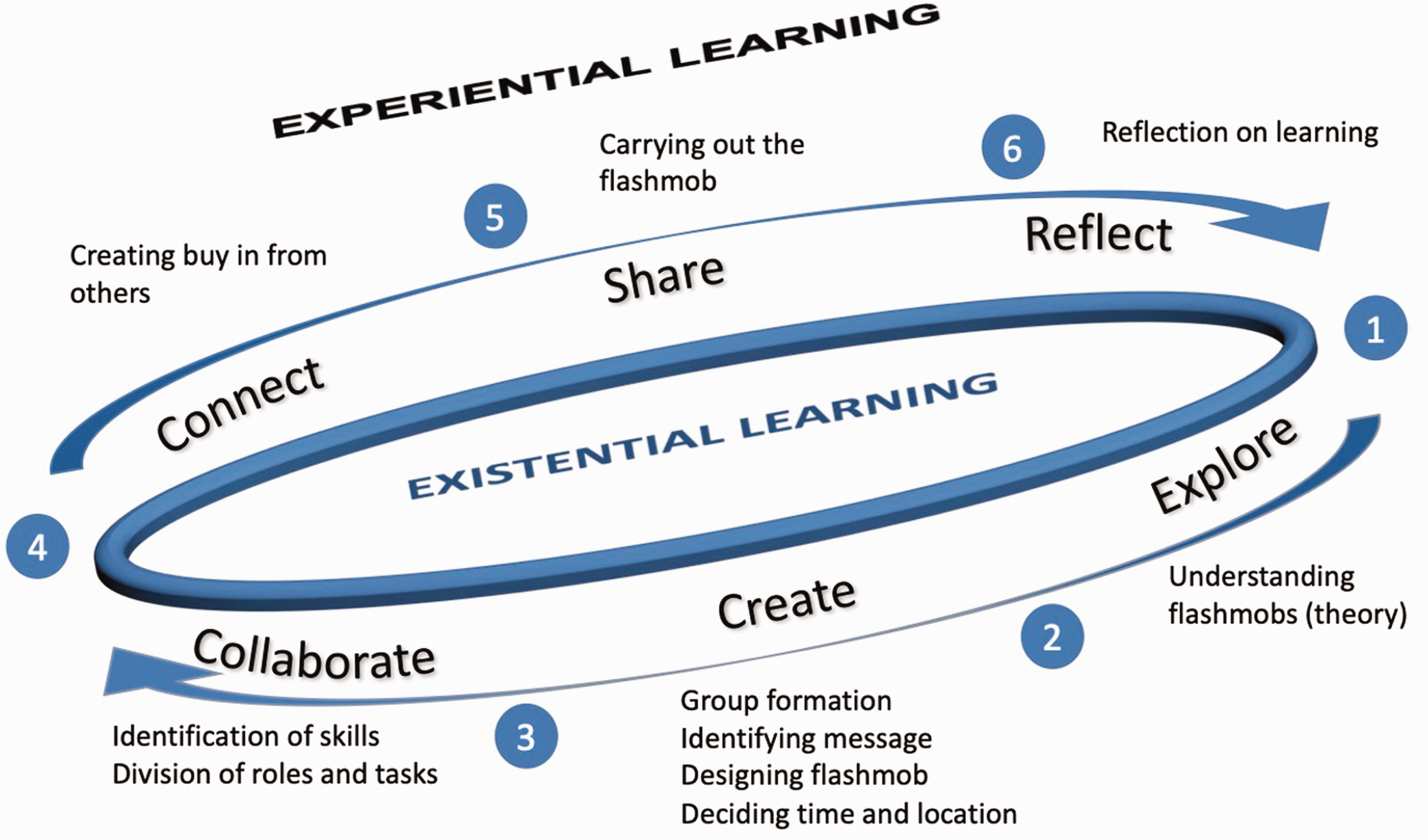
The Heutagogical Cycle Applied to Flashmobs.
Opportunity recognition (identifying and creating opportunity for value creation) Value creation (recognition and buy-in from the public) Risk mitigation (identifying and mitigating perceived risks) Tenacity/Perseverance (to carry out and repeat the flashmob despite setbacks) Creative problem solving (to develop, plan and carry out the flashmob) Resource leveraging/Bootstrapping (making do with or developing the resources available) Guerilla skills (taking advantage of the local context and surroundings) Resilience (personal and project capacity to carry on regardless of setbacks) Building and using networks (involving stakeholders to enhance outcomes)
So why should we use flashmobs in entrepreneurship classes to develop a student’s entrepreneurial mindsets?
In sum, we suggest that the above provide a core learning activity in developing entrepreneurial mindsets amongst students. In the following we will explain the ten steps used in the educational process.
Resources Needed
The basic requirements are the student team and a video recording device (usually a smartphone). The team may also choose to use any material that is necessary to carry out the flashmob e.g. costumes or props but these should be acquired without financial expenditure by the educational institution or the students themselves, to support the focus on developing networks and leveraging resources.
Step 1: Introducing Flashmobs as an Entrepreneurial Method
The educator commences by discussing with students the competences that are required by a successful entrepreneur such as mitigating risk, tenacity and building networks and ask students to consider their existing position in relation to these aspects. In addition, at this stage, principles of effectuation may be introduced (Sarasvathy, 2001a). The facilitator also outlines how a flashmob works, using video examples to illustrate, since this helps students realize that it is achievable for them, and also outlines the basic requirements. It can also be discussed how these flashmobs could help enhance student’s own competencies.
In total this stage should not take more than about 20 minutes
Step 2: Group Formation and Process Instruction
Instruct small student groups (approx. 5 individuals in each group) to plan a flashmob ensuring that it (i) has a message (normally based on a group agreed problem); (ii) ensure that they have the skills necessary (iii) map out who they are going to involve in the flashmob and how they are going to secure buy-in; (iv) to identify an adequate public place in which to carry out the flashmob.
Instruction takes about 20 minutes – discussion needs to be continued outside class
Step 3: Defining the Message
Students are encouraged to consider a problem or need which they would like to explore through a flashmob. There is no need to identify precisely how this will be addressed; instead time should be spent on agreeing on common concerns or problems, which are socially-situated in their everyday experience; e.g.
By focusing on lived-experience of students on social-situated problems, this marks a significant shift for an EE class from the focus on market-needs or gaps that might start off a traditional andragogical analysis to situationally-driven problems. It can act as a companion or pre-cursor to established problem-based approaches to entrepreneurship such as lean startup. A key divergence here is that while lean startup emphasizes research skills to understand customer problems as part of a new venture creation process, entrepreneurial flashmobs emphasize human agency and entrepreneurial action as part of the development of an entrepreneurial mindset.
Through this approach, flashmobs promote a way of thinking and acting that is helpful when students encounter problems that can be solved entrepreneurially in their everyday life. Through the problem-identification process, students may ultimately identify socially-situated societal or market problems or emphasize flaws in an assumption in the target market environment. At this stage, however, the emphasis remains on the problem rather than the solution as this explicitly supports the development of an entrepreneurial mindset. For example, in the past our students have enacted the problems of human trafficking and how loneliness kills, but they have also enacted messages of encouragement around recycling, respect for diversity, good citizenship, fitness and festive spirit. These ultimately create a stepping-stone towards a deeper engagement with market opportunities in the follow up. We have noticed that by keeping this stage distinct from market-opportunity spotting, our students found it easier to focus on identifying their personal attitudes and competencies. This initial base-line awareness then supported them in mapping their personal development through later new venture creation experiential learning.
Step 4: Identifying the Skills Necessary
Students have to map out their personal resources (the who I am, what do I know, what am I good at, what am I passionate about) and use these as a basis for creating the flashmob. In other words, they may be resource restricted. Thus, if some members are skilled musicians, have a hobby, knowledge, networks or are part of a student society, club, or social activist group then these can be pooled as a basis for developing the flashmob. Combined, the group should be able to identify a wealth of shared resources to draw on.
Step 5: Designing the Flashmob
Having decided the concern and identified their current resources, which they wish to address, students are then asked to develop this into a flashmob performance. Questions at this stage may include: What would a better situation look like? How would this happen? What should this feel like when you experience it? What examples can you think of this happening? Can this be replicated?
The facilitator instructs students that they have to ensure appropriate acceptance from e.g. a college receptionist or university canteen/coffee shop to carry out the flashmob within a given timeframe (1-2 weeks). In some cases, it may be advantageous to have explanatory signs or banners to attract attention or to inform passersby that this is a performance. E.g. the illustration of pretend kidnapping in the human trafficking flashmob by persons in masks may frighten passers-by, which naturally has to be avoided. Students also need to be instructed that they cannot plan flashmobs that break the law, intentionally aim to cause distress or encourage illegal behavior. It may be simplest to say ‘keep your flashmob positive’, but this of course may also provide an opportunity to have a short group discussion around ethics and entrepreneurship.
Step 6: Division of Roles and Ensuring Buy-Ins
Having agreed the intended act, roles should be divided amongst initial student group developing the act as the first-level participants. Second-level participants are friends and colleagues whom the first-level participants persuade to collaborate. Participants will necessarily have to be instructed specifically as to their intended actions for the event and further instructed where this should happen, how they should behave before and after and the timings of their participation, to ensure that the flashmob appears to be spontaneous rather than scripted. The performance may require rehearsal but may be carried out without this. Third-level participants are members of the public, passers-by whom the group hopes to engage. It is a criterion for success that the group as a minimum engage second-level participants, but confirmed success is recognition of the flashmob from passers-by.
Step 7: Deciding Time and Location
Having decided timings and location it is expected that one or more group members initiate the performance, with other first- and second-level members take the part pre-assigned to them. This may then be responded to by passers-by (members of the public or campus who were not previously involved or aware). The flashmob may be repeated on different times or days and in different settings to test the effects of the event on different groups of people and different environments.
Step 8: Implementation
The implementation can be carried out anywhere as long as it is a public space to have the greatest impact. The timing of the implementation of the flashmob is decided by the students. The flashmob itself takes perhaps 5-10 minutes depending on the activity.
The actual flashmob is usually unpredictable, even with rehearsal. It cannot be assumed whether other planned and rehearsed second-level participants will join in, or whether the initial group members will be left acting alone without others’ second-level involvement. Similarly, it cannot be predicted whether third-level members of the public will notice, acknowledge or participate in the act (through participation, viewing, applause or discussion). In this sense, the flashmob provides an opportunity to
Step 9: Documentation
The flashmob needs to be documented on video for assessment by the other groups and the facilitator in the debrief session. This requires a member of the team to video the flashmob. In addition, students may be required to write a reflective diary log about their experiences.
Step 10: Debriefing
On meeting with the facilitator and their peers in their class, students are asked to play their video of the flashmob and to talk it through. Students may be asked to debrief on the success of the flashmob by considering each of the previous 5 stages of the heutagogical cycle that they have experienced. For instance, questions to the team may include: What did you set out to do and why? How did you plan the activity and how did you integrate the support and abilities of others? How did the flashmob itself go? Why did it succeed/fail? How would you do it differently next time? An emphasis should be placed on the importance of self-directed learning and that the success or failure of the experience itself is not as important as the ability to learn from it.
The unpredictability of a flashmob is a key valuable element of the activity as it provides significant opportunities for reflection and discussion by the class on the entrepreneurial process, including acceptance, success and failure, based on student’s actual experience of this phenomena. Furthermore, it allows for discussion of the impact of the flashmob and how others reacted in response, supporting further discussion of the socially-situated aspects of entrepreneurship and associated intended and unintended outcomes.
Discussing the video recording of the flashmob also allows for exploring those feelings of being uncomfortable and how to get beyond these to reach the feeling of ‘Yes, I did it! and ‘it was not so bad after all’ to perhaps even ‘when can I do this again?’. We have discovered from these discussions that for students the advantage of planning a flashmob with a ‘message’ is that it seems more purposeful and therefore less embarrassing in hindsight than to do a presentation, roleplay or drama. Other issues to be addressed could include: What worked well? What didn’t? and How might your learning be applied to starting a new venture or taking an effectual approach to other problems?
While our experience is that students are usually very positive after completing a flashmob, it is worth noting that often students felt less confident when the activity initially begins. In our experience, this is often a sense of uncertainty due novelty which is quickly overcome through participation. There have been occasions when small numbers of students have expressed more significant anxiety due to personal concerns about public speaking. In these circumstances we have still insisted that these individuals take part, but have recommended they take the role of videographer, recording the event, which quickly reassures them. Often these same students, once involved in filming, end up taking part anyway once the enthusiasm of the group for the develop plan emerges. In either case, these individuals are just as able to reflect on their learning from the experience.
A key element of the debrief is then not only to discuss questions in class, but the opportunity for students to formally reflect on their experience. This can be through a general reflective log as part of an assessment, or could be more structured around entrepreneurial heuristics, plotting causal or effectual logics to post-hoc rationalize the experience, as well as considering how this learning may be taken forward to future activities. We include reflection as one form of assessment to evaluate the development of entrepreneurial mindsets and competencies. This approach also goes a long way to negate the possibility of ‘free-riders’ in the group, as not only is their participation observed by other group members, but the formal requirement to reflect for assessment can only be completed through the direct experience of participation.
Follow-Up
Used as a heutagogical technique for developing entrepreneurial mindsets through EE, a flashmob supports students in developing their independence and sense of personal agency. As a result, a direct follow-up would be to support the students in an appraisal of their entrepreneurial mindset and competencies and how this has developed through the flashmob experience. This could be approached through a formal written reflection, such as reflective logs, or through mapping against formal competency frameworks including EntreComp or Morris et al.’s (2013) Competency Scale.
Following the flashmob, students are usually required to go on to engage in further entrepreneurial activities, building their entrepreneurial confidence in sharing their initiative through value creation with others. We found that our own students often used their learning from the flashmob exercise to develop their interest in solving identified problems further as market opportunities, through research and more traditional enterprise activities such as prototyping and customer feedback.
This two-stage approach allows an educator to switch their technique iteratively from a heutagogy approach to a more traditional andragogy approach to EE in developing student ideas, based on student-generated initiative and the needs of the student as identified through the experience of the educator (Jones et al., 2019). In our experience of applying this to our students, simply put, their new venture ideas were better than in similar courses without flashmobs. We identified that our student’s business ideas had greater depth and because students engaged with them more personally, they worked harder on subsequent new venture development activities associated with them, often explicitly utilizing their identified competencies to support their work (such as more actively networking to support research and resource development).
Alternatively, an educator may decide to continue with a heutagogy approach, whereby the research required to develop their act may encourage the student to develop their learning and engagement further about both the issue, creative and entrepreneurial processes through their own initiatives within and outside of the curriculum as they continue on their journey to become truly self-directed learners. This is perhaps most likely within startup programs outside of formal curriculum courses, or in student self-directed curriculum such as Team Academy (Kapasi & Grekova, 2018; Tosey et al., 2015). In our experience, working within the formal curriculum, we have seen students go on to create further flashmobs with student societies outside the classroom, as well as finding other ways to work on identified problems with new venture ideas amongst peers in other classes.
Limitations and Risks
Flashmobs have the potential to allow students to be entrepreneurial by both devising and co-ordinating performances with social impact which, as public events, inevitably involve social risk, but these can be co-ordinated with educational and public organizations to avoid direct legal risks. While the purpose of the flashmob may be left open to students to decide, the process through which this
Limitations of this approach include the planned, coordinated nature of flashmobs, however this planning should be entirely led by students and only supported by educators. In addition, the outcomes and impacts of these projects are not directly controllable, resulting in opportunities to reflect on uncertainty and risk. While nervousness, embarrassment and failure are all acceptable in a flashmob as a learning tool, personal risk is not. Therefore, it is typical for an educator to ask students to limit the location of their flashmob to campus areas, securing permission from anyone responsible for the space being used where appropriate. Flashmobs can be carried out outside campus but in this case, it is very important that students seek permission to perform the flashmob and abide by any restrictions placed or change the location. It is also important to remind students not to force others to take part, but that success is where others actively seek to join in.
Limitations and Risks During the Covid-19 Pandemic
As personal and public safety is a paramount concern in flashmob activities, this raises special challenges due to the requirements for social distancing and self-isolation during the global Covid-19 pandemic. The Covid-19 pandemic has created significant challenges for EE which often relies on classroom participation to support experiential learning (Liguori & Winkler, 2020). While at first, the constraints placed on social interaction may seem to prevent flashmobs, this is not the case. Indeed, constraints often act as a catalyst and framework for creativity to flourish (Johnson-Laird, 1988). Even during Covid-19, physical flashmobs could take the form of singing or playing from windows of college accommodation, building on the Flashmob Sonoro which took place in Italy in March 2020 during early lockdowns (Music Covers and Creations, 2020). Other options may include directing the student groups to plan how to take the flashmob online and delivering it during another shared online class or online student club event, such as coordinating who switches on and off their cameras during a class, or perhaps even using the Muppet’s version of Beethoven’s 9th symphony as a template, switching cameras on and off to produce a similar effect on Zoom Gallery View (The Muppets, 2009).
Evidence of Effectiveness
The authors and their colleagues have utilized flashmobs as an educational activity for over 5 years at universities in the United Kingdom, Finland, France and Denmark and have presented this to educators across Europe and the USA. At first, for an educator, it can be a nerve-wracking experience to implement this teaching innovation in the classroom. However, in our experience this nervousness is unfounded. By promoting the activity as a ‘class challenge’, framing it within entrepreneurship theories and theories of personal and entrepreneurial learning from the outset, providing clear support and working with groups about their learning throughout, pushing the students to go further and reflect more, then carefully debriefing and relating back to entrepreneurship theory and practice, the activity can create a profound learning experience for students. Program reviews have indicated that that flashmobs are noted by students as a key foundational learning experience in their studies.
Students can be nervous and unsure about the flashmob activity at first. The idea that they should ‘go out there and do it’ may be daunting for students more used to traditional classroom learning. However, with careful guidance about expectations, these concerns can be overcome. In our experience, after the initial shock of the ‘challenge’ students typically set to work quickly and their enthusiasm rapidly increases as they take charge of the activity and try to produce the ‘best’ flashmob.
Our students have told us of many benefits of this unique learning experience. In the following, we have included quotes from student reflection logs handed in after the classes as part of a self-appraisal.
The quotes tell us that students have a realization that they can do things they think they were unable to do, were uncomfortable with, did not dare to do, or felt was out of their comfort zone. They felt a boost in confidence, were happy, thought it was fun once it was completed. Indeed, things are often ‘worse in your mind’ as a student stated.
Making a fool of yourself in public is not something that most people feel comfortable with but it was a refreshing challenge compared to sitting in class.
It was fun to see people’s reaction even though my stomach did hurt (from nervousness) before doing it.
We discussed what and how we were going to perform our flashmob and it is definitely out of my comfort zone, standing in front of people I don’t know doing things that I elsewhere wouldn’t do. But at the same time, it will be funny. In our group we are convinced that we will support each other and make the best of it.
Just before I was a little nervous but during it, I didn’t think about it that much and afterwards I thought it was kind of funny.
The realization that sometimes their own ways of thinking constitute the biggest obstacles in achieving their goals is an important one in terms of students who adopt an entrepreneurial mindset;
It was not as bad as we had imagined. Sometimes we make things worse than they are in our minds. I would actually like to be part of a larger flashmob after doing this one.
I think it is a breakthrough for all of us to dare to dance in public. I mean before suddenly starting to dance in the public is something I will never do. But now I can proudly say that I’ve done that – and it was good.
The flash mob was fun and unique. The biggest experience is that sometimes you are the one who prevents yourself from achieving your goals, or fun, or happiness.
And realize the benefit of working with others to achieve successful outcomes;
Once it was over with, we all had a good and happy feeling
We are in this together.
Students also noted links to their understanding of entrepreneurial practice:
Perhaps this is what we need as an entrepreneur. It is about daring to try new things and never be afraid of losing face.
Several times we had to change the plan because the outsiders were not willing to participate in this crazy affair.
It boosted my confidence and can-do attitude, and at the same time, proving that humans are indeed group animals. We get more confident if there’s a group who are doing the same thing, we also get peer pressure from that. We also get assurance if
there’s a person in the group who has useful skills or knowledge. Diversity of skills and knowledge + motivation and creativity = good things will happen. That can be very useful in term of making entrepreneurial decisions
Through repeated use of this method, we have found that it is particularly effective as a precursor to other experiential learning activities in an entrepreneurship class, including more traditional business development activities such as pop-up stalls or other small real-world venture activities. We have observed that students who undertake a flashmob first tend to be more likely to be more open to adapting their ideas in subsequent new venture creation activities and pivot to customer demand, as well as being more likely to engage in bricolage of resources through engaging with potential supporters of their venture idea and providers of resource through personal networks. In this sense, flashmobs both ‘break the ice’ and set the bar for the level of engagement required, while also providing a basis for students to begin engaging in entrepreneurial action and reflection in their class.
We have found that the use of flashmobs is most appropriate to students at the beginning of an entrepreneurship course or program at the early stages, when they are starting to develop their understanding. Indeed, many students come into the classroom with no notion of wanting to become entrepreneurs. They are first and foremost students, who focus on academic performance, rather than entrepreneurial capability. In order to move from the student mindset to an entrepreneurial mindset, educators need to support students in taking small steps, through testing out new behaviors, observing their impact, reflecting on the experience and developing more challenging goals for the future. Flashmobs can help achieve this objective.
Conclusion
We have found flashmobs to be instrumental to our teaching where we adopt a heutagogical approach to courses which include an aim to develop student’s entrepreneurial mindsets through combining experiential and existential learning. While flashmobs provide a powerful learning activity, they are not the only one we might use in our teaching. Any activity which allows students to lead on discrete challenges related to entrepreneurial action would build well on flashmobs. The key would be to build this into an overall heutagogical approach, by supporting student’s reflection on theories of the entrepreneurial process while benchmarking their own personal development of their own entrepreneurial competencies and ways of thinking. We have found that this then supports the students in approaching future entrepreneurial challenges, with flashmobs acting as one of the foundational activities they experience.
Footnotes
Declaration of Conflicting Interests
The author(s) declared no potential conflicts of interest with respect to the research, authorship, and/or publication of this article.
Funding
The author(s) received no financial support for the research, authorship, and/or publication of this article.
