




Abstract
In this study, we widen the understanding of how the dialectics of distributed leadership develop as part of discursive interactions in an interorganizational setting directed at renewal. Using a dialectical perspective, we analyzed developmental meetings of an entrepreneurship hub and identified three dialectics, namely disagreement versus encouragement, organizational dependency versus interorganizational engagement and status quo versus transformation, by which the discussion reached the resolution. Our study widens the current understanding of distributed leadership and offers a nuanced account of how dissent and consent act as equally important forces for the development of the distributed leadership practice, as well as for reaching the collective resolution directed at organizational renewal. Our study also highlights the significance of co-created visual representations for converting complex discursive dialectics into a more tangible form. More generally, our study opens an approach in leadership to study tension-laden organizational dynamics in discursive and processual terms, especially in complex interorganizational contexts.
Keywords
Introduction
As an alternative to the traditional focus on individual leaders, researchers have emphasized that distributed and practice-based conceptions of leadership are needed in complex settings to enhance organizational interaction, coordination and renewal (Alvehus, 2019; Bennett et al., 2003; Bolden, 2011; Günzel-Jensen et al., 2018; Gronn, 2002, 2010; Jones, 2014; Uhl-Bien and Ospina, 2012). This is the case especially in collaborative networks and projects in which established actors with dissimilar perspectives meet (Cullen-Lester and Yammarino, 2016; Gibeau et al., 2020; Mitterlechner, 2019; Ospina et al., 2020; Smith et al., 2018; Zerjav et al., 2014). In contexts like these, distributed leadership often enables conjoined performing by participants (Choi and Schnurr, 2014; Gronn, 2002; Martinez, 2021; Mitterlechner, 2019; Smith et al., 2018; Wodak et al., 2011; Zerjav et al., 2014) coming from multiple organizations and different organizational positions (Bennett et al., 2003; Gronn, 2002; Jones et al., 2022; Raelin, 2016).
However, the participants’ different assumptions, rules and expectations stemming from dissimilar backgrounds may generate strong pressures and tensions, thereby preventing leadership from becoming distributed (Bolden, 2011; Currie et al., 2009; Schweiger et al., 2020). Despite an abundance of distributed leadership research on how the participants discursively work towards reaching a consensus (Choi and Schnurr, 2014; Ogunfowora, 2014; Smith et al., 2018; Wodak et al., 2011; Zerjav et al., 2014), the current understanding of the dynamics by which disagreements either drive or hinder the process of leadership is still limited (Carroll and Nicholson, 2014; Mitchell et al., 2014). Thus, a dialectical lens which focuses on historically evolving tensions and their resolution (Di Domenico et al., 2009), is needed.
Previous leadership studies using dialectical approaches enrich our knowledge of the ways in which complex organizations manage contradictory pressures during the interactive unfolding of leadership and organizing (Collinson, 2005, 2011, 2014, 2020; Deye and Fairhurst, 2019; Fairhurst, 2001; Putnam et al., 2016; Zoller and Fairhurst, 2007). Thus, instead of studying “mainstream” issues, the dialectical approaches join forces with distributed and practice-based conceptions of leadership in paying attention to the socially complex nature of leadership (Collinson, 2020; Hargrave and Van de Ven, 2017; Putnam et al., 2016) in a context specific manner (Mitterlechner, 2019; Smith et al., 2018; Zerjav et al., 2014). By re-framing the traditional dichotomic alternatives in dialectical terms (Collinson, 2014; Gronn, 2002; Ray et al., 2004), these studies inspire us to explore leadership as a socially constructed discursive practice, which is reflective, context-based and distributed (Mitterlechner, 2019; Zerjav et al., 2014) as well as facilitated by organizational tensions and contradictions towards forming a common, meaningful purpose or image of the future (Jones et al., 2022; Smith et al., 2018: 1427).
In the present study, we defined distributed leadership as a socially constructed discursive practice (Raelin, 2016; Robinson and Renshaw, 2022; Fairhurst and Uhl-Bien, 2012), which includes negotiation, ideation, problem solving and co-creation across boundaries of multiple organizations (Mailhot et al., 2016; Mitterlechner, 2019; Smith et al., 2018; Zerjav et al., 2014). It is a complex relational process (Smith et al., 2018) in which oppositional human perspectives meet one another, and where interdependencies and power asymmetries exist (Collinson, 2018a). Inspired by Jones and others (2022) distributed leadership denotes a conjoint agency (Gronn 2002), which includes dialectical tensions that foment collective organizational change (Collinson, 2005; Zoller and Fairhurst, 2007). Expanding the current distributed leadership literature, the dialectical notion of unity of opposites is the key in our study, meaning that the opposing forces require one another and, through their interplay form the resolution (Fairhurst, 2001), which opens up an avenue for organizational development (Di Domenico et al., 2009). On this basis, we ask: How do dialectics of distributed leadership develop as part of discursive interactions in an interorganizational setting directed at renewal?
Examining distributed leadership in an interorganizational entrepreneurship hub we make the following contributions. First, offering a nuanced account of interactional patterns between dissent and consent as equally important forces in the development of distributed leadership, our study expands the understanding of distributed leadership in dialectical terms to show how participants discursively produce a tangible resolution, which renews the interorganizational entrepreneurship hub in question. Second, illustrating how the collectively reached resolution temporalized the hub into the future (Åkerstrøm Andersen and Grønbæk Pors, 2016), our study gives further empirically grounded theoretical shape to the existing research that has conceptualized distributed leadership as a tension-laden process, which evolves over time. Third, our study highlights the facilitative role of reflexive spaces, such as developmental seminars, as vehicles for advancing distributed leadership practices so as to jointly reflect on the organizational problems and thinking about new ways of coordinating distinct goals across organizational boundaries, thereby binding different organizations closer together.
Interactive distribution of leadership practice
From a mainstream perspective, leadership is conceptualized in leader-centric terms, meaning that the unit of analysis is a stand-alone leader who makes others follow his or her intentions by virtue of his or her personal characteristics, organizational position or behavioristic style (Yukl, 2006). However, in a similar vein as in strategic management (Vaara and Whittington, 2012), leadership research has started to emphasize dynamic, situational and distributed forms of activity (Cullen-Lester and Yammarino, 2016; Mitterlechner, 2019; Raelin, 2016; Robinson and Renshaw, 2022). According to this view, distributed leadership emphasizes concertive action (Gronn, 2002), such as stretching over “the social and situational contexts” of an organization (Spillane et al., 2004: 5) or pooling expertise across teams of equals that are attributed with leadership by their organizations (Greenleaf, 1977: 62, 77, cited in Gronn, 2002: 430–31). Such a collective agentic practice “means that agents synchronise their actions by having regard to their own plans, those of their peers, and their sense of unit membership” (Gronn, 2002: 431). Distributed leadership thus denotes a socially and sometimes spatially (Jones et al., 2022; Robinson and Renshaw, 2022) dispersed collective practice through which some or even all members of an organization act as leaders in a concerted way (Crosby and Bryson, 2010; Gronn, 2002).
More recently, the leadership-as-practice perspective has gained momentum with an aim of expanding the unit of analysis to an evolving collective configuration, involving multiple actors and various patterns of leadership practices, such as scanning, signalling, weaving, stabilizing, inviting, and unleashing (Raelin, 2016; Martinez, 2021). Raelin’s take on leadership-as-practice is representative of this in a sense that it focuses on engaged discursive practices but considers these to be intertwined with broader structures and different forms of materiality, such as reports, technologies and other artifacts (Raelin, 2016: 142–143). Further, elaborating upon the relevance of artifacts from the point of view of leadership Zerjav and others (2014; also Mitterlechner, 2019) show the importance of a spatial architectural layout in giving rise to problem-based and resolution-oriented leadership during a collaborative construction project. In a similar vein, Smith and colleagues (2018) emphasize interactions and representational artifacts that helped an innovation project’s team members to resolve their collective uncertainty and clarify the route towards the studied project’s goals. Despite these publications, there is a “limited” amount of empirical research that has addressed relational and processual dynamics of leadership, especially in interorganizational settings (Smith et al., 2018: 1426).
As there are also differences in how explicitly the various existing frameworks consider dissent and conflict vis-à-vis more harmonious collaboration in distributed leadership (Bolden, 2011; Choi and Schnurr, 2014; Crosby and Bryson, 2010; Gronn, 2002), we turn to dialectics and use it as a tool for reconceptualizing distributed leadership in practice-oriented discursive terms, i.e., from the point of view of deep-seated interactional tensions (Collinson, 2020; Deye and Fairhurst, 2019; Jones et al., 2022; Mitterlechner 2019) that provide mechanisms for organizational change (Carroll and Nicholson, 2014; Mitchell et al., 2014; Putnam and Powers, 2016). We justify our focus on discourse with a view, which regards communication as formative of any organization (Luhmann, 2013) and therefore intrinsic to leadership as well (Fairhurst, 2009; Raelin 2016; Smith et al., 2018). Further, the mechanisms we suggest are specifically dialectical in the sense that new stabilized synthesis—a resolution—emerges from existing oppositional forces (Hargrave and van de Ven, 2017) that meet one another during a reflexive distributed leadership conversation taking place in a physical space of a development seminar (Mitterlechner, 2019; Zerjav et al., 2014). Building on the inspiration gleaned from these studies we analyzed the dynamics of distributed leadership practice in an interorganizational entrepreneurship hub, which was searching for a new organizational concept at the boundary of two universities and a city’s business promotion service.
Dialectical perspective on distributed leadership
Despite the calls for dialectical approaches in leadership, the use of dialectics has remained peripheral in the field of distributed leadership, and empirical research taking this lens remains scarce, a research gap we addressed in the present study. Dialectical thinking is especially useful for the study of distributed leadership as it allows us to reconceptualize the conflict-ridden discourse in relational terms where expressions of oppositional views are regarded as being interactively constructed tensions that resolve in a synthesis, which creates new avenues for organizational renewal (Di Domenico et al., 2009; see also Putnam et al., 2016; Hargrave and Van de Ven, 2017). Thus, from a dialectical perspective, language can be viewed as a key for analyzing the evolvement of tensions present in the distributed leadership speech (Fairhurst, 2009; Fairhurst and Putnam, 2014; Zoller and Fairhurst, 2007).
The advantage of a dialectical approach is that it adds a special focus on interactional contradictions as a source of organizational development to the distributed leadership research: “Rather than seek to avoid or eliminate these dilemmas, dialectical perspectives acknowledge them as central, inescapable features of leadership both in theory and practice” (Collinson, 2014: 47). On such a basis, interactional patterns (Robinson and Renshaw, 2022) and tensions can be taken as empowering and transformative forces (Collinson, 2018b) that drive the process of distributed leadership forward towards consensus about joint purpose or organizational change (Carroll and Nicholson, 2014; Mitchell et al., 2014; Putnam and Powers, 2016). The dialectical approach also creates added novelty to researching distributed leadership by its special emphasis on interdependencies and power asymmetries, which are usually not in the focus of leadership-as-practice studies (see Collinson, 2018a, 2018b). Thus, to better to capture the complex dynamics of distributed leadership and organizational change, attention needs to be directed to the contested nature of leader–follower relations, and to investigating issues such as hierarchy, power, control, diversity and inequality, embedded and reproduced in organizational structures and leadership practices (Collinson, 2018a). In particular, as Collinson (2018b) considers power in organizations to take “both positive (e.g. empowering and transformative) and negative (e.g. abusive and corrupt) forms”, our study will illustrate the positive one, meaning contradictions as a sources of practical organizational transformations.
Our dialectical approach draws from those studies that conceptualize dialectics in terms of a struggle between thesis and antithesis, which becomes resolved by means of a new synthesis (Di Domenico et al., 2009; see also Putnam et al., 2016; Hargrave and van de Ven, 2017). We thus emphasize he interplay between opposites, which forms the basis of the resolution of the historically evolved tensions. So, taking a dialectical stance, we consider distributed leadership to be a complex discursive process (Fairhurst and Uhl-Bien, 2012; Jones et al., 2022; Smith et al., 2018) in which contradictory perspectives meet one another to form an evolving dialogue over time. These multivocal exchanges (Fairhurst and Uhl-Bien, 2012) are situated, but also connected to the specific leader–follower relations and organizational contexts and structures surrounding the speakers and their communication (Collinson, 2018a, 2018b). We therefore acknowledge the relevance of the domain-specific character of the distributed leadership speech (Bolden, 2011; Clifton et al., 2020) while simultaneously preserving our sensibility to the broader organizational landscape in which the interaction takes place. Thus, in addition to the internal discursive dynamics of the distributed leadership, we pay attention to the ways in which the participating actors form linkages or detach themselves from their background organizations which had established the hub we studied.
Further, adding to the distributed leadership research, we emphasize the empowering and transformative nature of dissent (Bratton et al., 2004; Collinson, 2018b) for driving altered forms of activities and processes. Following Zoller and Fairhurst (2007) we conceptualize discord, resistance and contradictions, not as problematic or harmful, but as central characteristics of distributed leadership dynamics, and as important means for the participants to reconceptualize their collective activities. By so doing, these adversarial perspectives facilitate the forming of resolutions that transform the activity in question in a meaningful and tangible way (Engeström and Sannino, 2011). Furthermore, we see both dissent and consent as important and inherent forces for the development of the distributed leadership practice, as well as for reaching the collective resolution directed at organizational renewal and its temporal evolution in time.
In the following, we investigate a specific reflexive space—a developmental seminar—wherein the participants came together to make sense of the hub’s problems and produce a shared vision for its subsequent operation. The interorganizational group of people thus formed was subjected to competing perspectives and seeks to solve problems caused by these during a discourse through which views and ideas become supported, accepted, questioned and rejected. Based on our analysis of such interaction, we identify three dialectics of distributed leadership and illustrate how the actors formulate a future-oriented resolution of these in time.
The universities’ entrepreneurship hub
In response to the growing economic emphasis, traditional technology transfer and university-industry collaboration have been complemented by entrepreneurship hubs that promote innovation and start-up formation in universities. The value of such hubs is to foster interaction between actors coming from science, higher education and industry to advance community engagement, economic impact and local development. These hubs are typically formed by several organizations, such as universities, municipalities and businesses, and therefore require flexible and distributed modes of leadership (Fleischmann et al., 2016).
The hub under investigation here was established in the early 2010s by a local research university, a university of applied sciences (polytechnic) and a municipal business promotion service in Finland. The hub is engaged in multiple activities, such as being a business incubator, providing entrepreneurship programs and offering commercial innovation projects. It also consists of a community of students interested in entrepreneurship and offers a space with office facilities for those interested in entrepreneurship. Being financially supported by project money from the European Union, the hub is a semi-temporary organization found at the boundaries of higher education institutions, the city’s business promotion service and local companies. All the participants expect the hub to enhance entrepreneurship via the creation of technological and social innovation for the benefit of regional prosperity.
A key characteristic of the hub is that its three background organizations have their own cultures, traditions, missions and visions, and the representatives of the organizations deploy different terminologies to express these. Stimulated by policies to foster innovation and societal engagement, the university wants to include entrepreneurship in its curriculum. The university of applied sciences, on the other hand, has a strong track record of providing entrepreneurship education. The municipal business promotion service, in turn, focuses on business development and revitalization of the local economy. The hub’s personnel represent these organizations and share a common goal at a general level but lack tangible organizational structures (e.g., common budget, shared administrative rules and joint leadership) that would support their work. This has caused problems for the hub and multiple tensions draw it in different directions.
The hub’s management acknowledged that the future of the hub was at risk because of these problems, and initiated an effort to enhance its operational idea, client service and integration with other higher education institutions and the city. To overcome the difficult situation, the leaders of the hub invited a researcher (the first author of this paper) to facilitate meetings during which the hub’s key personnel and the leaders of the background organizations analyzed the hub’s developmental challenges and made an effort to renew its practices.
Methodology
Data collection
Our data consists of a series of six 2.5 hour-long video-recorded meetings (for a participant list, see Appendix). Participants attended all meetings, except for three occasions when a vice-rector (H), a lecturer (S) and an associate professor (V) were absent. The agenda of the seminar series was to aid the participants to identify and articulate the major tensions and problems hampering the hub’s operations and productivity (meeting 1), continuing with the collective analysis of the problems encountered (meeting 2), to generate solution-oriented discussions about the hub’s overall mission and clients (meetings 3 and 4), tentatively discussing the avenues that might be taken to develop the hub’s operational model (meeting 5) finally ending with tangible, resolution-oriented reconceptualization of the hub’s future operational model (meeting 6).
The seminar setting can be conceptualized as a reflexive space (Mitterlechner, 2019), which provides opportunities for communicative practices that seek energy from contradictions and the resulting discursive dialectics (Putnam et al., 2016). The role of the facilitator was to allow the discussion to proceed quite independently, while simultaneously supporting the participants’ interactive deliberation via edited video recordings of the hub’s activity. By so doing, the goal was to enable the participants’ joint identification and analysis of the problems and tensions present in the hub and to facilitate their resolution.
Analysis
Our analytical approach can be defined as abductive, involving four phases, and repeated iterations between theory and data. During the first phase, we reviewed the transcripts of the six seminar meetings and openly coded verbal utterances. Our coding proceeded line-by-line as described by Charmaz (2006), resulting in the identification of 995 utterances. From these, we discerned 21 first-order categories (Gioia et al., 2013) based on their substantive contents reflecting what the speaker was doing with his or her utterance (such as “blaming the other”, “continuing another’s thinking”, etc. See the first step in Figure 1). The process of coding the data, analytical categories found and number of coded data per category.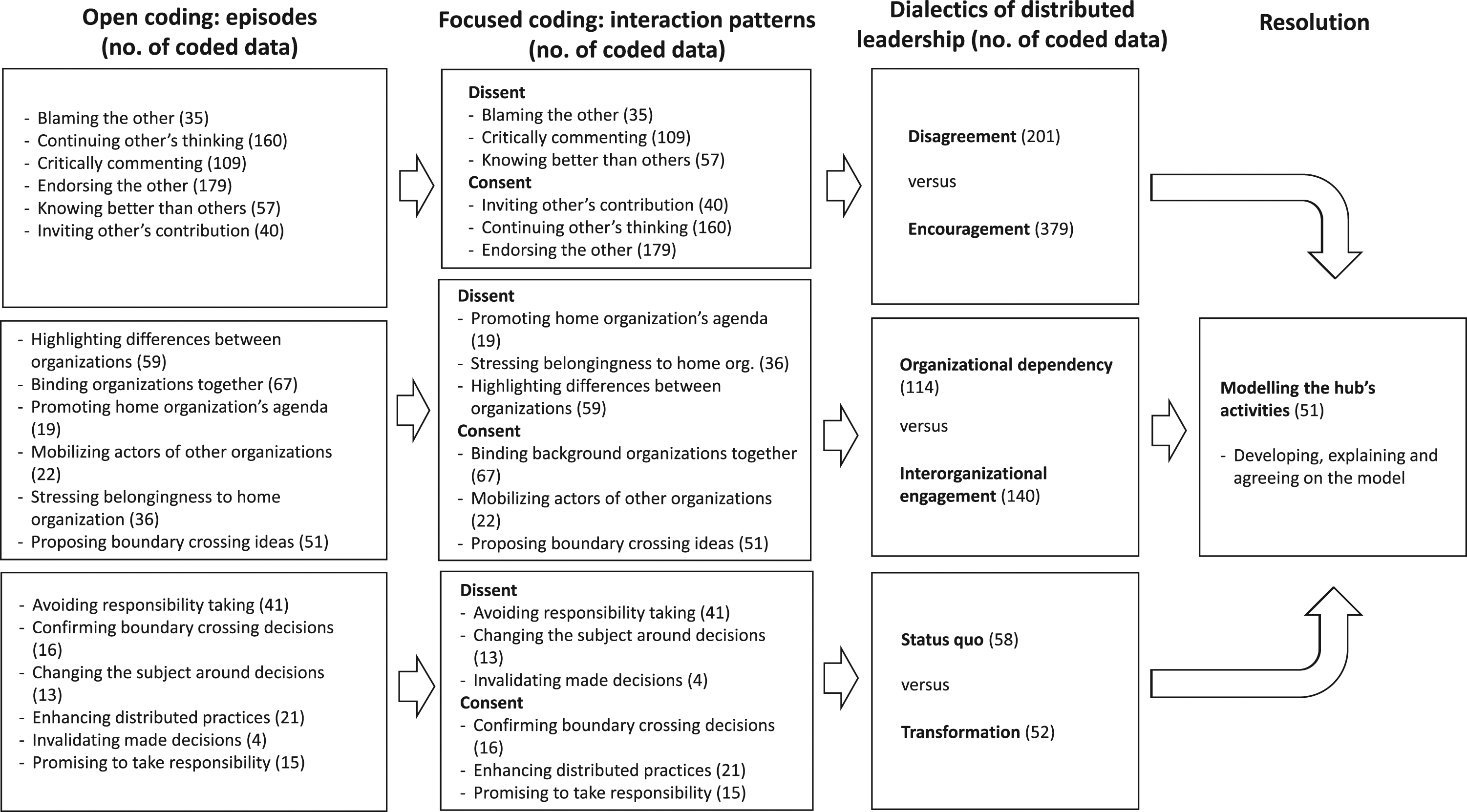
The initial open coding of the data helped us to enter the second phase, focused coding (Charmaz, 2006: 57–60), which was informed by our dialectical lens. In this phase, we reviewed the seminar transcripts once again and grouped 18 of the 21 first-order categories under the titles of dissent and consent, the dialectics of which has been identified by Collinson (2005: 1435; 2011; see also Zoller and Fairhurst, 2007) as a crucially important feature of leadership dynamics requiring detailed examination. Thus, taking inspiration from Collinson, we defined dissent to mean overt or covert resistance, such as manifestations of criticism, challenges, contrasts or avoidance, for instance, by talking over, critically commenting and blaming each other. As regards consent, we understood it to refer to the verbal utterances manifesting support to other participants’ views via acceptance, confirmation, commitment and mobilization, for example by endorsing the contribution of others, and promising to take responsibility and action.
In the third phase, we conceptualized the categories of dissent and consent with the help of discursive contents of the coded utterances to gain a theoretically informed understanding of the references the speakers made in their speech. We named each category of dissent and consent content-wise to form three major dialectics of distributed leadership, namely (1) interactional disagreement versus encouragement (c. 56% of the coding in our data), (2) organizational dependency versus interorganizational engagement (c. 25% of the coding), and (3) organizational status quo versus transformation (c. 11% of the coding). We then exported the coding to an Excel spreadsheet, to analyze the sequential nature of the three dialectics of distributed leadership in the meeting interaction.
Finally, in the fourth phase, we examined the seminar data once again to identify utterances that worked towards resolving the identified three discursive dialectics. This analytical phase also provided a window to the materially mediated discussion (Vygotsky, 1978), which was directed at the reconceptualization of the hub’s future operational model started at the end of the meeting 5 and continued with tangible efforts of defining the model in the meeting 6. This resolutionary, i.e., non-coercive, voluntary and constructive speech using which the hub’s new operational model was created accounted for circa 9% of the coding in our data and was constituted by three first-order categories: developing the new model, explaining the new model and agreeing upon the new model. This resolution phase of the analysis is represented in the extreme right on Figure 1.
Findings: Dialectics of distributed leadership
First dialectic: Interactional disagreement versus interactional encouragement
The first dialectic of distributed leadership—disagreement versus encouragement—captures the complex organizational speech, which oscillates along the degrees of agreement among the participants over the hub’s current activities. This type of talk includes statements varying from contesting to approving other participants’ viewpoints during the seminar.
In the disagreement extreme, we observed the speakers blaming each other for the problems encountered, e.g., making critical comments about their opinions and claiming that they knew things better than the others. Such contestation created tension-laden interaction between the participants. The other extreme was encouragement. In this type of talk, the speakers continued each other’s thinking, invited others to contribute to the dialogue and endorsed one another’s opinions. The encouragement-oriented talk represented smooth, constructive engagement in the discussion, i.e., speech that contributed to the production of shared understandings about the hub’s mission and practices. During the seminar series, the disagreement talk was more common in the first session, while the encouragement talk was more usual in later meetings.
The aim of the first meeting was to discuss the main problems hampering the hub’s activities, thereby generating an abundance of disagreement. The members from the university were especially overwhelmed and burdened with strong feelings of frustration and helplessness about the hub’s situation. Underlining the chaos at the hub they critically commented on the representatives of the university of applied sciences for not contributing enough to the joint activities. After a series of such comments, a senior staff member of the university of applied sciences (speaker B) took to the floor to emphasize his home institution’s efforts of organizing entrepreneurship teaching. He blamed the university for its lack of entrepreneurial teaching capability and downplayed the problems presented by the university representatives: The university has a challenge with entrepreneurial capability. At the university of applied sciences, almost all the students take a course on entrepreneurship. This has been the case for several years. This problem between the two organizations—I do not see it always as a problem. This is an open innovation environment. Those who participate in it are interested in the development of its object: new businesses, competence development and creation of start-ups. (Meeting 1)
Later, an innovation director, a representative of the municipal business promotion service (speaker E), entered the discussion and moved it forward by asking how the situation would be different if the hub’s employees were members of a single organizational unit. Thus, using the “how” adverb he invited contributions from others to think about the pressing situation from a different perspective: What would you think about a situation in which you all were part of a one and the same small unit, a kind of a multi-actor group in a public organization using facilities similar to these? How would you solve these practical problems? (Meeting 1)
This and several other interventions from the same person triggered a lively discussion, which later resulted in a shift in the nature of the dialogue, thereby moving it from disagreement to encouragement. However, despite these enabling comments, the strong disagreement between the parties dominated the dialogue in the first meeting creating a very edgy situation.
At the second seminar meeting, many participants continued to highlight that the problems they had experienced were an integral part of daily life in the hub. Development manager (A), for instance, proceeded with the disagreement type of speech by blaming the staff of the university of applied sciences for not prioritizing the hub’s core duties. The discussion continued with innovation director’s (E) question, which maintained his facilitative role in searching a way out of the tricky situation: It has flashed in this discussion that the hub should have a vision ja mission. So, does [director F of the university of applied sciences] have a suggestion about how could we start working on that side of things? (Meeting 2)
These kinds of questions gradually turned the dissent into a dynamic for organizational encouragement and approval of each other’s viewpoints. Thus, as a result of many facilitative questions, the seminar participants started to reflect on the collective need for change and to question the hub’s practices, which strengthened the transformation of the discourse from dissent to consent. This shift is exemplified by a question from development manager (B), who had denied the existence of problems in the first place: A good criterion for all actors would be to ask whether they really enhance the development of expertise in entrepreneurship and creation of new businesses. (Meeting 3)
Discussion entries like this enhanced collaborative tone in the discussion, because through them, the participants invited each other’s contributions and endorsed one another, simultaneously as their encouragement-oriented speech increased the idea about elaborating the joint mission of the hub advanced. This set grounds for even more constructive moves in the discussion: verbal exchanges that underlined the importance of service development for the hub’s clients as its future activity. For example, a post-doctoral researcher of the university (N) moved the discussion toward this end: What is our role? I guess we do not wish to be in a subcontracting relationship to our background organizations, but we need to find a service, a joint area of value creation. How could the hub better serve the university and the university of applied sciences, and their clients? We need to define that clearly. (Meeting 3)
The encouragement-oriented talk drove the participants to focus their dialogue on the overall mission and clients of the hub, a purpose they started jointly elaborating. This increased the relative strength of the encouragement type of speech and produced grounds for a new social order within the seminar. A characteristic of the vocabulary used here were verbal exchanges that endorsed the thinking of the others and continued their ideas. The following exchange, taken from the fourth meeting, provides an illustration of the kind of discussion which later led to the co-creation of the hub’s mission statement: Community coordinator (T): Is that [word] “platform” difficult to understand (…) for a person who does not have much background information? Could it be something like... Would it be bad if we used the word community? Does it take it [the meaning] in the wrong direction? Coordinator (D): I think it is very good, “co-creation community”. T: Yeah, could it be like that? D: That would be nice. “Community” is kind of like, a warm word. It makes... T: Yeah, isn’t it? It is easily approachable. D: Something you want to belong to. “Platform” is very clean and cold. (Meeting 4)
This mode of talk continued in the fifth and the sixth meetings as the participants jointly elaborated the hub’s mission statement. During these meetings, the drafting of the shared operational idea proceeded smoothly and collaboratively, with only minor signs of disagreement.
In summary, the dialectic between contesting and approving of one another’s opinions created an interplay between disagreement and encouragement. The critical and resisting comments were inhibiting the temporal unfolding of consent at the beginning, but later turned into factors that prompted discussion that sought to form shared understanding. Thus, the dialectic started from dissent, with the participants contesting the views of the others, but with the help of discursive invitations, endorsement and continuation of the ideas presented by others moved toward consent. This encouragement kind of talk was vital here as it led to progressive interaction towards the resolution.
Second dialectic: Organizational dependency versus interorganizational engagement
The second dialectic of distributed leadership—organizational dependency versus interorganizational engagement—represents a similar progression as was the case with the first dialectic. The seminar started with the dominance of organizationally dependent talk, which then declined and was replaced by an emphasis on inter-organizational engagement. Thereafter, the amount of both types of talk was reduced until they increased again in parallel, which was evidently a function of the fact that the participants became engaged in making tangible decisions about how to develop the hub further. In a similar vein with the first dynamic, a characteristic of this dialectic was that once the talk about the interorganizational engagement had become dominant, it remained so until the end of the seminar series.
When it comes to the organizational dependency extreme, utterances exhibiting historically embedded organizational arrangements, practices and values of the speaker’s home organization were abundantly represented. The modes of talk also included statements in which the speakers underrated the other organizations, promoted the agendas of their own and stressed their belongingness to its customary practices. Regarding the speech, which we categorized as interorganizational engagement, the most significant type of talk was that which bound the background organizations together. Also, those utterances through which the participants proposed boundary-crossing ideas were common. However, the verbal exchanges that tried to mobilize other participants were at the margin, especially during the early phases of the seminar.
Taken together, the polarity between organizational dependency versus interorganizational engagement reveals different levels of engagement in the participants’ “we talk”. Depending on whether the actors were positioning themselves at either the organizational dependency or interorganizational engagement extremes, the indexical word “we” referred to different things. Especially in the first meeting, the reference was the speaker’s own university, thus utterances of this type can be regarded as intra-organizational “we talk”, i.e., the speakers’ organizationally dependent attitude towards the activities of the hub. In the latter case, the referent of “we” was clearly the hub’s actors, thus it represented interorganizational “we talk”. We start our analysis with the organizational dependency end of the dialectic.
The organizationally dependent speech often created boundaries between participants who came from the university and the university of applied sciences. In the first meeting, for instance, program developer (K) of the university reflected on the strong embeddedness of the hub’s practices in either one of the universities as follows: There are these two organizations, the university and the university of applied sciences. We don’t have any influence on each other’s activities. If one’s supervisor says something, that’s how it is. In principle, the other can’t affect that decision in any way. (Meeting 1).
After the organizationally dependent talk, some of the participants started to take notice of the other organization’s problems and objectives, which bridged the oppositional viewpoints and increased constructive interaction across the organizational boundaries. In cases like these, the actors began to step outside their organizationally dependent “we talk” and proposed boundary-crossing questions to their own organization as well as the representatives of the others, such as is done here by a director (I) of the university: I think the question of how the background organizations want to organize this activity is important. How do they see this in terms of the evolving university-business interface, and what it means to the students and the faculty? (Meeting 2)
As the dialogue evolved, and the participants adapted to one another, they also started to mobilize those who had not yet been very active in taking part in it. In the second meeting, this created a lively discussion oriented towards interorganizational engagement, thus balancing dissent talk with consent. This shift was highlighted in the third meeting as the participants began to design solutions to the problems the hub had encountered and continued the joint elaboration of its shared mission. In the following example, the innovation director of the city’s business promotion service (E) elaborated on the hub’s mission by way of defining its clients: It just popped into my mind when you look at youth unemployment in the city. Could it be thought that this activity would be focused to address entrepreneurship plus business, but that its goal was to solve the city’s youth employment problem? The best brains, knowledge and know-how of the city’s universities are at our disposal. So, we would focus on solving this thing. (Meeting 3)
To summarize, in the second dialectic the intra-organizational and interorganizational “we talk” created an interplay between what we more analytically call organizational dependency versus interorganizational engagement. The dominance of the latter after the second meeting focused on the attempts to solve the hub’s managerial problems and on elaborating its shared mission and clients. Although the talk that exhibited interorganizational engagement had already been present in the first meeting, it had been subordinated to the organizationally dependent type of speech, which emphasized the intra-organizational perspectives. After the second meeting, however, the interorganizational talk started to dominate and maintained that position throughout the seminar thereby leading to the resolution.
Third dialectic: Organizational status quo versus organizational transformation
The third dialectic of distributed leadership captures the dialectics between organizational status quo and transformation. This polarity revealed different grades of commitment for collective decisions and tangible actions and included statements varying from status quo-oriented to transformative organizational activities. The speakers fostering the status quo talk typically avoided responsibility taking, underrated the problems and changed the subject when the dialogue came around to making decisions. These verbal exchanges brought a tension-laden tone and the struggle for power in the interaction. The other end of the polarity, transformation, included speech that exhibited the speakers’ commitments to the development of the joint organization, the hub. For instance, the speakers confirmed the boundary-crossing ideas presented by others, enhanced organizationally distributed practices, and promised to take responsibility for them.
As was the case in other polarities, the dialogue started with an abundance of dissent speech that represented the threat to the development of the hub. However, during the second meeting, the amount of this talk diminished, and transformative speech started to raise its head. In the third meeting, the discordant talk increased, but then disappeared altogether in the fourth and fifth meetings. Although the amount of transformative speech diminished as well, it remained dominant, and in the sixth meeting a strong increase in the transformative talk occurred.
As stated, the seminar started with dissent types of speech, which was of two main types. First, some participants tended to change the subject of the discussion away from the needs for change in the hub’s activity. This type of talk can be regarded as being status quo-oriented since the speakers took the focus away from the need to make progress. Second, some actors avoided taking responsibility for the development of the hub. The following excerpt taken from the first meeting illustrates this type of speech. For a starting point of the discussion, the innovation director of the municipal business promotion service (E), calling the two universities competitors, underrated the expressed problems, refusing to admit the need for a major transformation: I have personally wanted to view this hub, I’d say, through rose-colored glasses, because one has accomplished so much after all. About these contradictions, the relationship between the two competitors, it was almost funny to listen to. Still, I have the rose-colored glasses on. I do understand this rather well and have heard about these problems. Yet, I listen to this as a success story. I could say these issues are small potatoes, easy to solve! (Meeting 1)
Another example of status quo speech focused on the idea of hiring a caretaker to keep the hub’s facilities functioning, an issue which was an unrealistic option for the hub. Despite this, the participants representing both universities concentrated on the issue during the first meeting by describing difficult situations in the hub’s daily operation that were nobody’s responsibility. The discussion about the caretaker, who would save the hub from its problematic everyday duties, continued in the third meeting when again there was a slight increase in status quo talk. In that session, some participants proposed questions that started to drive the others to reflect on the problems caused by the lack of responsibility. This promoted transformative talk and highlighted shared responsibility taking, but it soon changed to the dissent type of talk addressing the shared dream about the caretaker. However, some of the participants worked towards getting the dialogue back on the trail of transformation with the help of further questions and ironic comments on the caretaker: Development manager (A): Are we trying to achieve the impossible here? When we share “the pasture”, no one is responsible for how this is resolved. What is the focus of this activity, who do we serve? Who are we loyal to; each actor? What is the shared aim? And do we simply perform old existing functions, or do we create some new kind of activity? This type of tension exists here. We just dream about some caretaker, someone who could take care of everything. (Meeting 3)
If dominant, status quo speech could have stymied the discursive movement towards the shared understanding about the hub’s renewal, which did not happen here, as the shift from status quo towards transformative talk started slowly emerging from the second meeting onwards: the discourse began to emphasize organizational transformation. The shift became evident as the participants promised to take responsibility for organizational change by means of planning shared and altered practices. Several of such exchanges had occurred at the beginning of the seminar, but the major change of the discussion took place during the fourth meeting when a lecturer (J) of the university of applied sciences pushed the participants to define the clients of the hub: Populating the universities we have 24 000 students, and 4 000–5 000 experts. These numbers are quite startling (…). Of course, we do not reach all of them, but we can pick the best ones, so to speak. It is the network that everyone can see, and it connects the competence of the two universities in different fields to useful purpose, if we so wish. This hub is the crossroads for various kinds of know-how and utilization. So, it is still possible to pick those people who have the urge and will to operate in this sort of a chaotic creative environment with other crazy people. (Meeting 4)
Still further effects of the moves towards the hub’s renewal became visible during the sixth meeting when a significant increase of transformative speech occurred. The facilitator’s (S) initiative that the focus of the discussion should be kept on the needs of the hub’s clients enhanced this type of talk thereby firming up the desired changes into action plans to be followed during the hub’s subsequent development. This strengthening emphasis on the hub’s transformation was important for the further development of distributed leadership as it contained a more elaborated definition of the hub’s clients and their needs.
In summary, the interplay between dissent and consent-oriented speech created a dialectic, which we have called status quo versus transformation. Because the hub was facing the threat of being closed unless it improved its activities, the participants were inclined towards its joint development. However, becoming committed to the transformation was not an easy process, but required a struggle between the dialectical extremes of maintaining the organizational status quo and inducing transformation. As was the case with other dialectics, the movement towards the shared understanding about the hub’s future developed at the latter part of the seminar series with crucial ideas about how to develop the hub further.
Resolving the dialectics
In the fifth meeting of the seminar, the participants realized that their discussion about the hub’s aims was still quite abstract. To facilitate more substantial discussion, they were split into two smaller groups to brainstorm and collect ideas that could be used in formulating the hub’s operational model. When the groups were brought back together, they presented the outcomes of their work to get feedback about their ideas. After such discussion, the fifth session was finished and the development manager (A) of the university and the manager (R) of the university of applied sciences were given the task of summarizing the groups’ ideas into a single graphical model of the hub’s operation before the sixth meeting. The outcome of their work to develop the new model was represented at the beginning of the sixth session in the form of a Power Point slide (Figure 2). The draft of the operational model for the hub discussed by the participants in the sixth seminar session.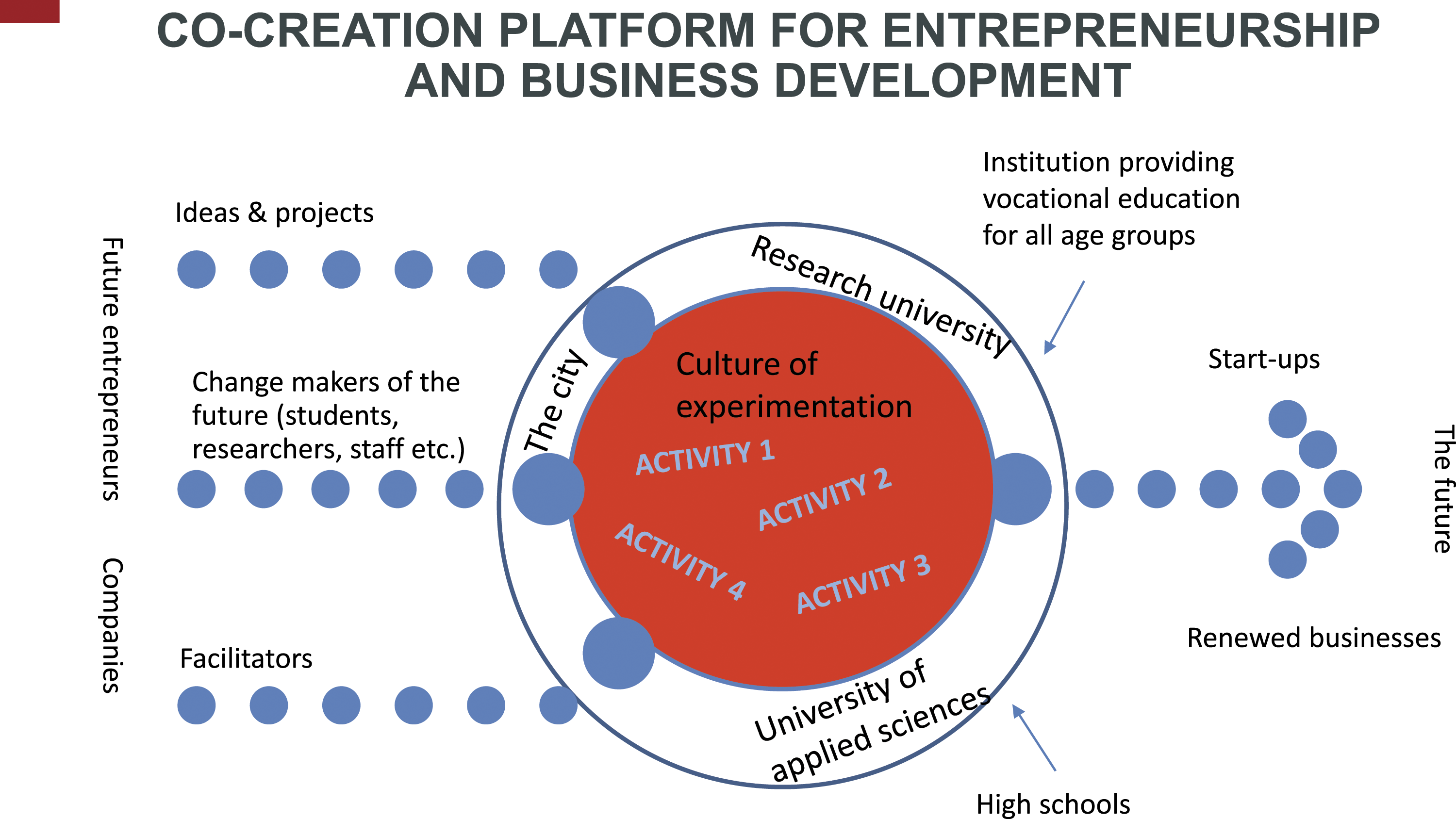
At the beginning of the sixth session, the development manager (A) explained the new model, presented in Figure 2, to the participants. She summarized the figure to facilitate the participants’ judgmental deliberation about the outcome: A: So, (R) and I sat down on Friday for some hours to create this (…). I am not totally satisfied with this model though. [At the fifth session,] we all defined the future entrepreneurs and new businesses as our object of work, right? We had a lot of discussion about it. But now, if we do not include the students in the [model], it does not work, in my view. Therefore, R and I added them in this model.” (Meeting 6)
Reflecting on the discussions earlier, the development manager (A) confirmed that the hub was a meeting place for entrepreneurs, experts and students for generating new businesses. It was represented as a red circle in the middle of Figure 2, filled with “culture of experimentation” as well as the names of different business-oriented activities provided for the students. The two universities and the city’s business promotion service were the main organizations maintaining the hub and were pictured in the model as a white circle placed around the red hub. External to these were local high schools and an educational institution, which provided vocational education for all age groups in the area. People studying in these schools were free to join the hub’s activities if they so wished. The left-hand side of the figure represents the hub’s resources—ideas, projects and different kinds of people—with the help of which the outcomes were produced. Finally, the right side shows the outcomes of the hub’s work, i.e., start-up firms and renewed businesses that continued their operations into the future.
During the session, Figure 2 sparked a lot of discussion, most of which was directed at agreeing on the new model and its further development. The participants sought to make sense of it and adapt thoughts of their own to it. An example of such an elaboration was given by the director of the research university (I), who used a metaphor of “a mill” to describe how he understood the visual model: (I): I could think of this [the hub] as a mill where the business ideas are ground with the people and companies. And now these are outside of the mill. If you think about the business development in a simple way, there are two perspectives, external and internal. If the clients and markets as well as the [service] needs, opportunities and competitors are external, the resources and networks are internal. Now, on the left [of Figure 2] are the business needs and opportunities. But there are the [hub’s] owners’ resources and the networks as well. These should be inside of the mill, of course.
Many participants agreed with this characterization and thought that the hub’s resources could be pictured within the red circle of the hub. Other ideas voiced by the participants concerned simplification of the terminology used in the model: Names of the activities (changed here into artificial names of “Activity 1”, “Activity 2”, etc.) communicated nothing to the outsiders and should thus be replaced by short descriptions of their contents. Another example of the changes requested was to add entrepreneurial “expertise”, “networks” and “mindset” into the model’s outcomes, as was emphasized by the post-doctoral researcher of the research university (N). Finally, the participants suggested re-defining the contents of the circles that were pictured at the middle. Supported by others, the director of the university (I) spelled the way these should be written in the next version of the model: I: At the center, there should be expertise and its development. The next circle should be business development, meaning the refinement of [business] ideas. And then the outermost circle should be a network, ecosystem or community.
The discussion cited above shows that the use of the visual representation of the hub’s operational model (Figure 2) changed the nature of the discussion: the debate, which was earlier characterized by the three dialectics, was now complemented with another rationale, that of jointly developing the hub’s future-oriented model. An important condition for this new dynamic to emerge was the fact that Figure 2 was embedded in the ideas presented by the participants during the seminar series thus making them motivated to develop it further. As a model, Figure 2 also provided the participants a shared representation to work with, converting the complex dialectical speech and the abstract aims of the hub into a more synthetized and tangible form. First, it visualized the key ideas about the hub’s operation, indicating the internal and external actors with certain tasks and responsibilities. Second, it captured the hub’s resources, activities and outcomes converting them into an idea about the hub’s future operation. Third, the model temporalized the hub into the future and made it a vehicle for furthering the discussion from the three dialectics towards the participants’ joint sensemaking, thus binding the universities and the city’s business promotion service closer together. Such temporalization also made it clear to the participants that the hub’s renewal was a demanding and time-consuming process, and that the seminar series needed to be considered not as an end of it, but only as the beginning.
Discussion
In this paper, we developed a dialectical understanding of distributed leadership and investigated how it developed discursively in an interorganizational setting—a context which has not yet received much research attention in the scholarly literature. By so doing, we not only continue the existing line of research in distributed leadership (Cullen-Lester and Yammarino, 2016; Gronn, 2010; Ospina et al., 2020), but also add novelty to dialectical leadership studies focusing on both discursive micro-dynamics of the distributed leadership practices, as earlier research taking a dialectical stance has focused primarily on the phenomenon at the theoretical level (Collinson, 2005, 2011, 2014, 2020; Deye and Fairhurst, 2019; Hergraves and Van de Ven, 2017; Mitchell et al., 2014; Putnam et al., 2016; Zoller and Fairhurst, 2007). Thus, by offering a rare first-hand account of the lived realities of distributed leadership dialectics and how these were enacted on employers coming from different organizations and different positions, our study also adds a dialectical case to mainstream leadership studies which challenges the received focus of leadership research on those actors who are in official leadership positions only.
We investigated distributed leadership in context-specific discursive terms and directed our research to the deep-seated interactional tensions (Collinson, 2020; Deye and Fairhurst, 2019; Mitterlechner, 2019) conceptualizing these in terms of dialectics directed at organizational renewal (Carroll and Nicholson, 2014; Mitchell et al., 2014; Putnam and Powers, 2016). Our analysis shows that interlocutors engaged in the studied interaction were capable of creatively using their discursive resources and seeking energy from the dialectical tensions (also Putnam et al., 2016) and power asymmetries (Collinson, 2018a), thus renewing their understandings and jointly constructing novel routes for organizational change. In this respect, the analysis highlighted how the participants discursively explained the need for change to themselves and others as well as formed agreement about it, thereby shifting the discursive emphasis from the tensions into the development of a shared understanding, and simultaneously opening an avenue for the hub’s organizational renewal. So, understanding dissent and consent as a dialectic rather than a dualism, our study illuminates their intertwined nature, and their equal importance for the development of the distributed leadership practice, as well as for the reaching of the collective resolution, i.e., a visual representation that is the reconceptualization of the hub’s novel operational model (also, Di Domenico et al., 2009).
In line with critical leadership studies, our case shows how the seminar participants who did not hold formal authority, presented themselves as skilled, knowledgeable and proactive agents, who expressed dissent and resistance in creative ways, even within asymmetrical and insecure conditions (see also Collinson, 2018b). Echoing a recent dialectical study by Robinson and Renshaw (2022), our analysis therefore provides additional evidence to the trans-subjective nature of collaborative agency and underlines the importance of interactional patterns, such as various kinds of discussion entries and uses of visual representations, in aiding distribution of leadership at micro-social level of organizational practice. As the study by Robinson and Renshaw (2022) also indicated, it became apparent to us that there was a consistency in the discursive contents between certain interactional patterns of leadership practices. For example, the pattern of confirming boundary crossing decisions, enhancing distributed practices and promising to take responsibility, enabled the participants to overcome the tensions and power struggles. It also helped them to move forward iteratively in the distributed leadership process and were thus clustered by us into a broader category of organizational transformation.
Further, following Raelin (2016), our analysis pinpoints that the practice-based approach to distributed leadership enables the recognition of various forms of materiality contributing to the development of distributed leadership in a multi-modal manner. In our case, the seminar series offered a safe space (cf. Robinson and Renshaw, 2022) for the participants to critically reflect on their practices (see Mitterlechner, 2019). It allowed for negotiation, ideation, problem solving, and co-creation across boundaries of multiple organizations and organizational positions (also Mitterlechner, 2019; Smith et al., 2018; Zerjav et al., 2014). Further, it enabled the co-creation of a discursive artifact, i.e., a visual representation of the hub’s novel operational model, which can be viewed not only as a tool to coordinate interaction, but also as a material carrier of a shared purpose to which the participants could relate. On the one hand, it had performative power in a sense that it visualized the key ideas about the hub’s operation, on the other, it acted as a mediator (Vygotsky, 1978) that supported the participants’ sensemaking and distribution of leadership, to legitimize the institutional position of the organization in question.
Furthermore, in line with the findings by Smith and colleagues (2018), the legitimacy was acquired, not through any specific skill, capacity or role played by individual actors, but through the mobilization of interactive practices and the use of material artefacts (see Zerjav et al., 2014), in our case, the representation of the hub’s operational model. This process also facilitated the alignment between the participants’ distinct goals (see also Smith et al., 2018), importantly reducing social tensions and enhancing collective sensemaking among them (Zerjav et al., 2014). So, emphasizing the significance of representational artifacts and spaces as facilitators of the collective deliberation processes, our study corroborates the existing findings achieved by practice-based approaches to distributed leadership.
In addition to the contributions discussed above, our study has limitations that should be taken seriously. The first of these is that the analysis was based on a revelatory case that has unique features in that the entrepreneurship hub we examined constitutes a rare instance. The findings about the hub might not be directly transferrable to other social or organizational settings. Although we believe that other cases are likely to be characterized by analogous practices we found here, it would be important to examine case examples in different settings and then compare the findings to our own. While our analysis highlighted the discursive dialectics in distributed leadership, future studies using a dialectical lens could zoom more consistently into the structural conflicts of interest that may arise in these distributed leadership processes, as well as to investigating conflicts over scarce resources in dialectical leadership processes. It would also be intriguing to investigate the micro-foundations of legitimacy (Drori and Honig, 2013; Smith et al., 2018) by analyzing the dynamics between key actors participating in the dialectical leadership process and connecting these to the broader organizational arrangements exceeding the boundaries of a single unit. By so doing, it would be possible to understand longer temporal processes of institutionalization and the ways in which novel organizational resolutions either disappear, transform or become stabilized as entities in the wider contexts.
Conclusions
In sum, our dialectical approach on the development of dialectics of distributed leadership can be taken as a further contribution to the efforts of providing a more dynamic understanding of how various tensions and discursive leadership practices play themselves out in the process of social interaction in complex inter-organizational and pluralistic contexts searching for renewal. Our study makes the following contributions. First, it expands the understanding of distributed leadership by conceptualizing it in terms of interactional patterns and interplay between the opposing forces of dissent and consent, as equally important for the development of distributed leadership, as well as for reaching of the collective resolution about organizational renewal. Second, it contributes to the application of distributed leadership in analyzing organizational practices by highlighting the facilitative role of (1) reflexive spaces for nurturing open developmental interaction and (2) such discussion entries that are directed at developing novel organizational models and explaining these to others in shifting the discursive dialectics from tensions to resolution. Third, it adds novelty by exemplifying how co-created visual representations can provide resolutions and convert rather abstract aims and complex discursive dialectics into a more tangible form. Such artifacts can function as powerful mediators binding the distinct stakeholders closer together, and in guiding and facilitating organizational renewal in complex inter-organizational contexts.
Footnotes
Declaration of conflicting interests
The author(s) declared no potential conflicts of interest with respect to the research, authorship, and/or publication of this article.
Funding
The author(s) disclosed receipt of the following financial support for the research, authorship, and/or publication of this article: Juha Tuunainen received support for this research from the Academy of Finland (grant no. 316545).

Author biographies
Participants at the seminar,their organizational position and employer
Participant
Organizational position
Employer
A
Development Manager
University
B
Development Manager
University of applied sciences
C
Manager
University of applied sciences
D
Coordinator
University
E
Innovation Director
Municipal business promotion service
F
Director
University of applied sciences
G
Lecturer
University of applied sciences
H
Vice-Rector
University
I
Director
University
J
Lecturer
University of applied sciences
K
Program Developer
University
L
Professor
University (author of this paper)
M
Specialist
Municipal business promotion service
N
Postdoctoral researcher
University
O
Lecturer
University of applied sciences
P
Project Designer
University of applied sciences
Q
Student
University
R
Manager
University of applied sciences
S
Coordinator
University of applied sciences
T
Community Coordinator
University of applied sciences
U
Research Assistant
University
V
Associate Professor
University, external (author of this paper)