



Abstract
Surely a leader should know what to do? But what happens when complexity means they cannot know which path to take? We answer this question with an ethnographic study of distributed leadership (DL) in an organisation grappling with inherent tensions within its mission. The article makes a counter-intuitive argument for the value and utility of unknowingness, defined as a state of awareness of both an absence of knowing and one’s inability to know. Three inter-related aspects to unknowingness are developed – acceptance of not knowing, tolerance of the discomfort of not knowing, and distribution of unknowingness – leading to an innovative theory of unknowingness. We reveal how unknowingness and DL are bound with each other in the sense that not knowing can enable distribution of leadership within the organisation, whilst DL addresses challenges in complex organisations associated with not knowing. We thereby provide an illustration of the interplay between those with hierarchical authority and others dispersed throughout an organisation. In sum, we provide an alternative perspective to the heroic, all-knowing individual leader.
Introduction
I think there’s a flaw in our model. Does anyone know what is the right answer? The more senior you are, there is an assumption that somewhere in the process someone knows what the right answer is. There are lots of reasons why we end up doing things. I think there is an assumption someone knows what the right answer is . . . that there is a way of getting to the right answer. That there is a way of dealing with ambiguity better. (Member of senior management team)
Collective leadership scholars and practitioners alike argue that the complexity of many contemporary organisations, as well as inter-agency networks, requires new forms of leadership practice (Huxham and Vangen, 2005) that depart from traditional heroic models. Yet, despite the innovations in forms of collective leadership and governance, there remains a need for additional theoretical understanding of collective leadership (Ospina et al., 2020). Collective leadership has been broadly defined as ‘influence that stems from more than a single individual’ (Maupin et al., 2020). It is understood as a lens through which to view both interpersonal relationships (leadership residing in the group) and system dynamics (leadership residing in the system), and as a type of leadership that highlights the plural nature of leadership in practice (Ospina et al., 2020). Collective leadership emerges from social interaction, and focuses on the collective dynamics of leadership, rather than on the actions of individual leaders.
As a specific form of collective leadership, distributed leadership (DL) is one of the most commonly discussed forms of collective or shared leadership. DL is an approach based on three key assumptions. First, leadership is practised beyond those with explicit leadership roles or titles. Second, leadership is relational and systemic, being a product of interactions (Bolden, 2011; Spillane and Diamond, 2007). Third, interactions are situated; they create and reinforce contextually specific leadership behaviour and action (Spillane, 2005, 2006). These assumptions underpin an emphasis on how leadership practice is constructed and reconstructed between leaders, followers and situations, rather than through a focus on structure, function and the performance of individual roles (Bolden, 2011).
One aspect of DL that has not been examined concerns what happens when there is little or no knowledge of how to act, or when persistent organisational tensions unsettle knowledge of what to do. This is important because not knowing has typically been seen as undesirable if not incompatible with leadership. Leaders fear being seen to lack knowledge in situations where they are responsible and accountable. In this article, therefore, we examine ways in which not knowing is integral to DL. We develop the concept of ‘unknowingness’ (Hay, 2022), which we define as a state of awareness of both an absence of knowing and one’s inability to know, and explore how the productive sharing of not knowing can enable the accomplishment of DL. We provide an empirical example from Forestry England (FE), where our study found that not knowing is a challenging but accepted aspect of interaction and practice. Our research provides the opportunity to explore and outline the specific elements and value of unknowingness for DL. We contribute to the theoretical development of DL by emphasising the value and utility of unknowingness. We show an intertwined relationship between them in the sense that not knowing can support DL, whilst the latter addresses organisational challenges associated with not knowing. We highlight three inter-related aspects to unknowingness – acceptance of not knowing; tolerance of the discomfort of not knowing; and the distribution of unknowingness. These are key dynamics for understanding how not knowing helps get work done rather than necessarily signifying deficiency. Together they show its potential utility for leading in and navigating through complex contexts. We make a further contribution by providing a rare empirical example of DL in practice from a sector other than education. Findings from the study lead to an innovative theory of how unknowingness is an enabler of DL.
In the following sections of the article, we summarise existing theory on DL. We describe the context for our study, FE, an organisation charged with caring for the country’s forests, and explicate the ethnographic approach to the study. The data analysis section explains how unknowingness emerged as a dominant theme, with three aspects, namely, accepting unknowingness, tolerance of unknowingness and distribution of unknowingness. In our discussion we develop our theoretical contribution and emphasise the value of unknowingness for DL. Finally, we consider the implications of our study for leadership development and for future research. We end by concluding that not knowing not only has utility in achieving DL, but it is also an influential part of the process of developing leadership, both individual (Bolander et al., 2019) and collective (Vince and Pedler, 2018).
A brief theoretical overview of distributed leadership
We align the article with current discussions, in this journal and others, that focus on the processual and relational nature of leadership, rather than on its heroic aspects (Ospina et al., 2020). From this perspective, leadership ‘can best be viewed as a fluid process emerging from the communicatively constituted interactions of myriad organisational actors’ (Tourish, 2014: 80) and as a collective endeavour ‘embedded in the everyday relationally-responsive dialogical practices of leaders’ (Cunliffe and Eriksen, 2011: 1425).
DL is one of the most widely discussed forms of collective or shared leadership within the academic literature (Bolden, 2011; Denis et al., 2012; Fairhurst et al., 2020; Humphreys and Rigg, 2020), where leadership is not simply in the hands of the formally appointed leader, but is also accomplished through shared effort and insight (Fairhurst et al., 2020; Fitzsimons et al., 2011; Ospina et al., 2020; Yammarino et al., 2012). However, just as the umbrella term ‘leadership’ is considered an ‘essentially contested concept’ (Grint, 2005: 17), DL also lacks a universally agreed definition (Thorpe et al., 2011). As Lloyd and Carroll (2019: 814) note, the ‘promise of leadership being spread across levels and parts of an organisation beckons scholars and practitioners alike, yet the theory and practice of it remains partial and elusive’. Gronn (2002) traced ‘distributed’ leadership to Gibb (1954), who argued that it is not the specific traits of individuals that define leadership, but rather the degree to which people assume ‘leadership functions’ (though it should be recognised that Parker-Follett was already talking of ‘reciprocal influence’ in 1942, as something we might now term collective leadership, cited by Spencer et al., 2022). One definition of DL widely employed presents it as a combination of ‘leader plus’ and ‘practice’ (Spillane and Diamond, 2007), with the ‘leader plus’ aspect recognising that leadership is practiced by more than just those with leadership titles, and ‘practice’ acknowledging that leadership is a product of interactions in a particular context (Bolden, 2011). Similarly, Denis et al. (2012: 212) presented DL as ‘a collective phenomenon that is distributed or shared among different people, potentially fluid, and constructed in interaction’. Although the inclusion of ‘practice’ and ‘interaction’ in these definitions invites attention to more than just what individuals do that constitutes leadership, there has been strong criticism that much DL scholarship has simply shifted the focus of study from the individuals in top positions to studying multiple individuals (Gronn, 2016).
More recent insights into DL are offered by the collective leadership categorisation matrix of Ospina et al. (2020), wherein DL is classed as a type of leadership that resides within the system, rather than with a group. As such, DL can be distinguished from dual or co-leadership, a form of collective leadership where two or more individuals jointly take a shared leadership role (Gibeau et al., 2020). Instead, this categorisation of DL sees leadership as residing more generically within the patterns of organising: ‘the persons in relationship are not the sources of leadership, but leadership is a property of the system itself, theoretically decoupled from the relationships that produce it’ (Ospina et al., 2020: 445). This perspective also helps to distinguish DL from other common forms of shared leadership practice such as delegation, which, applying the matrix of Ospina et al. (2020), sees leadership as produced by a group of individuals rather than residing within the system.
There has been much enthusiasm for the idea of DL as a way of coping with increasing organisational complexity (Mabey and Freeman, 2010; Uhl-Bien, 2017, 2018) when it would be too much for one individual alone to ‘bridge the sources of influence, expertise and legitimacy needed to move a complex social system forward constructively’ (Denis et al., 2012: 272) and ‘where complexity of the issues lies beyond the capacity of any individual leader’ (Currie et al., 2009: 1739). Collective leadership more broadly has a long tradition, particularly in public service organisations (Crosby and Bryson, 2018), where ‘leadership has to work with, and negotiate with, many different stakeholders who have divergent values, goals, ideologies and interests’ (Hartley, 2018: 206). The language used to describe such collaborative leadership has varied, encompassing, for example, collective governance (Huxham and Vangen, 2005) of partnerships and networks, and relational leadership of public service ecosystems (Kinder et al., 2021). According to Crosby and Bryson (2018), UK public policy makers have been particular and explicit advocates of DL.
Despite the rhetorical importance assigned to context, there is a paucity of empirical studies of DL beyond the education (Bolden, 2011; Denis et al., 2012; Fitzsimons et al., 2011; Ospina et al., 2020) and healthcare sectors (Currie and Lockett, 2011; Fitzgerald et al., 2013). Consequently, a number of important aspects remain poorly understood. Firstly, when DL is described as ‘spreading leadership across levels over time . . . [and] ‘leadership relayed between people to achieve outcomes’ (Denis et al., 2012: 215), we have little insight into how such spreading or relaying unfolds so as to accomplish joint leadership.
The second area that remains poorly understood is the relationship between hierarchy and collectivity. Leadership research has generally focused on either collective or individualistic leadership, rather than taking a more ‘hybrid’ view (Gronn, 2009), or considering co-dependency between hierarchical and shared leadership (Holm and Fairhurst, 2018). Although there have been isolated calls to recognise both ‘formal and informal leadership roles’ in DL (Harris and Spillane, 2008: 31), a call to see DL as an ‘essential complement’ that both ‘facilitates and is facilitated by the leadership of specific individuals’ (Gosling et al., 2009: 300), and a caution that the language of DL can obfuscate power dynamics (Bolden et al., 2009), DL has more frequently been presented as a benign, more democratic approach to sharing power and influence. There remains limited knowledge of lived experience of collective leadership in relation to hierarchy (Fairhurst et al., 2020: 608), and limited understanding of cross-hierarchical leadership. As Lloyd and Carroll (2019: 814) note, the ‘promise of leadership being spread across levels and parts of an organisation beckons scholars and practitioners alike, yet the theory and practice of it remains partial and elusive’. This is important because, when organisations are seeking ways to respond to the increasing complexity they face and are experimenting with forms of shared leadership such as DL, they need to know what mechanisms, roles, skills and mindsets will best enable success.
These gaps provide the questions that we focus on in this article:
What are the mechanisms that enable distributed leadership?
What is the interplay between established hierarchy and collective effort where there is an intent to distribute leadership?
We do this by drawing from a two-year ethnographic study that explored how DL is experienced on the ground in FE, an organisation that was formalising a DL approach at the time of the study.
Research context – Forestry England (FE)
FE is a part of the UK Forestry Commission that was set up in 1919 as a government organisation to replenish timber stocks after the First World War. FE is responsible for managing the Public Forest Estate (PFE) in England, the largest landholding in the country, covering over 250,000 hectares. Its 100-year history has seen a gradual change of purpose for FE, which now has two key, uncomfortably interlinked objectives: a commercial one that includes growing and selling timber, and a custodian one to look after the habitats under its care for the benefit of wildlife and the people who visit it. In this respect, FE can be understood as a hybrid organisation possessing more than one institutional logic (Thornton and Ocasio, 1999), which organisations are known to generate tensions for leadership (Putnam et al., 2016; Smith et al., 2013).
Complexity is integral to FE’s work through its ‘public’ ownership, its legal obligations, its accountability to national government, and its unusually long planning time horizons. The first two are common to many public service organisations where ‘public professionals . . . have to grapple with contradictions within policies, multiple goals, diverse publics and a wide variety of stakeholders each with particular interests’ (Hartley, 2018: 206). The public are key stakeholders in FE. They have a strong voice but, as a heterogeneous body, they can have very different views of what the PFE is and what it is for. For certain stakeholders the PFE might be a place to grow timber, for some it is space to walk a dog, and for others the principal purpose is an environment to protect wildlife. These different conceptualisations of the PFE are often in tension. For instance, cutting down trees to sell for timber will have a negative impact on the birds nesting in those trees. The tensions may also operate within the same side of the commercial versus custodian divide, for instance around which type of wildlife to protect, highlighting the fact that there are more than two distinct organisational logics driving the complexity.
As a result, most actions taken by FE have simultaneous positive and negative consequences at any moment, depending on who is judging that action. This results in persistent organisational tensions that are recognised and experienced by everyone within the organisation. Tensions, defined by Putnam et al. (2016: 73) as alternatives that are not necessarily incompatible, arise from FE’s need to satisfy a wide and diverse group of stakeholders. There is scrutiny to ensure that FE operates within existing laws around wildlife protection. It is also accountable to a UK government minister, the Secretary of State, who is susceptible to change based on the political climate and the short-term five-year UK governmental cycle. This sits in contrast to the timescales for growing trees that takes up to 60 years, and for habitat changes, where FE has plans for up to 300 years into the future. This extremely long time horizon adds to the organisation’s complexity.
As part of the UK civil service, the organisational structure in FE is hierarchical. The majority of FE’s 1000+ staff are located within seven geographic districts, and multiple ‘beat’ areas within them, across England, either in a district office or in a local ‘beat’ office somewhere on the PFE. The latter are often in temporary buildings where members can step straight into the part of the forest where they work. In contrast, the national office, where the organisation’s senior management team (SMT) are based, is in an out-of-town business park on the edge of Bristol, England.
Alongside the hierarchical organisational structure, there was a narrative circulating within the organisation at the time of the study that maintained that everyone had a part to play in the leadership of the organisation. As such, leadership was both hierarchical and shared (Holm and Fairhurst, 2018). This was formalised through a ‘leadership model’ that had been designed by the SMT and then was being rolled out through workshops within the organisation during the time of the ethnography. Although FE employees did not explicitly use the term themselves, DL (Bolden, 2011; Ospina et al., 2020) captures their situation well. It is an approach that arises from their need to make localised decisions across a wide geographic spread, and the complexity of the organisation’s mission. This decentralised decision making, multifaceted mission and geographical dispersal emulates the situation of other large organisations, particularly in the public sector where multiple stakeholders and legislative frameworks create a situation for leadership of manifold competing priorities. The ‘leadership model’ that was being disseminated during the time of the ethnography was based on the narrative from the SMT that ‘everyone is a leader’. The documentation that formed part of the leadership model built on this idea of ‘everyone is a leader’ through presenting a list of leadership behaviours under three key headings of People, Drive and Impact, such as ‘empowering people through exemplary delegation’ and ‘coaching’ as a means of ‘developing leadership and management skills’. A leadership development workshop program was delivered alongside the leadership model documentation in which employees above a certain salary band were further encouraged to embed the behaviours into their working practice to demonstrate what the leadership model termed ‘exemplary leadership’.
Research design and methods
Research design
Recognising the importance of ensuring adequate fit between the theoretical frameworks adopted and the methods used, we employed an ethnographic approach (Wolcott, 1999; Ybema and Kamsteeg, 2009) as the most effective way of capturing data on how DL was done in FE. This enabled prolonged engagement to observe organisational dynamics in situ. We combined periods of non-participatory observation with loosely structured interviews to create in-depth and up-close immersion in this specific context. We studied experiences and interactions across hierarchical and role boundaries with the aim of: ‘seeing, feeling and hearing how conversations unfold; how language is constructed; what rhetorical devices are employed; what stories are told; how “influence” happens; and how actors’ and organisations’ realities are defined, maintained or changed’ (Sutherland, 2018: 269).
Using ethnographic methods, we were able to generate insight into the dynamic process of distributing leadership (Fairhurst et al., 2020). We were able to hear about experiences, to view organisation processes (Ybema and Kamsteeg, 2009), and to gain insight into how things work within a specific organisational context (Watson, 2011). Our reason for using this design was to ‘capture ambiguities and contradictions that would have remained concealed if our empirical focus had been confined to a single empirical vantage point, or if we had relied on participants’ post-hoc (e.g., interview-based) justifications for their actions’ (Glimmerveen et al., 2019: 1512). Ethnography is likened to exploration, whereby ‘an explorer can never know what he [sic] is exploring until after it has been explored’ (Bateson, 1972: xvi). In a similar way, Weick (1988: 305–306) wrote that someone ‘cannot know what he is facing until he faces it, and then looks back over the episode to sort out what happened’. At the outset of this study, therefore, we did not have a specific theoretical lens. This was reflected in the interview questions, for example, wherein participants were not explicitly asked about unknowingness. This theme emerged following data collection and analysis.
Data collection
Field work was conducted by the first author between June 2016 and January 2019. During site visits she attended a total of 39 meetings (Table 1) and talked to and interviewed 55 people across functions, seniority levels and geographic locations (Table 2). In addition, she work-shadowed individuals, visited sites and collated documents.
Meetings attended within Forestry England.
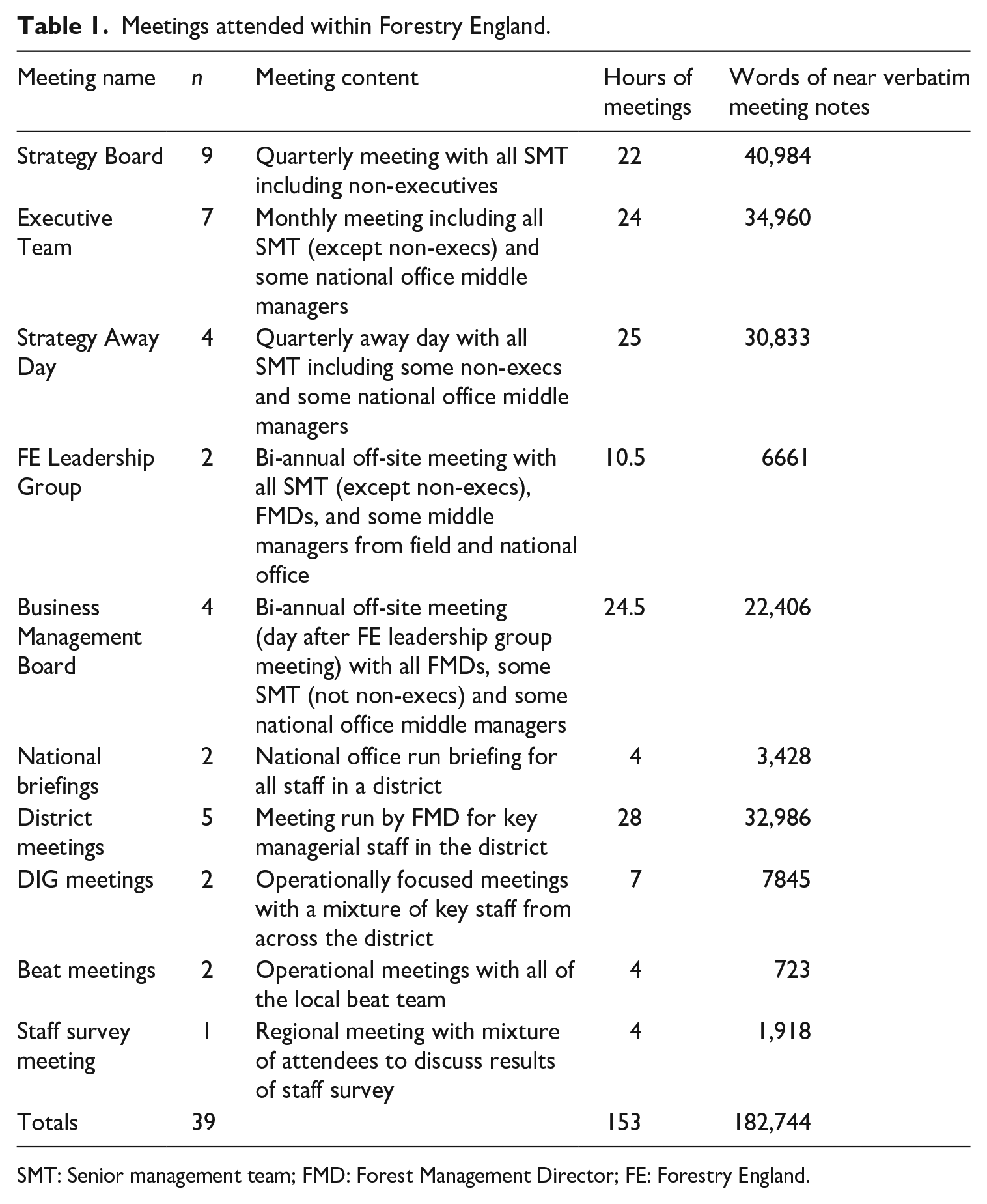
SMT: Senior management team; FMD: Forest Management Director; FE: Forestry England.
Interview data.
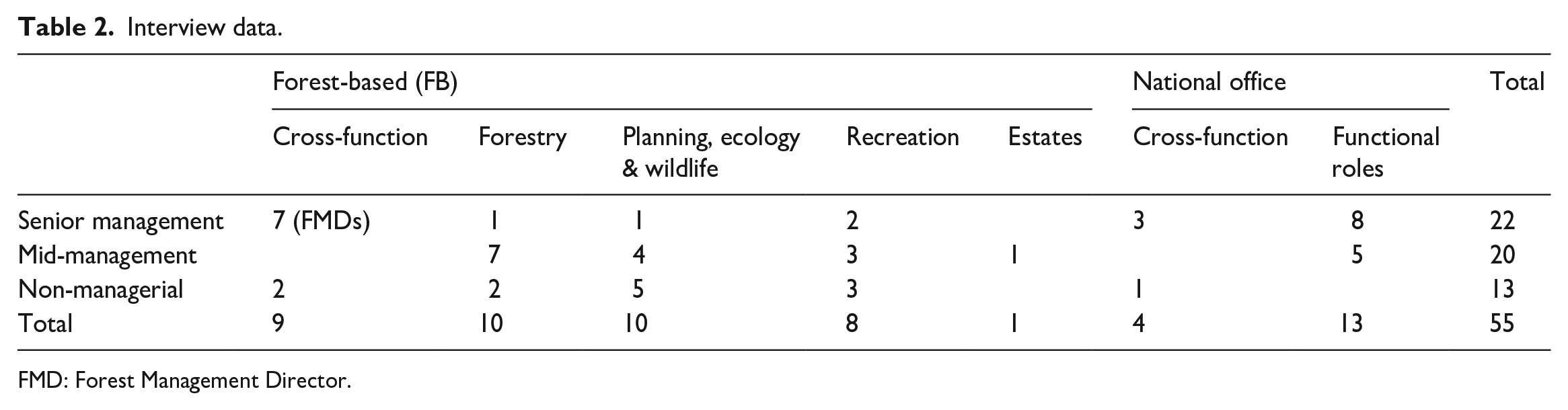
FMD: Forest Management Director.
Most of the interviews were conducted face-to-face in the interviewees’ place of work, with eight of the later interviews conducted by phone and one by FaceTime. The format was loosely structured (Hammersley and Atkinson, 2019) around members’ experience of conflicting organisational objectives but also included their motivations for working in/with the organisation, and their view of personal and organisational success. Interview length ranged from 15 to 208 minutes. All were audio-recorded, transcribed, then coded using the qualitative analysis software NVivo 12.
To ensure that research participants remained anonymous, all interviewees were assigned a code differentiating them either as part of the national office SMT; the forest-based (FB) forest management directors (FMDs) heading up the districts; a lower-level member of the national office; or FB staff. We refer to ‘senior managers’ rather than ‘senior leaders’ to avoid confusion.
Data analysis
Given the wide range of data gathered over many months, a key challenge was untangling it to generate insight (Glimmerveen et al., 2019; Langley and Abdallah, 2011). Initially, the first author attempted to code on NVivo 12 to organise data thematically. However, this proved overly reductive and decontextualised, as recognised by Gjerde and Alvesson (2020: 130), who caution that systematic coding is not appropriate for all types of qualitative data, or for all qualitative traditions. This seemed especially apt in our study where it was important to maintain close connection between data and context. Ultimately, the first author found it was more fruitful to immerse herself in the data by reading and re-reading notes and transcripts and paying attention to repetition, variation and contradiction within different interviews and observations (Gjerde and Alvesson, 2020). In this process, she was joined by the second and third authors. Our approach to analysis was one of abduction, which drew heavily on imagination, feelings and hunches (Locke et al., 2008).
We gained creative insight from the interplay of our pre-understandings, personal experience during the research, and going back and forth between data and ideas from the literature (Bloomfield, 2021; Gjerde and Alvesson, 2020). Theory did not ‘emerge from the data’ through rational processing but was ‘actively and imaginatively constructed’ by the researchers (Mees-Buss et al., 2022: 419). Following Sætre and Van de Ven (2021: 685), we employed a form of generative reasoning that began with ‘observing and confirming an anomaly’ and then ‘generating and evaluating hunches that may explain that anomaly’. This started with the palpable sense of surprise (Locke et al., 2008) the first author experienced when observing SMT meetings. Her initial feeling was that nothing seemed to get done in those meetings: conversations seemed to go round the table without any resulting decision or direction. Similarly, when spending time with people in the field there was no sense that they were being directed in what they did. The author was left wondering ‘how on earth are decisions being made? Who is ‘in charge?’ (observation notes). What became even more surprising to her, however, was that she seemed to be the only one feeling that. The people working in FE seemed not to notice and to carry on as is: ‘the system clearly works’, she noted, ‘but how?’ This was particularly the case in the discussions around FE’s Strategic Framework. She observed SMT meetings where this was discussed, and then it was disseminated, but she could not see it as directing anyone to do anything different, and hence she struggled to understand why the senior team were spending so much time preparing and disseminating it.
When talking about this experience with academic colleagues, the first author realised that it sounded like she was saying that the senior leaders were bad at their job. However, she realised she was not thinking this, but rather she was struck by a realisation that both the content and the process of producing the Strategic Framework document suggested an absence of knowledge amongst senior managers, and, given the context of FE, in some respects, no-one could know what to do. Her research diary at the time recorded a reflection: ‘Oh wow, they really don’t know and can’t know, can they?’ Through generative conversations between ourselves and other academics at conferences and in working groups, the sensitising concept (Blumer, 1954: cited by Cunliffe, 2022) of unknowingness appeared to describe the situation well, to distinguish from other possibilities such as ignorance. We therefore revisited the data to track the process of creation and dissemination of the Strategic Framework document and to pay closer attention to how staff talked about it.
A key insight we gleaned from this abductive process was the prevalence of not knowing, the awareness of no right way to proceed, and the impossibility of certainty considering the organisation’s inherent strategic tensions. Once this theme became apparent, we then reviewed the data more systematically using the NVivo software, looking for how people experienced or talked about unknowingness. This led to further insights of ‘people’s acceptance of not knowing’, alongside their ‘discomfort’ with yet ‘tolerance’ of it. Furthermore, we made the interpretation that the creation and dissemination of the Strategic Framework’s content could be described as ‘distributing unknowingness’. At this stage, we also conducted further reading of organisation studies literature on terms related to unknowingness, including ignorance, doubt and uncertainty.
We liken the abductive conceptual leaps involved in this to the spontaneous ideas that come into one’s mind when walking, running or meditating. As recognised by neurologists and psychologists (Northoff, 2018), the arrival of such thoughts into consciousness is not necessarily deliberately procured or logically connected to the previous train of thought, but nevertheless can be highly insightful. Acknowledging that such leaps could be idiosyncratic to the individual researcher, we sought to be reflexive and check resonance (Cunliffe, 2022) by referring back to the organisation members of FE. To ensure the trustworthiness of the study, we observed Cunliffe’s (2022) guidance for interpretive rigour: we seek to achieve consistency between ontology, epistemology, theorising and writing; we have been thorough in eliciting participant accounts and have checked our interpretations back with participants. Figure 1 presents a summary of the steps in our data analysis process.
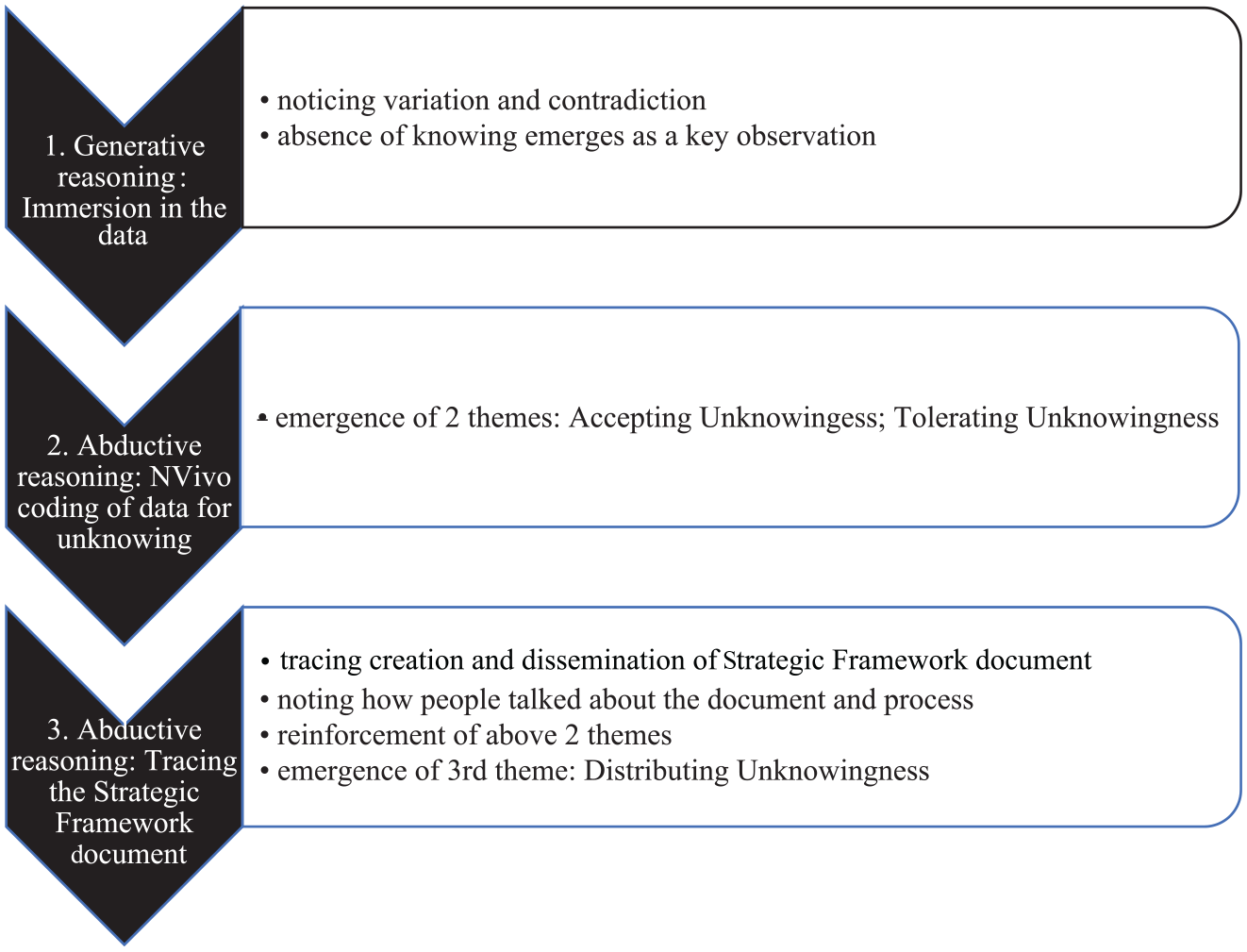
Steps in the process of data analysis.
Table 3 shows the coding that resulted from our reasoning process.
Coding table.
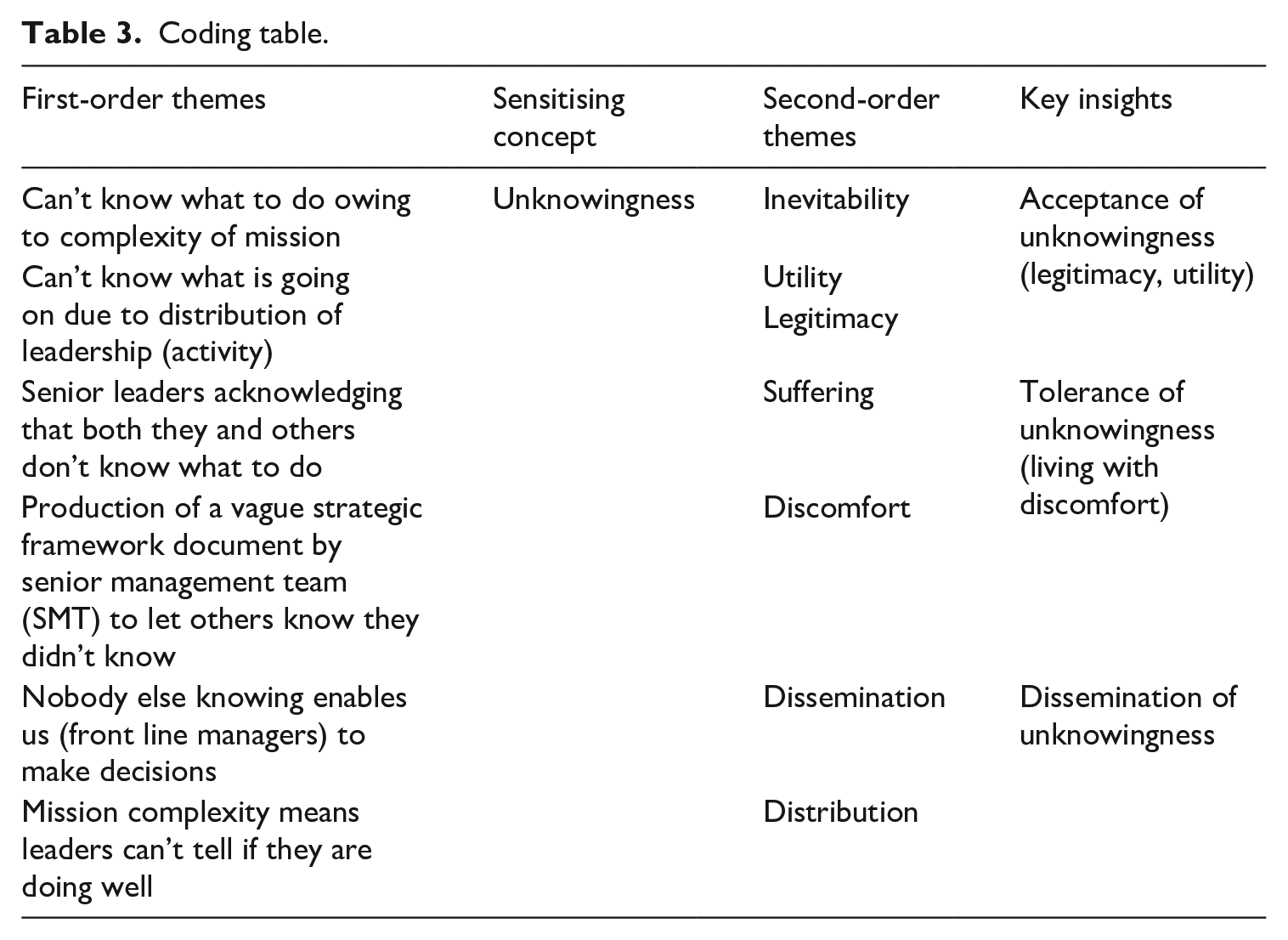
We now present the key insights from our study. For reasons of space, these only use selected quotes from the interview data and ethnographic observations.
Findings
Our findings reveal three main dynamics associated with unknowingness in FE. First, organisational members accepted not knowing as an integral aspect of the context of their work (accepting unknowingness). Second, at the same time as recognising the utility of unknowingness, there was a degree of discomfort resulting from their acceptance (tolerating unknowingness). Third, not knowing was disseminated through the organisation to enable navigation of the organisation’s complex mission (distributing unknowingness). In this section, we explore each of these in more detail, providing illustrative quotes from the data.
Accepting unknowingness
Our findings demonstrate the sense of there being open recognition and acceptance that central aspects of organisational activity within FE could not be known – what we term ‘known unknowns’. Members of FE talked openly about known unknowns, both in interview and in the course of their work. Those narratives, which centred around acknowledgement and acceptance of the known unknowns, served to legitimise what we have termed unknowingness within the organisation. Furthermore, we found that senior managers appeared to utilise unknowingness to enable decisions to be made, and hence work to continue, rather than stall, despite the inherent tensions in the organisation’s mission. Individuals’ lack of knowledge about what to do was made easier by collective acceptance of known unknowns that were ongoing and integral to FE’s mission. Respondents spoke about absences of knowledge concerning how they were meant to act in the context of the organisation’s inherently competing objectives, geographical dispersal and complex mission. Known unknowns were generated by conflicting impacts between different parts of their mission, contradictory external policies, working with remarkably long timeframes, the practicality of locally focused leadership, and persistent awareness of there being no right way to proceed. These became accepted as ongoing and legitimate aspects of FE’s work. The absence of (individual) knowledge about what to do was set in the context of the (collective) presence of known unknowns.
Conflicting aspects to the overall mission
Actions taken by members of FE could have positive impacts on one part of the mission, whilst simultaneously having negative impacts on another part of that mission. For example, the organisation benefits from attracting visitors, yet an excess of visitors has a negative impact on wildlife. Generating income from felling trees for timber provides important revenue, yet cutting down trees is detrimental for both visitor experience and wildlife conservation:
You can’t have people where there’s ground-nesting birds without disrupting them, and you can’t have forests with trails going through them without disrupting the forestry. You can’t have the trees and people enjoying nature, without the forestry or without the wildlife. (FB12)
Whenever the first author talked to anyone within the organisation, the recognition of tensions within the different elements of the organisation mission was explicit. This was whether it was a wildlife ranger talking about the disruption that bike races (that are good for public health) have on the wildlife (that they are trying to protect) (FB30); or an ecologist talking about the ‘balancing’ act of having to juggle competing demands from timber production, leisure activities and events (FB21), or the field-based employer talking about creating a habitat that looked after both dormice and snakes in the same place at the same time where they need very different habitats (FB28).
Competing government policies
Inconsistencies in policy create conflicts concerning how FE members comprehend and act on their responsibilities. For example:
You’ll have a policy which says we should be restoring heathland for example, but some of our heathland sites, because they were wooded heath, or heathy woods in the past, they’re also considered to be ancient semi-natural woodland, there is a policy which says we should restore those to site native species . . . You can’t restore heathland and restore native woodland, they’re mutually unexclusive [sic] . . .. (FB22)
In the quote above, the field-based staff member explained how the organisation was being asked to both grow trees and not grow trees, on the same piece of land at the same time. The same member outlined a similar situation when he explained how he was expected to cut down some dying Ash trees as they were a risk to public health, whilst also having to leave the trees standing owing to their role as a nesting site for bats (FB22). These conflicts around the species they were being asked to protect were widespread.
The intangibility of the mission
Organisational members lived with the inevitability of FE’s long timeframes. They made plans for up to 300 years ahead, even though it was impossible to know, for example, what the climate will do (hence which trees will grow best), what people will want and need in terms of timber, and its use, and how outdoor space and nature will be perceived and used in the future:
Obviously when we’re planning forestry, you’re looking at 10-, 15-, 20-, 30-, 40-year cycles really, so it’s difficult to predict what the market might want in terms of the materials further down the line. (FB29) In the future, it might not, we might say actually, our economy is in such a state that I’m sorry, we can’t look after snakes and sand lizards, we need trees now. (FB10)
We found that there was an explicit acknowledgement by FE members, both when talking about themselves and about others, that they did not know what to do. In the participants’ views, the inevitability of unknowingness was exacerbated by the non-availability of performance metrics:
So as land managers we have potentially many different points on the spectrum depending on the asset you are considering (a woodland, visitor centre, designated habitat) – it is no wonder we are constantly struggling to find what we ‘feel’ is the right balance. To make the ‘right’ choice objectively we need to be able to value/measure the social, environmental and economic outcomes of our choices – that is hugely complex, and no-one yet has found a clear and fair way of doing that across both financial and non-market public benefits. (FMD 6)
The point we make with these illustrations is the presence of multiple known unknowns within the organisation that were salient and openly acknowledged. Through acknowledging and accepting the known unknowns, organisation members gave legitimacy to unknowingness as a daily aspect of getting work done.
Tolerating unknowingness: Putting up with the discomfort of not knowing
Although there was widespread acknowledgement and acceptance of not knowing within the organisation, we identified discomfort and tension, particularly amongst those in senior management positions. Such discomfort was particularly manifest within SMT team meetings as senior organisational members tried to find key performance indicators to show how successful they were being:
As well as quantitative measures we need to understand whether we are making progress. How do we know what is happening with these things? We have lots of things that sort of tell us but don’t quite tell us how well we have done . . . We haven’t got to point where we can measure road to improvement. Have we got it right? We didn’t go bust. We are doing a lot of good things. People seem to like us. But that is not a good enough answer. (SMT 3)
The quote above was noted during a SMT away day when the members were reflecting on how difficult it was to measure success given their multiple conflicting objectives. They recognised that they could not define success, which made them feel uncomfortable, particularly when trying to portray how successful they were being to external stakeholders. At the same time, SMT members understood there was nothing they could do about it; they were left with no alternative but to tolerate the unknowingness.
The desire for convincing measures was voiced by those lower down the organisation as well. Members accepted that they would never be able to show that they are doing well, owing to the complexity and multi-faceted nature of their mission:
Different people will say that’s successful or not, depending on what their objectives are. If you talk to someone from the RSPB
1
they might say that’s not being very successful, because you haven’t got very many birds in there, or there’s no nest sites because you haven’t got low scrub. Whereas someone else might look at it and say, ‘You’ve got a fantastic assemblage of ferns and so on through there’, because it’s damp, it’s heavily shaded. (FB22)
As this quote shows, some wildlife experts would say that having a lot of small bushes is successful in terms of wildlife, whereas others would judge the success based on the number of birds present. As the researcher noted in her field notes, ‘the fact that they have to put up with the discomfort comes with the territory of the organisation and their role within it, and hence they seem just to accept it’.
As a government agency, FE was required to provide central government with answers to questions as to how they were doing, providing positive stories to be passed on to the public. However, in the face of conflicting organisational objectives and long timeframes, some actions with positive outcomes would have corresponding negative outcomes on another part of the organisation’s mission, making it impossible to measure success in any meaningful way. Additionally, the intangibility of some parts of the mission were impossible to measure. As one SMT member put it: ‘You will always struggle to put a value on a butterfly’ (SMT 11). Similarly:
The problem we have is that the clarity of whether the decision was right or wrong may actually take years to materialise because we are managing land and habitats where practical actions do not always deliver immediate measurable benefits. (FMD 6)
The SMT could be asked, at short notice, by central government to provide positive messages on any and all of the competing areas of their mission. Within their senior management meetings there was a continual focus on gathering data for that messaging. The lack of clarity around organisational success and how they had performed either organisationally or in terms of leadership effectiveness left them feeling uncomfortable and vulnerable to central government displeasure:
I think not being able to describe whether you’re meeting your objectives is not a good place to be, even if it’s quite hard to do it . . . [it’s not that] we just kind of run around and sell a bit of wood and do a few other things, there’s got to be more coherence to it . . . I think we could be seen as highly successful if we did all the things we do normally, or a real problem organisation, even if we’d done all of those normal things normally, but we’d got some of our political handling wrong. (SMT 3)
The data showed that alongside acceptance of the presence of unknowingness within the organisation, there was discomfort, but also widespread tolerance of that unknowingness, both their own and that shown by others. This included people holding no expectation that senior management would be all knowing.
So far in presenting our findings, we have linked the existence of known unknowns to the complexity of the organisation’s mission and geographical dispersal that characterised FE. The size and spread of many organisations, particularly in the public sector, would make this a familiar feature. However, our findings also highlight how, not only was unknowingness accepted (albeit with discomfort at times), but also that senior managers appeared to disseminate unknowingness through the organisation so as to enable decisions to be made at local levels, and hence to enable the organisation to get work done despite the tensions in its mission.
Distributing unknowingness
A non-specific strategic framework
A subject that was discussed repeatedly in senior management meetings during the time of the study was the production and dissemination of a ‘strategic framework’ document. This outlined 12 areas that should be covered within staff members’ work. Given the tensions we have already described, the 12 areas were often mutually conflicting. As an example, they simultaneously called for harvesting timber at the same time as creating special places for nature and providing quality experiences in beautiful locations. What the strategy document did not do, however, was give any direction on how to deal with tensions across the areas, neither did it offer success criteria for any of them. SMT members were aware that the document left many aspects opaque: ‘A weakness is, whilst it gives a clear vision and mission, there is no clarity about what that means in terms of outcomes which have to go across the triple bottom line’ (SMT 11).
Some SMT members described this less as opaque and more as ‘open’ – intentionally not giving direction, but helping people see where they fitted into the overall strategy:
I think it’s quite innate, about how you see yourself and your role fitting in to a wider picture, and in our strategic framework we’re hoping that everyone will be able to get behind our overarching statement, see how they fit in, and appreciate how other people fit in too, to that story. (SMT 7)
The fact that the local teams should interpret the Strategic Framework in their own districts was discussed explicitly in both the senior management meetings, and in the district meetings that the researcher attended. There was a clear narrative within the organisation that it was up to the local teams to interpret the Strategic Framework document as they saw fit, and the researcher sat in on district meetings in two of the districts where the local teams spent a day together doing exactly that: trying to work out what the Strategic Framework meant for them in their district.
Rather than the apparent absence of guidance in the Strategic Framework being experienced negatively, we saw that forestry management directors, whose role was to implement strategy in the field, found utility in the vagueness: nobody else knowing what to do enabled them to make decisions. The resultant vacuum gave them space to determine what to do:
We’re running the process at the moment of trying to convert [the Strategic Framework] into what it means for us, locally . . . This is our framework that says, ‘that’s what we’re about, that’s what we want to do or to deliver’. It’s my job to say, ‘with this asset-base what can I deliver against that?’ No-one’s telling me what to do, so I have reasonable autonomy to decide how best to deliver things against all these areas. (FMD 6)
The SMT’s struggle to find measures of performance provides a further example of the utility of unknowingness in the sense of facilitating decision making lower down the hierarchy. If performance could have been meaningfully measured, then a clear answer would have been expected and targets produced for different areas. Instead, organisation members were freed to make their own decisions about how to act in the face of local tensions. The impossibility for the SMT to measure organisation-wide effectiveness necessitated decisions based on what a wider group of members thought was best within their locality. This was all they could do, in the absence of knowledge as to what decisions were best. In this sense, therefore, not knowing what to do informed DL to enable effective navigation of the organisation’s complex mission at a local level. The fact that they had not defined what should be done, or what success looked like, was discussed by members of the SMT as intentional, as a way of leaving decision making to local staff.
The dispersal of decision making to local level
Owing to persistent tensions and the geographical spread of the landholding, it was accepted that most decisions within the organisation needed to be taken at a local level, thereby dispersing leadership in line with DL:
Because of geography and the nature of the business, people have always had to take on a lot of responsibility at the local level. (SMT 3) We are quite delegated in our decision making; we give people a lot of autonomy. (SMT 11)
This dispersal of decision making meant that those in senior leadership positions did not always know what was being done, even if they were ultimately responsible for it. There was persistent lack of knowledge in FE about what was happening across the whole organisation. This view was voiced particularly amongst the FMDs who talked about having autonomy but not control in terms of needing to push decision making further down the hierarchy to the local beat teams, a further demonstration of their form of DL:
I’m not in control here . . . I don’t know what’s going on. I’d be a fool to pretend, I try to get out to each beat twice a year which sounds pathetic . . . So, I’m not in control . . . all you can do here is set the strategy and talk to people about the vision, they have to interpret the detail themselves. I can’t possibly know the detail. (FMD 3) I don’t dabble in any of the detail of what we do on the ground, and I couldn’t keep up with it all, there’s so much going on I don’t know half of what’s going on. (FMD 6)
FE members painted a clear picture that there was no unambiguously right way to proceed, and this known unknown was acknowledged and accepted throughout the organisation:
I was mentoring a relatively senior colleague from [another] district who was saying they wished there was more direction nationally, but as we worked through it, I was sort of pointing out I think the problems are, or the issues we’re dealing with are, ultimately so complex and finely balanced on a very context specific that it is very difficult for the organisation to set out a very prescriptive way forward. And I think the current strategy . . . is probably about as far as you can go in terms of highlighting what sort of themes that we want to pursue and connections that we want to make and where it could be criticised for being all things to all people type strategy and virtually anything we do can fit it. Yes, it’s difficult to be more prescriptive than that, I think. (FMD 7)
Our findings suggest that unknowingness facilitated DL through the creation of spaces for the exercise of leadership across organisational levels and locations. Had SMT members shown they did know what to do, organisational members on the ground would have struggled to make decisions and would have spent time trying to work out what those further up the hierarchy wanted. In the next section, we discuss the interconnections between unknowingness and DL.
Discussion
We opened this article by asking, ‘What are the mechanisms that enable DL?’ Our study found that three interlinking mechanisms around unknowingness support and confirm DL: acceptance of unknowing; tolerance of the discomfort of not knowing; and distribution of unknowingness. We now discuss these further.
FE is an organisation that is characterised by DL in the sense that responsibilities and decision making are dispersed (Crevani et al., 2010; Denis et al., 2012), and leadership practice is a product of interactions between organisational members with and without explicit leadership roles (Bolden, 2011; Harris and Spillane, 2008). It is also an organisation whose complex mission means there are persistent organisational tensions and often little or no knowledge of how to act. The state of being with this lack of knowledge is what we are terming unknowingness. In FE, we found this to be widely accepted, inevitable and even positive for enabling decisions to be made and work to get done across this dispersed, complex organisation. Accepting unknowingness refers to both absence of knowledge and presence of not knowing. Organisational members accept the existence of persistent gaps in their knowledge about what to do. At the same time, there is collective awareness and acceptance of known unknowns. In FE, known unknowns were sustained by competing and contradictory external policies and the inherent tensions within the organisation mission.
Seeing lack of knowledge as something progressive in this way contradicts much management and organisation theory, in which not knowing is often considered as a deficiency (Saggurthi and Thakur, 2016). A prevalent assumption is that ‘there is something wrong in not knowing’ (Crossman and Doshi, 2015: 2; emphasis in original), and that the leader is ‘the one who knows’ and must ‘act decisively and give a strong lead’ (Simpson et al., 2002: 1211). Such views are persistent. For example, ‘as a manager you are used to being the guy who can handle it on his own. You are supposed to have all the answers’ (Luscher and Lewis, 2008: 230).
Existing thinking also positions not knowing as a temporary state of ignorance, ‘an absence or lack of data’ (Bernstein, 2009: 249), a ‘momentary state of not-knowing . . . that can be overcome to achieve a full understanding of the situation or issue in focus’ (Allen, 2017: 126). Our development of unknowingness (Hay, 2022) recognises there are situations that cannot be ameliorated by additional knowledge, when the impossibility of knowing what to do is integral to tensions and contradictions that are embedded into an organisation. In FE, 300-year tree-planning cycles and contradictory mission objectives mean that ignorance of a right course of action is inherent and permanent, and cannot be dispelled by data. The resultant unknowingness as a permanent, inevitable and accepted state challenges what is commonly understood as ‘not knowing’ in the literature. This latter perspective optimistically suggests that data have the power to dispel ignorance and provide knowledge. The incomplete knowledge within unknowingness also differs from ignoring, in the sense of deliberate inattention or active avoidance of information (Schaefer, 2019).
In this article, we put forward a counter-intuitive argument to the predominant assumptions that lack of knowledge constitutes deficiency. We argue that an absence of knowledge can have beneficial effects for leadership if such unknowingness is recognised, accepted and disseminated in that this enables distribution of leadership that helps an organisation to function in the face of competing or conflicting objectives.
Current theory recognises the inevitability of uncertainty and doubt that arises from the complexity of organisational life (Zembylas, 2005). However, the focus has been on the potential of individual’s (negative) capability to exploit that doubt (Crossman and Doshi, 2015; French, 2001). We have shown how unknowingness can be understood as an organisation-wide phenomenon and thereby part of collective leadership and mutual action. Our findings shed light on how absence of knowledge might be inherent within a system. This supplements discussion of not-knowing in the leadership literature that has predominantly been from the perspective of an individual not knowing something, which can be remedied, or how to do something, which can be learned. Similarly, although Hay (2022) introduced the term unknowingness, this was in relation to an individual’s ‘realisation of inadequacy to anything approaching full and comprehensive understanding’ (Zembylas, 2005: 142). Recognition that lack of knowledge is integral to processes of organising is present in some literature; for example, the notion of ‘uncertainty absorption’ (Bakken and Wiik, 2018) provides an organisational-level treatment of not knowing. However, the more prevalent view is that mastery can be achieved, and ignorance and doubt suppressed (a delusion that Alvesson and Spicer (2012) term ‘stupidity management’).
Recognition and acceptance of unknowingness is important because without that self-awareness organisations create and reinforce self-limiting ways of working when they fail to engage with the organisational realities of uncertainty, complexity and doubt (French, 2001; Vince et al., 2018). Our findings show the importance of tolerance of unknowingness in FE. Tolerance refers to organisational members’ emotional experience of not knowing. It is an accepted although not necessarily a comfortable place. It is frustrating not to have answers, not to feel that there is a right way to do things, not to have convincing measures of doing well, not to be able ‘to put a value on a butterfly’. The desire for simplicity is strong and remains part of peoples’ experience, even though the complexity that surrounds them is tolerated because it is integral to the work. This resonates with the concept of ‘negative capability’, which has been used to express the idea of being comfortable with the uncertainty of not knowing (Crossman and Doshi, 2015; French, 2001). Negative capability implies the capacity for individuals ‘to live with and to tolerate ambiguity and paradox’ (French, 2001: 482), to practice patience and possess the ability to tolerate frustration and anxiety (Simpson and French, 2006: 245). It is an approach that invites managers to be comfortable with uncertainty, mystery and doubt (Saggurthi and Thakur, 2016). The application of negative capability in leadership has focused on how individuals experience and respond to states of not knowing (Crossman and Doshi, 2015), and how leaders at the top of organisations should personally approach situations when faced with the complex, paradoxical and unsolvable. However, the notion of unknowingness provides a broader perspective than negative capability, enabling us to understand ‘not knowing’ across an organisation.
The argument for acceptance of unknowingness should not be taken to equate to tolerance of ignorance. There can be any number of risks associated with lack of information in decision making, and when a knowledge gap exists that could be filled, we are not making an argument for not doing so. Rather, our focus is on situations where knowledge is not and cannot be available, where factors such as complexity and very long timescales make it impossible to have full knowledge of the right course to take. These are the situations that the construct of unknowingness, defined as a state of awareness of both an absence of knowing and one’s inability to know, captures.
Leadership within DL is known to reside within the patterns of organising (Ospina et al., 2020). Our findings show how dissemination of unknowingness is integral to the leadership approach in the organisation. FE senior managers spent considerable time and energy creating a vague strategic document to inform other organisational members that they knew what to do generally, but not specifically. The opaqueness of the Strategic Framework supported the localised navigation of inherent tensions in the organisation’s mission and facilitated DL through the creation of localised spaces for the exercise of leadership across organisational levels and locations. As such, the process of distribution of unknowingness provides insight into how to navigate the complexities and tensions of the organisation mission. Conversely, the organisation’s existing DL provided a way of steering direction despite the inherent unknowingness embedded across the organisation. These dynamics help scholars and practitioners to understand how not knowing can promote insight rather than deficiency, and therefore its potential efficacy for leading in and navigating through complexity.
Unknowingness and DL are bound with each other in the sense that not knowing seems to support DL within the organisation, whilst DL addresses organisational problems associated with not knowing. The findings from this study lead to a theory of how unknowingness is an enabler of DL (Figure 2). Our research shows how unknowingness can be a key element in the process of distribution in DL because it enables navigation of tensions of leadership and action in complex organisations. A novel element of our theoretical contribution in this article comes from combining what we know about DL with what we know about not knowing. Our analysis resonates with calls for a deeper examination of the concept of not knowing in management studies (Roberts and Armitage, 2008) and a rethink of ‘the negative notions attached to not knowing’ to appreciate instead ‘its usefulness and inevitability’ (Crossman and Doshi, 2015: 6; emphasis in original). We provide an empirical example of DL in an organisation grappling with the complexity of inherent tensions in its mission, as commonly found in public administration.
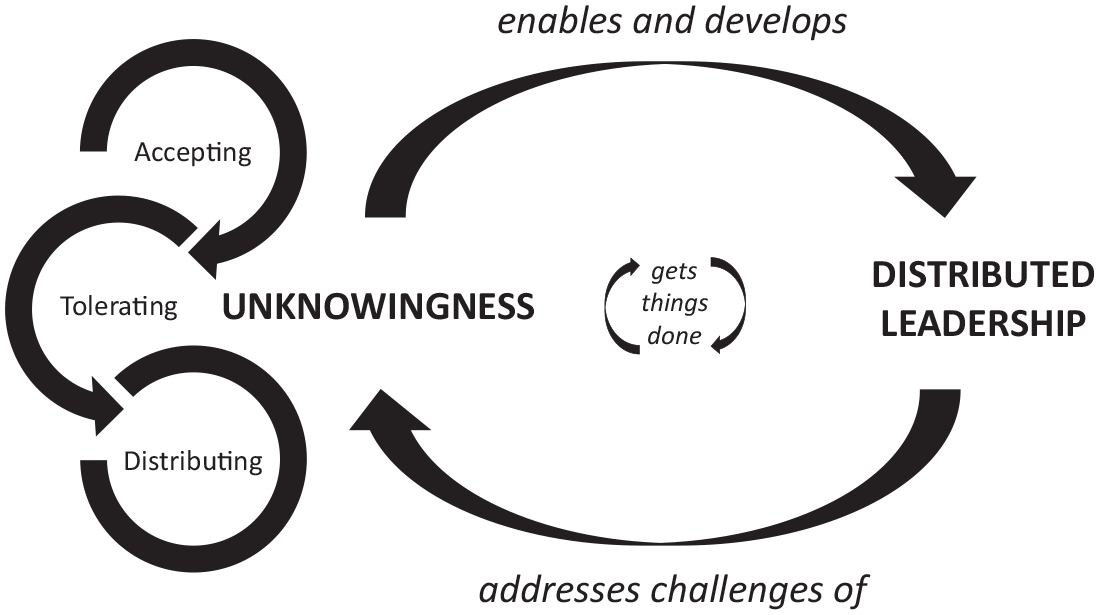
Theorising the relationship between unknowingness and distributed leadership.
Our second research question asked, ‘what is the interplay between established hierarchy and collective effort where there is an intent to distribute leadership?’ We argue that the utilisation of unknowingness within an organisation can facilitate DL, in the sense that people on the ground are enabled to take local decisions. In a context where unknowingness is accepted, spaces and opportunities exist for staff across wide parts of an organisation’s hierarchy to step into leadership. This is not to negate the agency of those in formal leadership positions. In FE, SMT members had positional power and exercised influence over the work done, for example, in drawing up the Strategic Framework document and leadership model. However, the case provides an illustration of the interplay between those with hierarchical authority and others dispersed throughout the organisation, whose influence within their localities collectively also shaped the direction of activity. As such, our research shows DL through a co-dependency between hierarchical and collective leadership (Holm and Fairhurst, 2018). This creates an integrated process of leadership development and capacity building across the organisation. In this sense, unknowingness not only has utility in achieving DL, but also is an influential means for extending leadership capability, both individual (Bolander et al., 2019) and collective (Vince and Pedler, 2018). It has already been recognised that the focus of leadership development in the context of DL should be on the development of leadership practice rather than the development of leaders (Spillane, 2006). One element of such development involves building capacity to accept not knowing and to sustain (not to avoid) the discomfort that comes with its acceptance. We think that this tension is an integral element of systems where DL can prove effective. By explicitly recognising unknowingness as a function of leadership practice, a wider section of leaders will be better placed with a mindset to hold ongoing tensions and to resist defensive or dismissive responses. This creates a process that further supports DL.
We think it unlikely that leadership can be exercised in a dispersed, collective manner when senior leaders feel and act as if they are solely responsible, and where other organisational members reinforce that expectation. Our view is that DL requires acceptance of unknowingness to promote a more collective practice, and to unsettle peoples’ over-reliance on individual leadership. Acceptance of ‘unknowingness’ recognises the inherent emotional, social and political complexity of management, and the doubt and lack of confidence in knowledge that has to be navigated in leadership roles and relations. This was the case in FE, where conflicting objectives and known unknowns were so integral to everyday work. Such an environment is well suited to DL, to engage the decision making and expertise throughout the hierarchy. However, their experience offers ideas that can easily be applied to other organisations where there is a hybrid combination of individual and collective approaches to leadership.
In this article, we have articulated a theory of unknowingness by combining existing thinking about DL with ideas about unknowingness to inform theoretical developments in DL. Our motivation to do this follows calls to expand the boundaries of research on DL. We have focused on what happens in an organisation when there is limited knowledge of how to act, and when persistent organisational tensions unsettle knowledge of what to do. Our analysis suggests that unknowingness is valuable in the process of distribution in DL. We have identified three inter-related mechanisms, which are the acceptance of not knowing; tolerance of the discomfort of not knowing; and the strategic distribution of unknowingness. These help to understand how unknowingness might promote insight rather than deficiency, and therefore its potential utility for navigating through tensions.
Whilst the ‘spreading of leadership across organisational levels has been promoted as a required capability for companies facing increasingly complex workplaces, business challenges and social problems’ (Lloyd and Carroll, 2019: 817), there has been little investigation of DL in complex contexts. Our ethnographic study therefore provides a rare example of DL in a setting outside education or healthcare, and in an organisation grappling with the complexity of inherent tensions in its mission.
Conclusion
We acknowledge several limitations of this study. The research was conducted within one organisation over a specific period of time, and we recognise the dangers of attempting to make generalisations from our analysis. Nevertheless, we think that our detailed narrative of FE and our analysis will be of interest to leadership scholars. We hope to stimulate further research around the idea of unknowingness within leadership practice as an underlying support for DL. There is also the potential for research reflecting different organisational contexts. This study was conducted within a public sector organisation with competing organisational objectives, which is a common situation. The findings will be of interest to scholars studying public sector organisations where there is a consistent pull between the conflicting demands of different stakeholders. The extremely long timeframes in FE are less typical of most organisations, hence further research might explore unknowingness within more typical public-, private- or third-sector environments, and the extent to which it could be used explicitly to develop leadership capacity in the context of conflicting public-sector demands. In addition, our study was conducted in an organisation where DL is adopted because of the complexity of the organisation’s mission. It could be interesting for future research to study unknowingness in other contexts of collective leadership with less convolution.
We recognise there are other theoretical lenses we could have explored, which with the limitations of space we could not do. Notably, firstly, what we have described as tensions in the FE organisation mission and objectives could perhaps benefit from being viewed through a paradox lens. Secondly, we recognise that a discussion of hierarchy and collective implies a power relation. Though we have acknowledged this, a detailed re-analysis of power dynamics within the case could also be a fruitful further study.
Effective theories generally have two characteristics: they should be original and useful. The originality of a theory stems from the creation of insights that reveal new ways of understanding. The utility of a theory recognises that such insights need to be practical and applicable (Corley and Gioia, 2011). Practically, our theory has value for informing thinking about the qualities and capabilities required for DL, as well as for mechanisms to develop such capacities. Theoretically, we provide an additional perspective on the value of not knowing in management and organisation studies, that contributes to countering leadership narratives of the heroic, all-knowing, all-powerful individual leader.
Footnotes
Acknowledgements
We are grateful to Forestry England and its members for enabling us to gather the data for this article, and to Nancy Harding, Norah Almubarak and Kerrie Howard for their insightful comments and valuable feedback on earlier drafts. We would also like to thank our Human Relations Associate Editor, Karan Sopal and the three anonymous reviewers for their developmental recommendations and support throughout the peer review process.
Funding
The authors disclosed receipt of the following financial support for the research, authorship and/or publication of this article: This work was supported by the Economic and Social Research Council [grant number ES/J50015X/1].
