




Abstract
This ‘Leading Questions’ thought piece explores the elusive nature of collective leadership. We use our previous experiences to explore issues that tend to go unnoticed and unreported within the academic analysis of collective forms of leadership, including (1) the motives of those commissioning and conducting applied research to ‘make a difference’ through collective forms of leadership; (2) the performative effects of how ‘collective leadership’ is framed; and (3) the extent to which ambiguity around the nature of collective leadership makes it a powerful ‘empty signifier’ for holding incompatible and inconsistent conceptions and ideologies. Such issues, we suggest, are inherent features of the landscape of collective leadership theory, policy and practice and have important implications for scholars, practitioners and developers.
Introduction
Whilst much contemporary leadership theory and research remains highly leader-centric, since the 2000s there have been significant developments in conceptualising leadership as a collective process, widely distributed across people and contexts, (see Bolden, 2011, Cullen-Lester and Yammarino, 2016, Döös and Wilhelmson, 2021, Fairhurst et al., 2020; Jones, 2014, Ospina et al., 2020; Sweeney et al., 2019; Ulhøi and Müller, 2014; Zhu et al., 2018 for reviews). These reviews have noted a proliferation of terms and significant differences in the meanings attributed to them (Ospina et al., 2020), conceptual inconsistency and understanding (Döös and Wilhelmson, 2021; Zhu et al., 2018) and a lack of contextual appreciation (Sweeney et al., 2019). Hence, ‘collective leadership’ whilst becoming more mainstream (as is the call from Döös and Wilhelmson, 2021), is also in danger of becoming even more ambiguous and elusive. In the most recent review, Döös and Wilhelmson suggest ways forward that link concepts of managerial shared leadership to plural ideas and critical leadership studies. It is this later point we build on in this leading questions piece and aim to illustrate how engaging from a critical perspective reveals important aspects of collective leadership that might otherwise remain hidden. As researchers who have been actively involved in the field for the past two decades, we felt this was an opportune time to look back at our own experiences of researching and developing ‘collective leadership’ and to consider what additional insights could be gained. We were led by provocative questions such as, how and why has ‘collective leadership’ been interpreted and operationalised in the ways that it has by academics and practitioners (including ourselves)? Is collective leadership always a useful concept for organisations or are there times when it may be problematic? If collective leadership becomes mainstream, will it lose its potency as a counterpoint to more leader-centric perspectives? These, we suggest, are not just questions we are wrestling with but are also issues that the wider community of leadership scholars should consider.
To enable the potential to look back in a structured way on personal experiences, we used several of our own studies as prompts for a series of reflexive conversations. These studies, whilst directly concerned with collective leadership, framed and operationalised it in a number of different ways and in a variety of contexts. Looking back at these experiences, we were particularly interested in exploring the following questions: How is ‘collective leadership’ conceived? When and how is it evoked? How does this play out within the different projects? Why were particular framings of collective leadership used within these projects? What purposes did they serve and for whom? These were the guiding questions we explored in co-constructed narratives (see Kempster and Stewart, 2010), and from which we identified the themes outlined in this paper.
In exploring these questions several other concepts emerged as useful frames for our enquiry. The first of these was the notion of ‘socially constructive’ theory and research. Drawing on the argument of Grint and Jackson (2010), we considered the extent to which understandings of ‘collective leadership’ may be socially constructed in the hope of making the world a better place. Whilst the intention to make a positive difference is to be encouraged, however, we also noticed a shadow side that merits attention if we wish to avoid colluding in processes that may reinforce existing power imbalances and inequalities.
Secondly, we drew on the notion of ‘negative ontology’, as outlined by Kelly (2014). From this perspective we considered the extent to which ‘collective leadership’ may be an empty signifier (Laclau, 1996), which ‘… does not signify anything specific or fixed, but instead serves to create the conditions of possibility for many competing and complementary definitions, meanings and interpretations’ (Kelly, 2014: 906). To date, little attention has been given to this idea in theorizing or developing collective leadership, and yet it has the potential to explain differences in the popularity and uptake of theories and concepts in different settings.
Thirdly, in our conversations we also explored the ‘performative’ nature of ‘collective leadership’. Whilst recognising the multiple perspectives on performativity within organisation studies, in this paper we take Marti and Gond’s (2018: 488) definition whereby ‘… theories do not merely describe, but also shape the patterns of social interaction that constitute social reality’. This definition is used, as opposed to other material on performativity (see Gond et al., 2016 for a review), as it focusses on theory development and the potential for theories to become self-fulfilling. Furthermore, we recognise those scholars that have highlighted the performativity of leadership discourse more generally (e.g. Denis et al., 2012; Knights, 2021; Simpson et al., 2018).
Within this article, therefore, we consider the links between the performative nature of ‘collective leadership’ with social constructiveness and negative ontology. To give some background to our conversations we begin with a short overview of the collective leadership literature (see earlier citations for more extensive reviews).
Collective leadership
Whilst there is evidence that collective forms of leadership go back much further (see Edwards, 2015), it is since the turn of the millennium that notions of ‘collective’ (e.g. Mattanini and Holtschneider, 2017; Novicevic et al., 2017; Raelin, 2018), ‘plural’ (e.g. Denis et al., 2012), ‘dispersed’ (e.g. Gordon 2010), ‘distributed’ (e.g. Gronn, 2002), ‘shared’ (e.g. Döös and Wilhelmson, 2021) and ‘systems’ (e.g. Ghate et al., 2013) leadership became popularised as credible alternatives to the leader-centric theories and practices that preceded them (Western, 2019). Despite some variation in their origins and applications (see Bolden 2011; Denis et al., 2012; Edwards, 2011), these perspectives share a common commitment to viewing leadership as a collective process rather than as a property of individuals and their behaviours (Denis et al., 2012: 212).
We also note how collective leadership research is characterised by a focus on the ‘constitutive’ role of context (Spillane et al., 2004) in developing and mobilising leadership that is frequently absent in more individualistic approaches (Porter and McLaughlin, 2006) and the call for greater appreciation of context in collective leadership research (Sweeney et al., 2019). Also, we appreciate how collective leadership (however described) has not been confined to academic theory and research but has had a significant impact on practice in areas including education (Spillane and Diamond, 2007), healthcare (West et al., 2014), public administration (Ospina, 2017) and commercial organisations (Sweeney et al., 2019). The enthusiastic adoption of collective leadership in such contexts, whilst promising, has not been without its difficulties. Indeed, there is mounting evidence to suggest that in application, collective leadership, like many concepts, may become politicized, distorted and/or co-opted as a vehicle for maintaining, rather than challenging, existing power structures (see Gosling et al., 2009; Grint and Holt, 2011; Hatcher, 2005, 2008). Hence, we wish to continue the work of others (e.g. Empson, 2020; Empson and Alvehus, 2020) in foregrounding the power and politics of collective leadership.
As we progress in researching, practicing and developing collective leadership – at a time where it is moving from an alternative to a mainstream approach (Döös and Wilhelmson, 2021) - it is a timely to reflect on the challenges of connecting theory and practice and the implications for future scholarship in this area. Wicked problems such as climate change and the recent Covid pandemic, for example, show how collective forms of leadership are likely to become the norm (Grint, 2010a, 2020). These issues were not and will not be tackled through individualistic, heroic models of leadership but require the mobilization of collective effort, beyond roles and boundaries (Kars-Unluoglu et al., 2022).
An anchor for the discussion and reflections in this paper is a recent framework provided by Ospina et al. (2020). They map out approaches to collective leadership research through a four-cell framework, situated across two axes: (1) the locus of leadership – as a group or system level phenomenon, and (2) the view of collectivity – as a type or a lens (see Figure 1). We use this when discussing our own conversations later in the paper. A map of collective approaches to leadership. Adapted from: Ospina et al. (2020: 443)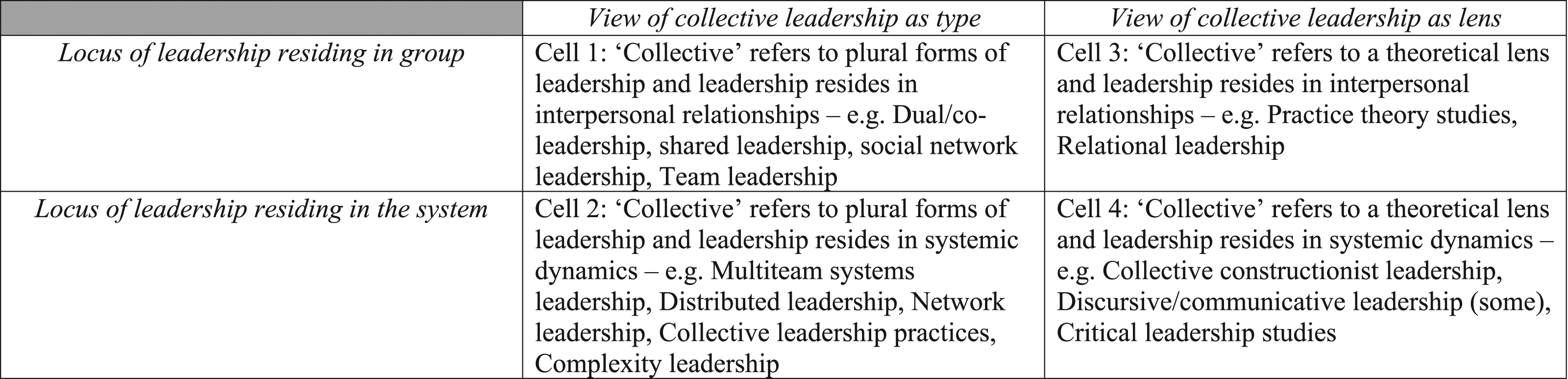
Furthermore, we take note of Fairhurst et al. (2020) ‘road map’ and the challenges they highlight for collective leadership researchers. Firstly, they point to the fundamental ambiguity of the space in which collective leadership resides. Secondly, they highlight the definitional problems inherited from leadership studies more broadly and lastly, they urge researchers to embrace issues of process in collective leadership research. We respond by asking the following key questions: How and why were framings of collective leadership used within these projects? What purposes did they serve, for whom? What does reframing leadership as ‘collective’ do? And how is it beneficial or otherwise?
In providing reflections from our own experience, we hope that others may be encouraged to take a similarly reflexive approach within their own research, practice and development.
A reflexive conversation approach
The method for our reflexive conversation approach involved a series of in-depth discussions, in which the second author (Richard) reflected on a number of research projects where he had acted as principal investigator, whilst the first author (Gareth) acted as a questioner and provocateur. As mentioned in the introduction, this provocateur role involved using notions such as ‘social constructiveness’ (Grint and Jackson, 2010), ‘negative ontology’ (Kelly, 2014) and ‘performativity’ (Marti and Gond, 2018) as critical lenses with which to delve deeper into the narrative provided. In each conversation there was a continuing interchange of reflections and looking back at previous reflections with differing viewpoints. Hence, true to our reflexive approach, we hoped to rework our knowledge as ‘knowing-from-within’, making sense of the situations we were in through what we now say and do (Cunliffe, 2002). We also sought to turn our reflections back on ourselves (Lawson, 1985) to question our emerging understandings of collective leadership over time. This approach was considered both relevant and timely given how theory has outpaced empirics in collective leadership scholarship in recent years (Ospina et al., 2020) and the need to capture insights into how this work is being used to inform policy, practice and development. We also believe that using this type of approach can help deepen the quality of dialogue between leadership researchers and practitioners, the need for which is highlighted by Ospina et al. (2020). By standing back and taking a long-term view, this approach enabled us to step outside the boundaries of specific projects and papers to take a more meta-level perspective that enables patterns and connections to be drawn between different projects over time. One limitation we identified in our approach, however, was in response to the ‘Who am I’ questions encouraged by Fairhurst and Grant (2010) in encouraging us to be reflexive about our social constructionist account. Our response to this question was that we were both white British, middle-aged males and hence, whilst we do not see any explicit bias towards a masculinised interpretation, this might be implicit in our conversations.
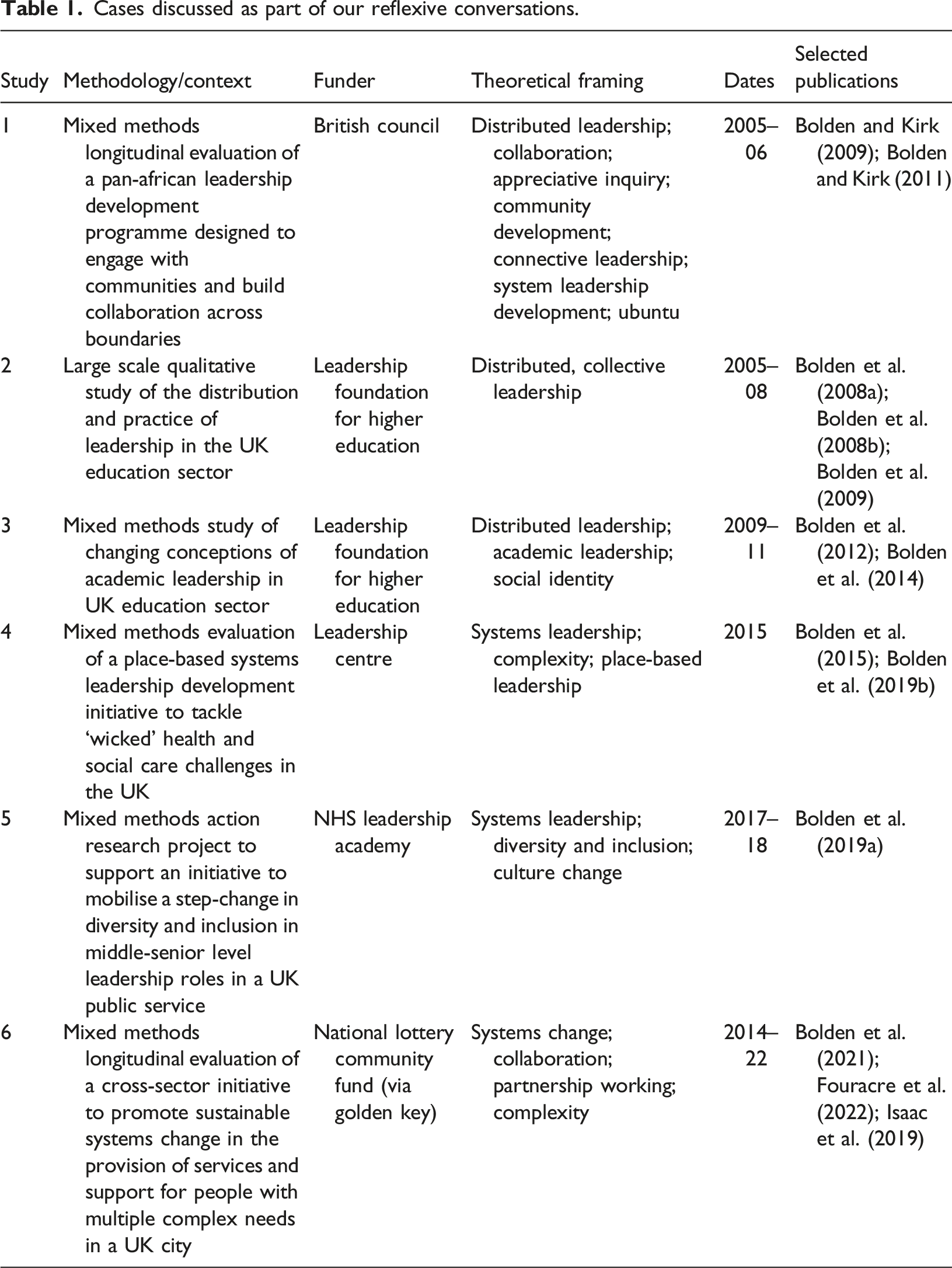
Cases discussed as part of our reflexive conversations.
Situating the studies
Before presenting insights from the reflexive conversations, we begin with a brief overview of the six studies that informed our discussions. What is perhaps most notable from Table 1 is the diversity of contexts, methodologies, and conceptual framings across these studies. They were not undertaken as a coordinated set of projects, with an explicit aim of developing an integrated understanding of ‘collective leadership’, but rather a set of standalone inquiries linked by the emerging interests and orientations of the project lead (Richard) and the commitment of those funding them to better understand the nature and processes of collective leadership in its broadest sense.
The diversity of theoretical framings was not accidental, nor based on the assumption that these approaches are equivalent or interchangeable. Instead, framings were chosen to (a) reflect key conceptual developments in the theory and practice of leadership at the time of the studies, (b) to mirror the terminology used within the sector/context where the research was conducted, and (c) to align with the primary aims/focus of the organization that commissioned the research.
Study 1 was funded by the British Council as an independent evaluation of a pan-African leadership development programme that sought to develop the capacity of participants to lead change within their communities and to strengthen collaboration across boundaries. There was no explicit framing of leadership from the funder or provider although the approach was heavily informed by appreciative inquiry and community development. In analysing and interpreting findings, we drew on concepts of connective leadership (Lipman-Blumen, 1996), collective empowerment (Reed, 2001), dialogue (Isaacs, 1999) and organizational learning (Senge, 1990) to develop a framework for ‘system leadership development’ (see Bolden and Kirk, 2011). It was around the time of this study that we first became aware of emerging theory and research on distributed leadership although, given the organisational (rather than community) context of much of this work, we made little explicit reference to this within publications arising from this project. A concept that was explored in some depth, however, was ‘ubuntu’ – a philosophy of mutual interdependence that was widely recognised within many of the countries where the research took place (see Bolden and Kirk, 2009; Bolden, 2014).
Whilst Study 1 was influenced by, but not particularly framed around the notion of distributed leadership (Gronn, 2000, 2002), Study 2 was specifically designed to explore this perspective. The project proposal was developed by the research team in response to a call for empirical research into leadership in higher education (HE) by the recently established Leadership Foundation for Higher Education (since assimilated into Advance HE). Given the fact that most existing theory and research on distributed leadership had been conducted in schools, it was felt that this was an ideal opportunity to extend empirical research into the HE arena. Given the aspiration of the Leadership Foundation to fund projects with practical relevance for its member organisations (HE institutions in the UK and abroad), however, the research was positioned to explore the implications for ‘developing collective leadership’ (Bolden et al., 2008a). Within this study a distributed leadership framework was used to explore how universities and other HE institutions might more effectively ‘distribute’ leadership across and beyond the holders of formal leadership and management roles (see Bolden et al., 2008b, 2009).
Study 3, also funded by the Leadership Foundation for Higher Education, built on from the findings and conclusions of Study 2 and was commissioned with the aim of understanding ‘changing conceptions’ of ‘academic leadership’ (Bolden et al., 2012). The study combined a distributed leadership framing with insights from a social identity approach to leadership (Haslam et al., 2010) to explore the identity dynamics through which academics (not necessarily in formal management roles) become motivated to lead and/or follow others and how they perceive and experience leadership more broadly within the sector. An additional collective framing used within this work was the notion of ‘citizenship’ given its relevance within academia (see Bolden et al., 2014).
Study 4 marked a shift in focus from leadership within organisations to leadership across systems of organisations collaborating to address shared challenges. The empirical work was commissioned as an independent evaluation of a ‘systems leadership’ intervention delivered by the Leadership Centre, which took a place-based approach to building systems leadership capacity (see Bolden et al., 2015, 2019b).
A systemic framing of collective leadership also informed Study 5 - an independent evaluation research project designed to inform and capture learning from a national initiative from the NHS Leadership Academy to develop and promote greater diversity and inclusion within the healthcare workforce in England. A collaborative action research approach was taken, whereby the research team supported the team leading this work in developing spaces for learning and reflection, whilst also doing in-depth case studies of change projects in a number of locations around the country. Due to the shifting political landscape of health and social care, and series of organisational restructurings, findings from the research are yet to be made public, although a literature review completed as part of the work is in the public domain (Bolden et al., 2019a).
Finally, Study 6 is the local evaluation of an eight-year partnership project to mobilise system change around the design and provision of services for people with multiple complex needs (a combination of homelessness, drug/alcohol dependency, repeated involvement with the criminal justice system and a history of mental health problems). Whilst neither the project nor the evaluation was framed specifically in terms of leadership, the project brought a range of insights into building cultures of collaboration, partnership working and mobilising systems change (see Bolden et al., 2021; Fouracre et al., 2022; Isaac et al., 2019) that have relevance for the practice and development of collective leadership.
Together these projects provide insights into a range of contexts where collective, rather than individual, conceptualizations of leadership are present, as well as being actively promoted by those involved. We now turn our attention to what insights were revealed from the reflexive conversations about the similarities, differences, and interconnections between these six studies. We use examples of Richard’s reflections to illustrate the themes that emerged.
Themes from our conversations
‘Socially constructive’ social constructions
Our first observation of note was how all these interventions were based on a wish to promote more inclusive forms of leadership and to mobilise beneficial social change. Hence, we held Grint and Jackson (2010) as a key text in our ongoing reflective conversations where they promote a ‘socially constructive’ view of leadership where ‘… it is possible to generate a critique of the status quo and simultaneously provide alternatives that might be more equitable, or more efficient, or even less equitable for the sake of efficiency’ (ibid: 350). We found that this creative tension played out in our own work as scholars seeking to critique mainstream approaches to leadership whilst mobilising alternative, more inclusive perspectives. We recognised the challenges and limits of taking a ‘critical’ perspective whilst seeking to support practitioners (including ourselves) involved in the day-to-day work of ‘leadership’ (Collinson, 2014, 2017). Hence, we believe these programmes were largely socially constructive (Grint and Jackson, 2010) in orientation. Within our conversations we found 20 examples of when we highlighted evidence of collective forms of leadership being described in a socially constructive way, where there was emphasis on these forms of theory and practice being used for the benefit of certain organisations, groups, or communities.
Here we see examples of institutions recognising limitations in their orientation and hence using the concept of collective leadership as the basis for transforming their own practice. For example, the quote below (referring to Study 4) seems to resonate: “… so there’s been a kind of joint narrative actually, one which is kind of going so placed based leadership in systems is necessary and valuable and important because it helps give better service and better experience to people and more control to people living in places.” (Conversation 3, page 6)
Similar issues were explored in Conversation 1, where we considered the aspirations of those commissioning the research and associated interventions, noting an aspiration to enhance the reputation and/or performance of groups and organisations. “… for the British Council [Study 1] this was a noticeably different sort of intervention for them and I think was part of their attempt of shifting to a more … post-colonial view of what they might be like… as an organisation that historically is really about promoting British interests and British culture …in other parts of the world…to Britain as a kind of friend, ally and partner who…you might start to try and collaborate with on things in the future then because you had a positive experience of them on things like this then they may well be the partner that you go to rather than somebody else…” (Conversation 1, transcript page 14)
These examples suggest that whilst the ‘socially constructive’ nature of collective leadership is usually represented in ideological terms (e.g. as more ethical or inclusive) it can also be considered in rather more instrumental terms (e.g. as something that improves outcomes and experiences for service users, but which can also enhance the profile of the sponsor organisation). The politics of reputation management and organisational image (see Vigoda-Gadot, et al., 2003) suggests a potential ‘shadowy’ ‘under belly’ (Conversation 1, transcript page 20–21) to notions of social constructiveness, whereby good intentions may become politicized and distorted if a critical perspective is not maintained. We see this as indicative of the tensions around positioning collective leadership within a particular cell on Opsina et al.’s (2020) matrix and a tendency to reframe how the concept is conceived according to audience/s and agenda/s.
Besides considering the intentions of those commissioning the work, however, the co-constructed nature of our conversations also drew attention to our own motives for engaging in projects, notably in terms of “…wanting to do some good” (Conversation 1, transcript page 19). Again, we see an example of the wish for the work to create some form of social good (e.g. emancipation, inclusion) whilst using the implicit collective concept as a basis for doing so (‘for people wherever they happen to be in the system’). Notions of emancipation and inclusion were concepts that also started us thinking along the lines of the inherent ideological nature of the projects and programmes we were discussing and drew our attention to the negative ontological perspective highlighted by Kelly (2014) and discussed further below.
Towards a negative ontology of collective leadership
From our second conversation onwards, we noticed the extent to which ‘collective leadership’ could be considered as an ‘empty signifier (Laclau, 1996) into which varying (and occasionally incompatible) intentions, interpretations and ideologies were being placed. This seemed to position our reflections most closely within Cell 4 of Ospina et al.’s (2020) framework (see Figure 1), whereby collective leadership is viewed a ‘lens’ that resides at system level. Through engaging with Kelly’s (2014) notion of ‘negative ontology of leadership’ we considered the extent to which collective leadership could serve as a container for differing views and perspectives before it began to leak or fall apart. This is like others who have used a different ontological basis from which to explore collective leadership, such as Youngs (2017) who used a practice-based ontology to transcend the limitations of distributed leadership. Our conversations likewise indicate the benefits of shifting from a traditional dualistic leader-follower, them and us ontology, to gain a deeper appreciation of how conceptualisations of collective leadership operate.
We do not view ‘collective leadership’ therefore as a collection of people or interactions but more as an ‘epiphenomenon that organises and determines our experience of social reality and our experiences of ourselves’ (Kelly, 2014: 908). By taking this view we believe our reflections on collective leadership sit slightly outside the framework provided by Ospina et al. (2020). Our methodology of retrospective reflexive conversations uncovers a perspective on collective leadership as a meta-level concept that doesn’t seem to fit a ‘group’, ‘system’ or ‘type’. Whilst we see the concept as a ‘lens’ on leadership practice its locus is figurative rather than actual. In this, we agree with Kelly’s assertion that leadership is always epistemological - being arrived at retrospectively as we try to make sense of what happened or was observed (hence the relevance of looking back as we have done herein). Kelly goes on to explain that by taking a negative ontological view we then are pushed towards a sense that it is ideology (also highlighted by Alvesson, 2019) that shapes collective leadership theory and practice rather than a positive ontology.
When re-reading the conversations, we noted moments where spaces were being filled with ideological rhetoric or where there was an interchange of ideology present in the narrative. These instances, we felt, represented an empty signifier where a ‘collective’ approach to leadership was given meaning through its ability to represent an ideological commitment rather than an empirical reality. We were aware of a possible contribution here in response to Kelly’s call to understand the ‘…strategies employed by organizational members to make sense of the complexity and open-endedness of everyday life’ (2014: 910). We believe that linking a ‘socially constructive’ perspective to notions of ‘negative ontology’ helps to illuminate how these strategies might be envisioned for analysis purposes, and hence a basis for identifying how empty signifiers might be preceded by and interrelated to other signifiers. With regards to our conversations, we found 16 examples of when we highlighted evidence of collective forms of leadership being filled with differing ideologies. Some examples include: “I can’t remember the exact wording but certainly the intent was … about kind of mobilising and releasing energy and capability and developing … collective capability to develop whatever it happens to have been.” (Conversation 1, transcript p. 13) “The idea was around health sector reform so kind of the whole systems reform but systems leadership as a particular kind of lever within how to mobilise whole systems change… and very explicitly framed around the idea of systems leadership and kind of dealing with wicked problems and a placed based approach to leadership… It could be traced back to things like… devolving decision making and accountability around provision of services and framing and shaping of services to citizens in local places and also those people leading and running services in local places. So, it’s part of an interesting tension that exists and continues to play out between centralisation and decentralisation in government policy.” (Conversation 3, p. 3)
In the examples here we see the empty signifier being filled with differing ideologies such as inclusivity, mobilization, releasing energy, collective capability, distributed-ness, whole systems, total place, and devolved decision-making to highlight a few. It seems all were being used in connection to, or under the umbrella of, collective forms of leadership. A question that remains from Kelly’s paper, however, is what purpose is achieved by the filling of empty signifiers? We believe that our conversations may provide a possible response – performativity. Our reflections suggest that by attempting to be reflexive through a negative ontological perspective we start to uncover the position collective leadership holds within a performative process. We also show how this plays an important role in starting off the performative process by acting as the boundary condition – ‘powerful initial backers’ (see Marti and Gond, 2018). We explore this in greater detail below.
The performative nature of ‘collective leadership’
It was during the fourth discussion when the notion of performativity (Marti and Gond, 2018) emerged as a potential way of making sense of the boundaries of a negative ontological approach. At this point in our conversations the focus seemed to shift back towards the tension between ‘type’ and ‘lens’ according to Ospina et al.’s (2020) framework. The point we make here is that for collective leadership to have an impact on practice (in a socially constructive sense) it cannot simply be a case of ‘everything goes’ (as implied by the ‘everyone is a leader’ notion articulated in some accounts of distributed forms of leadership - e.g. Bajer, 2009), nor can the concept be a meaningless fantasy (Sveningsson and Larsson, 2006) with no practical utility. Here, therefore, we challenge the binary distinction between ‘type’ and ‘lens’ presented in Ospina et al.’s (2020) framework and suggest that there are more fluid, substantive, and possibly unseen effects associated with the shift towards more collective framings of leadership that also hold power. We used the paper by Marti and Gond (2018) to help us search for these perhaps powerful performative processes evident in our own narratives. They suggest that theories become performative or self-fulfilling when they a) motivate experimentation, b) if experimentation produces anomalies and c) if these anomalies lead to a practice shift. Within each of these process stages Marti and Gond (2018) emphasize the importance of boundary conditions such as ‘material devices’ and ‘powerful initial backers’ for the experimentation stage, ‘visibility of effects’ and ‘counteracting behaviour’ for the anomalies stage and ‘discontent with the status quo’ and ‘sense-giving by convinced actors’ for the practice shift phase. They go on to suggest that these boundary conditions act as moderators influencing the strength of relationship between concepts. We were therefore interested in searching out instances when any of these boundary conditions were evident in our conversations. Within our conversations we found 12 examples where we highlighted differing forms of performativity playing out on collective forms of leadership. This was particularly evident in relation to the performative role of authorial voice, such as the ‘graph of doom’ and the concept of ‘distributed leadership’ itself: “The ‘graph of doom’ [referred to by one of the organisations in Study 4], was a graph of the amount that it cost them to deliver adult and children’s services, which kind of increases year on year, and then the amount of budget that they were going to be getting to provide this which kind of decreased year on year and there’s a point when the two graphs cross and you’re going to go ‘you know clearly this isn’t going to work for very long’.” (Conversation 3, pp. 6–7) “[A colleague in another institution] had done a lot of work around distributed leadership, using it as a framework for understanding leadership in [the higher education] context. And you know the observation along the way that whilst we were I suppose, particularly in that first piece of work [Study 1], going into universities and trying to look around to see to what extent is there evidence of distributed leadership...” (Conversation 2, pp. 13–14)
Despite these authorial voices, mapping our conversations onto the performative categories highlighted by Marti and Gond (2018) proved difficult but we gained a general impression from the conversations that collective forms of leadership were being used to motivate experimentation and facilitate shifts in practice. What increasingly appeared significant, however, was the interrelated and dynamic nature of authorial voices within our socially constructive and negative ontological interpretation.
Future challenges in collective leadership research
Our reflections suggest that collective leadership is represented by several empty signifiers (Laclau, 1996) that play an important part in the sense-making processes (Weick, 2012) through which dominant discourses of leadership are reframed (Fairhurst, 2005). However, we go further by illustrating how these empty signifiers are created through the socially constructive orientation of collective leadership notions and then interact with performative social processes. In this case example we would suggest that our ‘looking back’ has opened up further questions for collective leadership research, including: To what extent are collective notions of leadership part of a performative process? How can we capture the intricate interplay between socially constructive intentions, empty signifiers, ideological interpretations and performative aspects of social and theoretical interaction in leadership research? These questions, amongst others, can hopefully guide collective leadership research to continue in the critical paradigm whilst also working with these notions in more practical environments.
In addition, we observe that collective notions of leadership (including distributed, shared, plural, etc.) seem to have a socially constructive narrative given the response they have to previous interpretations of leadership being too leader-centric. We note in our conversations however that leader-centred and individualised notions of leadership still hold performative power in social terms and are therefore always in danger of return, like Grint’s (2010b) view of leadership as sacred. By ‘sacred’ Grint suggests that the individualised (heroic) notion of leadership is too powerful a notion to be denigrated owing to the performative social space in which it has been created. He goes on to suggest that the only way to desacralize individualised heroic notions of leadership is to (re)sacralise collective forms of leadership. But, as we highlight, there appears to be an inherently dynamic aspect to conceptualisations of collective leadership, which are continually squeezed by performativity themselves and pushed and pulled by social constructiveness. This, in our minds responds to the interpretation highlighted by Döös and Wilhelmson (2021), whereby pluralistic concepts used are much more complex in their construction than previously recognised. Our challenge to collective leadership researchers is firstly to recognise these underlying power dynamics and then to challenge their own research to question what this means for researching, developing, and practicing leadership within and across organisations and society. This, we see, is central to the need to frame shared, distributed or collective leadership from within a critical perspective as is also suggested by Döös and Wilhelmson (2021). Hence the following questions come to the fore in our attempt to capture collective leadership: How can we harness the fluidity and dynamism of the concepts we use? What are the power mechanisms that put pressure on the concepts in use and what are the implications and repercussions?
In practical terms, we see empty signifiers as vehicles for pragmatism as well as ideology. In Studies 4, 5 and 6, for example, notions of ‘systems leadership’ and ‘systems change’ are used as means for mobilising collective action and collaboration to address systemic, intractable challenges that traditional hierarchical approaches would be unable to achieve. Further examples include how the notion of ‘distributed leadership’ has been embedded into the Ofsted inspection regime for schools in England – thereby obliging schools to ensure that teachers at all levels, as well as pupils, recognise that they have an important role to play in the leadership of learning, whilst failing to seriously (re)consider how power is distributed and enacted (Hatcher, 2005; Lumby, 2017). Similarly key health and social care bodies in the UK have made a commitment to embed compassionate and inclusive leadership at all levels yet there remain systemic barriers to inclusion and under-representation by people from marginalised groups (Bolden et al., 2019a; Kline, 2019). Hence, we feel that there is opportunity here for further research to integrate the ‘collective’ notion with emerging ideas on inclusive leadership (e.g. Roberson and Perry, 2021) and diversity issues more generally. Some further questions for collective leadership researchers therefore are: How does collectively impact on diversity and inclusion? How might collective leadership also exclude?
Together, we believe our reflections in this paper relate to both critiquing functionalist notions of ‘collective leadership’ in uncertain and challenging times and demonstrating how the performative effects of language and framing play a constitutive role in leadership processes and outcomes. Within this thought piece paper, we recognise that we have only scratched the surface with the concepts we use. For example, exploring the performative nature of ‘collective leadership’ needs a deeper level of engagement with foundational texts such as Austin (1962). We appreciate here that we are ‘borrowing’ the concept (see Gond et al., 2016) for the purposes of exploring collective leadership and further research is needed to develop a much deeper appreciation of nuances derived from a performative approach. Having said this, we do also recognise those using the notion of performativity within Critical Management Studies (CMS) to deconstruct and expose power relations (e.g. Alvesson and Spicer, 2012; Alvesson, 2021) which, in turn, links to the critical turn in leadership studies (Collinson, 2014, 2017). Here we see Wickert and Schaefer’s (2014) paper as useful whereby they suggest that new practices can be talked into existence through performative effects of language in what they call ‘progressive performativity’. However, like Gond et al. (2016) and Knights (2021) our reflections here warn of a double notion of performativity whereby remaining ‘critical’ sits uncomfortably next to ‘making organisations perform’. We suggest that this is like our uncovering of a ‘shadow-side’ to social constructiveness that suggests a dynamic and paradoxical link to organisational power and politics. We hope that our reflections within this paper help other researchers and theorists to uncover these dynamics and paradoxes and work with them when developing theory, research, and practice around concepts of collective leadership.
Footnotes
Declaration of conflicting interests
The author(s) declared no potential conflicts of interest with respect to the research, authorship, and/or publication of this article.
Funding
The author(s) received no financial support for the research, authorship, and/or publication of this article.
