




Abstract
In this study, we explore the relationship between a team’s shared leadership and a formal leader’s collective leadership style, and their joint impact on team performance. We draw upon identity theory to examine how shared leadership in the team influences formal leaders’ leadership identity claims. We also examine how a formal leader’s use of a collective leadership style facilitates the claiming and granting of leadership identities by other team members. We also draw on role congruity theory and the social categorization perspective to examine the moderating role of gender, a critical component of identity. Our findings suggest that there is a mutual relationship between the formal leader’s collective leadership style and the team’s shared leadership, and that they jointly influence team performance, but these effects are contingent on the formal leader’s gender and the gender composition of the team. This study addresses several calls in the leadership field for examining the more nuanced ways shared leadership and the actions of a formal leader may influence each other, as well as the contextual conditions in which shared leadership is enacted.
In the two decades since Pearce and Conger (2003) first published their pivotal work on shared leadership, the growing body of shared leadership research indicates that this form of leadership, where the leadership role and influence processes are shared by multiple individuals (Carson et al., 2007; D’Innocenzo et al., 2016), is one of the key ways to leverage human capital and the unique capabilities of individuals in a team (Ensley et al., 2003; Liang et al., 2021; Wang et al., 2014; Zhu et al., 2018). As our understanding of the drivers of shared leadership has increased, it has become clear that formal, or vertical, leadership can influence shared leadership in a variety of ways. For example, vertical leader behaviors can be antecedents of shared leadership, or moderate the effect of other influences on shared leadership (Ali et al., 2020; Klasmeier & Rowold, 2020; Ziegert & Dust, 2021; Zhu et al., 2018). As Zhu et al. (2018) note, however, it is likely that, over time, vertical and shared leadership mutually influence each other.
From an identity perspective, higher levels of shared leadership exist as more team members claim a leadership identity, which they may claim for themselves and/or which may be granted by others, including a formal leader (DeRue & Ashford, 2010). This lens allows us to explore the mutual influence process between formal leadership and shared leadership, that Zhu et al. (2018) suggested. Specifically, the way team members informally share leadership may influence how formal leaders view themselves, in terms of adopting their leadership identity, and the way formal leaders proactively grant leadership identities to team members should influence later levels of shared leadership.
Along these lines, adaptive leadership theory has been used to describe how leader and follower behaviors can mutually influence one another (DeRue, 2011). For example, there is evidence that the social context of the team can influence when, and in what way, formal leaders act (Oc, 2018). Other work has found that the relational dynamics within the team can influence the leadership style that formal leaders use (Friedrich et al., 2016). Despite this, shared leadership has yet to be examined as a feature of the team context which may influence how formal leaders adopt a leadership identity within the team. Given that multiple forms of leadership can coexist in teams (Cullen-Lester & Yammarino, 2016), it is important that we explore how leadership sharing by members can influence how formal leaders claim their leadership identity, how formal leaders may attempt to proactively grant leadership identities to other members, and what boundary conditions may exist. We use an identity theory lens, including leader identity construction theory (DeRue, 2011; DeRue & Ashford, 2010; Epitropaki et al., 2017) to examine this mutual influence process and whether a prominent feature of identity, gender, acts as a boundary condition.
According to DeRue and Ashford’s (2010) leader identity construction theory, shared leadership occurs when multiple team members are recognized by their peers as leaders (Carson et al., 2007). They propose that as members interact with each other, they may adopt a leader identity based on their own perceptions and behaviors as well as based on the behaviors and attributions of other members. Typically, some individuals claim a leader identity for themselves, which may or may not be granted, or endorsed, by others. This claiming and granting process occurs for both informal and formal leaders (DeRue & Ashford, 2010). Although most research suggests that the process of claiming precedes the granting of leadership identity, leader identity construction theory asserts that the granting of a leader identity to someone can also precede that person’s claiming, or acceptance, of a leader identity (DeRue & Ashford, 2010). In other words, the adoption of a leadership identity by team members may be initiated by another person, such as a formal leader.
The collective leadership style identified by Friedrich et al. (2016) describes formal leaders’ attempts to proactively grant leadership responsibilities to other team members. They do this by developing the team’s network, fostering communication, and exchanging the leadership role between themselves and the team (Friedrich et al., 2014). Through these behaviors, leaders employing a collective leadership style not only divest aspects of the leadership role to others but also create team conditions, such as increased awareness of each other’s capabilities, that enable multiple members to adopt leader identities (DeRue & Ashford, 2010; Xu et al., 2022).
Leader identity construction theory further maintains that the claiming and granting of leadership identities may differ for men and women (DeRue & Ashford, 2010). Gender is a characteristic on which people readily classify others and for which stereotypes are easily activated (Eagly & Karau, 2002). It is also central to leadership identity (Epitropaki et al., 2017). Prior research has found that men and women are likely to be perceived as leaders in different contexts (Dinh & Lord, 2012). Gender has also been shown to affect when men and women emerge as leaders (Lemoine et al., 2016), what leadership styles they employ (Eagly & Johannesen-Schmidt, 2001), and how they are viewed as leaders (Rudman et al., 2012). We propose that gender influences the identity-claiming and granting process, as well as the impact of this process on team performance, in two ways—via the formal leader’s gender and the gender composition of the team.
One’s identity within a team is influenced both by the social categories to which they belong, such as those defined by gender, and by the roles they take on, such as that of leader or member. According to role congruity theory, individuals will view themselves more favorably, and be viewed more favorably by others, when there is congruence between their roles and social categories (Eagly & Karau, 2002). Identity congruence thus can influence the claiming and granting of leadership identities via formal leaders’ self-perceptions (Epitropaki et al., 2017; Karelaia & Guillén, 2014). Identity congruence can also affect the claiming and granting process for team members (Lanka,et al., 2020; Shen & Joseph, 2021), via expectations imposed on formal leaders and gender norms within the team and broader culture (Marchiondo et al., 2015).
Gender may also shape the impact of a leader’s collective leadership style vis-á-vis the gender composition of the team. Formal leaders employ a collective leadership style to enhance team performance via increased shared leadership. Researchers, however, have consistently found small but negative effects of gender diversity on team performance (Kelemen et al., 2020; Williams & O'Reilly, 1998) and team processes such as shared leadership (Kukenberger & D’Innocenzo, 2020). This negative effect has been attributed to gender diversity increasing the salience of gender stereotypes and biases (Chen & Houser, 2019) and increasing social categorization (Kukenberger & D’Innocenzo, 2020). From an identity perspective, such social categorization processes may undermine a team’s collective identity, disrupting team coordination and cooperation (Tajfel et al., 1971; van Knippenberg & Mell, 2016). Thus, we might expect that formal leaders’ efforts to proactively grant leader identities to members would not lead to higher performance in teams with higher gender diversity where social categorization is more likely to interfere with teamwork processes.
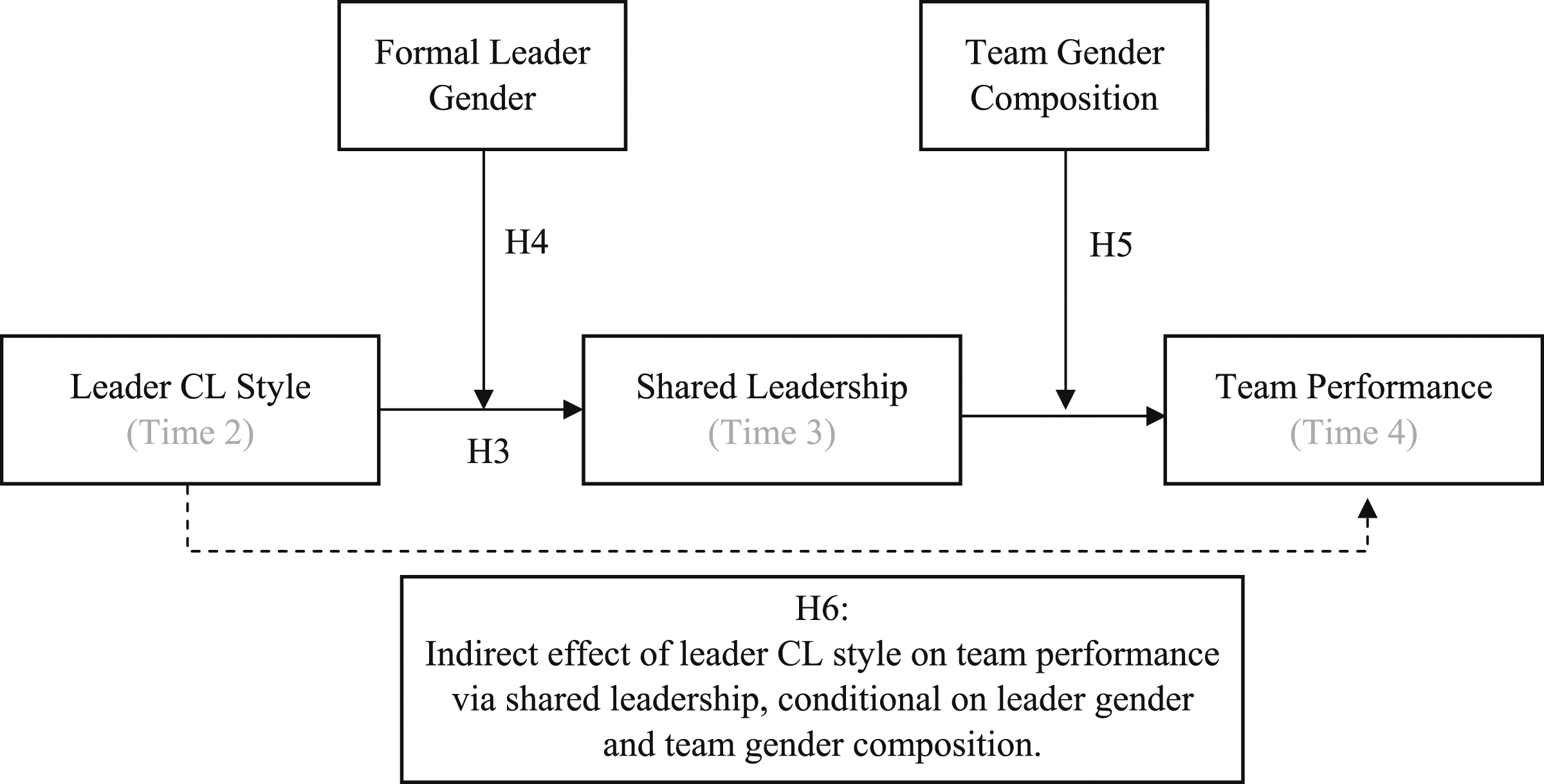
In summary, we draw from leader identity construction theory (DeRue & Ashford, 2010; Epitropaki et al., 2017) and adaptive leadership theory (DeRue, 2011) to examine how formal leaders claim their leadership identity in response to prior leadership sharing among members and how formal leaders use of a collective leadership style to grant leadership identities shapes later levels of shared leadership and, ultimately, team performance. We also draw from identity theories related to gender (Epitropaki et al., 2017) - role congruity theory (Eagly & Karau, 2002; Garcia-Retamero & López-Zafra, 2006) and the social categorization perspective on group identity (Tajfel et al., 1971; van Knippenberg & Mell, 2016) to explore formal leader gender and the gender composition of the team as moderators of these relationships. A conceptual summary of our study is presented in Figures 1 and 2. Conceptual model and hypotheses predicting formal leader CL style. Note. CL = Collective Leadership Style. Conceptual model and hypotheses for effects of leader CL style on subsequent team SL and team performance. Note. CL = Collective Leadership Style.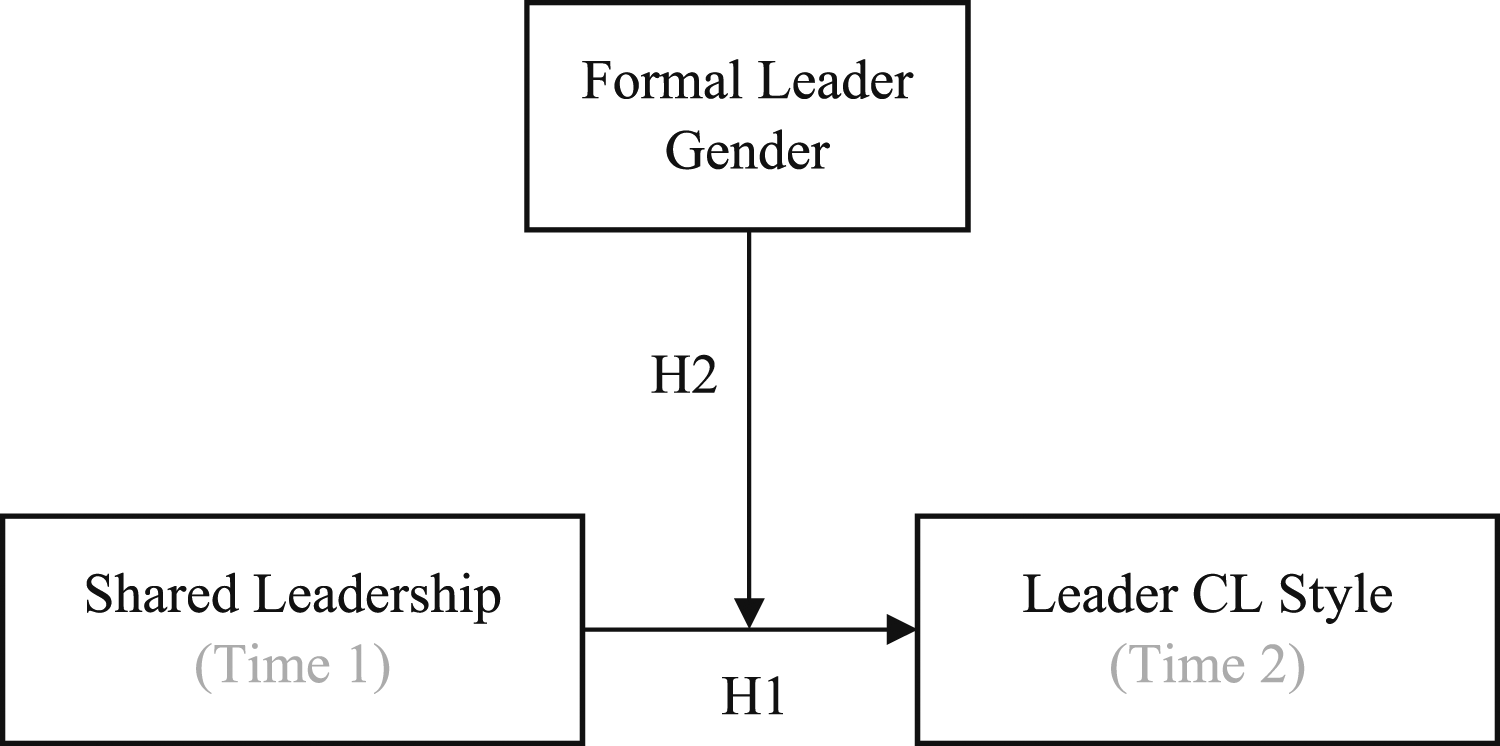
Theory and Hypotheses
Adaptive leadership theory (ALT) (DeRue, 2011) sees leadership as a dynamic process that emerges from interactions between leaders and followers. During these interactions, members develop identities as leaders and followers. According to identity theory, individuals have several identities that are organized hierarchically and activated depending on their centrality to the individual’s self-concept and also the relevance to the situation they are in, including the team context and follower dynamics (Epitropaki et al., 2017). For instance, formal leaders who are also members of a team may have two competing identities—one as team member and one as formal leader (Haslam et al., 2022). Furthermore, these identities are seen as “influenced […] by formal authority structures, such that the direction of influence in leading-following interactions can move up, down, and/or lateral in formal organizational structures.” (De Rue, 2011, p. 126).
While the original ALT focused more on the granting and claiming processes among members of the team without formal leadership roles (DeRue, 2011), more recent work has explored how formal leaders facilitate the granting and claiming process within the team (Chiu et al., 2016) as well as the overlap between leaders’ personal and social identities (Haslam et al., 2022). Our work extends ALT and builds on existing work on the intermingling of formal and informal forms of leadership (Van De Mieroop et al., 2020; Ziegert & Dust, 2021) by examining how internal/formal team leaders both claim and grant leadership as they react to and seek to influence shared leadership in their teams. In doing so we address calls to examine “how and under what situations vertical leadership emerges and how it facilitates, hinders, complements, and/or supplements shared leadership” (Nicolaides et al., 2014, p. 935) and Fairhurst et al.’s (2020) challenge to consider the hierarchies, or interrelationships between different forms of leadership, and examine the processes and context underlying them.
Shared Leadership
The leadership field has seen a paradigm shift to an increased focus on forms of leadership in which multiple individuals take on the leadership role (Denis et al., 2012; D’Innocenzo et al., 2016). Several terms are used for this overarching category of leadership, such as plural leadership (Denis et al., 2012), collectivistic leadership (Yammarino et al., 2012), shared leadership (Wang et al., 2014), and collective leadership (Cullen-Lester & Yammarino, 2016). To avoid confusion and encourage consistency in language, we use the term shared leadership when referring to the concept put forth by Pearce and Sims (2002) and Carson et al. (2007) and defined as a property of the team where the leadership role and processes are shared amongst multiple team members. We use the term collective leadership style when referring to the leadership practices identified by Friedrich et al. (2009) that a formal leader takes to encourage team members to share the leadership role in the team. Friedrich and colleagues (2009) propose that a collective leadership style will enhance team shared leadership, but until the present study this has not yet been empirically tested.
Shared leadership involves mutual influence among team members (Carson et al., 2007), which can shift depending on the expertise or skills required (Seers et al., 2003), and may even be an outcome of team processes (Day et al., 2004). Several recent reviews summarize the ways in which shared leadership shapes performance in teams (D’Innocenzo et al., 2016; Nicolaides et al., 2014; Wang et al., 2014). Each of these found it to be complementary to formal, hierarchical leadership in enabling team outcomes. Generally, shared leadership has been related to a number of positive team processes and outcomes, such as creating a sense of meaningful work (Liang et al., 2021), creativity and innovation (Ali et al., 2020; Ziegert & Dust, 2021), and trust and cohesion (Bergman et al., 2012). However, most studies have examined these outcomes without exploring potential moderators or boundary conditions (Nicolaides et al., 2014).
Taking an identity construction lens, shared leadership within the team is reflective of the claiming and granting of leadership identities among team members (Adriasola & Lord, 2021). Higher levels of shared leadership would be found in teams where multiple members claim leader identities and other members grant them, for example, by turning to them for expertise and leadership. It is possible, however, for formal leaders to promote shared leadership in the team. Indeed, meta-analytic estimates show a positive relationship between some forms of vertical leadership and shared leadership (Nicolaides et al., 2014; Wang et al., 2014). Yet, prior research has mostly treated the vertical leadership influence from a formal leader as independent or even the opposite of shared leadership (Zhu et al., 2018). For example, some research has focused on the incremental contribution of shared leadership above and beyond that of vertical leadership (Wang et al., 2014), or on the unique contribution of each to team performance (He et al., 2020). Vertical leadership is also notably absent from recent meta-analyses and reviews of shared leadership (D'Innocenzo et al., 2016; Wu et al., 2020; Zhu et al., 2018), even though some of the input studies included it (see Table 2 in Wu et al., 2020). Building upon ALT (DeRue, 2011) we emphasize the role of vertical leadership as a key antecedent of shared leadership because formal leaders can proactively grant leadership identities and create an environment where members are more likely to claim leadership identities for themselves and be more willing to grant them to other members. Using a leader identity lens, we propose gender as a boundary condition.
The Collective Leadership Style
Although often disregarded in the dialogue on shared forms of leadership, where the focus is typically on the team (Denis et al., 2012), research on how formal leaders impact a team’s shared leadership offers a complementary line of inquiry (Hernandez et al., 2011) and has recently emerged as a key area of research (He et al., 2020). Given that, in reality, most organizations have formal managerial structures, these leaders are likely to be key actors in establishing or precluding shared leadership in teams and the broader organization (Cullen-Lester & Yammarino, 2016).
The initial work on collective leadership style 1 (Friedrich et al., 2009) provides an integrated view of the ways a formal leader interacts with their team to create conditions for others to share leadership roles. The authors define collective leadership style as a process in which a formal leader “selectively utilizes skills and expertise within a network, effectively distributing elements of the leadership role as the situation or problem at hand requires” (Friedrich et al., 2009, p. 933). This style has since been shown to involve three interrelated leadership practices – developing the team’s network (e.g., encouraging team members to build relationships with one another), fostering communication (e.g., encouraging members to give feedback and express ideas with each other), and engaging in leader-team exchange of the leadership role (e.g., sharing leadership responsibilities or empowering team members to take on leadership) (Friedrich et al., 2016). The specific behaviors associated with each of these practices can be seen in Appendix A.
While some behaviors in this style are similar to elements of other leadership styles, such as empowering leadership (Ahearne et al., 2005; Zhang & Bartol, 2010), dynamic delegation (Klein et al., 2006), or participative leadership (Somech & Wenderow, 2006), there are important distinguishing aspects of the collective leadership style. While empowering, delegating, and participative leadership styles all emphasize members’ connections to the formal leader, thus reinforcing the formal leader’s position in a hierarchy, the collective leadership style directs members’ attention toward other members, de-emphasizing hierarchical relationships (Friedrich et al., 2009). The collective leadership style encourages members to communicate, build relationships, and make decisions together without the formal leader’s involvement (Friedrich et al., 2009, 2014, 2016).
Evidence of these differences can be found in the operationalizations of these leadership styles, where the hierarchy is reinforced. For example, empowering leaders direct individual members to make decisions but the emphasis is on “my manager [making decisions] together with me” (Ahearne et al., 2005, p. 949, emphasis added). Participative leaders share power “by consulting [members] before [the leader makes] a decision” (Kahai et al., 2004, p. 71, emphasis added). And while dynamic delegation includes giving leadership to members, it also involves leaders’ “withdrawal of the active leadership role from more junior leaders” (Klein et al., 2006, p. 598). Thus, these leadership styles reinforce continued dependence on the formal leader’s directing of shared leadership. Other leadership theories such as relational (Uhl-Bien, 2006), network (Balkundi & Kilduff, 2006), and leader-member exchange (Graen & Uhl-Bien, 1995) similarly reinforce the hierarchical position of the formal leader in relation to team members. The potential for continued dependence on the formal leader may inhibit the development of members’ leadership identities. Another critical difference is that the collective leadership style does more than delegate, it also creates an environment where members are more likely to claim leadership identities for themselves and to accept the leadership claims of other members (Friedrich et al., 2009). Thus, a collective leadership style is uniquely positioned to promote the claiming and granting of leadership identities by other team members (Xu et al., 2022).
The Influence of Shared Leadership on Formal Leaders’ Identity Claims
Formal leaders use a collective leadership style not just to affect change in the team but also in response to the relational conditions in the team, such as the team’s existing network density and communication patterns (Friedrich et al., 2014, 2016). This is represented in the bi-directional relationships proposed in Friedrich et al.’s (2009) original framework (pp 937). We argue that formal leaders may sometimes adopt a collective leadership style as they attempt to claim their own leadership identity.
As we mentioned earlier, identity theory suggests that individuals have multiple identities that are organized hierarchically. The activation of each identity depends on its centrality to the individual’s self-concept as well as how relevant it is to the situation they are in, which includes the relationships of those around them (Epitropaki et al., 2017). For instance, formal leaders who are also members of a team may have two competing identities—one as team member and one as formal leader. Indeed, Epitropaki et al. (2017) argued that an individual’s leader identity may be activated more when they are in a room with their direct subordinates, where they are expected to engage in leadership behaviors, but less so in a room with their peers, where horizontal relationships exist. Valcea et al., (2011) reasoned that internal formal leaders, who are also members of the team they lead, would experience “tension between one’s identity as a peer and one’s role as a supervisor” (p. 608).
Extending the rationale of Epitropaki et al. (2017), we expect that the level of shared leadership in a team activates either the formal leader’s team member identity or leader identity. As mentioned earlier, higher levels of shared leadership in a team indicate that more team members are claiming, and being granted, a leader identity by their peers. Formal leaders are likely to view other team members who are sharing leadership roles as peers, accentuating their own team member role rather than their formal leader role, in part because greater perceived similarity between self and other team members will increase the formal leader’s personal identification with those peers (Ashforth et al., 2016). On the other hand, in teams with lower shared leadership there is a greater contrast between the leader’s and other members’ identities. In these teams, a formal leader’s leader identity will be more salient than his or her team member identity as the granting of leadership in the team is focused more on the formal leader and less on other members. We expect formal leaders in teams with lower shared leadership to thus engage in more leadership behaviors because activation of an identity is a precursor to actions related to that identity (Day & Harrison, 2007; Kwok et al., 2018).
With regard to actions related to leader identities, the primary function of team leadership is to resolve needs created by challenges that arise within the team (Morgeson et al., 2010). Common team needs include developing positive team norms, promoting effective communication, monitoring team member behavior, and coaching team members (Morgeson et al., 2010). Viewing the “leader as completer … the best a leader can do is to observe which functions are not being performed by a segment of the group and enable this part to accomplish them” (Schutz, 1961, p. 61, cited in Morgeson et al., 2010, p. 8). As noted above, a collective leadership style is used “as the situation or problem at hand requires” (Friedrich et al., 2009, p. 933) and with an ultimate aim to facilitate the leadership of others in the team (Friedrich et al., 2009). Thus, we expect that when formal leaders sense low shared leadership in their teams, not only will their leader identities be activated but they will specifically be inclined to address team needs related to shared leadership, such as communication and coordination, by adopting a collective leadership style.
Along these lines, Friedrich et al. (2016) found that a team’s relational structure prompted leaders to engage in a collective leadership style. Specifically, use of a collective leadership style was more pronounced when teams had less embedded networks, suggesting that leaders took this as a signal that the team may be low in trust and require interpersonal development. We build on this by considering how formal leaders react specifically to existing levels of shared leadership in their teams and expect that a formal leader’s use of a collective leadership style will be negatively related to existing levels of shared leadership in the team.
A team’s shared leadership will be negatively related to the subsequent use of a collective leadership style by the formal leader.
Formal Leader Gender as a Moderator of Leaders’ Responses to Initial Team Shared Leadership
Formal leaders’ identities are likely to be influenced by a combination of both contextual influences, such as levels of shared leadership in the team, and by personal and social factors such as gender roles and expectations. Extending our arguments for hypothesis 1, we expect that existing levels of team shared leadership will differently activate the leader identities of male and female formal leaders. First, male and female formal leaders draw their leader identities from different sources. Zheng et al. (2021) proposed a gendered leader identity work framework based on their qualitative study of leader identity development. They examined the narrative frames leaders used to understand and enact their leader identities. They found that men’s leader identities were derived largely from being granted formal positions while women’s leader identities were based in claims made by engaging in participative or facilitative leadership behaviors. This suggests that in low shared leadership teams, where leadership is being granted primarily to the formal leader, a male leader’s leader identity is more likely to be salient. On the other hand, in high shared leadership teams where formal leaders must claim their identities, likely through participative behaviors, female leaders may be more likely to have their leadership identities activated (Lanaj & Hollenbeck, 2015).
In addition to being more likely to make a female leader’s leader identity more salient, we also expect high levels of shared leadership to make it more likely that female leaders use collective leadership style to resolve the team needs discussed earlier. According to social role theory, individuals will show a greater propensity for adopting role identities if those roles fit existing social norms (Eagly, 1983). Behaviors associated with a collective leadership style, such as encouraging participation, delegating, and facilitating group dynamics, are more often associated with women (Akinola et al., 2018; Eagly & Johannesen-Schmidt, 2001), and thus would present less identity risk for a female leader to adopt (Ryan et al., 2021) especially in situations that allow for congruence between both her social and leader identities (Eagly & Karau, 2002). Other research suggests women may be more motivated to lead in contexts with greater cooperation among team members, such as would be the case in teams with higher shared leadership. For example, Fritz and Van Knippenberg (2017) found that women’s leadership aspirations were more strongly influenced by a cooperative climate than were men’s aspirations.
Given that women’s leadership identities often originate from opportunities to enact collective leadership behaviors and that female formal leaders may be more likely to enact such behaviors in cooperative environments, we argue that a female formal leader’s leader identity is more likely to be activated in a team with high shared leadership. In such a context, members’ collaborative behaviors provide a female formal leader with opportunities to engage in the collective leadership behaviors that are central to women’s leader identities (Zheng et al., 2021) and are seen as more gender compatible for women (Eagly & Johnson, 1990), all while minimizing risk of rejection (Ryan et al., 2021; Xu et al., 2022).
Teams with low shared leadership, however, are more likely to activate a male formal leader’s leader identity. Because men tend to draw their leader identities from being granted formal positions, the contrast between a male formal leader and other team members who are engaging in little or no shared leadership would make his position more salient than in a team where leadership was shared among other members. Using a collective leadership style in teams with already higher levels of shared leadership may conflict with gender norms for men (Eagly et al., 2020) and may put them at risk of being seen as less competent (Rosette et al., 2015). Thus, we expect male and female formal leaders to differ in their use of a collective leadership style in response to existing shared leadership levels in the following way.
Gender will moderate the relationship between a team’s shared leadership and a formal leader’s subsequent collective leadership style, such that there will be a positive relationship for female leaders and a negative relationship for male leaders.
Using a Collective Leadership Style to Grant Leadership Identities to Members
Formal leaders must both claim their own leadership identity and promote (grant) leadership to other members. In hypotheses 1 and 2 we focused on the collective leadership style as part of a formal leader’s attempts to claim his or her own leadership identity. The remaining hypotheses deal with how male and female formal leaders use a collective leadership style to proactively grant leadership to other team members (DeRue & Ashford, 2010). DeRue et al. (2009) note that contexts that support individuals “trying on” a leader identity, which is the type of context promoted by a collective leadership style, can facilitate identity construction among team members. Several examples from Lanka et al.’s (2020) qualitative study on leader identity construction highlight formal leaders being catalysts for others in the team adopting a leader identity in this way.
In their framework on collective leadership style, Friedrich et al. (2009) proposed that formal leaders engage in behaviors associated with building the team’s network, fostering communication, and exchanging the leadership role with the team. Each of these sets of behaviors can foster shared leadership in the team by encouraging other members to adopt leadership identities. Formal leaders exchange aspects of the leadership role with others in the team by delegating responsibilities (Klein et al., 2006), extending their leadership role to someone that has complementary skills or resources (Hunter et al., 2017), or empowering followers with autonomy (Zhang & Bartol, 2010). In this way, formal leaders are granting team members the opportunity to claim leadership identities, leading to subsequently higher levels of shared leadership (Carson et al., 2007).
In addition to sharing aspects of the leadership role, formal leaders can build the team’s internal network and establish communication norms that facilitate the formation of members’ leadership identities (Friedrich et al., 2009). Leaders may facilitate the network function by encouraging members to get to know one another and further embed their connections to one another (Friedrich et al., 2016). Increased embeddedness of relationships can foster trust (Chua et al., 2008) and lay the groundwork for both improved communication (Friedrich et al., 2014) and mutual support, leading to more shared leadership. In addition to building the network, formal leaders who engage in a collective leadership style may establish communication norms in which individuals feel they have voice (Kramer & Crespy, 2011), share information and feedback, and can emerge as leaders when they have relevant expertise (Friedrich et al., 2016).
With a stronger team network and the communication norms mentioned above, members of the team may not only become more aware of the expertise of others but may also increasingly seek out their expertise (Hiller et al., 2006). According to recent work on shared leadership that also draws on leader identity construction theory, this would enhance the claiming and granting process of sharing the leadership role within the team (Xu et al., 2022). In other words, the increased reliance on one another’s influence would increase perceptions that multiple members of the team are acting as leaders, and thus increase perceptions of shared leadership in the team (Carson et al., 2007).
A formal leader’s use of a collective leadership style will be positively related to subsequent team shared leadership.
Formal Leader Gender as a Moderator of Members’ Response to Leaders' Identity Grants
As DeRue (2011) notes in his initial work on adaptive leadership theory, “When one person engages in an act of leading, the intended effect and degree of influence is contingent on how that act fits within other actors’ zones of acceptance.” (pp. 129). Collective leadership style is an act of leading specifically intended to encourage other members to accept a leadership identity of their own. Thus, the effectiveness of formal leaders’ attempts to proactively grant leadership identities to other team members will depend on whether members perceive the formal leader’s collective leadership style as credible and competent. Perceived competence, in turn, is influenced in part by the alignment of leader behaviors with followers’ expectations.
As we mentioned earlier, male leaders are seen as more agentic, and female leaders are seen as more communal (Eagly & Karau, 2002), and those who act in ways that are role congruent tend to be rewarded, and those who do not tend to be penalized (Heilman & Wallen, 2010). Specifically, female leaders who act in an agentic way are evaluated more harshly (Rudman et al., 2012), and male leaders who seek input are perceived as incompetent (Rosette et al., 2015). The collective leadership style is expected to be more congruent with female stereotypes, given the emphasis on more inclusive decision-making processes, enhanced communication and authority sharing practices (Eagly et al., 1995). Based on the principles of role congruity theory and the fact that female leaders are perceived as more effective when their behavior aligns with preconceived stereotypes (Hogue, 2016), we expect that members will be more likely to respond favorably to female leaders’ use of a collective style to grant them (members) leadership roles and may respond in a more accepting way towards female leaders’ attempts to foster shared leadership. More specifically, this more favorable response means they are more likely to claim the grants of leadership from a female leader using collective leadership style and the resulting increased claiming of leadership by team members will manifest in higher shared leadership in the team.
In contrast, male leaders who utilize a collective leadership style could be at risk of contradicting expectations for using more agentic forms of leadership (Eagly & Johannesen-Schmidt, 2001). Members may then equate this with loss of authority and weakness (Eagly et al., 1995; Paustian-Unterdahl et al., 2014) undermining the intentions of collective leadership and resulting in reduced shared leadership at the team level. In research along these lines, Rosette et al. (2015) found that male leaders who sought help from others were perceived as less competent than female leaders who did so. This reversed paradox of power, where male leaders attempt to claim a leader identity, but it is not granted, would potentially result in a leadership void (DeRue, 2011) and the intended outcomes of the men’s collective leadership actions, granting leadership to others, would not be successful. In each of these instances, for both men and women, alignment with gender norms for leadership would mean their leadership claims would be less likely to be rejected (Xu et al., 2022). Thus, we expect the following moderated relationship.
Leader gender will moderate the positive relationship between formal leaders’ use of a collective leadership style and subsequent team shared leadership, such that the relationship will be stronger (and positive) for female leaders compared to male leaders.
Team Gender Composition as a Moderator of the Shared Leadership – Performance Relationship
One of the key drivers of the proliferation in research on shared forms of leadership is the consistent positive influence of shared leadership on team performance (D’Innocenzo et al., 2016), particularly for complex problem solving (Wang et al., 2014) and when engaging team members with varied expertise (Mumford et al., 2012). When navigating complex problems, shared leadership is instrumental for leveraging the human capital and associated skill sets of all team members (Hiller et al., 2006). It capitalizes on the expertise in the team by allowing those with the most relevant knowledge or experience to step into a position of influence (Marques-Quinteiro et al., 2022). In this way, it can facilitate creativity as well as the general effectiveness of the team (Ziegert & Dust, 2021). In addition to promoting effective use of information and expertise, shared leadership can also influence performance via its effects on motivational states in the team. For instance, Nicolaides et al. (2014) identified increased team confidence as an explanatory mechanism between shared leadership and team performance, and D’Innocenzo et al. (2016) suggested that members sharing influence with one another can increase trust and commitment in the team.
Venus et al. (2012) argued, however, that the performance benefits of shared leadership are contingent on team members’ holding a collective identity, or the definition of the self, based on group membership. They argued that shared leadership requires individuals valuing the overall success of the team and being willing to lead and to follow as necessary, as well as requiring high levels of coordination and interdependence. Social categorization based on personal characteristics can undermine this collective identity by inducing competing sub-group identities, such as gender (Ashmore et al., 2004). Shared leadership is a relational process, making it susceptible to disruptions arising from interpersonal stereotypes and biases (Lemoine et al., 2016). While evidence is lacking on how the specific social categorization along gender lines might moderate the relationship between shared leadership and team performance, Waldman et al. (2016) reported a negative relationship between shared leadership and performance in teams with fault lines based on social categories.
When gender stereotypes are made more salient (Chen & Houser, 2019; Hoyt et al., 2010), social categorization increases within teams (van Knippenberg & Schippers, 2007) leading to lower performance (Bell et al., 2011). One way gender stereotypes can be made salient is through the gender composition of the team. For instance,, drawing on stereotype threat theory, Chen and Houser (2019) compared the behavior of men and women working in teams with manipulated gender compositions (e.g., majority female, majority male). They found that men only experienced stereotype threat in mixed gender groups (i.e., in the presence of women). The magnitude of the stereotype effect was more than double for men in majority-female teams versus men in majority-male teams. Conversely, women were susceptible to stereotype threat in teams with any gender composition and the magnitude of the effect was strongest in majority-female teams. They argued that stereotype threat for men is a comparative process, activated by the opposite gender, but for women it is based on identity, strengthened in the presence of other women. Thus, majority-female teams produced the strongest stereotype effects for both men and women.
The context of the team’s shared leadership may also influence the salience of gender stereotypes and emergence of social categorization. As Bell et al. (2018) note, the influence of stereotypes may be minimized in strong team contexts versus weak. Strong contexts (Mischel, 1977) are ones where there are clearer roles and norms for individuals’ behavior which may override the power of individual differences (Bell et al., 2018). Given the more informal nature of shared leadership, where hierarchy is more limited and leadership roles are more fluid (Zhu et al., 2018), this may be considered a weak context, and thus increase the likelihood that gender stereotypes, if activated, will then affect behavior. Together with Chen and Houser’s (2019) findings on team gender composition, this suggests that stereotype threat and social categorization will likely to be strongest in majority-female teams with high shared leadership, where the negative effects of social categorization will be maximized. This will disrupt cooperation and may lead members to withdraw or withhold effort. Thus, we predict the following:
Team gender composition will moderate the relationship between shared leadership and team performance such that the relationship is negative when the team is majority female.
How Gender Moderates the Indirect Relationship Between Formal Leaders’ Identity Grants and Team Performance
Collective leadership style is held to increase team performance through several mechanisms such as increased problem-solving capacity and more effective team processes, including shared leadership (Friedrich et al., 2009). This is in line with the more general prediction that formal team leaders influence team performance in part via shared leadership (Zhu et al., 2018). When a formal leader encourages team members to communicate with each other, share information, and make decisions together, not only is the observed level of shared leadership expected to increase as members adopt leadership identities, but these actions should also build the team’s capacity to collaborate effectively, for instance through more robust transactive memory systems (Xu et al., 2022) which should in turn increase performance. For example, Hoch (2013) found that vertical leadership was significantly indirectly positively related to innovative behavior through shared leadership. Similarly, Carson et al. (2007) found that coaching by a formal (external) leader was positively related to shared leadership which in turn was positively related to performance, though they did not explicitly test for mediation.
Although initial evidence indicates a positive relationship between collective leadership style and team performance (Friedrich et al., 2014), none of the proposed mediating mechanisms have been tested. We expect that a collective leadership style will be indirectly related to team performance through shared leadership (Friedrich et al., 2009). However, given our arguments above (for hypotheses 4 and 5), we also expect this indirect relationship to be conditional on formal leader gender and team gender composition. We predicted (H4), according to role congruity theory (Eagly & Karau, 2002) and leader identity theory (DeRue, 2011), that female (vs. male) leaders’ use of a collective leadership style would be more strongly (and positively) related to team shared leadership and (H5) that shared leadership in majority-female teams would be negatively related to team performance due to the disruptions caused by increased social categorization (Ashmore et al., 2004) and stereotype threat (Chen & Houser, 2019). Combining these arguments, we expect that female leaders’ use of a collective leadership style will have a stronger indirect effect on team performance because members are more likely to accept influence attempts when the leadership style matches followers’ expectations (Eagly & Karau, 2002). We further expect that indirect effect to be negative when the potential for stereotype threat and social categorization is maximized. Thus, we predict:
Shared leadership will mediate the relationship between a formal leader’s collective leadership style and team performance, conditional on leader gender (stage 1) and team gender composition (stage 2), such that the relationship will be more negative in majority-female teams with female formal leaders compared to teams with all other leader gender/team gender composition configurations.
Method
Sample and Procedure
The sample for this study was drawn from 585 undergraduate students enrolled in a new venture creation course at a top five business school in the United Kingdom. The study was approved by the Humanities and Social Sciences Research Ethics Sub-Committee and participants provided their informed consent prior to participating. In this 10-week project-based course, students worked in teams of four or five developing a new business for which they produced a formal business plan submitted after the end of term. Course grades were determined entirely by the team project so there was substantial motivation to engage in the team’s work. We selected these teams and this project for our study because shared leadership has shown to be important for complex problems (Wang et al., 2014) requiring team creativity (Zhu et al., 2018), including new venture creation tasks (Ensley et al., 2006).
Teams had already worked together in a different course the term prior, but without a formal leader. In the opening lecture for the course in which study data were collected, students were told that their teams would be “self-managing” but that they must “elect their group leader by the end of this week” and that the leaders’ responsibilities would be “similar to that of a managing director of the business,” specifically “to lead, encourage, and help motivate the team in developing the business idea and leading them through the project.” Prior research has identified hierarchy, or an “implicit or explicit rank order of individuals or groups with respect to a valued social dimension” (Magee & Galinsky, 2008, p. 354), as necessary for formal internal leaders to exhibit vertical leadership (Hoch, 2013; Morgeson et al., 2010; Wang et al., 2014). Although hierarchy can be created by several factors, prior studies indicate naming a designated leader is sufficient to create hierarchical differentiation (Tost et al., 2013; Ziegert & Dust, 2021). In our sample, elected formal leaders were more conscientious (M = 4.33, SD = .60, t (126) = −2.34, p = .021, d = −.46) and extraverted (M = 3.97, SD = .70, t (126) = −4.39, p < .001, d = −.86) than their teammates (conscientiousness: M = 4.02, SD = .71; extraversion: M = 3.20, SD = .96) 2 . When rated by teammates on the extent to which the team relied on each other for leadership (from 1-Not at all to 5-Completely) 3 , formal leaders were rated much higher (M = 3.78, SD = .76) than other members (M = 2.66, SD = .90), t (214) = −7.57, p < .001, d = −1.28). Thus, the elected formal leaders possessed higher levels of characteristics that are positively related to leadership emergence (Ensari et al., 2011; Judge et al., 2002) and whom members perceived as providing substantially more leadership than others.
Three surveys were administered over the course of the project. In the first survey (Time 1), sent in the second week of term, we measured Time 1 shared leadership and asked participants demographic and individual difference questions. Four weeks later (Time 2), a second survey was sent and members who were not the formal leader answered questions about the formal leaders’ collective leadership style. A third survey, sent approximately three weeks later (Time 3), was used to measure Time 3 shared leadership. Approximately seven weeks later and after the term ended (Time 4) teams submitted their business plans, which were scored by three independent judges to provide team performance data. It was important to examine the relationship between our variables of interest across several time points because we are interested in the mutual influence process between a formal leader’s actions and the conditions within a team. To capture that mutuality, as well as allow time for any relationship between the variables to emerge, it was critical to measure our variables of interest at multiple, separate time points.
All surveys were sent to students’ university email addresses and those who completed the surveys could opt to enter a drawing for several prizes. Data for teams with completed responses from at least two members were included in the final dataset, resulting in a final sample of 216 students from 44 teams. The average team size was 4.93 members (range: 4–5). Teams were also diverse in gender composition (percent female: M = .48, SD = .11), major (Blau’s index: M = .55, SD = .18), and nationality (Blau’s index: M = .79, SD = .03). One-hundred thirteen (52%) of the 216 participants were male. Forty-three percent were Asian, 30% European, 22% British, 2% Russian, and 3% were from Africa, the Middle East, New Zealand, or North or South America. Students for whom data were included in this study earned slightly higher grades in the course (M = 63.58, SE = .537) than those who had incomplete data (M = 61.50, SE = .472), t (583) = −2.81, p = .005, d = −.24. No significant differences were found between participants included in the study and those who provided only demographic data at Time 1 with regard to age (t (236) = .90, p = .369, d = .12), gender (χ2 (1) = 1.04, p = .308), years of work experience (t (237) = .02, p = .983, d = .003), English as a first language (χ2 (1) = .04, p = .834), or GPA (t (237) = −.51, p = .612, d = −.07). Thus, the study data was representative of the diverse, international group from which it was drawn.
Measures
Formal Leader’s Collective Leadership Style
We created a 16-item collective leadership style measure (see Appendix A) derived from prior research. Items were answered (at Time 2) by teammates who were not the formal leader in reference to the collective leadership style of the formal leader. Answers were given on a 1 (Never) to 5 (Always) scale. Twelve of the items were used previously by Friedrich et al. (2016) for content coding leaders’ written plans for indicators of collective leadership across three sets of actions – developing the network, communication, and exchanging the leadership role. The 12 items used by Friedrich et al. (2016) did not include several items from other collective leadership measures (Friedrich et al., 2014; Yammarino et al., 2014) because they were not observable in written responses or appropriate to the experimental task. These items were added for this study and all items were rephrased to be appropriate for a survey.
The three facets of collective leadership behaviors are held to be highly interrelated. For example, Friedrich et al. (2016) described communication as the “lifeblood” and network development as “the artery through which it [communication] flows” (p. 315). Extending this metaphor, leader-team exchange reflects the distribution of shared leadership nutrients (i.e., expertise, delegated responsibilities, authority) throughout the network. Therefore, the mean of all 16 items was used to represent the level of collective leadership style used by the formal leader (median rwg = .88, ICC1 = .17, ICC2 = .45, α = .91). A confirmatory factor analysis with all 16 items loading onto a single factor fit the data well, χ(120) 2 = 183.37, RMSEA = .066, CFI = .909, TLI = .909, SRMR = .068 (Browne & Cudeck, 1992; Hu & Bentler, 1999). A three-factor model, with items loading onto their respective facet of collective leadership, also fit well, χ(117) 2 = 182.06, RMSEA = .068, CFI = .907, TLI = .905, SRMR = .068, but did not improve the fit (BIC = 5178, vs. 5167 for the single-factor model).
Shared Leadership
Leadership networks can be elicited at either an “atomistic” (individual-to-individual) or “molar” (individual-to-social entity) level, with the latter being useful for identifying “the degree to which members are perceived by other members as leaders of the team as a whole” (Contractor et al., 2012, p. 1003). We used Carson et al.’s (2007) widely used molar prompt (Zhu et al., 2018) to elicit members’ perceptions of their teammates’ leadership. Specifically, teammates answered, “To what degree does your team rely on this individual for leadership?” about all other teammates. By demonstrating that individuals are acknowledging others as leaders, these items can be seen as an indicator of leadership being granted from one individual to another (DeRue & Ashford, 2010). Responses to this question were given on a scale from 1 (Not at all) to 5 (Completely) and were collected at Time 1 and Time 3. Ratings were reliable (T1: median rwg = .75, ICC1 = .31, and ICC2 = .69; T3: median rwg = .75, ICC1 = .30, and ICC2 = .69). The Time 1 and Time 3 ratings were separately entered into a calculator provided by Lemoine et al. (2020) to compute Importance Weighted Density (IWD) scores for each team. IWD scores based on Time 1 and Time 3 ratings were used to represent shared leadership at Time 1 and Time 3 respectively.
Means, Standard Deviations, and Correlations Among Study Variables.
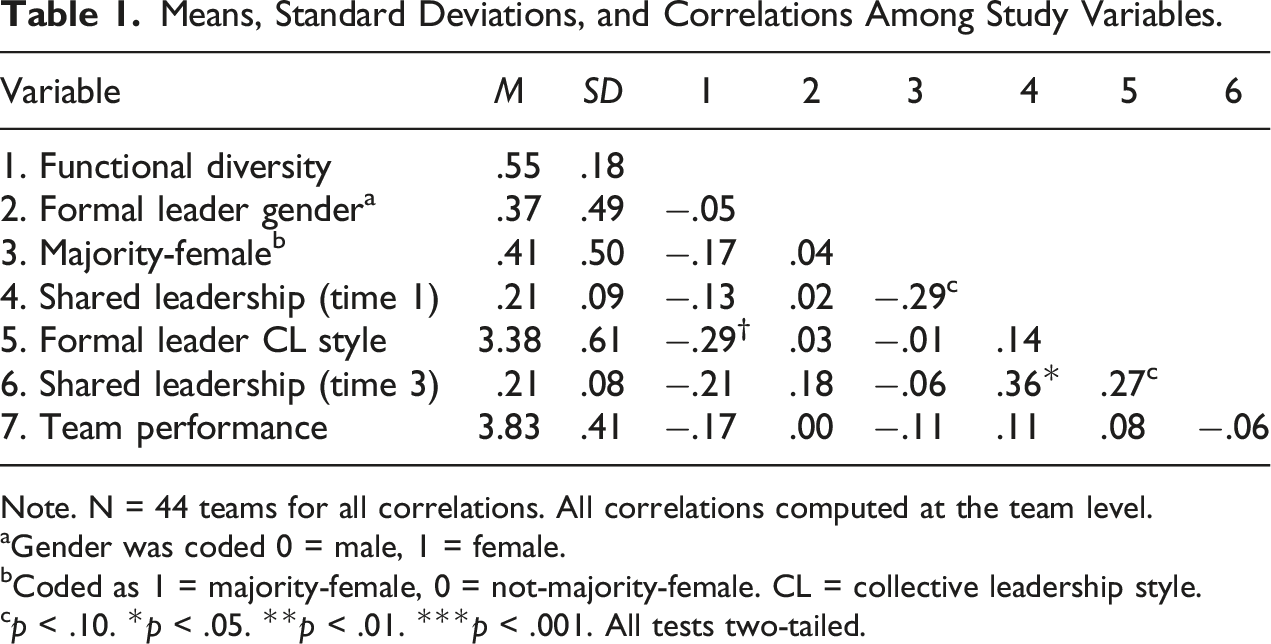
Note. N = 44 teams for all correlations. All correlations computed at the team level.
aGender was coded 0 = male, 1 = female.
bCoded as 1 = majority-female, 0 = not-majority-female. CL = collective leadership style.
cp < .10. *p < .05. **p < .01. ***p < .001. All tests two-tailed.
Formal Leader Gender
Participants were asked (Time 1) to indicate their gender as male (coded as 0 in analyses) or female (coded as 1). Formal leaders’ values were used in analyses.
Team Gender Composition
Teams were created by undergraduate administration staff to randomize the nationality, major, and gender diversity of the teams. Thus, team gender composition in this study was a manipulated exogenous variable. The percentage of women in teams in our sample ranged from 20% to 60%. In line with prior research (e.g., Chen & Houser, 2019; Kirkman et al., 2004), gender composition was operationalized as whether a team was majority-female (coded as 1; 18 teams in our sample) or not (coded as 0; 24 teams were majority-male, two 4-member teams were balanced).
Team Performance
Team performance was assessed via the teams’ course deliverable submitted after the end of the term (Time 4). All teams developed a plan for a new business. The student’s grades for the course were based entirely on work related to the team project, incentivizing them to invest in the team’s work. Three judges, doctoral students with expertise in creativity, innovation, and entrepreneurship, assessed the quality of the teams’ business plans and the judges were blind to the purpose and hypotheses of this study. Judges rated the plans using five 4 criteria that Mason and Stark (2004) found investors use to evaluate business plans—strategy, operations, product/service, market, and financial considerations. Judges first participated in 10 hours of training where they discussed definitions, practiced rating plans (ones not used in the final sample for this study), and discussed discrepancies. Judges’ ratings were reliable (LeBreton & Senter, 2007)—for each criteria in order listed above: ICC(A,1) = .51, .37, .43, .46, .68; ICC(A,K) = .76, .64, .69, .72, .86; median rwg = .92 (for all criteria)—and were averaged for each criteria and the mean across criteria was used to measure team performance.
Controls
According to Bernerth and Aguinis (2016), a variable should only be included as a control if theory suggests it has a relationship with a focal variable and the relationship has either been established empirically or the control variable is integral to the model. The social categorization perspective (van Knippenberg & Mell, 2016) has been used to describe how team gender composition can inhibit members’ identification with the team and thus reduce shared leadership and performance (Xu et al., 2019). Researchers have theorized and found that functional diversity is positively related to shared leadership under certain conditions (Kukenberger & D’Innocenzo, 2020) and provides a broader array of information which enhances team performance (Bell et al., 2011; van Knippenberg et al., 2004). On the other hand, we also expect that in the present context (student teams with students from different majors) that functional diversity (operationalized as major diversity) could also highlight faultlines (between majors) and thus act similar to surface-level diversity, exerting negative effects on shared leadership and team performance. Thus, functional (major) diversity and gender composition were entered as predictors in analyses where the dependent variable was shared leadership or team performance. Functional diversity was operationalized as Blau’s index (M = .55, SD = .18, Min = .00, Max = .72) of team members’ declared university major. Blau’s (1977) index is frequently used to measure diversity, where values range from zero (no diversity) to one (high diversity). Gender composition was dummy-coded as 1 = majority-female or 0 = not-majority-female, as described above.
Results
Analytical Approach
We used Mplus code provided by Stride et al. (2015) to construct regression models and a path model in Mplus 7.3 (Muthén & Muthén, 2014). All models were based on the PROCESS model templates for moderation and mediation provided by Hayes (2017). Simple moderation models (model 1 in Hayes, 2017) were used to test hypotheses 1-5 and a moderated moderated mediation (model 21 in Hayes, 2017) was used to compute conditional indirect effects to test hypothesis 6. Regression coefficients, conditional indirect effects, standard errors, and bias-corrected 95% confidence intervals were computed using path analysis with maximum likelihood estimation 5 and bootstrapping with 20,000 replications (Maydeu-Olivares, 2017). All continuous variables were first centered and divided by their standard deviations so that standardized parameter estimates could be reported. Where control variables are included, the analyses were repeated with and without controls to assess the impact of controls on the focal relationships (Becker et al., 2016). In all instances results were essentially identical with and without control variables.
Hypothesis Tests
Hierarchical Regression Results for Leader Collective Leadership Style.
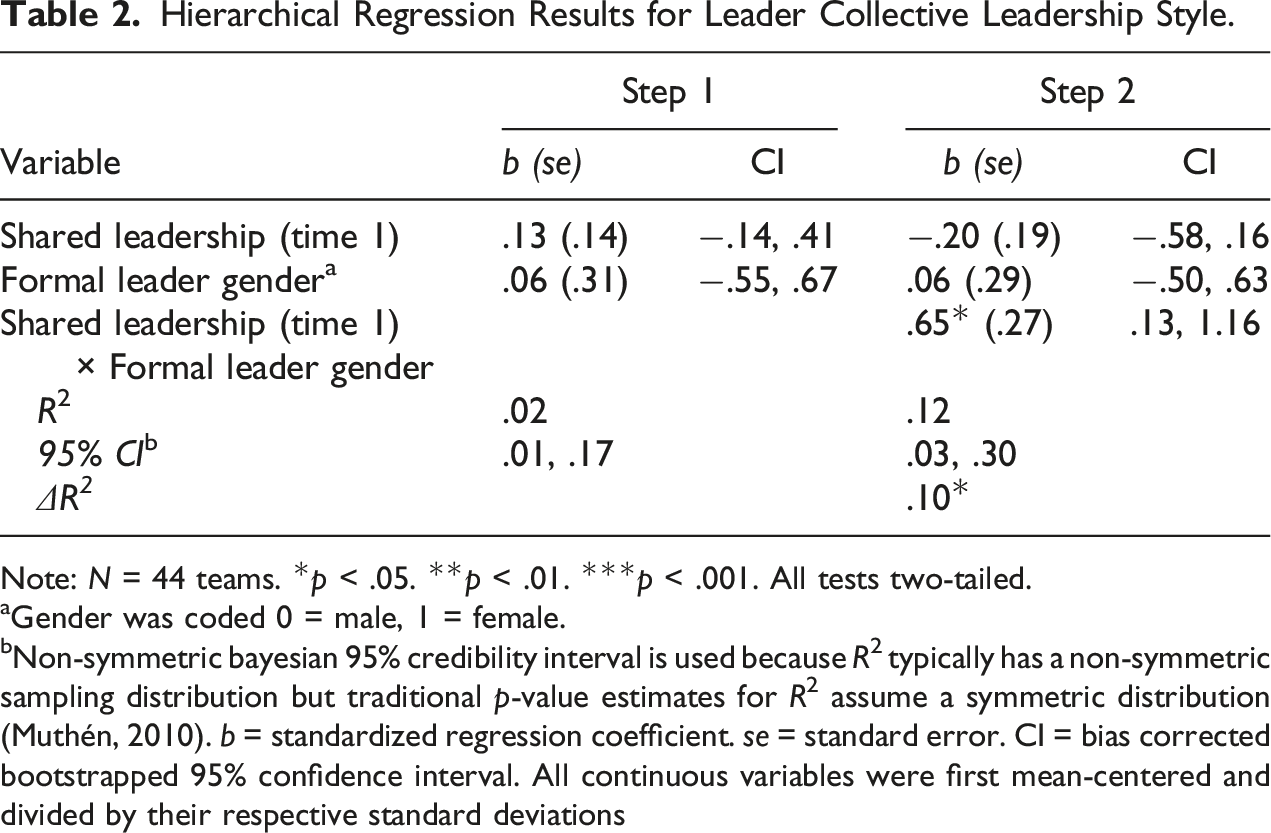
Note: N = 44 teams. *p < .05. **p < .01. ***p < .001. All tests two-tailed.
aGender was coded 0 = male, 1 = female.
bNon-symmetric bayesian 95% credibility interval is used because R2 typically has a non-symmetric sampling distribution but traditional p-value estimates for R2 assume a symmetric distribution (Muthén, 2010). b = standardized regression coefficient. se = standard error. CI = bias corrected bootstrapped 95% confidence interval. All continuous variables were first mean-centered and divided by their respective standard deviations
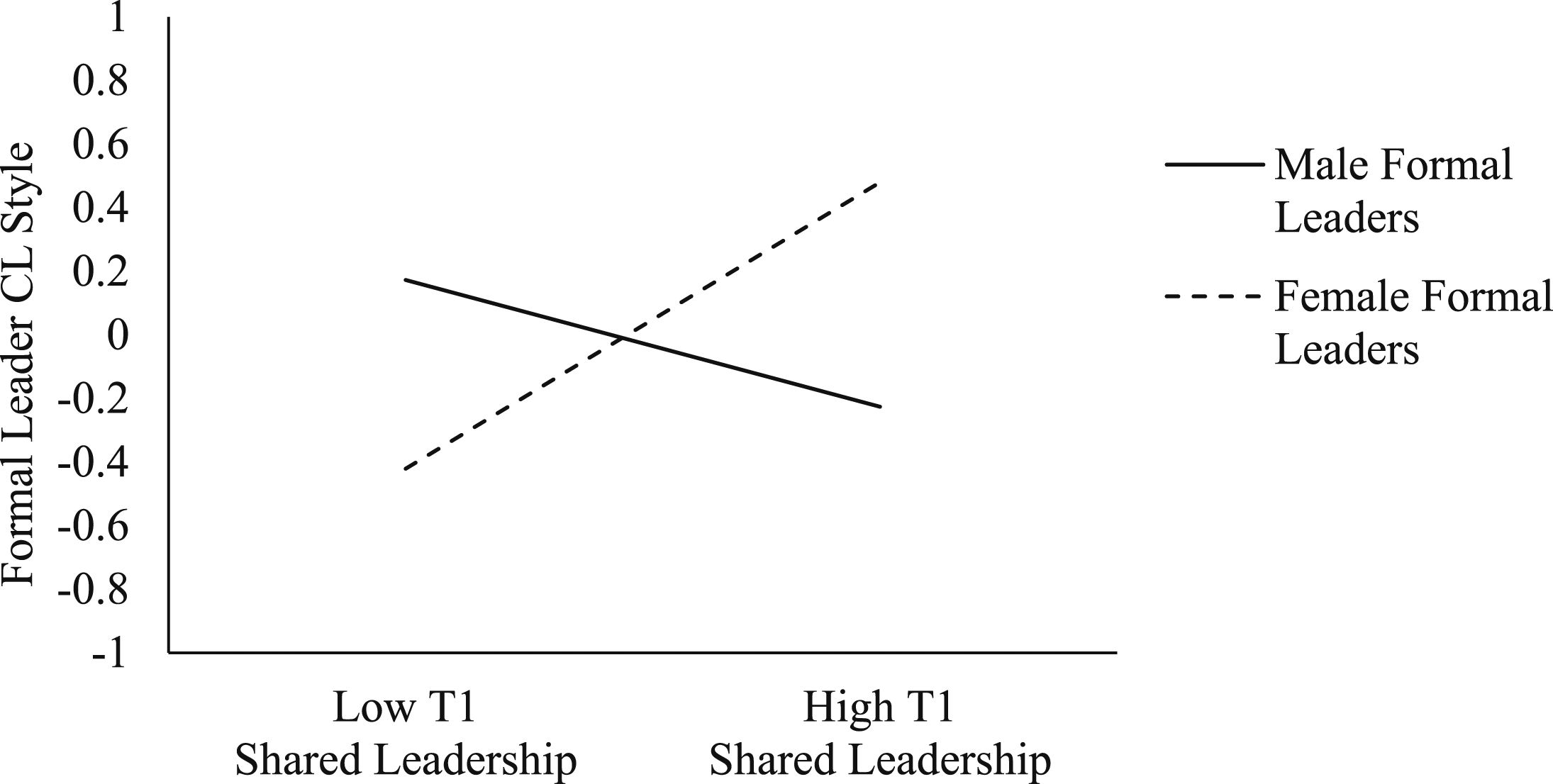
Effect of team shared leadership (at time 1) on subsequent formal leader CL style for male and female formal leaders. Note. CL = Collective Leadership Style. Testing Hypothesis 2.
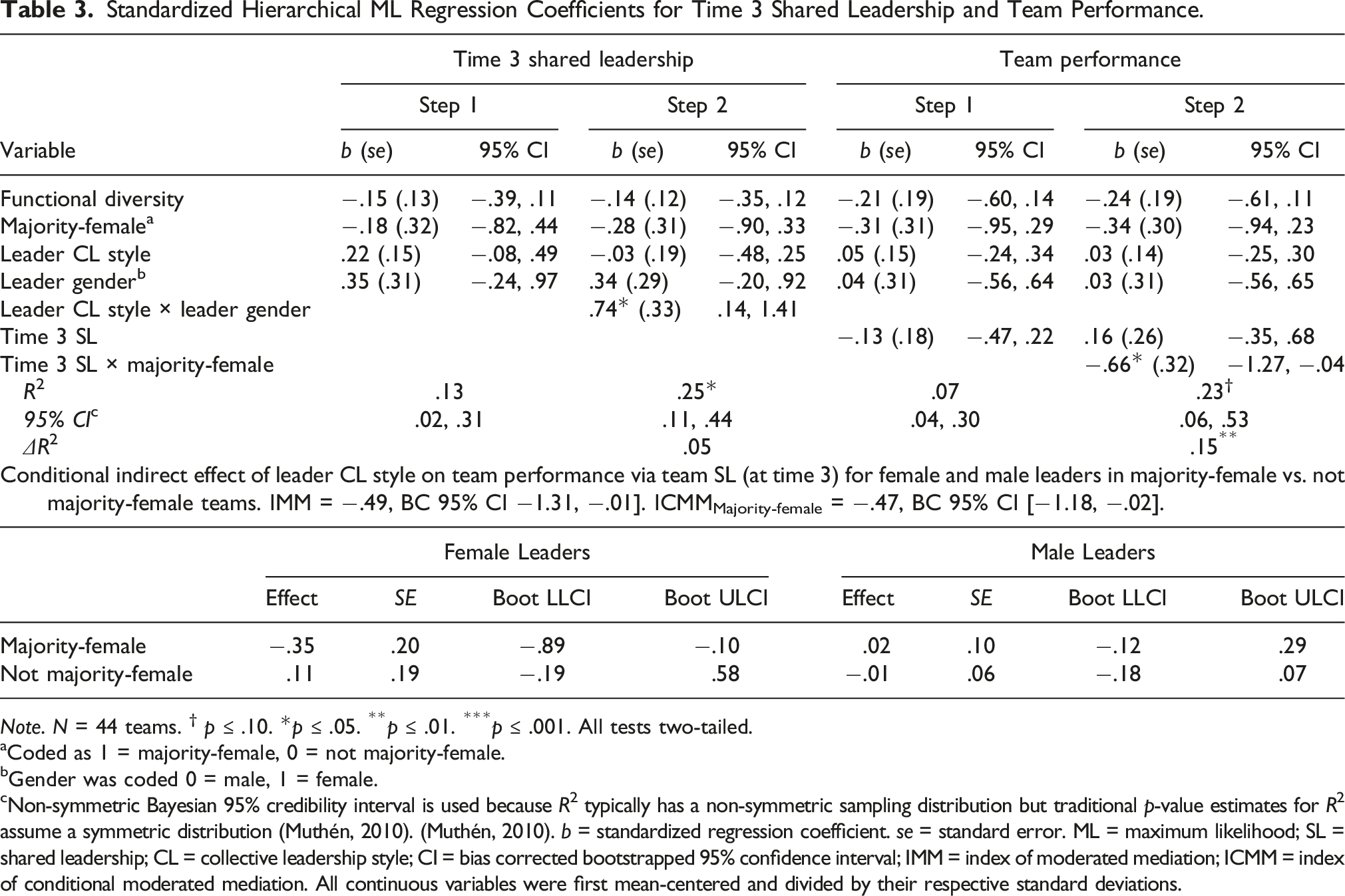
Standardized Hierarchical ML Regression Coefficients for Time 3 Shared Leadership and Team Performance.
Note. N = 44 teams. † p ≤ .10. *p ≤ .05. **p ≤ .01. ***p ≤ .001. All tests two-tailed.
aCoded as 1 = majority-female, 0 = not majority-female.
bGender was coded 0 = male, 1 = female.
cNon-symmetric Bayesian 95% credibility interval is used because R2 typically has a non-symmetric sampling distribution but traditional p-value estimates for R2 assume a symmetric distribution (Muthén, 2010). (Muthén, 2010). b = standardized regression coefficient. se = standard error. ML = maximum likelihood; SL = shared leadership; CL = collective leadership style; CI = bias corrected bootstrapped 95% confidence interval; IMM = index of moderated mediation; ICMM = index of conditional moderated mediation. All continuous variables were first mean-centered and divided by their respective standard deviations.
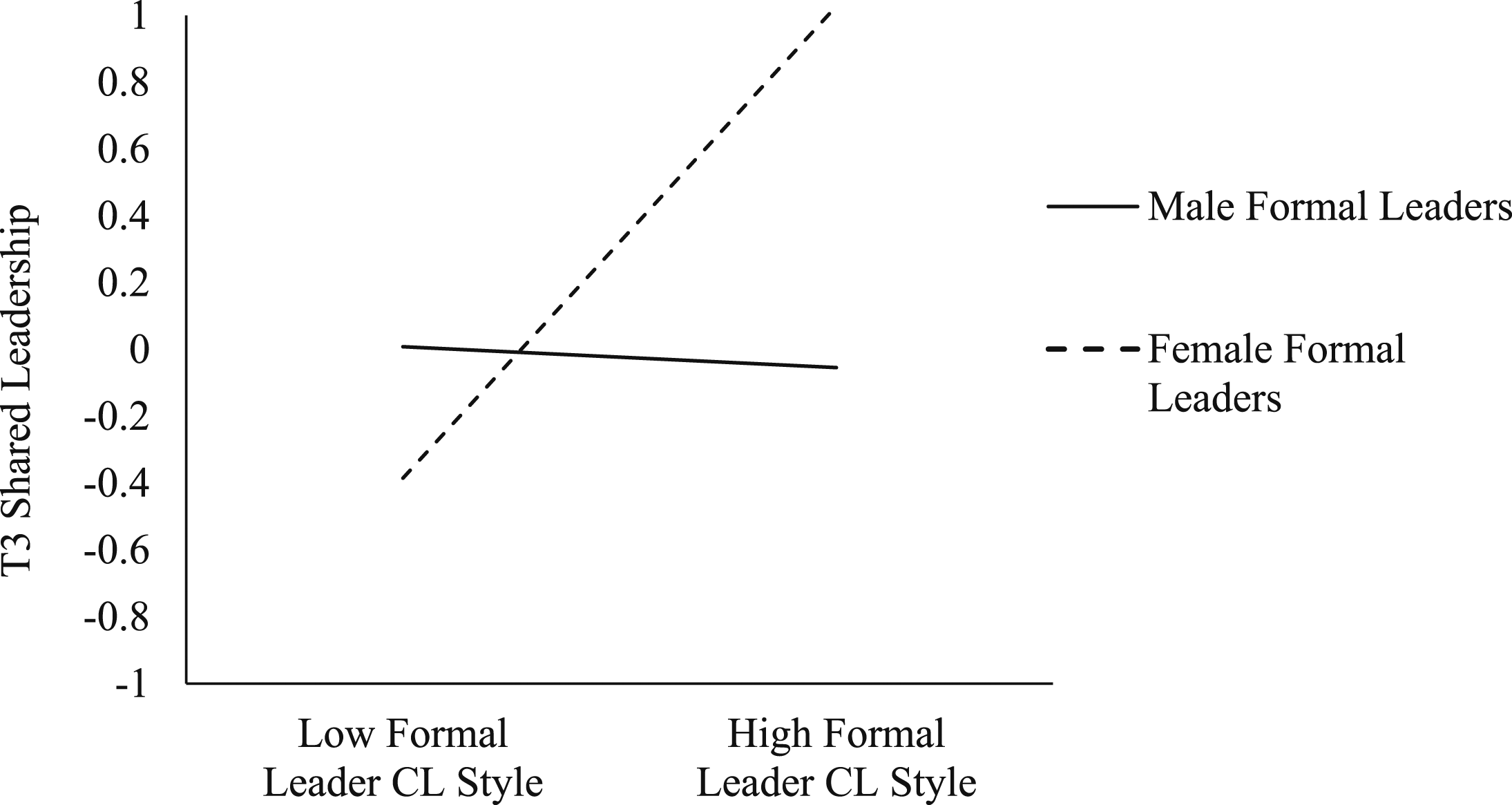
Effect of leader CL style on subsequent shared leadership (at time 3) for male and female formal leaders. Note. CL = Collective Leadership Style. Testing Hypothesis 4.
Hypothesis 5 predicted a negative relationship between T3 shared leadership and team performance in majority-female teams. To test this hypothesis team performance was regressed onto T3 shared leadership, the majority-female dummy, and their interaction. Functional diversity (ß = −.24, 95% CI [−.61, .11]) and formal leader gender (β = .03, 95% CI [−.56, .65]) were first entered as controls. Hypothesis 5 was supported. The interaction term was significant, ß = −.66, 95% CI [−1.27, −.04]. Figure 5 shows the relationship between T3 shared leadership and team performance according to teams’ gender composition. As predicted, T3 shared leadership was negatively related to performance in majority-female teams, simple slope: ß = −.51, 95% CI [−1.01, −.21], but not statistically significantly related to performance in other teams (ß = .16, 95% CI [−.35, .68]), slope difference: β = −.66, 95% CI [−1.27, −.04]. Finally, in hypothesis 6 we predicted a negative indirect effect of leader CL style on team performance via T3 shared leadership for female leaders in teams that were majority female. We used PROCESS model 21 (Hayes, 2017) to estimate and test these conditional indirect effects (see Table 3). Team performance was regressed onto leader CL style, T3 shared leadership, the majority-female dummy, and the interaction of shared leadership and the majority-female dummy. Functional diversity and leader gender were included as controls here. Then T3 shared leadership was regressed onto leader CL style, leader gender, and their interaction. Functional diversity and the majority-female dummy were included as controls here. The conditional indirect effects of leader CL style on team performance via T3 shared leadership were then computed for male and female leaders in teams with different gender compositions.
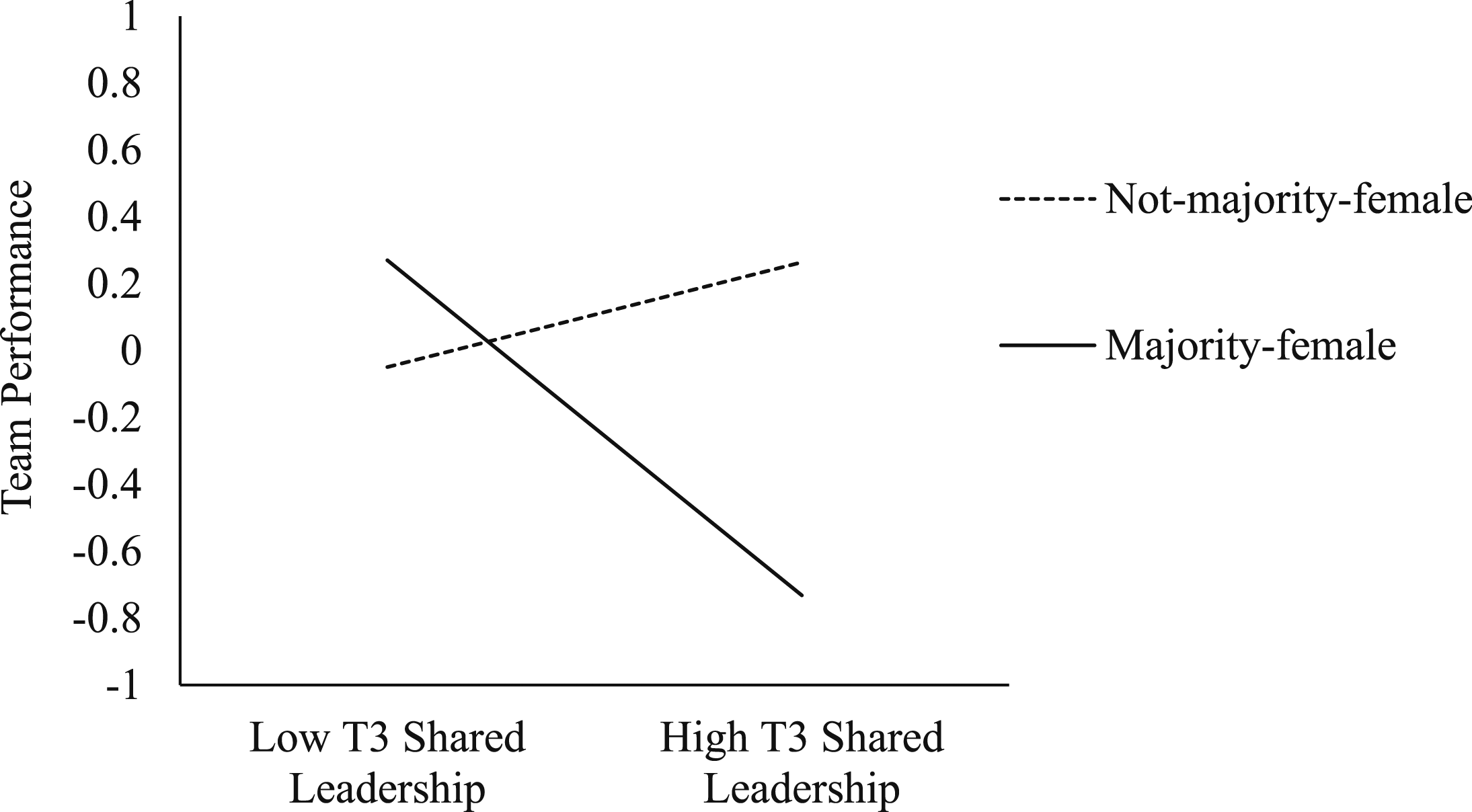
Effect of T3 shared leadership on team performance, moderated by gender composition. Note. Testing Hypothesis 5.
Hypothesis 6: was supported. The index of moderated mediation (Hayes, 2015) was statistically significantly different from zero, β = −.49, 95% CI [−1.31, −.01]. Furthermore, the index of conditional moderated mediation, which tests whether a moderated mediation effect is further moderated by a second moderator (Hayes, 2018), was also significant for majority-female teams, β = −.47, 95% CI [−1.18, −.02]. This indicates that the indirect effect of CL style on performance, moderated by leader gender, was further moderated by team gender composition. Figure 6 shows the conditional indirect effects for female leaders in majority-female versus not-majority-female teams. The CL style of female leaders in majority-female teams was indirectly negatively related to team performance via T3 shared leadership, ß = −.35, 95% CI [−.89, −.10]. The conditional indirect effects for female leaders in teams without female majority membership and for male leaders, regardless of gender composition, were all statistically insignificant (see Table 3).
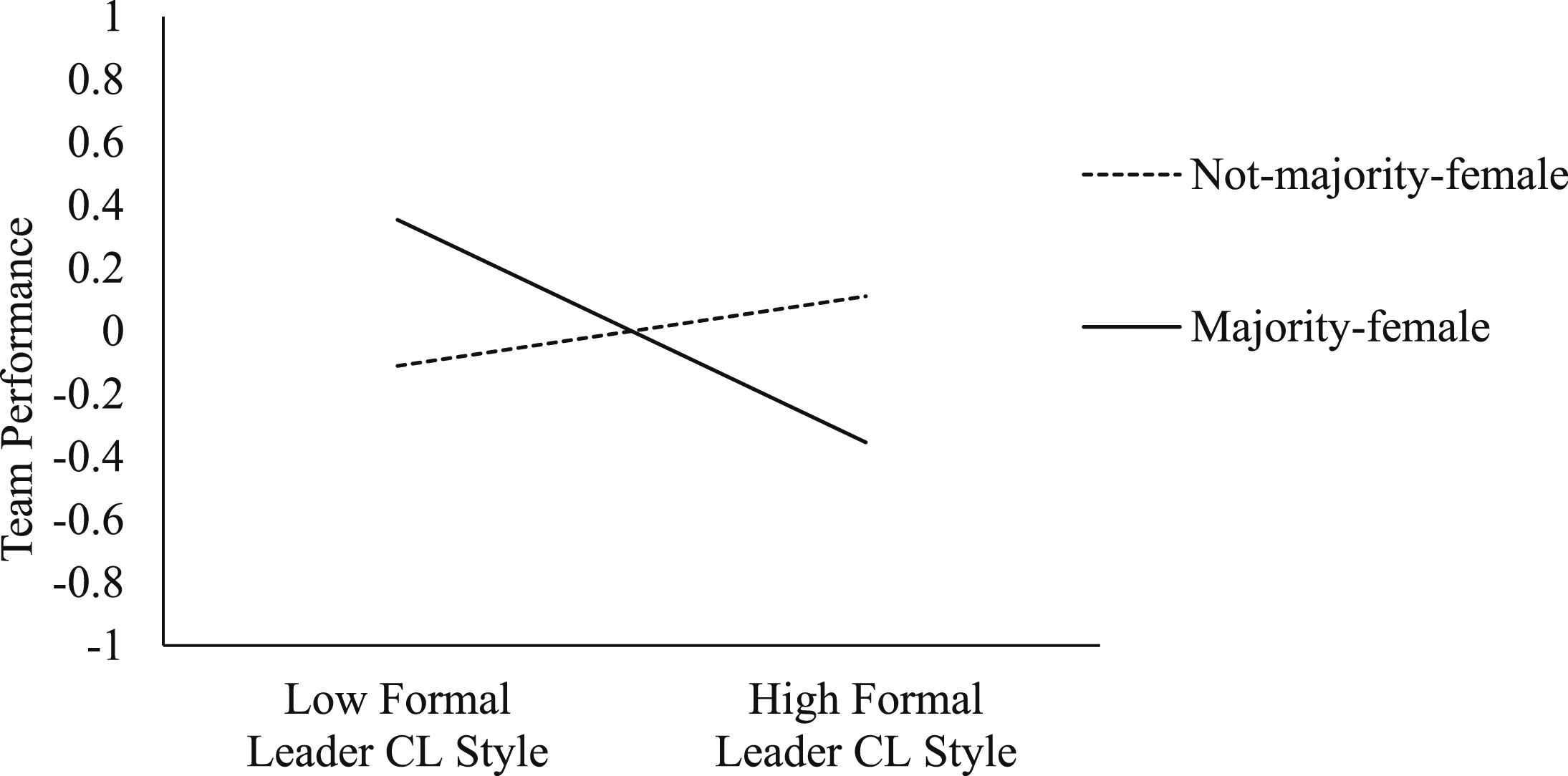
Conditional indirect effect of female leader CL style on team performance through team shared leadership (at Time 3) for majority-female versus not-majority-female teams. Note. CL = Collective Leadership Style. Testing Hypothesis 6.
Discussion
With this study, we aimed to advance our understanding of the interrelation between a team’s shared leadership, the collective leadership style of the formal leader, and team performance as well as the moderating role of gender. In doing so, we contribute to several lines of inquiry in the leadership field. First, as we adopted an identity lens, we have added to our understanding of the ways in which shared and formal forms of leader identity may be enacted as a team works together (Adriasola & Lord, 2021), including addressing calls for more research on the role of gender in the process (Marchiondo et al., 2015; Zheng et al., 2021). We add to the broader research on the role of formal leaders in shared leadership (Ali et al., 2020; Ziegert & Dust, 2021) and address calls for exploring beyond their parallel or interactive impacts on team performance (Wang et al., 2014). In particular, we address the need to examine the process of shared leadership ‘emergence’ (Nicolaides et al., 2014) and confirm Zhu et al.’s (2018) suggestion that shared leadership may be a trigger for, and thus have a sequential relationship with, formal leader behaviors. We provide unique empirical insight in how shared leadership is a contextual driver of formal leader behavior. We also explore the role that a formal leader’s attributes play in enacting shared leadership, finding that gender affects the use and effectiveness of the collective leadership style. Not only does this add to the dialogue on leader individual differences (Zaccaro et al., 2018), and gender and leadership specifically (Shen & Joseph, 2021) but also fills a gap on how the formal leader’s attributes impact their use of a collective leadership style (Friedrich et al., 2016) and subsequent team shared leadership (Chiu et al., 2016).
Finally, we add to our understanding of the shared leadership and team performance relationship, demonstrating that the evidenced relationship between shared leadership and team performance (Wang et al., 2014), may be conditional on contextual factors, particularly as they relate to gender. Along these lines, we add to research on leadership and gender, role congruity theory and the social categorization perspective more specifically (Eagly & Karau, 2002; Rosette et al., 2015; Shen & Joseph, 2021), with findings that, in some cases, contradict prior work.
Contributions to Theory
For our first hypothesis we proposed that lower initial shared leadership in the team would prompt a formal leader to adopt a more pronounced collective leadership style due to making their leader identity more salient and prompting the formal leader to activate untapped shared leadership potential in the team (Morgeson et al., 2010). This hypothesis was not supported which contradicts previous research that suggests leaders consider the social processes in the team when deciding how to engage with the team (Balkundi & Kilduff, 2006) and, specifically, how to involve others in the leadership process (Friedrich et al., 2016; Klein et al., 2006). Recent findings by Lorinkova and Bartol (2021) on the longitudinal development of shared leadership suggest this lack of relationship may be a result of observing the relationship over a limited time window or that the teams having worked together previously may have influenced where they were in their shared leadership trajectory at the start of the project. It may be the case that formal leader identity was more stable and less susceptible to situational changes than other research has suggested (Adriasola & Lord, 2021; Epitropaki et al., 2017). It could also be that some individuals are more innately collective and a shared leadership environment would be more likely to activate their identity as a leader. The innate underpinnings of collective leadership have yet to be examined, so this is an avenue that requires further research. In addition, as we measured only one iteration of the shared-collective leadership relationship, future work may explore whether the pacing or cyclical nature of this relationship may play a role (Van de Mieroop et al., 2020), and whether and how future iterations of the relationship may occur. Given the results of hypothesis 2, this finding for hypothesis 1 highlights the important role that contextual factors may play in this relationship.
For our second hypothesis we expected that as shared leadership in the team increased, women would be more likely to use a collective leadership style as it would align with the ways in which women are more likely to derive their leader identity (Lanaj & Hollenbeck, 2015; Zheng et al., 2021), and, due to role congruity theory, would present less identity risk (Akinola et al., 2018; Ryan et al., 2021). We found this to be the case, as there was a significant, positive relationship between a team’s initial shared leadership and the subsequent use of a collective leadership style by women. However, we did not find support for our predictions of how men would utilize collective leadership in response to the team’s shared leadership. We proposed that, for men, lower levels of shared leadership would represent more hierarchical leadership structures, and thus be more in line with men’s typical foundations for a leader identity (Zheng et al., 2021). We also proposed that the use of a more communal form of leadership would be breaking gender norms for male leaders (Rosette et al., 2015). While the findings were in this direction, they were not significant. This may be a result of men utilizing other, less communal, forms of leadership more generally, or because they may not be as responsive to the existing relational conditions of the team, as suggested by Marchiondo et al. (2015). Along these lines, Eagly and Johannesen-Schmidt (2001) emphasized that female leaders are likely to be more oriented to interpersonal processes, indicating they may be more sensitive to the relational norms of the team and thus take the shared leadership conditions into consideration more than men.
In addition, as we noted previously, Zheng et al.’s (2021) research on the foundations of leader identities found that men draw their identities more from positional sources. They add that, for this reason, men’s identities are more stable while women’s are more ephemeral and subject to their context. Thus, women’s leader identity, and use of a collective leadership style, may be more susceptible to the levels of shared leadership in the team than men. This finding demonstrates the important role that the context can play in determining how gender and leadership interact (Paustian-Underdahl et al., 2014).
In our third hypothesis we argued for the positive impact of a collective leadership style on shared leadership. This hypothesis was not supported, which raises a question around the general impact of a collective leadership style on shared leadership in teams. As findings by Friedrich et al. (2016) demonstrate, the way in which formal leaders adopt a collective leadership style may depend on the task or problem context. Although each team was given the same brief, the focus of their business ideas may have been more or less conducive to the use of a collective leadership style to foster shared leadership in their team. This finding gives pause to what many assume – that participative or empowering forms of leadership will directly support shared leadership (Zhu et al., 2018). Certainly, it underlines calls for more attention to the context specificity of leadership practices and in particular when it concerns the interrelation between the collective leadership style and shared leadership (Nicolaides et al., 2014; Zhu et al., 2018). Our fourth hypothesis presents one such argument.
In our fourth hypothesis we proposed and found a significant interaction between collective leadership style and the leader’s gender on the team’s shared leadership. Specifically, collective leadership style and subsequent shared leadership (T3) are positively related for female leaders, but unrelated for male leaders. These findings for female leaders are in line with role congruity theory which suggests that followers will react more positively to leaders who act in a role congruent manner (Eagly & Karau, 2002). However, the results for male leaders contradict role congruity theory in that there was no difference in shared leadership, regardless of how much collective leadership male leaders engaged in. This is an interesting finding as it may be evidence of changing trends in perceptions of communal behavior (Eagly et al., 2020), where it is seen as generally positive, and men are not necessarily penalized for using it. Future research should measure specific perceptions of male and female leaders using the collective leadership style to understand the underlying mechanisms. Similarly, it may add more insight to measure team members’ perceptions of the formal leader’s gender rather than use a categorical variable from what the leader has declared as their gender.
In our fifth hypothesis, we proposed that the team’s gender composition would moderate the relationship between shared leadership and performance due to activation of gender stereotypes and social-categorization. We expected this to be particularly prominent in female-majority teams. We found that gender composition effects indeed carry risks for teams aiming to benefit from shared leadership as social categorization may give rise to dysfunctional team dynamics if teams become increasingly polarized along gender lines. Our finding is in line with other studies in the social categorization tradition, (e.g. Ashmore et al., 2004; Randel, 2002) as well as the concept that shared leadership benefits emerge more readily if the team members can identify with the collective identity (Venus et al., 2012). We also suggested that high levels of shared leadership may create a “weak context” (Mischel, 1977) in which there are fewer clear norms for member behaviors and stereotypes have a stronger influence (Bell et al., 2018). This may present an opportunity to minimize the negative impact of stereotypes and social categorization without reducing shared leadership – by strengthening the context via emphasizing a shared understanding of the team norms and creating a stronger collective identity. As Bell et al. (2018) note, interventions that focus on the team’s superordinate identity can mitigate these negative effects.
Finally, in our sixth hypothesis, we tested whether shared leadership was a mediating mechanism between the formal leader’s collective leadership style and team performance and if gender moderated this effect. We indeed found a significant negative indirect effect of collective leadership style on performance via shared leadership for teams with female formal leaders and majority-female teams. This finding, combined with a very weak direct relationship between these variables, suggests that a collective leadership style influences distal outcomes such as performance via its effect on processes such as shared leadership, as was originally proposed by Friedrich et al. (2009). Our findings are the first to directly test this mediating mechanism and show that the effect may be contingent on leader and team characteristics. These findings further highlight the social nature of shared leadership and its susceptibility to biases and stereotypes, adding to recent studies reporting negative effects of gender diversity on shared leadership (Kukenberger & D’Innocenzo, 2020; Xu et al., 2019).
Managerial Contributions
Beyond the theoretical contributions, our findings have several important implications for practitioners. First, our findings add information on contextual conditions that should be considered when practicing a collective leadership style or seeking to foster shared leadership in the team. When choosing to use or evaluate a collective leadership style, formal leaders need to be aware of potential gender effects that may infringe on its intended use. Although we would never recommend a collective leadership style to be practiced by one gender only, those using it should be aware of potential biases in its use as well as biased perceptions that may emerge in gender-diverse teams towards the formal leader’s adoption of a collective leadership style. It is important to note, though, that the negative effects of gender composition on shared leadership may decrease with team tenure (Kukenberger & D’Innocenzo, 2020). While tenure cannot be accelerated, similar benefits may be achieved by encouraging collaboration in the team, which has been shown to mitigate the negative effects of surface level diversity (Harrison et al., 2002), or by focusing interventions on developing a superordinate identity (Bell et al., 2018). Our findings should also give practitioners pause in assuming that a collective leadership style will automatically lead to shared leadership and improve subsequent team performance. Our initial results signal that it is a function of who leads and who is being led.
Our findings also demonstrate that the emergence of shared leadership need not be entirely organic–that a formal leader can, under some circumstances, facilitate it by granting a leadership identity to members of the team. We also add caution to assuming shared leadership always improves team performance. Managers may want to consider how the team’s composition may be related to shared leadership. Rather than adjust levels of diversity, we anticipate that leader behaviors supporting the collective identity of the team may be a more viable solution (Chrobot-Mason et al., 2016), and may be particularly important where differences are made more salient (Ashmore et al., 2004). In addition, there may be other interventions that can be used to mitigate these effects, such as developing the team’s political skills (Xu et al., 2019).
Limitations and Future Research
Our study is not without its limitations. First, we have used a sample of student teams to conduct our research which we acknowledge is a threat to the validity of our findings for leadership in organizations. We did take care to use teams that had worked together on a substantial assignment in the prior term, giving them a more authentic pattern of relationships, which is important for shared leadership. Students also elected leaders, based on their prior co-working experience. In this way, we feel these student teams closely resembled intact teams in organizations (Morgeson et al., 2010). This method also allowed us to control for the task, which can affect how a collective leadership style is used (Friedrich et al., 2016). In addition, there is evidence that there are no significant differences in the effects of shared leadership observed in student teams versus field studies (Nicolaides et al., 2014; Wang et al., 2014). We should note, though, that given they were leaderless teams in the prior term this could influence the patterns of shared leadership existing at time 1 in our study. Although this is likely to be similar to intact project teams in organizations, our findings may be different for newly formed, or ad-hoc teams – presenting an opportunity for future research.
A second limitation is that we did not directly measure gender salience or social categorization. While our results are in line with past research that suggests the negative effects of increased social categorization on shared leadership (Kukenberger & D’Innocenzo, 2020), we cannot be certain that these were the mechanisms by which the leader’s gender and the team’s gender composition had an effect on shared leadership and team performance. Future research should explore this mechanism, for instance with measures like Mayo et al.’s (2016) which draws on AI to evaluate social categorization without priming it. Similarly, to limit the complexity of our models and focus on yet-untested tenets of the collective leadership style framework, we did not examine higher order interactions where, for example, leader gender and gender diversity might interact. This would be a natural extension of our findings given that members may differently evaluate formal leaders and others depending on both the members’ and others’ gender (Eagly & Karau, 2002; Gloor et al., 2020).
A third limitation is the single item operationalization of shared leadership. While the IWD measure is sophisticated in accounting for density and centralization as well as the leadership profile of each member, the measurement of leadership attribution could be extended. For instance, future studies could measure specific aspects of shared leadership, such as task or relational forms of influence. Given that different foci of leadership (e.g., task vs. relational) are attributed to men and women (Eagly & Johannesen-Schmidt, 2001), it may be useful to create separate IWD scores for these foci of leadership being shared in the team. Relatedly, studies could control for interpersonal relationships among team members to make sure leadership attributions in IWD are not (partly) attributable to friendship or other underlying connections (Mehra et al., 2009).
Finally, a methodological limitation arises from our use of a time-lagged design instead of collecting longitudinal data. Longitudinal data may uncover recurring or changing cycles of influence between formal leaders and team members (Marks et al., 2001; Marques-Quinteiro et al., 2022) that our data would not have detected. While the timing of our surveys was based on the fixed schedule of the course, we suggest future research surveys participants at even more regular intervals to capture the process-based nature of the collective and shared leadership relationship more precisely (Acton et al., 2019; Lorinkova & Bartol, 2021; Zhu et al., 2018).
Conclusion
Our results provide insights into the way in which formal leaders react to the shared leadership context of teams as well as how their collective leadership style further impacts the team’s shared leadership. Importantly, our results underline that the application of shared leadership as well as the adoption and enactment of a collective leadership style by formal leaders may be contingent on the gender characteristics of the formal leader and the team, calling for further attention to gender in the study of shared forms of leadership.
Footnotes
Declaration of Conflicting Interests
The author(s) declared no potential conflicts of interest with respect to the research, authorship, and/or publication of this article.
Funding
The author(s) received no financial support for the research, authorship, and/or publication of this article.

Data Availability Statement
The anonymized data that support the findings of this study are not publicly available but can be made available from the corresponding author upon reasonable request.