




Abstract
Leadership development is big business, with business schools and private providers offering leadership development programmes claimed to help turn managers into wise, good and able leaders. Leadership development originated in philosophy and, in the Western tradition, dates back at least as far as Socrates. This article asks: how would philosophers qua wisdom-lovers [philo-sophes] respond to contemporary programmes? We use the dramatic licence offered by theatre to imagine Foucault, Butler, Kant, Hume and others participating in a leadership training course. As our play opens, we find them critiquing a 360-degree psychometric assessment instrument they have been asked to complete. Our highly select group argue it solicits docile, servile supplicants to the interests of neoliberal capitalism. They offer an alternative containing key questions putative leaders should explore. The script includes other dramatis personnae and a Chorus (the authors of this paper). Speeches and programme notes provide the necessary bones of an academic paper, such as literature reviews and philosophical contexts. We ask colleagues to join with us in reconnecting leadership development to its philosophical roots in an effort to foster wiser and more ethical leadership.
Keywords
Programme
1. Prologue: why this drama, why now? 2. The script 3. Epilogue 4. Programme Notes i. References ii. Hume’s handout.
Prologue
In the Western tradition, efforts to ensure rigorous, systematic approaches to leadership development (LD) can be traced back at least as far as ancient Greece (Russell, 1984; Wilson, 2016). Historians disprove assumptions that research and theorizing about leadership and its development are recent phenomenon (Day et al., 2014). Ancient sources show aspiring leaders encouraged to commit their lives to seeking truth, knowledge and wisdom, to serving the greater good, acting honourably and exercising personal constraint, and to revere the divine (e.g. Aristotle, 2009; Plato, 2007; Xenophon, 2006). A similar focus on truth-seeking, life-long service to the greater good and the development of a virtuous character were key concerns in medieval texts on leadership (e.g. Erasmus, 2010; James VI, 1950; Lipsius, 2004).
Today LD typically focusses on mastering techniques intended to improve organizational performance and, simultaneously, advance participants’ career prospects. Context-free competency development is often the core focus of leadership development programmes (LDPs) (Carroll and Simpson, 2012; Gagnon and Collinson, 2014), but outcomes are often not what were anticipated. Espedal, Gooderham and Stensaker (2013: 607), for example, concluded the LDP they examined ‘instead of developing social capital … turned out prima donnas’. A general warning has been issued that many LDPs risk fostering hubris amongst participants (Collinson and Tourish, 2015). However, LD is big business for management consultants, business schools and other providers (Kellerman, 2018), with estimates of annual spending in the US alone ranging between nearly $14 billion (Subramoney, Segers, Chadwick et al., 2018) and $45 billion (Day, 2011, in Gagnon and Collinson, 2014).
Surprisingly, critical and rigorous evaluation of LDPs of such a costly investment is lacking (Edwards and Turnbull, 2013). There is a dearth of evidence of their effectiveness (Jeyaraman et al., 2018; Whaley and Gillis, 2018), while ‘skeptical attitudes’ toward their measurement are commonplace (Gabel et al., 2011: 58). Gurdjian, Halbeisen and Lane (2014, no page number) argue the common reliance on participant feedback to evaluate LDPs creates the risk that ‘trainers learn to game the system and deliver a syllabus that is more pleasing than challenging to participants’. King and Nesbit (2015) posit the weaknesses in evaluation nonetheless creates ‘functional and financial benefits’ and suggest ‘collusion with denial between the suppliers and purchasers of leadership development’ (p. 134) may underpin this state of affairs. All in all, research indicates LDPs involve vast sums of money, are typically instrumentally focussed and are subject to typically weak evaluation as to whether they generate the desired (or desirable) results.
This paper focuses on the 360-degree psychometric instruments that are common features of LDPs. Again, precise figures are lacking, however at the end of the 20th Century ‘perhaps millions’ had undergone such assessments (Atwater and Waldman, 1998) and their use amongst Fortune 500 companies was estimated to be ‘nearly universal’ (Wareech et al., 1998). The trend has continued in more recent decades such that these tools are ‘almost ubiquitous in organizations of every type’ (Day et al., 2014: 70), even though they entail ‘intense, comprehensive scrutiny’ (Day, 2001: 587).
As with LDPs in general, 360-degree instruments have received little critical scrutiny and there is sparse evidence as to their value in LD (Day, 2001: 606). Scholarly investigations of them are rare (Avolio and Luthans, 2006). Efforts to edit a special edition on their use saw only two papers being published (Atwater and Waldman, 1998). Twelve years later, these instruments remained the least explored topic in leadership research (Avolio et al., 2010), with the field described as ‘relatively immature’ in Day et al.’s literature review (2014: 80).
360-degree instruments involve participants and selected colleagues (bosses, peers and ‘direct reports’) rating the participant against a series of statements, with results typically reported in aggregated form. However, because peers, direct reports and managers likely have varying expectations about what constitutes effective leadership a concerning degree of subjectivity is embedded into these tools (Hooijberg and Choi, 2000). Raters’ leadership schemas, personalities, motivations to carry out the task and the quality of their interactions with the ratee have all been identified as influencing factors (Fleenor et al., 2010), meaning judgement of leadership effectiveness may simply be in the eye of the beholder (Day et al., 2014). Given this, it is not surprising that the credibility of the ratings is questionable (Markham et al., 2015). Moreover, with such small samples, typically between six and 15 raters, drawing major conclusions from quantitative data seems inherently risky. Unsurprisingly, ratees’ willingness to accept feedback as valid is linked to how positive it is, with more negative feedback garnering less acceptance (Facteau et al., 1998).
This paper, written in the form of a play, addresses this lack of scholarly evaluation of the 360-degree instrument’s part in LDPs through analysing perhaps the most influential and widely used of them, the Multifactor Leadership Questionnaire (MLQ). The MLQ purports to translate into practice one of the most influential leadership theories, transformational leadership (TFL).
The paper returns to the philosophical roots of LD to guide its analysis. Philosophers have long since vacated the LD stage but here we bring some back to develop a philosophical critique of the MLQ and similar instruments. The paper rests on a creative artifice: it gathers a handful of philosophers together on a fictionalized LDP, using the format of a play to envisage how they might, both jointly and severally, critique 360-degree psychometric tools. They, our interlocutors, will argue that the business-focused approach to LD undermines the very thing it aims to create: rather than producing visionary leaders, as claimed, it instead fosters unquestioning rule-followers.
Recognizing the eradication of LDPs is unlikely, our protagonists also offer philosophically-informed questions for those engaged in LDP’s to explore which aim to foster the development of wisdom and ethics, rather than unquestioned obedience to the profit motive. Our contribution is thus to show both why the field of LD needs to be reinvigorated through a return to its roots in philosophy and to offer ideas for how that might be achieved.
The play has three acts. Act One, Scene One is set in the training room. The Trainer introduces transformational leadership and the MLQ. The curtain falls on the participants completing the psychometric tool. Act One, Scene Two, set in the bar of the Executive Development suite, sees the philosophers gather to discuss their day’s experiences. We listen to Hume’s denunciation of the scientific foundations of TFL and Foucault’s analysis of the programme. Kant elucidates implicit normative injunctions and Butler concludes by advocating the need for change. In Act Two, Scene One, the VC worries about the impact on the University’s income of the philosophers’ critique. She directs the Business School’s Dean to find out what the philosophers have to say. In Act Two, Scene Two, we rejoin the philosophers as they are briefed by a critical leadership scholar about recent critically inspired research into leadership development. In Act Three, Scene One, the philosophers debate amongst themselves what principles might put improve LPDs, given the impossibility of their eradication. In Act Three, Scene Two, they present their ideas to the VC and the Dean. The Epilogue has the Chorus (qua authors) asking colleagues across business schools to consider offering more radical, philosophically-driven LDPs, perhaps using the ideas outlined in this paper. Programme notes conclude the Play and the paper.
Act One, Scene One: The training room
The first day of the LDP. Hume, Kant, Foucault, Butler and others are in the room chatting.
Trainer
‘Good morning and welcome everyone. I’m going to outline transformational leadership before introducing the psychometric assessment tool you will complete.
[Slide One]
• Transformational leadership theory: arguably the most influential of modern leadership theories, backed by extensive research • The MLQ: a 360-degree psychometric tool to translate TFL theory into practice • The MLQ: used worldwide, translated into 47 languagesTransformational leadership theory and the MLQ
Seminal sources setting out TFL’s core propositions include Bass (1985), Avolio et al. (1999) and Bass and Riggio (2006). Diaz-Saenz (2011) reports on the MLQ’s wide reach.
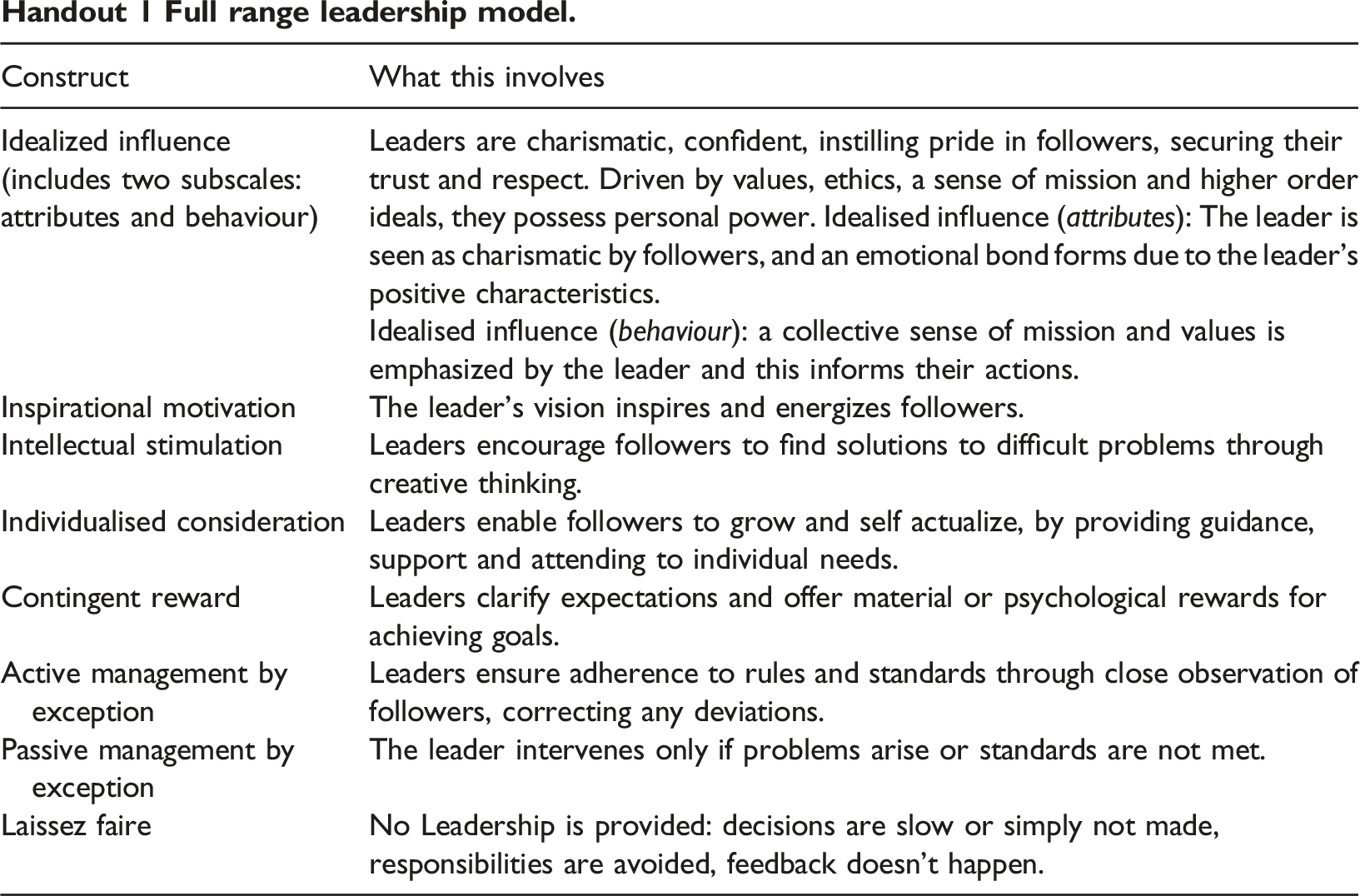
So, what is TFL? Bass (1985) and various collaborators (e.g. Avolio and Bass, 1995; Avolio et al., 1999) define it as a ‘full range leadership model’ (Avolio and Bass, 1991; Bass, 1995, 1999b; Bass and Riggio, 2006) that distinguishes between transactional and transformational leaders.'
[Slide Two]
• Transactional leaders = traditional managers • Transformational leaders ○ Achieve outstanding results ○ Secure dramatic changes in purpose, strategy, values, culture ○ Elicit commitment, effort and personal growth from followers • MLQ, grounded in TFL’s core concepts and constructs, creates a direct link between theory and your development as a transformational leaderTransactional vs transformational styles and the MLQ
Chorus
For influential studies of the effects a transformational leadership style is said to have, see Avolio and Gardner (2005), Avolio and Luthans (2003), Bass (1985); Bass and Riggio (2006)), Bryman(1986) and Kotter (1988). For key discussions of the MLQ and its relationship to TFL, see Avolio et al. (1999) and Antonakis et al. (2003).
Trainer
[Slide Three]
• Developed over time, through various iterations • Measures 3 outcome criteria (Rowland, 2005): ○ Followers’ extra effort ○ Effectiveness of leader’s behaviour ○ Followers’ satisfaction • Through the MLQ, ‘leaders discover how they measure up in their own eyes and in the eyes of those with whom they work’.
1
More about the MLQ:
Chorus
For discussions addressing the MLQ’s development see, for example, Avolio and Bass (1991) and Avolio, Bass and Jung (1995).
Trainer
‘Your MLQ results will help you to become an ideal transformational leader comparing your individual profile to the TFL ideal. Improvements are ‘‘measured through a re-testing program to track changes in leadership style.’’ 1 The MLQ, completed in only 15 minutes, will indicate whether you are an ‘‘exceptional’’ or ‘‘marginal’’ leader (Delaney and Spoelstra, 2019: 76; see also www.mindgarden.com).
Now isn’t that wonderful? Your leadership style will be revealed through assessing how closely a series of 21 statements describe you.
[Slide Four]
• MLQ stage 1: complete the questionnaire ○ Self rating ○ Boss, peers and direct reports rate you anonymously ○ 4-point Likert rating scale ○ Computer generated analysis of your results • MLQ stage 2: feedback on your results.The MLQ process
As you can see on the slide above the MLQ has two stages: completing the questionnaire and receiving feedback. In Stage One you rate yourself and ask your boss, plus two or more from among your organizational peers and your ‘‘direct reports,’’ to rate you anonymously, on a Likert scale of 0 to 4. Completed questionnaires are analyzed using a computer program, and in Stage Two feedback is given. You can discuss your leadership style in depth in that feedback discussion.
‘‘Any questions?’’ No?: Good. Then can you now complete the 360-degree psychometric tool. You’ll only need 15 minutes.'
Chorus
We leave the philosophers, like many people at the start of an LDP, completing the MLQ. Because the MLQ is a proprietary instrument details of its contents cannot be discussed or subjected directly to critical analysis, so we must gloss over the specific contents of the tick boxes.
(The curtain falls at the end of Act One, Scene One.)
Act One, Scene Two: The bar in the Business School’s Executive Suite
Picture Raphael’s School of Athens, 2 in which geographically and temporally distanced philosophers are seen congregating. The conversational hum is interrupted as David Hume, reflecting on gaps between cause and effect asks for everyone’s attention.
Hume
‘Colleagues, this 360-degree instrument’s claim to veracity is unfounded. As Van Knippenberg and Sitkin (2013) show: 1. Rather than deploying sound scientific research, the MLQ’s factors rely on a taxonomy that presumes what constitutes good leadership and then sets out to look for this in practice. There is a clear non sequitur here – “you cannot define a concept in terms of its effects and such a definition would disqualify the concept from studying its effects” (p. 11); 2. Research on TFL is hindered, if not fundamentally flawed, by poor conceptual definitions along with problematic assumptions that a group of selected behaviours coheres simply because they have been clustered under a common label (p. 10); 3. Finally for now, they show that circular reasoning informs the research guiding the MLQ: it first defines leadership according to what is thought to have desirable effects on followers. It then defines effective leaders as those portraying those very characteristics. So “the MLQ and similar instruments study ‘the effectiveness of leadership’ that is defined a priori as effective” (p. 15).
So, the foundation for the MLQ’s claims to legitimacy is unsubstantiated; there is no cause and there is no effect.’
(Hume resumes his seat and Michel Foucault stands.)
Foucault
‘Like David, I too have deep concerns about the 360-degree instrument. Notwithstanding their lack of scientific credibility, TFL and the MLQ nevertheless have effects in the world. However, rather than producing visionary, dynamic, transformational leaders, surely they produce just the opposite: docile, controlled servants of power?
Why so? Firstly, the MLQ subjects participants to normalizing “games of truth”, as I discussed in 1990 (p. 6). It comprises a subjectivating power/knowledge apparatus, requiring participants to see themselves as subjects about whom expert discourses possess important truths, and whose prescriptions they should adopt (p. 5). It is thus a “technique of the self” (1990, p. 11) soliciting conformity to dominant norms and discourses. It is, moreover, not unlike the medieval practice of confession; asking subjects to speak of themselves using only terms that experts have determined are relevant and desirable (1978; 1989). Broadly, then, the MLQ constitutes a mechanism of power/knowledge and a normalizing discourse, soliciting docile subjects who will internalise TFL’s prescriptive demands.
This raises the question of what manner of subject is invoked by the MLQ’s particular prescriptions?
Consider the constructs: Idealised influence. This prescribes a self with confidence, charisma, personal power and a sense of mission, focussed on “higher-order ideals and ethics” (Antonakis et al., 2003: 264) and able to instil “pride, respect and trust” in followers. This self thereby comes to perceive itself as superior to others, more desirable, driven, capable, influential and insightful than they. Concomitantly, followers are inferior to it, indeed its raison d’etre depends on understanding followers as fundamentally deficient, needing to be “transformed” by leaders. That said, this self is simultaneously disciplined by the MLQ, to brook no dissent. Not achieving its requirements entails being constituted, shamefully, as a failed leader, who must then undergo extensive self-disciplining efforts to raise themselves to the MLQ’s standards.’
(Kant interjects.)
Kant
‘Interesting gentlemen. There seems to me to be a normative injunction operating here: if you want to succeed as a leader then believe in your own superiority and followers’ deficiencies.’
Foucault
‘Indeed. There may be similar injunctions underpinning the other dimensions that you, Immanuel, could highlight for us.
Let me turn next to inspirational motivation. This requires leaders to “energize” followers by promoting a positive view of the future, “projecting an idealized vision” and communicating confidence in the attainment of that vision (Antonakis et al., 2003: 264–265). Leaders are thus constituted as visionaries, while followers are mired in the mundane present. Leaders it seems aspire to an “ideal” future. Not only is this unrealistic, impractical and immodest, it also requires grandiosity and narcissism.’
Chorus
See also Alvesson and Kärreman (2015) and Tourish (2013). Avoidance or misrepresentation of realities, that are always less-than-ideal, occurs when this overly-positive “prozac” (Collinson, 2011) style of leadership arises.
Foucault
‘It seems, moreover, their ideal future is something leaders simply will into being. Their visions are just presumed meritorious, with no contestation or input from followers contemplated. In enacting their required capacity for inspirational motivations, this leader self appears warranted to ignore or overrule objections, alternatives, participatory dialogue and practicalities.’
Kant
(taking up the baton) ‘So, followers are again marked and constituted by their inferiority which implies a second normative injunction: if you are to score highly on this factor in the MLQ then practice egotistical self-indulgence and fantasy labelled ‘inspirational motivation.’
(Foucault nods towards Kant.)
Foucault
‘Thank you, Immanuel. What manner of self is invoked by the next major element, ‘intellectual stimulation’? Here leaders appeal to followers’ “sense of logic and analysis” and encourage them to “think creatively” and “find solutions to difficult problems” (Antonakis et al., 2003: 264). This seems initially unobjectionable – but still neither questioning or critical analysis are encouraged. Moreover, this self functions in the context of manager-worker dynamics, where power inequalities and dialectical tensions impede the potential for critical questioning (Collinson, 2005, 2006). And, this element is offset by other MLQ/TFL factors which solicit a silencing of followers.’
Kant
‘This suggests that a focus on logical analysis and creative thought inform the moral norms of the MLQ, but that these may occur only within very narrow parameters: the organization’s aims and objectives must not be questioned. Combining this with what we have said already, a third normative injunction emerges: if you seek to embody idealized influence and inspirational motivation, then exercise the fantasies, narcissism and hubris these provoke within you but wrap your efforts in the simulacra of independent thought qua intellectual stimulation.’
Foucault
‘Turning now to individualised consideration. This entails a self “advising, supporting and paying attention to the individual needs of followers, and thus allowing them to develop and self-actualize” (Antonakis et al., 2003: 265). This apparent care for followers is paternalistic, implying leaders have superior insight into what others need for their self-actualisation.
It also supports organizations’ requirements for productive, disciplined staff. Followers’ autonomy to decide the kind of person they wish to become is thus undermined. The leader’s managerial authority is equated with moral authority. Possibilities of resistance, autonomy and ethical practice are simultaneously suppressed. Apropos individualised consideration the leader adopts a moral code in which care entails acts of domination and the suppression of critique, resistance and self-determination by followers and leaders both.’
(He now gives way to Kant.)
Kant
‘The normative injunction here is that if leaders are to demonstrate individualised consideration, then they should practise acts of domination but conceal them beneath a caring visage’ (He sits).
Foucault
‘Let us now consider the transactional and non-leadership aspects of the MLQ (contingent reward, management by exception and laissez-faire leadership), which overtly assume leadership is conjoined with managerial responsibilities and authority. These aspects of the model, while seemingly at odds with the transformational ones, serve to remind leaders their duty is to the organization, not followers. If, through engaging in individualised consideration, inspirational motivation, and so on, leaders find themselves tempted to place followers’ needs ahead of concerns for efficiency and profitability, then these transactional elements serve to mitigate that potential risk to the corporation’s interests.
Transformational leaders then, are to act only in ways amenable to capitalist and managerialist values. While it is claimed ‘leaders’ and ‘managers’ are fundamentally different beings (Zaleznik, 1977), transformational leaders qua managers possess the right and duty to direct, reward and punish others. Unquestioning compliance with organizational desires to maximize efficiency and profitability demonstrates leaders’ mastery of these transactional elements’ (Looks over to Kant).
Kant
‘So, the character of this 360-degree instrument is fundamentally unethical. It solicits blind adherence to a narrow set of norms and behaviours designed to serve organizational interests, rooted in the naïve assumption that whatever the organisation seeks is, ipso facto, good. It rejects the constructive potency of critical thinking and instead solicits acquiescence. This undermines individual autonomy and gives way to external stimuli – what I call heteronomy.’
Foucault
‘Indeed. Pursuant to the MLQ’s injunctions aspiring leaders are to become docile, obedient and disciplined managerial subjects, with permission to constitute their followers as similarly compliant and unquestioning of their employer’s expectations. Alternative approaches to leadership are closed off by such narrow prescriptions, which find their roots within a negative morality of capitalism. In this, both followers and leaders are denied their capacity for ethical reasoning or resistance and managerial authority is equated with moral authority.
Organizational interests are privileged over those of individuals, communities, nations or society. Unquestioning, uncritical obeisance to organizational demands to maximise profits and/or efficiency is deemed both good leadership and what must be elicited from followers.’
Kant
‘It seems the LDP we have embarked upon threatens to impose upon us normative injunctions that are fundamentally opposed to ethical practice. These injunctions are: if you are to become a leader then you must: 1. believe in your own superiority and followers’ inadequacies; 2. develop egotistical self-indulgence and fantasy and call it ‘inspirational motivation’; 3. think of the fantasies, narcissism and hubris that will be provoked within you as indicators of your success in embodying idealized influence and inspirational motivation; 4. under the guise of ‘intellectual stimulation’, discourage critical analysis and independent thought. 5. under the guise of individualised consideration practise acts of domination but hide them beneath a caring visage.’
Foucault
‘From this, it follows that those managers identified as having leadership potential are subjected to a subtle form of control articulated by a seductive language of duty and morality which simultaneously encourages them to become the manipulated and manipulative servants of power.’
Butler
‘This calls for action.’
Act Two ends amidst a clamour of conversation and a rush to the bar.
Chorus
The curtain falls on a hubbub of philosophers plotting to subvert the 360-degree instrument’s role in leadership development. But does their plan threaten to kill the University’s goose that lays golden LDP eggs? During the development of this play the European Foundation for Management Development (EFMD) offered business school leaders an LDP that includes a 360-degree tool. The ‘early bird’ fee is €4000 per person, with a maximum attendance of 20 people (https://events.efmdglobal.org/events/the-executive-academy-europe/).
Act Two, Scene One: The VC’s office
A smart suited VC sits at her desk. The Business School Dean is at the door.
VC
‘Look at this. (her monitor). Our promised marketing boon is turning into a disaster. Rather than “Michel Foucault says he has become a far better leader thanks to Middling University” he’s telling the media that it is a charade. Other philosophers have emailed me complaining about it. The evaluations for this course will be the worst in this university’s history. This could damage our business irreparably and that income is essential.’
Dean
(blanching) ‘Yes. And executive education income is vital for creditations.’ 3
VC
‘Then we must retrieve the situation. Go and listen to the group. Perhaps we can address their concerns without losing this revenue stream.’
Act Two, Scene Two: A meeting room on campus
The philosophers have been inspired by Butler’s call to ‘do something.’ The Dean is sitting quietly at the back: ‘I’m just here to listen’ she says.
Butler
‘Last night we agreed we needed to know more about recent developments in critically-inspired research. I’m very grateful that Dr Crills is here to assist us with that.’
(
As you can see in slide one, critics have identified some fundamental problems in how leadership and its development is typically approached, with my diagram illustrating how these problematic notions of leadership flow through to create problematic effects in LDPs.
[Slide One]
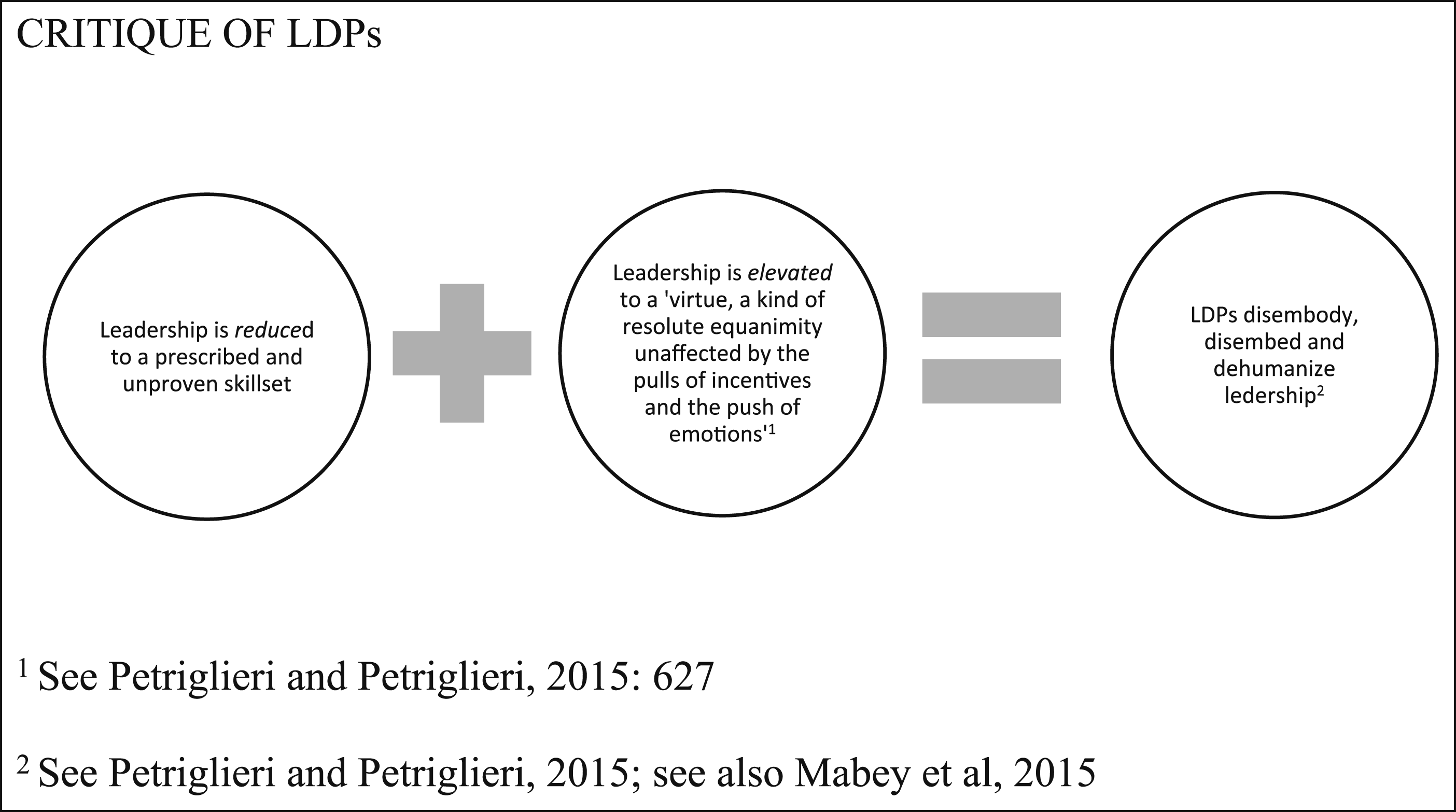
As part of all this decisiveness, efficiency and KPIs are emphasized, pressuring leaders to present themselves as omniscient controllers of an environment where endemic uncertainty and instability renders such control impossible. Deliberation, analysis and critique are undermined by such emphasis (Saggurthi and Thakur, 2016. See also Carroll, 2015; Nicholson and Carroll, 2013). Critics also observe how LDP’s often ignore the ambiguity and dynamism of something that is both a practice and an identity which defies definition (Ford, Harding, Learmonth and Lee, 2011; Nicholson and Caroll, 2013).’
Dean
(an aside) ‘Wow, this actually reflects my own experiences. I’ve spent years pretending to know the answers, pretending I can control things, when really, I feel all at sea – it’s so exhausting and isolating (Sinclair, 2011). What if this is the experience of many people in leadership? If that is so, what if our LDPs acknowledged such issues and encouraged participants to critically reflect on their feelings and experiences, to help them identify opportunities for change (Cunliffe, 2004)’?
Dr Crills
‘There are further criticisms made of how LDPs commonly operate, as summarized in this next slide,’
[Slide Two]
• Homogeneity suppresses heterogeneity1 • Innovative thinking smothered by conformity1 • Overly positive views of leadership2 • Encourage ‘hype and hubris’ in participants2
1Ford and Harding, 2007; Ford, Harding and Learmonth, 2008Critique of LDPs (cont’d)
2Collinson and Tourish, 2015,
Dr Crills continues
‘LDPs’ curricula have been subjected to much criticism, with some key points noted on my next slide.
[Slide Three]
• Emphasize methods and models designed to help leaders extract maximum effort from followers VS exploring issues of wisdom, judgement and morality (Edwards and Turnbull, 2103; Mabey and Mayrhofer, 2015) • Do not contribute to ethical leadership practices (Khurana, 2007) • There is a failure to ‘build a broad body of knowledge on a carefully considered theoretical foundation’ (Kellerman, 2018: 37) • Deploy ‘pedagogies that are hasty and superficial, that are minor and meagre’ (Kellerman, 2018: 58)Critique of LDPs Curricula
These concerns apply to US business schools and management consultancy firms but also to those in India (Bhandarker, 2008) and Europe (Alvesson and Kārreman, 2015; Durand and Dameron, 2008; Ford, Harding and Learmonth, 2008) and more widely still (Morsing and Rovira, 2011).’
The Dean.
(an aside) ‘I understand these criticisms of LDPs but the University needs the profits and the kudos they bring. We cannot simply ignore this source of revenue – yet continuing on our current path is clearly problematic.’
Dr Crills
‘There are numerous suggestions of how to improve LDPs, none of them straight-forward. Some recommend a focus on character-building, rather than functional content (Crossan, Mazutis, Seijts and Ganz, 2013). However, a prescriptive approach to character raises questions as to what is ‘character’ and satisfactory answers to those would be essential.
Character-building is implicit in Collingwood's (2001) extolling of self-awareness as ‘leadership's first commandment’. There is now consensus on this point within leadership development (Petriglieri, Wood and Petriglieri, 2011). That said, to do this meaningfully means engaging with philosophy instead of mimicking popular self-help mantras amenable to a market-based logic.
A focus on identity work rather than ‘doing’ leadership has also been recommended (Gagnon, 2008; Sinclair, 2011). This involves ‘identity undoing’, as participants work to (re-construct) a sense of self through ‘letting go’, as well as ‘strengthening’ or ‘evolving’, aspects of the self (Nicholson and Carroll, 2013). However, such effort entails dynamics of seduction, conformity, anxiety, insecurity, power and resistance within, between and amongst educators and learners (Carroll and Nicholson, 2014; Gagnon, 2008; Sinclair, 2007a, 2009, 2011). Facilitators may strive to practice the ethics and duty of care yet find this all but impossible given the messiness and unfolding realities of LDPs (Carroll and Nicholson, 2014; Gabriel, 2009; Sinclair, 2009). Slide Four summarizes these points for you.
[Slide Four]
• Focus on character building – although what that means is contested • Self-awareness is key – but we must not fall prey to trite self-help mantras • Identity work is a useful focus BUT its complex and difficult: ○ Participants face messy issues in reconstructing their sense of self ○ Facilitators face difficult dynamics of seduction, conformity, insecurity, power and resistance ○ Efforts to practice an ethics of care may prove impossible to sustainImproving LDPs
These challenges may explain why such concerns have had little influence upon the content of LDPs thus far (Kellerman, 2018). Nonetheless, other key issues identified by critics as important elements of an LDP curricula include:
[Slide Five]
• Examining issues of power and resistance (Collinson and Tourish, 2013); • Questioning the romanticized ideals fostered by heroic theories of leadership (Collinson and Tourish, 2013; Ford, 2015); • Exploring doubt, ambiguity, complexity and uncertainty, rather than sustaining the illusion of control over people and events (Carroll and Nicholson, 2014; Hawkins and Edwards, 2015; Sinclair, 2007b); • Examining the challenges of gender, gendering and embodied experiences of being leaders (Sinclair, 2005, 2007a, 2007b).Other recommendations for LDPs Curricula
For a holistic leadership development approach, Sinclair proposes (2007a, 2007b: vx) the following general principles:
[Slide Six]
• ‘Leadership should be aimed at helping to free people from oppressive structures, practices and habits encountered in societies and institutions, as well as within the shady recesses of ourselves. Good leaders liberate’. AND • ‘We can liberate leadership thinking itself from its narrow instrumental confines, so it may reconnect with ideals’.Sinclair’s advice
Similarly, Sutherland, Gosling and Jelink (2015) recommend an holistic orientation should shape the lived experience of an LDP:
[Slide Seven]
• Generate aesthetic and embodied ways for participants to experience the power and responsibility that comes with leadership • Aim to activate all the senses and sensibilitiesSutherland, Gosling and Jelink’s advice
Cunliffe (2004) also offers important guidance for LDPs.
[Slide Eight]
• Focus on critical reflexivity to foster ethically good leadership • Encourage participants to question the assumptions they have about themselves, others, and leadership • Doing this builds a sensitivity to power dynamics, enables a better grasp of fragile, complex identities and mindfulness of the ethics involved in leadership practiceCunliffe’s advice
It is also worth bearing in mind other critically informed advice that could help to transform – oh how ironic – the leadership development industry,’
[Slide Nine]
• Tomkins and Ulus (2015:601) on the development of critical awareness; • Berkovich (2014), who includes ‘critical thinking’ as one of eight components in authentic leadership development; • Petriglieri, Wood and Petriglieri’s (2011: 432) emphasis on the need to learn how to question one’s core beliefs.Other critically oriented work seeking to improve LDPs
Butler
‘Thank you, Dr Crills. There is much that confronts us when designing an LDP and a perfect solution seems most unlikely. Nonetheless, let us each ponder these issues and discuss further later.’
Act Three, Scene One: At the Athenian bar, located just around the corner from campus
Hume
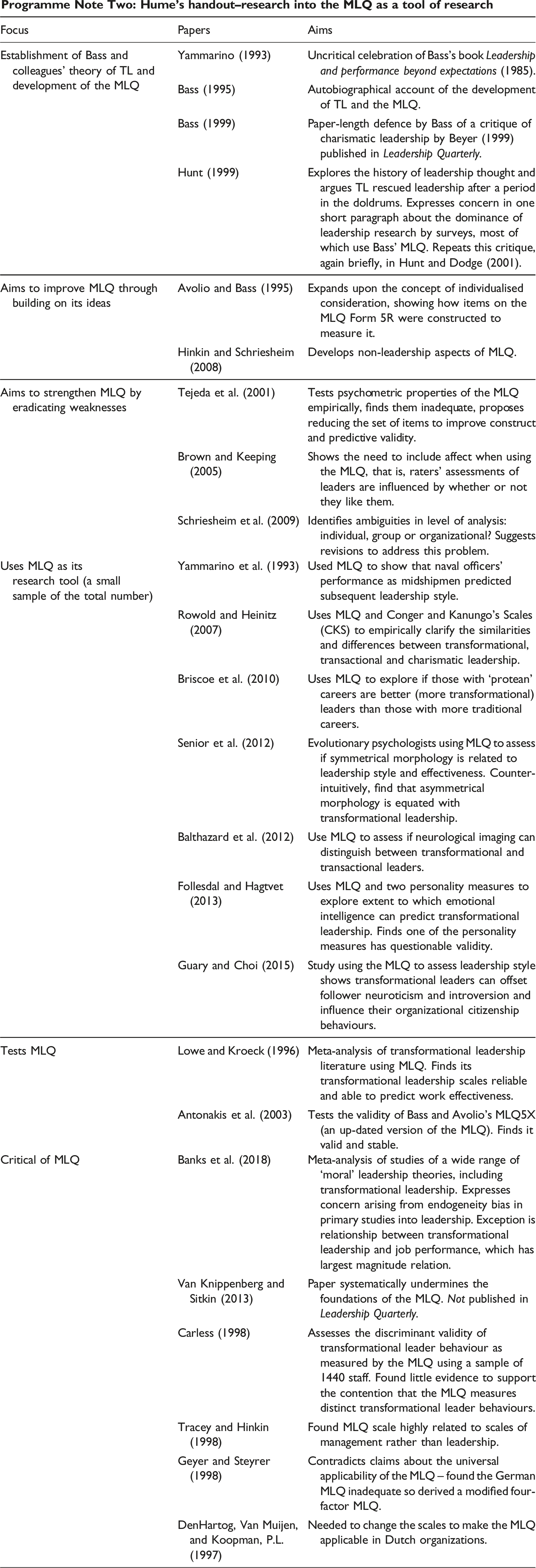
‘Colleagues, we must proceed with caution. This MLQ has its roots in transformational leadership theory. I’ve examined 50 papers discussing or reviewing the MLQ’s use in research: (He circulates photocopied sheets – see Programme Note 2 below). You will see there is very little critical scrutiny of the MLQ. Perhaps more worryingly, I cannot assess this tool directly without paying the commercial proprietor a fee to gain access, and even then, I mustn’t divulge its contents in any detail. This seems to me to undermine the foundations of scientific research and academic freedom. We are told the MLQ “identifies the characteristics of a transformational leader and helps individuals discover how they measure up in their own eyes and in the eyes of those with whom they work”, 4 but we cannot test the validity of that claim. I’m very concerned by such strict control by a private company over its product with such widespread use as an academic tool.’ 5
Butler
‘I share these misgivings, but, as I am sure Michel would agree, leadership is a dominant discourse, and as such it has performative effects (Butler, 1990, 1993). I maintain that the MLQ’s core constructs give rise to ‘injurious speech’ (Butler, 2005). It is not only a dominant discourse but a major industry, a behemoth that requires challenging.’
Aristotle
‘Our first consideration, always, must be virtue.’
Kant
‘So long as profit-seeking is core to LDPs then they will continue to circulate the normative injunctions we previously discussed. LDPs should, nae must, be designed to produce ethical and moral leadership.’
Chorus
(unable to stay in the wings). As feminists, we argue in favour of micro-revolutions that accumulate over time to achieve seismic changes (Thomas and Davies, 2005).
Butler
‘Micro-revolutions can occur because of the cracks in the performative.’
Leonard Cohen
,
philosopher poet, is heard singing in the background:
‘There’s a crack in everything. That’s how the light gets in.’
Butler
‘Exactly. We must foment micro-revolutions using LDPs themselves – change their content, use them to encourage critical questioning and the development of analytical skills. To work my friends.’
(End of Act Three, Scene One. The curtain falls on a scene of highly engaged philosophers huddled together, deep in discussion).
Act Three, Scene Two: The training room
Butler
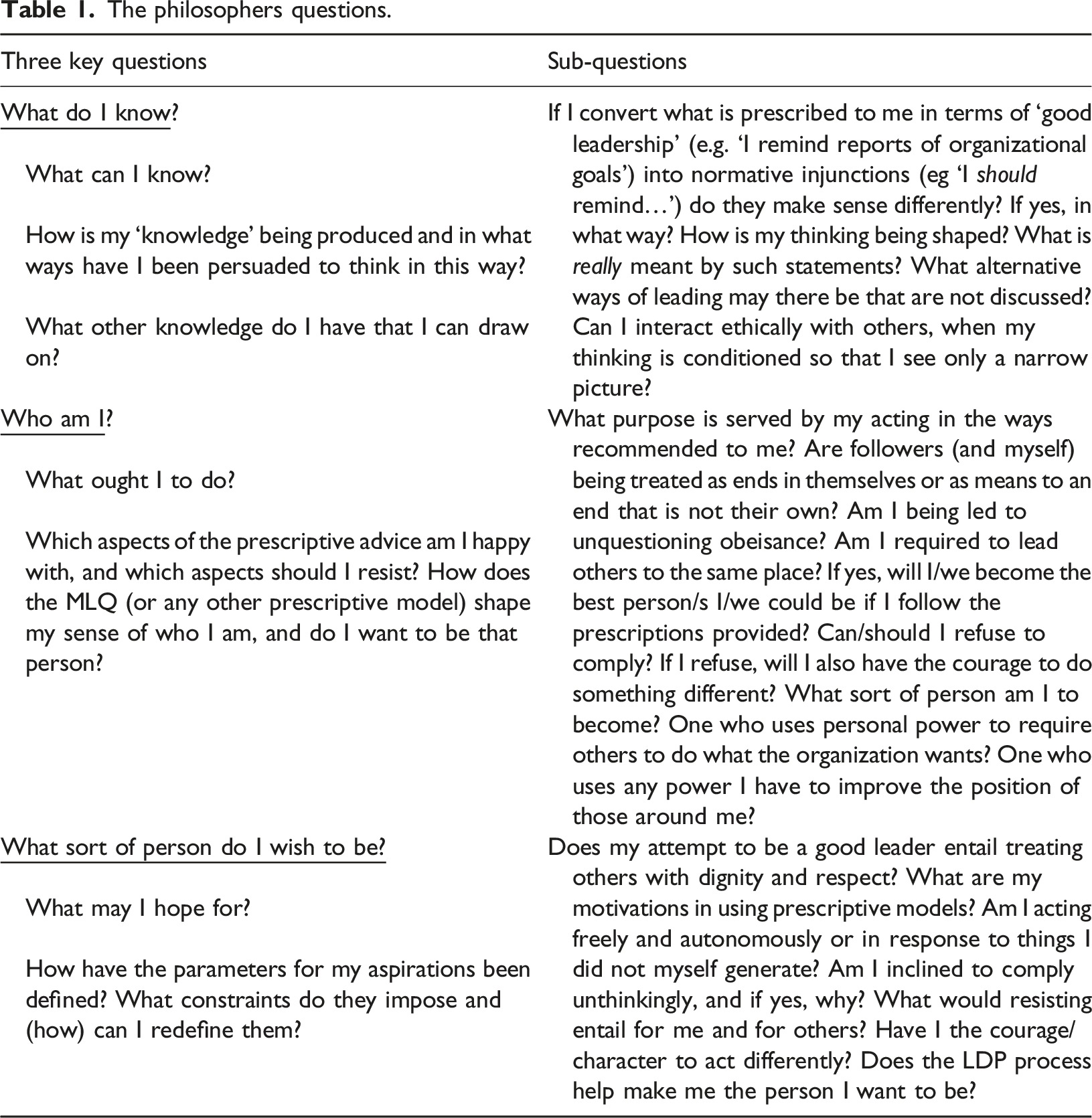
(addressing the Dean and the VC) ‘I wish to acknowledge my esteemed colleagues for the hard work put into developing this philosophical LDP. We propose that participants be introduced to the MLQ, as we were, but then examine it more critically. This involves them in critically reflecting on themselves and their place in the organizational world. They will identify the person they wish to become rather than the person they are required to become. Alastair will elaborate.’
McIntyre
‘If I am to answer the question “What shall I do?” I had better first pause and answer the question “What is it that I want?” Further reflection indicates I also need to think critically about my present desires, to ask “Is what I now want what I want myself to want?… and still further reflection [is needed] to ….ask how I came to be the sort of person that I am, with the desires that I now have….” (MacIntyre 2016: 4).’
Butler
‘Let me explain the key influences informing this first aspect of our proposal. Immanuel, your insights please:’
Kant
‘To be ethical, leaders must act from duty, this being derived from the unique human capacity for reason. The capacity to reason means individuals have freedom, notably the freedom to choose what to think and do – rather than simply responding to inclinations and desires we did not ourselves create.
This reason-based freedom should inform our actions. Accordingly, to foster ethical leadership our LDP asks that participants exercise their duty (and freedom) to both question the MLQ and what it asks them to become and to ask questions of themselves as to who they wish to become and what reasoning shall guide their actions.’
Foucault
‘To develop virtue in leaders we can also draw on my work on the ethics of the self, particularly my advocacy of the need to question truth, to understand its effects on power, and to understand its effects on discourses of truth (1986, 2008, 2010). I also highlight the critical importance of parrhesia, or courageous speech, and care of the self, through enacting habits and disciplines that enable us to become the self we wish to be. I’ve acknowledged Immanuel’s influence on my own ethical thinking (Foucault, 2010; Mendiata, 2011).’
Butler
‘My work also informs our proposal (1990, 1993, 1997). In particular, I have argued “who ‘I’ am is nothing without your life, and life itself has to be rethought as this complex, passionate, antagonistic, and necessary set of relations to others” (2009, p. 29). Complementing Immanuel’s emphasis on reason and extending Michel’s emphasis on power, my work helps bring attention to emotions and relationships as part of how we understand ethics, such that one’s ethical responsibilities to others are the condition of one’s existence. I have also emphasized the impossibility of ever being perfect, and that everyone is flawed (2004). The flawless leader does not exist and certainly does not arise from LDPs.
The philosophers questions.
The vice chancellor
‘These are certainly thought-provoking questions. I see you are also asking the faculty running LDPs to engage with participants in the manner first modelled to us by Socrates: exploring questions rather than providing preordained answers. This need not be inimical to our ability to generate revenue. But you do ask that we be driven first and foremost by a concern to foster ethical leadership.’
Chorus
Grounding LDPs in scholarly rather than commercial imperatives is critical if we are to advance ethical leadership.
Butler
‘We would also want to see participants gain experience in practical ethical reasoning by engaging with questions arising from Kant’s three formulations of the categorical imperative (CI).’
(Kant walks to the lectern.)
Kant
‘I maintain that our capacity for reason means we can choose freely how to act. I further argue that for any act to be ethical it must conform to reason. This leads inescapably to the conclusion that, to act ethically is to act for the sake of acting ethically, not simply because it conforms to some ethical principle or other (maximizing happiness for example) Thus reason shows there are certain things we must do and things we must not. I refer to these by the term ‘‘categorical (and) Imperative.” To evaluate any act for it’s ethical foundation I proposed three ‘‘tests’’ for behaviour that can be considered ethical.
Applying these tests builds participants’ capacity for moral reasoning, a necessary precursor to taking ethically meritorious action.
In my 1785 work, page 58, the first test states: “Act only on that maxim through which you can at the same time will that it should become a universal law”. Meaning, what you are about to do you are also sanctioning it as ethical for anyone in similar circumstances to do.
One of the MLQ statements reads: “I make others feel good to be around me”. Now, making this intent my maxim means that I must always do what I can to make others feel good around me, and everyone else must do the same. Adding an implicit and normative ‘‘should’’ into the MLQ’s propositions would help participants evaluate such propositions consistently.’
Dean
‘Well, the proposition is utterly implausible – it ignores contextual considerations and presumes universal beneficence.’
Kant
‘Indeed. But if we express the maxim in the negative then the MLQ’s statement becomes: “I should not make others feel bad around me”. Expressing maxims in the negative allows for pragmatism and the ability to respond according to context: for example, ‘‘do not lie’’ is very different, in practise, from ‘‘always tell the truth.’’
If I were to say ‘‘it is permissible to lie if circumstances merit it,’’ we can never rely on any statement to be true. Such a world would be utterly impossible and irrational. Similarly, if we say ‘‘make others feel bad if and when you think it justifiable,’’ social and working relations are impossible. This approach helps break through the prison-house of the MLQ’s language: its prescriptions are revealed as self-defeating or impossible to achieve and the implicit meaning and effect of the MLQ’s requirements become clearer.’
Chorus
In the context of an LDP, we envisage individuals and groups exploring the implications of prescriptive injunctions about leadership framed as ‘moral imperatives’ according to this first maxim. Doing so will foster critical awareness as to the kinds of impossible-to-achieve expectations and morally problematic powers being gifted to leaders embedded within these models. They can then start identifying what might be more appropriate principles to guide their actions.
Kant
‘My second formulation of the categorical imperative says “Act in such a way that you always treat humanity, whether in your own person or in the persons of any other, never merely as a means, but always at the same time as an end” (Paton, 1948: 84). That is, we must always recognize that followers have aims, goals and ‘‘ends’’ of their own and we must always respect and never ignore that fact. Aristotle and Judith can add to this.’
Aristotle
(standing) ‘Such questioning can help to foster virtue, the attainment of eudaemonia and the practise of phronesis or practical wisdom as distinct from Sophia (abstract wisdom).
As I discussed in Nicomachean Ethics, Book Six, practical wisdom, an intellectual virtue, is acquired through developing the capacity to reason truly and arrive at decisions of how to act according to a Mean in ways that are good for humankind. The development of phronesis may start with the questions: what is the ultimate purpose of my acting as a manager or leader? Am I contributing to what is truly good for humankind? What norms and rules govern my actions, and how might I resist them if they inhibit virtue? As Immanuel emphasises, turn these questions upon yourselves, ask if you are treated as ends in yourselves, or only as a means to someone or some organisation’s end. Would such practice help me become the best person I could possibly be?’
Butler
‘We can also ask participants to consider, per my own and Michel’s work, the theories influencing how they see others, the relational dynamics these foster, and whether the propositions proposed by these theories are ethically meritorious? They can explore why they are asked to think in this way about their role as leader and how this is being influenced, by whom and to serve what purpose? Such efforts cut to the heart of prescriptive leadership theorizing, by exposing them to critical inquiry so as to enhance participants’ sensitivity to issues of ethics and power.’
Dean
(looking at the Vice Chancellor) ‘I see that whilst disrupting the status quo with these approaches, a key aim is to develop leaders with the moral courage to address difficult problems. In our crisis-riven world that’s a worthy aim.’
Kant
‘A final test of the categorical imperative checks that when I act (qua leader) I must ask ‘would any and all objective observers approve of my acting in this way if they knew, not only what I was doing but also my motive for doing so?’ we can think of this as ‘the New York Times test’ or ‘the Grandmother’ test. The formal formulation is: “that the will can regard itself as at the same time making universal law by means of its maxim” (Paton: 1948: 96). Put simply, would other people be happy to agree that what I’m doing and why I’m doing it is ethical? This points, via Michel’s emphasis, to critique as a necessary act that assists in freeing one’s self from an unthinking immersion in the rules and regulations that govern leadership activities. The discussion to be had here therefore may be: would a ‘good’ leader not develop skills of questioning and critique, and does, for example, transformational leadership theory help or hinder me in thinking critically and questioningly?’
Butler
‘Which goes beyond the reflexive stance everyone seems to be asked to adopt today. Ask yourselves: why should I put myself in this position of wanting others to follow me? And: would my closest relatives approve of the way I behave towards less powerful people? In other words, am I good enough to be a leader? Am I able to resist becoming a toxic leader (Lipman-Blumen, 2005; Pelletier, 2010; Tourish, 2013)?
We thank you for your consideration of our proposals.’
(The curtain falls.)
Epilogue
Our sometimes light-hearted, sometimes farce-like encounter with philosophers on a training course always had a serious intent. We’ve drawn on their ideas to develop an alternative approach to leadership development that subverts contemporary LDPs from the inside. Our approach is pragmatic: we cannot eliminate LDPs but we can seek to unsettle them through using the skills we, as academics, valorize, that is, encouragement of more critical thought and the development of skills of deep analysis and questioning.
We conclude by asking colleagues involved in LDPs to join with us in bringing philosophy into these programmes so that they conform more closely to the ideal of a university education. Perhaps, together, we can invigorate the leadership development industry through destabilizing it. We have offered a practical and feasible way of doing this that is located, firmly, in an ethos of university education business schools.
Footnotes
Declaration of conflicting interests
The author(s) declared no potential conflicts of interest with respect to the research, authorship, and/or publication of this article.
Funding
The author(s) received no financial support for the research, authorship, and/or publication of this article.
