




Abstract
Our contribution lies in extending theorizing on relationship quality, by illustrating how the interwoven relationships between a leader and ‘follower’ may support or disrupt relationship development over time. Based on a study of leaders and organizational members in high-tech start-up firms, we provide concurrently a broader, more in-depth understanding, and therefore a more detailed and nuanced view, of how relationship quality develops or is disrupted. In particular, we highlight the importance of trust, exploring the under-researched topic of how differing interpretations of trust by leaders and organizational members can impact leaps of faith, acceptance, short-term or longer-term relationship quality. The findings address critiques of Leader Member Exchange (LMX) theory as the dominant explanatory construct for relationship quality, and highlight the need for longitudinal qualitative studies to explore the meanings both leaders and individual members of their organization give to their relationship over time.
Introduction
The increasing number of studies published each year demonstrate a continuing interest in the quality of relationships between leaders and ‘followers’ (e.g. Carsten et al., 2018; Day and Miscenko 2015; Schedlitzki et al., 2018). The dominating theoretical construct used to explain this relationship is Leader Member Exchange Theory or LMX (Bauer and Erdogan, 2016; Erdogan and Bauer, 2014), in which quality reflects ‘the extent to which leader and subordinate mutually exchange resources and support’ (Le Blanc and González-Romá 2012: 534).
LMX has been critiqued for its conceptual and methodological shortfalls. Conceptually, there is a confusing array of descriptions of how leaders and followers relate and a lack of clarity about the nature of the relationship being explored, for example, whether the focus is on leaders, followers, on exchanges, perceptions of exchanges or on perceptions of relationship quality (see Sheer, 2015, for an overview). The main focus of many studies lies on the four dimensions of LMX (affect, loyalty, contribution and respect) and describe antecedents, outcomes and mediating/moderating variables of leader–follower relationships (e.g. Dinh et al., 2014; Stentz et al., 2012), and there is relatively little research on the factors that disrupt relationship quality (Nahrgang and Seo, 2016). From a methodological perspective, the majority of LMX research is quantitative, based on retrospective surveys and single time-point studies. This limits our understanding of how and why relationships between leaders and organizational members change in four main ways. First, such studies use confirmatory scales and tools that can only capture a limited number of variables/dimensions at any one time, therefore potentially missing other factors influencing how relationships progress (Antonakis et al., 2010). Studies focussing on testing one or two additional factors such as communication (Geertshuis at al., 2015), trustworthiness (Brower et al., 2000; Walker et al., 2011), and trusting behaviours (Wasti et al., 2011) offer a fractional view of how relationships function. Second, single time-point studies fail to capture how relationships develop over time or how relationship quality fluctuates in response to situations within the workplace (see Bauer and Green, 1996, for an exception). This means that we can only describe the outcomes of positive or negative relationship development linked to recalled events. Third, the majority of LMX studies connecting relationship quality and performance are based on the perceptions of either leaders (Tourish, 2014) or followers (e.g. Carsten et al., 2019) with few matched pairs being explored. Finally, few longitudinal inductive qualitative studies with leaders and organizational members have been undertaken that elaborate the situated, mutual, and experiential nature of relationship quality (e.g. Kabalo, 2017), looking for instance at how communication, trustworthiness, trusting behaviour, emotions and performance at work may interweave to support or disrupt the development of particular relationships over time (Oh and Farh, 2017).
Our paper addresses these conceptual and methodological issues by using a qualitative, subjectivist, inductive, and longitudinal study of how relationships between leaders and their ‘followers’ develop or are disrupted over time. By development we mean that both participants increasingly value and respect what each other brings to the relationship. For the purpose of our study, we define disruption as an event, action, comment, or interaction on the part of either a leader or a follower, that is contrary to the other person’s expectations and causes that person to question and reassess the relationship. Disruption may lead to a failed relationship, where one or both parties terminate the employment relationship. Our contribution lies in extending theories on relationship quality by showing how relationships between leaders and members of their organization (staff) develop or may be disrupted over time, and crucially: (a) how relationship quality is interpreted and considered by both leaders and staff; (b) how and why relationships develop, are disrupted, or fail; and (c) how trust is implicated. Our focus lies not on the nature of the hierarchical relationship, but the nature of the interpersonal relationship.
Data collection took the form of a longitudinal study carried out over an 18-month period. During this time, in order to follow relationship development, interviews were conducted with twelve pairs of leaders and selected members of their organization at different time points. We focus on one key theme that emerged inductively from the data, to address the primary research question of this paper:
How does the quality of relationships between leaders and their staff 1 develop over time and what role does trust play?
While we focus centrally on trust, we will identify and explain briefly other influences on relationship development. In doing so, we go beyond LMX theory by examining relationship quality as mutually implicated and unfolding within specific contexts. We therefore offer a more subjectivist, relational, and situated view of the development or disruption of relationship quality.
The paper is organized as follows: First, we discuss why further research is needed on the role of trust in examining the relationship quality of leaders and their staff. We then explain the methodology and study findings, and finally discuss the implications for theory and practice.
Relational leadership and trust
In 1986, Dienesch and Liden critiqued the then current state of LMX and called for researchers to develop more multidimensional constructs related to the social aspects of leadership. Over the last 10–15 years, LMX theories, which continued to focus on social aspects by drawing on objectivist and positivist approaches, have been supplemented by relational theories which draw on a range of paradigmatic positions, including network, psychodynamic, communicative, and constructionist, to focus on leadership as a phenomenon generated in the interactions between people. As Uhl-Bien and Ospina (2012) note, within this paradigm interplay, ‘authors agree that leadership is a relational (social) process, but they disagree on what that means’ (p.552). They differentiate between variance and process approaches, with the former assuming causal relationships, fixed entities, and variables and the latter focussing on relational and social processes of leadership. Relational theories taking either approach are still mainly based on an objectivist ontology (Cunliffe, 2011), where lived experience is objectivized as dynamics or processes (cognitive, linguistic, or interactional), traits, variables, etc. (e.g. Cropanzano et al., 2017; Epitropaki et al., 2017; Fairhurst and Uhl-Bien, 2012).
Cunliffe and Ericksen (2011:1429, italics in original) offer an alternative relational perspective, suggesting that leadership ‘occurs in embedded experience and relationships’ between people. They argue that relational leadership is not a statement of relationships between objects or variables, nor a study of cognition or of process dynamics, but a way of being and relating with others in lived experience and living conversations. This more subjectivist/intersubjectivist approach to studying leaders’ relationships is developing slowly (Hosking, 2011; Liu, 2017; Orr and Bennett, 2017; Reitz, 2015). For example, Jian (2021) argues that empathy unfolds in the intersubjective relationships between leaders and others and this is also our focus – how leader–follower relationships unfold over time in the specific relationship between a leader and a member of his/her staff.
Relationships between leaders and followers are complex (Wang and Clegg, 2007) and objectivist theories fail to capture the complex lived experience and situated meanings that both leaders and organizational members give to the nature of their relationship. Our purpose is to ground our understanding of relationship quality in real world experiences (Sheer, 2015). We therefore draw on a subjectivist approach to relational leadership by exploring the meanings leaders and specific members of their organization ascribe to their relationship: meanings that ‘cannot be isolated from the context in which they are embedded’ (Benson et al., 2016: 951). In doing so, we aim to provide concurrently a broader, more in-depth qualitative understanding and therefore a more detailed and nuanced view of relationship quality.
An influential study of trust is Mayer et al. (1995) who propose a model which identifies three factors of perceived trustworthiness – ability (skills, competence), benevolence (the trustee will act to benefit the trustor) and integrity (acting in accordance with the trustor’s principles) – along with the trustor’s propensity to trust. Further, McAllister (1995) differentiated between cognition-based and affective-based trust. The former is evidential in terms of competence, performance, reliability, dependability, etc. (e.g. Dietz and Hartog, 2006), while the latter relates to more emotional issues such as care, concern, integrity, honesty, friendship (e.g. Nienaber et al., 2015). This work led to further research on trust and relationship quality, much of which is quantitative and focuses on the leader’s trust in the follower and the follower’s perception of the leader’s trust in him/her (Brower et al., 2000).
Our study extends this work by using qualitative methods to examine how both leaders and individual staff members interpret trustworthiness, trusting behaviour, and the impact on the nature of their relationship. We define trustworthiness as occurring when one individual is willing to make him or herself vulnerable to another (e.g. Rousseau et al., 1998). Trusting behaviours are defined as risk-taking actions (Wasti et al., 2011), which may include a leader disclosing information, delegating or giving autonomy, supporting progression and promotion, and introducing staff to social and professional networks. Trusting behaviours of staff include offering discretionary effort, disclosing information, and benevolent actions towards the leader (Wasti et al., 2011). We illustrate that trusting behaviours and trustworthiness were noted as important by both leaders and staff in the interviews in their assessment of their relationship.
Typically, leadership theorists view assessments of trustworthiness as antecedent to high-quality relationships through an iterative exchange process (Bligh, 2017). Also, many existing studies generally theorize trust, performance and relationship quality as outcomes of relationship development, where leader interventions influence the level of trust that a leader can gain from his/her followers (Hernandez et al., 2014). While this understanding has benefits, it can also lead to an overly one-sided instrumental input-output focus and research is needed around how leadership and trust develop and change within leader–follower dyads (Dinh et al., 2014). We propose that relationship quality, trust, and trusting behaviours are not outcomes, but interrelated constituents of an iterative and emergent process of relationship development on the part of both leaders and staff. In particular, we address an under-theorized aspect – how relationships may be temporarily or permanently disrupted because of trust-related issues on the part of either leader or staff member. By disrupted we refer to an event or issue that causes one or both persons to re-evaluate the relationship.
Methodology
[Wilson] designed a qualitative, inductive, longitudinal study to explore the perceptual, temporal and experientially complex nature of relationship quality development. Twelve leader–staff pairs were studied, consisting of 21 individuals in 8 UK hi-tech start-up firms. The leaders interviewed were founders and owners of their organization. Members of staff were selected on the criteria that they had been with the company for less than 6 months. The context was chosen because the quality of relationships is particularly important in new technology firms, which ‘are known to be volatile dynamic organizations whose innovations are subject to short life cycles and product imitability’ (Gannon et al., 2015: 27). The high-tech environment also offers an alternative to the majority of leadership research, which is carried out in corporate organizations (Ayman and Korabik, 2010). All start-up organizations are subject to both external pressures (competition, legislation, barriers to entry) and internal issues (lack of funding, lack of experience, breakdown of relationships within the firm). Hi-tech start-ups are particularly susceptible to such problems given the high costs of developing the product within rapidly changing market places where competition is likely to be fierce. This environment increases the internal pressures within a start-up, so that leader–staff relationships are vulnerable to failure (Zaech and Baldegger, 2017). This context therefore offers a fresh perspective on how relationship quality develops between leaders and staff.
The world of hi-tech start-ups is a fairly closed community, generally accessed through recommendation and personal introductions because of the competitive/sensitive nature of their business, therefore a snowball sampling technique was used to gain access to a group of individuals who were unlikely to respond using cold contact methods. The sample did not attempt to be representative of the high-tech start-up environment, although the predominantly white, male and under-35 set of participants mirrors the make-up of this context (Nathan et al., 2013).
Three sets of interviews with each leader–staff pair (each being interviewed separately) were carried out every 3 months using semi-structured interview questions informed by theory but deliberately left open to allow additional issues to emerge. The questions aimed to elucidate changes in how each pair experienced their relationship over the three time points, and as such were broadly similar in scope at each meeting. The questions were trialled in a pilot study of software engineers involved in corporate banking in the City of London.
In total, sixty interviews took place over a period of 18 months in a variety of locations depending on convenience and the need for privacy, including local coffee shops, work-space offices, and where necessary Skype or telephone. All conversations were recorded digitally, anonymized to maintain confidentiality and the transcript was shared with each respondent to ensure they were happy with the information they had provided. Interviews lasted between 30 and 90 min with a mean length of 57 min, and resulting in over 35,000 words. Longitudinal studies examining leader–member relationships from early stages are rare, yet can add important insights relating to the development of relationship quality (Liden et al., 2015: 415). The initial interviews in this study were carried out soon after recruitment of the staff member.
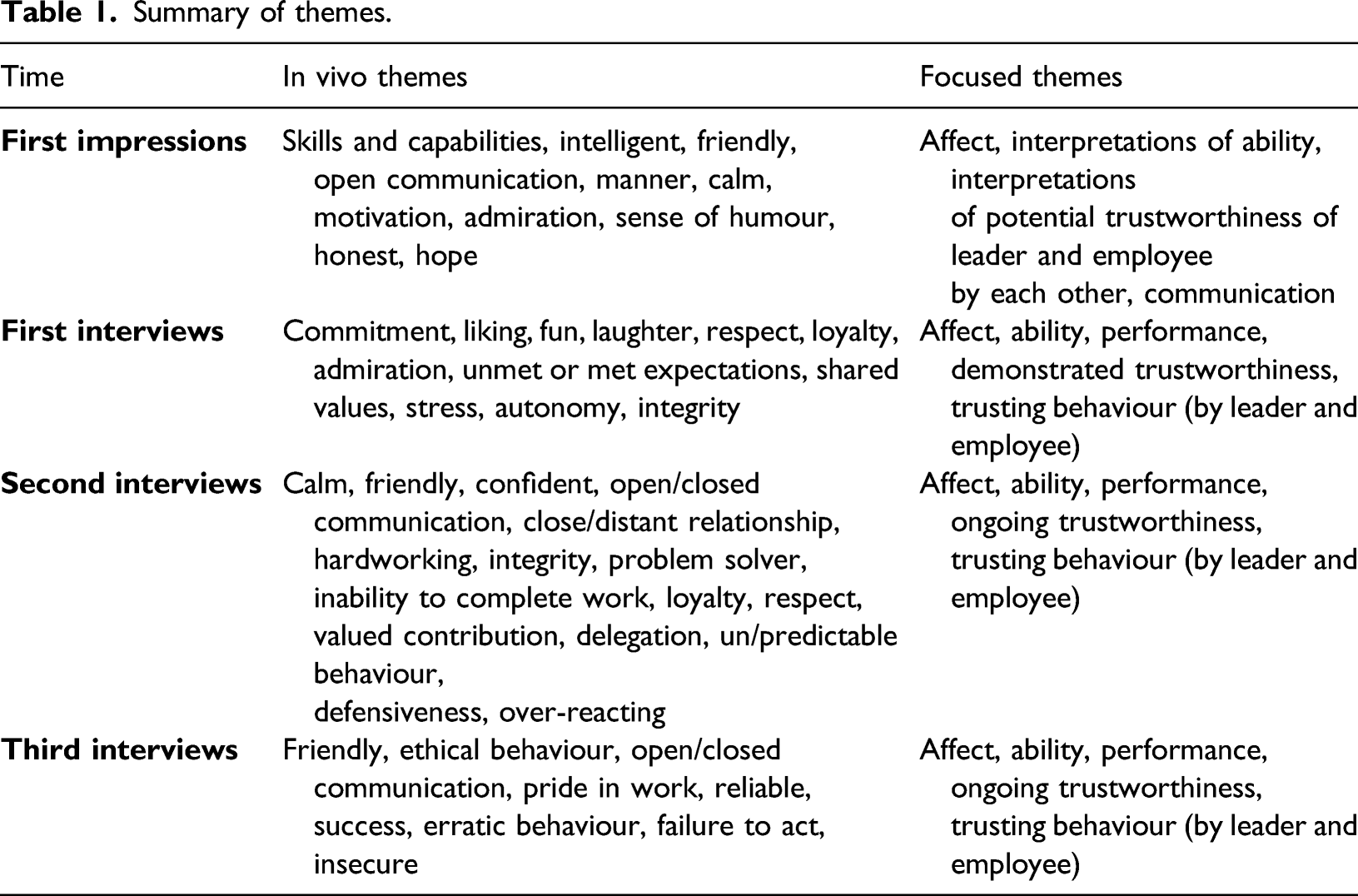
Summary of themes.
Findings
Development and disruption to relationships over time.
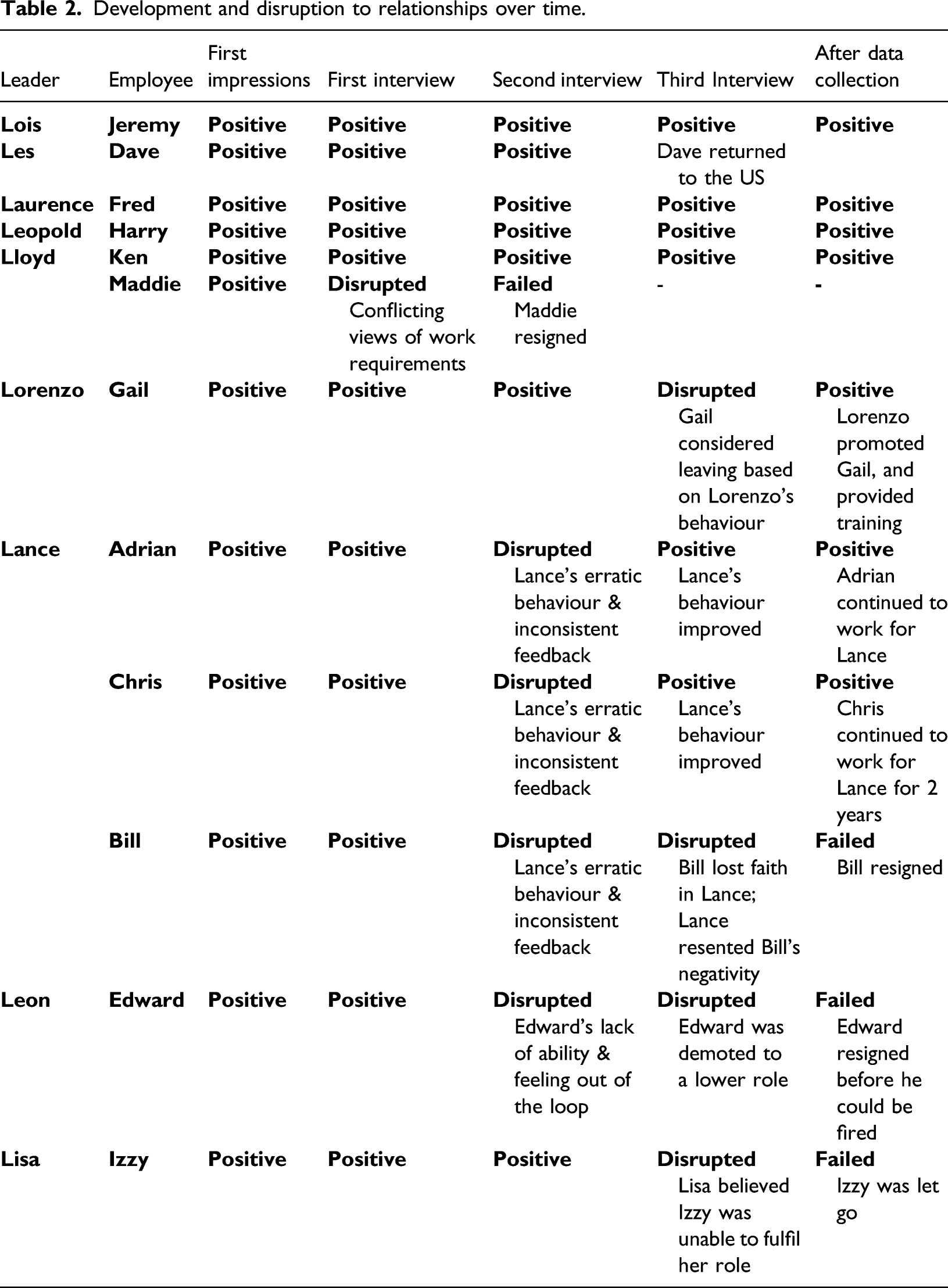
Overall, all twelve relationships had positive first impressions in the initial recruitment interviews. Had these been negative, the relationships would have ended at that point, in which case there would have been no further relationship to study. From the first set of interviews, a number of influences emerged inductively from the data, which demonstrated relationships were developing in either a positive way or a negative way. Five of the relationships continued to grow positively through over time. For three, the relationships were disrupted by events or issues that caused either the leader or staff member to evaluate the relationship, but then the relationship recovered. For four pairs, events took place that disrupted relationship quality to a point where employment was terminated. We explicate the factors that appeared to support, disrupt or cause relationship quality to become so negative that the relationship failed entirely. The results are presented in chronological order, beginning with first impressions. To aid clarity, all leader pseudonyms are followed by the letter ‘L’ and staff pseudonyms by ‘S’.
The development of relationship quality over time
First impressions
Relationships start to form on first meeting and first impressions inform the first few months of interactions (Liden et al., 1993). Nahrgang et al. (2009) suggest that after the first few months, relationships stabilize and first impressions diminish. [Wilson] asked participants retrospectively about their first impressions of the other person between one and 6 months after they first met.
The importance of liking and ability are evident in these initial interviews. When Leon (L) described meeting Edward (S) he was effusive about how much he liked him immediately and how effective he thought he would be in his role:
While assessments of ability are unsurprising, they were matched with more personal and visual interpretations by Leon of openness, caring and being ‘smiley’ – which we suggest are relational qualities because they are connected with Edward’s potential trustworthiness and likability which he saw as creating the potential for good quality relationships with others within the organization. Reflecting on his first impressions of Ken (S), Lloyd (L) also spoke of likability and connected this with honesty and intelligence:
Ken’s first impressions were also favourable, relating to his appreciation of Lloyd’s ‘good reputation in the industry’ and his transparency about the company’s financial position and future. We suggest this indicates that first impressions are therefore not only about ability, but also emotional and affective connections and assessments of integrity.
The focused themes from reflections by all study participants suggest three influences on initial relationship development, how each person assessed the: (i) trustworthiness (ability, honesty and integrity); (ii) communication (open and articulate); and (iii) affect (likability) of the other. But, whereas LMX theories often view trustworthiness as a discrete, early-stage relationship process where trusting behaviours will follow later (Van der Werff and Buckley, 2017) our research contained examples of trusting behaviours occurring early in the relationship connected with first impressions. For example, Les’s (L) initial assessment of Dave’s (S) trustworthiness led to him giving Dave access to the company’s most prized asset, the code base (the software that creates the company’s product online) at the end of Dave’s job interview. This was a significant risk for Les that could have backfired had Dave not accepted the job – with trust comes potential vulnerability – but the relational and mutual aspect of trust can be seen in Dave’s comment that ‘I don't think that ideas should be secret’. Lance (L) acted similarly with his employees Adrian (S), Chris (S) and Bill (S). This highlighted the reciprocal nature of trust with Adrian signing an employment contract giving Lance control of any material that he produced outside of work hours. He commented:
When asked if he trusted Lance’s word, Adrian responded that he did, indicating that they trusted each other having openly communicated about intellectual property rights. Indeed, within each interviewed pair, trusting behaviour involved a mutual assessment of the trustworthiness of each person, even in their first conversation. But, as Lorenzo (L) noted, trust also involves having faith in yourself as well as others, and does not guarantee anything:
The start of Lisa (L) and Izzy’s (S) relationship provides another example of the relationship between initial trust and early trusting behaviour. Izzy had returned from the USA and wanted an internship. She contacted Lisa, whose company she had recently researched, feeling it offered an exciting opportunity. At their initial meeting, Lisa was aware of Izzy’s lack of formal experience but risked giving her a job, trusting that she could do it.
From Izzy’s perspective, she took the risk of offering her services for free on the basis of her first impressions of Lisa’s talent and energy, trusting that she would eventually be financially rewarded:
Her decision was based not only on an assessment of Lisa’s achievements, but also on her feelings of admiration for how much had been accomplished and the women-focused social ethos of the company, which Izzy found appealing.
These examples illustrate the interrelated nature of cognitive and affective aspects of trust (Massey et al., 2019), that assessments of potential ability or integrity (cognitive) and liking and/or feelings of admiration (affective) – in this case by both parties – influence relationship development early on. Communication skills also appeared as a key factor in deciding to trust the other party. Our findings contribute to the relatively small amount of work on the longitudinal process of trust development (Van der Werff and Buckley, 2017) and differ from much of the existing literature. Whereas much trust research focuses on followers demonstrating trusting behaviours or garnering trust from leaders, our data shows that trust can be mutual based on how leaders and followers interpret the words and actions of each other. In contrast to studies where trust is an outcome of relationship quality (e.g. Dietz and Den Hartog, 2006), our data indicates that trusting behaviour such as sharing the code base can occur early in a relationship and help build mutual trust.
The first recognition of early trusting behaviours is found in work on predispositions to trust, supported by more recent work on the influence of prior knowledge before leaders and followers meet. McKnight et al. (1998) suggested that individuals were more predisposed to trust if they had both a general faith in humanity and a trusting stance (where benefits derive from treating others as though they are trustworthy until proved unreliable). Delgado-Márquez et al. (2015) expanded this, arguing that a trustor’s prior knowledge about a trustee influences trusting behaviours because initial knowledge reduces uncertainty and allows a trustor to more accurately determine how a trustee might behave in future situations. While our data partially supports this in that prior knowledge in the form of information about the company, owner and/or past performance played a part, assessments about trustworthiness were more relational – made upon first meeting by both leaders and staff member and based on affective issues such as liking, openness, integrity, and caring. This suggests the need for a more comprehensive explanation than predispositions.
What emerges from our study is that trust was not an outcome of trust-testing behaviours but concurrent experiences including first impressions, and involved both cognition and affective-based trust, that is, interwoven interpretations and feelings of liking, integrity, ability and communication skills, that we suggest facilitate a socio-emotional connection between leaders and individual staff members. Across the twelve relationships, these aspects appeared consistently at the start of each relationship.
The next section describes how each pair viewed their relationship in the first interviews.
First interviews
Positive relationships
For many of the relationships in the study trustworthiness, trusting behaviour and mutual trust continued in a positive vein. First impressions were strengthened around the affective theme of liking, fun, laughter, and benevolence. These findings are in line with recent literature around workplace relationships where affect and friendship are associated with positive emotions at work, higher creativity, performance and reduced staff turnover (Buch and Kuvaas, 2016; Colbert et al., 2016; Little et al., 2016). They also appear to confirm Dysvik et al.’s (2015) findings that the better the quality of socio-emotional relations, the greater the likelihood of co-operation and information exchange between leaders and followers. But whereas these studies treat socio-emotional aspects as causal factors in performance, we suggest they are relational qualities that are key to leaders and staff making mutual connections that impact the trust and confidence each place in the other – in positive and negative ways.
This is reinforced in the example below. The word ‘laughter’ appeared frequently from first interviews onwards and was often teamed with performance:
Positive relationships were also linked to respect and loyalty. Both leaders and staff made comments about having respect for each other and admiring the other party. Loyalty took the forms of ‘not wanting to let the other person down’ and doing well for the other person – feelings that grew over time unless something occurred to disrupt them as in Leon (L) and Edward (s) and Lisa (L) and Izzy (S) relationships. Trust continued where promises were fulfilled and declined when one person felt let down, demotivated or over-managed (on the part of staff), or promises or contracts were broken.
Our findings support Abu Bakar and Sheer (2013) and Sheer’s (2015) conclusions that positive perceptions were linked to commitment, communication, support, trust, individual performance and high-quality relationships. However, as we will now show, they differ in that this array of factors can also disrupt relationships when problems arose.
Relationship disruptions
Whilst most relationships were doing well at this stage, some were not. Trust quickly deteriorated in Lloyd (L) and Maddie’s (S) relationship. For Lloyd, this related to his feelings about Maddie’s signs of extreme discomfort when she felt under stress:
His assessment of Maddie’s lack of ability to multitask and cope with stress was the undoing of their relationship and caused him to reflect on his own judgement. While from Maddie’s perspective she felt she was asked to take unacceptable shortcuts:
The quality of their relationship suffered because Maddie felt that Lloyd had let her down – she had trusted him to provide a role that she could fulfil and he had failed to behave in a way that protected her interests. Lloyd felt that Maddie was unable to cope with the work and that her personal standards were more important than the company’s needs. Both withdrew trusting behaviours: Lloyd stopped delegating tasks that were above routine and Maddie resigned shortly after the interview, thus showing the mutual, darker and iterative side of trust and how it may decrease over time and disrupt relationship quality.
Relationship quality can therefore be affected in positive and negative ways as cognition-based (ability, predictability/reliability) and affect-based (respect, care, loyalty) trust plays through relationships (Colquitt et al., 2007; Frazier et al., 2016). While there are questions in the literature around whether ability, benevolence and integrity have a unique or collective impact (Poon, 2013), our findings indicate that they are mutually implicated, that trust is an issue for both leaders and individual staff members, situated in how each assesses the behaviour and intentions of the other and understands the nature of their relationship.
Second interviews
Between the first and second interviews seven relationships developed, one relationship failed (Lloyd (L) and Maddie (S)), and four were disrupted (Lance (L), Bill (s), Chris (S) and Adrian(S); Leon (L) and Edward (S)). The reasons related to the main themes of trust, affect and ability.
Positive relationships
By the second interview, positive relationships were continuing with increasing reports of trust, trusting behaviour, good communication, and strong affective ties. The interplay of these issues seemed to strengthen relationships as seen in Jeremy (S) and Lois’s (L) case where each recognized the other’s ability:
And Jeremy’s confidence had grown in response to Lois’s trust in him, reflected in being given autonomy ‘without fear’ – especially given that the business is Lois’s ‘life’:
Similarly, Izzy (S) respected Lisa’s (L) ability to remain calm and trusted her judgement:
I don’t see her panic very often, which is good, maybe she’s panicking inside and just doesn’t show it … which is reassuring for me because inside I’m like going “what am I meant to be doing?”
These three excerpts illustrate the mutual and relational nature of trust and its impact on relationship quality – how Lois’s trust in Jeremy is demonstrated through empowerment and respect (trusting behaviour), to which Jeremy responds with respect and his absolute belief in her ability to lead the company towards success (cognition-based trust). This example also highlights the role integrity plays in trusting relationships, that while they have similar principles and values, importantly in Jeremy’s eyes, Lois adheres to those principles. Both Izzy and Jeremy spoke about the affective aspects of trust, being able to communicate, the friendship and laughter in the office. The interplay of these relational aspects influences trustworthiness and respect: ‘trust begets trustworthiness and trustworthiness begets trust’ (Korsgaard et al., 2014: 8).
Relationship disruptions
However, not all relationships were running smoothly – disruptions occurred relating to a person’s unpredictability, ability, or a lack of challenge in work. Contextual issues also impacted trust and the development of relationship quality.
Lance’s (L) firm needed refinancing and wasn’t performing as well as he’d hoped. He was spending a lot of time in difficult negotiations with venture capitalists, and employees viewed his behaviour as erratic. For Bill (a software engineer), Lance’s unpredictability made it difficult to read his boss’ moods and he wasn’t sure how to react:
This excerpt highlights the relational nature of trust in a sense of being able to understand and ‘know’ the other person, that if trust relates to the ‘expectation that one will find what is expected rather than what is feared’ (McAllister, 1995: 25) then unknowing and unpredictability are key influences. Thus, Bill’s uncertainty and Lance’s lack of feedback led to a deterioration in their relationship. Interestingly, Bill’s and Lance’s views of their relationship contrasted:
This disparity of views occurred also with Chris (S) and Adrian (S).
The relational nature of trust was evident in Lance’s comments about Adrian. While he had trusted Adrian with the code base early at first meeting (page 12), he was now irritated because Adrian wasn’t meeting his expectations:
A similar deterioration occurred, despite a positive beginning, in Leon (L) and Edward’s (S) relationship, also based on Edward’s ability:
Leon’s faith in Edward’s ability (cognition-based trust) diminished and led to what Edward perceived as non-trusting behaviour which caused him to rethink the nature of their relationship:
And later …
To be an entrepreneur as Leon is, you have to be of a certain mindset and maybe, that’s the type of person I really don’t work well with.
The deterioration in their relationship led Edward to be demoted before the third set of interviews.
Third interviews
Between the second and third interviews, of the seven positive relationships four continued to be so, one ended in a mutually amicable way, and one was disrupted. Of the four disrupted relationships, two remained disrupted, while two recovered. This indicates the importance of longitudinal studies in studying these issues.
Positive relationships
Laurence’s (L) early positive assessment of Fred (S) was upgraded as they got to know each other over time, and by the last interview he had complete faith in Fred based on a set of judgements made over the preceding months relating to ability, affect and trust:
Laurence valued Fred’s integrity as a moral human being and as someone who would stand up for himself. This feeling was mutual, with Fred increasingly enjoying his role, becoming aware of Laurence’s appreciation, and respecting his abilities as a leader:
These two excerpts suggest that both leaders and members of their organization continually assess the nature and quality of their relationships, and that this involves not only a mutual assessment of ability but also socio-emotional aspects such as bringing people together, feelings of pride, and being ‘nice’. Together these can increase confidence and trust in each other.
Ongoing assessments of the relationship’s value by both leaders and individual staff members was therefore an integral part of relationship quality development and included subjective perceptions of trustworthiness, proven ability, and trusting behaviour. As Lloyd (L) commented about Ken (S) in this third interview, his estimation of the quality of their relationship was based on a number of factors:
And on this basis, he promoted Ken, indicating Ken’s trustworthiness and Lloyd’s trusting behaviour. As Kuvaas et al. (2012: 757) note, socio-emotional relationships are “characterized by a long-term orientation, where the exchanges between leaders and followers are on-going and based on feelings of diffuse obligation, and less in need of an immediate ‘pay off’.” These sentiments were reflected in our data. Where relationships were positive, both leader and staff member wanted it to continue, for example, Jeremy (F) felt that even if the business was bought out, he wouldn’t want his working relationship with Lois (L) to end:
Across the interviews we see a similar interplay of considerations across positive relationships over time: respect, integrity, liking, pride, reliability and proven ability are all influential, linked to trusting behaviour such as support and promotion (Wasti, et al., 2011). However, poor perceptions of performance and disruptions to relationship quality were also evident in the third interviews.
Relationship disruptions
By contrast, a number of the relationships didn’t progress smoothly, disrupted by a perceived inability of the leader or staff member to perform a role, or by breaches of trust. Lisa and Izzy’s relationship – which started off on a positive footing – was disrupted and the quality of their relationship decreased. Despite giving Izzy the benefit of the doubt in their initial meeting, coaching her to develop her skills, and having a friendly relationship, in the final interview, Lisa was struggling with Izzy’s inability to meet her expectations:
Lisa’s comments raise two issues, trusting someone to do their job and trusting one’s own judgement in relation to another person. Lisa risked giving Izzy a position without her having any experience and in the first interviews, both commented on their close relationship. However, at this stage Lisa feels she expected too much and that given the circumstances she had to let Izzy go.
The issue of trust and performance emerged in the study as reciprocal, not only in terms of leaders feeling that it was part of their role to assist their employees to perform, but also in employees supporting their leader:
The relationship between trust and performance is complex and cannot be simplified to straightforward cause and effect as some studies imply (e.g. Gupta, et al., 2016; Peterson and Behfar, 2003). For example, Gail (S) felt that a lack of transparency and inconsistency created tension in the workplace and this led her to question Lorenzo’s trustworthiness and what had previously been a particularly positive working relationship. Lorenzo was in a personal relationship with a senior team member, which was negatively influencing office relationships because she enforced rules she didn’t personally follow. Gail was sure that Lorenzo was aware of the inconsistencies but did nothing about them. For Gail, this issue was significant because she felt the professional working atmosphere was undermined and Lorenzo’s failure to act created tension and led to a lack of trust in his ability to act ethically:
Failure to perform was undoing another relationship. Edward’s (S) and Leon’s (L) experiences had become increasingly negative over time due to Edward’s lack of ability. Leon described his feelings about Edward after he had hired a replacement Chief Marketing Officer, whilst Edward was still at the company and nominally in that role:
So while Leon thought Edward was still a ‘great person’ (affect), his ability was lacking, he was underperforming and Leon’s trust in him had diminished. Aware of this, Edward felt insecure and unhappy:
Because of their assessment of the ability and intentions of each other, trust decreased, and so did their relationship. Neither Edward or Leon seemed to feel that their relationship could be restored and their increasingly negative views of each other were expressed though their interactions. Leon knew that employing a new Chief Marketing Officer would impact Edward:
Adrian (S) and Chris (S) described how their boss (Lance) became erratic and intimidating whilst he was struggling to refinance the firm. In other words, his trustworthiness in terms of being predictable was reduced, which influenced their respect for him. However, they forgave him when they later understood the context and by interview three, they professed themselves content with their relationship. For Bill, however, his trust in Lance did not recover and despite receiving his long-awaited pay rise he sought employment elsewhere. Oh and Farh (2017) provide an explanation for these different responses arguing that employee responses to abusive behaviours may differ depending on context. They may attribute poor behaviours to the situation rather than to the leader and will therefore forgive displays of abuse, providing that they are discontinued after the stressful situation has passed. Adrian and Chris forgave Lance because they felt that his behaviour was situational and unlikely to return once the funding crisis was resolved.
Gail’s (S) relationship with Lorenzo (L) also recovered because Lorenzo had learned to trust her ability, commenting:
A few weeks after the third interview (November 2014), [Wilson] contacted Gail to see how things were progressing. She reported that the inconsistencies had finally been dealt with and that because of her performance, Lorenzo was aiming to promote her into a new role. This recognition of her performance, Lorenzo’s resolution of the issues (his performance), and Gail’s promotion (Lorenzo displaying a trusting behaviour) restored her view of their relationship.
In the relationships where trust was disrupted, Edward, Bill and Maddie (Ss) resigned, feeling their relationships with their respective bosses Leon, Lance and Lloyd (Ls) were sufficiently toxic that they had to leave. Lisa (L) made Izzy (S) redundant despite her initial leap of faith in giving her a job and their close relationship: the company’s product was a social media application and both women worked together with consumers. Leon (L) deliberately created a situation of demoting Edward (S) and bringing in someone else to do Edward’s role and line manage him.
Leon commented:
Ed was exceptional, because Ed lives an hour and a half commute away… he does 9-5 every day and then he goes home and he also carries on working… we understand and trust that he can do that and that he will go home and work.
Edward’s work ethic however, wasn’t enough for Leon to overlook what he perceived to be Edward’s shortcomings and Leon was relieved when Edward found another role elsewhere.
Discussion
Relational leadership theories presume that leadership is effective when high-quality relationships exist. Within LMX, such relationships are characterized by high levels of affect (liking), loyalty, respect, and contribution (Bligh and Kohles, 2013; Dulebohn et al., 2017; Graen and Scandura, 1987), and feelings of psychological safety which ‘blends trust and respect’ (Edmondson, 2019: 6). However, when relationships are seen instrumentally as a way of improving productivity and interactions are transactional, low levels of trust, affect, loyalty and respect often occur (Dansereau et al., 1973; Martin et al., 2016; Schyns and Schilling, 2013). Our findings indicate that relationship quality is more complex, can shift over time and is situated in that it depends on a particular relationship – developing in either a positive way or a disrupted way – based on the subjective interpretations of both leaders and staff of each other as they continually assessed the nature and quality of their relationship. Trust was an integral part of their assessment, which was not purely transactional, but also socio-emotional, related to liking, laughter and enjoyment of the work relationship. We also suggest that high-quality relationships are often perceived to be long-term in focus, involving open communication and a willingness to work through differences by each person.
The study contributes to our understanding of the quality of the relationship between leaders and followers in three main ways: (1) It extends current theorizing around relational leadership and trust by illustrating that trust and trusting behaviour are deeply implicated in relationship quality, occurring ongoingly and interrelatedly over time, influenced by both leaders and staff members. (2) Extending a rarely researched issue – the impact of the disruption of trust on relationship quality – an aspect that emerged inductively from the data. (3) We also illustrate the value of adopting a longitudinal interpretive methodology – rarely used on this topic – in providing data on how leaders and members of their organization experience and give meaning to their relationships over time. We will expand below.
(1) Trust, trusting behaviour and relationship quality occur ongoingly and interrelatedly over time: Over the last 10 years, relational leadership theory has expanded beyond positivist, leader-centric and psychological approaches to study relational processes between leaders and followers as discursive (e.g. Fairhurst and Uhl-Bien, 2012), co-constructed (e.g. Sklaveniti, 2020), and as relational practices (e.g. Raelin, 2016). While trust has been theorized as an important aspect of relational leadership (Brower et al., 2000), it is, as Sánchez et al. (2020) observe, often absent from empirical studies, is rarely studied from a subjectivist and interpretivist perspective, and studies of trust need to consider role of context and time in ‘real work situations’ (Reid and Karambayya, 2016: 621). Brower et al.’s (2000) integrated model of relational leadership combines LMX and trust to theorize trust as dynamic and based on a continuous evaluation. Our study addresses this gap, highlighting the emergent and complex nature of relationships between leaders and staff members, how they may develop or be disrupted over time, and how trust is implicated in relationship quality. In contrast to many studies of relationship quality and trust which examine and generalize the impact of leader and/or followers’ personal characteristics, competence, similarities of attributes and expectations by using instruments that measure and rate these elements (see Nahrgang and Seo, 2016, for an overview), our findings highlight that trust and trusting behaviours are embedded in the lived relationships between leaders and staff – in other words they are personal, relate to specific people, behaviours, events and experiences. As such, they cannot be theorized in simple cause-effect, predictive, or process terms – we need to consider the meanings each person gives to the relationship. For example, while Lance (L) and Bill’s (S) relationship deteriorated because of Lance’s erratic behaviour and Bill left the company, Chris (S) and Adrian (S) continued to work for Lance despite the disruption; Gail (S) and Lorenzo’s (L) relationship deteriorated as she perceived him acting with little integrity but then recovered; and Laurence (L) and Fred’s (S) trust and relationship grew over time. While Hernandez et al. (2014) theorize trust as an outcome of relational leadership behaviour, our study suggests that trust may be expressed upon initially meeting and is intricately and ongoingly connected with how specific relationships develop over time. We therefore supplement relational leadership theories by arguing that trusting relationships between leaders and individual staff members are: Mutable – not always an outcome but may be enacted in initial impressions by both leaders and staff as a ‘leap of faith’. Returning to our working definition of trust as making oneself vulnerable to another, the study highlights a number of instances where this occurred, as in Lisa and Izzy’s and Lance and Adrian’s relationship. Trust relationships also change over time depending upon how each person interprets the relationship and the outcome is not always predictable, as in Lorenzo’s and Gail’s or Lance’s and Chris’s relationship in which trust was disrupted and restored. Mutual – embedded in the particular relationship and interactions between a leader and staff member and how they relate with each other. This extends to issues of trust, Cunliffe and Eriksen’s (2011) observation that leadership is negotiated and constructed in relationships between people. In doing so we highlight the importance of temporality in the development of relationships and trust, as we indicate in Table 2. Complex – a balance between a number of features including affective (socio-emotional), and ongoing assessments of ability, performance and trustworthiness of leader and staff member by each other. Even if some aspects of the relationship are positive, interpretations can disrupt relationship quality. As Leon (L) stated about Edward (S), ‘I still think he’s great as a person, he deserves success in his life’, but his lack of trust in Edward’s ability to perform his role meant he was prepared to take action that would lead to Edward’s resignation. Idiosyncratic – while trust influences the development or disruption of relationships it may be interpreted differently in specific relationships. Trust is therefore embedded in the specific experiences and interpretations of each pair as each person assesses the other’s integrity, openness, likeability, ability, behaviour, and performance.
We suggest that relationship quality cannot be theorized in simple cause-effect, objectivized, or predictive terms as often seen in dominant LMX relational theories. Rather, consistent with a subjectivist ontology and epistemology we offer interpretive insights that may alert leaders and ‘followers’ to notice what may be happening in their relationship as a means of anticipating how trust may be impacted and how the quality of their relationship may be disrupted. We build on Sheer’s (2015) reconceptualization of LMX’s theorization of relationship quality as a two-way social interaction between leaders and followers, suggesting that quality is more than interaction, it relates to the nature of the relationship and how trust and trusting behaviours are perceived and interpreted by leaders and staff. The findings indicate that relationship quality emerges, shifts over time – from first impressions onwards – and is embedded in the interpretations of self and other in specific relationships.
In summary, our study builds on current relational leadership and trust theories by highlighting that: (1) Trusting behaviours may occur at the beginning of relationship development rather than developing after relationships become established; (2) both leader and staff member’s interpretations of each other’s actions and talk are integral to relationship quality; (3) the development of relationship quality is temporal and iterative based on ongoing assessments that may support or disrupt relationships; and (4) friendship and emotion are important influences on the process.
(2) The impact of the disruption of trust on relationship quality: The second contribution of the study lies in foregrounding and illustrating the role of disruption in trust and relationship quality. Few studies exist on the role of disruption of trust in relational leadership theories. Many trust studies take a cognitive perspective and few social constructionist researchers have explored trust and relational leadership (Sánchez et al., 2020). From our relational perspective, trust requires that we are true to our word and that we act accordingly or as others expect us to, that is, that others perceive us as being trustworthy. When this does not happen, relationships are disrupted and our findings indicate that responses by leaders and staff to disruption vary and are emergent depending on the nature of the particular relationship and circumstances. We extend Cunliffe and Eriksen’s (2011) intersubjective notion of relational integrity by illustrating how trust is based on a sense of moral responsibility to the other and implicated in moments of difference that are potentially disruptive. For example, Lisa (L) felt responsible for helping Izzy (S) succeed by supporting her development as far as she was able, and Gail’s (S) growing frustration with Lorenzo’s (L) behaviour receded when he indicated his trust by promoting her. Our data indicates that trust is also interpersonal in that both leaders and ‘followers’ assess and respond to how they are treated by the other, that is, an ethics of reciprocity (Cunliffe and Eriksen, 2011: p.1439) over time. This brings us to our next point.
(3) The value of a qualitative longitudinal methodology: Ospina et al. (2020) note that collective and relational leadership scholars must ‘work collectively to clarify appropriate theory–methods connections’ (p.442). Some longitudinal studies of trust use techniques such as observational interaction to remove self-reporting bias (e.g. Maxwell and Lévesque, 2014); many qualitative studies of trust are not longitudinal (e.g. Scarbrough, et al., 2013); and many are neither qualitative nor longitudinal (e.g. Yang and Mossholder, 2010). We argue that studies employing theoretical constructs and academic instruments limit what can be said about how relationships develop beyond identifying a number of causal dimensions. Edmondson (2107, p.17) argues that trust is an ‘expectation about whether another person or organization can be counted on to do what it promises to do in some future moment’ and as we have seen in the data, expectations of leaders and staff are situated in their specific relationship and also vary over time as each responds to the other. This underlines the need for both longitudinal and qualitative studies because a leader and a staff member’s expectations of each other, how each sees and interprets trust and the nature of their relationship, is important in understanding that relationship. The value of a longitudinal qualitative methodology therefore, lies in capturing how trust, trusting behaviour, and relationship quality are experienced and shift over time highlighting reasons that may be unanticipated.
Conclusion
The significance of this study lies in illustrating how trust is implicated in leader and staff interpretations of the actions, the intentions of each other, and develops in far more complex and nuanced ways than current studies allow for. Trust is embedded in specific relationships that may develop or be disrupted over time as leaders and staff make ongoing assessments relating to the nature of their relationship. This draws attention to the need for more longitudinal and qualitative studies that examine the nature of trust and relationship quality within specific relationship contexts, and as mutual and emergent rather than as causal elements. The study also suggests that contrary to many LMX studies, relationship quality cannot be determined by surveying leaders and ‘followers’ separately and purely on the basis of theoretical constructs. Rather, we build on relational leadership theory by drawing attention to the need to consider the entwined, situated and experiential nature of relationships between leaders and their staff, and how they may develop or be disrupted over time by a specific event, action, comment, or interaction that is contrary to the other person’s expectations and causes that person to question and reassess the relationship. Our study also highlights the personal and emergent nature of relationships and the agency of both leaders and staff in assessing, influencing and acting upon their subjective perceptions of relationship quality. This suggests that qualitative longitudinal research on how both leaders and staff perceive their relationship would be beneficial in furthering the development of theory and in providing organizations with practical opportunities to improve relationship quality and performance at work.
If researchers want to understand how to improve workplace experience, relationships and productivity, the quality of leader–staff relationships needs to be considered wholistically, within a specific relationship context, and as reciprocal and emergent, rather than separate causal elements that can be measured. Our findings also draw attention to the need for leaders and organization members to be sensitive to the impact of their actions and words on the quality of their relationships, to consider relationships as mutually constituted, and to understand how trust can be built from day one. Central to this is a need for reflexive practice, for questioning how one’s assumptions, words and actions impact others. By doing so, potential disruptions can be anticipated and dealt with appropriately (by building or ending the relationship) through dialogue and discussion. Addressing these issues would add another dimension to relational leadership theories, the need to consider temporality and to develop research around the ‘living conversations’ (Cunliffe and Eriksen, 2011) between leaders and staff. Because it is in these conversations and interactions that trust and relationships develop in meaningful, as opposed to instrumental, ways.
Finally, while this study has examined vertical relationships between leaders and staff in a high-tech start-up context, extending qualitative and quantitative studies across different contexts and also in relation to managers and employees could develop the resulting ideas. In addition, while our sample was representative of the high-tech start-up population, addressing the development of relationship quality in more diverse settings and considering the impact of gender, race, ethnicity, and sexuality would further enhance our understanding.
Footnotes
Declaration of conflicting interests
The author(s) declared no potential conflicts of interest with respect to the research, authorship, and/or publication of this article.
Funding
The author(s) received no financial support for the research, authorship, and/or publication of this article.
