




Abstract
The representation and progression of women in leadership roles is a global issue, but research insights on the enactment of leadership by women stem from a predominantly Western perspective. As leadership is inherently context-dependent, we focus on a specific ‘place’ of leadership enactment and provide a more situated and contextual understanding of the challenges women in Iran face in entering and enacting leadership roles. This study contributes to the understanding of leadership and place by considering the dynamics of place as occurring at multiple levels – societal norms (including religion), organisational and physical (including geographical). For this in-depth inductive study 24 semi-structured interviews were conducted and analysed through Reflexive Thematic Analysis. Through the intersection of different spheres of place particular challenges for women arise. The women within our study had to negotiate the complex dynamics of doing gender well and being seen to act in line with the normative conceptions of femininity with dominant masculine expectations of what leadership and how it should be done. While also women Western contexts are constrained and / or supported by cultural (national, societal and organisation) factors as well as place in a physical and geographical sense, the specific nuances in national and societal cultural norms and the ‘harsh’ physical environment in our study provide additional challenges for women to negotiate. This study affords female leaders in Iran a voice and extends previous work on the lived experiences of women in the Middle East and North Africa Region in the under-researched context of Iran.
When first I came here many colleagues, especially men, turned against me and objected: ‘you are swimming against the current. Rosa
Introduction
Women’s underrepresentation in organisational leadership roles remains persistent albeit varied global advances in equality in the workplace (Catalyst, 2020; United Nations, 2021). A significant body of leadership research has sought to examine the challenges and systemic factors that contribute to this under representation of women but these insights stem mainly from a ‘Western’ perspective (Abalkhail, 2019; Bullough and De Luque, 2015; Metcalfe, 2008). As our opening quote demonstrates, the challenges women leaders experience may be different depending on the ‘place’ where leadership practices are examined.
There are increasing calls for research that adopts a greater appreciation of context when examining challenges for women aspiring to be and succeeding in leadership roles (Ayman and Korabik, 2010; Eagly and Karau, 2002; Elliott and Stead, 2008; Shaya and Abu Khait, 2017), within the leadership field (Bolden and Kirk, 2009; Edwards, 2015; Osborn et al., 2002) and within management and organisation studies research more generally (Bamberger, 2008; Johns, 2006; Rousseau and Fried, 2001). Presenting empirical research with women leaders working in the oil and gas industry in Iran, this article aims to address this call through focussing on a specific ‘place’ of leadership enactment and by exploring the challenges which women in Iran face in entering and enacting leadership roles.
We take a social constructionist approach to studying ‘place’ (Creswell, 2004), seeking to ‘understand place as the product of underlying social processes as power relations operating across a wider scale’ (Collinge and Gibney, 2010: 381). Place is seen as being in the physical sense an oil and gas refinery in the Persian Gulf but also as a ‘human place’ (Massey, 1994), which can offer a form of social, cultural and emotional attachment (Collinge et al., 2010) for those who operate within it. Thus, we consider ‘place’ in our research not only in the physicality of the organisation and its industry but also as the embedded social values, beliefs and norms which correspondingly translate into imagined structure and enmeshed power relations within the organisation (Sutherland et al., 2020), which all impact on women’s experience of leadership practice. Thus, the study gives voice to, so far, silent Iranian women leaders and further develops our contextual understanding of leadership practice and gender.
In studies of gender and leadership, gender is often conceptualised as being distinct from context; reinforcing the view of leadership as being situated within the individual (Elliott and Stead, 2008). However, women are never just women, but have intersecting categories of social exclusion, such as class, ethnicity, religion, and are located within a particular cultural setting and societal norms (Essers and Benschop, 2009). This highlights the importance of research that recognises the contextual importance and the variety of ‘places’ where individuals (particularly women) practice leadership. Iran provides a useful context to study this due to its cultural norms heavily influenced by Islam, as well as the existence of long-held cultural traditions which impact on class and societal expectations. Whereas previous research (see, for example, Essers and Benschop, 2009), provides insight into the complexity of multiple lived identities of Muslim women leaders by examining the interlocking of gender and culture, we examine the intersection of different layers of place and how this creates tensions and challenges for women in the workplace. Furthermore, whilst a number of studies have been conducted on gender and leadership in the Middle East and North Africa (MENA) region, there have been very few undertaken in Iran. Those studies that do exist tend to focus on women entrepreneurs and/or entrepreneurship (see, for example, Al-Dajani and Marlow, 2010; Bullough and De Luque, 2015; Essers and Benschop, 2009; Javidian and Singh, 2012) rather than on women working for large, heavily regulated organisations, such as in oil and gas. There are important cultural differences between Iran and much of the Arab world, particularly in relation to gender-based challenges (Javadian and Singh, 2012). Iran has a poor reputation for equality for women in leadership roles (Sarfaraz and Faghih, 2011; Soltani, 2010); but it has seen an increase in women in professional and technical roles (World Economic Forum, 2018).
This paper therefore contributes in two ways to the literature on leadership, gender and place. Firstly, through adopting a critical perspective, it not only draws attention to the importance of place in shaping how leadership roles are seen and enacted but takes ‘place’ in its multiplicity into consideration. It highlights the interplay between context in terms of national/societal culture (Iran), industry/organisational culture (an organisation in the oil and gas industry) and physical place (a refinery in desert with little infrastructure). While also women Western contexts are constrained and/or supported by cultural (national, societal and organisation) factors as well as place in a physical and geographical sense, the specific nuances in national and societal cultural norms and the ‘harsh’ physical environment in our study provide additional challenges for women to negotiate. Secondly, this paper draws attention to an under-explored context and gives voice to women leaders, who have been largely underrepresented in the leadership literature. Iran has several important differences to other Middle Eastern and North African countries relating to religion, socio-historical roots and language – all of which contribute to the way gender is ‘done’ in this context.
In the following section, we outline a brief review of the literature on gender and leadership and leadership in the Middle East and North Africa, before describing the research context and the methodology used. In the findings and discussion section we explore Iranian women’s leaders experiences of the intersection of different layers of place – national/societal culture (Islam), industry/organisational culture (oil and gas industry) and physical organisational space (oil and gas refinery in a desert along the Persian Gulf). By looking at this intersection of three different spheres of place, we highlight how specific nuances in national and societal cultural norms and the ‘harsh’ physical environment in our study provide specific challenges for women to negotiate. Finally, in the conclusion, we discuss the theoretical implications of our findings and suggestions for future research.
Theoretical context
There is a tendency within the leadership literature to see gender as a variable rather than a social construct; something that people ‘do’ rather than something that people ‘have’ (Tyler, 2012; West and Zimmerman, 1987). Seeing gender as a social practice recognises that masculine and feminine ‘ideals’ are socially constructed and vary by context, economic, societal and power relations, and that ‘femininity’ holds a set of prescriptive feminine norms which constrain women’s behaviour (Mavin and Grandy, 2014). Gender can be seen as a ritualised performance; it is ongoing, unavoidable and embedded in everyday interactions (Wickes and Emission, 2007), where individuals are continuously accountable to the audience to do gender in line with normative conceptions of one’s sex category (West and Zimmerman, 1987). This presents a tension for women leaders. As Mavin and Grandy (2012) highlight, women leaders must be ‘doing gender’ ‘well’, in line with normative conceptions of femininity, and ‘differently’, to fit with the masculine norm of leadership. Extending this to women elite leaders in the UK, Mavin and Grandy (2016) illustrate how women negotiate tensions between the inherent masculinity of leadership roles and wider society expectations of respectable femininity. Others have spoken about this as a powerful normalising force in the global contexts of India (Radhakrishman, 2009) and Sri Lanka (Fernando and Cohen, 2014). Furthermore, Special Issues in The Leadership Quarterly (Eagly and Heilman, 2016) as well as calls for discussion in Leadership (Leitch and Stead, 2016) have built on key debates on gender and leadership, drawing attention to gender dynamics and particularly highlighting the importance of other contextual aspects, such as where women enact leadership.
Recent explorations of the leadership experiences of women in the Middle East and North Africa (MENA) have tended to focus on the Arab region. For example, Hallward and Bekhdash-Muellers (2019) explore how local perceptions of success are related to Omani women’s agency and leadership choices. Al-Salem and Speece (2017) highlight the difficulties for women in accessing diwaniya (social gatherings) and wasta (connections) in order to develop social capital and progress within leadership roles in Kuwait. Taking a different angle, Abalkhail (2019), in exploring the perspectives of women in Saudi Arabia on the barriers and facilitators in accessing senior leadership roles, found that normative conceptions of women being less able to perform leadership roles effectively were prevalent within both society and organisational cultures. Furthermore, they noted the way in which ‘patriarchal values’ are institutionalised and legalised within the workplace. Al-Dajani and Marlow (2010) further explore the presence of patriarchal values in Jordan. They illustrate how these patriarchal values are challenged, contested and/or reproduced through women’s home-based enterprises. These enterprises gave women a sense of autonomy, but the majority still prioritised family and domestic responsibilities.
Exploring the challenges of work–family balance and family responsibilities specifically within the Omani context, Al-Lamky (2007: 59) argues that, even within ‘modernising’ Arab societies, women experience a tension between fulfilling economic roles, whilst at the same time still adhering to cultural traditions and customs that prioritise their role within the family. Women are expected to perform a ‘sentimental and emotional role’ as a mother and a wife, whereas men perform a ‘rational and economic’ role (ibid). This work–family conflict is not reserved solely for married women, but demands are placed on single women within the idea of an extended family (Sidani and Al-Hakim, 2012).
Research has shown how the way in which women enact and perform leadership in the Middle East is affected by the interaction of a number of important factors. For example, Hodges (2017) illustrates how the cultural, religious and social context in which Saudi women live and work impacts upon their relationship with self, with others, with place and with work. Place in this way, is seen as consisting of physical and geographical location. Hodges (2017: 41) further suggests that women within Saudi Arabia are not viewed as being ‘natural inhabitants of leadership roles’, and therefore, they have to develop ways of operating in a masculine culture in order to be recognised as leaders.
All of these studies have important implications for understanding the experiences of women in non-Western contexts and demonstrating the significant roles that long-embedded cultural traditions and Islam have on the way in which women’s leadership and/or management is enacted. However, taking a broad view of women’s experiences in the Middle East can be problematic (Hodges, 2017) as each country has cultural nuances. Very little leadership research has been done in Iran, which is not considered to form part of the Arab world and whose culture, it can be argued, is markedly different from its Arab neighbours (Soltani, 2010) influenced by different historical roots, religion and language.
Iran is a predominantly Shia Muslim country and became an Islamic Republic in 1979. It has historical roots dating back to the Persian Empire. There is a strict dress code for women, stating that they must wear a Hijab by law. It has a Gender Inequality Index score of 0.583 and is ranked in this regard by the World Economic Forum (World Economic Forum, 2018) as being 142 out of 149 countries. Women’s participation in the workforce is 17% compared to 76% for men (World Economic Forum, 2016). However, the education rate for women is high and the World Economic Forum (2016: 32) identifies Iran as being one of a group of countries who are ‘ideally poised to maximise women’s participation in the labour market but have failed to reap the return on a pool of highly educated and skilled women’.
Despite being identified as a Middle Eastern country, many have recognised the distinct cultural differences and historical roots between Iran and its Arab neighbours (Javidan and Dastmalchian, 2003; Javidian and Singh, 2012; Sarfaraz and Faghih, 2011; Shaw et al., 2014; Soltani, 2010). One key difference is that the official and most widely spoken language in Iran is Farsi. The important role that language plays as a ‘cultural voice’ has been highlighted in the literature (Ailon, 2008; Jepson, 2010; Schedlitzki et al., 2017). Jepson (2010: 431) suggests that “language is an inherently powerful tool that steers our interpretation of situations and our actions based on these interpretations.” There are important examples of this within Farsi and the Iranian culture such as the concept of ‘Tarof’. This is a form of civility, etiquette and politeness whereby meaning does not lie in the words that are said but the context surrounding them. It emphasises both deference and social rank. An appreciation and understanding of the dual nature of culture and language was therefore seen as important in conducting this study.
In the last decade, research on Iranian professional women has started to emerge. This has found that the challenges faced include negative stereotypes (Javidian and Singh, 2012) and access to resources (Sarfaraz and Faghih, 2011), but these barriers were mainly cultural and social rather than legal (Sarfaraz and Faghih, 2011). However, these studies predominantly focus on entrepreneurs, entrepreneurship and home-based enterprises. Al-Dajani and Marlow’s (2010: 481) research shows that home-based enterprises in the Middle East (specifically Jordan) can enable women to engage in craft-based entrepreneurial activities; however, this was with the permission of their husbands and ‘there was little toleration of any “spill over” into the domestic sphere nor any erosion of traditional roles’. Thus, women are continuously negotiating subject positions of entrepreneur and ‘respectable femininity’ (Mavin and Grandy, 2016) within contexts in which the women’s rights may differ from the ‘Western’ centric ‘assumed’ norm (Al-Dajani and Marlow’s, 2010). Indeed, according to Essers and Benschop (2009: 407) “feminine identities are most contested in public settings that traditionally have masculine connotations”.
If ‘place’ extends beyond the physical sense, constituting not only national and societal culture, but also organisational industry culture, then research also needs to be carried out beyond the context of entrepreneurship and home-based enterprises. For example, Metcalfe and Mimouni (2011) take a wider perspective and suggest that current gender and leadership theory lacks applicability in terms of understanding gender and leadership in the Middle East and that particular value systems and institutional forces shape women’s experiences in this context. We therefore suggest that there is scope for exploring the experiences of Iranian women within large organisations – particularly in industries that are stereotyped as typically ‘masculine’ such as the oil and gas industry.
In summary, this section has explored literature which discusses some of the gendered challenges that women may face in aspiring to and enacting leadership roles in the Middle East. While some of these factors, such as the presence of patriarchal values can be found within discussions of gender and leadership in the Anglo-American world, the way in which aspects of national culture, such as religion and socio-historical roots, interact with the physicality of space in Iran means that these challenges may be experienced differently. We argue that exploring women’s leadership experiences in the context of both Iran and gendered industries such as oil and gas, provides a more nuanced understanding of the place of women’s specific leadership experiences. The next section discusses our research context and research approach in more detail.
Research method and context
Research context
To explore our research question, we conducted a qualitative study of women managers and leaders working for GASCORP, a large oil and gas organisation and refinery located in the Persian Gulf. GASCORP currently employs approximately 18,000 people, with a planned expansion to 25,000 by 2025. 4500 of its employees are women. For ‘professional’ posts (e.g. managerial, specialist) the gender split is 75% men and 25% women. Lower level maintenance posts are almost all taken up by men from local areas. Having recently established a ‘women’s committee’ within the organisation there is a management drive to enhance gender equality within the workplace through a strategy of trying to recruit and train more local female graduates in the relevant fields. They are also working on improving living accommodation and schooling facilities.
When GASCORP was established there were few facilities and little infrastructure in the surrounding area. Conditions can be physically tough with temperatures reaching 45 degrees centigrade in the summer months. In response to this, many single GASCORP employees live in single-gender company ‘camps’ near to the site. Children often live with their grandparents in cities in other parts of the country. The organisation runs a ‘two-weeks-on, two-weeks off’-scheme where parents (usually mothers) get two weeks paid leave for every two weeks they work in order to meet childcare and other caring responsibilities. In many departments, women are also permitted to leave work two hours early or start work two hours late in order to attend to school drop-offs and pick-ups.
Research methods
Semi-structured interviews were carried out with 24 women at GASCORP. Interviewees were selected using a combination of purposive sampling strategy (Maykut and Morehouse, 1994) and a snowball sampling strategy. We supplied the criteria by which to identify participants (women with some level of management and/or leadership responsibility) to an internal gatekeeper, who was responsible for recruiting them. However, we had not fully appreciated the political nature of selection. Once word of our research project got around, whilst on site, other women came forward to us, expressing their disappointment and frustration about not being asked to be interviewed. In order to be inclusive and provide women with a ‘voice’, we accommodated anyone who wanted to participate.
All women in the organisation were invited to a briefing on the first day of interviews, which explained the purpose of the project. This gave anyone who had not been invited for interview the chance to come forward and approach us afterwards. 47 women attended the briefing in person and 32 watched virtually via a webinar. In the end, 22 of the women interviewed were selected through purposive sampling and two were those who asked to be interviewed on the day. No one who asked to be interviewed was turned down by the research team. This process highlighted the power afforded to networks and connections within this context.
In our sample, there is representation across different roles, functions and divisions of the organisation and differing levels of leadership experience. However, production and engineering functions are more strongly represented than support functions such as Human Resources and Purchasing.
Participant information (participants with roles marked with * lead teams).
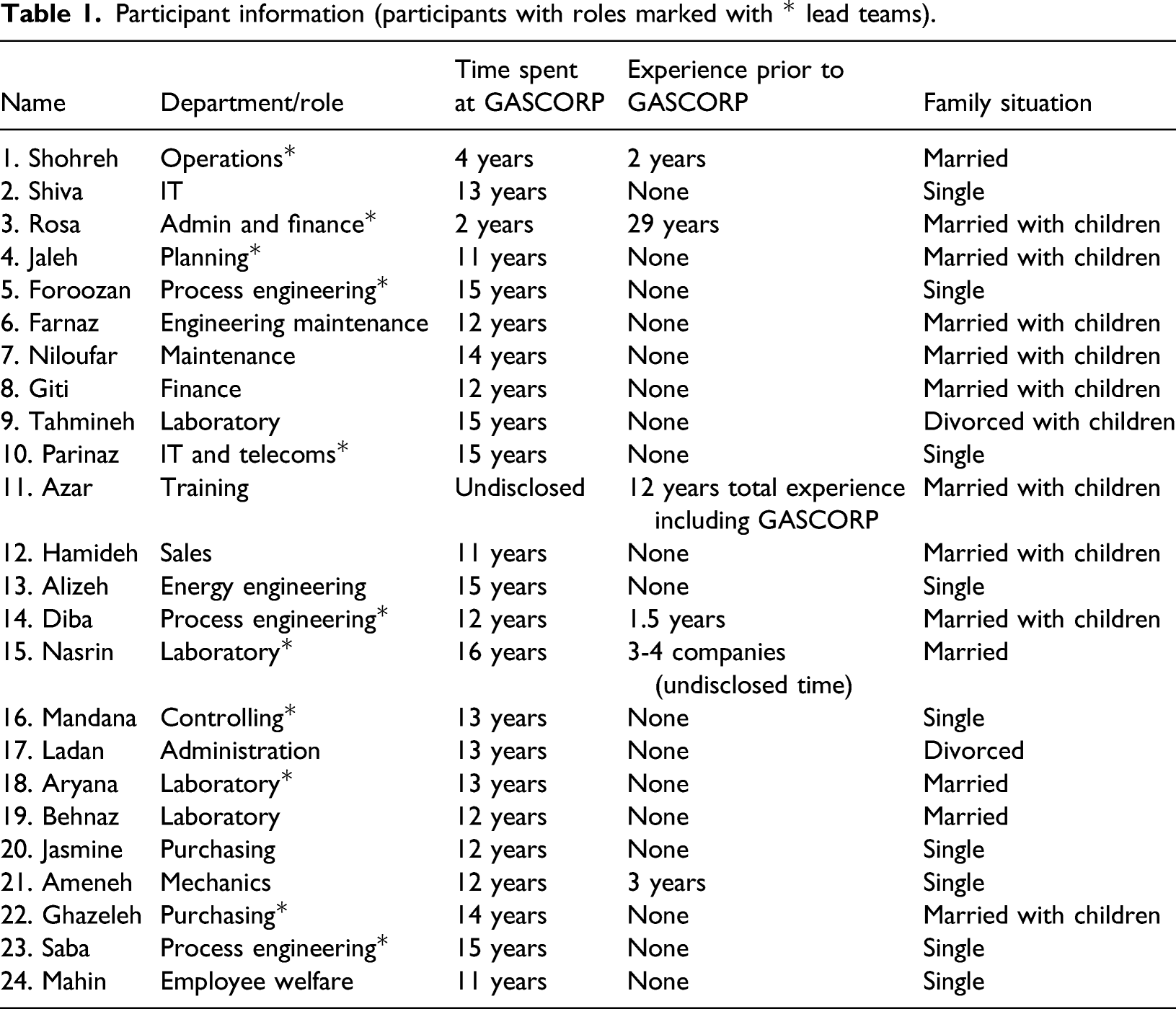
All 24 interviews were carried out on the GASCORP site over a 2-day period by the first and third author and lasted approximately 30 min each. We were given allotted slots by the organisation and we were conscious of the demands of juggling heavy workloads and home responsibilities that our participants were facing. We therefore did not want to place additional pressure on them by requesting longer interviews. However, we never cut an interview short and it was up to the individual interviewee to talk and answer our questions for as long as they felt comfortable. The longest interview lasted 45 min and 41 s.
Following Schedlitzki et al. (2017), it is important to recognise the role of the research team in both data collection and ‘meaning-making processes’. Thus, we outline the backgrounds and cultural assumptions of the authors involved. The first author has mixed British and Iranian heritage and although she has travelled to Iran multiple times since childhood and carried out previous research there, she has limited understanding of Farsi, the official language of Iran. The third author is an Iranian national whose first language is Farsi and second language English. She was born and educated in Iran and resides and works there. The second author has no connection with Iran. She is German, working in the UK and living in a tri-lingual household, with family-ties in Europe and Latin America. The fourth author also has no connection with Iran. She is British and works in the UK but has previously conducted leadership development work in the Middle East.
All participants were asked each question in both English and Farsi and given the choice of which language to respond in. 17 participants chose to respond in Farsi, 1 in English and 6 in a combination of both languages depending on the question and point they wanted to get across.
The interview schedule focused on a range of topics that provided the data for this paper. The questions were divided into the following themes: (a) Personal Background and Career Development: This focused on their role in the organisation, their career development and their career goals. (b) Experiences of Women in the Organisation: This focused on barriers and/or challenges they had faced in the organisation and any steps GASCORP had taken to address these. (c) Roles and Identity: This focused on the roles that the participants had enacted in their work and home lives and the ways in which they prioritised and managing competing commitments and pressures on their time.
Data analysis
Data were analysed using the four phases of Reflexive Thematic Analysis (Braun and Clarke, 2006, 2019). The first stage is ‘familiarising yourself with the data’, whereby all 24 interviews were transcribed in the language in which they were conducted and then translated into English by the third author. In instances whereby participants switched between languages, this was indicated clearly on the transcripts. Each transcript was then read several times by the first and third author while listening to the recordings. This was done to ensure that the transcriptions were accurate and so that the researchers could familiarise themselves with the raw data. Back translation (Brislin, 1970) was also carried out to ensure as much as possible that meaning was not lost in translation. Where idioms and culturally embedded phrases were used in Farsi, both the literal translation and the meaning behind them were included on the transcript. For example, the literal translation of the phrase used by one of the participants is “I have broken many skeletons”. The meaning behind it is “I faced many difficulties and became stronger”.
The second stage was ‘generating initial codes’, whereby interviews were systematically coded. Taking an inductive approach, codes were ‘data driven’, rather than ‘theory driven’. An a priori coding scheme was developed associated with the questions covered in the interviews. This was discussed and agreed between the authors before final coding took place. The coding was double-checked by the authors independently from one another. The next stage of Reflexive Thematic Analysis involves ‘searching for themes’. This was conducted with the aid of NVivo Version 11. In the fourth stage of thematic analysis, ‘reviewing themes’, the themes were verified and refined.
At the heart of Reflective Thematic Analysis is reflecting on the assumptions of the researchers involved. Themes are viewed as ‘creative and interpretive stories about the data, produced at the intersection of researcher’s theoretical assumptions, their analytic resources and skill, and the data themselves’ (Braun and Clarke, 2019: 593). It requires a ‘continual bending back on oneself’’ (ibid, 2019: 594). Coding and identifying themes was a collaborative process between all four researchers, who reflected continually throughout on their own philosophical and cultural assumptions. Themes are discussed in the next section.
Findings and discussion
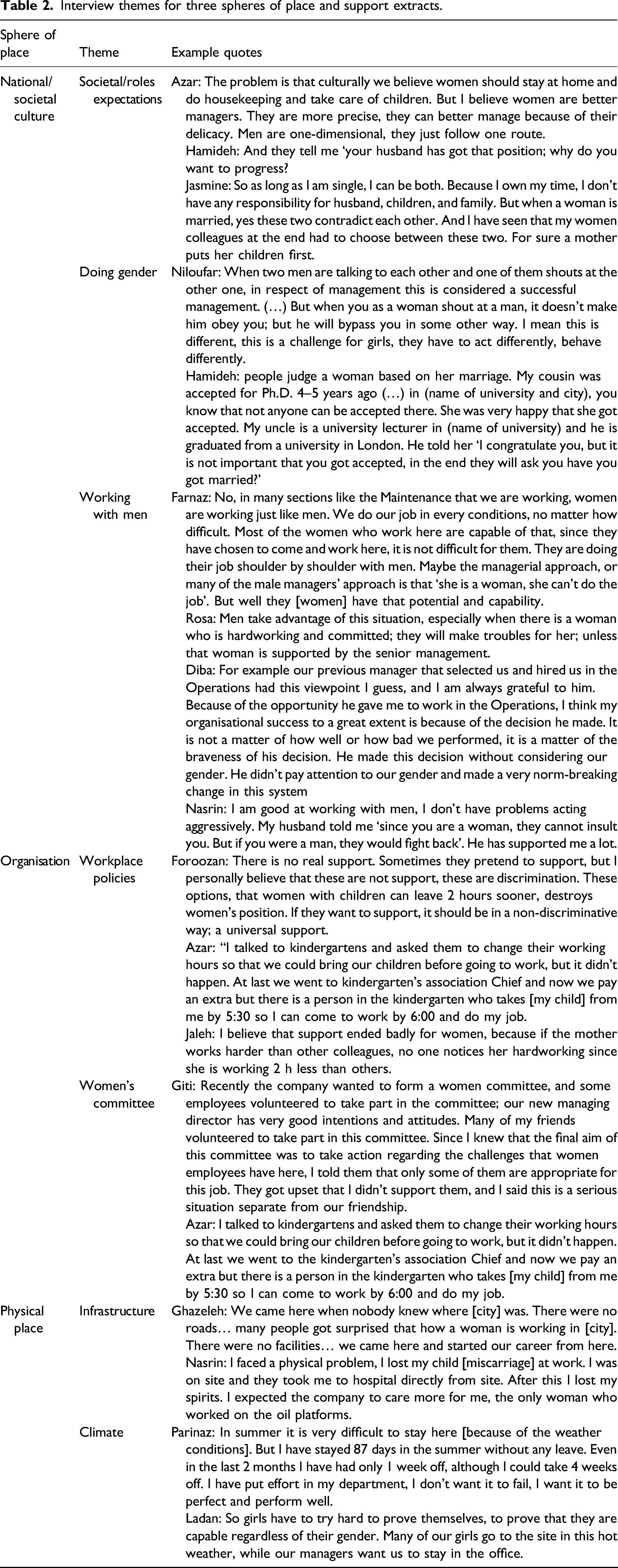
Interview themes for three spheres of place and support extracts.
Place sphere 1 – National/societal culture
Notions of masculinity and femininity are social constructs defined within cultures and context (Due Billing and Alvesson, 2000). Social norms prescribe certain roles, behaviours and appearance for men and women (West and Zimmerman, 1987). Our findings show three themes where national and societal ‘place’ created challenges for women’s leadership. These themes were societal/role expectations, doing gender (or doing respectful femininity) and working with men.
Societal roles expectations
Iran is a patriarchal society (Chanzanagh and Akbarnejad, 2012) and this is reflected in organisational culture and structure. Within Iran, there are ingrained societal beliefs about women’s place and position in society, much of this primarily seen as nurturing and supporting the family. For some of the women we spoke with, this was acknowledged and accepted as the boundaries of the place in which they are ‘doing’ leadership. Jaleh, for example, states: Jaleh: … I am an employee, a mother, a wife. Before getting married everything was different, I had more free time, less pre-occupations [...] But the successful person is someone who does her work besides all other responsibilities; and you have probably noticed that in our company, most of the managers are men. Women are also rightful to become managers but I personally do not object ‘why didn’t they choose that woman as the Chief?’ because I know that woman has a little child and when she gets home, she has to perform her mother role. Or I have to play the role of wife for my husband, I cannot say that since I work I don’t have any responsibilities for my husband. I believe a woman is first a wife and a mother, and then an employee.
Here, Jaleh has a sense of acceptance that women’s work roles and responsibilities are secondary to those of a wife and mother; she does not ‘personally object’. Many of the women in our interviews described themselves first as a daughter or wife and mother and friend. Whereas in the Western context, this ‘second shift’ (Hochschild, 1992) is well documented, here societal expectations position women’s identities within the domestic sphere and work is secondary. As Jaleh says, she must ‘play the role of wife’; the importance and salience of the working role ranks relatively low in comparison to the family roles a woman holds. Indeed, Sidani and Al-Hakim (2012) found that women more than men (in Lebanon) tend to see family as part of their social identity and any events that compromise that identity are more likely to be seen as more threatening. For women, negotiating the demands of a ‘double-burden’ is heightened (Camussi and Leccardi, 2005). Shiva, for example, describes how: Shiva: The society is well prepared for them [men] but for us, we encounter many problems that they even don’t understand.
Here, Shiva describes the society in patriarchal terms, as ‘prepared’ for men, but suggests men do not understand women’s challenges. In this context, women negotiate cultural and societal values that emphasise their caring role as a mother and wife in opposition to the men’s rational and economic role (Al-Lamky, 2007). Similarly to Al-Dajani and Marlow’s (2010) research on displaced Palestinian communities in Jordan, many of the women interviewed indicated an awareness that in this context it is the husband’s duty to provide financially for them and their families, and whilst this does not prevent women from working, their husband’s role as breadwinner and their roles as mother, daughter, daughter in law and so on must be prioritised. We saw examples of resistance to these norms within the interviews (see, for example, Azar in Table 2, however in contravening societal expectations, women made sacrifices. Ladan, for example, attributes her work on the breakdown of her marriage: Ladan: I earned many things in my life because of my job. I love working and women who love their jobs. I prefer an employee to a housewife. So I think your partner should think the same way and respect your choice. My job was the reason I lost my marriage.
Women had to make sacrifices to be working and to be (aspiring) leaders but they also risked pushing the boundaries of respectable femininity (Mavin and Grandy, 2016). For example, while there is an expectation amongst some families for women to be highly educated, they face prejudice for working or wanting to progress to leadership positions (see Hamideh in Table 2).
For single women the position was more nuanced. Some of the women found more freedom in not having marriage and childcare responsibilities. For example, Jasmine who is single says, ‘I own my own time’. However, in Middle Eastern societies single women also often experience work–family conflict (Sidani and Al-Hakim, 2012) that would not be so prevalent in a Western context. As women in a patriarchal society, which places an emphasis on the importance of the extended family, they still have responsibilities as a daughter and a sister, especially where they are the only or oldest daughter in a family. Parinaz illustrates this: Parinaz: In my family I am the only single child. Since all my siblings are married, I am mostly responsible for my parents.
Although having moved away from home and living in ‘camps’ on site with other single women, women such as Parinaz are free from the day-to-day domestic duties, however they still face pressure to visit their families often and in some cases care for them. Societal role expectations place women’s role predominantly within the domestic sphere, with potential sacrifices for women that violate these norms.
Doing gender
Interlinked with societal expectations about women’s place within society, we observed that women were expected to do respectable (Iranian) femininity (Mavin and Grandy, 2016). In other words, notions of how individuals demonstrated femininity and masculinity framed the women’s interactions and constrained how they interacted with others. There was a tension in how gender is performed, as illustrated by Niloufar who positions these challenges as contextual; in ‘our country’: Niloufar: You see the most significant challenge we face as girls in Iran, I don’t know about other countries, but in our country when you face a man in for example a meeting, or you want to speak to, I don’t know, your colleague, your employee, your subordinate, your superordinate; the first thing he expects from you is to be feminine. The expectation from a girl is to be delicate and feminine. (…) When two men are talking to each other they do not apologise in every sentence they say, but when a man is talking to me he keeps apologising for talking inappropriately and he expects me to talk to him respectfully in return, in a way that he doesn’t get annoyed. This is our most important challenge; it is very hard to change their assumptions and mind-set.
In her interactions with male colleagues, Niloufar expresses that she is expected to be ‘delicate and feminine’, conditions that need to be met in every interaction that she has and that are not present for interactions between men. For others, they spoke of their gender being the most salient characteristic which has to be done ‘appropriately’ before attention can then be paid to their efforts as a manager and/or leader. Parinaz says: Parinaz: My managers don’t see me as a talent but as a woman who has to first observe the Islamic dress code, and then do her job.
In terms of communication style, for example, a number of women explained that they cannot confront others (particularly men), which they see as being an important part of the leadership role, as this was stepping out of the boundaries of respectable femininity (Mavin and Grandy, 2016). Alizeh shows this below. Alizeh: And whenever they let you in, they set conditions for you: don’t talk; keep your mouth shut; and don’t say anything, just go in and sit. And I, all the time I see that a man with my position, with lower years of experience can talk and can speak, and me with for example 15 years experience, I’m asked to be shut in the meetings.
We also saw that doing gender ‘well’ (Mavin and Grandy, 2012) meant that being married and having children should be the most important focus for women managers. Therefore, as previously discussed, for the single women in the organisation, a tension existed. While being single enabled women to focus on their jobs, this subject position means that they are not fully accepted. This is illustrated in the quote from Hamideh in Table 2 who describes her cousin being accepted to do a PhD at a prestigious university, yet her father replies that ‘in the end they will ask you have you got married’. Marriage is the ultimate goal for women. For many women though, regardless of their status, they recognised that they felt ‘Other’ within the organisation where men were the standard or norm (De Beauvoir and Parshley, 1953). As one of our interviewees Parinaz explains, “When we were first hired they looked at us like we are aliens”.
It can be argued that leadership is constructed within a ‘masculine frame of reference’ (Due Billingson and Alvesson, 2000: 2) where expectations exist that women ‘take care’ and men ‘take charge’ (Hoyt and Chemers, 2008). This can be even more exaggerated in a strongly patriarchal society, where men’s most common frame of reference may be ‘woman as wife’ or ‘mother’, and where women are idealised as emotional and empathetic (Sikda and Mitra (2012). When women challenge the long-embedded cultural norms and expectations of being ‘delicate’ and ‘feminine’ and leaders needing to be ‘decisive’, they find themselves at a glass ceiling or indeed a cement ceiling (as Aguirre et al., 2011 also found in a study with Qatari women).
Working with men
Strong religious and societal norms of how men and women engage with each other, and what role each takes in society, created workplace barriers for women aspiring to leadership positions. The way men are expected to talk to women, and vice versa, was experienced by our interviewees as making it hard to legitimise women as leaders. Language therefore plays a role in shaping the relationships at work and creates a barrier for women to act as leaders and be seen as leaders. As one of our interviewees states below, appointing a female manager was seen to create more communication ‘work’ for everyone and subsequently became a barrier: Parinaz: They said ‘we prefer a manager who is a man so that he can easily communicate with upper managers, we are not comfortable with women’ and so I lost the opportunity.
While there was widespread acceptance of women in non-managerial jobs in the organisation, resistance to women in managerial and leadership positions was fairly pervasive within the existing leadership team. Some women are working in roles which were physically demanding and male-dominated, such as maintenance, so the tensions seemed to arise in terms of hierarchy rather than role segregation (see Farnez in Table 2, for example). While this could be interpreted as men trying to maintain their hegemonic positions, it is also related to the societal roles and expectations of ‘doing’ gender which we previously discussed. Aryana sums this up: Aryana: It is hard for men to see women as managers: men don’t like to tell their family that their boss is a woman.
As Hodges (2017) also found, women (in Saudi Arabia) are not seen as natural inhabitants of leadership roles, but here Aryana extends this to describe a woman leader as a source of discomfort for men in having to explain this to their family. For one of our participants, she described leadership as a ‘game’ into which women had forced themselves (see also Rosa in Table 2 for the way men resisted this): Foroozan: Men respect each other and they have always controlled everything. As a friend said, it is like a masculine game which we women entered by force, and they believe that this game is only for them. They don’t like women participating in this game.
Not all men were unsupportive and some of our interviews described support from men in different ways. As Ghazeleh tells us: Ghazeleh: Although he couldn’t promote me to a higher organisational position, but well, in respect of benefits I am not dissatisfied. And about overtime… when I compare myself with women working in other departments, for example overtime, appraisals… the welfare perks, they supported me as much as they could.
Consequently, pockets of support do exist, yet the embedded power relations constitute a part of place (Hartley, 2011) where the workplace is seen as a masculine domain and a strong hierarchy characterises the oil and gas industry in Iran. Women seem to challenge these power relations, first through their presence, and second in their aspirations to become managers and/or leaders.
To summarise, national and societal culture impacted the women’s aspirations to leadership through the dominant societal roles and expectations about women’s place and role in society, the way in which they were expected to do gender appropriately and in their working relations with men. The different constructs of national and societal culture therefore intertwined to create a complex web of inequalities. Thus, there are many challenges women have to navigate in their leadership practice and aspirations. We next turn to discuss these in relation to organisation as ‘place’.
Place sphere 2 – Organisation
The organisation had previously introduced workplace practices and policies to support women, however, these were found to reflect the societal and national culture that we previously described, thus reinforcing the view of women in the ‘traditional sense’ that we presented previously. Flexible working policies and a women’s committee were introduced, seemingly with good intentions. However, the women we interviewed felt this further hindered them in their work and progression. We turn to describe how the workplace policies and a newly formed women’s committee reinforce gendered roles and create more barriers for women’s careers.
Workplace policies
As there is a drive to maximise women’s participation in the labour market in Iran, the organisation aimed to support their female staff through; the introduction of shorter working hours and a ‘two week on, two week off’ working structure (see research context), and the formation of a women’s committee. On the surface, these are positive developments. However, some of the women experienced these policies as hindering their participation and progression even further in the workplace. For many of the women we spoke with, these policies seemed to obscure many of the real issues the women faced, some of which were structural, others related to childcare issues and women’s role in society as the primary carer of the extended family. As Gitti states below, two weeks on and two weeks off did not help manage the ‘second shift’ (Hothschild, 1992) of childcare and family responsibilities that still needed to be managed: Gitti: I think it is necessary to pay attention to women’s family and personal life. I don’t know if you have heard about some employees who are two-weeks-on-two-weeks-off. If women don’t have preoccupations about their children, their kindergarten, their nursery, they will be able to work better and so the manager’s attitude towards women will improve consequently. I believe, in our complex, helping women employees to manage their personal life will free up their mind and so they can work more effectively and more motivated, which will improve the way our super-ordinates see us.
As Gitti suggests here, these work rotas did not deal with the issues for women in terms of their childcare responsibilities; it did not ‘free up their mind’ or indeed change managers' attitudes towards women. The organisation positioned itself as women-friendly and indeed these flexible working practices introduced by the company are not common (and generous by paying a month salary for two weeks of work). However, the domestic and structural barriers allowing more women to enter the workplace are not mitigated.
The same holds true for the company-specific flexible working structure where women can arrive and leave two hours earlier than men. Some of the participants explained how handovers and important decisions are made when women employees are not present and some women saw the flexible working arrangements as an active attempt by the organisation to create further barriers for women (even though not all women do take this flexible working option). Diba expresses this as ‘eliminating women’: Diba: I mean you could leave two to three hours sooner, and to me, Doctor, it wasn’t an honour, somehow. Many of the women here didn’t realise but I think this was a decision to eliminate women's presence even more. Since when you come to work at 9:00 and leave by 12:00, the system [company] will not rely on you anymore. When you are not present at the first working hours which is the ‘shift change’ of the Refinery and do not realise what is happening, or you are not attending the early morning meetings of the Refinery and you are not aware of what is going on, in reality you are working towards eliminating yourself from the system. That was the viewpoint.
Although these strategies appear to be well-intentioned mechanisms to support women’s involvement in the workforce and provide a means of managing home-work conflicts, in practice, they reinforced women’s position as being primarily in the home, with work a secondary activity. Therefore, these policies reinforced the cultural and societal aspects of place, which acted as a barrier for women. In this way, it can be argued that the policies replicate notions of women as guardians and carers and men as having economic responsibility (Al-Lamky, 2007).
The women’s committee
The organisation recently introduced a ‘Women’s Committee’ that was put in place with the aim of addressing some of the equality challenges within the workplace. However, this had several unintended consequences. Again, it was felt that the Women’s Committee served to reinforce women’s position and role within society. For example, the focus of the Women’s Committee fell on highlighting the importance of family to help female employees to feel better at work. As one of the women said: Tahmineh: They have recently organised a Women Committee; and our manager has paid more attention to women and family affairs that women mostly face… well, families are shaped when a woman decides to concentrate her individual energy on making a family; otherwise a man cannot shape a family. So, in response to matters such as depression and money-loving that is happening to our [women] colleagues… [the Women Committee] is trying to highlight the importance of the family, so that we face less of such problems in the future.
In this way the Women’s Committee serves to reinforce societal expectations on what it means to be a woman and that it is her responsibility to ‘shape’ a family. It further highlighted the need to juggle work and home life and prioritise the latter (Shaya and Abu Khait, 2017). However, the Women’s Committee also became quite political and a source of intra-gender tension and conflict for some of the women. Rosa states: Rosa: The woman who is elected as the head of the committee asked me in private to give her a charter for the committee and to tell her the current weaknesses. Unfortunately, women here are not collaborative with each other. Men work better with each other. Why? Many reasons. If women backed each other up, instead of backstabbing each other, there would be no conflict in the workplace.
Rosa states that women were not being supportive of each other, in fact she describes ‘backstabbing’. However, as Parinaz recognised in the quote below, women faced a lack of senior women role models and she relates this to women’s intra-gender conflict. Parinaz: I believe that this committee will last two months only, we women cannot work with each other [laugh]; women want all women to be equal, but you cannot expect to receive the same benefits as someone with more work experience and responsibility. That is the problem with women. We don’t have role models.
With the lack of female role models available, rather than supporting each other, a competitive informal hierarchy has formed in which women compete for position and arguably, for a voice. As others have discussed, women’s relationships take place within gendered contexts in which women in leadership are seen as ‘the exception’ rather than ‘the norm’ (Mavin, 2008; Mavin et al., 2014). GASORP is a highly ‘gendered context’ in that it is both situated within a male-dominated industry, and in a strongly patriarchal society. Finally, for some women, bypassing the organisational policies and the women’s committee and resorting to individual effort seems the only way to create better working conditions for themselves. Individual acts of challenge at a micro level shifted some of the barriers for women (see Azar in Table 2).
To summarise, while organisational practices sought to support women’s advancement and participation within the organisation, the tension between the multiple roles of Iranian women was heightened by these organisational practices. Highlighting to women the importance of family and reinforcing working structures disadvantages women in equal participation.
Place sphere 3 – Physical place of work
The third sphere of place is the physicality of the place of work; an oil refinery in the desert. The environment is harsh for both men and women with extreme heat and a lack of infrastructure. However, this impacted on women in particular ways which we discuss below.
Infrastructure
The oil and gas company and its refineries are located on the Persian Gulf and many of its employees relocated from their home cities all over Iran to work there. Some of those we interviewed were amongst the first women to work for the organisation approximately 15 years ago. When they arrived, there was very little infrastructure such as roads, schools and nurseries. Azar reflects what it was like, she says: Azar: I also had to visit newly built Refineries which did not have any facilities; they said it is not appropriate for women.
Whilst this has improved through investment, some participants reported a lack of childcare facilities. The extended family structure is an important part of Iranian society and culture. However, with many women living far from home, their source of childcare is limited. They need to choose between leaving their children with their family in another city or juggling the conflicting demands of work and family life on a daily basis. Some of the women reported challenging conditions and recognised the sacrifices that have had to be made. Ladan describes this below. Ladan: We have difficult living conditions here (…) The reason they [women] bear these conditions is that they want independence and personal freedom, and they have made sacrifices for their job.
When some of the participants raised their concerns and highlighted the challenges that they were facing, it was sometimes met with criticism and their role as a woman or a mother was reinforced over their roles as an employee in the organisation. Diba recalls a conversation that she had with the Employee Welfare department: Diba: I went to the person in charge [Employee Welfare department] and asked him what should I do with a baby in a city that doesn’t have any kindergarten, how can you help me? He simply replied that, ‘go home lady! Go home and raise your child!’ I told him according to Labour Law you have to prepare a kindergarten, I know the rules, this is my job. He said ‘if I am in charge, I tell you to go home!’
Diba describes that although she knows ‘the rules’, in other words the organisational policies, the lack of infrastructure combined with the hostile attitude of the department head, created a barrier for her. Here, the three spheres of place are intersecting to create complex leadership barriers. Hodges (2017) also found that in Saudi Arabia, there is a lack of appropriate infrastructure to accommodate women because employing women means totally new bathrooms, meeting rooms and entrances. Additional infrastructure gaps include insufficient access to safe, reliable public or company-provided transportation. These presented infrastructure issues that impacted on women.
Climate
The Persian Gulf sees temperatures soar to over 45 degrees centigrade amongst the summer months with very high humidity. The dress codes are in part dictated by law and regulations but added to by workforce policies, which state that women need to wear dark clothes. With women and men sharing office space, these physical conditions can make it challenging for women. Amineh describes these differences: Amineh: Even in respect of formal dress, men’s formal dress is a tunic and short-sleeved shirt while women have to wear thick and dark clothes. They all sit in the same room, so the room’s temperature does not adjust to one of them.
In this way, not only the physical aspects of place (such as climate) create a barrier to these women but for Amineh, not adjusting the temperature also positions her as ‘Other’ and without a voice. Social activities in the city are also predominantly aimed at men, with no leisure activities for women being available beyond 6 pm and women cannot socialise with men together, unless they are married. The place arguably, is not conducive for women to work and lead. However, women showed resistance, resilience and agency within this. As Jaleh says: Jaleh: The long distance between work and home and the harsh environmental conditions, this contradicts the emotional spirit of a woman. But I have to do something to make the situation joyful: going to gym, having fun time with my husband, going out with my children, or planning monthly trips. This way I can keep on.
For Jaleh, the environment challenges her ‘emotional spirit’ but she finds pleasure outside of work. To summarise, the sphere of physical place acts in concert with the other two spheres of place to create barriers. Lack of infrastructure and the climate impact on both men and women, but they have a particular gendered dimension.
Conclusion
The article has shown that, by focussing on a specific ‘place’ of leadership enactment, we can provide a more situated and contextual understanding of the challenges women in Iran face in entering and enacting leadership roles. These challenges manifest themselves in relation to three spheres of place: national/and or societal culture, the organisation, and the physical place of work, which in turn impact upon women’s experiences and their ability to perform and enact leadership within the context of GASCORP in Iran. These three spheres do not act in isolation but intersect to shape the lived leadership experiences of women.
Place as national and/or societal culture created a pervasive set of social norms and expectations for women to adhere to. Through societal roles and expectations, women’s primary role was positioned within the domestic sphere as carers for both immediate and extended family. These roles are often expected to be prioritised over careers. Furthermore, women were expected to be doing respectable Iranian femininity in ways which constrained their interactions with others within the organisation. In working with men these challenges became apparent through things such as communication and power relations. These national and/or societal challenges permeated the second sphere of organisation as a ‘place’ in which to enact leadership. In workplace policies and the women’s committee, we saw that while the organisation had implemented a series of policies designed to support women in fulfilling their domestic and family responsibilities alongside their employment, this had created further challenges. The women in our study often felt excluded from key decision making which served to further “foster patriarchal values” and reinforce the ‘guardianship’ roles of women (Al-Lamky, 2007: 11). Finally, the third sphere of place; ‘the physical place of work’, impacts on both ‘the organisation’ and ‘national/societal culture’. The infrastructure; in a city that is quite remote and far from home for many of the employees, and the climate served to reinforce the discourse of these conditions not being suitable or appropriate for women, who are expected to be ‘delicate’. With very few childcare facilities and support networks it also reinforces societal norms such as the expectation for women to prioritise their families over everything else. These are all interlinked and act as a web of barriers and challenges for women negotiating their leadership place. The article thus contributes to our understanding of the relationship between leadership and place. By considering the dynamics of place as occurring in multiple spheres, through not just the physical place but also at the sphere of the organisation and a national and societal sphere we demonstrate that leadership is situated within place and the ability to enact and ‘perform’ as leaders is constrained and/or supported by cultural (national, societal and organisation) factors as well as place in a physical and geographical sense. We therefore support calls for more appreciation and understanding of place within leadership studies, with a particular focus on gender and leadership.
The second contribution we make is to extend previous work on the lived experiences of women in the Middle East and North Africa Region (see, for example, Al-Dajani and Marlow, 2010; Bullough and De Luque, 2015; Essers and Benschop, 2009; Hodges, 2017). However, we extend this to focus on the under-researched context of Iran. As we have shown, Iran has several important differences relating to religion, socio-historical roots and language – all of which contribute to the way gender is ‘done’ in this context. Place as both a physical and human space (Massey, 1994) serves to offer a form of social, cultural and emotional attachment (Collinge et al., 2010) for the women operating within it. The women within our study had to negotiate the complex dynamics of doing gender well and being seen to act in line with the normative conceptions of femininity (Mavin and Grandy, 2012) with dominant masculine expectations of what leadership is and how it should be done. While this is arguably true for women in Western contexts, the specific nuances in national and societal cultural norms and the ‘harsh’ physical environment provide additional challenges for women to negotiate in order to be accepted and supported in leadership roles. Here, women were simultaneously pushing against walls of both societal expectations, the organisation and the physical place. Our research therefore aims to afford female leaders in Iran a voice and engage in deliberate consciousness raising of the challenges these women face in the workplace.
As with all empirical work, there are limitations to this study which open opportunities for future research. Firstly, we recognise that our findings stem from the experience of women in a single organisation in Iran. National and/or societal culture, organisational culture and the physicality of place intertwine to offer unique nuances in the gender-related challenges experienced by these women. However, our research, could be strengthened by similar studies in other organisations, sectors and locations. Secondly, whilst steps were taken to ensure a representative sample of interviewees, we had not fully appreciated the power dynamics surrounding sample selection. In addition, the research drew upon interview data, but expanding a wider range of methods and approaches, such as ethnography could add to the rich picture of these women’s lived leadership experiences.
To conclude, this paper has highlighted the importance of adopting a critical place-based approach to exploring the challenges that women may face in experiencing and enacting leadership. Our research suggests that organisations need to develop policies, practices and leadership development approaches that do not exclude women through surface level support initiatives but go deeper, to involve women in decision making and positions of power to help create a reality that works for them. In doing so, it engages in deliberate consciousness raising, highlighting simultaneously how the Iranian context is both unique and offers parallels with the experiences of women everywhere.
Footnotes
Declaration of conflicting interests
The author(s) declared no potential conflicts of interest with respect to the research, authorship, and/or publication of this article.
Funding
The author(s) received no financial support for the research, authorship, and/or publication of this article.
