



Abstract
The concept of ‘place’ can play a powerful role in understanding how leadership is socially constructed. This article explores the geographic, symbolic and mythic uses of place in the cultivation of a distinct leadership style around the Presidency of John F. Kennedy. It focuses on the history of a social and learning event that today might be called a leadership development programme: the ‘Hickory Hill Seminars’ of 1961-4, named after and mostly held at the specific location of Robert F. Kennedy’s home. These seminars – only lightly touched on in Kennedy-era history and leadership literatures – were semi-formal occasions organized by the historian Arthur Schlesinger that brought eminent public intellectuals of the day to present their work to the assembled group of insiders. The seminars functioned as a network in action, both cultivating and projecting certain cultural formations of leadership. Bounded by the geographic places inhabited by Washington elites, the seminars formed part of the broader construction of the symbolic place of the ‘New Frontier’ and the mythic place of ‘Camelot’. The Hickory Hill seminars were one part of a broad metaphysical canvas upon which a distinct presidential leadership style and ‘legacy’ was created. Building on critical and social constructivist perspectives, we argue that geographic, symbolic and mythic notions of place can be central to the social construction of particular leadership styles and legacies, but that these creations can be deceptive, and remain always vulnerable to critique, co-optation and distortion by opponents and rivals.
Keywords
Introduction
22 November 1963. Dallas, Texas.
In preparation for a re-election campaign the following year, President John F. Kennedy is due to give a speech to the Dallas Citizens Council at the Texas Trade Mart. The speech is written and laid out ready on a series of cue-cards. It will discuss several issues of the day, including a paradigmatic Cold War phrase about America and Americans as ‘Watchmen on the walls of world freedom’. It will contain important lines about personal development, skills and technocracy, in keeping with notions of a knowledge economy that were contemporary then and remain so now. It will carry an important passage about how ‘leadership and learning are indispensable to each other’ 1 . But at 12.30pm fate intervenes – ‘the seven seconds that broke the back of the American century’ (DeLillo, 1989: 181). Kennedy is assassinated in Dealey Plaza, and the speech (marked ‘undelivered’ in the Kennedy presidential library) becomes one of the last unfinished acts of the ‘unfinished life’ of President Kennedy (Dallek, 2003).
The speech was a rumination on the complexity and difficulty of leadership in the modern world. As if to admonish recent presidential leadership in our own time, Kennedy would have told his audience in Dallas that: In a world of complex and continuing problems, in a world full of frustrations and irritations, America’s leadership must be guided by the lights of learning and reason or else those who confuse rhetoric with reality and the plausible with the possible will gain the popular ascendancy with their seemingly swift and simple solutions to every world problem.
2
The draft speech fused a Cold War commitment to American leadership in anti-Communist foreign policy with a progressive optimism that open societies could flourish through learning and critical inquiry. The approach to leadership adopted rhetorically by Kennedy in the Dallas speech was informed by, embedded in, and stemmed from, a distinct formation of intellectual life. It rested on, and promoted, a vision of leadership which is unproblematically associated with U.S. democracy, open society, intellectual endeavor, rationality, reason and activist government. Left unspoken are certain implicit assumptions: the notion that US foreign policy promotes the peaceful spread of democracy and prosperity, and that ‘leadership’ itself is an unproblematic good. It leaves unmentioned the hidden systems of power that underpin political systems both then and now – the raced, sexed and gendered assumptions that ‘the free world’ rightly requires the leadership of powerful, white, heterosexual American men (Liu, 2020).
Our article examines one specific example of the social construction of US Presidential leadership. We explore the history of the ‘Hickory Hill Seminars’ – regular meetings of ‘the best and the brightest’ (Halberstam, 1983) of American society that were held at, and named for, Robert Kennedy’s house (‘Hickory Hill’) in McLean, Virginia. Drawn from politics, law, media, academia and the entertainment industry, the seminars centred around a group of individuals who were part of the ‘New Frontier’ – the term used by Kennedy and Kennedy-friendly journalists to describe both a ‘metaphorical landscape’ for the administration (Hellman, 1997: 120), and a distinct socio-cultural operating style (Watts, 2016). Upon Kennedy’s death, the identity of this leadership group came to be represented by the mythical construction of ‘Camelot’ as discourses shifted into those of a Presidential ‘legacy’ (Dallek, 2013: 421–423).
Our article challenges and unsettles the usually mainstream and taken-for-granted ways in which the presidency intersects with leadership as a phenomenon and as a genre of writing. Many presidents find their way into leadership textbooks as case studies of success or failure. There is a specific literature on the historical ‘rankings’ of presidents, typically featuring Washington, Lincoln and FDR at the top, and Buchanan, Pierce and Harding at the bottom (Greenstein, 2019; Merry, 2012; Mukunda, 2012; Schlesinger, 1997). Much of the work on presidential leadership, however, offers simplistic and limited lessons, with the focus very much on the ‘effectiveness’ (Fiedler, 1967) of leaders who – through their ‘vision’ and ‘energy’ – can heroically rescue distressed and rudderless organizations and followers (Carroll et al., 2019; Liu, 2017, 2020; Spector, 2016; Wilson, 2016). Rather than the ‘effectiveness’ paradigm that features heavily in presidential leadership writings (see, for example, Beschloss, 1991, 2003, 2007; Burns, 1960, 1978, 2006; Goodwin, 2019; Mukunda, 2012; Neustadt, 1991), this article investigates a vital but underexplored element of leadership – how leadership styles are framed via the mobilization of the geographical, symbolic and mythic meanings of place (Collinge and Gibney, 2010; Ropo et al., 2013).
Geographically, the seminars were placed at the location of Hickory Hill itself (the physical setting of many of its meetings). Symbolically, the seminars were the intellectual expression of the New Frontier that the Kennedy presidency aimed to project America towards. Mythically, the seminars have been laid to rest at Camelot: the heavily romanticized notion of what presidential leadership can and should be, something that is simultaneously an imagined goal for aspiring future leaders and an elegy for something special lost forever. The New Frontier was a symbolic leadership vision oriented to the present and future that had a strong imprint at the Hickory Hill seminars and beyond. Camelot is an even more powerful and enduring mythical creation, developed by Jacqueline Kennedy to memorialize Kennedy and his leadership style shortly after the traumas of the Dallas assassination.
The specific example of the Hickory Hill seminars is just one local element of a broader set of processes that helped to establish the romanticized Kennedyite vision of presidential leadership. Nonetheless some of the main advocates for the Camelotian view of the Kennedy presidency participated in the seminars. From the New Frontier and its nostalgia-infused composite, Camelot, have flowed a huge range of cultural materials: academic texts adopting ‘Camelot school’ and ‘counter-Camelot school’ historiographical interpretations (for a useful summary, see White, 1998), middle-brow leadership writings, coffee table photo collections, recordings of speeches, oral histories, feature films and TV docudramas. Through these outputs, the Kennedy circle’s distinct leadership legacy has been sustained and reproduced beyond its own time and, as we shall see, into the present.
The article is structured as follows: The following section explores existing connections between the historical study of US presidents and leadership studies, highlighting the limitations and weaknesses of the constricted and mainstream frame of reference typically advanced in those discussions. Following a discussion of methods and sources, the article then proceeds in three sections to explore what the sources tell us about the purpose and organization of the Hickory Hill seminars, and their membership, content and function. The first examines how the seminars were organized, including how they were gatekept, who attended and who did not. The second section explores the speakers and topics that were chosen for the seminars, and what this reflects about the concerns and interests of the group, in terms of the cultural and intellectual frames they convey into the visions of leadership being formed. The third section explains the overall functions of the seminars, explaining the roles of geographic, symbolic and mythic places of leadership in the deliberate social construction of Kennedyite leadership tropes. A following section then explores how the placing of leadership through Hickory Hill and related cultural processes has left a powerful imprint on the American presidency, leaving a cultural and rhetorical legacy – an archetype of leadership – to which all other presidencies are compared, or compare themselves (Henggeler, 1995). We demonstrate that conscious choices about the uses of place in the construction of leadership can have far reaching and powerful effects (Mabey and Freeman, 2010), tracing how one of the historical episodes that led to the seminars also led, by a different path, to the Trump presidency. We conclude by arguing that a critical understanding of the socio-cultural places of leadership can provide vital new insights for social constructivist perspectives on leadership which emphasize leadership’s normative aspects, as well as its less edifying elements that typically remain unspoken or deliberately obscured.
The social construction of ‘greatness’: Critically interrogating presidential history and presidential leadership
Political figures – and US Presidents especially – feature heavily in the leadership literature (Fairhurst and Cooren, 2009; Greenstein, 2009; Mukunda, 2012). James MacGregor Burns, one of the foundational scholars of leadership, developed his theories from historical studies of presidents (Burns, 1960, 1978). Common aspects of presidential leadership discussed in the existing literature are personality traits, leadership style, policy measures, crisis management or wartime leadership (Beschloss, 2003, 2007; Burns, 2006; Cullinane and Elliott, 2014; Goodwin, 2019). There is also a distinct literature that sits at the intersection of history and leadership ‘effectiveness’ – the writings on presidential ‘greatness’ or historical ‘rankings’.
It is instructive that Arthur Schlesinger Jr (1917–2007) played an important role in developing and popularizing the task of rating presidential performance, what Merry describes as ‘the great White House ratings game’(Merry, 2012: xxiii–xxii). A highly respected and extremely prolific historian, Schlesinger was asked by Robert Kennedy to ‘serve as a sort of roving reporter and trouble shooter’ for the Kennedy administration (Aldous, 2017: 218). Schlesinger remained very closely associated with the Kennedys and with Democratic party politics until his death. It was his father, Arthur Schlesinger Sr, who first wrote about presidential historical rankings, in 1948 and again in 1962 (Riccio, 1990). Building on and adapting his father’s work, Schlesinger Jr’s 1997 article is one of the most influential and enduring attempts to develop meaningful historical rankings of presidential ‘greatness’ (Schlesinger, 1997). His method involved distributing a survey instrument to leading US historians. Although the result was a fairly predictable outcome that has been reproduced closely in subsequent polls, many have observed how difficult it is to make objective judgements of presidents serving in quite different historical eras (Merry, 2012; Riccio, 1990). Indeed, it is important to consider ‘ranking’ attempts as socially constructed; different writers and methodologies have produced different outcomes across various parameters. Many of the Camelot histories are unapologetic social constructs, with several of the foundational texts (such as Schlesinger (2002) and Sorensen (1999)) written by friendly interpreters and insiders (Aldous, 2017; White, 1998). But the same could be said for the historiography of any president. Partly as a response to the perceived liberal bias of the academic polls, Republican-leaning writers, consultants, media figures and think tanks have also made explicit and successful efforts to ‘bid-up’ the historical rankings of other presidents, most notably Ronald Reagan in recent years (Bunch, 2009).
There have been several revisions to the original Schlesinger rankings. These have included academic studies by historians Murray and Blessing (Murray and Blessing, 1983, 1993), presidential scholar Felzenberg (Felzenberg, 2008), as well as opinion polls run by media organizations such as The Wall Street Journal (2005), and C-SPAN (2017), that indicate the enduring nature of presidential reputation. All have resulted in similar overall rankings, with John F. Kennedy placed around 12th-15th (Merry, 2012: 244–5). Presidents’ reputations as good, bad or indifferent leaders are shaped not only by posterity and political inclination, but also in the ways in which the presidency is projected to the wider public, to the media, and, indeed, within governmental and elite circles during the presidency itself. Our article explores how understandings of leadership are cultivated and promoted (Collinge and Gibney, 2010; Grint, 2005; Jackson, 2019), with a particular emphasis on leadership’s cultural and aesthetic aspects (Fairhurst and Cooren, 2009; Fairhurst and Grant, 2010).
There are many places where the history of the US presidency intersects with culture, both ‘high’ and ‘low’ (Lubin, 2003). To some extent the president can be considered a pop-culture figure, endlessly featured in film, TV and fiction (Cimpean, 2014; Frame, 2014; Peretti, 2012). Ronald Reagan once described his prior career as a film actor as perfect training for the job (Fitzgerald, 2000: 39). Donald Trump’s ‘reality TV’ persona was a major factor in his election campaign in a digitized, social-media saturated, post-truth age. Kennedy even made his own contribution to leadership literature with his popular bestseller Profiles in Courage (Kennedy, 1955). JFK and his family were pioneers of political image-making from the promotion of Kennedy’s books and his PT-109 war stories (Donovan, 2001) to developing a dynamic and youthful aura for the televisual age (Giglio, 2006; Hellmann, 1997; Lubin, 2003). His father is said to have commented ‘We’re going to sell Jack like soap flakes’ (Brands, 2010: 365). Gendered and sexualized elements of the Kennedy leadership vision were also carefully cultivated, rooted in and contributing to unspoken norms about gendered systems of power (Liu, 2020). Terms beloved of the media included Jack’s ‘vigour’ and Jackie’s ‘poise’. The leadership vision falsely presented all the Kennedy men as devoted to their families and wives (Watts, 2016). The president’s sexual aggressiveness was sometimes hinted at in his own time, and only recently has come in for open criticism (Dallek, 2013: 29–33; Hersh, 1998; Lubin, 2003; Watts, 2016; White, 1998).
Our focus in this article is not so much on JFK’s image as an individual, or on his position on the historical ladder of performance rankings. Rather, we are interested in how his circle marshalled various uses of place (Collinge and Gibney, 2010; Mabey and Freeman, 2010) to influence the careful and deliberate social construction of a culturally infused leadership style and legacy (Grint, 2005; Liu, 2020). The Hickory Hill seminars were one part of a broader conceptual and cultural mission (Jackson, 2019) to create and sustain the ‘New Frontier’/‘Camelot’ style of a US presidency. What is particularly important in the Kennedy story is the significant role played by administrative insiders in creating history; not just insiders writing their own memoirs or biographies (such as Kennedy’s speechwriter Ted Sorenson (Sorensen, 1999)), but also via the employment of professional academic historians of political leaders, most notably James MacGregor Burns and Arthur Schlesinger. Burns played an active role in the Kennedy campaign, advising the candidate, meeting supporters and attending the trail (Schlesinger, 2011: 36). He also wrote an authorized biography – John Kennedy: A Political Profile (1960) – to introduce JFK as a viable Democratic presidential candidate (Burns, 1960). Schlesinger acted as a special advisor the President, organized the Hickory Hill seminars and wrote foundational ‘Camelot school’ histories of John and Robert Kennedy (Schlesinger, 1978, 2002, 2018/1978).
Our work on the Kennedy circle contributes to the field of critical leadership studies, emphasizing the social construction of leadership concepts, tropes, contexts and practices (Collinson, 2011, 2014; Fairhurst and Cooren, 2009; Fairhurst and Grant, 2010; Grint, 2005; Learmonth and Morrell, 2019; Liu, 2017, 2020; Meindle, 1995; Spector, 2016; Tourish, 2017; Wilson, 2016). By thinking of the Camelot leadership creation as a particular form of ‘placed’ leadership, our work contributes to decentering the dominant role of ‘heroic’ and ‘transformational’ individuals in leadership writings, while also thinking of both ‘place’ and ‘history’ as things that are constructed rather than fixed (Jackson, 2019; Mabey and Freeman, 2010).
Methods and sources
This article examines the cultural and intellectual life of an elite social group during an historical period, c.1961-c.1964. The period reflects when the Hickory Hill seminars are known to have taken place and is roughly coterminous with the presidency of John F. Kennedy, though the last of the seminars took place after his assassination in November 1963. Our exploration of the seminars and their wider impact is based, first of all, on the interrogation of fragmented archival sources that relate to the Hickory Hill seminars, all of which are in the Arthur Schlesinger Papers archived at the John F. Kennedy Presidential Library and Museum in Boston, MA. These are of two types. First, there are attendance lists for some of the seminars, which give an indicative sense of who attended the seminars and how regularly. 3 Second, there are three correspondence folders relating to the organization of the seminars that provide insights into the topics, speakers and details about their arrangement. 4 We also consulted several oral history interviews carried out as part of the John F. Kennedy Presidential Library oral history programme. 5 These sources are treated as primary data in line with the norms of historical research based on archives and oral histories (for a guide to documentary analysis, see Bowen, 2009; as guides to standard historical methods, see Marwick, 1970 and Jordanova, 2006). We also draw upon published memoirs, letters and diaries, as well as the existing secondary historiographical and biographical literature about the Kennedys and Camelot. None of these focuses on the Hickory Hill seminars specifically, but they do contain contextually important insights or additional fragments of information about the social and political function of the seminars. Methodologically, we treat all of these sources collectively as ‘constructed evidence’ that has been purposefully combined to address the central problematique (Fischer, 1995); that is, in this case, the role of the Hickory Hill seminars as one part of the broader social construction of Kennedyite presidential leadership.
The organization of the Hickory Hill seminars
The first seminar was held on 27 November 1961. Schlesinger claimed that the group managed to hold around one meeting per month, except during the summer months (Schlesinger, 2018/1978: 592). The format was ‘lecture meetings, accompanied by drinks and dinner’ (Thomas, 2000: 188). Considerable work was required to keep them functioning. Attendees would pay the speakers’ travel fees. Schlesinger would often send chasing messages, prompting humorous replies. For the visit of A.J. Ayer, Robert Kennedy sent Schlesinger $5. ‘Herewith my share. Don’t pocket it’, he wrote 6 .
Other documents similarly display the seminars’ light-hearted side, such as Robert Kennedy nudging Schlesinger to keep the seminars ticking over: ‘I hope you are working on a schedule for our seminars starting mid-September. You said you would and if you don’t I’ll tell J. Edgar Hoover’ (Schlesinger, 2018/1978: 592). Schlesinger also jokingly described the sessions as ‘The Robert F. Kennedy School of Advanced Studies’ and its head as ‘Dean Kennedy’. They were sometimes referred to as ‘Hickory Hill University’ 7 and attendees were referred to as ‘students’. 8
The seminars were a priority to those who attended. For example, the day after the end of the Cuban Missile Crisis, Schlesinger wrote to Rachel Carson, the environmentalist, to invite her to deliver at the Hickory Hill seminars. ‘Now that the crisis has subsided, the local appetite for intellectual excitement is reviving’, he wrote 9 . Robert Kennedy would also drive this process, but Arthur Schlesinger would undertake the actual organization: ‘[if] a whole month would go by and we hadn’t had a seminar, he [Robert Kennedy] would get really agitated and ring up and say, “For God’s sake, haven’t you got somebody coming over from England who can give us a lecture,” or, “Kick Arthur if you see him and tell him that I’m very fed up that we haven’t had a seminar for so many weeks”’. 10
Much of the documentary correspondence reflects the participants’ enjoyment of the sessions. Alice Longworth – the daughter of Theodore Roosevelt, who attended the seminars aged in her 70s – stated that ‘[t]here was nothing precious about these lectures. It was all sorts of fun’ (Thomas, 2000: 188). But the talks did not always go down well. ‘Mortimer Adler bored Ethel by droning on about his Great Books’ (Thomas, 2000: 188). There was also a difficult incident during the talk by psychoanalysis professor Lawrence Kubie on ‘Urban Problems and Poverty Children’ in October 1963. RFK burst out: ‘That’s the biggest bunch of bullshit I’ve ever heard. You’re trying to tell us that people can’t help being what they are’. Ethel chimed in ‘Everything isn’t sex’ (Thomas, 2000: 188). Lord Harlech, the British Ambassador to the US remembered that session as being particularly amusing: We had a very funny one with a psychiatrist […] The purport of his lecture really was that parents were extremely bad for children and gave them neuroses and that the sooner children could be parted from their parents the better. Of course, this absolutely infuriated the entire Kennedy family who were sitting around. I remember Bobby shouting from the back, “Are you saying all my children are neurotic?” It was Dr. Kubie. It turned out that he was pretty neurotic himself.
11
Nine years later, correspondence between Kubie and Schlesinger suggests that Kubie deeply regretted this incident, indicating the substantial social importance attached to these seminars. 12
The Supplementary Appendix provides details of the most regular attendees. Persons invited included major cabinet level figures such as Defense Secretary Robert McNamara and Treasury Secretary Douglas Dillon, people counted among Kennedy’s closest advisors and who were deeply involved in major events of his presidency. Also present were close friends of Kennedy such as Lord Harlech, and Camelot-friendly Time/Life journalists such as Anne Chamberlin and Donald Wilson.
JFK himself didn’t often attend (Thomas, 2000: 188), but we know that at least two of the seminars took place at the White House to accommodate the president, those delivered by David Donaldson, historian of Lincoln who spoke about the Civil War, and British philosopher Isaiah Berlin speaking about Russia (Schlesinger, 2011: 251–2). Berlin observed that prior to his seminar he was ‘in a very nervous state, because I always am before any lecture, and particularly before lecturing to such very eminent and critical personages as I was about to face’. 13 It is also clear that Jackie Kennedy attended seminars on occasion, separate from her husband, and also participated in the pre-seminar dinners. Writing to Jackie Kennedy’s social secretary to see if the First Lady might want to attend the seminar with A.J. Ayer, Schlesinger advertised the seminar as the ‘Robert F. Kennedy Academy of Higher Learning’, and noted that the dinner before would include Evangeline Bruce (a socialite), John Bartlow Martin (writer, diplomat, adviser to Adlai Stevenson) and the Orsmby-Gores (the British Ambassador and his wife). 14 Otherwise the seminars were usually held at Hickory Hill, though they were also held at the houses of Schlesinger, Walt Rostow, Robert McNamara, Potter Stewart and Alice Roosevelt Longworth. 15
Attendance was exclusive and closely guarded. Schlesinger wrote to an administrator in the Attorney General’s Office to explain that two individuals (Gourevitch and Kadragic) who had expressed interest in attending the seminars should be put off, observing that ‘the group is a small and informal one, and confined to appointive officials’. 16 Recruitment to attendance was made by Robert Kennedy. In July 1963, for example, he wrote to Frederick Dutton to say that ‘I would like very much to have you join the Hickory Hill Seminar. As you probably know, we do not meet during the summer but will start up again in the fall’. 17 Schlesinger would also suggest names to Kennedy for inclusion. In October 1962, for example, he wrote to Robert Kennedy suggesting Kay Halle, journalist and confidante of many famous men of the first half of the 20th Century, including Kennedy’s father, Joe Kennedy Snr. ‘As you know she has been a loyal friend … [and] has not received any particular recognition by the administration and I believe she greatly appreciated her inclusion with Randolph last time’, Schlesinger recommended. 18 It also appears that others may have been on the periphery of the group. John Seigenthaler, who was RFK’s administrative assistant when Attorney General, commented that ‘[a]nytime I wanted to go, I was welcome, but I only remember two or three that I attended, and then I was on the periphery’. 19 The seminars were attended by CIA director John McCone, as well as a range of people from across the political spectrum, from Byron White, the centrist Supreme Court Justice and former professional football player, to more liberal figures such as Stewart Udall (see Supplementary Appendix).
It is also instructive to consider who was not present at the seminars. There is no record of any Civil Rights campaigners attending as either guests or speakers. Nor is there any mention of JFK’s closest advisers and political fixers Kenneth O’Donnell and Dave Powers (the so-called ‘Irish Mafia’). There were some figures from the Adlai Stevenson days, but none of Lyndon Johnson’s own people. The seminars and the social group that was built round them were a clique within the elites connected to the White House. The geographical centre was Robert Kennedy’s house, and he was its primary patron.
Perhaps surprisingly the seminars continued into 1964 after the death of John F. Kennedy. In early February 1964, Schlesinger wrote to Robert Kennedy to note that he had invited Dillon Ripley, an ornithologist from the Smithsonian to give a seminar on 24 February. 20 The correspondence indicates that, following a phone call between the two men, Schlesinger agreed to ‘take over the Hickory Hill Seminar at the next meeting after Dr Ripley’, at Robert Kennedy’s suggestion. 21 This implies that Kennedy wished to step back from the organization and hosting of the seminars around this time, and it seems likely that they ended shortly after.
Historical sources about the organization of the Hickory Hill seminars reflect several important features of the ‘placing’ of Kennedyite leadership. Firstly, hosting the seminars at the geographic location of RFK’s house demonstrates the enduring importance of the image of a Kennedy political ‘brand’ built around an elite family with impeccable political, cultural, social and intellectual connections. Secondly, the specifics of who was invited and who was excluded provide clues as to the careful filtering of persons, ideas and aesthetics in the cultivation of the symbolic place of the New Frontier. Thirdly, the central position of the academic historian Arthur Schlesinger as the organizer and intellectual impetus behind the seminars was very significant. It indicated the group’s self-conscious, confident and perhaps arrogant assumption of a ‘mantle’ of history around their activities, and in laying the ground for the mythic notions of a Camelot ‘legacy’ yet to come. We elaborate further on all of these elements in the next section, as we explore what the content of the seminars meant for the use of place in Kennedyite leadership.
The speakers and topics of the hickory hill seminars
Potential Hickory Hill seminars, 1963–1964.
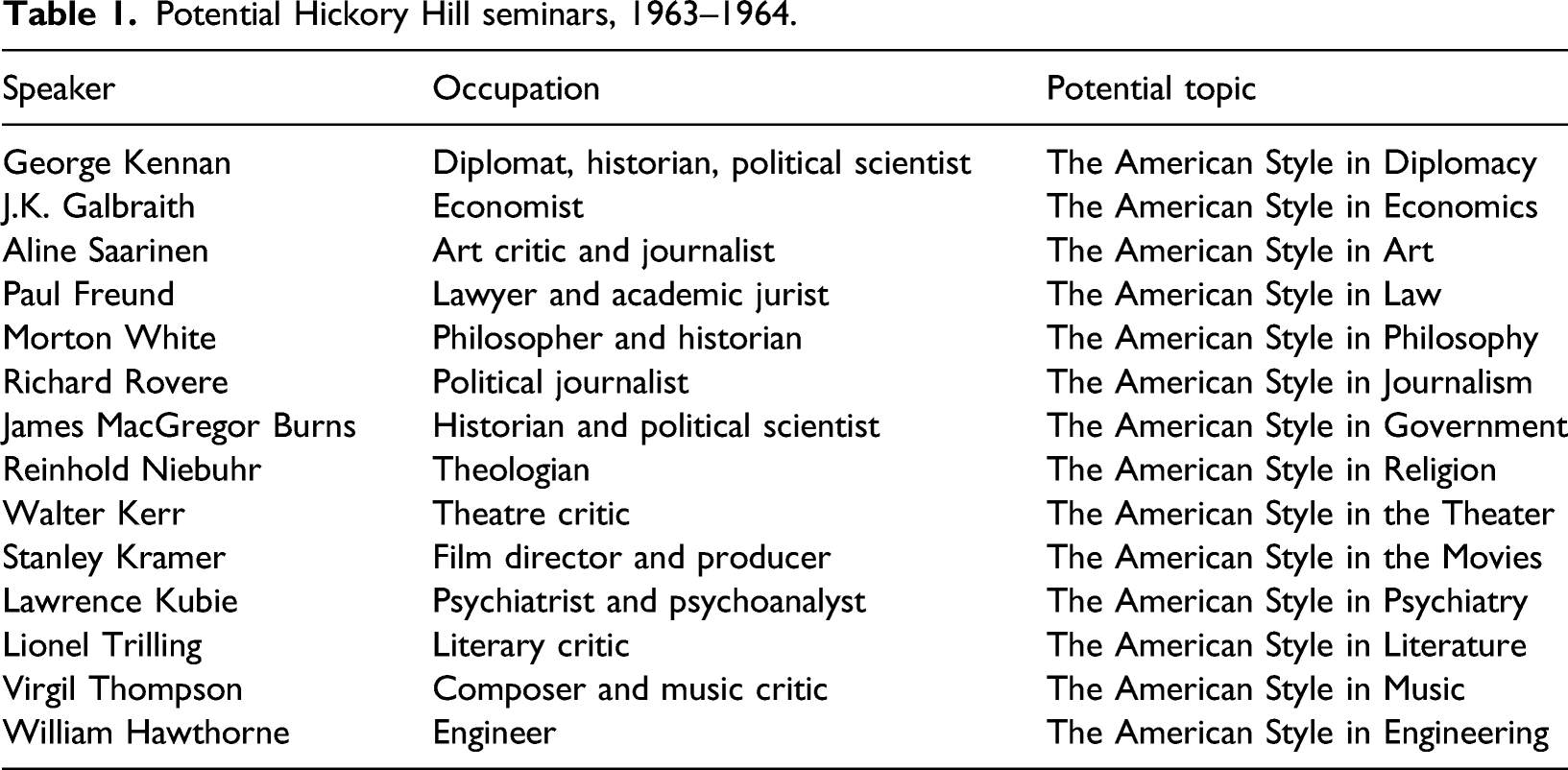
This planned seminar programme was truncated by the assassination of John F. Kennedy, with only the first two speakers (Kennan and Galbraith) able to attend. George Kennan gave the first seminar of the 1963-64 season in October 1963. 23 On 18 November 1963, only 4 days before Kennedy’s murder, the seminar was held at the house of Supreme Court Justice Potter Stewart. The speaker was J.K. Galbraith. 24
Table 1 is revealing as a statement of intent and an indication of the content and style of the seminars. ‘The American Style’ resonates closely with the symbolic place of the New Frontier; broad in scope, ambitious, adventurous and metaphorical (Dallek, 2003; Smith, 1995); ‘the unfinished business of American life’ (Hellman, 1997: 122). The topics ranged over were wide, suggesting a generalist intent – that knowledge was required of high-brow topics (e.g. philosophy), low(er) brow subject matter (movies), along with practical affairs of state, such as government, journalism, law, economics and diplomacy. The pitch was, however, decidedly middle-brow. The philosopher A.J. Ayer agreed to attend in January 1962. 25 Schlesinger told Ayer that his talk ‘does not require elaborate preparation’ and asked him to ‘speak informally for about forty-five minutes on why distinctions made by philosophers matter in practice life, or what contemporary philosophers are up to’. He noted that Ayer could ‘expect those present to be exceedingly intelligent and in the main, exceedingly uninformed about philosophy’. 26
Schlesinger went on to identify other themes, based on the ‘American Style’, in ‘War, Science, Crime, Humor, Architecture, Sports, Politics, Anthropology etc’. Another theme he mulled was to get the speakers to ‘explain how they purport to tell the difference between what is good and bad in their respective fields …. or we could go back to the earlier idea of a more detailed survey of American history and ideas, to be conducted by the Rostows and me’.
27
Schlesinger observed he would keep a ‘sharp look-out for visitors to the United States who might be interesting’, noting Sir Zolly Zuckerman (a British expert on zoos) and Nicolas Nabokov, a composer and cultural advisor to Willy Brandt (then leader of the SPD in West Germany) as examples of the ‘touring luminaries’ they sought to attract. Other suggestions made by Schlesinger were C. Vann Woodward of Yale University on the history of segregation, Marya Mannes on culture, Abe Burrows on humour, Edwin O’Connor on Catholicism and literature, Bill Walton on the Soviet Union and the Arts and David Ormsby-Gore (Lord Harlech) on the Conservative tradition.
28
They also thought of inviting Isaiah Berlin back to give another seminar in December 1963.
29
Several of those suggested were themselves regular attendees at the Hickory Hill seminars, which itself was indicative of the self-consciously intellectual nature of the group as a whole. According to Lord Harlech: Some of them were very intelligent indeed. I mean, Bob McNamara has, I suppose, got one of the best brains one could possibly meet. There was Chip Bohlen, who is very bright and has enormous experience in Soviet affairs. There was Walt Rostow, and, whatever his judgment may be on politics, he has a very encyclopedic mind on a great many subjects. There was Elspeth Rostow, who in my view is at least as clever as Walt and with better judgment. There was Doug Dillon, Averell Harriman, and Arthur Schlesinger, always—he sometimes gave the lecture, but he was always there, and sometimes it was in his house. Marian Schlesinger, very bright. No, they were a very bright group of people, and whatever the subject was, you could expect to hear extremely intelligent comments and some very penetrating questions.
30
Of particular relevance to leadership studies was the intention to host James MacGregor Burns to discuss ‘the deadlock of democracy’ in early December 1963, 31 which would have focused on this book of the same title published in 1963 (Burns, 1963). The connection to Burns provides a direct link from Kennedy to the development of leadership as an academic field.
Overall, our analysis of the content of the seminars demonstrates how these events used the geographic place of Hickory Hill to cultivate, reproduce and project the New Frontier, a symbolic place of expansion, learning, optimism and ambition; notions that were central to the Kennedy leadership ‘brand’ and subsequent ‘legacy’. The next section explains the overall function and impact of the seminars in further depth, exploring how the seminars assisted with the ‘leadership development’ of the individuals involved and how these gatherings helped to further reassert and signal this group’s confident and self-conscious use of intellectual, social and cultural assets.
The functions of the Hickory Hill seminars
The Hickory Hill seminars performed a number of leadership functions. These can be divided into intended and sociological categories, though in practice these functions were mutually reinforcing. The intended functions were twofold: personal self-development, and to provide intellectual resources for the presidency. The sociological functions were threefold: as an informal place for the leadership elite to network and undertake some of the business of state; as a place of elite socialization and enculturation; and as a signalling mechanism (within the administration, as well as to the media and the political world) for the promulgation of the Camelot/New Frontier mythos.
The primary intended aim of the seminars was to engender self-growth among the participants. In this sense they were much like a leadership training programme or a course of life coaching. The idea for the seminars came from Robert and Ethel Kennedy on their return from visiting the Aspen Institute seminars in the summer of 1961 (Bedell Smith, 2004: 244; Thomas, 2000: 188). The Aspen Institute was formed in 1949 as a leadership development organization, and it continues to operate internationally, based out of Washington DC and Aspen, Colorado (The Aspen Institute, n.d.). According to Schlesinger, ‘Robert and Ethel asked me whether I would organize a series of evening meetings in Washington at which heavy thinkers might remind leading members of the administration that a world of ideas existed beyond government’ (Schlesinger, 2018/1978: 592).
John C. Culver, a university friend of Ted Kennedy and later congressional representative for Iowa, observed Robert Kennedy’s desire for self-improvement: Bobby, you know, was always known to be tough and competitive and so forth, and didn’t have the reflective side that Jack had, or the almost quasi-academic mentality and interests. But from the time that he had those Hickory Hill Seminars, I remember, when he was attorney general and so forth, and had various academics in and others prominent in different fields, and he had tape recorders going with various things that interested him or a Shakespeare play or something. So he was just.... He was really catching up in a lot of ways, and his interests were broadening.
32
Robert Kennedy’s personal assistant John Seigenthaler noted something very similar to this in his oral history interview: You know the Hickory Hill seminars […]. Bob made a conscious effort to find out from as many different sources as he possibly could as many different things as he possibly could so that he would be in a position to advise the President.
33
Seigenthaler’s observation also hints at the second intentional function of the seminars, namely to provide intellectual resources to enable RFK and the other attendees to better advise the president.
The seminars also provided several wider sociological functions. One was as a means of local elite creation. We noted in the previous section that attendance and access were carefully managed. The seminars themselves, however, also involved a great deal of socialising and ‘Washington matrons began to vie for the honor of hosting them at their own homes’ (Thomas, 2000: 188). Hickory Hill was a convenient geographic place providing a means of cementing the presidency’s collective sense of mission and purpose.
This extended, also, into the business of government itself. Stewart Udall (Secretary of the Interior) was a regular attendee. Commenting on the Hickory Hill seminars, he stated that it was ‘partly social and partly informal contact. I never understood how the invitation list went out on that because there were a few of us from the Cabinet who were invited and other members weren’t. I guess this wasn’t important, it was purely personal’.
34
He went on to observe that: [i]t was a very interesting sort of extracurricular way of informally exchanging ideas. There were some vigorous discussions that went on and some equally good private conversations where you would discuss things relating to the administration’s decisions, its activities. Of course, where you had a president’s brother that was doing this, this gave it even more importance than it would have had if simply some of the Cabinet members had decided to meet informally. Bob Kennedy being as close to the President [John F. Kennedy] as he was, you know, you could feel almost if you were talking to him you were talking with the President.
35
Further, comments from Udall highlight this, as he describes the seminars as part of the ‘lively social life’ of the Kennedy circle: That was one of the advantages of Hickory Hill and the advantage of the kind of lively social life that existed under the Kennedys, that sometimes you didn’t have to make an appointment and then go over to see somebody, you could simply get them off in a corner and do it casually and informally chat. That has certain advantages.
36
In this way, the seminars also performed the function of providing an informal place of government: a venue for social networking and impromptu conversations to oil the wheels of the state.
The presence of journalists and editors enabled the seminars to communicate and project the New Frontier style of enlightened governance, intellectuality and statesmanship and, to a significant extent, incorporate those people into the project. Journalists such as Anne Chamberlin, Edward Murrow, Donald Wilson and Bill Walton were all regular attendees. The list of attendees represents a group and social network of considerable power, fame and wealth.
Decades after they ended, the Hickory Hill seminars remain a touchstone of the ideals of an intellectually able Presidency, especially in Democrat circles. In February 1995 Schlesinger wrote to the Vice President, Al Gore, thanking him for a dinner invite, and drew a parallel with the Hickory Hill seminars: I want to congratulate you on taking the trouble to organize these dinners. We had at Robert Kennedy’s initiative a somewhat similar but less organized series in the Kennedy years. RFK’s idea in the Hickory Hill seminars was to expose high government officials to issues and ideas not normally in their administrative jurisdiction; and the interchange between officials and outsiders was stimulating and fruitful for both sides. You might want to consider including more top administration people in the dinners so that they might have a chance to hear and challenge what is on the minds of outside experts (Schlesinger, 2013: 552).
The geographic place of Hickory Hill provided a powerful resource through which the symbolic place of the New Frontier was assembled and projected. Through these gatherings the concept of the New Frontier, as both a present- and future-oriented political programme and as a signifier of a certain socio-cultural style of leadership, was skillfully cultivated by an ambitious and self-confident group of elites. The Hickory Hill clique, especially through Schlesinger’s academic resources and connections, were especially attuned to the importance of history as a cultural resource to leverage in the social construction of a presidential leadership ‘legacy’. The Kennedyite leadership style was highly visible in the entire arc of the political project of the Kennedy family, not only during the New Frontier of the early 1960s, but also in the later political campaigns of Bobby, Teddy and indeed other Democratic candidates to the present day. This Kennedyite leadership style developed into an even more powerful and enduring product upon JFK’s death, when it moved on from the present- and future-oriented, symbolic place of the New Frontier and developed into the historic, memorializing tone of Camelot. We will return to this point in the conclusion.
Using and abusing the mythological places of leadership
The brief presidency of John F. Kennedy and its wider social circle has become an archetype of the noble and worthy presidency (Henggeler, 1995) to which all others are to some degree compared (Dallek, 2013; Hellman, 1997; Watts, 2016). Recent journalism about the Trump presidency makes similar comparisons. The BBC, for example, described the First Lady, Melania Trump, as ‘a kind of retro presidential spouse, a modern-day Jackie Kennedy’ (BBC News, 2020). And the following passage appeared in The Atlantic: The Trumps like to invoke the Kennedys in their own mythmaking. The president has called Melania “our own Jackie O.” Ivanka’s husband, Jared Kushner, whose father reportedly sees himself as a “Jewish Joe Kennedy,” had a framed photo of JFK in his Manhattan office. And close Ivanka watchers have noted that her Instagram feed—filled with idyllic photos of family life against the backdrop of the White House—has a certain Camelotian quality. But if Camelot was always a romantic facade, the Trumps have dropped the ennobling pretense. Like a fun-house-mirror version of the Kennedys, they reel across the national stage swapping the language of duty and sacrifice for that of grievance and quid pro quo (Coppins, 2019).
The Trump leadership style is brash, unlearned and aggressive (Goethals, 2017; Mollan and Geesin, 2020; Polletta and Callahan, 2019). Trump and his inner circle would have been both figuratively and actually ‘out of place’ at a Hickory Hill seminar. And yet, perhaps surprisingly, both the Trump White House and the Kennedy mythos are, at least in part, a consequence of a connected historical contingency.
The Hickory Hill seminars were both a means towards, and symbolic of, the personal growth of Robert Kennedy, especially in seeking to revise the reputation he had developed in the 1950s as a legal henchman for Joe McCarthy (Bryan, 1994; Oshinsky, 2019; Schlesinger, 2018). The virulent anti-communism of McCarthy had, in part, been embraced by the Kennedys as a means of establishing that, as Catholics, they were staunch patriotic Americans opposed to totalitarianism – unlike the notoriety that their father had developed because of his support for Joseph Chamberlain’s policy of appeasement in the 1930s, and his opposition to American participation in World War Two (Black, 2012). This was not, however, without costs to reputation. Arthur Sylvester, who was not part of the Kennedy inner circle but who worked for McNamara as Assistant Secretary of Defense for Public Affairs, commented that he ‘detested’ Robert Kennedy because of his association with McCarthy. ‘He and Roy Cohn were the little taillights [of] McCarthy’s committee’, he observed in his oral history interview. 37 RFK’s reputation for ruthlessness was widespread in US society, an image problem he struggled to address throughout his life (Thomas, 2000: 20).
Roy Cohn was chief counsel to the Senate Permanent Subcommittee on Investigations at the height of the ‘Red Menace’ scares in 1953-54, including the notorious Army-McCarthy hearings. Robert Kennedy was the Democrat minority assistant chief counsel, appointed to the committee by McCarthy in 1952. The Army-McCarthy hearings shattered McCarthy’s power, and led to Cohn’s expulsion from legislative legal work (Friedman, 2005). Cohn later returned to private legal practice in New York, where he developed a client roster of ‘discotheque owners, real estate moguls, and mobsters’ (Kranish and Fisher, 2016: 62) who benefitted from his aggressive, hostile style.
In 1973 Donald Trump, then an ambitious young New York property developer, was accused by the Justice Department of racial discrimination in the allocation of housing. He sought out Cohn to defend him. The case was eventually settled in favour of the Justice Department, although Cohn and Trump claimed victory in the media. Thereafter Cohn became a mentor to Trump, who ‘adopted the Cohn playbook: when attacked counter-attack with overwhelming force’ (Kranish and Fisher, 2016: 62). From 1973 until his death in 1986, Cohn was a key adviser to Trump, ‘a constant presence by Donald’s side, serving not only as lawyer, but as informal adviser, publicist, and intermediary’ (Kranish and Fisher, 2016: 69), providing him with a schooling in an abrasive political style that, eventually, was to become Trump’s own. It was through Cohn that Trump met Roger Stone and Paul Manafort, highly controversial individuals who were to play critical roles in his election to President in 2016 (Kranish and Fisher, 2016)).
The story of Cohn demonstrates how the social construction of leadership can have long, and sometimes paradoxical, echoes through time. Robert Kennedy disavowed association with McCarthy by embracing and developing the mythos and mystique of his brother’s presidency, a personal journey that was to culminate in his support for the Civil Rights movement and, ultimately, his assassination in 1968 (Schlesinger, 2018/1978). The Hickory Hill seminars were part of this, demonstrating a purposeful and deliberate attempt to cultivate statecraft, expertise and learnedness. However flawed the realities of Camelot (Hersh, 1998), there was a degree of lofty intent. In contrast, Roy Cohn never forswore his commitment to McCarthy, his aggressive tactics, or his desire to win at all costs for a narrow benefit. His protege, Trump, was to find his way to the White House decades later, using many of those same techniques. From a similar starting point we can see two very different genealogies of how leadership might be conceived, cultivated and promoted. One has arguably bequeathed the archetype of an ideal presidency; the other, its mirror image.
Conclusion
‘They’ll be great Presidents again […] but they’ll never be another Camelot again’.
Jacqueline Kennedy, as quoted in White (1963)
The first known portrayal of the Kennedy White House as ‘Camelot’ appeared in an interview with Jackie Kennedy by Life journalist Theodore White, just one week after JFK’s death (Dallek, 2003: 422). Entitled ‘For President Kennedy – An Epilogue’, the resulting article is heavily overlaid with Kennedyite pathos and melodrama. Lines from a Lerner and Loewe musical are quoted. Jackie describes a boyhood president-to-be reading Arthurian legends. Some of her quoted lines are in the tradition of the most mainstream and saccharine of leadership tropes: ‘For Jack, history was full of heroes’ (White, 1963). This Life article represents the social construction of Kennedyite leadership in its most explicit and overwrought form, perhaps understandably so given the traumas of Dallas. Drawing on symbolic elements reminiscent of many features of the New Frontier terrain, it takes mythological visions of history and heroic leadership to extreme lengths in rhetorically disallowing critique of a tragically slain President and his lofty leadership vision. Upon JFKs death, the mythic place of Camelot was carefully constructed by Jackie, Bobby, Sorenson, Schlesinger and other Camelot insiders, and enthusiastically adopted and reproduced by present and future figures in journalism, academia and the entertainment industry.
The enduring resonance of the Kennedy White House as ‘Camelot’ is an extraordinary example of the power that the ‘placing’ of leadership can have. This mythical place is explicitly constructed of simplistic tropes around heroism, masculinity, romance, power and history that feed uncritical and taken for granted narratives of leadership as natural, vital, progressive and just (Wilson, 2016; Liu, 2020). Such leadership creations are sociologically and historically fascinating. But, like most conventional leadership discourses, they are ‘limited, limiting and problematic’ (Wilson, 2016: 2). Critically informed, social constructionist leadership scholars have done much to decentre such perspectives, offering sustained critiques of mainstream leadership writings in a similar way to the academic critique of journalistic history where writers have compromised their independence by getting a little too close to their subject, something all too obvious in the Kennedy era (Aldous, 2017; Brands, 2010; White, 1998).
Such discussions point to the deceits inherent in the Camelot myth. From a critical viewpoint, the leadership creations of the Kennedys were developed in order to deliberately obscure some glaring weaknesses and contradictions. New Frontiersmen were healthy, adventurous and ‘vigorous’, yet JFK suffered with serious health problems throughout his life (Watts, 2016). JFK presented himself as a family man, obscuring his sexual promiscuousness (Dallek, 2003; Lubin, 2003; Watts, 2016). Camelot espoused beauty, truth and justice, while some of its insiders had murky connections to mobsters such as Sam Giancana (Giglio, 2006: 149–150; Hersh, 1998: 141–6). The New Frontier projected ideals of social progress, equality and democracy, but its principals were complicit in a road that led to Operation Rolling Thunder, Agent Orange and Pinkville (Ellsberg, 2003; Greiner, 2010; Milne, 2008).
In an important article about leadership and place, Collinge and Gibney (2010: 380–1) note that ‘[h]umans work tirelessly to construct and reconstruct – make and shape – the physical, socio-economic, cultural and political dimensions of place, and they are in turn shaped by the places they inhabit’. Hickory Hill is a perfect example of this dynamic. It functioned not only as a prototype leadership development seminar but also as part of a broader landscape of Kennedyite leadership in general, where geographic, symbolic and mythic modes of place explicitly and implicitly promoted specific sets of codes and ambitions around political leadership. Considering the various ways in which leadership is socially constructed through ‘place’ can be a powerful way of thinking and writing differently about leadership (Collinson, 2011; Carroll et al., 2019; Liu, 2020; Tourish, 2017). Rather than referring solely to the domain of decision-makers, effectiveness, heroism and personal traits, leadership can be seen for something else, as a cultural and aesthetic form, one that, in this case, draws on the power of geographic, symbolic and mythical places.
Political leaders face strenuous challenges in building and maintaining their image in the face of hard political realities. Presidential ‘legacies’ are developed and embodied in a range of publishing, consulting, training and entertainment industry products. They are promoted and controlled by presidential libraries and leadership centres. The boundaries between leadership and culture have always been blurred, as shown in the many intersections of management literature and pop culture (Rehn, 2008; Rhodes and Parker, 2008). The Kennedy legacy has been particularly noteworthy for both its political and cultural appeal. It is especially attuned to the dynamics of cultural consumption; witness, for example, the ‘personal histories’ of the Kennedys by the journalist J. Randy Taraborrelli: After Camelot (Taraborrelli, 2013), and Jackie, Ethel, Joan (Taraborrelli, 2012). 38 After Camelot became a TV miniseries starring Katie Holmes. Works like these are added to the tottering pile of Kennedy-era coffee table photographic collections, memoirs, films and TV docudramas. This is not to say there is nothing there of historical value. Rather, as Lubin (2003) argues in Shooting Kennedy ‘[c]ulture, popular, or otherwise, is not a mere side effect of history or a glittering distraction from it but is instead integral to it, playing an active role in the making of that history’ (Lubin, 2003: xi). The Kennedy administration arguably failed to establish a major policy legacy. JFK’s violent death deprived him of the chance of a second term that might have created one. Instead, he left Johnson with an incomplete civil rights agenda and a growing crisis in Vietnam; momentum for LBJ’s schizoid legacy of domestic success and overseas calamity. The rhetorical places of ‘The New Frontier’ and ‘Camelot’ have left a dominant cognitive imprint on what a Presidency can or should be, albeit one always vulnerable to erosion, commercialism and by cooptation by various figures and interest groups across the considerable divides of American politics and society.
Finally, in discussing the placing of leadership, we should be aware of the risks associated with the fusing of culture, leadership and history. The use of presidential history to provide ‘lessons’ in mainstream leadership bestsellers carries major risks of the simplification and ‘purification’ of leadership (Collinson, 2011). Goodwin’s work Leadership in Turbulent Times (2019) is a perfect example of a presidential history/mainstream leadership crossover text, carrying a back-cover endorsement from Jim Collins of Good to Great fame (Goodwin, 2019). The connections between Goodwin and Burns to the Hickory Hill seminars, and to the Kennedy Presidency more generally, adds piquancy to the sense that conceptions of Camelot – that were in part created at Hickory Hill – shape not only the sense of the Kennedy presidency and the notion of what it is to be (or not be) presidential, but also something of what ‘leadership’ itself might be.
Supplemental Material
sj-pdf-1-lea-10.1177_17427150211042153 – Supplemental Material for Placing Camelot: Cultivating leadership and learning in the Kennedy presidency
Supplemental Material, sj-pdf-1-lea-10.1177_17427150211042153 for Placing Camelot: Cultivating leadership and learning in the Kennedy presidency by Leo McCann and Simon Mollan in Leadership
Footnotes
Declaration of conflicting interests
The author(s) declared no potential conflicts of interest with respect to the research, authorship, and/or publication of this article.
Funding
The author(s) received no financial support for the research, authorship, and/or publication of this article.

Supplemental material
Supplemental material for this article is available online.
Notes
Author biographies
References
Supplementary Material
Please find the following supplemental material available below.
For Open Access articles published under a Creative Commons License, all supplemental material carries the same license as the article it is associated with.
For non-Open Access articles published, all supplemental material carries a non-exclusive license, and permission requests for re-use of supplemental material or any part of supplemental material shall be sent directly to the copyright owner as specified in the copyright notice associated with the article.
