




Abstract
In organizations, paradoxes are not only an expression of growing dynamism and complexity. Leaders can also generate them intentionally by means of double-bind rhetoric in order to exercise power. In double-bind situations, followers are trapped in a paradox: they have no possibility of doing what is right, but can always be made responsible by their leaders for wrong decisions. To create awareness of this dark side of paradoxical leadership, the article builds and elaborates a theoretical typology of double binds in organizations and discusses it in terms of the introduced concept of paratoxical leadership. The article further explains how paratoxical leadership leads to dysfunctional outcomes for the individual and the organization and discusses ways to successfully prevent and resolve instances of paratoxical leadership. In this way, the article shows how leadership power, or more precisely, the abuse of leadership power, in organizations can be explained from a paradox perspective.
Introduction
In recent years, increased attention has been paid to the discussion on paradoxes in organizations (Lewis and Smith, 2014; Putnam et al., 2016). Scholars argue that the increasing complexity people face at work means that paradoxes are becoming a commonplace phenomenon. The key in dealing with paradoxes is seen in embracing rather than resolving paradoxes (Smith and Lewis, 2011). For leaders, this results in the challenge of paying attention to competing demands simultaneously in at least two ways. On the one hand, they must deal with tensions in their role as leader, and, on the other hand, they are expected to support their followers in coping with paradoxes.
However, there is also a “dark side” of paradoxical leadership. As we will argue, the deliberate employment of paradoxes to subjugate followers represents a communication strategy using double-bind rhetoric. With rhetoric of this type, leaders are able to create situations in which followers have no chance of doing the right thing, but can always be made responsible by leaders for doing the wrong thing. For leaders, double-bind rhetoric is a potent means of communication that not only threatens the health of those affected, but also has the potential to damage what purports to be the organization’s core purpose and interest. In order to create awareness of the rhetorical generation of double-bind situations, the article aims to reveal the mechanisms behind such rhetorical maneuvers and to elaborate a theoretical typology of double-bind rhetoric. In this way, the article shows how leadership power, or more precisely, the abuse of leadership power, in organizations can be explained from a paradox perspective. Conceptually, we refer to the dark side of paradoxical leadership as “paratoxical” leadership to distinguish it from the concept of paradoxical leadership—and to emphasize the toxicity of related practices.
The article is structured as follows. First, we contrast the dark side of paradoxical leadership against the bright side and place the concept of paratoxical leadership within the dark leadership discourse. Then we show which characteristics must be present for a situation to be considered a double-bind situation and demonstrate how double-bind rhetoric works from the perspective of the leader. Following this, we show that at least five different types of double-bind rhetoric must be distinguished and give various illustrations of how leaders can coerce and manipulate employees for each type. Finally, the article shows the negative consequences for employees and the organization and discusses ways for the successful prevention and resolution of instances of paratoxical leadership.
Framing the concept of paratoxical leadership
The bright and the dark side of paradoxical leadership
A paradox relates to “contradictory yet interrelated elements that exist simultaneously and persist over time. Such elements seem logical when considered in isolation but irrational, inconsistent, and even absurd when juxtaposed” (Smith and Lewis, 2011: 386). Since paradoxes cannot be solved logically, scholars argue that either/or thinking is not conducive to dealing effectively with paradoxes (Lewis, 2000; Quinn and Cameron, 1988). In general, either/or thinking follows Aristotelian logic, which is linear, sequential, and rational in nature, and aims towards converging upon a single, unequivocal correct solution; everything is either one thing or another (Low and Purser, 2012). Instead of solving the paradox, either/or thinking thus denies its existence. To cope with paradoxes effectively, one needs to juxtapose the opposing elements and reframe the tensions of either/or as the possibilities of both/and (Smith, 2014; Smith and Tushman, 2005). Scholars widely agree that paradoxes call for both/and thinking, which refers to a more holistic thinking mode in which elements of competing demands are accepted to be simultaneously true (Ashforth et al., 2014; Miron-Spektor et al., 2018; Waldman and Bowen, 2016). Some scholars explicitly refer to both/and thinking as paradoxical thinking (Lewis, 2000; Lewis and Smith, 2014; Schad et al., 2016; Smith and Lewis, 2011; Smith and Tushman, 2005).
Over the past decade, scholars have increasingly argued that leaders face contradictory challenges on a regular basis. This has led to the introduction of the concept of paradoxical leadership, which is reflected in the leader’s ability to respond to paradoxes in a constructive way (Fürstenberg et al., 2021) and involves “practices seeking creative, both/and solutions that can enable fast-paced, adaptable decision making” (Lewis et al., 2014: 58). Zhang et al. (2015) introduced the concept of paradoxical leader behavior to understand how seemingly competing, yet interrelated leader behaviors contribute to meeting competing workplace goals. Their concept is based on the unity of opposites in yin-yang philosophy. Taoist yin-yang philosophy views the world as a unified whole, in which all phenomena are formed by the integration of two opposing cosmic forces, yin and yang. The two sides of a paradox are understood as both contradictory and complementary, with each side containing a “seed” of the other (as symbolized in the s-shaped yin-yang symbol). In contrast to Western analytical thinking, yin-yang approaches acknowledge the holistic nature of paradoxes and embrace both/and rather than either/or thinking. The authors empirically derive five dimensions of paradoxical leader behavior and show that their effective handling is essential to successful people management. For example, one dimension is concerned with the paradox that leaders are expected to treat their followers both uniformly and individually. While uniformity is a key principle for treating people equally, it may also depersonalize followers and contradict the desire to be considered as a unique individual. The authors showed that effective leaders are able to harmonize uniformity and individualization despite their opposites (e.g., one leader said they gave similarly priced gifts to thank employees every year, but selected each gift based on personal interests).
Contrasting the bright and the dark side of paradoxical leadership.
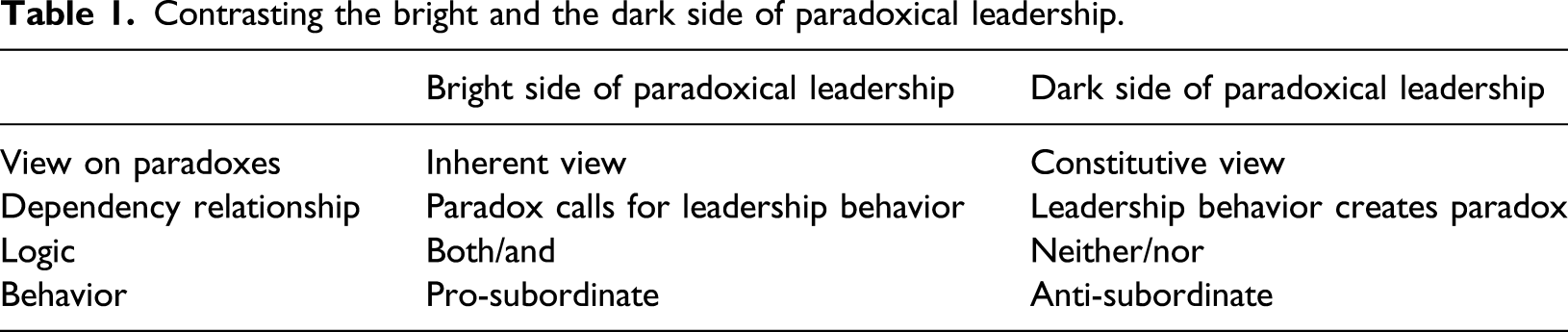
First, we suggest taking a constitutive view on organization paradoxes instead of an inherent view. The inherent view assumes that paradoxes are inherent in organizational systems, whereas the constitutive view assumes that paradoxes are enacted through textual or discursive construction (Hahn and Knight, 2021). According to the latter, language and rhetoric form rather than reflect reality and are thus the key to the formation and operation of paradoxes (Putnam et al., 2016). Putnam et al. (2016) proposed their constitutive approach to put emphasis on the investigation of the largely neglected “origins of paradoxes, their formation, their development, and the ways that they become intermingled with organizational practices” (Putnam et al., 2016: 77). In this context, they explicitly stress double binds and paralysis as a key outcome in dealing with tensions in organizations that needs further investigation.
Second, paradoxes not only emerge as by-products of discursive interactions, but can also be intentionally designed. In particular, leaders can exercise power by defining the situation in a way that serves their purpose (Smircich and Morgan, 1982), and they can define the situation in a way that puts employees in a paradoxical situation. In this way, we reverse the dependency relationship between paradoxes and leadership behavior: instead of analyzing how paradoxes call for leadership behavior, we are interested in how leadership behavior may intentionally create paradoxical constellations for employees.
Third, we believe that bringing the dark side of paradoxical leadership into the light requires moving from paradoxes that call for a both/and solution to paradoxes that impose a neither/nor logic. In such constellations, actors are obliged to choose between two mutually exclusive alternatives, cannot suspend the decision and have no third alternative. For example, the demand “Break new ground, but don’t make mistakes!” suggests there is a both/and solution, but the demand actually implies a neither/nor logic. If one breaks new ground, mistakes are inevitable. Thus, the actor has two mutually exclusive alternatives: to break new ground (and make mistakes) or to operate in familiar ways (and not break new ground). Since neither the first nor the second alternative leads to a satisfactory outcome, actors perpetually oscillate between non-existent alternatives and/or are trapped in a feeling of being "damned if you do and damned if you don’t” (Putnam et al., 2016). There is no room to handle paradoxes effectively with an inherent neither/nor logic.
Fourth, we assume that leaders creating neither/nor constellations for employees are acting against the employee’s legitimate interest. Leadership behavior is therefore to be classified as anti-subordinate behavior instead of pro-subordinate behavior (Einarsen et al., 2007). Accordingly, we associate the analysis of the dark side of paradoxical leadership with the dark leadership discourse. To distinguish this dark side from the concept of paradoxical leadership, we use the term paratoxical leadership to refer to it in the following.
Paratoxical leadership and the dark leadership discourse
Intentionally putting employees in a situation where they cannot win is a case of abuse of power. Abuse of power occurs when a leader uses means of coercion or manipulation to achieve personal and/or organizational goals at the expense of followers (Sankowsky, 1995), for example, by blaming followers for mistakes, taking credit for their achievements, or using pressure to get tasks done (Pelletier, 2010; Schilling, 2009; Schmid et al., 2019). As Kaiser and Craig (2014: 262) point out, intentionality, “either to produce harm or to disregard the risk of producing harm, distinguishes” the “dark side of leadership” from the “bright side” emphasizing positive aspects of leadership. By using paradoxical communication intentionally, it becomes paradoxical rhetoric. Importantly, intentionality—or the intentional use of rhetorical means—does not imply consciousness. In cases of “unconscious intention” (El-Sawad et al., 2004: 1199), the leader is not consciously aware that they are creating a neither/nor situation for their followers. Leadership behavior may still be directed toward achieving a purpose. Since the successful use of paradoxical rhetoric requires a certain degree of fluency, we assume that the systematic use of rhetorical patterns over an extended period of time is more likely to occur (and succeed) when intentionality is present. In contrast, when the paradoxical situation evolves from oversight rather than from intentional entrapment (Putnam, 1986), this would be not an instance of paratoxical leadership.
Based on the points discussed above, we define paratoxical leadership as a form of abusive behavior and rhetoric by a leader that is intentionally designed to create paradoxical situations in which the employee must choose between undesirable and conflicting alternatives. The leader who applies paratoxical leadership behavior or rhetoric is called the paratoxical leader.
In order to link the concept of paratoxical leadership to the dark leadership discourse, we will now discuss its relation to different concepts of dark leadership. Researchers have proposed several concepts to describe harmful leadership behavior (for an overview, see Krasikova et al., 2013; Schyns and Schilling, 2013; Tepper, 2007). The most common concepts are tyrannical leadership (Ashforth, 1994), abusive supervision (Tepper, 2000), toxic leadership (Lipman-Blumen, 2006), destructive leadership (Einarsen et al., 2007), despotic leadership (De Hoogh and Den Hartog, 2008), and exploitative leadership (Schmid et al., 2019). In addition, some researchers proposed the use of destructive leadership as an umbrella term to encompass different concepts of harmful leadership behavior (Kaiser and Craig, 2014; Krasikova et al., 2013). Nevertheless, despite behavioral overlaps between these concepts, they still retain unique characteristics that differentiate them from each other (Kaiser and Craig, 2014; Pelletier, 2010). It is not our intention to add the concept of paratoxical leadership to this list. Rather, we understand paratoxical leadership as a specific instance of harmful leadership behavior that explains means or strategies by which leaders can exercise their abusive power. Thus, it needs to be clarified in relation to the concept for which it can be an instance.
Most importantly, paratoxical leadership has a rhetoric element and thus includes verbal and non-verbal behavior. Concepts excluding verbal and/or non-verbal behavior cannot therefore be linked to paratoxical leadership. As Schyns and Schilling (2013) demonstrate in their meta-analysis, all of the above mentioned concepts encompass both verbal and non-verbal statements. This also applies to the recently introduced concept of exploitative leadership (Schmid et al., 2019).
In contrast, the question of intentionality is discussed more controversially. Intentionality is evident in the definitions of despotic leadership as a “behavior that serves the self-interest of the leader” (De Hoogh and Den Hartog, 2008: 298), and exploitative leadership “as leadership with the primary intention to further the leader’s self-interest” (Schmid et al., 2019: 1404, emphasis removed). For destructive leadership, intentionality is included in the definition of the term by Krasikova et al. (2013), but excluded in the definition provided by Einarsen et al. (2007). The concepts of abusive and tyrannical leadership refer to behavior that does not necessarily have to be intentional (Schyns and Schilling, 2013). However, since both concepts do not explicitly exclude intentional behavior either, paratoxical leadership could still be described as an instance of abusive or tyrannical leadership. We therefore regard paratoxical leadership as an instance of destructive leadership behavior in the broader sense, as a specific form of destructive behavior in which toxic leaders engage.
To understand how and why leaders impose paradoxical neither/nor situations on employees, we draw on double-bind theory and specify neither/nor situations as double-bind situations. In the following section, we describe the characteristics that must be present in order to speak of a double-bind situation and demonstrate how leaders can create them through rhetorical means for the purpose of self-immunization.
Double-bind rhetoric as the essence of paratoxical leadership
Characteristics of double-bind situations
The double-bind theory can be traced back to the anthropologist and communication researcher Gregory Bateson, who used it to characterize situations in which a defined action is demanded, while at the same time the feasibility or legality of the action is denied (Bateson, 1972; Bateson et al., 1956). The consequence of this is that either the action is not carried out, or an elementary basic principle is contravened. The double-bind theory has its origin in research into schizophrenia patients and the observation that those suffering from schizophrenia frequently have a family background with paradoxical communication structures. Although the theory has become discredited in schizophrenia research as the knowledge of neurobiological research on mental disorders increased, it still counts as a milestone for the understanding of pathogenic human communication and has proved to be useful in therapeutic practice (Tramonti, 2019).
Following Bateson and his colleagues, Watzlawick et al. (1967) emphasized that double-bind situations also occur in normal relationships, and further classified double-bind situations as pragmatic paradoxes. Unlike logical paradoxes—as theoretical paradoxes that emerge from contradictions following correct deduction from given premises—pragmatic paradoxes ensue from ongoing communication and relational binds. They “develop over time through the accumulation of messages and activities, which create a cycle of self-reflexive contradictory alternatives” (Stoltzfus et al., 2011: 354).
Various scholars have argued that double-bind situations can be frequently found in organizations (Argyris, 1988; Berti and Simpson, 2021; Dopson and Neumann, 1998; Hennestad, 1990; Hornung et al., 2016; Putnam, 1986; Soldow, 1981). In organizations, pragmatic paradoxes are seen as the most important form of paradoxes for the study of human behavior (Ballard-Reisch and Turner, 2017). In leader-follower relationships, double-bind situations arise when a leader practices “paradoxical communication” and gives their followers orders “that must be obeyed but must be disobeyed to be obeyed” (Watzlawick et al., 1967: 195).
A double-bind situation is given if the situation has the following characteristics (Bateson, 1972; Bateson et al., 1956; Watzlawick et al., 1967): 1. Intense relationship 2. Repeated experience 3. A primary injunction, disregard of which is sanctioned 4. A secondary injunction that contradicts the primary injunction and disregard of which is also sanctioned 5. Prohibition on meta-communicating the paradoxical injunction 6. Prohibition on escaping the situation
An intense relationship is given when at least two persons are involved in the situation, whereby one of them is the victim (as the “double bound”). When an individual is involved in an intense relationship, he/she feels it is vitally important to accurately understand what kind of message is being communicated to respond appropriately (Hennestad, 1990; Watzlawick et al., 1967). An intense relationship is built on a complementary relationship in which an individual or a group has power over the victim (Soldow, 1981). Because of this characteristic of an intense relationship, double-bind situations are inherently power-related.
Second, a double-bind situation requires repeated experience. Only when the victim is confronted with the paradoxical injunction on a regular basis, does it become a habitual expectation of punishment for whatever the victim decides to do. In general, the focus on repeated experience is an important feature of destructive leadership behaviors and excludes isolated misbehavior, such as unjustified anger or uncharacteristic outburst (Einarsen et al., 2007; Tepper, 2000).
Furthermore, a double-bind situation necessarily relies upon two mutually exclusive injunctions. The primary injunction consists of a direct, verbally given order, disregard of which is explicitly sanctioned. The secondary injunction conflicts the primary injunction by denying the first injunction or expressing its opposite (Dopson and Neumann, 1998). In contrast to the primary injunction, the secondary injunction is often less obvious, although disregarding it is also sanctioned. For example, the secondary injunction can be communicated by non-verbal means (Kutz, 2017; Putnam, 1986), or be implicitly given by social norms and organizational demands (Putnam et al., 2016; Tracy, 2004).
For a situation to be considered a double-bind situation, it is further necessary that the victim feels unable to comment on the paradoxical injunction; that is, the victim cannot make a metacommunicative statement. For example, the leader could pretend that the injunctions do not conflict and thus prevent any discussion of the situation, or the employees feel tension about whether they should communicate their entrapment. As Hennestad (1990) states, this characteristic is “critical in an assessment of the consequences of double bind, because it ‘locks’ the ambiguity of the situation” (Hennestad, 1990: 268).
Moreover, the victim is prohibited from escaping the situation. Although some scholars have argued that this characteristic cannot be applied to organizational settings (e.g., Putnam, 1986), it is now widely accepted that followers may be indeed captured in double-bind situations for different reasons, including financial dependency (Berti and Simpson, 2021; El-Sawad et al., 2004; Kutz, 2017), desired status (Pelletier, 2012), and threatening behavior of the supervisor (Hornung et al., 2016). Even a leader’s charisma can result in a strong dependence, from which followers cannot easily free themselves (Harding et al., 2011). Recently, Blom and Lundgren (2020) have argued that purely voluntary followership is indeed a rare case, whereas most leadership-followership relationships contain at least some elements of obligation, compulsion and/or ignorance.
In double-bind situations two paradoxical demands for action cancel each other out and thus paralyze the victim’s scope for action. The double bind “bankrupts choice itself, nothing is possible, and a self-perpetuating oscillating series is set in motion” (Watzlawick et al., 1967: 217). Because communication on this paradox is regarded as not possible on a meta-plane, the correct action is impossible. One order is always flouted. It is therefore not surprising that victims experience a strong sense of resignation with regard to the changeability of the situation. They perceive the environment as unpredictable und uncontrollable, leaving them paralyzed (Kets De Vries, 1980; Putnam et al., 2016). The experience of double binds may thus lead to patterns of learned helplessness which generally occurs when someone is repeatedly confronted with unpleasant stimuli that they cannot escape (Seligman, 1975). For the victim, the only “escape” from double-bind situations consists of learning to perceive the world in double-bind patterns, which, ultimately, is a “schizophrenic” perception. In this case, the complete set of characteristics is no longer necessary because the victim then no longer perceives the paradox of the demand for action. However, at the same time, they can no longer break free of their paradoxical habitual patterns (Bateson, 1972; Westenholz, 1993).
The mechanism of double-bind rhetoric
If we move from the perspective of the victim to that of the perpetrator, an enormous power potential can be seen in the deliberate use of paradoxical communication to generate double-bind situations. Although “the issue of power is a major vacuum in paradox studies” (Cunha and Putnam, 2019: 100), it is a necessary, central element of paratoxical leadership. As something that can be actively brought about, pragmatic paradoxes are inseparably linked to power. They refer to “situations in which oppressive power conditions restrict the ability for organizational members to make legitimate choices in the face of interdependent contradictions (paradoxes)” (Berti and Simpson, 2021: 4). In principle, paratoxical leadership can manifest itself both in coercion and manipulation. Coercion is the direct exercise of power to achieve certain purposes (Fleming and Spicer, 2014). In these cases, the double bind emerges as the outcome of an intentional strategy to subjugate followers in order to achieve certain political ends. Unlike coercion, manipulation is a way of influencing others where the manipulated person does not recognize the intentions of the manipulator (Blom and Lundgren, 2020). It reflects an indirect form of episodic power and is concerned with agenda setting through implicitly shaping the boundaries of what is considered relevant and can be discussed (Fleming and Spicer, 2014). Double binds of manipulation are possible by setting an agenda that either denies itself or contradicts an existing boundary condition. At the same time, the range of legitimate arguments available for discussion is limited in a way that the thematization of the double bind is suppressed.
To answer the question of how leaders can use double-bind rhetoric to strengthen their position, a distinction must be made between the relationship of paratoxical leaders with their followers and the organization. In their model of destructive leadership behavior, Einarsen et al. (2007) differentiate destructive leadership behavior according to whether it is directed against the employee and/or the organization. While paratoxical leadership is always anti-subordinate behavior, it is not necessarily anti-organization behavior. In fact, we argue that paratoxical leadership becomes particularly attractive when it serves what they see as the achievement of organizational goals. Einarsen et al. (2007) refer to leadership behavior that is anti-subordinate and pro-organization as tyrannical leadership. Tyrannical leaders behave in accordance with what they have determined are the organization’s goals, “but they typically obtain results not through, but at the cost of subordinates” (p. 212). They coerce and manipulate followers to get their job done. Because tyrannical leaders may perform well, they can often conceal their misconduct. In some cases, managers may even knowingly tolerate such behavior (Ma et al., 2004).
We assume that paratoxical leadership is most effective when it is tyrannical. Nevertheless, paratoxical leadership is about more than just getting the job done. The primary intention of paratoxical leaders may also be to further their self-interest. From this perspective, double-bind rhetoric becomes a method to propitiate the end and the means superficially, but secretly to be able to pick the side from which the leader profits the most. Take, for example, Trump’s speech on January 6, 2021, immediately before the violent riot inside the US Capitol. On the one hand, he directly urged people to stand up and fight at the end of his speech (primary injunction): “We fight like Hell and if you don’t fight like Hell, you’re not going to have a country anymore […] So let's walk down Pennsylvania Avenue” (rev.com, 2021: 01:12:14). On the other hand, earlier he stated: “I know that everyone here will soon be marching over to the Capitol building to peacefully and patriotically make your voices heard” (rev.com, 2021: 18:27). Although this statement serves as the secondary injunction here, it develops its double-binding effect precisely because it is not actually a demand, but rather an expectation; whether there is a wish or a worry in the expectation is up to the followers to interpret (provided the followers even took note of this passing remark). Since (a) the only direct call is to fight, and (b) a peaceful fight would be an oxymoron, it seems plausible to interpret the speech as an encouragement of violence. Regardless of what Trump’s intentions were, however, he can easily refer to the second statement and (re-)define it as an injunction to march to the Capitol peacefully in hindsight (which his team actually did, see Woodward, 2021). In general, leaders intentionally use such communication strategies of equivocation to avoid the negative consequences of direct, unequivocal statements (Bavelas, 1988; Stapleton and Hargie, 2011).
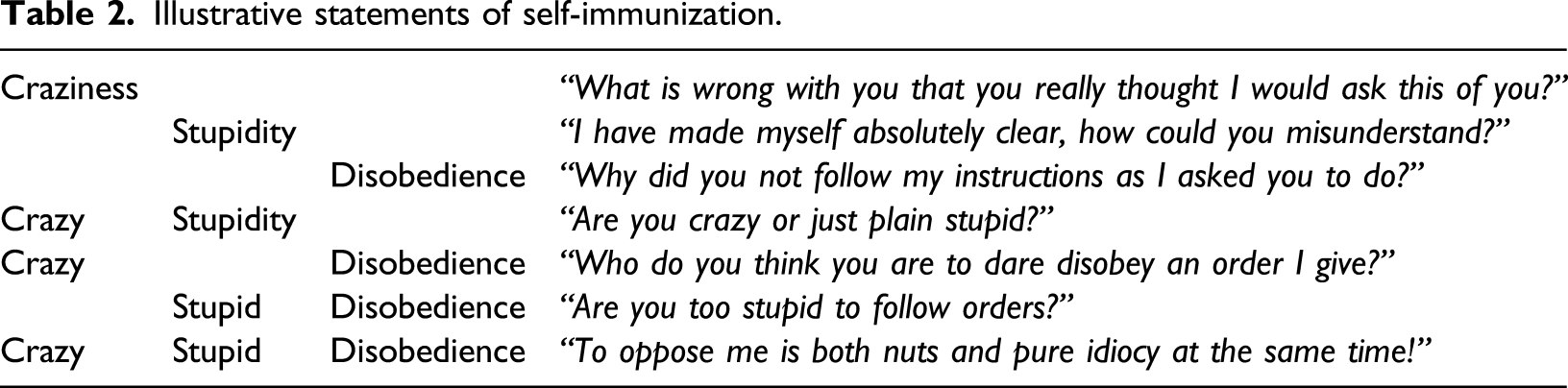
Illustrative statements of self-immunization.
For the victim, it is impossible to behave appropriately. Whatever you do is wrong, and if you do nothing, you are defying instructions. Sanctioning is threatened in any case (Watzlawick et al., 1967). Figure 1 illustrates this “scope of action” for the receiver: no matter what the follower decides to do, the leader is always in a position to punish them. This does not mean, of course, that the paratoxical leader needs to punish the follower every time to perpetuate the double bind. For example, Ashforth (1994) has shown that noncontingent punishment is a core dimension of petty tyranny. The paratoxical leader is always free not to reproach the follower for their decision, and not knowing when one will receive punishment further deprives the victim of control over the situation. Paratoxical leadership gives leaders thus enormous latitude and the freedom to punish or not punish followers just as they please. From the perpetrator’s point of view, the creation of double-bind situations allows the leader to exercise power and control over others. In this way, the leader can deliberately develop and strengthen power structures. “Scope of action” in double-bind situations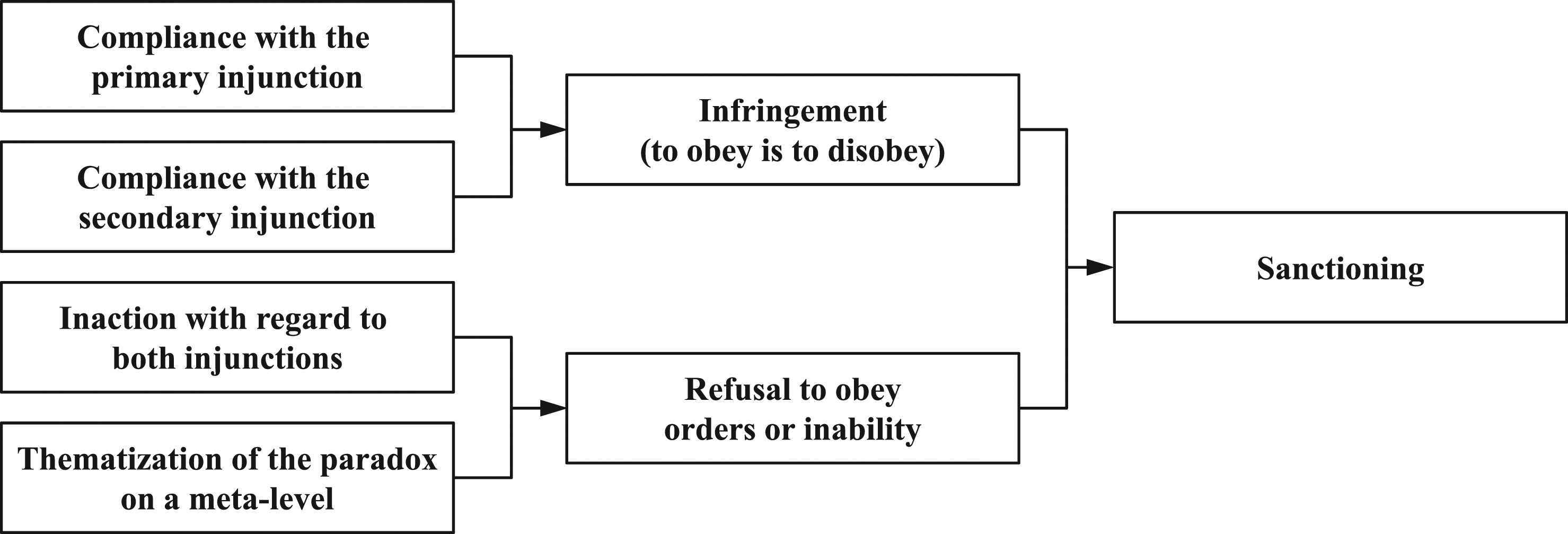
For Watzlawick et al. (1967), double-bind situations “are in fact far more frequent [in interactional contexts] than one would be inclined to believe” (p. 195). In line with Berti and Simpson (2021), we assume that the use of double-bind rhetoric in organizations is carried out not just by a few bad apples but is a frequently encountered method with which leaders abuse their position of power. Precondition for this is that the follower (as victim) is not able to escape the situation created by the paratoxical leader (as perpetrator). For followers, the double-bind situation is expressed by them having hardly any chance to filter the action that is exactly the right one in the context from the available information. They feel incapable of either changing or leaving the situation (Dopson and Neumann, 1998). In this way, they are literally at the mercy of their leader and a prisoner of paradox.
One reason why double-bind rhetoric is seldom explicitly thematized in organizations is probably due to the difficulty of meta-communicating the paradoxical injunction. Anyone who brings such paradoxes up is skating on very thin ice because such attempts may be perceived as an attempt to undermine the leader’s authority. In addition, if the use of double-bind rhetoric is legitimized through the organizational culture, in case of doubt the follower is in opposition to the whole organization (Hennestad, 1990). Furthermore, it is difficult not just to thematize double-bind rhetoric but also to recognize it. The more powerfully double-bind rhetoric functions, the more subtle it often appears, and followers can only disentangle it with difficulty. In many cases, the double bind is much less clear to the victim than it is to the perpetrator (Rieber and Vetter, 1995). Instead of recognizing their double-bind situation, followers look for the fault in themselves, concluding that they must be overlooking vital clues (Watzlawick et al., 1967: 217).
Types of double-bind rhetoric
Overview
Double binds are often difficult to identify in practice. Even experts in double-bind theory often fail to identify patterns of paradoxical communication (Soldow, 1981). One reason for this difficulty is probably that double binds come in many flavors. There are many ways of subjugating followers through the deliberate use of double-bind rhetoric. An important step towards identifying them in practice is therefore to distinguish between different types of double-bind rhetoric. In general, the distinction between different forms of appearance helps to reduce the ambiguity and complexity of a phenomenon and allows the researcher to reason about the phenomenon in more differentiated, nuanced, and fruitful ways (Sandberg and Alvesson, 2021). Against this background, it is surprising that—despite the many descriptions of double-bind situations in organizations—no attempts have been made so far to differentiate between types of double-bind rhetoric.
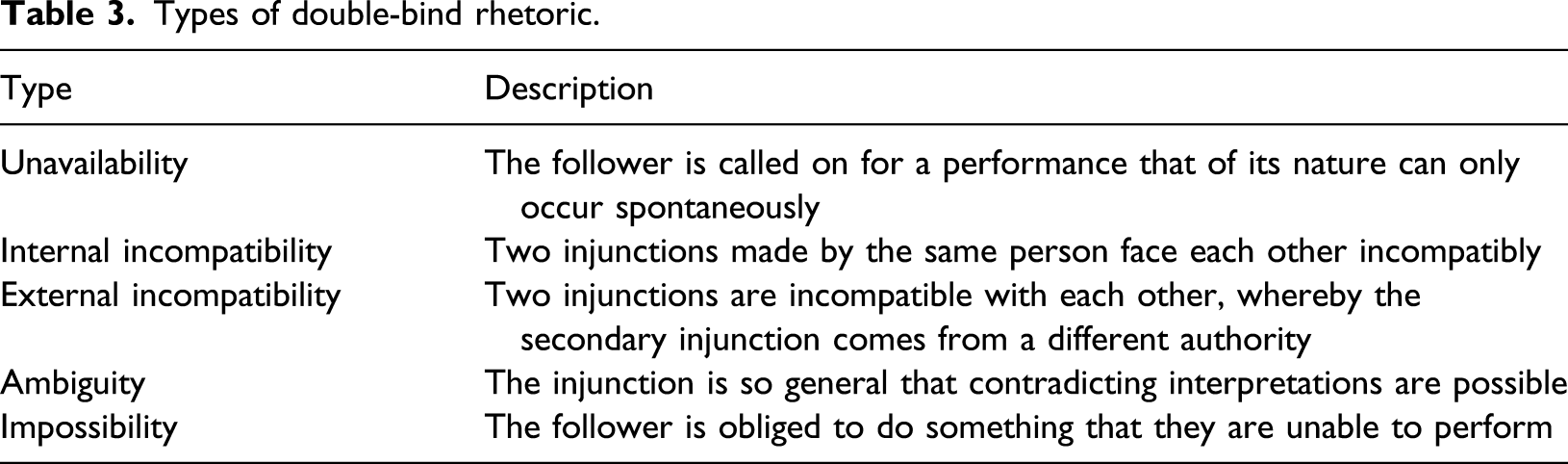
Types of double-bind rhetoric.
Unavailability
In the case of unavailability, the follower is called on for a performance that of its nature can only occur spontaneously. The prototype of such a demand is “Be spontaneous!”. The follower can do these things in principle, but not if they are ordered to do so, because they evade the follower’s deliberate access at least partially through their unavailability. Obedience is always nonspontaneous (Watzlawick et al., 1967). Nobody can be spontaneous at the touch of a button, just as one cannot fall asleep on command. Whereas planning to be spontaneous is nonspontaneous, refusing to comply with the demand is paradoxically spontaneous. Hence, if the order is disobeyed, it is obeyed, and vice versa (Tracy, 2004). If the follower is not spontaneous in the emerging double-bind situation despite the demand, for the leader they are either incapable or defying orders.
There are many analogies to this prototype in organizations. For example, with the performative self-contradiction of “Be creative!”, a leader can coerce pressure on employees. On the one hand, creativity can only unfold spontaneously, which is why the command cannot be obeyed. On the other hand, the leader can hold employees accountable for their failure. As Amabile et al. (2002: 52) put it: “When creativity is under the gun, it usually ends up getting killed.”
Demands of unavailability can also be used for more subtle manipulations. For example, the statement “Real men don’t cry!” is not only an expression of toxic masculinity but can also be effectively used to suppress complaints. What someone finds acceptable (or when someone needs to cry in the literal sense) cannot be commanded, while any expression of a complaint implies that the person is not a “real man.”
There are numerous further examples of demanding that others do something that, by its nature, can only be performed spontaneously, including “You must be motivated!”, “Admire me!”, “Trust me!”, “Be more assertive!”, “Surprise me!”, or “Like your colleague!”.
Internal and external incompatibility
Where incompatibility is involved there are two injunctions that are incompatible with each other, of which usually only the primary injunction is articulated explicitly, while the secondary injunction is regarded as dependent on this. We distinguish between two types of incompatibility: internal and external incompatibility.
In case of internal incompatibility, both the primary and the secondary injunction are made by the same person (i.e., the paratoxical leader). Several constellations are conceivable here. First, the conflicting injunctions can be voiced together. For example, the leader might say, “Take on more responsibility from now on. In return we will monitor you more frequently!”. As monitoring contradicts the idea of giving responsibility, the paratoxical leader can keep the employee trapped in the paradox: either the employee takes the liberty to take responsibility and thereby eludes control or the employee works by the book to minimize deviations from the expected behavior (and thus does not take any responsibility). In any case, the leader may conclude that the delegation of responsibility was not merited.
Second, the paratoxical leader can make two contradictory requests in different situations while both remain valid across situations. For example, a leader within a consulting firm may want to establish a learning community of practice to solve company-wide challenges. In front of the group, the leader makes it clear that everyone is expected to engage in the development of the community of practice. However, in personal conversations the leader never tires of emphasizing that, in the end, all that matters is to sell services to the customer. Since establishing a learning community of practice is not billable, participating in it is a violation of the second injunction. Likewise, since maximizing sales performance leaves no room for participation in the establishment of a community of practice, this would violate the first injunction. In both cases, the leader may hold the employee accountable for not doing what was told.
Third, the leader’s verbal message can conflict with their actual behavior. For example, a leader who wants to hold down criticism might state “Say what’s on your mind or I will assume you agree with me!”. Then, if the employee speaks up with an opinion that differs from their own opinion, the leader may ignore it or shut the employee down. In case of disagreement, not speaking up violates the leader’s verbal message, but speaking up is actually not condoned. As employees repeatedly have negative experiences when saying what is on their mind, they eventually stop expressing their opinion (although this goes against the verbal message). Similarly, a leader who says, “There’s no such thing as a stupid question”, but then shakes their head incredulously at so much incompetence after every other question, creates a double-bind situation that leads to followers no longer putting any questions for fear, while the leader can say after every mistake: “Why didn't you ask me?”. Even if the leader is not aware of their inconsistency, such a behavior may still be intentional, as the leader effectively immunizes themself, while it is always the employees who make the mistakes.
In case of external incompatibility, the secondary injunction is issued by a different authority, for example, when the leader insists on compliance while another authority insists on achieving productivity or customer satisfaction at all costs (Berti and Simpson, 2021). Moreover, the secondary injunction may be inherent in existing norms or structures in an organization. In such cases, what is said is in contradiction to what is generally valid in the organization (Hennestad, 1990). If a leader punishes every mistake, no matter how small, while the prevailing norms demand absolute honesty, the paratoxical leader can establish a regime of total control in this way. Since making mistakes is human, they will be punished in any case: either for their mistakes or for their lies. While such paradoxes can manifest themselves in direct coercion, they can also be used for indirect manipulation. Imagine a corporate culture where acting as a team is the highest value, and a leader who wants to hold down those with high levels of competence (e.g., because they are seen as a threat to the leader’s position, Milosevic et al., 2020). Further, suppose that the leader demands high performance from the employees. Now, if an employee shows outstanding performance, the paratoxical leader may interpret this as a lack of team spirit (“Follow orders, play for the team, why don’t you get that?”). If, on the other hand, the employee does not stand out from the team, they will not show outstanding performance (and thus do not represent a threat). Although the two injunctions “Act as team!” and “Perform!” do not constitute a logical paradox, they can be turned into a pragmatic paradox that subtly keeps employees down.
Ambiguity
Double-bind situations that can be characterized through the ambiguity of demands exist where the demand is so general that different concrete action steps can be derived, including those that contradict each other, without being in opposition to the general demand. In other words, the demand is intentionally formulated so generally that the person issuing it cannot be pinned down to it. On the other hand, however, the employee must make a precise interpretation in order to be able to act. A typical example is the statement: “It is your responsibility, so you are free to decide!” But then, no matter what you decide, the leader makes you understand that it was the wrong decision. Such behavior can be very direct and coercive, but also subtle and manipulative.
Consistently, Eisenberg (1984) uses the term strategic ambiguity to refer to this phenomenon “where individuals use ambiguity purposefully to accomplish their goals” (p. 231). Although not necessarily bad, strategic ambiguity is a useful tactic for escaping blame (Eisenberg et al., 2013). For example, the demand “Act responsibly!” is formulated so generally that it is not even clear for whom or what responsibility is to be assumed. Depending on the interpretation, this may mean the welfare of the organization, the customer or a colleague, whereby in an individual case they may conflict with each other. The leader can always argue that the follower had misunderstood them. The decisive feature of the type of ambiguity is that the paradoxical injunction is created through the interpretation by the follower and the subsequent taking of the opposite view by the leader. For this purpose, the paratoxical leader must make an injunction that can be understood in at least two contradictory ways.
As Keyton and Menzie (2007) demonstrate, the construction of verbal sexual harassment often relies on ambiguous messages which can be read with a sexualized and a non-sexualized interpretation. Only the high level of abstraction allows the leader to create space for the sexualized interpretation, while at the same time the statement can be interpreted as professional and acceptable. In this way, the leader can deny a sexualized interpretation of the message, even though sexual harassment can be an undeniable fact for the follower. This mechanism is also evident in gaslighting rhetoric such as “You’re overreacting!”, “It doesn’t mean anything!”, “You’re imagining things!”, “I was just joking!”, “Don’t be so sensitive!”, “It’s not that big a deal!”, or “You’re just a prude!” (Abramson, 2014).
Impossibility
In the case of impossibility, the double-bind situation arises for the follower through them being obliged to do something that they are unable to perform. This type occurs in particular when factual, temporal, or social totalizations are made (e.g., zero-defect programs) or they are given tasks that cannot be fulfilled within the given boundary conditions. For example, the leader may assign the follower to perform a task that requires overtime work while simultaneously overtime work is sanctioned (Putnam, 1986). Similarly, the demand “Give 120%” may in fact be deliberately formulated as a paradox or stretch goal (Sitkin et al., 2011), in order to mobilize the last reserves in followers, but it may also be used to create a double-bind situation, because this is only possible (if at all) for a short period. In the long run, no one can give more than they have—that would be paradoxical! If the follower does not want to be declared to be incapable or stubborn, they must create the outward appearance of a performance that they cannot provide. In this way, the follower is coerced into employing false pretenses and is thus turned into an accomplice. For example, if a parcels delivery service plans its routes in such a way that they are impractical, a follower may feel forced not to ring the doorbell at half of the addressees in the first place and to act as if no one had been at home. If this is discovered, the follower takes the blame.
A real case example of impossibility is the paratoxical leadership practices associated with the Volkswagen emission scandal (Gaim et al., 2021). To meet emission requirements, leaders pushed their engineers to develop a diesel engine that is “fast, cheap, and green” (primary injunction) although this was not technically possible (secondary injunction). They further used the doctrine “Geht nicht, gibt’s nicht [The impossible doesn’t exist]” (Ewing, 2017: 90, as cited in Gaim et al., 2021: 957) to block any metacommunication about the paradoxical demand. The then Chairman, Ferdinand Piëch, told engineers who reported they could not pass the emission test: “You will pass, I demand it! Or I’ll find someone who can do it” (Lutz, 2015, as cited in Gaim et al., 2021: 957). Such a confrontation with an unfulfillable demand may have motivated engineers to behave unethically in order to meet the paradoxical demands ostensibly (i.e., by installing software designed to cheat on emissions tests). After the scandal became public, attempts were made to hold the engineers responsible. For example, Michael Horn, the VW’s former US CEO, claimed that it was “software engineers who put this in for whatever reason” (Volkswagen Congress Hearing, 2015, as cited in Gaim et al., 2021: 958), which is pretty close to an accusation of “crazy, stupid disobedience.”
Paradoxes through impossibility can also be used for manipulation purposes. For example, implicit expectations to maximize customer satisfaction may effectively neutralize impulses to resist and address issues of exploitation (Kärreman and Alvesson, 2009). While the primary injunction to maximize customer satisfaction may sound logical and unquestionable, it conflicts with the boundary condition that in practice utmost customer satisfaction is often difficult or even impossible to achieve (Dmitrović et al., 2009). As a result, the follower can in any case be held responsible for not taking sufficient care of the customer, making complaints about exploitation seem objectionable, whereas the follower is in fact manipulated into self-exploitation.
Consequences of paratoxical leadership
Consequences for employees
Followers (as victims) experience double-bind situations as emotionally stressful. Those affected feel powerless because they are forced to choose between two equally undesirable alternatives. The affected persons cannot solve the double-bind situation and they are unable to thematize them on a meta-plane. If, in addition, they feel they cannot escape the situation, the trap finally snaps shut. Such a feeling may stem from an employee’s impression that it is hard to find another job (Milosevic et al., 2020), but it is also a common phenomenon of toxic leadership that employees keep toxic leaders in power because they think they are at the mercy of the leader. Lipman-Blumen (2006) refers to such deeply held beliefs about what one is allowed to do and not to do as “control myths” and argues that these freeze employees into inaction. Control myths convince employees that they cannot or should not even attempt to topple a toxic leader in power, locking them into an invisible prison from which it is virtually impossible to break out. The result is a feeling of distressing powerlessness and helplessness.
A glance at a neighboring research area provides more specific indications of the health consequences of double-bind situations. A characteristic of double-bind situations consists of two demands for action directed at a person being in conflict with each other. This characteristic is de facto identical with the concept of role conflict (Hornung et al., 2016), which arises by definition if the expectations directed at a person are incompatible (Kahn et al., 1964). In the past, innumerable studies have been carried out on the pathological consequences of role conflicts, in which it was possible to detect a positive relationship with depression and burnout (Cordes and Dougherty, 1993; Schmidt et al., 2013). It may be assumed accordingly that these relationships are valid in double-bind situations as well (Putnam, 1986; Tracy, 2004) because these are much more restrictive than role conflicts. In the case of double-bind situations caused by impossibility, the risk of burnout is almost created by definition when there is a permanent demand for more than can be performed. Double-bind situations cause work-related stress in those affected, which arises in general if the performance requirements are either incompatible with each other or are in contradiction to the conditions under which the performance is to be provided (Hornung et al., 2016). It is therefore hardly surprising that a series of research projects suggests that double-bind situations foster psychopathological symptoms such as stress, anxiety and behavioral disorders (Visser, 2010).
Consequences for organizations
Paratoxical leadership may also damage what purports to be the organization’s core purpose and interest. For example, scholars argue that patterns of learned helplessness are not only associated with a range of negative consequences for the individual, but also lead to lower productivity, higher turnover intention (Martinko and Gardner, 1982; Seligman and Schulman, 1986), and less success in innovation implementation (Chung et al., 2017).
In addition, it cannot be excluded that paratoxical leadership permeates organizations. As Spicer (2020) argues, with the social practice of bullshitting, rhetorical patterns have the potential to spread in and take over organizations when they are perceived as promising. Double-bind rhetoric may appear promising because double binds effectively silence employees. The victim is confronted with the paradoxical injunction on a regular basis. The repeated experience leads to a “perpetual oscillation between non-existent alternatives or a feeling of being ‘damned if you do and damned if you don’t’” (Putnam et al., 2016: 81). As attempts at metacommunication are interpreted as refusal to obey orders, the victim becomes increasingly isolated in their “solitary confinement.” The more often the victim is confronted with double-bind rhetoric, the more they expect to be confronted with such constellations in the future. As paradoxical injunctions refer back to previously made injunctions, paratoxical leadership sets a vicious cycle in motion that strengthens and reproduces habitual experiences of being trapped with no way out (Berti and Simpson, 2021; Smith and Berg, 1997; Wendt, 1998). As paralyzed victims often look for the fault in themselves, this fault search only leads deeper and deeper into an inextricable tangle of inconsistencies and self-reproaches because double-bind situations cannot be resolved. In this way, the voice of the employee is effectively suppressed. As long as paratoxical leaders get their job done at the same time, this could encourage non-paratoxical leaders to imitate them and engage in paratoxical leadership behavior themselves. In this sense, nontoxic leaders may develop paratoxical leadership behavior when placed in organizational structures that encourage such behavior (Bandura, 2002; Zimbardo, 2004). As a result, paratoxical leadership behavior can spread throughout the organization, ultimately creating a state Gabriel (2012) describes as “organizational miasma.” This term refers to a contagious state of material, psychological and spiritual pollution that defies control by defensive mechanisms and generates self-vicious cycles in which attempts to solve the condition actually deepens it.
In general, recurrent patterns of toxic leadership behavior may develop into a toxic organizational culture, which then in turn becomes the glue that keeps the toxicity together and attracts more leaders to engage in destructive behavior (Appelbaum and Roy-Girard, 2007; Erickson et al., 2015). Once set in motion, this itself sets off a vicious circle of paratoxical leadership behavior, which is maintained by an organizational culture in which employees confronted with paratoxical leadership behavior “come to discipline themselves with feelings of anxiety, shame and guilt” (Willmott, 1993: 523). The power of double-bind rhetoric is then no longer merely episodic but becomes systemic. For example, the manipulative demand “Give 120%” may transcend into the identity of organizational members, who then no longer perceive such demands as paradoxical. Through subjectification, the double bind of impossibility becomes a habitus, according to which employees feel obliged to give more than they have, whereas the inevitable failure leads them to place the blame on themselves.
Implications for practice
The effects of double-bind situations are not only devastating, but also difficult to prevent in reality. For those affected, it is almost impossible to free themselves from their prison of paradox. They could only escape from a double bind and keep their values system intact by leaving the organization or the affected environment. However, in double-bind situations, this is often not perceived as a valid option. Followers could at most dissociate themselves internally from the existing situation, but this can lead to schizophrenia-type mental problems (Westenholz, 1993).
Since the means of double-bind rhetoric are essentially based on a complementary relationship and thus power asymmetry (Soldow, 1981; Wood and Conrad, 1983), managers could try to redress these asymmetries to prevent or resolve instances of double-bind rhetoric (Berti and Simpson, 2021). However, the prescription to redress power asymmetries in organizations is not only highly impractical (Li, 2021), but is also based on the assumption that power in itself is a negative and repressive property (Fairhurst and Connaughton, 2014). Power as such is neither positive nor negative, and managers should not fight power but its abuse. In general, they should empower employees to share their ideas, concerns, worries or fears in an honest and open way. Paratoxical leadership aims to suppress this empowerment. Therefore, management must find a way to enable and encourage employees to communicate safely by bypassing their supervisors when problems arise. To prevent or resolve pathogenic communication patterns, managers should thus focus on empowering metacommunication about double-bind situations.
Metacommunication allows the victim to step outside the paradox frame and describe the double bind (Putnam, 1986). For this to succeed, managers must create safe spaces shielded from leaders in which metacommunication is possible and is not equated with insubordination. In this way, the management can provide a “paradox escape route” (Tracy, 2004: 142) through which employees can free themselves. However, to do this they have to create suitable preconditions because a very intense atmosphere of security and trust is required to make it safe to “speak up” (Cunha et al., 2019) and break silence. Only then can people speak freely about double-bind situations, without being afraid of negative consequences (Dopson and Neumann, 1998). Ultimately, this fear may be deliberately fomented by the perpetrator—not uncommonly the direct superior, framing attempts to meta-communicate as “further evidence of her incapacity or her insolence” (Watzlawick et al., 1967: 197). We therefore see it as essential that the supervisor is excluded from this offering and that an independent position must be created to which employees can turn (e.g., in human resources departments). To prevent the owner of such positions from co-opting with the paratoxical leader, the parties should agree upon a certain level of confidentiality before getting into specifics (Ayers, 2020). In addition, managers could establish an infrastructure that supports whistle-blowing. For examples, telephone hotlines or dedicated e-mail systems may help employees to provide anonymous tips about systematic misconduct (Kaiser and Craig, 2014).
For such offerings to work, managers cannot expect employees to take the first step. They need to strive proactively for a climate for ethical behavior by clearly communicating the standards of leadership behavior that the management expects from organizational members. It is not sufficient to assume that everyone knows what is expected. Expectations have to be communicated in a clear manner, and violations of expectations must be sanctioned. This also implies accountability to limit individual discretion (e.g., by taking complaints seriously and actively investigating them) and transparency in terms of establishing norms for open communication (Kaiser and Craig, 2014; Schnackenberg and Tomlinson, 2016). An organizational culture that effectively prevents double-bind rhetoric is characterized by authentic, clear, transparent, and open communication at all levels as well as accepted metacommunication (Kutz, 2017). Questioning established structures and regarding mistakes as a learning and development opportunity must be permitted and valued rather than stigmatized. If the social norms of an organization do not allow challenges to dominant cognitive frames, a climate of silence is created and constantly reinforced that impairs metacommunication (Morrison and Milliken, 2000). This is often the case in organizations where managers encourage “functional stupidity” and an “inability and/or unwillingness to use cognitive and reflective capacities in anything other than narrow and circumspect ways” (Alvesson and Spicer, 2012: 1201, as cited in Berti and Simpson, 2021: 15). In such organizations, metacommunication is likely to be taken as insubordination.
Of course, all this does not guarantee that those affected will actually speak up. In paratoxical leadership, it is the paradox itself that leads the victim to self-censor out of fear of consequences. As long as the paradox is a matter of fact for the employee, it is difficult and sometimes not even a perceived option to speak up. Therefore, the most effective way to combat paratoxical leadership is to detect and confront the paratoxical leader. However, identifying paratoxical leaders is extremely difficult, since they may achieve their goals well and employees do not voice complaints. Instead of seeing this as a sign of success, managers could take such constellations (successful leaders, silent followers) as an impetus to take a closer look. When a paratoxical leader is finally confronted about their behavior, the challenge is to convict them. They are likely to engage in self-immunization strategies, leading to a denial of misconduct and to shifting blame to the employee (again). At the end of the day, tackling paratoxical leadership remains a difficult endeavor. But not being proactive and denying its existence is the ideal breeding ground for paratoxical leadership to thrive.
Implications for research
The aim of the article was to draw attention to a hitherto neglected but very powerful aspect of destructive leadership: the deliberate creation of double-bind situations in order to achieve personal and/or organizational goals at the expense of followers. To give substance to the discussion of this aspect, we have introduced the concept of paratoxical leadership and defined its unique meaning and distinctiveness.
This article has identified five types of double-bind rhetoric and provided examples of each. We are aware that the examples given provide, at best, an idea of how double-bind rhetoric works in reality. Speaking of a double-bind situation, it is not enough to put employees in a neither/nor situation just once. A double-bind situation further requires that the relationship between the leader and the follower is intense and that the latter is repeatedly confronted with double-bind rhetoric. In addition, the leader must strive to consistently shut down communication about the paradox and keep the follower trapped in it. To understand this complexity and dynamic, future research is now called upon to examine instances of paratoxical leadership empirically, and to use case studies to investigate how leaders use double-bind rhetoric over time to achieve their goals and what the consequences are for those they lead. Leaving aside political leaders such as Donald Trump, it would be interesting, for example, to examine the rhetoric of cult leaders. The relationship between cult leaders and followers is intense due to a high power imbalance and strong dependency (intense relationship); a cult must be consistently reproduced in order to persist (repeated experience); cult leaders do not tolerate alternative views on reality and suppress communication that challenges their own view (prohibition on metacommunication); cult leaders often undertake great efforts to prevent people from leaving the cult (prohibition on escaping the situation) (Tourish, 2011, 2013). As, in addition, cult leaders “have an excessive need for power” (Tourish, 2013: 26), double-bind rhetoric appears to be an extremely attractive means of perpetuating a cult.
Future research may also address the further theoretical development of the introduced concept. We have shown what internal logic the types of double-bind rhetoric follow (see Table 3). It would be interesting to discuss whether there are other types that follow a different internal logic. To answer this question, scholars may also search for an external logic to develop a meta-theoretical model and demonstrate how the different types are related to, and differentiated from, each other.
We conceptualized the paratoxical leader as an individual occupying a formal role. However, it would be interesting to explore whether and how informal leaders might also be able to subjugate followers through the creation of double binds. This seems evident in the case of subtle manipulation in particular, because followers are mostly unaware of the paradoxical constellation. In addition, whereas we have looked at paratoxical leadership as a form of destructive leadership, double binds may result unintentionally from the leader’s incompetence or ignorance. Future research could thus address the relationship between leadership behavior and double binds in a broader sense.
Another interesting avenue of future research might be to look at positive forms of neither/nor constellations. In principle, a neither/nor logic may imply that, if there are two alternatives, one should choose the third (Stroh and Miller, 1994). Although we looked at situations that leave employees with no third alternative, leaders may as well create neither/nor constellations to empower followers. Such an approach is the basic idea of the Zen Buddhist practice of kōan. A kōan is a brief saying, dialogue, or anecdote that cannot be solved in a logical way and is intended to support students in attaining comprehension and understanding (Ming-pen, 2006). As Low and Purser (2012) point out: “The Zen student is also caught in a double bind; the Zen master expects a response, but any conceivable answer or conceptual response will be rejected. While there are similarities between koans and double binds, in Zen, koans are used for awakening and liberation from suffering, not as a technique to impose punishment.” (p. 345)
It would certainly be interesting to explore the possibilities of leadership by kōans. In complement to Taoist yin-yang philosophy, the philosophy of Zen Buddhism in general could be an exciting perspective of research on paradoxes in organizations.
From a communication perspective, the article showed how rhetorical practices are an effective means for leaders of subjugating employees and pursuing their own goals. In line with the underlined constitutive approach, the performativity of double-bind rhetoric further demonstrated that communication is more than just a symptom of organizations and co-constitutes the followers’ factual reality (Schoeneborn et al., 2014). Hence, the key to success can only be found in proactive communication about communication, that is, by fighting bad communication with good communication.
Footnotes
Declaration of conflicting interests
The author(s) declared no potential conflicts of interest with respect to the research, authorship, and/or publication of this article.
Funding
The author(s) received no financial support for the research, authorship, and/or publication of this article.
