




Abstract
The rise of populist leaders in the political sphere mounts a challenge to normative understandings of leadership. To better understand this challenge, we examine how political leaders mobilize different forms of social capital in pursuit of leadership legitimacy, providing insight into the dynamics of how leadership norms are maintained. While research has tended to focus on specific forms of capital, this article considers capital as multidimensional and strategically mobilized. The article applies a multimodal analysis to examine interactions between Donald Trump and Hillary Clinton during peak ‘Twitter Moments’ of the three 2016 presidential election debates. We theorize the paradoxical dynamics of the mobilization of multiple capitals and their intersection as a simultaneously disruptive and reproductive resource. While the mobilization of multiple capitals operates to disrupt traditional notions of who can claim legitimacy as a leader in the political field, their disruptive mobilization serves to reproduce implicit heteronormative leadership values. Hence, our theorization illuminates the resilience of implicit leadership values, and their intimate connection with heteronormativity, calling for the need to interrogate leadership legitimacy claims that promise ‘new’ approaches.
Introduction
Amidst a global pandemic, widespread calls for systemic change to address social inequalities and the urgent need to tackle climate change, our political leaders are under constant scrutiny. In recent years, we have witnessed a rise in populist leaders in politics who exploit public dissatisfaction with those in power (Bezio and Goethals, 2018), prompting calls for leadership scholars to ‘reveal the scaffolding’ behind the political spectacle of populist leaders like Trump to better understand what is happening (Ladkin, 2020). Responding to this challenge, we apply Bourdieu’s concept of capital to examine how political candidates mobilize different forms of capital to persuade others of their leadership legitimacy. Understanding the ways in which candidates mobilize capitals reveals how candidates, including those engaging in disruptive activity, reproduce heteronormative leadership norms. Specifically, our multimodal analysis illustrates how disruption of the political field can reaffirm gender norms and reveals how some capitals afford greater leadership caché than others. Revealing the scaffolding behind the political spectacle shows that what appears to be disruptive on one level is merely ‘business as usual’ on another.
How leaders convince others of their leadership legitimacy is connected to the manner in which they mobilize specific forms of capital (Harvey and McLean, 2008; Robinson and Kerr, 2009). We adopt Bourdieu’s understanding of capital as acquired and accrued resources ‘differentially active’ (Friedland, 2009: 889) and distributed within a particular field such as the field of politics. Capital takes different forms: economic (wealth and property), cultural (cultural goods and knowledge, including education), social (shared norms and values) and symbolic (distinction and standing resulting from social capital) (Kerr and Robinson, 2016).
Understanding how leaders mobilize different forms of capital provides insight into the sociocultural norms and values that influence perceptions of what makes one leader appear more legitimate than another in a specific field and context. This is particularly salient with regard to leaders in senior roles, including those occupying positions of high political office. Research on political campaigns has examined how leaders adopt certain behaviours and actions, or display social capital, to help reinforce their status as a legitimate leader (Driessens, 2013; Robinson and Kerr, 2009). Leadership debates have also drawn attention to the resilience of leadership norms and how claims for legitimation are complicated by gender (Elliott and Stead, 2018). Despite the recognition of social capital’s importance to a leader’s advancement and their perceived legitimacy, how individuals draw on different forms of capital and how the mobilization of capitals influences leadership norms remain underexplored. To understand the relationship between the mobilization of social capitals, leadership legitimacy and the resilience of leadership norms, our study asks: how do leaders mobilize different forms of capital to persuade others of their leadership legitimacy and what impact does this mobilization have on the resilience of dominant heteronormative leadership norms?
This article is organized as follows. First, we consider how organization and leadership scholars have addressed the issue of social capital as a resource used by individuals to convince others of their leadership legitimacy. Next, we discuss the relationship between heteronormativity and leadership norms, against the backdrop of a surge in populist politics. Our theoretical framework then considers how Bourdieu’s concept of capital offers a means to understand how diverse capitals are mobilized by leaders to gain leadership legitimacy. As part of our theoretical framework, we include the concept of heteronormativity as a lens through which to understand the impact of the mobilization of capitals and their effect on the resilience of leadership norms. To illustrate our argument, we examine the Trump/Clinton interactions in the 2016 US presidential debates. Following a description of the multimodal analysis, we explore nine key moments from the debates to examine how the candidates mobilized diverse forms of capital to achieve leadership legitimacy and to disrupt the other candidate’s ability to do so. In the final sections, we theorize the mobilization of capitals including its impact on leadership norms and discuss how this encourages a closer interrogation of claims to ‘new’ approaches to leadership.
Social capital in organization and leadership studies
The study of social capital has become a field of research (Kwon and Adler, 2014), yet organization and leadership studies have hitherto neglected important aspects related to its mobilization as a resource to acquire leadership legitimacy (Robinson and Kerr, 2009). This includes how individuals draw on social capital accrued in one recognized collective social space, such as the field of corporate business, to gain legitimacy in another, such as the field of politics. Most research focuses on how social capital confers advantage on individuals within a network (Galunic et al., 2012) and on the organizations for whom they work (Inkpen and Tsang, 2005). The literature largely ignores how a lack of capital, relevant to an occupational or organizational field, can disadvantage those outside a particular field of power (Grugulis and Stoyanova, 2012). This scholarship is also largely silent on how individuals aspiring to elite leadership roles mobilize different forms of capital, associated with a particular field, to their advantage. Instead, the tendency has been to focus on social capital as an ‘intangible process that resides in the “nexus” of interaction as a mechanism for unlocking resources’ (Lee, 2009: 252). Nahapiet and Ghoshal’s (1998) suggestion that social capital cultivates intellectual capital, and is a source of competitive advantage for organizations, has been critiqued for its lack of attention to social capital’s potential dangers (Locke, 1998).
Furthermore, Kwon and Adler (2014: 418) observe the paucity of studies that examine the ‘dark side’ of social capital: ‘its capacity to fragment broader collectivities in the name of local, particularistic identities’. How different capitals are mobilized by individual leaders is significant in determining whether they confer advantage (Elliott and Stead, 2018) and the extent to which they challenge or reinforce implicit theories of leadership. Because the mobilization of capitals is underexplored in the organizational and leadership literature, our aim is to examine the ways in which leaders use diverse capitals to achieve legitimacy and thereby shed light on the reproduction of leadership norms.
We address these issues by following a Bourdieusian approach to analyse the mobilization of capitals by the two candidates for the US presidency – Hillary Clinton and Donald Trump – during the 2016 presidential debates. The presidential debates provide candidates with the opportunity to stake their claim as legitimate leaders. The 2016 debates are a rich site for this study as the focus is upon a populist candidate (Trump) and a woman member of the political elite (Clinton). Bourdieu is interested in understanding how power is legitimated from the viewpoint of the dominated (Robinson and Kerr, 2009). Bourdieu (1986) understands power as taking multiple forms realized through the acquisition of resources, such as economic or cultural resources. While resources may be individually accrued, they may also be gained or transferred through social action. Bourdieu acknowledges how resources are differentially conferred through social class structures. Gender scholars, recognizing Bourdieu’s primary focus on social class distinctions, have developed feminist interpretations of cultural capital to illuminate how gender becomes mobilized in the broader leadership context (Elliott and Stead, 2018). Resources are viewed as forms of capital that can be acquired, converted and exchanged by individual agents through their interactions with others (Bourdieu, 1986; Vincent, 2016) in a specific field. Building upon this relational view, we examine how different forms of capital are mobilized and intersect in the pursuit of leadership legitimacy. In the context of the 2016 US presidential debates, we identify how the mobilization of capitals serves to reproduce heteronormative values. In so doing, we gain insight into how leadership norms and heteronormativity are closely interlinked.
Theoretical framework
To illustrate the significance of forms of capital to leadership legitimacy, we turn to Bourdieu who identifies capital as an institutionalized resource that in the hands of élites allows them to operate simultaneously within different fields of power. His work has been positioned as providing a methodological and epistemological approach ‘to overcome the dualities between structure and agency and objectivism and subjectivism’ (Őzbilgin and Tatli, 2005: 855), and to compel analyses that situate organizations and individuals within their social and historical context. Bourdieu’s concepts enable more fluid understandings of the connection between the leadership behaviours of individuals and the leadership norms that are embedded within the social and cultural context within which individuals operate.
Individuals’ capacity to transfer their capital from one field of power to another can be identified through an exploration of the empirical context in which that transfer of capital takes place and by exploring the conditions that may facilitate such a move. An awareness of the ‘laws of the functioning of the field’ (Bourdieu, 1986: 19) is necessary to understand how capital is unequally distributed, revealing who profits most from the reproduction of the capital specific to a field. In analysing movements within and across fields, it is vital to understand the specific forms of capital that confer most power to specific individuals within social spaces. According to Bourdieu (1986:16), capital can take three fundamental forms: as economic capital, which can be converted into money or ‘institutionalized in the form of property rights’; as cultural capital, which under certain conditions can be converted into economic capital and as social capital, which consists of social ‘obligations’ which can under certain conditions be converted into economic capital ‘and may be institutionalized in the form of a title of nobility’ (Bourdieu, 1986: 16). Related to social capital is symbolic capital.
Symbolic capital can be interpreted as a consequence of having achieved social capital and is usually specific to a field. Bourdieu (1991: 238) referred to symbolic capital as another name for distinction; it can be capital of any kind ‘when it is known and recognized as self-evident’. Swartz (2013) argues that symbolic capital takes shape not only when it is recognized as self-evident ‘but also when it is misrecognized as capital and accepted as legitimate’ (Driessens, 2013: 551).
The concept of celebrity capital represents a form of symbolic capital. Understood as the accumulation of media visibility, celebrity capital is achieved through repeated media representations (Driessens, 2013) and is an addition to Bourdieu’s field theory to explain how capital is mobilized to move between fields. Driessens (2013) positions celebrity capital as a form of capital in its own right; it is not a subset of social or symbolic capital. While symbolic capital is generally specific to a field, celebrity capital offers a nuanced appreciation of how the power afforded by celebrity enables movement between fields. Illuminating the specificities of the national and historical context that allows such moves to occur Ribke (2015: 46) argues that celebrity politics is not necessarily a form of protest voting. Individuals celebrated in the media are elected because sufficient numbers of the population ‘feel that they somehow represent them’, irrespective of the ideologies they hold.
As noted earlier, a further extension to Bourdieu’s ideas of capital as a resource for leadership legitimacy focusses on gender. Leadership scholars have drawn attention to how Bourdieu’s primary focus on social class distinctions tends to neglect gender, despite gender’s role in shaping structural inequalities, including in leadership roles (Glass and Cook, 2020). Recent debates have identified different aspects of gender capital, including how men and women draw differentially on masculinities and femininities in pursuit of legitimacy (Elliott and Stead, 2018; Liu et al., 2015). Our specific concern here is to examine how gender norms are reproduced through the mobilization of capitals including forms of gender capital.
Attention to gender’s role in the mobilization of capitals reveals the nuances of capitals’ complex intersection in the pursuit of leadership legitimacy and the extent to which the intersection of capitals influences the resilience of leadership norms. Our theoretical framework is informed by multiple forms of capital to interrogate how diverse capitals are mobilized and intersect. We then apply the concept of heteronormativity to understand in more detail capitals’ mobilization impact on leadership norms.
The relationship between capitals, leadership norms and heteronormativity
Literature examining capitals’ mobilization emphasizes the extent to which gender is central to the reproduction of management and leadership (Liu et al., 2015; Ross-Smith and Huppatz, 2010). Ferry (2018) contends that a technology of heteronormativity dominates leadership discourse and underpins heteronormative ways of thinking about leaders. Drawing on Chambers (2003: 26), heteronormativity means that ‘heterosexuality is the norm, in culture, in society in politics’, and that leaders, regardless of their sexuality or gender, are often judged by this norm. On the one hand, leadership theory purports to be gender neutral in its outlook but, on the other, reaffirms heteronormative ideas about gender, including through leadership discourse. Muhr and Sullivan (2013: 417) argue that we need to understand how gender is ‘shaped through discursive practices’ as these discursive practices have an effect on how leaders are perceived.
One effect of these leadership discourses is to shore up ‘the invisible norm’. This invisible norm, according to Ryan and Dickson (2018), privileges a particular kind of masculinity, one that is also borne of white privilege. Thus, within leadership discourse, ‘[t]he gendered stereotypical expectations of a heteronormative white male leader are still pervasive and dominant’ (Gause, 2021: 76). Furthermore, ‘the interaction of privileged groups of men in leadership roles and normalized forms of masculine create a normative set of constraints’ (Ryan and Dickson, 2018: 334).
Thus, the discourse of heteronormativity is built upon a binary way of thinking about gender roles, which serves to reproduce asymmetrical ways of thinking about masculinity and femininity (Connell and Messerschmidt, 2005). In leadership discourse, these gender binaries place supposedly feminine traits in direct opposition to masculine traits (Gardiner, 2015). Such traits include strength versus softness or competition versus altruism. This is particularly noticeable, Gamboa et al. (2020) argue, for public leaders like politicians. Additionally, in the US context, heteronormativity represents not only ‘a fundamental motor of social organization’ (Berlant and Warner, 1998) but also encourages ongoing social, personal and political inequities.
Legitimacy and leaders’ mobilization of capital
Essential to our study is understanding the process of legitimation as it relates to the mobilization of diverse capitals by leaders. Studies examining the use of rhetoric in the context of presidential debates show how it can result in leadership legitimation by successfully framing their arguments to link to significant discourses (Erkama and Vaara, 2010; Suddaby and Greenwood, 2005). Concerned with evaluations of social acceptability that are conferred by others, judgements about what might constitute legitimate or non-legitimate status are perceptual (Agle et al., 1999) and tied to social and cultural norms (Mitchell et al., 1997). Individuals who seek legitimation as a leader are therefore concerned to perform leadership in ways that they perceive might meet with an audience’s collective approval (Hampel and Tracey, 2017; Colyvas and Powell, 2006). Approvals rooted in a shared presumption (Colyvas and Powell, 2006) may be based on pragmatic concerns of self-interest, moral evaluations or cognitive aspects of comprehensibility (Suchman, 1995). However, it is not just the audience’s shared presumption that is central to the legitimation process. A crucial element is the individual’s understanding of the audience’s shared presumption: any leader seeking legitimation will have a view of what their audience considers to be good leadership. Thus, leadership legitimacy, the claiming and granting of a leader identity (DeRue and Ashford, 2010), is a socially constructed process with consequences for the individual leader and for leadership more broadly. An essential consequence of gaining approval for the individual leader is admiration, respect and the sanctioned authority to act (Vial et al., 2016) and be recognized as a legitimate leader.
Examining how Trump and Clinton mobilized different forms of capital as resources to position themselves as legitimate leaders in their bid for the US presidency offers insight into how they implicitly responded to, and explicitly reproduced, lay images of leadership. That is, the implicit leadership theories that an audience holds (Schyns et al., 2011), including the traits and behaviours that comprise an ‘ideal’ leader (Kenney et al., 1996), and what makes leadership effective (Schyns and Schilling, 2011) within a particular context. The context we examine illustrates how heteronormativity underpins how these politicians mobilized capital in an effort to legitimize their candidacy.
Ladkin’s (2017) analysis of Trump’s presidential victory is also instructive with regard to leadership legitimacy. A crucial interplay of context, purpose, followers and the individual leader is shown to coalesce into a ‘leadership moment’ assuring Trump’s victory. This interplay points to how individual actors, seeking legitimation for high office, need to engage at micro levels of perception, as well as at the macro context level. Legitimacy is therefore not just bound up with individual identity but is also tied to the ability to be seen to represent and promote the interests of particular social groups (Smith et al., 2018), and to challenge and reinforce notions of ideal leaders and models of leadership (Schyns et al., 2011).
Trump, Clinton and the mobilization of capital
Trump’s election to the US Presidency has inspired studies that aim to understand the antecedents of his election and to interpret his appeal to voters. Trump’s ability to ‘tap into and articulate the resentment of his followers’ (Kellner, 2018: 135) was partially a consequence of a disinformation campaign ‘intended to disrupt the democratic order’ (Bennett and Livingston, 2018: 122). Some claim Trump transformed public space by offering a new media reality (Mirzoeff, 2017). Comparisons of Berlusconi with Trump attribute their rise to power in their transposition of the discursive practices of a ‘hybrid television genre into the political domain’ (Doyle, 2017: 488). Berlusconi’s ascent to the role of Italian Prime Minister foreshadowed how celebrity capital (Driessens, 2013), in the contemporary sociopolitical context, facilitates movement across fields.
It was not only Trump’s celebrity capital that disrupted previous political rules of engagement during the 2016 US election campaign. This was the first time in US history that one of the presidential candidates was a woman. Unlike her male counterpart, Clinton’s nomination as the Democratic Party candidate in the 2016 election was borne from a more traditional route to political leadership. As a former first lady, she also served as a New York Senator from 2001 to 2009. In 2008, Clinton ran as the Democratic candidate, losing to Barack Obama, during which she experienced negative coverage framed by gendered stereotypes (Carlin and Winfrey, 2009). Clinton then served as Secretary of State during President Obama’s first period in office. Examining the 2016 presidential election debates presents an opportunity to understand how leaders mobilize forms of capital, the new relationship between media and politics and ‘what happens when figures move between these fields’ (Doyle, 2017: 488) and its effects on leadership legitimacy.
Although regarded as two of the least popular candidates in US presidential election history, according to a pre-election ABC/Washington Post 1 poll, Trump and Clinton nonetheless acquired nomination from their respective parties to run for President so were perceived as the most legitimate candidates.
Examining the 2016 debates between these two particular candidates therefore offers an opportunity to understand not only the mobilization of multiple capitals, including those less commonly accessed in the political field, but also the extent to which these capitals intersect and their impact on leadership norms.
Data collection and analytical framework
USA presidential debates 2016 overview.
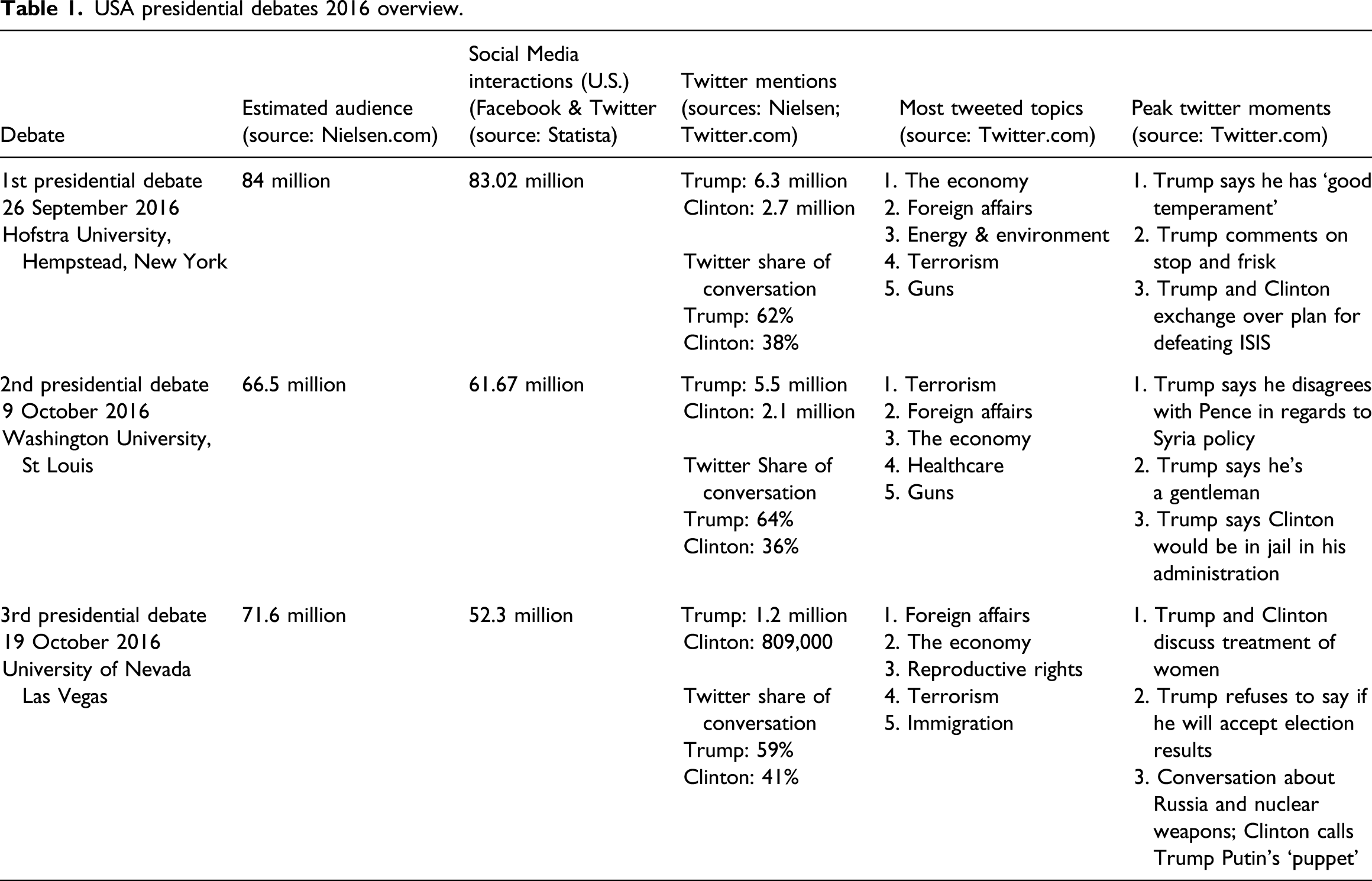
The moments we focus on in the debates provide us with three chief sources of data: the linguistic; the visual and the tele-filmic. We developed a framework drawing on these different data modes to aid our data collection and analysis that can serve as a critical analytic tool to interrogate televised debates. Broadcast via multiple networks, our analysis is based on the New York Times feed and is representative of the switched camera format where the camera alternates between the candidates, one of two dominant approaches, commonly utilized to broadcast debates (Stewart et al., 2017). We chose this format rather than the split screen approach, showing candidates framed side by side on the screen, which has limited camera movement and obstructs viewers’ wider vision of the debates’ physical staging, therefore providing less opportunity to utilize tele-filmic analysis.
Theoretical basis for a multimodal framework
Our multimodal framework draws on social semiotics, a tradition based on a theory of communication that is interested in the associations that images evoke (Barthes, 1977). These associations include what social meanings are created by visual communication and how meanings are created through images (Ledin and Machin, 2018). Within this tradition, visual communication is understood as not only communicating ideas and values but also creating social meaning that serves to constitute ‘part of the shaping of how we think and what we do’ (Ledin and Machin, 2018: 193). Texts and telefilms are purposefully designed (Iedema, 2001), with multiple aspects contributing to their meaning-making potential. As such, communication is multimodal; it draws upon multiple forms to become both purposeful (function) and to engage us in different ways (affective) (Ledin and Machin, 2018). However, what the telefilm is ‘”really about” (their content)’ (Iedema, 2001:186) can neglect what else is going on, including the ‘above content’ socio-politics, and the ‘below form’ structural significance in editing, framing use and choices. As such, this multimodal discursive analysis seeks to understand the mobilization of different forms of capital in the enactment of political leadership legitimacy through a focus on what is said (linguistic) and how it is represented (visual and tele-filmic).
Three modes of data
The presidential debates were filmed in real time. The narrative flow was largely determined by the candidates’ ongoing debate rather than the editing process. This calls for additional emphasis on particular modes of analysis due to the distinct debate characteristics as we now illustrate.
The linguistic
Adopting Hellgren et al. (2002) concept of argumentation, we examine the arguments, viewpoints and interests that the individual candidates promote to persuade the audience to their viewpoint and to their suitability as leaders. Hellgren et al.'s (2002) demonstrate how use of tone can be examined as part of the process of reasoning, including the use of objective language to suggest neutrality or subjective language to provide affective emphasis. Other aspects of tone they highlight include focussing on a particular argument to enhance its importance and referring to expert opinion to lend an argument weight (Hellgren et al., 2002). In these presidential debates, although topics were chosen by the moderators, we examined how each candidate chose to talk about issues and how their speech reinforced their argument. In each of the nine Twitter moments, we examined both candidates’ rhetoric for the duration of each moment.
The visual
We examined three forms of visual data: the setting in which the debates took place, the physical positioning of the candidates and the candidates’ behaviour to convey or reinforce their arguments. The visual setting helps to reveal the sociopolitical context of the debates. In each debate, there were national emblems that signified the US political context, such as the use of the colours on the US flag and wording from the US constitution as part of the scenery. These background emblems and artefacts provide visual insight into particular ideals (Ledin and Machin, 2018). The candidates’ positioning also offered information on what was afforded priority. Where visible, the moderator’s movements and behaviour were noted, including their use of hands and facial expressions. These data provided us with semiotic insights into representational meaning (what is included in the frame/shot) and interactive meaning (how the elements interact) (Kress and van Leuwen, 2006). These aspects were contrasted with the linguistic and tele-filmic to understand how the visual was used to underscore the candidates’ claims for legitimacy.
The tele-filmic
Camera use and movement can illuminate how individuals are positioned to enhance particular representations; high, low or side-on angles, positioned in front or behind the candidate, as well as long or close-up shots can denote distance or intimacy with the viewer. Movement of the camera with an individual can also create a sense of dynamism (Iedema, 2001). Our analysis was informed by four tele-filmic aspects; frame, shot, scene, and sequencing. Frame describes how Trump and Clinton were framed by the camera such as in profile. Shot examines the camera movement such as zooming in for a close-up during a particular moment. Scene explores how shots of both candidates participating in the same interaction were filmed, thus capturing camera movement in dialogue, typified by movement from one shot to another. Sequencing considers how meanings link together to develop a structure and rhythm such as a beginning, middle and end to form a unity. Typically, sequencing is used to examine the camera and editing function of telefilms (Iedema, 2001). Given the context of political debates, we related sequencing to structuring of the debate. This technique alerted us to the tele-filmic and the linguistic together, for instance, when the moderator was brought into the camera and was seen to provide structure to the debate, to interject or to move things along. Sequencing also draws attention to how the candidates interacted with each other to form a narrative sequence.
Attending to the linguistic, visual and tele-filmic enabled us to capture the nuance of capitals’ mobilization, including through attention to tone of voice (Hellgren et al., 2002), and movement of actors and camera (Iedema, 2001). We identified how Clinton uses emotive language ‘It’s horrifying’, ‘I am appalled’ and also how she appealed to her audience by use of ‘our’ and ‘we’. Visually, we observed how she maintained a calm demeanour and still composure that was in contrast to Trump’s interruptions and agitation. This was emphasized by the tele-filmic back and forth nature of the camera shots. Together these techniques draw attention to how Clinton mobilized political capital and emphasizes Trump’s lack of political expertise.
Data analysis and findings
Adopting this multimodal framework, and by following qualitative research guidelines in conducting the analysis of rich, detailed and complex data (Flick, 2018), our analysis of the mobilization of capitals followed four key stages. First, to familiarize ourselves with the debates, each researcher independently watched full live recordings of the three presidential debates. Second, each researcher independently conducted a multimodal analysis of top three Twitter moments within one of the three debates. For example, the first Twitter moment in Debate 1 focusses on Trump saying he has a good temperament. Our analysis shows that Trump draws on two key arguments: his ‘winning temperament’ is innate, and his temperament contrasts favourably with Clinton’s. The visual analysis, examining what we see and how different elements interact, highlights Trump’s use of gestures to reinforce what he is saying. The tele-filmic adds emphasis to this visual analysis by noting how the camera focusses predominantly on Trump as the main speaker in this moment and also moves with the dialogue.
During this stage, we held frequent discussions to provide feedback on each other’s analyses and to check the relevance and value of the proposed framework as a means to articulate the mobilization of capital. In our discussions on the first debate, for example, we noted how the analysis of the candidates’ argumentation highlighted both the use of political capital by Clinton and the undermining of this political capital by Trump, by asserting his celebrity ‘CEO’ capital as a means to legitimize his own suitability for high office.
The third stage of our analysis involved the researchers working together with the detailed analyses to gain insight into the multidimensional nature of capital, by identifying the different forms of capital mobilized by the candidates. We identified that both candidates mobilized forms of gender capital. Clinton used a form of gender capital during discussions of Trump’s treatment of women (Twitter moment 1, Debate 3), to appeal to women in the audience ‘we all know what that feels like’. Trump used a form of gender capital that equates to traditional and masculine stereotypes of leadership. During discussions about the viability of ‘stop and frisk’ approaches to law and order (Debate 1, Twitter moment 2), for example, Trump’s argumentation is a masculinist appeal to fight crime with force ‘police are afraid to do anything, we need more police’.
The fourth stage of our analysis involved moving back and forth between findings and data to compare and contrast the different ways in which capitals were mobilized by the candidates in their claim to leadership legitimacy. This analytical stage revealed that capital was mobilized in diverse ways by the candidates that both served to strengthen and weaken legitimacy claims, often simultaneously. At this stage, by theorizing capitals’ mobilization, we were able to identify how an apparent challenge to conventional leadership masked a reproduction of heteronormative leadership norms. Furthermore, our analysis shows how this reproduction of gender norms was utilized by both candidates as a way to legitimize their leadership candidacy. First, while legitimacy claims were strengthened through presentation of particular capitals (political, business and gender), their mobilization was also used to undermine legitimacy claims, such as drawing attention to the other candidate’s lack of experience or lack of fitness. Second, capital was mobilized by each candidate to defend their character (moral, good citizen and caring) and to present what they believed to be appropriate leadership characteristics, such as resilience. The mobilization of capital was also used to weaken the legitimacy claims of the other candidate by pointing to a lack of or a lesser claim to certain characteristics. The typical back and forth nature of political debate mirrored the way that each candidate engaged in different forms of capital to evidence their superior experience and/or character and to negate that of the other candidate. An illustrative example that our analysis revealed was a particular strategy used by Clinton to mobilize her political capital through argumentation to draw attention to Trump’s lack of political capital. This was evident in the second Twitter moment during the third debate where Trump refuses to say if he would accept the election results. Drawing on her political capital as a stateswoman, and expertise in the democratic system, Clinton asserts ‘he (Trump) is talking down our democracy’. She also presents herself as a ‘good’ citizen who abides by democratic rules simultaneously drawing attention to Trump’s unwillingness to play by the rules. During this stage, we also identified how multiple capitals intersected in their mobilization by the candidates. During the second debate, Clinton’s argument relies on her political capital to focus on her political experience, while Trump draws on his celebrity and business capital to focus on his winning temperament. Trump disrupts the political arena through his continual refusal to answer questions and aggressive demeanour. Next, we discuss our theorization of the mobilization of capitals, and we show how it illuminates the resilience of implicit heteronormative leadership values.
Mobilizing capital in pursuit of leadership legitimacy
Applying Bourdieu’s theory of capitals and field to interpret how each candidate vies for leadership legitimacy, we reveal how the mobilization of multiple capitals simultaneously operates as a disruptive resource while reproducing implicit heteronormative leadership values and norms. Previous studies have suggested that leadership legitimacy is related to how one mobilizes capital to master a particular field (Lee, 2009), as illustrated in the third Twitter moment in the third debate where discussions turned to the issue of Russian interference in the election. Pointing to Clinton, Trump asserts that Putin: ‘from everything I see has no respect for this person.’ Clinton: “well that’s because he’d rather have a puppet as president in the United States and...” Trump interjects “No, no puppet.” Clinton: “It’s pretty clear...” Trump: “You’re the puppet.” Clinton: “It’s pretty clear, you won’t admit...” Trump: “No, you’re the puppet” Clinton: “that the Russians have engaged in cyberattacks against the United states of America, that you encouraged espionage against our people, that you are willing to spout the Putin line...”
In this exchange, Clinton mobilizes her political capital to substantiate her argument that Trump does not grasp the gravity of the political situation. Her suggestion that Trump is Putin’s puppet, and her emphasis on the conclusions reached by 17 intelligence agencies highlighting Russian intervention, reinforces Clinton’s possession of political capital and Trump’s lack of it. This is heightened by visual evidence where we see Trump both stopping the moderator from interjecting and pointing his finger repeatedly at him. The tele-filmic analysis identifies the significance of the camera’s movements that place Trump at the centre of the screen and emphasizes Trump’s movements and the camera’s subsequent panning to Clinton that shows her smiling at this reaction.
Yet during the debates, Clinton’s mobilization of political capital is countered and undermined by the disruptive presence of Trump. He mobilizes capitals that are external to politics particularly his celebrity capital accrued through the television series ‘The Apprentice’, thereby referencing a traditional and masculinist leadership norm, to legitimize his presidential candidacy in the political realm.
Trump’s apparent populist success revealed the reproduction of implicit and normative leadership values. For example, during the first debate, the moderator invites the candidates to talk about race. Clinton responds first stating that: ‘race remains a significant challenge in our country’. Later, Clinton refers to how race determines how individuals are treated in the criminal justice system and argues that, since the first day of her campaign, she has ‘called for criminal justice reform’. Part of Trump’s response to Clinton is to accuse her of ‘not wanting to use a couple of words and that’s law and order’. This section of the debate then leads to Trump referring to ‘stop and frisk’ (Twitter moment 2). Trump’s argumentation in this section of the debate emphasizes his ‘strongman’ credentials. He refers to ‘the endorsement of the Fraternal Order of Police’ he has received. Trump follows this by implying Obama has been weak in stopping violence. Trump: ‘In fact, almost 4000 have been killed since Barack Obama became President. Over 4 – almost 4000 people in Chicago’.
Trump’s reference to law and order, within the context of a debate on race, implies the need to curtail protests and contain dissent, emphasizing an authoritarian masculine stereotype of leadership. Drawing on his outsider capital as a ‘straight talking’ businessman, Trump undermines Clinton’s political capital, reinforcing implicit heteronormative values that promote a disruptive, domineering and hyper-masculinist leadership.
Leadership candidates mobilize different forms of capital that can be seen to represent the interest of particular social groups
Our analysis illustrates how each candidate mobilized different forms of capital that can be seen to represent the interest of particular social groups to obtain leadership legitimacy. The following examples draw attention to the multiplicities and dynamic qualities in the mobilization of capital (Bourdieu, 1986).
The different approaches to political debate, evident in the second debate, reflect forms of capital that each of the candidates believed to be most relevant to their audience. In this debate, the moderator, Martha Raddatz, asks both candidates to respond to a question from Dianne in Pennsylvania about the humanitarian crisis in Aleppo. Clinton gives a detailed answer, arguing against Russian action. Instead of responding directly, Trump’s answer is more discursive. He talks about the ‘dumbest deal ever’ that was made by the Obama administration with Iran. Raddatz repeats her question about what would he do about the Syrian humanitarian crisis and asks Trump to respond to Mike Pence’s comments on America’s Syrian policy.
Trump: “Ok. He and I haven’t spoken, and I disagree. I disagree.”
Raddatz, in response, states: “You disagree with your running mate?”
Trump then states: “I think you have to knock out ISIS. Right now, Syria is fighting ISIS. We have people that want to fight both at the same time. But Syria is no longer Syria.”
Then he complains that Clinton was responsible for what’s happening in Syria, conflating Syria with Russia and Iran, stating
“Syria is Russia and its Iran, who she made strong… She had a chance to do something with Syria. They had a chance. And that was the line. And she didn’t.”
Trump’s repetition of ‘she’ belittles Clinton’s status. Drawing on his business capital, he implies that Clinton was responsible for the crisis, inferring the failure of the Obama administration through ‘the dumbest deal’. In so doing, he shifts the discourse, undermining Clinton’s political capital and pointing to her alleged ineptitude and responsibility for the Syrian crisis, and the rise of ISIS.
We also witness how the candidates mobilized multiple capitals in seeking to represent particular interests in the third debate, where the moderator referred to Trump’s comments about grabbing women. In this discussion, Clinton draws on gender and political capital. She points out that nine women have come forward to say Trump groped or kissed them without their consent. In a discussion that lasted for over seven minutes, Clinton draws on gender capital to align herself with the women in the audience and denounce Trump’s behaviour. Simultaneously, she mobilizes her capital as a stateswoman by emphasizing what is expected and required in the role of President. Her argumentation is reinforced by the visual and tele-filmic, emphasizing the gravity of the claims made against Trump. Clinton: (speaks slowly, looking down and then directly at camera, using open gestures with hands, pausing and emphasising the words ‘dignity’ and ‘self-worth’). “Donald thinks belittling women makes him bigger. He goes after their dignity, their self-worth, and I don’t think there is a woman anywhere who doesn’t know what that feels like. So we now know what Donald thinks and what he says and how he acts toward women. That’s who Donald is, I think it’s really up to all of us to demonstrate who we are and who our country is and to stand up and be very clear about what we expect from our next President …”
In this extract, Clinton uses her gender capital to appeal to women voters, in opposition to Trump’s harmful macho behaviours. Her emphasis on women’s dignity and self-worth reinforces a heteronormative discourse that reflects binary ways of thinking about gender. This is also stressed by her political capital as someone who understands the appropriate behaviours expected from ‘our’ President, reinforcing her legitimacy and undermining Trump’s fitness for presidency.
These examples illustrate how Trump and Clinton try to convince different segments of the audience of their leadership legitimacy. In Trump’s case, his focus is on the working man, whereas Clinton uses her gender capital to appeal to women voters. Additionally, Trump highlights his business credentials to attempt to swing the popular vote, an indicator of his attempt to ‘tuck away’ (Morris, 2019: 28) his elitism. This tells us that there are particular interests that each candidate viewed as important to their success. For Clinton, her political acumen and her experience as a woman is highlighted. Trump meanwhile focuses on his status as a businessman and celebrity figure, a status that is outside of the political field but has representative value for the public (Ribke, 2015). The mobilization of these forms of capital also draws attention to assumptions that individuals hold about the kinds of knowledge that is valued in leaders, thus providing insight into implicit leadership theories with which individuals align themselves (Schyns et al., 2011).
Capitals are mobilized to convince the audience of their leadership legitimacy in different ways
The analysis reveals how capitals are mobilized in complex, contradictory and non-uniform ways to claim leadership legitimacy. This includes the denigration of other claims to legitimacy and as a trade-off where some capitals are promoted as more important than others. Illustrative is Trump’s repurposing of his celebrity capital for political intent, downplaying and thereby undermining Clinton’s political capital, by deploying the cultural and social capitals he gained as a celebrity businessperson who achieved prominence though The Apprentice television programme (Mollan and Geesin, 2020). Trump’s political performance is simultaneously undermined by his lack of civility and his refusal to accept facts or to distort them as he chose. In the second debate, Clinton refers to the need to fact check everything Trump says since he has such a cavalier attitude to the truth. Then Clinton states: ‘It’s just awfully good that someone with the temperament of Donald Trump is not in charge of the law in our country’, leading Trump to quip: ‘Because you’d be in jail’. Rather than delegitimizing Trump’s candidacy, this appeals to some voters because of its shock value (Brown, 2019) that disrupts norms of political engagement. His populist appeal not only disrupts the political field but also reinforces heteronormative ideals (Brown, 2019).
We see the complex dynamics of capital mobilization, particularly with how each candidate mobilized gender capital in contrasting ways, as an embodied form of capital (Lovell, 2000). That is, being seen as a man or a woman is mobilized as a means to improve their position in relation to a specific issue (cf. Clinton’s appeal to the audience when referencing Trump’s relationships with women) or where masculine or feminine characteristics are mobilized to accrue legitimacy (Ross-Smith and Huppatz, 2010). The language used by these candidates is reinforced by their actions: the traditional masculine/feminine comportment of candidates reaffirms heteronormativity. In the Twitter moments, Trump is shown to move aggressively around the stage, whereas Clinton is often shown motionless. Trump’s aggressive behaviour is particularly noticeable in the second presidential debate where he prowled around the stage, often standing behind Clinton when she was speaking. This alarming display of threatening behaviour illustrates the complex interaction of power, gender and social capital. His action plays to implicit theories of leadership that associate the masculine body with strength, vigour and authority. Trump’s mobilization of dominant masculinity, visibly asserted, embodies a menacing and non-rational behaviour, serving to reinforce hyper-masculine preoccupations with conquest and control (Knights, 2021), and in so doing reaffirms stereotypes of men (Trump) as powerful and women (Clinton) as the weaker sex, a bodily display that associates dominance or lack of it with a normative gender binary. On the one hand Trump defies ‘prodemocratic norms’ (Spector, 2021: 231), but on the other Trump’s gender performativity, illustrated through his action, highlights his ‘cave man’ approach designed to appeal to the basest element of his political base. His action not only disrupts the decorum of presidential debates but is a reaffirmation of an insidious type of masculine bravado. Prowling around the stage, behind Clinton’s back, is a hyper-masculine norm that is not only shocking but unsettling.
In contrast, Clinton’s use of gender capital draws on traditional modes of feminine capital in her demeanour and argumentation (quiet and calm and ethos of care and family) yet also drawing attention to her alterity as a woman.
The mobilization of capitals can negatively affect legitimacy claims
Clinton is trying to establish her legitimacy for a role that no woman has ever held before. Yet, Clinton’s use of gender capital is, as Ladkin (2017) argues, not without problems. When Clinton states ‘we all know what that feels like’ in response to Trump’s mistreatment of women, she illustrates both a strength and a weakness of employing gender capital in vying for leadership legitimacy. Showing she cares about other women’s predicament enables Clinton to respond to criticisms that she is unfeeling. Yet this is undermined by Trump’s previous attack on the moral character of Bill Clinton in the first debate, where Trump asserts his masculine bravado to explain his actions as ‘locker room talk’, going on to say ‘you look at Bill Clinton, far worse. Mine were words and his were action’. The audience are reminded of this exchange in the third debate when the moderator introduces the topic of sexual allegations and asks Trump to comment. At the same time, the moderator proposes that Clinton can also respond to concerns raised regarding Bill Clinton’s behaviour. However, this line of questioning relating to Bill Clinton is not picked up again during this part of the debate. Nonetheless, the reference to Bill Clinton’s sexual liaisons implies a stain on Hillary Clinton’s character, while Trump’s assertion of his behaviour as ‘locker room talk’ suggests this is regular, and therefore, normal male conversation. Here, we see an interplay between these different forms of gender capital where the potential of a woman President, and feminine qualities, is promoted as advantageous. Nonetheless, this is evaluated against stereotypical notions of what it means to be a ‘good woman’ or a ‘good leader’ (Gardiner, 2015; Liu et al., 2015). In this example, Trump mobilizes his masculinity to counter the (less valued) feminine capital (Liu et al., 2015) employed by Clinton. In so doing, he sends a message that Clinton’s claims to gender capital as a means to legitimate leadership are weakened; she is not able to control her husband and therefore does not have the ability to lead. Trump’s attempts to mobilize gender capital are however tempered, illustrated in the third debate where he is asked to explain his treatment of women. This example is illustrative of the mobilization of capital not only to undermine the other candidate but also as a trade-off. In the third debate, Trump attempts to invoke gender capital by asserting his respect for women, but this appears to be weakened; we see Clinton smiling and the audience laughing. Trump: “Nobody has more respect for women than I do, nobody. Nobody has more respect.” Moderator: “Please everybody.” (audience laughs, Clinton is smiling) Trump: “And frankly those stories have been largely debunked and I really just want to talk about something slightly different. She mentions this which is all fiction, all fiction and lies. Probably or possibly started by her and her very sleazy campaign but I will tell you what isn’t fiction and lies is her emails where she destroyed 33,000 emails. Criminal, criminal.”
Trump’s response is to change the direction of the debate by declaring that the more serious issue is Clinton’s lack of trustworthiness, and Trump goes on to return to the refrain of Clinton’s ‘crooked’ campaign. His disruption serves to undermine Clinton and undermines the value of the gender capital she seeks to mobilize (Ladkin, 2017).
The intersection of capitals serves not only to disrupt but also to challenge traditional notions of political leadership
Against the backdrop of populist narratives that suggest traditional rules of the game in the political field are being disrupted by celebrity politicians including Trump, we observe that Clinton is also disrupting traditional notions of leadership as a woman in high office. While gender capital mobilized by women is not highly valued (Elliott and Stead, 2018), in these Twitter moments, this is one of the key capitals she draws upon. The use of gender and leadership capitals can be a disruptive resource to unsettle leadership norms. Yet by drawing on forms of gender capital (the caring and compassionate discourse, the appeal to other women and to the family unit), Clinton reinforces heteronormative values. Examples that highlight Trump’s mobilization of his business capital include his pronouncement on Obama’s deal-making with Syria, and his appeal as a straight talking business man to law and order in the debate on criminal justice. These examples illustrate how Trump's hyper-masculine gender capital not only aligns with leadership norms but also intersects with his mobilization of celebrity capital. The audience know and recognize him as a businessman, invested with an authority accrued via The Apprentice programme that privileges authoritarian forms of leadership associated with masculinity. This form of celebrity capital is therefore rooted in an implicit understanding of leadership, sustained by heteronormativity. While the celebrity he mobilizes is disruptive in the political field, it is neither without precedent at the highest level (e.g. Reagan) nor is it out of alignment with implicit heteronormative leadership norms.
Mobilizing capitals between fields
Our analysis reveals that the mobilization and fusion of diverse capitals serves to disrupt the political field through an ostensible enactment of a different kind of leadership legitimacy. To understand how this leadership legitimacy gains traction, it is important to understand how each candidate utilized various forms of capital to enact a power shift (Doyle, 2017) from one field to another.
We see this power shift at play in the way in which Trump’s leadership legitimacy is enhanced through his CEO capital. His perceived economic capital is enhanced by his sense of himself as a strong leader. He plays the law and order card, we suggest, to reaffirm his tyrannical ‘strength’ through an attack on the weakest, serving as an implicit call to associations of leadership with masculine strength.
Trump also mobilizes his economic capital in the political arena by arguing that he has common sense. His CEO capital is juxtaposed with Clinton’s extensive political capital. Her expertise in senior roles during President Obama’s administration is used against Clinton by Trump who appeals to popular opinions that most politicians are untrustworthy. Arguing that Clinton should be in jail reinforces the idea that she is a leader the public should not trust. Clinton’s detailed grasp of politics and policy, illustrated in the debate on cyberattacks influencing election results, and the gravity of international relations, exemplifies her political capital. Stressing her expertise however allows Trump to build upon his maverick narrative, dismissing the political and Clinton, as untrustworthy, and to assert his celebrity capital as the people’s champion. Clinton’s desire to concentrate on specifics rather than generalities highlights her political experience, but also enables Trump to issue rambling sound bites that seem to incite an aura of excitement/disgust in the studio audience.
The dynamics of capital mobilizations
Identifying the mobilization and intersection of different forms of capital by individuals aspiring to leadership roles provides insight into how images of the ideal leader are (re)produced, disrupted and challenged by those aspiring to high office. How individual leaders mobilize different capitals is significant in determining whether they challenge or reinforce implicit theories of leadership (Schyns and Schilling, 2011). From the Twitter ‘moments’, we notice that Clinton uses traditional methods of mobilizing political capital, including drawing upon her expertise and engaging in dialogue. Yet, her approach is dismissed by Trump who disrupts the ‘political’ game in his attempt at legitimacy through his ‘maverick’ approach to politics. His maverick narrative plays upon the stereotype of the rugged (masculine) individualist who will stop at nothing to get his way. Although lauded as anti-prototypical leadership qualities (Schyns and Schilling, 2011), the tyrannical and masculine qualities that Trump exhibits nonetheless underscore an implicit heteronormativity that underpins a traditional leadership norm.
Conclusion
To address the call to ‘reveal the scaffolding’ (Ladkin, 2020) behind the political spectacle of how populist leaders like Trump are elected, we have examined how two Presidential candidates mobilized diverse forms of capital to pursue leadership legitimacy. We have scrutinized the dynamics of the intersections between diverse forms of capital to understand how the candidates drew on and invoked the capital they have respectively accumulated.
We have sought to understand whether the specificities of the intersections of capitals indicate the development of an implicit theory of leadership. The mobilization of multiple capitals disrupts traditional notions of who can claim leadership legitimacy in the political field, yet their disruptive mobilization also serves to reproduce normative implicit leadership values. In this context, we see both candidates drawing on traditional gender norms as a way to bolster their leadership.
Our theorization of the intersection of capitals identifies the intimate relationship between leadership and heteronormativity, set in the context of a populist narrative surrounding Trump that was predicated on his ‘supposed’ outsider status (Brown, 2019; Morris, 2019). Both candidates’ political leadership performances are rooted in traditional gender beliefs, a key foundation of heteronormativity (Duggan, 2004). Trump’s masculine gender capital intersected with the capital he mobilized as an outsider in the political field. Furthermore, his celebrity capital is rooted in an implicit understanding of leadership sustained by heteronormativity and the resilience of the gender binary. We witness a close connection between masculinity and leadership in Trump’s appeals to ‘law and order’. Clinton’s appeals to women who are watching the discussion of Trump's treatment of women emphasize a binary divide, and this is further underlined by visual cues (Trump’s aggressive pointing, interjecting; Clinton’s stillness). Theorization of our findings identifies a reinforcement of heteronormative values as a key component that Trump mobilizes to facilitate his movement from the male (celebrity) CEO to gain power in the political field.
This study has also considered how capital is multidimensional, and how capital can be strategically mobilized to establish leadership legitimacy. Extending debates that examine the dynamic interplay behind the legitimation of leaders (Ladkin, 2017), we have identified how the mobilization of capitals can be used to enhance a leader’s legitimacy and as a disruptive resource to enable leadership legitimacy.
Specifically, this analysis has revealed the diverse ways in which the mobilization of diverse capitals can reinforce and undermine leadership legitimacy and identifies the resilience of heteronormativity as ballast to implicit understandings of leadership. Our analysis illustrates that heteronormativity underpins political discourse, and functions to legitimate leadership, typically operating as an invisible norm (Ryan and Dickson, 2018). Examining the intersection of capitals has illuminated the ways in which heteronormativity is reproduced through the mobilization and intersection of capitals. Heteronormativity reinforces a mode of leading that builds upon traditional patriarchal norms and promotes particular forms of capital over others. Within the political debates discussed here, it strengthens the notion of the heroic, masculine leader. In Trump’s case, his disruption of politics is underpinned by his transference of celebrity capital into the political arena. This mobilization of celebrity capital serves to highlight his perceived strengths as a maverick CEO, whilst undermining Clinton’s political expertise. Trump’s disruption of the political arena turned his perceived weakness, as someone without political credentials or experience, into an apparent strength. We therefore reveal how presidential debates can be used as a site to mobilize capitals, not only to disrupt political norms but also as a vehicle to reinforce gender norms that reinforce traditional notions of leadership legitimacy. Implicit assumptions that associate men with leadership success and abilities (Koenig et al., 2011) mean that women are less likely to be accepted as leaders than men (Parks-Stamm et al., 2008). A consequence is that women who adopt traditional masculine tendencies, including the use of power or authority, can face negative reactions and resistance for upsetting the normative hierarchy (Moss-Racusin et al., 2010), particularly in traditionally male-dominated occupations (Ridgeway, 2001) such as politics. A contradiction we revealed through our analysis, illustrated by Clinton’s use of gender capital, is that if women in elite roles do trade on their gender capital, this can draw attention to the binary divide, in turn inadvertently reinforcing heteronormative norms.
An additional aspect that merits future research is the consequences of embodied status, that is, how leaders’ bodies are ‘read’ by others (Pullen and Taksa, 2016: 125) across media platforms. Research illustrates how women’s embodiment is a visible disruption of leadership norms (Liu et al., 2015) that necessarily affects perceptions of women’s legitimacy as leaders. Furthermore, examining how language is mobilised by individuals may reveal how ‘the enactment and reproduction of discourses such as hegemonic or masculine discourses in the media and provide insight into dominant discourses in a particular field’ (Elliott and Stead, 2018: 27). Future research could apply the form of multimodal analysis developed in this article to study other political debates, to examine whether this mobilization of capital has a disruptive effect in other political contexts. For example, the analytic approach we have adopted could be applied to an examination of different intersections of identity as they relate to political campaigns. Another fruitful and related avenue of research would be to consider how white privilege also influences leadership legitimacy.
We conclude our article by drawing attention to the paradox the study reveals. While scholarly and media analyses of Trump’s leadership campaign have asserted the relevance of his celebrity outsider status as a foundation for his success, this study’s analytic attention to the mobilization of social capitals reveals the resilience of traditional gender norms to leadership legitimacy. In brief, to achieve leadership, it still helps to be a man. The wider significance for leadership studies is the pressing need for critical scholarship that interrogates claims of alternative leadership approaches, to reveal norms that underpin the legitimation of our most elite leaders. How leaders mobilize different forms of capital, and the consequences for reproducing leadership norms, has relevance for leaders and followers. Recognizing the power of leaders’ discourse provides a means to hold elite leadership discourse to account.
Footnotes
Declaration of conflicting interests
The author(s) declared no potential conflicts of interest with respect to the research, authorship, and/or publication of this article.
Funding
The author(s) received no financial support for the research, authorship, and/or publication of this article.
