




Abstract
Previous research provides important insights into leadership in inter-organizational networks but says little about how organizations can establish themselves as leaders in heterarchical networks where power is decentralized. We draw on a longitudinal single case study of a German banking cooperative and develop a process model explaining how an organization can create and sustain leadership legitimacy under terms of limited formal and informal power in a heterarchical network. The model advances the understanding of leadership legitimacy in organizational networks in different ways and suggests a new understanding of leadership enacted by formal and informal leaders.
Keywords
The network literature provides important insights into leadership in inter-organizational networks—defined as the “direction of the activities of a network of independent organizations by one or more organization(s), either temporarily or permanently, in which this role is commonly perceived and accepted by the other participants” (Müller-Seitz, 2012, p. 430). A large body of the literature targets leadership from a governance perspective, associates formal structures with leadership, and examines how different formal structures direct the activities of a network and influence their outcomes. Research on network governance shows that hierarchical structures may increase efficiency, while heterarchical structures can join organizations’ capabilities flexibly (Benitez et al., 2020; Hoffmann, 2007; Ligthart et al., 2016; Provan & Kenis, 2008; Savarese et al., 2020). These are valuable insights because, in times of fast and fundamental changes, both efficiency and flexibility are key for performing in the presence and being capable of adapting to the future. At a more general level, network governance literature advances the understanding of how formal structures influence actions and outcomes.
However, as mentioned by Müller-Seitz (2012), particularly in heterarchical networks (i.e. networks without clear hierarchical structures), formal structures cannot fully account for leadership. More specifically, a governance perspective does not grasp the recursive interplay between structures and actions, and neglects informal structures (Sydow & Windeler, 1998). Focusing on social practices, that is, action patterns unifying human agency and structures, practice-theoretical research addresses this shortcoming and examines how practices enact and re-enact leadership as both concrete actions and roles accepted by participants of a network (Figueiredo et al., 1998; Gutberg et al., 2021; Martin et al., 2009). For example, (Mitterlechner, 2019) shows how leadership practices (i.e. action patterns) of reflexive coordination by a group of organizations give a sense of direction, influencing organizational, network, and field-level structures that in turn influence leadership practices in the network. (Müller-Seitz & Sydow, 2012) show how a lead firm in an inter-organizational hierarchically structured network can mobilize its formal authority (i.e. formal power) and financial power to become the informal leader of a heterarchical network through practices of development and use of roadmaps across networks. This study explains how firms can transfer power from one network to another and become accepted or legitimized by its members.
However, how organizations achieve and sustain leadership legitimacy in a heterarchical network of organizations under limited formal and informal power–that is, without the power of asserting the direction of activities despite opposition (Weber, 2013)–has not been examined. The notion of legitimacy puts acceptance into the center, based on the judgement of the extent to which an entity or an action is appropriate for its social context (Tost, 2011). From a practice-theoretical perspective, leadership legitimacy is the ongoing process of achieving acceptance through and for leadership practices. Examining exactly how leadership practices and practices of evaluating leadership legitimise a lead organization under the terms described is important to better understand leadership in heterarchical networks. This, in turn, may advance the practical understanding of how to establish efficient and flexible networks and foster collaboration in multi-stakeholder settings to alleviate multifaceted social problems in an increasingly complex and fundamentally changing society (Gray & Purdy, 2018).
This motivates us to ask the question: How can an organization enact and re-enact leadership legitimacy in a heterarchical network of organizations, under the terms of limited formal and informal power? In response, we apply a practice-theoretical lens to a single case study of German banking cooperative, here called “COOP Bank” (COOP). COOP represents inter-organizational networks defined as social systems “in which the joint activities of at least three independent legal entities are reflexively coordinated on a repeated basis, in order that joint benefits may accrue to all the parties concerned” (Müller-Seitz, 2012, p. 429). In two and a half years of fieldwork, we observed how COOP jointly worked on its future potential in the face of increasing challenges in the banking sector, such as digitalization, increasing competition, and changing customer needs. The practice-theoretical lens enabled us to derive practices appearing at organizational and inter-organizational levels from concrete micro-level interactions (Seidl & Whittington, 2014; Whittington, 2006).
The result is a process model that explains how the interplay of leadership practices and practices of judgement re-enacts the leadership legitimacy of an organization that has limited formal and informal power in a heterarchical network of organizations. This study makes three theoretical contributions to the literature. First, the model advances the understanding of leadership legitimacy in the heterarchical networks of organizations. Second, it suggests a new understanding of leadership based on evidence that moves beyond the dyadic understanding of the relationship between leaders and followers, and provides a fine-grained view on leadership activities by informal and formal leaders and therefore contributing to their organization's leadership. Third, the model advances the understanding of leadership legitimacy in inter-organizational networks as a multidimensional phenomenon. These theoretical contributions have several practical implications.
Leadership in Inter-Organisational Networks, Leadership as Practice and Dimensions of Legitimacy
Leadership and its Legitimacy in Inter-Organisational Networks
Research provides insights into organizational networks, including various constellations of different legally independent organizations that coordinate their activities to benefit from coordination (Müller-Seitz, 2012). Previously examined networks are, for example, public networks (Chen & Graddy, 2010), networks of buyers and suppliers (Uzzi, 1999), small and medium-sized enterprise networks (Sabatier et al., 2010), and research-and-development networks (Müller-Seitz, 2012).
Conceptualizing hierarchical and heterarchical networks as two opposed types of networks along a continuum, leadership in one type of network fundamentally differs from that in the other type of network. In a hierarchical network, a lead organization has the formal power to make collective binding decisions for network members to quit its formal leadership role. Formal power is the source of leadership legitimacy in this type of network, attributed to the lead organization through role definition (Müller-Seitz & Sydow, 2012; Provan & Kenis, 2008). Accordingly, previous research has shown that leadership takes place through decision making. A lead organization makes decisions and network members follow these decisions. Provan and Kenis (2008, p. 235) label in their seminal paper the type of governance in hierarchical networks “lead organization-governed networks”. Such governance or leadership is highly efficient. It often appears in settings in which one organization has informal power through its resources and achieves becoming the formal lead organization in a network. Accordingly, the lead organization influences the network to achieve shared goals that may be particularly aligned with the goals of the lead organization (Provan & Kenis, 2008; Weiner & Alexander, 1998).
On the other side of the continuum, no firm has the formal power to collectively make binding decisions for the entire network. Formal power is decentralized (Müller-Seitz & Sydow, 2012). All network members collectively lead the network, and each organization directs the course of action in activities that are relevant to them. Leadership takes place through consensus-based decision-making in a collective direction, and the efforts of single organizations mobilize other network members in certain directions (Huxham & Vangen, 2000; Provan & Kenis, 2008). However, due to the decentralization of formal power, leadership legitimacy is especially fragile rather than enduring and depends on informal acceptance by other network members (Müller-Seitz, 2012; Müller-Seitz & Sydow, 2012). Provan and Kenis (2008, p. 234) label the type of governance in hierarchical networks “shared participant-governed networks”, which Kenis et al. (2019) more recently labeled “shared governance”. This type of governance provides much autonomy and flexibility but makes coordination challenging.
Along the continuum between fully hierarchical and heterarchical networks, different networks between both extreme types were examined. The third type of governance indicated by Provan and Kenis (2008, p. 236) is the “network administrative organization”, where an organization or individual is exclusively set up to govern the network. While network administrative organizations (NAO) lead the network operatively, the other network members direct the network activities strategically, for example, through their representation in the management board of the NAO (Provan et al., 2004; Provan & Kenis, 2008). Applying this governance structure, formal power is decentralized and shared among network members, which constitutes a heterarchical network, while the administrator operatively supports the other network members. More recently, Kenis et al. (2019, p. 283) have examined two other types: the “combined lead and NAO governance”, where the NAO operatively supports the lead organization, and the “core-periphery governance”, where the formal power of leading the network is in between centralized and decentralized and a group of lead organizations direct the activities of the network.
The typification of governance forms advances the understanding of the structural differences that define leadership roles of organizations. Research applying a governance perspective on leadership provides insights into how formal structures and leadership roles are associated with decision-making practices and the conditions that define the most effective governance structures. A more recent examination of different types between both poles, that is, the clearly hierarchical network with a lead organization and shared governance in a heterarchical network, provides a more nuanced view of the reality of leadership in inter-organizational networks.
However, the governance perspective reduces leadership to a formal structure. From a governance perspective, an organization is or is not formally legitimized to lead a network. Empirical questions are, from this perspective, for example, how formally legitimized lead organizations lead a hierarchical network, how network members collectively lead the network, or how hybrids in between take place. Using a practice perspective supports investigating more messy associations that might rest between formal structures and informal leadership practices. Moreover, a practice perspective might overcome the otherwise neglected informal legitimization and opens our view for the richness of reality in and practice, which we describe next.
Leadership Legitimacy Enacted Through Practice
A practice-based view puts practices, unifying human agency and structures, and re-enacted through concrete action, activities, or praxis into the center of analysis (Bourdieu, 1984; Giddens, 1984; Whittington, 2006). Following a practice-based view that distinguishes different levels, we understand an action pattern as a practice that is constantly enacted and re-enacted through actions or activities at the micro level and appears at higher levels, such as the organizational or network level (Jarzabkowski, 2004; Seidl & Whittington, 2014).
Researchers are increasingly applying theoretical lenses to leadership in inter-organizational networks (Martin et al., 2009; Mitterlechner & Bilgeri, 2021; Soekijad et al., 2011). Moreover, a handful of studies have provided important insights into leadership legitimacy. As indicated above, in heterarchical networks without a formally defined lead organization, the legitimacy of informal leaders is particularly fragile because of a lack of formal power (Müller-Seitz, 2012). Organizations need to continuously qualify themselves as leaders through practices that need to be evaluated as adequate leadership practices by network members (Sydow & Windeler, 1998). Furthermore, research suggests that a lack of formal power can be compensated for through informal power, for example, in the form of resources or a powerful market position (Müller-Seitz & Sydow, 2012).
However, how an organization can enact leadership legitimacy under limited formal and informal power has not been examined. More concretely, how an organization can become and establish itself as a powerful leader that can direct actions an “make things happen” (Huxham & Vangen, 2000, p. 1160); if a leadership role is not formally ascribed and the firm does not have means like money or regulatory power to assert the direction of activities in a network independent of opinions of this direction by the network members, is undertheorized. While previous research provides insights into different leadership practices in different settings (Dulewicz & Higgs, 2005; Hansen & Villadsen, 2010; Jogulu, 2010), how legitimacy is achieved and sustained through interacting practices is not understood. One reason for this might be that research on leadership in networks uses the concept of legitimacy in a rather undifferentiated manner, neglecting the multidimensionality of leadership. To address this shortcoming, we draw on the legitimacy literature.
Dimensions of Legitimacy
To better understand legitimacy, we approach Tost’s (2011, p. 689) definition of legitimacy as a “judgement of the extent to which an entity is appropriate for its social context” from a practice-theoretical lens. From a practice-based perspective of leadership in networks, the entities of judgement are actions or practices. Network members judge the appropriateness of leadership practices attributed to organizations that take the lead through practices. Judging appropriateness, in turn, is an activity that might reoccur, and thus enact and re-enact practices of judgement.
One key finding of the legitimacy literature is that legitimacy concerns multiple dimensions (Bitektine, 2011; Deephouse & Suchman, 2008; Suchman, 1995). Scholars have either identified different dimensions or combined the same dimensions differently. Johnson and Holub (2003), Zyglidopoulos (2003) and Suchman (1995), for example, distinguish between moral, cognitive, and pragmatic legitimacy. Suchman (1995) distinguishes between processual, consequential, structural, and personal legitimacy, while Aldrich and Fiol (1994) and Golant and Sillince (2007) distinguish between cognitive and socio-political legitimacy. Tost (2011) differentiates between moral, relational, and instrumental/pragmatic legitimacy, arguing that moral legitimacy is based on actors’ norms, values, and ethics and that the judgement of relational legitimacy is based on actors affirming the social identity of one another. Furthermore, instrumental legitimacy arises when an actor is perceived as facilitating an organization's self-defined goals (Tost, 2011).
While previous research says much about different dimensions of legitimization of different entities or units such as individual leaders, organizations, and industries in different social contexts (Brown & Toyoki, 2013; Suchman, 1995; Tost, 2011), scholars have paid too little attention to multiple dimensions in the examination of leadership legitimacy of organizations in networks. Human and Provan (2000) identify three dimensions of legitimacy that need to be addressed by organizational networks to obtain internal and external legitimacy: the network as form, the network as entity, and the network as interaction. So far, however, little discussion exists about different dimensions in the examination of organizations’ leadership legitimacy in inter-organizational networks. To date, research has tended to focus on different entities, such as individual leaders and networks, which are key for an organization to receive legitimacy. Thus, previous research might inspire us to consider the dimensions of legitimacy or legitimization, developing a more nuanced view on how organizations achieve and sustain leadership legitimacy in a heterarchical network of organizations under limited formal and informal power. Based on this limited knowledge, we applied a reflexive methodology (Alvesson & Sköldberg, 2009) to a single case study, which we describe next.
Empirical Setting and Method
Empirical Setting
To explore the creation of leadership legitimacy, we conducted an empirical study in a heterarchical organizational network. We studied a German cooperative banking cooperative (which we call “COOP Bank”) that serves about 30 million customers in Germany. This cooperative consisted of almost 1,100 legally and economically independent local banks in Germany. While these banks were mostly small enterprises with 50–200 employes, a few were very large, employing thousands of people. The individual banks only needed to follow the FED's financial and liability provisions but acted autonomously in all entrepreneurial decisions concerning strategy, organization, markets, products, customers, HR, and infrastructure. In addition, each individual bank had its own independent supervisory board elected by its owners, the members of the cooperative.
Membership is the foundation of the legal form of registered cooperatives. The law on cooperatives defines a cooperative as one designed to promote the acquisition or economy of its members. Members are, therefore, not only customers, but also partners. A cooperative bank directs its business policy to the interests of its members. Members benefit from the individual bank's success and are involved in democratic decision-making processes in the bank's direction.
While the COOP banking group boasts over 150 years of organizational history, the FED was founded only in 1972, during a major organizational restructuring project. The FED's original tasks were the national and international representation of COOP interests and administration of COOP safeguard funds. In 2004, a general assembly of all COOP banks voted (with the necessary 75% quorum) to grant the FED the task of developing strategic concepts for the entire banking group. The organizational charter of FED describes this additional task as follows: “FED as a strategic competence center has the task of developing concepts for the COOP banking group, without limiting the autonomy of the strategic orientation of each individual bank” (BVR, 2021).
As the quote indicates, individual banks of the COOP were autonomous in their strategic orientation, which included that each bank was sovereign in and responsible for managing internal and external network relationships. Thus, following Provan and Kenis (2008) typology, COOP's formal governance structure involved a key feature of “shared participant-governed networks” (shared governance). Furthermore, FED was founded to support COOP members, and later, COOP members formally gave FED the task of supporting them with concepts and tools for their strategic work. Concerning these specific responsibilities, FED played the role of a “network administrative organization” (Provan & Kenis, 2008). Thus, the formal governance structure of COOP can be described as an inter-organizational network combining shared governance and the network administrative organization model. Previous research shows that the combination of different types of formal governance structures is not new (Kenis et al., 2019). The interesting point in our study is that FED informally established itself over time as a lead organization not only supporting individual members but also guiding them strategically. We present our findings on how this occurred.
Method
To observe how the FED and local banks continuously recreated the FED's leadership legitimacy, we applied a single-case study approach (Eisenhardt, 1989; Eisenhardt & Graebner, 2007; Hernes, 2014; van de Ven, 1992; Yin, 1994). To gain an in-depth understanding of the interactions between organizational units within the COOP banking group, we conducted a longitudinal field study (Van de Ven & Poole, 1990).
After the initial conversations that established the research partnership, data collection took 23 months. This included non-participant observations, interviews, and documents (see Table 1). The research team received the opportunity to observe a broad strategic FED project called “Spirit”, a pilot project for developing retail banking strategies, together with 20 participating banks. The pilot comprised six workshop modules supported by an external consultancy. While one of the authors was also part of the Spirit consulting team, a second author conducted non-participant observations and interviews, and the third was deeply involved in the coding process and in developing theory from raw data together with the other two authors. During the Spirit project, we were able to directly observe the workshop modules and, thus, the interactions between the FED and the 20 participating COOP banks. This direct observation included 12 steering committee meetings (lasting two–three hours), during which the FED evaluated and adjusted the Spirit project, as well as the observation of 30 workshop days.
Data Collected.
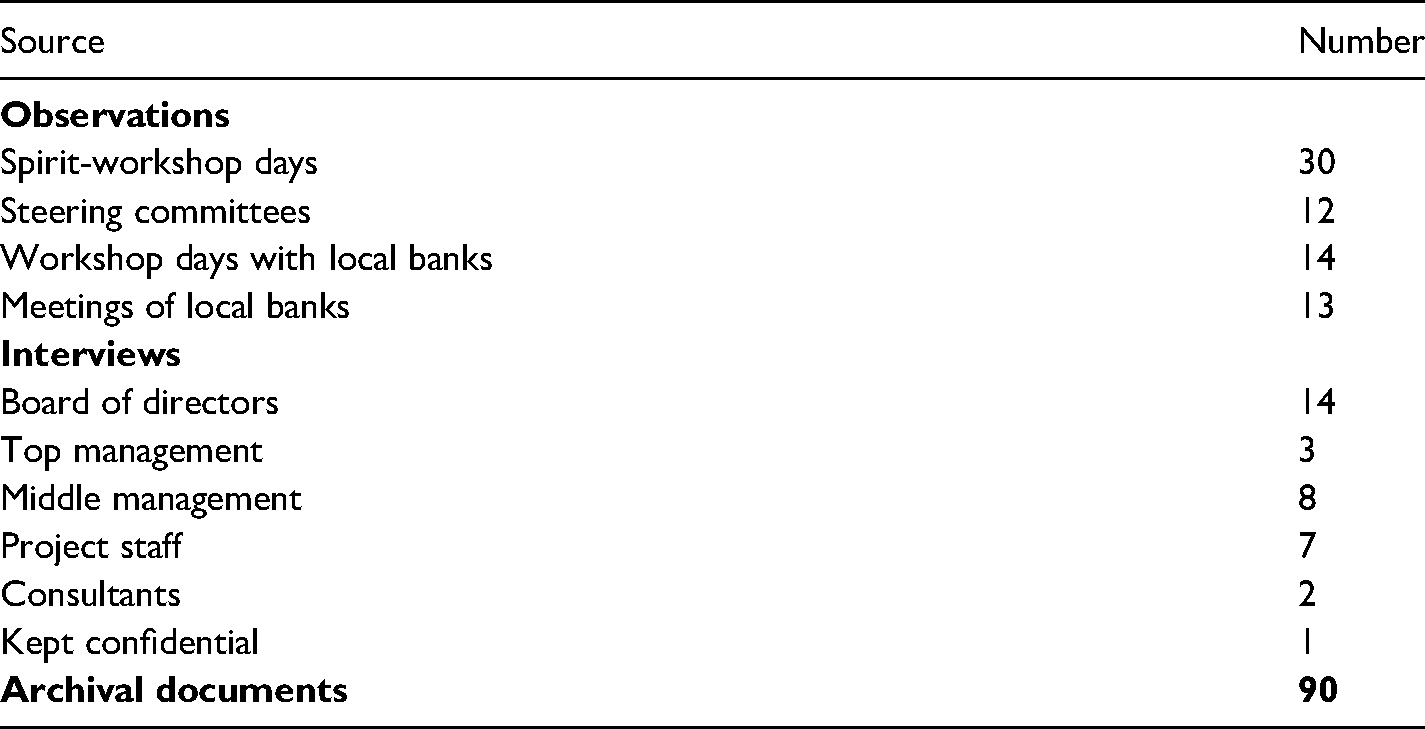
In addition to observing the interaction between the FED and the participating banks, we also followed seven of the banks more closely, observing 14 workshop days and 13 meetings. Each bank meeting lasted approximately two hours. The seven banks were representative of the COOP local bank size range and geographically dispersed throughout Germany. Moreover, we conducted 35 semi-structured interviews with leaders and employes across different levels of FED and seven banks about FED leadership and FED's interaction with them. All interviews were recorded and transcribed. Furthermore, we granted broad access to documents. In total, we analysed 90 documents, including all documents related to the Spirit project, the FED charter, and diverse meeting protocols.
Our analytical approach follows a reflexive methodology (Alvesson & Sköldberg, 2009), which does not strictly separate the collection and analysis of data. That is, “data collection, data analysis, and conceptual development [proceed] iteratively” (Denis et al., 2000, p. 1069). To develop the theory from our case study, we followed a narrative strategy, making sense of our data by thick descriptions (Langley, 1999; Pentland, 1999) of, for example, the Spirit project, a project for developing the COOP-Customer Consulting Plan, and strategic project meetings. We structured our data, developed different concepts, and reconstructed their dynamic relationships (Gioia et al., 2013). Moreover, by iteratively conducting field research, reading literature, making thick descriptions, and coding our data, we developed a data structure showing our concepts, which we reflected and linked in their dynamic relation. We started with a larger number of leadership practices, dimensions of legitimacy, and other concepts; changed our theoretical lens; selected and redefined leadership practices and other concepts; and reconstructed the relationship between them. While this approach obviously helped us conceptually structure the data, its limitations are obvious when it comes to temporally linking data (Berends & Deken, 2021). Therefore, by presenting some of the findings upfront and displaying the link between the process data and process theory, we hope to maintain temporal coherence.
Within the research team, we were able to reflect on and discuss our observations and possible interpretations, regularly and critically. To develop a collective understanding of how, under limited formal and informal power, leadership legitimacy is constantly created and recreated over time, we repeatedly evaluated all observation data and interview transcripts. At the end of this process, based on evidence, we selected the concepts and dynamics that were essential to answering the research question of this study. The next Section presents the findings.
Findings: Enacting and Re-Enacting Leadership Legitimacy in a Heterarchical Network of Organizations
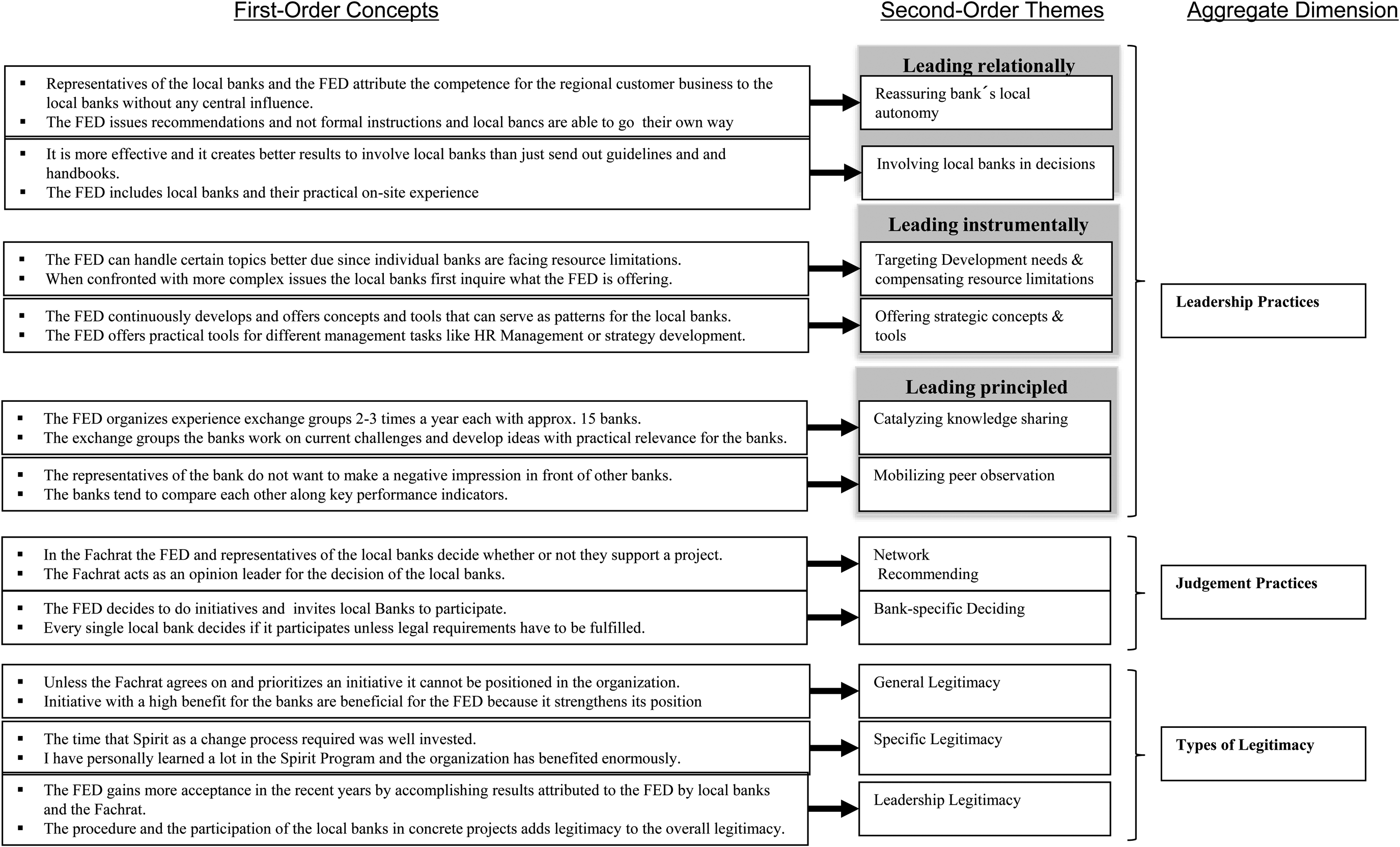
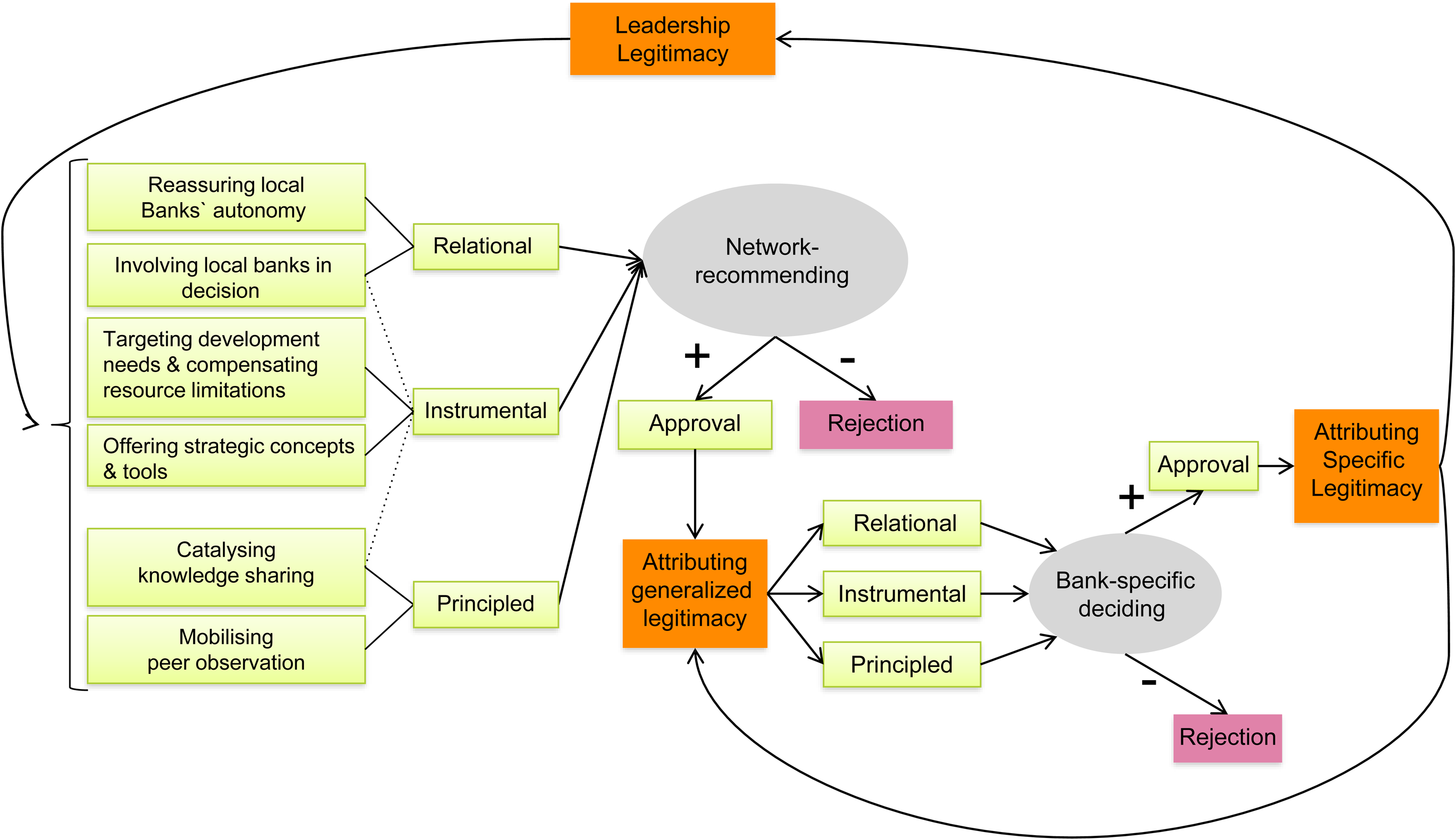
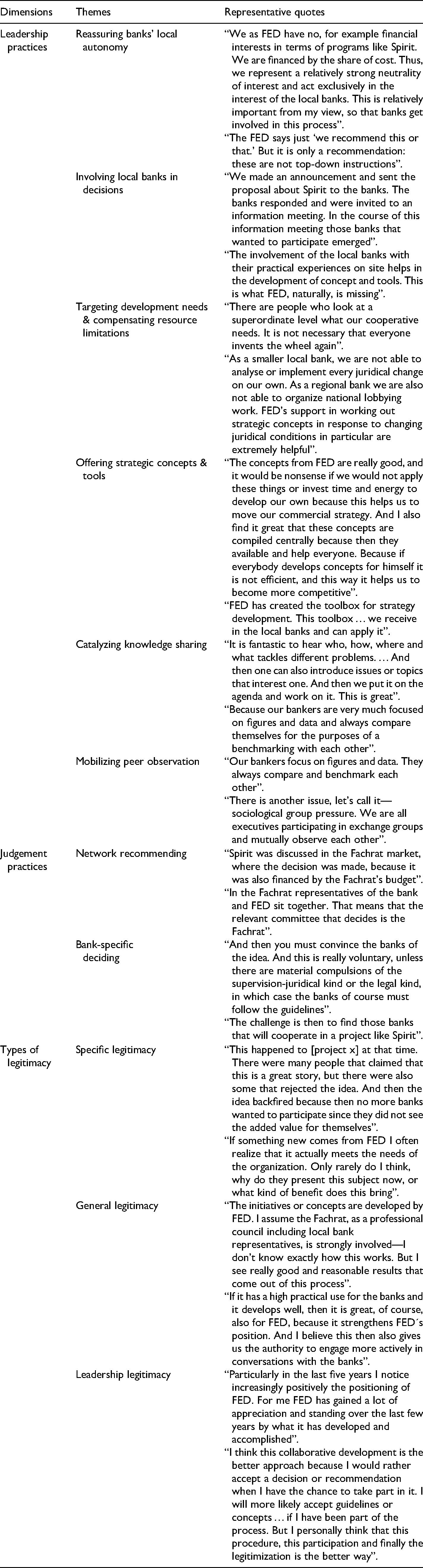
As stated previously, the FED held only limited formal and informal power over COOP's local banking organizations. Only if individual banks did not follow legal requirements or did not conduct their business in line with the FED's financial and liability provisions had FED statuary possibilities and obligations to act by, for example, asking for restructuring measures or adding personnel to the management board to avoid financial burdens on the system. In the following subsection, we describe and analyse the practices the FED applied in interaction with local COOP banks to co-create inter-organizational leadership legitimacy. To support the narrative, we depicted how we structured our data and developed concepts (see Figure 1), data supporting our interpretations and conceptualization (see Table 2), and a process model (see Figure 2), thereby putting our concepts in a dynamic relation.
Data structure.
A model of (re)enacting leadership legitimacy under terms of limited formal and informal power in a heterarchical network of organizations.
Data Supporting Interpretations of Second Order Themes.
Legally and economically independent individual local banks primarily characterized COOP's inter-organizational network structure. On one hand, COOP was built on the principle of subsidiarity and the autonomy of its members. Entrepreneurial responsibility for local market cultivation rests with local banks. On the other hand, in 2004, COOP banks voted (with the necessary 75% quorum) to grant FED the task of developing concepts, tools, and manuals for the entire banking group including 1150 local banks. Fed became a “strategic competence centre”, that should pursue this task, but “without limiting the autonomy of the strategic orientation of each individual bank”, as indicated in the organizational charter of FED. Although FED still had almost no formal or informal power to assert the direction of activities in the network despite opposition, FED became, in general terms, a network administrator aimed at dealing with problems of the network and its members and reducing the complexity the network faced.
Five years after the quorum in 2004, despite the recognized quality of the FED's work, not only the FED itself but also the local banks felt a lack of impact. As one manager stated, ‘We are missing the pragmatic implementation of what FED is developing….If you receive a manual of 140 pages, what are you going to do with it? Moreover, the FED increasingly realized the need to develop the change capacity and managerial competence of local banks. This ultimately led to Spirit, a management development project for developing the top management of local banks.
Leadership Practices
Analysing how FED, together with local banks, (re)enacted leadership legitimacy in COOP's heterarchical context revealed three categories of leadership practices: leading relationally, leading instrumentally, and leading principled.
Leading Relationally
The first category of leadership practice included specific practices concerning the relational dimension of legitimacy. This dimension included the perception that the FED's cooperation and interaction within COOP (re)affirmed the autonomous role of the banks, treated the banks with respect, and appreciated their competence in local business. We refer to the first practice in this category as reassuring the autonomy of local banks. Indeed, through its communications, FED constantly reassured the local banks of their autonomy and openly indicated its appreciation of the sovereignty of each bank as one FED manager expressed: “We as FED have no, for example financial interests … we represent a relatively strong neutrality of interest and act exclusively in the interest of the local banks”. By explicitly expressing that it held almost no formal or informal power over the local COOP banks, the FED emphasized this autonomy as a part of a unique inter-organizational culture. As a member of the FED top management stated, “Interactions are based on equal terms”.
This practice became obvious during the Spirit Project. For example, during the preparation stage (including the first module), FED organizers emphasized that banks could opt out of the pilot, three of the 20 participating banks did so. Local banks’ autonomy is also traceable to bank managers’ attitudes. As one said, ‘I do not have to [participate in FED projects]. They clearly have to promote it, and I need to have a sensation that I like what they are offering and that it fits [my bank].
As previously indicated, both the independence and autonomy of banks were anchored in the inter-organizational structure of the COOP. However, by actively emphasizing these principles, the FED ensured that banks that decided to participate in FED projects were constantly aware that they did so of their own volition. Thus, this practice reduced the potential for opposition and increased the likelihood of banks adhering to their commitments.
The second leadership practice of the leading relational category, a practice we call involving local banks in decisions, focuses on keeping many banks involved in the COOP's decision processes. All banks were legal members of the cooperative and collectively held the most votes in the annual meetings. Moreover, a Fachrat—a committee in which representatives of local banks hold the most seats—headed each FED department. Thus, by incorporating representatives of local banks into the decision-making processes, the FED strongly influenced the perceptions and acceptance of the project. One manager of the local banks stated, “For me, the responsible persons are real COOP bankers too!”
For example, before the launch of the Spirit project, presentations and discussions in the “Fachrat market” aimed to receive feedback and ideas for improvement, particularly from local bank representatives on the committee. Local bank managers in Fachrat tended to carefully weigh the arguments and not lose sight of local banks’ situations. Since they knew that all FED projects practically required the banks’ support a formal local bank manager revealed the local banks’ appreciation for the cooperation: “In terms of strategic leadership we realize more and more that FED is providing good guidance here”.
Leading Instrumentally
The second category of leadership practices includes those concerning the instrumental dimension of legitimacy, that is, practices facilitating the goal attainment of COOP and individual banks. The first leadership practice in the leading instrumental category is what we call targeting development needs and compensating for resource limitations. The FED distinctly targeted development areas in the overall COOP network, particularly local banks. These were often areas in which local banks, due to their size, did not have the necessary resources. Moreover, even though the local bank managers were proud of their self-reliance, they acknowledged that today's banking industry was too complex for small organizations to survive on their own. As one CEO of a local bank commented, ‘We are a bank with a total of 100 employes. We cannot autonomously work on all the topics that affect us. Thus, we need to rely on FED support.
Small banks were unable to develop their own systems and practices in response to regulatory challenges, such as increasing consumer protection laws or money laundering regulations. Moreover, they faced various additional challenges that were difficult to handle, such as rising competition from Fin-tec and other developments in the context of digitalization. Instead, they were primarily occupied with developing new strategic marketing approaches and campaigns to manage their local markets and customers.
The COOP network is aware of the discrepancy between local banks’ capabilities and the requirements of the fast-changing financial sector. Therefore, it used a model of shared entrepreneurship in which the smaller banks concentrated on cultivating their market, and the FED put its resources where the local bank's capabilities were limited. As an FED manager indicated, FED built its core expertise in areas where “local banks have no chance to formulate [strategic concepts] for themselves, in the way FED can do it for them”. Thus, a management development project for top managers of local banks could only be organized by the FED. Confronted with this or other complex issues, local banks usually first asked whether the FED offered any relevant projects.
The second leadership practice in the leading instrumental category is what we call offering strategic concepts and tools. This practice focused on the continuous development of concepts and tools that the FED offered to local banks. These offerings included HR management tools, strategic management concepts, and various checklists for management issues, such as customer analysis and customer segmentation. Most concepts included operational tools that the banks could directly use, ranging from project plans to marketing pamphlets, customer questionnaires, or tailor-made software updates facilitating implementation within each bank.
Because the purpose of these practical tools was to enable the banks to implement the FED's overall strategic concepts, and because the banks appreciated the FED's work, the obvious lack of implementation was the springboard for the Spirit project, during which diverse topics such as strategising, change, complexity, and HR management were addressed. One bank manager voiced his perception of the FED's offerings: “There is a great multitude of offerings [from FED] that come up, and not everything … comes at the right time for us…. But … there are always important suggestions that we can make use of [now or later].”
Therefore, banks chose on their own from the variety of concepts that the COOP organization offered them as the output of a usually intensive cooperation between the FED and local bank representatives in the Fachrat. Rather than aiming for a 100% adoption rate of the concepts and tools it offered, FED supported a range of options for the 1,100 local banks by offering a portfolio of modular concepts that had the approval of Fachrat and were likely to find resonance in each bank.
Leading Principled
The third category of leadership practices includes practices concerning the principled dimension of legitimacy, that is, practices consistent with COOP's or the individual bank's principles and ethical values. For COOP, the content of the principled dimension of legitimacy judgements is related to the origins of the cooperative, which was created to achieve more by voluntary cooperation, thereby strengthening the independence of its members. Self-help, personal responsibility, and self-government are the basic principles of the COOP network.
The first leadership practice of the leading principled category is what we call catalysing knowledge sharing among COOP members. For example, the FED organized experience exchange groups two or three times a year, each with approximately 15 banks. Within these exchange groups, banks worked on current challenges and developed ideas with practical relevance. This kind of support for knowledge sharing existed throughout the COOP organization and in nearly all of the FED projects, even if the knowledge-sharing activities themselves were mostly unrelated to the projects themselves.
One case in point was the Spirit project, whose primary goal was to focus on the problems of retail banking. Nevertheless, substantial time was spent on general inter-bank knowledge sharing during the pilot project. Such activities were familiar to Spirit participants, as each bank had previously participated in various knowledge-sharing groups and regularly engaged in discussions with other COOP banks.
These knowledge-sharing groups substantially influenced COOP's legitimacy processes in two ways. First, as they had a chance to influence COOP via participation in committees such as the Fachrat, these groups supported the formation of political will within the COOP banking group. Second, knowledge-exchange groups serve as multipliers for FED projects. In several cases where banks adopted FED concepts, including Spirit, responsible personnel stated that they were convinced to do so by earlier adopters whom they had met in local knowledge-sharing groups.
The second leadership practice in the leading principled category is mobilising peer observation. On the one hand, it emerged from banks’ tendency to compare themselves with one another along key performance indicators. On the other hand, the representatives of local banks did not want to create a negative impression of other banks. Thus, when representatives from different banks came together, as during the Spirit project, they tended to compare their ways of operating with their own successes. Within Spirit, this practice became particularly obvious in their presentations on change projects, during action learning sets, and in discussions of different market approaches. Moreover, their individual decision to participate in Spirit was partly due to the participation of (other) banks, which they viewed as attractive peers. Often, comparative practice itself influences future decisions. As one banker said, “There is, of course, a certain peer pressure if one bank deviates too much from the way other banks handle certain challenges”.
COOP mobilizes this peer observation by regularly publishing and distributing benchmarks and performance indicators. Thus, bankers showed a relatively deep understanding of the areas in which they outperformed their peers, or others outperformed them. Moreover, while some characteristics can be traced back to the local conditions of specific banks, in general, the mutual observation process increased comparisons and contrasts among the banks. Some bank managers even sought further support from the FED in areas where their performance did not match that of comparable banks. Thus, leadership practices, as practiced in Spirit, included mutual peer observations that made banks aware of possible weaknesses, thereby increasing the likelihood that they would turn to the FED for strategic advice.
Judgement Practices
COOP as a network showed two practices that characterize the decision-making process between the different parts of the COOP and made up COOP's leadership as a collaborative form of leading on courses of action. These two different practices, which we call organization-wide recommending and bank-specific deciding, build upon one another.
Network Recommending
The first judgement practice consisted of network recommending carried out by particular committees (e.g. the Fachrat), in which representatives of the regional banks and FED decided on projects that they considered helpful and recommended to the network. If the Fachrat decided that a particular idea was good, it supported that idea by issuing a recommendation, and if necessary, granting the required budget. Thus, the committees acted as opinion leaders in the decisions of over 1,150 local banks. For the Spirit project, FED representatives first developed the idea and then presented it to the Fachrat Market. The Fachrat agreed to support Spirit, particularly because it was aware of the local banks’ limited capacity to implement the various concepts and tools offered by the FED. As one FED manager noted, “The relevant committee that decides if you can do something like Spirit is the Fachrat”.
However, Fachrat's decision to support the Spirit project by approving it and providing a budget did not necessarily mean that Spirit would take place. “But to implement this kind of project among our 1,150 banks”, said one FED manager, “is a true challenge … and that really depends on the voluntary nature of each individual bank's decision”.
Bank-Specific Deciding
The second judgement practice, bank-specific decisions, is vital to the decision-making process in COOP. After the discussions and recommendations about Spirit in Fachrat, local banks were informed of Fachrat's decision. However, unless a project entailed legal or regulatory issues, the final decision to participate was made by the individual bank. In the case of Spirit, the banks were invited to a kick-off, informing them in detail about the project and its benefits. Most banks particularly appreciated that Spirit was their ability to communicate on equal terms with FED, the possibility for relationship-building with FED, and the opportunity to influence upcoming FED concepts, as well as networking and mutual exchange with other banks.
Nonetheless, local bank reactions ranged from spontaneous approval and enrollment to statements of lack of understanding and demonstrations of little interest. Even during the first module, some banks left the project because they were not convinced of Spirit's usefulness to their individual banks.
By providing concepts, tools, or projects such as Spirit in areas where banks were not able to develop their own solutions, the FED was able to influence local banks. As one bank manager explained in an interview, “In challenging projects … I always look first [to see] what is already there in the FED toolbox. Why should I create the tool myself if it already exists?” The existence of such practical tools made it easier for banks to follow the FED's strategic advice and made expensive local solutions unnecessary. Therefore, local banks often chose to follow Fachrat's recommendation when FED offerings promised to be useful for local banks, when they felt that FED acknowledged their competence with respect and appreciation, and when FED treated them in the spirit of COOP values.
Types of Legitimacy
Three different types of legitimacy emerged as collaborative agencies in deciding on courses of action within the COOP. Zooming in on the process made it clear that the overall legitimizing process consisted of two phases—which we call generalised legitimacy and specific legitimacy—from which leadership legitimacy as an ex-post attribution to the organization's leadership finally resulted.
Generalized Legitimacy
The first type of legitimacy was generalised legitimacy, which COOP established through its committees through the approval and support for projects like Spirit. Within the committees, the active support of the participating bank representatives was key because by approving the central projects, the committees exerted strong support for FED projects. As a COOP manager stated, “I believe that by the work of and the cooperation in COOP's committees, it is now guaranteed that we are focusing more on the relevant challenges than we have done in the past”.
The first phase, which took place at the overall inter-organizational level and, in the case of committee approval, for a particular project, led to the mobilization of attention, as with the Spirit project. In its decision to recommend a project, the committee drew on the instrumental, relational, and principal dimensions of leadership practices. Thus, practices that addressed the instrumental, relational, and principal expectations of the committee were more likely to make the committee approve of a project.
On the one hand, the Fachrat was essential for a project like Spirit, because unless the Fachrat approved and supported such a project, the organization could not offer it. On the other hand, even for Spirit to garner the Fachrat's approval was not enough because that approval still did not guarantee that individual banks would participate. Nevertheless, that approval made it more likely that banks would join the project and be disposed of favorably. Conversely, if Fachrat suggested projects that provided a high benefit for the banks and that the COOP network saw as beneficial, these projects would strengthen Fachrat's legitimacy. As a Fachrat member said, “I cannot tell you about an exact number like eight out of ten, but my feeling is that the vast majority of the recommendations that the committees suggest are really useful and relevant”.
Specific Legitimacy
The second type is specific legitimacy, which emerges from an individual bank's decision to consider both FED activities and a committee's recommendations for their course of action.
In the case of Spirit, the banks appreciated FED's both emphasizing the banks’ local autonomy and involving the banks in their decision-making. Thus, together with local bank approval, the FED, the Fachrat, and local banks collaboratively created specific legitimacy. However, the pivotal points in accomplishing specific legitimacy are banks’ judgments concerning the principled, relational, and instrumental dimensions of FED projects. By voluntarily using FED tools, for example, for strategy development, local banks acknowledged the legitimacy of FED's work.
However, local banks’ decisions against Fachrat's recommendation could also have a delegitimising impact, as became apparent when the initial invitation to the Spirit project announced that Spirit's outcome for the banks would consist of strategies for local banks’ private banking business. This attempt to instrumentally legitimise the Spirit project did not indicate that the project was even more (and perhaps primarily) focused on the development of local banks’ management capacities. This broader focus subsequently led to irritation among local banks during the early stages of the project. As one FED manager reflected, Obviously we need to work on the communication so that we can avoid the ambiguous expectations from the participants in the sense of ‘I go to Spirit and at the end I receive a package that entails successful strategies in the private banking business’. However, despite this initial irritation, the project was able to recapture legitimacy. As one participant stated, ‘In hindsight I have to admit that it was good that we stayed with Spirit because it has helped us a lot.
Leadership Legitimacy
The third type of legitimacy was leadership legitimacy, that is, the local bank's attributing validity to COOP's collective leadership practices and FED's informal role as a strategic lead organization while maintaining its formal role as a strategic competence center supporting the network with tools and concepts. As one manager of a local bank reflected, ‘In terms of strategic leadership, we realize more and more that FED is providing good guidance here. The FED established a strategic leadership role in COOP.
Moreover, leadership legitimacy was characterized by the absence of local banks’ questions regarding COOP's form of leadership. Rather than comprising the dimensions of substantive content, leadership legitimacy comprised social cues, such as the taken-for-grantedness of an inter-organizational decision-making process. One member of the board of directors said, ‘Over the last four years, I increasingly perceive how FED in general has positioned itself. By what the FED has been doing, it has enhanced its role and status in the bank's perception. Remarkably, this type of legitimacy within COOP was not attributed to a single organizational unit or person but rather to the way in which the different parts of the organization had accomplished a mutual understanding of how these different parts collaboratively practiced leadership over time. One COOP manager said, Why do we currently have a COOP finance plan [a particular approach to customers]? Because some people have thought ahead, sometimes methodically/conceptually, have tested the finance plan with single banks and together have continuously developed it further and established it network-wide with the help of a committee like the Fachrat. Certainly, communication is pivotal here.
Local bank managers’ experiences in the COOP showed that leadership legitimacy needed to be created and recreated during concrete projects or routine work, such as the COOP finance plan or Spirit. However, because leadership legitimacy transcended the individual project, it was attributed to an overall inter-organizational leadership practice—in the case of COOP, a cooperative, participative approach. As one bank manager summarized, In general I think this is the better course of action, this cooperative approach where I have contributed and used my room to maneuver. I think this approach, the participation, and the legitimacy that comes out of that is much better.
Discussion
In this study, we asked the question: How can an organization enact and re-enact leadership legitimacy in a heterarchical network of organizations, under terms of limited formal and informal power? In response, we applied a practice-theoretical lens to a single case study of a German banking cooperative and developed a process model of (re)enacting leadership legitimacy under limited formal and informal power in a heterarchical network of organizations. The model depicts six leadership practices unifying relational, instrumental, and principled “substantive beliefs and perceptions” (Tost, 2011, p. 690) of the banking network and how they stepwise influence practices of judging (i.e. recommending and decision-making), thereby attributing informal leadership legitimacy to the network administration organization (FED) and re-enacting formal leadership legitimacy of the other network members (individual banks). In this process, network members enacted and re-enacted the collective leadership of all network members, separated into informal and formal leadership. In the first step, organization-wide recommendations constitute the general legitimacy of concrete activities and projects. In the second step, the recommendation either does or does not influence bank-specific decisions constituting the legitimacy of these activities and projects. Applying this two-step approach, the overall organization collectively constitutes an ex-post leadership legitimacy that, in turn, affects the impact of future leadership practices and legitimacy judgements of future activities and projects. We now discuss the main contributions of our findings, as depicted in the process model: three theoretical and two practical implications of our results. We then reflect on the limitations of our study and offer recommendations for future research.
Implications for Theory
First, our study advances the understanding of leadership legitimacy in the heterarchical networks of organizations. Many studies provide insights into leadership by lead organizations in hierarchical structures (Batterink et al., 2010; Nambisan & Sawhney, 2011; Sydow et al., 2015). Others examine collective leadership by all organizations in heterarchical networks, the role of administrative network organizations in operatively coordinating a heterarchical network, or leadership by a group of organizations with formal legitimacy to lead the network (Boari & Lipparini, 1999; Kenis et al., 2019; Mitterlechner, 2019, 2020). These studies provide insights into how organizations fulfill their roles in a network and effectively lead the network. In other words, these studies explain how organizations sustain their formally attributed legitimacy in doing something (e.g. leading a network, collectively leading a network with other members). (Müller-Seitz & Sydow, 2012) show how a firm can achieve and sustain leadership legitimacy without formal power in a certain network by mobilizing its formal power in another network and its informal power based on resources and market position to direct activities in the network where it does not have a formal leadership role. This study provides insights into how a firm equipped with informal power can enact an informal leadership role.
Our study extends previous research by explaining how an organization can enact and re-enact leadership legitimacy in a heterarchical network under terms of limited formal and informal power. More specifically, it shows how all members of a network enact and re-enact the informal leadership legitimacy of a network administrator and formal leadership legitimacy of other network members through leadership practices attributed to an administrator and practices of judgement by other network members. Thus, our model provides important insight into how leadership legitimacy can be achieved. Furthermore, it challenges previous research that clearly associates leadership actions with leadership roles, and stresses the importance of examining messier constellations of formal and informal structures and processes in praxis.
Second, we contribute to the understanding of leadership legitimacy in organizational networks as a multidimensional phenomenon. While previous research on organizational networks provides insights into leadership legitimacy (Müller-Seitz & Sydow, 2012; Sydow & Windeler, 1998), and research on dimensions of legitimacy examines a broad range of entities that are legitimized (Deephouse & Suchman, 2008; Tost, 2011), we could not find a study that considers the interplay of multiple dimensions of legitimacy in the examination of leadership in networks. Our study addresses this shortcoming and provides a nuanced view of the dimensions of enacting leadership legitimacy in organizational networks as collaborative accomplishment by practice. More specifically, our model shows that not only do certain leadership activities and projects affect judgements of legitimacy or legitimization, but that leadership practices also make concrete meaning of abstract beliefs and perceptions, thus directing the activities in a network. Our process model explains leadership legitimacy as the result of a process that is constituted by concrete practices that actualise the relational, instrumental, and principled content of legitimacy. These are the first important insights into the dimensions of leadership legitimacy in organizational networks that can be refined by future research.
Implications for Practitioners
From a practical perspective, our study makes two important contributions. First, our case and model offer a better understanding of the challenges of leading, changing, and influencing networks of organizations, including their subtle relationships of mutual dependencies (Wimmer, 2010). Showing the existence of concrete practices that allow the co-creation of leadership and leadership legitimacy far from top-down processes, we hope to inspire practitioners striving to combine the advantages of a decentralized structure with an informal leadership role. The six leadership practices we have identified—reassuring banks’ local autonomy, involving local banks in decisions, targeting development needs and compensating resource limitations, offering strategic concepts and tools, and catalyzing knowledge sharing and mobilizing peer observation—can serve as an inspiration for practitioners to constitute and recreate leadership as a collaborative agency. This understanding of leadership has implications beyond the context of pure heterarchical organizations. More generally, our insights can inspire practitioners to think and act differently in challenging leadership contexts, such as matrix organizations (Hall, 2013) and hierarchical complex multinational corporations (Hedlund, 1986).
Second, our findings have implications for management development. The ability of an organization such as the COOP to develop leadership practices that support the co-creation of leadership legitimacy is crucial for management and organizational development. According to Pearce and Conger (2002), a training agenda for a distributed form of leadership should incorporate elements, such as approaches to responsible and constructive leadership in groups and skills that influence complex organizational contexts and teamwork skills. As all these elements are related to the leadership practices that we have identified, we understand these practices as a medium of collective reflection. Moreover, our research suggests a stronger focus on creating awareness among organizational actors for elements such as appreciating autonomy or individuality, fostering mutual exchange, and considering peer-to-peer processes as ingredients for the co-creation of leadership legitimacy.
Limitations and Future Research
A limitation of our study is the single case study design and the particular inter-organizational context of COOP as a cooperative, which raises questions about the generalisability of our findings. Thus, future research might explore how leadership as a collaborative agency is (re)created in other inter-organizational networks as well as within the boundaries of one organization. Furthermore, as our interviewees evaluated the overall Spirit project as an inter-organizational success enabling the creation of legitimacy, research exploring the creation or loss of legitimacy in less favorable contexts would be highly useful.
Conclusion
In today's society undergoing large-scale changes, where demands on organizations are increasing, even competing firms collaborate to address these demands, and organizations are joining forces to contribute to the management of societal challenges, it is becoming increasingly important to better understand organizational networks. This study contributes to a better understanding of organizational networks by showing how an organization can enact and re-enact leadership legitimacy in terms of very limited formal and informal power in a heterarchical network of organizations. In this way, we advance our understanding of how organizational networks can be led. Our hope is to inspire future research and practitioners facing the challenges of leading an organizational network.
Footnotes
Appendix
Interview guide
Introduction: Short presentation of the project and interviewer, the interviewee, and his or her bank Spirit Project
What was yours and your bank's expectation towards Spirit? How was the bank involved in Spirit? What was Spirit´s outcome for the bank? How do you evaluate Spirit? Volksbanken/Raiffeisenbanken Organisation
How do you and your bank experience the FED organization? How does FED play its role as a strategic competence center despite its lack of formal power? How do the regional structures in COOP act? How would you describe their role in the coop organization? How does exchange take place between local banks (e.g. knowledge exchange groups)?
Declaration of Conflicting Interests
The author(s) declared no potential conflicts of interest with respect to the research, authorship, and/or publication of this article.
Funding
The author(s) received no financial support for the research, authorship, and/or publication of this article.
