




Abstract
This article examines the social processes of political leadership in situations of contest and conflict, taking place within a key and long-established democratic institution, the UK Parliament. The empirical focus is on leadership in House of Commons select committees, which are concerned with holding the government to account. Headlines and media scrutiny, combined with internal challenge from the cross-party mix of politicians on the committees and a range of external stakeholders, create leadership challenges for committee chairs. The study is of two committee inquiries led by the same committee chair, which occurred concurrently and in real time, thereby providing a rare comparative study of leadership through the same leader at the same time but with different leadership challenges. Rather than shying away from conflict, as does much of the leadership literature, this research highlights how leaders who actively engage in challenge and conflict can build a degree of shared purpose among diverse groups of stakeholders. It examines and combines, in theory elaboration, two theories relevant to understanding these leadership processes: agonistic pluralism with its role in creating respectful conflictual consensus, and the theory of sense-making and sense-giving. The two cases (the two inquiries) had different trajectories and reveal how the chair recognised and dealt with conflict to achieve sense-making outcomes across divergent interests and across political parties. There are implications not only for understanding political leadership but also more widely for leadership where there are diverse and sometimes conflicting interests.
Introduction
This article examines theory and empirical research about leadership, agonism and sense-making where leaders are working in a context of contest and conflict. The article provides a detailed empirical study to explore the theoretical issues raised in a distinctive research design which examines leadership processes across concurrent cases with the same leader but with very different outcomes. The cases illustrate some of the complexities and dilemmas of leadership linked to handling contested issues in rapidly moving political settings.
This is a critical juncture at which to be studying political leadership. There is a crisis of public confidence and trust in political leaders, both as individuals and as a class (Hartley and Benington, 2011; Stansfield, 2016); the mythology of strong leaders abounds and is deeply damaging to democracy (Brown, 2014) and some ‘solutions’ to societal crises have been expressed through populist leadership across a number of Western democracies (Crosby and Bryson, 2018). This article addresses the call by the editor of Leadership for more studies which ask ‘challenging questions about important issues’ (Tourish, 2015: 139). We hope that this article will contribute to a greater understanding of political leadership processes as well as have wider relevance for leadership theory more generally.
Leadership is enacted in public settings by a variety of different actors, both state and non-state (Hartley, 2018), and this particular study is concerned with political leadership, as exercised in a key institutional setting, that of UK Parliamentary select committees. Much research into leadership draws on generic leadership theory and has downplayed inherent conflicts within leadership processes (as noted by Collinson, 2005; Hartley, 2017; 2018;). On the other hand, theorising about leadership from political science has tended either to focus on individuals (as revealed through biography, Shamir et al., 2005) or to focus on how institutional structures constrain leadership. Political science is also somewhat ambivalent about the concept and practice of leadership due to the scholarly wariness about the risks of leadership in democracies (Ruscio, 2004). Critical leadership theory about politicians is less widespread than might be expected, though there are important exceptions (e.g. Brown, 2015; ‘t Hart, 2014).
This article aims to address that theoretical gap by drawing on both generic and political leadership theory and examining leadership processes where contest and conflict are ubiquitous. The research takes place at the heart of UK government, its national parliament. Steeped in history, tradition and institutional processes, this political context imposes constraints on, and offers opportunities for, leadership. Notably, since 2010, following the Wright reforms, select committees have become more dynamic (Kelso, 2016), with greater opportunities for select committee chairs to exercise leadership. They have become increasingly important as a means to hold the government to account.
Of particular interest in this article is whether and how leadership in this context involves active engagement in agonistic pluralism and therefore challenge (Mouffe, 2005). Agonism is a theory which recognises the existence of conflict within liberal democratic regimes (Mouffe, 2000b) and suggests that there are ways in which this conflict can be channelled constructively. This can be seen as a leadership task, though Mouffe does not analyse leadership as such. As to how such conflict is channelled, this article deploys sense-making and sense-giving (Maitlis, 2005; Weick, 1995) to understand leadership in a context of divergent interests among stakeholders.
These two theoretical lenses, in combination, provide a novel perspective on the social processes of political leadership, well-grounded here in empirical research. Rather than assume that the social processes of leadership are necessarily collaborative, it illustrates that processes and outcomes of leadership can involve ‘conflictual consensus’ (Mouffe, 2005). The article argues that these processes are also more widely applicable to leadership in managerial or wider organisational contexts, given the existence of complex or ‘wicked problems’ (Rittel and Webber, 1973) and the existence of multiple stakeholders with divergent values, goals and interests.
This article proceeds as follows. Firstly, the literature on leadership, on agonism and on sense-making and sense-giving are examined in order to identify key theoretical insights and understandings relevant to political leadership. This leads to the formulation of the research question about how select committee chairs exercise leadership in the context of contest and conflict. The following section introduces the empirical research starting with, a brief introduction to UK select committees and their institutional context in order to set the scene for the interplay between leadership and institutional constraints and opportunities. The research design and methods are explained, noting the particular value of two concurrent select committee inquiries which shaped and were shaped by leadership processes, both similar and contrasting. The findings examine in detail the leadership processes in each inquiry (case) and draw out insights about the exercise of leadership in the context of contest and conflict which led to very different outcomes. The discussion analyses the leadership processes and shows how the agonistic pluralism and the sense-making approaches help in the interpretation of leadership processes but also how this article uses these theories in combination and extends them.
Leadership, agonism and sense-making
Leadership has predominantly been assumed, in generic leadership theory, to be a process which involves social mobilisation around common goals or a sense of shared purpose (Kempster et al., 2011; Kouzes and Posner, 1995; Stein, 2017) and this ontology has been critiqued by a number of leadership scholars (Drath et al., 2008; Hartley, 2017). Furthermore, Collinson (2005, 2014) highlights interdependencies between leaders and so-called followers, offering opportunities to pay attention to ‘the importance of deep-seated tensions and contradictions in relations based on opposing but interdependent forces that produce conflict and change’ (Collinson, 2014: 41). Political leadership increasingly recognises tensions, complexities and challenges of leadership (‘t Hart, 2014), and within generic leadership theory, there is a small literature which recognises that challenge and contest can be integral to leadership in organisational as well as formal political settings (Hartley et al., 2015; Heifetz, 1994).
Burns (1978, 2005) viewed purpose and conflict as fundamental and complementary aspects of leadership. Inherent within his argument is the assumption that leadership is grounded in a seedbed of conflict, and he advocates that leaders ‘shape as well as express and mediate conflict’ in order to lead effectively by ultimately achieving ‘collectively purposeful causation’ (Burns, 1978: 434). ‘t Hart (2014) notes that a key tool for public leaders is to be able to generate conflict as well as keep it in place and find ways to capitalise on it constructively while avoiding its dysfunctions.
Mouffe (2005) accounts for the conflictual forces at play in the daily enactment of political processes in national legislative settings in her theoretical argument for recognising and containing conflict within an agonistic model of democracy. Agonism, she argues, is the constructive enactment of conflict which can be contained within a political regime (such as liberal democracy) and enacted in institutional arenas, such as a national parliament or senate. She explains it as follows: ‘Antagonism is struggle between enemies, while agonism is struggle between adversaries. We can therefore reformulate our problem by saying that, envisaged from the perspective of “agonistic pluralism”, the aim of democratic politics is to transform antagonism into agonism. This requires providing channels through which collective passions will be given ways to express themselves over issues, which, while allowing enough possibility for identification, will not construct the opponent as an enemy but as an adversary’ (Mouffe, 2000a: 16).
Mouffe (2000a, 2000b, 2005) distinguishes this form of political process from ‘post-political’ views of politics which assume that political decisions can be won through creating a full consensus, winning people over through purely rational argument and ignoring the differences in interest, identity and values which exist in society. She also differentiates agonistic pluralism from ‘deliberative democracy’, which she argues, underplays the role of emotions and identity in addressing differences of interest. Instead of eliminating emotion from debate, she thinks passions can be mobilised towards democratic ends. In her view, a well-functioning democracy invites and channels ‘a vibrant clash of democratic political positions’ (Mouffe, 2000a, 2000b: 104). Mouffe advocates that inherent conflict or agonism should be recognised and played out through adversarial political engagement and debate demonstrating that it ‘must have a partisan character’ (Mouffe, 2005: 6). Parliamentary or senate conventions and political parties usually contain this conflict as all sides recognise the same traditions and rules, particularly in contested situations where, Mouffe argues, the counting of votes determines the outcome and indicates who has won the battle. There is likely to be antagonism at times, but this should be channelled into constructive agonism as much as possible.
Mouffe’s arguments about political systems are expressed at a high level of philosophical and political science abstraction. They are also normative in expressing a preference for a particular approach for displaying and deploying conflict. However, one does not have to accept the normative element to perceive the value in conceptualising politics as a struggle between adversaries. This is, in a sense a ‘team of rivals’ approach to politics (cf. Goodwin (2005)), with all the inherent paradoxes in that phrase. Agonism, we suggest, has particular relevance for understanding the leadership of select committee chairs because it involves chairing a group of politicians who have to work together over long periods of time to produce agreed inquiries and reports which are in the public domain, so there is a need for them to be able to respect each other enough to work together, despite differences of party, ideology or interest. On the other hand, select committees have members from the various political parties in Parliament, so there are likely to be political struggles and indeed point-scoring over meaning, evidence and its interpretation from witnesses and in the writing of reports. Consequently, Mouffe’s work is particularly pertinent. However, her analysis does not operate at the level of leadership, which is not mentioned. The implications of agonism and antagonism for political leadership can only be inferred from her writings. The actual social processes of leadership in a parliamentary context require other concepts to build theory. To do this, the article now turns to consider sense-making and sense-giving as key processes for leadership.
This article suggests that sense-making may fill some of the theoretical gap between leadership and agonism. Sense-making originated with research by Weick (1995) and has since been elaborated by a number of scholars (e.g. Maitlis, 2005; Maitlis and Christianson, 2014). Sense-making has been defined as a social process within which ‘members interpret their environment in and through interactions with others, constructing accounts that allow them to comprehend the world and act collectively’ (Maitlis, 2005: 21). It takes place where there are events, issues or actions which are surprising, ambiguous or confusing, which leads to the collective construction or activation of ‘accounts’ to explain the situation, enabling people to deal with uncertainty or ambiguity. It is seen as a fundamentally social process of producing an account of what is happening. Weick (1995) notes that accounts have to be plausible to those concerned, not necessarily accurate. Sense-making can precede or follow decisions and/or actions. Sense-giving is a contributory aspect of sense-making and has been defined as ‘the process of attempting to influence the sense-making and meaning construction of others towards a preferred redefinition of organisational reality’ (Gioia and Chittipeddi, 1991: 442). Already, sense-giving, for the purposes of this article, seems to provide a hint of contest and even conflict over meanings.
Maitlis (2005) notes that sense-giving is a fundamental leadership activity. However, many stakeholders, not just the leadership, may also wish to contribute to sense-giving. In a study of sense-making in and around orchestras, Maitlis developed a four-fold typology of sense-making based on how far the leader and/or other stakeholders were actively involved in sense-giving or whether they were accepting of others’ sense-making accounts. The two dimensions are based on whether the leader’s and whether the stakeholder’s sense-giving is high or low. Using this typology, her research identified guided, restricted, minimal and fragmented sense-making. This framework is adapted in this research, as will be shown from the data, and the modified version is shown here at Figure 1. Dynamic sense-making across four forms, adapted from Maitlis (2005).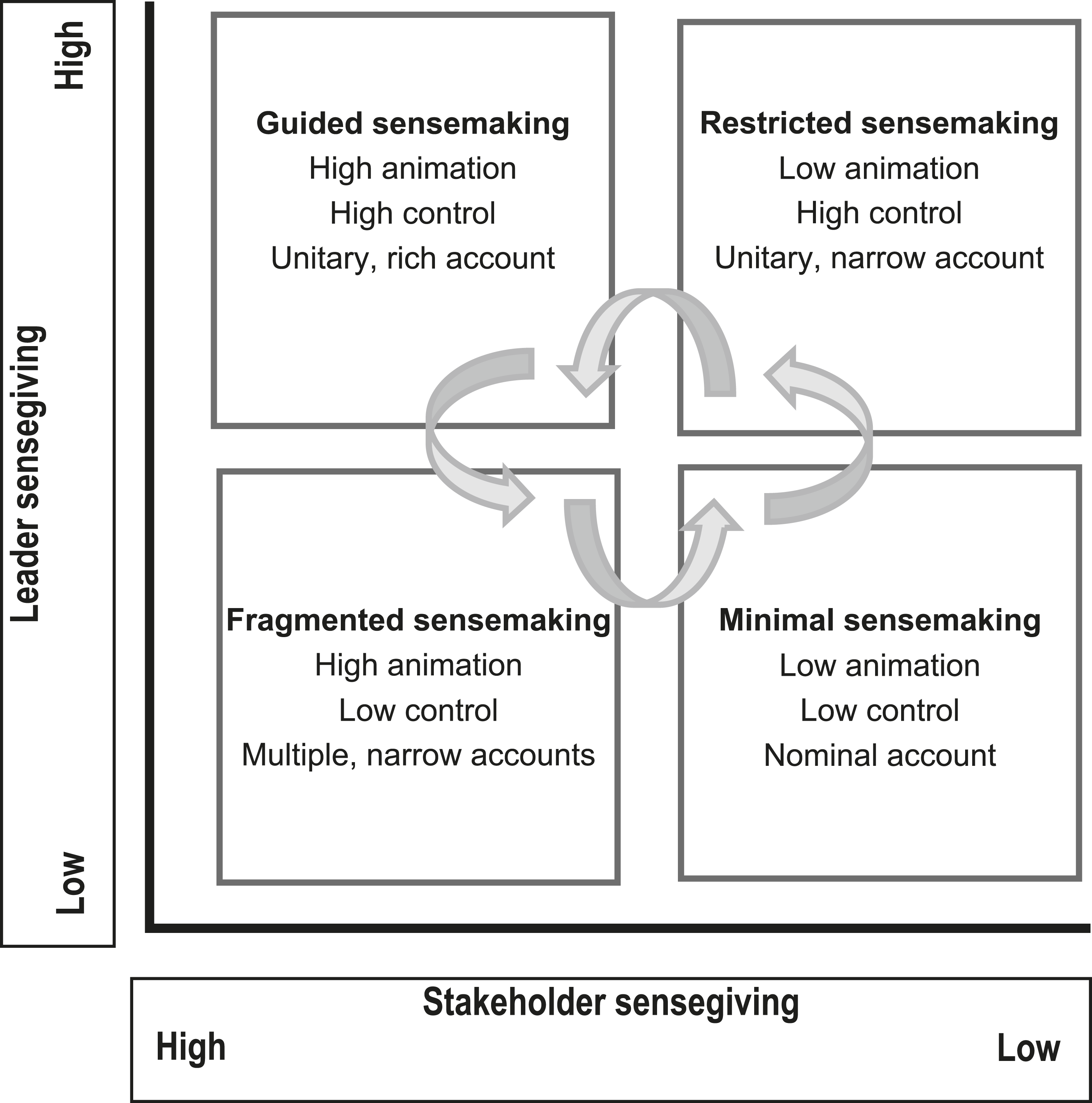
Sense-making is of potential relevance to this study because select committee inquiries are inherently about dealing with ambiguous, uncertain or surprising matters. Inquiry topics are selected to shed light on a puzzling or contested policy issue or to examine how government has tackled an issue. If there was no sense-making to be done, there would be no need for an inquiry.
Yet, much of the organisational sense-making literature focuses on retrospective accounts of how groups of people directly involved in organisational problems coped with volatile situations (Maitlis and Sonenshein, 2010) or with retrospective analysis of crises as reflected within public inquiry reports (Brown, 2004). Some of these studies have been undertaken after official inquiries have been completed, drawing largely on individual testimonies for empirical evidence. By contrast, the research reported here is based on an analysis of sense-making as it occurred in real time. Although Maitlis (2005) work was longitudinal, she created a typology rather than a dynamic approach to sense-making. Additionally, most sense-making research has taken place in organisations with hierarchical relationships, with the leader holding formal authority. In select committees, the chair is more ‘primus inter pares’ as leader, so formal authority is constrained. Some studies have lacked the characteristics of the volatile, contested contexts within which Collinson (2014) urges the study of leadership in order to develop a more nuanced understanding of its dynamic complexity.
There is consequently a gap in empirical work on real-time studies and linked theoretical findings around how differing perspectives are contested and reconciled, and the role of leadership within sense-making processes. Existing theory does not elucidate how leadership and sense-making might be linked in contested contexts and with contentious subject matter. It is also silent on how far leading collective sense-making might involve engaging in challenge and contest in order to earn the respect of so-called ‘followers’, or in this case elected politicians who sit on the select committee.
This consideration of three somewhat disparate literatures leads to the formulation of the key research question which will inform this article. The approach is theory elaboration (extending the scope and explanatory power of theories of leadership, agonism and sense-making) but also theory combination (using them in conjunction to provide a more rounded theoretical explanation of leadership in contested settings). Together, the gaps identified lead to the question:
RQ: How can leaders who actively engage in challenge and conflict build a degree of shared purpose among diverse groups of stakeholders.
This is examined through a study of leadership in a House of Commons Select Committee, in two contrasting cases which occurred concurrently and with the same chair.
Context and research design
The research design was one of comparative case study of the social processes of leadership, in two inquiries undertaken concurrently by the same committee, with the same committee members and led by the same chair. In order to make sense of the design and the methodology, it is helpful to present an outline of the case context, which is the UK Parliamentary select committee system.
The parliamentary context of select committees
Bennister et al. (2017) note that the ‘key puzzle of political leadership is how it affects, and is affected by, the contexts in which it occurs’ (p. 1) so this section outlines the case study setting of select committees within Parliament.
UK select committees hold government to account through scrutiny of government policies and their impact on society. Unlike their US Senate equivalent special and select committees, they do not hold legislative powers or report directly to parliament but exert influence through conducting inquiries on particular topics in which the committee summons senior legislators and prominent and relevant witnesses to public hearings, held in Parliament meeting rooms. The cross-party committee is seated in a horseshoe, with witnesses seated in front of them. The proceedings are transmitted live on national television and fully transcribed in the official Hansard (parliamentary) record. Recommendations and findings of committees’ inquiries are reported in a public document and a formal response from ministers to the recommendations is expected.
At the time of the research, there were 51 committees (each with a minimum of 11 members), of which 31 operated within the House of Commons. Many of the select committees have a remit to scrutinise a particular ministry of state and the focus of this article is one such committee. The political composition of committees reflects the balance of power in the government of the day so, while the overt remit is a cross-party consensual one, the underlying committee dynamics can reflect adversarial party-political relationships. Most UK elected politicians are members of political parties, the largest of which are Conservative and Labour, which hold differing ideological and policy positions (Rush, 2005). While officially working to manage their dual roles of scrutiny of the executive and their party-political role, all committee members bring personal and party-political perspectives into consideration of inquiry issues which, as noted, may be on controversial topics.
Changes to select committee membership rules in 2010 have contributed to their higher public profile than ever before (Kelso, 2016; White, 2015). Challenge through scrutiny, with increasing levels of media coverage (Kubala, 2011), is a visible sign of the leadership initiative being taken by select committee chairs to expose ‘government activities to the oxygen of publicity’ (Kelso, 2009: 230). Select committees and their chairs are therefore, arguably, exercising leadership at the forefront of parliamentary challenge.
Each select committee is supported by a small team consisting of a committee clerk (an experienced public servant), a couple of specialists in the field, and administrative support. The chair may have their own personal support team, in this case, one special advisor.
Chairs as leaders of select committees
In contrast to Senate committees, since 2010, UK Commons committee chairs are elected by fellow Members of Parliament (MPs) rather than appointed from within political parties (Russell and Benton, 2011). This means that chairs are less beholden to their political party and so the scope for agency and leadership of select committees, with their cross-party composition, has created more opportunities for initiative and leadership, sometimes in contentious circumstances (Kelso, 2016).
Is chairing a leadership role? A view of chairing as ‘running a meeting’ underplays the planning and preparation work as well as the mobilising of divergent and sometimes competing interests, goals, values and ideologies, within the committee and with the variety of external stakeholders, working with informal as much as formal authority. The chair must also lead with awareness of working with politicians and with the professional support team, which includes experts as well as a special (political) personal advisor. Even this brief review of divergent interests suggests that select committee chairing is most definitely a leadership activity.
A key leadership challenge for select committee chairs is that of recognising, challenging and working not only with the range of different interests and perspectives within a committee to achieve a report from an inquiry, but also dealing with a variety of external stakeholders who may hold and express strong views about topics covered by the select committee. These may be witnesses or others within society who have views and interests about the topic of the inquiry and wish to try influence its scope, direction and conclusions.
Research methods
The research was an ethnographic study based on close observation in real time of a particular select committee, with a focus on two inquiries, which are the research cases. Unusually, therefore, the research is based on real-time analysis and also unusually, the cases were concurrent, providing access to leadership processes with the same leader, group and context, but contrasting issues around which the chair aimed to mobilise support.
The ethnographic element was achieved by negotiating, through its chair, an embedded placement within the committee support team in order to undertake an exploratory study of all aspects of committee dynamics and ensure frequent confidential access to the chair as the research developed. Obtaining privileged access to the committee ensured observation of private as well as public meetings, for example the chair’s confidential briefings by clerks and special advisors, pre-meetings of the committee which were held off-camera, and private meetings of committee clerks.
The selection of cases was preceded by a phase of research, prior to the placement, which analysed the context for select committee leadership in the House of Commons. Observation of 11 different committee hearings across a range of select committees, and 18 scoping interviews (13 with committee MPs), were undertaken. This immersion across several select committees enriched the understanding of the role of institutions and agency in select committees overall and also enabled an informed choice about the select committee to focus on for intensive research.
Once the study committee had been identified for the research, and access to both public and private meetings of that committee negotiated, the placement phase involved one of the authors spending 11 days fully immersed on a daily basis within the select committee support team. This involved close observation and note-taking, and also conducting 17 individual interviews, 10 of which were with MPs on that committee during that time, also the chair and the public servants in the support team. This gave multi-respondent perspectives on leadership. Access to the chair’s diary for two weeks also gave information about where leadership time and attention was being spent during that same period.
For the final critical reflective phase, after the placement period, nine further interviews and eight committee observations were conducted alongside a comprehensive review of all data including analysis of full official transcripts and archive video footage of public committee meetings.
In total, 22 committee hearing observations and 39 interviews, 24 of which were with MPs, took place. All interview and observational data were fully transcribed before being analysed thematically using Nvivo software and then more closely and holistically analysed through developing detailed sequential narratives of the cases.
The cases
The research reported here focused on two cases, which consisted of the leadership processes within two inquiries. The cases were selected because they were led by the same chair and committee members within the same time frame, while their content and trajectories, including levels of media exposure, were contrasting. The two inquiries took place largely concurrently, which is unusual for research into leadership and the research design therefore provides points of systematic comparison. Case 1 took six months from inquiry announcement to the report being released. Case 2 started three months after Case 1 and took place over 10 months, with the first two months being particularly intensive.
Due to the privileged access to elite actors who were dealing with controversial topics in the public gaze, it is not possible to give information about the subject matter of the two inquiries, otherwise confidentiality could be compromised. This was a condition of the deep and intimate access given for the study. However, the advantage of this limitation is that it enables the analysis to focus on the social processes of leadership without being distracted by the content or substantive complexities of the two inquiries.
The first case was an inquiry on a topic initiated by the chair. It was quite a narrow topic, and its potential impact was also narrow. Despite considerable effort by the chair, the topic did not engage the interests and efforts of committee members, witnesses and wider stakeholders, resulting in negligible outcomes. A report was produced but it was not acted on by government or picked up by the media outside Parliament.
The second inquiry came about because of the committee’s awareness of, and response to, the unexpected exposure of a controversial issue which grabbed national media headlines for several weeks. It concerned a priority policy area for government, affecting many people, and it struck a chord with individual committee members because their constituents were directly affected and had vociferously shared their concerns about recent developments. The committee’s activities evolved as the national situation unfolded, making preparation and planning difficult. The two cases were rich in contrast in terms of issues, dynamics of the committee, and leadership processes.
Agonism and sense-making in select committee leadership
Comparison of the two inquiry cases.
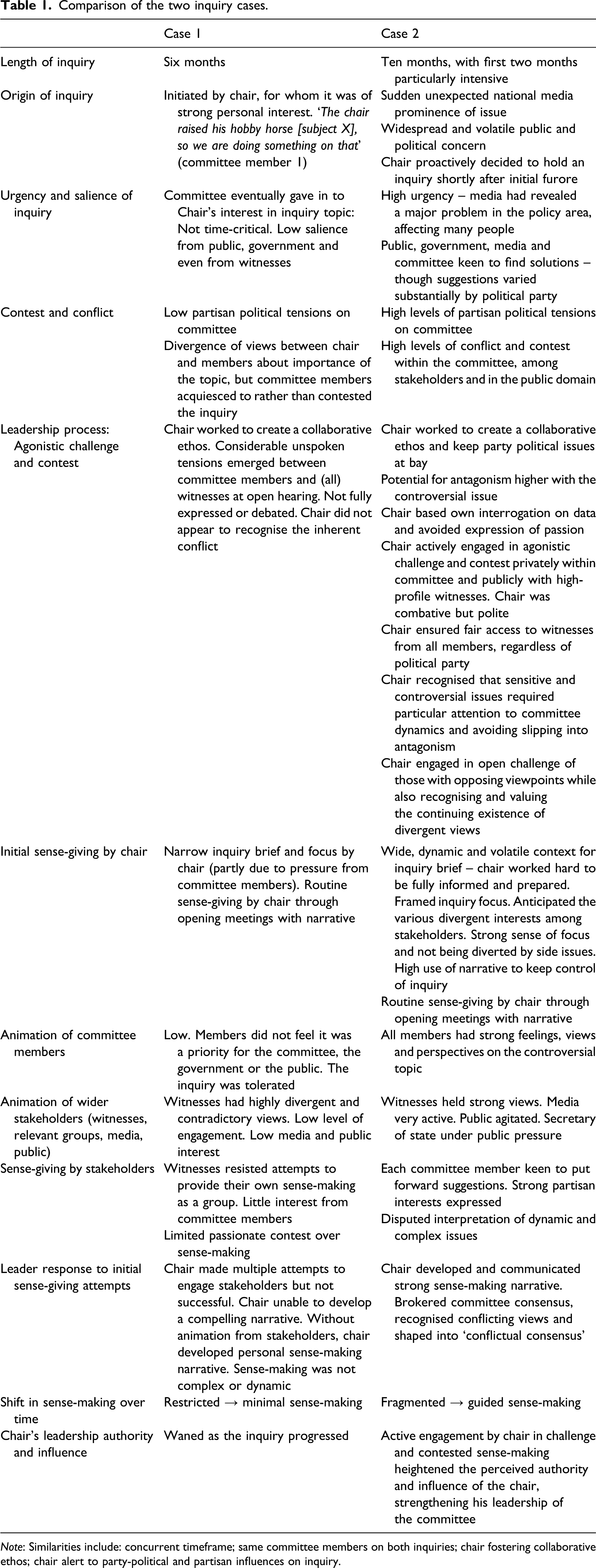
Note: Similarities include: concurrent timeframe; same committee members on both inquiries; chair fostering collaborative ethos; chair alert to party-political and partisan influences on inquiry.
Contest, agonism and antagonism across different arenas
In order to devote the time needed to lead the committee, the chair juggled conflicting pressures of the select committee and its chairing role with other pressures coming from a number of other arenas (Hartley and Benington, 2011), related to the broader Parliamentarian role. From the diary analysis, the chair spent, over two weeks, 22 hours in the select committee arena (leading or listening to briefings, chairing inquiry hearings) and in addition 17 hours – nearly as much time – on specialist contacts and networks linked to the committee (this included speaking at events, talking with specialists). The chair also worked in the House of Commons Chamber for 19 hours (which included speaking from the back bench, sometimes supporting or challenging the committee-relevant Secretary of State). Some small time was devoted to the Parliamentary political party (4 hours in total) while 28 hours were spent in an arena in an entirely different geographical location – their Parliamentary constituency, with wide-ranging contacts and networks and 18 hours in administration etc. (This analysis does not include travel time). This was not fixed time each day but was based on judgements about priorities, a dynamic matter.
Committee members were involved in similar arenas, some overlapping and some not. It gave both the chair and committee members exposure to a range of stakeholders and perspectives, some of which was played out in the select committee proceedings. Much of the time was spent in the public eye and therefore under scrutiny. So, there were conflicting pressures on each committee member, as well as conflicts and contest between them. The pressures to toe the political party line versus take an independent line on issues were summed up by one close observer of the chair: ‘As chair [he] doesn’t adopt the government line on most major issues. He thinks through and adopts his own position. ….. On [committee policy area], he agrees with general policies but is “fiercely independent” ’.
Due to the multiple arenas that each committee member worked in, there were contradictory pressures, and a contest over purposes and meanings. The chair, from observations and interviews, worked to build a collaborative ethos within the committee, welcoming the members at the start of the day’s proceedings, providing an overview of the aims of the inquiry and the particular day in the pre-meetings, welcoming witnesses before a formal hearing began and circulating briefly at the end, thanking participants and support staff for their contributions. These personal approaches to people, whether committee members, witnesses or staff, sometimes combined with lightly humorous introductions, created an inclusive atmosphere at hearings.
But however well the chair built up a collaborative ethos within the committee, its members were constantly alert to the underlying party-political divisions within the committee and often interpreted relatively minor aspects of each other’s behaviour through a partisan lens. For example seating arrangements were sometimes invested with meaning: ‘[Committee member A], interestingly, sits as far away from us as you can get, basically’.
The chair tried to be particularly aware of underlying partisan tensions which could potentially flare up into destructive committee conflict, threatening to undermine the politically neutral basis for his leadership of the select committee. Operating within the broader adversarial context of Parliament, the committee’s partisan tensions could emerge suddenly and create open antagonistic conflict: ‘You have the inevitable party-political allegiances but they are a committee and they do operate by consensus, or attempt to. You do see compromise and you do see give and take but there are times when the party politics does take over and you have to ride it out’ (staff).
There was party political advantage on many occasions: ‘Taking the issues on board through the select committee means we can use it as political ammunition’ (committee member 1).
Individual committee members’ perceptions of each other’s degree of partisan behaviour varied widely but the alertness to political positioning appeared to be constantly present in their mutual assessment of each other’s behaviours and statements. One commented: ‘In some ways, the success of the committee depends on us not having political discussions…… As soon as you get into something that is really quite political, it really fails to function as a select committee’ (committee member 8).
The ever-present sense of partisan behaviours and antagonistic behaviours could colour what evidence was presented. In discussions and inquiry reports: ‘There have at times been battles…. Really battling to get a report that was based on the evidence rather than what the coalition majority members wanted was a really tough piece of work’ (committee member 2). ‘We held a fundamentally different view of the evidence’ (committee member 7).
The underlying partisan and personal tensions within the committee increased when the issue under scrutiny was seen as urgent and controversial. The Case 2 inquiry was fast paced to keep up with national public and media concern, and the chair had to work hard to ensure that strong feelings, views and perspectives on the controversial topic did not prevent the inquiry happening or the report being produced.
Chairing in such situations involved a continual alertness to the fissiparous possibilities of scope and nature of discussions, both in private as a committee and in public with witnesses. The chair recognised the complexity and contested partisan context for his leadership: ‘When you get to these sensitive issues, it is important that the committee is never used as a political football. We are not outside the political process…. any party can legitimately pursue their principal interests through the committee…. So, it is balancing that with maintaining an esprit de corps and a common purpose. There are always going to be times when people are seen to be seizing on a particular issue… for a partisan purpose. That can be both those seeking to attack the Government and those seeking perhaps to defend it’ (chair).
This involves being aware of the antagonistic politics but also trying to craft a way of respecting different views and values on the committee: ‘In a report we have to agree which [issues] we all feel most strongly about… it is a consensus report but do we all feel equally happy to be backing this? We don’t want to make this just a Labour thing or just a Tory thing. Do we all think this is really important? Do we all think it will make a material difference to [people affected by this policy]?’ (chair)
The style of questioning of witnesses was also important in generating an agonistic rather than antagonistic approach: ‘[The chair] can be quite combative at times, but he asks things which need to be asked. I think [the Secretary of State being questioned] feels very uncomfortable in front of the committee and that is how it should be. [This chair] is always polite but some of his questioning of the Secretary of State is very tough…… As tough, if not tougher, than the [opposition] members of the committee’ (committee member 2).
The analysis points to the chair being alert to the detailed social dynamics of the committee membership, its interactions with witnesses and staff, and the underlying (and sometimes surfacing) partisan political tensions. The data highlight the chair’s appreciation of his need to lead the committee through building alignment across diverse interests and generating a respectful approach to difference. This echoes some aspects of generic leadership theory, for example Drath et al. (2008) and Yukl (2013) who emphasise the need to forge common purpose but we suggest that generic leadership theory does not account fully for the ways in which challenge, contest and conflict needed to be addressed in order to lead this committee. This is where Mouffe (2005) concept of agonistic consensus is valuable. While Mouffe (2005) argument is a philosophical one, at the level of grand theory relating to political thought and institutions, her conceptions of democratic agonism and antagonism help develop analysis of why engagement in challenge and conflict are important aspects of leadership, as shown in this study.
Through emotionally charged public debate, media exposure and Commons debate, differences of political perspective on the committee were ever present, so in Mouffe’s terms this scenario can be said to be potentially antagonistic because the cases show the potential to spill out into widespread public vilification of government policy. Yet instead this study illustrated that conflict was contained within the select committee social processes, steered by the chair’s leadership.
Reflecting on the chair’s challenges in this research through Mouffe’s perspective, the chair can be seen as leading, within this parliamentary context where ‘passions can be mobilised around democratic objectives’ (Mouffe, 2005: 104), towards a ‘conflictual consensus’ (Mouffe, 2005: 103), based on agonistic adversarial party political differences of principle. This research revealed that the chair’s leadership in part involved open challenge of those with opposing viewpoints while also recognising and valuing the continuing existence of divergent views and the need to work with ‘many different and conflicting interpretations’ (Mouffe, 2005: 103) among select committee members and other stakeholders in order to build commitment and alignment to the shared purpose of making sense of select committee inquiry dilemmas and producing influential reports on which most committee members could agree. In this context, perhaps ‘conflictual consensus’ (Mouffe, 2005: 103) is a more appropriate term for the direction and purpose of leadership than either ‘common goals’ (Yukl, 2013) or even ‘collectively purposeful causation’ (Burns, 1978), all of which imply whole-hearted consensual agreement with a leader’s vision or aims.
Mouffe (2005) also offers an explanatory concept for analysing the chair’s sometimes openly adversarial leadership challenge of powerful stakeholders in public settings. Mouffe (2005: 103) argues for adopting a perspective of ‘agonistic pluralism’ based on an understanding that: ‘[an] aim of democratic politics is to transform antagonism into agonism. This requires providing channels through which collective passions will be given ways to express themselves over issues which…. will not construct the opponent as an enemy but an adversary’ (Mouffe, 2005: 103).
In the two cases, challenge and contest can be seen as ways of expressing collective passions, closely connected to the members’ political principles. The playing out of these passions through public challenge is an important aspect of the chair’s leadership, helping him build ‘idiosyncrasy credit’ (Hollander, 1992) and therefore legitimacy to lead within his committee. However, while not shying away from tough questioning and challenge, the chair also led the discussions to be agonistic rather than antagonistic, where possible, through creating a collaborative atmosphere, through humour and informal relations and in recognising the divergent views on the committee and trying to find and create the areas of consensus.
The nature of public challenge observed in this study revealed various aspects of agonistic tension, demonstrating that challenge and conflict are integral and important elements of parliamentary, and potentially wider political, leadership. Overall, as Mouffe argues, ‘democracy requires a conflictual consensus: consensus on the ethico-political values of liberty and equality for all, dissent about their interpretation’ (Mouffe, 2005: 121). When select committee chairs lead through sense-giving within the parliamentary partisan context, agonistic tensions sometimes risk becoming antagonistic, making the achievement of a ‘conflictual consensus’ a significant challenge which needs to be recognised, anticipated and managed in order to lead.
Making sense of contested sense-making
Select committee inquiries, by their nature, are about sense-making as well as holding the government to account. Sense-making theory is frequently linked to strategic or other organisational change (Gioia and Chittipeddi, 1991; Maitlis and Christianson, 2014), so when discrepancies occur between accounts, in the literature these have tended to reflect hierarchical differences between management and employees. By contrast, sense-making discrepancies in this research are spread across a non-hierarchical network of stakeholders, committee members, other Parliamentary actors (such as the relevant Secretary of State) and external commentators. Consequently, the sense-making context for inquiries was, here, inherently complex, dynamic, contested and pressured.
As Maitlis and Lawrence (2007) note, sense-giving is also an important component of sense-making and is a key leadership activity. But other stakeholders may also try to influence or impose sense-giving from their perspectives, so that the overall sense-making is a combination – and in this context also a contest – between the leader(s) and those being mobilised by the leader.
Some of the chair’s leadership practices in both cases involved routinised sense-giving. These included the chair’s recurring technique of opening meetings (both public and private ones) with a narrative outline of his perspective on the main pertinent issues, in what appeared to be efforts to shape or establish a dominant sense-making narrative (Brown, 2000). Where this narrative sparked debate because other committee members did not agree with this interpretation, then committee members engaged in the issues in an animated way and carried their animation into the public hearings. By contrast, when the chair did not share a compelling narrative with members, they did not independently engage with the issues or appreciate its overall purpose. For instance, in Case 1, in one public hearing a number of witnesses appeared to contradict each other when they gave live evidence in public. Despite numerous efforts by the chair to steer witnesses, they refused to make clear recommendations for the committee and this left committee members frustrated and bewildered by the apparent lack of purpose of the hearing.
However, there were interesting and revealing differences in the two cases which illustrate that the combination of context, issue, sheer number of stakeholders and also leadership behaviours had differential impacts on the leadership processes of sense-giving and on the final sense-making. Given that the two cases occurred concurrently, with the same leader (chair) and the same committee members, there are particular insights into how social processes of leadership through sense-making occur in such contested settings.
In Case 1, the choice of inquiry topic was instigated by the chair to investigate a specialised policy area in which he was particularly interested. Other committee members did not feel this topic was a priority for the committee, for the public or for the government. The review issues were not time critical and the whole process had been carefully planned well in advance. The topic did not initially engage the interest of the committee members, who merely tolerated it: ‘I am not sure why we are doing the inquiry to be honest. It is [the chair’s] agenda and I don’t know what he is up to’ (committee member 3). ‘The committee are indulging [the chair] in agreeing to this review as it is his pet project and carries little general interest, so there is strong support for keeping it very short and tightly focused’ (staff).
The chair had initially established control of the inquiry sense-making through setting a narrow inquiry brief (partly pressured by colleagues in this). Here, the chair as leader rather than stakeholders (whether witnesses or committee members) dominated the process and produced very controlled accounts. The chair made multiple efforts to engage stakeholders and members in his sense-making perspective on the purpose of the inquiry. However, witnesses had very divergent views which did not coincide with his own: ‘I got the impression that different people giving evidence to us, if you put them in a room and asked them to talk about the subject matter, very soon they would be at each other’s throats’ (committee member 1). ‘[The witnesses] all had very individual agendas and couldn’t agree amongst themselves, never mind give us a clear view. They couldn’t give us the kind of insight we required’ (committee member 3).
When stakeholders repeatedly resisted his attempts to influence them and had such divergent views, the chair effectively lost control of the sense-making narrative and was unable to forge a degree of commonality out of those accounts. In addition, members shared their own critical views of witnesses’ accounts frankly among themselves, producing further ‘multiple, narrow sense-making accounts’ (Maitlis, 2005) which differed from the chair’s view and demonstrated that members did not share his commitment to the purpose and trajectory of the inquiry.
The original draft report from the chair was rejected by all on the committee, reflecting cross-party commonality of view. The chair was persuaded by an advisor to relinquish his more ambitious set of recommendations in order to avoid antagonistic confrontation or conflict with the rest of the committee. Most committees and chairs pride themselves on consistently achieving consensually agreed reports, signifying the cohesion of the committee and the influence of the chair in achieving a degree of consensus even on controversial topics. ‘The chair realised that he wasn’t going to get through what he wanted to get through and had to stand back and think what to do. At this point, I advised him to get the meat of his report through, the stuff about what worked and actually needed to change, but that he wouldn’t be able to include controversial issues’ (staff).
The chair subsequently attempted to gain committee agreement to a number of recommendations which he himself proposed and which had not been derived naturalistically from the dialogue with witnesses.
This case provides an example of sense-giving where the chair had not been able to cultivate a sufficiently strong sense of purpose among members and stakeholders to create agreement over sense-making. Members resisted his attempts to dominate and define the inquiry. The final report contained a very limited number of recommendations because the chair had not succeeded in brokering a consensus of views either among witnesses, nor among his committee members and certainly not between the two. None of the inquiry recommendations, albeit limited, were accepted by the government.
Initially, the sense-making can be analysed in Maitlis (2005) terms as restricted sense-making because there was low animation from the committee and indeed from witnesses and high control from the chair. This, following Maitlis, produces a narrow and unitary account. However, the chair was not able to maintain this control over sense-making. Despite repeated attempts to retrieve sense-giving authority, attempts to engage the stakeholders foundered and from this point onwards the inquiry sense-making process slipped from restricted into what Maitlis, (2005) categorises as ‘minimal’. This applies in situations where ‘both leaders and stakeholders become disengaged and cease attempts to exert control over the sense-making narrative’ eventually producing ‘only a nominal interpretation of events’ (Maitlis, 2005: 42). There was a shift over time between types of sense-making according to the degree of control and level of animation by the chair and by the other stakeholders.
The second case provides considerable contrast, despite having the same committee chair and members involved at the same period. The inquiry was instigated in response to a major, sudden and controversial issue which had grabbed national media headlines. It concerned a priority policy area for government which was also within the committee’s remit for inquiries. It also impinged directly on each of the committee members because heart-felt concerns about the controversy were being voiced in their constituencies. The chair made a rapid decision to hold an inquiry on the matter, because of public and media pressure, and also to demonstrate the committee’s relevance to contested and highly charged national concerns.
A major challenge for the chair at the planning stage was to steer a credible course of action while aligning and mobilising all committee members, despite their very varied opinions and values on the subject of the inquiry. He had to enable members to voice their concerns – ‘it was all very emotive language. That is how it started off’ (committee member 8) and ‘… well, you heard me lay in about the unfairness [of the issue]’ (committee member 3). There were passionate and very diverse views on the committee, reflecting their party political differences. However, members appeared to accept the chair’s sense-giving at this early stage as he set a narrative of getting ‘to the truth’ in this pressured and volatile context. ‘It has been a huge issue over the last few weeks since it broke. There’s been a huge amount of media interest. [The chair] is wanting to figure out what was going on, wanting to be engaged….people have wanted to speak with him about it’ (staff).
The chair described ‘Trying to wrestle with it… through all this noise and through all the stuff, the representations we get, to get to the truth, so that is what we are trying to do and that goes on while you are running from radio studio to newsnight to the next thing, and talking with [relevant actors] about it while doing other things like constituency stuff and supporting colleagues. So it is pretty intense’ (chair).
The committee’s activities evolved as the national situation dynamically unfolded, which made planning and preparation difficult. Members continued to press for different approaches to the inquiry, and the chair had to be firm and urge them to hold the line about the approach that had been agreed in committee. The volatile situation meant that there were various challenges and red herrings to the way the inquiry was conducted.
While the chair inherited a contested sense-making challenge that had not been anticipated at the start of the inquiry, he rose quickly and adeptly to the challenge, through ensuring that he was thoroughly versed and briefed in the background issues before any meetings took place in committee. From the start, he led the committee’s sense-making, having anticipated the likely divergent interests of committee members and through engaging widely with external stakeholders to understand the various positions and views. The leadership practices that enabled him to stay ahead included sharing a sense-giving narrative at the start of each briefing meeting so that committee members knew what he thought. The narrative was presented as a meaningful framework to enable others to approach complex issues from his perspective and this narrative was not challenged in public. However, in the private sphere of the committee, despite his narrative, the process risked becoming fragmented through more contested sense-making. The other committee members were highly animated by the issues and aimed to provide their own sense-giving.
He kept a clear steer on the inquiry process and actively engaged in the challenging of the witnesses, which included a government minister. He led the committee in sense-making by cutting to the most pertinent issues rather than being fobbed off by deliberately distracting discourse from some witnesses who did not relish much probing. He led questions forcefully and was effective in getting past the ‘spin’ to some solid responses. He ensured that all members, regardless of political party, had ample opportunity to question the government minister. Witnesses at the public hearings were well prepared, as was the chair, so the quality of inquiry was well informed and his scrutiny of issues rigorous. Overall, the chair appeared to be able to mobilise and align committee members through their engagement in the inquiry and also being able to slow down the volatility of the contentious issues so that there was a more reasonable, considered pace with a search for evidence not only passion. The chair had to steer the inquiry independently, ensuring the committee held government to account while broadly charting a common way through the immediate crisis. Overall, the chair led the process to produce a clear report with recommendations, based on learning how to avoid future similar crises in future, which were accepted by government.
Sense-making in this case can be seen as discrepant (Brown et al., 2008) as it took shape within the committee as a dynamic, contested and rapidly changing ‘intertwining of the cognitive and the social’ (Weick, 1995) process, with individual members actively engaged in assessing the plausibility of contrasting stakeholder accounts (from the media, their constituents, the government minister and other committee members). Individually, in clusters and as a full group the committee members engaged actively in developing collective sense-making perspectives (in the plural) through their own internal discussion, within and across party political perspectives, through reflection and sometimes through internal contest.
In this second case, the chair publicly led the contested sense-making by exerting authority over the process after an initial period of ‘media fever’ with the unexpected, sudden and time-pressured controversy. Initially the case could be characterised by fragmented sense-making in Maitlis (2005) terms, where there was high animation from a range of internal and external stakeholders which, for a short time, got ahead of the chair’s ability to control the sense-giving. However, the chair worked hard to ensure he was fully briefed and prepared and he used his chair’s authority to exert a high degree of control and offer a great deal of sense-giving. Along with the high animation of the stakeholders, this fits Maitlis (2005) definition of guided sense-making because it involved high levels of animated challenge from both the chair and the committee members, during public hearings and in private along with a high level of control from the chair. Sense-giving was contributed by all the stakeholders, and this lead to a rich and unitary sense-making account. The chair had guided the numerous, varied, contested and controversial views of committee members into a new, single but collective account. It was a rich account because the opportunities the chair gave to committee members to express passionate views and to question witnesses freely meant that the chair could shape and guide the emerging view and set of actions. Returning to the concept of agonism from Mouffe (2005), this was achieved not through competition or dominance of different accounts but through respectful recognition by the chair of the passions and the perspectives of the stakeholders. This did not preclude tough questioning, which is seen as acceptable in this parliamentary arena, including where a senior witness was thought to be ‘economical with the truth’ but it was polite and it held as legitimate the holding of different views and values by different stakeholders. This created a rollercoaster ride for the chair, who was leading sense-giving under intense media pressure but he had prepared well and understood the need to encourage but shape different sense-giving accounts.
The two cases also reveal striking differences in the leadership of sense-making. In the first case, sense-giving was dominated by the chair with weak or little interest from the committee members. In a sense, there was insufficient passionate contest of the type that Mouffe (2005) indicates is valuable and with low animation in Maitlis (2005) terms. This started with a restricted account but became a minimal account over time, and the chair’s leadership authority waned as the inquiry progressed. By contrast, the chair’s leadership in the second case revealed how active engagement in challenge and contested sense-making heightened the perceived authority and influence of the chair over the whole inquiry process and strengthened his influence and leadership of the committee.
Maitlis (2005) grid provides a useful interpretive framework that offers theoretical insights into findings from this study and reflects that sense-giving is a complex leadership process. However Maitlis’ categorisation does not fully reflect the two case studies’ findings about the volatile, complex and dynamic nature of public sense-making where contest and competing views are part of the institutional context. While Maitlis and colleagues see leadership as involving sense-giving activities (e.g. Maitlis (2005) and Maitlis and Christianson (2014)), her work perhaps underplays the leadership challenges inherent in sense-giving and sense-making, particularly in this exposed and politicised institutional context. The research shows that the nature of collective sense-making and the chair’s leadership of sense-giving in both of these cases often slipped from one category into another, whereas the Maitlis’ four forms of sense-making was a typology to understand different approaches to sense-making. To better reflect the volatile and partisan context of political leadership, we have incorporated a level of movement into the typology to reflect this dynamism. Figure 1 depicts one way in which this adaptation might work, with the central arrows reflecting potential movement between categories.
Overall, this research builds on Maitlis (2005) sense-making framework to illustrate that sense-giving is related not only to levels of animation and control, but also to challenge, contest, alignment and commitment to purpose. This article argues that sense-giving (the leadership of sense-making) can be a more dynamic and volatile leadership process than the Maitlis’ model suggests, because particular sense-giving processes defy static categorisation and need to be considered in relation to direction and purpose, as well as leadership theory more widely, in order to be better understood. The sense-making is also influenced by sense-giving in other arenas so that leadership took place not only within a formal hierarchy of institutional roles with varying degrees of authority but also in messy, overlapping arenas with multiple stakeholders.
Sense-making is complemented and combined in this study with agonistic pluralism. Sense-making and sense-giving would, we argue, be incomplete without this additional concept. The Mouffe (2005) definition of the likely outcome of agonistic democratic processes, that of conflictual consensus, can be seen as an approach to leadership which takes account of pluralism. A sense of shared purpose might be achieved provisionally through leadership in a particular context but this might fragment as antagonism resurfaces, circumstances change or stakeholders shift their positions. Forging a conflictual consensus presents particular leadership challenges as leaders need to recognise and work with the inherent nature of conflict in particular contexts to build alignment around particular issues or shared purposes and to construct temporary coalitions. A key leadership practice, it can be argued, is to behave in ways which recognise and can deal with antagonism where it plays out but where the leadership purpose is to channel emotion and strongly-held values into a respect for opponents through agonism. Agonism adds to the understanding of sense-making, which otherwise has largely been from an organisational and mainly hierarchical perspective.
Implications for leadership theory
This research focussed on the research question about how can leaders who actively engage in challenge and conflict build a degree of shared purpose among diverse groups of stakeholders. The question has been examined through two concurrent case studies, where challenge and conflict occurred in different ways, and providing insights into leadership and conflict. There are still relatively few accounts of the conflicts involved in leading people and situations, (as witnessed by the dearth of either ‘conflict’ or ‘contest’ in the indexes of leadership books), despite the efforts of critical leadership theory to address power and dialectics (e.g. Collinson (2014)). There is a literature about political leaders handling conflict within and across parties, but this research widens the interest in political leaders to the chairs of select committees, showing their role in the managing of diverse interests and aiming to channel conflicts into ‘conflictual consensus’ (Mouffe, 2005). Select committee chairs exercise leadership with some degree of formal authority but given that they are ‘primus inter pares’ and working across divergent interests among stakeholders, and across various political arenas, their leadership is inevitably somewhat precarious and provisional, relying on their opening up enough divergence of intellect and passion to enable animation but also shaping that conflict into a degree of shared purpose. The article therefore makes a contribution to understanding the social processes of leadership in situations of conflict and contest.
This research has taken place in a particular institutional context–the Westminster Parliament-with its own culture, social norms and practices, but the detailed examination of the shaping of conflict by not only the chair but also other stakeholders has resonance for other settings.
The handling by leaders of both conflict and a sense of shared purpose is analysed using the concepts of agonistic pluralism and sense-making. This article draws out the implications of agonism for leadership in ways which go beyond the original political theory of Mouffe (2000a, 2000b, 2005). It also combines insights from agonistic pluralism with those of sense-making and sense-giving in new ways.
Sense-making and leadership have long been associated theoretically and in empirical research (Maitlis and Lawrence, 2007). However, this article takes sense-making beyond organisational leadership, or political leadership in crises (Boin et al., 2012) and considers the leadership processes in situations where there are divergent and competing interests and in a variety of overlapping arenas.
The contribution of agonistic pluralism alongside sense-making provides a different perspective on political regimes from traditional oppositional politics, or on one of its alternatives, deliberative democracy. Agonism recognises the role of emotion not only cognition in political behaviours and implies, though does not spell out a role for, leadership in channelling relations out of antagonism into agonism. The two theoretical lenses complement each other and have wider applicability to leadership studies.
While conflict and contest characterise many political leadership challenges, they are also applicable to leadership in broader organisational and civil society contexts. Plurality of interests and differences across arenas exists in a wide variety of settings. Consequently, the theoretical analysis of this study is applicable more broadly to the generic leadership literature. Some researchers are interested in pluralism and power in leadership theory and research (Collinson, 2005, 2014; Drath et al., 2008) rather than assuming that leaders and those they aim to influence have pre-existing shared goals. Heifetz (1994) also recognises the integral nature of conflict to the purpose of adaptive leadership, which involves leaders selectively engaging in challenge and conflict in order to ‘preserve a sense of purpose’ (Heifetz, 1994: 252). Heifetz uses the terms ‘challenge’ and ‘conflict’ recurrently in a way that illustrates how he views them as integral aspects of leadership and encourages leaders to engage in contentious issues, while working with and through others to build the means of resolving them. Hartley et al. (2015) use leadership language in similar ways to Heifetz (1994) and Burns (1978) to describe practices by public managers including ‘Recognise difference and plurality and forge them into collaborative action … bring difficult issues into the open and deal with differences’ (Hartley et al., 2015: 199). What is described here, using such verbs as ‘forge’ and ‘deal’, is active leadership engagement in challenging and handling divergent interests.
This research has illustrated how UK parliamentary select committees can be seen as a vital part of an agonistic democratic system offering a site and a social dynamic within which challenge and contest can be enacted without spilling out in a sustained way into more widely dispersed and potentially destructive antagonism. The role of the chair is not only a formal role but an active process of leadership concerned with sense-giving outside a hierarchical setting and needed to channel diverse and sometimes competing and partisan interests so that, at best a rich unified account through sense-making is achieved, but at worst is a nominal narrative which fails to satisfy anyone. These very different outcomes point to the tasks and practices of leadership. Benton and Russell (2013) suggest that the chair’s leadership is a highly influential factor in the success or otherwise of select committees. This article has delved more deeply into the leadership processes which underpin the interplay of contest and sense-making to produce agonistic consensus, drawing on the theoretical frameworks of Mouffe (2005) and Maitlis (2005). These processes, we argue, have wider resonance for studies of leadership outside political leadership, because divergent interests exist more widely than perhaps the leadership literature has analysed to date.
Footnotes
Declaration of Conflicting Interests
The author(s) declared no potential conflicts of interest with respect to the research, authorship, and/or publication of this article.
Funding
The author(s) received no financial support for the research, authorship, and/or publication of this article.
