




Abstract
In my 2019 publication, Constructing Crisis: Leaders, Crisis, and Claims of Urgency, I argued that “crisis” is a label, a claim of urgency employed, typically by leaders, to characterize a set of contingencies that are, together, taken to pose a serious and immediate threat. I then proposed a typology for sorting through any such claim in order to reach a judgment concerning the legitimacy of the claim. Classification systems such as typologies are foundational to knowledge creation in that they enable pattern recognition.. How we classify phenomenon has a real impact on how we consider and behave in response to that phenomenon. In the context of a global pandemic, the importance of critical judgment is especially salient. Labeling the global pandemic as a crisis may be non-controversial (to most). But there are enumerable claims being made under the general rubric of that pandemic that are not nearly so widely and easily accepted. Furthermore, claims of urgency will continue long after this particular contingency passes. It is never advisable to relax a critical perspective, especially when assertions of power and interests are involved and the stakes are so high.
Introduction
The central assertion of my recent book, Constructing Crisis (Spector, 2019) was that there is no such thing as a crisis. It’s an observation I came to at a moment when the United States, indeed much of the Western world, seemed to be engulfed in upheaval: waves of migration, the rise of would-be authoritarians in democratic societies, terrorist attacks, foreign interference in domestic elections, voter suppression, children in cages, #BlackLivesMatter and #MeToo movements. The Earth continued to warm, the polar caps continued to melt, and Australia combusted. It sure felt like crises were real.
And then the pandemic struck!
I can’t tell you the number of friends and colleagues who have contacted me with some version of the same challenge, some variation of: “I guess you’ve changed your mind about there being no such thing as a crisis.” I even wrote to my book editor raising the possibility of naming my next work: Now This Is a Friggin’ Crisis. But in reality, I hold more strongly than ever to my thesis. In the current circumstances in which we all find ourselves equally susceptible and inequitably vulnerable it is more vital than ever to understand the nature of the concept of crisis.
The construction of crisis
Let me be clear what my position is: “crisis” is a label, a claim of iurgency employed to characterize a set of contingencies that, taken together are assumed to pose an immediate and serious threat. Any crisis, regardless of the immediacy and urgency of the threat, is not a corporeal thing. It is not an object that can be placed under a microscope, manipulated, examined, and experimented on.
Typically, claims of urgency emanate from leaders; not just heads of state(s) but also medical and social experts, economists, and community activists, among many others. Angela Merkel, Boris Johnson, and Jacinda Ardern characterize the state of their nations (very differently!), and so do bioethicist Ezekiel Emanuel, economist Anne Case, and philosopher Simon Critchley. For all these various and varied leaders, the intention of applying the label “crisis” and claiming urgency is the same: to shape the understanding of and actions by others.
The coronavirus is objectively real. We’ve seen high-resolution images of it (at, for instance, https://www.cdc.gov/media/subtopic/images.htm). It can be placed under a microscope and studied. The resulting illness and suffering that follows is real as well. The fact of quarantine, the devastation wrought of all of society’s vital institutions—economic, of course, but also educational, social, and religious—is real.
The assertion of a “global pandemic”, on the other hand, is a label, one that requires an act of human intervention. It was the folks at the World Health Organization (WHO) who applied the term “global pandemic” to an outbreak that was impacting large populations in multiple countries: “We expect to see the number of cases, the number of deaths, and the number of affected countries climb even higher” (quoted in Branswell and Joseph, 2020).
Calling “crisis” a label is not to suggest that the act of labeling is inherently illegitimate. There are times, certainly, when claims-maker interests are coincident with the aims of the larger social unit. When Anthony Fauci, Director of the National Institute of Allergy and Infectious Diseases, declared, “I must say that the degree of efficiency of transmissibility of this is really unprecedented in anything that I’ve seen. It’s an extraordinarily efficient virus in transmitting from one person to another. These kinds of viruses don’t just disappear,” most people took that claim as an attempt to promote social well-being (quoted in Moreno, 2020).
If the application of a crisis label is not inherently illegitimate, it is not inherently legitimate either. What needs to be kept in mind in that the claim is always an assertion of power and an expression of interests. Always. Interests may be self-promoting and power self-aggrandizing. But that isn’t necessarily the case.
An “interest” is defined as any stake in achieving a particular outcome. That stake can be financial, of course, but needs to be understood much more broadly. An interest may be self-aggrandizing in a power-amassing or identity-enhancing way. It may also be an altruistic interest in seeking improvements in society. As the US President engaged a campaign to discredit WHO (Shear, 2020), Americans overwhelmingly (although by no means universally) expressed trust in the medical experts over the president. Public health doctors were making claims intended to advance the interests of society. Claims asserted by the president, conversely, were largely taken to be advancing a set of interests that did not align with general well-being (Rakich, 2020).
To repeat: the application of the crisis label may be perfectly legitimate. Anyone who is sentient and sane agrees that a global pandemic qualifies as a legitimate use of the label. The application of the crisis label to the danger of COVID-19 is not, for the most part, in contention.
1
So why bother, at this stage, to urge critical analysis of crisis claims? My reasoning is two-fold:
Labeling the global pandemic as a crisis may be non-controversial. But let’s not forget, there are enumerable claims being made under the general rubric of that pandemic that are not nearly so widely and easily accepted. Claims of urgency will continue long after this particular contingency passes. It is never advisable to relax a critical perspective, especially when assertions of power and interests are involved.
For these reasons, my intention is to offer a system for classifying any and all claims of urgency.
But what about …?
But wait, I can almost hear people saying (via Zoom, most likely). Even if my argument that claims of urgency usually require human authorship, doesn’t this case transcend that qualification? Isn’t the global pandemic inherently, objectively, a crisis? This is what I call the threshold argument. It is appealing but wrongheaded.
The threshold argument is this: some events are, by their nature, crises. That proposition rests on two variables: the scope of the event and the consensus (or existence of “little debate”) on the meaning of the event. But huge scope and widespread consensus do not alter the ontological nature of the construct: claims are always the result of human declarations.
Let me take you back to an earlier period in history when a leader claimed a crisis and that claim was accepted as legitimate by virtually all constituents. That was the day after the 7 December 1941 Pearl Harbor attack. FDR’s famous “date of infamy” speech contained many objective and verifiable descriptions: “The attack yesterday on the Hawaiian Islands has caused severe damage to American naval and military forces”; and “Very many American lives have been lost.” Both statements were verifiably accurate. And then came this: “The facts of yesterday speak for themselves.” On that point, Roosevelt was wrong.
Facts never “speak for themselves”. They always await the assignment of meaning. That is what FDR provided with his statement—a subjective statement that ascribed meaning to the events that he would describe—that “yesterday, December 7, 1941” was “a date which will live in infamy”. As it happens, his ascription of meaning was taken as plausible by most Americans and nearly all in Congress.
Roosevelt had a choice: certainly not a popular and definitely not a politically feasible one. Previous direct attacks on the American military, after all, had evoked responses from presidents, including from FDR himself, that did not involve declarations of war (Beschloss, 2018; Peifer, 2016). In making a claim, leaders always have a choice as to how the event that they are referencing will be represented. Contrast Bill Clinton’s response to the first attack on the World Trade Center in 1993—it was, in his telling, a “criminal” act requiring a policing response—to George Bush’s assertion that the second, far more destructive attack, amounted to an act of war (Spector, 2019). Even among US governors who took the threat of coronavirus seriously, the response varied dramatically in terms of characterization and response (Bosman, 2020).
Constituents, likewise, will always have the option of rendering judgment concerning a claim’s legitimacy in comparison to other claims. The “facts” do not speak for themselves. And no interpretation is incontrovertibly baked into the nature of the event itself, no matter how broad the scope and certainly no matter how popular of the claim.
There are objective facts. They become crises only through the act of someone asserting a claim. And we should never, even under the current wretched conditions, stop wondering how to think about claims of urgency. To that end, I would like to propose a classification scheme intended to sort any claim of urgency into legitimate and three types of non-legitimate claims. But first, let me address the matter of why such a sorting system is important.
The value of classification
Classification, which involves the assignment of “labels to a set of instances in such a way that instances with the same label share some common properties and logically belong to the same class,” is foundational to all knowledge; it enables pattern recognition. The process of sorting “entities into groups or classes on the basis of their similarity” helps us understand complex phenomena (Bandyopadhyay and Saha, 2013: 1).
Once phenomena are sorted by some classification system, generalizations can be drawn about members of that classification (Mayr, 1981). Creating a classification framework enables comprehension, understanding, explanation, attribution, extrapolation, and prediction (Parrochia and Neuville, 2013). We “make sense” of our world by classifying contingencies and dynamics that might otherwise be overwhelmingly ambiguous and confusing.
How we classify phenomenon has a real impact on how we behave. We know, for instance, that decision-making is guided by the classifications we use (Sechrest, 1987). If a phenomenon is classified as this rather than that, we make different decisions. A typology, a conceptual system of classification, provides an excellent tool.
Typologies are conceptual, not empirical: they classify ideas, not data. As such, a typology offers an approach to rendering significant abstract phenomena comprehensible, thereby shaping ongoing discourse. A typology builds its specific classifications based on propositional logic, not on data sets and measurements (Bailey, 1994). The phenomenon being studied is defined, and then a process of logical extrapolation leads to sorting along multiple dimensions. So, let me start my construction of a typology with a generalized analysis of claims of urgency.
Constructing a typology for claims of urgency
A crisis is a claim of urgency. There is my straying point, my definition. From there, I make a logical step (I don’t mean indisputable, of course, simply a rational and relevant step) to the observation that all claims of urgency contain two elements: an objective description and a subjective ascription (Figure 1).
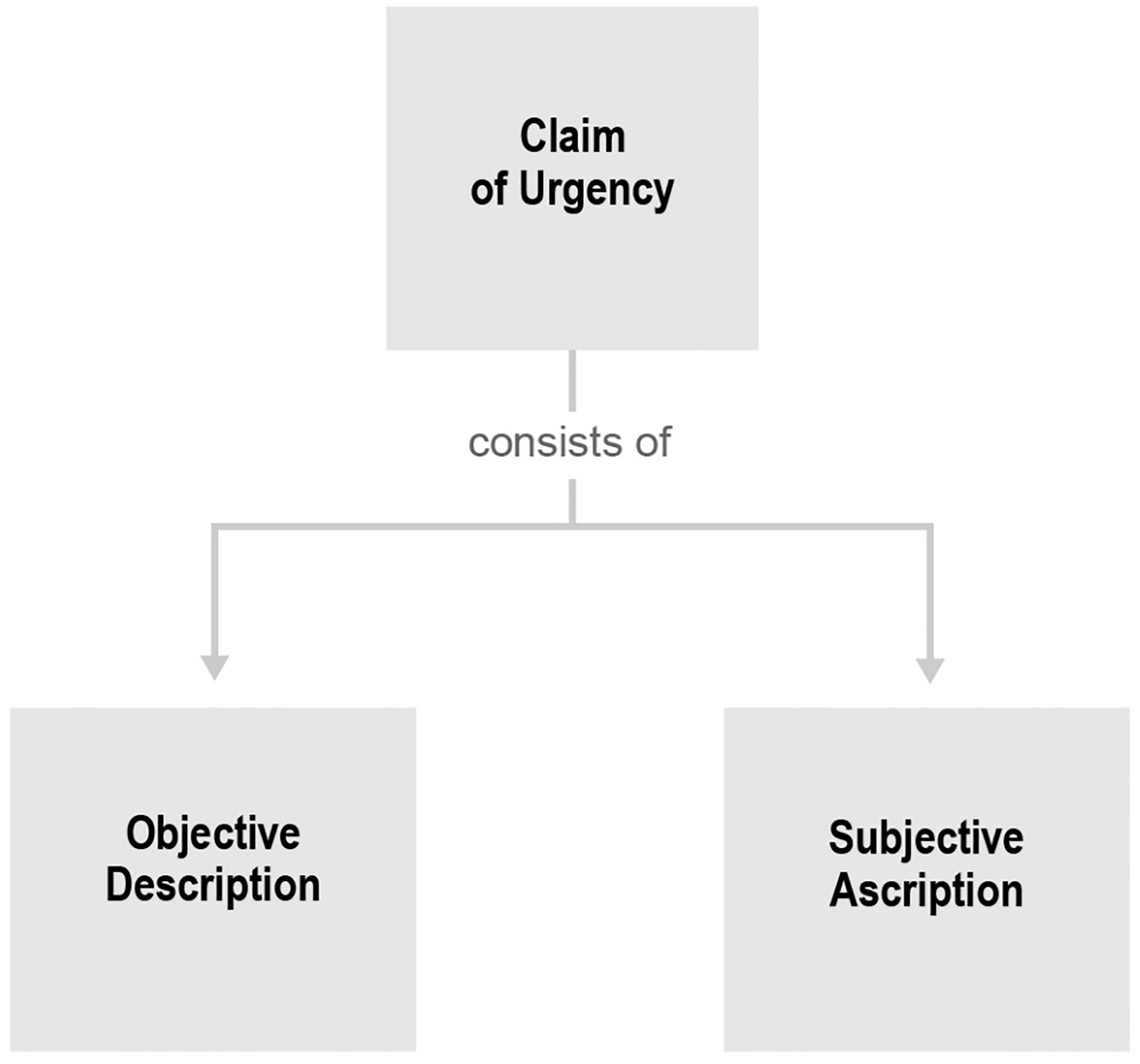
The dual construction of a claim of urgency. Spector (2019) published by Cambridge University Press, reproduced with permission.
To appreciate that delineation, let’s consider a claim offered by WHO Director-General Tedros Adhanom Ghebreyesus. After detailing rates of infection as well as the percentage of infected people who would develop a severe illness and require critical care, Ghebreyesus added, “This is not just a public health crisis, it is a crisis that will touch every sector—so every sector and every individual must be involved in the fight” (quoted in Branswell and Joseph, 2020). This is a claim, a human application of a crisis label to a particular set of contingencies. And like every claim of urgency, it offers two elements: both objective description and subjective ascription.
First, there is an objective description, pointing to particular exigencies upon which the assertion of threat will be based. These are what Searle (1995) called “brute facts” that cannot be wished away (9). Objective elements are capable of being verified or discredited. For Ghebreyesus, the objective description amounted to an enumeration of the statistics accumulating about the disease and its brutal impact. The second element of Ghebreyesus’ claim, of any claim of urgency, is a subjective ascription of meaning to what is being described. This is the element that seeks to define the import and meaning of those brute facts, the “uh-oh” contention that big trouble is coming, the “public health crisis” that will “touch every sector” such that “every individual must be involved in the fight.” Uh-oh!
Once we have parsed claims of urgency into these two elements, we can take the next step in propositional logic to answer the question: how can these two elements—objective description and subjective ascription—be evaluated? Both elements can and should be evaluated, but only by the appropriate criterion. I propose accuracy as the criterion for analyzing the descriptive element of a claim, and plausibility as the criterion for sorting ascription of meaning.
Accuracy and plausibility
Accuracy is a much simpler concept to understand, so let’s start there. Accuracy reflects the extent to which the descriptive elements of a claim adhere to cold, hard facts (Foley, 2012). Sure, our understanding of cold, hard facts can and do change. Epidemiologists are regularly revising their analysis of the novel coronavirus and the resulting COVID-19 disease based on accumulating data and experience (Chotiner, 2020). Even as I write this, there is no certainty as to the accurate “case fatality rate” of the disease (Mooney et al., 2020). To be sure, determining accuracy is not always easy. Cold, hard facts may be difficult to ascertain. Nonethless, to the best of our capacity, we can and must strive to validate the accuracy of the descriptive element of a claim with reference to things that exist outside of the claims-makers’ mind.
Accuracy may be difficult to ascertain, but the concept is clear. The notion of accuracy cannot be applied to ascription, however. This is where plausibility comes in to play. Plausibility is an inference drawn on the basis of well-defined reasoning (Lombardi et al., 2016; Wagar, 2014). Plausibility insists that reliable principles and methods of reasoning are utilized in a transparent process that moves the formation of an ascription in a coherent, logical progression. Plausibility requires a claim to be structured in such a way that offers a logical path of compatible propositions (Agazzi, 2011; Von der Mühlen et al., 2016). We wonder as we evaluate the plausibility of a claim if there has been intellectual rigor and honesty brought to bear as the claims-maker moves from A to B? When these criteria are met, we can judge the ascriptive element to be plausible. We may or may not fully believe it, we may or may not agree with it, but we can accept the application of a crisis label as plausible.
The typology
To deal with the classification of claims, I propose the typology depicted in Figure 2. Each quadrant name is based on what I consider to be its dominant characteristic.
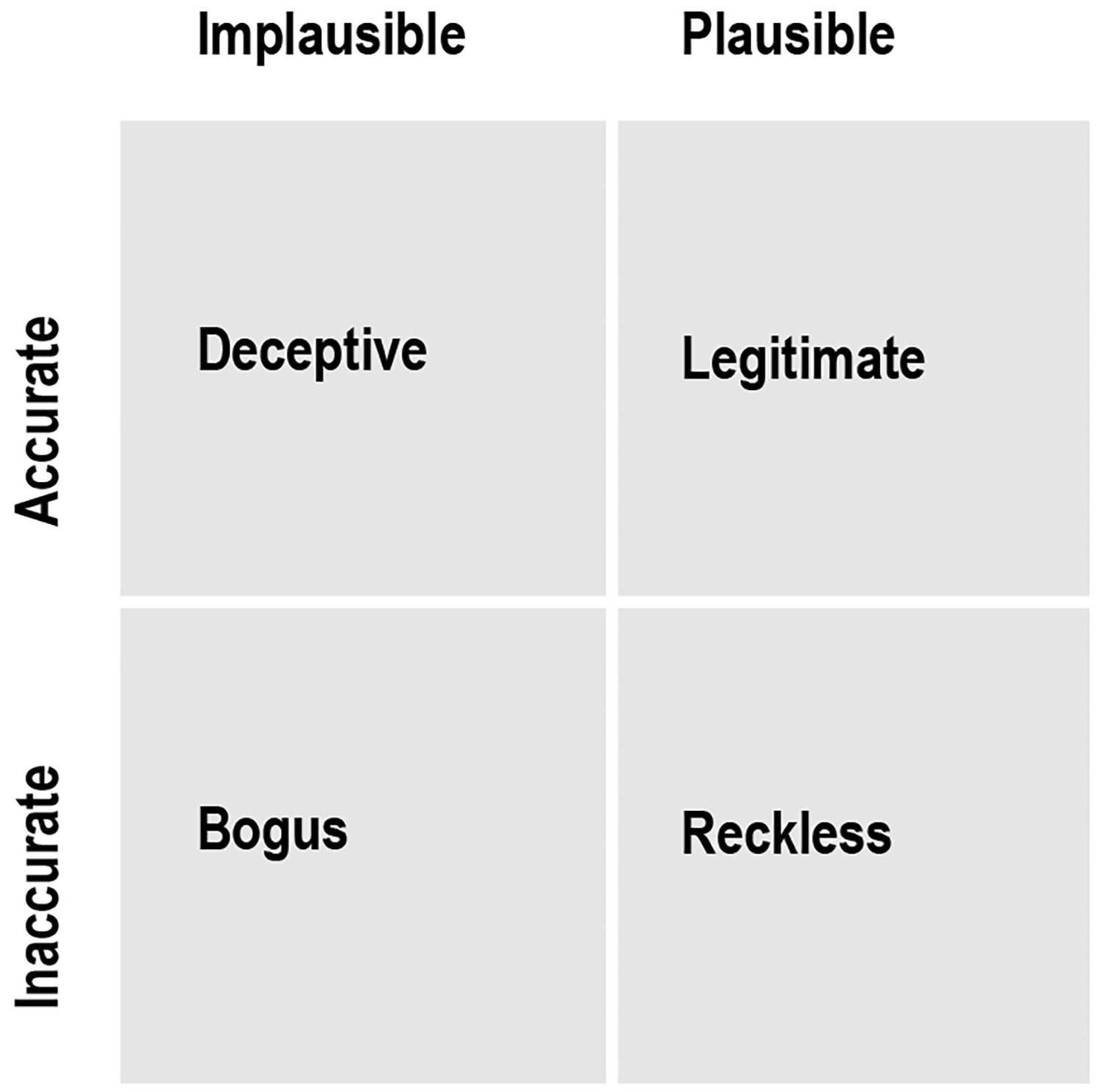
A typology of claims of urgency. Spector (2019) published by Cambridge University Press, reproduced with permission.
Accuracy applies to the objective, descriptive element of a claim, and plausibility to the subjective, ascriptive element that attributes meaning to the claim. A claim that is both accurate and plausible is thus classified as a legitimate claim. Providing quantitative and verifiable data on the spread of COVID-19 and declaring a public health crisis can be classified as both accurate and plausible, thus legitimate. Remember, labeling a claim as legitimate is not equivalent to asserting that it is true. The typology is not a tool for settling arguments, not designed to separate right from wrong. Nor can it predict how claims will be believed or what impact they will have. Legitimacy will influence but not determine whether people believe a claim. (More on that point later.)
And what about the possibilities of non-legitimate claims? Let’s visit each possibility from the typology:
A claim that is accurate in its description but implausible in terms of its subjective ascription is a deceptive claim. “This is COVID-19, not COVID-1, folks,” claimed senior White House advisor Kellyanne Conway as a way of assigning blame for the US government’s lack of preparedness to the WHO (quoted in Kaufman, 2020).
2
Accurate? Sure. The name COVID-19 comes from a shortening of COronaVIrus Disease 2019, after the year it appeared. So the statement “This is COVID-19, not COVID-1” is accurate. But to draw a line between that name and the response of WHO is implausible. It makes no logical sense. A claim that is inaccurate and implausible is a bogus claim. “Anybody that needs a test gets a test. We … they’re here. They have the tests, and the tests are beautiful” (Donald Trump quoted in Paz, 2020). With hospitals, mayors, and governors screaming for adequate testing weeks after the virus first US appearance, there was simply no accuracy or logic to the claim. A claim that is inaccurate but plausible is a reckless claim. Trump’s claim, for instance, that the coronavirus would weaken “when we get into April, in the warmer weather—that has a very negative effect on that, and that type of a virus” (quoted in Paz, 2020) was plausible. Respiratory viruses can be seasonal. It simply was not true of this respiratory virus. Another frequent Trump claim—that an economic shutdown would lead to more deaths via suicide and desperation than the virus itself—also contained a modicum of plausibility. The facts, however, suggested that such a claim was not accurate.
Reckless claims represent perhaps the most nefarious category of the typology. These are the kinds of claims are so dangerous precisely because they are plausible. Reckless claims—Lyndon Johnson’s 1964 claim that the USS Maddox had been the victim of an unprovoked attack in the Gulf of Tonkin from North Vietnam or Colin Powell’s 2003 claim that Saddam Hussein was amassing weapons of mass destruction—can and have led to war. Trump’s reckless claims, whether by design or otherwise, serve to exert pressure on state governors to “open” the economy prematurely, creating, in Dr Fauci’s view, an “extraordinary risk” of new spread (quoted in Bredemeier, 2020). Those reckless claims helped spur small demonstrations against public health lock-downs in multiple states (encouraged by presidential tweets such as “LIBERATE MICHIGAN!” and “LBERATE VIRGINA” (Haberman, 2020). Beware, particularly, of reckless claims.
Move on, folks—There’s nothing to see here
The coronavirus is a “little flu,” nothing more than a “cold” and “sniffles”. It is the media that has manufactured “hysteria,” a mere “pretext” manufactured by political enemies out to “get” him and his “Make Brazil Great Again” movement (Anderson, 2020; Friedman, 2020). President Jair Bolsonaro has become a world leader in the “there’s nothing to see here” response to the global pandemic.
The proposed typology can be applied equally to such claims of non-crisis. The phrase, “move on, folks – there’s nothing to see here,” is typically attributed to police in their attempt to disperse gawkers from a crime scene. The Urban Dictionary ascribes deeper, even sarcastic meaning to the phrase, suggesting that the denial of anything to see is employed as a deception.
The “there’s nothing to see here” claim can—like counterclaims that yes, there is something to see here—be held to the same evaluative criteria of accuracy and plausibility. Bolsonaro’s move-on-folks claim can be classified as bogus.
Legitimacy and beliefs—An uneasy fit
It should also be acknowledged that the classification of a claim is not determinate of whether people believe the claim. The content of a claim of urgency—its objective description and subjective ascription—influences constituent belief in its validity. As people evaluate a claim, they mostly value truth and the avoidance of error. Mostly, but not entirely. Beliefs are shaped by additional powerful forces.
What else besides truth and the avoidance of error do people value? Well, we value cognitive comfort, which involves the maintenance of rather than challenges to our own assumptions and biases, those we bring to bear as we decide if to believe new claims. We also value credibility on the part of the claims-maker. And we value membership in a community of like-minded thinkers. That belief formation process impacts us—all of us—in a systematic way.
Think of belief as an act of filling a gap. There is, after all, always some room for doubt in any claim. Will the coronavirus really spread that far and wide? Is a virtual shutdown of social institutions actually the optimal response? Certitude does not come easily. Beliefs are formed in the absence of absolute proof, helping to span that void by alleviating doubt (Shermer, 2011).
Believing starts with pattern recognition. We notice patterns, or at least think we do. A typically precedes B, which leads to C. We then look for further instances of that same pattern and intuit a rule of thumb, a heuristic (Spiliopoulos, 2012). By forming a pattern, we render a decidedly non-linear, ambiguous, complex, and ever-changing world suddenly comprehensible. We all partake in this hunt for patterns.
And we all want to believe, perhaps even need to believe, that patterns exist. The possibility of making our way through this pandemic without attaching some coherence is overwhelming. We all believe something and someone. But that doesn’t mean people believe anything. We make active decisions as we consider claims; believing some, rejecting others.
People look at the world today and “see” different patterns. Some see scientists seeking to protect society from great harm, while others see a pattern of media and political types out “get” them and their favored leaders. From the complex intake of sensory data, the brain seeks patterns and then infuses those patterns with meaning (Ariely, 2008: 4). People with high cognitive complexity are more willing and able to admit to pattern formation paradoxes, uncertainties, and debates. People with low cognitive capacity prefer simpler cause-and-effect patterns with clearly delineated right and wrong answers. Either way, humans can’t help it; it’s just the way the brain works. Perceived patterns become beliefs. We develop our own hypotheses based on those perceived patterns. This is how the world works. These are the reasons things happen the way they do. Then we seek “truth” within our preferred model; verification that our models represent the world accurately.
That predictable belief formation process presents a challenge to any classification system that seeks to sort out legitimate and varied forms of non-legitimate claims. The wicked challenges raised by the pandemic—questions for which there were no definitive, objectively correct answers or solutions (Grint, this issue)—calls for leaders who see their role not as heroic saviors but as individuals (and groups) capable of welcoming debate and disagreement, and possessing a sophisticated capacity to delineate among the myriad of claims those that are legitimate and those that are otherwise (see Wilson’s analysis of Jacinda Ardern, this issue).
A classification system offers leaders, constituents, and those of us who analyze their interactions a framework for considering the process of crisis construction as well as the consequences of those constructions. It presents crisis not as an objective condition but a subjective claim, one that involves as exercise in power and influence. Claims may be legitimate and immediate response may be appropriate. At the same time, scrutiny and debate are encouraged because critical thinking is always advised.
Footnotes
Acknowledgements
Special thanks to José Santos and Milorad Novicevic. They never fail to add insights.
Declaration of Conflicting Interests
The author(s) declared no potential conflicts of interest with respect to the research, authorship, and/or publication of this article.
Funding
The author(s) received no financial support for the research, authorship, and/or publication of this article.