




Abstract
Communication and information technologies continue to shape political movements in increasingly abstract ways, demonstrated by far-right violence blurring with memetic digital styles. Building on this, I apply insights from postphenomenology to examine how social media platforms mediate the vernacular practices of far-right users, with a specific focus on right-wing Discord communities. I illuminate practices related to a genre of memes called ‘fashwave’, a bricolage of the vaporwave aesthetic and fascistic iconography. I suggest that fashwave memes magnify a nostalgic worldview whilst inhibiting other kinds of affective modalities, in turn producing a collectively felt sense of community which resonates with Griffin’s conception of fascism as palingenetic ultranationalism. Not all consumers of fashwave memes on Discord turn to fascism, however. As multidimensional cultural artefacts, fashwave memes stabilise in relation to the overarching orientation of Discord, and the motivations of individual users. Here, by attending to forms of macro-mediation and micro-mediation, I argue that the platform’s affordances invite particular action scripts that, when interpreted by far-right community members, activate sensorial resonances which translate into harm. Through this translation, vernacular practices like proliferating fashwave memes are rearticulated by far-right users as mechanisms to symbolically align with the nation by undertaking a contemporary palingenetic struggle.
Introduction
For as long as digital technologies have existed, they – and emergent digital subcultures – have been linked to expressions of political violence. From concerns about how digital technologies are leveraged by ‘bad actors’ to recruit or proliferate ideologies (Conway et al., 2019), to fears about the radicalising force of social media platforms (O’Callaghan et al., 2015; Pariser, 2011), in more recent times scholars have paid closer attention to the gamified and memetic nature of contemporary political movements (Fizek and Dippel, 2020; Lakhani and Wiedlitzka, 2023). Bringing this into sharp focus is the recent assassination of US far-right influencer, Charlie Kirk, who was shot at Utah Valley University on September 10, 2025. Whilst right-wing pundits and leaders were quick to position the attack as an example of ‘left-wing extremism’, the ideological leanings of the shooter remain unclear (Stone, 2025), particularly as engravings on the shooter’s bullet casings make a range of highly memetic digital subcultural references (Sharpe, 2025). This has led the US House of Representatives to call for the CEOs of digital platforms including Discord, Steam, Twitch and Reddit to testify to Congress about the contributions such platforms make to political violence (Committee on Oversight and Government Reform, 2025; McWhertor, 2025).
The fallout of Kirk’s assassination demonstrates the ongoing need to clarify how technologies shape political violence. This paper contributes to such work by examining far-right digital communities on Discord, a social media platform which, despite receiving relatively little academic attention, has been identified as a central ‘meeting point’ for the far-right in recent years (see Conway et al., 2019; Gallagher et al., 2021). Discord is a free platform that affords multi-modal communication, including voice calls, video calls, messaging, and file-sharing. Users can communicate with each other individually, but typically participate in communities known as ‘servers’, which are user-generated collections of chat rooms. Originally designed for gamers, Discord has rapidly grown in popularity due to the wide range of community building tools it offers, servicing over 200 million users each month (Discord, 2025a). The growing contemporary relevance of the platform is further demonstrated by recent online safety legislation in the UK regulating the use of Discord, with suggestions that it may eventually be captured by similar legislation in Australia (Discord, 2025b; Lavoipierre, 2025). Discord, as such, is ripe for analysing the ways in which digital technologies intersect with experiences of harm across online and offline space.
I undertook a digital ethnography of far-right Discord servers to illuminate this intersection (see Ferrell, 2018; Pink et al., 2016), enabling me to experience firsthand how far-right users were interacting and collectivising. To frame the conceptual offering of this paper, I want to briefly reflect on an encounter between two users in a far-right Discord community
1
:
I hate this fucking world
Cess pit
The old times were better definitely. There were more based regimes
How does this brief conversation have anything to do with political violence and online safety? As this paper argues, the interaction between PitDweller and TimeWizard mirrors aspects of Griffin’s (1991, 2018) conceptualisation of fascism as palingenetic ultranationalism, which identifies the core of the fascist mythos as a narrative of struggle to rebirth a nation in the image of a valorised past (i.e. palingenesis). Within the interaction, both users inflect a kind of struggle (‘the good fight’) in relation to a romanticised vision of the past (‘Wish we could turn back time’; ‘The old times were better definitely’). For Griffin (1991, 2018), what separates fascism from other reactionary thought is a sense of utopic progress rather than a mere return to the past. This dimension of the interaction is less visible, implicit in memetic vernacular styles which permeate far-right Discord servers. The reference to ‘more based regimes’ is an example; ‘based’ being a digital slang term which signals that one finds something agreeable. In this sense, whilst both users articulate a desire to return to the regimes of old, they also imagine a future that is modulated by contemporary digital sensibilities, where the utopia will be even ‘more based’ than what came before. It is this imagining which I focus on throughout the paper, examining how narratives of time and struggle intersect to produce a shared ‘nation’ which far-right Discord users are invited to actualise. Importantly, I explore how these dynamics emerge as a uniquely textured platform vernacular in part through the mediatory role of Discord’s affordances (Gibbs et al., 2015). As I develop below, digital technologies mediate experiences of far-right users by inviting them to feel nostalgic about a world that has been lost, integrating them within a valorised fascistic mythos, whilst inhibiting other kinds of affective modalities. Ultimately, this analysis helps illuminate how material acts of far-right harm – including significant acts of exclusionary political violence – can be underpinned by banal modes of digital participation.
To make this argument, I wed an analysis of far-right digital vernaculars to postphenomenology, a theoretical approach that has gained currency in criminological research through its ability to qualify the relationship between digital technologies, harm, and justice (Wood, 2025; Wood et al., 2023, 2025). More specifically, I argue that Discord’s affordances invite particular action scripts that, when interpreted by far-right community members, activate sensorial resonances which ossify harmful ideologies. To develop this argument, I examine a type of meme called ‘fashwave’, a bricolage of the vaporwave aesthetic and fascistic iconography. Such memes depict a utopic imagining of the future that is simultaneously oriented to rebirthing a romanticised past; the same kind of narrative conveyed by PitDweller and TimeWizard. I explore how users construe sharing and creating fashwave memes – as well as other vernacular practices – as part of a nationalistic project which is, in part, mediated by Discord itself. Here, Discord invites engagement across its user base, a kind of technological intentionality that is interpreted by far-right users as a way for them to symbolically align with, and actualise, the future-nostalgic imagining depicted in fashwave memes. Through this postphenomenological framing of far-right Discord servers, I demonstrate how users are invited to rearticulate fascism in ways that are commensurate with the sensibilities of contemporary digital vernaculars. Overall, I improve an understanding of how interactive and multimedia capacities are central to ‘digital fascism’ (Fuchs, 2022: 320), offering deep insight into the structures of digital platforms in facilitating far-right community building.
Understanding the ‘digital far-right’ and ‘digital fascism’
It is important to begin by explaining how I operationalise ‘far-right’ and ‘fascism’ in this paper, given the terms are contested within scholarly literature. At the outset, there is often a blurring between the kinds of concepts used to describe the far-right, including ‘populist right’, ‘radical right’, ‘extremist right’, or some combination of terms like ‘far-right populist’. Whilst scholars like Mudde (2007) and Rydgren (2018) have made important contributions in distinguishing these terms as operating at different points along a continuum towards extremism, there remain debates around how these terms should be deployed. In addition, research which has considered the ‘mainstreaming’ of the far-right raises questions about whether making these distinctions are valuable in the first place (see Brown et al., 2023).
Given this conceptual precarity – such that Miller-Idriss (2020: 17) describes ‘far-right’ as the ‘best bad term’ we have available – I deploy the term in line with Albrecht et al. (2019) and Pirro (2023), who argue for its use as a broad umbrella category which captures the blurred boundaries between different ideologies. In this sense, I have operationalised ‘far-right’ and ‘fascism’ as heuristics to illuminate the affective dimensions of the fascist mythos, and how these overlay far-right digital communities. A heuristic approach resonates with a focus on how banal, everyday encounters in virtual and terrestrial space sustain the far-right, of particular importance given the ethnographic basis of this research (see Holmes, 2016; Miller-Idriss, 2020).
This leads me to consider how the relationship between digital technologies and political violence has typically been approached in scholarship. Researchers have investigated how technologies are used to recruit members and proliferate extremist materials (see Conway et al., 2019; Koehler, 2014); how technologies automatically induce or exacerbate radicalisation processes and political polarisation (see Murthy, 2021; O’Callaghan et al., 2015; Pariser, 2011); and how radicalisation pathways are connected to digital subcultural norms (see Conway, 2017; Holt et al., 2017). Whilst this research is significant, it often embodies certain assumptions about human-technology relations; assumptions which are also common in criminological literature examining the role of technology in experiences of crime and justice. As Wood (2021) suggests, common framings of digital technologies tend to adopt a use-based perspective which frames technologies as neutral artefacts that enable humans to fulfil their ends (see also Mitchell et al., 2025). This same framing is present in research into political violence which focuses on how digital technologies expand the ‘toolkit’ of extremists in various ways (Conway, 2006; Wong et al., 2015). As a specific example, Fuchs (2022: 318) broad definition of ‘digital fascism’ embodies this use-based orientation, defined as “the communication of fascism online as well as fascist groups’ and individuals’ use of digital technologies as means of information, communication, and organisation.”
Use-based approaches only offer one piece of the puzzle, as they bely the ‘thing-power’ of technologies themselves (Bennett, 2010). Contrastingly, focusing too heavily on the causal role of technology can result in techno-determinism which undermines human agency (Archetti, 2015; Maly, 2024). Techno-deterministic assumptions are often found in research about political violence in relation to the existence of algorithmic radicalisation, information pipelines, or echo chambers (see Alfano et al., 2018; Pariser, 2011; Ribeiro et al., 2020). These approaches tend to render audiences as passive consumers who are automatically influenced by the content they engage with, rather than active in this process (Archetti, 2015; Munger and Phillips 2022). Indeed, despite the salience of this characterisation across literature about political violence, very little empirical evidence supports the existence of these kinds of pipelines or echo chambers (Bruhns, 2019; Zuiderveen Borgesius et al., 2016).
Understanding the dynamics of these processes requires a sociotechnical account which attends to interfaces between humans and technologies, an approach consistent with the field of digital criminology (see Brown, 2006; Powell et al., 2018; Stratton et al., 2017). Examining these interfaces helps to unravel the complex vernacular practices which emerge in the relationship between digital platform design and user intentions (Gibbs et al., 2015) – of utmost importance when considering the often esoteric and arcane dimensions of digital fascism (Tuters, 2020). To varying degrees, scholars investigating the far-right have focused on these dimensions by examining the relationship between digital subcultural norms and political violence (Milner, 2013; Phillips, 2015), as well as explicitly focusing on the sociotechnical dimensions of far-right communities (de Keulenaar and Tuters, 2023; Donovan et al., 2019; Massanari, 2017). However, there is scope to build upon this work by drawing on insights from postphenomenology, or mediation theory.
How do technologies mediate affective potentials?
As Verbeek (2015) suggests, the core of postphenomenology is an emphasis on the mutual shaping of humans and technologies. Rather than discrete poles which interact with each other, ‘human’ and ‘technology’ are emergent and relational properties. From this perspective, rather than consider how technologies cause far-right extremism or how the far-right use technologies, postphenomenologists would investigate how digital technologies mediate the far-right. Whilst this may seem like a trite change of emphasis, it averts pitfalls around use-based and techno-deterministic approaches to digital harm. Rather than viewing humans or technologies as discrete objects with a predisposition to harm, harm is identified as (potentially) arising in certain kinds of relations between technologies and humans (see Wood, 2025).
Postphenomenology offers a range of conceptual tools for understanding these relations, some of which will be used throughout the paper (see van Den Eede et al., 2017). At the outset, the concept of ‘invitations’ is central to understanding technological mediation. Verbeek (2005: 171) suggests that a technology’s mediational capacity relates to its ability to invite or encourage particular modes of action whilst inhibiting or discouraging others. In this sense, postphenomenologists acknowledge that technologies do more than afford various action possibilities (Gibson, 2015), as they are imbued with certain orientations, or intentionality, through their design (Verbeek, 2008). In accounting for human intentionality, postphenomenologists suggest that understanding relations with technologies also requires attending to the cultural environment in which an actor relating to technology is embedded: ‘technological mediation, in this view, considers the actor’s interpretation of the invitational properties of a technology’ (Mitchell et al., 2025: 1390). This process can otherwise be understood as a form of translation, where the modes of action encouraged by a technology are translated into an action that may or may not ‘match up’ with the action scripts invited by the technology (Verbeek, 2005; Wood, 2022). As such, postphenomenology helps to capture the multistability of digital technologies. Multistability refers to the various forms of a technology that may at some time or another become temporarily stable (van Den Eede et al., 2017: xxi). In other words, technologies come to mean different things for different people in different social, cultural, and physical contexts (Spicer, 2017: 83).
Building on this framework, postphenomenological approaches to digital harm and justice can benefit from considering the automatic and felt qualities associated with human-technology interfaces (see Anderson et al., 2026). I suggest that Discord’s affordances invite particular affective modalities that are automatically and often tacitly interpreted by far-right users in ways that are cognisant with their cultural environment: they are interpreted through a distinct far-right platform vernacular. Indeed, the postphenomenological emphasis on relation is compatible with continued calls within criminological literature to decentre ‘objects’ of analysis and focus on sensorial and affective ‘encounters’ with harm and justice (Young, 2014; Young et al., 2023). I theorise affect through the work of Massumi (2021), amongst others. Drawing on Deleuze and Guattari’s (1987) distinction between the virtual and the actual, Massumi (2021) posits that affects exist in a perpetual state of emergence and cannot be wholly reduced to a particular emotion or experience. The virtual represents the global field of potential containing the latent possibilities of all things in the world, whilst the actual refers to a moment where potentials are constrained or ‘singularised’ into a felt experience. Affects slide across these fields, referred to by Massumi (2021: 25) as a turning point where a ‘physical system paradoxically embodies multiple and normally mutually exclusive potentials, only one of which is “selected”’. In this sense, affects flow across bodies and modulate experiences, by augmenting or diminishing the capacity of those bodies to act (Massumi, 2021). Through this lens, digital technologies are imbued with affective potential as well, operating as contouring bodies or architectural forces which shape felt experiences (Massumi, 2021; Papacharissi, 2014). In other words, technological invitations contribute to the selection or singularisation of a potential outcome, by inviting (augmenting) particular modes of action whilst inhibiting (diminishing) others (Verbeek, 2005: 171). Affect theory indicates that the translation of invitations may be an immediate rather than reflective process, wherein perceptions and experiences are modulated in the moment of contact between bodies (Ahmed, 2014) – or in the interface between digital users and technologies. To build on this, I turn to examine specific examples of fashwave memes, demonstrating how Discord mediates the contemporary fascist mythos.
Methodology: Ethnographies of the digital far-right
To argue that digital technologies mediate participation in far-right digital communities, I draw on findings from my research into such communities on Discord. Embracing the importance of internalist research into the far-right (see Blee, 2007), I undertook a covert participant observation of 33 far-right Discord servers between May 2021 and November 2021. There are, of course, myriad ethical constraints to undertaking this kind of research, and in recent years scholars have paid increasing attention to how to ethically engage with the far-right (see Vaughan et al., 2024). Elsewhere, I have discussed a range of ethical dilemmas and risks associated with my research (Wood, 2024), and given the focus of this paper, I do not intend to cover them in detail again here. Rather, I briefly demonstrate how I methodologically justified an ethnographic approach in line with some of the problematics identified above.
Drawing on criminological ethnography and digital ethnography (Ferrell, 2018; Pink et al., 2016), I aimed to understand what it meant for far-right users to navigate their digital lifeworld. Through immersion, I gleaned something about the tacit and immediate dynamics sustaining participation across a disparate userbase. This approach was methodologically justifiable given the need for additional internalist research into the far-right (Blee, 2007), and a need to examine the everyday contexts the far-right inhabit (Miller-Idriss, 2020). In addition, it provided an understanding of the seemingly incoherent ideological claims and practices that often permeate the far-right (see Bhatt, 2021; Gillespie, 2023; Malmqvist, 2019), magnified even more-so in a digital context which valorises playful satire, edginess, and memetics (de Zeeuw and Tuters, 2020). Relatedly, scholars have examined how the far-right tap into or embrace digital styles in their ideological dispositions, recruitment strategies, and general vernaculars (see Trillò and Shifman, 2021; Tuters, 2021). Tuters and Hagen (2020) have connected these dynamics to the implementation of arcane grammars or languages across the digital landscape – and from the outside, they are utterly incomprehensible.
Yet, through an immersive, ethnographic approach, I recognised that these seemingly arcane practices made a kind of sense to users who were saturated in such platform vernaculars (Gibbs et al., 2015). An ethnographic approach allowed me to move away from conceptualising the far-right as a discrete object, instead formulated through a range of affective encounters (Young, 2014). In a digital context, examining far-right encounters involves asking questions about how technological innovations co-shape the ways that users feel their way into the far-right (Verbeek, 2005: 130). My research qualified a range of affective dynamics, tethered to myriad digital practices, which contributed to the emergence of a shared sense of digital nationhood. This paper draws on a particular subset of these dynamics by focusing on fashwave memes. In the following sections, I include specific examples of fashwave memes I encountered in Discord servers, as well as other examples of memetic practices and features of Discord’s ecosystem. These examples help demonstrate how Discord mediates a sense of palingenetic ultranationalism.
Fashwave and the ‘Golden Age’
Before examining the relationship between fashwave memes and palingenesis, it is important to briefly signal why Discord users emotionally invest in the fascistic mythos. Here, I draw inspiration from Hage’s (2000) work on Australian nationalism. Hage (2000) depicts nationalistic imaginings as rooted in fantasy, in turn revealing the danger of distinguishing between ‘good’ and ‘evil’ nationalism. For the purposes of this paper, particularly useful from Hage’s work is how nationalism is sustained through affective investment, and reproduced through a range of everyday practices. These practices – what Hage (2000) terms ‘nationalistic practices’ – represent moments where individuals symbolically align with their vision of the ideal nation. By engaging in such practices, nationals accumulate capital, enabling them to stake a claim to power over others within the nation, and over those excluded from it entirely. As I explore below, Discord users imagine their servers as fascistic, nationalist spaces, which in turn provides an affective basis for continued investment in the nation: to sustain a position of power within a nationalistic fantasy.
Nationalistic fantasies are not grounded only in nostalgia. However, nostalgia represents a central vector through which the nation is idealised by far-right Discord users, manifesting as a niche, vernacular-laden formation of contemporary fascism. Indeed, nostalgia is a useful analytic for demonstrating Hage’s point, since nostalgia is itself a fantasy, involving attachment to a romanticised past. Boym writes The danger of nostalgia is that it tends to confuse the actual home and the imaginary one. In extreme cases it can create a phantom homeland, for the sake of which one is ready to die or kill. Unreflective nostalgia can breed monsters. (Boym, 2007: 9–10)
Scholars of the far-right have similarly warned of the dangers of nostalgia. Miller-Idriss (2020: 11), for example, suggests that feelings of ‘faux nostalgia’ can mobilise violence in defence of ideals which never existed. Other scholars have emphasised that far-right narratives often rely on nostalgia as a mobilising force, drawing on visions of the past to diagnose and repair problems in the present (see Elçi, 2022; Farokhi, 2022; Kešić et al., 2022; Menke and Wulf, 2021). Certainly, there are some emergent tensions in framing nostalgia as a far-right sentiment. Is nostalgia dangerous only in ‘extreme’ cases? If nostalgia is, by definition, a fantasy or romance with the past, can there be nostalgia which is not ‘faux’? What might ‘reflective nostalgia’ look like? For Boym (2007: 16) reflective nostalgia involves challenging it, which indicates that any kind of nostalgic investment could be dangerous, not just ‘extreme’ nostalgia.
These tensions are worth interrogating but fall outside of the remit of this paper. At the least, when read through Hage’s (2000) approach to nationalism, nostalgia as an affective frame can help to explain how digital users mobilise into fascistic imaginings through vernacular practices. Nostalgic bonds tether pasts, presents and futures to the nation as an object, construing it as real. Drawing on Massumi (2021) here, the nation therefore emerges as real in the moment it is felt by far-right Discord users. The way that this is expressed and reified through nationalistic practices is further textured, or mediated, by Discord’s memetic ecosystem. As a starting point to investigate this relationship, I turn to the genre of memes known as fashwave; cultural artefacts which help users invest in their image of the nation.
Fashwave memes combine fascist iconography with the vaporwave aesthetic – a dreamlike, retro, sci-fi aesthetic which combines pastel hues with techno-futurism. Through this, as Tuters (2021: 172) suggests, fashwave memes conjure a seemingly paradoxical feeling of nostalgia for an imagined ‘future-past’. Vaporwave – and its derivative, fashwave – are known primarily as musical genres, but they have always featured graphical components (Tuters, 2021). The same aesthetics encoded into fashwave memes, such as those depicted below in Figures 1 and 2, feature on the covering art of fashwave albums, which combine to produce a nostalgic mood rooted in far-right ideology (Larsen and Jensen, 2025: 10). This typically involves using Nazi symbolism, or other aesthetic choices which convey a desire to return to an (imagined) culturally and ethnically homogenous society. Additionally, as Larsen and Jensen (2025) suggest, fashwave is essentially a bricolage of existing symbols and styles which are remixed to produce new emotional meanings. This, I suggest, aligns with fascism as involving palingenesis, because fashwave memes connote struggle and utopic progress.

Fashwave meme posted in a far-right Discord server.

Fashwave meme welcoming users into a far-right Discord server.
Figure 1 demonstrates the imagined future-past just described. The meme depicts a Caesar of Roman antiquity leading an army of legionnaires, resonating with a broader trend of far-right groups drawing on Greco-Roman imagery to reinforce their triumph and grandiosity (Dozier, 2020). As Finchelstein (2020: 41) notes, fascist leaders are often depicted as ‘living myths’, cognisant with romanticised framings of Greco-Roman heroes. Other aesthetic choices in Figure 1 could be said to promote far-right ideology (see Carter, 2018): the legionnaires marching in line connote homogeneity; Caesar leading from the front signifies authority and hierarchy; and the tag-line promotes deference to that authority. In this respect, the meme conveys a narrative about the valour of conquest in the name of shared ideals, and an authority who defends those ideals.
This is the function of nostalgia in mobilising users into the far-right. As Murphy (2009: 126) writes: ‘nostalgic narratives present characters that propel their plots forward; through such plots, and such characters, they advance a moral tale centred on the superiority of the past over the present’. In so doing, nostalgic appeals establish the superiority of the national as well, producing what Hage (2000: 45) frames as governmental rather than passive belonging. Where passive belonging involves a sense of being a part of the nation, governmental belonging is the belief in one’s right to manage the nation. It is to this position which far-right Discord users aspire, speaking again to the mythos of fascism, where although the leader is framed as a ‘living myth’, heroism is normalised within fascist societies in that all inhabitants are invited to imagine themselves as heroic (Eco, 1995). Motifs of legionnaires – and below, soldiers rowing to war – explicitly conjure the cult of death attached to this mythology. In other words, Figure 1 invites far-right users to imagine themselves as engaging in a corresponding struggle to a Roman legion (see Dafaure, 2020), but a struggle which has been reconfigured to align with contemporary digital vernaculars (de Zeeuw and Tuters, 2020; Tuters, 2021). This temporal sliding is achieved through the vaporwave aesthetic: pastel hues, glitch motifs, and font choice slide the nostalgic vision generated by the Roman imagery into a narrative of utopic rebirth, rather than mere nostalgic return.
A second example of fashwave, depicted in Figure 2, further demonstrates how appeals to the past produce a valorised fraternity or brotherhood that symbolises shared nationhood.
Figure 2 is a fashwave meme displayed alongside a welcome message in a far-right Discord server. The meme idealises struggle, tethering it to a sense of hypermasculine fraternity by transposing shared values of honour, duty, and glory onto the faces of Nazi German soldiers rowing to war. Similar to Figure 1, users are invited to locate themselves in a nostalgic vision of the nation. By rendering the soldiers faceless, known only by the values transposed over them, Discord users are invited to imagine themselves as soldiers continuing the work of a fraternity which came before, by embodying those same values. Compared with Figure 1, Figure 2 is more explicitly fascistic given the multiple references it makes to Nazism. Beyond the depiction of the soldiers, the date in the bottom left is telling, as May 10, 1940 denotes the beginning of the Western Campaign, which marked Nazi Germany’s invasion and eventual defeat of Belgium, Luxembourg, the Netherlands, and France. The meme therefore positions users to nostalgically imagine themselves as part of a fascist nation connected by shared values oriented towards struggle.
However, like Figure 1, it is not only return to Nazism that is connoted by the meme. By being framed as if a rewinding still from a VHS tape, the nostalgic imagining is transposed into contemporary action. The juxtaposition of a historical image with modern video technology does not only connote a need to ‘go back’ by rewinding to the past, but invokes a feeling of rebirth. These imaginings are then overlaid onto Discord servers themselves, framed by users as contemporary battlefields, or new sites of struggle. This is evidenced by the welcome message which was displayed alongside Figure 2: Welcome to the [server name]. Once again we rise up from the ashes and march on striking fear and terror into the enemies of god and the human nature on discord. After being banned 4 times with honorable members of hundreds with us and many of our admins and highly trusted members, We want them to know that their fight isn’t over yet!
This message, created by the server owner, draws on the same kinds of nationalistic appeals generated by fashwave memes. Anderson (2006: 7) suggests nationalistic bonds produce a willingness to die for the nation. Here, Discord users display a similar attitude, willing to sacrifice their accounts for the good of the community. Indeed, this imagining is central to sustaining fascism, which requires that ‘life is lived for struggle . . . life is permanent warfare’ (Eco, 1995: n.p.). The server re-emerging ‘from the ashes’ four times is worn like a badge of honour, proof that the server and its inhabitants are engaging in palingenesis. Furthermore, the rearticulation of death as being banned emphasises that the far-right nation on Discord is mediated by the vernaculars of the platform itself. Transgressive practices which breach Discord’s terms of service and result in a ban from the platform – which include the spread of memes containing banned symbolism – are framed as opportunities for users to bring about a utopic future. This rearticulation signals that users are not motivated purely by a nostalgic return to the past, but by rebirth, where fascism is creatively remixed to align with contemporary platform vernaculars. Indeed, this dynamic indicates the ways in which technological environments mediate far-right participatory digital cultures, through users interfacing with the invitational qualities of Discord.
How does Discord mediate fascism?
Digital technologies contribute to the ossification of fascism at multiple, and intersecting levels. An important starting point for this analysis is Ihde’s (1990: 29) distinction between microperception and macroperception. Where microperception refers to sensory or bodily perceptions, macroperception refers to the socio-cultural contexts which inform the interpretations of such perceptions. These concepts go some way to conceptualising the arcane dynamics of fashwave memes, including what kind of affective resonances they invite and inhibit, as well as broader social and cultural forces which shape how these resonances are translated into collective nationalism.
However, as Wood (2025: 122) indicates, postphenomenologists have tended to focus on a ‘micro sociology of harm’ by examining the direct impacts technologies have on experience. Indeed, this relationship is hard to pin down in the context of affective resonances, which despite being emergent, dynamic, and uniquely experienced, also have tangible political effects (see Ahmed, 2014; Massumi, 2015). For example, as a researcher of the far-right, whilst I can appreciate that Figures 1 and 2 inflect a nostalgic aesthetic, the meme also activates other affective sensoria like confusion, distaste and amusement; resonances which would be inhibited in a user otherwise oriented towards ultranationalism. Locating harm in this affective arrangement is difficult, because memes are multistable, lacking ‘direct, stable, or reliable connection between signifiers and signified’ (Wiltse, 2017: 8). Yet for those involved in memetic subcultures, memes stabilise in a way that makes sense, and understanding this process involves considering technological mediation.
Relatedly, this involves examining fashwave memes in terms of a confluence of Discord’s individual, subcultural, and structural dynamics. Wood (2025: 195) indicates the importance of examining ‘how technologies contribute to harms less directly through their ripple effects on social relations and structures’. I capture these dynamics by denoting the macro-mediatory and micro-mediatory forces that shape the experience of fashwave memes on Discord, the result of which induces an inflected, or ossified form of fascism (see Wood, 2025: 201). By distinguishing between macro-level and micro-level mediation rather than perception, I seek to capture different environmental orientations that shape processes of perception and interpretation. Whereas macro-mediation entails processes that implicate a variety of elements of Discord’s media ecosystem, micro-mediation focuses on interactions between individual users and components of this ecosystem. At the level of macro-mediation, social media platforms like Discord sustain a wider attention economy which habituates engagement amongst userbases. At the level of micro-mediation, far-right users reorient engagement affordances based on the nationalistic vernaculars proliferating in their communities, which in turn reshapes how attention flows economically. In doing so, the proliferation of fashwave memes – and the normalisation of other nationalistic practices within Discord servers – demonstrates how harms arise both synchronically through users directly interfacing with Discord, and diachronically through the ripple effect these interfaces have on future interactions and broader social norms (see Wood, 2025: 196–199). As such, the ossification of fascism emerges through the rearticulation and reproduction of memetic practices as nationalistic practices, in turn revealing that the attention economy and interfacing with Discord itself contribute to far-right harm.
Macro-mediation: The attention economy
There are myriad digital technologies involved in memetic practices, ranging from software used to create a meme, to the algorithms which contribute to their circulation. Rather than canvas these technologies and qualify the relationship far-right digital users have to them, a useful starting point is to consider the overarching intentionality of the technological environment within which fashwave memes proliferate. Environments, for Wiltse (2017: 9), capture how ‘we live in a technosphere of ambient, pervasive technologies, and ones that increasingly sit at the interface between self and world’. Environments are often hidden, involving infrastructures and ‘background relations’ with technologies, with ‘no clean edges, firm boundaries, or absolutely exterior positions. An environment is . . . something that surrounds and incorporates us’ (Wiltse, 2017: 10). If the circulation of fashwave memes generates a shared nostalgic sentiment, then it is useful to think about the broader orientation or intentionality of the environments which macro-mediate the spread of such sentiment.
Given I focus on a social media platform, the logics of the attention economy are a useful way of characterising the broad intentionality of Discord’s infrastructural design. The attention economy refers to a business model which focuses on seizing and maintaining the attention of digital users to generate advertising revenue (de la Torre et al., 2026). This model encourages technology companies to shape platform interfaces in ways that attracts attention for as long as possible. 2 However, as a multistable platform, although Discord is oriented towards attention, its emphasis on customisability and community building means that users relate to this in myriad ways. 3 Hermansson et al. (2020: 155) have made similar connections between the far-right and the attention economy, with a specific emphasis on the networked aspects of far-right Discord servers. As such, appraising Discord in relation to the attention economy helps articulate how particular micro-mediations (such as those occurring within far-right Discord servers) co-constitute broader digital economic flows. The attention economy, as such, represents a larger ecology or social condition within which Discord – and myriad other social media platforms – are situated (Wood, 2025: 202).
What might be considered ‘stable’ about the attention economy – the orientation of the technological environment – is, as de la Torre et al. (2026: 6) suggest, engagement. Engagement is measured by users developing a ‘habit’ of interacting with the platform for as long as possible, maximised through complex trigger and reward systems that produce motivation for continuous engagement (de la Torre et al., 2026). de la Torre et al. (2026: 6) provide a useful starting point for understanding how platform interfaces relate to the attention economy, where ‘interaction elements such as vibrations, sounds (“beeps”), pop-ups, wriggling and moving elements, or bright colors . . . direct users’ attention’. However, given the desires and motivations of each individual user differ, the ways that they engage with a particular platform will be distinct. Engagement, as such, manifests in various ways.
In the context of far-right servers, the multistability of Discord means that although there is a general orientation of engagement invited by the platform, this can (inadvertently) induce harm. The extent to which Discord views the spreading of far-right content on its platform as an ‘accepted harm’ – ‘unintended but expected and permitted by designers’ (Wood, 2025: 135–136) – is an open question. Relatedly, scholars have noted that social media platforms benefit from the circulation of polarising content because it produces engagement (Anderson, 2026; Rathje et al., 2021). In this context, the presence of far-right servers on Discord may to some extent align with the broader orientation of the attention economy because Discord benefits from the increased engagement attached to users promulgating fascism. Simply put, the more that users engage on the platform, regardless of what that engagement looks like, the higher the chance that users will interface with the platform’s monetisation strategy. As such, as a multistable platform, Discord’s design features which are oriented towards engagement mediate user experiences without determining what that experience looks like for specific users. In turn, through processes of macro-mediation, Discord may itself be contributing to harm by co-shaping harmful digital practices, such as the proliferation of fashwave memes and other related vernacular practices.
For example, Discord’s central monetisation strategy relies on a subscription service called ‘Nitro’, which enables users to apply ‘boosts’ to servers they participate in, unlocking a variety of additional functions within such servers for a certain amount of time. This mediates an engagement ecosystem because Discord server administrators often seek to increase server membership, raising the pool of potential users who might apply a boost to the server, which is then further used to advertise their server to other prospective users. In far-right Discord servers, purchasing Nitro is recoded as a nationalistic practice. Consider the following interaction, where a server owner offers administrator privileges to whoever applies a boost, enabling the owner to customise their server URL.
<
From a postphenomenological perspective, Discord’s orientation towards engagement stabilises in relation to particular design features on the platform – such as the various benefits offered by Nitro – and when far-right users interface with these features, they are essentially undertaking nationalistic practices. Thus, quite transactionally, ‘HumbleServant’ accumulates nationalistic capital in exchange for boosting the far-right Discord server, in turn actualising the server as a nationalistic space. Indeed, in this sense, macro-mediation can only be understood in the context of micro-mediation, which I discuss below.
To reiterate, the way that Discord implements engagement affordances is not deterministic of far-right harm. Rather, at the macro-level, technological environments and mediating (infra)structures shape the formation of digital habits in ways that can often recede from view (Susser, 2017; Wiltse, 2017). Discord invites memetic engagement as it seeks to capture an audience of gamers, and interrelated subcommunities. In this context, the various ‘wriggling’ elements noted above – enabled by the attention economy – invite all digital users to actively promote, share, mimic, and remix their own memes (Shifman, 2013). In this process, memes scale from individual communication artefacts to a ‘shared social phenomenon’ (Shifman, 2013: 364–365), producing a digital lingua franca which cuts across various Discord communities, but also ripples into broader, networked platform vernaculars (Gibbs et al., 2015; Milner, 2013). This helps to explain how memes become a vector for far-right mobilisation. At the outset, far-right users are not just passive consumers of memes who access them and fall into linear radicalisation pathways (see Munger and Phillips, 2022). Rather, social media platforms like Discord invite users (including far-right ones) to ‘prosume’ memes – to dually consume and produce memes – in ways that are commensurate with broader memetic norms. As an example, consider Figure 3 below, which displays a collection of customisable emojis from a far-right Discord server. Customisable emojis are one such function unlocked by applying a Nitro boost to a server. As can be seen, these emojis slide across cultural forms, incorporating hate speech, extreme political symbolism, and banal memetic references like cat reacts or Pepe the Frog, the latter of which has been identified as a meme ‘hijacked’ by the far-right and other transgressive movements in recent years (see Tuters and Hagen, 2020).
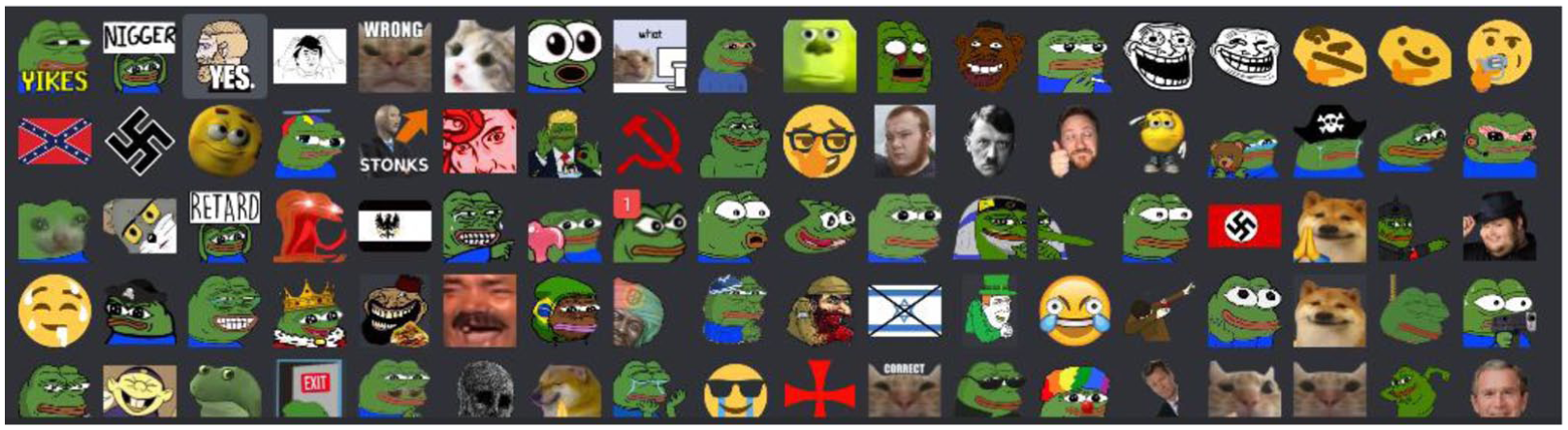
A collection of customised emojis from a far-right Discord server.
In this sense, Discord’s implementation of the attention economy, as well as broader memetic practices, texture the emergence of far-right communities on the platform, who as demonstrated above, interact with memes as a form of palingenesis. To borrow Ahmed’s (2014) term, fashwave and other memetic artefacts ‘stick’ with far-right Discord users in distinct ways, in essence actualising the nostalgic worldview connoted by such memes in the moment they are created and shared. In turn, customising memetic emojis carries additional meaning for far-right users because doing so accumulates nationalistic capital.
In addition, because contact with fashwave memes is macro-mediated, vis-à-vis the attention economy, specific far-right communities are always connected to a wider pool of potential harm, as memetic practices co-shape broader networks and digital vernaculars. In other words, far-right harms emerge diachronically – and ‘scale up’ (Wood, 2025: 195) – through a confluence of macro-mediatory forces. In other words, aspects of Discord’s media ecosystem, including its tether to the attention economy, and how it inheres in engagement affordances, can induce harm by shaping subcultural practices, which in turn ossifies fascism. Consider Figure 4 below, which depicts a far-right Discord user sharing themselves planting a Nazi flag in a LGBTQ+ server on Roblox. 4

A far-right user shares himself spreading hate on Roblox.
In exerting power over those considered undesirable (LGBTQ+ Roblox users), this user accumulates nationalistic capital, particularly when he is lauded for his trolling exploits by other server members (other nationals). In this process, Discord is reified as a nationalistic space, and the valorised battlefield is extended to other digital platforms. Where the fascistic mythos depicted in Figures 1 and 2 above help users envisage an ideal nation, the nation is sustained through repeated affective investment into it, vis-à-vis nationalistic practices.
Indeed, this indicates once more that patterns of macro-mediation cannot be separated from how users interface with its various elements. I now turn to consider more specifically how harms emerge through users interacting with Discord’s ecosystem, focusing on what Botin (2017: 176) characterises as more visible ‘micro-manifestations of mediation toward which we relate physically and mentally, through practices and interpretations’. In doing so, I explore how far-right Discord users re-interpret engagement affordances, reformulate memetic practices, and ossify fascism.
Micro-mediation: Vernacular habits in far-right Discord servers
Building on the discussion so far, de la Torre et al. (2026: 9) suggest that engagement is an emergent process: ‘neurodynamic, interactive, bodily and social patterns . . . play a fundamental role, together with that of the digital environment specifically crafted with the aim of inducing and stabilizing certain habits’. Memes are similarly emergent, and in far-right Discord servers, are generated as a uniquely textured platform vernacular (Gibbs et al., 2015). At the outset, several of Discord’s design features – some of which I have covered above – make it relatively simple for users to proliferate transgressive materials like fashwave memes. This is because Discord is distinct from other mainstream social media platforms in that it does not subscribe to dominant ‘face culture’, which according to de Zeeuw and Tuters (2020) involves corresponding one’s online and offline activities and identities. Where a platform like Facebook encourages users to populate their profiles with personal information, Discord has historically encouraged anonymity and ephemerality, particularly as it is a free platform which requires limited subscription data. This makes it relatively easy for far-right users to transgress in ways that breach Discord’s terms of service agreements, without fearing significant repercussions.
That is not to say Discord’s designers actively try to cultivate far-right participation (although this may be a byproduct of the attention economy, as signalled above). Rather, in a paradoxical way, far-right users are compelled to transgress in response to Discord’s moderation strategies, as outlined earlier in connection with Figure 2. This dynamic involves vernacular micro-mediations in that Discord’s affordances are reoriented to suit the nationalistic imaginings of far-right users. It is through this lens that fashwave memes can be seen as not just communicative, but productive. Although macro-mediations may inadvertently encourage far-right engagement, additionally relevant is that at the micro-level, engagement practices are further textured by users who see memetic practices as opportunities to accumulate nationalistic capital and sustain a fascistic vision of the nation. In this process, broader habits around meme prosumption are rearticulated as ‘fascist prosumption’, which refers to user-generated fascist content and the activity of fascist users on social media platforms (Fuchs, 2022: 319).
As an example, far-right Discord users often framed meme generation as a form of creating ‘propaganda’, a vernacular term which demonstrates how banal digital practices are recoded as nationalistic practices. Figure 5 shows a list of subchannels in a far-right Discord server, one of which is dedicated to the posting of propaganda.

Channel names in a far-right Discord server.
These micro-mediations capture a memetic ecosystem where server moderators cultivate a user-base which is invited to continuously prove itself to the nation by engaging in nationalistic practices: trolling on other platforms, creating symbols, spreading memetic ‘propaganda’, and so on. Whilst such practices enable users to jostle for position over each other, they also maintain the fantasy of Discord as a nationalistic space. Partaking in these practices represent a moment of what Massumi (2021) might refer to as singularisation, where nationalistic potential is constrained into a fascistic imagining. Demonstrating this, the emphasis on constantly performing one’s allegiance to the nation aligns with Eco’s (1995: n.p.) emphasis on the fascistic ‘cult of action for action’s sake’. As he writes: ‘Action being beautiful in itself, it must be taken before, or without, any previous reflection’ (Eco, 1995: n.p.). The narratives conveyed by fashwave memes invite users to imagine themselves as part of a historical struggle, and the cultural pattern of incessantly partaking in nationalistic practices actualises this imagining. Participation is valorised and therefore becomes motivation unto itself. Another example of this is depicted in Figure 6 below, where a user, out of ‘boredom’, shares a homemade flag which combines Nazi iconography with the SuperStraight flag. 5 This example not only demonstrates the banality of nationalistic practices, but it also demonstrates how far-right users materially graft their contemporary fascistic imaginings onto arcane digital vernaculars, remixing new symbols and meanings in the process.

A ‘SuperStraight’ flag made by a far-right Discord user.
Again, examining technological mediation illuminates how nationalistic practices are tethered to Discord’s memetic ecosystem. Whilst the rewards earned by far-right users for partaking in nationalistic practices are symbolic, they are also coded into the infrastructures of servers themselves. To this point, many Discord servers (regardless of their ideological disposition) incorporate ranking systems to reward users for participating: the more someone participates, the higher their rank climbs. This is certainly connected with the overarching intentionality of the attention economy. As de la Torre et al. (2026) indicate, engagement is habituated in part by technologies which provide social motivations to participate. In far-right Discord servers, ranking systems provide a mechanism for users to register their governmental belonging, because higher ranking members are those who have accumulated more nationalistic capital, and, in turn, are awarded additional privileges. Relevantly, these ranking systems typically reproduce server vernaculars, demonstrating their nationalistic tack. For example, servers which style themselves as ‘Reichs’ of ‘Empires’ often mirror military or monarchist hierarchies: in Reichs, a server owner may be referred to as the ‘Fuhrer’, and server moderators as ‘Reichsmarschalls’. Figure 7 depicts a list of roles belonging to a server administrator, who has accumulated a range of positions which signal his belonging to the fascist nation.

Example of a far-right user’s roles and ranks.
These ranks are sometimes assigned manually, where server administrators promote valued users to higher ranks in recognition of their contribution to the community (such as boosting the server, as discussed above). Action for action’s sake, as such, often fosters validation from server leaders, reminiscent of Laqueur’s (1996) characterisation of the fascistic leadership cult. Through subservience to their administrators, Discord users accumulate nationalistic capital and are rewarded for it by climbing ranking systems. This also demonstrates how heroism manifests distinctly in far-right Discord servers: the leader of the server is imagined as a kind of living myth, and fascist subjects within the server vie for his validation by participating as much as possible, thereby proving their own heroism. Further demonstrating the banal and mediated nature of these dynamics, accumulating higher ranks is often an automatic process, as shown by Figure 8, where a user posts a non-descript message, and is immediately rewarded with a higher rank.

A user automatically ‘ranking up’ in a Discord server.
This reflects what Floridi (2013) refers to as the ‘in-betweeness’ of technologies, as bots – automated software applications, like ‘Tatsu’ – routinely modulate the interface between users and the servers they interact with. By participating, users come closer to ranking up, but their progress cannot be tracked, in turn inviting continuous engagement through an intermittent reward process (de la Torre et al., 2026). This demonstrates the importance of examining seamless, background relations with technologies (Ihde, 1990; Wood, 2021). Discord’s fluidity as a platform contributes to the habituation of vernacular practices like creating and spreading memes through varying degrees of transparency and opacity (see Susser, 2017). Further, the platform mediates the experience of far-right users in ways that likely do not align with the intentions of Discord’s designers. Rather, Discord’s affordances – which invite participation through a variety of trigger and reward systems – represent a range of micro-mediations when they are interpreted by far-right Discord users. Harms, as such, emerge through users interfacing with and translating particular elements of Discord’s media infrastructure. As such, participation in these servers cannot be reduced to the influence of technology itself, because participation is also textured by the desires of users to accumulate nationalistic capital through palingenesis. In this mediatory process, users are invited to continuously struggle to actualise a Golden Age. To do otherwise is to be branded an enemy of the community, and as such, an enemy of the nation.
Conclusion
In this paper, I have analysed how Discord mediates the experience of far-right users, co-shaping a range of seemingly arcane memetic practices that nevertheless make sense to participants sharing in fascist platform vernaculars. Through a postphenomenological lens, I have suggested that far-right users translate Discord’s invitational properties in ways cognisant with their image of the nation, clarifying how digital technologies can, even inadvertently, shape contemporary experiences of fascism. To investigate this, I have explored how fashwave memes integrate users within a shared fascistic imagining which valorises palingenesis. Through nostalgic appeals inhering in fashwave memes, far-right users tether their pasts and futures to the nation as an idealised object. In this process, far-right users rearticulate digital participation as a form of struggle that actualises the nation in ways commensurate with contemporary digital sensibilities. Further, by engaging in memetic practices, far-right users accumulate nationalistic capital, and in turn ascend a nationalistic hierarchy. Borrowing from Hage (2000), I have argued that these memetic practices can therefore be understood as nationalistic ones, representing a familiar language through which far-right users jostle for position within their communities.
The postphenomenological approach adopted in this paper helps to interrogate these imaginings, of vital importance when contemporary fascism continues to be rendered obscure through its tether to arcane digital subcultures (see Tuters, 2020, 2021). I have illuminated these processes by understanding fashwave memes in relation to patterns of macro-mediation and micro-mediation. The concept of micro-mediation is useful in clarifying how far-right users translate Discord into a nationalistic space implicit in processes of palingenesis. Through this translation, memetic practices are reregistered as nationalistic, enabling far-right users to accumulate capital based on a belief in their right to manage their vision of the nation. To make sense of how memetic practices could invite such effects, it is dually important to situate micro-mediations within a broader media ecosystem, which may itself be oriented towards harm. In other words, macro-mediations – which I have conceptualised in relation to Discord’s connection with the attention economy – help explain how micro-relations ‘scale up’ into collective harms. In examining these kinds of mediations, I have signalled the synchronic and diachronic emergence of harm through users encountering fashwave memes, and participating in memetic practices on (and indeed, beyond) Discord. Here, harm emerges through users interfacing directly with aspects of Discord’s ecosystem, but also through the ossification of harmful structures. In other words, far-right users sustain the attention economy through their continued nationalistic engagement on and off Discord (even if such engagement is at odds with the intentions of the platform’s designers), thus ‘maintain[ing] the structural whole’ that produces harmful events (Wood, 2025: 201).
An integral contribution of this approach is its ability to capture second-order harms; the often indirect, imbricated, and potential forms of harm that are induced by human-technology relations (see Anderson and Wood, 2022). In this case, second-order harms manifest as the reification fascism across far-right Discord servers, and beyond. Overall, I have illuminated the esoteric dimensions of fascism, particularly how the paradox of nostalgia – which romanticises a past that never existed – fuses with seemingly arcane digital vernaculars. In doing so, I have revealed how digital fascism is sustained by everyday practices oriented towards nationalistic belonging. By reckoning with the banality of these practices, and how they are mediated by digital structures, contemporary fascism can be understood and resisted.
Footnotes

Ethical considerations
This study received ethical approval from the University of Melbourne HASS 2 Research Ethics Committee (approval #2021-14589-16766-2) on 6 May, 2021, with the need for informed consent waived.
Consent to participate
The requirement for informed consent to participate was waived by the Research Ethics Committee.
Funding
The author disclosed receipt of the following financial support for the research, authorship, and/or publication of this article: This work was supported by the University of Melbourne Arts Graduate Research Publication Support Grant.
Declaration of conflicting interests
The author declared no potential conflicts of interest with respect to the research, authorship, and/or publication of this article.