




Abstract
Kowloon Walled City (hereafter KWC or Walled City), Hong Kong has been described as ‘one of history’s great anomalies’. The territory remained under Chinese rule throughout the period of British colonialism, with neither jurisdiction wishing to take active responsibility for its administration. In the postwar period, the area became notorious for vice, drugs and unsanitary living conditions, yet also attracted the attention of artists, photographers and writers, who viewed it as an instance of anarchic urbanism. Despite its demolition in 1993, KWC has continued to capture the imaginations of successive generations across Asia. Drawing on data from an oral and visual history project on the enclave, alongside images, interviews and observations regarding the ‘second life’ of KWC, this article will trace the unique flow of meanings and reimaginings that KWC has inspired. The article will locate the peculiar collisions of crime and consumerism prompted by KWC within the broader contexts in which they are embedded, seeking out a new interdisciplinary perspective that attends to the internecine spaces of crime, media and culture in contemporary Asian societies.
Introduction
The author F Scott Fitzgerald once wrote, famously, that there are no second acts in American lives. The line is often taken to mean that past sins in public life are never forgotten – indiscretions and corruptions remain imprinted, a tarnish that stains. In a scene from the HBO drama The Wire, a character in a prison book group echoes this reading: ‘He’s saying that the past is always with us … you can say you somebody new, you can give yourself a whole new story. But what came first is who you really are, and what happened before is what really happened’. In the field of criminology, this idea is central to scholarship on ‘desistance’ from crime (Maruna, 2001), which seeks to understand the ways in which ex-prisoners re-narrate their lives in a society that defines them by their past. As it transpires, however, Fitzgerald’s famous line originated in an earlier work – an essay called ‘My Lost City’ (Fitzgerald, 1932: 30), which offers a slightly different emphasis: ‘I once thought that there were no second acts in American lives, but there was certainly to be a second act to New York’s boom days’. This suggests that not only people, but places, may similarly struggle to cast off the shackles of their public image – places with perhaps more success.
In the digital age, the opportunities for enacting this form of ‘second life’ – for both people and places – have been rendered more complex. Information, images and ideas, rendered in the online world, are virtually impossible to remove; the Internet is not a space that forgets easily. Indeed, the very idea of a separation between online and offline selves is increasingly redundant, as ‘real’ and ‘virtual’ forms of sociality become increasingly entangled (Leurs, 2015). Identity formation is increasingly cast in the hinterland between online and offline worlds, rebounding between real and virtual forms of capital. 1 At the same time, however, both people and places can themselves take on a form of ‘second life’ in the virtual world that is untethered from its offline existence. ‘Real-life’ events can become rapidly removed from their original context, and subsequently reconstructed according to the logic of social media (Hayward, 2010: 2), or individuals recast as ‘data-doubles’ in online systems (Haggerty and Ericson, 2000). In this context, tracing the ‘social life of things’ (Appadurai, 2013) enables a form of analysis that explores the spaces between disciplines, cultures and online-offline worlds.
This article seeks to explore these unique sites within contemporary Asian societies by investigation of the ‘social life’ of a quixotic space in the history of Hong Kong, described as ‘one of history’s great anomalies’ (Sinn, 1987): Kowloon Walled City. A former garrison, measuring approximately 0.1 square miles, it remained as mainland Chinese territory during the period of British colonialism, and developed notoriety as a safe haven in which gambling, vice and illicit trade flourished amid unsanitary living conditions. Though demolished in 1993, the affective imprint of the Walled City has made its way firmly into the popular imagination through photo books, movies, documentaries, science fiction, manga, anime and video games. In the process, the Walled City has taken on several ‘second lives’ that bring to the surface some of the peculiarities and particularities of the crime-media-culture nexus on Asian contexts – notably themes of digital memory, hybridised cultural flow and commodified transgression. Drawing on data from an oral and visual history project on the Walled City, this article will trace these multiple trajectories through their varying cultural, digital and physical contexts. In so doing the article seeks out an interdisciplinary perspective between Asian cultural studies, postcolonial scholarship and cultural criminology, attending to the internecine spaces between crime, media and culture in contemporary Asian societies. This approach aims to advance the empirical and ontological roots of Asian criminology, while challenging the bias towards Anglo-American contexts prevalent in much scholarship on the crime-media-culture nexus.
The death and life of Kowloon Walled City
In The Death and Life of Great American Cities, Jane Jacobs (1961) contrasts the rationalist, top-down vision of urban planners with the bottom-up forms of street sociability that emerge in the unplanned spaces of the urban environment. Jacobs contrasts the vision of planners, designers and architects with the realities and rhythms of everyday street life. For Jacobs, street life is the heart of urban life, a complex and layered tissue that was being atrophied by the march to modernism—wider roads, bigger offices, sprawling suburbs – representing a form of ‘order from below’ (Greenspan, 2014: 38). Despite changes to the urban fabric, Jacobs argues for an essential continuity in urban life; social life continues to beat a deep rhythm beneath the progress of change. As in the famous French aphorism ‘le roi est mort, vive le roi’ (the king is dead, long live the king), there was a cultural core that persisted despite surface alterations. These continuities indicate a process in which social identity is passed on through oral tradition and cultural memory, persisting today through forms of digital memorialisation and reappropriation of heritage.
During its lifetime, the Walled City in many ways represented this form of social life ‘from below’. Due to a historical quirk, 2 the Walled City was left out of the original treaty agreement between Britain and China, and there remained continuing uncertainty as to jurisdiction. As a result, this small and unlikely patch of land emerged as both disputed territory and diplomatic impasse (Harter, 2000). At several points, the British colonial administration sought to clear the Walled City. In 1933, 1948 and 1963, plans were drawn to evacuate and demolish the makeshift buildings that had been constructed there (Ho, 1986). At each turn, however, resistance from local residents – backed by the Chinese government – prevented the plans from proceeding (Miners, 1983: 180; Wesley-Smith, 1973: 74–76). 3 As a result of this dispute, the population of the Walled City was by and large left to its own devices: the area was not plumbed into the water supply or electricity grid, public services were minimal and policing was confined to daily patrols. In the aftermath of the Cultural Revolution, tens of thousands of Chinese refugees arrived in Hong Kong. This influx of new residents saw the population rise from 10,000 in the early 1960s to 20,000–30,000 in the 1970s. Some estimates placed the population at closer to 60,000, as there were inherent difficulties in making such estimates. Statistics are sketchy, but some estimated 60% of the population to be under the age of 16, with a population density of 1,255,000 per square km (Chow, 1975; see also Davis, 1976).
The proximity and density of the Walled City created forms of sociality and interdependence that would not have been possible in the high-rise developments that began to dominate Hong Kong public housing from the 1970s onwards. As there was little planning or regulation in force, buildings in the Walled City developed in a do-it-yourself fashion, with buildings crisscrossed with walkways above street level (see Figure 1 and 2). 4 A German documentary from 1989 (dir. H Portisch) 5 offers unique footage on this density, drawing the viewer down the impossibly narrow streets, past thick tangles of cable and wire, through dripping pipes and darkened alleys and out into the lives of everyday people who lived and worked there. The Walled City was referred to as mo wong goon (無王管), which translates as ‘outside the king’s control’, with housing constructed in a rough-and-ready fashion, quickly and cheaply. This organic form of architecture has been linked to a form of makeshift community life, making do with what was available, with a range of ‘off-the-books’ economic activities flourishing – from fishballs and cakes to plastics and matches. As Muncie and colleagues summarise: ‘such areas may be marked by a form of social order, albeit a different one from “normal” society: a form of social order that is established as the state withdraws from providing security’ (Muncie et al., 2010: 57). It is precisely this form of improvised architecture and makeshift community that has captivated architects and designers over the years. Girard and Lambot (1993), for instance, were attracted to the Walled City as an instance of anarchic urbanism and sociability that could be read as a microcosm for Hong Kong life – formed in the cracks between the governance of the UK and China, but forming a cultural core that is both unique and resilient. This theme, of anarchic urbanism and community ‘from below’, away from the master narrative of the UK and China, has formed a critical strut in the enduring resonance of the Walled City in popular culture.
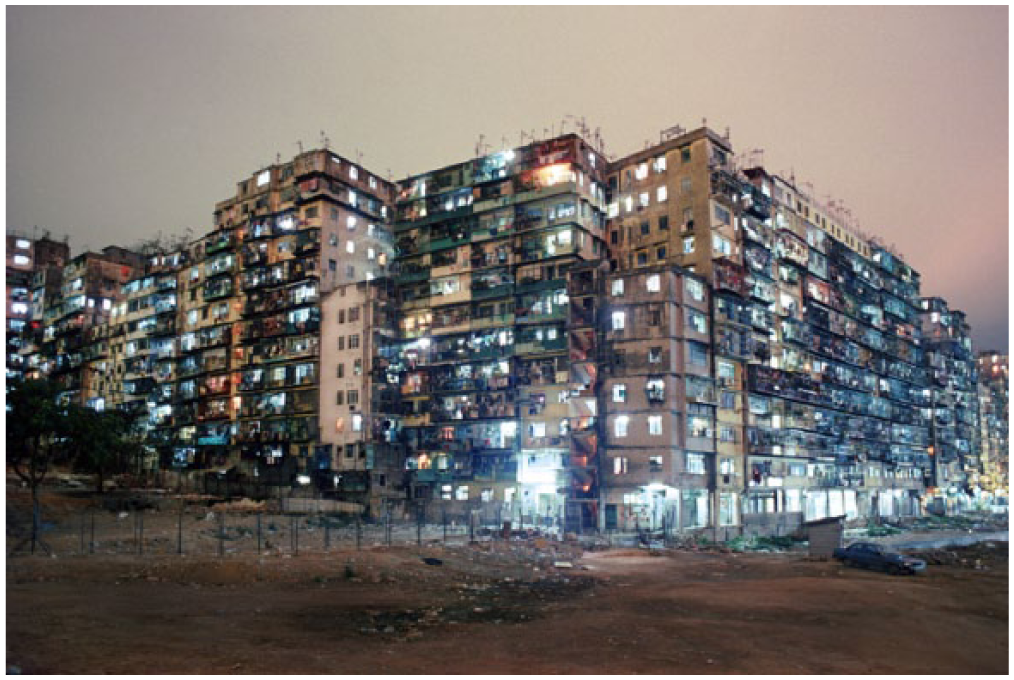
Kowloon Walled City night view from the southwest corner, 1987.
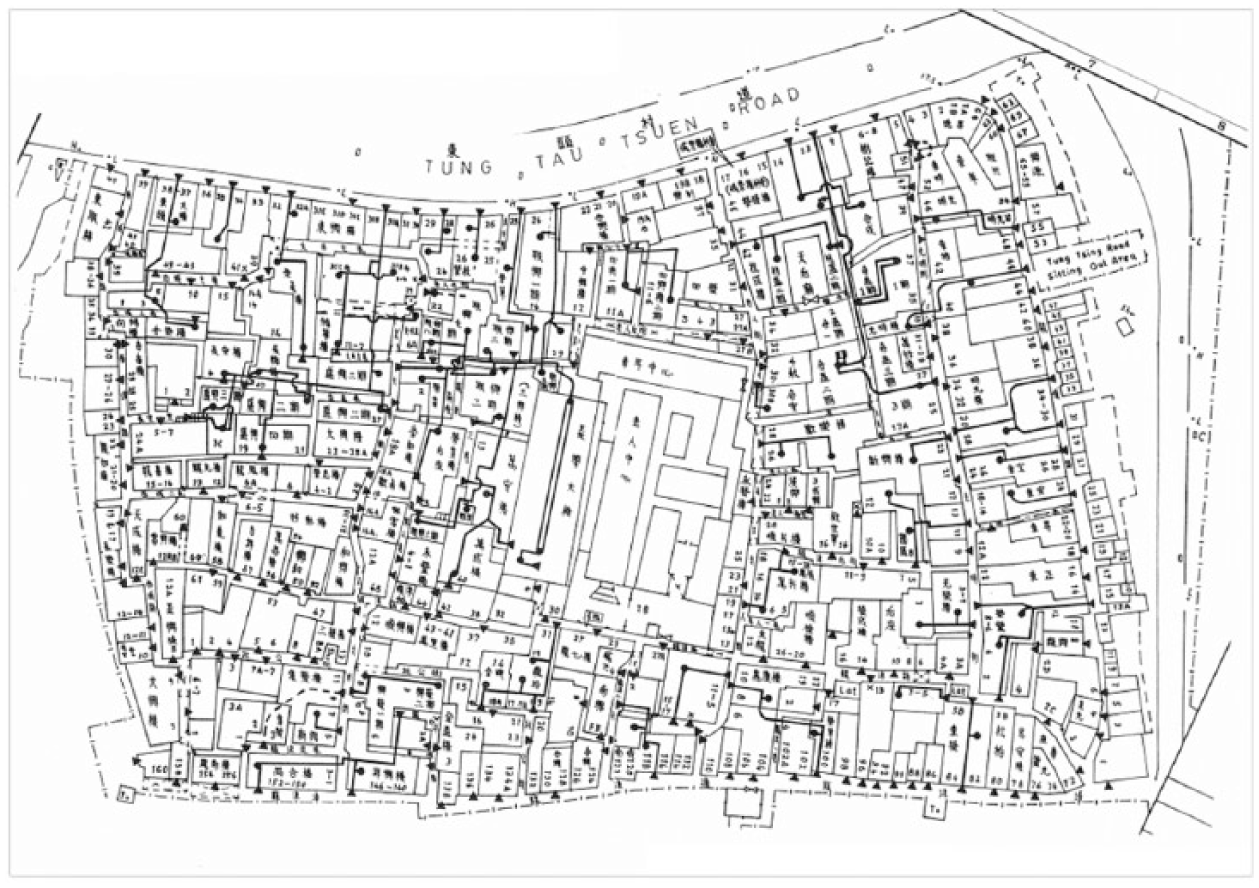
Map of Kowloon Walled City, 1985.
In 1993, after nearly a decade of negotiations, the Walled City was finally demolished. The Housing Department had previously carried out a ‘pre-clearance’ survey, registering all residents for the purposes of calculating compensation. A full census and property register was completed, and the residents rehoused in public housing estates across the city. In the end, the demolition turned into a media event, with t-shirts bearing the legend ‘I was there at the demolition of Kowloon Walled City’ given to those participating. Since its demolition, however, the Walled City has embarked on a ‘second life’ across a range of physical and virtual contexts – from Hollywood films to online games, manga comics to architectural reconstructions – in which the ‘real’ space of the Walled City is recast as a hyper-mediated space onto which a range of competing narratives are projected. These reconstructions are less about the lived space of the Walled City itself and more about the idea that it represents: a self-sustaining social ecology that emerged in the cracks between the forces of ‘collaborative colonialism’ (Law, 2009), a multistoried space of anarchic urbanism in which crime and corruption were deeply embedded. In this sense, the study of the Walled City’s ‘second life’ can be envisaged as a portal into the cultural flows and rhythms that exist at the nexus of crime and media in contemporary Asian contexts, and the various ways in which cultural memory is created in and through the virtual world.
The material presented in this article draws from two iterations of data collection that speak respectively of the ‘death and life’ of the Walled City. The first sought to excavate a history of Hong Kong ‘from below’ through oral history interviews with 22 individuals who lived and worked in the Walled City in the 1960s and 1970s when its reputation for criminal and political deviance was at its height. The second sought to tap into the ‘second life’ of the Walled City, tracing the ideas and constructions of subsequent rememberings of the space. The study incorporated a range of visual, virtual and observational methods, including field visits, media analysis 6 and five semi-structured interviews. The material presented in the following analysis draws principally from the second iteration of data collection, drawing from and building on the first tranche of data.
The ‘second life’ of Kowloon Walled City
In cultural studies and sociology, the study of memory has recently shifted from memorialisation as a static object to the study of process, practice and social environment (Erll and Rigney, 2009; Sturken, 2008). Where memory was traditionally conceived as primarily physical, textual and oral – in the form of monuments, books and the spoken word – memorialisation now occurs at the intersection of the ‘space of place’ and the ‘space of flows’ (Castells, 2000) 7 through performativity, practice and meaning-making (Erll, 2008; Kuhn, 2000). The study of cultural memory is therefore less about tracing ‘authentic’ origins and more about what and how history is remembered, represented and interpreted (Dijck, 2007; Sturken, 2008). These processes are particularly apposite in Asia, where political tensions over historiography, revisionism and ‘forgetting’ remain central (Nougayrede, 2016). Indeed, for Abbas (1997) heritage and culture in Hong Kong holds a particular immanence that has emerged from the uncertainty over the future. In the lead-up to the transfer of sovereignty from the UK to China in 1997, the ‘imminence of its disappearance … precipitated an intense and unprecedented interest in Hong Kong culture’ (Abbas, 1997: 7).
In this context, Kowloon Walled City emerged as a unique site for cultural memorialisation in the years leading up to 1997. A major photographic, architectural and journalistic account of the Walled City, titled City of Darkness, was compiled during demolition (Girard and Lambot, 1993),
8
followed by an extensive photographic record published in Japanese (Miyamoto, 1997). More recently, online reconstructions and narratives have become prominent.
9
Most recently, the Walled City has inspired a series of popular consumer products from Hong Kong lifestyle brand G.O.D. (Goods of Desire): from notebooks to pillows, aprons to curtains. As the following quotation from the CEO of G.O.D. makes clear, the ‘real’ memory of the Walled City as a physical place has been replaced by a cultural memory rooted between artificial reconstruction and affective cultural memory: Probably the only good thing about the demolition is that KWC will always be a beautiful place in our memory. It is very romantic because we only remember its beauty. It is not just a cluster of buildings. It is a representative, a symbol of Hong Kong – hardworking, the perseverance to improve life in such a crowded space, the spirit of struggling. It represents certain values or spirit of struggle and resistance. So the dark side of KWC, its dirtiness and darkness, is no longer important.
As the Walled City has traced a path from a physical place into the realm of cultural memory and consumer appropriation, so the meanings associated with it have become increasingly diverse. In official memorialisations, for example, a sanitised account is presented, with crime and corruption in the background (Abbas, 1997). In cultural reconstructions via film and online gaming, however, it is precisely these aspects of life in the Walled City that dominate, evincing a consumer-driven ‘rootless nostalgia’, involving the ambivalent longing for an imagined organic communality (Hirsch and Spitzer, 2003). At the same time, the Walled City has become bound up with pop cultural flows between Hong Kong and Japan revolving around ACG (animation, comics and games), resulting in a range of surprising acts of memorialisation – notably a reconstruction of the Walled City in a Tokyo theme park, and the re-enactment of the manga comic ‘City of Darkness’ on the original site of the Walled City.
On the one hand, this plurality of readings echoes the cultural density of the place itself. The multiplicity of the Walled City as a cultural memory mirrors its pluralised community. On the other, though, it is clear that the Walled City has come to represent a manifestation of simulacra, in which ‘reality’ is replaced by systems of signs and symbols (Baudrillard, 1994). As Baudrillard argues, today ‘it is the real that has become the alibi of the model, in a world controlled by the principle of simulation’ (Baudrillard, 1994: 122). The second life of the Walled City can therefore be envisaged as a ‘copy’ without original, yet one that is made meaningful through processes of cultural appropriation and commodification. In what follows, we trace three notable reconstructions of the Walled City, each demonstrating a different facet of the contemporary crime-media nexus in Asia. In tracking these ‘second lives’, our intention, following Appadurai, is to ‘follow the things themselves, for their meanings are inscribed in their forms, their uses, their trajectories’ (Appadurai, 2013: 5).
Crime, corruption and cultural memory
One of clearest images to emerge from interviews with those who lived and worked in the Walled City was of a place in which crime and corruption formed a crucial aspect of the social ecosystem of the community. Where administrative oversight was largely absent, triad leaders and police officers conspired to regulate, control and profit from the wide-ranging illicit industries that flourished in the Walled City:
10
from gambling to drug-divans, prostitution to illegal dentistry.
11
As one resident commented, ‘many things that didn’t exist in the outside world, they could be found in the Walled City’. In the first round of data collection, both police and residents spoke of the endemic corruption that inhered in the Walled City. As one resident commented: At that time, the CID [police] were ferocious. They could do whatever they liked. They could arrest you and charge you whenever they liked. For example, somebody was robbed, they arrested you. It was very dark. They went to your triad head for scapegoat. If the triad head refused to ‘submit’ somebody as scapegoat, the cops would trouble you, for example, raiding your dens.
The lived experience of the Walled City was therefore intimately bound up with experiences of crime, corruption and makeshift politics. Nonetheless, in the physical memorialisation of the Walled City on the site of the original habitation – in the form of an open-air museum and walled garden (Harter, 2000) – this memory is erased. Although the park preserved several artefacts of the Walled City, such as the old cannons and the structure of the Yamen (the official office) (Kowloon Walled City Park, 2014), the site erases the experiences of crime, corruption and unsanitary conditions from the official record, replacing these experiences with ornate gardens in the style of the early Qing dynasty (See Figure 3).
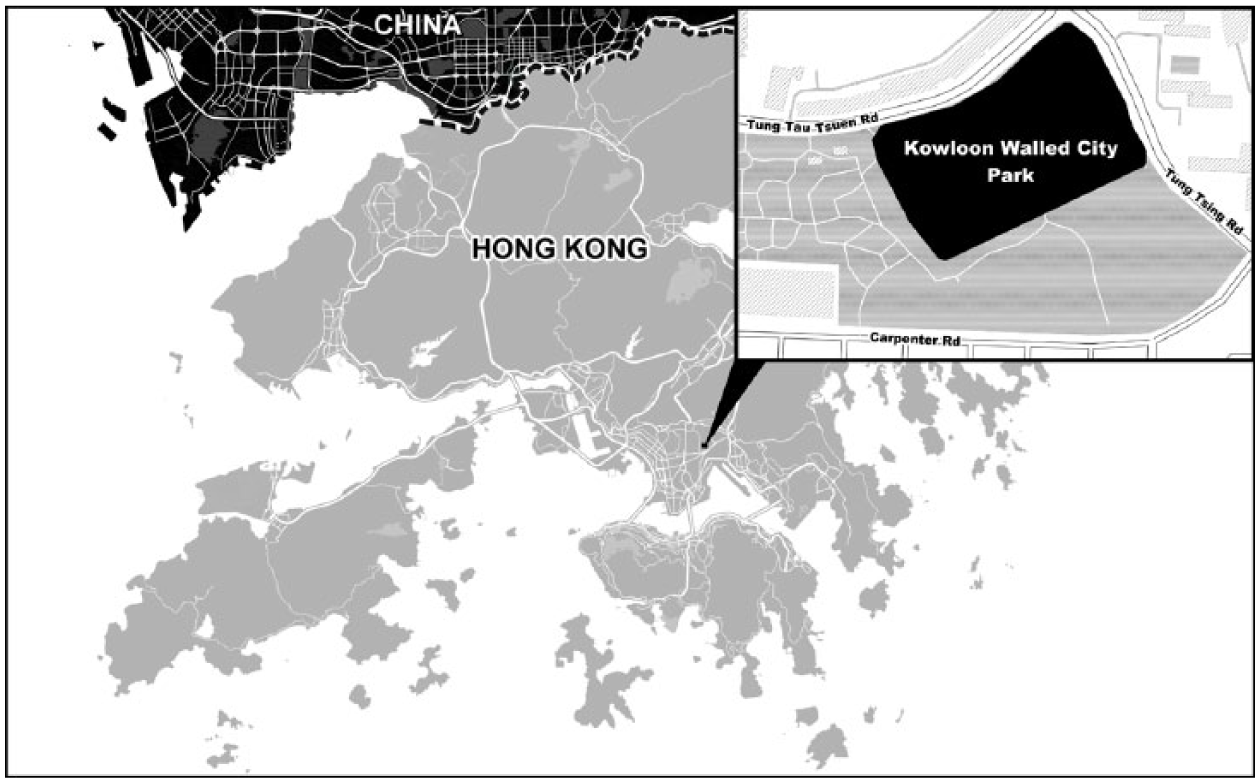
Location of Kowloon Walled City Park.
For many Hong Kong scholars, this represents a clear airbrushing of the historical record, with a ‘return to the motherland’ narrative favoured by the Chinese government (Chin, 2005; Harter, 2000). Sanitising the dirt, pain and emotions in its history (Abbas, 1997: 66), for many the park showcases a ‘politics of disappearance’ manifested by the avoidance of political controversy in the name of bureaucratic neutrality (Chin, 2005; Chu, 2013: 14). These controversies are symbolised powerfully in the opening speech by the former governor Chris Patten in December 1995, where he applauded the ‘fantastic transformation’ of the Walled City from ‘a black spot to a beauty spot that all can treasure’ and ‘an oasis of leisure’ (Flint, 1995). Patten stressed the importance of ‘moving forward’ by ‘cleaning up’ the undesirable Walled City – tapping into longstanding colonial representations of the Walled City which ‘pitted clean, dynamic, orderly colonial Hong Kong against the dirty, stagnant, lawless, and above all noncolonial and hence Chinese Walled City’ (Harter, 2000: 95). A government official involved in the demolition plan, interviewed for the project, notes that: it had to be done before 1997 because if this dreadful high-rise slum had been allowed to stay and fester it would be very possible for us to see the Chinese PR machine turn around and say, ‘Ooh, look at this wonderful legacy of British colonial rule’.
Law Wing Sang (2009) develops the notion of ‘collaborative colonialism’ to capture the unique intersection of forces that have structured the history of Hong Kong subjectivities. Detailing the collaboration between Hong Kong elites and government officials from both the UK and China, Law argues that a technique of social reproduction has emerged that has kept Hong Kong citizens in a state of subordination. In a creative analysis incorporating both history and literary studies, Law traces the patterns in both culture and government that demonstrate this persistent form of power brokerage and its impact on social life in Hong Kong. In interviews, a picture emerged of the Walled City as a microcosm of this broader system of ‘collaborative colonialism’ (Law, 2009) through the hidden, negotiated political and juridical relations that oiled the machinery of the colonial authority. The contest over this physical memorialisation of the Walled City, and its erasure of politically sensitive ideas, mirrors this broader pattern of history and heritage in Hong Kong. The recent protests surrounding a proposed ‘national education’ curriculum in Hong Kong schools caused widespread protest in 2012, resulting from a similar ‘forgetting’ of prominent incidents in Chinese history, notably related to the 4 June crackdown in Tianan’men Square in 1989. Alternative forms of memorialisation have emerged in relation to 4 June – through a yearly vigil in Hong Kong attended by tens of thousands 12 – and towards the Walled City particularly. Some reimaginings are untethered from the ‘real’ memories of the Walled City, while others recast them in a new context.
Disembedding, nostalgia and cultural flow
Interviews with police officers demonstrate that the lead-up to demolition involved a process in which the physical site of the Walled City became reimagined as a site of tourism. One officer described it as a: tourist attraction for people in the know who came to have a look … I kind of developed a bit of a tourist trail where if I was told, ‘right, you’re taking so-and-so around,’ I’d take him through several things and end up on the rooftops.
This process signifies a process of untethering from the Walled City as a lived place, and into the realm of cultural memorialisation. Since its demolition, the lived experience of the place has receded in physical memory and it has been recast in the realm of ‘rootless nostalgia’ (Hirsch and Spitzer, 2003). This process of disembedding, or ‘“lifting out” of social relations from local contexts of interaction … which capture the shifting alignments of time and space’ (Giddens, 1990: 21–22), has resulted in an artificial reconstruction of the Walled City across a range of cultural media.
Tracing a similar pattern, there is a marked difference between film depictions of the Walled City from the period before demolition and those from the period after. Where early films such as Brothers from the Walled City (1982), Long Arm of The Law (1984) and Crime Story (1993) use the Walled City as a backdrop for crime and lawlessness – ‘a slum to escape from’ or no man’s land of darkness and crime – they nonetheless take care to show a version of the lived experience in the Walled City. In the postcolonial era, however, the Walled City has been increasingly represented as a symbol of nostalgic communality (Kung Fu Hustle, 2004; A Fist within Four Walls, 2016), thrilling aesthetics (Re-cycle, 2006) or anarchic urbanism (Ip Man: The Final Fight, 2013). 13 Beyond Hong Kong, the Walled City has also made its way into Hollywood, most notably in Blade Runner (1982), Bloodsport (1988) and Batman Begins (2005), all of which involve scenes or settings explicitly based on the Walled City. The Walled City has also deeply influenced the science fiction sub-genre cyberpunk (for example, the work of Wilson Gibson), which focuses on the dark side of the future and expresses the anxiety of postmodernism and late capitalism (Featherstone and Burrows, 2000: 3), as well as a range of video games such as Call of Duty (Treyarch, 2010), Deus Ex: Human Revolution (Eidos Montreal, 2011), Jet Set Radio Future (Smilebit, 2002) and Guild Wars: Factions (ArenaNet, 2006). In Hollywood films, and in fiction and video games, the Walled City is presented once more as a space of makeshift culture. 14
Across a range of cultural media, then, the Walled City has moved from ‘real’ depictions in documentary and film to ‘unreal’ portrayals across a range of platforms. The imagined space of the Walled City has become a ‘modern pirate utopia’ (Mead, 2014), disembedded from the lived experience of the place itself; ‘a real without reality’ (Baudrillard, 1994: 1). In this new, hyper-mediated context, echoes of the ‘real’ place remain but are recast as a virtual space in which desires for anarchic urbanism are consumed and commodified via the global film and game industries. In the process, the idea of the Walled City has become tethered to alternative cultural flows and eddies that have carried it – like a branch on a river – to unpredictable contexts. In Japanese popular culture, for example, the Walled City has become a frequent reference point (Ng, 2015: 160), inspiring a range of anime movies (Ghost in the Shell 1995, 2004), manga series (Tsubasa: Rezaboa Kuronikuru (Clamp, 2003–2009) and Kindaichi Case Files: Hong Kong Kowloon Treasure Murder Case (Amagi, 2012)) and video games (Kowloon Gate (Zeque, 1997) and Biohazard 6 (Capcom, 2012)). Japanese consumption of the reimaginings of KWC in colonial Hong Kong is a manifestation of the Orientalist fantasy (Ng, 2015: 145), as well as a nostalgic yearning for Japanese national past (Iwabuchi, 2002a: 549–550). This is best encapsulated in the Kawasaki Warehouse amusement arcade in Tokyo, Japan, where the ‘unreal’ of the Walled City is recreated in physical form.
Opened in 2009, the Kawasaki Warehouse involves a complete reconstruction of a section of the Walled City, including minute details such as dated posters, rustic signs and the inclusion of actual domestic waste collected from Hong Kong households (see Figure 4) (Ryall, 2013). Covering a long wall over two levels, it incorporates intersecting walkways, ramshackle Chinese row-houses, red neon Chinese lettering, hanging balconies, mannequinned sex shows, launderettes and roasted meat sellers – recasting the Walled City into a strange region of consumption, consumerism and nostalgia. A street from the Walled City has been painstakingly reconstructed from old photographs and street-plans in the midst of a gigantic amusement arcade. It is situated in a huge, bleak warehouse set amidst a flat-grey backdrop of office buildings and train lines – the effect is incongruous and unsettling, like a brown sock tumbling round in a white-wash. The fieldnote below reflects on the experience of entering the building: You step forward; before your eyes can adjust, a set of sliding doors zing apart. A sharp hot blood-curdling wail assaults you as you stumble forward. Your heart-rate leaps up, pounding and tentative; bewildered, you step forward again, and find yourself in a dimly-lit, narrow alleyway of Chinese storefronts. Once your eyes adjust, you venture forward again. There, the first signs of incongruity confront you – an elevator, and an escalator. A sickening, lurching feeling descends as you ascend to the next level. (Fieldnote, 18 July 2014)
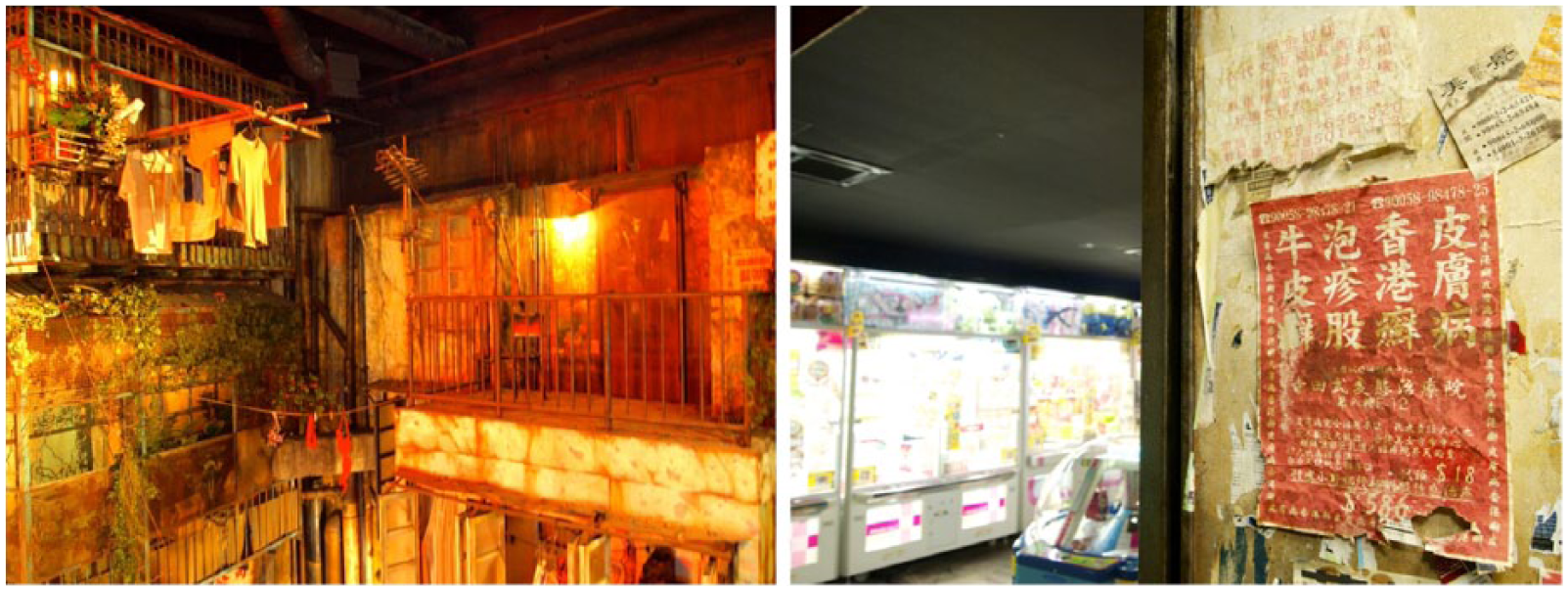
Interior images of the Kawasaki Warehouse.
The entire space consists of four vast floors of an amusement arcade, nestling up against a mise-en-scene of a no man’s land, skilfully staged to convince visitors of its authenticity. The Walled City thereby becomes dehistoricised for nostalgic fantasy and consumption (Iwabuchi, 2002b: 33). The distinction between history and memory is blurred in this hyperreal re-creation: After the initial, heart-rending shock of entry, the sadness of the arcade swims into view. That slightly grubby, greasy tang of stale smoke and broken dreams and small-change capitalism. Nobody looks at the walled city exhibit. A staff member tidies busily; the punters make a beeline for the machines. (Fieldnote, 18 July 2014)
Kawasaki Warehouse juxtaposes incompatible imagined spaces and consumption sites such as a casino, a games arcade and a dripping alley in a single real physical place, in a manner that is comparable to the ‘heterotopia’ of the Walled City itself (Foucault, 1986: 25). This contradictory co-existence of consumerism and unvarnished social life in some ways reflects a unique configuration of crime, consumerism and culture in Asia (Lui, 2001). Studies on East Asian popular culture usually position Japan as the producer and other locales such as Hong Kong as the consumers (Bridges, 2003; Iwabuchi, 2002b; Otmazgin, 2014); therefore, the reconstruction of the imagined Walled City reverses this cultural flow.
ACG, cosplay and Hong Kong identity
As we have seen, the ‘second life’ of KWC is characterised by multiple forms of remembering, which are not static but are re-embedded in new cultural forms that operate at the intersections of the virtual and the ‘real’ (Baudrillard, 1994). Nonetheless, as analyses of cultural memory suggest, the Walled City has also been re-appropriated, reincorporated and re-embedded into everyday life in new and unpredictable ways. One example of this can be found in the incorporation of the Walled City into youth-led ACG (action, comics, gaming) practices in Hong Kong. Following the trend from Japan, the Walled City has formed a backdrop for a highly successful series of Hong Kong manga comics, City of Darkness (Yu and Szeto, 2010–2011, COD thereafter). 15 COD is a fictitious story set in 1980s Hong Kong. Authored by the writer Yu Yi and illustrated by Danny Szeto, it involves the story of Lok Kwan, a male protagonist and triad member who escapes to the Walled City (see Figure 5). As the author notes, the intention was to blend influences in a hybridised form – a ‘molecular novel [where] everything mixes together … triad movies, novels and comic’. Unexpectedly, however, the comic became very popular among a younger generation, who were born during the run-up to the Walled City’s demolition:
Who were your target readers?
Initially, I was targeting people of my age. I was 30 when I wrote the novel. I wrote about the collective memories of the 1980s. The manga adaption subsequently attracted many secondary school students. This is weird because they were not our target audience. The readers are much younger than our expectation.
How old are they? Are they junior high school students?
Yes. Even primary school students buy the manga. I once attended a fan event. Fans published 10–20 fan works. Most of them are in their 10s.
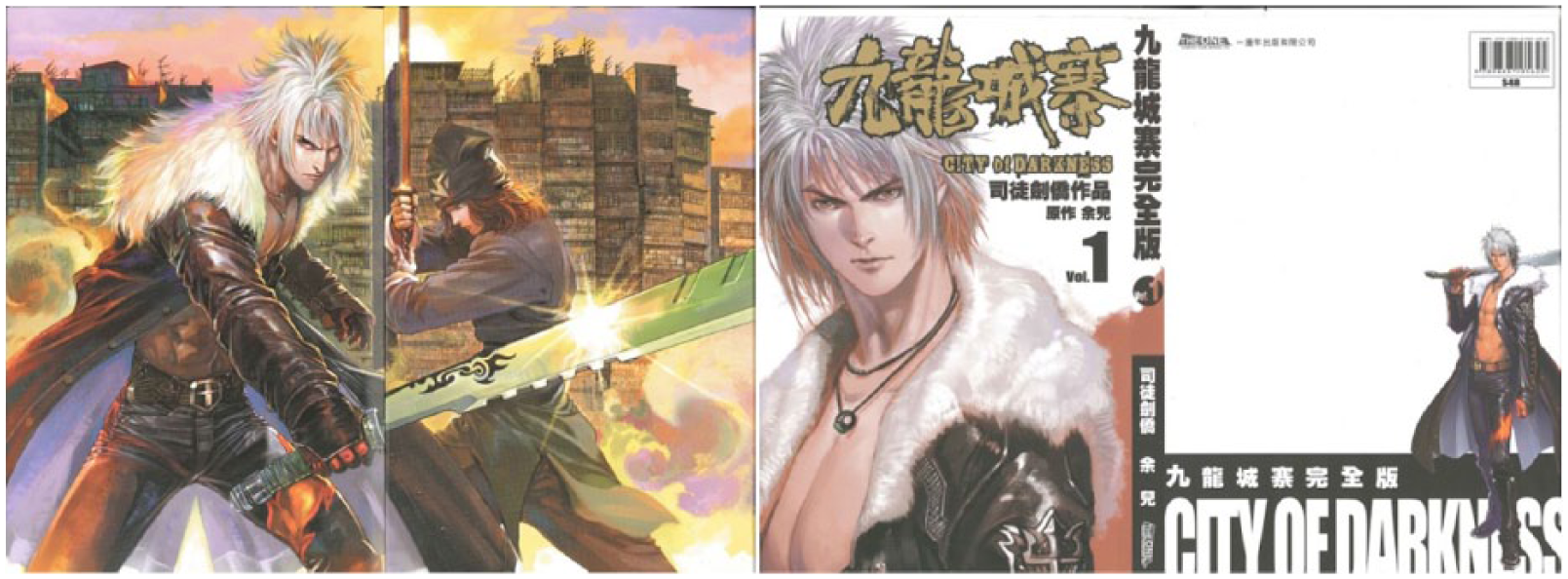
Cover and inner page of COD
This popularity subsequently led to the development of ‘doujinshi’ – self-published fan works including comics, light novels and art books that pay homage to canons, which are circulated within fan communities (Lamerichs, 2013) – relating to the comic, and in turn the emergence of a ‘cosplay’ scene surrounding it. ‘Cosplay’ refers to dressing up and acting like characters from ACG (Winge, 2006).
16
Cosplayers re-enact narratives from ACG, actualising identities and transgressing conventions such as modifying canons and in some cases performing non-normative genders (Lamerichs, 2011; Gn, 2011: 584). In the case of COD, this involved the acting out of characters from the comic book in particular locations in Hong Kong – including in the Walled City Park. Two cosplayers, Maigo and Kamikaze, interviewed for the study discussed their discontent with the lack of official documentation, and framed their COD ‘cosplay’ as an effort to re-appropriate the meaning of the Walled City in the face of insufficient official historiography: As you can see the park nowadays has framed our memory in certain limited ways. It hides many things … We can’t know what it is like unless we’ve lived there before. I feel that I have exactly missed the chance to explore KWC in real since it was demolished a few years after I was born.
When cosplaying COD characters and taking photo shoots, Maigo and Kamikaze chose sites which were ‘quintessentially Hong Kong’, such as the bamboo stage of the Chinese Opera during the Ghost Festival (Figure 6), and imitated characters in the manga by meeting up to have claypot rice in a dai pai dong (open-air food stall).
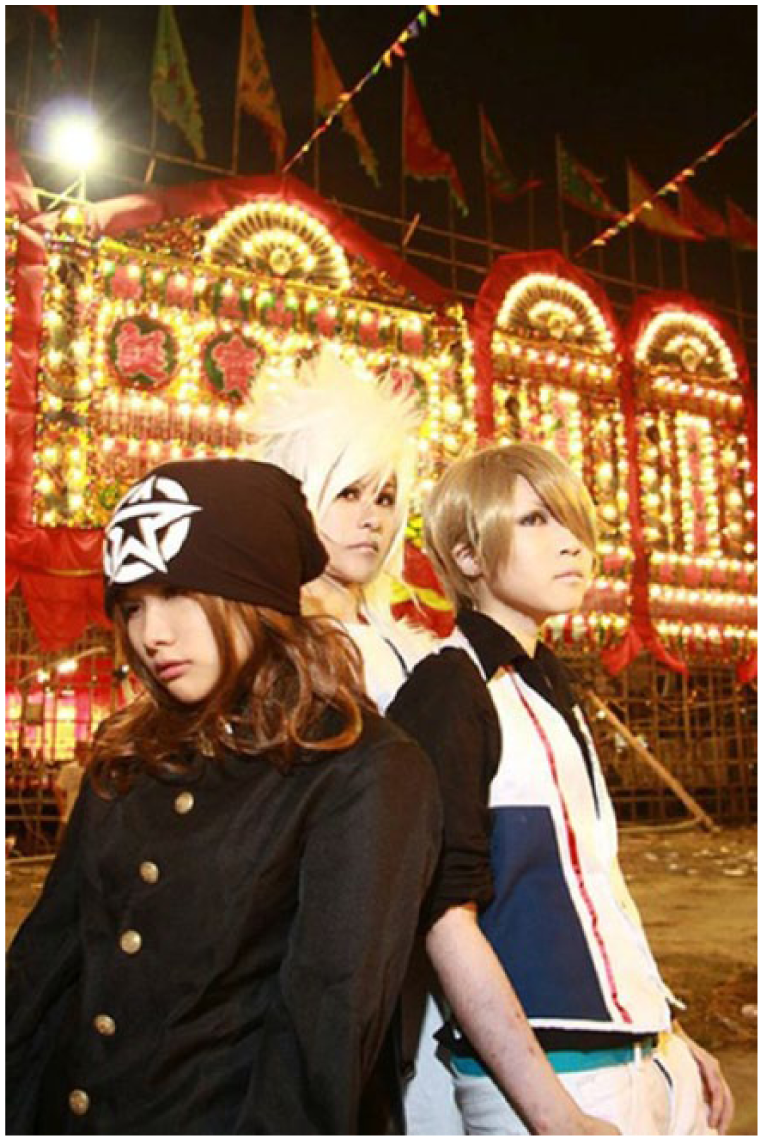
Cosplayers in front of the Chinese Opera stage during the Ghost Festival.
By recoding meanings and generating new practices via cosplay and doujinshi, COD fans re-negotiated their Hong Kong identity through a system of cultural flow and ‘real virtuality’, moving beyond the screen and merging with everyday life (Castells, 2009: 404). Indeed, in certain circumstances, COD cosplay itself was intended as a reclamation of Hong Kong identity. As Maigo recalls: KWC is something that Hong Kong has lost. To me, I haven’t heard of KWC before reading the manga. KWC no long existed when I was born. What we know about KWC are all myths. There’s unlimited space for imagination in myths. We can play with many … local elements … Something that is very Hong Kong.
The reflexive search for the authentic KWC under the ‘politics of disappearance’ (Abbas, 1997) takes place in the context of calls for the redefinition of Hong Kong identity (Chu, 2013). In this respect, the mediated, affective and performative memories of KWC have moved beyond ‘rootless nostalgia’ to a renegotiation of local identity, echoing Hong Kong poet Yesi’s (1996: 118) writing on KWC: ‘Rethinking this place (KWC) is not for nostalgia, but for better reflection of the space that we’re living in’.
Conclusion
This short article has sought to create an interdisciplinary dialogue between cultural criminology, Asian cultural studies and postcolonial scholarship by tracing the diverse and diffuse ‘second life’ of a unique and quixotic historical space in Hong Kong: Kowloon Walled City. This approach is intended to build foundations for a nascent Asian criminology while unsettling the roots of scholarship on crime and culture which tends towards an Anglo-American perspective. First, in contrasting the lived experience of place constituted by people who lived and worked in the Walled City – which frequently features crime and corruption – with the sanitised memorial in its place, the article has drawn attention to the politics of forgetting and memory in Hong Kong. Second, in tracing the process through which the cultural memory of the Walled City became untethered from the place itself, and recast in the realm of ‘real virtuality’, we demonstrated the way in which consumerism and commodification figure in memorialisation. The affective imprint of the Walled City is one of anarchic urbanism yet it is mostly memorialised through the global industries of film, gaming and comic books – in which transgression and consumerism are conjoined in the ‘merchandising’ of Chinese history (Lowe and McLaughlin, 1995). Third, however, we followed the ‘social life’ of the Walled City as it became reappropriated by a new generation of young people in Hong Kong, through ‘cosplay’ and ‘doujinshi’ subcultures, in which place-based memorialisation of the Walled City are reclaimed as an act of heritage. In this way, the Walled City highlights a complex and fragmentary picture of a highly connected, hyper-mediated and consumer-driven crime-media nexus that has distinctive characteristics. As film historian, So, interviewed for the project, summarises: KWC is like adding sugar to a cup of coffee: you add a cube of sugar to it and it melts. The sugar dissolves but it doesn’t disappear as it is saturated in the coffee already. Only a tiny piece of concentrated sugar is left. To a certain extent, it’s like Hong Kong. Most aspects of Hong Kong since the 1950s have already merged into the broader environment: the society, the colonial rule, or the general global political economy of the 20th century. But there is still something that cannot be dissolved … KWC is the most concentrated essence of Hong Kong … there are always forces of resistance. It is what makes Hong Kong interesting.
The multiple ways in which the Walled City has been re-storied and multi-mediated lead to several conclusions pertinent to the study of crime, media and culture in Asia. First, while the standard toolbox of criminological concepts can be problematic when applied to Asia (Lee and Laidler, 2013), the virtual domain has created a level playing field in which there is a clear argument for a common theoretical vocabulary. In this sense, the study of the Walled City’s ‘second life’ represents a portal into new configurations of online and offline identity in a way that is untethered from the space itself. Second, it is important to understand these lived realities within specific cultural contexts. Hong Kong and Asia are interesting and important sites as they have different forms of youth subcultures and demonstrate the importance of the local – cosplay subcultures for example exhibit both the fluidity of cultural reference points and an anchoring in history. As Appadurai argues, ‘globalization is itself a deeply historical, uneven, and even localizing process’ (Appadurai, 1996: 17, emphasis in original). Third, the study of cultural memory represents a critical meeting point for these processes, demonstrating the need for interdisciplinary and transdisciplinary perspectives in tapping into these unique rhythms. This aims to set the tone for a new ‘criminology of the periphery’ (Lee and Laidler, 2013) that draws together local and global scholarship to build a critical knowledge base on crime, media and culture in contemporary Asian contexts.
Footnotes
Declaration of conflicting interests
The author(s) declared no potential conflicts of interest with respect to the research, authorship, and/or publication of this article.
Funding
The author(s) disclosed receipt of the following financial support for the research, authorship and/or publication of this article: This study was supported by a grant from the University of Hong Kong Seedcorn Fund.
Notes
Author biographies
Film and television
Batman Begins (2005, dir. C Nolan)
Blade Runner (1982, dir. R Scott)
Bloodsport (1988, dir. N Arnold)
Brothers from the Walled City (1982, dir. NC Lam)
Crime Story (1993, dir. K Wong)
A Fist within Four Walls (2016, TVB)
Ghost in the Shell (1995, dir. M Oshii)
Ghost in the Shell: Innocence (2004, dir. M Oshii)
History Must Be Crazy: Walled City (1991, ATV)
Hong Kong Connection: Walled City (1979, RTHK)
Hong Kong History Decode: No Man’s Land (2007, ATV)
Ip Man: The Final Fight (2013, dir. H Yau)
Kowloon Walled City (1988, dir. H Portisch)
Kung Fu Hustle (2004, dir. S Chow)
Long Arm of The Law (1984, dir. J Mak)
Re-cycle (2006, dir. Pang Brothers)
Video games
ArenaNet (2006) Guild Wars: Factions (Windows). Seoul: NCSOFT.
Capcom (2012) Biohazard 6 (PlayStation 3, Xbox 360, Windows). Osaka: Capcom.
Eidos Montreal (2011) Deus Ex: Human Revolution (Windows, OX X, PlayStation 3, Wii, Xbox 360). Tokyo: Square Enix.
Smilebit (2002) Jet Set Radio Future (Xbox 360). Tokyo: Sega.
Treyarch (2010) Call of Duty: Black Ops (Windows, NDS, PlayStation 3, Xbox 360, Wii and OS X). Santa Monica, CA: Activision.
Zeque (1997) Kowloon Gate (PlayStation). New York: Sony.