




Abstract
This paper explores the legal, social and ethical drivers behind readdressing the synonymous use of the words ‘fraud’ and ‘scam’ in the United Kingdom. Drawing on a variety of data from across academia, professional practice and the media, this paper challenges and redefines prevailing narratives and reporting practices. It explores the difficulties of inaccurate terminology in referring to fraudulent acts in the media, in academia and in public protection messaging and education, and the potential harms of this in terms of victims, offenders and the criminal justice system. It also identifies the harms associated with authoritative organisations using colloquial terminology for fraud in public-facing communications. The work suggests that the language used, including media hyperbole and negative narratives around fraud victimhood, can harm victim care and contribute to existing barriers to individuals reporting their victimhood. It concludes by recommending minimum communicative standards in the use of consistent, legally accurate language to refer to fraudulent acts, and that these standards will play a role in starting to redress harmful biases and negative societal perceptions of victims of this crime.
‘The Medium is the Message’ (McLuhan, 1964)
Introduction
It is well documented that fraud is the UK’s most commonly experienced crime (Westmore, 2023), is considered an issue of national security (Bath, 2021) and causes both financial and psychological harm (Carter, 2021) so comprehensive and far-reaching that it can be considered a public health issue (Hawkswood et al., 2022); one that authorities have a duty of care to safeguard against (Brown and Carter, 2020). The problem of fraud has also been widely reported in the media, particularly in cases commonly referred to in the UK as ‘Authorised Push Payment (APP) fraud’ - where a criminal manipulates a victim into sending money, often through a false romance, false investment opportunity, phishing communication, or having been deceived in an online shopping transaction (see e.g. Edwards et al., 2025; Hock and Button, 2023; Carter, 2024). This crime trend shows no sign of abating. Some recent examples in the UK media include the sentencing of a man who stole £214,000 from a woman in a romance fraud and a story that a Chinese organised crime group set up a call centre in the Isle of Man to perpetrate romance-investment fraud, sometimes (misguidedly) taking on the criminals’ own pejorative terminology and referred to as ‘pig butchering’ (BBC, 2024a, 2024b; Cross, 2024; Whittaker et al., 2024). From the perspective of post-fraud financial restitution, a popular media angle in the UK is to cover stories where banks appear to fail their customers who have been victimised (BBC, 2024c). Most recently APP fraud has captured the UK media’s attention due to the reimbursement duties on banks (Payment Systems Regulator [PSR], 2024) in relation to victims of this particular crime type. This is an important conceptual step in terms of financial institutions recognising that APP fraud is the result of grooming and manipulation, rather than individuals who have made a bad decision (Cross, 2015; Carter, 2021).
However, this recognition is rarely reflected when APP fraud offences are subsequently reported by the UK’s media. These crimes are largely portrayed along a range of perspectives; victim vulnerability, detailed accounts of solo perpetrator (often in-person) actions, sentencing (driving the misperception that most cases end in detection, apprehension and custodial sentences), of serious organised international criminal networks, and latterly, of fraud criminals as victims of modern slavery. These are all legitimate topics relevant to this crime type, however, a far wider multiplicity exists in relation to the language of fraud reporting, where an inconsistent landscape of terminology is used to describe these offences. The media in the UK often describes the crimes as ‘cons’, ‘swindles’, ‘tricks’, and, as is the focus of this paper, as ‘scams’ (see e.g. Beard, 2024; Belcher, 2024; Parkin, 2024). Many academic articles follow the same trajectory, with publications often using the terms scam and fraud interchangeably (see e.g. Jung et al., 2022; Lacey et al., 2020; Rege, 2008). The interchangeability of terminology is brought into focus in the work of Taylor and Galica (2020) who propose that ‘frauds are scams whereby countless individuals have been tricked into conveying funds to a fraudster. . .’. An implication of this is that the way in which fraud awareness and prevention messaging is disseminated to the public has become distorted, in that the term ‘scam’ has often come to replace or be used interchangeably alongside ‘fraud’.
Of course, communication styles and terminology is often fluid, and in particular, media reporting understandably favours a range of lexis to ensure accessibility of a wide readership and to avoid unnecessary repetition in articles. This paper, however, seeks to explore whether using ‘fraud’ and ‘scam’ interchangeably, or using ‘scam’ instead of ‘fraud’ contributes to skewed public perceptions of the crime as unserious and victimhood as the fault of the victim for not spotting the ‘trick’. We will discuss the key difference between frauds and scams and explore the impacts of using ‘scam’ instead of fraud, as well as the use of these terms interchangeably. In doing so, this work suggests that it may be a case of ethical, legal and social responsibility to encourage and engage in using the term fraud when referring to this criminal act in public-facing communications.
We first set out the definitional complexities around defining what is a fraud and what is a scam, before examining some of the UK media representations of and narratives around fraud criminals and fraudulent behaviour, and explore the impacts of inaccurate and inconsistent terminology on victim harm, public safety and offender behaviour rationalisations. This paper will also examine the potential trivialisation of fraud by organisations that provide platforms for vigilante actors, commonly referred to as ‘scambaiters’, whose activities are often controversial and, in some cases, unlawful. This will be considered in contrast to the widespread critique of other forms of online vigilantism, such as those involved in the pursuit of alleged online child predators. From there, this article moves on to explore the implications for public protection information and criminal justice system responses. We draw on and build on the work of Carter (2021, 2023, 2024) who focuses on the anatomy and impacts of the language used by fraud criminals using a combination of criminology and forensic linguistics, and expose the (ab)use of language and terminology as the very tool through which individuals become victims of fraud. This paper will argue that by replacing inaccurate and potentially damaging terminology (in particular the term ‘scam’), it will reduce the trivialisation of fraud as an offence in public discourse and will enable our communications as educators and professionals to do the work it intends; to inform, protect and support, and not (however inadvertently), belittle, reduce or dismiss.
An exploration of the definitional difficulties of the term ‘scam’
The Oxford English definition of a ‘scam’ is ‘a trick, a ruse; a swindle, a racket’ (Oxford English Dictionary, 2025); one that situates a ‘scam’ as wider in scope than a fraud, including unethical practices which are not necessarily criminal acts.
The UK’s financial service providers also draw a distinction between fraud and scam, with the former used by the financial industry to describe frauds perpetrated against banks. This could be through, for instance, identity theft or unauthorised use of a bank card. The latter was used to describe frauds against its customers through APP fraud (see HSBC, 2025 e.g.). The distinction is legally inaccurate, as both ‘scams’ and ‘frauds’ would meet the legal definition of fraud under the Fraud Act 2006 in England and Wales. The added inference here is that, with a ‘scam’ representing something that customers have been ‘persuaded’ to participate in, there is an element of victim precipitation, responsibility - and worse - blame, on the part of the customer.
Within academia, a ‘scam’ is described as ‘. . .a deceptive scheme that seeks to trick a person(s) out of money and/or personal information which is unethical and may also be a civil, regulatory or criminal issue too’ (Button and Cross, 2017). This also encompasses a greater range of practices than fraud, to include, for instance, an individual who provides false information on a dating website with the intention of misleading a prospective partner into an online relationship. This is not a violation of civil or regulatory law in the United Kingdom, but it is an unethical act often referred to as ‘catfishing’ (Taylor et al., 2024). However, if there were the intention of providing the false information to profit from it, or to expose prospective victims to a risk of financial loss, the matter would then become fraud. Given that the definition refers to a ‘deceptive scheme’, attempting to trick another person out of money, it would meet the legal definition of fraud under section 1 & 2 of the Fraud Act 2006 in England and Wales. So, whilst there is an argument for ‘scam’ being broader than ‘fraud’, even the wider definition still amounts to a ‘fraud by false representation’ under section 2 of the Fraud Act 2006, in that it is ‘deliberately untrue or misleading’, with the ‘intent to make a gain for themself or another, or to cause loss to another, or expose another to a risk of loss’. The difficulty this poses is that in framing scams as broader than fraud, and not necessarily criminal (or fraud), when the narrative of these does in fact meet the legal definition of fraud, it minimises the seriousness of the act and associates it with non-criminal incidents. This has potential real-world implications for victims too. Firstly, this may create an additional barrier to reporting, as victims may mistakenly interpret the incident as a scam rather than fraud, leading them to believe it is not clearly enough something that was illegal, and therefore not something that should be reported (Association of Chief Trading Standards Officers [ACTSO], 2014: 5). This state is exacerbated by the commonly experienced feelings of guilt and self-blame for fraud victimhood (Cross et al., 2016). Secondly, when financial institutions misclassify incidents as ‘scams’, which, in legal terms, would more accurately be defined as fraud, this misidentification may lead to the wrongful denial of victims’ statutory rights to reimbursement for Authorised Push Payment (APP) fraud losses under the PSR Regulations (Day, 2025). The Regulations explicitly exclude reimbursement in cases deemed to fall under civil, rather than criminal, law. This highlights both the scope of the legal definition of fraud and its frequent misinterpretation. The use of the term ‘scam’ in place of ‘fraud’ introduces further ambiguity, particularly as its definition may encompass non-criminal conduct, thereby raising significant concerns for both academic discourse and practical application.
Problematic media representations in the United Kingdom: the portrayal of fraud, fraud offenders, victims and guardianship
Much like newspaper headlines, prominent narratives in public-facing campaigns and popular linguistic tropes ‘function as negotiators between stories and readers’ (Dor, 2003: 720); defining and shaping understandings of the form and prevalence of the crime, and modelling the social understandings of, and responses to, the criminality and victimhood of it. As well as reflecting back to the reader their own biases and cognitive shortcuts, popular narratives around fraud act as a semantic constraint to the story (limiting it to the well-worn perceptions of the crime and victimhood), fuel stereotypes and expectations. As media effects theory suggests (Jewkes, 2015), such representations serve to reassure readers; in the context of fraud, audiences are comforted by the belief that they themselves are unlikely to become victims, assuming that their intelligence, vigilance, and use of protective measures would prevent them from being so deceived. The use of metaphor, euphemism, and colloquial language, in place of legally precise terminology that carries no inherent moral judgement, contributes to the trivialisation of the crime. It fosters a perception that fraud is easily avoidable, reinforcing the blaming, mockery, or scorn of victims. This framing renders the offence abstract and seemingly irrelevant, distorting public perception and diminishing the seriousness of fraud as a calculated and sophisticated criminal act. Instead, it is reframed as a simplistic, mildly entertaining, scheme that only the careless are victims of, or worse, ‘fall for’. This portrayal stands in contrast to the types of threats that typically evoke public fear; what Best (1999, p. xi) describes as “the carjackers, the sexual predators, the drive-by shooters. . .the strangers who attack without warning or provocation”, representing sudden, chaotic, and senseless violence.
According to discourse analytic principles, negative undertones of terms such as swindle, dupe, scam and con both feed into and feed from the reader’s own semantic and pragmatic knowledge (Caldas-Coulthard, 1997); existing biases, interpretations and perceptions of the pervasiveness of fraud and risk of victimhood, self-protections and victimhood. The negative inferences of these terms, and indeed the use of colloquialisms when reporting on a crime, have the potential to inflict secondary victimisation on those who have been a victim of fraud and see their situation, or a situation similar to theirs, subject to mockery, judgement or derision. Van Dijk (2001) also suggests those who have the ‘controlling context’ have the power to steer and define the communicative situation, such as media reports on fraud victimhood, and therefore have the ability to do so in order to use these communications to shape public perceptions; in this case, perceptions of fraud as a serious crime with severe financial and psychological harms, and victims of that crime as victims of grooming, manipulation and control that anyone can find themselves experiencing. Indeed, “The media. . . has a critical part to play in the language their audiences respond to. For example, a story covering a person who “gave their life savings to someone they had never met following a whirlwind romance”, is likely to encourage negative reactions and “serves-them-right” type replies. However, would they respond in a similar way if the same story was headlined: “Criminals targeted and exploited victim in a coercive, emotional fraud””’. (Rowe, 2024).
This paper draws on these analytic principles in using examples from publicly-available media and public and private organisations’ public-facing fraud protection and awareness raising messaging in order to provide context and examples to the discussions in this section. Drawing on the work of Carter (2023, 2024), this account by fraud victim and advocate Anna Rowe highlights the importance of careful reporting of this crime type by the media. Rather than being a victimless crime, “‘stories that place the blame solely with the criminals can be the difference between a victim being seen as courageous for coming forward or being further humiliated by keyboard warriors. Whether burglary or romance fraud, people don’t fall for crime, they are the victim. We should be supporting them, not ridiculing them’ (Rowe 2024). This is supported by Lokanan (2023), whose analysis of tweets in the month following the Tinder Swindler documentary aired on Netflix, which showed the public not understanding the power of the perpetrator’s manipulative tactics had over the victims and the impact this had on their decision-making capabilities. Not being able to understand why someone would not see the fraud unfolding is part of the design of these criminal interactions; creating barriers between victims and their families and friends, who are outside of the grooming and manipulation, which only compounds the vulnerability of the victim to continuing fraud victimhood. The words used reflect a deeper societal trivialisation of fraud and existing societal barriers. By changing the name we help to drive the change rather than continue to contribute towards it
The representation of fraud criminals as practitioners of an underhand skill is also clear in common terminology such as ‘scam artists’, ‘con artists’, ‘rip-off merchants’. These skills have long been fetishised in non-UK media representations of fraudulent acts with a clear example being in the fictitious ‘Oceans’ big budget Hollywood film franchise (Seçmen, 2023), where movie-goers are set to root for the criminals as they use ingenious methods to carry out their criminal acts by defrauding organisations. In the narrower context of the UK, the television show ‘Hustle’ portrays the main protagonists as likeable, alluring and clever as they attempt to defraud their ‘marks’ each episode (Seçmen, 2023). Another example from the UK is ‘The Real Hustle’, which moves into the realm of non-fiction, where criminal acts are carried out on individuals for entertainment. Described on IMDB as ‘a team of real-life confidence tricksters carry[ing] out notorious scams on unsuspecting members of the public whilst hidden cameras catch all the action’, this is something that would never be considered appropriate if those acts were anything other than fraud. The word ‘hustler’ itself has changed in meaning both internationally and in the context of the UK from someone who enterprisingly tricks you out of money to a more legitimate source of financial gain, owing to the rise of the term ‘side hustle’, which means an additional source of income alongside one’s main employment (Christian, 2023). There are problems associated with how the media attempts to advocate for the tackling of fraud. One such issue here is the glorification of and continued partnership between media outlets and so-called ‘scambaiters’, vigilantes who enact their own versions of justice on online fraud criminals by operating outside of conventional policing efforts, often to a virtual audience of subscribers. Here we highlight the different way in which this type of activity is glorified and legitimised whereas other crimes are not, and this may be an indication of the lack of seriousness given to fraud offences in the media, while also indicating a public dissatisfaction with the criminal justice responses to fraud threats (Button and Whittaker, 2021; Dynel and Ross, 2021; Johnston, 1996; Sorell, 2019; Williams and Thompson, 2004).
The primary goal of scambaiting is simply to waste the time of fraud criminals by acting as potential fraud victims (Robinson and Edwards, 2024). Whilst scambaiting is by no means a new phenomena (e.g. 419eater, a scambaiting forum, was established in the early 2000s), its popularity as an activity has surged in recent years as a result of the growth of YouTube channels dedicated to this activity (Button and Whittaker, 2021). Notable current examples of this include Kitboga, Scammer Payback, and Atomic Shrimp who have each accumulated millions of channel subscribers. It is important to acknowledge that these efforts arguably offer some degree of positive utility in that they raise awareness about online fraud, particularly to a younger audience, and in specific instances they have successfully pressured law enforcement into pursuing the capture of offenders. For example, the US-based scambaiter Scammer Payback has successfully lobbied Indian law enforcement to shut down several fraudulent call centres and for the prosecution of their operators (Ghosh, 2025). However, this type of activity has proven to be controversial), and conflict with the altruistic framing of using scambaiting tactics to help to tackle the problem of online fraud. Examples of this type of behaviour can be found in the US-based Youtube channel ‘Trilogy Media’ which has uploaded several videos where they confront and ridicule suspected money mules; individuals hired to launder the proceeds of fraud face-to-face (Trilogy Media, 2020). Further to this, money mules can be victims of fraud themselves, having been deceived into thinking that they are working for a legitimate company as ‘part-time work’ or whereby they may be victims of online romance fraud and convinced to launder the proceeds of crime from other victims on behalf of fraud criminals who masquerade as their ‘lovers’ (Agari, 2022; Raza et al., 2020). The second issue surrounding scambaiting relates to how some scambaiters engage in perpetrating offences themselves, particularly hacking, with their general belief being that engaging in illegal activities is justified if it is an offender being targeted by their efforts. An example of this is the YouTuber ‘Scambaiter’ who has regularly hacked into both the computers and CCTV inside Indian boiler rooms (Scambaiter, 2025).
The trivialisation of fraud by the UK media has resulted in what is arguably a broad acceptance of ‘scambaiting’ and vigilante justice in this context, with scambaiters having been utilised in various UK television shows to showcase their work. For example, the BBC has continued to partner with Jim Browning who has featured on an episode of ‘Panorama’ and on another show called ‘Scam Interceptors’, which describes itself as ‘working with ethical hackers’ and ‘hunting down the scammers plaguing our lives’ (BBC, 2020; BBC, 2024d). Notably, the BBC acknowledges that their partnership is problematic, describing in an article about the Panorama episode that ‘what Jim did was illegal’ (BBC, 2020). What is particularly striking about the BBC’s continued use of vigilantes in the context of scambaiters is that it does not view other forms of vigilantes such as online paedophile hunting groups, vigilante’s who pose as children and lure offenders into meeting them to then later expose them (Tippett, 2024), with the same outlook that sparsely acknowledges the legal and ethical issues posed by their efforts. A BBC Three documentary entitled ‘Paedophile Hunters: The Rise Of The Vigilantes’ (BBC, 2019) takes a much more critical approach to vigilantism than in the case of scambaiters. It describes how ‘journalist Livvy Haydock investigates the rise of vigilante groups who, without official endorsement from the police, target suspected paedophiles’ and questions whether ‘the hunters [are] actually making potential convictions more difficult for the police? Or are they helping capture predators who might otherwise slip through the net?’ These very same questions could be posed to scambaiters and offers crucial insight into the UK media’s complex and paradoxical outlook on vigilante justice. Namely, that vigilante justice is perceived in the UK’s media as being broadly acceptable in tackling online fraud because it is viewed as an offence that exists solely within the realm of ‘cyberspace’ and therefore less serious, whereas face-to-face confrontations between vigilantes and offenders taking place in the ‘real world’ are challenged because of a perception that ‘real world offences’ are much more dangerous.
Implications for victims and offenders
Fraud is a chronically underreported crime type, with the National Crime Agency stating that only 13% of UK victims report to the UK’s fraud reporting facility Action Fraud. The accurate use of the term fraud has important implications for victim and offender; specifically, for victims in relation to the psychological impacts of the crime and likelihood of reporting victimhood, and offenders’ assessment of risk and ability to rationalise their criminality.
From the offender’s perspective, criminals that perpetrate fraud often downplay and rationalise their offending. For instance, prisoner interviews with doorstep criminals reveal offenders denying causing harm to victims, claiming that the victims do not need the money and they aren’t physically injured (Phillips, 2016; Steele et al., 2001). This is particularly evident in the case of frauds originating in West African countries, where in-spite of the offending being economically motivated, offenders often seek to downplay and trivialise their offending for example by referring to it as a ‘game’ ( Lazarus, 2018; Lazarus et al., 2025; Whitty, 2018) and justifying it as a response to colonial injustice and economic exploitation (Lazarus et al., 2025). The term ‘scam’ is associated with intellectual superiority and an activity to be admired and glamorised (Lazarus et al., 2023a, 2023b). Whittaker (2024, 173) found a novel example where a lecturer at a University in Cameroon openly joked with his students that were perpetrating fraud by commenting ‘I know those scammers in this class will know what I’m saying’, as a means of validating and accepting their actions. Offenders interviewed in ethnographic studies often boast about their financial earnings and the ‘game’ of ‘scamming’, but shirk the fact that they inflict financial and psychological harm, particularly in the case of romance fraud as a result of their offending (Bilz et al., 2023; Lazarus et al., 2023b; Offei et al., 2022; Carter, 2024). This is supported by classical criminological literature on reconciling criminal behaviour and one’s self-perception of ethicality or righteousness (Sykes and Matza, 1957). Despite this, the harm inflicted by perpetrators of fraud is well documented in terms of both financial and psychological devastation (Cross, 2018; Lazarus et al., 2023b; Kassem and Carter, 2024). Indeed, in some cases, this harm is to such an extent that the victim takes their own life (Cross, 2018). As such, we note that the use of the term ‘scam’ in the day-to-day lexicon of fraud criminals may contribute to the trivialisation and glamorisation of their actions.
By misrepresenting fraud as a scam, the seriousness of the act, the representation of the act as a criminal offence, and the personal characteristics of the victim are all called into question. Research has explored how in some instances victims often do not report fraud because of the small sums of money taken from them. It is therefore crucial that the police, the wider constituents of the fraud justice network, and academia use the term fraud to emphasise that it can in fact be a ‘volume crime’, whereby offenders seek to defraud many victims of relatively small amounts of money. It is common to describe smaller losses (e.g. the fraudulent sale of fake concert tickets) as scams (Solomon, 2024), however, describing these as a fraud would provide an important accuracy of reporting that would support rather than detract from public awareness of the status of these acts as serious, criminal and often professional, rather than portraying it as a ruse. Fraud is not distinguishable from a scam by the financial loss to victims (or conversely the gain to perpetrators). Indeed, as fraud is a conduct rather than a results offence it can be complete without there even being a victim or a loss; it is the deliberate false representation in and of itself, rather than the victimisation, that completes the offence (Ormerod, 2007).
Another key area of impact in relation to victims’ likelihood of reporting is the potential difficulties in individuals recognising and identifying whether what they have experienced was a criminal offence or a non-criminal unfortunate event. The synonymous use of ‘fraud’ and ‘scam’ does not alleviate this difficulty; indeed the doubt this conflation introduces could contribute towards victims’ difficulty in correctly categorising their experience as a criminal act, and negatively impact their reporting decision-making (together with the manipulative nature of many interpersonal frauds such as romance and investment fraud impacting victims’ perceptions by encouraging self-blame and shame (Carter, 2024), which in turn hinder reporting. Any impact on victim decision-making on whether or not to report the situation to Action Fraud or their bank has subsequent impacts on victim decision-making on, or knowledge of, accessing support services, or, where applicable, their statutory right to reimbursement. This has the further consequence of the psychological impacts of fraud and the financial loss being untended, and further protections from fraud victimhood (the risk of which is increased for older adults who have previously been a fraud victim, (DeLiema et al., 2024)) not put in place.
Feelings of shame are also found to be a barrier to fraud victims reporting their experiences to the authorities (Cross, 2015, 2018; Parti and Tahir, 2023). Interestingly, a possible etymological origin of the term ‘scam’ can be traced back to the latin word ‘scōmm’, a later iteration of which is listed in the Imperial English dictionary (Ogilvie, 1882: pp. 794) as ‘Scomm’, defined as a ‘buffoon’ and to ‘mock’ and ‘jeer’. The continued use of the term scam to describe acts that amount to fraud is likely to result in these same feelings being engendered in victims. Shame in the context of fraud victimisation has been explored by scholars such as Cross (2015, 2019), Button (2021), Button et al. (2014), Titus and Gover (2001) and Parti and Tahir (2023). Crucially, researchers exploring this problem have identified a strong victim-blaming discourse amongst the public who believe that victims are ‘greedy’ and that you have got to be an ‘idiot’ to be victimised in a fraud (Cross, 2015). Notably, many victims of fraud are hesitant to disclose their victimhood to friends and family because of concerns that they will receive an overwhelmingly negative reaction from them with little to no compassion (Cross, 2015). A particularly salient example of why victims fear disclosure can be found in a recent case that received substantial media attention involving a 53 year-old French woman who was defrauded for €830,000 after believing that she was in a relationship with the movie star Brad Pitt. Whilst the victim in this case had been through a divorce and was in cancer remission, she was mocked online by hundreds of social media users with her lawyer commenting that ‘she has been branded as silly, naive and stupid, also being harassed online, leading her to delete all her social media pages. She has attempted suicide three times and two months ago she was admitted to a mental health clinic, where she remains to this day’ (Reynolds, 2025).
Furthermore, it is not only the friends and family of victims and the wider public who have been known to shame victims but also law enforcement and their staff. A particularly concerning example of this was found in 2019 when an undercover reporter working in a UK Action Fraud call centre found that victims were mocked by staff who referred to them as ‘morons’, ‘screwballs’, and ‘psychos’ (Button, 2021; Morgan-Bentley and Good, 2019). Aplin (2022) has also identified the use of minimising language by police in relation to fraud, and negative organisational cultures in policing that result in narratives being used in relation to doorstep fraud victims that allow them to abrogate responsibility for its investigation, foreclosing reports without recording them as crimes by describing victims as ‘agreeing’ to the situation, for example. These particularly concerning examples experienced by victims of fraud identify a long-standing and pervasive victim-blaming culture.
Implications for the Criminal Justice System
As the examples in this paper suggest, using ‘fraud’ and ‘scam’ interchangeably is likely to, drawing on similar situations with other crimes detailed below, make categorisation of this crime more difficult. The impacts a lack of full understanding of the correct categorisation of acts as a criminal rather than civil matter can have on police response and victim outcomes in doorstep crimes as a type of fraud are exposed by Day (2024). Other crimes that have experienced similar definitional difficulties include white-collar crime (Smith et al., 2011) and stalking (HMIC, 2017). The definitional ambiguity in respect of ‘scams’ may be having a similar effect in terms of being a barrier to reporting and negatively impacting a case progressing through the CJS. This effect is most acutely felt against a backdrop of police lacking in training and knowledge of fraud and financial crime and perceiving it to be outside their remit (Gilmour, 2021), which suggests that wider organisational biases and (in)action is fed into, through misunderstanding of a particular criminality. This is precipitated, at least in part, by the use of language to describe it in public and police reports. Moving further along the CJS process, there is also the possibility that if the terminology used fails to reflect the significance and harm of fraud, this could affect sentencing, meaning that, even where the impact on the victim is a determining factor (Sentencing Council, 2025.), ‘most fraud offenders get off comparatively lightly’ (Levi, 2007).
The importance of using language that accurately reflects the reality of the criminal offence in public-facing communications is gathering apace. Most recently, INTERPOL has communicated to the world that the popular term ‘pig butchering’ should no longer be used in relation to romance-investment fraud hybrids, due to the harm this dehumanising term inflicts on victims of these crimes (Cross, 2024; Interpol, 2024; Whittaker et al., 2024). It poses a media-friendly alternative to ‘romance-investment fraud hybrid’ in ‘romance baiting’, crucially recognising the importance of capturing the public imagination, whilst offering a term (a range of terminologies to describe this crime is explored by Maras and Ives, 2024), that focuses on the context of the fraud rather than the pejorative term the criminals have for the victims. INTERPOL have also started to use ‘fraud’ rather than ‘scam’, driven by the recognition that the legal term should be used and that scam does not accurately represent the crime nor aid public or organisational understandings of it. The National Trading Standards Scams Team (despite the name) has also produced a nationwide ‘no blame no shame’ campaign and a Victims Charter for organisations (National Trading Standards, 2023), which asks organisations to commit to, and provides guidance on language use, detailing how essential careful language use is in terms of accurate communications with victims that do not expose them to additional harm. Explicit amendments for public-facing communications are to avoid using ‘fall for’, as this poses victims as dupes to a ruse; a call driven by academia and practice (Hawkswood, Carter and Brown, 2022) which most recently has been taken up by the BBC in the daytime television programme ‘Morning Live’ (BBC, 2025). A parallel can be drawn here with the terms ‘child porn’ and ‘child prostitution’, both of which wrongly place the victim at the heart of the incident, infer consent and even legitimacy of the act, and infer blame or reponsibilisation of the victim, obfuscating the fact that both are criminal acts involving exploitation. These were commonly used in law enforcement, media and other organisations’ communications. However the harm caused by the use of these phrases has now been recognised; precipitated by academic calls for change (Frangež et al., 2015), much like the present paper seeks to perform), and their use in UK enforcement settings and media reporting has been replaced by the more accurate child sexual abuse material (CSAM) and child sexual exploitation (CSE) respectively. These are categoric terms which emphasise the criminality and status of victimhood. With multiple examples of failings by police to protect victims of CSE at the hands of grooming gangs, with victims being dismissed or blamed, the severity and systematic nature of which warranted an independent enquiry (Jay, 2022), one could posit that the language both reflected and perpetuated narratives that allowed these failings, causing secondary victimisation. Again there exists a parallel in terms of perpetuated narratives in the way that some police describe incidents of fraud involving doorstep crime rogue trading, given they have been found to legitimise the offenders, dismiss the victimisation of the victim and fail to record the incident as a crime (Aplin, 2022; Day, 2024), re-victimising the victims as a result. This has been said to result from the use of ‘scripts’ and ‘mental shortcuts’ employed by police officers (Aplin, 2022), key amongst which are the dismissal of incidents as ‘civil disputes’, declining to record a crime on the basis that victims ‘consented’ to the work, and the ‘portrayal of the perpetrator as legitimate and law abiding’ (Aplin, 2022). Adopting language that unequivocally frames incidents in the criminal law and labelling them as fraud would make these harmful and inaccurate narratives far more difficult to sustain.
Implications for public protection literature and education
Public-facing communications from organisations with a responsibility for countering fraud and protecting the public (or their customers) from fraud communicate the harms of fraud, ways to protect oneself from it and what to do if you are a victim of it. However, it is apparent that the methods used to do this commonly draw on narratives of victim responsibilisation and blame; ‘don’t fall for a scam’ (Applebank.com, 2025)’, ‘don’t be a victim’ (Scamadvisor.com, 2025), ‘don’t make life easy for cyber criminals’ (City of London Police, 2025), ‘Don’t Let Imposters Part You From Your Money’ (Vista Capital Partners, 2025). These deliver expectations of an individuals’ ability to identify manipulation, recast having money criminally taken from you as the much more amicable ‘parting’ from it, conflate the crime as one of choice (‘letting’ it happen), negligence or stupidity (avoid victimhood by being ‘scam savvy’, Take Five, 2025) and as if it is a lack of thought, or a lack of self-protection that results in victimhood, rather than a result of manipulation, grooming and abuse. Such framing through the transactional, and focus on responsibilisation would appear inappropriate if these phrases were used in relation to other crimes that rely on psychological manipulation to achieve criminal gain. Phrases such as ‘too good to be true’ (Take Five, 2025) are used as public protection messaging to warn against taking risks, yet they situate victims as those who have become a victim due to their own greed or stupidity, and focus the blame for becoming a victim on the victim themselves. Such narratives downplay the financial and psychological harms of fraud, the reality of the crime as a serious offence and reinforce and feed into the societal judgement, negative narratives and shaming of fraud victims as discussed in the previous section. It is clear how, however well meaning and well-intentioned, the plethora of communication from across the counter-fraud sphere that uses this most common approach to public protection from fraud leaves the public over informed and under-protected, and encourages shame and additional harm on those who become a victim of the crime. This, in addition to the use of the broader and amorphous term ‘scam’ instead of the precise and cognisable term ‘fraud’ to describe the illegal act of deceiving another for economic gain, contributes to the underreporting of fraud by victims and supports a narrative through which offenders downplay and rationalise their offending (Figure 1).
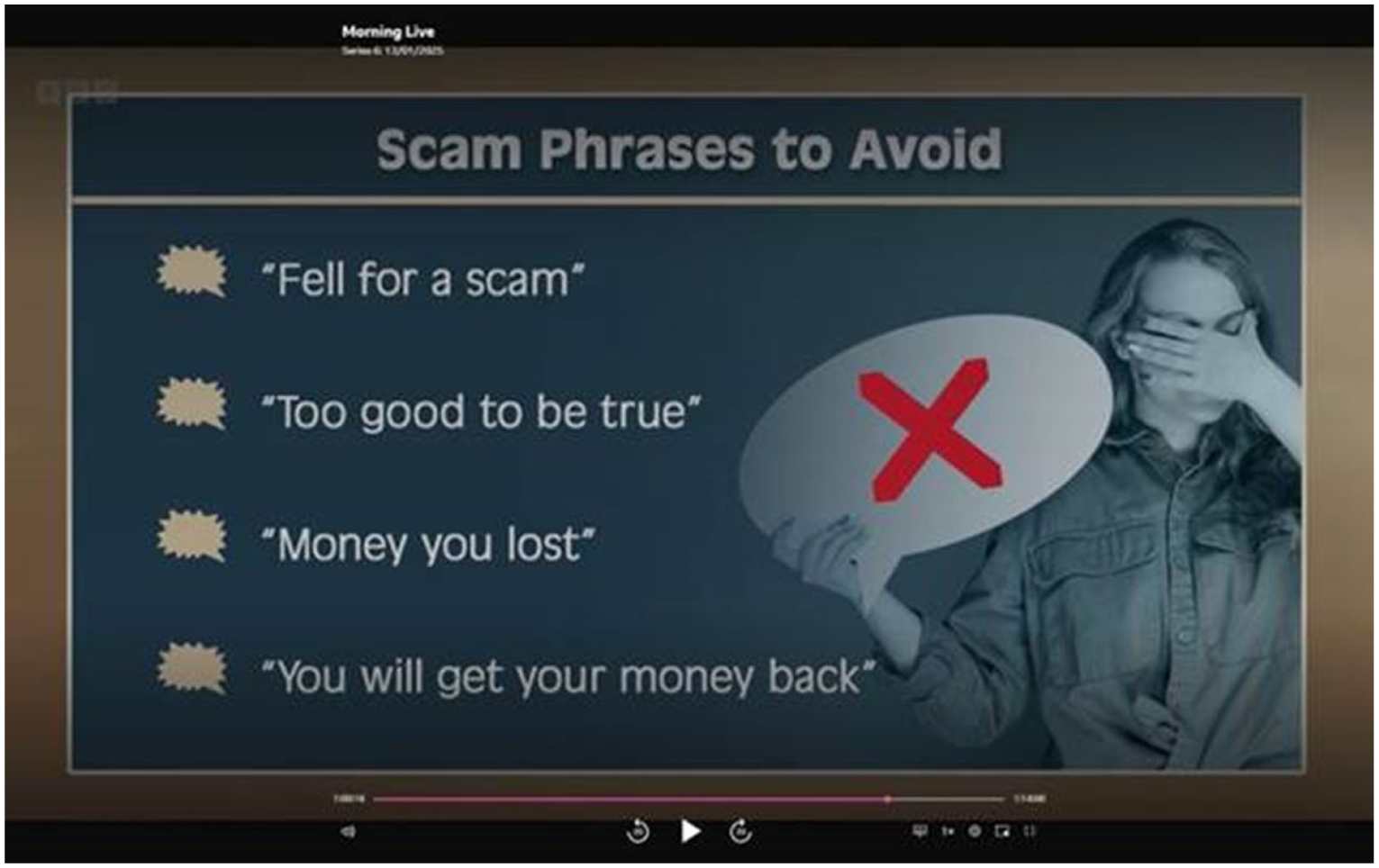
Scam phrases to avoid (BBC, 2025).
Conclusion
To ensure we do not contribute to this downplaying of the harm that offenders cause to victims, or contribute to negative public narratives that reflect these terms in questioning how someone could be so naïve as to be a victim of a scam, we argue that those writing about, examining and working against fraud must ourselves use ‘fraud’ to describe these crimes. Professionals across academia, the criminal justice system, financial industry, charity sector and the media can recognise and harness their social power, and understand the potential and real harm of engaging in colloquialisms to describe criminal acts, including mislabelling frauds as scams and avoid doing so in their work. This language shift moves us towards combating the shame associated with victimhood, recognising and honouring the proclivity of fraud, the psychological manipulation it involves and the inherent difficulty of being able to identify fraud and protect oneself from becoming a victim. This will bring a fitting and justified focus on the perpetrator’s wrongdoing, bring into sharp focus across academia, practice and the general public the seriousness of the acts and the multifaceted financial and psychological harm they cause. Accurate representations of fraud and fraud victimhood, without the euphemistic language, will encourage reporting and enable victims to access the rights and support they need. Increased reporting will also enable criminal justice agencies to gain a more accurate picture of these crimes in order to better combat, deter and capture fraud criminals and protect the public from threat. Although it is a small part of a bigger problem, and there are a multiplicity of factors that prevent victims from reporting and perpetuate social unsympathetic or judgemental responses to fraud victimhood, we have shown here the importance of distinguishing between a scam and a fraud, and in doing so have re-written the script for fraud communications. The question now is what can we do in the future. The answer is quite simply; call a fraud a fraud.
Footnotes

Ethical considerations
This article does not contain any studies with human or animal participants.
Consent to Participate
The article does not involve participants.
Author contributions
Dr Elisabeth Carter Overall content, fraud language impact inputs, analysis, review, editing. Dr Jack Whittaker Paper structure, overall content, media portrayals, editing. Dr Tim Day Content, Overall content, specialist Trading Standards and legal, editing.
Funding
The authors received no financial support for the research, authorship, and/or publication of this article.
Declaration of conflicting interests
The authors declared no potential conflicts of interest with respect to the research, authorship, and/or publication of this article.