




Abstract
We analyze the 2015 horror film Human Centipede III: Final Sequence (HC3), written and directed by Dutch filmmaker Tom Six. Engaging with literature on torture porn and body horror, we argue that this film reflects and refracts ideas about crime and punishment including a critical view on mass incarceration in America while critiquing a culture of institutional violence in Western society. By critiquing the institutional violence of the prison in a satirical and visceral manner, we argue Tom Six evades dominant tropes (liberalism, reform, rehabilitation, and escape) prevalent in other prison films and avoids the cinematic tendency to naturalize and reproduce the legitimacy of the prison. We also contend that the film operates at a meta-level to address criticism about the dangers of graphic violence in horror films. HC3 thus offers insight on the disingenuous nature of censorship in a society that condones mass suffering behind bars, systemic racism, and institutionalized punishment of the body for millions.
Introduction
Fictional films about crime and punishment contribute to what American criminologist Rafter (2007) calls “popular criminology.” Along with crime related television (Kennedy, 2017; LaChance and Kaplan, 2020), literature (Linnemann, 2015), comics (Phillips and Strobl, 2013), and videogames (Fawcett and Kohm, 2020; Steinmetz, 2018), fictional crime films offer pathways for public engagement with the emotional, philosophical, and psychological aspects of crime and punishment that are often neglected in mainstream criminology (Rafter, 2007). Films about law breaking and social control work alongside and in tandem with academic criminological discourses to weave together a popular conception of crime’s causes, consequences, and just responses (Rafter and Brown, 2011). Popular criminology bridges lay attitudes and academic discourses (Kohm, 2017). Kohm and Greenhill (2011) demonstrates that criminological theories are often mirrored in crime films’ characters, plots and themes, shaping public conceptions of both criminal transgression as well as formal and informal responses to those who violate legal, and moral norms. Moreover, films about crime and justice can be ideological in the way they present ideas about justice and injustice, order and disorder, ideas that may be drawn upon by audience members later as they navigate the social world and make sense of day-to-day phenomena (Rafter, 2006). Film can be a rich data source for criminologists who want to make sense of the interplay between crime, culture, and control (Hayward and Young, 2004).
In this paper, we analyze the 2015 horror film Human Centipede III: Final Sequence (HC3), written and directed by Dutch filmmaker Tom Six. HC3 is the final segment of a trilogy depicting the gruesome act of surgically disfiguring human beings and reconstituting individuals into a larger single monstrous entity. This satirical, self-referential film reflects and refracts ideas about crime and punishment including a critical viewpoint on mass incarceration in America while critiquing a culture of institutional violence in Western society. The human centipede is monstrous, and HC3 could be viewed within the monster horror subgenre (Briefel, 2005). Monsters are metaphorical, as they reveal something about the societies we live in and what is valued (Briefel, 2005; Peck, 2014). Consequently, HC3 has much to reveal about American society. The Human Centipede films are often discussed as examples of torture porn, a subgenre of horror from the early 2000s focusing on “the attempts of abducted [and illegally imprisoned] characters to survive torture procedures at the hands of their captors” (Lockwood, 2009: 40; Jones, 2013a, 2013c). Torture porn is often viewed as an allegory for geo-political events after September 11, 2001 (Kattelman, 2010; Kellner, 2010; Lowenstein, 2011; Middleton, 2010). However, some film scholars challenge these allegorical readings and argue that torture porn extends earlier horror tropes and reflects more enduring societal arrangements (Jones, 2013b; Kerner, 2015). The first two Human Centipede films are clearly situated in the torture porn genre, while building on earlier horror motifs including “David Cronenberg’s graphic body horror” (Jones, 2013a: 3). We contend HC3 (set in a legally authorized prison) shares more affinity with the body horror genre, a cinematic approach characterized by “the manipulation and warping of the normal state of bodily form and function” (Cruz, 2012: 161; also see Williams, 1991). Body horror graphically focuses on biological aberrations, mutations, and metamorphoses (Cruz, 2012). Because HC3 interrogates reactions to crime and moral transgression, resulting in a popular cultural critique of American penal policy, it should also be viewed as a prison film. While we agree HC1 and HC2 are more reflective of the torture porn subgenre, we read HC3 as contributing to the body horror genre and as a prison film due to its focus on the abomination of sewing humans together in prison as a form of punishment (also see Wilson, 2014). In HC3, the subtext suggests the centipede mimics the unethical focus on efficiency and human processing characteristic of the penal industrial complex with uncanny familiarity. From images of chain gangs, to skin-peeling medical experiments in carceral spaces (Hornblum, 1998), to thousands of prisoners stripped naked in El Salvador and wedged together in a mash of flesh (Sheridan and Brigida, 2020), to revelations of forced hysterectomies of immigrant women in Immigration and Customs Enforcement (ICE) detention centers in the United States (Bryant, 2020), brutal human processing and abuse is germane to carceral sites. We argue the use of body horror makes HC3 effective as a form of critique, as typical prison films tend to recycle tropes including liberalism, reform, rehabilitation, and escape that naturalize the prison as a form of social control.
Beyond revealing the ways HC3 operates as a prison film in the body horror genre and the critique of the prison it offers, we contend that HC3 operates at a meta-level to address fears and criticism about the dangers of graphic violence in popular culture. The film is dedicated to bodily suffering, but audiences would be remiss if they believed the critics that HC3 is mindless splatter or a carnival of sexualized violence operating in a pornographic modality (Jones, 2013a; Smith, 2015). Rather than dismissing this film as “gore porn” (Tait, 2008: 93) or an exploitative celebration of corporeal violence, we read it as a metaphorical commentary on violent media, state perpetrated carceral violence, and the fascist tendencies threatening to break through the veneer of civilization in America. As scholars in the humanities have demonstrated vis-à-vis the torture porn subgenre, horror films like HC3 can take up important ethical and philosophical questions about violence and human suffering (Jones, 2013a, 2013c; Morris, 2010). Alongside growing criminological interest in literal and metaphorical monsters, ghosts, zombies and horror film (e.g. Briefel, 2005; DeKeseredy et al., 2014; Fiddler, 2019; Linnemann and Wall, 2014; Peck, 2014) we demonstrate that the body horror film genre holds vast potential for critique by critical and cultural criminologists who seek to interrogate the horrors of state violence, crime, and fascism.
Crime film and criminology
Rafter’s (2006, 2007) pioneering work on crime film and popular criminology set the tone for cultural criminological inquiry into film and the representation of crime and punishment. Drawing on interdisciplinary work from film studies, law, and the social sciences, Rafter asserted that an analysis of crime film can reveal much about ideology, or “the myths that a society lives by” (Kaplan, 1983, cited in Rafter, 2006: 9). Myth refers to “the fundamental notions that people hold (usually without much conscious thought) about how the world is structured, who is good and who is bad, and which kinds of actions are wrong or right” (Rafter, 2006: 9). Moreover, ideology is linked to power because these unconscious ideas structure “what can be said and what modes of expression can be used” (Rafter, 2006: 9). Mainstream Hollywood films about crime and transgression tend to reinforce rather than challenge common beliefs, contributing to a process by which these ideas come to be seen as natural and self evident. Hollywood crime films reproduce official ideas about justice and punishment while muting institutional critiques about the justice system and carceral punishment. Most crime films offer viewers a “double movement” which allows audiences to “experience the vicarious thrills of criminal behavior while leaving them free to condemn this behavior, whoever is practicing it, as immoral” (Leitch, 2002: 306). In mainstream films, criminal behavior and corruption within the justice system are usually depicted as the actions of a few bad apples rather than being institutionally organized, culturally rooted, and politically authorized. When popular cultural justice fails, it is usually the result of corrupt lawyers, ignorant jurors, sadistic prison guards, and rogue police officers. However, these injustices are usually righted within the system by more decent justice figures who demonstrate that the official process can still work despite its flaws. Ironically, the answer to a corruptible justice system is often to further punish bad institutional actors through the same system (LaChance and Kaplan, 2020). The popular criminology of mainstream crime films works ideologically to render the system free from scrutiny or calls for reform or abolition.
A much smaller number of films with a critical take on crime and punishment have begun, change to to coalesce into what Rafter (2006: 14–15) termed an alternative category of “angry (or at least cynical) movies that subject viewers to harsh realities and refuse to flatter either their characters or their audiences.” These films differ from mainstream films in “their lack of a traditional, admirable hero and in their recognition of the inevitability of confusion, crime, and suffering” (Rafter, 2006: 17). Critical and alternative crime films pose troubling questions about the institutional and societal roots of crime, the efficacy of the formal justice system, and even question the possibility of justice itself. 1 While critical crime films may delight critics and academics, these films face competition from a barrage of mainstream films that offer viewers a slicker product with an ideological orientation more likely to accord with viewers’ personal sense of justice. Alternative, critical crime films can be tough to watch because they challenge our assumptions about how the world works and may even invite empathy for morally questionable characters like serial killers and sex offenders (Kohm and Greenhill, 2011).
Representing prison and punishment in film
Films about prisons and punishment demonstrate the ideological work of film and the nexus between popular sentiment and visual culture. In mainstream films prisons are depicted as strange places rife with violence and deviant sexual practices (Eigenberg and Baro, 2003). Cinematic prisons brutalize their inhabitants and breed indifference to suffering by staff members. Ironically, while mainstream prison films purport to depict the pains of confinement they also facilitate voyeuristic pleasure for audiences and offer “viewers escape from the miseries of daily life through adventure and heroism” (Rafter, 2006: 163). While viewers may feel some empathy, the prison film subgenre is built around the pleasures of voyeurism and control as audiences appear to be mesmerized by images of human beings in bondage. Brown (2009) draws our attention to the idea of penal spectatorship. To conceive of viewers of prison films as penal spectators is to acknowledge that “a kind of experiential distance defines our relationship to its practice. Such distance shields us first from the most fundamental feature of punishment—its infliction of pain” (p. 9). Standard Hollywood-type prison films offer a cultural means of distancing from the infliction of pain that is the very heart and soul of carceral punishment. Punishment is deserved by most of those who inhabit the cinematic prison. When punishment goes too far, or when the wrongfully convicted are subject to state sanctioned pain, the heroes of mainstream films are rewarded through dramatic escapes, cathartic riots, and table-turning acts of violent vengeance wreaked upon the villains who caused their undeserved carceral suffering. The standard plots, themes, and characters of mainstream Hollywood prison films work to dull criticism of the institution or broader penal policy while allowing audiences to root for characters plotting to defy their captivity through riot or escape. Consequently, penal spectators are not forced to confront their complicity in acts of punishment inflicted upon the minds and bodies of those confined in carceral spaces.
However, spectators of the body and torture horror subgenres are implicated in acts of pain and violence. These films amplify transgression and taboo, and therefore should be of interest to criminology and criminal justice scholars. For Williams (1991: 2), films within what she calls the “body genres”—horror, melodrama and pornography—“promise to be sensational, to give our bodies an actual physical jolt.” The HC trilogy embodies the three pivotal qualities of torture porn identified by Jones (2013a: 8): They were made after 2003, they centrally involve “abduction, binding, imprisonment and torture”, and they fall under the horror genre. While there are compelling reasons to view HC1 and HC2 as torture porn (Jones, 2013b), we contend that HC3 should be of interest to criminology and criminal justice scholars because it unfolds in the setting of an American prison. Rafter (2006) argues that film (sub)genres ought not to be viewed as rigid boxes, but rather flexible and permeable categories that enable us to “shift films around, juxtaposing and regrouping them to identify new trends, detect previously unnoticed concerns, and discover new meanings” (p. 7). Rather than viewing HC3 solely as torture porn or body horror, we argue that when HC3 is viewed as a prison film, it facilitates an encounter between penal spectators and acts of carceral violence not found in conventional crime films that typically work to deny the connection between watching and the infliction of pain.
Literature on punishment in cinema has shown that prison films tend to rely on dominant tropes about punishment (Mason, 2006; O’Sullivan, 2001). The tropes include liberalism, reform, rehabilitation, and escape. HC3 avoids these tropes in ways that we examine below. First, for Alber (2011: 229) prison films tend to represent a liberal consensus that normalizes prison and the existing political order. In HC3, however, there is no attempt to normalize the American prison system or liberalism. There is simply a grotesque body horror and relentless satirical critique. Prison films re-present penality, but in doing so they skew representations of prison that push the films to be more in line with prevailing political ideologies (Mason, 2006: 609). With HC3, Tom Six re-presents American penality not so much to reflect a past political ideology but to forecast the resurgence of American white supremacy and political fascism beginning with former US President George W. Bush after September 11 2001 and reaching new heights under former President Donald Trump. In this way, HC3’s representation of the prison is not allegorical, but literal in its socio-political commentary about the contemporary carceral state. Second, in many prison films the tropes of redemption and reformation are guiding schemes (Bennett, 2008). There are typically scenes depicting prisoner release and the possibility of reintegration. However, only one prisoner walks out alive at the end of HC3, after being sewn into but then cut out of the centipede. Third, Bennett (2006) notes that prison films tend to depict the reformation of prison institutions over time. HC3 offers no such trope about reform and worse yet suggests that institutional inertia and political expediency are propelling the prison backward. HC3 is a brutal depiction of the prison, comparing it to concentration camps and medieval forms of torture. There is no attempt to redeem the prison as an institution. Fourth, as Griffiths (2014) notes, escape is a prominent trope in 20th century prison films. Relatedly, prison films over-emphasize prisoner deviance. In HC3, there are several inversions of these tropes. Fifth, most prison films are oriented to the perspective of prisoners and tend to depict dehumanization in scenes of prison deprivations that grind inmates down (Marsh, 2009: 372). By focusing on hyperreal punishment and taking the perspective of the warden and his accountant, Tom Six brings attention to institutional violence more than the typical prison film. Finally, unlike the move toward documentary films on imprisonment and the turn to realism in prison film (Hedges, 2014), HC3 does not operate in a realist register of meaning. It engages in the realm of schlock, and verisimilitude. The critique of the prison and of American culture offered may therefore be more effective, in ways we explain below.
Sequential horror: The Human Centipede phenomenon
The Human Centipede trilogy elicits negative reactions even from those who have never watched it. For those who persevere, the film does not fail to deliver exactly what it promises. In his review of the first segment in the Human Centipede series, iconic film critic Ebert (2010) stated “No horror film I’ve seen inflicts more terrible things on its victims than The Human Centipede.” Nevertheless, Ebert provided a laudatory review of the movie, though he refused to rank it using his conventional star rating system. Ebert acknowledged that the film is “not simply an exploitation film” and that “within [Tom] Six, there stirs the soul of a dark artist.” Human Centipede was a commercial and cultural success, selling 55,000 copies in the first week of its release and “quickly [becoming] the stuff of midnight-movie and sleepover-party legend” (Herzog, 2015). The films pivot around the gruesome idea of surgically constructing a centipede-like monster consisting of human beings sutured anus-to-mouth, constituting a horrifying and apparently functional gastro-intestinal chain. The villains of the Human Centipede films vary in their motivations for inflicting bodily violence—one is a mad surgeon, another is an “anally-orally fixated psychopath” (Herzog, 2015), and the final segment features a sadistic prison warden who believes in corporeal retributive punishment. The grotesque amalgamated body of the centipede is an affront to humanness and goes beyond the idea of a cyborg or post-human body (Shabot, 2007) given its material and carceral trans-corporeality. The centipede reflects a monstrous, and malicious humanism. We contend that all three Human Centipede films spring from late modern sensibilities about crime and punishment, a connection that has so far been overlooked by criminologists interested in the nexus of crime and popular culture.
Director Tom Six describes the Human Centipede idea as arising from his personal desire for harsher forms of criminal punishment for offenders deemed heinous: I saw a child molester on television here in Holland, and I made a joke that they should stitch his mouth to the anus of a fat truck driver. But that idea kept coming in my head, and I thought, That is a great idea for a horror movie, because that is really about punishment, and I’m a big warrior for proper punishment of criminals. Then I started writing and photographed my girlfriend at the time on her hands and knees, and I Photoshopped it like in a chain, and it looked like a centipede. I said, “Well, that’s a human centipede. That’s my title.” (Herzog, 2015, original emphasis)
It has been suggested that the child molester or pedophile embodies diffuse cultural anxieties about The Other in late modernity (e.g. Garland, 2001; Kohm and Greenhill, 2011). A range of regressive and expressive penal practices have been shaped by the cultural prominence of the sex offender at the end of the twentieth century including various symbolic legal statutes (e.g. Megan’s Law), three-strikes mandatory sentencing policies, sex offender registries, public notification requirements, and a host of emotive and expressive shame-based punishments (Pratt, Kohm, 2009). It is unsurprising that the root of the Human Centipede idea is a desire for more ostentatious forms of punishment for a criminal figure that has come to represent a contemporary boogeyman (Kohm, 2009; Hooper and Kaloski, 2006; Silverman and Wilson, 2002). It is also ironic that for Six, an apt punishment for a monstrous type of offender would spawn an even more hideous monster—a human centipede.
Six envisioned three films stitched together in self-referential and symbiotic fashion. The initial Human Centipede film—First Sequence—detailed the sadistic medical experiments of Dr. Josef Heiter, played by German actor Dieter Laser. Dr. Heiter is a retired German surgeon who kidnaps and conjoins three unsuspecting tourists into a monstrous human centipede that he regards as a pet (Herzog, 2015). The mad doctor provides a cultural referent to the atrocities of the Nazis during the Second World War. The villain’s name—Josef Heiter—nearly elides two of the most notorious Nazi figures: Josef Mengele and Adolf Hitler. This move echoes films in the Naziploitation genre. According to Kerner (2015) historic figures like Mengele have shaped the characters of exploitation cinema “and these types can also be found in torture porn films” (p. 62). Laser notes that the Nazi subtext of the film is critical to understanding the character of the evil doctor: Tom [Six] had seen me in the German movie Führer Ex and wanted to offer me the leading part in The Human Centipede. He told me the whole story very vividly, even with some precise camera angles, and I said, “I love your passion, we have to do this!” But when the script arrived at home, I got shocked. Then I discovered the deeper layers of Tom’s script: to expose anal-retentive Nazi doctors to ridicule. I had found my narrative key for the character. (Herzog, 2015)
The dehumanizing experiments of Dr. Heiter are carried out solely for perverted scientific curiosity, echoing the cruel experiments performed by Mengele and other Nazi war criminals in concentration camps. There are several clear references to Nazism throughout HC3 as well.
The second segment in the cinematic centipede—Full Sequence—envisions a mentally unhinged copycat sadist who attempts to emulate the surgical experiments of Dr. Heiter with more victims and without the necessary medical skills or proper facilities. The film “creates a level of meta-awareness” by “featuring the original film as a fictional work within its diegesis” (Jones, 2013b: 4). HC2’s central character Martin (portrayed by British actor Laurence R. Harvey) was envisioned by Six as the physical opposite of Heiter in the first film: “Dr. Heiter is a lean, tall, almost handsome guy. This time I wanted a fat, small, chubby guy” (Herzog, 2015). While the first film left much of the gruesome detail to the imagination, Full Sequence was a deliberate effort by Six to show audiences more explicit violence: People were so shocked by [Part I], but a lot of things happen in your own mind. It’s not very gory or bloody. Some people were appalled, but others were like, “You don’t see hardly a thing. We want more.” I had the idea, “Okay, you wanna see the real stuff, I’m gonna give you the real stuff,” and that’s why Part II is so intense. (Herzog, 2015)
Full Sequence was filmed starkly in monochrome, providing an unsettling backdrop for the already disturbing images on the screen as well as a potential defense against “censorial interference” (Jones, 2013b: 4).
The last part of the series—Final Sequence—refers intertexually to the first two filmic segments. In the HC3 storyline, the previous two movies are rendered fictional, while the application of the centipede concept in the prison is treated as real. Going from fiction to practice (O’Riordan, 2008) makes the movie all the more horrifying. For Six, “critical condemnation contributes to the authoring process” (Jones, 2013b: 3). While the first two movies were critiqued as too extreme for viewing in some film circles, Six transposes calls for censorship onto an example that already guarantees daily mass suffering: the American prison. The two earlier movies provide inspiration for sadistic Warden William “Bill” Boss (played by Dieter Laser, star of First Sequence) who, along with his penny-pinching accountant-assistant Dwight Butler (played by Laurence R. Harvey from Full Sequence) enact a new cruel approach to punishing and managing offenders in George H. W. Bush State Prison, a fictional maximum security prison in Texas. The Texas penal system is known as especially harsh (Thurston, 2016). Texas and toughness are synonymous, and HC3 takes this to the extreme. In doing so, the film returns explicitly to Tom Six’s penal philosophy that inspired the series. Not only does Bill Boss watch the previous two films and screen them for the hundreds of prisoners who will form the new monstrous megapede, Tom Six appears in the film as himself, to explain the medical mechanics of the human centipede and outline his penal philosophy. The three films were designed to be read together and constitute a meta commentary about crime and punishment; censorship, media and copycat violence; and the culture of violence and sublimated fascism in Western societies.
The popular criminology of The Human Centipede III: Final Sequence
The Human Centipede III: Final Sequence (2015) is situated at the apex of America’s late twentieth century prison boom and within a post-911 context wherein the enemies of the United States are imagined as racialized outsiders to the cultural and religious heartland of the nation. George H. W. Bush State Prison is populated by a veritable United Nations of religious, ethnic and racialized Others while staff and guards are entirely white. Orthodox Jews, Muslims, African Americans, Indigenous Americans, and Latino prisoners are singled out for scorn by Warden Bill Boss who never misses an opportunity to invoke an offensive racial slur. The prison is cinematographically framed as a lonely outpost in the Texas desert, reinforced by stock footage of heat rising from the parched landscape and rattlesnakes slithering along the sand. Bill Boss is a swaggering caricature of a cinematic Texas prison warden. He wears cowboy boots, a white Stetson hat and has a sizeable shiny belt buckle affirming his position as a lawman of the American Wild West. Boss brandishes a huge revolver that he discharges indiscriminately around the prison to announce his presence and to demand respect and compliance from the prisoners. Bill Boss is the perfect embodiment of a prison warden in Trump’s America, and in this sense HC3 could be considered prescient. Tom Six has tapped into the American psyche (fascination with sex, violence, the economy, drugs, and volatility). Unlike the cinematic lawmen of the imagined Wild West, however, Bill Boss is an immigrant from Schweinfurt in southern Germany. His familial roots in Bavaria as well as his heavy German accent and obsession with authority forge intertexual links to the First Sequence and provide an historical cultural point of reference connecting American carceral punishment with fascism and the atrocities of Nazi Germany. Prisoners continually refer to the warden as a Nazi. The warden is exactly the kind of person who could have come to America through Operation Paperclip in the aftermath of World War Two (Jacobsen, 2014). Before being persuaded to implement a human centipede to manage and punish the prisoners, Bill first threatens to control them using a dehumanizing technique handed down from his German family that reverberates with echoes of the Holocaust: A prison is like a swine farm and I’m your Almighty Lord and swineherd. My grandfather owned a big one in Germany. He castrated thousands of pigs. Why? Because they have too much testosterone. That’s what makes ‘em so aggressive. You might wonder why I’m telling you this touching little story. One of you lucky cocksuckers will have the privilege to experience first as a prototype the transformation into a sissy eunuch. Castration will return all of you back into society as sweet, harmless, submissive pussy schnitzels.
Bill’s plan to castrate prisoners echoes not only the genocidal atrocities of the Nazis, but also contemporary penal policies targeting sex offenders in some American jurisdictions (Hamblin, 2019). While Bill is putatively focused on stemming recidivism, the real goal of “torture castration” is clearly obedience, subservience, and raw corporeal punishment.
In contrast, Bill’s second in command, Dwight Butler, is a short, doughy, and obsequious accountant obsessed with making the institution more cost efficient. In a cultural nod to fascist tendencies of American carceral punishment, Dwight sports a Hitler-style mustache in an attempt to curry favor with his German-American boss. Dwight reiterates throughout the first half of the film that he has the solution to the problems that plague the institution, to which Bill finally counters: “No. Torture castration will be the final solution.” The term “final solution” is synonymous with Hitler’s organized program of mass murder of the Jewish people in Europe during the Second World War and its use here traces out a cultural space to critically examine practices of punishment in America. Rather than sanitizing penal spectators’ view of the prison, Final Sequence makes the infliction of pain upon the bodies of prisoners focal through vivid depictions of corporal torture and abuse as well as frequent cultural references to Nazi genocidal atrocities. The film aligns American penal practices with wartime human rights abuses. This cultural link is reinforced through references to state sanctioned torture in the War on Terror after September 11 2001, including the CIA’s “extraordinary rendition program” (Kerner, 2015: 25) that spawned so-called enhanced interrogation techniques. In one violent scene, Bill Boss zealously water boards an Indigenous American prisoner as punishment. He declares: “Guantanamo Style XXL. . . Boiling water boarding. . . Eyes for eyes. Teeth for Teeth. Yeah! Times 100!” 2 Mirroring the complicity of ordinary people in acts of genocide, like an acquiescent Nazi accountant, Dwight does nothing to stop the abuses. His feeble protests demonstrate only concern for his own position: “Please sir, just think of the outrageous medical costs. It’s our jobs on the line here.”
HC3 situates Bill Boss and Dwight Butler as the popular cultural embodiment of two countervailing tendencies underlying late modern criminal justice (Garland, 2001). Bill Boss echoes the neo-conservative and expressive impulses that underpin what Garland calls the criminology of the Other. Within this perspective, criminals are seen as dangerous predators, and society can do little to stem the tide of crime except to ratchet up social control and ensure criminal Others are set apart from civil society. From this perspective, the main purpose of the prison is to incapacitate offenders and ensure punishment is harsh, austere and reflective of the harms caused by the criminal act. The rehabilitative functions of the criminal justice system are recalibrated to emphasize greater controls over criminalized persons and to prioritize the protection of the public. The criminology of the Other is deeply conservative in its focus on restoring traditional values, respect for authority, and order. Bill Boss, despite his comedic bluster, embodies these values run completely amok.
The criminology of Other, however, competes with another impulse within late modern criminal justice that is highly technical, and focused on situational controls, cost effectiveness and prevention. Garland’s (2001) criminology of the self relocates the source of crime away from the monstrous Other to the everyday routine transactions that structure day-to-day life in late modernity. Crime is re-imagined as the rational product of opportunity. Consequently, crime can be designed out of everyday situations, or at least managed through cost effective interventions driven by cost-benefit analysis, or what Garland (2001) calls an economic style of reasoning. While calls for expressive and emotionally charged punishment of predatory criminals demand the attention of media and politicians, bureaucrats, situational crime prevention engineers and accountants work invisibly behind the scenes using the tools of actuarial science and statistics to manage offenders, prevent crime, and reduce ballooning crime control budgets in an era of economic austerity. Dwight Butler embodies this rational and technical impulse in his constant focus on calculations of cost-to-output ratios. For example, within the first few minutes of the film, Dwight encourages Bill Boss to change his approach to managing the prison by using statistically driven and economic forms of argument: “Our prison relatively has the highest personnel turnover, violence rates, legal, and medical costs than any other institution in the US correctional system. Things will have to change fast or Governor Hughes will replace us.” Boss’s overriding objective is to ensure the prisoners are brought to their knees in deference to his authority, costs be damned. Alternatively, Dwight is obsessed with pleasing his political masters by providing measurable results at a reasonable cost. The constant friction between these two divergent impulses underlying late modern criminal justice is illustrated in the many interactions between Dwight and Bill Boss. For example, after attending to an assault of a white prison guard by an African American prisoner, Dwight and Bill spar over how best to improve conditions in the prison: Bill: “I believe in bringing back medieval torture methods. Reverse hanging, Spanish boots, and the good old rack!” Dwight: “Statistics show that the system as it is now just doesn’t function.” Bill: “Poisonous spiders for prisoners with arachnophobia. Massive force feeding with raw slaughterhouse waste of pork for Muslims and Jews. Beat them crippled with their Torahs, Korans, or Bibles.” Dwight: “More than 50 billion dollars a year are spent on corrections. Yet more than 4 in 10 offenders nationwide return to prison within three years of their release.” Bill: “Eyes for eyes. Teeth for teeth, times 100! A prison should be a real deterrent, not a goddamn nursing home.” Dwight: “I agree! But medieval torture ain’t gonna be the answer. Something else will.”
The two central characters of Final Sequence present a popular criminological illustration of a tension underlying late modern criminal justice, as well as competing philosophical justifications for punishment. While Bill demands an extreme form of lex talionis, Dwight urges an evidence-based approach grounded in statistics and science. Final Sequence explores how these competing tensions are resolved in a way that brings further abuse to prisoners. The film demonstrates that political expediency, an impulse toward expressive punishment, and cost efficiency can amalgamate when prisoners are effectively dehumanized. While dehumanization is an inherent feature of carceral punishment, the construction of a human centipede dramatically illustrates this process as prisoners are surgically stripped of their individuality and humanity, and as bodily violence unfolds on an industrial scale. This dramatic illustration of carceral violence forges a conceptual link between the prison and the dehumanizing practices underlying genocide—the crime of all crimes (Rafter, 2016)—and this creates a cultural space for critical reflection about contemporary penal practices.
Politics and penal compromise
Final Sequence explores tensions between Bill Boss’s megalomaniacal need to dominate the prisoners and concerns voiced by Dwight and later by Texas Governor Hughes (played by Hollywood A-list actor Eric Roberts) that the prison is not working to reform criminals despite enormous costs. Dwight is obsessed with the massive cost of running the prison, while Governor Hughes is more concerned about public opinion, particularly in an election year. Bill uses violence and intimidation to try to assert his authority. However, the prisoners remain defiant even after being assaulted, tortured and even castrated. Over the protests of Dwight, Bill forces the prisoners out into the yard in 120 degree Fahrenheit heat, exclaiming: “Let the pork roast!” Bill verbally berates Dwight and sexually abuses his female assistant Daisy, who is played by former adult film star Bree Olsen—a move likely designed by Six to “bait censors” (Jones, 2013b: 9) by explicitly linking torture, horror and pornography. Yet Bill is insecure about his grip on power and worries about his ability to keep prisoners under control. The film is a portal into the desires of eccentric prison wardens, and again there is a real referent here in the likes of Sheriff Joe Arpaio—pardoned of this criminal conviction in 2017 by former President Trump. The hallucinatory scenes such as when Bill dreams of the death rape inflicted upon him by the prisoners dwells in the realm of the fantastic (Gonzalez, 2008), a cinematic approach that sets the film apart from other prison movies and the torture porn genre. Bill has a disturbing dream where prisoners corner him in the dining hall and gang rape him through a wound slashed into his lower kidney region. Bill pleads for his life, claiming: “I only follow orders. I just try to do my job. Please forgive me and let me go.” The prisoners, however, do not relent and continue to chant “death rape” as they violently assault his open wound. Bill’s pleas for mercy ring hollow and echo similar feeble justifications about following orders invoked by participants in Hitler’s genocidal project. Bill’s deep insecurities are further demonstrated by his use of bizarre superstitious rituals to bolster his power, including consuming the testicles of a castrated prisoner as well as eating dried clitorises obtained after female circumcisions in Africa.
That Bill Boss is a racist, narcissistic, insecure, and megalomaniacal warden does not in itself constitute a compelling critique of prison. However, an alliance between bean-counter Dwight, political animal Governor Hughes, and Bill Boss to implement a new final solution to the problems facing the prison suggests a powerful indictment of the American correctional system as an unholy compromise between political expediency, unchecked fascist power, and economic austerity. The compromise is the implementation of a massive human centipede. By suturing hundreds of prisoners together into a monstrous, lumbering creation incapable of insubordination, Dwight reasons that costs can be reduced while ensuring a strong specific deterrent for any prisoner forced to serve their sentence joined anus to mouth with their fellow prisoners. Once released, prisoners will wear the scars from the sutures around their mouth as “stigmas” that will act as general deterrents to other would-be criminals.
At the climax of the film, the prison centipede is presented with fanfare to the Governor—“on time and under budget”—with the following explanation by Dwight and Bill (Figure 1): Dwight: “Well sir, more than 50 billion dollars a year are spent on corrections. Yet more than 4 in 10 offenders nationwide return to prison within three years of their release. This, despite a massive increase in state expenditure. But not anymore. This human-prison centipede will reduce crime dramatically. It will be a deterrent to anyone considering a career in crime and no more recidivism. The savings would be in the billions! We can make savings on prison staff, food and drink. On books and television, housing. Heck, we don’t even need fences no more.” Bill: “We can even save more money if we attached them in a circle like a perpetuum mobile. Feces going round and round. Food isn’t needed anymore. Only cheap liquid and vitamin injections.” Dwight: “And that money could be spent on schools and the hospitals and nursing homes and road improvements. Whatever you want. And the taxpayers, they’ll love you for it.”
Despite expressing initial shock over human rights abuses, Governor Hughes eventually embraces the idea: “Gentlemen. . . this is exactly what America needs. This may even get me elected president. You’ve convinced me. It’s genius. Don’t change a goddamn thing.” The film concludes with Bill shooting Dwight to ensure his second-in-command does not take credit for the human centipede idea. The credits roll as Bill screams incoherently through a bullhorn from the guard tower as he surveys the prison centipede below, while the US national anthem plays.
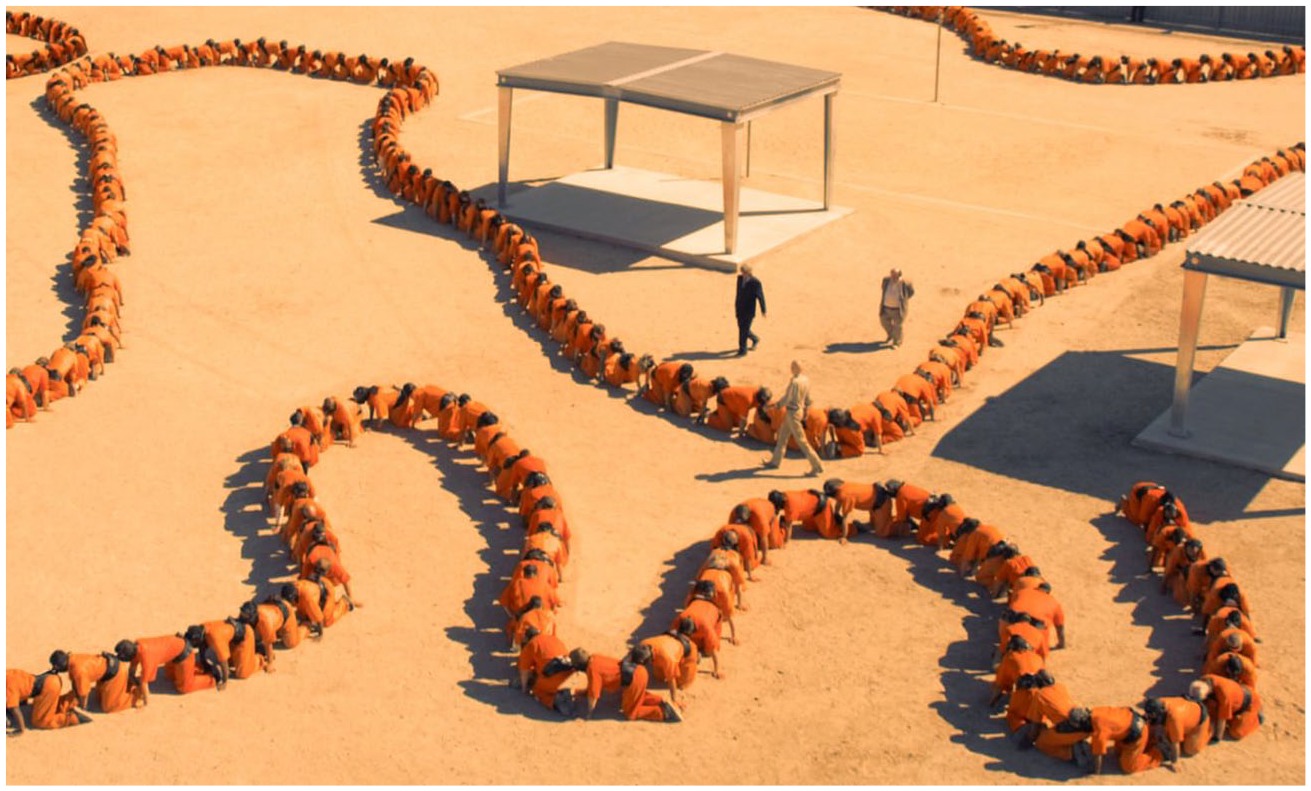
The human centipede is revealed for Governor Hughes—“on time and under budget.”
Whether or not we agree with Roger Ebert’s contention that Tom Six possesses the soul of a dark artist, the director is making deliberate gestures to compare American penal culture to the fascism of Nazi Germany. Final Sequence draws on iconic symbols of American greatness—a soaring bald eagle high above the prison, desert landscapes evocative of the Wild West, American flags, and the US national anthem. Horror films are often set in national contexts that provide cultural frames (Miyamoto, 2016). However, Six also invokes references to and imagery associated with Nazism and fascism. Six casts the same lead actor from First Sequence in the role of Warden Bill Boss. Given that he envisioned the three films as one larger conjoined text, viewers will inevitably draw an association between the evil Nazi doctor Joseph Heiter and the deranged prison warden Bill Boss. One way to read this is to consider historic events at the conclusion of World War Two. Hundreds of Nazi scientists and officials escaped justice by altering their identities and fleeing to North and South America. In some cases, this happened with the direct participation of governments eager to exploit their talents. The American space program was aided considerably by Nazi technology and scientists seized at the conclusion of the war (Jacobsen, 2014). Several South American governments employed the dark talents of former Nazis in their efforts to suppress political foes. Six draws a straight line from the horrors of Nazism to the American prison. Six’s film jars audiences who cannot escape questions about the excesses of American punishment in light of the ends to which it is taken in HC3.
Media violence and censorship
As the third segment in a cinematic trilogy, HC3 provided a vehicle for Tom Six to reflect on the cultural impact of his previous works, and to address criticism about the dangers of media violence. There are two key ways that the director engages in meta-commentary about his films and their possible social effects. First, Tom Six inserts himself in the narrative and appears at the behest of Dwight who is seeking to convince Bill Boss of the merits and feasibility of the human centipede. Six arrives at the prison with ballyhoo, Daisy and the prison Doctor, Jones, announce that they are huge fans, and Dwight gushes over the director’s tremendous cultural impact: Dwight: “First of all Mr. Six, I’d like to say congratulations on your movies. They’ve become a cultural meme. I mean, there is the “South Park” episode of the Human Cent-iPad. And then there’s the LA porn parody, and the cat toys.”
The scenes with Six allow the director to explain the origin of the concept—as a punishment for child molesters—as well as an opportunity to assert claims about the medical accuracy of the surgical procedure. According to dialogue in the film, Six consulted with a doctor who declared that the human centipede procedure was “100% medically accurate.” However, while insisting he was in support of implementing his ideas with real prisoners—“I love this idea”—Six demands reality rather than cinematic illusion: “Gentlemen, you may use my human centipede idea, but on one condition. I have witnessed all the fake latex stuff on my movie sets. Now I insist on attending one of your real mouth-to-anus operations.” The real human centipede being assembled becomes too much even for Tom Six. The putative pervert creator behind the human centipede concept recoils in horror at the conduct of the warden. Tom Six proclaims “oh man, this is so wrong” after the warden revels in pleasure while the mouths and asses of prisoners are sewn together and after the warden kills a prisoner who expressed a desire to be in the centipede as he had already grown accustomed to eating his own feces. Tom Six pukes when the warden shows him the human caterpillar for death row prisoners, which involves amputation of the prisoners’ limbs. This is the last time Six appears, which leads us to the conclusion that Six does not approve of Bill Boss’s application of his idea. Even the corrupt prison doctor, Jones, who dutifully follows the Warden’s orders, is reticent to take Boss’s ideas to their extreme ends. The idea of a human centipede is so ludicrous that it involves an element of schlock, although various references to the science of the centipede formation and the medical accuracy of the approach are made throughout the film, adding to the sense of verisimilitude (Duncan, 2018). In these scenes, Tom Six provides a meta-commentary on the censorship of his earlier films (Smith, 2015) and the absurdity that real institutional violence in the American prison goes unchecked.
Is Six suggesting that popular ideas about punishment may be taken too far when allowed to escape the bounds of the celluloid image? Is he sounding a warning about the excesses of punishment even after advocating the human centipede as a treatment for sex offenders? These are all possibilities, but given the fascist undertones woven throughout the film, one can connect these conceptual threads to reveal intersections between the Nazi project of genocide and contemporary Western carceral punishment. While prisoners and sex offenders make convenient scapegoats and lightning rods for cultural anxieties in late modernity, there are dangers in focusing our sublimated rage on captive populations who exist under the control of the state. The political and cultural imagineers of punishment who demand harsh and expressive sentences for offenders who only exist in the abstract might be horrified, as was Six, when confronted with the reality of those punishments in action. We read Six’s horror at watching his ideas taken to their grisly limit as a cautionary tale about the dangers of scapegoating The Other in a context of racism, inequality and total power, such as in the American penal industrial complex.
A second way that Six provides meta-commentary about mediated violence is through the voices of prisoners who react to a screening of the first two segments of the Human Centipede trilogy. Bill Boss screens the films in an effort to psychologically torture the prisoners before implementing his surgical program. At the end, prisoners stand up and shout at the screen: “Yo what the fuck is this?” “This trash occupies a world where the stars don’t shine.” A Muslim prisoner yells angrily in Arabic (no subtitles are provided). A Hasidic Jewish prisoner exclaims: “These films risk causing harm. They should be banned!” The scene draws humor through its inversion of our expectations. That hardened prisoners who are brutalized, violent and ready to enact “death rape” would be offended by the fantasy body horror of HCI and HCII is presented as irony in an effort to address the critics and censors who Six deems “unnecessary and misaligned with contemporary values” (Jones, 2013b: 9). The inversion of the typical prison movie appears in a third scene as well. Daisy is put in a coma in the medical ward after being beaten by a prisoner during a riot (triggered when Bill made the prisoners watch the first two HC films). Yet in HC3, the warden represents the zenith of evil, raping his former assistant when she is comatose in the prison hospital. Warden Boss shows no remorse when Daisy is then sewn into the centipede, adding a gendered and sexualized dimension to the violence and horror, and providing a commentary on disposable prison labour. It is not uncommon for prison movies to depict scenes of rape, with prisoners represented as violent (also see Eigenberg and Baro, 2003), yet in HC3 the warden commits the most repugnant forms of sexual violence.
Clearly, then, the violence of the prison is a much greater risk of “causing harm” than a fictional horror film. Tom Six uses the prisoners to articulate concerns voiced by media critics and others who view cinematic violence as harmful and requiring censorship. The violence is graphic compared to other television and movie representations of prisons (Weaver and Wilson, 2009). Six’s meta commentary on media violence and censorship is blatant given the focus in Final Sequence on the horrors of carceral punishment with all the attendant human rights abuses and, in the context of the War on Terror, torture and humiliation. For Six, the violence inherent in American society and in the prison is far worse than any fictional horror film gore, and in this sense even represents a subtle critique of torture porn itself. HC3 offers insight on the disingenuous nature of censorship in a society that condones mass suffering behind bars, institutional racism, and punishment of the body for millions.
Discussion
Human Centipede III: Final Sequence depicts many scenes of shocking body horror. Rather than drawing from a more furtive aesthetics (Holland, 2017), Tom Six takes the gruesome punishment of the human centipede and transposes it on the American prison. The transposition works because it fits with the idea of the penal industrial complex, adding to it an element of body horror. Images of conjoined prisoners in the film have cultural resonance in America because they echo contemporary and historical images of racialized prisoners forced into monstrous unity in penal chain gangs and in the bondage of slavery. Such images and the resonance of the centipede is not limited to America, as such scenes were common in other settler colonial countries like Australia (Figure 2). The visual spectacle of a huge human centipede, in orange prison uniform, snaking around the prison yard also foreshadowed shocking images of prisoners in Central America displayed in a raw exercise of penal power (Figure 3). In April 2020, photographs were released by authorities in El Salvador showing hundreds of incarcerated gang members, stripped to their shorts and apparently jammed together in a sort of monstrous formation designed to humiliate and intimate (Sheridan and Brigida, 2020). Recent revelations of immigrant women lined up for forced hysterectomies in Immigration and Customs Enforcement (ICE) detention centers (Bryant, 2020) are another example of the real body horror of American carceral spaces. The point could be extrapolated further to other carceral spaces and concentration camps, all of which from a critical theory perspective represent the dreadful pinnacles of modern rationality (Bauman, 1989). Racism and extermination become woven into sites like prisons, as these bureaucratic machines feature instrumental rationality, dehumanization, and moral bankruptcy as their cornerstones. While acts of ritual humiliation are not new to the justice system in Western nations as well as in the developing world, HC3 can be read as a parable about the dangers of largely invisible power operating in carceral institutions. The competing logics undergirding the penal system modeled in Final Sequence—a desire for absolute control and compliance of prisoners; an economic imperative to be cost efficient; and the need to align punishment with populist political ambitions—conspire to drive carceral punishment to dangerous ends that echo the abuses of the Holocaust. While it might seem difficult to imagine the conditions that could lead a modern Western nation like Germany to fashion a system designed to murder millions with industrial scale efficiency, we contend that parallel currents are put on display in HC3.
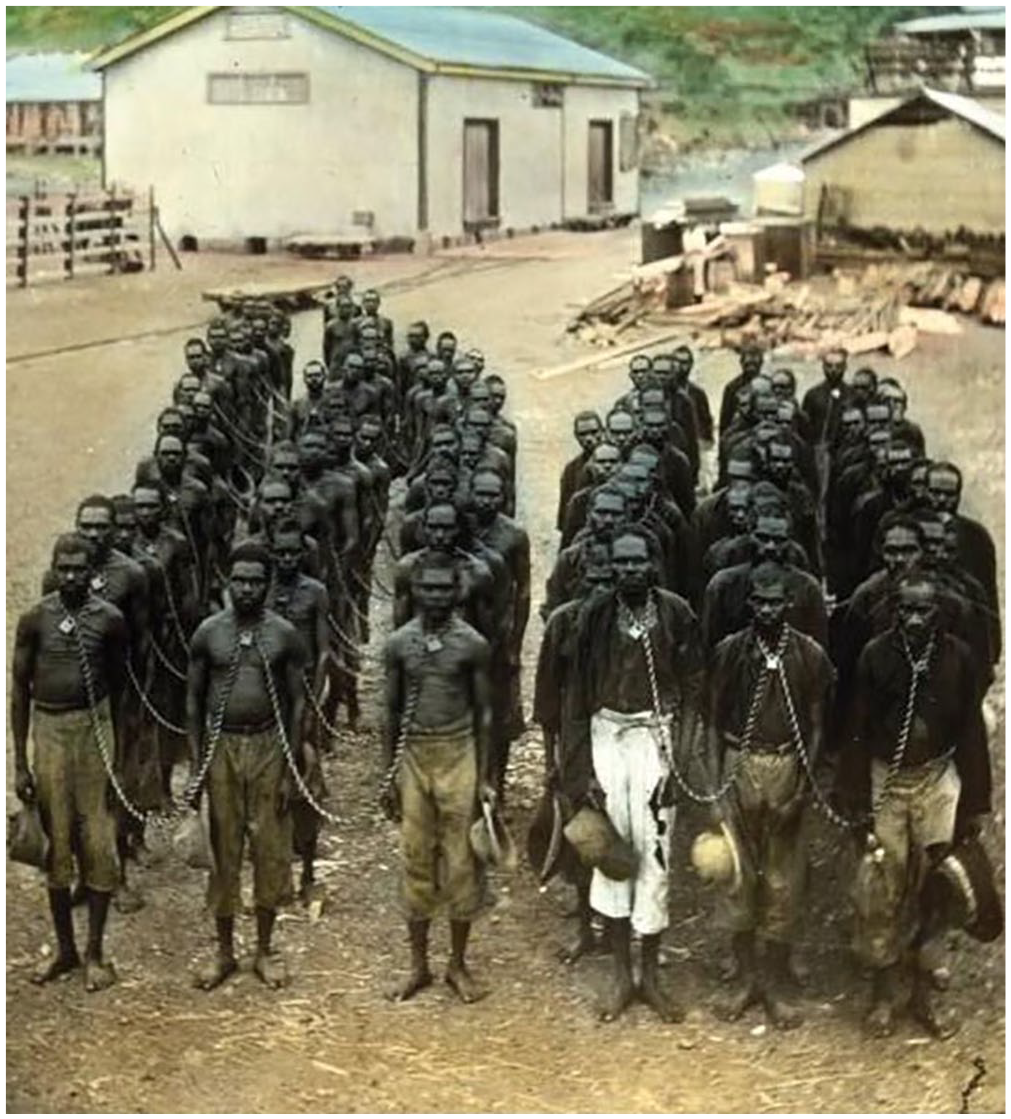
Historical images of racialized bodies in monstrous bondage echo the human centipede.
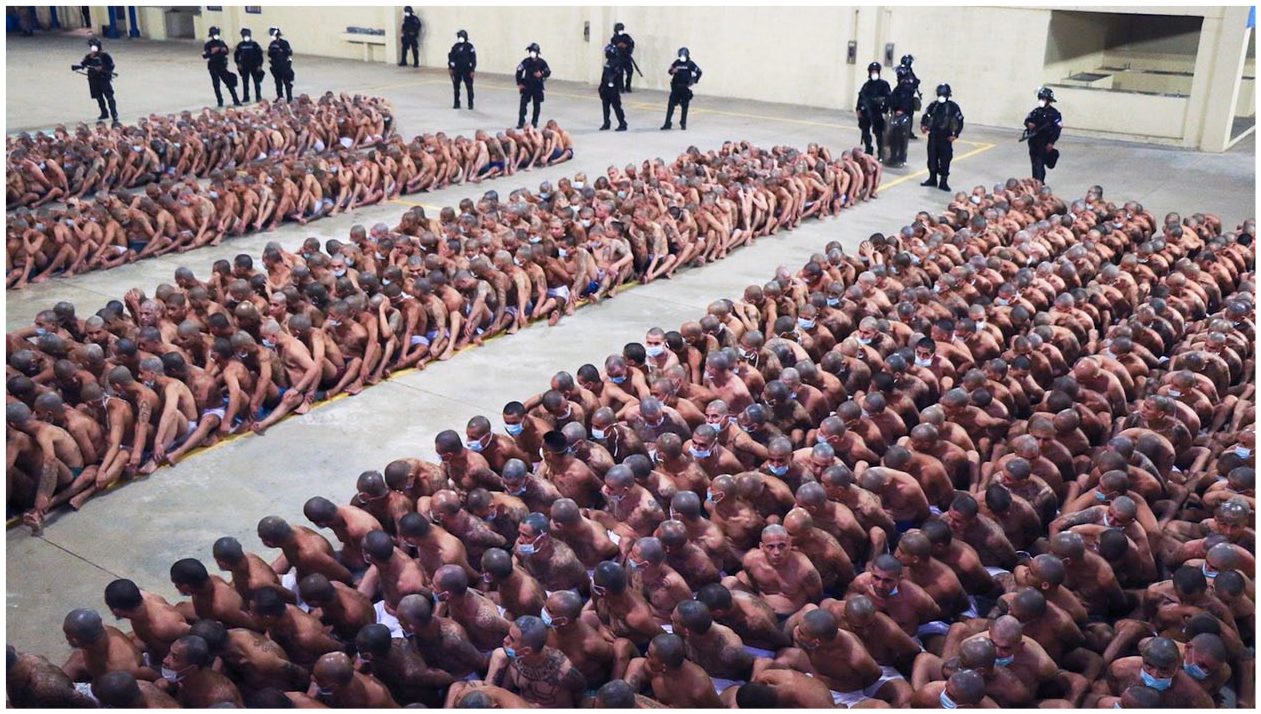
Photographs released by authorities in El Salvador showing hundreds of incarcerated gang members in monstrous human formation.
Mason (2006: 623) suggests that “the episteme of prison in cinema helps to bolster support for the prison industrial complex in countries such as Britain and the USA, where injustices, cruelty, inefficiency, and dysfunction remain endemic.” By operating in the realm of body horror, Tom Six evades this tendency to reproduce the legitimacy of the prison prevalent in other prison films, instead offering a critique of the violence of prison as an institution. We have argued that Tom Six eschews the dominant tropes of prison films (liberalism, reform, rehabilitation, and escape). The human centipede is a hopeless vision of modernity, one that blends punitive populism with instrumental rationality to exact the most grotesque punishment on prisoners. To look away from these scenes or censor these representations is to neglect the grotesque features of American culture and the carceral state. The racialized violence in HC3 may be shocking, however this violence is common in American criminal justice and in other colonial countries. The racial epithets are used in vulgar repetition, however in our reading this is political as it reveals the confluence of racial violence and body horror in the prison system. HC1 and HC2 were censored in formal (Smith, 2015) and in informal ways—for example, Ebert’s refusal to rate HC1 using his standard star metric. Moreover, we know many horror film fans who simply refuse on principle to watch any of the movies (Jones, 2013a). Looking away from HC3 ignores the racial violence and body horror endemic in the prison system, and discounts the way power organized in prisons overlaps with institutionalized brutalities of the past (Nazism) and the present (post September 11, 2001 War on Terror).
We read the work of Tom Six as an attempt to examine the very soul of modern carceral punishment. This film provides a scathing indictment of the American carceral complex by showing how otherwise competing penal logics combine to make new horrors possible. HC3 provides a sort of immanent critique of censorship, American culture, and the prison system. Compared to realism in the form of documentaries, the vulgarity evokes a visceral bodily response and memory of the horrorism that recounting facts and figures on incarceration in documentaries may not. While we do not believe any prison official is truly working to implement a surgically facilitated prison centipede, we see strong echoes of the idea in the recent images from El Salvador, as well as in both modern and historical images of prison chain gangs and medical experimentation in prisons (Hornblum, 1998). A popular criminological reading of Human Centipede III: Final Sequence provides opportunities to interrogate the cultural assumptions that make our current system of punishment possible, just as similar assumptions made Guantanamo Bay, Abu Ghraib, and Auschwitz not only viable, but visually arresting historical moments that live on in infamy and in popular culture.
Footnotes
Declaration of conflicting interests
The author(s) declared no potential conflicts of interest with respect to the research, authorship, and/or publication of this article.
Funding
The author(s) received no financial support for the research, authorship, and/or publication of this article.
Notes
Author biographies
 .
.