




Abstract
School discipline is a key part of school leaders’ roles, but scholarly knowledge on this important domain is limited and scattered. This study aimed to conduct a systematic review of the peer-reviewed empirical literature on school leaders and school discipline. Data sources were Scopus, Web of Science and Google Scholar. In total, 40 empirical studies were identified. Thematic analysis was used to reveal the scholarly knowledge and identify key research themes, and a sensemaking perspective assisted in interpreting the evidence. The review identified several themes related to school leaders’ sensemaking: how they interpret discipline problems, make disciplinary decisions and understand disciplinary actions and approaches; how competing meaning systems and organisational structures shape those interpretations; how racialised sensemaking produces inequities; and how technology increasingly mediates disciplinary judgment. Research on the relationship between school leaders and school discipline remains limited despite recent growth, and the field still lacks a recent integrative review that organises and synthesises the relevant literature. This review contributes to illuminating the state of knowledge on the connection between school leaders and school discipline. The work helps researchers by identifying key gaps and offering directions for further study, and helps leaders understand the consequences of their decisions and actions.
Introduction and research questions
School discipline is a basic aspect of school life, key to promoting a safe and productive learning environment. For school leaders, school discipline is an integral and significant part of their daily work. Turnbull et al. (2009) reported that 5% of principals’ workday is dedicated to directly addressing student discipline and an additional 10% to student supervision during breaks and in public areas.
School leaders have a major role in shaping the success or failure of educational policies (Gu et al., 2018). As key agents in the policy enactment process, they do not merely implement policies, but interpret and adapt them to fit their school environment and, at times, to advance their own goals (Gu et al., 2018). School leaders use cognitive sensemaking processes (see Weick, 1995) when coping with policy or situational ambiguity (Ganon-Shilon and Schechter, 2017). These interpretative processes can range from macro issues such as race (Evans, 2007) to micro issues such as problem solving in schools (Sleegers et al., 2009). Sensemaking can be personal or collective, but even when it is personal, it is a social process because it often involves collecting information from others and engaging in discussion (Coburn, 2005). According to the literature, cognitive frameworks help a person develop ‘a sense of what is going on’, and also ‘a sense of how to engage in the situation’ (Sleegers et al., 2009: 154). Thus, sensemaking involves both cognition and action (Ganon-Shilon and Schechter, 2017). Prior systematic reviews and meta-analyses in the field of school discipline focused on alternative disciplinary methods (Jean-Pierre and Parris, 2018), the outcomes of disciplinary measures (Gerlinger et al., 2021), teachers’ perceptions of students’ misbehaviour (Crawshaw, 2015) and other role holders (Cameron, 2006), but a recent synthesis focusing specifically on the intersection between school leadership and school discipline remains lacking.
Existing studies on school leaders and discipline are fragmented and vary in their focus, limiting our understanding of how leadership shapes school discipline. For example, scholars have explored the role of school leaders in implementing reforms (e.g. Trudel and Davies, 2024; Wiley et al., 2018), school leaders’ views and philosophies (e.g. Oplatka and Atias, 2007; Smith and Hains, 2012) and the effects of leaders’ views (e.g. Heilbrun et al., 2015; Skiba et al., 2014). Fewer studies addressed school leaders’ cognitive processes (Findlay, 2015; McLaughlin et al., 2025), and only one study used a sensemaking perspective (Golann and Jones, 2024). Recently, scholars have stressed the need for further research in this area (McLaughlin et al., 2025). This state of the literature reflects a blind spot in understanding how disciplinary policies are understood and implemented, due to limited attention to interpretive processes.
Despite a growing body of research on school discipline and educational leadership, the field needs to expand its understanding of how school leaders interpret and enact disciplinary practices at the cognitive and organisational levels. Existing studies remain fragmented across policy implementation, behavioural outcomes, and leadership practices, with limited integration of the interpretive processes that mediate between them. This review aims to address this gap in the literature by summarising the literature and interpreting it through a sensemaking lens. The current work is set to illuminate how leaders’ internal interpretations mediate formal disciplinary policy and actual administrative practice. This paper addresses two research questions:
How do school leaders make sense of discipline issues, and how does sensemaking inform their decisions and actions? In what ways does leaders’ sensemaking contribute to the disciplinary outcomes that unfold in their schools?
By applying a sensemaking lens, this review moves beyond descriptive aggregation of findings to theorise the interpretive mechanisms through which disciplinary practices are constructed. This shifts the focus from what leaders do to how and why disciplinary meanings are formed, contested and enacted, offering a conceptual contribution that repositions school discipline as an interpretive and socially constructed process.
Methodology
Identification of sources
The study followed the Preferred Reporting Items for Systematic Reviews and Meta-Analyses (PRISMA) updated standards (Page et al., 2021). Relevant research on the connections between school leaders and school discipline was found in publications that were indexed in two databases: Web of Science and Scopus. Manuscripts considered for the analysis met the following inclusion criteria: were published or provided online in educational peer-reviewed journals, were written in English, covered primary and secondary school settings only, were relevant to sensemaking, and included empirical findings on school leaders and school discipline as the primary focus. Early childhood settings were excluded because their underlying institutional and regulatory structures, and the conceptualisation of behavioural guidance, differ substantially from those in primary and secondary education. This leads early childhood settings to address discipline issues using developmental support approaches (e.g. timeout, praise, stars) (Saputri and Widyasari, 2022). These approaches greatly differ from formalised disciplinary frameworks in primary and secondary education. Conference papers and book chapters were excluded because, in general, the quality of the peer-review processes is less rigorous (e.g. student reviewers, lower rejection rates), and their methodology and findings are often reported with less detail due to stylistic expectations and tight space limits. As in prior works using the Web of Science Core Collection for in-depth reviewing of a topic that has not been previously reviewed in the scholarship, to ensure a comprehensive inclusion of the literature, we did not specify a start date (Roitenberg, 2025). The earliest relevant publication retrieved was from 1984; therefore, the search covered the period between 1984 and June 2025. Studies carried out in other educational settings were not included. To locate the articles, we used search queries based on the following search strings in the titles or abstracts of the documents: (principal* OR “school head*” OR “head teacher*” OR “school leader *” OR “school executive*” OR “school administrator*” OR “educational leader*”) AND (“school discipline”). Sensemaking was not used as a search term but was applied as an inclusion criterion at the full-text screening stage and as a theoretical lens during the deductive analysis. Search keyword selection was supported by existing literature reviews addressing school leaders (Lee et al., 2024) and school discipline (Welsh and Little, 2018). We used the Scopus database to start the search and found 99 articles. A search of the Web of Science yielded an additional 44 items. We conducted an additional search in Google Scholar (Haddaway et al., 2015), scanning the first five pages of the results (Foo et al., 2021), and identified 50 papers. We then screened titles and abstracts to narrow the corpus. Subsequently, full-text screening was conducted for the remaining articles. At the full-text screening stage, sensemaking relevance was applied as an additional inclusion criterion. Studies were considered relevant to sensemaking when they examined how school leaders interpret, frame or assign meaning to disciplinary situations, even if sensemaking was not explicitly named. Relevance was therefore assessed through a theoretically informed reading of study findings, guided by established dimensions of sensemaking (e.g. interpretation, cue extraction and meaning construction). We arrived at a final count of 40 sources (Figure 1).

PRISMA flow diagram of article selection.
Analysis
We used thematic analysis to identify recurring themes in the data. This process involved systematically grouping similar findings to draw meaningful insights. In the first stage, we conducted an inductive qualitative coding to identify findings in the selected articles addressing school leader perspectives, actions and contextual influences related to discipline. Codes were rooted in direct excerpts from the findings of the studies (e.g. leaders’ race and suspensions, zero-tolerance, etc.). Next, we grouped the codes into themes. In the initial phase of analysis, the literature was organised into four broad descriptive categories: (1) school leaders’ beliefs about discipline issues, (2) disciplinary decision-making and actions, (3) disciplinary approaches, and (4) the role of race and technology in discipline. These themes primarily captured what school leaders think and do. In the second stage, a deductive approach was applied, drawing on sensemaking theory to reorganise, refine and interpret the emergent themes. Thus, sensemaking theory guided the final categorisation and explanation of findings. In consultation with the literature on sensemaking, we relabelled the themes, redrew the theme boundaries and removed the less relevant reporting on findings to focus on a narrative that demonstrates how sensemaking plays a role in school leaders’ interpretation of discipline. As a result, adopting a sensemaking lens shifted the focus from descriptive categorisation to interpretive processes, leading to a more differentiated, analytically driven structure of eight themes. Rather than treating beliefs, decisions and actions as separate domains, the revised analysis reorganises them into interconnected dimensions of sensemaking, including how leaders interpret discipline problems, make decisions and assign meaning to disciplinary actions. This led to the development of eight final themes highlighting how interpretations are shaped by identity, institutional constraints and competing meaning systems.
Findings
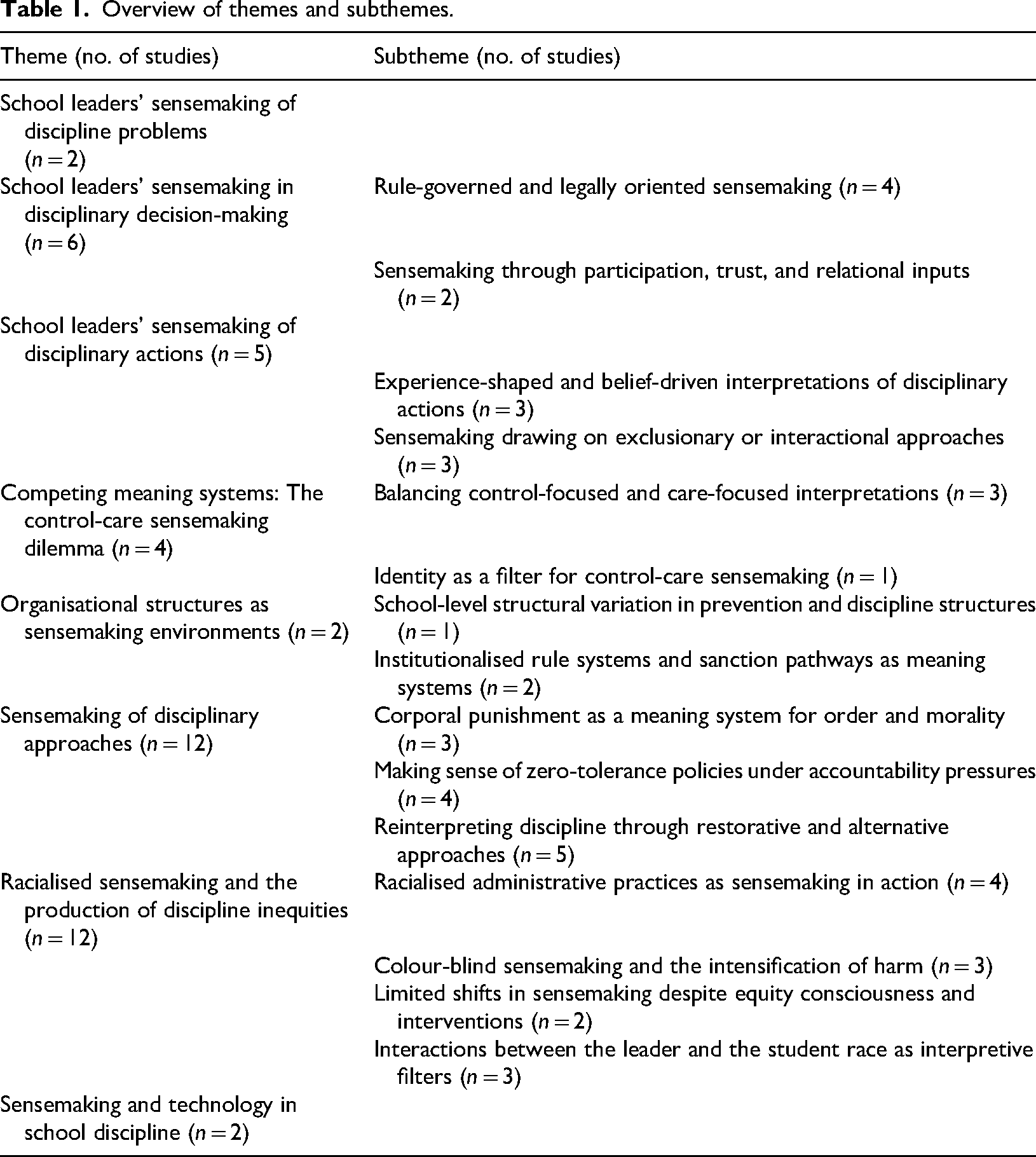
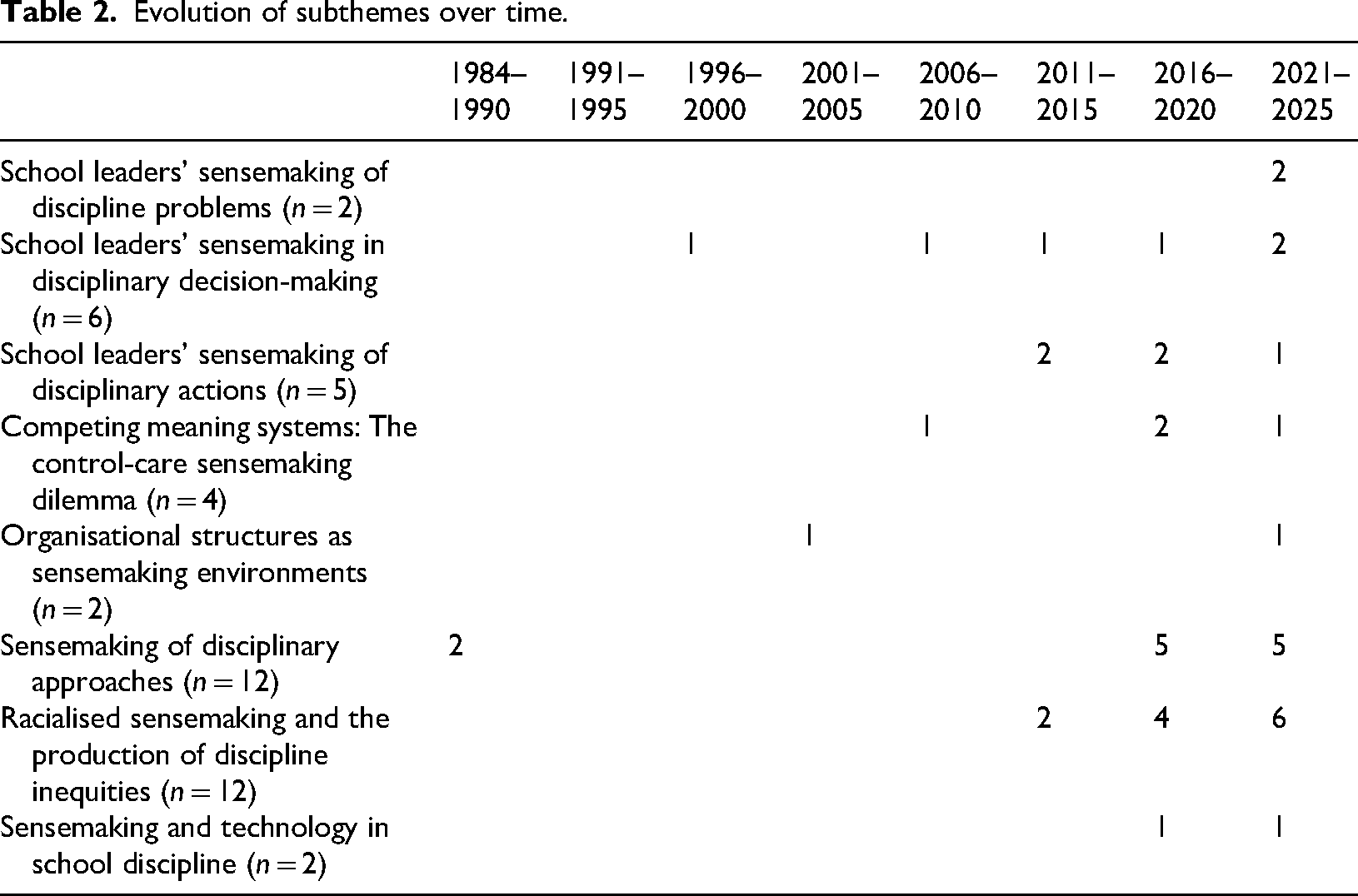
We identified eight key themes in the scholarship on school leaders and discipline. Table 1 lists the themes, subthemes and their frequencies. The studies reviewed explored various topics, some of which received more attention than others. Table 2 presents the evolution of subthemes over time. ‘Sensemaking about disciplinary approaches’ (n = 12) and ‘racialised sensemaking and the production of disciplinary inequities’ (n = 12) were the most frequently studied subthemes, gaining noticeable momentum in the past decade.
Overview of themes and subthemes.
Evolution of subthemes over time.
School leaders’ sensemaking of discipline problems
School leaders’ interpretations of discipline begin with the meanings they attach to student behaviour and to social, family or community conditions that are used as cues in the sensemaking of misbehaviour. In Turkish secondary schools, administrators consider discipline issues to be more prevalent in students with a background of low SES (poverty, lack of parental education), dysfunctional families and violence in the family (Ağin, 2021). Obadire and Sinthumule (2021) identified similar factors contributing to leaders’ views of disciplinary problems in South Africa. What is notable here is not simply that leaders draw on contextual cues, but that these cues are already socially loaded. Interpreting behaviour through SES or family background does not just explain discipline problems; it frames them in ways that can prefigure particular responses, narrowing what counts as a legitimate intervention.
School leaders’ sensemaking in disciplinary decision-making
Principals’ disciplinary decisions emerge from ongoing efforts to interpret rules, policy demands, staff expectations and the complexities of real-time behaviour; this sensemaking process underlies both legally mandated and participatory decision structures. These patterns reflect day-to-day interpretive decisions rather than the broader moral logic that guides leaders’ disciplinary worldviews.
Rule-governed and legally oriented sensemaking. When leaders try to make sense of disciplinary incidents based on formal rules, they tend to rely on punishments and teacher-centred interpretations of student behaviour. In the US, administrators’ disciplinary philosophies favoured upholding rules and supporting teachers, and described legal constraints as guiding their discipline decisions (Findlay, 2015; Kennedy et al., 2017; Welsh, 2023). Butera et al. (1998) further illustrate rule-governed sensemaking by addressing the issue of individualised education programs (IEPs) for special education students. To maintain the logic of equal discipline for all students, principals in their study framed IEPs as a bureaucratic burden that undermines disciplinary consistency, rather than as an educational tool. Hence, while some principals kept lists of students with IEPs for discipline decisions, they rarely consulted special educators about the appropriateness of the chosen disciplinary measures. The pattern described above shifts attention to a subtle but important formal mechanism. Formal rules do not merely constrain decision-making; they reorient attention towards procedural consistency at the expense of contextual responsiveness. The result is a form of sensemaking that appears neutral, yet systematically sidelines student-specific considerations.
Sensemaking by participation, trust and relational inputs. Another focus of sensemaking is relational, as principals interpret disciplinary issues based on their interactions with teachers, students and families, drawing on shared meanings. The study by Alani et al. (2010) of students in Nigeria found that student participation in maintaining school discipline enhanced principals’ effectiveness. Rodriguez and Welsh (2024) found that higher parental trust in principals was associated with a lower likelihood of suspension.
To sum up, the findings above suggest that disciplinary decision-making is less about choosing between rule-based and relational approaches. Disciplinary decision-making emerged as an ongoing negotiation between these contrasting approaches. The significance of the findings above is that variation in discipline outcomes may stem not from the absence of one logic, but from how and why leaders prioritise one logic in practice.
School leaders’ sensemaking about disciplinary actions
School leaders’ preferences for disciplinary actions reflect interpretive processes shaped by their personal and professional experiences, school context and interactions with staff and students.
Experience-shaped and belief-driven interpretations of disciplinary actions. In a study conducted in the US, administrators’ beliefs about disciplinary actions were found to be shaped by their upbringing, teaching and professional experiences (Kennedy et al., 2017). Similarly, Smith and Hains (2012) found that administrators’ philosophies regarding school discipline stem from their personal values and former experiences and affect their interpretations of the school rules. In a quantitative multilevel analysis, Skiba et al. (2014) found that principals’ views on discipline influenced their use of exclusionary practices. Hence, differences in schools’ disciplinary policies and actions can reflect interpretive variance among school leaders, stemming from their different backgrounds and professional experiences.
Sensemaking drawing on exclusionary or interactional approaches. Trudel and Davies (2024) found that school leaders in Canada supported the use of suspension in certain situations. The term ‘imminent safety risk’ is not clearly defined, but leaders noted the need for discretion when making suspension decisions. Schools with principals who supported exclusion had higher rates of out-of-school suspensions (the odds were 37.6% higher) and expulsions (the odds were 132% higher) (Skiba et al., 2014). Tookes et al. (2020) found that high-achieving secondary school principals tended to adopt an interactionalist disciplinary approach (educators and students shared control, limited students’ choices to what was allowed by rules, and worked together on behaviour issues). Low-achieving principals favoured an interventionist approach (high control for educators, who set clear rules and used rewards and penalties).
In this theme, we saw that rather than simply reflecting individual preferences, the noted differences indicate that disciplinary actions express deeper interpretive commitments. What appears as variation in practice is variation in how leaders construct the meaning of behaviour itself.
Competing meaning systems: The control-care sensemaking dilemma
The control-care tension operates at a deeper level than concrete decisions, shaping the fundamental meaning systems by which leaders interpret disciplinary incidents. As leaders interpret misbehaviour, they often toggle between competing logics, the need for control and the desire to offer care. This reflects a conflict over what school discipline is intended to accomplish.
Balancing control-focused and care-focused interpretations. Principals make sense of incidents by evaluating safety, order and compliance needs versus relational and developmental needs, which create dilemmas. The priorities often differ across school types and policy climates. Several studies described two opposing disciplinary approaches with different goals and practices among principals: a punitive approach and one based on building relationships and fostering positive behaviours (Golann and Jones, 2024; Kennedy et al., 2017). Golann and Jones (2024) described the first as the logic of control, which focused on ensuring students’ physical safety, aiming to minimise dangerous or disruptive events and ‘passive misbehaviour’. The second, the logic of care, was manifested in providing more holistic support and ensuring students’ emotional safety. Control logic manifested in rules about language, clothing and movements that were tightly enforced with a system of merits and demerits. Studies also reported care-focused interpretations in contrast to control-focused ones. Wiley et al. (2018) studied interviews and focus groups with 198 public school educators (39% of them school leaders) in the US and found that participants reported normative dimensions of discipline, with largely inclusive beliefs about discipline, stressing the importance of prevention, relationships and the ability to change and grow. In the US, research found that alternative schools’ approach to discipline focused on building student–teacher relationships (Golann and Jones, 2024).
Identity as a filter for control-care sensemaking. Sensemaking is also filtered through leaders’ identities, such as gender, shaping how they read student behaviour and choose between competing disciplinary responses. The literature suggests that the approaches may be gender related. Oplatka and Atias (2007) found that both genders prioritised consistent rules but differed in approaches to handling severe disciplinary issues. Male principals focused on creating a learning environment through hierarchy and sanctions, whereas female principals encouraged a positive school climate and social skill development.
The persistence of the tension in time, localities and settings suggests that control and care are not opposing options to be resolved, but coexisting logics that define possible action paths. The challenge, then, is not to determine which logic dominates, but to understand how leaders stabilise one logic over the other in the central meaning system in their work.
Organisational structures as sensemaking environments
Structures shape leaders’ interpretations independently of broader policy environments, which operate at a different level of the sensemaking system. Because sensemaking is situational, structures, such as school level, location and the density of rules, frame how administrators interpret behaviour and respond to it.
School-level structural variation in prevention and discipline structures. Leaders interpret prevention and disciplinary tools differently depending on their organisational setting, which influences what they see as workable or necessary. Gottfredson and Gottfredson (2001) found that principals in middle schools reported more prevention measures than high school principals, and principals in rural schools reported fewer than those in urban schools.
Institutionalised rule systems and sanction pathways as meaning systems. Formal rule systems provide leaders with ready-made interpretive scripts that guide responses to misbehaviour, especially for severe offences. McLaughlin et al. (2025) qualitative study with 50 US administrators reported that principals’ discipline decisions are constrained by safety protocols, managing students with disabilities, and prescriptive disciplinary matrices, leaving principals with what they viewed as little autonomy to use non-strict disciplinary measures. Gottfredson and Gottfredson (2001) also found that formal written rules on issues like arrival time, drugs and weapons were common at all school levels, with secondary schools focusing more on issues like class cutting and dress codes. In addition to usual responses to undesirable student conduct, secondary schools also used probation, police notification and after-school detention.
These findings complicate a purely top-down policy model of school discipline. Local structures do more than implement policies; they actively shape what leaders perceive as feasible or appropriate.
Sensemaking about disciplinary approaches
Leaders’ use of different disciplinary approaches reflects how they make sense of effectiveness, legitimacy, community expectations and moral obligations, and whether their method is punitive, exclusionary or restorative.
Corporal punishment as a meaning system for order and morality. In settings where corporal punishment is permitted, leaders frame it as an effective and institutionally legitimate response, although they must cope with emotional tension and ethical uncertainty. Rose's (1984) US study found that corporal punishment, mainly spanking with a paddle, was reported as being used to handle disciplinary issues by 74.1% of participants. It was widely viewed as effective and supportive of teacher morale. Rose (1989) conducted another study focused on special education students and found that corporal punishment was widely used with students labelled ‘mildly handicapped’, particularly those with behavioural disorders (reported by 69% of participants) and learning difficulties (46%). The administration of corporal punishment, typically spanking with a paddle (92%), was handled primarily by male principals (96%) and female principals (70%), and was often carried out in the headteacher's office (71%). The prevalence of the practice indicated that normative legitimacy principles were shaping how participants made sense of corporal punishment. Kennedy et al. (2017) investigated schools in the US that allow corporal punishment and found that administrators’ decisions involved emotional labour, contradictions and compromises. The research reported that principals tried to strike a balance in their decisions between preventing misbehaviour and promoting child growth. This evidence, obtained over three decades, shows shifts in principals’ sensemaking concerning corporal punishment.
Making sense of zero-tolerance policies under accountability pressures. Unlike organisational-level structures, state and district policies impose external interpretive constraints that leaders must make sense of and adapt to locally. Leaders reinterpret or resist zero-tolerance mandates based on their perceptions of effectiveness, community impact and the practical demands of policy implementation. Principals found zero-tolerance policies largely ineffective and sometimes counterproductive (Curran, 2016). Gahungu (2019) found that principals may downplay issues or avoid reporting incidents to maintain a positive school reputation, compromising the effectiveness of the policy. Gwathney (2025) reported that principals were reluctant to use zero-tolerance suspensions and that self-reflection and empathy helped avoid strict policies. Principals’ exclusionary practices were influenced by top-level discipline policies.
In addition, studies revealed leaders’ interpretations associated with policy-driven variation and contextual adaptation of zero-tolerance practices. Graham (2020) explored the consequences in Queensland, Australia, of revising education policy to grant principals greater authority to suspend students. After this change, suspension rates of students in Year 7 (12 to 13 years old) rose sharply. These increases reflect how reforms and students’ transfer to secondary school influenced school discipline decisions. The studies reviewed above suggest that zero-tolerance frameworks do not uniformly produce exclusion; rather, their impact depends on how leaders reinterpret them in response to local pressures.
Reinterpreting discipline using restorative and alternative approaches. When adopting restorative or innovative discipline, school leaders draw on sensemaking that emphasises relationships and collaboration. Hannigan and Hannigan (2019) found in California that participants in an alternative discipline workshop became more supportive of innovative discipline approaches. Similar effects of training based on restorative practices on changing principals’ support and use of these practices were reported by Watkins and Lowery (2023). Lustick et al. (2024) reported that US districts were adopting restorative justice practices, focusing on repairing harm by bringing victims and offenders together. Restorative justice was found to reduce suspensions and narrow racial discipline gaps. Restorative coordinators considered restorative justice to be a principal-led, voluntary practice, requiring collaboration by staff and involving the students and communities. Principals actively promoted and participated in restorative justice practices. In a case study of three schools in a Midwestern district, Shramko et al. (2024) showed how school leaders favoured whole-school restorative practices, tailoring them to local circumstances, managing the complexities of relational, restorative work.
Studies also revealed how leaders’ interpretations were linked to structural and community constraints imposed on alternative disciplinary policies. Implementation challenges included a lack of alignment at the district level and resistance from parents and the community (Hannigan and Hannigan, 2019). Trudel and Davies’ (2024) Canadian study of school leaders’ perspectives reported that although progressive discipline strategies were suggested as promising alternatives, leaders made sense of their effectiveness as largely depending on support from broader social systems outside the school.
Across the studies in this theme, effectiveness emerged not as an inherent property of a disciplinary policy but as an outcome of its interpretation and enactment. This helps explain why similar reforms yield different results, as the variability lies in the sensemaking processes that accompany them.
Racialised sensemaking and the production of discipline inequities
School leaders’ interpretations of behaviour are inflected by racial meanings, at times implicit, at others explicit, that shape disciplinary outcomes and reproduce disparities.
Racialised administrative practices as sensemaking in action. Principals’ interpretations of offences often vary by student race, contributing to systematically different disciplinary consequences. Gullo and Beachum (2020) analysed 3898 disciplinary incidents from Pennsylvania schools alongside administrators’ Implicit Association Test scores, and found that principals’ pro-White implicit bias predicts harsher consequences for students of colour in subjective discipline decisions. Welsh and Sobti's (2023) study reported that deficit thinking and internalised racism leading to racial disparities in discipline can be found among Black principals and assistant principals. Heilbrun et al. (2015) surveyed 306 public high school principals in Virginia and found that Black students were suspended at more than twice the rate of White students. Some administrators rely on racialised scripts when interpreting student behaviour, normalising criminalising responses for some groups and leniency for others. Wiley's (2021) US study found that school administrators played a key role in enforcing a racially biased disciplinary system, applying ‘criminal sequestering’ to Black students and ‘racial exemption’ to White students. This created a dual system with discriminatory outcomes.
Colour-blind sensemaking and the intensification of harm. A colour-blind interpretive stance, treating all behaviour as equivalent regardless of students’ backgrounds, can magnify racial inequities because leaders overlook structural and developmental differences. Shabazian's (2020) critical study showed how administrators in highly exclusionary US schools promoted fairness and efficiency in discipline without considering students’ backgrounds. Based on interviews with Black, Latina/o and White principals, DeMatthews et al. (2017) reported a similar ‘neutrality’ viewpoint that contributed to racial bias in discipline enforcement and punishment. These administrators believed in treating all students equally by applying uniform punishments, but failed to recognise that each student had unique needs, particularly low-income, racial minority youths facing external challenges. Some administrators blamed students and their families for school violence, echoing the cultural deficit model (Shabazian, 2020). This led to racial bias, disproportionately affecting low-SES racial minority students, and fostering a culture of criminalisation. Welsh et al. (2023) found that inclusive disciplinary schools in New York City with the lowest exclusionary practices were more likely to have Black or Latinx principals, as well as more experienced principals, vice principals and teachers, compared to non-inclusive disciplinary schools.
Limited shifts in sensemaking despite equity consciousness and interventions. Even when administrators receive equity data, shifts in underlying interpretive frames remain modest, limiting their influence on racial discipline gaps. Williams et al. (2023) found that assistant principals recognised race as a factor in discipline disparities, but perspectives on its consequences varied. In a double-blind randomised controlled trial, sending monthly equity reports highlighting the extent of racial discipline disproportionality directly to school administrators increased report viewing compared to schools that sent general discipline reports (McIntosh et al., 2020). Despite this increase, however, the reports did not lead to meaningful changes in disciplinary equity or school improvement goals, making the intervention ineffective.
Interactions between the leader and the student race as interpretive filters. Leaders’ interpretations are shaped partly by their own racial identities, which intersect with school students’ backgrounds to influence referrals, suspensions and offence-specific outcomes. Welsh (2024) found that the frequency of disciplinary actions was similar in schools with Black and White principals, but racial disparities were slightly higher under White principals, especially in elementary and high schools. Black principals imposed slightly fewer referrals and suspensions for subjective offences. Suspension rates varied by offence type, leadership race and school level. In middle schools, students were more likely to receive out-of-school suspensions from Black principals, but racial gaps disappeared for non-subjective offences. In elementary schools, Black students were less likely to receive out-of-school suspensions under Black principals. Kinsler's (2011) study found that race had little effect on how principals disciplined students once a referral was made, showing fairness within schools. Black students, however, were still referred more often, suggesting that racial bias may influence referrals rather than punishments. In a mostly Black sample of principals, Gwathney (2025) found that participants preferred individualised approaches over zero-tolerance policies, viewing the latter as harsh and ineffective. They pointed out racial disparities in suspensions, with racially conscious approaches associated with improved outcomes, particularly for Black male students.
Taken together, these studies indicate that racial disparities are not simply outcomes of direct, biased decisions but are embedded within the interpretive frameworks that guide those decisions. In this sense, inequity is reproduced through the meanings that make certain actions seem reasonable, necessary or fair.
Sensemaking and technology in school discipline
Technological tools such as CCTV have become part of leaders’ sensemaking systems, offering new ways to obtain cues and interpret incidents. Perry-Hazan and Birnhack's (2018) Israeli study found that school CCTV was used by school leaders for disciplinary evidence gathering, real-time monitoring and building trust by avoiding unnecessary access to footage. Cho et al. (2021) reported that school leaders used data from behavioural management applications to tighten classroom management and plan student interventions, and to examine equity patterns in student discipline. Thus, digital technology and data have helped leaders make sense of school discipline. Both studies show that the use of similar technological tools can yield different outcomes for school discipline, reflecting different sensemaking processes among school leaders regarding these tools. For example, similar behavioural management applications were used either for classroom behaviour management or to examine schoolwide patterns and address biases, and CCTV had different educational meanings depending on its use. This underscores that technology does not standardise disciplinary practice as might be assumed. Instead, it becomes another site of interpretation, where the same tool can either reinforce surveillance-oriented logics or support reflective, equity-oriented practices.
Findings overview
Across the eight themes, a unifying pattern emerges: school discipline is shaped less by the formal properties of policies than by the interpretive frameworks through which leaders understand them. Whether in relation to race, organisational constraints or disciplinary approaches, leaders’ sensemaking processes act as the central mechanism linking structural conditions to observable disciplinary outcomes. This highlights the need to conceptualise school discipline as an interpretive system rather than a purely procedural one.
Discussion
This review synthesised evidence on how school leaders interpret and respond to disciplinary issues, using sensemaking theory as the guiding analytical frame. Sensemaking offers a unique lens because school discipline frequently involves ambiguity, conflicting norms and competing expectations. Leaders are therefore required to interpret policy and behaviour, not simply implement them. Across the reviewed studies, leaders’ decisions consistently reflected the core dimensions of sensemaking: noticing cues, framing incidents, negotiating meanings with staff and enacting interpretations in policy and practice. The review suggests that disciplinary systems are not neutral mechanisms but socially constructed, value-laden processes, and embedded in broader power relations. More broadly, a sensemaking perspective helps surface the cognitive and social assumptions at play by showing how disciplinary systems are reproduced, negotiated or resisted in practice by school leaders.
The systematic review found 40 articles that studied school leaders and discipline. This is a surprisingly small number considering the vast scope of the subject, the central role school leaders play in disciplinary processes, and the key part that discipline plays in school leaders’ daily work. Only a few studies were published in education administration journals, which may indicate that the role school leaders play in school discipline is usually studied as part of the research about school discipline and not about school leaders’ work. Nevertheless, the review found that interest in the subject has been on the rise since 2018, which may result in more studies in the coming years.
Analysis of the sample helped identify gaps that future research can address. Given that alternative approaches to school discipline are gaining increasing attention (Welsh and Little, 2018), further research is needed on the role of school leaders in these contexts. For example, future studies may focus on the role of principals in creating an authoritative school climate, and further study is needed on the role of school leaders in implementing a restorative approach. The sensemaking perspective demonstrates how leaders interpret emerging practices based on prior experience, cultural norms and interactions with staff. Thus, applying this lens can clarify how school leaders understand, translate and enact alternative disciplinary models. Several of the reviewed studies discussed the challenges and opportunities related to the school leaders’ relationship and cooperation with the school staff (e.g. Kennedy et al., 2017; Tookes et al., 2020; Welsh, 2023). Therefore, it may be useful to focus future research on these aspects, seeking to describe the mutual effects between these relationships on the enactment of changes in the school disciplinary policy. Sensemaking also draws attention to how staff interactions create shared (or contested) interpretations of misbehaviour, suggesting that relational dynamics are not merely contextual factors but mechanisms by which disciplinary policy becomes meaningful and actionable.
Although the study of the problems and challenges in the field of school discipline is important, scholars may wish to focus on ‘success stories’ in this field, for example, by studying schools that successfully adopted an alternative disciplinary approach, reduced the use of exclusionary practices, or closed the race gap. These cases offer opportunities to examine how leaders construct and stabilise new meaning systems around discipline, an aspect of sensemaking that remains underexplored.
Last, almost two-thirds of the studies were conducted in the US. The dominance of US-based studies limits understanding of how cultural, systemic and policy differences shape school leaders’ disciplinary beliefs and practices in other countries. For example, although it is not unusual for the US to be overrepresented in school leadership research, this disproportion may lead to overrepresentation of zero-tolerance discipline policies in the literature on school leaders and discipline. According to critical scholars, the prominence of zero-tolerance discipline in the US reflects broader neoliberal orientations toward control, accountability and risk management (Sellers and Arrigo, 2018). This policy environment has been linked to what is commonly termed the school-to-prison pipeline, in which the use of increasingly punitive and exclusionary disciplinary measures involves criminalising minor behavioural issues and contributes to students’ dropout and a heightened likelihood of contact with the criminal justice system (Wald and Losen, 2003). From a sensemaking perspective, the school-to-prison pipeline can be understood as an institutionalised outcome of dominant interpretive frames. The findings of this review suggest that such frames are not merely imposed by policy but are actively interpreted and reproduced by school leaders, shaping disciplinary practices in ways that may sustain systemic inequities.
Limitations
The study has four main limitations. First, the evaluation did not include book chapters and conference proceedings. Second, only English-language publications were included in the search. Third, the scope of this review was restricted to examining empirical studies on the connection between school leaders and school discipline in primary and secondary schools. Future research can address each of these issues and expand the scope of scholarly knowledge. Fourth, the dominance of US-based studies in the corpus is linked to the dominance of accountability and zero-tolerance policy frameworks in the literature, which express specific institutional and ideological assumptions, and to questions about the generalisability of the knowledge base. A more global exploration of interpretive frames is needed.
Conclusion
This review adopts a sensemaking perspective as its primary analytical lens, as it is particularly well suited to capturing the interpretive processes through which school leaders understand and enact disciplinary practices. By emphasising how leaders construct meaning under conditions of ambiguity, this approach offers an important account of the cognitive and social mechanisms that mediate between policy and practice (Sandberg and Tsoukas, 2015; Weick, 1995). At the same time, it is vital to recognise that sensemaking is not the only framework suitable for explaining these dynamics. Other closely related approaches, such as street-level bureaucracy (SLB), can provide complementary insights by highlighting how discretion, structural elements and resources shape the adaptation and transformation of policy in practice (Gassner and Gofen, 2018; Lipsky, 2010). While SLB is especially useful for explaining processes of policy enactment and change, the present review demonstrates the added value of a sensemaking perspective in revealing the interpretive foundations of these processes. Future research could build on this contribution by integrating both perspectives to better account for the interplay between meaning-making and discretionary action in shaping disciplinary outcomes.
Footnotes

Funding
This research was supported by The Open University of Israel's Research Fund.
Declaration of conflicting interests
The authors declared no potential conflicts of interest with respect to the research, authorship, and/or publication of this article.