



Abstract
Some schools are able to generate sustained, widespread leadership practices. This paper adds to the corpus that explains how collective leadership has been developed in a distinctive set of schools, drawing on the Researching the Arts in Primary Schools (RAPS) project. Eight conditions appeared consistently across schools where leadership was distributed and dense: mutual trust across hierarchical levels, freely circulating expertise, endemic agency, desired rather than mandated collaboration, enabling structures, shared conviction about purpose, universal continuous learning and visible celebration of contribution. These conditions function as an ecology in which each reinforces the others. The paper identifies the processes through which these conditions are produced and sustained: conversations that traverse normal hierarchical boundaries, strong symbolic messaging, consistent organisational narrative, collaborative working, whole-school occasions that build collective identity, shared sensemaking and external validation of the school's arts identity. The paper advances a school-as-design framework and shows the points of connection and difference with the extant leadership literatures.
Keywords
A Year 5 student explains: ‘We have control because it's our meeting. It's our art’. The arts lead at another school describes her approach to colleagues: ‘I share everything – planning, resources, progression frameworks. The point is building everyone's capacity’. A headteacher reflects on the school she joined five years earlier: ‘When you start that wave off, you need a certain amount of numbers to believe in what you're doing. Now it just happens’.
These three voices are from the Researching the Arts in Primary Schools (RAPS) project (Thomson et al., 2025). They show a level of ownership that extends beyond formal leadership roles, was distributed across formal positions and was dense across the whole community. However, observing these leadership practices does not explain how they came to exist, why they held together, nor what enabled a student to exercise genuine curatorial authority while an arts lead shaped curriculum and a headteacher maintained strategic direction. This paper addresses that explanatory gap.
The paper proceeds in an unconventional sequence. Rather than reviewing existing frameworks before turning to data, it begins with the ecology tradition in educational leadership research, develops the school-as-design framework that situates our results, and presents conditions and processes. It then connects the analysis with relevant extant leadership literatures. This sequence reflects the inductive research logics.
Schools as living systems: ecological approaches in educational leadership research
Ecological and living-systems thinking has influenced much educational leadership research. One of the most pervasive accounts of educational ecology is Bronfenbrenner's (Bronfenbrenner, 1979, 1989) ecological systems theory, which conceptualised child development nested within imbricated systems whose interactions shaped outcomes at every level. School improvement research draws on this perspective, often implicitly, to argue that change cannot be understood without attending to the multiple systems within which it is embedded. No classroom intervention is independent of its institutional, district, or policy context; leadership thus involves navigating system-level interdependencies and flows (e.g., Ainscow, 2015; Hargreaves and Goodson, 2006).
Complexity theory and living-systems thinking suggests that schools are self-organising systems whose behaviour is emergent, non-linear and context-dependent, not mechanistic systems amenable to linear implementation. Change cannot be mandated; it must be grown. Leaders in complex ecological systems do not control outcomes; they cultivate conditions (Morrison, 2012). Researchers informed by this approach attend to capacity-building (e.g., Davis and Sumara, 2014), and move from examining individual leadership towards system-wide learning (Ho et al., 2025; Kershner and McQuillan, 2016).
Professional learning communities research (Liou and Daly, 2018; Stoll and Fink, 2003) positions the school as a learning ecology. Schools that sustain improvement have shared norms of inquiry, collective responsibility for student learning, and knowledge circulating through professional networks and school culture (Hallinger and Heck, 2010; Lee and Louis, 2019). Hargreaves and Fullan (2012) suggest that professional capital grows and circulates via just such a sustainable organisational ecology; individual educators’ expertise is embedded in collaborative relationships, and trust and shared norms ensures that knowledge/practice is mobilised collectively.
These literatures lead to three propositions. First, schools are better understood as living systems than as machines: adaptive, self-organising, capable of generating novel responses to challenges not anticipated in any plan. Second, collective generative capacity resides not in individuals or structural arrangements alone but in the quality of relationships, norms, and practices across the whole organisation. Third, formal leadership in such systems is less about directing action than about cultivating conditions in which collective capacities, including among children, can emerge and be sustained.
Our paper begins from these propositions.
School-as-design: an emerging approach to educational organisations
Thomson and Blackmore (2006) developed a school-as-design concept to explain how schools and their leadership might be transformed. They argued that schools are not invented from scratch but continuously remade through the combination and recombination of familiar elements: curriculum time, staffing, physical space, partnership arrangements and assessment practices. Three redesign principles underpin the framework: design almost always works with available designs rather than inventing ex nihilo; designing is ongoing work performed through meaning-making and adjustment; and in redesign, available designs are both reproduced and transformed. Blackmore et al. (2011) extended the notion of school-as-design in research on learning environments, applying it to how schools use space, time and relationships as designable rather than fixed features of organisational life.
We applied this framework at scale to arts-rich primary schools, describing six categories of designed organisational practice (Thomson and Hall, 2026): spatial (use of architectural space and community as pedagogical resources); temporal (time allocated for reflection, planning and dialogue); cultural (symbolic work, identity, recognition of expertise); structural (arrangements from loose coupling to multilayered structures including network participation); communication (knowledge production and dissemination) and social, where leadership as collective endeavour features. These interconnected aspects of everyday organisational life together describe how arts-rich schools are works-in-progress, continuously remade through the interrelated actions of everyone within them. This paper takes a different, complementary approach to explaining school-as-design.
School-as-design holds that sustaining arts-richness is inseparable from organisational capacity-building. However, it does not explain how the capacity for continuous collective redesign is generated and maintained and why some schools keep collectively redesigning. The eight generative conditions proposed here move into that space; they are the mechanism that makes continuous collective redesign possible across organisational practices. The analysis in this paper advances school-as-design from an analytical lens to an explanation of how collective redesign capacity is generated and sustained. The three redesign principles (Thomson and Blackmore, 2006) are explained at the mechanism level: schools engage in continuous creative redesign as a collective activity because the ecology of conditions and particular processes make it possible.
Creativity/arts researchers (e.g. Hall and Thomson, 2017; Harris and de Bruin, 2018) hold a school/system to be an interconnected ecology where each element enables and reinforces the others to generate creative/aesthetic capacities that no single element could. The generative conditions we identify here are mutually reinforcing and produce emergent collective capacity/ies. The term ecology suggests that removal of any condition weakens others; cultivate one and it opens conditions for others to develop.
The RAPS project
Our interest in arts education is research-based. Neither of us works primarily as an arts educator, and our orientation towards organisation and leadership is less common in arts education research, which more often focuses on pedagogy, outcomes and policy advocacy. The RAPS project extended our research in arts-richness from secondary schools (Thomson and Hall, 2023) to primaries, focusing in part on organisational questions: how schools build and sustain arts-rich provision in a policy landscape consistently hostile to arts subjects since the introduction of the revised national curriculum in 2010 (Ramiah, 2025). Extended research in schools working well in a domain under policy pressure generates appreciation as well as analysis; we have managed potential bias through rigorous cross-case analysis, comparator data and through returning case-study accounts to participating schools for validation and challenge.
Research design
RAPS (2021–2024) addressed four questions: What is an arts-rich primary school? What do arts-rich schools offer children? What are the benefits? How do schools sustain this offer? We did not aim to describe the general decline in arts education, but rather wanted to understand what arts-richness looks like when it flourishes, studying schools we could learn from rather than schools representing the norm.
Stage one: identifying and surveying arts-rich schools
The research was purposive (Campbell et al., 2022). We generated a list of 168 arts-rich schools by asking key arts informants for recommendations (Berg, 2014). After screening websites for evidence of sustained arts provision, we invited all 168 to complete an online survey. Seventy-six schools responded, providing baseline data on: arts curriculum provision across different art forms; specialist facilities and staffing; partnerships with arts organisations; extra-curricular arts activities; and school demographics and contexts. Survey data were analysed using descriptive statistics to identify patterns across the cohort. All 76 schools agreed to participate in subsequent research stages.
Stage two: intensive case studies
We selected 40 schools for intensive case-study. Selection ensured geographic diversity across urban, suburban and rural schools in different English regions; varied demographic profiles included different levels of deprivation, ethnic diversity and school size. We also sought variation in approaches to arts provision, including specialist versus generalist models and different partnership configurations.
COVID-19 profoundly affected the fieldwork. Pandemic restrictions forced us to compress visits to two or three days without the planned systematic classroom observation. In each school we conducted semi-structured interviews with headteachers, arts leads, classroom teachers and governors, and ran focus groups with children from Years 4 to 6 and with those involved in arts leadership. We photographically surveyed facilities, collected documentation including curriculum plans, policies and websites, and developed detailed case descriptions. All interviews were transcribed and analysed thematically through constant comparative analysis.
Stage three: focused analysis and comparison
We selected 22 schools from the 40 for intensive study, excluding those with highly unusual characteristics: a very recent headteacher change, an unusually arts-rich location or an arts specialism that had effectively lapsed. These would have made the analysis less useful to policymakers and practitioners alike (Slee, 2011). We focused on schools that others could realistically learn from including small village schools, urban schools with high levels of poverty and schools serving global majority communities. Unable to recruit comparator schools for intensive study due to the pandemic, we used the Education Endowment Foundation's (EEF) school families database. For each RAPS school, we selected the two schools immediately adjacent in their EEF family performance ranking, providing 44 comparator schools and enabling comparison using publicly available test results, inspection ratings and performance measures.
During Stage Three visits we interviewed headteachers, all arts leads, surveyed all Year 5 children, and surveyed generalist classroom teachers about confidence, professional development and collaboration with specialists.
Data analysis
The final dataset comprised surveys from 76 schools; interviews with 854 children and 150 adults across 40 schools; classroom teacher surveys (n = 151); Year 5 child surveys (n = 1017); documentation and photographs from 40 schools; and comparative performance data from 66 schools. Analysis proceeded through multiple lenses: individual school cases, cross-case thematic analysis, positional analysis comparing what different role-holders said about the same phenomena, and focused examinations of specific topics including leadership. Research team members analysed transcripts, developing themes via inductive analysis (Braun and Clarke, 2021). The research was approved by the Ethics Committee, School of Education, University of Nottingham. Participants are identified by school pseudonym or role rather than name.
Design boundaries
This design had a sample size unusual for qualitative research on schools, multi-stage progressive focusing, multiple perspectives including children and mixed-methods triangulation. However, this was purposive sampling of flourishing arts-rich schools, not representative sampling of all primary schools. COVID prevented classroom observations, limiting us to reported rather than observed practice. Failure to recruit comparator schools for intensive study limited our understanding of what organisationally distinguishes arts-rich schools from others. Our results describe arts-rich schools and identify conditions within them rather than proving that arts-richness causes any particular outcomes.
Arts-richness: what it means
The term arts-rich was coined by Catterall (Catterall, 2009, 2012; Catterall et al., 2012), whose longitudinal research found that sustained in-depth arts involvement was associated with better outcomes for young people from low socioeconomic backgrounds. The RAPS research shows what arts-richness means in English state primary schools.
Stage One and Two RAPS research showed that the core of arts-richness is subject teaching (Thomson et al., 2025): art and music taught to all children every week, every year. Arts-rich schools also offer diverse expressive arts subjects, drama, creative writing, dance and design and technology, creating what one school called ‘a palette of creative opportunities’. The expressive arts are not occasional treats; they are entitlements, woven into the curriculum as carefully as mathematics or literacy.
Arts-richness demands specialist expertise. Every RAPS school employed specialist arts teachers who design curricula, support generalist teachers, manage cultural partnerships and lead ongoing development of the school's provision. Critically, arts-richness does not come at the expense of other learning. Stage Three data showed that most RAPS schools perform as well as or better than comparable schools on standardised assessments and inspections. As the head of one high-performing school put it, their ‘excellent results in core subjects are not despite, but because of, our arts-rich approach’. This result challenges the view that time spent on the arts is detrimental to core academic learning.
All stages of the research showed that arts-richness is key to school identity and culture. These schools display student artwork prominently, hold regular performances and exhibitions, and reference the arts explicitly in their vision statements. One school's published curriculum intent reads: ‘A passion for the arts lies at the heart of all we do. Children have rich opportunities to participate in art, drama, music and dance in our school, taught by a specialist team of educators’. Arts-rich schools maintain sustained partnerships with artists and cultural organisations: strategic relationships developed over years, not transactional visiting workshops. As one head said: ‘Arts education is crucial for providing children, especially those from disadvantaged backgrounds, with cultural capital and opportunities they might not otherwise have’.
Distribution and density in RAPS schools
Leadership distribution was clearly visible across all 40 RAPS schools (Stage Two). Headteachers appointed arts leads and delegated curriculum coordination; subject specialists held responsibility for progression planning and resource development; teaching and learning responsibility holders managed specific domains; governors exercised oversight and strategic governance. These distributed functions meant that people understood their responsibilities, coordination happened efficiently, and expertise was appropriately deployed.
Leadership density was equally visible. Children proposed and organised exhibitions, judged competitions, advised on provision and taught skills to peers. Classroom teachers experimented with cross-curricular integration and identified new partnerships. Arts specialists developed relationships beyond their formal remit. Governors brokered community connections. Initiatives emerged throughout these school communities from people who saw possibilities and acted on them. Observing that both distribution and density exist does not explain how they work together. Three concrete examples show what we needed to explain.
At one RAPS school, the headteacher appointed an arts lead who held clear responsibility for arts curriculum, yet initiatives emerged continuously from classroom teachers, children and governors that the arts lead had not anticipated or commissioned. We wanted to understand how the coordinating role enables rather than constrains teacher and student initiatives, and how emergent innovations align with the coordinated curriculum rather than fragment it.
A second school had clearly distributed roles: music specialist, art specialist, drama specialist, each responsible for their domain. Children regularly proposed cross-arts projects requiring coordination across these domains. How did student initiatives coordinate with specialist responsibilities without either dominating or being subsumed? We wanted to understand the coordination enabling both distribution and density to function together.
A third school shows another puzzle. Five years before our visits, the headteacher had distributed arts leadership structurally: coordinator appointed, time allocated and roles defined. Teachers fulfilled minimal requirements. Few initiatives emerged. Distribution existed structurally but did not function dynamically. Three years later the same school demonstrated vibrant density: widespread initiative, creative experiments and adaptive innovations. The structure had not changed substantially. Something else must have changed to enable both distribution and density. The eight generative conditions arising from our analysis address that question.
The eight generative conditions
Inductive cross-case analysis across the 40 schools identified eight conditions consistently present in the RAPS schools. These are conditions in a specific sense: not inputs producing specified outputs, but states of being/becoming that make certain kinds of collective action possible, including forms of action that no structure anticipated or role defined.
Mutual trust across hierarchical levels
Trust operated in multiple directions simultaneously, not downward from leaders to trusted subordinates but across levels at the same time (c.f. Day, 2009). Headteachers trusted arts specialists with genuine curriculum autonomy. Arts lead trusted classroom teachers to adapt resources to their contexts. Teachers trusted children's creative judgment. Children trusted adults to take their contributions seriously.
This differs from the trust supporting effective delegation, where a leader trusts a subordinate to execute a defined task well. Mutual trust holds across levels simultaneously and changes what people can do. The arts lead: ‘I share everything – planning, resources, progression frameworks. The point is building everyone's capacity, not protecting my territory’. Their headteacher: ‘I trust my arts lead completely. But it goes further – I trust the teachers to make it their own, and I trust the children to know when something is working’.
Trust did not remove accountability. Headteachers held people accountable for outcomes while trusting them with methods. And trust also made productive disagreement possible. At one school, teachers raised concerns openly when an arts lead proposed significant curriculum changes, but trust meant disagreement did not threaten the relationship. Staff negotiated a solution incorporating multiple perspectives. Schools with lower trust typically avoid such conversations; disagreement is experienced as conflict rather than as useful friction (Zembylas, 2017; Datnow, 2000).
Expertise circulates freely
In conventional hierarchies, expertise concentrates in specialist roles or at senior levels. The RAPS schools had expertise moving in multiple directions (c.f. Wilburn, 2019). Arts specialists shared knowledge proactively with generalist teachers. Generalists shared what they had learned from working with specialists. Children who developed particular skills taught those skills to peers and younger students. External artists brought knowledge that became part of the school's collective capacity.
Children who had served as guides at a Turner Prize exhibition brought what they had learned back to school: ‘It's about understanding what the artist was trying to do, not just what it looks like’. At one school the arts lead described a deliberate approach: ‘I share everything. The point is building everyone's capacity’. The music lead at another school built non-contact time into the timetable specifically to work alongside classroom teachers: ‘I'm not teaching at them. I'm teaching with them’. Over time, generalist teachers described growing confidence: ‘I learned from watching. Now I can teach a fairly good quality music lesson myself’.
When expertise circulates, roles connect to actual knowledge rather than positional authority alone and knowledge is accessible throughout the school rather than locked in specialist domains. Circulating expertise creates what one headteacher called ‘collective intelligence': a school-wide capacity that exceeds what any individual contributor holds.
Agency is endemic
The most striking feature of RAPS schools was the quality of agency at every level: not allocated decision rights but enacted capacity to make meaningful choices and take initiative (c.f. Apple and Beane, 1995). Children made curatorial decisions about exhibitions, proposed projects and advised on provision. Arts ambassadors at one school had visited the National Gallery for inspiration, planned an arts week programme and made recommendations that the headteacher took seriously and acted on. One ambassador said: ‘To suggest things that we could do in the school to make it have more art. And to help other people learn’.
Teachers adapted specialist resources: ‘I take what she gives me and make it work for my class’. They initiated partnerships and projects not anticipated in any plan. Support staff ran activities extending the curriculum in directions they judged valuable. Headteachers repeatedly said the best ideas came from throughout the community. Endemic agency did not mean unconstrained action: schools had clear understanding of what decisions sat where. But within appropriate scope, authority was at every level from headteacher to the youngest participating child.
Collaboration is chosen, not mandated
In RAPS schools, people collaborated for educational purposes. Teachers sought colleagues when uncertain: ‘If I’m not completely confident in a subject, I can go to the arts lead and ask for more support, more strategies’. Arts specialists described work with classroom teachers as continuing to develop: ‘It's been a much more collaborative approach this term. The CPD (continuing professional development) made a real difference’.
Mandated collaboration produces compliance (Hargreaves, 1990). Chosen collaboration produces genuine exchange, including the willingness to share uncertainty, say what is not working, and redesign rather than simply implement. At one school, a teacher told the arts lead a proposed project was too ambitious for her class. They redesigned it together. That conversation required both trust and chosen collaboration; it would not have happened where collaboration was a requirement rather than a resource.
Structures enable rather than control
The RAPS schools created supportive structures: protected time allocations, ring-fenced budgets, defined roles, partnership agreements (c.f. Thomson et al. 2009). Structures were designed to make things possible, not to specify what would happen. Headteachers structured opportunity; people determined its use. One: ‘We've got a broad and balanced curriculum where children do arts every week, drama, dance, art. It's not Arts Week then forgotten’. Another: ‘We ring-fence adequate funding for the arts, even when budgets are tight. It's a non-negotiable’. Non-contact time was protected for arts leads to work alongside classroom teachers without prescribing what that time had to produce.
People brought current priorities, uncertainties and emerging ideas to protected time with open use rather than coming to fulfil a requirement in time allocated to a predetermined agenda. Enabling structures also protect the ecology under pressure: ring-fenced funding is held during budget constraints; partnership structures maintained expertise continuity when specialist staff leave.
The enabling structures in RAPS schools included arts-specific artefacts that mediated leadership as well as learning. Documents – progression frameworks mapping skills from Early Years to Year 6, sketchbooks that travelled with children through the school as cumulative records of developing capability, shared frameworks for teaching creativity across the curriculum – coordinated practice across the school without requiring the arts lead to always be in every classroom. Documents are the medium through which expertise reaches classrooms,: they make children's development visible across time and to others, enabling the peer mentoring and expertise-sharing that endemic agency depends on. These artefacts are simultaneously and inseparably both curricula and leadership tools.
Shared conviction about purpose
Conviction about arts education existed throughout these communities, held in different registers at different levels but pointing in the same direction. Headteachers were strategic: ‘Arts education is crucial for providing children, especially those from disadvantaged backgrounds, with cultural capital and opportunities they might not otherwise have’. Arts leads were pedagogic: ‘Art is a right for the children and it's their right to have a good quality art education in primary schools’. Classroom teachers were practical: ‘Creativity is just a natural thing for children; we should be building on it, not constraining it’. And 75.6% of surveyed Year 5 children said the arts were ‘just as important as other subjects’. These different inflections are the same commitment held from different standpoints. Conviction held locally is more robust than top-down vision, because it does not depend solely on formal leaders renewing it (Courtney and Gunter, 2015).
Learning is continuous and universal
The operating assumption across RAPS schools was that everyone, children, teachers, specialists, leaders and governors, was continuously developing (e.g., Smylie, 2009). Arts specialists continued their own practice: ‘I still perform, still make things, still take risks in my own work. You can't ask children to take creative risks if you've stopped taking them yourself’. Classroom teachers reported growing expertise over years of working alongside specialists. Governors described deepening their understanding of arts pedagogy through sustained engagement with school events. Children said: ‘When you are getting better, you start to practise more because you want to get better. And if you get better, you start helping other people get better’ (Thomson et al., 2023). This is a dynamic process, developing expertise generates the desire to share it; expertise circulates and leadership capacity is continuously produced.
Contribution is visible and celebrated
RAPS schools made work visible and systematically recognised contributions, displaying student work and recognising effort and initiative at every level (c.f. Narayanan and McCluskey, 2025). Physical spaces were curated as testimony: entrance foyers displayed arts identity statements alongside student work; music rooms held photographs of every ensemble performance in recent history. Teacher development was made visible too. When a generalist teacher successfully led a project previously requiring specialist support, this was acknowledged in staff meetings. When children taught peers what they had learned, that teaching was treated as genuine contribution. Visibility serves a specific function in the ecology: it makes contributions consequential. When people can see that their initiative and expertise are recognised as adding to the school's collective life, the motivation to contribute is continuously renewed.
How conditions are produced and sustained
The above eight conditions describe conditions but not how they come to be or kept alive. Our data showed recurring generation/renewal processes in all 40 schools. These processes were sometimes deliberate and sometimes serendipitous, sometimes formal and sometimes incidental, but they appeared consistently.
Conversations that traverse hierarchical boundaries
RAPS schools were characterised by everyday conversations that disrupted hierarchical organisation: a headteacher asking a Year 4 child what the school should do differently about its art programme; an arts lead and a classroom teacher redesigning a unit together after the teacher said it was not working; a governor asking a specialist directly about music provision rather than receiving a report through senior leadership. These conversations shifted the usual directionality of information flow where knowledge moves upward as reporting and downward as instruction. When people at different levels speak frankly across hierarchy, trust deepens and endemic agency is continuously renewed.
Strong symbolic messaging
Symbolic acts by leaders profoundly shape school culture because they are enacted rather than declared (David, 2025; Deal and Peterson, 1999). Headteachers in RAPS schools understood that their actions communicated more than their words. The headteacher who got ‘stuck in alongside the kids in the art room’ was sending a message no policy document could replicate. When leaders participated in performances rather than observing them, displayed student artwork in their own offices, and publicly referenced arts achievements alongside academic ones, these acts constituted a continuous argument about what the school valued. The symbolic repertoire in RAPS schools was rich and consistent, accumulating over time into a settled organisational identity.
Consistent narrative about identity and purposes
Narrative is the primary medium through which meaning is made collectively (Boje, 2006; Czarniawska, 1997). All RAPS schools had a recognisable story about who they were and their purposes, told repeatedly in assemblies, governors’ meetings, parent evenings, inspections and staff recruitment. This narrative was a continuously revised account incorporating new evidence as it accumulated. The arts identity narrative functioned as the dominant sensemaking resource, giving people at every level a framework for understanding why they did what they did, and resolving ambiguity when purposes conflicted.
Collaborative working as ordinary practice
Collaborative working is less a condition in itself than the medium through which the other conditions were continuously activated (Jones and Harris, 2014; Resch and Rozas, 2025). In RAPS schools, collaborative work was not an event or an initiative but everyday life. Team teaching, joint planning, informal advice-seeking, shared reflection on student work and routine working-alongside were embedded in daily practice. Trust deepens through repeated productive experience of working together. Expertise circulates through the accumulation of small acts of sharing. Conviction is renewed through conversations in which people articulate and hear back the purposes they share.
Whole-school occasions, regular and serendipitous
Regular occasions – performances, exhibitions, arts cafes, competition showcases – gave the whole school community repeated experiences of coming together around shared creative work (Ferreira, 2014). These were identity-building events: moments when the school's arts identity was made visible to everyone simultaneously, including parents, governors and community members. Serendipitous occasions mattered differently. When a visiting artist's session became a moment of collective astonishment; when children's work was selected for an external exhibition and its significance spread through the school without anyone organising it – these unplanned moments demonstrated a self-reinforcing ecology. Schools do not need to plan every identity-building moment because a functioning ecology produces them spontaneously.
Shared sensemaking across levels
In shared sensemaking, the interpretation of experience is collaborative, and the resulting understanding is held across the community (Ganon-Shilon et al., 2022). When inspection reports came in, staff discussed together what they meant for the school's direction. When a partnership ran into difficulty, arts leads, teachers and sometimes children worked through what had gone wrong. This collective interpretation is distinct from consultation, in which leadership asks for input before deciding. Shared conviction about purpose is partly the product of shared sensemaking: conviction made together, not transmitted, is owned collectively and more resistant to erosion.
External validation of the school's arts identity
Shifts in collective self-understanding deepen conviction and generate new agency. Inspection outcomes, Artsmark accreditation, recognition in local authority networks, exhibition selection, media coverage and the RAPS research provided occasions when the school's arts identity was confirmed externally. Affirmation gave communities evidence to resist policy pressure and amplified the arts identity narrative. A school with external recognition for its arts provision has a publicly confirmed story to tell when budget pressures mount or inspection frameworks shift. External validation also broadened the community's sense of their school's value.
Conditions as generative ecology
Each of the eight conditions enables the others; they do not operate independently or additively. Together they constitute an interconnected system in which elements mutually sustain each other (Figure 1). Trust enables expertise to circulate: people share knowledge when they trust it will be received rather than hoarded. Circulating expertise builds trust: people trust those who share generously. Agency requires trust: initiative is only possible when people believe their action will be received without defensiveness. Shared conviction generates agency: people act on purposes they hold themselves. Enabling structures protect the whole. Visible celebration renews the motivation to contribute. Remove any condition and the others weaken; cultivate one and it opens conditions for others to develop.
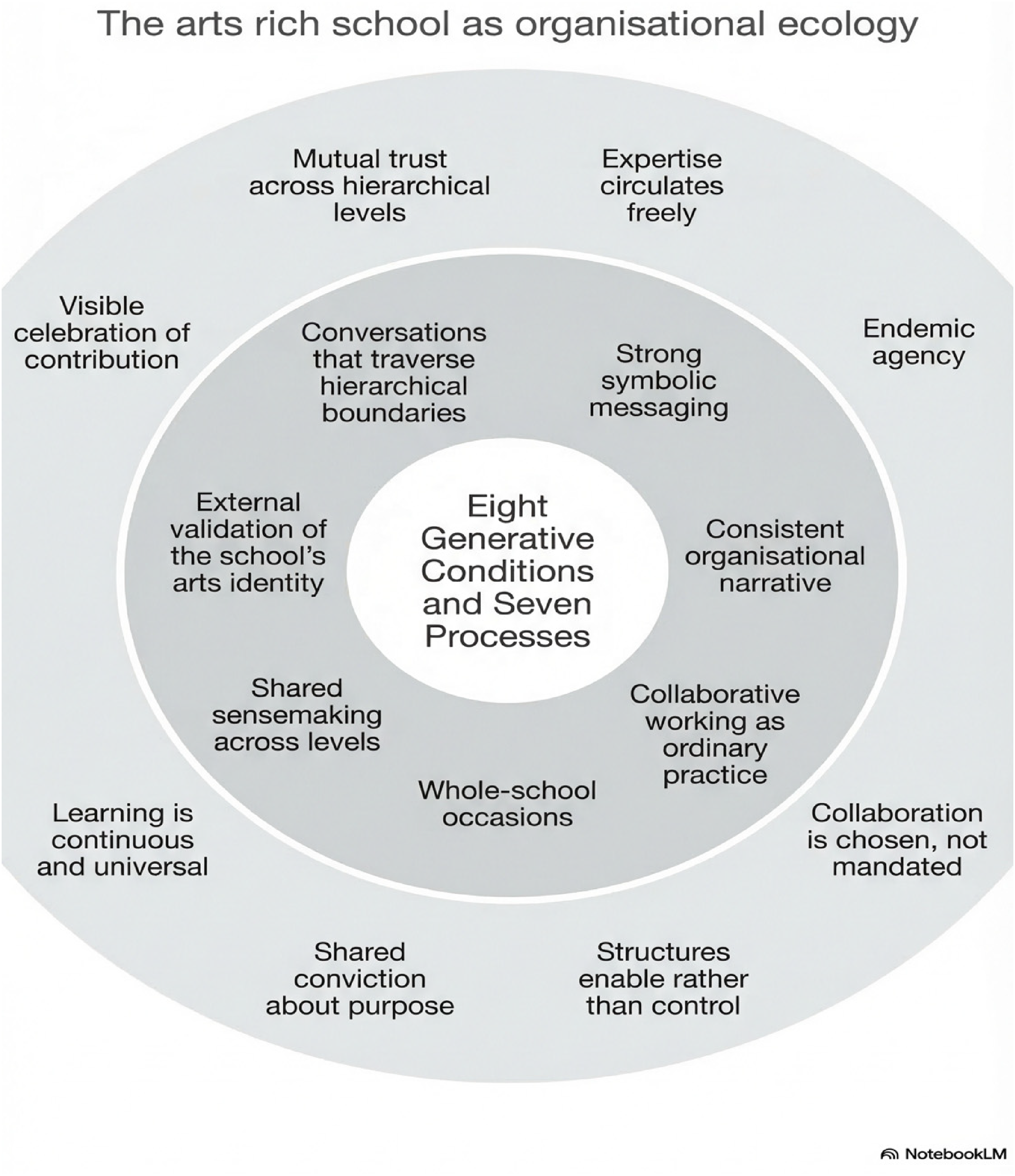
School-as-design ecology.
Two examples illustrate how ecologies develop. At one RAPS school, the arriving headteacher first created enabling structures: protected time, specialist appointment, ring-fenced budget. Initially little changed; the specialist taught in isolation. Structures were necessary but insufficient. The head: ‘I kept telling the story of what was possible. Not what I wanted. What the children deserved’. Over 2 years, conviction shifted, then trust, expertise circulation, agency and density. At another school, conviction existed in a core group before a new headteacher arrived, but constraining structures had prevented action. When the head created enabling structures, conditions already present rapidly activated the whole ecology. The sequence was different; the outcome was the same.
The ecological nature of the conditions distinguishes them from structural interventions or cultural initiatives. Announcing that trust is now a school value does not produce mutual trust. Mandating collaborative planning does not produce chosen collaboration. Designating student arts ambassadors does not produce endemic agency. Each condition must be cultivated, which opens space for the others. Sustainability follows from the same logic: when staff change, when budgets are cut, when inspection pressure intensifies, an intact ecology absorbs these shocks in ways that any single condition or structure cannot.
The processes described in the previous section are inseparable from the conditions. They are how the conditions are made and kept alive. Conversations that cross hierarchical boundaries both require and produce mutual trust. A consistent narrative both expresses and renews shared conviction. Whole-school occasions both celebrate contribution and make it visible. Collaborative working both assumes and builds chosen collaboration. The conditions and its generative processes are one ecological system.
Connections with extant leadership literatures
Our analysis chimes with two extant leadership literatures: (a) symbolic leadership and school culture, and (b) distributed leadership.
Symbolic leadership and school culture
School culture is shaped primarily by the symbolic actions of leaders, what they pay attention to, celebrate, and model publicly, rather than by formal policy (Deal and Peterson, 1999). Where headteachers participate in arts activities alongside children, attend performances and display student work in their own offices, they enact what the school values. These acts accumulate into durable settled organisational assumptions. RAPS school leaders oversaw the production of arts-rich identity symbols: these told the community repeatedly who the school was and where it was headed. Such symbols function as discursive resources providing a shared language through which communities interpret change (Narayanan and McCluskey, 2025).
Narrative connects symbolic action to sustained conviction. Organisations construct the meaning of events through the stories they tell and hear; such narratives are constitutive rather than merely descriptive (Boje, 2006). RAPS schools’ consistent arts identity narrative functioned as a key sensemaking resource, giving people at every level a framework for interpreting ambiguous events and understanding why they did what they did. Collective sense-making rather than delivered interpreted meaning downward, meant RAPS school communities had robustly held understandings (Ganon-Shilon et al., 2022)
Ritual occasions build collective identity through repeated enactment: their significance lies less in what they communicate than in what they do to/with those who participate (Ferreira, 2014). Regular performances and exhibitions in RAPS schools were identity-building events of this kind, but serendipitous occasions, unplanned events producing collective experience, demonstrated a self-reinforcing ecology rather than a managed culture programme. Serendipitous occasions confirmed that the RAPS schools were not simply well-led but organisationally alive: strong school cultures are distinguishable from imposed culture by the capacity to produce new expressions of shared values without deliberate management (Lee and Louis, 2019).
Distributed leadership
Distributed leadership frames leadership as a collective, dynamic and relational practice stretched across multiple organisational members (Spillane, 2006; Harris, 2013). Three early conceptual developments are particularly relevant to our ecological analysis. Gronn's (2002) ‘conjoint agency’ distinguishes additive distribution (multiple people doing separate tasks independently) from conjoint action, in which interdependent actors develop a unified sense of purpose and generate leadership practice qualitatively different from any individual contribution. The conditions ecology is what generates conjoint rather than additive action. Thorpe, Gold and Lawler's (2011) four-quadrant typology separates planned-aligned and planned-misaligned forms from emergent-aligned (spontaneous initiatives consistent with organisational purposes) and emergent-misaligned distribution. Leadership density in RAPS schools is emergent-aligned; the conditions ecology explains what specifically produces this form. Lambert's (2003) leadership capacity framework adds a third connection, positioning distributed leadership as the means of building collective capacity requiring investment in both human capital and social capital; the generative conditions ecology specifies social capital at the mechanism level.
Activity theory based accounts of distributed leadership (e.g., Spillane and Diamond, 2007; Spillane et al., 2004) have leadership practice mediated by tools and routines – the artefacts and standardised patterns of interdependent behaviour through which leadership stretches across people and is carried in the task environment rather than in minds or relationships alone. The relevant tools are usually management artefacts: performance data systems, appraisal frameworks and meeting protocols. RAPS schools add a specific arts configuration: progression documents, sketchbooks, shared creative habits frameworks, arts council meeting structures and the school performance and exhibition cycle. These simultaneously structure curriculum and distribute leadership; the two functions are not separable. The generative conditions we identified are not simply conditions for good distributed leadership in general but conditions sustained and mediated by artefacts particular to arts-rich organisational life. The generative conditions framework raises the question of whether equivalent arts-specific artefacts exist in non-arts contexts, or whether their function would need to be served by different tools.
Distributed leadership has faced persistent, substantive criticism. Distributing tasks does not distribute power (Hatcher, 2005) and teacher leadership discourse can mask workload intensification (Gunter, 2009). Lumby (2019) identified a distributed-but-not-democratic pattern in which headteachers delegate operational tasks while retaining decision-making authority, producing frustration among staff carrying increased responsibility without commensurate agency. Democratic leadership explicitly prioritises participatory decision-making and equity, whereas distributed leadership as a descriptive framework does not inherently require this (Woods, 2005). These critiques identify the consequences of distributive structures without something like a generative ecology. When agency is endemic and conviction is genuinely shared across the whole community including its children, participatory and equity dimensions are structurally produced rather than normatively declared.
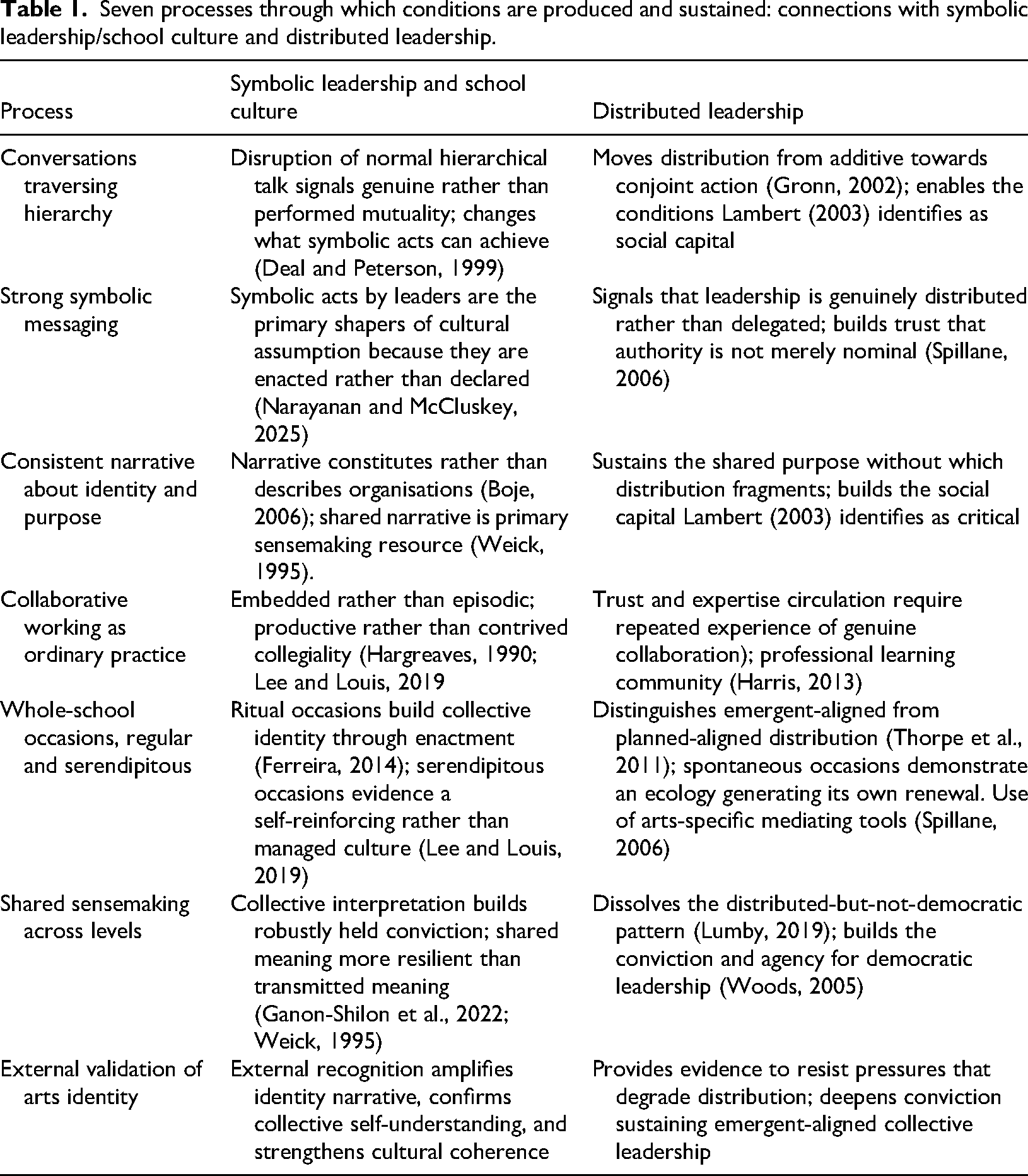
Table 1 shows the connections between extant literatures and the generative conditions and processes. The symbolic leadership and culture literature explains how shared conviction and collective identity are built and maintained; it has less to say about how leadership initiative becomes widespread. The distributed leadership literatures explain how collective leadership capacity can be distributed across an organisation; it has less to say about how shared conviction and collective identity are built. The generative conditions framework connects both: the conditions ecology produces organisational culture robust enough to sustain distributed leadership, and the seven processes keep it alive.
Seven processes through which conditions are produced and sustained: connections with symbolic leadership/school culture and distributed leadership.
Conclusion
This paper set out to answer a question raised from the RAPS data analysis: how does an arts-rich school generate shared leadership? The eight generative conditions answer at the level of what the organisation needs to have in place; the seven processes answer at the level of what it needs to keep doing. Together they explain the school-as-design framework in practice, and show why structure and conditions together generate collective capacity.
The most important practical implication of the analysis is about equity. Arts education in England is inequitably distributed: independent schools and schools in wealthy areas access specialist staff, cultural partnerships and facilities at rates unavailable to most state schools serving disadvantaged communities (Thomson and Hall, 2026). The RAPS schools are state primaries, many in areas of significant deprivation. Their arts-richness and collective leadership are built, not inherited. The conditions ecology is accessible to any school that commits to cultivating it; the seven processes are available to any leader who understands them.
The framework points to particular priorities for leadership development. Individually-focused programmes build headteachers’ strategic capability and prepare teachers for leadership roles, addressing the supply side of capacity without necessarily attending to the conditions under which capacity is continuously generated throughout the organisation. The generative conditions framework asks different questions: not only who is developing leadership capability but whether the ecology as a whole is developing and which conditions are currently weakest. A school where symbolic messaging is strong but sensemaking is conducted by leaders rather than shared across the community faces a different challenge from one where collaboration is chosen but enabling structures are precarious. The seven processes offer a practical diagnostic for directing development attention.
The research evidences that schools capable of collective leadership are not accidents but organisations that have learned, through sustained effort, to generate and maintain the conditions that make collective leadership possible. Three questions remain open. Do the same eight conditions and seven processes operate in non-arts contexts, or do different organisational purposes require different generative configurations? How does the ecology react to sustained resource pressure, staff turnover and inspection regimes rewarding narrow accountability? And how do conditions and processes interact with multi-academy trust governance, where distributed authority operates across multiple sites?
Footnotes

Funding
The authors disclosed receipt of the following financial support for the research, authorship and/or publication of this article: The RAPS research was funded by the Freelands Foundation.
Declaration of conflicts interests
The authors declared no potential conflicts of interest with respect to the research, authorship and/or publication of this article.
Statements and declarations
Ethical approval was from the School of Education (Faculty of Social Sciences), University of Nottingham Ethics Committee.