




Abstract
Complex educational innovations in vocational education and training (VET) schools require teamwork and distributed leadership so that team members are enabled to contribute based on their expertise. The literature suggests that distributed leadership is affected by formal leaders’ and teachers’ actions, but how their actions affect distributed leadership remains largely unknown. Our study, examining what kind of actions affect distributed leadership within VET teacher design teams (TDTs) working on educational innovations, helps to fill this knowledge gap. Individual interviews and group interviews were conducted with three formal leaders (team leaders) and thirteen members of five TDTs from one VET school. These interviews were analysed using thematic analysis. Regarding formal leaders’ actions, results showed that team leaders created opportunities for distributed leadership in TDTs, but also set boundaries by, for instance, limiting the scope and making decisions. Regarding teachers’ actions, results indicated that TDT members established leader–follower relationships through team learning processes. Furthermore, it was found that distributed leadership in teams changed according to the different phases of the educational innovation. Overall, this study shows that hybrid leadership configurations existed, in which team leaders and teachers played a central role in establishing distributed leadership in teams, and the study indicates that distributed leadership in teams depends on team members’ expertise, time and context.
Keywords
Introduction
Schools are expected to continuously work on complex educational innovations, to retain or even to increase the quality of their educational programmes (Runhaar, Konermann, & Sanders, 2013). This is also true for the vocational education and training (VET) sector. As a response to increasing labour market demands, which require (future) employees to possess professional competences and stay employable, VET schools all over the world are redesigning their educational programmes to better prepare students for these demands by implementing and improving competence-based education (CBE). In CBE professional competences needed in jobs and vocational core problems are a starting point for curriculum development. In order to develop CBE curricula, teachers need to collaborate to develop multidisciplinary programmes, which integrate theory and practice (Truijen, 2012; Wesselink, de Jong, & Biemans, 2010). This is considered a complex task that puts high demands on teachers’ collaboration in teams and subsequently on their leaders.
The distributed leadership literature argues that formal leaders cannot single-handedly lead others when demands are high, because complex tasks involve many challenges that require input from different perspectives and areas of expertise (Gunter et al., 2013). Therefore, distributed leadership in teacher teams – which implies that leadership is the product of conjoint activity instead of individual actions (Woods et al., 2004) – is preferable during complex educational innovations such as CBE, if teams are to cope more effectively with these innovations. It is however unclear how distributed leadership can be effectively achieved, as there is no blueprint on how to establish distributed leadership (Harris and DeFlaminis, 2016).
Distributed leadership in teacher teams depends on structures such as the organisational culture and values, and on the actions and interactions of those involved. Bolden (2011) suggests in his review study that research on distributed leadership should focus on these actions and interactions by examining how formal and informal leadership co-exist and interact with each other in so-called ‘hybrid leadership configurations’. The concept of hybrid leadership configurations was introduced by Gronn (2009) to take into account the role that formal leaders play in situations where leadership is distributed. More recently, Tian et al. (2016) argued in their review study that there still is a research gap between these formal and informal leaders’ actions and interactions. They suggest to examine distributed leadership from an agency perspective, which refers to ‘the actions and interactions of people in taking initiatives, making choices and participating in leadership work’ (Tian et al., 2016: 148). In this study, we follow their suggestions and use an agency perspective to examine how actions and interactions of formal leaders (team leaders) and informal leaders (teachers) affect the establishment of distributed leadership in VET teacher teams working on the implementation of CBE. We are specifically interested in how formal leaders create opportunities for distributed leadership, and how teachers utilise these opportunities by taking on leader and follower roles within the team.
Greater insight in formal and informal leaders’ actions and interactions is needed for several reasons. First, although the influence of formal leaders’ actions on distributed leadership is often emphasised, scholars such as Crawford (2012) and Tian et al. (2016) argue that only a few studies have actually examined formal leaders’ actions. Formal leaders can create opportunities for distributed leadership (Tian et al., 2016), but can also put boundaries on distributed leadership (Hairon and Goh, 2015). As such, they act as what Bush and Glover (2012) called ‘gatekeepers’ of distributed leadership. Because empirical research on their actions is limited, it remains largely unknown how they create opportunities and put boundaries on distributed leadership and how this affects the establishment of distributed leadership in teacher teams. Second, regarding teachers’ actions, Scribner et al. (2007) show that interactions in teacher teams need to be taken into account when examining how distributed leadership can be established. They show that collaborative dialogue, which refers to the construction and reconstruction of collective knowledge by team members (Loureiro and Caria, 2013), plays a crucial role in establishing leader and follower roles within teams. However, research on distributed leadership within teams is scarce (Scribner et al., 2007), and much remains unknown about what this collaborative dialogue actually encompasses and how this affects the establishment of leader–follower relationships in teams. Therefore, we use team learning literature to theoretically and empirically determine relevant collaborative dialogue activities in the establishment of distributed leadership.
Hence, we aim to answer to following research questions: ‘In what ways do formal leaders create opportunities for distributed leadership, and how do they set boundaries for distributed leadership?’, and: ‘In what ways do teachers establish leader–follower relationships within their team, and what is the role of team learning activities in this process?’
Towards distributed leadership
Although distributed leadership has gained much attention in the educational management literature over the past decades, many scholars agree that different conceptualisations of distributed leadership have made the concept elusive (e.g. Hairon and Goh, 2015; Harris and Spillane, 2008; Tian et al., 2016). This has resulted in conceptual confusion and overlap with other concepts such as shared leadership, democratic leadership and collaborative leadership. For empirical studies on distributed leadership it is therefore important to determine characteristics of distributed leadership that scholars agree upon and to conceptualize these characteristics in measurable ways.
Recently Hairon and Goh (2015) did this by developing a questionnaire measuring formal leaders’ role in distributed leadership. By focusing on formal leaders, they did not include the establishment of distributed leadership by teachers within teams in their questionnaire. Nevertheless, their attempt in combination with characteristics described by other scholars provides input for conceptualising distributed leadership in our study. The first characteristic that many scholars agree upon is that distributed leadership contains multiple levels of involvement in decision-making, such as formal leaders in hierarchical leadership positions and informal leaders (e.g. Bolden, 2011; Gronn, 2009; Harris, 2008; Tian et al., 2016). A second characteristic is that distributed leadership is dynamic with open boundaries of leadership. This means that those who are best equipped and skilled to lead to achieve a certain goal do so, and that who leads thus depends on the goals that are being worked on (e.g. Harris and DeFlaminis, 2016; Woods et al., 2004). As such, multiple individuals can exercise leadership at some point, but not everybody is a leader or always leads (Harris and DeFlaminis, 2016). Third, interactions between individuals are needed to determine who leads and who follows (e.g. DeRue and Ashford, 2010; Woods, 2016). These characteristics form the starting point for conceptualising formal and informal leaders’ actions and interactions in establishing distributed leadership.
Formal leaders’ actions
Teachers act within a complex power structure that creates, but also constrains their opportunities to lead (Lumby, 2013). This power structure is reflected in formal leaders’ behaviour. On the one hand they create opportunities for distributed leadership by empowering teachers (Tian et al., 2016), on the other hand, they put boundaries on teachers’ empowerment (Hairon and Goh, 2015).
Creating opportunities for distributed leadership
Formal leaders can create opportunities for teachers to exercise influence in non-hierarchical networks of teachers that exist alongside prevailing formal leadership structures in schools (Tian et al., 2016). This implies that formal leaders encourage or discourage teachers to lead, and, as such decide on how distributed leadership is shaped (Hatcher, 2005). To conceptualise how team leaders can create these opportunities we use the framework on distributed leadership of MacBeath (2005).
MacBeath (2005) distinguishes four ways in which formal leaders can create opportunities for distributed leadership. The first, formal distribution, implies that formal leaders delegate influence by describing leadership tasks in the job descriptions of teachers. The second, pragmatic distribution, implies that formal leaders delegate influence relatively ad hoc as a response to increased demands, such as the need to improve the quality of educational programmes. The third, strategic distribution, implies that formal leaders introduce new members with specific expertise and resources in teams to fulfil specific leadership tasks. The fourth, incremental distribution, implies a transition from formal leaders’ influence to teachers’ informal influence. On the one hand, formal leaders give increased responsibilities to teachers as teachers demonstrate their ability to lead, and on the other hand, teachers show willingness to take on more responsibilities.
Bounded empowerment
Formal leaders also decide on the scope of distributed leadership by deciding what responsibilities are distributed and how this distribution is realised. Hairon and Goh (2015) refer to this as ‘bounded empowerment’, which means that teachers are only given a certain degree of influence. The authors give three reasons why distributed leadership is bounded. First, there will be certain areas of decision-making that cannot be given to teachers. For instance, teachers are only empowered to make decisions within their scope of work, and not on school-level aims. Second, distributed leadership is bounded insofar as formal leaders are kept informed about decisions made by teachers. Gronn (2009) adds to this that formal leaders also make final decisions based on information provided by informal leaders. Third, decisions made by teachers are bounded because these must be aligned with school goals and coordinated with decisions made by others (Hairon and Goh, 2015). Overall, bounded empowerment implies that power in schools continues to be a characteristic of formal leaders, and that distributed leadership is merely a delegated and licensed form of influence under the formal leader’s authority, which has also been emphasised by Hatcher (2005). Distributed leadership does therefore not imply that the boundaries of leadership are fully open or that everybody has equal opportunities to lead (Lumby, 2013). Instead, formal leaders set the conditions for distributed leadership.
Teachers’ actions
When the conditions are set by formal leaders, teachers can allocate influence within their team. Here the dynamic character of distributed leadership and the central role of interactions in determining leader and follower roles become apparent. To conceptualise the dynamics, we built on another part of the framework of MacBeath (2005), and distinguish two ways in which team members do this. To conceptualise the interactions, we use team learning theory.
The first way of distributing leadership within teams, opportunistic distribution, implies that teachers willingly undertake additional responsibilities in an ad hoc manner. The second, cultural distribution, implies that influence is spontaneously and organically shared between teachers, and is expressed through activities rather than roles. Here, distributed leadership has become part of the team culture (MacBeath, 2005). In both opportunistic and cultural distributions, some individuals may be included in and others may be excluded from exercising influence.
Because Scribner et al. (2007) showed the importance of collaborative dialogue in establishing distributed leadership, we argue here that collaborative dialogue also plays a role during these opportunistic and cultural distributions. As previously mentioned in the introduction, it however remains unclear what activities collaborative dialogue consists of and how these activities affect distributed leadership. Collaborative dialogue has much in common with the concept of team learning, because both refer to the co-construction and reconstruction of collective knowledge by team members (Decuyper et al., 2010; Loureiro and Caria, 2013). In the team learning literature distinct team learning activities are distinguished, which enables us to conceptualise collaborative dialogue based on this literature. Decuyper et al. (2010) identified three activities that describe what happens when teams engage in team learning and that are central in this study as well. The first, information sharing, implies that team members share previously unshared information with each other. The second, co-construction, implies that team members develop shared knowledge by refining, adding to and changing shared information by questioning, concretising and completing this information. The third, constructive conflict, implies that team members discuss or negotiate about opposing ideas to reach agreement. In practice, these three processes are highly intertwined. For example, co-construction can lead to constructive conflict, and new information can be shared while team members engage in constructive conflict. Given this interconnectedness, these processes are also combined in the literature under the denominator ‘information processing’ (Van Woerkom and Van Engen, 2009).
As teacher teams are usually not internally hierarchically structured, meaning that no hierarchy exists between teachers within teams, their loose structure makes it possible for all members to engage in collaborative dialogue (Scribner et al., 2007), and thus in team learning as well. We can imagine that, by engaging in different team learning activities, team members construct solutions to complex challenges and, as such, lead their team through these challenges. This implies that team learning contributes to the distribution of leadership in teams, as is also suggested by Day et al. (2004). Additionally, teacher teams can develop a shared understanding of distributed leadership through engagement in team learning, such as an understanding of what leadership encompasses and who the leaders are. As such, we assume that team learning contributes to establishing leader–follower relationships in teams.
In turn, established leader–follower relationships can shape team learning. When leadership is distributed within a team, the mutual influence among team members increases, which requires frequent interactions between members, such as information sharing and co-construction (Liu et al., 2014). Moreover, teachers with leader roles may contradict or point out fallacies in other teachers’ ideas, which can stimulate team learning (Leithwood et al., 1997), and teachers with leader roles can create learning environments in their team (Chatalalsingh and Reeves, 2014).
In line with what is theoretically proposed by Day et al. (2004), the aforementioned studies indicate a reciprocal relationship between distributed leadership and team learning: learning activities shape leader–follower relationships, and these relationships shape new learning activities.
Consequently, on the one hand we explore how formal leaders set conditions for distributed leadership in teams, and on the other hand, we explore the dynamic nature of distributed leadership by examining how teachers utilise these conditions by establishing leader–follower relationships within their team through engagement in team learning. This is visualised in Figure 1.
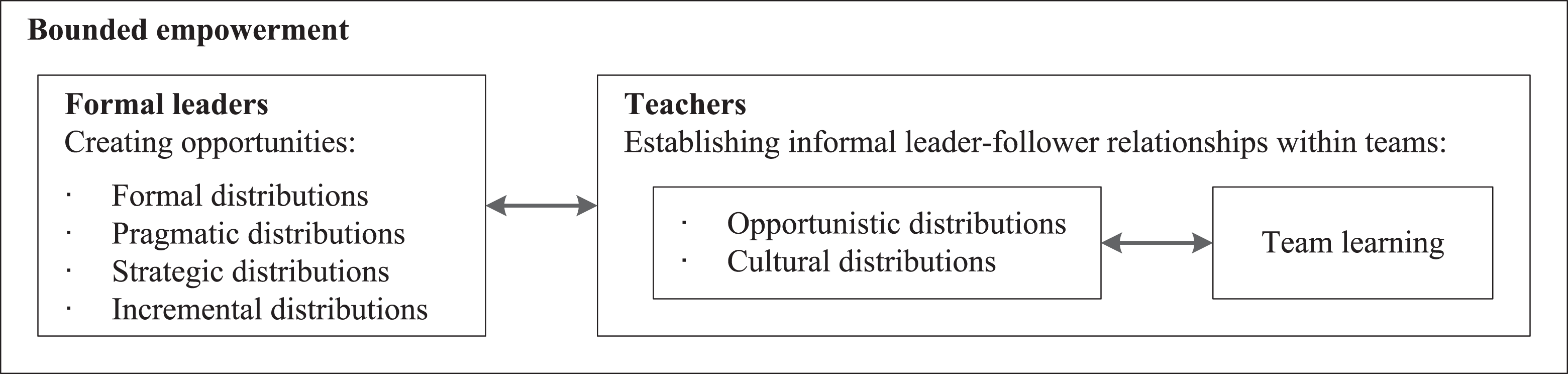
Conceptual model.
Method
In this section we explain our choices regarding the research context, study and instrument design, and analysis, and elaborate on the quality of our research in terms of validity, reliability and ethics.
Research context and sample
The study was conducted in one VET school that had developed a policy for an educational innovation to increase the alignment between CBE programmes and the labour market. This policy required teacher teams to organise their teaching in blocks of five weeks, in which various professional competences of students were to be developed and tested. These five-week blocks needed to be practice-based and tailor-made in the sense that they contained both mandatory and elective learning activities.
Teacher teams’ development of this innovation consisted of two consecutive phases. In the first phase, they had to develop a vision of the innovation. Teams could design their own vision, as long as they adhered to the policy regulations, such as organising education in blocks of five weeks. This implied that teams had to determine the core competences for which they educate students, and specify which courses should be part of the five-week blocks. In the second phase, teacher teams had to develop these five-week blocks and experiment during class. To do this, teachers had to integrate courses into blocks, sometimes develop new courses, and create schedules.
In all teacher teams, a teacher design team (TDT) was set up to take responsibility for the innovation. A TDT is ‘a group of at least two teachers, from the same or related subjects, working together on a regular basis, with the goal to (re)design and enact (a part of) their common curriculum’ (Handelzalts, 2009: 7). TDTs consisted of teachers, here called design teachers – who were members of the larger teacher team – and a coach, who was not a member of the larger teacher team. There was no predetermined hierarchy between design teachers and coaches within the TDTs and they fell under the supervision of a team leader.
These TDTs were expected to yield interesting results on the establishment of distributed leadership. Through purposive sampling with two selection criteria, five TDTs were selected. The first criterion was that all TDTs be selected from a single VET school to ensure that the TDTs had similar structures and worked on the same innovation. This increased the TDTs’ comparability. The second criterion was that only select TDTs that were developing innovations, to ensure that the TDTs worked on complex tasks during the data gathering and that it was possible to reconstruct their reality.
Based on these criteria, eight TDTs were selected and their team leaders were approached to participate in the study. Three team leaders declined because of practical reasons (e.g. time constraints), and the team leaders of the remaining five TDTs agreed to participate.
Table 1 shows the sizes of the participating TDTs and their larger teams. Teacher teams varied in size, which implies that the percentage of teachers involved in TDTs also differed.
Sizes of teacher design teams (TDTs) and larger teacher teams.
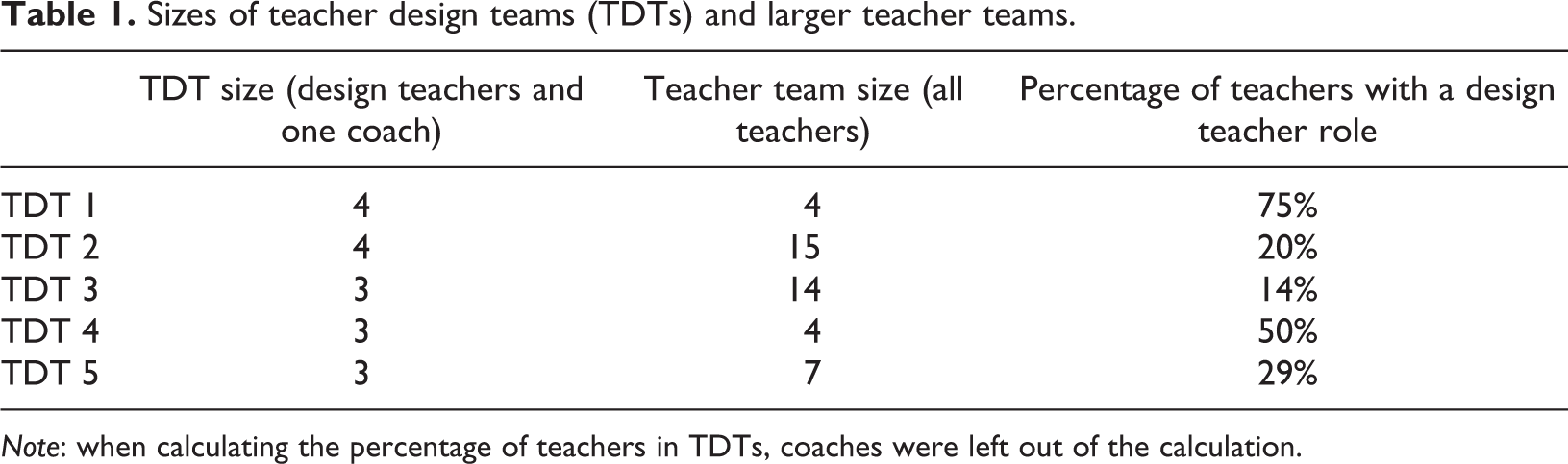
Note: when calculating the percentage of teachers in TDTs, coaches were left out of the calculation.
Study design
Ten design teachers, three coaches and three team leaders were interviewed to gain insight into formal leaders’ and TDT members’ actions, and to obtain reconstructions of reality from different perspectives (see Table 2). All the interviews lasted about one hour.
Overview of group interviews and face-to-face interviews per teacher design team (TDT).
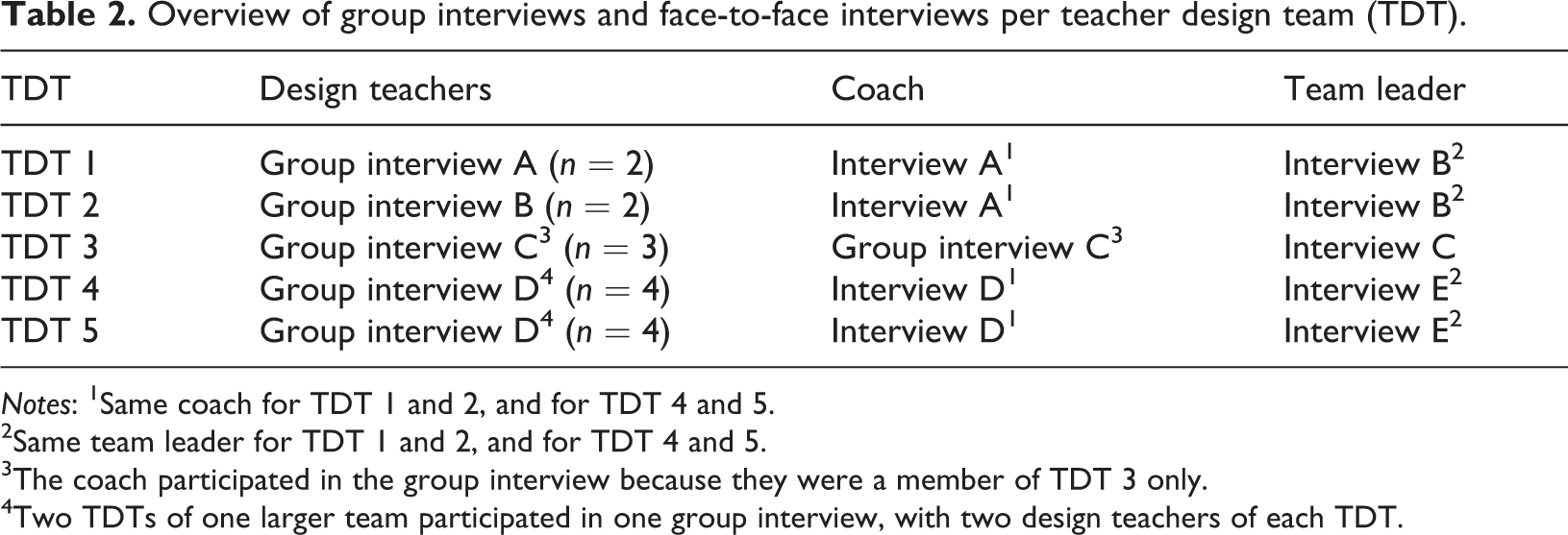
Notes: 1Same coach for TDT 1 and 2, and for TDT 4 and 5.
2Same team leader for TDT 1 and 2, and for TDT 4 and 5.
3The coach participated in the group interview because they were a member of TDT 3 only.
4Two TDTs of one larger team participated in one group interview, with two design teachers of each TDT.
Design teachers participated in group interviews A, B, C, and D because of the expected snowball effect: by discussing team processes together, design teachers could reconstruct team processes more accurately than individual teachers would be able to do in individual interviews (Barbour, 2007). One coach also participated in group interview C because the coach was only a member of that specific TDT (TDT 3). The other coaches participated in individual interviews because they were members of two TDTs: one coach was a member of TDTs 1 and 2, and the other coach was a member of TDTs 4 and 5. The interviews enabled us to discuss these TDTs separately. Team leaders participated in separate interviews to prevent power relations being exhibited during group interviews: because design teachers and coaches were asked to reflect on the team leader’s role, we wanted to ensure that they could speak freely and uninhibited by the team leader’s presence (Barbour, 2007).
A similar topic list was used as a research instrument for all interviews. Topics that were addressed included: the actions of design teachers, coaches and team leaders during the innovation; the delegation of leadership; and engagement in team learning activities. The topic list was evaluated with a policy advisor of the participating VET school to ensure clarity and relevance.
Analysis
Transcripts were coded with Atlas.ti Version 7.5 using thematic analysis (Braun and Clarke, 2006), and data were processed and analysed in four phases. In the first phase, the first author made initial notes, coded transcripts in a theory-driven way, and combined codes into themes. In the second phase, the themes and codes of two transcripts were reviewed by the second author and the differences between the first and second author were discussed to reach agreement on the final codes. In the third phase, the first author refined codes and themes in the remaining transcripts based on the final codes, and in the fourth and final phase, the codes and themes were associated and quotations were abstracted from the data.
Quality and ethics
Based on Gibbs (2007) and Barbour (2007), the validity of the study was assessed in several ways. First, triangulation was used by combining data from group interviews and individual interviews to compare insights from different perspectives. Second, we used the idea of constant comparison, which implies checking the consistency and accuracy of codes by comparing the content of codes both within and between cases. Third, we provided evidence for our data interpretation through the examples and quotations in the results section.
Reliability was assessed by calculating the interrater reliability for the two transcripts that were coded and discussed by the first and second author. The average Cohen’s kappa was 0.82, which indicates good agreement (Viera and Garrett, 2005).
Ethics were taken into account in two ways. First, verbal informed consent was obtained from all participants. Second, anonymity was ensured by removing participant, team and organisation identifiers from the results, and by denying unauthorised people access to non-anonymised data (Gibbs, 2007).
Results
As mentioned above, two consecutive phases of the educational innovation were defined: vision development; and content development. We have described how distributed leadership was established through the actions and interactions of formal leaders and TDT members for each phase. The results therefore provide insight into the dynamics of distributed leadership over time (i.e. the differences between the two phases), and during different task-related contexts (i.e. developing a vision, or developing content and experimenting).
Phase 1: Vision development
Formal leaders – creating opportunities
At the start of the educational innovation, team leaders delegated influence to TDTs through pragmatic and strategic distributions. First, based on teachers’ expertise and motivation, team leaders appointed two or three teachers from the teacher team as design teachers in the TDT (pragmatic distribution). For example, the team leader selected one teacher with experience in the labour market, one teacher with experience in specific courses and one teacher with experience in innovation for TDT 2. Second, because one of the challenges that arose during the vision development phase was that design teachers did not have the appropriate expertise, team leaders introduced coaches with expertise in vision development in all TDTs to support the design teachers (strategic distribution).
Formal leaders – bounded empowerment
Teacher design team members experienced boundaries set by team leaders in several ways. First, all team leaders regularly took part in TDT meetings to stay informed about decisions made by the TDT. Although TDT members generally welcomed the team leader’s presence, in TDT 5 it caused tensions between the team leader and the design teachers. The design teachers thought that the team leader should only facilitate the TDT and not influence vision development through the meetings. At the time of data gathering, they had not yet found a solution to this problem. Second, in TDTs 2 and 3, team leaders made decisions on aspects of the innovation beyond the TDT members’ scope of influence. For instance, in TDT 2, it was the team leader who decided whether other teachers could join TDT meetings. In TDT 3, the team leader decided on the innovation’s scope, as this quote illustrates: ‘I said: “Take it easy. Let us first look at developments in other teams, so we can use those…We will not change our examination yet…” I outlined the main directions’ (team leader, TDT 3).
TDT members – establishing informal leader–follower relationships
Teacher design team members established two different informal leader–follower relationships (opportunistic distributions), in a relatively ad hoc manner but through the created opportunities and within the fixed boundaries. The first of these relationships, identified in TDTs 1, 2 and 5, implied that coaches claimed and were granted leader roles and design teachers claimed and were granted follower roles. Coaches claimed this leader role by sharing information on how to develop a vision. The design teachers granted this role to coaches and claimed follower roles themselves because they acknowledged their own lack of expertise in vision development. This quote illustrates this: ‘Without the coach we would not have succeeded…. Possibly, we would still be at the start of vision design’ (design teacher, TDT 1).
The second relationship, identified in TDTs 3 and 4, implied a leader–follower relationship in which both coaches and design teachers took on leader and follower roles. In TDT 3, design teachers and the coach had different perspectives on the educational innovation. Constructive conflict was needed to reach agreement on a leader–follower relationship, in which design teachers took the lead in the vision development, and the coach inspected whether the vision reflected the school’s policy. The need for constructive conflict is illustrated by this quote: Design teachers focused on conditions of their current education, and I focused on conditions of the innovation. I am not implying that these conditions collided, but they did not always correspond. At the beginning, we had a lot of discussion about this. At a certain moment I realised that it was useless to impose my conditions and I let go of my conditions a little. That went well, because the design teachers took over (coach, TDT 3).
Summary of Phase 1
Team leaders created opportunities for distributed leadership through pragmatic and strategic distributions. The boundaries of TDT empowerment became apparent through team leaders’ presence in TDT meetings, and through certain decisions made by team leaders. Design teachers and coaches established leader–follower relationships in their TDTs through opportunistic distributions. Team learning – information sharing and constructive conflict – contributed to the establishment of these roles.
Phase 2: Content development
Teacher design teams 1 to 4 had finished developing their vision and were starting to develop content. TDT 5 had not yet reached this phase and was still engaged in vision development at the time of data collection. TDT 5 was therefore not taken into consideration in this phase.
Formal leaders – creating opportunities
Team leaders of TDTs 1 to 4 observed that the TDT members had acquired additional leadership expertise and delegated more influence to them, which indicates an incremental distribution. This quote illustrates this: ‘My role was most notable during the vision design. Since the teachers have started to develop content for the programme, I can step back more’ (team leader, TDT 1 and 2).
Formal leaders – bounded empowerment
Although team leaders delegated more influence to TDT members in this phase, TDT members still faced boundaries to their empowerment. The design teachers in TDT 2 explained that their team leader tried to ‘create a balance between delegation and having control’. This was also the case in TDTs 1, 3 and 4. In general, team leaders attended fewer TDT meetings but continued to make decisions and to monitor the TDTs’ progress.
Regarding decision-making, the team leader of TDTs 1 and 2 decided when the TDTs could start implementing the innovation. The TDT members accepted the team leader’s decision, as this quote indicates: ‘The team leader participated in meetings to hear about our progress. Then she decided that TDT 1 could start implementing and that TDT 2 could not yet start…That was it, the decision was made. Nobody debated that decision’ (coach, TDT 1 and 2). Additionally, in TDT 4 the team leader decided on the experimentation with content during classes. The design teachers wanted to have two teachers involved in the experiment, but the team leader decided to deploy only one teacher. The design teachers accepted this because the team leader explained that he ‘must justify the deployment of teachers, and has to make sure that the deployment is effective’ (design teachers, TDT 4).
Regarding monitoring, in TDT 3 the team leader monitored the content development phase to make sure that the innovation’s scope as agreed on in the vision development phase was followed.
TDT members – establishing informal leader–follower relationships
Teacher design team members established new leader–follower relationships in which design teachers took on a leader role and the leader role of coaches was reduced (opportunistic distribution). Again, information sharing played a role in establishing these leader–follower relationships. For instance, in TDTs 1 and 2, design teachers claimed and were granted leader roles because they knew more about the content of course materials than the coach, which they showed through information sharing. The coach described this change in leader–follower relationships as follows: At the start you intensively try to make the design teachers adopt a vision…. When they adopt that vision, my influence decreases, and the materials’ development by the design teachers becomes a matter of course (coach, TDT 1 and 2). At the start, the design teachers need a lot of coaching. This need diminished slowly during the innovation trajectory.…For years, innovation was not really necessary because schools bought a lot of existing educational materials. Therefore, innovation became a bit of a lost competence of teachers that is now coming back…(coach, TDT 4).
In their leader role, design teachers stimulated team learning with other teachers to overcome the challenge of how to gain support from the entire teacher team (TDTs 2, 3 and 4). To do this, design teachers initiated information processing with the entire team, by putting the educational innovation on the agenda of team meetings. For instance, design teachers in TDT 2 organised brainstorming sessions with the entire teacher team: During team meetings, we share our ideas and ask the team what they think about those ideas. For example, we have split the team into two halves for brainstorming. One week we brainstorm with one half, the other week with the other half. So, we do not decide ourselves on what we are going to do, but consult with other teachers (design teacher, TDT 2). Once every two weeks we invite one teacher. We discuss our ideas with that teacher and how we can combine materials for next year…. So, we share our ideas, but also ask the other teacher’s opinion, what that teacher wants, and whether the teacher thinks our ideas fit into the programme…(design teacher, TDT 2).
Summary of Phase 2
Team leaders gave more influence to TDT members through an incremental distribution. The bounded empowerment of TDTs became apparent through formal leaders’ decision-making and monitoring. The TDT members generally agreed with these boundaries. Members established new leader–follower relationships in TDTs through information sharing. TDT members also engaged in information processing to increase the involvement of other teachers of the entire teacher team.
Conclusion and discussion
Conclusion
Although distributed leadership is often seen as an effective way of meeting complex demands, the literature provides limited insights into how distributed leadership can be established within teacher teams. Therefore, the goal of this study was to provide insight into how formal leaders’ and teachers’ actions and interactions affect the establishment of distributed leadership in VET TDTs working on educational innovations.
With regard to research question one, we found that team leaders created opportunities for distributed leadership through pragmatic, strategic and incremental distributions. Moreover, they set boundaries for distributed leadership by continuously exercising influence during the educational innovation. Team leaders not only influenced the vision development by being present during TDT meetings, they also made important decisions regarding the educational innovation’s scope and monitored the progress.
With regard to research question two, we found that the team learning process of information sharing helped TDT members to decide who is an expert in certain aspects of the educational innovation. Acknowledging an individual’s expertise resulted in granting leadership to that individual. If TDT members were not convinced of an individual’s expertise or had different ideas, constructive conflict helped to reach agreement among TDT members on the leader–follower relationships. Additionally, in their leader roles, TDT members also stimulated team learning. They stimulated other teachers to engage in information processing with the TDT members to increase support from these teachers and to obtain insights into their perspectives.
In addition to these results related to the research questions, we found that the distributed leadership structures that were established in TDTs were dynamic, because different forms of distributed leadership emerged in different phases of the educational innovation. For instance, coaches had informal leader roles in all the TDTs during the vision development phase, while they stepped back as informal leaders in most TDTs during the content development phase.
We discuss these findings step by step below, by first discussing the formal leaders’ actions, then team members’ actions and interactions, and then the dynamic character of distributed leadership.
Discussion
Formal leaders’ actions
Our finding that formal leaders created opportunities for distributed leadership that allowed team members to establish leader–follower relationships among themselves indicates the importance of taking formal leaders’ actions into consideration. This finding supports previous studies which argue that formal leaders delegate distributed leadership (Hairon and Goh, 2015), and that they decide who can fulfil leadership roles (Tian et al., 2016). The framework of MacBeath (2005) enabled us to add new insights to these previous studies by showing what specific actions formal leaders intentionally took to create these opportunities.
Additionally, by showing that formal leaders also set boundaries for distributed leadership, our results seem to imply that informal distributed leadership structures cannot co-exist alongside formal leadership structures in hybrid leadership configurations. Instead, in line with scholars such as Hairon and Goh (2015) and Hatcher (2005), we argue that distributed leadership structures continue to be influenced by leaders in formalised hierarchical positions. Therefore, a cultural distribution as described by MacBeath (2005) may not be realistic for teacher teams. Although team members may distribute informal leadership increasingly spontaneously, the formal leader will ultimately determine the scope of this spontaneous distribution. A hybrid leadership configuration in which formal leaders have actual power and teachers exercise leadership within fixed boundaries therefore seems more realistic. Hatcher (2005) uses the following fitting quote to illustrate this ‘I participate, we participate, but they decide over what kind of issue we can decide’ (Wainwright, 2003: 193 in Hatcher, 2005: 259).
There are multiple possible explanations why formal leaders set boundaries on distributed leadership. First, formal leaders (team leaders) need to account for their own actions and for the team’s performance to their own formal leader, such as the school leaders or board members. Second, the school’s context can also play a role: schools must meet accountability demands that are usually determined by national authorities. Therefore, formal leaders want to continuously exercise control over performance (Gronn, 2009; Runhaar and Runhaar, 2012).
To increase our understanding of the formal leaders’ role, we suggest that future research should focus on how and why formal leaders promote and/or limit distributed leadership.
Team members’ actions
We have provided a detailed insight into what interactive processes contributed to the emergence of leader–follower relationships in teams, by showing the role of team learning, and particularly of information sharing and constructive conflict. This insight was needed, because although the importance of interactions and collaborative dialogue were emphasised in previous research (e.g. Scribner et al., 2007; Woods, 2016), a clear analysis of what these interactions and collaborative dialogue encompass was missing.
Additionally, we have found support for the work of Chatalalsingh and Reeves (2014), who argue that team members can act as ‘team-learning leaders’, because the results showed that informal leaders (design teachers) enabled team learning in their team by involving other teachers in information processing.
The learning activities in this study are derived from the team-learning literature. Because more learning activities are identified in the team-learning literature than are included in our study (see for instance Decuyper et al., 2010), we believe that the role of team learning should be examined further. Future research on distributed leadership in teams could build on the existing team-learning literature, so that we can acquire greater insight into the contribution of other team-learning activities to the allocation of leader and follower roles within teams, and into why and how informal leaders promote specific learning activities in teams.
The dynamic character of distributed leadership
We found that distributed leadership has a dynamic character. As previously argued by Gronn (2009), the way in which distributed leadership was established in TDTs changed over time, depending on the available and acquired expertise of the team members. For instance, team leaders gave more influence to TDT members as they gained leadership expertise. Related to time, the context also seems to play a central role in this dynamic character, as the relevance of available and acquired expertise in TDTs depended on the tasks that TDTs were working on. Some expertise was not relevant at the start of the innovation and became relevant in later phases. The bounded empowerment provided by team leaders was also dynamic, because team leaders attended fewer TDT meetings when they believed that the relevant expertise was available in the TDT.
Overall, these findings show that distributed leadership does not imply that everybody is a leader, which is also emphasised by Harris and DeFlaminis (2016). Who leads is dynamic and will depend not only on a person’s expertise, but also on time and the task context.
Limitations and future research
The framework of MacBeath (2005) proved to be useful for examining the establishment of distributed leadership in the TDT’s of this study, because it allowed for including both formal leaders’ and teachers’ actions. However, a limitation of the framework is that possible leader–follower relationships, or distributions of leadership tasks, that may emerge during the opportunistic and cultural distribution are not clearly defined. The framework of distributed leadership of Leithwood, et al. (2006) is more specific in this respect by describing four ways in which informal leaders can distribute leadership tasks: planful alignment; spontaneous alignment; spontaneous misalignment; and anarchic misalignment. We therefore suggest that future research integrates the frameworks of Leithwood et al. (2006) and MacBeath (2005). Integrating these frameworks has several advantages. First, the integration can lead to a more consistent conceptualisation of distributed leadership. Second, this integration may contribute to distinguishing distributed leadership from related concepts that are sometimes used interchangeably, such as shared leadership and collaborative leadership (e.g. Hallinger and Heck, 2010; Wang et al., 2014). Third, a more specific framework allows for more detailed empirical examinations of the development of distributed leadership.
Moreover, given the explorative character of our study, we distinguished between two successive phases in educational innovation: vision development; and content development. This distinction made it possible to explore changes in distributed leadership. However, more innovation phases are identified in the instructional design literature, as for example described in the analysis–design–development–implementation–evaluation framework (Gustafson and Branch, 2006). It is possible that the establishment and dynamics of distributed leadership depend on these phases. Therefore, we recommend that future research takes these innovation phases into account as well. Teams could be selected that have been through all the phases, or data could be collected after each phase.
Additionally, while organisational changes such as educational innovations are faced with content, process and contextual challenges (Devos et al., 2007), we only explored the process challenges faced by the TDTs. For instance, we explored how team learning contributed to creating support from the whole team. However, the TDTs also faced difficulties in the alignment between educational programmes and the labour market and in meeting school policy regulations, which are content challenges, and with the facilitation in time by schools, which is a contextual challenge. Given our focus on the process of establishing distributed leadership, we did not collect data on content and context challenges. Therefore, we recommend that future research focuses on all three types of challenges and examines how these affect distributed leadership and educational innovations.
Furthermore, in addition to time and context, Gronn (2009) also argues that leader–follower relationships are influenced by the membership-bound configuration of these relationships. We were unable to provide any insight into this membership-bound configuration because all the TDTs in this study had the same configuration. It is however possible that dynamic configurations affect distributed leadership structures in teams. Therefore, more research in other teacher teams with dynamic membership is needed to increase our understanding of the dynamics of distributed leadership.
Lastly, retrospective self-reported data were collected, which could result in subjective and biased reports. This issue is partly addressed by collecting data from different actors and comparing their reports. Additionally, because design teachers were asked to reflect on their team processes together in the group interviews, they were able to respond to other teachers’ comments. This increased the chance of retrieving actual team processes not influenced by subjective interpretations (Barbour, 2007). However, all actors may have been unaware of specific leadership distributions, roles or team learning activities, or may have failed to recall specific processes. Therefore, it would be interesting if future research were to combine self-reports with observations and to gather data at multiple points in time during educational innovations.
Practical implications
Although it is generally assumed that distributed leadership can help teams during educational innovations, such as VET teacher teams’ implementation of CBE, distributed leadership needs to have the opportunity to emerge in schools. Team leaders play an important role in delegating influence so that distributed leadership can emerge in teacher teams. Distributed leadership can then be shaped within teams through team members’ engagement in team learning. For instance, by sharing information with each other, teachers can prove that they are experienced and claim leader roles. In this way, informal leaders can emerge and co-exist within the team, and together develop and implement new materials. However, team members need to be aware that team leaders will place constraints on distributed leadership. Team leaders will determine the scope of distributed leadership and continue to exercise influence themselves. Given the dynamic character of distributed leadership, it is important that team leaders and informal teacher leaders together explore how both forms of influence can reinforce each other within schools.
Footnotes
Declaration of conflicting interests
The authors declared no potential conflicts of interest with respect to the research, authorship, and/or publication of this article.
Funding
This work was supported by the Netherlands Organization for Scientific Research (NWO) under Grant 411-12-070.