



Abstract
The significant and influential leadership role of deputy principals is under researched and poorly documented. Whilst the role of school principals has been comprehensively explored and theorized, including metaphorically, literature exploring the roles of deputies is now dated. This qualitative, mixed model study utilized a qualitative survey for seven systems’ and policy leaders and interviews with 16 senior leaders in five school case studies. Guided by Conceptual Metaphor Theory, the analysis revealed how metaphors serve as cognitive and linguistic tools through which deputy principals make sense of their leadership identities and roles. It revealed powerful unsolicited metaphors, including from the deputies themselves, describing leadership practices—metaphors that offer deep, personal insights into their professional identities and challenges. The metaphors were clustered around the themes of the deputy as an operational manager and the deputy as an enabler. By capturing these metaphorical narratives, the study not only addresses an underresearched area but also provides a nuanced understanding that can inform leadership development, support structures, and succession planning in schools.
Introduction
Metaphors are tools that enable us to relate new information and experiences to what we already know. Research indicates that metaphors play a key role in understanding and processing new concepts (Boxenbaum and Rouleau, 2011). For social scientists, metaphors serve as a means for exploration, theory development, and empirical analysis (Alvesson and Spicer, 2010). Although metaphors simplify complex ideas by linking them to familiar concepts (Paranosic and Riveros, 2017), and can aid in meaning-making, it is important to critically examine them to uncover the underlying assumptions and beliefs that they reflect.
This article adopts a metaphorical lens informed by conceptual metaphor theory (CMT) (Lakoff and Johnson, 1980) capturing metaphors both as a process and a product, to explore the leadership phenomenon of secondary deputy principals.
The study draws on a subset of data from a larger, previous project by Leaf et al. (2024) that examined deputy principals’ in-situ leadership practices. The present analysis extracted the metaphorical data from the wider, research project. While the original study addressed secondary deputy principals’ roles, responsibilities, and engagement with the Australian Professional Standards for Teachers, the present article explores and focuses on the numerous, unsolicited leadership metaphors that emerged during the analysis; surprising the researchers and providing the motivation for this separate analysis and paper. Unsurprisingly, many metaphors clustered around the traditional role of deputies as enablers and managers of school operations, however the diversity in this data merited deeper analysis because metaphors provide further keys to unlocking participant perspectives (Schon, 1993) on the working lives of these deputies.
For this analysis, the investigation applies CMT to explore how these leaders construct and communicate their professional identities through the metaphors embedded in their accounts of practice. This theoretical and analytical reframing extends the original study by offering a deeper understanding of the cognitive and symbolic dimensions of deputy principals’ leadership sense-making. Accordingly, this article seeks to explore how secondary deputy principals construct and communicate their professional identities through the spontaneous metaphors that emerge in their accounts of practice
Global educational leadership scholarship is often principal-centric (Armstrong, 2010; Tahir et al., 2023) and frequently overlooks the key role of deputies (Abrahamsen and Aas, 2023; Cranston et al., 2004; Kılınç et al., 2025) as senior school leadership (De Nobile, 2018). This disparity is also reflected by more research interest in principal-generated leadership metaphors (e.g. Schechter et al., 2018; Whang, 2025), compared to the dearth of those invoked by deputies regarding their own leadership practices. Ironically, for decades, this systemic neglect has manifested in a range of striking metaphors describing deputies, further exposing systemic neglect: “forgotten stepchild” (Austin and Brown, 1970: 1), “invisible man” (Marshall, 1991: 3), “neglected actor” (Hartzell, 1993: 707), and “unsung hero” (Williamson and Scott, 2012: 9). Global deputy neglect was acknowledged decades ago by Harvey (1994: 17), who referred to them as “a wasted educational resource.” Furthermore, these authors found a dearth of studies exploring deputies generating their own metaphors, resulting in a gap in the literature. Deputies’ perspectives often remain unheard in the scholarly discourse (Militello et al., 2015). Additionally, the perspectives of systems’ leaders and policy regulators who impact deputies’ roles (Pollock et al., 2014) have been overlooked, leading to another hole in the discourse, making this study unique. It is timely to now focus on these perspectives, as distributed leadership includes deputies and other staff sharing tasks (Goldring et al., 2021). Moreover, distributed leadership can be indicative of leadership that is democratic but does depend on whether and how the principal shares power (Abrahamsen and Aas, 2023). However, deputies’ energies, experience, and expertise are diverted to their traditional role of school management and administration (Dowling, 2007), particularly student discipline (Ismail et al., 2021), due to established school cultures restricting how they function and innovate (Marshall and Mitchell, 1991), as well as dynamic school role socialization processes. These influences result in interesting rhetorical questions: To what extent do linguistic images reflect how these leaders are encultured into disciplinarians who maintain organizational equilibrium (Armstrong, 2010)? Furthermore, how might leaders’ language reflect deputy socialization?
Both leadership and metaphors are about sense-making, so metaphors are effective in describing how leadership is demonstrated and practiced (Parry, 2008). The term “sense-making” reflects how we construct the unfamiliar so that we can respond to it (Schechter et al., 2018). Metaphors have long been employed as linguistic devices to facilitate greater comprehension of peoples’ worlds and environments (Arnold and Crawford, 2014). In fact, the way we conceptualize the world around us is predominantly metaphorical (Lakoff and Johnson, 1980). Which metaphorical images of deputies do senior-school systems and policy leaders invoke—and, in particular, what imagery might deputy voices reveal? What might these linguistic devices uncover regarding leadership practices? What can be learnt from them?
A qualitative, cross-sectional, mixed-model method utilizing a collective case study of principals and their deputies, as well as policy and system leaders across three New South Wales (NSW) education sectors (Catholic, government, and independent schools) was employed for this study (see Leaf et al., 2024).
It is guided by the following questions:
This investigation contributes to the global scholarship regarding leadership practices not only through thematic analysis but also through an additional layer of metaphor analysis from a secondary deputy perspective. Discourse explicitly investigating deputies generating their own metaphors is scant, and scholarship based on system and policy leaders utilizing these important linguistic devices to describe deputy work, could not be located. Thus, gaps in the literature have been addressed in this study.
What follows is a brief discussion of CMT as well as the constructivist approach underpinning this research.
Conceptual metaphor theory
Metaphors are not merely linguistic devices but reflect cognitive projections between source and target domains (Ge et al., 2022). For deputy principals, these projections provide a means of expressing how they perceive, interpret, and navigate their leadership roles. The metaphors identified in their narratives thus serve as cognitive and emotional frames through which professional identity and sense-making are enacted.
The proposal that metaphor is as much a part of ordinary thought as it is of language has been voiced by many over the years. The theory goes back a long way and builds on centuries of scholarship that takes metaphor not simply as an ornamental device in language but as a conceptual tool for structuring, restructuring and even creating reality (Kövecses, 2016). However, it has gained its greatest attention in the last few years with the rise of CMT introduced by George Lakoff and Mark Johnson's book Metaphors We Live By (1980). CMT specifically proposed that metaphor is not just an aspect of language, but a fundamental part of human thought (Gibbs and Raymond, 2011).
As Gibbs and Raymond (2011) argues, CMT primarily relates to metaphors with implicit target domains—that is, instances where metaphorical language reveals deeper conceptual structures shaping thought and experience. This makes CMT particularly relevant to the current study, as the spontaneous metaphors used by deputy principals provide insight into the implicit beliefs, identity constructions, and sense-making processes underlying their leadership practice.
Lakoff and Johnson (1980) distinguish three fundamental types of conceptual metaphors: structural, orientational, and ontological. A structural metaphor refers to a conceptual metaphor that is constructed from one conceptual structure to another. In other words, in structural metaphor, one concept is understood and expressed in terms of another structured, sharply defined concept (Li, 2010). Unlike the structural metaphors, orientational metaphors do not structure one concept in terms of another but instead organizes “a whole system of concepts with respect to one another” (Lakoff and Johnson, 1980: 14). Lastly, our experience of physical objects and substances provides a further basis for understanding that goes beyond mere orientation and this is what Lakoff and Johnson (1980) referred to as ontological metaphor.
Despite its growing popularity, there have also been numerous criticisms of CMT from scholars both within and outside of cognitive linguistics. Critics of CMT frequently argue that one of its major shortcomings is that evidence from nonlinguistic domains is needed to truly demonstrate the presence of conceptual metaphors in human thought, apart from their linguistic manifestations (Gibbs and Raymond, 2011). This concern is particularly relevant to the current study, as the metaphors used by deputy principals are not viewed merely as linguistic expressions but as reflections of broader cognitive and experiential processes shaping their leadership identities and practices. By examining the metaphors within the context of their lived experiences and professional narratives, this study contributes to bridging the gap between linguistic evidence and the embodied, sense-making dimensions of leadership work.
Constructivist framing of the research
The qualitative methodology employed in this study, underpinned by a constructivist approach, emphasized the social construction of principals’, deputies’, and organizational informants’ multiple realities (Merriam, 2009). It embraced the “ontological relativity” and multiple understandings underpinned by language and culture (Patton, 2002: 97). This study is inextricably linked to the contexts in which participants constructed these numerous realities (Braun and Clarke, 2013). Therefore, it investigated the leadership phenomena in situ and how the participants make meaning within their own context (Creswell and Creswell, 2017). As constructivists, the researchers centered on the individual cognition of meaning (Crotty, 1998), hence the investigation's focus on meaning-making through metaphor generation.
Methods
As indicated, the current article represents a secondary interpretive analysis derived from a larger qualitative project on deputy principal leadership practices (Leaf et al., 2024). While the original study examined organizational and relational dimensions of deputy leadership, this article focuses on a distinct conceptual strand within the dataset—participants’ unsolicited metaphoric language—analyzed here through a new theoretical and interpretive lens. The present analysis represents a secondary interpretive study with a distinct conceptual and analytical focus. It reexamines the data through the lens of CMT to explore how deputy principals construct and communicate their professional identities, an aspect not addressed in the earlier publication.
The study employed two qualitative methods: a survey of system and policy leaders and a multiple-school case study. Ethical approval was obtained from the University of Sydney Research Ethics Committee (No. 2018/952) and all other pertinent institutions before data collection. All procedures complied with institutional and research ethics standards. Participants were fully informed of the study's purpose, provided voluntary consent, and were assured of anonymity, confidentiality, and the right to withdraw at any time without penalty.
Participants and context
Study 1: Systems and policy leaders’ perspectives
Study 1 aimed to investigate the perspectives of seven policy and systems’ leaders with expertise (Fink, 2003) in the leadership of student and teacher learning. Each worked for one of six educational organizations influencing deputies in one or all of Australia's three systems—government, independent, or Catholic. Some worked in educational regulatory or jurisdictional (systemic) organizations, supplying professional learning and senior leadership to schools. None were school-based, except a practicing deputy from the NSW Secondary Deputy Principal Association (NSWSDPA). Their diversity provided a rich picture (Parsons, 2008) of deputy leadership, and their perspectives provided a valuable background for the case studies. The seven participants are represented in Table 1.
Systems and policy leaders.
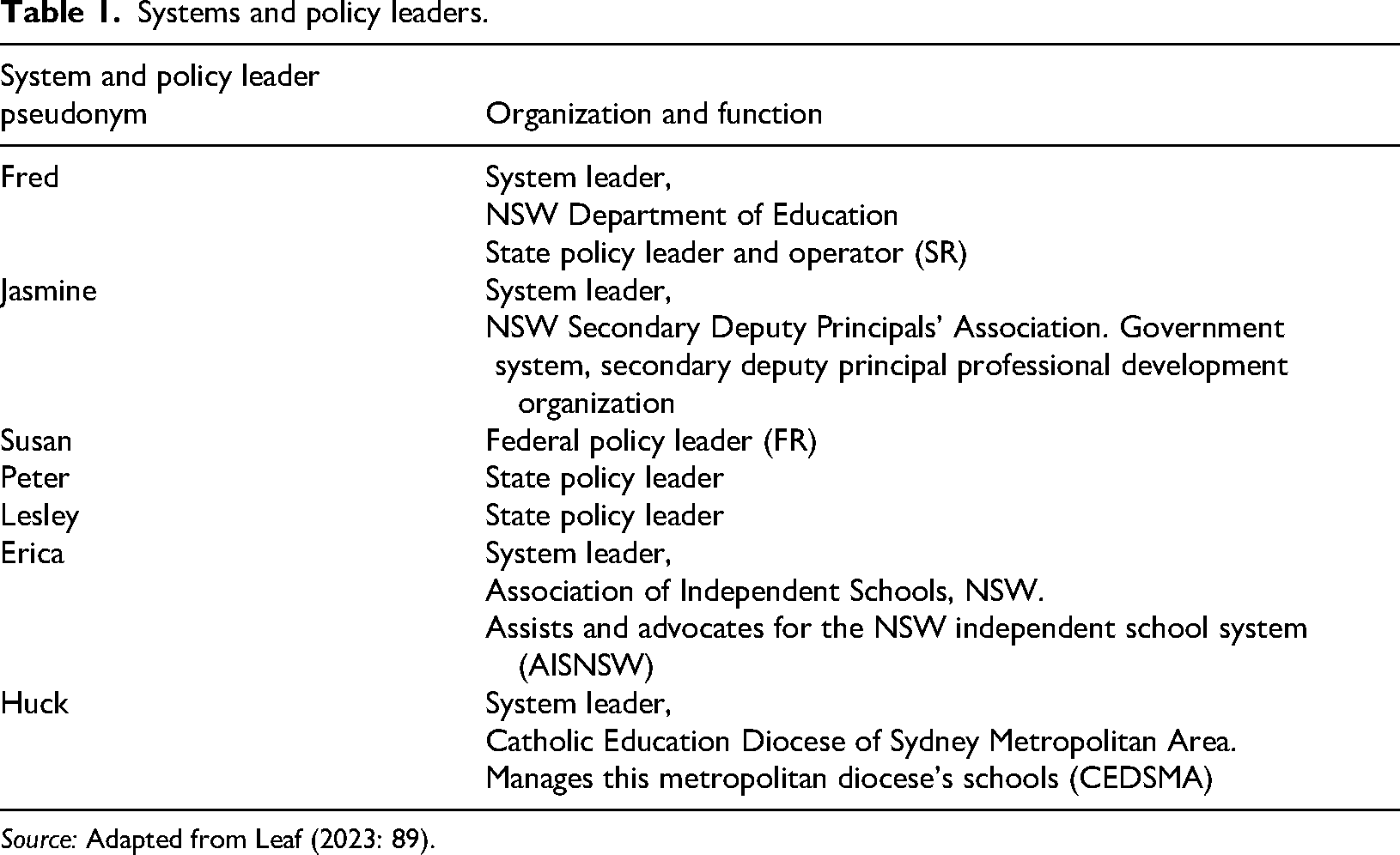
Source: Adapted from Leaf (2023: 89).
All but one system or policy leader had taught and obtained various leadership roles in NSW primary and or secondary schools. The federal policy leader (Susan) had taught overseas.
Study 2: School perspectives
Multiple cases provided deeper knowledge of the impact of context and richer descriptions, as well as fostering generalizability (Miles et al., 2014) so Study 2 used a cross-sectional, multiple case study of five purposively selected NSW schools in government and non-government schools. The Australian My School (Australian Curriculum, Assessment and Reporting Authority (ACARA), n.d.) website operationalized the investigation (Yin, 2009), facilitating varied settings in which to investigate the deputy phenomena—for example, the school type, educational system, size, and Index of Community Socio-Educational Advantage (ACARA, 2015). This purposive school sampling facilitated interviews with their five principals and 11 deputies and allowed access to selected school documents. The case studies can be seen in Table 2.
The five case studies.
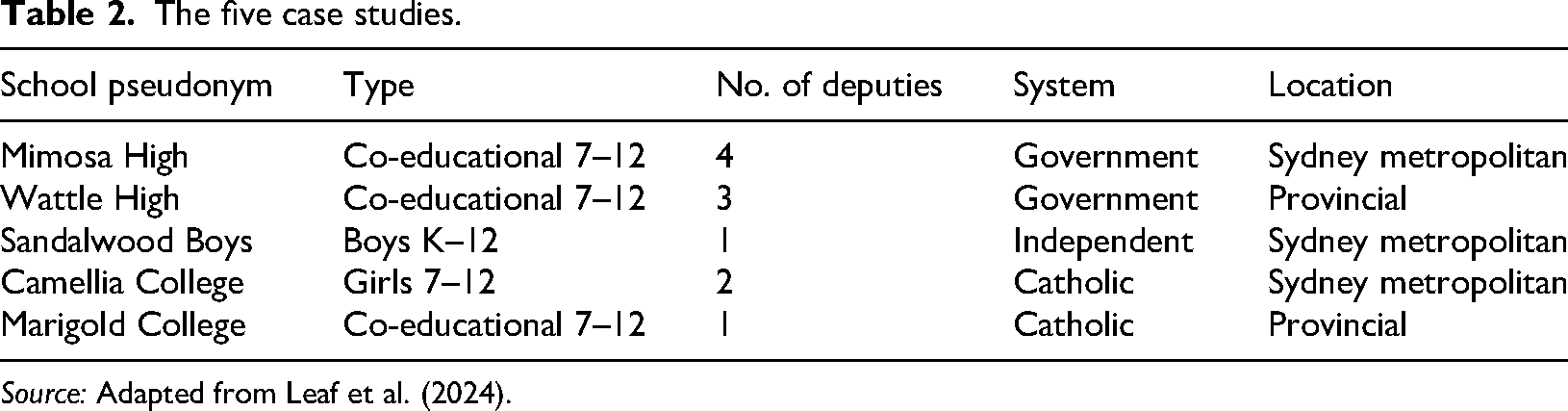
Source: Adapted from Leaf et al. (2024).
Data collection protocol
Twenty-three participants—11 deputy principals, five principals, and seven system and policy leaders—participated in face-to-face, semi-structured interviews conducted privately on site. Data analysis was triangulated with school documents, though these are not reported here, as metaphors appeared only in the qualitative survey and case-study interviews.
Data analysis
The analysis was informed by CMT (Lakoff and Johnson, 1980), which views metaphors not merely as linguistic embellishments but as fundamental cognitive mechanisms that structure thought and experience. This theoretical orientation enabled a systematic examination of participants’ spontaneous metaphorical expressions to uncover how they conceptualize and make sense of their professional roles, challenges, and identities as deputy principals.
Through iterative coding and interpretive analysis, metaphors were identified, categorized, and analyzed for their conceptual significance. This approach provided insights into the affective and cognitive dimensions of deputy principals’ leadership experiences that augmented the original role-based analysis reported in the earlier study.
The 23 audio-recorded interviews were transcribed professionally and researcher-checked, and then each script was emailed to the appropriate participant, initiating participant validation (Stake, 2010). Word tools and the electronic Max Qualitative Data Analysis 12 were used for the analysis. The first author was previously a government-school secondary deputy principal, so researcher subjectivity and background is acknowledged and was reflected upon (Johnson and Christensen, 2008). The findings align with the data that is presented, enhancing reliability (Merriam, 2009). Theory was tested inductively, impacted by in-situ learning, but we recognize that theoretical leadership frameworks impacted both analysis and interpretation (Merriam, 2009). For this reason, Armat et al.'s (2018: 220) terminology—“inductive-dominant qualitative content analysis”—is more appropriate, acknowledging that a researcher's mind utilizes both inductive and deductive analysis, with one dominant during the process.
The study adopted Braun and Clarke's (2019: 589) “reflexive thematic analysis,” with the investigator immersed in the data, and new understanding through theming is seen as valuable and not a challenge to objectivity. The interviews were analyzed and progressed from coding to categorizing to theming (Rossman and Rallis, 2017). Thematic analysis generally moves from coding directly to theme development (Braun and Clarke, 2013). However, in this investigation, handling an abundance of data necessitated firstly creating categories to facilitate the development of themes (Rossman and Rallis, 2017). Theme and category terminology are often conflated in the literature so categories are defined here as clustering similar data together (Morse, 2008).
As an ongoing part of the data reduction process and pattern-making devices, metaphors in transcripts were identified, providing links to theory (Miles et al., 2014). Metaphors were recorded and documented in their context as part of the overall text coding to theming process. Metaphors across datasets further supported the conceptualization of the emerging themes.
Examples of the coding to theming process are presented in Figure 1.
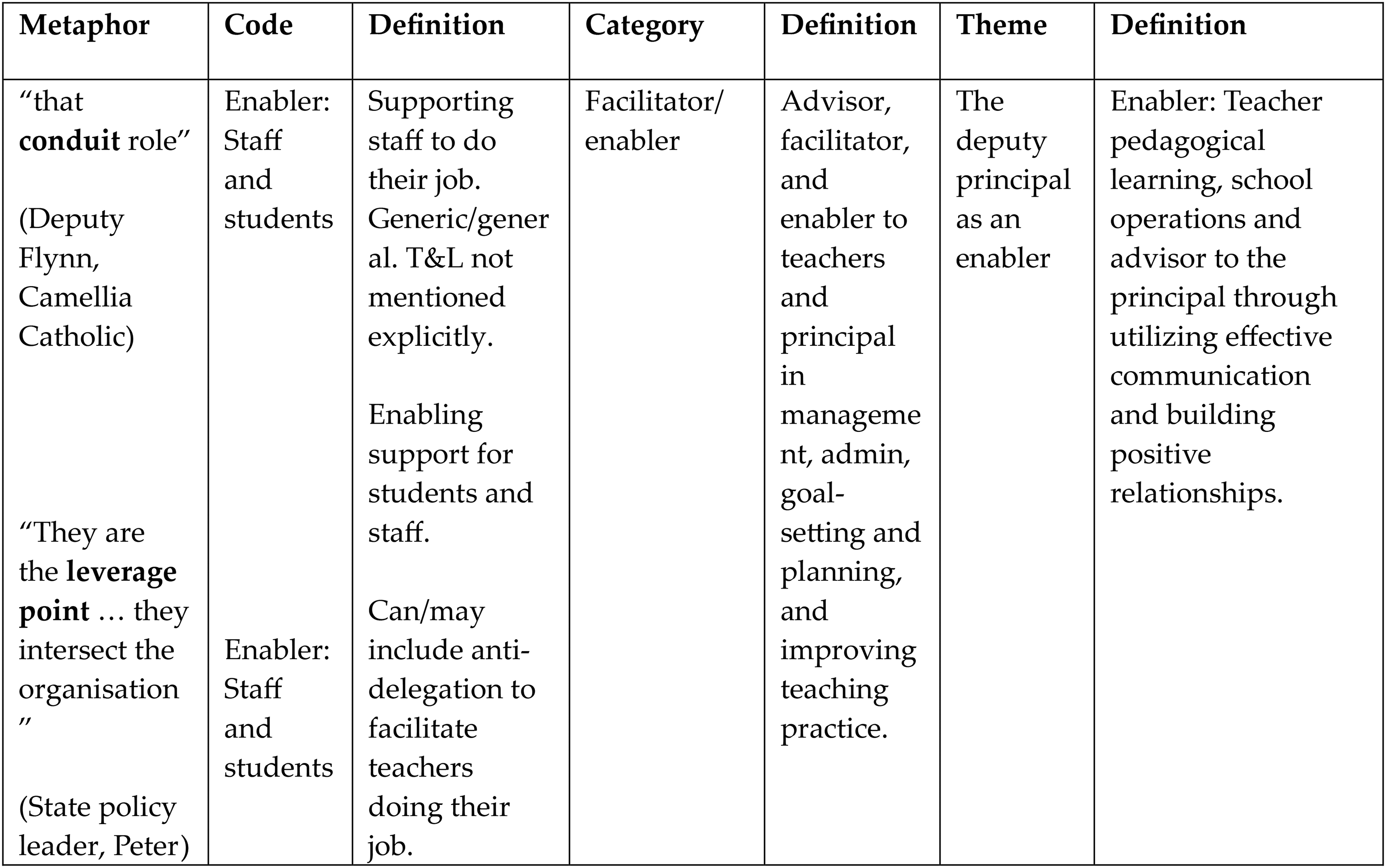
Data reduction process: From coding to theming.
Together, the 23 participants’ perspectives provided some triangulation, increasing credibility (Lincoln and Guba, 1985). Checking interpretations with respondents and peers established dependability through developing a recorded trail of methodological decisions (Lincoln and Guba, 1985). To address concerns of bias and increase “dependability” and “confirmability,” a reflection log was kept as an auditing process to track decisions (Lincoln and Guba, 1985: 327).
As the metaphors were unsolicited, they became even more powerful and worthy of exploration, becoming intimate descriptions (Clouse et al., 2013) and windows into the deputy world. Metaphor analysis has some limitations. It can reveal some aspects of a phenomenon while shrouding other key aspects (Gill, 2006). An inconsistency in metaphor research is that analysis can either result in deeper knowledge of a phenomenon, or cause misunderstandings and disconnection (Gill, 2006). Therefore, metaphors cannot be seen entirely as a perception lens (Morgan, 2006), nor can they be viewed as unbiased explanations (Heffernan et al., 2019).
Findings and discussion
As mentioned above, the current analysis employed CMT (Lakoff and Johnson, 1980) as a new theoretical lens, allowing for symbolic and cognitive interpretation of participants’ discourse. There were many metaphors identified throughout interview analysis. However, most were clustered around the specific themes of The deputy as an operational manager and The deputy as an enabler. In these two particular themes, the policy, systems, and school leaders generated similar metaphors, revealing similar conceptualizations of the deputy role.
In terms of metaphors generated, the role of deputies as leaders of teaching and learning emerged but was limited. These two themes of managing and enabling were the most abundant in metaphors. They are discussed below.
The deputy principal as an operational manager
The policy and system leaders, deputies, and principals created rich structural metaphors across the survey and multiple case studies, in keeping with this theme. Together, their voices illustrated the multifaceted, largely traditional, managerial role of the deputy principal, presented in Figure 2, which demonstrates, in more detail, the linguistic context of the metaphors, and which participants generated the metaphor. A discussion of some of the more insightful metaphors follows.
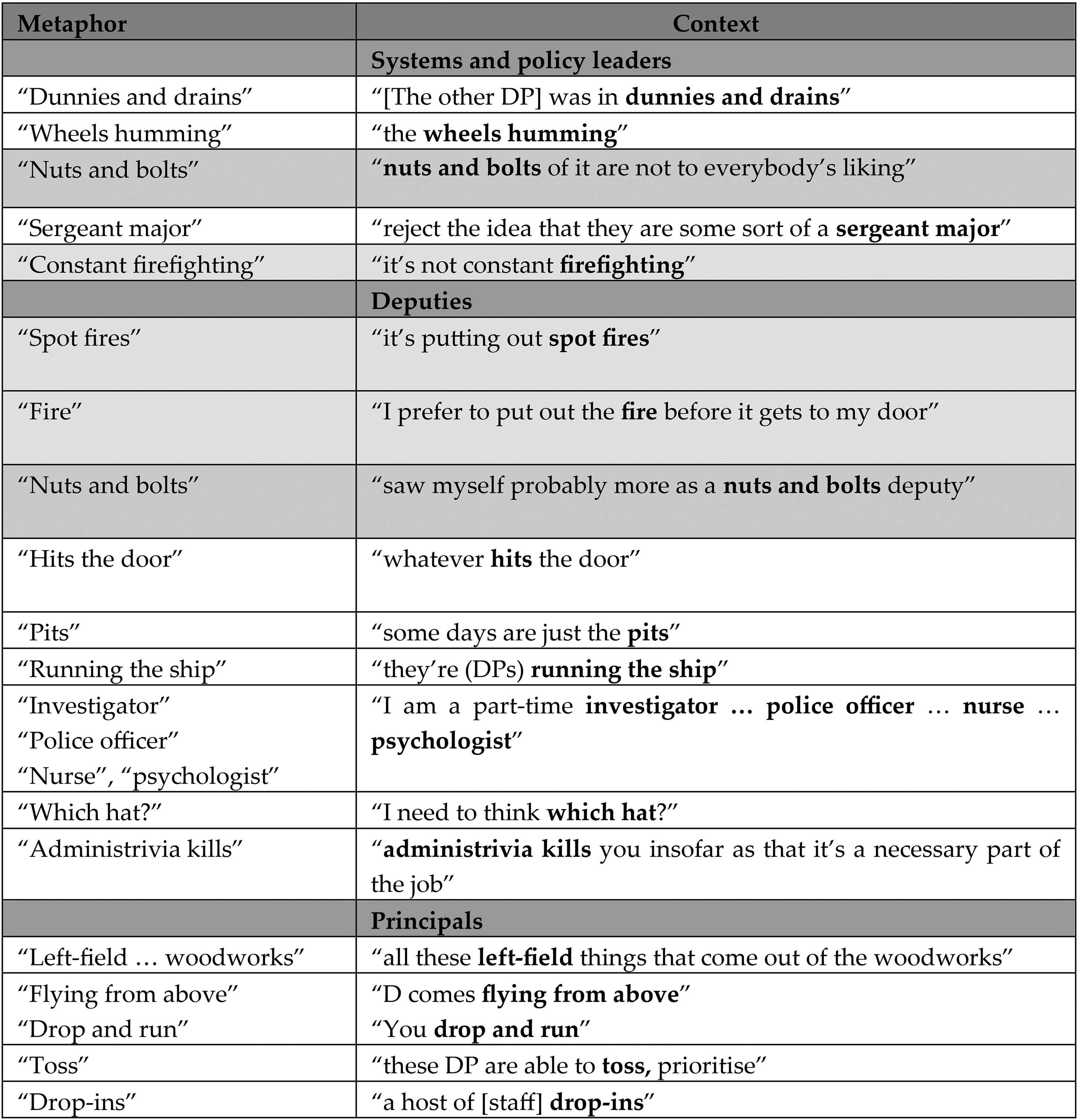
The deputy principal as an operational manager: Cross-model metaphors by participant group.
Deputies as machine operators
This NSW research confirms that our visualization of leadership has long been based on business administration models (Murphy, 2002). Gill (2006: 11) suggested that the last century's prevailing organizational metaphor has been the machine, leading to a school as a “factory,” and hence the ensuing focus on efficiency, with any variation perceived as a “defect” to be rectified during construction. Some metaphors reflect the Weberian bureaucratic approach of employees being mechanized to boost efficiency (Morgan, 2006). This theme is dominated by “ontological metaphors” which use the description of abstract concepts, like “Wheels humming,” to shape our understanding of the world, in this case how schools both move through mechanistic motion and activity. Through these metaphors deputies are positioned as wardens and protectors of various “ontologies” of schools.
What can be clearly seen in Figure 2—for example, “wheels humming” (policy leader Peter), “nuts and bolts” (both deputy Simon and Peter, policy leader), and “dunnies [toilets] and drains” (system leader Jasmine, NSWSDPA)—is the mechanistic perception of the deputy world. These machinery metaphors illustrate what Morgan (2006: 13) described as our embedded “mechanistic thinking” of bureaucratically organized schools, functioning as machines in a “routinized, efficient, reliable, and predictable way.” They illustrate Morgan's view of Taylorism, in which employees become machine assistants. Similarly, Sergiovanni (1994: 215) stated that school leadership, underpinned by management theory, still emphasizes “quality, productivity and efficiency” as part of keeping organizational stability. Educators still see deputies as maintaining the smooth running of the school, rather than as pedagogical leaders (Kaplan and Owings, 1999)—captured in policy leader Peter's “wheels humming” and “nuts and bolts,” and system leader Jasmine's “dunnies [toilets] and drains.” The deputies as machine operators’ appears in the metaphors used by systems and policy leaders (3/5) and also acknowledged by deputies own metaphor “nuts and bolts” (1/8).
Deputies as community, law enforcement, and emergency services
Metaphoric insights demonstrated that as part of maintaining the organizational machinery of a school, deputies were collectively perceived as emergency service personnel—for example, law enforcement, medical staff, and community service providers such as nurses and psychologists. These myriad of daily deputy roles were illustrated in deputies own metaphors (5/8); for example, by deputy James who posed a metaphorical rhetorical question about “which hat” he will wear for his multiple daily ad hoc roles, such as “investigator,” “police officer,” “nurse,” and “psychologist.” Some of these metaphors almost mirrored the historical discourse on DPs, such as Garawski (1978: 8), who stated that due to DPs role as “first-line management,” they were “an arbiter, a disciplinarian, or a counsellor.” Culver (1978: 114), using the same metaphor as James, 41 years earlier, warned that deputies should not be depicted as “school policemen.”
System and policy leaders also referred to these types of roles (2/5) in relation to firefighters and sergeant majors—a reference which echoes Culver's (1978) warning against deputies typecasting themselves as “sergeant majors.” Policy leader Susan also cautioned deputies to move beyond “firefighting,” suggesting this role was appropriate but not sufficient. The deputies made many references to firefighting imagery. Deputy Nick said, “I prefer to put out the fire before it gets to my door,” regarding discipline issues by visiting classrooms. Mirroring her colleague, deputy Denise spoke three times of “putting out spot fires” in managing student behaviour. “Firefighting,” as Edmonstone (2016: 119) stated, necessitates the immediate resolution of sudden challenges. These rich, metaphorical images draw us into what Kaplan and Owings (1999: 85) suggested is the “reactive crisis” deputy world, where management replaces developing instructional leadership expertise, in their opinion, due to lack of time. These images illustrate that “despite the general movement towards increased responsibilities for deputy principals, the traditional ‘maintenance’ view of the role persists” (Muijs and Harris, 2003: 7). This was exemplified by deputy Nick's personification of management: “it's whatever hits the door.” Managerial metaphors are so entrenched in educational discussion that they have dictated the thinking of the majority of educational stakeholders and limited other perceptions of schools (Hoyle and Wallace, 2007). Managerial metaphors seemed particularly pervasive in the two government schools, probably due to their disadvantaged school contexts. Similarly, Schechter et al.'s (2018) study found that Israeli principal metaphors focused entirely on administrative responses to restructuring agendas, instead of advocating for improving teacher quality. The current deputy study was comparable in that a lot of metaphors centered largely on management and administration and on indirectly enabling teaching and learning. In fact, deputy Flynn vividly personified his administrative duties as “administrivia kills.” Here, administration becomes an “ontological metaphor” (Lakoff and Johnson, 1980: 33), as Lakoff and Johnson (1980: 34) suggested, by explaining a phenomenon through personifying attribution of human behaviors—in this case, depicting administration as an “adversary,” or worse, as in this example, a necessary deputy assassin, to enable others to do their job.
Most participants did not generate metaphors explicitly capturing deputies as leaders of learning, other than policy leader Susan (FR), Principal Victoria and her deputy, Dennis. Federal regulator Susan moved beyond the traditional managerial metaphor and identified deputies as “deputy lead learners,” perceiving them as experts in pedagogy and recent research. Susan echoed Murphy (2002: 187), who suggested that principals and district leaders should provide “intellectual leadership not as head teachers but as head learners.” Huzzard and Spoelstra (2011: 80) pointed out that the “intellectual stimulation” implied by Susan is still linked to the notion of a heroic leader in transformational leadership. However, there should be a development from heroic leadership to “quiet leadership” requiring humility and problem-solving (Badaracco, 2003). Likewise, Murphy (2002: 188) replaced the heroic leadership metaphor with that of a “community builder,” whose enabling leadership is more thoughtful, indirect, and self-reflective and works though a relationship network, rather than top down.
Linked to Murphy's (2002) community-builder idea, an interesting teaching and learning gardener personification was used by Principal Victoria, suggesting her deputy's role was to “grow their [key learning area] leadership.” This was reinforced by her deputy, Dennis, who referred to “building their capacity and growth.” Huzzard and Spoelstra (2011: 77) maintained that the leader is perceived as a “gardener” who facilitates development in the organization's workers. However, Huzzard and Spoelstra (2011: 90) cautioned that growth is deliberately vague in leadership discourse because although it refers to “post-heroic leadership,” it is also hiding more controlling leadership. On the other hand, Drysdale and Gurr (2017: 173) suggested that, due to the intricacies of leadership, a dichotomy between “heroic and post heroic” is unnecessary, as leadership practices may necessitate different behaviors according to particular circumstances.
These educational leadership metaphors contrasted starkly with the other machine metaphors, perceiving the deputy as maintaining organizational stability. They revealed perceptions of a more emergent deputy role (Harvey, 1994), as leaders of schools addressing new educational agendas (Cranston, 2007). Yet the relative absence of educational leadership metaphors as data is, in itself, powerful (Charmaz, 2014), indicating the current focus of the deputy role as largely centered on managerial tasks, rather than educational leadership (Cranston, 2007).
The deputy principal as an enabler
Metaphors were critical in revealing original insights and illuminating the life (Schon, 1993) of these deputies. Linked to the machine metaphors discussed previously, policy leader Peter saw deputies as the “leverage point” and as “intersect[ing]” the whole school organization, enabling the school to function both operationally and pedagogically. His metaphors reflected deputies as key actors in effective schools (Sun and Shoho, 2017). This view is reflected in how the deputy role is conceptualized in Australia. The government and non-government (Catholic and independent) systems each have their own ways of managing the deputy role. The NSW Department of Education (2021) government deputy role description requires duties such as leadership of learning and teaching, school improvement, managing the school and working with the community. It makes explicit that, “deputy principals perform their duties in collaboration with and as delegated by the principal” (NSW Department of Education, 2021, para. 4). The principal's authority to conceptualize and develop the role is consistent across all three systems so the hierarchical structure of schools may be problematic for deputies to lead (Kılınç et al., 2025) as both followers and leaders (Ho et al., 2021).
However, in this research, principals’ inclinations to share power in a distributed approach (Hallinger, 2003) and deputy enabling of their principals was evidenced by various linked metaphors. Catholic deputy Flynn suggested “I free-range,” advising the principal on pedagogical matters, while government deputy Simon said his principal gave him “carte blanche” to also engage in educational leadership. These metaphors may be understood as orientational in Lakoff and Johnson's (1980) framework. The shared educational leadership between principals and their deputies (Calabrese, 1991) indicated in these metaphors demonstrates deputy and principal collaboration in building organizational capacity (Hallinger, 2003, 2012) and three-dimensional power where leadership is genuinely shared within the senior executive team (Abrahamsen and Aas, 2023).
In this theme, the metaphors evoking deputies’ role as school enablers are presented in Figure 3, where references related to educational leadership and teaching and learning, are highlighted in bold.
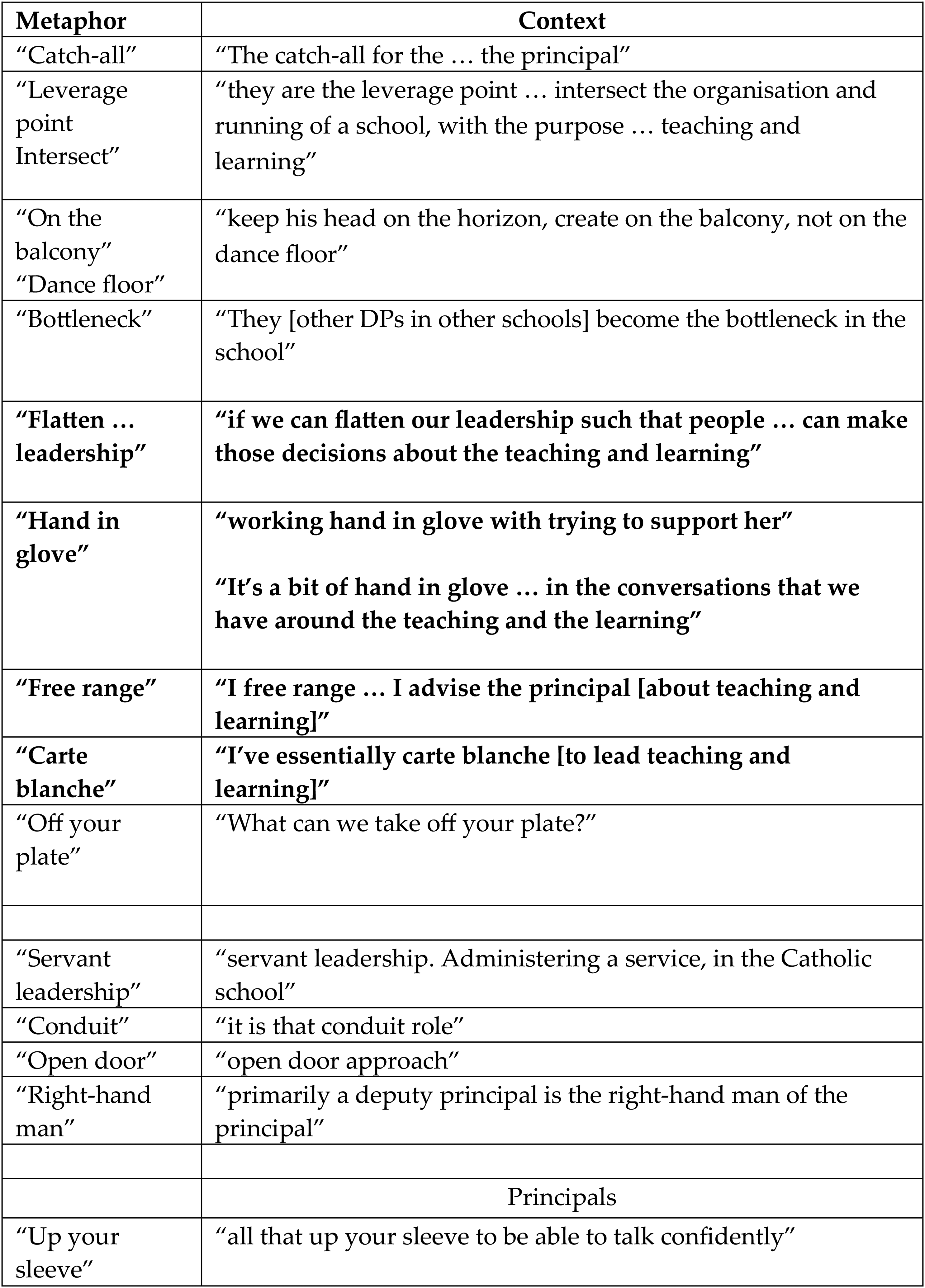
The deputy principal as an enabler: Cross-model metaphors by particpant group.
Other participants also perceived deputies’ enabling role to the principal. System leader Erica (AIS) perceived the principal “on the horizon” and “on the balcony,” not “on the dance floor,” and it was the other personnel who might enable the principal to envision. One assumes the deputy or other staff kept order on the dance floor. Here, Erica perceived the principal as the hero, at the apex of a “pyramid,” excluding all others (Badaracco, 2003: 4). However, an exemplar leader seems mutually exclusive to sharing power and overlooks that envisioning usually results from a group working together, not from one exemplar leader (Yukl, 1999), also evidenced in this NSW study.
Interestingly, a sleeve—and, in particular, the hand—and their metaphorical enabling functions were also used to symbolize deputy support for the principal by different participants: “up your sleeve” (principal Andrew), “catch-all” (policy leader, Susan), “right-hand man” (deputy Mark,), and “hand in glove” (deputy Flynn). Flynn repeated the “hand in glove” metaphor, reflecting his two different responsibilities: providing generic support for the principal and working collaboratively on teaching and learning. These enabling images were similar to Ertürk's and Akgün's (2021: 46) Turkish primary and secondary multiple case study. Their teachers regarded their deputies as facilitating communication and unity, metaphorically identified by “bridge,” and as communicator, identified by “adhesive.” These and other Turkish deputy practices were required to enable their principals.
Facilitating others, deputy Flynn explained that his senior executive was trying to distribute leadership to other teachers, saying that at their school they “flattened their leadership” to build staff leadership capacity (Marks and Printy, 2003) as shared decision-makers regarding teaching and learning. This range of metaphors indicates bidirectional interactions, suggesting a transformational approach, rather than one of command and control (Printy et al., 2009). However, despite the distributed educational leadership, the metaphorical “right-hand man” and “catch-all” still reflect Weber's (1978: 957) supervision through an “office hierarchy” and ultimate acceptance of “principal as boss” in a bureaucratic organization (Mertz, 2000: 8).
The metaphors generated were fairly consistent in meaning-making on the theme of the enabling role of the deputy. Metaphors are inextricably linked to the setting in which they occur (Gill, 2006), evidenced by the two deputies at a Catholic College. They had particularly revealing perceptions of being in service to others (Smerka, 1980) through the metaphors they generated. For example, deputy Lily saw herself as offering an “open door approach” to staff to discuss issues, reflective of “individual consideration” in transformational leadership (Leithwood et al., 1996: 806). She also described her “servant leadership” in keeping with her religious views regarding her service to others. Similarly, deputy Flynn saw himself as a “conduit” enabling teachers to focus on teaching. He offers to take administrivia “off your plate” to his teachers. These images reflect the out-of-date idea that successfully overseeing school operations to facilitate teaching is important, yet in reality, it has limited impact on student progress (Snitch, 2017).
Connected to deputies’ acceptance of these enabling responsibilities, several metaphors highlight and reinforce a “socialised disposition to the role” (Mertz, 2000: 1). For instance, deputy Flynn perceived the need to “suck it [administration] up.” Deputy Nick felt discipline was “part and parcel of the job,” as did his principal, Colin, who described deputy (discipline management) as “the nature of the beast.” These striking metaphors reveal further findings of the complete acceptance of the DP management and administrative role. As Armstrong (2010: 686) stated: “these socialisation practices remain unquestioned because they are normalized within the daily rituals of schooling.” Interestingly, in Rintoul's and Goulais’ (2010: 753) Canadian secondary deputy study, the “suck it up” metaphor was also used regarding the deputy role. However, in their case, Rintoul and Goulais (2010) regarded this metaphor as an indication of deputies’ resolve and a way for them to regulate their own behavior.
Conclusions and recommendations
In general, studies focusing specifically on deputies are limited, while the field is evolving and many aspects of the deputy principal's role remain underexplored. As argued in this paper, most of the global school leadership studies are principal-centric (Tahir et al., 2023). Research on how deputies themselves perceive their roles is particularly scarce—especially how they, and other educational stakeholders, make meaning regarding their leadership practices. This gap in the research limits our understanding of how deputy principals perceive, interpret and enact their responsibilities within increasingly complex school environments.
Significantly, this study reveals that deputies generate powerful metaphors to describe their leadership practices—with conceptual metaphors that offer deep personal insights into their professional identities and challenges. Unfortunately, with some notable exceptions, many of the metaphors captured in this study reflect the traditional conceptualization of deputy principals as school operations managers (Armstrong, 2010) rather than instructional leaders (Oleszewski et al., 2012). These images consistently reflect leadership functions and practices as maintaining the status quo rather than transforming and improving teaching practice. Although policy organizations and leadership development programs espouse equity, systemic support for the status quo raises questions regarding equity and democratic practices (Armstrong, 2010), providing fertile ground for further research.
By reexamining a subset of data through the lens of CMT, this study extends earlier findings from the broader project to reveal new dimensions of meaning-making and professional identity among deputy principals. By capturing these metaphorical narratives, this study not only addresses an underresearched area but also provides a nuanced understanding that can inform leadership development, support structures, policies, and succession planning in schools. The metaphors were dominated by structural metaphors and clustered around the themes of the deputy as an operational manager and the deputy as an enabler, which reflects a traditional conceptualization of their role.
As Da’as et al. (2025: 357) argued, “metaphors can simplify complexities and break down that which is abstract and incomprehensible into understandable images.” They can help explain our worldview—how we give sense to our reality, frame our problems, and select our paths of coping (Schön, 1993). This aligns with earlier discussions in the introduction, with particular reference to Paranosic and Riveros (2017). The metaphors used by deputy principals in this study convey their thoughts, perceptions, and feelings related to their experiences in their roles. They express the way they see the figure of the deputy principal and how it makes them feel.
The more ontological machine metaphors, were prevalent last century and may hinder creativity and fluidity (Gill, 2006), yet they are still evident in participants’ responses in this 21st-century study. The challenge is that mechanical visualizations underestimate organizations’ human elements, and preferred metaphors can imprison us, confining us to particular practices (Morgan, 2006). The discourse of leadership probably maintains how we perceive things (Edmonstone, 2016). Along these lines, Hoyle and Wallace (2007: 435) posed an important rhetorical question for consideration: “do changes in practice lead to changes in metaphor or do changes in metaphor lead to changes in practice?” Their suggestion is that political forces are usually more formidable than language.
Leadership research could further explore whether practice precedes meaning-making or the reverse, with important implications for policy, research, practice, and leadership professional learning programs. Metaphorical and other descriptive imagery provide useful tools for further investigation to reveal leadership in a range of contexts and by a range of leaders beyond just the principal. There is a place for looking past conventional prevailing metaphors, towards a form of leadership that is perceived in new ways, is more engaging, includes others, and is more constructive in comprehending it (Heffernan et al., 2019).
Limitations
It should be acknowledged that the first author was previously an NSW government secondary-school deputy principal but reflected throughout the analysis process (Braun and Clarke, 2019) and annotated key decisions to improve dependability (Snitch, 2017). Due to the small sample size, the presented analysis cannot be generalized (Zainal, 2007) and the metaphors are of purely exploratory value. Some quotations and metaphors presented in this article (e.g. “firefighting,” “nuts and bolts,” “right-hand man,” “conduit”) also appeared in Leaf et al., (2024); however, they are analyzed here from a distinct and deeper conceptual and linguistic perspective using CMT to explore identity construction and sense-making, rather than organizational or functional role enactment. When reflecting on the findings relating to metaphors, it is important to recognize that it may be that not all aspects of deputy roles lend themselves equally to metaphorical language. References to educational leadership, for example, are constrained to more ubiquitous educational terminology. A broad exploration of deputy roles, drawing on the full interview and document data, beyond metaphors, is provided elsewhere (Leaf et al., 2024).
Footnotes

Funding
The authors received no financial support for the research, authorship, and/or publication of this article.
Declaration of conflicting interests
The authors declared no potential conflicts of interest with respect to the research, authorship, and/or publication of this article.