




Abstract
Although constituting a significant position in the daily practices and development of many school organizations, little is known regarding how the position of the deputy principal is organized. The purpose of this paper is to explore how Swedish principals organize for the deputy principal position by focusing on the triggers and factors constituting their sensemaking of the division of responsibilities. The paper provides an additional perspective by focusing on the interpretive aspects comprising the organizing processes. The paper draws from qualitative interview data from a larger study on deputy principals’ position in the Swedish school system. The results show how principals’ sensemaking is triggered by contextual cues and reform-driven factors that together create spaces of ambiguity in relation to the organizing of the deputy principals’ position. Principals make sense of these events based on personal- and identity-oriented beliefs, as well as frameworks and perceived expectations from municipal organizers.
Introduction and background
The role of the deputy principal and the specifics of their responsibilities within school organizations is often conceived as ambiguous or hard to universally define within research on the subject. Prior studies describe deputy principals as the forgotten leaders in school leadership research (Cranston et al., 2004) and ascribe the lack of role clarification, job descriptions and undefined span of tasks as influential factors to hardships in understanding the position (Oleszewski et al., 2012; Morgan, 2018). The role is further complicated due to its variation in content, sometimes overlapping with other managerial positions in local school organizations (Watson, 2005). While these ambiguities are raised, other studies highlight the sometimes-overlooked significance of deputy principals in school improvement, instructional leadership and organizational development (Muijs and Harris, 2003; Hilliard and Newsome, 2013; Johnson, 2015), accentuating the importance of further developing our understanding of how to utilize their role in schools. The organizing efforts and decision-making shaping the role of the deputy principal is in many instances conceived to be at the hands of the principal (Weller and Weller, 2002; Jansen and du Plessis, 2023) – making them a valuable study object for further understanding of the role. Simultaneously, while a highly common position within Swedish school organizations, the concept of a deputy, assistant or vice principal is not present in regulatory documents at the national level. Neither has the role of the deputy principal in Sweden been given any significant scholarly attention in school leader or management research, motivating further exploration of how it is organized by principals within the specific educational context.
The regulatory context of the Swedish educational system is a necessary starting point for understanding the conditions principals operate within to organize the role of the deputy. In the 1990s, the system transformed from a centralized to a decentralized system of governance, making municipal and private organizers and local school professionals’ operative agents of the governments supply of political objectives (Sundberg and Wahlström, 2012). Principals has operated with a considerable amount of autonomy regarding decision-making within their individual organization in light of this system (Nordholm et al., 2023), with the direction and support in quality management being negotiated and executed in collaboration with local municipal organizers (Liljenberg and Andersson, 2021). However, due to frequent reforms during the last decade the decentralized foundation of the countries educational system has experienced a re-centralization movement that through reform efforts has located government control closer to the local managerial level of governance (Adolfsson, 2013; Adolfsson and Håkansson, 2021). The position of Swedish principals, wedged between national quality governance and local organizational circumstances, holds an underlying ambivalence that requires them to navigate between competing objectives (Ståhlkrantz and Rapp, 2022).
One example of the re-centralization movement, relevant to the studýs purpose, can be found in the Education Act of 2010 (SFS, 2010:800) which stipulates that all school units, whether municipal or private, in Sweden is to be managed, coordinated and internally organized by a principal, and only one principal per school unit. Dissatisfied with the direction of the municipal organizers’ governance and declining student scores, these changes made it possible for the government to bypass municipal organizers earlier discretion and regain control over local schools’ managerial composition from a distance (Madestam, 2017). The Education Act further states that the main responsibility for managing the individual school unit cannot be shared with other actors, apart from being able to delegate managerial tasks and decision-making in cases where these are not regulated by law to be executed by the principal. Prior studies have highlighted how this creates legal possibilities of different forms of shared leadership and inter-organizational collaborations with municipally organized managerial functions (Döös and Wilhelmson, 2021), while simultaneously depriving principals of the possibility of actual shared principalship. Although Swedish principals held the sole formal responsibility of the school's organizations, Döös et al. (2018) found that tasks and responsibilities were divided between them and the deputy based on collaborative and structural arrangements, informed by factors such as grade differentiation, municipal organizer influence and personal preferences of the school leaders.
While the judicial and organizational structures conditioning principals organizing efforts in relation to the role of the deputy principal has been elaborated on above, less is known concerning what precedes and shapes these circumstances in terms of principals’ interpretive processes. Following this, the purpose of this study is to explore how principals in the Swedish educational context make sense of the deputy principal role by focusing on their perceptions related to the division of responsibilities in the local school organization. The study is guided by the following research questions:
What are the main triggering events for principals in relation to the division of tasks and responsibilities between themselves and the deputy principal? How do the principals make sense of these events – and what are the central factors that characterizes the sensemaking process?
Triggers and factors of organizational sensemaking
In order to explore the triggers and factors shaping principals organizing of the deputy principal role, this study is theoretically informed by organizational sensemaking (Weick, 1995; Weick et al., 2005). Sensemaking is, first and foremost, set in motion by organizational actors when daily practice is disturbed, when something is perceived as different or when there are some discrepancies in actors’ sense of the world around them (Weick et al., 2005). These triggers constitute the contextual cues and violated expectations that fuel the actors need to make sense of what is going on in the organization (Maitlis and Christianson, 2014). In making sense of these situations, actors interpret and bracket cues from their environment, coupling them to prior experiences, knowledge and beliefs (Weick, 1995), which in turn coordinates further action in response to the initial triggers. The process is in essence socially constructed as it unfolds and is shaped by interactions and negotiations with others (Maitlis, 2005) and within and between levels of the organization (Orton and Weick, 1990). The perspective has priorly been thoroughly applied and developed in prior research on how principals and other school actors make sense of and act in response to ambiguous or complicated situations in educational organizations (e.g., Spillane et al., 2002; Coburn, 2006; Ganon-Shilon and Schechter, 2017). Prior studies on principals sensemaking in regards to organizing professional roles in Swedish schools has illustrated that principals own experiences, beliefs and apprehensions of pressures or support from municipal organizers plays an important role in how the particular position is shaped within the local organization (Andersson, 2022; 2023).
Research methodology
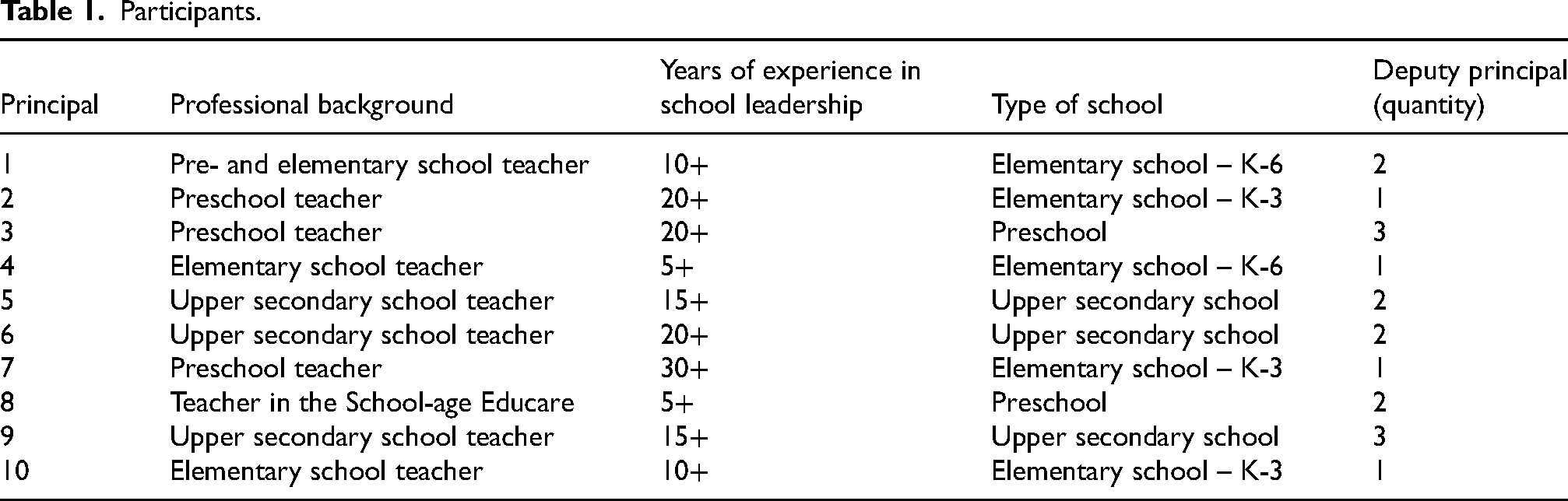
The paper draws from empirical data collected in a larger research project on deputy principals’ position and responsibilities within the Swedish educational context. In all design and execution phases of the present study, ethical guidelines from the Swedish Research Council (2023) were taken into consideration in order to conduct the study in an ethical matter. The study was designed based on the iterative logic and analytic strategies from constructivist grounded theory (Charmaz, 2014; Richardson and Kramer, 2006), adhering to the constant comparison method within and between different sets of data collection and a reflexive approach to differing theoretical explanations and research literature. Qualitative empirical data was collected from different sources and through different methods, increasing validity and reducing subjectivity through triangulation in the exploration and analysis towards theoretical concepts in the larger study (Jonsen and Jehn, 2009). These sources consisted of a qualitative content analysis of job advertisements directed towards deputy principals in Sweden, semi-structured interviews with Swedish principals (see Table 1) and available job descriptions extracted from principals participating in the study. Following the purpose of exploring principals’ apprehensions and sensemaking related to the division of tasks and responsibilities in school organizations, the present paper focuses exclusively on data collected from the semi-structured interviews conducted with school principals (n = 10). Since the study had an explorative approach, the sampled participants were chosen based on a judgement sample (Marshall, 1996) of key informants who represented a wide range of different school sites and grades (see Table 1 – Participants).
Participants.
The content of the interview questionnaire was constructed in part based on prior analytic themes from the wider study – and in part based on prior literature on deputy principals’ position and responsibilities. The participating principals were asked questions regarding their views on the position of the deputy principal in relation to themselves, their definition of responsibility within their organizations, what areas of responsibilities were delegated to (or shared with) their deputy, and why certain responsibilities were delegated, or shared, with their deputy, and not others. Interviews, which were performed either on-site or through Zoom-calls, lasted between 20 and 45 min and were subsequently transcribed and analyzed throughout the study. Coding and analyzing procedures were executed through a step-by-step process influenced by grounded theory methodology (Charmaz, 2014) – where initial, line-by-line coding was followed by more focused coding to construct categories of the empirical material. Alongside extensive memo-writing, these steps were repeated throughout the studies execution and in the latter stages analyzes shifted towards connecting and focusing these categories in order to develop a theoretical understanding (or sense of saturation) of the material.
Results
Triggers – Local and systemic phenomena
Two interconnected themes in relation to sensemaking triggers emerged from the principal interviews regarding deputy principals and the division of responsibilities: Expanding mission due to expanding (or large) school units, and Changes to the education act: One school, one principal.
Local triggers – Expanding mission due to expanding (or large) school units
A majority of the principals shared the perception that deputy principals were essential in managing the current managerial mission due to the share amount of tasks and responsibilities resulting from the size of school units. Many conveyed this to be either a result internal pressures following higher rates of students and succeeding responsibilities, budgetary constraints within the municipality or strategic decisions by the organizers to create a more coherent organization. Some principals perceived their sometimes-overwhelming workload as a trigger to making sense of the deputy principal role due to finding themselves not being able to execute key tasks inherent to the principals’ position. This was often expressed in terms of internal pressures, extracted as cues within their immediate context: R4: The reason is that since it is such a big school here, we needed to make changes to free up time for the principal. Not only day-to-day things, but also having time for reflection, reading about things and school development issues. I needed the time to be able to do such things. I didn’t have time for anything other than ‘running around’. I did not do what I was supposed to do. There was no room for that.
In other cases, principals had experienced an expansion of the local school organization following municipal decision-making and budgetary constraints. Unlike the internal organizational pressures described above, the principals expressed these situations as triggering due to cues being communicated from outside the local school organizations, making them no longer able to manage all principal responsibilities by themselves. In some cases, principals found themselves in ambiguous situation of responsibility-sharing due to the deputy principal ‘coming with the package’ when municipal organizers decided to expand the local school unit: R7: It was not me who decided that I would have a deputy principal. It was my superior when they decided to expand the elementary school and organized for someone to fill in for the additional responsibilities.
In these events, what was earlier perceived as manageable within the principals’ mission was disrupted by changes to the local circumstances, enlarging their organizations and responsibilities within them and requiring additional managerial actors in order to maintain a functional organization. As seen above, this triggers could stem either from more immediate, contextual cues in the principals environment, or become triggering through external pressures from municipal organizers. Some principals had not experienced any specific, significant events that could be directly tied to problems associated with the division of responsibilities – while still finding the process hard to make sense of. What was common for this theme was the fact that the triggers was extracted from instances within the municipal- or local school unit level of management.
Systemic triggers – Changes to the education act
On the contrary to the first instance which had its root of influence within the principals’ immediate context, the second trigger descended from a source outside of the local organization. Following a government enforced reform change in 2011, it was no longer possible to have two or more principals responsible for the same school unit – a reform that many of the principals referred to as the ‘one school, one principal’-policy. R6: They changed this in our municipality, from a structure consisting of an upper-secondary manager and principals constituting the organization, to what was considered an organization in line with changes to the education act – one school, one principal.
This reform led to what many principals perceived as a substantial re-organization within their municipalities that resulted in former principal-positions being replaced by deputy principals. In turn, this changed the dynamics between layers of leaders within the schools and lead to difficulties in understanding how responsibilities should be shared. The principals now had ‘full’ executive responsibility for their inner organization, which actualized the question of how responsibilities could be delegated or shared to other leader-categories in the organization: R2: The organization was continuously restructured, and when principals left quite a few deputy principals were appointed in a short time. It became quite obvious in that re-organization that you needed to clarify the division of responsibilities; it was new for everyone. From actual shared leadership to the fact that things started to move towards deputy principalship.
When combined with the prior triggering events in the local context, the organizational changes emanating from the reform resulted in a situation in which the principals perceived their position as hard to manage due to the overwhelming amount of tasks, while also having a sole executive responsibility for their inner organization as a result of the reform induced re-organization of the municipality. Following this, deputy principals could not legally have executive responsibilities – which created a dilemma to many principals concerning what the deputy principal should and should not do within their mutual organization. The dilemma of responsibility-sharing was present in a large majority of the principal responses.
Making sense of deputy responsibilities – The central factors
The principals that participated in the study appeared to make sense of the dilemma and triggers explained above on the basis of different factors – often coinciding in the perceptions of individual respondents. In this section, the most common factors will be detailed and explained under separate headings. These are: leader identity, municipal organizer control or support, and personal or professional characteristics.
Leader identity
The first factor had to do with principals’ perceptions and beliefs regarding what it is to be a principal – and what responsibilities composes that particular identity. As described by Weick et al. (2005), the act of facing difficulties in organizations perceived as in need of clarification is frequently connected to questions to who we are, and this process ‘(…) begins with a sensemaker’ (Weick, 1995, p. 18). Many of the principals expressed that they identified their position as being strategic which entailed responsibilities of a more holistic nature – while deputy principals where conceived to be operative, entailing responsibilities being performed closer to the teaching practice: R5: They have their specific tasks, which can differ depending on the program. I have insight in to all the programs, which they do not. I try to see the wider picture, to see synergy effects between the programs, and in some way I have an information advantage in that too. I am also part of the municipal organizing team.
Others, although expressing that their position as a principal entailed more strategic responsibilities compared to the deputy, dis-identified with a sole, holistic leadership identity and actively sought out tasks which brought them closer to educational practice. Often, this was motivated based on a preferred, earlier possessed leader identity – one that had a closer relationship to the teachers and students: R1: I have to be there and keep an eye on my students. I feel that I want to be a ‘living’ principal in some way. I don't want to be some eccentric sitting in my room all day. I have to be ‘in it’ because that's what feels best to me.
Although all participating principals identified with a strategic leader identity, differences in identification shaped the division responsibilities in part on the basis of how they conceived them to correlate with their preferred leader identity – resulting in more or less operative tasks carried out by principals (and therefore not being delegated to the same extent to deputy principals).
Municipal organizer control or support
The second factor consists of principals’ apprehensions connected to pressures and influence from municipal organizers. While the principals expressed high levels of discretion in how to organize for the division of responsibilities between themselves and their deputy – a large majority expressed different forms of control efforts being communicated to them by their superiors. One such effort that was commonly expressed had to do with local quality management in the municipality, where the deputies’ role related to efficiency and development of the individual school unit constituted a point of interest: R2: Within the school unit, I am in control. Well, the principal together with deputy concerning the organization. Then the municipal organizer follows it up. They are careful to do that in their systematic quality work. And there is a clear question of structure and of the organization. Is it working as it should do? How does it work? This if followed up 3 times per school year.
The position and function of deputies in the municipality here constituted part of the strategic developmental work and was subjected to continuous assessment and systematic evaluation. Others expressed the notion that the municipal organizers had expectations related to what is to be considered principal responsibilities, and therefore what is not to be considered responsibilities of the deputy. Some principals expressed that these responsibilities were written in their job description from the beginning of their tenure, others perceived them to be informally expressed through meetings and other types of communication. One common example of such a responsibility concerns budgetary and economic responsibilities: R4: Economic questions, without a doubt. But that is the division that we have made. I am the one who makes the decisions. I have been involved in the economy from the beginning. I also believe that the municipal organizers expect me to be the one to have that responsibility when it comes to financial statements, interim decisions, monthly follow-ups, etc. That means that the principal must have that responsibility.
While many principals expressed high influence and control from their superiors in regards to the organizing of their deputies mission – many of them also perceived this as providing a sense of security in their own decision-making due to a lack of direction from national governance and the Education act regarding the deputies role: R6: It is a fairly robust and secure framework for me to lean towards in relation to the role of the deputy principals. It is quite clear and quite equivalent between schools within the municipality. There may be someone who has a slightly different design for their role, but most have roughly the same role as my deputies have.
Sensemaking is essentially a social process (Maitlis, 2005) and the principals in this study seemed to draw substantially from the inter-organizational relationship with the municipal organizers. In this instance, the municipal organizers appeared to provide comforting cues to the principals in their work of organizing the deputy position, as well as assisting them with a framework to make sense of how to divide the responsibilities. While support was present in a large majority of the respondents cases – there were also large variations in how this support was organized, with some principals expressing higher amounts than others.
Personal or professional characteristics
The third and factor is comprised by the principals’ preferences related to personal or professional characteristics of the deputy principal – and how these characteristics are complementary to their own characteristics in relation to dividing responsibilities in the organization. In more general terms, many of the principals expressed that the deputy principals’ position was integral to managing the share quantity of tasks involved with the school's mission – and could be delegated a variety of responsibilities depending on their prior experiences, knowledge and preferences: R8: What I think about a lot is the competencies of my deputies. We have to see who we are, what strengths we have and what we can use them for because I think that is the most important thing. I don't have to do everything, and I don't have to be the one who runs the whole ship, but we have to take turns holding the helm.
Although day-to-day tasks were shared between the principal and the deputy based on these perceptions, many principals considered the strategic leadership responsibilities to be solely inherent to the principal position. The deputy was here considered by many to only assist in managing parts of these responsibilities in close proximity to the principal. However, some developmental and specified improvement tasks could be delegated to the deputy based on the principals’ perceptions of their competencies.
Concluding discussion
The purpose of this study was to explore how principals in Sweden make sense of the deputy principal role – focusing on the triggering events and factors behind the division of responsibilities between themselves and the deputy in their local organization. In light of prior studies conceptualization of the deputies role as being hard to comprehend (Oleszewski et al., 2012; Morgan, 2018), the results of the present study appear to shed some light on the interpretive and contextual factors shaping this apprehension in the Swedish context. The triggering events explored within this study which ignite principal sensemaking can be described as conflicting, and co-constructive, pressures of governance, in line with prior research on Swedish principals’ navigation between competing objectives (Ståhlkrantz and Rapp, 2022). The principals’ managerial position, having to adhere to objectives from both the municipal organizers and the national government, appeared to initially create uncertainty in how to organize for the role of the deputy. This is evident by their perceptions of pressures from governmental, re-centralizing efforts (Adolfsson, 2013; Madestam, 2017) which made them the sole responsible for the internal organization, as well as pressures from the internal organization and not being able to manage the growing quantity of responsibilities by themselves. This appeared to create a space of ambiguity for the principals – having to rely more heavily on deputy principals for a functioning school organization, while simultaneously not having an imperative framework for the width or content of their responsibilities.
As seen in prior studies (Nordholm et al., 2023), the principals of the study appeared to manage their organizations with a high amount of autonomy within the present, de-centralized system (Sundberg and Wahlström, 2012) – being able to draw from individual factors such as leader identity and perceptions of personal- or professional characteristics in making sense of how to share tasks and responsibilities with their deputy. In line with Döös et al. (2018), perceptions regarding structural and personal factors appeared to assist principals in how to organize this matter – paving the way for varying iterations of task- and responsibility-division. Municipal organizers have priorly been conceived as central figures in shaping other aspects of local educational and quality managed within the Swedish system (Andersson and Liljenberg, 2020; Adolfsson and Håkansson, 2021) and has been conceived to have an impact on the organizing of deputy principals (Döös et al., 2018). The present study expands the prior results in regards to how and in what ways this might be enacted from the perspective of the principals. The lack of a framework or judicial imperatives from the national level of governance in relation to principals organizing of deputy principals appeared to create a need for municipal guidance on the issue. While this in some cases were perceived as a control mechanism for local quality management by the principals, many also expressed the guidance from municipal organizers as comforting due to having a municipal-wide framework to fall back on. The structure of this guidance also indicates an aspiration towards consensus in the municipal school organization regarding the deputy role – which might constitute an initial step towards developing the understanding for and utilization of the role within the wider organization (Hilliard and Newsome, 2013; Johnson, 2015).
Footnotes
Declaration of conflicting interests
The author(s) declared no potential conflicts of interest with respect to the research, authorship, and/or publication of this article.
Funding
The author(s) received no financial support for the research, authorship, and/or publication of this article.

Author biographies