



Abstract
The study explores leadership practices of school principals in marginalised communities during times of crisis in public schools in Lebanon. Through in-depth, semi-structured interviews with 24 school principals, we examine (1) their leadership practices and (2) the rationales they gave these practices. This research employs a conceptual triangulation of the Bolman and Deal four-frame model and Foucauldian concepts of governmentality, surveillance and technologies of the self to critically analyse school leaders’ narratives. Findings suggest that, in the compounded-crisis context of Lebanon, school principals exhibit a tension between re-evaluating their routine practices and maintaining established systems of control and surveillance to ensure the efficient functioning of their schools. This study underscores the need for future research to explore how leadership in marginalised contexts can move beyond these normative practices to develop more empowering and human-centred approaches, especially during crises. This research could inform practices that balance structural efficiency with teacher empowerment and community engagement, fostering sustainable educational leadership. Findings of the study can also have implications for policymakers to consider this dynamic and develop leadership preparation programmes and professional development that build principals’ capacity to navigate their complex roles while working towards the necessary structural reform.
Introduction
Research on educational leadership in crisis contexts has proliferated, yet it remains shaped by assumptions of stability, episodic disruption and universal applicability. Most studies foreground the experiences of leaders in well-resourced Western settings. This leaves critical gaps in understanding how leadership operates under protracted crisis conditions, particularly in fragile, resource-deprived contexts marked by socio-political instability. In Lebanon, where crises are chronic and structural, educational leadership faces unique and underexplored challenges. Although research on leadership during disruptions such as COVID-19 has grown, it largely reflects the institutional conditions of the Global North (Mifsud and Day, 2022). Such work often overlooks the dynamics of leadership in contexts shaped by ongoing structural marginalisation, economic collapse and political precarity. In Lebanon, public school principals contend with layered crises, including mass displacement, infrastructural decay and the collapse of public services, while managing historically underfunded and socially peripheralised institutions (El-Amine, 1994; World Bank, 2021).
The global literature increasingly acknowledges the emotional, relational and ethical dimensions of educational leadership under pressure (Harris and Jones, 2020; McKay et al., 2022). Yet the dominant frame continues to privilege performativity, efficiency and managerialism (Bush, 2019), often underpinned by surveillance practices aimed at monitoring and controlling behaviour (Skerritt, 2020). How such logics are taken up, or resisted, in fragile, under-researched contexts remains poorly understood.
This study addresses this gap by examining how principals in Lebanese public schools serving marginalised communities interpret and use surveillance not simply as a mechanism of control, but as a tool of support. This inquiry is situated within a theoretical framework that triangulates Bolman and Deal's (1997) four-frame model with Foucauldian concepts such as governmentality and technologies of the self (Foucault, 2023). This enables a dual-layered analysis: one that foregrounds both the structural demands placed on school leaders and the agentic ways they reframe and repurpose these demands within contexts of chronic instability.
Prior work on Lebanese educational leadership has largely centred on private schools (Hilal, 2021; Harb and Karami-Akkary, 2021), neglecting the perspectives of those operating in public schools that serve refugees and low-income communities. These leaders contend with resource scarcity, heightened accountability and shifting expectations of care and discipline, conditions that demand a rethinking of leadership as a practice of containment, negotiation and situated ethics rather than transformation.
This paper contributes an original account of how surveillance is recontextualised not only as a control mechanism but as a perceived modality of care and support in high-stress, low-resource schools. It builds on, but critically departs from, global crisis leadership research by centring the persistent nature of crisis and by problematising the binary of control versus support through a Foucauldian lens. This study makes three contributions: repositioning surveillance in educational leadership discourse; centring the rarely heard Global South leadership voices; and conceptualising leadership in fragile systems. In advancing these claims, the article aims to contribute to both crisis leadership literature and broader debates about the future of educational leadership in the context of systemic inequality and geopolitical dislocation.
Contextualising the study
Before delving into the conceptual tools utilised in this study, it is essential to provide an overview of the Lebanese context to ground the research aim and approach. Lebanon's compounded crises, spanning political, economic, and social domains, have created an environment in which educational leadership is uniquely pressured to adapt while grappling with systemic instability. These pressures shape not only the day-to-day practices of school leaders but also their broader conceptualisation of leadership itself.
Context of the study
The Lebanese context offers a compelling setting for studying leadership practices due to its chronic political and economic instability (World Bank, 2021). This instability has shaped Lebanon as a nation in a state of protracted structural crisis, characterised by persistent inequities and chronic under-resourcing. Historically, this has meant that education for marginalised communities has been repeatedly disrupted. During the Lebanese Civil War (1975–1990) and the 2006 Israel-Lebanon War, schools were often destroyed or became inaccessible, leading to prolonged closures and a disproportionate impact on vulnerable students. More recently, the Syrian refugee influx since 2011 has left thousands of children out of school due to systemic barriers and insufficient resources.
While this is the baseline reality, the educational system has also been subjected to a series of acute, sudden crises. Since 2019, the economic collapse and the COVID-19 pandemic have served as critical junctures that exposed and exacerbated the system's pre-existing vulnerabilities. Amid the pandemic, Lebanon also endured the Beirut port explosion in August 2020, which displaced over 300,000 individuals, caused severe damage to nearly 200 schools and deepened an already severe economic crisis. These acute crises have meant that schools in Lebanon closed for more than one and a half academic years between 2019 and 2022, with online learning available only to those with access to electricity, internet and digital hardware.
These events are not the sole source of Lebanon's educational problems; rather, they serve as compounding crises that intensify the underlying structural instability. In this article, we focus on the pivotal moments of the economic collapse and the COVID-19 pandemic to explore how principals navigate the daily reality of a system under constant strain.
Unlike many other countries, the private sector in Lebanon serves over 52% of K–12 students (CERD, 2020) with public schools increasingly serving vulnerable, marginalised and lower socioeconomic communities (El-Amine, 1994). In 2019, the economic crisis caused a significant influx of students from private to public schools as families could no longer afford private school tuition.
In Lebanon, public school principals are appointed based on recommendations from the Directorate of Education and a ministerial decree, with no exam or licensing process (Decree No. 44, 1964). Principals are responsible for scheduling, supervision, staffing assessments, procurement and reporting (Decree No. 590, 1974), with duties being largely managerial. They must also inspect classrooms, review lesson plans and assess teacher performance (Decree No. 590, 1974). The Ministry of Education and Higher Education (MEHE) and Directorate Inspection General evaluate principals' performance through inspections (Decree No. 2460, 1959), with possible outcomes including school closure or contract suspension (Baroudi and Hojeij, 2020). Despite these responsibilities and accountability, principals’ autonomy is limited; for example, although designated as chief administrators (Decree No. 590, 1974), staffing decisions remain centralised under MEHE. Such centralised governance and limited autonomy influence how principals navigate their roles, especially during crises that expose and challenge institutionalised leadership practices.
Crises have the unique ability to expose deeply ingrained, institutionalised and normalised leadership practices (Harris and Jones, 2020; Leithwood et al., 2020). Researching leadership during crises provides an opportunity to critically examine leadership as a social phenomenon shaped by invisible norms, assumptions and contextual factors. This study utilises the Bolman and Deal (1997) four-frame model to examine the multifaceted nature of leadership, alongside Foucauldian tools such as governmentality and technologies of the self (Foucault, 2023) to explore how school leaders shape their practices and rationalities in response to established rules and norms.
The compounded-crises context is particularly well suited for addressing the aims of this research. While Bolman and Deal's four-frame model has been critiqued for its instrumentalism (Bush, 2019), its use here is not prescriptive but heuristic, providing an entry point to examine how leaders rationalise their roles in plural ways. The Foucauldian lens is applied to trace how these framings are discursively constructed and embedded in broader power regimes. This paper begins with a literature review discussing the Bolman and Deal model, Foucauldian tools and their relevance to the Lebanese context. This is followed by sections on methodology, results and discussion, concluding with implications for educational leadership research and practice.
Literature review
This section reviews the concepts of leadership in crises, the Bolman and Deal four-frame model and Foucauldian tools of governmentality and technologies of the self to ground the study.
Leadership within the context of crises
Crises, including the COVID-19 pandemic, highlight the complex role of school principals (Leithwood et al., 2020). They expose systemic inequities, with vulnerable groups being disproportionately marginalised by dominant, standardised educational practices (Harris and Jones, 2020; Ravitch, 2020).
Research suggests that during crises, leadership becomes more networked and relational, with an emphasis on socio-emotional well-being and people-centric approaches (Harris and Jones, 2020; Leithwood et al., 2020). This contrasts sharply with the prevailing discourse framing leadership as a technical, standardised endeavour tied to performativity (Carroll et al., 2008; Hollenbeck et al., 2006). Leadership complexity intensifies in crises, especially in schools serving socioeconomically marginalised communities such as Syrian and Palestinian refugees.
The Lebanese context exemplifies compounded crises in a lower-middle-income country (LMIC), where public schools serve marginalised populations. These schools face both economic and sociocultural marginalisation, echoing other studies on school isolation (Colman, 2021; Ovenden-Hope and Passy, 2015). Ovenden-Hope and Passy (2015) emphasised that marginalisation is not merely geographical but also socioeconomic and cultural, a framing relevant to public schools in Lebanon.
Challenges in compounded crises
In contexts of compounded crises, leadership might be expected to adopt more networked approaches and reconsider entrenched norms (Harris and Jones, 2020; Leithwood et al., 2021). However, this is challenging in performative cultures, where principals are subject to centralised governance (Ball, 2003; Jones and Ball, 2023). In Lebanon, these challenges are intensified by the panoptic oversight of ministry policies, mandates and inspections (Hilal and Akar, 2023; Foucault, 2023; Harb and Karami-Akkary, 2021).
Effective leadership during crises requires flexibility, contextual awareness and decision-making attuned to communal needs (Harris and Jones, 2020; Leithwood et al., 2020; Ravitch, 2020). These adaptive practices often conflict with the disciplinary gaze of policy mandates and deeply internalised norms. To understand this tension, the study employs the Bolman and Deal four-frame model alongside Foucauldian concepts of governmentality and technologies of the self to analyse leadership practices critically.
Bolman and deal four-frame model
Bolman and Deal's (1997) four-frame model, structural, human, political and symbolic, offers a useful lens for analysing the complexity of leadership. Evidence from Lebanon (Al Chibani and Hajal-Al Chibani, 2013; Baroudi and Hojeij, 2020; Karami, 2014) shows that school leaders demonstrate practices aligned with multiple frames, making the model well suited to studying leadership in this context. The
While each of these frames provides a distinct perspective, achieving a critical understanding of leadership practices within these frames is enhanced by integrating Foucault's tools of governmentality and technologies of the self (Gillies, 2013; Niesche and Gowlett, 2015).
The Foucauldian toolkit
Foucault's work is widely utilised in educational leadership research due to its conceptual flexibility. Rather than presenting a unified theoretical framework, Foucault offers a toolbox of interconnected yet distinct analytical tools (Gillies, 2013; Megill, 1987; Niesche and Gowlett, 2015). This flexibility allows researchers to select tools that align with their research questions and context, enabling a critical understanding of leadership practices (Megill, 1987; Niesche and Gowlett, 2015). Within the context of the study, these tools allow for an exploration of the underlying assumptions and sociocultural context that affect these leadership practices.
These concepts help reveal how principals internalise state control, navigate limited autonomy and enact leadership practices under crisis and accountability pressures. However, before addressing these tools, it is essential to discuss Foucault's concepts of panopticism.
Surveillance and panopticism
In Discipline and Punish, Foucault (2023) examined how individuals are managed and disciplined through observation, which objectifies them and ensures normative behaviour. He described this as ‘hierarchised surveillance’ (Foucault, 2023: 172). Inspired by Bentham's (1791) panopticon design, Foucault adopted the concept to illustrate how power operates through permanent visibility, compelling individuals to internalise surveillance.
The panoptic gaze ensures that individuals regulate themselves, transforming external surveillance into self-surveillance: ‘An inspecting gaze … each individual thus exercising this surveillance over, and against, himself.’ (Foucault, 2023: 155). In school leadership, the panoptic gaze manifests in practices that increase teacher visibility, such as frequent inspections and classroom visits (Hope, 2016). These practices create a sense of constant surveillance, driving self-monitoring among staff.
The Foucauldian concepts of panopticism and surveillance provide a critical lens for understanding how leadership operates in educational settings. In the following sections, we explore governmentality and technologies of the self to analyse how individuals govern themselves within this framework.
Governmentality and technologies of the self
Foucault's metaphor of government as a ship's captain guiding their crew to safety (Foucault, 2023) highlights the relation between governmentality and leadership, particularly during crises. As in the captain metaphor, this recalls the great man theory of leadership, which portrays leaders as saviours (Northouse, 2010). Such conceptualisations influence how leaders perceive their roles and rationalise their actions, particularly in times of crises when they are often expected to make challenging or unconventional decisions (Beronich, 2015; Eichenauer et al., 2021; Smith and Riley, 2012).
Governmentality provides a valuable framework for analysing the rationalisations that school principals offer for their decisions, particularly in the context of crises. It exposes the assumptions and conceptualisations underlying leadership practices, offering critical insights. Crises, by their nature, disrupt norms and taken-for-granted practices, making these assumptions more visible (Leithwood et al., 2021). A closely related concept, technologies of the self, explores how individuals govern their own behaviours (Foucault, 2023).
Foucault's approach to governmentality suggests that leaders must align their conduct with systemic standards to gain approval (Gillies, 2013). This involves shaping one's actions to meet external expectations, using governmentality to rationalise decisions and technologies of the self to regulate behaviour (Gillies, 2013; Megill, 1987; Niesche and Gowlett, 2015).
In the context of this study, these tools are critical to understanding the following:
how the rules and standards of the panoptic gaze in Lebanon's centralised and chronically fragile educational system influence school leaders’ actions during periods of acute crisis, including the COVID-19 pandemic and the Lebanese lira collapse and the rationales provided by these leaders for their practices and the challenging decisions they make, as interpreted through Bolman and Deal's four-frame model.
This study is guided by two research questions: (a) How are school principals in Lebanon leading their schools that serve marginalised groups during periods of acute crisis, including the COVID-19 pandemic and the Lebanese Lira collapse, within a chronically fragile system? (b) What challenges are school principals facing during these crises?
In Lebanon, school leadership operates under a highly centralised governance system, shaped by national decrees such as Decree No. 590 (1974) and Decree No. 2460 (1959), which designate principals as chief administrators. These laws centralise decision-making and accountability, compelling leaders to operate within rigid structures. Such policy environments reinforce the structural frame (Bolman and Deal, 1997) while enabling internalised surveillance practices (Foucault, 1991), aligning well with the study's conceptual focus on performativity and governmentality.
Methodology
This study adopted an exploratory methodology rooted in interpretivism, focusing on how individuals interpret and make sense of their experiences (Briggs et al., 2012; Creswell, 2013; Coleman and Briggs, 2002). This approach aligns with the study's objective of investigating school principals’ leadership practices, as they describe them, within the context of Lebanon's compounded crises.
Consistent with the interpretivist paradigm, the study also incorporated elements of grounded theory (Corbin and Strauss, 1990). Grounded theory, linked to symbolic interactionism, posits that individuals act based on evolving meanings attached to phenomena through interactions in specific social contexts (Blumer, 2012). This framework is well suited to understanding how principals conceptualise and enact leadership during crises, as they reframe the meanings of their roles, particularly in contexts where ‘existing theories fall short and new explanatory models are needed’ (Creswell, 2013: 423).
Research on leadership in conflict-affected regions, particularly in the Arab world, is scarce, and much of the field's understanding of leadership has been shaped by Western contexts (Hallinger and Hammad, 2017). This gap supports the use of grounded theory in this study. While the study did not aim to develop a new theory, it sought to move beyond mere description of the data to offer a deeper explanation of the findings.
To achieve the study's objectives, open-ended, semi-structured interviews were conducted with principals (Bush, 2012; Creswell, 2013; Riessman, 2003). The interviews enabled principals to discuss their leadership practices amidst current challenges in Lebanon's current crisis.
Before beginning the study, ethical clearance was obtained from the MEHE. This process involved submitting an application, including the research proposal and interview questions, to ensure ethical compliance.
Participants
The study included 24 public school principals, selected through purposive sampling to ensure they could address the research questions (Patton, 2014; Creswell, 2013). Consistent with grounded theory methodology, we employed a combination of maximum variation and theoretical sampling (Corbin and Strauss, 1990; Dimmock and Lam, 2012). This approach aimed to select participants who could provide valuable insights into the research questions while also contributing to the theoretical understanding of the phenomenon under study (Corbin and Strauss, 1990; Dimmock and Lam, 2012). The number of participants was determined based on data saturation (24 for this study), which was reached when the transcripts from new participants no longer offered additional perspectives or insights (Corbin and Strauss, 1990). To ensure diversity (see Table 1), participants were selected from a range of backgrounds, including variations in gender, teaching and leadership experience and the regions in which their schools were located.
School and principals’ demographic information.
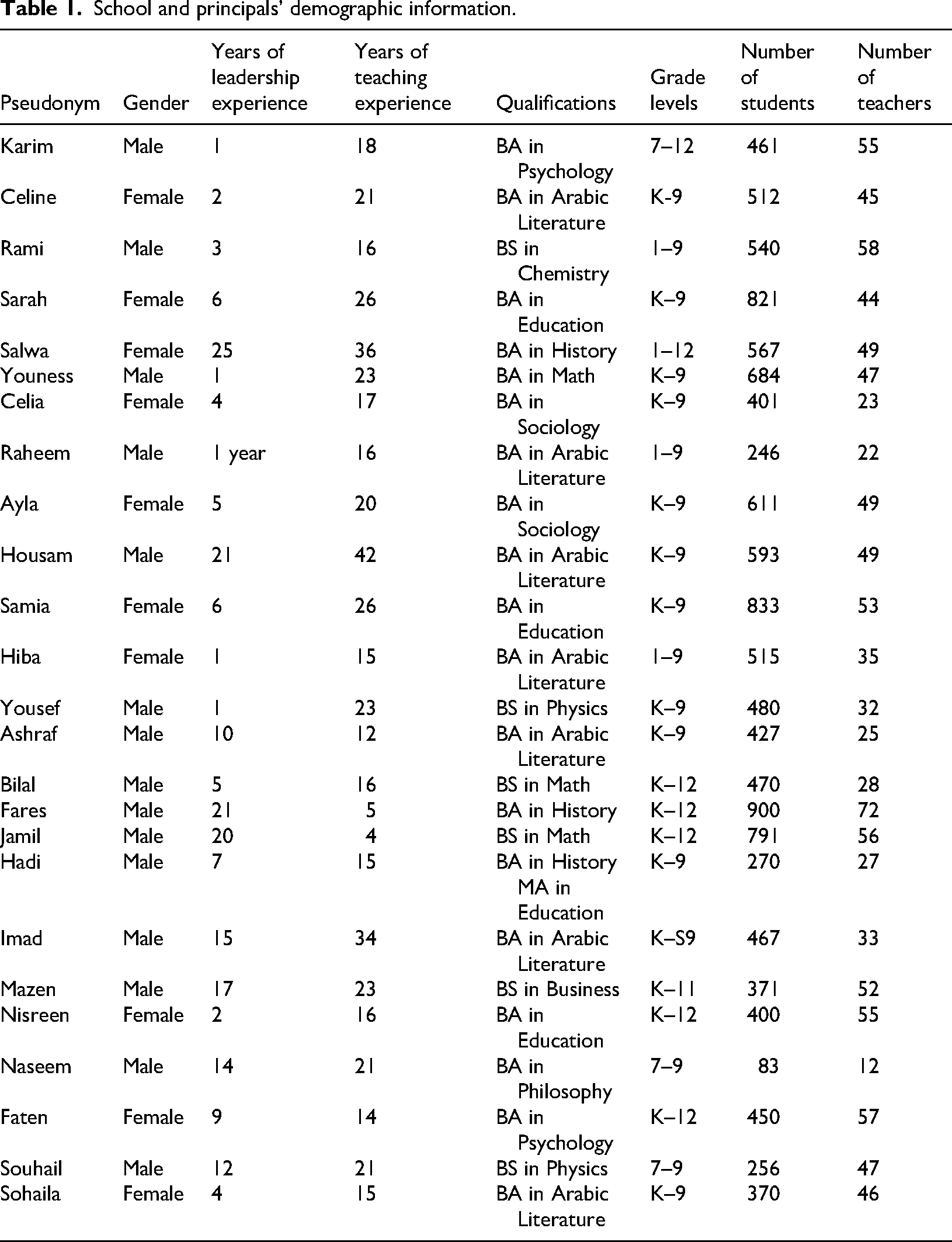
Public schools in Lebanon typically serve communities from lower socioeconomic backgrounds (Hilal and Akar, 2023). To focus specifically on schools serving marginalised and refugee communities, which aligned with the study's aim, the researchers contacted the Ministry of Education and requested a list of schools that met these criteria.
The researchers then worked with the Ministry to identify 40 schools that represented a variety of regions and had principals willing to participate, ensuring the schools served a high number of marginalised, low-socioeconomic-status students. Of the 40 principals contacted, 38 agreed to participate. Saturation was reached at 24 participants, beyond which no new insights emerged. An invitation letter and consent form were sent to each participant, assuring them that all information would remain anonymous and that they could withdraw from the study at any time.
Data collection
The researchers collected data from the participants through open-ended, active, semi-structured interviews (Bush, 2012; Riessman, 2003). Interviews were chosen as they are well situated within the interpretive paradigm of the study, and they enabled the research to explore school principals’ views about their leadership practices. Additionally, the semi-structured interviews enabled the researchers to have general probes while providing flexibility to ask follow-up questions when needed. The researcher made a conscious effort to foster a conversational and collaborative climate rather than a formal question-and-answer setting (Bush, 2012).
The interview questions were piloted on one public school principal to determine their adequacy and lucidity. A sample of the interview questions is presented in Appendix 1. Interviews ranged between 45 and 60 min and were conducted in Arabic, the participants’ native language. The first author's first-language fluency in both spoken and written Arabic enabled her to conduct interviews, analyse data and interpret findings directly in the participants’ native Arabic language. This eliminated the need for translation, ensuring that meaning, nuances and cultural context were preserved. All interviews were audio-recorded with the participants’ consent.
Data analysis
The study adopted an interpretivist approach, as it helps in understanding participants’ own description of their (Creswell, 2013; Briggs et al., 2012) leadership practices without imposing pre-existing views of the phenomenon. Since the goal of the study was to gain an understanding of context-specific leadership practices rather than develop a theory, the data analysis employed aspects of the grounded theory-based approach, specifically the systematic design (Corbin and Strauss, 1990; Dimmock and Lam, 2012), complemented by a thematic organisation of the emerging themes (Miles and Huberman, 1994).
The initial phase of data analysis involved a thorough review of the complete transcripts, which is essential for researchers to engage deeply with the data and fully comprehend the participants’ responses (Creswell, 2013). The grounded theory (Corbin and Strauss, 1990; Dimmock and Lam, 2012) and thematic analysis (Miles and Huberman, 1994) and open coding were employed. In open coding, transcripts were read line by line, and codes, as ‘labels’, were assigned to phrases and sentences that captured their general meaning. The second step in data analysis was axial coding, and this is consistent with grounded theory (Corbin and Strauss, 1990; Dimmock and Lam, 2012). In this step, similar codes were grouped together into categories. This step included aspects of selective coding, consistent with the grounded theory methodology and thematic analysis (Corbin and Strauss, 1990; Dimmock and Lam, 2012; Miles and Huberman, 1994).
Trustworthiness
To ensure the trustworthiness of both data collection and analysis, a consistent protocol was followed for conducting and transcribing the interviews. During the interviews, a conscious effort was made to create a conversational and collaborative atmosphere, which helped enhance the trustworthiness of the principals’ responses (Bush, 2012). Additionally, a coding scheme was developed, and detailed memos and notes were maintained to clarify the meaning of each code (Creswell, 2013). The constant comparative method from grounded theory was employed, allowing the data to be continually compared with the generated codes (Corbin and Strauss, 1990; Creswell, 2013). Reflexive thematic analysis involved ongoing memo writing, intercoder dialogue and iterative questioning of positional assumptions. Finally, member checking was conducted by sharing the findings with participants to ensure their intended messages were accurately captured (Bush, 2012; Creswell, 2013).
Results
Data analysis identified two key themes, leadership for survival and leadership for support. This section presents these themes and their subsequent sub-themes. Transcripts are followed by the pseudonym of the participant, their gender (M or F) and years of experience as a school principal (see Table 1 for details).
Leadership for survival
Analysis of the transcripts reveals that principals’ leadership practices were primarily governed by the need to ensure the schools’ survival and continued functioning. Principals frequently cited the lack of resources and basic necessities as significant factors affecting their leadership: If there are no books and students cannot attend, what can we do? My sole role is to secure the necessities. (Yousef, M, 1)
The economic crisis in Lebanon, coupled with the devaluation of the Lebanese lira, has left many families in a critical economic situation (World Bank, 2021). This is exacerbated in schools serving primarily refugees and communities with low socioeconomic backgrounds: these families are more concerned with putting food on the table and keeping a roof over their heads. (Celine, F, 1) We have teachers who cry hysterically at the end of their classes; I worry about them quitting. (Hadi, M, 7) I worry about my teachers, it is not an easy time for them. (Hiba, F, 1) Control through centralised bureaucracy Compliance through pseudo-implementation
Subtheme 1.1: Control through centralised bureaucracy
The narratives reveal that school leaders prioritised maintaining control over their schools: As a school leader, I need to make sure the school remains in order and is not chaotic. (Housam, M, 21) My job is to ensure order and rules. (Nisreen, F, 2)
To ensure this, principals adopted autocratic leadership practices, as their success was measured by the extent to which the schools is functioning in an orderly manner: During these times, I cannot afford any mistakes; everything must go through me. (Fares, M, 21) I follow up on everything. No mistakes are allowed. (Celia, F, 4) Teachers must write weekly reports about their classes and give them to their respective coordinators. (Samia F, 6) At the onset of the crisis, the deputy principal, coordinators, and I developed a set of clear rules. Now teachers know what to do. (Younes, M, 1) With teachers knowing their tasks, they are held responsible. (Sarah, F, 6) At the end of the day, I am the one responsible for the safety and success of the school. (Ayla, F, 5) We are passing through a tough time. It is my responsibility to ensure we land safely with the least amount of damage. (Mazen, M, 17) The school is my family, they are my children. (Hadi, M, 7)
Subtheme 1.2: Compliance through pseudo-implementation
While school principals exercised considerable control through centralised bureaucracy, they expressed frustration with the restrictive nature of the Lebanese educational system, describing it as hindering and restricting their autonomy: The level of bureaucracy kills us, forms, reports, and approvals. (Imad, M, 15) I have to implement the directives and respect the bureaucracy. (Souhaila, F, 4) During this time, visits rarely happen. (Raheem, M, 1) During these times, visits are minimal, if they happen at all. We continue doing our job the way it should be done. (Imad, M, 16) I find smart ways, especially now, to implement and not implement. (Ashraf, M, 10) I cannot not implement; otherwise, my practices will be questioned, but I do that with my school in mind. (Housam, M, 21) These policies are very unclear and hence leave room for interpretation! (Fares, M, 10) Participants also criticised the Ministry's decision-making as reactive, lacking vision and strategic planning: The ministry's directives show that officials are reacting to events. I don’t feel they have a plan; they work on a day-to-day basis. (Salwa, F, 25) Policies only addressed some areas. (Souhail, M, 12) They [the Ministry] did not explain how online teaching should happen, so I do what is good for my school. (Jamil, M, 20) I have been running this school for the past 17 years. I know more than the minister, who has been in office for 18 months and has never worked in a school before. (Mazen, M, 17) I have made use of my connections with associations with international NGOs to provide us with stationery and laptops. As public-sector principals, we are not allowed to take money. (Salwa, F, 25)
One significant area of manoeuvring was budgeting, particularly amidst resource shortages. Principals leveraged professional networks to secure funding from United Nations (UN) agencies or international NGOs instead of waiting for ministry approval:
Theme 2: Leadership as support
This theme explores the normalised conceptions of support that participants used to describe their leadership practices. The narratives suggest that school leaders often interpret support as a means of protecting teachers from making mistakes, primarily through the establishment of surveillance-oriented structures. These mistakes were primarily related to the orderly functioning of the schools such as showing up to class, following the lesson plans and taking attendance. The data analysis revealed two subthemes: structure as support and surveillance as support.
Subtheme 2.1: Structure as support
The data show that principals described their practices as humane and supportive. However, this support was not focused on empowering teachers to overcome challenges but rather on providing immediate emotional and structural relief, which aligns with the previous theme of leaders leading for survival and maintaining the status quo.
Some schools utilised committees and psychologists to provide structured psychological support: Teachers know who they can go to, to speak and vent. I have explained this in the school policy. (Nesrine, F, 2) I made sure subject coordinators provide teachers with resources and help them locate and use these resources. (Karim, M, 1) Supporting teachers during crises means having clear structures and communication and ensuring teachers know exactly what is expected of them. (Faten, F, 9) In times of crises and limited resources, clear organisational structures and accountability prevent chaos and provide stakeholders with a sense of stability. (Naseem, M, 14)
Surveillance as support
Analysis of the narratives reveals that surveillance was a key method of support employed by school principals. The support was seen as a means to ensure the orderly functioning of the school, which school principals perceived as being a success: I support the teachers by making sure they are doing their job properly. I attend many classes now, and subject coordinators are instructed to regularly attend classes to ensure that teaching aligns with the plan. (Hiba, F, 1) This online teaching enables me to be in different places at the same time! Sometimes teachers and students don’t even notice my presence in the class. (Sarah, F, 6) If we don’t do this, chaos will dominate, and the school fails. (Mazen, M, 17) We follow up on all our teachers. Their lesson plans, exams, and day-to-day teaching are all monitored, and they know that. (Bilal, M, 5) I ensure that all teachers are abiding. (Karim M, 1)
Discussion
This section discusses the findings in light of the relevant literature, Bolman and Deal's leadership model and Foucauldian tools of governmentality and panopticism to unpack the rationales underlying school leadership practices.
The analysis revealed a paradox: while principals were critical of bureaucratic structures, control and surveillance, they simultaneously relied on these same mechanisms to govern their schools. Principals internalised mechanisms of governmentality and technologies of the self (Foucault, 2023), viewing them as essential both for institutional success and for supporting their teachers. The data indicate that principals viewed structure and surveillance as providing the stability and certainty necessary during prolonged periods of crisis. This finding complicates dominant assumptions in leadership in crisis literature that view crisis as an opportunity for transformation (e.g. Harris and Jones, 2020). Instead, our data suggest that crisis contexts in marginalised settings may incentivise adherence to bureaucratic norms, not as ideological alignment, but as a means of ensuring functional continuity, which is perceived as a ‘success’. Successful leadership in this context is survival oriented, focused on preserving the community and preventing collapse through strict adherence to rules, ensuring the orderly functioning of the school while simultaneously revealing how leaders both critique and reproduce the systems that constrain them.
Leadership practices were largely informed/driven by the principals’ self-perception as the ‘captain of the ship’ and ‘protector of the community’. These metaphors align with studies conducted in the Arab region where the school leader is often perceived as having a pastoral role (Da’as et al., 2025; Oplatka and Arar, 2017). We argue that such self-perceptions, in addition to the centralised governance, underly the leadership practices within Bolman and Deal's different frames and within the Foucauldian tools of surveillance and panopticism.
Despite their vocal criticism of bureaucratic constraints, principals adopted an authoritative style of leadership situated within centralised bureaucracy, ironically, the very structure they found restrictive. Their protective role mirrors Foucault's (2023) metaphor of the ship's captain, with leadership focused on survival and maintaining the status quo as they represent ‘success’ in this context. Maintaining the status quo requires adherence to policies and standards (Al-Omari, 2013; Karami, 2014). Our results show that most leadership practices fell within the structural frame of Bolman and Deal (1997), with strong emphasis on efficiency, order and accountability. This finding aligns with research from Lebanon (Al Chibani and Hajal-Al Chibani, 2013; Baroudi and Hojeij, 2020; Karami, 2014), the wider Arab region (Al-Omari, 2013; Hilal et al., 2024) and international studies (e.g., Khanal et al., 2020), all of which highlight the dominance of structural leadership approaches focused on maintaining the status quo. More contextually, these results are well grounded in local (Lebanese) policy frameworks (e.g. Decree No. 590, 1974; Decree No. 2460, 1959), which assign school principals primarily executive and managerial responsibilities, with a strong emphasis on teacher monitoring and accountability. Under this law, principals are formally designated as ‘chief administrators’ and are held solely accountable for school performance. This policy context supports earlier findings on the effects of centralised governance on leadership practices in Lebanon (e.g., Baroudi and Hojeij, 2020; Karami, 2014) and resonates with broader international research in similarly centralised systems (Da’as et al., 2025; MacDonald, 2019).
However, our results are in contrast to global, specifically Western, literature on leadership at times of crisis, which emphasises relational and networked approaches to leadership (Harris and Jones, 2020; Leithwood et al., 2021). Such a deviation may be explained in a number of ways, all of which highlight the significance of context. The assumed ‘heroic’ roles and parent/protector metaphor, in addition to the accountability and centralised governance in which the participants were leading, prompted them to solely hold the reigns of their schools. This role embodiment and the governmentality that it shaped may be a reflection of a more classic ‘lone ranger’ form of leadership (Hallinger, 2003). This resonates with recent research highlighting the emotional intensity and moral strain experienced by educational leaders in marginalised communities, where systemic failures are often internalised as personal responsibility (McKay et al., 2022). Such expectations have been critiqued by scholars for placing undue burden on individual leaders and reinforcing problematic leadership discourses (e.g., Niesche, 2010; MacDonald, 2019).
In this context, Bolman and Deal's structural frame prevails, with the status quo unchallenged, even in crisis. This contrasts with findings from Western literature, which often highlight how crises serve as disruptive moments that expose systemic inequities and hidden challenges, offering opportunities to question the assumptions underpinning existing structures and practices (Leithwood et al., 2020). However, our findings diverge from this perspective: school principals in our study demonstrated a strong adherence to the structural frame, prioritising rule-following and institutional continuity. Rather than using the acute crises as a catalyst for rethinking or reform, they focused on maintaining order and ensuring that schools continued to function within established regulations, effectively avoiding any disruption to the system. These practices are understood within the narratives indicating that success for these principals, at the time of crisis, was primarily to ensure the survival of their schools through its orderly functioning.
Such an avoidance of system disruption is further bolstered by data analysis showing that the centralised bureaucracy and strong structural leadership approaches (Bolman and Deal, 1997) were internalised by school principals and used as a form of panoptic gaze (Foucault, 2023) to constantly monitor and control school operations. Principals’ narratives suggest that this gaze intensified during the crises, as they felt the need to maintain strict oversight to prevent disorder, particularly as they were leading in marginalised context, a result that aligns with Colman's (2021) ‘hyperenactment’ leadership practices in deprived areas. These results also reflect a performative approach to education, where teachers’ roles were reduced to task execution (Jones and Ball, 2023), increasing their visibility (Hope, 2016) within a system primarily driven by accountability and technicist, managerial conception of leadership (Carroll et al., 2008; Hollenbeck et al., 2006).
Hoyle and Wallace (2007) and MacDonald et al. (2020) argued that internalised norms of success lead school leaders to use surveillance as a compliance mechanism. Similarly, Gillies (2013) asserted that leaders conform to systemic standards to gain institutional approval. Our data analysis provides sufficient evidence to show that principals have internalised these norms and standards. Despite the lack of inspection visits during the crises, leadership practices that aligned with centralised bureaucracy were adopted. Therefore, while inspections were not taking place, the panoptic gaze remained, a form of ‘absent presence’ (Troman, 1997), illustrating how school principals continued to feel monitored by the sovereign authority (MEHE) even in its physical absence. This gaze became internal, as a technology of the self (Foucault, 1991), and became the mechanism through which leadership practices were disciplined. This aligns with the understanding of panopticism, where internalised surveillance fosters discipline without external enforcement (Foucault, 2023). Despite the lack of direct oversight, principals continued to operate under the influence of performativity and compliance-driven imperatives.
Interestingly, our data analysis shows that the role of the protector was pivotal not only in rationalising practices within the structural frame and panoptic gazes but also in the rationales principals gave for their practices within the human and symbolic frames. They described surveillance and control as tools to ‘protect’ teachers from making mistakes and to support them during difficult times. The following paragraphs discuss this.
These pastoral and protector roles, which were prominent throughout principals’ narratives, also shaped leadership practices within human and symbolic frames. While the dominant approach to leadership was largely structural (Bolman and Deal, 1997), there were glimpses of relational and symbolic practices. Principals frequently described their schools as their family, showing resemblance to the symbolic frame (Bolman and Deal, 1997), and referred to themselves as parental figures. These metaphors reflect a culturally embedded understanding of the leader as caretaker and align with findings from the Arab world (Hilal and Alawi, 2023; Hammad et al., 2023) and Lebanon (Ghamrawi, 2010; Karami, 2014), where leadership is often framed through familial and protective lenses. These pastoral roles also manifested in practices such as offering a ‘shoulder to cry on’ and providing support, actions that partially align with Bolman and Deal's human frame, as they reflected attentiveness to teachers’ emotional needs and human relations. Such attentiveness is important as our findings show that teachers showed emotional distress, which aligns with research highlighting the emotional labour that teachers pass through (Hochschild, 1983; McKay et al., 2022). Similar leadership practices have been observed in both regional and international studies (Al-Omari, 2013; Khanal et al., 2020). However, while these actions may suggest a commitment to care, our results indicate that they were primarily instrumental in nature, intended to ensure that teachers remained in classrooms and that the school continued to function during crisis, rather than to support deeper well-being or professional growth.
Additionally, and while principals adhered to bureaucratic norms and enforced a strong panoptic gaze, their self-conception as protectors also gave rise to a form of agency expressed through pseudo-implementation of policies. This form of resistance from within aligns with Stetsenko's (2023) notion of agency, whereby individuals navigate within the system while subtly subverting it. This manoeuvring reflects Bolman and Deal's (1997) political frame, wherein leaders leverage networks and negotiate policies to secure resources. Principals in our study operated as political subjects, navigating tensions between institutional mandates and school-level realities (Niesche, 2010).
Conclusion
This study explored the leadership practices of school principals in marginalised communities during times of crisis. However, a consideration of the study's limitations is necessary to provide an accurate account of its implications and conclusions. The sample was small and specific with no intention to make generalisations to all schools in Lebanon or any other context. Additionally, private schools serving marginalised communities were not included. Moreover, the study collected data using semi-structured interviews; other sources, such as observations and/or teacher interviews about principals’ leadership, may also be beneficial. However, the deep insights gained through the rich description and systematic analysis in this study hold implications for further research and suggest the possibility (encouraged by others’ research referred to in this article) that some findings may well be applicable to principals in different contexts.
Our data indicate that principals’ leadership was driven by their embodiment of the protector role, a role that is deeply seated in Arab cultures and has been bolstered by performative approaches holding principals accountable for their schools’ performances. The principals’ leadership practices reflect their internalisation of these discourses, using technologies of surveillance (Foucault, 2023; Hope, 2016; Skerritt, 2020) to monitor and regulate staff behaviour according to pre-set rules and standards. These practices ensured the continued functioning of their schools, defining success through a performative lens that prioritises measurable outputs and adherence to structural norms (Gardner-McTaggart, 2024; Gillies, 2013).
Principals employed hierarchised forms of surveillance (Foucault, 2023), such as forming teams and delegating responsibilities to team leaders and coordinators. This approach resonates with Bolman and Deal's (1997) structural frame, where structure and policies gain heightened importance to maintain order and functionality. The principals’ narratives illustrate how their leadership practices, shaped by surveillance and governmentality, objectified teachers to ensure compliance with normative behaviours, aligning their schools with dominant discourses of performativity (Ball, 2012, Jones and Ball, 2023).
While crises have shaken norms and altered practices in some educational contexts (Gardner-McTaggart, 2022; Striepe and Cunningham, 2022), our findings suggest that in marginalised communities, crises have reinforced rather than dismantled these norms. Principals became vehicles through which the power of performativity and neoliberalism passed, leading their schools in ways that supported immediate stability but perpetuated entrenched systems of control and accountability. As the findings are deeply embedded in the Lebanese public school context, they cannot be generalised across all national or regional contexts. Future research might explore whether similar patterns of structural adherence and protective leadership emerge in other protracted crisis contexts, particularly where centralised governance is also present. Longitudinal studies or triangulated data including teacher perspectives could further validate and extend the findings.
This study underscores the need for future research to explore how leadership in marginalised contexts can move beyond these normative practices to develop more empowering and human-centred approaches, especially during crises. Future studies could explore how to balance structural efficiency with teacher and school leaders’ empowerment and community engagement for sustainable leadership. Additionally, research can study the emotional labour and experiences of dysregulation among school leaders and teachers working in compounded-crises contexts serving marginalised communities.
The findings suggest that policymakers should prioritise the development of preparation and professional development programmes to strengthen principals’ capacity to navigate their complex roles. However, while such initiatives are necessary, they are insufficient on their own, as they cannot replace the need for structural reform.
Footnotes

Funding
The authors received no financial support for the research, authorship and/or publication of this article.
Declaration of conflicting interests
The authors declared no potential conflicts of interest with respect to the research, authorship and/or publication of this article.
Author biographies
Appendix 1
Sample interview questions