




Abstract
This study examines the joint impact of principals’ and teachers’ perceptions of instructional leadership on teacher collaboration. Using Programme for International Student Assessment 2022 data from Hong Kong, we employ polynomial regression with response surface methodology to understand how perceptual congruence and incongruence are associated with teachers’ collaborative practices. The findings reveal a U-shaped relationship for both congruence and incongruence: Collaboration is higher when principal and teacher perceptions align at high or low levels, compared to when their views converge around the mean. Collaboration also increases with perceptual disagreement, where one party's ratings are higher than the other's. These dynamics are significantly amplified in contexts where teachers report high levels of trust in their principals and colleagues, underscoring trust as a key moderating factor that enhances the benefits of both perceptual alignment and misalignment. The findings suggest that cultivating trust can be a critical strategy for leveraging perceptual dynamics to strengthen teacher collaboration. By adopting a congruence perspective and addressing methodological limitations, this study contributes to a more dyadic and relational understanding of the relationship between instructional leadership and teacher collaboration.
Keywords
A substantial body of research in educational leadership has consistently emphasised the pivotal role of school principals as instructional leaders driving school improvement and teaching and learning (Authors, 2020). Research demonstrates that principals, as instructional leaders, play a crucial part in developing teacher capacity, including teacher collaboration in schools (Li et al., 2016a; Supovitz et al., 2010). Specifically, instructional leaders can cultivate collaborative cultures by conducting classroom observations, offering instructional feedback, and promoting collective responsibility for student learning (Liu and Hallinger, 2024; Nguyen et al., 2021). These leadership practices not only support teachers’ professional growth but also contribute to enhanced student academic outcomes (Goddard et al., 2015; Miller et al., 2010). As teacher collaboration gains increasing recognition as a catalyst for school innovation and improvement (Blömeke et al., 2021; Liu et al., 2021), the role of principals in facilitating it has become more critical than ever.
Despite the broad consensus on the importance of instructional leadership, there is a gap in understanding how the joint effect of multiple sources (e.g., self-evaluation of leaders and followers) affects teacher collaboration. Principals and teachers often hold differing perspectives on leadership, yet these have not been adequately addressed together in educational leadership research (Daniëls et al., 2020; Goff et al., 2014). In most quantitative studies, researchers have relied on either principals’ or teachers’ perceptions to measure leadership practices, which may not fully capture the diverse realities and experiences of both groups regarding educational leadership (Ahn et al., 2024). Although some quantitative studies have examined both perspectives to investigate their distinct relationships and develop a congruency typology model of leadership (Bowers, 2020; Bowers et al., 2017; Urick and Bowers, 2019; Wiens et al., 2025), there remains a need for a more integrated and rigours approach. The leader–follower (in)congruence framework is valuable as it captures the exchange relationship between leaders and followers in a more nuanced, dyadic manner, offering insights into how differing perspectives influence organisational capacity and professional development (Ahn et al., 2024; Graen and Uhl-Bien, 1995).
This study investigates the joint effect of principal and teacher perceptions of instructional leadership on teacher collaboration, including both the magnitude and direction of their (dis)agreement. To do this, we employ polynomial regression analysis (PRA) with response surface methodology (RSM)—an emerging approach in educational leadership research (Paletta et al., 2021; Wiens et al., 2025) that overcomes the critical limitations of traditional congruence studies, such as the use of difference scores (Edwards and Parry, 1993). Recognizing that context is crucial in leadership dynamics, we also examine whether this relationship is moderated by organisational trust, which often serves as a social glue that fosters reliance, interaction, and effective collaboration among members of the school (Bryk and Schneider, 2002; Tschannen-Moran and Hoy, 2014). Organisational trust serves as a lubricant in teachers’ daily work and relationships, ensuring that instructional leadership enhances teacher collaboration effectively (Li et al., 2016a; Liu et al., 2016). Therefore, this study considers organisational trust as a moderating factor in the relationship between principal–teacher (dis)agreement and teacher collaboration.
This study aims to deepen the understanding of how the interplay of leaders’ and followers’ perspectives on instructional leadership affects teacher collaboration, providing both practical and theoretical implications for enhancing teacher collaboration. To achieve this, we utilise Hong Kong data from the Programme for International Student Assessment (PISA) 2022. We focus on the context of Hong Kong, rather than analysing all available countries and regions, to ensure that our discussion and implications are more in-depth and contextually relevant. Hong Kong offers a unique yet broadly applicable case, with a school system that combines traditional, hierarchical leadership norms and modern, decentralised organisational structures (Lee and Ip, 2021). In this context, trust emerges as a potential bridge across the divides created by hierarchy. The study's findings therefore, hold significant implications both within and beyond Hong Kong. A more detailed overview of the Hong Kong school leadership context is provided in the Supplemental Material. Specifically, this study addresses the following research questions: RQ 1: What is the impact of the joint combination of principals’ and teachers’ perceptions of instructional leadership on teacher collaboration? RQ 2. Does this relationship vary by the level of organisational trust?
Congruence framework
Gathering feedback from oneself and peers or subordinates has gained considerable traction in contemporary organisational research, for at least two reasons. Firstly, due to the increasingly complex and fluid nature of institutional contexts, information collected from more than one source presumably provides more complete information than that derived from a single source (e.g., London and Beatty, 1993). Secondly, perceptual differences in the same variable from multiple sources have been found to be significantly correlated with important individual and organisational outcomes (e.g., Fleenor et al., 1996; Kenny and Tessa, 2010; Lee and Carpenter, 2018; Souki et al., 2025). Utilising a multi-rater feedback mechanism, prior research frequently highlights discrepancies in ratings, particularly between self-reports and those from followers (e.g., Atwater and Yammarino, 1992; Vriend et al., 2021). These rating gaps are indicative of the quality of leader–follower exchange, leadership effectiveness, and associated outcomes (Kenny and Tessa, 2010). Given that leaders’ behaviours vary among individual followers and that followers maintain diverse leadership expectations and interpretations (Ugwuanyi et al., 2025), an approach that overlooks these two perspectives may fail to address the inherently dyadic and relational nature of leadership (Matta et al., 2015). Specifically, previous studies have indicated that a lack of agreement between a leader's self-assessment and the evaluation from followers often signifies lower levels of leadership efficacy and effectiveness (Ali et al., 2022; Fleenor et al., 1996).
Educational leadership literature has also demonstrated how principals and teachers interpret and rate leadership capacities differently. Hallinger and Murphy (1985) showed that principals often rated their own leadership skills more favourably than their teachers, a discrepancy that would not diminish over time (Kwang and Swann, 2010). The disparities in perceptions stem from contrasting belief systems, as principals often assess instructional leadership based on their confidence in performance. In contrast, teachers may rely on tangible observations of leadership behaviour. As noted by Goff et al. (2014), increased interaction time between principals and teachers does not necessarily lead to heightened perceptual agreement, indicating a complexity in interpersonal dynamics that merits further exploration.
While the general trend shows that principals regard themselves more positively than their teaching staff, there are notable exceptions. Research from Sinnema et al. (2015) indicates that certain demographics of principals—specifically, those with extensive prior experience but limited time in their current roles—tend to rate themselves lower compared to their teachers. Guo and Lu, (2018) collected paired self-rating and teacher ratings of instructional leadership and power distance from 132 principals and 1708 teachers in China. They found that when principals rated themselves lower than their teachers’ rating of them, teachers reported significantly lower levels of power distance between the principals and teachers, which might be conducive to more teacher-initiated activities or behaviours. Conversely, when principals’ self-ratings were higher than their teachers’ ratings, teachers were found to report high levels of power distance, which could presumably suppress teacher-initiated actions and behaviours.
Analyzing TALIS 2008 data from three Asia-Pacific countries (Australia, Malaysia, and South Korea), Park and Ham (2016) found that perceptual discrepancies between principals and teachers regarding instructional leadership adversely impacted teacher collaboration. They argued that principal–teacher agreement signifies critical school conditions essential for collaborative interactions. More recently, a study in Italy by Paletta and colleagues (2021) demonstrated that high levels of agreement on instructional leadership were positively associated with teachers’ innovative practices, highlighting the utility of a congruence framework for evaluating leadership effectiveness. Notably, their study employed PRA-RSM, overcoming the limitations of traditional difference scores. Existing research consistently underscores the value of the congruence approach and has introduced important methodological advancements (Wiens et al., 2025). However, educational research to date still lacks sufficient evidence of its outcomes and a clear understanding of the contexts in which (in)congruence effects vary. This gap impedes the formulation of evidence-based strategies for effective leadership in schools.
Literature review
Instructional leadership
The instructional leadership model provides an essential set of practices for school leaders to continuously improve teaching and learning processes in their schools (Hallinger, 2005; Leithwood et al., 2004). Hallinger and Murphy (1985) provided one of the initial conceptualisations, proposing three main dimensions of instructional leadership: Defining the school's mission, managing the instructional programme, and promoting a positive learning climate. Despite various understandings and roles that have emerged over the years, these dimensions remain the core of instructional leadership. However, how to actualise such broad tasks and transform them into improved student learning has become the central question (Murphy et al., 2016; Neumerski, 2013).
Relevant empirical studies across contexts have provided ample evidence that instructional leadership is highly relevant to student learning outcomes (Tan et al., 2022). However, its influence on student learning mainly occurs through improved classroom practices or school cultures conducive to such practices (Heck and Hallinger, 2014; Murphy et al., 2016). Lee et al. (2012) showed that instructional leadership may also catalyse the positive impact of other factors on student outcomes. Based on data from 42 secondary schools in Hong Kong, the authors highlighted that principals’ focus on the instructional process in their schools, such as initiating school-based instructional projects, encouraging staff to consider new ideas for teaching, etc. further elevates the positive effects of students’ school attachment on their academic achievement. Professional collaboration among teachers, crucial for improving classroom practices, is also often highlighted in relevant research as one of the key organisational components that can be achieved through effective instructional leadership (Goddard et al., 2015; Mora-Ruano et al., 2021). Indeed, instructional leadership is identified as the most effective leadership domain, among several others, such as strategic leadership, resource management, etc. in improving teachers’ collaborative learning experiences in Hong Kong primary schools (Li et al., 2016b).
Studies have also shown that while principals’ role is crucial in implementing instructional leadership, they cannot solely be responsible for such a complex process. Involving other school administrators and teacher leaders in the process seems essential for creating an actual impact (Neumerski, 2013; Printy and Marks, 2006). This perspective does not entirely align with the historical understanding of instructional leadership, which often refers to the principal directly (Edmonds, 1979). This means that expectations from school principals, as instructional leaders, have evolved from direct involvement in various related processes, such as developing curriculum or setting instructional objectives, to more of a facilitator role, which enables various leaders and teachers to work collaboratively for the improvement of the teaching and learning process (Ho et al., 2024; Murphy et al., 2016; Printy and Marks, 2006).
In line with the increasing emphasis on the shared approach and the importance of collaborative culture, the relational aspect of instructional leadership has received more attention in recent years. Existing studies suggest that building positive and productive relations with teachers and middle leaders could play a critical role in the effectiveness of instructional leadership (Boyce and Bowers, 2018; Shaked, 2024). Such relations are particularly important for increasing the commitment and motivation of teachers as well as building trust, all of which are vital for building a collaborative school culture (Murphy et al., 2016; Tschannen-Moran, 2014). Accordingly, in the Hong Kong context, Kwan (2016) provided evidence that the positive influence of instructional leadership on student outcomes is not prevalent in low-trust schools.
Teacher collaboration
As a core component of a collaborative school culture, teacher collaboration has emerged as a linchpin to broader school improvement efforts and instructional effectiveness (Datnow, 2018). The benefits of such collaboration are well-documented, encompassing enhanced student learning, professional learning and growth, and organisational efficacy (Chapman, 2018). Several key elements characterise effective teacher collaboration. This includes its focus and purpose, ensuring shared goals and a common vision drive it, and ensuring alignment and commitment among participants (Armstrong et al., 2021). In addition, high levels of trust have been found to be essential, fostering open communication and mutual commitment to action and outcomes (Hargreaves, 2019). This necessitates flexible meso- and macro-level structures to support diverse forms of collaboration, allowing for adaptability and responsiveness to varying needs within and across schools (Armstrong, 2015). Leadership plays a pivotal role in this, and more broadly in cultivating a collaborative culture, emphasising shared power and co-construction of activities, which are vital for achieving meaningful outcomes (Campbell, 2024; Fullan and Quinn, 2016).
However, the nuances of genuine collaboration, particularly within unique socio-cultural contexts such as Hong Kong, still require further exploration (Hargreaves, 2019; Wang, 2015). Collaboration can lead to significant improvements in student outcomes and professional practices, given that when it is well-designed, it enables teams to adapt and innovate in response to changing needs, foster equity in student access and outcomes, and cultivate a culture of professional inquiry and reflection (Vangrieken et al., 2015). However, the impact of collaboration is often determined by the power dynamics within organisational contexts and the broader political drivers influencing teaching and learning (Datnow, 2018). In Hong Kong, the emphasis on collaboration in policy and practice has not always translated into effective implementation and positive outcomes, highlighting the need for a deeper understanding of the enablers, barriers, and moderating factors on teacher collaboration in the pursuit of instructional improvement (Lee and Ip, 2021).
Principals and other school leaders are often seen as key actors in creating the structural, cultural, and relational conditions necessary for collaboration to thrive (Qian and Walker, 2021). In Hong Kong, the hierarchical nature of school systems and elements of centralized control, which often characterise school leadership, can pose challenges to teacher collaboration and the leadership required for it (Lee and Ip, 2021). Teachers may hesitate to exercise leadership in collaborative settings, fearing it might interfere with the practice or intentions of those in formal leadership roles (Kwan and Li, 2015). This underscores the need for principals to actively promote a culture of mutual trust and shared objectives, which are essential for successful collaboration (Qian and Walker, 2021).
Organisational trust
Organisational trust refers to the shared beliefs and confidence among school members in the ethical, reliable, and competent actions of their colleagues and leaders. This trust influences the dynamics between teachers and principals, as well as among teachers themselves, thereby impacting the overall school climate (Ho et al., 2025; Zayim and Kondakci, 2015). Trust builds relational capital, which is crucial for sustaining long-term collaborative efforts and achieving shared educational goals. It acts as a lubricant for effective collaboration, enabling teachers and principals to communicate openly and honestly without fear of judgment or negative repercussions (Laursen et al., 2024). Trust fosters resilience and adaptability within schools, helping them navigate challenges and changes (Marshall et al., 2023). When trust is present, it reduces uncertainty and anxiety, encouraging teachers to share information freely and support each other's professional growth (Kılınç et al., 2024). This promotes a culture of empowerment and psychological safety, where risk-taking and innovation in teaching practices are encouraged and valued (Kılınç et al., 2024; Laursen et al., 2024).
In the realm of instructional leadership, organisational trust has the potential to positively moderate the joint effect of teachers’ and principals’ perceptions on teacher collaboration. Trust serves as a bridge that aligns the perceptions and expectations of instructional leadership between teachers and principals, ensuring that both parties work towards common goals with mutual understanding and respect (Laursen et al., 2024). When organisational trust is high, principals and teachers can engage in meaningful dialogues, leveraging diverse perspectives to enhance instructional strategies and school improvement initiatives (Laursen et al., 2024; Banwo et al., 2022). This fosters a collaborative culture where all teachers feel empowered to contribute their insights and expertise (Adams and Adigun, 2024).
Present study
This study addresses a critical gap in the literature by examining the (in)congruence between principals’ and teachers’ perceptions of instructional leadership. Investigating this leader–follower perceptual (dis)agreement using RSA is significant not only for providing more rigorous empirical insights but also for aligning the analytical approach with theoretical perspectives that conceptualise leadership as a dynamic interaction between leaders and followers. By moving beyond single-perspective assessments or simplistic discrepancy models, this study offers a more nuanced understanding of how perceptual alignment—or lack thereof—relates to teacher collaboration. This will help determine whether such (in)congruence is uniformly beneficial or detrimental, emphasising the need for more sophisticated leadership approaches. Finally, the study provides actionable insights by assessing whether fostering organisational trust can enhance the effectiveness of instructional leadership in promoting collaboration.
Methodology
Data and sample
To examine this, we utilised data from the PISA 2022 survey in Hong Kong, organised by the OECD. While PISA 2022 collects information from 15-year-old students, their parents, teachers, and principals, our research focused on the teacher and principal surveys. Teachers and principals responded to identical items regarding instructional leadership, providing a unique opportunity to assess the congruence framework. In Hong Kong, 2335 teachers who were teaching the modal grades of 15-year-old students across 155 secondary schools participated in the survey. Schools were selected using a stratified systematic sampling strategy, and within each school, at least 10 mathematics teachers and 15 teachers of other subjects were randomly selected. Principals from 45 schools were excluded from the analysis due to missing responses on nearly all survey items, including instructional leadership. Most of the missing data involved a small number of cases, ranging from 0% to less than 2%, although there were approximately 7% missing data on teacher-perceived instructional leadership. We used listwise deletion due to minimal data loss, resulting in a final analytical sample of 1562 teachers across 109 secondary schools. A robustness check using multiple imputation with ten datasets yielded consistent findings.
Measurement
Instructional leadership
Both teachers and principals were asked to rate five items regarding how frequently their principal, or they themselves as principals, engaged in behaviours and activities related to instructional leadership over the past 12 months. For example, the items included questions about principals collaborating with teachers to address classroom discipline problems and providing feedback based on classroom observations. Teachers and principals had four and five response options, respectively; these differences were accounted for by creating a latent construct with standardisation. McDonald's coefficient omega was 0.97 for teachers and 0.98 for principals. Standardised factor loadings ranged from 0.62 to 0.90 for teachers and from 0.50 to 0.97 for principals, with all p-values being significant. Following the guidelines for research using PRA with RSM (Tsai et al., 2022), the latent construct for teacher perceived instructional leadership was group-mean centred, while that for principal perceptions was grand-mean centred, after both were standardised to have a mean of zero and a standard deviation (SD) of one.
Teacher collaboration
Teachers were asked to rate how often they participated in collaborative activities within their school. The four items covered various collaborative activities, such as exchanging teaching materials, engaging in discussions about learning development, and working together to ensure common standards for evaluation. The response options ranged from 1 (never) to 6 (once a week or more). We used a composite score created by PISA based on Item Response Theory (IRT) scaling. McDonald's coefficient omega for this measure was 0.96.
Organisational trust
Teachers were asked to rate their agreement with statements regarding trust within the school organisational setting. Five items were used to create a composite score by PISA based on IRT scaling. These items included statements such as ‘Even in difficult situations, my colleagues know they can trust me’ and ‘Teachers can rely on the school's management for professional support.’ Responses ranged from 1 (strongly disagree) to 4 (strongly agree). McDonald's coefficient omega for this measure was 0.96. Since the items primarily refer to a climate of trust across members of school organisations rather than focusing on the individual, this composite score was aggregated at the school level. To justify this aggregation, we calculated the within-group interrater agreement, rwg(j), for each item. The rwg(j) was 0.96, indicating a high level of interrater agreement (James et al., 1993).
Control variables
We included a set of control variables to account for potential confounders based on the literature at both the teacher and school level (Vangrieken et al., 2015). At the teacher level, teachers’ subjects, gender, advanced degree, employment status, and teaching experience were included. At the school level, school type and the proportion of low socio-economic students were included in the model. The detailed information on all variables utilised in this study is summarised in Table S1 in the Supplemental Material. Descriptive statistics for the dataset are presented in Table S2 in the Supplemental Material.
Analytical strategy
This study utilised PRA combined with RSM to assess the joint effect of principals’ and teachers’ perceptions of instructional leadership. Traditionally, the congruence framework has been tested by creating a single index through correlation or algebraic differences between two scores (Edwards, 1994). However, these approaches can yield inaccurate and biased estimates, failing to capture the dynamics of the joint effect and potentially leading to false claims about hypotheses (Edwards, 1994; Humberg et al., 2019). By collapsing two distinct variables, this approach loses critical variance and information unique to each component. A single difference score is inherently ambiguous; it cannot distinguish between the various underlying component pairs that create it (e.g., 5–4 vs. 2–1), the direction of a mismatch (X > Y vs. Y > X), or whether the effect of a match is consistent at high versus low levels of the variables.
RSM combined with PRA has been developed to address such limitations and flaws, enabling the exploration of the effects of (in)congruence between two scores on an outcome in a three-dimensional space, where the coupled components form the two horizontal axes and the outcome forms the vertical axis (Edwards, 1994; Edwards and Parry, 1993). This approach has been increasingly adopted in the leadership, organisation, and management literature, allowing for an evaluation of the slope and curvature along the line of congruence and the line of incongruence (Tsai et al., 2022). However, to date, no study in the field of educational leadership has utilised it to explore the joint effect of principals’ and teachers’ perceptions of leadership.
Firstly, alongside polynomial regression, we employed multilevel modelling to account for the nested data structure (teachers within schools) and to ensure accurate estimation of standard errors. The final teacher weight was included in the analysis to account for sampling error and provide appropriate estimates of population parameters. The model is represented by the following equation (control variables are omitted for simplicity):

where Z represents teacher collaboration for teacher i in school j; x is teacher i's perception of leadership; y is school j's perception of leadership; x² and y² are their respective squared terms; xy is their interaction term; and
The
Results
Before establishing PRA with RSM, we tested whether the second-order polynomial terms significantly improved model fit by comparing a model without polynomial and interaction terms with the polynomial model. The second-order polynomial demonstrated a significantly better model fit (χ2 = 9.99, p = 0.019), indicating a nonlinear relationship between teacher-principal perceptions of instructional leadership and teacher collaboration (Edwards, 2002).
The results and parameters of RSA are presented in Table 1, and the response surface plot is shown in Figure 1. The a₁ parameter (0.286, p < 0.001) represented the slope of the line of congruence. The positive direction indicated that teacher collaboration was higher when teachers and principals agreed at a higher level rather than a lower level – collaboration increased from low-low agreement to high-high agreement.
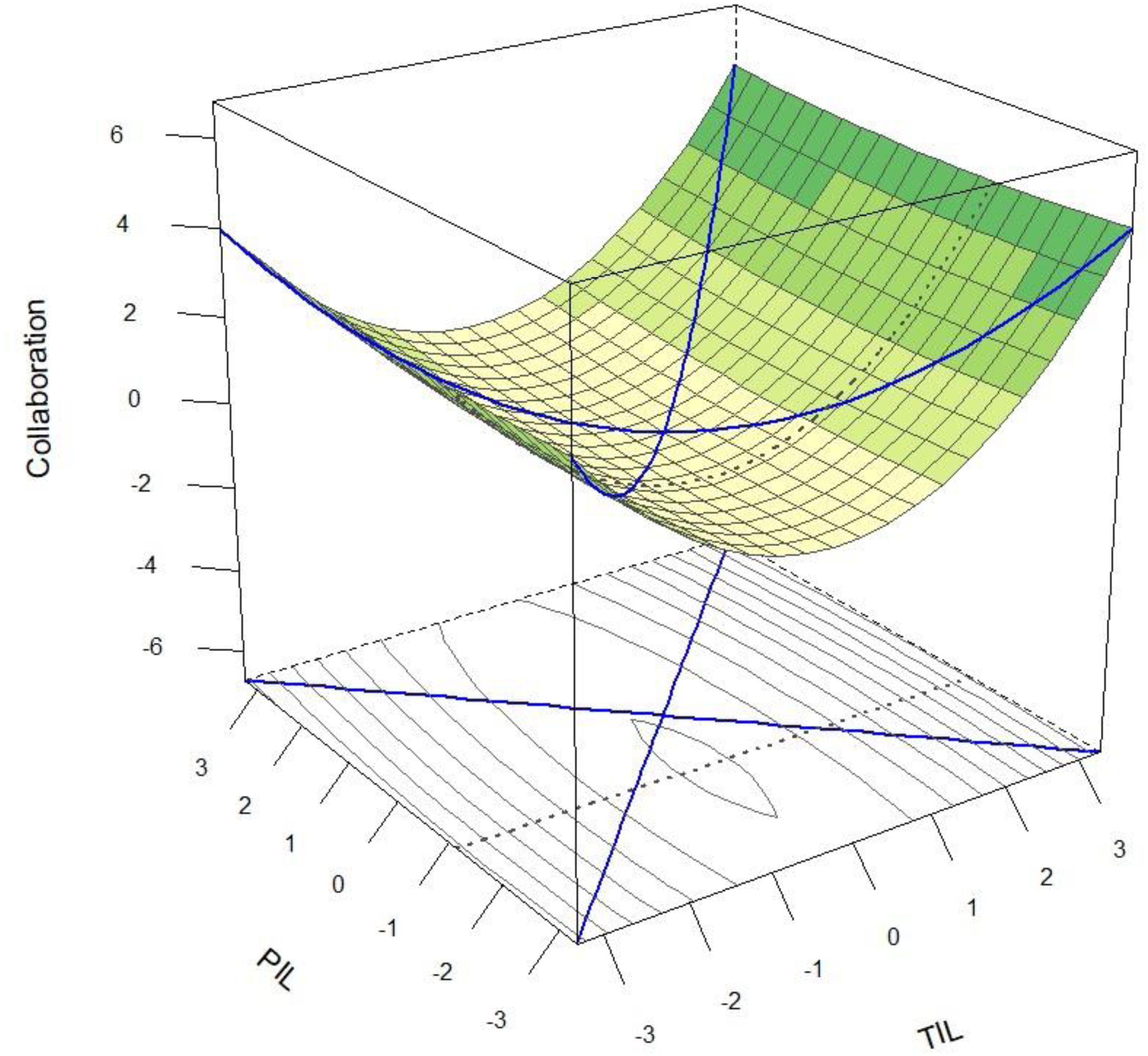
The diagonal line running from the front-left to the back-right corner of the plot represents the line of congruence (where teacher and principal perceptions are equal). The diagonal line running from the back-left to the front-right corner represents the line of incongruence (where teacher and principal perceptions diverge). Note. TIL: teacher perceptions of instructional leadership; PIL: principal perceptions of instructional leadership.
Response surface results predicting teacher collaboration.
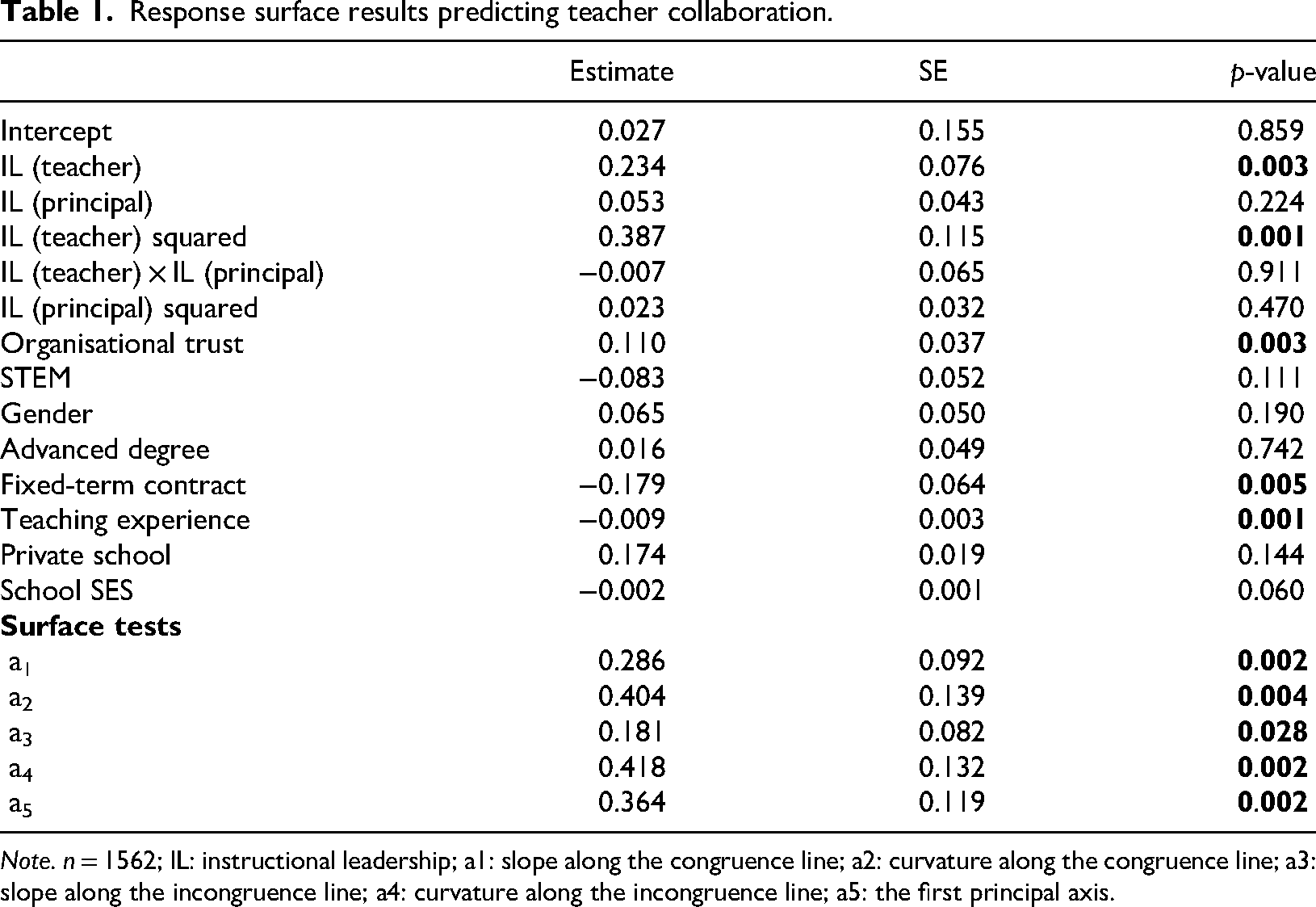
Note. n = 1562; IL: instructional leadership; a1: slope along the congruence line; a2: curvature along the congruence line; a3: slope along the incongruence line; a4: curvature along the incongruence line; a5: the first principal axis.
However, as shown in Figure 1, this relationship was U-shaped (a₂ = 0.404, p = 0.004). This is depicted as the curvilinear line of congruence, shown as a blue line running from the front to the back corner of the plot cube. As illustrated in Figure 1, teacher collaboration decreased from the front corner (i.e., congruence at a low level) to above the point (0, 0), where it then increased as agreement reached a higher level. The slope of the congruence line accelerates as it moves to very high or very low levels of instructional leadership, indicating that the positive effect of agreement becomes stronger as the agreed-upon level increases. While this change applies whether positively or negatively, the high-level agreement had a higher level of collaboration than the low-level agreement (see Figure 1).
The a₃ parameter tests the linear slope along the line of incongruence—a blue line running from the left to the right corner of the cube in Figure 1. The significant and positive a₃ parameter (0.181, p = 0.028) demonstrated that teacher collaboration was higher when teacher perceptions were higher than principal perceptions (the right side of the plot, TIL > PIL), compared to the opposite case (the left side of the plot, PIL > TIL). This indicated an asymmetry in the effect of disagreement on collaboration. The positive and significant a₄ (0.418, p = 0.002) parameter further indicated a U-shape of the incongruence line. As shown in Figure 1, collaboration increased as the magnitude of the disagreement between perceptions grew, moving from the centre towards either the left or right corner, while the highest point located at the right corner (TIL > PIL).
The a₅ parameter tests whether the line along which the response surface changes most rapidly (the principal axis) is aligned with the congruence line (Tsai et al., 2022). The significant a₅ (0.364, p = .002) indicated that the surface was rotated and the line of the steepest upward slope on the surface, was not aligned with the line of congruence. To align with the congruence framework (Nestler et al., 2019), the following conditions must be met: a₂ = 0, a₁ = 0, a₄ < 0, a₃ = 0, and a₅ = 0 (or a₄ > 0 for the incongruent effect). The results of the current study did not conform to either the congruent or incongruent effect (a₂ ≠ 0, a₁ ≠ 0, a₄ > 0, a₃ ≠ 0, a₅ ≠ 0), suggesting that perceptual (dis)agreement does not consistently serve as either a positive or negative influence on teacher collaboration; rather, the relationship appears to be more dynamic. Overall, the findings indicated that teacher collaboration was greater when teachers and principals agreed at either high or low levels than at the mean level. Teacher collaboration also increased with the level of incongruence, whether teachers held higher perceptions of instructional leadership than principals or vice versa.
Figures 2(a) and 2(b) illustrate the moderating effects of organisational trust, evaluated at one SD above and below the mean, respectively. As shown in the Supplemental Material (Table S3), the joint impact of teacher and principal perceptions on teacher collaboration depended significantly on the level of trust. Under the low-trust condition (Figure 2(a)), the relationship between perceptual congruence and collaboration was substantially muted. The response surface became notably flatter, and all parameters except a3 turned statistically insignificant. When trust was low, both perceptual agreement and disagreement had a negligible effect on teacher collaboration. In contrast, under the high-trust condition (Figure 2(b)), the magnitude of the parameters significantly increased, except for a₃, demonstrating that trust acts as a powerful catalyst for the perceptual dynamics in both agreement and disagreement.
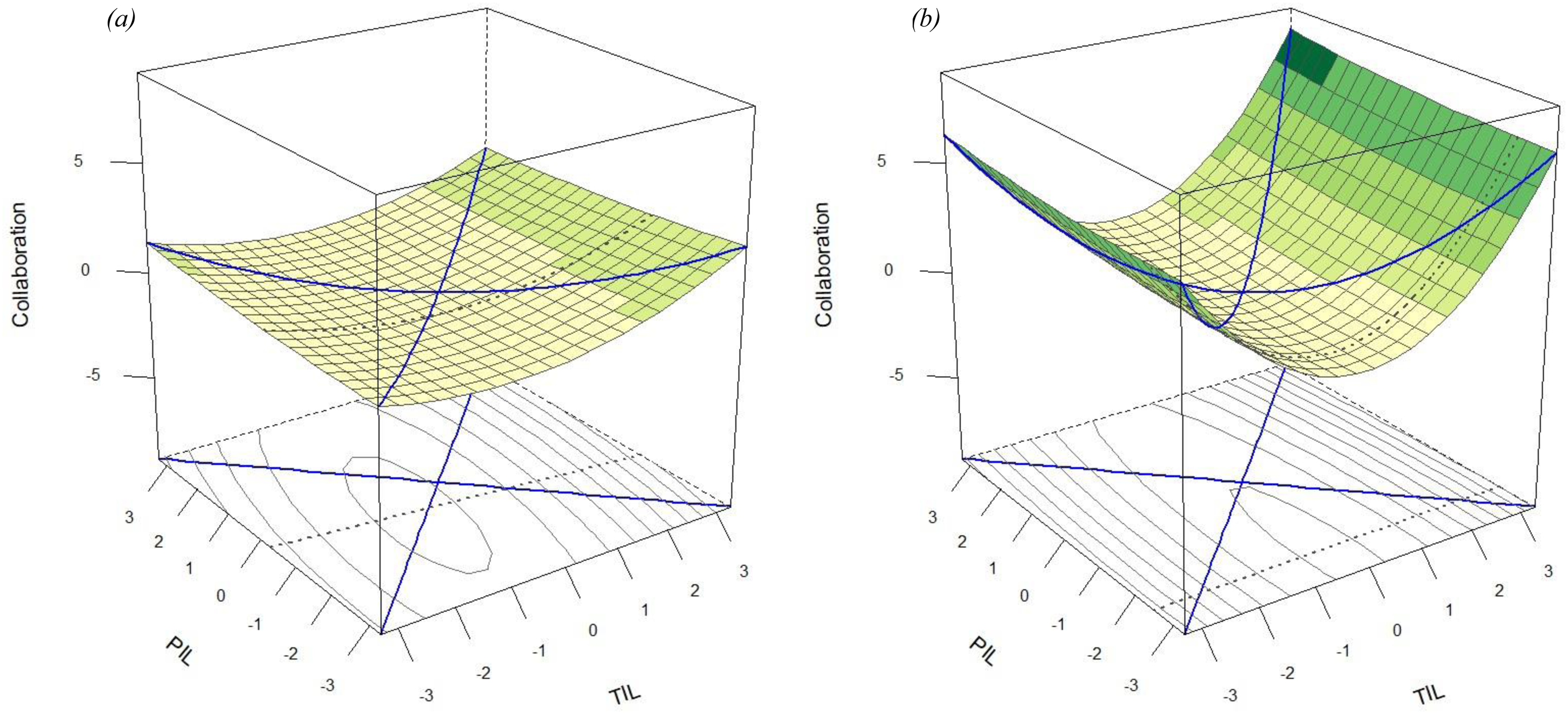
The diagonal line running from the front-left to the back-right corner of the plot represents the line of congruence (where teacher and principal perceptions are equal), and the diagonal line running from the back-left to the front-right corner represents the line of incongruence (where teacher and principal perceptions diverge). (a) denotes one SD below the mean of organisational trust; (b) denotes one SD above the mean of organisational trust. Note. TIL: teacher perceptions of instructional leadership; PIL: principal perceptions of instructional leadership; SD: standard deviation.
Discussion and implications
Our findings illuminate how shared understanding or differing views of leadership functions impact collective teacher work. Previous research on principal–teacher perceptual (dis)agreement on leadership has highlighted the potential significance of these dynamics in school settings (Daniëls et al., 2020; Goff et al., 2014). The study's results could reveal specific patterns of congruence or incongruence that are more or less conducive to teacher collaboration. Understanding these patterns is key because, as shown in our findings, relying on perceptions from either principals or teachers fails to recognise that the effect of principal–teacher (dis)agreement is not often simply linear and can vary depending on the levels and direction of the perceptions (Ahn et al., 2024). By analysing the joint effect of principal and teacher perceptions using PRA and RSM, our study moves beyond simpler discrepancy models and provides a more nuanced understanding of how the alignment or misalignment of perspectives can promote teacher collaboration.
Consistent with prior research on leader–member exchange in the business sector (Matta et al., 2015), our findings indicate that high–high agreement generally promotes teacher collaboration. This finding demonstrates that perceived effective instructional leadership from both parties fosters a supportive environment where they have aligned goals and expectations (Hsieh et al., 2023). It underscores the need for principals and teachers to develop a shared understanding of instructional goals and practices and promote open communication and mutual support between teachers and principals, facilitating a collaborative environment (Authors, 2018). However, our study uncovers more nuanced dynamics, indicating that alignment at both low and high levels leads to greater teacher collaboration than alignment at the medium level. This suggests that there may be different and veiled mechanisms and theories explaining the effect of agreement in instructional leadership on teacher collaboration, depending on the location of agreement.
While providing conclusive reasons for this non-linear pattern is beyond the scope of our quantitative study, we propose that the U-shaped effect is driven by the pivotal role of clarity versus ambiguity (Rizzo et al., 1970). Agreement at a moderate level of instructional leadership appears to create a state of organisational paralysis born from ambiguity and a lack of clarity regarding one's duties, responsibilities, and organisational goals. When leadership is perceived by leaders and followers as mediocre, teachers may become uncertain about their own roles, leading to hesitation and stifling the proactive engagement essential for effective collaboration (Chrispeels et al., 1999). Without clear, compelling, and shared objectives driven by leadership, collaborative efforts can become fragmented and lack purpose. Effective collaboration is fuelled by a shared vision, and when leadership is moderate, that vision is likely to be perceived as vague or less valued. In addition, this climate of ambiguity breaks the motivational chain. Teachers may develop low expectancy and instrumentality, which reduces the motivation to initiate collaborative work (Eccles and Wigfield, 2002). In contrast, agreement at the extremes – both high and low – provides a crucial element: clarity. High-level agreement creates an ideal context where roles and goals are clear, and motivation is high. Low-level agreement also provides an unambiguous, shared understanding of the situation. This clarity regarding the leadership vacuum can reduce ambiguity and empower teachers to act. Knowing that formal instructional guidance from the principal is absent, teachers may rely more heavily on peer-to-peer collaboration to address instructional challenges and meet professional needs. This clear perception of a ‘problematic leader’ can act as an unambiguous signal that the status quo is untenable, motivating agentic, compensatory collaboration among teachers who feel empowered to self-organise and fill the void (Bowers et al., 2017: 42).
Regarding the incongruent perceptions, teacher collaboration is higher with a high level of disagreement—either high principal/low teacher or low principal/high teacher perceptions—compared to agreement at the medium level. Notably, the level of collaboration observed at the teacher-high/principal-low level is nearly equivalent to that seen under high-level agreement. In the case of high principal/low teacher perceptions, principals may drive teachers to take responsibility and roles for collaborative activities using authority and hierarchical management. While principals may exert leadership practices to promote collaborative activities, teachers might not always perceive these practices positively in such contexts. The opposite case, a ‘teacher-high/principal-low’ perception, may signal that a principal views instructional leadership not as a practice confined to their formal role, but as one that is shared across the school. The principal's modest self-rating could reflect a successful shift from a directive to a facilitative, distributed leadership style, where collective capacity is established to enact leadership for effective teaching and learning (Author, 2023; Qu et al., 2024). Such an environment inspires teachers to feel empowered and agentic, encouraging them to take on collaborative initiatives with colleagues. We argue that school leaders reframe perceptual gaps not merely as failures, but as invaluable diagnostic data. This can include establishing formal feedback loops, such as 360-degree evaluations or anonymous climate surveys (Goff et al., 2014). The purpose of these mechanisms is not to force consensus but to make differing perspectives visible, creating a foundation for collective sensemaking that fosters effective leadership and strong collaborative cultures. To this end, leadership training should equip principals with the skills to be diagnostic and facilitative leaders. This involves moving beyond models that prescribe a single set of behaviours and instead training principals to interpret perceptual data, facilitate non-defensive dialogues about school leadership, and build a culture of trust where every teacher's voice is valued.
Our findings reveal that organisational trust is not merely another variable affecting collaboration; it alters the landscape in which perceptual leadership dynamics operate. This aligns with a rich body of organisational theory that positions trust as a fundamental resource and social glue for organisational effectiveness and open communication, enabling diverse perspectives to be leveraged and making teachers feel empowered to collaborate (Laursen, 2024; Kılınç et al., 2024). This trustworthy climate allows positive leadership perceptions to fully manifest in collaborative activities (Demir, 2015). In contrast, low trust reduces the gain from either congruence or incongruence compared to high trust, eroding the social glue and making risk-taking associated with collaboration (e.g., sharing vulnerabilities or challenging ideas) less likely (Li et al., 2016b). Our study highlights that trust is a foundational condition that unlocks the productive potential of leadership congruence or buffers the negative effects of perceptual gaps. Trust is not built through singular initiatives but is cultivated over time through consistent, intentional leadership actions. School leaders can actively foster a high-trust environment by being transparent and communicative such as establishing safe channels for dialogue and involving teachers in shared decision-making processes (Author, 2023), to ensure that their leadership practices are more effective in facilitating teacher collaboration.
Limitations and future research
This study offers valuable insights into the relationship between instructional leadership, teacher collaboration, and organisational trust within the context of Hong Kong's PISA 2022 data. However, it's important to acknowledge several limitations.
Firstly, the specific context of Hong Kong may limit the generalisability of the findings to different regions. Hong Kong's unique cultural and educational system could influence the dynamics of instructional leadership, teacher collaboration, and organisational trust in ways that might not be applicable elsewhere. Future research should replicate this study in diverse cultural and educational contexts to validate the results and enhance their broader applicability. Secondly, while the use of PRA with RSM is innovative, it has limitations. Although effective in exploring the complex relationships among instructional leadership, teacher collaboration, and organisational trust, this analytical approach may not capture all the nuances of these interactions, such as shared values, policy directions, or emotional alignment. Future studies employing qualitative or mixed-methods approaches could provide deeper insight into the lived experiences behind the statistical patterns we have identified, helping to explain the “why” of these complex relational dynamics. In addition, this study's focus was intentionally centered on instructional leadership due to its direct theoretical link to classroom practices and teacher collaboration. We acknowledge, however, that this is just one of several important leadership frameworks. Other models, such as transformational or distributed leadership, offer different lenses through which to understand principal-teacher dynamics. Future research could therefore expand upon our findings by investigating how perceptual agreement on these alternative leadership styles relates to school outcomes. Finally, PISA provides only self-reported data from principals and teachers. Future research should consider incorporating different types of data, including objective measures, to provide a more balanced and accurate assessment of instructional leadership. Integrating leadership evaluations through observation could complement self-reported measurements within this congruence framework.
Conclusions
This study investigated how the alignment of principal and teacher perceptions of instructional leadership relates to teacher collaboration in Hong Kong secondary schools. Using PISA 2022 data with PRA with RSM, our findings challenge the simple assumption that perceptual agreement is always beneficial and disagreement is always harmful. Instead, the relationship between instructional leadership perceptions and teacher collaboration is complex and non-linear. By adopting a leader–follower dyadic perspective, this research offers a more nuanced understanding than single-perspective or simple discrepancy models. The results indicate that both agreement and disagreement can foster collaboration, but their effects are powerfully moderated by organisational trust. When trust is high, these dynamics are amplified; when trust is low, the potential benefits of both perceptual agreement and disagreement are significantly muted. Accordingly, this study suggests that rather than aiming for consensus at all costs, principals should cultivate a high-trust environment where diverse perspectives can be leveraged to strengthen professional collaboration. Building trust through various channels, such as open communication, clarity, and a participatory school culture, appears to be key to optimizing leadership effectiveness and congruence.
Supplemental Material
sj-docx-1-ema-10.1177_17411432251389093 - Supplemental material for Principal–teacher perceptual (in)congruence in instructional leadership, teacher collaboration, and organisational trust in Hong Kong schools
Supplemental material, sj-docx-1-ema-10.1177_17411432251389093 for Principal–teacher perceptual (in)congruence in instructional leadership, teacher collaboration, and organisational trust in Hong Kong schools by Soobin Choi, Sedat Gümüş, Paul Campbell, Jiafang Lu and Chun Sing Maxwell Ho in Educational Management Administration & Leadership
Footnotes

Funding
The authors disclosed receipt of the following financial support for the research, authorship, and/or publication of this article: This work was supported by the Research Programs Support Scheme in the Department of Education Policy and Leadership at the Education University of Hong Kong (RPSS/B04).
Declarations of conflicting interests
The authors declared no potential conflicts of interest with respect to the research, authorship, and/or publication of this article.
Supplemental material
Supplemental material for this article is available online.
Author biographies
References
Supplementary Material
Please find the following supplemental material available below.
For Open Access articles published under a Creative Commons License, all supplemental material carries the same license as the article it is associated with.
For non-Open Access articles published, all supplemental material carries a non-exclusive license, and permission requests for re-use of supplemental material or any part of supplemental material shall be sent directly to the copyright owner as specified in the copyright notice associated with the article.
