




Abstract
This qualitative research study explores the concept of curriculum leadership and how it is exercised by a multitude of actors at the school microlevel. Curriculum leadership has been recognised internationally as an under-researched leadership model that has frequently been confused with, and subsumed into, other general leadership models. Applying a multi-site, embedded case study approach within the Irish special school sector, this paper delineates how curriculum leadership is enacted across different positional levels within schools. Data were gathered from sixteen participants (n = 16), occupying the roles of principal, curriculum coordinator and unpromoted teacher, across three schools (n = 3). The findings evidenced two curriculum leadership premia that amplified the influence of those teachers in possession of either or both of them. First, principalship, or positional proximity to the principal, provided greater agency in exercising curriculum leadership. Second, the more experience a teacher had, the more professional capital it provided them with in influencing colleagues over how the curriculum should be enacted within the school. This paper provides important insights on how teachers leverage influence at school-level and also elucidates how distributed leadership manifests in relation to the curriculum.
Keywords
Introduction
While general school leadership models have attracted extensive scholarly attention over the last quarter of a century (James et al., 2020), there is a ‘Cinderella’ form of leadership that lacks prominence within international research discourses (Harris et al., 2020: 3). Leadership of the curriculum or curriculum leadership is insufficiently theorised and remains somewhat ‘amorphous’ (Jorgensen, 2016: 275), primarily because it is frequently viewed as synonymous with other leadership models– most notably instructional leadership (Bush and Glover, 2014). The corollary of this synonymy is that the actors involved in undertaking curriculum leadership, as a distinct practice in its own right, are also persistently understudied. This is problematic because contemporary scholarship in curriculum enactment has highlighted the importance of teacher agency (Priestley et al., 2021) in ensuring that the curriculum is meaningful and relevant for learners. In the Irish context, the policy posture is such that school-based autonomy is endorsed in the quality models for primary and post-primary schools (Government of Ireland, 2024a, 2024b), and the revised Primary Curriculum Framework (Government of Ireland, 2023) - which explicitly encourages teachers to appropriate the curriculum to their own learners. This is deemed to ensure that the curriculum experience is meaningful, contextualised and relevant. Similar patterns of teacher agency can be seen in other parts of western Europe, with both the Curriculum for Wales (Welsh Government, 2020) and Scotland's Curriculum for Excellence (Scottish Executive, 2004) extolling the benefits of school-level autonomy in curriculum enactment. Although recent research conducted for the Scottish Curriculum Review Cycle (Scottish Government, 2024: 24) highlighted ‘the tensions between autonomy and prescription’, teachers were clear that the former was important in providing a learner-pertinent curriculum. The direction of travel towards this kind of autonomy is buttressed by the Organisation for Economic Co-operation and Development (OECD) who have consistently viewed it as a key enabler of high-quality teaching (see, for example, OECD, 2025). So, while a preference for this autonomous approach appears evident in both policy and practice, empirical data on how it is operationalised and led at school-level remains marginal. This absence of data presents a challenge, insofar as it impedes the identification of effective strategies for mobilising autonomy towards curriculum excellence and hinders the systematic evaluation of leadership interventions that encourage it.
This study aimed to address the knowledge gap and illuminate the practice of curriculum leadership through reportage on an embedded case study with three special schools for learners with general learning disabilities, in the Republic of Ireland. The core research question was: what role does leadership have in the curriculum enactment process at school-level? The study's location within the special school sector was intentional because of these schools’ potential to magnify the role leadership plays in curriculum enactment, due to the need for learner-led approaches to provision (Dunkwu et al., 2024). In these contexts, the greater demand for curriculum modification (Ronksley-Pavia, 2024) necessitates intensive leadership interventions to ensure that mediation of the curriculum is as optimal as possible for the wide diversity of learners catered for (Morrissey et al., 2024). This intensity renders the leadership interventions, at multiple positional levels, more visible and therefore provides more fertile terrain for examining the subtleties of a leadership model that is somewhat nebulous. The paper also offers perspectives on the distribution of curriculum leadership and, accordingly, provides valuable insights on distributed leadership as a relevant cross-linked model.
Theorising curriculum leadership
At a foundational level, curriculum leadership is a composite concept, formed by combining distinct understandings, ideas, theories and constructs of both curriculum and leadership (Uljens, 2024). Examining these two components separately, first, provides a more robust theoretical foundation for exploring how both might interact to form a comprehensive leadership framework.
The concept of curriculum has traditionally been understood as the prescribed knowledge, skills and sequentially planned learning experiences provided to learners through different subjects in school (Eisner, 1990). While shared understandings may exist on what the curriculum prescribes, prescriptions are interpretable at individual level (Cuban, 1995), leading to enactment variation based on conscious, unconscious or subconscious influences. This ultimately leads to an operational curriculum that is ‘moulded by school- and teacher-level decision making’ on what works best in their contexts (OECD, 2025: 73). Lingard (2013: 6) suggests that the advent of new managerialism in education has resulted in attempts to over-prescribe on curriculum content, giving rise to the ‘curriculum now being “delivered”, rather than being utilised’ more pragmatically. Microlevel ‘acquiescence’ to this overly prescriptive approach (Smagorinsky et al., 2002: 187) casts teachers into more passive roles as curriculum transmitters (Shawer, 2010), ‘faithfully following’ what has been laid out from on high (McCarthey and Woodard, 2018: 56). More dynamic, resistive approaches (Smagorinsky et al., 2002) affirm teachers exercising agency as classroom-level curriculum developers or curriculum makers (Shawer, 2010), adapting the curriculum and rejecting parts of it to suit their cohort of learners (McCarthey and Woodard, 2018). The latter is contingent on teachers being empowered to exercise leadership over curriculum decisions.
Leadership hinges on the capacity to influence others (Spillane and Coldren, 2011), shaping or guiding their actions, in accordance with a clear vision and a strong set of underlying values (Bush and Glover, 2014). Yukl (2013: 23) succinctly describes it as: …the process of influencing others to understand and agree about what needs to be done and how to do it, and the process of facilitating individual and collective efforts to accomplish shared objectives. This shift is quite dramatic…. It implies the relinquishing of some authority and power … and a repositioning of the role from exclusive leadership to a form of leadership that is more concerned with brokering, facilitating and supporting others.
Curriculum leadership: A synthesis of concepts
The term curriculum leadership has emerged as ideationally ambiguous in the literature, primarily because the fields of educational leadership and curriculum have been theorised separately, with limited follow-up emphasis on conceptual synthesis (Uljens and Ylimaki, 2017). While over a century of research attention has not produced consensus on ‘how the two fields can optimally serve and complete one another’ (Bogotch et al., 2017: 304), the current discourse offers theoretical markers for possible trajectories of investigation. Uljens (2024: 180) proposes that while curriculum leadership is a much ‘narrower concept’ than other leadership formulations, it can be undertaken by a broader gamut of actors at, at least, three levels:
The macrolevel – policy makers, curriculum specialists and advisory committees at national level, exercising influence on the curriculum design process; The mesolevel – educational administrators at district or municipal level who, in some jurisdictions, exercise considerable influence over how the curriculum is enacted in schools; The microlevel – teachers at school-level influencing how curricula are enacted in their contexts to suit their cohorts. Instead of transmitting the intended curriculum, microlevel curriculum leadership is likely to involve some level of curriculum development or curriculum making (Shawer, 2010).
While the ‘multilevel mediation’ of curriculum leadership has also been acknowledged elsewhere (Mäkiharju and Hilli, 2024: 5), this article is focused on microlevel contexts only. At this level, instructional leadership and teacher leadership are germane to the exploration because it has been observed that the lack of research attention to curriculum leadership may be attributable to their overlap with it (Harris et al., 2020).
Instructional leadership is principally concerned with improving teaching and learning (Shaked, 2024) – since both of these activities are deeply interconnected with curriculum (Moore, 2012), it is not unexpected that the lines between instructional leadership and curriculum leadership have become blurred. But, the ad hoc blurring of boundaries should be tempered by noting that the extant body of scholarship on instructional leadership has tended to centralise the principal in terms of who enacts it (Hallinger, 2003; Hallinger et al., 2020), to the point that Neumerski (2013: 314) suggests that principal leadership and instructional leadership have become ‘synonymous’. However, interpreting instructional leadership through this positional lens may be influenced by the dominance of North American perspectives in the scholarship historically (Bush, 2023; Hallinger and Kovačević, 2019), which narrowly grounds instructional leadership on the technical aspects of teaching and learning (Bush, 2015). In the last decade, research from other parts of the world, in particular Asia, has shifted the discourse on instructional leadership toward a more distributed approach that emphasises relationships and influence in leadership for learning (Ng Foo Seong, 2019). Bush (2023) suggests that this theoretical coupling of leadership and learning can also be referred to as pedagogical leadership, seemingly alluding to a broader understanding of instructional work which underscores the role that those other than the principal can have in it. This broader approach accords with the OECD's (2017: 42) promotion of the ‘pedagogical core’ of the school and ‘learning leadership’, which emphasises the school dynamics and relationships that impact learner experiences. While curriculum enactment can be seen to be encapsulated within this core (Paniagua and Istance, 2018), it would appear to be a subset of it rather than encompassing it entirely. What is clear though, is that the historical preoccupation with the principal being the instructional leader has evolved to include individuals at multiple levels who can provide instructional leadership. This spotlights the role of teachers.
Teacher leadership assumes a key role for teachers in curriculum enactment (Harris et al., 2020) and in ‘the core functions of teaching and learning’ (York-Barr and Duke, 2004: 255). It is recognised internationally as an ‘essential starting point’ for schools of the future, including in relation to curriculum innovation (OECD, 2023: 32) and the design of effective learning environments (Paniagua and Istance, 2018). For example, in Singapore, teacher leaders demonstrate to colleagues how ‘to customise and adapt the curriculum to help…in responding to students’ needs’ (OECD, 2024: 85) – reinforcing the connection between curriculum and pedagogy, and the teacher's epistemic role in forging the nexus. In their systematic literature review of teacher leadership, which replicated and extended York-Barr and Duke's (2004) seminal work, Wenner and Campbell (2017) deduce teacher leadership as general influence that goes beyond individual classrooms – although the narrowness of this definitional criterion is contested by Nguyen et al. (2019: 61) who conceive it as also enactable within classrooms. While teacher leaders often assume roles as curriculum leaders (Cheung and Yuen, 2016), teacher leadership also transcends curriculum leadership and encompasses influence over policy-making and decision-making more broadly (Wenner and Campbell, 2017).
Building on these analyses, curriculum leadership emerges as a concept that intersects with both teacher leadership and instructional leadership, yet does not fully align with either. Rather, it encompasses distinct elements of each role, occupying a specific, yet partial, dimension within both models. Figure 1 provides a simplified, non-comprehensive visual, for conceptual purposes only, to illustrate where the overlap might be and to aid in defining what curriculum leadership is, at school-level. The overlap is likely closer to the pedagogical functions of instructional and teacher leadership, rather than the managerial or organisational functions, but is not limited only to pedagogy.
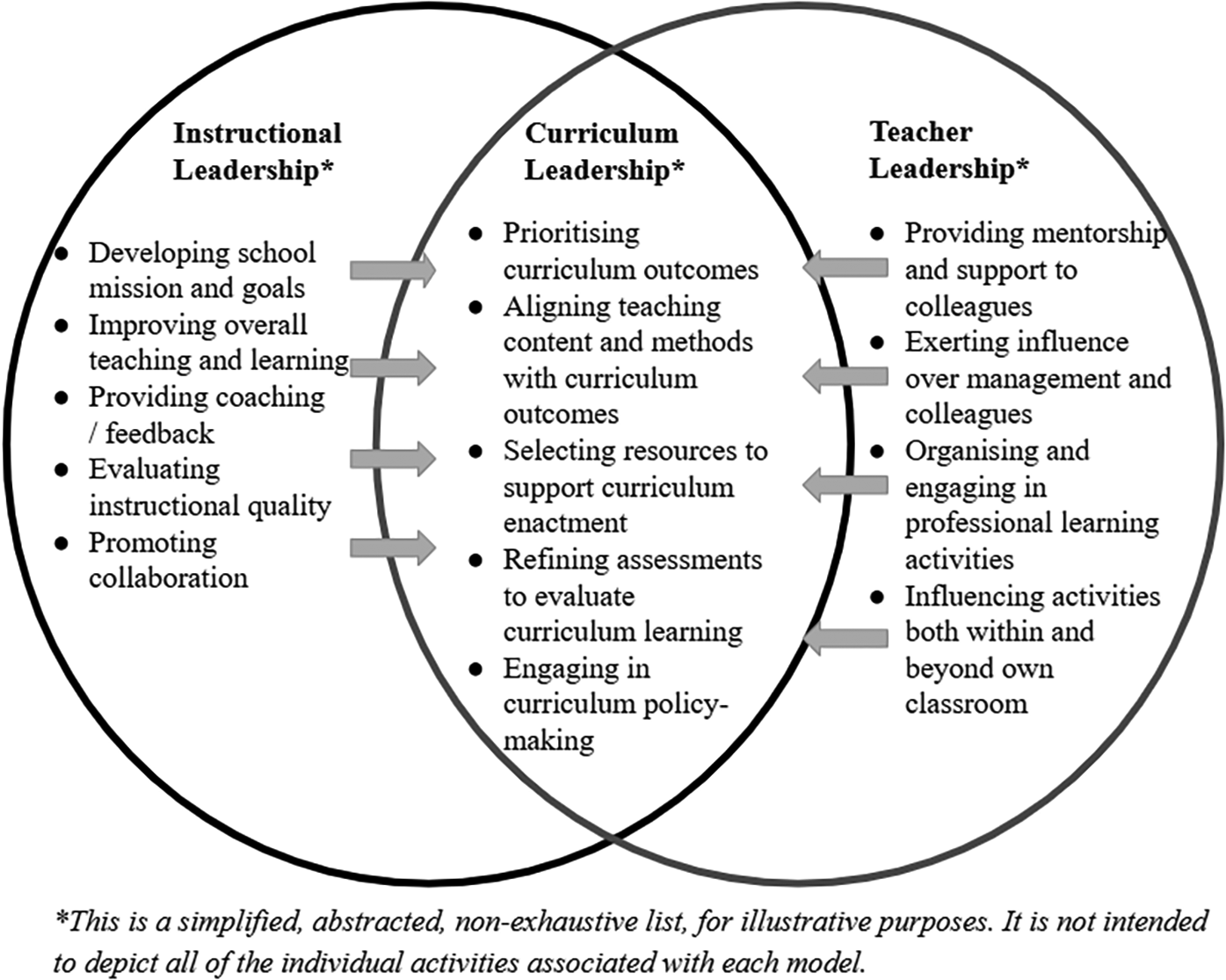
Relationship between curriculum leadership and instructional/teacher leadership.
Towards a definition of curriculum leadership
Curriculum leadership is narrow (Uljens, 2024), with a restricted focus, primarily referring to the methods, content and aims of schooling (Mäkiharju and Hilli, 2024) and how they are mediated through curriculum. Often, it involves critical reflection in balancing teaching pedagogies and disciplinary knowledge with learners’ needs (Uhlenwinkel et al., 2017), and in this way, can be framed as a form of praxis (Bogotch et al., 2017). Taking into consideration that leadership is often construed as influence (Yukl, 2013), curriculum leadership can be understood as exerting influence over what and how curriculum is enacted. Since influence is inherently interpersonal and relational (Burak and Bashshur, 2013; Haslam et al., 2020), this suggests that it relies on a collaborative approach (Harris, 2011; Hauge et al., 2014; Spillane et al., 2015). Crucially though, collaboration in schools is a phenomenon that has to be facilitated or enabled (Moynihan and O’Donovan, 2021) and, sometimes, the curriculum expertise of those who are not in principalships is underutilised (Tapala et al., 2021). In light of this, conceptualisations of curriculum leadership should, at least, be ‘receptive to the idea of bottom-up’ manifestations (Ho, 2010). Developing that analysis, Mäkiharju and Hilli (2024: 5) particularise curriculum leadership as dynamic and ‘processual’ (Mäkiharju and Hilli, 2024: 5), with any teacher capable of exercising it, regardless of whether they are a formal leader or not (DeMatthews, 2014; Shan and Chen, 2022). Indeed, a reassertion of the notion of the ‘teacher as a curriculum leader’ is fundamental in reclaiming the essence of teacher professionalism (Mitchell et al., 2022: 169), which the standards-based education policy trend has somewhat diminished (Sachs, 2016). While principals may have ‘mediational functions’ over how teacher curriculum leadership (Law et al., 2010: 301) or ‘collective’ curriculum leadership (Ritchie et al., 2007: 151) or ‘community’ curriculum leadership (Traver-Martí et al., 2021: 568) is enacted, the evidence illustrates that coordinating curriculum receives less principal attention than other aspects of their role (Gomiole et al., 2024).
Methodology
This qualitative paper was part of a broader, two-phase research project that gathered both quantitative (Phase 1) and qualitative (Phase 2) data on how curriculum enactment and curriculum leadership were undertaken in the Irish special school sector. Phase 1 consisted of a survey distributed to every special school principal in the Republic of Ireland (n = 133), to generate general descriptive data on pertinent curriculum issues in need of qualitative exploration. Phase 2 employed a three-site (n = 3) embedded case study approach to examine the minutiae of curriculum enactment and curriculum leadership at the microlevel. The embedded approach enabled each case to be examined as a single entity, while also isolating and exploring how different units within each case contributed to the overall impact or strategy (Scholz and Tietje, 2002). This article reports on the curriculum leadership dimension only, using data gathered during the qualitative phase, because this phase concerned the specific leadership actions undertaken by teachers at different positional levels. These actions were fundamental in demystifying curriculum leadership, which is the core purpose of this paper. The study received full ethical approval from the Research Ethics Committee at Dublin City University (approval number: DCUREC/2020/261).
Study context
To investigate how curriculum leadership operates across different positional levels in schools, this inquiry utilised the Stay Safe programme as a research probe. Stay Safe is a child safety education programme (MacIntyre and Lawlor, 2016) that is mandatory for every primary and special school in the Republic of Ireland. It is split over four levels to cater for learners between the ages of 4 and 12, and sits within the Social, Personal and Health Education (SPHE) curriculum in the Irish context. Although Stay Safe aspires to cater for the ‘wide diversity of learners and learning styles’ in all schools, it embraces the fact that some learners may need more ‘targeted individual adaptations’ (MacIntyre and Lawlor, 2016: 3). However, ambiguity exists on how to negotiate these adaptations for learners with general learning disabilities, in the context of a mandatory framework that requires the programme's ‘implementation’ (Government of Ireland, 2019: 20), and offers no guidance on the level of adaptation permissible. Calibrating this level can cause interpretative tension between principals, on the one hand, who have to ensure maximum compliance with policy guidelines, and teachers, on the other hand, who are faced with the reality of many learners not being able to access key learning at the classroom coalface (Morrissey, 2021). These conditions made Stay Safe the ideal instrument for interrogating how different levels of leadership influence enactment. Three special schools for learners with general learning disabilities were selected as cases. There were four units within each case:
Examination of the school's SPHE curriculum policy Semi-structured interview with school principal Semi-structured interview with curriculum coordinator for SPHE (in a promoted in-school management [ISM] position) Semi-structured focus group with three/four teachers
Sampling procedure
A two-stage sampling procedure was employed. The first stage identified the cases (schools) for examination; the second stage identified the units (participants) outlined at points C and D above.
Stage 1
A recruitment notice was sent to the principal of every special school in the Republic of Ireland (n = 133), inviting them to self-nominate their school. Non-probability, purposive sampling was then employed to select the three case schools from the respondents. There were three selection criteria:
Categoric criterion – all three schools had to be designated as schools for learners with general learning disabilities. Schools designated for learners with other disabilities were excluded; Staffing structure criterion – all three schools had to have the three grades of personnel needed to undertake the case study (a principal, an ISM curriculum coordinator for SPHE and at least three teachers with experience of enacting the curriculum under evaluation); Geographic distribution criterion – all three schools had to demonstrate variation in regional location.
These criteria were applied in a sequential exclusionary manner, where each criterion had to be satisfied before the subsequent criterion was considered.
Stage 2
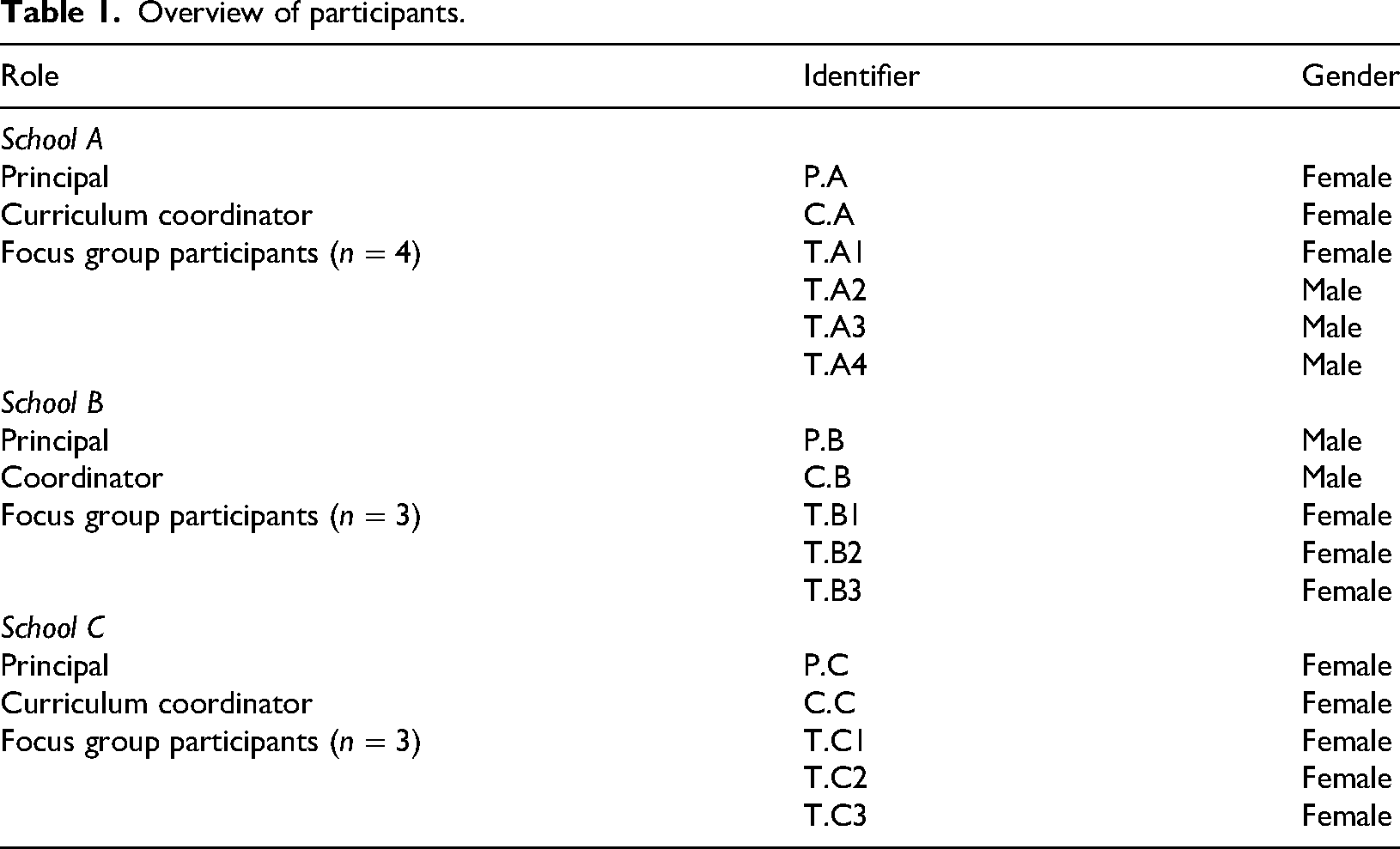
When the three schools were selected, snowball sampling was employed to identify the curriculum coordinator and the teachers. In practice, this meant each principal approaching the curriculum coordinator and inviting them to participate. The principal was also required to approach three or four teachers with experience of enacting the curriculum under investigation and invite them to participate. Where prospective participants indicated an interest, their contact details were provided to the researcher. The researcher then made direct contact with these prospective participants, providing detail on the project and what participation would mean for them. This yielded three (n = 3) curriculum coordinators (one from each school) and ten (n = 10) teachers. In total, there were sixteen participants (n = 16) across the three research sites (n = 3), all of whom were registered teachers with the Teaching Council of Ireland. Participation was on the basis of informed consent; participants could withdraw from the study at any time and assurances of confidentiality were provided. All data were fully anonymised in the research write-up. To maximise confidentiality, where necessary, certain information provided by participants was removed from the dataset altogether, where it could potentially have identified the participant or the school. Additionally, since this research focused on three special schools for learners with general learning disabilities (a specific subset of schools within an already small pool), the reportage of demographic details has been minimised, to further mitigate the risk. In any event, the most important demographic information, for the purposes of this paper, is the positional role occupied by each participant, because the focus was on probing how curriculum leadership was enacted at different levels. This information is outlined in Table 1, together with the identifiers used to report the data in this paper.
Overview of participants.
Interview procedures
All semi-structured interviews and focus groups took place online via Zoom, were audio-recorded only and then transcribed verbatim. Zoom has repeatedly been shown as an effective medium for conducting research interviews and focus groups (Archibald et al., 2019; Gray et al., 2020) – including with vulnerable groups (Lim and Kaveri, 2024). It enabled participants to engage with this study remotely, in some cases from their homes, which Oliffe et al. (2021: 3) argue brings ‘therapeutic value’ and comfort to participants, stimulating them to talk more freely, thereby enriching the data corpus. This was important in circumstances where participants may have been speaking about issues that arose in their schools. Each interview lasted approximately 60 minutes, while each focus group was approximately 90 minutes in duration. Audio recordings were retained until transcription was completed and then destroyed.
Data treatment and analysis
Before conducting interviews and focus groups, each case school's SPHE curriculum policy was preliminarily screened to identify salient issues that might need to be probed further with participants. This screening provided signposts as to how teachers engaged with the curriculum in each school and frequently identified the curricular roles/tasks that different levels of personnel undertook. Data emerging from the screening informed the subsequent development of interview and focus group schedules, ensuring that questions were targeted towards critical aspects of curriculum leadership. The policy documents and transcriptions were then coded using NVivo software, facilitating the identification of patterns and themes, which were then used to address the core research question. Braun and Clarke's (2021) widely used step-by-step guide for thematic analysis was employed to structure the analytical procedure.
Findings
This study revealed a complex tapestry of influences and considerations that shape the enactment of curriculum leadership across different positional layers in schools. While at surface-level, all participating principals articulated that curriculum leadership was distributed across different teachers, deeper probing of examples revealed that the distribution conceived of was more akin to delegation, in some cases.
Principal control of curriculum leadership
Principal control of curriculum leadership ranged from implicit (School C), to explicit (School A), to null (School B) across the case schools. Implicit control was evident in School C, where there was strong articulation from the principal of the importance of gaining staff ‘buy-in’ (P.C) in relation to the curriculum approach adopted. Regular meetings were held so that staff felt that they had input on their curricular offering: Now, obviously the secret behind it was, we already knew what we [senior management team] wanted…. Like the buy-in was key. We wanted them to feel that everything…was their voice, that they were heard, that we listened to every single staff member…’ (P.C). …from a leadership point-of-view … if you are actually just fumbling around hoping that everybody else comes up with a … consensus … you'll never get a consensus…. I suppose it's devious in a way (P.C). So a proposal to make a change that I potentially didn't agree with, I would look into it…. I would collect data on why this change was necessary or not. Then, if it's data-driven and I have the evidence to support the change, I will certainly make that change if I see that it's in the best interest of the children. But if I have evidence to the contrary I will explore that as well (P.A).
The power of the management hierarchy over curriculum leadership
Participant data overwhelmingly indicated that teachers in formal management roles had greater agency in curriculum leadership than those who were not. The more senior the role, the more influence and autonomy that accrued.
The deputy principal
In all three schools the deputy principal (DP) emerged as highly influential over the curriculum – on both the principal and the teachers. The DP provided credibility to the principal when they wanted to introduce curricular change: …if it was me on my own, I would have to be asking teachers … to pilot this for me because I'm not in a classroom. Where the deputy was able to … do that as a natural part of classroom routine…. I think this is why it's important to have the DP who is a practitioner in the classroom, leading it in many ways, with me, because they can say you know ‘I’m finding it easier in my planning’, because if it's just me here in the office they’ll say ‘it's alright for you up there in the office’ (P.C).
The curriculum coordinator
In School B, the SPHE coordinator was not the DP, unlike the other two case schools; instead, they occupied an assistant principal post on the ISM team. It is difficult to quantify the extent to which this more reduced management status impacted on how the role of curriculum coordinator was undertaken. The role appeared to have reduced visibility, with some participants in the focus group not fully sure who the curriculum coordinator was. This may have been linked to the fact that the current coordinator was only in the role for 6 months. There was also a sense that the coordinator did not have a leadership role because they were not someone who interacted with classes beyond the senior side of the school where they were teaching. This contrasted starkly with the curriculum coordinator in School A, who was also a teacher in the senior end, but whose influence, visibility and authority were readily apparent across the full span of classes. Since the curriculum coordinators in School A and School C were DPs, they met with the principal on a regular basis – their relationships were ‘underpinned by professional conversations’ (C.A). These relationships provided them with more access to ‘link with the principal’ (C.C) around curricular ideas that they wanted to progress. In School B the curriculum coordinator had no regular formal access to the principal, beyond discussion at ISM meetings. Instead, their role revolved around:
Organising resources Providing reminders when specific aspects of the curriculum needed to be covered Giving information around relevant courses
While the curriculum coordinators in the other two schools also completed these tasks, they additionally had a significant role in how the curriculum was enacted in classrooms. The curriculum coordinator in School B did indicate, however, that the person occupying the role prior to them ‘developed his own programmes’ (C.B) for the school – suggesting that time-in-role might impact how curriculum leadership can potentially be undertaken. Despite more influence appearing to accrue with more managerial status, there was still space for unpromoted teachers to exert influence.
Curriculum leadership beyond the management hierarchy
In all three schools there was a culture of collaboration and this served as a vehicle for many teachers, without an ISM post, to exercise leadership through influencing other staff members.
Classroom-level leadership
Teachers asserted that their classroom role in differentiating the curriculum and managing the pupils and other adults in relation to its enactment, was tantamount to a significant leadership role. This often involved accepting and rejecting suggestions for how the curriculum should be enacted and deploying special needs assistants (SNAs) in a targeted way to support its enactment: I have three SNAs…. So I think really the leadership role comes in here saying ‘okay guys, this is what we're doing today, this is how we're doing it, this is the language that needs to be used around it, or this is the topic for this week’ (T.A3). Every teacher has a degree after their name. They're highly intelligent people. They have to be allowed that freedom to interpret the programme … and to implement it in new and even visionary ways (P.B).
Leadership as influence through accumulated teaching experience
A premium was placed by all participants on experience in special education. Teachers with this experience were seen to bring value to the curricular decision-making process, were seen to know what approaches worked best for learners with learning disabilities and were highly influential towards their less-experienced colleagues: …it would be foolish of me … if I didn't go and consult or seek advice … from people that are here 25 or 30 years…. You'd be very foolish not to take advantage of the experience that is here and built up over many years (C.B). I would be very clear to give responsibilities to others as much as to postholders [on the ISM team] … if there are teachers who have that ability and capability of taking on another responsibility – they like that because it acknowledges their role within the school (P.A). …see if other members of staff taught the same topic recently, so this works really well, this didn't work really well, and you know actively seeking out support … is a very important part of a leader's role (T.A3).
Discussion
This study illustrated the ‘complex character’ of educational leadership (Bush, 2007: 393) and emphasised two premia that came to the fore in terms of how curriculum leadership was exercised. While the data illustrated that schools ‘continue to operate a hierarchical system’ where those higher up can be more influential (Lumby, 2016: 165), long-serving teachers also leveraged their experience to influence colleagues’ approaches to curriculum. The prevalence of distributed leadership was also evident in the data and although it was experienced differently across settings, the importance of teachers’ professional role in making school-level curriculum decisions was consistently acknowledged (Law et al., 2010).
Distributed curriculum leadership
This research provided some interesting perceptions on the fault lines and ‘interactions’ (Harris and DeFlaminis, 2016: 143) between ‘levels of leadership’ (Gronn, 2009: 381), as they apply to curriculum enactment. Broadly speaking, distributed curriculum leadership was often experienced in ‘licensed’ (King and Stevenson, 2017: 657) rather than ‘collective’ (Ritchie et al., 2007) terms, where those in management positions had power and influence over the leadership practised by teachers. While these kinds of situational factors (Fasso et al., 2016) may give credence to the ‘bounded empowerment’ argument (Hairon and Goh, 2015: 707), more nuance is necessary in assessing the role of ‘leadership from above’ (King and Stevenson, 2017: 657).
Guiding influence: Principals shaping curriculum leadership
This research demonstrated that those within the formal school management structure could exercise more influence over how curriculum is enacted – although some chose not to exercise it. In School A, where the principal exercised considerable control over the curriculum, the adaptation engaged in by teachers was buttressed by professional learning – because the principal insisted on this. This professional learning conceivably raised the likelihood of any resultant curriculum adaptation being more robustly informed. This arguably vindicates the assertion that leadership from above can improve the expertise and agency of unpromoted teachers (Darling-Hammond and McLaughlin, 2011; King, 2011). There was evidence in at least one of the case schools (School C) that, on some occasions, the principal was unable to make the ‘shift’ (Harris, 2012:) and let go of leadership when it came to making significant curricular decisions – a crucial characteristic of authentic distributed leadership (Hairon and Goh, 2015; Lumby, 2016). While this principal articulated that teacher voices had been captured, in reality these voices were corralled in the direction of the decision that the principal had already made. While the actions of the principal were informed by professional learning they had undertaken, teachers were simply following direction, acting as ‘technicians carrying out someone else's policy’ unbeknownst to themselves (Priestley et al., 2011: 269) – pointing, perhaps, to the possible presence of the ‘dark side of distributed leadership’ (Harris and DeFlaminis, 2016: 143), in relation to curriculum. So, while there was an awareness of the importance of teacher voices, in certain scenarios those voices were not actively listened to.
Curriculum leadership premia
Two curriculum leadership premia can be deduced from the findings which amplified the influence of those in possession of either or both of them.
The principal premium
The formal positional status of the principals enabled them to exercise more influence over how the curriculum was enacted, in line with what the broader body of scholarship has established in respect of the power attached to the role (Bush, 2018; King and Stevenson, 2017; Lumby, 2016). The principal could cultivate and curtail teacher leadership depending on the organisational culture that they promoted in the school – with curtailment potentially limiting the impact of bottom-up influences on curriculum leadership (Ho, 2010). Curiously, this research also established that positional proximity to the principal also increased influence. For example, both of the curriculum coordinators who were deputy principals (School A and School C) had far more influence over how the curriculum was enacted, than the SPHE coordinator who was lower on the management hierarchy, as an assistant principal. This reinforces the notion that some curriculum coordinators or department heads may be underutilised in curriculum leadership (Tapala et al., 2021). The assistant principal had to rely on their own teacher leadership exercised through collaboration and brokerage (Harris, 2012) with colleagues on the ISM team to influence curriculum enactment. The positional closeness of the DPs to the principal on the management hierarchy brought access to the fulcrum of school power; this access brought influence over whole-school curricular policy-making. Depending on the culture and structures established in the school, teachers could also exercise some influence, with those most experienced exerting the most influence.
The experience premium
The more years’ experience teachers had in special education, the more curricular credibility it provided them with. This accords strongly with Shawer's (2010) suggestion that the more experience a teacher has, the more likely they are to adapt or change the curriculum entirely. The accrued credibility of experienced teachers brought influence among colleagues in terms of curriculum enactment at classroom-level, although generally it was mediated informally, in an unstructured manner. This may be due to the teachers’ lack of a management role and protected time within their workloads to engage in formal conversations about curriculum, lending support to arguments made elsewhere in relation to curriculum leadership barriers (Cheung and Yuen, 2016). The informal mediation rendered it a slightly weaker force of influence than the leadership exercised by those with ‘positional authority’ (MacBeath et al., 2018: 90). Nevertheless, it does underscore how experienced teacher leaders can utilise ‘horizontal’ relationships to channel their leadership potential over the curriculum (York-Barr et al., 2005: 211), by adopting dialogic approaches (Nazareno, 2013). A point to note about the overlap between premia, however, is that many of those in positional authority here were also very experienced in the special education domain. Thus, disentangling the influence accruing because of their experience and the influence accruing because of their positional authority is difficult. It will be up to future research to determine whether an inexperienced principal can leverage the same influence over curricula as the principals taking part in this study.
Practical implications
Beyond its theoretical contribution, this study has important practical implications for how curriculum leadership is undertaken in schools and the enabling role of formal senior leaders in nurturing the leadership potential of those outside the management hierarchy. The results demonstrate that principals who enable unpromoted teachers to take a flexible approach to curriculum at classroom-level, while also setting an expectation that any curriculum adaptations will be informed by professional learning, are successful in building school capacity for learner-led curriculum enactment. This highlights the potential of what Bogotch et al. (2017: 304) describe as the ‘neo progressive relationship’ between curriculum and leadership, which is characterised by a reembedding of teacher professional judgement in decision-making about learning. Given that this kind of approach is key in enhancing learning experiences and driving systemic improvement (OECD, 2017, 2024), prioritising professional learning for principals in how best to facilitate it is both necessary and strategically aligned with what many countries, including Ireland, advocate for in educational policy (see, for example, Government of Ireland, 2023). There are also important implications for the position of DP – a role whose potential is often overlooked or not examined in detail in research literature (Leaf and Odhiambo, 2017). This study points to the critical bridging role they occupy between the principal and teachers, and how they can leverage influence both upwards and downwards on how the curriculum is enacted within a school - indicating that they also have the mediational role that Law et al. (2010) ascribe to principals in curriculum enactment. This capacity for influence underscores the privileged nature of the DP role and highlights the importance of providing in-career supports to enable DPs to leverage their influence to its fullest (Jansen and du Plessis, 2020). There is also a case to be made that DPs have significant capacity to be system leaders in curriculum enactment and such capacity should be examined further in future research studies.
Limitations
Although this study on curriculum leadership has yielded significant insight into a leadership model that is under-researched, the findings should be interpreted in the context of three limitations. First, while the snowball sampling procedure for identifying participants was successful in acquiring the necessary categories of school personnel, the quasi-gatekeeping role occupied by the principal was a limitation. It meant that other potential participants who could have added value to the project may have been unintentionally overlooked for participation. However, without this sampling approach, it would have been difficult to access the population groups necessary to probe the relationships underpinning the different leadership levels. Second, although this research focused on microlevel actors, the sample was limited to registered teachers. This meant that other actors – most notably learners and parents/guardians – were excluded, even though it is recognised that these groups can also exercise leadership or, at the very least, have valuable perspectives on how leadership is enacted. Undertaking research with these groups should be prioritised in future studies on curriculum leadership. Third, this study was located entirely within the special school sector, which caters to a particular category of learner and which, consequently, may lead to claims that it is context-specific. While this may be a legitimate critique, it is important to note that the focus was not on learners; rather it was on teachers and their leadership practices. Teachers in special schools in Ireland do not require additional or different qualifications to teachers in mainstream schools, and the leadership structure of both types of school is exactly the same. Furthermore, to enhance transferability, this research employed thick descriptions so that the reader can make their own judgements around what can be transferred, notwithstanding the minimised reporting of demographic information to meet the confidentiality assurances given to participants. The focus on special schools also responds to Hegarty's (2014) call to recognise how insights emanating from special education can enrich our broader understanding of knowledge practices in schools and education more generally. These insights should receive more research attention than they currently do.
Conclusion
Curriculum leadership is an under-researched leadership model, with the existing knowledge corpus emerging predominantly from conceptual rather than empirical studies. This research has attempted to reorient the balance and has explored the practice of curriculum leadership at the school-level. Using a standard curricular programme as a probe, it has demonstrated that curriculum leadership is exercised at multiple positional layers - akin to what Gronn (2009) has posited in relation to general educational leadership models. Those within the school's formal management structure can exercise it by implementing curricular initiatives from a top-down perspective or subtly influencing teachers towards their perspective. Those higher up in management are more agentic and influential in that regard (Lumby, 2016), with the scope of success dependent on collaboration and interrelationality, because leadership involves gaining buy-in that may range from nominal to fully-embraced (Hubbart, 2023). Meanwhile, those outside the formal management structure can also exercise curriculum leadership, by shaping their colleagues’ views, either supporting or resisting (Thomson et al., 2024) various curriculum approaches. It relies on a similar form of interrelationality for success – but one that is exercised horizontally rather than hierarchically (York-Barr et al., 2005), with this study demonstrating that experience-in-role augments a teacher's capacity to influence curriculum enactment. Broadening the discussion outward, these data also provide interesting insights on distributed leadership. Significantly, the principal was a determinant in how distributed curriculum leadership was experienced and how much authentic curriculum leadership a teacher could exercise. That point underscores the critical enabling role of principals, under distributed leadership models, in empowering others to engage in leadership for learning (OECD, 2016). This research has contributed to the empirical knowledge base in that area and serves as the basis for further probing of how curriculum leadership is operationalised across educational settings.
Footnotes
Acknowledgements
None

Ethical considerations
This study received full ethical approval from the Research Ethics Committee at Dublin City University (approval number: DCUREC/2020/261).
Consent to participate
All participants in this research participated on the basis of informed consent, which was provided in written format. Assurances of confidentiality were provided and participants could withdraw from the study at any time.
Consent for publication
This study does not include any identifying data. In their consent to participate in the study, all participants provided explicit, written, informed consent to publish anonymised data.
Funding
The author received no financial support for the research, authorship, and/or publication of this article.
Declaration of conflicting interests
The author declared no potential conflicts of interest with respect to the research, authorship, and/or publication of this article.
Data availability
Data from this study is available on request.