




Abstract
This study aims to understand and analyse the complex performativity involved when local education authority (LEA) officials implement systematic quality work (SQW). The article is based on a 3-year co-operative study with LEA officials in five Swedish municipalities, including observations of local SQW in action, interviews with LEA officials, and analyses of SQW documentation. Inspired by Goffman, we understand LEAs’ SQW as a performance conducted frontstage and negotiated backstage. We did discern four different and partially overlapping roles that LEA officials were engaged in frontstage: as experts, colleagues, guardians, and directors of SQW. Backstage, the LEA officials shared critical reflections and negotiations concerning their frustration, self-critique and feelings of disillusion related to SQW. While the SQW as a governing system continues to be produced and reproduced, LEA officials also continue to struggle to find proper measures for identified problems.
Keywords
Introduction
The last few decades have seen growing emphasis on the quality of education, not least in many OECD countries, evident in the efforts of strengthening quality assurance through evaluation policies and practices (Hanberger et al., 2016; Hjalmarsson, 2018; Wirzén and Hedegaard, 2020). Amid these changes, local education authority (LEA) officials face pressure from both national and local political and educational demands. They are also accountable for educational performance and the success of systematic quality work (SQW), a role that is both critical and complex. In this paper, our attention is directed towards these LEA officials and on how they are managing different social situations embedded in SQW.
The increasing interest in quality performance follows in the wake of New Public Management (NPM) and the ideas of decentralisation of public resources and responsibility to local service providers (Hood, 2001). These ideas of governing the public sector have also been embraced by the school sector, which in Sweden led to a transition from the state as the main school provider to approximately 1500 local education authorities competing on a school market (Dahlstedt and Fejes, 2019; Lager, 2015). This decentralised system has created a fragmented distribution of responsibilities among the state, local government, schools and individuals, accompanied by a decline in equal opportunities as well as in students’ performance (OECD, 2023).
The state’s response to fragmentation, a too decentralised accountability structure, and unsatisfactory results has been an increasing policy re-centralisation and juridification of the education system, based on frequent evaluations, reviews and follow-ups (Novak, 2019). At the centre of these efforts lies the idea of SQW. Håkansson and Adolfsson (2022) argued that recent decades’ disappointing delivery of the Swedish school in international comparisons (OECD, 2023) has been a crucial factor in the emphasis on LEAs and schools’ SQW.
Aim and research question
The present study, conducted in cooperation with LEA officials in five Swedish municipalities, contributes to knowledge about the challenges that SQW place on LEA officials and how they deal with these challenges. The 3-year-long study comprised observations of local SQW in practice, interviews with LEA officials, and analyses of SQW documentation. While acknowledging SQW as a legislative requirement, our point of departure is that SQW is also a social, cultural, and material set of ideas to be realised in a local context. The study aims to understand and analyse the complex performativity involved when LEA officials try to implement SQW. Our research question is: How are LEA officials managing different social situations embedded in SQW?
Previous research
In a decentralised education system, the LEAs serve as a crucial intermediary level (Greany, 2022; Liljenberg and Andersson, 2024). They play a vital role in interpreting and implementing both national and local policies and regulations (Anderson and Young, 2018; Campbell and Murillo, 2005; Hooge et al., 2019; Lager, 2015). Additionally, LEAs support principals in translating and executing government policies (Addi-Raccah and Gavish, 2010; Liljenberg and Andersson, 2024). Thereby, LEA officials find themselves in tension between contrasting interests, demands and expectations among the state, the municipality, and the local school level (Håkansson and Adolfsson, 2022). As critics have pointed out, the choices of LEA officials on how to implement and enact SQW will be decisive for the results that derive from it (Lundström, 2015; Ståhlkrantz and Rapp, 2022).
Research (Chapman, 2019; Muijs et al., 2011) highlights the importance of LEA officials, working in an institutional environment characterised by decentralisation, fragmentation, and re-centralisation, to adjust performance and to collaborate with local principals rather than controlling operational outputs. Chapman (2019) and Muijs et al. (2011) stressed the need to support local schools through collaboration based on schools’ local and diverse conditions instead of using standardised models. Here, the idea of quality dialogues has emerged as a way of collaboration and knowledge building between organisational levels (Karlsson, 2024), particularly spread in the Nordic education context. However, as shown by Karlsson, the joint and power symmetrical intentions of these dialogues easily turn into a controlling mode rather than a supporting one due to the participants’ sometimes conflicting understandings of the dialogues.
Research has also found that LEA officials have an important and significant role in supporting principals and teachers in analysing and making sense and use of performance data (Honig and Venkateswaran, 2012). Assisting with research and statistics and by communicating expectations of data use, LEA officials can create a foundation for principals and teachers to improve pedagogical practices (Prøitz et al., 2021).
Nonetheless, studies on the challenges and tensions in the interaction between LEA officials and school principals (as in Adolfsson and Alvunger, 2020; Håkansson and Adolfsson, 2022; Karlsson, 2024; Liljenberg and Andersson, 2021, 2024; Mufic, 2022) are still rare. As argued by Håkansson and Adolfsson (2022), considering that SQW is the all-encompassing and main tool for developing local schools, additional knowledge on how SQW is enacted at the LEA level is therefore needed.
LEAs and the Swedish education system
Quality reporting has been a legal requirement for schools in Sweden since the late 1990s, and since the Education Act of 2010, LEAs and schools share this responsibility: Each local authority within the school system must systematically and continuously plan and follow up the education, analyse the reasons for the results of the follow-up, and based on the analysis, carry out efforts with the aim of developing the education. (SFS 2010:800: Ch4 §3)
According to the General Advice of the Swedish National Agency for Education (SNAE), LEAs have ‘the ultimate responsibility for the education and must ensure that there are sufficient prerequisites to carry out quality work that secures quality and equity’ (SNAE, 2012a: 13, 2021). As part of the SQW at the LEA level, quality dialogues (cf. Karlsson, 2024) are often used as a tool, recommended by the SNAE (2012a, 2012b). The design of these dialogues, however, can be locally decided.
Theoretical framework – the SQW manuscript and stages of impression management
To understand the enactment of LEA officials in social situations staged by SQW, the work of Erving Goffman – particularly his focus on interpersonal interaction and its function to establish social identity – is used as our theoretical lens. Foundational in Goffman's methodology is that individuals always share social situations with others, while constantly lacking enough reliable knowledge about those others (Persson, 2018). Goffman uses the metaphor of a theatre to describe the participants as actors. According to Goffman (1959), an individual's behaviour on the stage could be recognised as a performance in which the desirable image – or assumed actor – in that specific setting is projected by adopting a certain mode of presenting him/herself. The performance is also key to defining the situation in which the actors are placed. Goffman used the notion of frontstage to describe ‘that part of the individual's performance which regularly functions in a general and fixed fashion to define the situation for those who observe the performance’ (1959: 22). Thus, the theatre's frontstage is also characterised by its audience, meaning that the actors on the stage are conscious of being observed by this audience. Actors ‘will perform to those watching by observing certain rules and social conventions, as failing to do so means losing face and failing to project the image/persona they wish to create’ (Bullingham and Vasconcelos, 2013). The LEA officials in the current study also alternate between being actors and part of the audience: speaking as performing actors, listening to other actors as part of an observing audience. The final audiences, for whom all SQW-related performances are conducted, are the School Inspectorate, local politicians, and citizens.
More specifically, the analysis builds on Goffman's concept of stage impression management (Goffman, 1959), which relates to how individuals within a social setting metaphorically wear masks and enact different roles to manage their appearance in relation to others. In this study, impression management is in part used to bring light to why the LEA officials do what they do and say what they say while performing SQW frontstage, such as when writing and presenting quality reports for politicians and participating in follow-up meetings and quality dialogues with schools. The concept is also used to understand why those same actors do and say what they do when critically reflecting on the overall SQW programme's inherent pitfalls and challenges – backstage.
In the analysis, the frontstage performances were operationalised as the actions and manifestations that take place in the formal arenas of the LEA officials. Frontstage, LEA officials take on the role of SQW experts who act in line with the SQW manuscript (as specified by the Educational Act and the General Advice for systematic quality work in schools). As Power (2003: 389) argued – in the context of organisational auditing – ‘to be an auditor, you have to act like one first’. This also means that, frontstage, the norms and values of the specific settings need to be upheld. For example, as our results will show, the SQW frontstage dramaturgy calls for reliance on (foremost) quantitative evidence, presenting successful measures, and signalling control of the situation. In contrast, the backstage is a place for exchanging confidences and for critical reflection. In Goffman's understanding, the conduct backstage is part of a working code of discretion: it allows the colleagues to exchange confidences concerning their relations to other people (…) [such as] expressions of cynicism concerning their mission, their competence, and the foibles of their superiors, themselves, their clients, their subordinates, and the public at large. (Hughes 1946, as cited in Goffman, 1959: 159)
Goffman emphasises that fundamental to these backstage expressions is the premise that what is told will not be repeated ‘to uninitiated ears’ (Hughes 1946, as cited in Goffman 1959: 159). This means that backstage is a place characterised by trust and a much less fixed manuscript. It is a social setting where the roles played frontstage are no longer required or needed.
In this study, LEA enactments of SQW are viewed as performances, and the participants as actors who try to follow the SQW manuscript, enacting roles constituted by the institutionalised norms and values of the specific social situation and audience (principals, politicians, colleagues, media, citizens, etc.), thereby interpreting, justifying and maintaining SQW in the local context.
Method and analytical process
Research design
The study emanates from a professional research network that met 12 times between 2020 to 2023, and in which four researchers and a group of one to two representatives from each of the five LEAs participated. This network was one of many established through a national initiative for practice-oriented research in collaboration between universities and LEAs. The five municipalities can be described as a kind of cross-section of Sweden, representing large cities, medium-sized towns and small boroughs. By mutual engagement, the purpose of the network was to develop shared knowledge about and to improve SQW at the LEA management level, as well as foster critical reflection and exchange of ideas. The design was participatory in the sense that researchers and LEA officials collaboratively planned activities during the network meetings and the data collection process. The close and extended cooperation between researchers and practitioners fostered a climate of sharing not only successful examples and achievements but also frustrations and shortcomings related to SQW as a practice.
Data collection
The empirical data, evenly collected from the five municipalities, have been assembled through four complementary methods: meeting minutes, document studies, observations, and interviews. The meeting minutes consist of network meeting protocols in the shape of thorough field notes. The LEA officials in the professional-research network have provided access to their organisations, enabling the analysis of documents, as well as observations and interviews with school staff and local politicians.
Observations of quality dialogues, including all five LEAs, were carried out in 2022, either digitally or in situ. These dialogues varied in size and design: from a dialogue between two people (a principal and a LEA official) to dialogues with 10 participants from schools, the LEA official and the political level. Besides the LEA officials, key performers in these meetings were the principals, assistant principals, teacher representatives of the school being monitored and, in one case, local politicians. In total, seven meetings were observed, on each occasion by two researchers. The observations were unstructured in the sense that researchers did not use a list of predetermined behaviours to look for, but rather wanted to capture behaviours and utterances occurring naturally during the meetings (Mulhall, 2003). An observation protocol was employed, focusing on the interaction between participants, issues and challenges related to SQW, how feedback was given, and the prevailing atmosphere in the group. The researchers acted as complete observers, meaning they did not interact with the participants during the observations (Gold, 2017). The observations were documented with field notes.
During the fall of 2022, interviews were conducted individually with 16 key LEA officials (managers of quality and development, operations controllers, development strategists, municipal lecturers, etc.) employed in the five LEAs. Six of the interviewees were part of the professional-research network, and four out of these six had also been observed during the quality dialogues. The duration of the interviews was approximately one hour and was conducted either face-to-face, digitally, or via telephone. The interviews were based on an interview guide consisting of questions about the participants’ experiences and activities in relation to the SQW, the expected and actual effects, as well as challenges and potential for improvement of systematic quality work. The interviews were recorded with informed consent and were later transcribed verbatim. The interview quotes visible in the results section of the article are representative examples from the relatively extensive interview data.
Data analysis
The initial reading of field notes and interview transcriptions was conducted by all four researchers independently to build a mutual understanding of the material. Subsequently, we discussed, compared notes, and reflected upon the interpretation of the empirical data, resulting in a shared insight into the inherent enigma of the empirical data: Why are there such discrepancies between different situations in how LEA officials discuss and perform SQW? We then returned to the material for a renewed perusal, repeating this cycle a couple of times, ending in the conclusion that Goffman’s dramaturgical approach (1959) provided a theoretical explanation of the data. Hence, to understand and explain these discrepancies in situations and performances, Goffman's theoretical concepts of frontstage and backstage were applied to give an initial answer to how the very same LEA official is managing different social situations embedded in SQW. Backstage, the LEA officials shared questioning reflections, expressed self-critique, frustration and feelings of disillusion related to SQW. The frontstage analysis resulted in discerning four different, partially overlapping, roles that every LEA manager was engaged in while performing SQW: as expert, colleague, guardian, and director of SQW. How these roles were analytically distinguished will be further explained in the results section (see Figure 1). Thus, the analytical focus has been on the LEA officials’ performances and impression management in different social situations staged by SQW, rather than focusing on differences among the five municipalities.
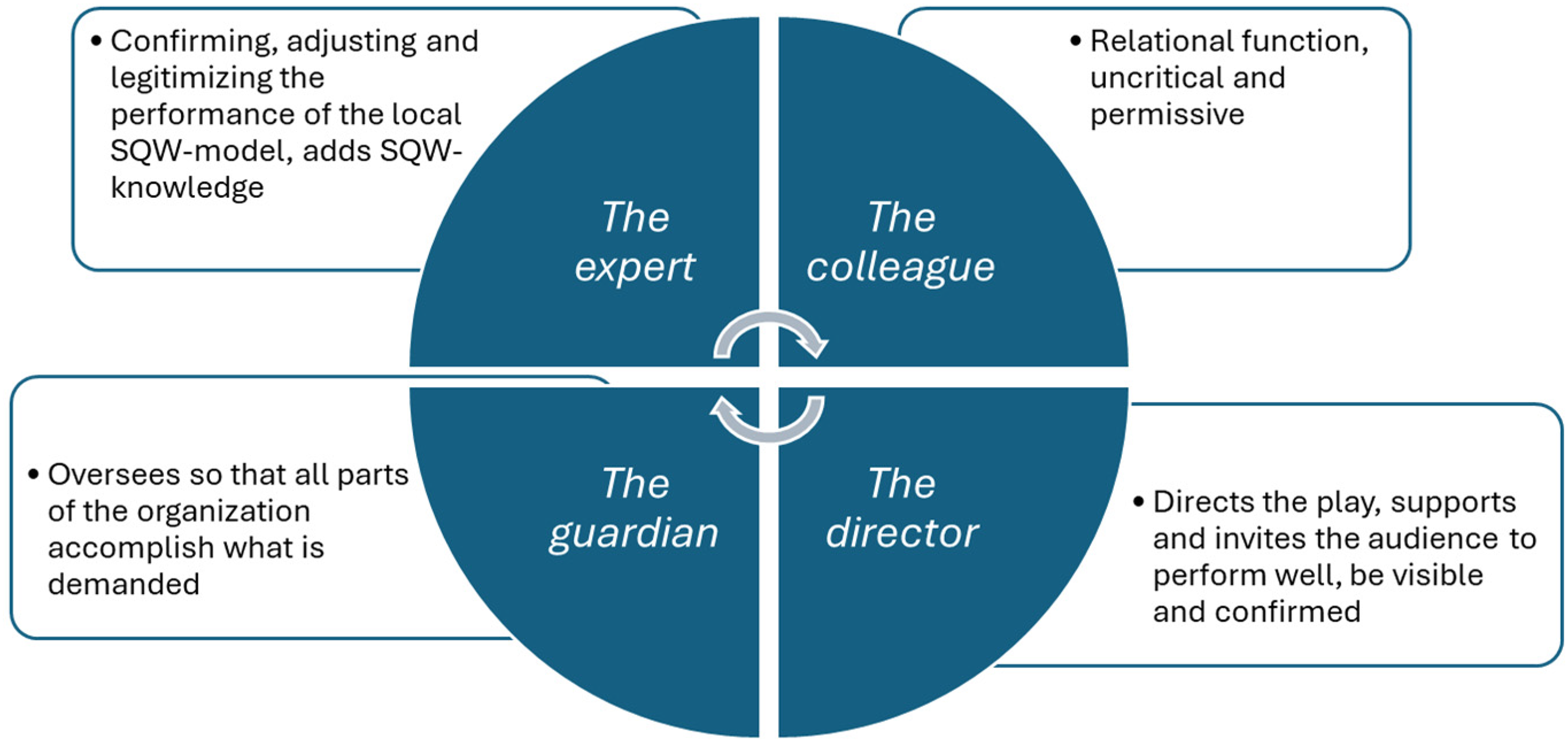
The frontstage roles of LEA officials.
Empirical considerations and limitations
As the study relies on interviews, we should not ignore Goffman's somewhat critical attitude towards interviews as a method. According to Goffman, interviews are superficial and do not provide deeper knowledge of people’s thoughts or actions (Goffman, interviewed in Verhoeven, 1993: 322). However, as the analysis is also based on data from meeting minutes and observations, we have ensured the validity of the interviews. Furthermore, the network meetings enabled establishing trustful relationships among participants, which contributed to a willingness to share different perspectives and thoughts openly, resulting in a shared understanding of what Goffman asserts as ‘a working code of discretion’ (Hughes 1946, in Goffman, 1959: 159). Consequently, this arrangement required thorough ethical considerations, concerning how to report the empirical data, as well as how to present the analysis in a trustworthy, respectful, and anonymised way.
Even though the municipalities organised and conducted SQW in similar ways (this isomorphism is probably explained by the strength of the institutional environment that authority regulations and guidelines constitute; cf. DiMaggio and Powell, 1983), it is not possible to claim representativity regarding the empirical selection – as the selection was formed through the professional network – or the findings, as the data and analysis is based on only five municipalities.
Results
With empirical examples from all five municipalities, this section starts by presenting the LEA officials’ frontstage performances, illustrating each of the four different, but partly overlapping, roles that were identified in the analysis. Thereafter, the focus shifts to the backstage negotiations.
LEA officials as experts
According to the analysis, the main role performed by LEA officials was as experts. The expert role is about legitimising SQW and the way it is conducted in the local context (see Figure 1). The role also entailed defining what SQW is and how it is accomplished in line with authority regulations as well as local SQW models. This role was especially evident in relation to teachers and principals and appeared when conducting quality dialogues. In these occasions, LEA officials had the function of supporting and guiding senior school supervisors in follow-ups of both local school unit results (student goal achievements) and of actions taken based on last year's dialogues. In these situations, LEA officials were ‘allowed’ by co-actors (LEA colleagues) and the different audiences (principals, teachers and politicians) to appear as experts if these others enacted the role of SQW apprentices.
Further, as experts, LEA officials also became advocates of both SQW in general terms and especially of the locally developed SQW model, including conveying the belief that SQW is fundamental to classroom improvement. In this role, LEA officials did not express critique or any doubts related to SQW, as this would be perceived as somewhat illegitimate responses to commands by national authorities and local politicians and would undermine both the legitimacy of the internal SQW organisation and the schools’ efforts in complying with SQW demands.
Nonetheless, the expert role also allowed an exploratory approach towards SQW. This relates to how to perform a high-quality SQW in line with authority requirements, which in all five observed municipalities contained elements of continuous evolving, including development of their own, unique SQW models. Almost every year, and at almost every participating LEA, the local SQW model was finetuned, elaborated, or sometimes even replaced by new ‘SQW 2.0’ designs. This never-ending development of SQW reflects the core idea of SQW as an ongoing mission that can never be good enough until all the students reach curricula goals (cf. SNAE, 2012a, 2012b; Swedish Schools Inspectorate, 2021).
Thus, the expert role entails a confirming and legitimising performance of the SQW model. In doing so, LEA officials need to appear competent and devoted to the overall purpose of the model. However, consideration must also be given to local political visions and goals, which make the frontstage expert role even more complex to act in accordance with. LEA actors need to balance formal requirements by national authorities with priorities at the local level. One of the interviewees described this as follows: It is not as though one can only plan with focus on the school unit isolated from the world outside; one must also consider, okay this relates to the school provider, how can we contribute in the best way to this? (Operations controller, Municipality A)
The expert role is not only constituted in relation to co-actors in need of guidance and support. The role is enacted on a scene dominated by a quantitative approach to quality assessment, as audience attention in SQW is mainly paid to specifically quantitative results. Complementary aspects of quality – qualitative aspects – were rare on frontstage scenes. One LEA manager described challenges in performing SQW associated with school employees and politicians having too much focus on quantitative data: …quality work, in my opinion, is not only about finding faults, but you have to trust professionalism, that everyone is doing a good job. (…) and from what I see, we need have more joint learning based on data. And data has been groped with a bit among pedagogues; I think they like the measurable. If you look at the politicians, they often focus more on the later [SQW] phases, which are then quantitative data, grades, merit values, and this is also the case in [this municipality]. (Quality and development manager, Municipality C)
With the role of being an expert on SQW, LEA officials were expected to ‘teach’ the audience (local politicians) how the national SQW system works. This includes aspects relating to school providers’ obligations, regulations, and requirements in the Education Act. One of the interviewees expressed challenges associated with a lack of interest and knowledge among local politicians: /…/ a challenge for us has been to get the board interested in what is their level of responsibility [not teacher or principal level]. We want them to make the big, long-term decisions about the conditions/…/ These big, more difficult questions are a little more difficult to create commitment to. (Development strategist, Municipality E)
Most politicians at the municipality level conduct their assignments in their spare time, which means that very few of them are to be considered political professionals with special interests in educational issues. Still, keeping up their appearances as the audience is key for legitimacy and the sustainment of SQW.
LEA officials as colleagues
Complementary to the expert role, a friendly and more socialising role of LEA officials was detected in the analysis. Socialising refers to what LEA officials do when they meet in person with their equals or superiors; they chat, smile, and confirm each other, slightly toning down the articulated purpose of SQW – to improve quality by revealing weaknesses and striving for transparency. However, socialising relates to aspects of collegiality in a scene where co-actors express independence and autonomy. Here, in contrast to scenes where co-actors take the role of apprentices, co-actors and LEA officials appear as colleagues, despite hierarchical differences. This is how one of the interviewees describes his/her reflections on observing a dialogue meeting: Relaxed atmosphere. Perhaps a little too relaxed… Those who are present show understanding of each other's situations and conditions. (Field note, 22-01-19; Municipality A)
The role of colleague was also visible in semi-formal scenes where co-actors with different organisational functions performed. This was observed, e.g., at two annual result workshops – located at a conference facility where food, coffee and snacks were served – at which local politicians, LEA officials, principals, and senior school officials met to discuss final SQW conclusions. On these kinds of occasions, hierarchical boundaries between actors with different positions were less evident than in scenes where LEA officials enacted other roles, such as experts or guardians. Here, boundaries between the audience (politicians) and frontstage actors (senior school officials and LEA officials) formed the roles as the scene represented the formal and legitimate side of SQW, namely, to follow up on school performance over the year. In contrast to this scene, LEA officials, together with others, appeared as colleagues on the semi-formal scene outside, which allowed actors to openly reflect on aspects concerning performance that, in other scenes, would have been disqualified as too separate from the core idea behind SQW. On the semi-formal scene, boundaries between actors and audiences were blurred, almost as if the audience was missing, just a scene with socialising co-actors.
LEA officials as guardians
Apart from the expert and colleague roles, a third appearance of LEA officials was identified: acting as guardians of SQW, protecting the intentions and demands of SQW according to the protocol. This role was found in scenes where SQW was performed as an evaluation of school performance. Here, LEA officials not only set the scene as definers and advocates of what SQW is and how to perform SQW (as in the expert role). Rather, LEA managers appeared as guardians of the local SQW system that, in all parts, accomplish what authorities demand. This role was built on the central position within the school management office that many of the interviewees had, including the authority to control co-actors such as principals on the scene: We follow up very carefully on the principal's responsibilities, for example, because there are certain parts of the principal's responsibilities that are not stated elsewhere in the curriculum, international contacts, the role of the library, interdisciplinary work and so on. It's like it's not stated anywhere else, and there we kind of try to push them: ‘How do we ensure that the principals work with these things?’ (Operations manager for compulsory and upper-secondary schools, Municipality E)
In similar ways, principals oversee teachers, the head of the school organisation oversees LEA officials, and local politicians control the heads of schools. This hierarchical way of organising SQW signals not only a need to supervise and ensure a sense of control, but also a lack of trust in the capability of other groups within the LEA-system to conduct SQW. One of the interviewees described his/her guardian role like this: So that my role/…/ensure that it [the SQW] is good, that it takes place according to the governing documents and the existing guidelines, that we have some kind of consensus on how we think about this systematic quality work. And here it has been to put in theories that/…/help hold on to … that it has consequences for how we reason and think. (Development strategist, Municipality E)
Thus, as the SQW manuscript prescribes controlling and evaluation, LEA officials need to display mastery of the situation, which the role of guardian enables.
LEA officials as directors
LEA officials also appeared in the role of directors while conducting SQW during the annual quality cycle. As directors, the LEA officials orchestrate the local SQW by creating routines around organising the SQW, such as form and frequency of dialogues/meetings and quality reports. Further, they decided what specific goals should be prioritised and followed up on during the annual cycle in their municipality. The possibilities [with SQW] are endless. And I think it's positive that we ourselves are allowed to create the form and the structure for it. So, there are the possibilities. (Operations manager for compulsory and upper-secondary schools, Municipality E)
This role includes both supporting and leading the actors through the regular dialogues and meetings. In general, the focus was more on making sure that the co-actors performed according to the local SQW manuscript, but when the schools were already high-performing, the focus was more on supporting the actors. Our goal is precisely to work with supporting and developing the operative analytical competence. That is our highest priority. (Municipal lecturer, Municipality A) And there we have something that I call SQW in a group, where at given times during the year, it will probably be about four times in an academic year, we have different themes that we discuss together in the principals’ group. (Operations manager for preschools, Municipality E)
During the quality dialogues, the director's role included both directing the actors but also confirming their competence, giving the actors the opportunity ‘to show off’.
The negotiation of SQW backstage
In this and the following sections, our focus shifts to the backstage, where LEA actors, now without formal audiences, reflect on SQW. When viewing SQW as a social, cultural, and material set of ideas, SQW becomes open for negotiations, as in understandings of what quality is and how SQW is to be carried out in practice. Following Goffman (1959), the concept of backstage is used as a metaphor of the social context constituted by participants among themselves and together with researchers. Here, contradictions and challenges become more visible than in the performances' frontstage, demonstrated by statements of frustration, disillusion, and self-critique.
LEA officials being self-critical about SQW
One striking result is the sceptical compliance that the LEA officials show towards the SQW system. This backstage confession concerns the very meaning of their work in terms of its possible effects on classroom performance. For instance, in the analysis, these concerns became evident in times of producing the final quality reports, such as when LEA officials are asking themselves: Are these reports of any use at all at the classroom levels? So, we can keep going here and make nice papers and nice documents and we can make great efforts, but if nothing happens, no changes in the classrooms, then it doesn’t matter what we are doing./…/ So the big challenge is to see and sort of track it; this work we do at the LEA level, can we track it all the way down to change in the classrooms? That is the effect we want to see. (Development manager, Municipality B)
While discussing difficulties in demonstrating visible results of SQW at the classroom level, one of the interviewees concluded: ‘After all, we do at least no harm’ (director of development, Municipality B). Such ironic approaches towards SQW and their own work could hardly be expressed frontstage. As an expert, colleague, guardian, or director, LEA officials are obliged to act in accordance with the SQW manuscript. Backstage, it became possible to problematise both SQWs as a system for attaining higher quality as their own functions: Then I think with the quality work as well, and these systems, that we are sort of trapped in the system, so then the question is what can be done with it. (Director of development, Municipality B)
While LEA officials were reflecting critically, they raised concerns about their own ability to perform SQW and the expected outcomes of SQW. As part of that, they expressed a genuine concern about whether SQW was conducted in the ‘right’ way or not. The self-conscious performance of the SQW expert that was played in front of audiences of politicians, teachers and principals was no longer that obvious; rather, it was replaced by resistance and reluctance.
LEA officials questioning collective capabilities to conduct SQW
Another self-critical reflection expressed backstage was a sceptical view among the LEA officials relating to the collective capabilities in their own organisations to conduct SQW in line with the authority's intentions. These doubts concerned their co-actors’ abilities and devotion to the system, as well as their occasional lack of capacity to analyse collected data for the SQW. These doubts, generously shared in more informal settings, were never expressed frontstage. However, several LEA officials shared these experiences and insights: It [analytical competence] is very superficial, I would say/…/merit value and eligibility are the basis of the grade, it is just a repackaging of the grades. And there are (…/problems with this. One is that there are major flaws in the equivalence of grading, which makes it very inaccurate to compare the grades from two different schools. After all, the grading itself cannot reflect quality, neither in the teaching nor in the students’ knowledge, it is not enough. (Municipal lector, Municipality A)
Another doubt concerned the use of common resources: There are resources, but are they used properly? We have different competences, researchers, statisticians, special functions in HR, a mother tongue unit and pupil health team /…/So we have a lot of different competences, but do we actually use this competence? And are we doing it in the best way? And use it for the schools that really need it? Do they [the support systems] work or is it that we are steered by the systems rather than the needs of the schools? (Municipal lector, Municipality A)
An inherent challenge was expressed as a questioning of their own (as LEA officials) capability to increase quality by means of the current SQW system: So, sometimes I’ve just thought that you’d just, you know, blow everything up, just blow everything away and if we were to start from scratch – I think you’d have to start from the kids and the students instead of just doing from the documents and the templates and system and so on. (Municipal lecturer, Municipality A)
However, the critical reflections shared backstage were only to a very limited extent part of the final quality reports presented to the different audiences. The analysis of data reveals a clear tension between, on one hand, the ambition to uncover weakness and deficit and on the other, the need, in front of an audience, to keep up the appearances for everyone included. I can say that there is not much focus on what is lacking. Because I can experience that it is a lot about what is good and what works, it's probably a bit about prestige, that you don't really maybe always want to show what [is lacking]. (Operations manager for preschools, Municipality E)
One of the core ideas of SQW is to identify deficiencies and then implement adequate measures to improve. However, that would require a kind of transparency and trust in the organisation that is very difficult to achieve in real life. You end up in the crossfire [laughs] between being blamed for what the head of administration shows up and what you actually want quality work to mean and how you can support the school leaders to get deeper /…/. The trust in that we understand the difference and that we have good intentions and are not some kind of spies [laughs] who say one thing and then send other signals upwards, we work a lot on that. (Head of development for upper secondary schools, Municipality D)
The continuous work on developing our own SQW models also reflects on how SQW is decoupled from overall school prerequisites. One of the interviewees described the ongoing struggle with balancing expectations of appropriate quality results with conditions that were excluded from the SQW: We are still struggling a bit with our SQW as there are, of course, aspects within the municipal assignment that affect the national assignment. Conditions such as staff, salary, sick leave, facilities, etc. /…/It is a wholeness that I’m missing, but I don’t know how, and that is why we are still struggling. /…/ As I mentioned before, we don’t make any notes for example concerning staff sick leave – we do not include that in SQW. However, I see that this have effects on performance. (Operations manager for compulsory and upper-secondary schools, Municipality E)
The separation of SQW from basic educational fundamentals enables national politicians, as well as local politicians and LEA officials, to also decentralise the accountability to individual schools, principals, and teachers, as if only they are to blame when results are disappointing. Therefore, in quality reports, local school conditions (as socio-economic factors, students’ background, segregation, teacher qualifications, etc.) are rarely explicitly discussed in relation to students’ results. However, every municipality has an open space to write their own SQW-report. I have seen municipalities that also conduct two separate reports. (…) and I have seen municipalities that have 100-page reports, and there were those that have 17-page reports. So, I believe that there is a major discrepancy in how to write, and as I said, there is no right or wrong. (Operations manager for compulsory and upper-secondary schools, Municipality E)
A way of coping with this pressure is to distance the audience – local politicians and authorities – from the behind-the-scenes practice. Some of the interviewees have experiences of a ‘double standard’ in terms of two quality reports – one official communicated frontstage and one in-official that has an internal aim.
Discussion
In this article, we have focused on how systematic quality work (SQW) was performed at the Local Education Authority (LEA) level in five Swedish municipalities. To understand and to analyse the performativity involved when LEA officials enact SQW, we have followed Goffman's (1959) dramaturgical approach to answer the research question: How are LEA officials managing different social situations embedded in SQW?
As has been shown, LEA officials have an intermediate and key frontstage function (cf. Greany, 2022; Håkansson and Adolfsson, 2022; Liljenberg and Andersson, 2024) in the local SQW. However, being responsible for SQW, LEAs need to shape and reshape trustworthy relations with other actors within the school organisation (teachers, principals, senior management, and local politicians). To do so, LEA actors enacted SQW frontstage by taking on four different but overlapping roles: the expert, the colleague, the guardian and the director. These roles enabled LEA officials to uphold and legitimise the idea and the practice of a locally developed SQW model, to sustain its existence despite the many concerns about what SQW can accomplish at the classroom level. We have also shown how LEA officials have made great efforts to what we, hesitantly, call believe in SQW – a belief that is necessary for the LEA as an organisation to be maintained and to avoid being questioned themselves.
In this study, SQW as performed in action was never debated during the observations. Instead, these negotiations took place backstage, in interviews and network meetings, where reluctance and even resistance were present. This distinction of practices is almost certainly explained by the inherent difficulties in SQW compliance as such.
It is worth noticing that the idea and practice of SQW is embedded in a political landscape with institutionalised and often contradictory understandings of what SQW is expected to accomplish at the classroom level. This landscape, shaped by NPM ideas, is characterised by highly juridified, fragmented, and decentralised responsibility structures that increase unequal educational opportunities, upheld and nurtured by a competitive market-oriented school system (Dahlstedt and Fejes, 2019; Hood, 2001; Lundström, 2015; Novak, 2019; Ståhlkrantz and Rapp, 2022). In this context, as shown by Karlsson (2024), the quality dialogues, for instance, embed both ritualised and performative aspects of formal interactions.
The negative outcomes of this entangled net of different school providers (cf. Hjalmarsson, 2018; OECD, 2023; Wirzén and Hedegaard, 2020) are, from a government perspective, assumed to be solved by a strong emphasis on SQW, which LEAs have the ultimate responsibility to put into practice, realise and accomplish (Addi-Raccah and Gavish, 2010: Anderson and Young, 2018; Campbell and Murillo, 2005; Hooge et al., 2019; Lager, 2015; Mufic, 2022). However, our findings suggest that there exists a discrepancy between how SQW is and can be performed frontstage, on formal scenes, and in relation to how it is discussed by key actors backstage. A reason for this can be found in how SQW has moved from being associated with learning and improvements in line with the National Education Act (SFS 2010:800: Ch4 §3), towards becoming an indicator of insufficiency. Within the political context, insufficiency is associated with critique from national authorities and media exposure that will harm the school's reputation and decrease LEA legitimacy. Showing quality weaknesses in, or being transparent with, the real issues and challenges concerning school performance, hereby becomes a major risk on the frontstage scenes. Being in this hotspot – pressured by teachers, principals, senior management, local politicians, and national authorities (cf. Adolfsson and Alvunger, 2020; Håkansson and Adolfsson, 2022) – and having the responsibility of supporting teachers and principals in conducting SQW and analysing data (cf. Chapman, 2019; Honig and Venkateswaran, 2012; Prøitz et al., 2021; Muijs et al., 2011), we found LEA officials to manage their appearance by taking on the four roles as a way of (re)shaping social relations with actors within the school system. However, the roles performed on stage – especially the colleague – enabled LEAs to manage and cultivate their social relations in what otherwise could be defined as a field of strong tensions and many contradictions (cf. Lundström, 2015).
To complement the current study, we suggest future research in two areas: First, there is a need to deepen the understanding of how SQW as a learning practice is formed by national policies and regulations. Second, there is also a need to further investigate the practice of LEAs and the intermediate role they have in a market-oriented and re-centralised school system.
Conclusion
By focusing on LEA-level actors, we contribute to a research area that has been somewhat in the shadow of other studies addressing quality aspects and policies within the Swedish school system (cf. Dahler Larsen, 2019; Håkansson and Adolfsson, 2022; Jarl et al., 2017; Liljenberg and Andersson, 2021). Hereby, this study contributes to research by highlighting how LEA officials, as key actors in the local SQW, socially manage their appearance within school organisations to minimise the risk of being criticised by authorities for performing insufficient systematic quality work. As the idea and practice of SQW is embedded in a political context – which does not always endorse transparency, learning and improvement – we found that SQW instead promotes an extensive amount of workload within local school unit organisations as the legitimate response to governmental requirements. And instead of being a means with the aim of improving classroom performance, SQW has become one of the dominating concerns for LEAs themselves.
Based on our findings, we suggest that SQW – both as an idea and as practice – should downplay the importance of and emphasis on monitoring performance in favour of trust in the teaching profession's ability to develop quality at the classroom level. We also conclude that transparency and trust are key factors for improving performance on all school system levels. This transparency and trust, however, are only possible under certain social conditions, which cannot be governed by legislation or regulations. Consequently, the SQW as an idea and practice is likely to only sometimes work as intended (that is, when the transparency and trust are established) – and often not. While the SQW as a governing system continues to be produced and reproduced, LEAs and schools continue to struggle with finding and implementing the assumed proper measures to address identified problems. The somewhat radical question is perhaps this: Would schools' efforts to improve be more successful without the administrative burdensome SQWs?
Footnotes
Acknowledgments
The authors want to thank the ULF-network participants, as this research would not have been possible without their vital contributions.

Funding
The authors received no financial support for the research, authorship, and/or publication of this article.
Declaration of conflicting interests
The authors declared no potential conflicts of interest with respect to the research, authorship, and/or publication of this article.