




Abstract
This study contributes to research on collective forms of leadership by exploring the interrelations between Finnish comprehensive schoolteachers’ perceptions of school leadership group's leadership practices and collaborative school development. The study was conducted in small and middle size municipalities (N = 16) in Southern Finland. The results from a survey data (N = 1030) showed that teachers who perceived their school's leadership group as acting coherently in line with shared values, also considered that there are clear goals for school development and practices for assessing the attainment of those goals. Teachers’ perceptions of participative leadership group practices were positively associated with perceiving a conversational environment and students’ engagement in school development work. Teachers having experience of working in the leadership group showed a stronger sense of shared responsibility for school development compared to teachers with no such experience. Overall, the study highlights the role of coherent and participative leadership practices of school leadership groups. Thus, school principals need to be trained and supported in organizing their leadership structures to enhance collaborative efforts of school development. As one of the first quantitative studies focusing on leadership groups, this article offers instruments for future research and informs policy about school leadership structures.
Introduction
The understanding of the variety of factors and components related to school leadership and school development has evolved over the past few decades (e.g. Datnow, 2018; Harris and Jones, 2010, 2021; Hatch et al., 2021; Oppi et al., 2023). The capacity for collaborative development work among educators has been noted as one central factor in developing practices in educational settings (Hargreaves and O’Connor, 2018). The way schools are led and how leadership is constructed is central in facilitating collaboration inside and outside schools (Goddard et al., 2015; Leithwood et al., 2020). This is related to developing the school in a direction that supports desired practices, formulating shared goals and a functional collaborative climate, as well as building relationships and strengthening all actors’ commitment and sense of responsibility for the work (Hargreaves and Fullan, 2012; Leithwood et al., 2020). From this perspective, school leadership aims not only to vertically build consistency between the objectives set at the state and local levels, and the development activities enacted at the school level, but also to enhance coherence horizontally by engaging all teachers in collaborative school development work in the professional community (Soini et al., 2016). When discussing the practices that enable the sharing of responsibilities and duties, and building collaboration, distributed leadership and teacher leadership appear among the more used concepts in the field (Harris and Jones, 2021). Distributed leadership is seen as an extension of practices and responsibilities related to leadership and suggests that informal leaders within the organization would be part of these processes, not just those having formal leadership roles (Harris and Jones, 2021; Spillane and Healey, 2010).
Practices based on collaboration in developing schools have been highlighted not only in research but also in the policy documents directing schoolwork (Datnow, 2018; Finnish National Board of Education, 2014). Yet, collaboration in the teacher professional community is not self-evident, not least because teachers act as autonomous professionals within their classrooms (Day and Sachs, 2004; Eisenschmidt et al., 2021; Salokangas et al., 2020). In the context of Finnish basic education, principals see that through the creation of leadership structures (i.e. teacher teams, leadership group) it is possible to enhance shared decision-making that engages and commits teachers to school development work (Ahtiainen et al., 2019; Eisenschmidt et al., 2021). The school leadership group in the Finnish context entails a team of 5–10 members of the professional community including the principal, vice/assistant principals and teacher members (Ahtiainen and Heikonen, 2024). There are differences between schools in how leadership structures are organized, but the leadership group is the most common structure that is often combined with other team structures related to school practices and development (e.g. curriculum team). By school leadership group practices we refer to the actions, strategies and procedures employed by leadership group members to manage and promote the school's educational objectives (i.e. decision-making, establishing collaborative environment). Nonetheless, the realization of such leadership structures and enhancement of teacher engagement has not necessarily been straightforward processes or without encountering challenges (Ahtiainen and Heikonen, 2024; Eisenschmidt et al., 2021; Simola and Ahtiainen, 2024). Moreover, a recent TALIS survey has shown that Finnish principals are among those who seem to wish for more training on how to construct cooperation between teachers, that is, more knowledge and skills related to whole-school teacher collaboration and its cultivation are hoped for (OECD, 2019; Taajamo and Puhakka, 2019).
Acknowledging such research findings and practice, this study focuses on leadership groups as they can be considered one of schools’ key organizational processes explaining how leadership can produce positive teacher outcomes (Stosich et al., 2018). To our knowledge, there is limited quantitative research conducted on leadership structures, such as leadership groups. In this study, collaborative school development work refers to a wide spectrum of practices where teachers act together towards school development objectives, including both large-scale programs (e.g. developing school curriculum) and small adjustments of everyday school practices. Despite the large amount of research around the topic (e.g. schools as professional learning communities), not much is known about how teachers’ perceptions of the school leadership group's practices regarding their coherence and efforts to engage teachers in decision-making are related to the collaborative school development that is experienced within the teaching community.
Literature review
Leading collaborative school development
Collaboration among teachers is a crucial element whether we focus on the development of classroom practices or the school community. There is evidence that teachers perceive collaboration and collaborative approaches to improving teaching among the most meaningful ways to develop professionally (OECD, 2019; Vangrieken et al., 2017). Collaboration in schools has also been shown to be related to teacher job-satisfaction, engagement, self- and collective efficacy beliefs, innovation as well as classroom practices and student performance (Vangrieken et al., 2015). Among the cornerstones of collaborative practices in the teaching community are transparency and shared decision-making processes (Ahtiainen and Heikonen, 2024; Honingh and Hooge, 2014; Lavié, 2006). Principals leading their schools in ways that encourage teachers to collaborate and try out new practices are more likely to reach sustainable changes in their school (Kohm and Nance, 2009). Still, collaboration is not a solution per se and may not necessarily lead to success in a school development process (Hargreaves and O’Connor, 2018: 12; Vangrieken et al., 2015).
One of the most known concepts used for describing collaborative processes improving schools is the professional learning community (PLC; DuFour and Eaker, 1998; Stoll et al., 2006). There are varying definitions and characteristics given to the concept, but generally it refers to a group of teachers (i.e. teacher team) working collaboratively in order to facilitate professional learning in the school with a clear focus on improving student learning (Hord and Sommers, 2008; Vangrieken et al., 2017). The characteristics of PLC have also been used to examine teacher communities’ capacity to learn and develop their school. For example, trust in other teachers, principals and parents has shown to be related to teachers perceiving their school according to characteristics of PLC (i.e. shared sense of purpose, collaborative activity, focus on student learning, deprivatized practice and reflective dialogue) that may further increase teachers’ professional learning (Yin et al., 2019). It has also been suggested that leadership practices that facilitate collaboration and construction of a shared vision in a school support PLCs and can further enhance teacher efficacy (Voelkel Jr., 2022). Admiraal et al. (2021) concluded in their study on PLC framed school interventions that the more school development measures are embedded in the structures (i.e. teacher teams, leadership group) and the culture of the school organization, the more sustainable impact they may have (see also, Liu et al., 2022). Similarly, Stosich et al. (2018) emphasize the role of leadership structures and teacher teams in the collaborative school development processes mediating the effects of school leadership on positive teacher outcomes (e.g. efficacy beliefs).
The evidence shows that the goals of educational development work can be reached by focusing on changing the key processes of an organization, such as leadership (Harris and Jones, 2021). Leadership can contribute positively to improvement of organizational practices (Harris and Jones, 2021). Today's view of leadership is based on the idea that everybody's capacity is needed in responding to the requirements and goals set for educational organizations. That approach assumes that schools benefit from organizing the work through a number of team or group structures (Ahtiainen and Heikonen, 2024; Stosich, 2023) and distributing tasks and responsibilities within the teaching community (Harris and Jones, 2021; Spillane et al., 2004). Distributed leadership seems to be the dominant way to conceptualize the phenomenon, and it together with leadership focusing on curriculum and learning (e.g. instructional leadership) are assumed to be positively related to organizational learning and students’ learning outcomes (Harris and Jones, 2021). The focus of distributed leadership is on putting emphasis on practices that enable leaders and teachers to communicate in a variety of situations taking place in schools (Harris, 2012; Spillane and Healey, 2010; Spillane et al., 2004). That is, the school forms a dialogic working environment that opens formal and informal channels for interaction among the staff and students. That kind of work community can form the grounds for developing a school vision, making decisions on development goals and building shared responsibility among the teachers (Eisenschmidt et al., 2021; Heck and Hallinger, 2010). Moreover, challenges and problems encountered by the school can be solved together and people have a clear division of responsibilities (Pearce and Conger, 2002).
The idea of distributed leadership has been embedded in education policies in various European countries, and it has been introduced as a model for successful leadership practice (Hall, 2013). Nonetheless, distributed leadership has been viewed, to say the least, as a double-edged sword that on the one hand can lead to a more meaningful professional development and enhance work commitment (Harris et al., 2022). On the other hand, it has been criticized as being one of the measures of New Public Management targeted to delivering policy reforms efficiently by escalating their scale and pace through involvement of more people in the process (e.g. Hall, 2013; Harris et al., 2022). Consequently, distributed leadership has been considered putting more pressure on and control over teachers in school development work and increasing their workload without any compensation (Hall, 2013). It is obvious that the discourse around distributed leadership is controversial, and a number of studies have pointed out how it is inherently neither a negative nor positive approach (Harris et al., 2022). A lot depends on the nature, form and purpose of leadership distribution (Harris et al., 2022; Leithwood et al., 2020), and many contextual factors (school size, type, development stage, external education policies) affect the way distribution can be realized in practice (Harris, 2012; Spillane et al., 2004).
Leadership group in the school context
Leadership in schools is increasingly exercised by groups rather than individuals (Abrahamsen et al., 2015; Bush and Glover, 2014; Tuytens et al., 2019) to incorporate the expertise and knowledge of teachers in decision-making processes related to school development (Stosich, 2023; Supovitz, 2018). In this study, a leadership group is considered to be an essential structure for both distributing leadership tasks to its members and for creating collective forms of leadership where the whole teaching community participates in decision-making processes (Ahtiainen and Heikonen, 2024; Stosich, 2020). The leadership group sets the vision, creates the culture and engages the professional community in school development processes. That is, the leadership group not only facilitates shared decision-making but also engages the teaching community in meaningful school development work (Ahtiainen et al., 2019). It has been shown that teachers who perceive that their school leader has set and articulated a clear vision, created a productive and stimulating school culture and structures for teachers’ participation feel more responsible for working collectively towards improving their school (Vanblaere and Devos, 2016).
Building coherence within the organization is central to school development processes (Fullan, 2003; Stosich et al., 2018; Sullanmaa et al., 2019). This entails the school's leadership group not only working to engage and commit the whole teaching community but also acting as a part of it, collaborating together in line with shared objectives and according to the values of the school (Lavié, 2006). Prior studies have shown that teachers’ thoughts on how leadership is constructed in their school are related to how they perceive collaboration and the organization more generally. For example, teacher collaboration has been shown to be associated with positively appraised support from leadership and opportunities to participate in decision-making (Honingh and Hooge, 2014). Furthermore, there is evidence that teachers who perceive their school leadership group as being collaborative feel more committed to their school (Hulpia et al., 2011). Accordingly, the coherence of the goals and values encompass the various leadership structures and levels within the school and set the frame for school development.
In addition to decision-making, the leadership group may have informational, consultative and/or coordinative functions (e.g. Weiner, 2014). However, leadership groups and their functions are not easily constructed and controlled. For example, principals have been shown to struggle in sharing their leadership with teachers within the leadership group and in sustaining the group's attention in monitoring and achieving the school development goals (Stosich, 2020; Weiner, 2014, 2016). Teachers may be reluctant to act as members of the leadership group and the ways they are chosen are not always transparent (Ahtiainen et al., 2021; Fletcher-Campbell, 2003; Simola and Ahtiainen, 2024; Weiner, 2016), which may also affect how the leadership group is perceived by the teaching community. Still, more information is needed on teachers’ perceptions of their school's leadership group and how they are related to experienced collaborative school development processes (Stosich, 2023; Weiner, 2016).
Aim of the study
The aim of this study is to gain a better understanding of the associations between teachers’ perceptions of school leadership group's coherent participative leadership practices and experienced collaborative school development in the teaching community. The following research questions were set:
RQ1: How are teachers’ perceptions of school's leadership group practices (i.e. coherence and participative decision-making) related to their experiences of collaborative school development (i.e. clear goals, assessment practices, conversational environment, shared responsibility and student engagement)? RQ2: How is the experience of acting as a member of a school's leadership group related to the teachers’ perceptions of collaborative school development work?
Method
Research context
In Finland, comprehensive schoolteachers include primary school teachers, subject teachers and special education teachers. Primary school teachers teach in grades 1–6 and have a 5-year university master's degree in education. Subject teachers teach in grades 7–9 or in upper secondary school and have a university master's degree in their subject domain, such as mathematics, and an additional academic year of pedagogical study in education (60 European Credit Transfer and Accumulation System credits, see European Commission, 2014). Special education teachers teach grades 1–9 and they have a university master's degree in special education.
Finnish teachers work autonomously in their classrooms, making pedagogical decisions and student assessments. They have the responsibility and freedom to plan, implement and revise their teaching within the national curriculum (Hammerness et al., 2017). However, they also take part in developing the local and school curriculums and other collective efforts to develop their school. Altogether, Finnish teachers are involved in the planning and decision-making taking place at the school level relatively often (Salokangas et al., 2020). Schools are led by a principal or principals together (e.g. vice principal, assistant principal) depending on the size and type of the school and the resources available. Often there is also a structure constructed around leadership, such as a leadership group, to support distribution of leadership practices and to enhance more collective forms of decision-making. The leadership group, consisting of principal(s) and a few chosen teachers, is a common form of leadership structure in Finnish schools, especially in medium-sized or larger schools (Ahtiainen et al., 2021).
The aim of Finnish comprehensive school (grades 1–9) is to provide a similar basic education for everyone and is publicly funded. No separations of students into vocational or academic studies are made during comprehensive schooling. The accountability processes have been designed to maintain trust in individual schools and municipalities (Toom and Husu, 2012).
Participants
The data consist of comprehensive schoolteachers (N = 1030) from schools that have a leadership group or similar team structure built around leadership that consists of principal(s) and chosen teachers. The respondents included primary school teachers (n = 367; 36%), subject teachers (n = 409; 40%), special education teachers (n = 204; 20%) and other teaching staff (e.g. student counselors; n = 50; 5%). Most of the participants were women (n = 800; 78%), 166 were men (16%), three respondents chose ‘Other’, 56 (5%) ‘Don’t want to report’ and five left the value missing. The teachers’ age was sufficiently normally distributed (7.5% 20–29 years, 22.8% 30–39 years, 35.1% 50–59 years, 28.9% 50–59 years and 5.4% over 60 years). The responses regarding gender and age were distributed similarly in the different teacher groups.
Survey was used to efficiently and cost-effectively collect data that enables constructing comprehensive and generalizable research findings based on statistical analysis. Survey was chosen as the data collection method through careful consideration of research interests and resources available. In addition to quantitative items analyzed in this article, the survey included open-ended questions that have been analyzed in prior studies (Ahtiainen and Heikonen, 2024).
The data were collected from 16 municipalities outside the Helsinki metropolitan area. The municipalities were taking part in a school development program, and the data were collected before the program started in autumn 2019. The link to the survey was sent to all the principals in the comprehensive schools of the municipalities, and they were asked to send it further to the teachers in their schools. The data collection included responses from principals and teachers resulting in an overall response rate of 28%. For this study, only teachers from schools (n = 104) with a leadership group were included. The average school size was 355 students (SD = 203, min = 34, max = 923). School size was included in the analysis as a four-level ordinal variable including schools with 0–200 students (23.1%), 201–400 students (37.5%), 401–600 students (22.1%) and above 600 student (14.4%). Three schools had missing values in the student population. The schools included primary schools (grades 1–6; n = 52), lower secondary schools (grades 7–9; n = 17) and combinations (grades 1–9; n = 34; 1 missing). The sample had relatively wide coverage and represented the Finnish comprehensive schoolteacher population well in terms of age and gender, although female teachers were slightly over-represented.
Measures
The survey was based on the literature presented in the theoretical section and prior empirical work by the research group. Even though the scales applied in this study have not been validated in prior studies, a confirmatory approach was chosen instead of explorative to allow a more rigorous evaluation of the underlying factor structures. Two scales were used to measure teachers’ perceptions of Collaborative school development (14 items) and School leadership group practices (11 items).The scales consisted of Likert items that ranged from one (completely disagree) to five (completely agree).
The Collaborative school development scale consisted of five factors: Clear goals (2 items), Assessment practices (2 items), Conversational environment (4 items), Shared responsibility (3 items) and Student engagement (3 items). When developing the scale, the objectives for school development and the assessment of their attainment were considered to form an entity. However, in the confirmatory phase, the correlation structures (between residual variances) revealed two separate dimensions, which resulted in having two separate factors (Clear goals, Assessment practices) both including only two items. All other factors took forms as expected confirming the five-factor structure for the teachers’ perceived Collaborative school development. The confirmatory factor analysis (CFA) model showed a good fit with the data (χ² (67, N = 1030) = 239.94, p < .001, CFI = .97, TLI = .96, RMSEA = .05, SRMR = .04). The factorial structure, the items included and reliability are reported in Table 1.
Collaborative school development – scale, items and Cronbach's alphas.

The School leadership group practices scale measuring teachers’ perceptions of their school's leadership group entailed two factors: Coherence of practices (4 items) included items related to the consistency between values, goals and actions of the leadership group. Participative decision-making (7 items) entailed items measuring teachers’ experiences of being involved in setting directions for school development and engaged in the school's decision-making processes by the leadership group. The CFA supported the expected two-factor solution for teachers’ perceptions of school leadership group practices. The CFA-model fitted the data well (χ² (67, N = 1010) = 287.25, p < .001, CFI = .96, TLI = .95, RMSEA = .08, SRMR = .03) showing evidence for the two related but separate dimensions. All items and Cronbach's alphas for the scales are presented in Table 2. Overall, Cronbach's alphas indicated good to excellent reliability for all the scales used in the study.
School leadership group practices – scale, items and Cronbach's alphas.

Furthermore, background variables used in the model included school size and school type. School size was a four-level ordinal variable created according to student population. School type was a three-level variable (primary, lower secondary, combination) used to indicate the complexity of the organization.
Data analyses
The analyses were conducted by means of CFA and structural equation modeling (SEM) using MPLUS version 8.3 to explore relations between the latent variables and background variables. The approach aimed to determine whether the hypothesized model was consistent with the data. The hierarchical structure of the data (teachers nested in schools) was considered by applying the ‘type = complex’ option in the Mplus software (design-based correction of standard errors, Asparouhov, 2005; Muthén and Satorra, 1995). This, together with robust maximum likelihood procedure, produced unbiased standard errors. The goodness-of-fit of the estimated standardized model was tested with a χ² test, Comparative Fit Index (CFI), Tucker Lewis Index (TLI) and Root Mean Square Error of Approximation (RMSEA) (Hu and Bentler, 1999).
Results
Descriptive and preliminary results
Collaborative school development
The results showed that teachers perceived the elements of Collaborative school development to be relatively high (Table 3). More precisely, most teachers reported that there were clear goals for collective development work in their school (Clear goals: M = 3.74, SD = 0.89). However, they perceived that the assessment criteria for school development were less often precise and considered assessment practices to be inadequate (Assessment practices: M = 2.87, SD = 0.87). Most participants’ experience was that their school was developed in a conversational environment in which they were able to participate in discussions on how their school was developing towards the chosen directions (Conversational environment: M = 3.98, SD = 0.81). They also perceived collective school development as being a shared responsibility that requires every teacher's contribution and is part of the teacher's profession (Shared responsibility: M = 4.02, SD = 0.76). Furthermore, teachers reported that students are involved in school development work and their ideas are considered (Student engagement: M = 3.59, SD = 0.71).
Correlations, means and standard deviations.
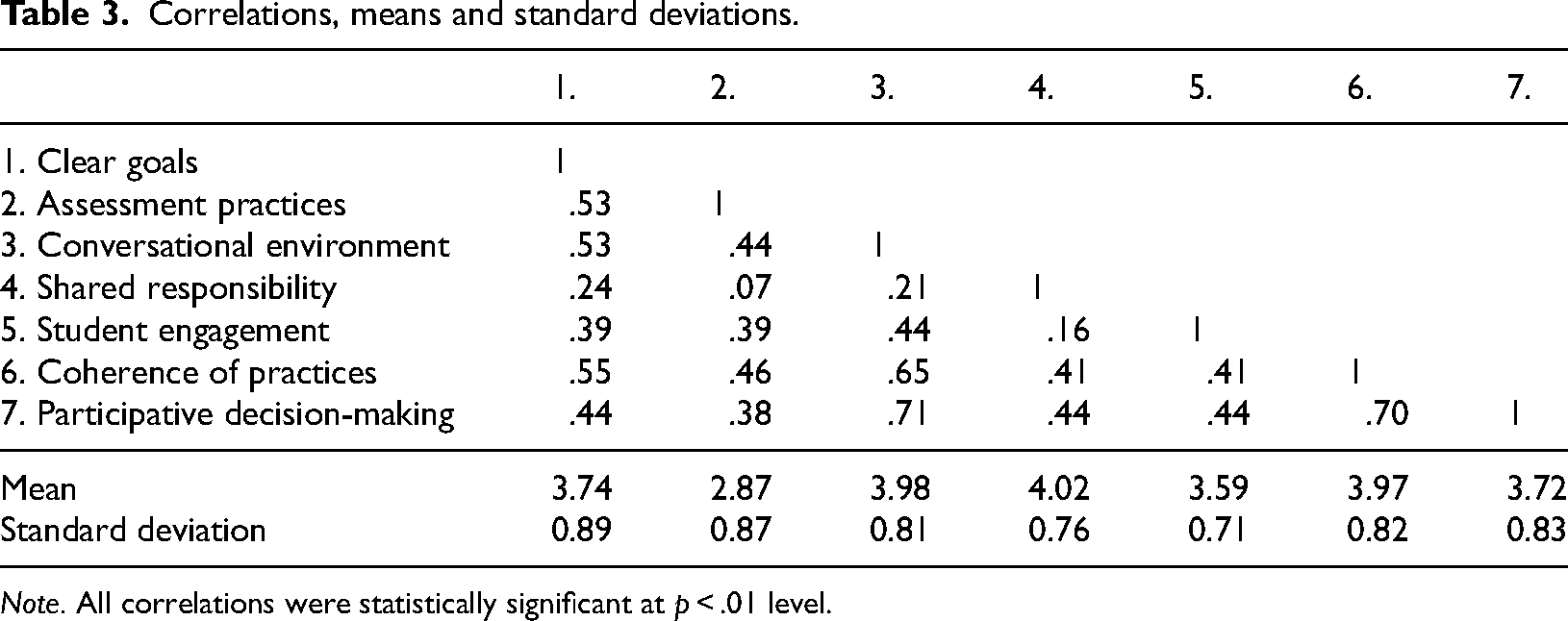
Note. All correlations were statistically significant at p < .01 level.
School leadership group practices
Teachers perceived their schools’ leadership group practices to be in line with the values and goals of their school. They reported coherent leadership group practices (Coherence of practices: M = 3.97, SD = 0.82). Teachers also experienced that they were involved and allowed to participate in decision-making by their school's leadership group. They perceived that the practices of the leadership group represented participative leadership (Participative decision-making: M = 3.72, SD = 0.83).
Preliminary examination of the relationships
All the elements of collaborative school development showed positive and statistically significant relation between each other (Table 3). However, the teachers’ experienced Shared responsibility over collective school development practices was of a slightly more individual dimension as it did not correlate as strongly with other factors. Furthermore, perceptions related to Coherence of practices and Participative decision-making of the school's leadership group were shown to correlate positively and strongly with each other (r = .70) indicating related yet separate dimensions of how the leadership group's practices are perceived in the teaching community. Despite the relatively high correlation, there were no multicollinearity issues among these variables according to the variance inflation factor, which could increase the risk of fallacious path coefficient estimates in SEM. Thus, it was possible to continue towards SEM to answer the research questions.
The results showed that all the factors measuring the collaborative school development correlated positively with the perceived coherence and participative leadership group practices. Coherent leadership group practices showed stronger relationships with perceived clear goals and assessment practices, whereas participative decision-making was slightly more strongly related to a conversational environment and engaging students. These findings indicated a need for more sophisticated analysis (SEM) of these relationships that enable controlling for the effect of the background variables and the hierarchical structure of the data (teachers nested in schools).
Relationship between perceived leadership group practices and experienced collaborative school development (RQ1)
In order to answer the research questions, we constructed a SEM model by setting the dimensions describing the school leadership group (Coherence of practices, Participative decision-making), leadership group experience and control variables (work experience, gender, school type) as predictors. The elements of collaborative school development (Clear goals, Assessment practices, Conversational environment, Shared responsibility, Student engagement) were set as outcome variables. The tested model (Appendix) showed a good fit with the data (χ² (350, N = 932) = 945.59, p < .001, CFI = .95, TLI = .95, RMSEA = .04, SRMR = .05). The model answered research question one (RQ1) by showing that considering coherence in school leadership group's practices in terms of actions being in line with the values of the school was positively related to collaborative school development work experienced by teachers (see Table 4). The coherence in the leadership group practices experienced showed strong positive and statistically significant correlations with perceiving clear goals for school development (β = .61, p < .01) and with reported criteria and practices for assessing the attainment of desired objectives (β = .52, p < .01). In addition to these strategic elements of school development, the coherence in leadership group practices was also positively associated with the collaborative elements of school development concerning teachers and students. Perceptions of leadership group members acting in line with school values showed a positive statistically significant correlation with experienced conversational environment (β = .28, p < .01) and student engagement (β = .21, p < .01) in collaborative school development work. However, perceived coherence was shown to be a less significant determinant of the collective responsibility over collaborative school development work experienced by teachers. The relationship between the coherence in leadership group's practices and teachers’ shared responsibility of school development was not statistically significant (β = .14, p = .07), although almost.
Standardized path coefficients, standard errors, critical ratios and p-values from the final structural equation model (for factor loadings of latent constructs, see Appendix).
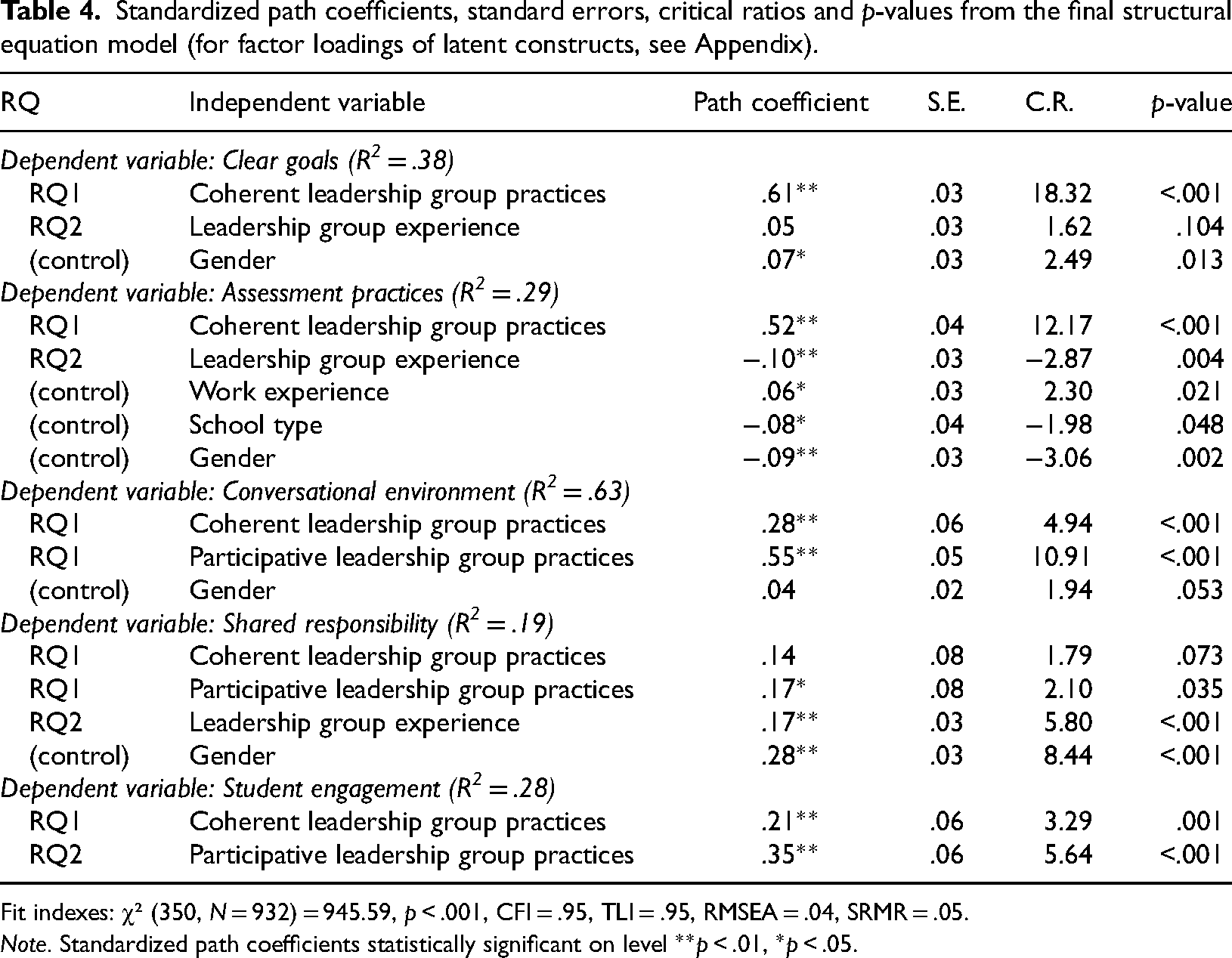
Fit indexes: χ² (350, N = 932) = 945.59, p < .001, CFI = .95, TLI = .95, RMSEA = .04, SRMR = .05.
Note. Standardized path coefficients statistically significant on level **p < .01, *p < .05.
The results further showed (RQ1) that perceiving the school leadership group's practices to engage all teachers in the school's decision-making processes was not statistically significantly related to experiencing clear goals and assessment practices for school development, thus these relationships were not included in the final model. However, the participative leadership group practices reported were positively associated with the elements of collaborative school development that yield safe and open conversations within the teaching community and the engagement of students. Experiences of the leadership groups’ actions that involve teachers in decision-making processes showed a relatively strong positive correlation with both perceived conversational environment (β = .55, p < .01) and student engagement (β = .35, p < .01). Furthermore, participative leadership group practices were also positively and statistically significantly associated with the shared responsibility over school development that was experienced (β = .17, p < .05).
Relationship between leadership group experience and perceived collaborative school development (RQ2)
The final model also answered research question two (RQ2) by showing that teachers who had experience of working as a member of a leadership group were shown to perceive stronger collective responsibility for school development and to take a more critical stand towards the way the attainment of development objectives were assessed. Experience of working as a member of a leadership group was positively related to shared responsibility (β = .16, p < .01) and negatively related to assessment practices (β = −.10, p < .01).
Background variables were included in the model to get reliable results and to investigate their effect on how collaborative school development work was perceived. Criteria and forms of assessing school development processes were perceived as being less adequate in more complex schools (i.e. primary vs. secondary vs. combination). Perceived assessment practices were negatively associated with school type (β = −.08, p < .05). Furthermore, processes and criteria for assessing the attainment of school development objectives were perceived more positively by more experienced teachers and male teachers. Work experience (β = .06, p < .05) and gender (β = −.09, p < .01) showed a statistically significant association with perceived practices for assessment. Moreover, female teachers were shown to perceive the objectives of school development more often clear and to perceive stronger responsibility for collective school development compared to male teachers. Gender was statistically significantly related to perceived clear goals (β = .07, p < .05) and shared responsibility (β = .28, p < .01). School size showed no significant relationship to the elements of collaborative school development and, thus, the variable was not included in the final model.
Conclusion of the results
Overall, the model showed relatively high proportions of explained variance in all the elements of collaborative school development. Perceived coherence (RQ1) in leadership group practices was strongly related to collective school development from the strategic perspective, including clear goals (R2 = .38) and assessment practices (R2 = .29), whereas perceived participative decision-making was not related to them. Perceptions of participative decision-making of the leadership group (RQ1) showed strong positive associations towards experiencing a conversational environment (R2 = .63), student engagement (R2 = .28) and teachers’ shared responsibility (R2 = .19). These findings provide further evidence of the two-factor structure of perceived leadership group's practices that seem to predict different dimensions of collaborative school development work. The results also showed that teachers, who had experience of being a member of a school leadership group (RQ2), perceived stronger shared responsibility for school development and were more critical towards how the attainment of school development goals were assessed.
Discussion
Leadership group facilitating collaborative school development
This study contributes to research literature on how collective forms of leadership are implemented and perceived in schools (e.g. Stosich, 2023; Weiner, 2014). Although there is evidence of the role of leadership in constructing school culture (e.g. characteristics of PLC) that supports teacher community's continuous efforts to learn (e.g. Admiraal et al., 2021; Vanblaere and Devos, 2018), to our knowledge, prior research has not provided empirical models where the role of leadership structures, such as leadership group, is studied. The results of this study showed that teachers, who considered that their school's leadership group acted coherently in line with shared values, also thought that there were clearly articulated goals for developing the school and the means for assessing the attainment of those goals. The result is in line with prior studies highlighting coherence in leadership practices through various leadership levels (Fullan, 2003; Soini et al., 2016; Sullanmaa et al., 2019). The results of this study emphasized the within-school coherence that entails consistency between school values and decision-making practices within the leadership group and seems essential for the teachers perceiving strategic alignment of school development processes (Ahtiainen and Heikonen, 2024). Our results also highlighted leadership groups’ participative decision-making practices that enable teachers to take part in conversations about the goals and measures of school development. Although separate dimensions in our study, participative decision-making can be considered intertwined with coherent leadership practices. This means that when leadership group engages teachers in discussions of objectives guiding school development work, it constructs vertical coherence within the school not only by acting in line with the shared values of the school but also by being responsive to the needs of the professional community engaging its members to set goals and assess the measures for the school's development work (Stosich, 2020).
The results of this study also showed that in addition to setting clear objectives in school development processes, the objectives are operationalized through continuous assessment as part of everyday conversations of the professional community, which was also associated with perceived coherence of the leadership group practices. These findings are in line with prior research highlighting the role of the leadership group in committing the professional community to the goals of school development processes (Ahtiainen and Heikonen, 2024; Hulpia et al., 2009). Overall, leadership in line with the values of the professional community seems to create the basis on which teachers construct their thoughts about school development work. The results of this study showed that perceived coherence was also related to teachers experiencing a conversational environment, entailing the ability to take part in the discussion of the goals and means of school development openly with the professional community.
Prior studies have shown that leadership groups may carry out a range of functions such as giving information, consulting, coordinating and decision-making (Stosich, 2023; Weiner, 2014). These can be considered to be hierarchical in a way that decision-making is the highest order function (e.g. Stosich, 2023; Weiner, 2014), in which the principal has the responsibility. Results from this study highlight that all these functions need to be acted on through coherent ways aiming to engage teachers in active professional collaboration. However, it is the interaction between the different functions that challenges principals. For example, Abrahamsen et al. (2015) have stated that principals need more education on how to apply the information collected with the help of the leadership group to lead the direction of the collaborative conversations within the group. They suggested a collaborative discussion method that could be a way for principals and leadership groups to construct the within-school coherence and teacher participation required for collaborative school development. Altogether, forming leadership groups requires constructing group cohesion and sense of we-ness, clarity of roles, stimulating collaboration and goal orientation among the group members (Devos et al., 2014).
Leadership group experience and collaborative school development
Teachers perceived shared responsibility for the development of their school and the feeling of responsibility was stronger among teachers who had worked as part of the school leadership group. Also, prior studies have suggested that teachers with experience of acting in formal leadership positions, such as members of the leadership group, are more committed to developing their school (Simola and Ahtiainen, 2024). This study further contributed to the literature by showing that teachers’ perceptions of participatory leadership group practices were associated with their sense of shared responsibility for school development. Also a study by Vanblaere and Devos (2018) showed that teachers who perceive their leader to be focused on supporting the group processes in their department experience more collective responsibility. Together these results emphasize the need for school leadership groups to engage all teachers in decision-making processes, in formal and informal roles, and collaboration, which builds teachers’ commitment to their school (Devos et al., 2014). Such leadership group practices may even contribute to student engagement in school development processes.
Our study further showed that teachers’ perceptions of shared responsibility were not strongly related to other factors, suggesting it is a more independent element of collaborative school development. Shared responsibility could be related to more individual factors of the teachers and their perceptions of the profession (e.g. autonomy, individual responsibilities). This is supported also by the results of this study showing that perceived coherence of leadership group was not related to teachers’ experiences of shared responsibility for school development. Also a study by Reinius et al. (2024) emphasized individual differences in how teachers perceive the responsibility for developing their school. They grouped teachers according to their views on school development work into five profiles: visioners, responsibility bearers, participating observers, traditionalists and stressed withdrawers. Together these findings call for person-oriented approaches, such as latent profile analysis, to determine patterns of how teachers perceive leadership and collaboration in school development work.
As collective forms of leadership are taking place and teachers are encouraged to collaborate more, knowledge is needed on how teacher professionalism is transforming in terms of collective forms of autonomy (e.g. Hargreaves and O’Connor, 2018). Consequently, further research is required on the organizational processes (e.g. collaboration, trust) that create opportunities for teacher participation and foster internal school coherence, which explain the relationship between leadership and positive teacher outcomes, such as their learning and efficacy (Heikonen et al., 2024; Stosich et al., 2018). For example, teacher trust in principal has shown to be positively related to teachers having a shared sense of purpose in their work, collaborating with colleagues, having a clear collective focus on enhancing student learning, sharing their practices and reflecting in dialogues (Yin et al., 2019). Furthermore, an innovative school climate has shown to increase the effect that teachers’ perceptions of PLC characteristics in their school (shared responsibility for the school mission, deprivatized practice, reflective dialogue and organizational learning) have on their self-efficacy (Liu et al., 2022). This study contributes to this research area by presenting an empirical model that emphasizes the role of leadership structures and their function in creating coherence and possibilities for teachers to participate in decision-making, which further facilitates their engagement in collaborative efforts to develop their school.
Limitations of the study
The response rate was moderate, but the representativeness of the sample was acceptable. Still, the generalizability of the findings to other contexts should be cautiously considered because the sample consisted of teachers from municipalities from southern Finland that were taking part in a school development program. Another limitation of this study was that the data consisted of teachers’ self-reports collected at one time point. Longitudinal data sets including perceptions of the members of the leadership group and the other members of the teaching community separately would provide the opportunity to examine causal relations. However, taking the school-level variation into consideration when choosing the analysis methods produced unbiased results. Still, the instruments used are novel and require further development and validation in other contexts. For example, factors including only two items constitute a limitation that should be addressed in future studies.
Supplemental Material
sj-pptx-2-ema-10.1177_17411432241268987 - Supplemental material for Interrelations between teachers’ perceptions of school leadership group practices and collaborative school development in Finland
Supplemental material, sj-pptx-2-ema-10.1177_17411432241268987 for Interrelations between teachers’ perceptions of school leadership group practices and collaborative school development in Finland by Lauri Heikonen and Raisa Ahtiainen in Educational Management Administration & Leadership
Footnotes
Data availability statement
Data will be made available on request.
Declaration of conflicting interests
The author(s) declared no potential conflicts of interest with respect to the research, authorship, and/or publication of this article.
Funding
The author(s) disclosed receipt of the following financial support for the research, authorship, and/or publication of this article: This work was supported by the Finnish National Agency for Education.

Supplemental material
Supplemental material for this article is available online.
Author biographies
References
Supplementary Material
Please find the following supplemental material available below.
For Open Access articles published under a Creative Commons License, all supplemental material carries the same license as the article it is associated with.
For non-Open Access articles published, all supplemental material carries a non-exclusive license, and permission requests for re-use of supplemental material or any part of supplemental material shall be sent directly to the copyright owner as specified in the copyright notice associated with the article.
