



Abstract
This study aims to examine what factors predict school-related commitment and work overload of school principals. The job demands-resources model served as a theoretical underpinning defining self-efficacy as a personal resource and extension of working time as a job demand. Structural equation modelling analysis based on 1095 school principals from the German-speaking part of Switzerland revealed that work overload significantly mediated the relationship between self-efficacy as well as extension of working time and school-related commitment. Extension of working time had a significant and negative effect on work overload but only an indirect effect on commitment through the negative effect of work overload on commitment. Self-efficacy had a significant negative effect on work overload and a significant and positive impact on commitment. However, a moderation analysis showed that self-efficacy could not buffer the negative effect of extension of working time on work overload. These findings provide important practical implications for stress prevention for school principals: it is not only important to strengthen the self-efficacy of school principals to avoid work overload and ensure a sustainable commitment for the school, time management training and a reduction of working hours are also relevant.
Introduction
The role of school principals has been repeatedly characterised as a key position, having ‘a significant effect on features of the school organization’ (Leithwood et al., 2020: 6) and indirectly impacting student achievement (Wu and Shen, 2022). Principals are usually not only expected to ensure a smooth day-to-day functioning of ‘their’ schools but also expected to implement government reforms and act as drivers for local school improvement. They often have to respond to a multitude of stakeholders, such as teachers, local or regional education authorities and parents, leading to their post sometimes being described as a ‘sandwich position’ (Rechsteiner et al., 2023: 323).
The work of school principals has been repeatedly characterised as burdensome and stressful (Marsh et al., 2023; Pont et al., 2008). In this context, a high degree of self-efficacy can act as a protective factor by (partly) reducing the level of stress and being overburdened (Bandura, 1997). However, it is unclear if and to what extent self-efficacy can also moderate the relationship between stress and commitment. Furthermore, only a few studies have investigated the dynamics of the work overload, commitment and self-efficacy of principals in the European context using large datasets.
Better understanding the relationships between working time, overload, commitment and self-efficacy can be useful for ensuring that job profiles are designed in a way that allows for a sustainable career without health risks. Additionally, such knowledge could be used to design forms of training and professional development that aid principals in (better) coping with the demands of their work. The goal of the present study was therefore to better understand how these factors interact using data from a large-scale study in Switzerland.
Principalship – A demanding position
School leadership positions have long been associated with high workloads and a multitude of stressors, with even early observational studies pointing out ‘the hectic, disjointed and constant pressure of work’ and a persistent ‘battery of demands’ (Wilis, 1980: 47). This is usually attributed to the significant responsibility, which covers the school, its functioning, its students and staff and the broad range of activities usually associated with the position (see for example stressors identified by van der Merwe and Parsotam, 2012). The different stakeholders and the fact that principals are usually recruited from the teaching pool can lead to situations of role ambiguity, causing further stress (Elomaa et al., 2024; Friedman, 2002; Gmelch and Torelli, 1994).
Authors of a major international Organisation for Economic Cooperation and Development (OECD) study commented that ‘[p]rincipal burnout caused by high levels of stress and long working hours is common’ (Pont et al., 2008: 177). There are indications that principals try to cope with job-related demands by expanding their working hours, working during their free time (Reid and Creed, 2023) and managing their emotional responses to stressors (Elomaa et al., 2023; Mahfouz, 2020).
Prolonged periods of stress can constitute a risk factor on several levels. Most importantly, principals who undergo prolonged periods of stress have a higher risk of developing serious health issues, such as burnout (Torelli and Gmelch, 1992). Principals who experience long periods of stress are also more likely to quit their job, sometimes even the profession (Mitani, 2018), with principal turnover negatively impacting the level of student achievement and increasing the probability of teacher turnover (Snodgrass Rangel, 2018). Finally, there are indications that principals who are under a lot of stress for a prolonged time are diminished in their capacity to effectively lead schools (DeMatthews et al., 2021).
Investigating work overload and commitment through the lens of the job demand-resources model
For this study, the job demands-resources model (JD-R model; Bakker and Demerouti, 2007) serves as a framework for investigating determinants and relationships concerning the work overload and school-related commitment of school principals. This model describes the relationship between demands, resources, motivation, work overload and outcomes, such as job performance, job satisfaction and commitment. Work overload can be defined as a hindrance encompassing constraints that prevent an individual from achieving valued goals. Workload and work overload can be differentiated depending on whether the individual perceives that they have enough resources to cope with the quantity of work (O’Brien and Beehr, 2019; Sandmeier et al., 2022). In contrast, commitment covers three dimensions: affective, continuance and normative (Dunham et al., 1994). Continuance refers to costs leaving the organisation from the perspective of the employee, while the normative dimension is related to employees feeling obliged to stay in the organisation. The affective dimension that is primarily assessed in research and is also the focus of this study mirrors employees’ identification, emotional attachment and involvement in the organisation (Dunham et al., 1994). According to the JD-R model, job-related resources lead to greater motivation, which in turn has a significant and positive effect on various individual and organisational outcomes. Conversely, job demands increase work overload, which in turn has a significant effect on individual and organisational outcomes (Bakker and Demerouti, 2007). Later, the model was expanded to take into account personal resources, showing that personal resources mediate the relationship between job-related resources and motivation and have a negative effect on exhaustion (Demerouti and Bakker, 2011; Xanthopoulou et al., 2007). More recent studies including personal resources indicate that job resources have a reciprocal relationship with personal resources and that personal resources might moderate the relationship between job demands and outcome variables, such as well-being (Bakker et al., 2023). A growing body of evidence indicates that the core assumptions of the JD-R model can be confirmed (Gonzalez-Mulé et al., 2021; Lesener et al., 2019; Mazzetti et al., 2023; Taris and Schaufeli, 2015). The meta-analysis of Mazzetti et al. (2023) reveals that the effects of personal resources on work engagement and outcomes, such as commitment, are higher than those of social and job resources. Overall, various studies support the core hypotheses of the JD-R model with personal resources being particularly important for investigating outcomes, such as commitment.
Some studies have already used the JD-R model in the context of educational leadership, investigating, among other aspects, work overload and well-being (Collie et al., 2020; Guglielmi et al., 2012; Marsh et al., 2023; Skaalvik, 2023). For example, the qualitative study by Elomaa et al. (2024) describes typical job resources and demands in the micro-, exo-, macro- and chronosystem. Job resources in the micro system are a good work community and management team at the school and other helpful principals, whereas in the mesosystem work resources are cooperations with other important stakeholders. Regarding job resources in the macrosystem, school size and socioeconomic context are relevant. For the chronosystem work experience is described as a job resource. In terms of job demands on the microsystems, challenging interactions with parents, conflicts between teachers, teachers and students or teachers and parents were mentioned by school principals. Related to the exosystem, numerous meetings, lack of superiors and limited availability of financial and time resources were identified as major job demands. For the macrosystem, the school size and socioeconomic status could also be job demand if the schools were too large and located in a community with a lower socioeconomic status. Similarly, a lack of work experience was perceived as a job demand in the chronosystem (Elomaa et al., 2024).
In an attempt to confirm the assumptions of the JD-R model, a Norwegian study using structural equation modelling (SEM) indicated that job resources, such as personal development and competent teachers, significantly positively predicted the job satisfaction of school principals, whereas the time pressure job demand had a significant negative impact on job satisfaction (Skaalvik, 2023). Fittingly, a path analysis of data from the Teaching and Learning International Survey (TALIS) from 22 OECD countries showed that job resources, such as collegial climate, had significant and positive effects on job satisfaction and occupational commitment, whereas job demands, such as staff shortages, significantly and negatively influenced these outcomes (Collie et al., 2020). In line with these findings, the path analysis by Hu et al. (2016) indicated that the job demand work family conflict had a significant and positive impact on job burnout and a negative impact on subjective well-being, whereas the job resource satisfaction with the job salary and promotion was a significant and negative predictor of job burnout. Supporting the assumptions of the JD-R the SEM analysis by Maxwell and Riley (2017) showed that emotional job demands of 1320 full time principals had a significant and negative effect on job satisfaction and well-being, whereas the effect on burnout was positive. A more recent study using a SEM with a sample of 625 Finish principals identified the job demands work family conflict and role conflict as significant and positive predictors of job burnout and job dissatisfaction, whereas the job resource sense of community was a significant and negative predictor of burnout and job dissatisfaction (Fang et al., 2025). However, a mixed-methods study by Combs et al. (2007) showed that job resources, such as trust and relationship quality, significantly affected elementary school principals’ burnout, but job demands, such as tasks perceived as stressful (e.g. paperwork, parental relations etc.), did not. Another SEM study including 518 Finish school principals even revealed that increasing structural job resources and challenge job demands are positive predictors for work engagement and reduced burnout with need satisfaction as a mediator (Toyama et al., 2022). A more recent study by Toyama et al. (2024) comparing school principals' job crafting before and during the pandemic confirmed these findings: SEM analysis including a pre-pandemic sample of 525 school principals revealed that increasing structural job resources and challenge job demands were positive predictors for work engagement but had no significant and direct effect on burnout. The SEM analysis involving 644 school principals surveyed during the pandemic supported this finding and found that increasing structural job resources was also a significant and negative predictor for burnout (Toyama et al., 2024).
Considering the expansion of the model to include personal resources (see Bakker et al., 2007), an Australian longitudinal study revealed that personal resources, such as resilience, had significant and positive effects on job satisfaction whereas job demands, such as quantity of work, were a negative predictor (Marsh et al., 2023). Guglielmi et al. (2012) stressed the importance of the self-efficacy personal resource for work engagement and burnout. Groß Ophoff and Pfurtscheller (2024) performed a SEM analysis and found that self-efficacy had a significant positive impact on job commitment and a significant negative effect on job-related tension. Similarly, Dadaczynski et al. (2020) identified self-efficacy and autonomy as important predictors of health and work outcomes using SEM. Fittingly, the SEM analysis by Skaalvik (2020) revealed that self-efficacy for instructional leadership had a significant and negative effect on job demands such as time pressure, demanding parents and lack of values which significantly and positively predicted emotional exhaustion and the motivation to quit. Moreover, SEM analysis indicated that self-efficacy had a significant and positive effect on job resources such as personal development and competent teachers which in turn had a significant and positive influence on job satisfaction. According to Bandura (1982), self-efficacy concerns beliefs about individual capabilities to produce a desired outcome and how well a person can execute courses of action to deal with a specific situation. Regarding this construct, individual and collective self-efficacy can be distinguished: individual self-efficacy is related to beliefs about individual capabilities, while collective self-efficacy covers beliefs about the capabilities of a group (Bandura, 2000).
In summary, the majority of the studies seem to confirm the assumptions of the JD-R model, and there is some evidence that personal resources, such as self-efficacy, are relevant predictors of work overload and outcomes, such as commitment. Still, the moderating role of personal resources, such as self-efficacy, on the relationship between job demands and negative outcomes, such as burnout, job tension or work overload, assumed by the JD-R model has not been investigated in these studies.
Moreover, relative to the various studies that use the JD-R model as a conceptual lens to investigate teacher well-being, work overload and burnout (see Lu et al., 2024; Stewart, 2015), only a few studies use the JD-R model for educational leadership research. Similarly, compared to the number of studies that focus on teacher work overload, only a minority consider the work overload of school principals (Creagh et al., 2023). Furthermore, educational leadership research in German-speaking countries is still a comparatively young field (Tulowitzki and Grigoleit, 2023), with hardly any studies using JD-R as a framework (Groß Ophoff and Pfurtscheller, 2024). Thus, the present study aims to investigate aspects of the work overload and commitment of school principals through the lens of the JD-R model in Switzerland.
Hypotheses
Based on the assumptions of the JD-R model and previous studies using SEM analysis, we propose the following hypotheses for our study:
The extension of working time has a significant and positive effect on work overload. Self-efficacy has a significant negative effect on work overload. Self-efficacy significantly and negatively moderates the relationship between the extension of working time and work overload. Work overload has a significant and negative effect on school-related commitment. The extension of working time has a significant and negative effect on school-related commitment. Self-efficacy has a significant and positive effect on school-related commitment.
All research hypotheses are depicted in Figure 1.
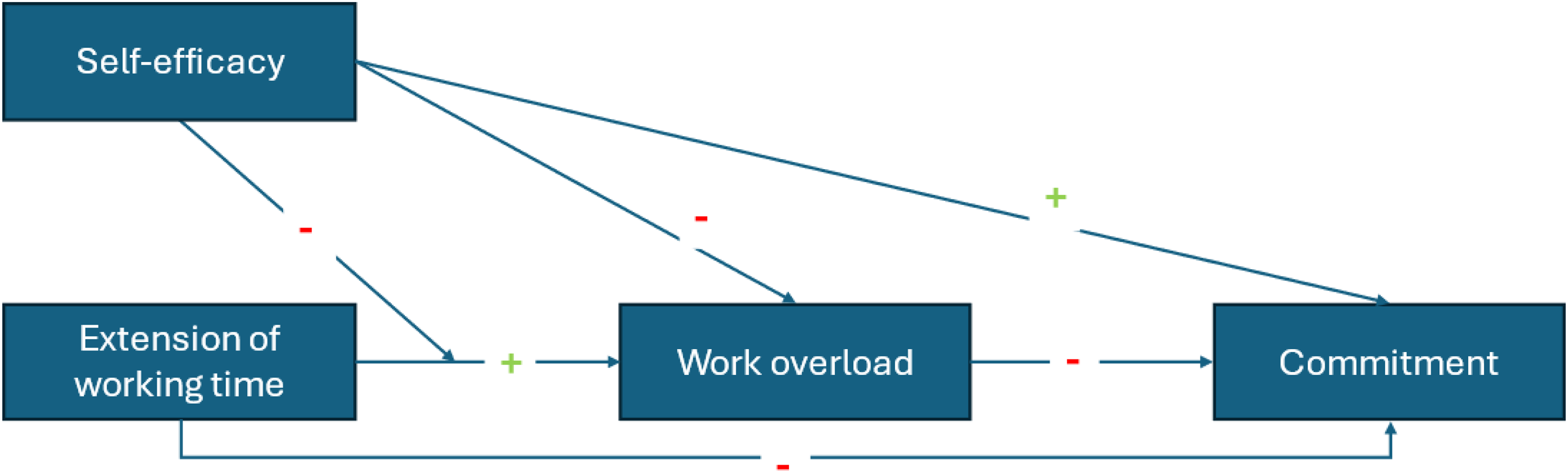
Hypotheses of the study.
Materials and methods
Study design, participants and procedures
The data of the present study were collected using a standardised online questionnaire that was distributed to school principals of mandatory schools (children in Switzerland have to complete 11 years of mandatory schooling at various types of schools, starting at the age of 4) only in German-speaking Switzerland due to limited resources and to avoid measurement invariance issues. A total of 2369 principals were contacted in the fall of 2022, 1095 of whom took part in the survey. This corresponds to about 25% of all principals in German-speaking Switzerland (Swiss Federal Statistics Office, 2024). As answering all questions was optional, the number of responses per question may vary.
In our sample, 51.8% of the school leaders identified as female, 48.0% as male and 0.2% as other. Overall, the mean age of the school leaders was 45.16 years old (standard deviation: 8.35 years). On average, principals had been working for 13.10 years as principals at their current school (standard deviation: 6.31 years) and reported an average of 16.24 years overall work experience as principals (standard deviation: 7.26 years).
Measures
Self-efficacy
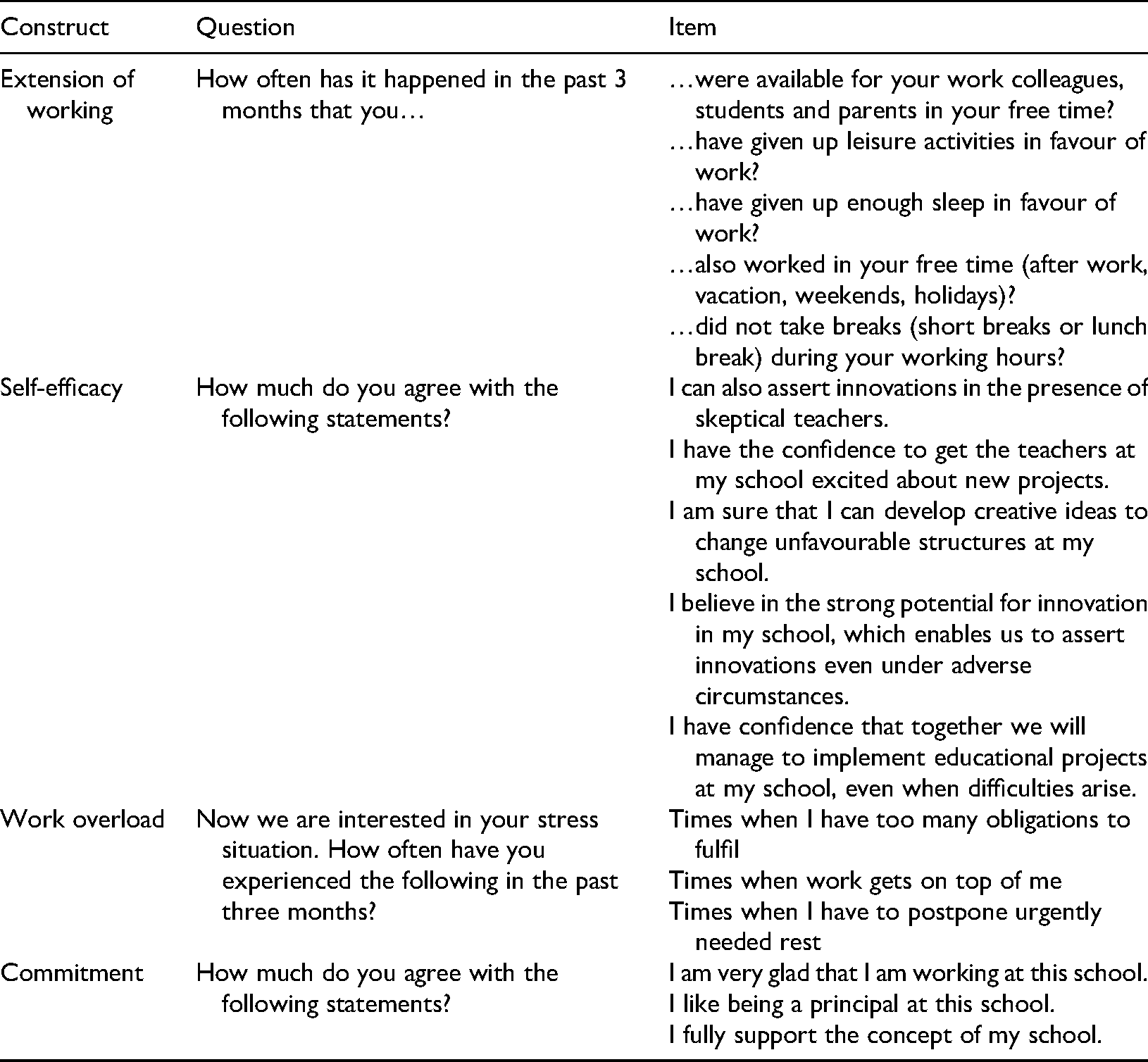
Self-efficacy was measured using five items that were self-developed based on a scale by Schmitz and Schwarzer (2002). Participants were asked to indicate agreement or disagreement with statements about their self-efficacy on a scale ranging from 1 (totally disagree) to 4 (totally agree). Three items were related to aspects of individual self-efficacy (e.g. ‘I have the confidence to get the teachers at my school excited about new projects’), whereas two items were related to aspects of collective self-efficacy (e.g. ‘I have confidence that together we will manage to implement educational projects at my school, even when difficulties arise’). All items can be found in the appendix. The scale has a Cronbach's alpha of .70. Cronbach's alpha is a measure of internal consistency that is used as indicator for the reliability of scales. According to Cronbach (1951) values ≥ .70 can be considered as acceptable and indicate that the scale can be used for reliably measuring the construct.
Extension of working time
Extension of working time was operationalised with five items following Krause et al. (2015). Participants were asked to state how often they had given up recreation and leisure time in favour of work in the past 3 months (all items can be found in the appendix). The response options were 1 (never), 2 (very rarely), 3 (rarely), 4 (occasionally), 5 (often) and 6 (very often). The scale has a Cronbach's alpha of .77.
Work overload
Regarding work overload, the three-item scale developed by Schultz et al. (2004) was used. Participants were asked to indicate how often they had experienced stressful situations in the last 3 months (the items are listed in the appendix). They could choose between the following response options: 1 (never), 2 (rarely), 3 (sometimes), 4 (often) and 5 (very often). Reliability analysis shows that the scale has a Cronbach's alpha of .83.
Commitment
Regarding school-related commitment, the three-item scale by Greb et al. (2011) was used. Participants were asked to indicate agreement or disagreement with statements about their commitment on a scale ranging from 1 (totally disagree) to 4 (totally agree). All items can be found in the appendix. The scale shows a good reliability (Cronbach's alpha = .78).
Statistical analysis
For the descriptive statistics, means and standard deviations were calculated. Regarding the inferential statistics, a correlation analysis including all relevant constructs (self-efficacy, extension of working time, work overload and school-related commitment) was performed. After that, SEM was performed with extension of working time and self-efficacy as predictors, work overload as a mediator and school-related commitment as the dependent variable. To investigate the moderating effect of self-efficacy on the relationship between extension of working time and work overload, extension of working time and self-efficacy were double-mean centred in the first step. According to Lin et al. (2010), double-mean centring is the preferred centring approach, as simulation analyses show that it performs superiorly compared to other centring strategies, especially when the assumption of normal distribution is violated. Finally, a SEM involving the interaction of self-efficacy with extension of working time on work overload was conducted.
Results
Descriptive statistics
The descriptive statistics indicate that principals report rather high school-related commitment and a medium degree of work overload. However, the standard deviations show substantial variation, indicating a high degree of variability, the reasons for which are to be explored in subsequent analyses (Table 1).
Descriptive statistics.
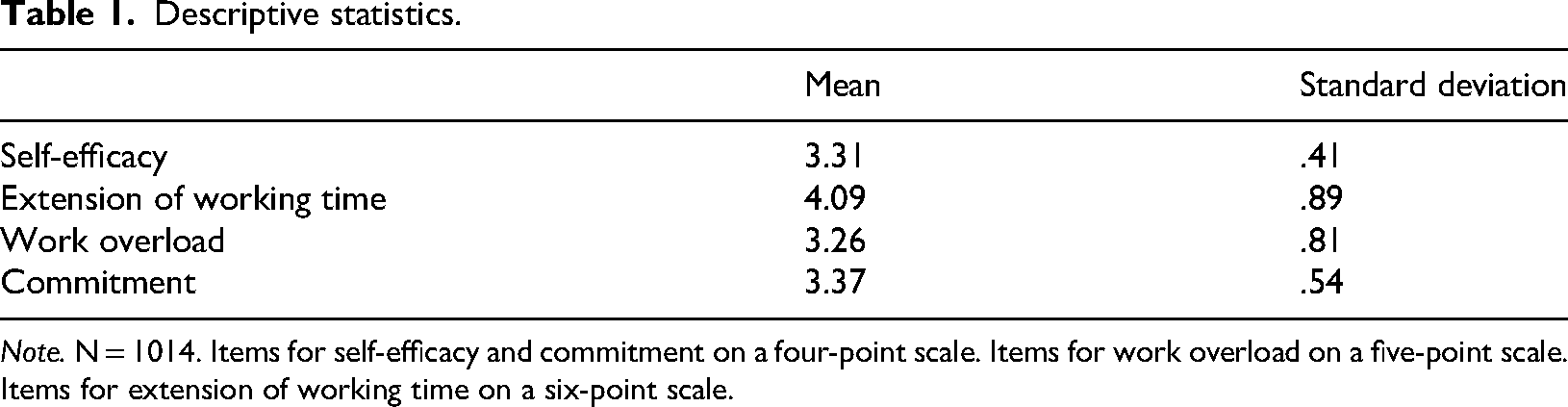
Note. N = 1014. Items for self-efficacy and commitment on a four-point scale. Items for work overload on a five-point scale. Items for extension of working time on a six-point scale.
Correlation analysis
The correlation analysis reveals a significant and positive relationship between self-efficacy and school-related commitment. The effect can be categorised as moderate (Cohen, 1988). Furthermore, self-efficacy correlates significantly and negatively with work overload. Following Cohen (1988), this can be considered a small effect. Extension of working time correlates significantly negatively with self-efficacy and school-related commitment. Both effects can be categorised as small (Cohen, 1988). Moreover, the extension of working time correlates significantly positively and strongly with work overload. All correlations remain significant after Bonferroni correction which was applied as standard procedure of multiple testing to avoid false positive (false significant) results (Table 2).
Correlations between the key constructs.
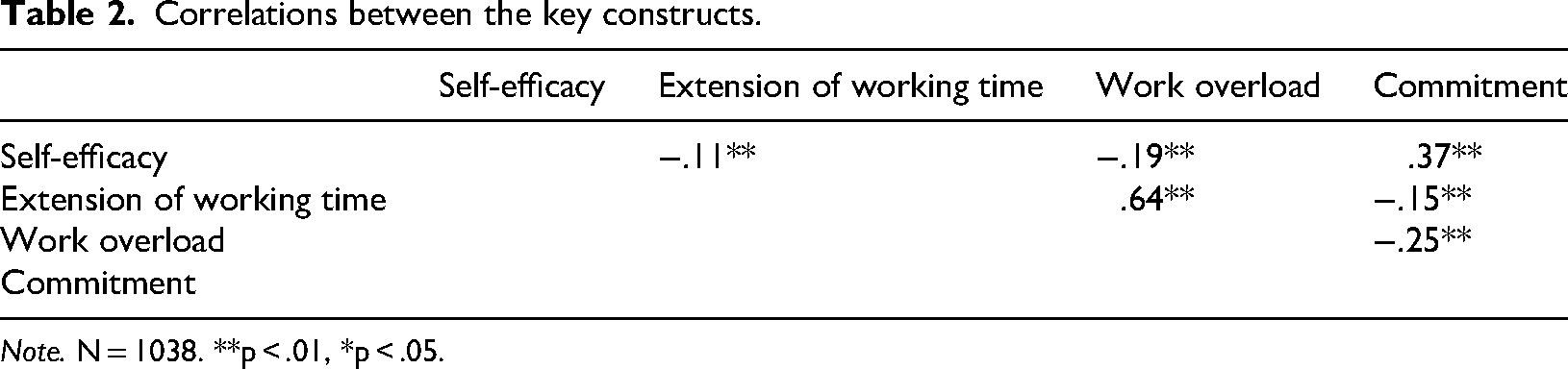
Note. N = 1038. **p < .01, *p < .05.
Structural equation modelling
In the first step, the SEM was performed without the moderators to check the fit indices and measurement model. Based on the criteria of Hu and Bentler (1999), the model revealed a good fit (χ2 (98) = 301.307; p < .001; TLI = 0.952; CFI = 0.960; RMSEA = 0.045; SRMR = 0.040). All items loaded well on their intended factor, and no factor loading was < .461. The results of the SEM are depicted in Figure 2. Regarding school-related commitment, the R-squared was .259, indicating that 25.9% of the variance in commitment could be explained by other variables of the model. For work overload, the degree of variance explanation was .675. Thus, 67.5% of the variance in work overload can be explained by the extension of working time and self-efficacy variables. Moreover, the SEM revealed that extension of working time has a significant and positive effect on work overload. In turn, work overload is a significant and negative predictor for school-related commitment. Furthermore, self-efficacy is a significant positive predictor for school-related commitment. In contrast, the extension of working time has no significant direct effect on school-related commitment.
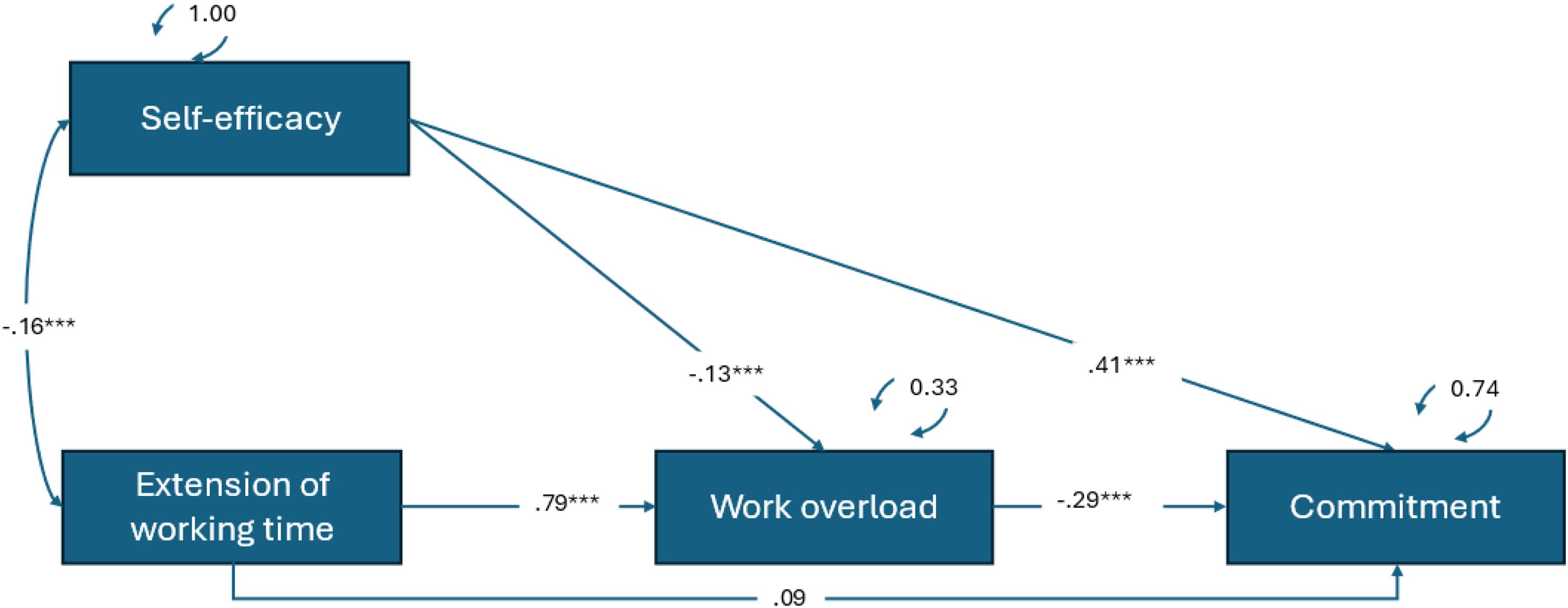
Results of the structural equation modeling.
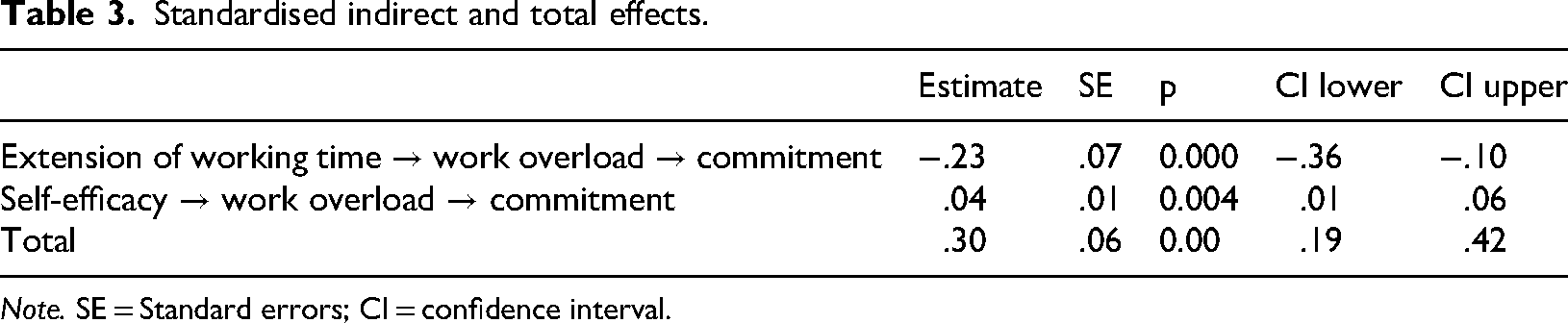
Table 3 shows that the indirect effect of the extension of working time through work overload has a significant and negative effect on school-related commitment. However, the indirect effects of collective and individual self-efficacy on school-related commitment with work overload as a mediator are not significant. The total effect is significant.
Standardised indirect and total effects.
Note. SE = Standard errors; CI = confidence interval.
In the second step, a moderation effect was added to the SEM. Comparing the AIC and BIC (see Lin et al., 2017), it can be concluded that the model fit for the model without the moderation is much better as the values are smaller (AIC: 39303.890 < 104910.116; BIC: 39522.187 < 105892.452). The significant effects were the same as those in the previous SEM. However, self-efficacy (β = .03, p = 0.721) did not significantly moderate the relationship between extension of working time and work overload.
Discussion
Overall, the results of the present study confirm most of the hypotheses based on the assumptions of the JD-R model. In line with previous findings, the extension of working time was found to have a significant and negative effect on work overload in the present study, revealing the detrimental effects of job demands related to the quantity and extension of work on indicators of work overload (Guglielmi et al., 2012; Marsh et al., 2023; Skaalvik, 2023). However, in the present study, the direct effect of the extension of working time on school-related commitment was not significant. In contrast, previous studies showed that job demands that were similar to the extension of working time, such as time pressure, the notion that the workday of a principal never ends and the quantity of work had significant and negative impacts on job satisfaction (Marsh et al., 2023; Skaalvik, 2023). In line with previous findings (Guglielmi et al., 2012; Skaalvik, 2023), work overload was found to have a significant and negative impact on school-related commitment. Similarly, the present study confirms previous findings (Groß Ophoff and Pfurtscheller, 2024; Guglielmi et al., 2012; Skaalvik, 2020) by showing that self-efficacy has a significant and negative impact on work overload and a significant and positive impact on school-related commitment.
However, previous studies did not investigate the moderating effect of self-efficacy on the relationship between job demands and the experience of work overload. By considering this moderation, the present study reveals the limits of self-efficacy in the context of the job demands and work overload of principals: if school principals extensively extend their working hours, self-efficacy cannot serve as a protective factor for experiencing work overload. This contradicts the findings of Combs et al. (2007) that stress the importance of personal resources on outcome variables, such as burnout, compared to job demands. The finding that self-efficacy is not a significant moderator also mirrors the ongoing debate on the role of personal resources in the JD-R model. Xanthopoulou et al. (2007) found that self-efficacy as a personal resource did not manage to offset the relationship between job demands and exhaustion. Instead, personal resources had a reciprocal relationship with job resources and work engagement (Xanthopoulou et al., 2007). Although there is a growing body of evidence that considers personal resources as a mediator or outcome variable, Demerouti and Bakker (2011) argued that the role of personal resources in modifying the impact of the work environment on positive outcomes, such as school-related commitment, might be even more complex. They proposed three-way interactions between job demands, job resources and personal resources. However, in a review of the JD-R model, Bakker et al. (2023) again proposed that personal resources moderate the impact of job demands on outcome variables. Our findings indicating that personal resources cannot buffer work overload when there is a strong relationship between work overload and extension of working time seem to confirm the findings of Xanthopoulou et al. (2007). This means that principals who substantially extend their working time suffer from work overload which cannot be compensated by self-efficacy. In case of extreme overtime, self-efficacy cannot balance out the negative impact of working time extension on work overload which in turn has a negative effect on commitment.
Limitations
There are several important limitations to this study. The first one concerns the sample of the study. As the official statistics on school principals in Switzerland contain very few details, it was impossible to assess how closely our collected data matches that of the general population of principals. Consequently, it was also impossible to employ weighting strategies to compensate for any possible underrepresented sets of data. Another limitation related to sample is that only principals from the German-speaking part of Switzerland were surveyed which points to limited generalizability even for the Swiss context. Next, the data is self-reported, making it prone to biases (Donaldson and Grant-Vallone, 2002), even though common strategies for controlling for it were employed.
Another limitation relates to the measurement of self-efficacy. Due to insufficient reliability, we were not able to measure individual and collective self-efficacy separately. Thus, future research could investigate differential effects of individual and collective self-efficacy as predictors for work overload and school-related commitment and as moderators for the relationship between job demands and work overload. Furthermore, the results of the SEM should be interpreted with caution, as for mediating variables, some effects unfold over time (Maxwell and Cole, (2007). Finally, this study was conducted using cross-sectional data. No causal statements regarding the results can be made with a cross-sectional and non-experimental design. Therefore, replications of the results with longitudinal data are warranted.
Theoretical and practical implications and avenues for future research
In terms of theoretical implications, the JD-R model is very suitable for the context of principalship, and its predictors seem to explain a substantial degree of variance in the work overload and commitment of principals. Thus, more studies using the JD-R model as a theoretical underpinning in the context of school leadership research are warranted to better understand and focus more on the causes of stress among school leaders. More research studying the role of personal resources in the context of school leadership is needed. Future studies should also include job resources to better understand the three-way interaction between personal resources, job resources and demands proposed by Demerouti and Bakker (2011). Moreover, other indicators for personal resources, such as resilience, organisational-based self-esteem and optimism (Marsh et al., 2023; Xanthopoulou et al., 2007), should be used. Similarly, for job demands, other indicators could be considered, such as staff shortages, demanding parents, work family conflict, role conflict, emotional job demands and limited autonomy (Collie et al., 2020; Fang et al., 2025; Groß Ophoff and Pfurtscheller, 2024; Hu et al., 2016; Maxwell and Riley, 2017; Skaalvik, 2023). Different operationalisations of personal resources and job demands in the context of principalship would help clarify under which conditions personal resources can be a protective factor, considering the relationship between job demands and organisational outcome variables, such as school-related commitment. This would also help identify the limits of the buffering effect of personal resources.
Additionally, there seem to be opportunities for qualitative research to tackle some of the blind spots revealed by the present study. For example, it might be warranted to approach demands and resources in the context of principalship more openly and to explore new resources and demands in this specific work context that have not been specified by the JD-R model literature (see for example Elomaa et al., 2024). Moreover, it is unclear at what point self-efficacy becomes insufficient as a protective factor against (excessive) job demands and work overload. This point will likely vary from individual to individual and is probably influenced by both personal and contextual factors. Studying principals who are close to the ‘breaking point’ but manage to stay healthy, as well as their self-regulation strategies, might give deeper insights into effective coping mechanisms and important elements that help buffer against work-related stressors.
In terms of practical implications, the findings highlight important conclusions regarding stress prevention measures for school principals and points at the important duties of the principalship role. School principals do not (only) need to strengthen their self-efficacy to avoid work overload; classic stress prevention training (see Kaluza, 2023) and a reduction in working hours are also necessary. In classic stress prevention training for work that have positive effects on coping strategies and employees’ well-being (Kaluza, 2000, 2002), one important element is time management (Kaluza, 2023). The aim of this element is for participants to recognise which of their own behaviours and attitudes contribute to time problems and what a healthy approach to time management looks like. In essence, participants learn how to prioritise tasks, take their own performance curve during the day into account and value the importance of breaks (Kaluza, 2023). Besides developing more confidence in individually and collectively managing school projects efficiently, principals need to observe themselves carefully, be (more) aware of the detrimental effects of the extension of working time and be encouraged to plan enough leisure time to reduce work overload and stay committed to schools in the long term.
Footnotes
Acknowledgements
The project ‘Schulleitungsmonitor Schweiz’ (School Leadership Monitor Switzerland), on which this study is based, was supported by the Jacobs Foundation (grant number 2022755342) and the Mercator Foundation Switzerland (grant number 2022-7036).
Our study complies with the ethical standards of the Swiss Academy of Social Sciences and Humanities.

Funding
The authors disclosed receipt of the following financial support for the research, authorship, and/or publication of this article: This work was supported by the Jacobs Foundation, Stiftung Mercator Schweiz, (grant number 2022755342, 2022-7036).
Declaration of conflicting interests
The authors declared no potential conflicts of interest with respect to the research, authorship, and/or publication of this article.
Data availability
The data underlying this study are currently not publicly available due to restrictions linked to privacy and confidentiality agreements, but access to the data is possible by contacting the corresponding author. Access to the data is subject to approval and a data sharing agreement.
Author biographies
Appendix: Measurement instruments
| Construct | Question | Item |
|---|---|---|
| Extension of working | How often has it happened in the past 3 months that you… | …were available for your work colleagues, students and parents in your free time? |
| …have given up leisure activities in favour of work? | ||
| …have given up enough sleep in favour of work? | ||
| …also worked in your free time (after work, vacation, weekends, holidays)? | ||
| …did not take breaks (short breaks or lunch break) during your working hours? | ||
| Self-efficacy | How much do you agree with the following statements? | I can also assert innovations in the presence of skeptical teachers. |
| I have the confidence to get the teachers at my school excited about new projects. | ||
| I am sure that I can develop creative ideas to change unfavourable structures at my school. | ||
| I believe in the strong potential for innovation in my school, which enables us to assert innovations even under adverse circumstances. | ||
| I have confidence that together we will manage to implement educational projects at my school, even when difficulties arise. | ||
| Work overload | Now we are interested in your stress situation. How often have you experienced the following in the past three months? | Times when I have too many obligations to fulfil |
| Times when work gets on top of me | ||
| Times when I have to postpone urgently needed rest | ||
| Commitment | How much do you agree with the following statements? | I am very glad that I am working at this school. |
| I like being a principal at this school. | ||
| I fully support the concept of my school. |