




Abstract
The research explored the role of organisational support for generative artificial intelligence (GenAI) in predicting middle leaders’ GenAI integration in school leadership work, with a focus on GenAI self-efficacy and valuing as mediators of that effect. The study was based on social cognition theory and a sample of 277 Israeli middle leaders from public elementary and secondary schools. The data were analysed using SPSS and the PROCESS macro. The findings indicate that support for GenAI positively influences both GenAI self-efficacy and valuing but only GenAI self-efficacy emerged as a significant mediator. The results expand the limited empirical scholarship on AI in school leadership, most of which is non-empirical. The results suggest that middle leaders’ confidence in their ability to use GenAI plays a critical role in their engagement with the technology and that organisational support helps promote GenAI adoption. Middle leaders’ GenAI self-efficacy was shown to play a key role in channelling the beneficial effect of school support on integration in practice. The results and their implications are discussed.
Keywords
Introduction
In recent years, there has been considerable interest in how artificial intelligence (AI), especially, generative AI (GenAI), can transform modern work and education (Collie et al., 2024; Quaquebeke and Gerpott, 2023). AI refers to software products that rely on machine learning to replicate human intellect to handle tasks including visual perception, decision-making, and language processing (Cheung et al., 2024). Although the concept of AI has long existed, it has become popular only with the emergence of GenAI. GenAI chatbots are used to create texts, images, videos, audio, code, and other products (Arriola-Mendoza and Valerio-Ureña, 2024). GenAI chatbots provide natural conversation interfaces for answering questions, making AI widely accessible (Cheung et al., 2024). With the increased sophistication and acceptance of AI, greater attention has been paid to using it in educational contexts (Ng et al., 2025).
The ability to effectively use GenAI technologies can revolutionise the way educational institutions operate (Collie et al., 2024; Ng et al., 2025). Among the various stakeholders engaged in schooling, educational leaders play a critical role in deciding how AI technologies are integrated into daily operations (Tyson and Sauers, 2021). Quaquebeke and Gerpott (2023) suggested that AI could potentially replace the tasks that people usually associate with human leaders, including those dealing with relationships (e.g. cultivating positive work relationships), tasks (e.g. monitoring, task-related guidance), and change (e.g. inspiring followers). Despite its growing potential to enhance educational leadership and administrative efficiency, empirical research on AI integration within school leadership (i.e. incorporating AI tools and approaches into existing leadership tasks and decision-making) remains limited.
The study of AI in educational leadership has been mostly theoretical (Fullan et al., 2024; Wang, 2021a). For example, researchers discussed how AI can affect symbiotic human–AI decision-making in school leadership (Arar et al., 2024; Dai et al., 2024; Wang, 2021a, 2021b). It has been argued that AI and GenAI have the potential to significantly reduce the managerial and administrative burden of school leaders (Fullan et al., 2024). The use of AI by school leaders has rarely been explored empirically (for notable exceptions, see Berkovich, 2025; Tyson and Sauers, 2021), therefore, many research questions demand attention (Fullan et al., 2024). One such question concerns the use of GenAI in school leadership tasks by middle leaders.
Middle leadership in schools is situated at the intermediate level of the organisational structure and has executive responsibility (Shaked, 2023). Previous review concluded that ‘middle leaders (i.e., subject leaders, middle managers, heads of department, curriculum coordinators) played a crucial role in developing and maintaining the quality of pupils’ learning experience’ (Harris et al., 2019: 256). Middle leaders navigate pressures from both upper and lower levels (Gleeson and Shain, 1999), balancing supervision and collegiality (Moshel and Berkovich, 2023), while judged by conflicting expectations (Glover et al., 1998) and managing tasks like instruction, cooperation, and implementing top objectives (De Nobile, 2018). Middle leaders play a key role in translating innovation into practice (Zhou and Deneen, 2020). Their ability and willingness to adopt new technologies like GenAI can significantly influence the broader digital transformation of educational organisations. The successful integration of such technologies, however, depends not only on access and availability but also on educators’ beliefs in their capabilities (self-efficacy) and the value they ascribe to the technology (valuing) (Collie et al., 2024). Yet, we lack clear knowledge of how middle leaders perceive and implement GenAI tools in educational settings. The present research addressed this gap in understanding by investigating how organisational support influences middle leaders’ use of GenAI in their leadership roles and whether it was mediated by GenAI self-efficacy and valuing.
Literature review
Theoretical framework
Social cognitive theory (SCT) describes human agency, wherein people actively self-reflect, self-regulate, and self-organise through cognitive processes influenced by various factors and their interrelationships (Bandura, 1989; Otaye-Ebede et al., 2020). SCT suggests that internal signals (e.g. personal factors) and external cues and environmental aspects (e.g. workplace elements, work climate) can influence employee behaviours by shaping their cognitions (Otaye-Ebede et al., 2020). These environmental factors can include, among others, training, observed behaviour, perceived social support, verbal persuasion, perceived hurdles and barriers, interpersonal states, and broader contextual elements (Otaye-Ebede et al., 2020). Thus, SCT points out the reciprocal interaction between environmental, personal, and behavioural determinants (Bandura, 1986, 1989). External factors, such as support and resources provided by management, can enhance personal capacities and motivation, leading to changes in behaviour (Otaye-Ebede et al., 2020; Ozyilmaz et al., 2018). Based on SCT, the present study proposes that environmental factors (e.g. AI support in the workplace) influence personal cognitive factors (e.g. AI self-efficacy and AI valuing), which in turn shape behavioural outcomes, namely, the integration of GenAI into school leadership practices.
AI management support includes elements such as providing resources and encouragement to use AI, which is considered central to promoting the use of AI by employees (Korzyński et al., 2024). Support in the workplace acts as a form of environmental reinforcement that increases the perceived ease and utility of the technology (Davis, 1989). AI self-efficacy refers to the domain-specific confidence individuals have in their ability to successfully use AI technology, comprehend it, learn about it, and apply it (Bewersdorff et al., 2025). AI valuing relates to the perceived benefits and costs associated with AI technology (Al-Abdullatif and Alsubaie, 2024). These personal cognitive factors are central to SCT, which posits that individuals regulate their actions by assessing both their capabilities and the value they assign to outcomes (Bandura, 1986; Wood and Bandura, 1989). Consequently, individuals who feel supported and capable in using AI are more likely to integrate AI technologies into their professional routines. AI self-efficacy and valuing have both been cited as key antecedents of AI usage and have been investigated in relation to students and teachers (Al-Abdullatif and Alsubaie, 2024; Bewersdorff et al., 2025; Collie et al., 2024).
The proposed model suggests a mediation model, where AI support indirectly influences GenAI integration behaviour through its effect on self-efficacy and valuing. This aligns with the SCT principle, according to which behaviour is not shaped by the environment alone but rather by how individuals internalise and respond to environmental conditions. Empirical studies in workplace and educational settings support this view, showing that organisational support enhances both confidence and motivation to adopt new technologies, including AI (Collie et al., 2024; Korzyński et al., 2024). The present study explored a mediation model (Figure 1).
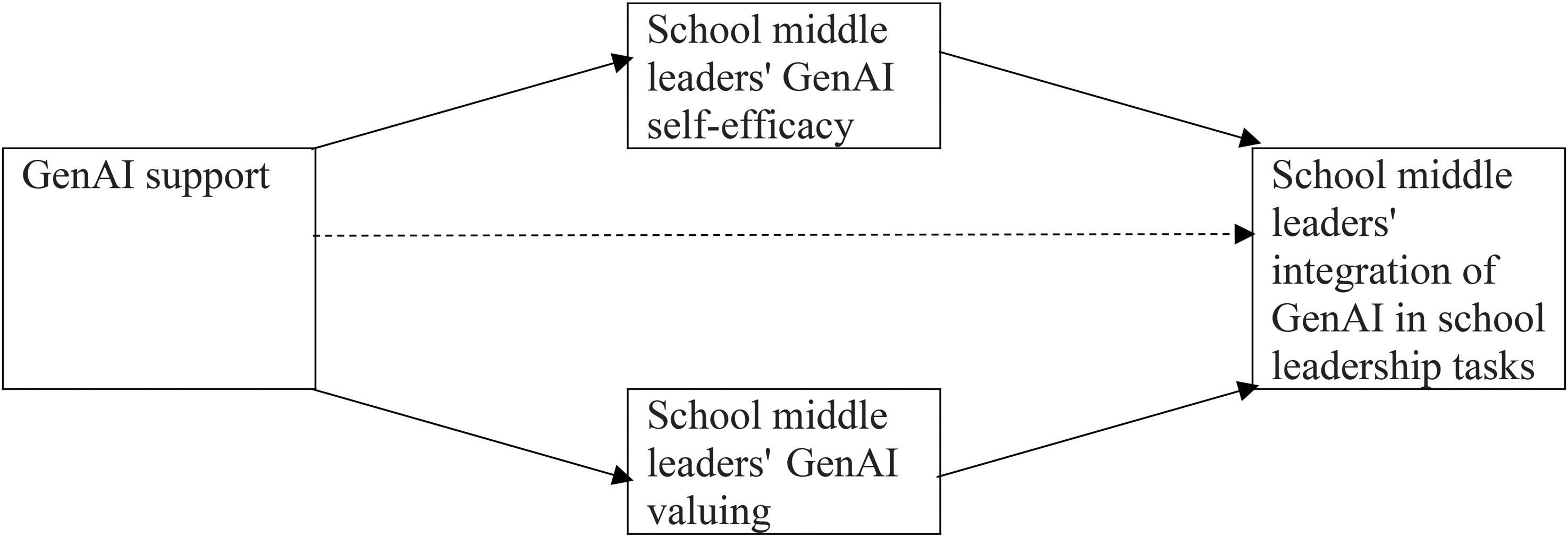
Proposed model.
Middle leader GenAI self-efficacy
According to Bandura (1997), self-efficacy beliefs are ‘beliefs in one's capabilities to organise and execute the courses of action required to produce given attainments’ (3). In other words, it is a personal belief that one can do what it takes (e.g. plan and act) to accomplish a task at a particular level of quality. Bandura (2000) noted that persons who question their capacities withdraw, quit, or accept inadequate answers when confronted with challenges, setbacks, and failures. By contrast, strong believers in their abilities redoubled their efforts to overcome obstacles. Self-efficacy is a dynamic personal component, essential for human agency (Bandura, 1997). These beliefs connect knowledge and actions in a given context, therefore, they are dynamic rather than a fixed character attribute of a person (Bandura, 1997). One's self-efficacy beliefs vary depending on the context and nature of the activities. In school work, teacher self-efficacy has gained much attention in recent years (Wray et al., 2022). Teacher self-efficacy beliefs refer to teachers’ personal opinions about their capacity to execute certain educational activities at a given level of quality in a designated environment (Dellinger et al., 2008). Another research focus concerning work in schools is principals’ self-efficacy (Hallinger et al., 2018), although it is limited compared to research on teacher self-efficacy (Skaalvik, 2020). The principal's self-efficacy refers to ‘a judgment of his or her capabilities to structure a particular course of action to produce desired outcomes in the school he or she leads’ (Tschannen-Moran and Gareis, 2004: 573). When faced with challenges, principals displaying high self-efficacy do not immediately regard their incapacity to address the issues as a failure (Skaalvik, 2020; Tschannen-Moran and Gareis, 2007). By contrast, principals with low self-efficacy are unable to control their surroundings, cannot perceive possibilities or adjust successfully, and are less willing to find suitable solutions or modify failing ones (Skaalvik, 2020; Tschannen-Moran and Gareis, 2007). The issue of the self-efficacy of middle school leaders appears to be underexplored.
Discussing leader self-efficacy, Hannah et al. (2008) differentiated between generalised leader efficacy as well as leader efficacy for thought, self-motivation, action, and means. Efficacy for action relates to the ability to take effective action to achieve a certain goal or task (Hannah et al., 2008). One such domain of efficacy for action involves technology. The present study focused on AI self-efficacy. It is widely known that self-efficacy has a significant influence on behavioural approaches related to learning and using new technology (Ayanwale et al., 2022). AI literacy is the most important predictor of intention regarding AI but other aspects like confidence were also found to play a key part. For example, Chai et al. (2021) showed that primary school students’ behavioural intent to study AI was significantly predicted by their self-efficacy together with social good and AI literacy. Thus, self-efficacy was the most important predictor of behavioural intention regarding AI (Ayanwale et al., 2022). Regarding GenAI research in schools, studies explored teachers’ self-confidence in their ability to use GenAI to accomplish essential teaching activities, such as creating lesson plans, providing feedback, or completing assessment tasks, and called it GenAI self-efficacy (Collie et al., 2024). Previous research suggested that teachers’ adoption of GenAI technology was related to their GenAI self-efficacy (Kong et al., 2024).
Middle leader GenAI valuing
According to Wigfield et al. (2016), valuing refers to people's subjective assessment of a given task or tool. It is said to include four aspects (Wigfield et al., 2020): (a) attainment value, which indicates how important people believe a task or tool is in reaching their goals; (b) intrinsic value, which is related to the degree people believe a task or tool is fun or interesting to perform or use; (c) utility value, which represents people's belief that a task or tool will help reach future goals; and (d) relative cost, which is related to people's perception that using a task or tool will take time away from other goals. The current study focused on valuing as it captures all four aspects.
People often expect that using technology will give them more time or opportunity to engage in other activities (Collie and Martin, 2024). Studies have shown that valuing technology significantly influences behavioural intention (Ayanwale et al., 2022). Pan et al. (2019) examined the reasons physicians adopt smart healthcare services from the perspective of technology transfer and found a substantial association between their views and behavioural intentions. Similarly, Wu et al. (2011) discovered a strong association between attitudes related to mobile healthcare services and behavioural intention to use them. The perceived usefulness of AI is the extent to which individuals believe that AI technology will assist them in achieving their objectives (Molefi et al., 2024). Previous studies have examined the relationship between perceived usefulness and intention to use AI technology (Molefi et al., 2024).
In educational research, teachers’ use of GenAI technology is affected by its relative benefits (An et al., 2023; Collie et al., 2024). Teachers’ adoption of technology and GenAI has been studied with reference to its perceived usefulness and valuation (Collie et al., 2024; Kong et al., 2024). Chounta et al. (2022) asked 140 Estonian K-12 teachers about their understanding, concerns, and challenges in the use of AI in the classroom. The findings of the survey indicated that 69% of the teachers reported that they considered AI to save time when searching for materials or information for class, and 53% indicated that its use can help review studies more rapidly. The empirical research on the usefulness of GenAI technology for school leaders is scarce, although claims about its value and usefulness for educational leaders are numerous (Arar et al., 2024; Dai et al., 2024; Fullan et al., 2024; Wang, 2021a, 2021b).
School support for GenAI
Vision, learning culture, supportive monitoring, an atmosphere encouraging professional development, and administrative support were proven to be key factors in helping teachers engage in professional development (Alsaleh, 2022). Dinham (2005) highlighted the crucial role school principals play in fostering originality and risk-taking to enhance creative learning. Eyal and Yosef-Assidim (2012) found that principal support is a key factor in fostering educational champions, teachers who initiate unsolicited innovation in schools. Both structural and informal administrative support elements can predict the degree of teacher involvement (Alsaleh, 2022). The literature on middle leaders indicates that support by principals can influence middle leaders by building their capacity, among others, through on-the-job professional learning and supporting tools (e.g. documentation and procedures) (Bryant and Walker, 2024). According to middle leaders’ narratives, their self-efficacy is greatly influenced by the support of senior leaders (Bryant, 2019).
Teachers’ perception that their workplace offered them sufficient help and direction to use GenAI in their teaching was reflected in the school support provided for using GenAI (i.e. GenAI support) (Collie et al., 2024). The provision of support and resources includes assistance and materials offered by educational organisations to help teachers in the use of AI (Molefi et al., 2024). Access to technology, professional development opportunities, and financial support are some examples of these resources and assistance (Molefi et al., 2024). Research on GenAI support in schools is still in its infancy (Collie et al., 2024). GenAI support is an important antecedent of teachers’ GenAI self-efficacy and valuing. Lu et al. (2024) examined a pre-service teachers’ professional development programme that used GenAI. According to the results, participation in the programme was associated with higher teacher self-efficacy than that of a control group of pre-service teachers who received training without GenAI. Higher levels of GenAI valuing at work were associated with teachers’ evaluations of autonomy-supportive leadership and principals who take into account their viewpoint and encourage their self-determination (Collie and Martin, 2024).
The mediation hypotheses
This study hypothesises that the relationship between support for GenAI and middle leaders’ integration of GenAI into school leadership practices is mediated by two key psychological constructs: GenAI self-efficacy and GenAI valuing. The mediation hypotheses are grounded in SCT (Bandura, 1986), according to which individual behaviour is shaped by the dynamic interaction between environmental influences, personal cognitions, and actions. Specifically, organisational support is expected to influence individuals’ beliefs about their ability to perform certain tasks (self-efficacy) and the value they ascribe to those tasks, which in turn affect their behavioural engagement. These interactions have received empirical support. Both AI self-efficacy and valuing have been examined in relation to students and teachers and identified as important precursors of AI usage (Al-Abdullatif and Alsubaie, 2024; Bewersdorff et al., 2025; Collie et al., 2024). Prior structural equation modelling found that GenAI support in schools was positively related to teachers’ AI integration in teaching and learning, with effects mediated by teachers’ GenAI self-efficacy and valuing (Collie et al., 2024). Based on the above literature review, it is proposed that the effect of GenAI support on middle leaders’ GenAI integration in school leadership work is mediated by middle leaders’ GenAI self-efficacy and GenAI valuing. Thus, one can propose:
Method
The study used a quantitative cross-sectional survey conducted in Israel in January 2025 to test the model presented in Figure 1. An institutional review board approved the study. Convenience sampling was used because it is a relatively less costly and time-consuming (Malhotra and Birks, 2006) method for an online survey. The conditions for participation were answering all survey questions and being a current middle leader in a public elementary or secondary school. The survey was completed by 277 middle leaders. The sample comprised of 49 coordinators of social activities, 55 department heads, 135 subject heads, and 38 school counsellors. The gender distribution of the participants was 82.3% female and 17.3% male; 0.4% (n = 1) was not specified. The distribution of teaching experience was: 9%: 0–3 years, 17%: 4–6 years, 25.6%: 7–10 years, 19.5%: 11–15 years, 16.6%: 16–25 years, and 12.3%: 26 years or more. Participants worked in the schools at nearly equal educational levels: 48.7% in secondary schools and 51.3% in elementary schools. The size of the team they managed was distributed as follows: 27.1% oversaw fewer than 5 teachers, 26%: 6–10 teachers, 13.4%: 11–15 teachers, 8.3%: 16–20 teachers, 4.3%: 21–25 teachers, 5.4%: 26–30 teachers, 8.3%: 31–50 teachers, and 7.2% oversaw teams of 51 or more teachers.
Measures
Prior to completing the survey, participants were provided with an explanation of what GenAI is: ‘Advanced technology that uses machine learning to create new content like text, images, and music (such as ChatGPT, Copilot, Claude, Gemini, Perplexity, and so on) is known as generative artificial intelligence (AI)’.
GenAI school support. The variable was measured using the GenAI school support scale (Collie et al., 2024). The four items of the scale were adapted for this study to capture middle leaders’ views of school support for the use of GenAI at work. For example, the original item ‘At work, I receive the support I need to integrate generative AI into my teaching’, was modified to ‘At work, I receive the support I need to integrate generative AI into my managerial work’ (see full items’ list in the Appendix). Respondents were asked to rank their agreement on a 5-point Likert scale, ranging from 5 = Strongly agree to 1 = Strongly disagree. The alpha reliability of the scale was excellent 0.93.
GenAI middle leaders’ self-efficacy. The variable was measured with a scale inspired by the GenAI teacher's self-efficacy instrument developed by Collie et al. (2024). The following stem, adapted from Collie et al. (2024), was used: ‘Assuming I decide or am asked to use generative AI in my managerial work next week….’ This was followed by 11 items describing different school leadership tasks: ‘I am confident I will be able to effectively use generative AI to…’ (see full items’ list in the Appendix). Participants were asked to rank agreement level on a 5-point Likert scale, ranging from 5 (Strongly agree) to 1 (Strongly disagree). The reliability of the scale was outstanding (0.95).
GenAI middle leaders’ valuing scale was inspired by the GenAI teacher's valuing scale developed by Collie et al. (2024). The following stem was used: ‘Thinking ahead, in the next 1–2 years I believe….’ According to Collie et al. (2024), the long time window is suited also to educators who did not use AI extensively. The four items were modified for the present research to describe school leaders’ valuing. The original item ‘It will be important to use generative AI in my work as a teacher’ was changed to ‘It will be important to use generative AI in my managerial work at school’. Cronbach's alpha was high (0.92).
Integration of GenAI in middle leadership work. This scale was inspired by earlier research on the use of GenAI by teachers (Collie et al., 2024) and was used successfully by Berkovich (2025). The participants were asked the following question: ‘For which tasks do you currently use GenAI as part of your leadership role at the school?’ The scale included 19 school leadership activities where GenAI is used in the areas of managerial, instructional, social, political, and ethical leadership tasks (see Greenfield, 1995). The tasks were selected to reflect the range of school leadership responsibilities (see the full list in the Appendix) and to be pertinent to the various positions of the school leaders. For each task that was mentioned, participants were asked whether they used AI for the task (1) or not (0). The score was the total number of school leadership-related activities for which participants reported using GenAI.
Controls. Based on past research (Collie et al., 2024), the study included demographic and professional variables such as gender, teaching experience, the number of teachers in the managed team, and school level.
Psychometrics of the measures
To ensure content validity after adapting the items, the researchers assessed the content (see Yaghmaei, 2003) and found that the items adequately represented educational leadership and GenAI use in schools. In addition, a pilot study was conducted with 48 middle school leaders using the four adapted scales. The validity of the four scales was further evaluated using the pilot sample. To assess face validity and perceived predictive validity, two items from Holtrop et al. (2014) were adapted for each scale. For face validity, participants rated the item: ‘The content of this questionnaire is clearly related to [school support for GenAI use in management/self-efficacy (ability) to use GenAI in school management work/the importance and value school leaders ascribe to GenAI in management work/the use of GenAI in the core aspects of middle school management roles]’. For perceived predictive validity, participants responded to: ‘With the results of this questionnaire, [school support for GenAI use in management/self-efficacy to use GenAI in school management work/the importance and value school leaders ascribe to GenAI in management work/the use of GenAI in core aspects of middle school management roles] can be predicted’. All items were rated on a 7-point Likert scale ranging from ‘Completely disagree’ to ‘Completely agree’. Face validity scores were: GenAI school support (M = 5.12), GenAI self-efficacy (M = 5.03), GenAI valuing (M = 5.20), and integration of GenAI in school leadership (M = 5.53). Perceived predictive validity scores were 4.97, 5.00, 5.15, and 5.25, respectively. These scores indicate high face validity and high perceived validity (see Holtrop et al., 2014). Pilot study participants completed the questionnaire at two time points, 1 week apart, to evaluate test–retest reliability. Intraclass correlation coefficients (ICCs) were calculated to evaluate test–retest reliability. The results indicated acceptable reliability for GenAI self-efficacy (ICC = 0.63), GenAI valuing (ICC = 0.62), and integration of GenAI in school leadership (ICC = 0.70), and good reliability for GenAI school support (ICC = 0.80) (see Koo and Li, 2016), supporting the temporal stability of these measures.
Data analysis
This cross-sectional survey required a common method bias (CMB) solution. Pre-collection mixing of response formats using a combination of yes/no (binary) and Likert scale (5-point) items reduces uniformity, lowering the likelihood of CMB (Podsakoff et al., 2003). In addition, participants’ anonymity was ensured to reduce social desirability bias, which contributes to CMB (Podsakoff et al., 2003). Confirmatory factor analysis indicated a strong factor structure as the three factors based on Likert scales (i.e. GenAI school support, GenAI valuing, and GenAI self-efficacy) fit excellently their respective factors (Comparative Fit Index = 0.98, Tucker-Lewis Index = 0.98, Normed Fit Index = 0.97, Root Mean Square Error of Approximation = 0.08, Standardized Root Mean Square Residual = 0.04) (see Byrne, 2016), with all item loadings above 0.70. CMB was first examined using Harman's single-factor test. The first factor accounted for 37.21% of the variance, which is below the 50% threshold suggested by Podsakoff et al. (2003), indicating that CMB is unlikely to be a significant concern. Descriptive statistics and Pearson correlations were then computed, followed by mediation analysis using Model 4 of the PROCESS macro in SPSS (Hayes, 2013). Model 4 of the PROCESS macro was used to specify GenAI school support as predictor (X) of the outcome of middle leaders’ integration of GenAI in their school leadership (Y) by the mediators of middle leaders’ GenAI valuing (M1) and GenAI self-efficacy (M2), with gender and school level as controls. To examine the indirect influence, a bootstrap approach with 5000 samples was set. If the confidence interval (CI) excludes 0, the mediation effects are significant (Hayes, 2013). The bootstrap approach boasts robustness when investigating mediating effects (Preacher and Hayes, 2004; Shrout and Bolger, 2002). Cohen (1992) pointed out that a small effect size for Pearson correlation coefficients and β coefficients is about 0.10, a medium effect size is about 0.30, and a high effect size is about 0.50.
Results
Skew and kurtosis values for the study variables ranged between −1.5 and +1.5, indicating acceptable univariate normality (Tabachnick and Fidell, 2018). Additionally, Mahalanobis distance values were examined to assess multivariate normality, and three cases exceeding the critical threshold (P < 0.001) were excluded (Tabachnick and Fidell, 2018). The final analysis included 277 observations. Multicollinearity diagnostics showed tolerance values above 0.60 and variance inflation factor values below 2.0, indicating no concerns with multicollinearity (Hair et al., 2019). Overall, the preliminary assumptions were met, allowing the analysis to proceed as planned.
Table 1 presents the Pearson correlations alongside the descriptive statistics for the study variables. GenAI school support and GenAI self-efficacy mean scores were medium, near the midpoint of the scale (3.157 and 3.164, respectively). By contrast, middle leaders’ GenAI valuing mean score was high (3.869), indicating a stronger positive perception. As predicted, GenAI school support was positively related to middle leaders’ GenAI valuing (r = 0.348, P < 0.001), and GenAI self-efficacy (r = 0.501, P < 0.001). In addition, middle leaders’ GenAI valuing and GenAI self-efficacy were positively linked with the integration of GenAI in their school leadership (r = 0.368, P < 0.001 and r = 0.506, P < 0.001, respectively). GenAI school support was also positively related to middle leaders’ integration of GenAI in their school leadership (r = 0.417, P < 0.001).
Correlations matrix (N = 277).
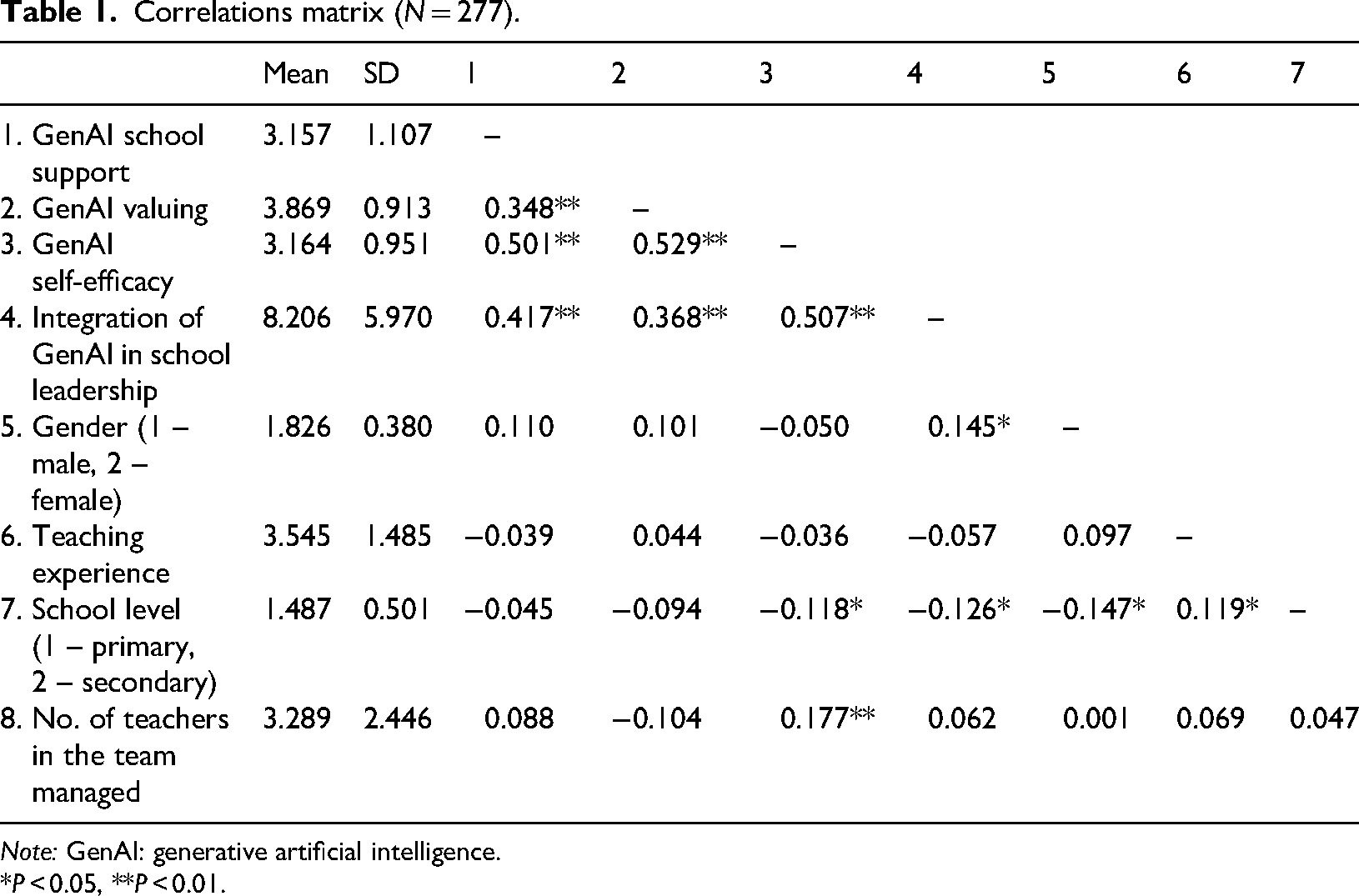
Note: GenAI: generative artificial intelligence.
*P < 0.05, **P < 0.01.
Using Model 4 in the PROCESS macro, the mediating effects of middle leaders’ GenAI valuing and GenAI self-efficacy were investigated (see Tables 2–4). As shown in Tables 2 and 3, there were positive and medium-to-high associations between GenAI school support on the one hand and middle leaders’ GenAI valuing and GenAI self-efficacy on the other (β = 0.337, P < 0.001 and β = 0.519, P < 0.001, respectively), after gender and school level are controlled for. Middle leaders’ GenAI valuing exhibited a non-significant relationship with middle leaders’ integration of GenAI in their school leadership (P > 0.05), and GenAI self-efficacy exhibited a positive medium association with it (β = 0.351, P < 0.001). As shown in Table 4, the bootstrap approach (5000 samples) found a significant indirect effect for middle leaders’ GenAI self-efficacy (effect = 0.182, 95% CI = [0.107, 0.264]) but not for the GenAI valuing (effect = 0.033, 95% CI = −0.005, 0.071]). Moreover, the direct effect of GenAI school support on middle leaders’ integration of GenAI in their school leadership was significant (effect = 1.031, 95%, P = 0.001) suggesting that middle leaders’ GenAI self-efficacy partially mediated the link between GenAI school support on middle leaders’ integration of GenAI in their school leadership.
Mediator variable models (N = 277).
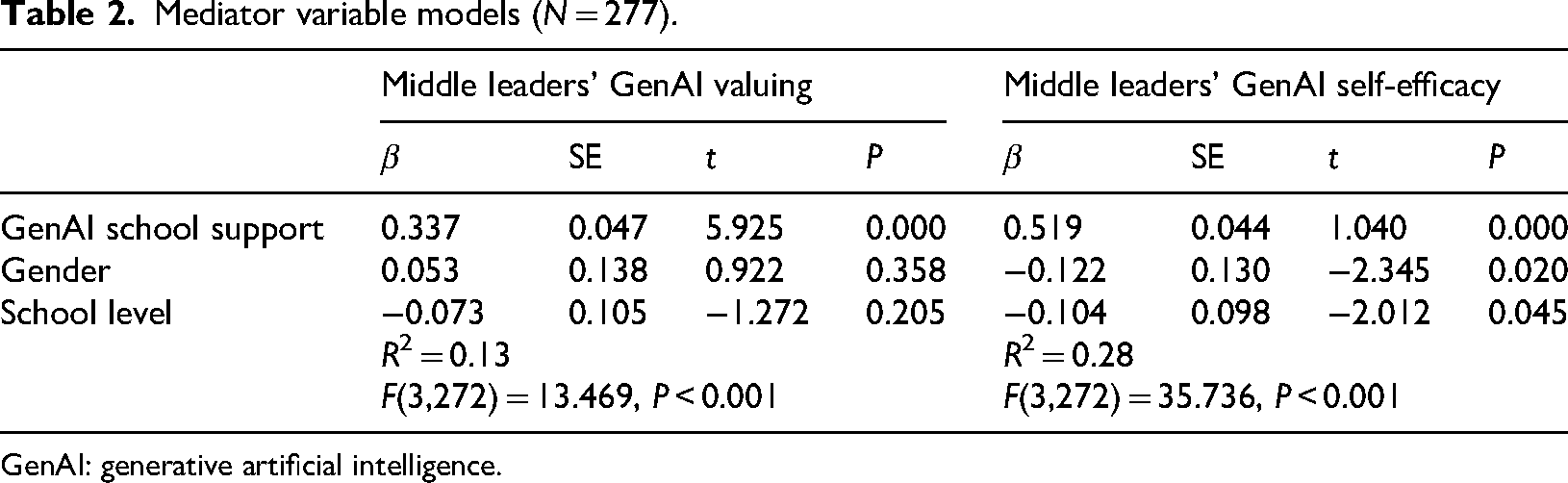
GenAI: generative artificial intelligence.
Dependent variable model: Integration of GenAI in school leadership work (N = 277).
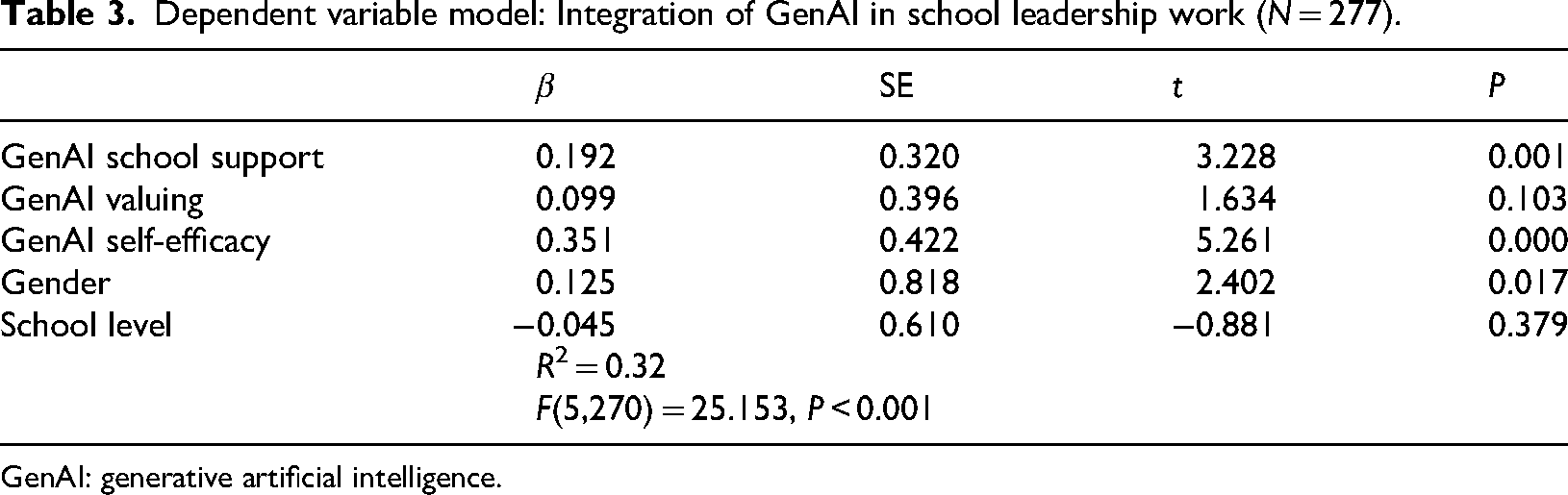
GenAI: generative artificial intelligence.
Direct and indirect effects on integration of GenAI in school leadership work (N = 277).
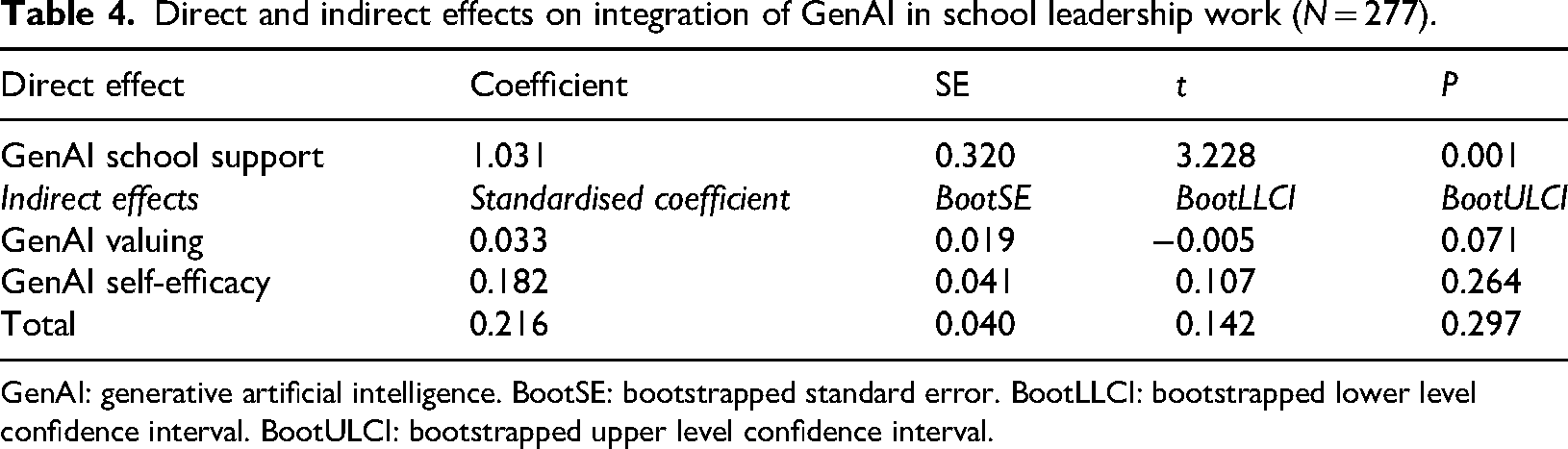
GenAI: generative artificial intelligence. BootSE: bootstrapped standard error. BootLLCI: bootstrapped lower level confidence interval. BootULCI: bootstrapped upper level confidence interval.
Discussion
The present study explored how school support of GenAI predicts middle leaders’ integration of GenAI in school leadership work and how their GenAI valuing and self-efficacy mediate this effect. Previous studies on the adoption of GenAI technology in schools have focused mostly on teachers and students (Chai et al., 2021; Collie et al., 2024). The present research responded to the call to expand the limited empirical evidence on the use of AI in school management work (Arar et al., 2024; Dai et al., 2024; Wang, 2021a, 2021b), which is much needed given the rapid pace of technological developments. AI integration in organisational leadership changes the relationship-related, task-related, and change-oriented activities of leaders (Quaquebeke and Gerpott, 2023). By offering an empirical description of how GenAI support affects middle leaders’ use of GenAI technology, our findings add to the emerging research on the adoption of AI in the work of school staff, especially in their leadership work. The importance of the study lies, among others, in the scarcity of scholarly knowledge on middle leaders and technology in schools. We know that middle leaders’ work is complex and it includes multiple actions at the top and lower levels of the organisations, and that they must cope with tasks in many job domains (De Nobile, 2018; Glover et al., 1998; Moshel and Berkovich, 2023). Thus, AI appears to be a natural assistant in middle leaders’ coping with their work tasks.
The results of the study have several implications. First, the research indicates the importance of school support for GenAI, which reflects employees’ perceptions that their workplace provides them with enough guidance and assistance to apply GenAI in their work tasks (Collie et al., 2024). The mean score found in the study of GenAI school support was medium, suggesting that schools can improve on this aspect. The findings of previous studies, unrelated to AI or technology, showed that principals’ support can help middle leaders develop their self-efficacy (Bryant, 2019; Bryant and Walker, 2024), as this study did regarding middle leaders’ GenAI self-efficacy. The findings extend existing insights into AI integration in schools and align with a recent study exploring GenAI school support and teachers’ GenAI self-efficacy and valuing (Collie et al., 2024). The present research extended these understandings to the population of middle leaders in schools. Although an earlier study on school support for GenAI in teaching in Australia, in mid-2024, reported a relatively low score for school support (mean of 2.62 on a 7-point scale) (Collie et al., 2024), the present study found that GenAI school support in school leadership was higher in early 2025 in Israel (mean of 3.157 on a 5-point scale). This may be due to the diffusion level of GenAI that has made great strides recently over a short time (see Rogers, 1995, on innovation diffusion theory), national culture (see Hofstede et al., 2010), and possibly to the nature of managerial work, which involves critical responsibilities that require focused attention, such as planned conversations, reports, and so on. This warrants further research.
Second, the study showed that the association between school support for GenAI and middle leaders’ GenAI integration in their leadership practices was mediated by GenAI self-efficacy. The study showed that the confidence of middle leaders in their capacity to use GenAI successfully was much increased when the school supported the use of GenAI. This is consistent with SCT connecting contextual and individual variables to behaviour (Otaye-Ebede et al., 2020; Ozyilmaz et al., 2018) and with Bandura's (1997) self-efficacy hypothesis, which contends that experiences of mastery and resource availability are important factors in determining people's confidence in their ability to complete a task. Previous works have shown the antecedents of AI usage by students and teachers, including AI self-efficacy (Al-Abdullatif and Alsubaie, 2024; Bewersdorff et al., 2025; Chai et al., 2021; Collie et al., 2024; Kong et al., 2024). Results of the mediation model indicate that GenAI self-efficacy is an essential psychological process for middle leaders because it channels outside support into useful GenAI integration at the workplace. The results imply that GenAI self-efficacy is a strong predictor of GenAI integration in school leadership work, consistent with other research showing the mediating role of GenAI self-efficacy between support and use by teachers (Collie et al., 2024). Furthermore, although the self-efficacy of teachers (Wray et al., 2022) and principals (Skaalvik, 2020) has been explored before, middle leaders’ self-efficacy has been much less investigated (see notable exception by Bryant, 2019 and Bryant and Walker, 2024). The present work concerns not the generalised leader efficacy but their efficacy in action (Hannah et al., 2008) involving AI technology. GenAI tools offer school middle leaders support in areas where the system typically provides little assistance. Additionally, school support may provide the flexibility middle leaders need to use these tools, enhancing autonomy, effectiveness, and adaptability in their work.
Third, school support for GenAI was found to predict GenAI valuing, but valuing was not a significant mediator of support effect on GenAI integration in middle leadership practices when GenAI self-efficacy is part of the model. Although the significant positive correlation between middle leaders’ GenAI valuing and its integration in their school leadership aligns with prior research on the connection between perceived utility and intention to use AI technology and its integration in work (Collie et al., 2024; Kong et al., 2024; Molefi et al., 2024), its effect as a mediator appears to be minimal when self-efficacy is included in the model. Previous work suggests that GenAI valuing levels are relatively high among teachers (mean of 4.65 on a 7-point scale in Collie et al., 2024; and rations above 50% in some tasks in Chounta et al., 2022). The present finding that the mean of GenAI valuing was high (3.869 on a 5-point scale) suggests that, on average, middle school leaders in Israel find GenAI useful in their leadership work. At the same time, despite the literature and the empirical evidence, GenAI valuing did not emerge as a significant mediator: its non-significant indirect effect suggests that self-efficacy plays a more critical role in mediating the relationship between the predictor and outcome variables, especially in the connection to AI integration in practice. Although organisational support predicts GenAI valuing, its role as a mediator may be diminished when self-efficacy is included in the model because support also enhances leaders’ confidence in using the tools. In the early stages of integration, practical capability (self-efficacy) may be a more immediate driver of use than general recognition of value, even if legitimacy from support contributes to both.
This study has several limitations. First, the cross-sectional design restricts the ability to draw causal conclusions. Experimental or longitudinal designs should be used in future studies to investigate how the associations develop over time. Second, self-reporting might be biased towards social desirability. A more thorough grasp of real-life integration patterns may be obtained by including objective measurements, such as digital logs of GenAI use. Third, the study was conducted at a certain time point of the diffusion of AI technology into school leadership work (Berkovich, 2025) and further exploration at more progressive stages of diffusion may produce different outcomes. Fourth, the study did not explore the actual contribution of AI to quality leadership or instructional processes in schools. Future works may explore such effects. Fifth, the use of a non-random convenience sampling method limits the generalisability of the findings to the broader population, therefore the sample may not fully capture the diversity of individuals and school settings.
The study findings have several practical implications. First, promoting middle leaders’ GenAI self-efficacy requires funding for organised GenAI school support, such as specialised training, mentoring programmes, and subscriptions to GenAI services. Purposeful national and regional policies and funding are much needed for shaping a supporting school dynamic. Second, schools should provide GenAI school support and instil a culture open to innovation (Fuad et al., 2022) that allows middle leaders to explore AI opportunities for more effective work. Third, school leadership development programmes must address familiarisation with GenAI and the strategic advantages of GenAI in school leadership. On-the-job school training for middle leaders can also incorporate these contents. It is important to remember that AI-related training also impacts educators’ professional identity, making opportunities for reflection essential (Lan, 2024). In sum, the results indicate the need for school support for AI to improve middle leaders’ AI self-efficacy required for AI adoption. Based on the literature, schools may benefit from setting the stage for more successful and long-lasting AI integration in leadership practices (Arar et al., 2024; Dai et al., 2024; Fullan et al., 2024; Wang, 2021a, 2021b).
Footnotes

Funding
The author(s) disclosed receipt of the following financial support for the research, authorship, and/or publication of this article: This research was supported by The Open University of Israel's Research Fund.
Declaration of conflicting interests
The authors declared no potential conflicts of interest with respect to the research, authorship, and/or publication of this article.
Author biographies
Appendix

| Scales | Items |
|---|---|
| Generative AI support scale (adaptation from Collie et al., 2024) |
At work, I receive the support I need to integrate generative AI into my managerial work. My school provides me with sufficient resources for using generative AI in my managerial work. At work, I am encouraged to use generative AI for my managerial work. I receive the necessary support at work to apply generative AI effectively in my managerial work. |
| Generative AI self-efficacy scale | Assuming I decide or am asked to use generative AI in my managerial work next week… I am confident I will be able to effectively use generative AI to:
Initiate, plan, and implement the development of the teaching capabilities of the teachers under my supervision. Monitor the management of finances, teaching hours, and resources of the team or school. Evaluate and oversee the activities of the team or school. Assist teachers in dealing with challenges, problems, or stress. Communicate and collaborate with parents and foster a strong connection between school and home. Diagnose, plan, and monitor a positive psycho-social environment for the staff and students. Recruit resources for the needs of the staff or school from the principal, owners, local authority, or Ministry of Education (district or headquarters). Identify, plan, and utilise available community resources, including people and places. Develop and implement policies and procedural guidelines aimed at the staff or school community. Design educational programmes for a specific age group or the entire school community. Identify relevant community resources and foster collaborations with the community. |
| Generative AI valuing scale (adaptation from Collie et al., 2024) | Thinking ahead, in the next 1–2 years I believe…
It will be important to use generative AI in my managerial work at school. Using generative AI will make my managerial work at school more interesting. Using generative AI will be useful for helping me do various managerial tasks at school. Using generative AI will enable me to do things in my managerial work at school that I normally could not do (e.g. save time that I can put to use for other managerial work-related tasks). |
| Generative AI integration in school management-related activities scale (Berkovich, 2025) | For what tasks are you using generative AI in your work as a school leader?
Finding solutions for effective mentoring of staff members. Planning conversations with parents (e.g. for conflict resolution) or subordinates (e.g. preparing for group discussions or feedback sessions). Planning, improving, or drafting observation reports for teacher evaluations. Developing educational programmes (subject-specific, social domains, life skills) for a specific age group or the entire school community. Formulating criteria for evaluating the performance of the teaching staff or the school. Planning or organising professional development workshops or training for teachers. Planning or drafting school policies or procedural guidelines for staff. Creating communication materials for the school staff or the parent community (e.g. newsletters, announcements). Designing or analysing surveys to measure the atmosphere among teachers and/or students. Analysing student achievement data to identify trends or areas for improvement. Preparing schedules for the team working under the manager or for school events. Developing lesson plans or resources for the teaching staff working under the manager. Assisting in budget planning or resource allocation. Proposing ideas or planning school events, extracurricular activities, or community engagement. Drafting responses or reports for the school principal, owners, local authorities, or the Ministry of Education (regional or central office). Writing detailed project or initiative requests for the school principal, owners, local authorities, or the Ministry of Education. Identifying or addressing issues related to diversity, equity, and inclusion (discussions, content planning, problem identification, etc.). Training or encouraging staff to use educational technological tools (e.g. learning management systems, digital platforms). Drafting ethical guidelines or assisting in decision-making on ethical dilemmas where the correct and appropriate course of action is unclear. |