



Abstract
We study the effects of principal instructional leadership on pupil educational achievement using longitudinal data of 120,394 teacher responses across 1919 schools in Sweden over 9 years. Through multilevel structural equation modelling, we test how teacher ratings of principal leadership influence indicators of educational achievement and the extent to which this effect is channelled through a collaborative teacher culture in schools. Findings suggest that teacher collaboration partly mediates the relationship between principal instructional leadership and pupil educational achievement in terms of final year grade point average. However, concerning final year standardised test scores, principal instructional leadership alone has a stronger relationship to school performance than teacher collaboration. The longitudinal analysis suggests these patterns are driven by relatively stable differences between schools rather than dynamic changes in schools over time, indicating that variation in school contexts such as culture, organisational structure, and leadership practices persist over time. We discuss implications for research, practice, and policy on school leadership and teacher collaboration.
Keywords
Data for the current study was provided by the Swedish School Inspectorate. We are grateful for comments from practitioner audiences at Leda Lärande 2024, participants of the ECER 2024 Conference, and seminar audiences at the Stockholm School of Economics. The authors are fully responsible for the conclusions drawn.
Introduction
How does principal instructional leadership, mainly aimed at teachers, impact school performance in one of the most determinant aspects, pupil performance? Much has been written in school leadership research about the importance of principal instructional leadership. Principal leadership is essential for pupil achievement because effective instructional leadership positively influences the overall learning environment (Liebowitz and Porter, 2019). Recent research further underscores this relationship, highlighting that core leadership practices such as setting direction and facilitating teacher collaboration are associated with higher-performing schools (Forfang and Paulsen, 2024). Principals also play crucial roles in shaping curriculum, implementing effective teaching strategies, and ensuring resources are aligned with educational objectives. But how is this achieved in practice? Research suggests that principal instructional leadership can positively impact pupil achievement, first and foremost, by enhancing teacher morale and the overall school culture (Pounder, 2011). This involves setting high expectations, providing professional development for the staff, and fostering a collaborative culture among teachers (Liebowitz and Porter, 2019). Moreover, principals foster environments conducive to meaningful teacher collaboration, which is a key mechanism through which instructional leadership is thought to indirectly influence pupil achievement (Li et al., 2023; Meyer et al., 2022). In other words, teachers represent the conduit by which effective instructional leadership may positively enhance pupil learning.
Our study departs from the literature on school leadership and its relationship to pupil achievement. Principals can positively influence pupil outcomes, but given that they rarely interact directly with pupils, their effects are more indirect through instructional leadership (Heck and Hallinger, 2014; Sebastian et al., 2016). How can effective instructional leadership influence teacher practices and, in turn, enhance pupil achievement in schools? This study probes the indirect role of teachers – the adults that pupils meet and interact with in daily classroom activities – in the relationship between principal instructional leadership and pupil educational achievement. Teachers influence pupil outcomes through the quality of teaching and the quality of their interactions with other teachers. Teacher interactions can improve teaching practices and pupil achievement regarding summative standardised test scores (Pil and Leana, 2009) and interim formative assessments (Daly et al., 2014). A central aspect of principal instructional leadership concerns providing teachers with the structures and opportunities for meaningful interaction and learning (Spillane et al., 2015). Recent findings also show that leadership practices can enhance critical components of professional learning communities, such as reflective dialogue and a collective focus on student learning, even though deeper forms of collaboration, like peer observations, may require additional institutional support (Zhang et al., 2023).
Our paper thus builds on the premise that the effect of principal leadership will somehow be channelled through teachers. Specifically, we examine the relationship between principal instructional leadership and the quality of collaboration among teachers, which, in turn, is expected to enhance educational outcomes for pupils. This forms the focus of our empirical investigation and the research question: what is the relationship between principal instructional leadership and pupil achievement, and to what extent is this relationship dependent on the quality of teacher collaboration? Distinctly from studies relying on self-reported survey data assessing school leader efficacy (Hallinger et al., 2013) or supervisor ratings of principal performance (Grissom and Bartanen, 2019), we assess principal leadership through teacher ratings of principal instructional leadership, which has been deemed more reliable than principals’ own (Hallinger, 2008). We analyse these relationships by using a large-scale longitudinal data set with school performance represented by final year grade point average (GPA) and standardised test scores.
Our study utilises an extensive dataset from the Swedish School Inspectorate, measuring principal instructional leadership through three items, which address principal familiarity with daily school operations, promotion of knowledge attainment, and responsibility for instructional work. These capture essential dimensions of instructional leadership identified by Hallinger and Murphy (1985) and later scholars (Grissom et al., 2013; Robinson et al., 2008). Yet, as Urick and Bowers (2019) note, instructional leadership encompasses multiple dimensions that may not be fully represented in abbreviated measures. Despite this constraint, the large-scale longitudinal nature of our dataset provides a unique opportunity to examine how these core elements of instructional leadership relate to school outcomes over time.
School leadership – What is it, and does it matter?
Educational research has adapted theories and measures of leadership to the school context, highlighting the importance of ‘instructional leadership’ (Daniëls et al., 2019). Principal instructional leadership encompasses defining the school's goals and pedagogical programme and developing the school's learning climate (Hallinger, 2003). The principal or instructional leader ensures that teaching practices align with school goals and that classroom instruction addresses the needs of all learners (Hallinger and Murphy, 1985). Unlike transformational leadership, which centres on systemic change and cultural shifts (Leithwood and Jantzi, 2005), or distributed leadership, which fosters collaboration across stakeholders (Spillane et al., 2015), instructional leadership focuses on measurable improvements in pupil learning (Dutta and Sahney, 2022). Recent studies show that distributed leadership can also directly and positively foster teacher collaboration, though its effects on instructional quality are often indirect (Bellibaş et al., 2021; Hsieh et al., 2023).
Other leadership concepts, such as ‘situational leadership’, which highlights the role of the school context and the fact that schools differ, and ‘transformative leadership’, have also been adapted and studied in the educational context (Leithwood and Jantzi, 1999). So has ‘shared leadership’, which is extended to include leadership group members, of which deputy principals and teacher leaders are included (Poekert et al., 2020). While transformational leadership emphasises long-term systemic change and cultural shifts, it often lacks the immediate focus on academic achievement gains (Leithwood and Jantzi, 2006), and while distributed leadership may diffuse responsibility, it may lead to slower, less targeted interventions for improving pupil learning (Harris, 2013). Hence, while all leadership models aim to inspire change or build capacity, many lack the focused and measurable impact that instructional leadership provides on academic performance. As such, principal instructional leadership stands out as the paramount responsibility of principals as it centres on the school's teaching and learning environment (Bush, 2015).
While the concept of principal instructional leadership is well established, several aspects remain unsettled. A critical strand of educational leadership research challenges traditional approaches by drawing on social, political, and critical theories. Niesche and Gowlett (2019) show how power and discourse shape leadership practices, framing leadership as socially constructed rather than a set of individual skills. Neumerski (2013) critiques the focus on principals as sole actors, instead conceptualising instructional leadership as a distributed organisational function, while Grace (2000) links market-driven reforms – such as those seen in Sweden – to a shift toward efficiency and accountability, often at the expense of democratic and collaborative leadership. Taken together, this body of research advocates for collaborative, non-hierarchical forms of leadership that acknowledge and value the agency and contributions of teachers.
A related line of research questions common assumptions about school leadership. Diamond and Spillane (2016) challenge the idea that instructional leadership is a consistent driver of educational quality, showing that its impact varies significantly across socioeconomic and cultural contexts. A recurring tension also exists between principals’ rhetorical support for instructional leadership and their actual practices. The OECD Teaching and Learning International Survey, TALIS, found a positive relationship between higher instructional leadership levels and more time allocated to curriculum and teaching-related duties (OECD, 2014). However, a time-use study by Grissom et al. (2013) shows that principals spend < 13% of their time on instructional tasks. Similarly, Lindberg and Vanyushyn (2013) found that almost 70% of Swedish principals deprioritised instructional leadership duties in favour of administrative work and urgent day-to-day matters. Principals also reported performing instructional leadership tasks less effectively compared to other responsibilities. Given the positive influence of principal instructional leadership on pupil outcomes, it is concerning that these tasks are often sidelined.
In sum, there are indications that principal leadership has important effects on teachers’ work environment and pupil achievement. However, applied leadership research in schools has yet to advance our understanding of the role of principal leadership in conjunction with teacher processes to gain knowledge about how principals best exercise leadership and to what extent the effect of school leadership is channelled by other key resources in school.
The indirect effect of principal instructional leadership on pupil outcomes
School principals have been argued to enhance overall school capacity and performance (Sebring et al., 2010) and quality of pupil learning (Mendels and Mitgang, 2013). Principal leadership is thought to indirectly affect schools and pupils, affecting school staff and pupils’ working conditions and performance (Pounder, 2011).
The direct relationship between principal leadership and pupil achievement has been studied in several meta-analyses to the extent that overall effects have been summarised in ‘second-order meta-analyses’ (Schmidt and Oh, 2013). Wu and Shen (2022) synthesised 18 effect sizes of meta-analyses, considering both quantitative and qualitative findings. They identified two main strands of research: First, studies with psychometrically validated leadership constructs, such as instructional or transformational leadership, often correlated with pupil achievement measures. Second, studies with practices signifying effective leadership in school contexts often correlated with measures of pupil achievement. An example of such a practice can be ‘to create a supportive organisation for learning’ (Daniëls et al., 2019). Wu and Shen (2022) also highlight two theoretical agreements in the research on principal leadership and pupil achievement: First, principal leadership can influence pupil achievement directly through developing relationships with pupils and indirectly through the organisational means they influence and by leading teachers. Second, the influence of principal leadership on pupil achievement should be understood in the presence of mediating factors such as the teaching staff or the school context.
Another second-order meta-analysis indicates that relationships between principal leadership and pupil achievement are generally stronger when leadership models are used to conceptualise and measure principal leadership, compared to studies where leader practices are used (Tan et al., 2022). Differences across studies regarding the direct versus indirect effects may partly depend on the measures used to estimate pupil educational achievement. The most commonly studied measures – grades and test scores – differ in nature, and discrepancies have been attributed to factors such as pupils’ gender and family background (Lekholm and Cliffordson, 2008) alongside individual differences like motivation (Willingham et al., 2002). Specifically, it has been suggested that individual differences between pupils in terms of personality are more predictive of GPA and that cognitive ability is more predictive of test scores (Willingham et al., 2002). These conceptual differences between GPA and test scores suggest that principal leadership may potentially influence one more than the other.
Leveraging teacher collaboration
Leadership is essential to developing school environments that foster teacher collaboration (García-Martínez et al., 2021), and a culture of collaboration is argued to be vital for schools to thrive (Goddard et al., 2015). Teacher collaboration encompasses diverse practices such as resource exchange, discussing pupil learning, developing standards for pupil assessment, participation in conferences and professional development, co-teaching, engaging in cross-curricular projects, and observing and providing feedback on colleagues’ teaching (OECD, 2014). These types of collaboration are thought to make teaching more efficient, give teachers a collective sense of responsibility for pupil learning, and improve strategies for teaching (Banerjee et al., 2017).
In several studies, teacher collaboration has been empirically linked to positive outcomes for pupils, teachers, and schools (Goddard et al., 2007; Seashore Louis et al., 2010; Vangrieken et al., 2015). More recently, it has also been associated with principal instructional leadership. A systematic review highlights the critical role of principals in fostering professional relationships within schools (García-Martínez et al., 2021). Empirical studies have also explored the link between principal leadership and teacher collaboration. Ahn et al. (2023) found that leadership practices positively influence teacher collaboration, primarily through intermediary psychological mechanisms. Similarly, Meyer et al. (2022) showed that principal leadership focused on instruction and staff development is a positive predictor of teacher collaboration, with the relationship shaped by underlying collective dynamics among teachers. Xie et al. (2022) also found that teacher-perceived principal leadership enhanced teacher collaboration, which was associated with factors known to support improved teaching practices. However, none of these studies directly measured student achievement or outcomes.
In line with research emphasising the connection between leadership and teacher collaboration, principal leadership has been shown to influence both the extent and quality of teacher collaboration (Honingh and Hooge, 2014; Voelkel Jr, 2022). These findings indicate that principal instructional leadership not only enhances pupil achievement but can achieve this, in part, by strengthening the collaboration among teachers who engage with pupils daily.
While there is extensive empirical literature on principal leadership and teacher collaboration, only a few empirical studies have probed the joint effect of these two essential factors on pupil achievement. A cross-sectional study of 185 lower secondary schools in Germany found a small but negative relationship between principal leadership and pupil performance in mathematics and reading, mediated by teacher collaboration (Mora-Ruano et al., 2021). These findings underscore that, while instructional leadership can foster teacher collaboration, not all forms of collaboration necessarily translate into improved student outcomes. Mora-Ruano et al. (2021) argue that the positive effects of teacher collaboration on student performance are primarily realised when collaboration is explicitly focused on enhancing instructional quality.
Contrarily, a more recent cross-sectional study of 79 lower secondary schools in Turkey found a small positive impact of principals’ learning-centred leadership on student achievement mediated by teacher collaboration and parental involvement (Özdemir et al., 2023). However, due to the cross-sectional nature of the data, neither of the studies allowed for the investigation of these relationships over time.
This highlights a dearth of empirical research on how principal leadership can affect pupil achievement by shaping the nature of teacher collaboration, despite strong theoretical arguments for their joint importance. Since principal instructional leadership primarily concerns the teaching staff – not pupils directly – it is plausible that high-quality instructional leadership will enhance collaboration amongst the teaching staff, leading, in turn, to improved educational outcomes for pupils. To study whether principals affect school results through teachers in longitudinal research designs using the outcome measures that matter most for access to the labour market and higher education (pupil grades and standardised tests) thus represents valuable extensions of prevailing research. Thus, we explore the relationship between pupil educational achievement and principal instructional leadership and the potential indirect effects of principal instructional leadership on pupil achievement through teacher collaboration.
The Swedish context
In Sweden – the context of the current study – school leadership research has been described as ‘important but neglected’ (Ärlestig et al., 2016). Yet principal leadership remains demonstrably important: Böhlmark et al. (2016) found causal links between principal turnover and pupil performance, as well as teacher sick leave and turnover, across 942 Swedish elementary schools. However, they could not determine whether these effects were attributed to increased levels of instructional leadership.
The Swedish school system combines strong welfare state principles with local autonomy: governmental agencies set national standards, while municipalities manage public schools alongside a growing number of privately operated, publicly funded schools through a voucher system (Nusche et al., 2011). Declining pupil performance in international assessments, notably the 2012 PISA results (OECD, 2012), has spurred extensive reforms focused on raising achievement, with increased emphasis on the role of principals’ instructional leadership (Ärlestig et al., 2016). However, debate continues about how instructional leadership should be enacted in practice (Jerdborg, 2021; Norberg, 2019).
Leadership in Swedish schools tends to prioritise collaboration and the support of teacher development over hierarchical control. This approach reflects the professional status of teachers, who are characterised by strong occupational norms and high levels of formal education (Alvehus et al., 2021). Similar leadership traditions are found in other Nordic countries, such as Finland and Norway, where trust, professional autonomy, and collegial collaboration are central (Sahlberg, 2011; Moos, 2013). In these contexts, principals are expected to lead by fostering professional growth rather than by exerting direct authority. Nevertheless, recent research highlights particular challenges in the Swedish context. Compared to their Nordic counterparts, Swedish principals operate under greater decision-making autonomy while simultaneously facing high external control, creating a complex and demanding environment where principals must navigate pressures from the state, municipalities, and parents within an increasingly marketised school system (Wermke et al., 2022).
By contrast, leadership practices in many other European countries and the United States have shifted towards a stronger emphasis on managerial control and accountability. In England and France, policy reforms have promoted more directive leadership, focusing on performance management and measurable outcomes (Greany and Brown, 2017; Pont et al., 2008). Similarly, in the United States, standards-based reforms and high-stakes testing have fostered leadership models centred on monitoring instruction, setting explicit performance targets, and holding teachers accountable (Hallinger and Heck, 2011; Rigby, 2014). While collaboration remains valued, it is often situated within systems of accountability rather than based primarily on professional trust. Thus, although rooted in Nordic leadership traditions’ collaborative and egalitarian norms, Swedish school leadership also incorporates managerial and directive elements more commonly associated with Western European and US policy contexts. This hybrid configuration positions Sweden as a theoretically salient case for examining the tensions and interplay between collaborative and managerial dimensions in educational leadership.
Methods
Data
We use data from a teacher survey collected by the Swedish School Inspectorate (2021). The survey is distributed twice a year, once for every school, and all schools must allow teachers to take the survey. No demographic information about responding teachers was collected. The data comprise 120,394 teacher responses from 1919 schools serving school year 9 in Sweden from 2013 to 2021. The number of school-year observations for our two key constructs, Principal Instructional Leadership and Teacher Collaboration, was n = 5387, with an average of 62.7 complete teacher survey responses per school. The outcome measure GPA in our sample is based on 373,725 pupil grades.
School data have a multilevel structure due to within-school variability from pupils or teachers (Snijders and Bosker, 2011). In our dataset, however, only school-level scores are available since teachers are not tracked over time. Still, the longitudinal structure of the data allows for multilevel analysis of the within-school variability over time. We followed recommendations by Newman and Sin (2009) and Maloney et al. (2010) to retain all available data.
Dependent variables
Pupil educational achievement. We used two dependent variables: mean grade point average per school (GPA) and mean standardised average test scores in Swedish, Mathematics and English per school (Test Scores). Both independent variables are standard measures of pupil achievement in Sweden (e.g. Böhlmark et al., 2016) and were collected from the Swedish National Agency for Education's (2023) publicly available database. Both GPA and Test Scores are from the final year of compulsory schooling (year 9), which hold significant value to Swedish pupils and schools. For pupils, they determine access to upper secondary school and subsequent higher education. For schools, they function as central measures of school quality, partly in terms of governmental quality assessment and partly by attracting pupils to schools (Erikson and Rudolphi, 2010; Wennström, 2020). This is important in Sweden, as schools compete for pupils through a universal voucher and school choice system. We include GPA and Test Scores in the analyses since they measure partly different achievement outcomes (Lekholm and Cliffordson, 2008).
Independent variables
Principal Instructional Leadership is our key independent variable. Instructional leadership has been characterised by three dimensions: defining the school's mission, overseeing the instructional programme, and promoting a positive learning environment (Hallinger and Murphy, 1985; Heck et al., 1991). While principals perceive instructional leadership as a multifaceted factor, research has shown that teachers perceive it as a single-dimensional factor wherein principals exhibit varying degrees of effectiveness in leading the school (Urick and Bowers, 2019). Following these findings, we measure instructional leadership through teacher ratings of principal instructional leadership in a single-dimensional factor model. The scale consists of three items from the Swedish School Inspectorate's annual teacher survey (2021). The three items are (1) ‘The principal is well familiar with the day-to-day work at the school’, (2) ‘The principal works to promote knowledge attainment in the pupils’, and (3) ‘The principal takes on responsibility for the instructional work at the school’. Teachers are asked to respond to the items with their current principal in mind. As such, we examine the instructional leadership of principals based on ratings provided by teachers within their respective schools. The teachers responded to the items on a 4-point Likert scale ranging from ‘fully agree’ to ‘fully disagree’. The ‘don’t know’ response option was treated as missing data. The scale was evaluated in a separate validation study that found internal and external validity to be adequate (N.N, 2023; concealed for double-blind peer review).
The mediator variable, Teacher Collaboration, was assessed using responses from the same annual teacher survey (Swedish School Inspectorate, 2021). It was measured in a single-dimensional factor model consisting of three items: (1) ‘At this school, we engage in interdisciplinary work (e.g. theme-based projects)’, (2) ‘I collaborate with my colleagues when planning lessons’, and (3) ‘The conferences at the school are beneficial for teaching’. Again, teachers responded to the survey items on a 4-point Likert scale.
Control variables
We control for school-level socio-economic status (SES), which is well-documented to affect school results and conditions for leadership and teacher collaboration (e.g. Lekholm and Cliffordson, 2008). SES was attained from the Swedish National Agency for Education's (2023) openly available school database, measured by average parental education per school and year.
We also control for year of measurement (Time), which is included in the analyses to account for variation in pupil composition and potential trends in pupil achievement due to exogenous sources (e.g. the COVID-19 pandemic). The Time variable was a consecutive sequence corresponding to the years in which the data were collected, 2013–2021.
Analytical methods
The relationship between Principal Instructional Leadership and pupil achievement, mediated through teacher collaboration, was tested in multilevel structural equation models (MSEMs) (Silva et al., 2019). The mediational relationships, that is, the indirect effects, were modelled in 1-1-1 MSEM designs. This means that the variables were measured at the first level, that is, the data points refer to schools, hence the ‘1’ describing each part of the multilevel design. These were used in a two-level hierarchy, in which the school scores vary within schools over time at the first level and between schools at the second level. As such, the independent, mediator, and dependent variables were decomposed to have variability at both the first, within-school level and the second, between-school level of analysis (Preacher et al., 2010).
The tests of mediational relationships were performed in the statistical software Mplus 8.1. Missing data in endogenous variables was treated with full information maximum likelihood (FIML). Standardisation in the multilevel models was performed per level; for example, between-school parameters were standardised to the variance at the between-school level, not the total variance (Muthén and Muthén, 2017).
Results
Validity and reliability of independent variables
The scales for the two independent variables, Principal Instructional Leadership and Teacher Collaboration, were first evaluated using a multilevel confirmatory factor analysis (MCFA) model. The data contained 120,394 teacher responses from 1919 schools. The two latent variables were then regressed on Time to explore possible temporal trends. The measurement model, including Time, yielded a good fit, x2(22) = 679.640, p=<0.001, CFI = 1.00, TLI = 0.99, RMSEA = 0.016, SRMRwithin = 0.02, SRMRbetween = 0.02. The significant chi-square was likely due to the large sample size, to which the chi-square is sensitive (Bollen, 1989). No time trend for the two latent variables was indicated. The scale reliability was also examined in terms of Cronbach's alpha. Principal Leadership exhibited a high alpha of 0.88, and Teacher Collaboration's an alpha of 0.61, lower than conventionally expected. Still, school-level reliability was supported by the item intraclass correlations (ICC) in the measurement model. The ICCs for the Principal Instructional Leadership items ranged from 0.16 to 0.19, and for the Teacher Collaboration items, from .09 to .23.
We performed additional convergent validity tests by estimating the average variance extracted (AVE) for both variables in separate MCFAs. The AVE describes how much variance in the indicators is explained by the latent construct. Data from 2015 was used to sample the AVE. The Principal Instructional Leadership scale had a between-school-level AVE of 0.96, and the Teacher Collaboration scale had a between-school-level AVE of 0.57. Both values exceeded the suggested threshold for adequate convergent validity of 0.50 (Fornell and Larcker, 1981). The results indicated sufficient reliability and validity to analyse the two independent variables separately and jointly.
Descriptive statistics
Table 1 displays the descriptive statistics and observed pairwise correlations in the school-level data pooled for 2013–2021. All pairwise correlations were statistically significant. Positive correlations were present and of moderate size between both independent variables and the school-level outcome variables GPA and Test Scores. Larger correlations were observed between average school SES and the two outcome variables, as could be expected (Ahn et al., 2023).
Descriptive statistics and pairwise correlations: school level data 2013–2021
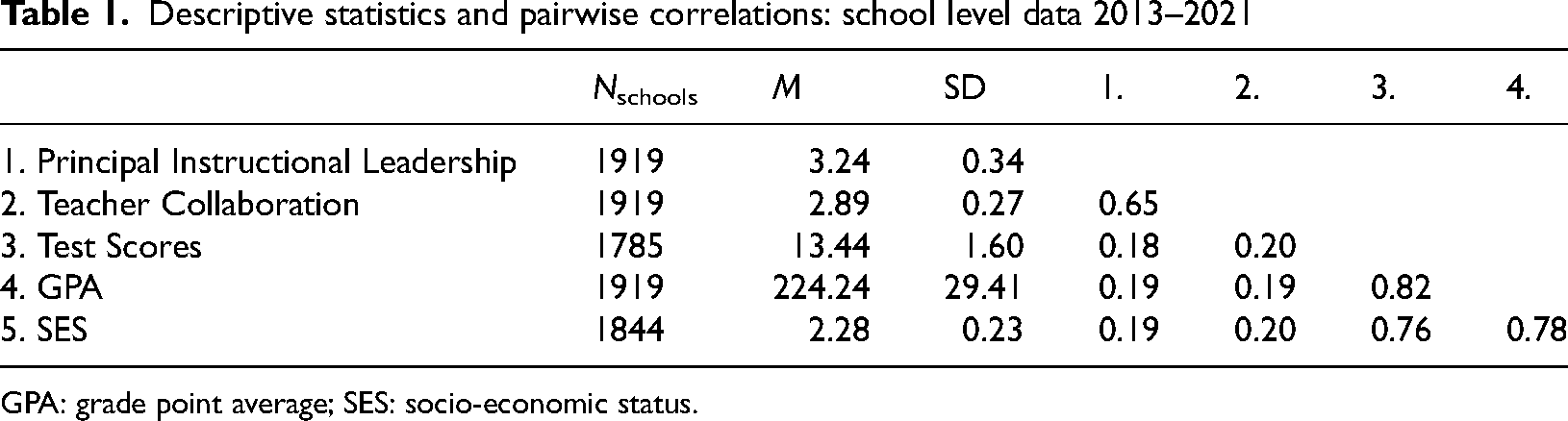
GPA: grade point average; SES: socio-economic status.
The following analytical step involved fitting an ‘unconditional model’ including only the dependent variable and Time for both dependent variables: GPA and Test Scores. In both unconditional models, a positive trend over time was observed: a correlation of r = 0.32 for GPA and a correlation of r = 0.20 for Test Scores, both statistically significant at p < 0.001. This indicates the existence of time trends for both outcome variables.
Tests of direct and indirect relationships
Before testing the indirect relationship, the direct relationship between Principal Instructional Leadership and GPA was examined in an MSEM model, excluding teacher collaboration. SES and Time were included as control variables. The model fit was good: CFI = 0.996, TLI = 0.992, RMSEA = 0.009, x2(13) = 140.299, p =< 0.001, SRMRwithin = 0.018, SRMRbetween = 0.014. The relationships between Principal Instructional Leadership and GPA were β = 0.016, p = 0.017 at the within-school level, and β = 0.23, p < 0.001 at the between-school level.
Subsequently, the direct relationship between Principal Instructional Leadership and Test Scores was tested in an MSEM model with SES and Time as control variables. The model fit was good: CFI = 0.997, TLI = 0.994, RMSEA = 0.007, x2(13) = 68.388, p =< 0.001, SRMRwithin = 0.012, SRMRbetween = 0.008. The relationships between Principal Instructional Leadership and Test Scores were β = 0.01, p = 0.548 at the within-school level, and β = 0.19, p < 0.001 at the between-school level.
In the next step of the analysis, the indirect effects were estimated in separate models for both dependent variables. Figure 1 shows an MSEM model examining the indirect effect of Principal Instructional Leadership through Teacher Collaboration on GPA, controlling for SES and Time. The relationships are reported in a standardised form. The left side of the figure reports within-school effects (over time), and the right side is between-school effects. The model exhibited good fit: CFI = 0.989, TLI = 0.984, RMSEA = 0.012, SRMRwithin = 0.018 and SRMRbetween = 0.034. The statistically significant chi-square value, x2(42) = 757.505, p =< 0.001, was likely due to the large sample size (Bollen, 1989). The results showed a positive mediational relationship between Principal Instructional Leadership and GPA through Teacher Collaboration. However, this relationship was only present in the between-school part of the model, β = 0.12, p = 0.044, and not in the within-school part, β = 0.0007, p = 0.113. Given the remaining relationship between Principal Instructional Leadership and GPA, β = 0.12, p = 0.053, the mediation through Teacher Collaboration is partial.
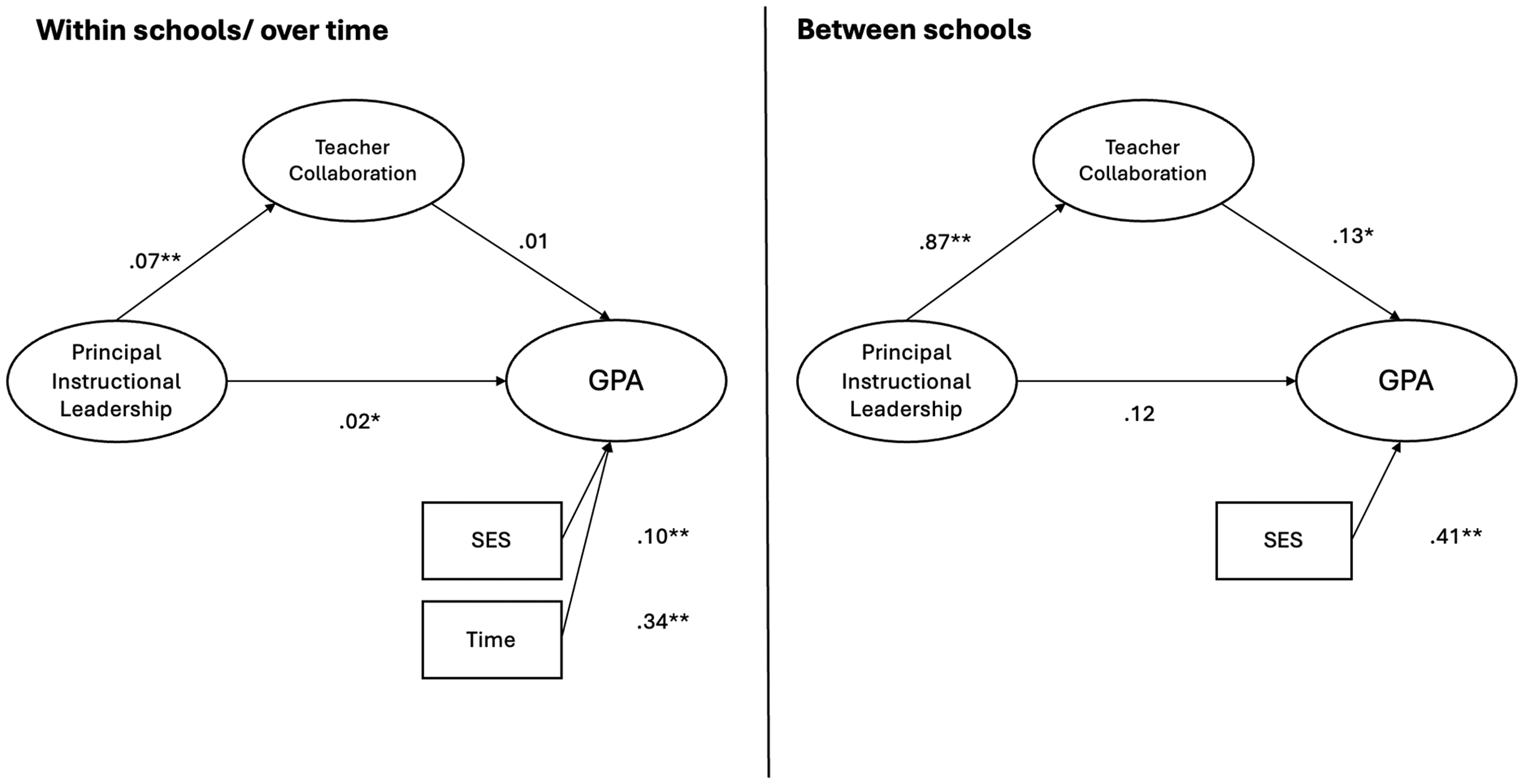
Multilevel mediation model with grade point average (GPA) as the outcome.
Results of the mediation model using Test Scores as the dependent variable are presented in Figure 2, with effects reported in standardised form. The model yielded good fit, CFI = 0.994, TLI = 0.991, RMSEA = 0.009, SRMRwithin = 0.011, SRMRbetween = 0.035. Again, the chi-square was significant, x2(42) = 320.066, p =<0.001. Since the relationship between Teacher Collaboration and Test Scores at the between-school level was close to zero, β = 0.04, p = 0.558, no sizeable mediation effect was identified.
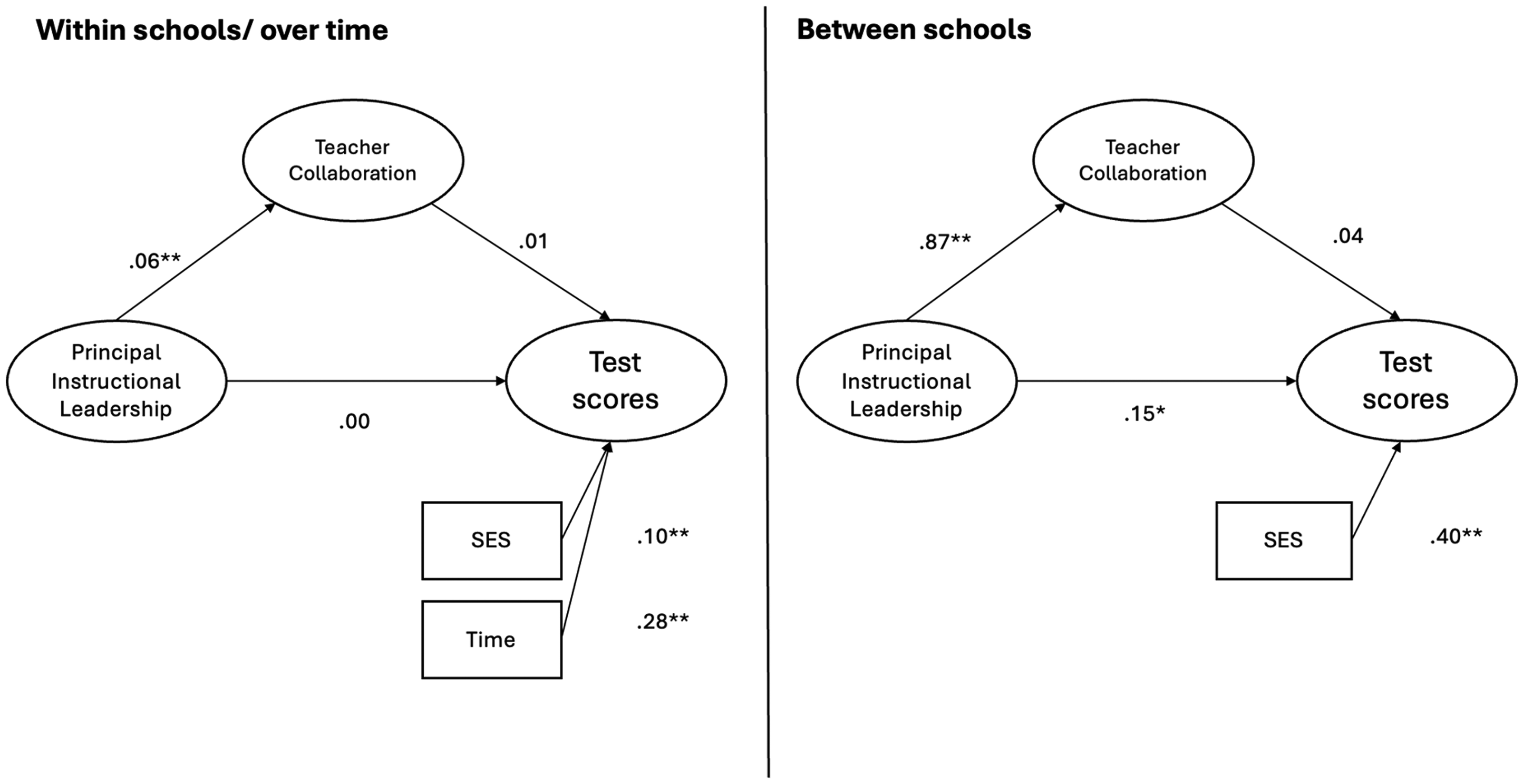
Multilevel mediation model with Test Scores as the outcome.
Discussion
This study investigated the effects of principal instructional leadership on pupil achievement, utilising a comprehensive longitudinal dataset of 120,394 teacher survey responses from 1919 Swedish schools. Additionally, we explored whether this relationship was mediated by teacher collaboration in the schools.
Our findings demonstrate that principal instructional leadership was associated with pupil performance partly through teacher collaboration. However, this partial indirect relationship was only evident when pupil performance was measured by school average grades and not standardised test scores. For test scores, principal instructional leadership had a direct effect that superseded the influence of teacher collaboration. These results suggest that while principals can indirectly affect pupil outcomes primarily through their impact on teachers, their direct influence also plays a significant role, particularly regarding standardised test scores.
Previous cross-sectional studies have examined the mediational role of teacher collaboration in the relationship between principal instructional leadership and school performance (Goddard et al., 2010; Mora-Ruano et al., 2021; Özdemir et al., 2023). Our study builds on this work by introducing a longitudinal perspective, testing this mediating effect across a large number of Swedish schools over time.
The discrepancy in results between average grades and test scores may have arisen from grades being more closely tied to classroom instruction than standardised test scores, designed to measure subject-wide attainment rather than specific course content (Willingham et al., 2002). Also, grading of pupils often involves evaluating overall performance based on explicit or implicit criteria, often encompassing a broader, more holistic assessment beyond cognitive abilities – such as commitment and perseverance. A review of the last century of research on grading shows that while student achievement remains the primary determinant of grades, other factors like effort and behaviour frequently influence grading (Brookhart et al., 2016).
In schools where teachers collaborate more extensively, shared values and practices may emerge, shaping extended assessment processes where discussions among teachers and principals take individual pupil circumstances into account. These discussions introduce an element of collective judgment not found to the same extent in standardised assessments, which adhere to strict marking guidelines and are more directly tied to pupils’ cognitive ability (Willingham et al., 2002).
Furthermore, our findings suggest that principal instructional leadership directly influences standardised test scores, while the influence of teacher collaboration on standardised test scores is close to zero. This finding may indicate that principals influence test scores not necessarily by fostering teacher collaboration but perhaps by encouraging practices like ‘teaching to the test’, where classroom instruction is tailored to align closely with test requirements (Jennings and Bearak, 2014). The observed relationships in our study occur between schools rather than within schools over time. This suggests that stable differences in school contexts – such as culture, organisational structure, and leadership practices – account for these relationships more than changes over time within schools. These findings align with previous research identifying a school-level dimension of grades not directly tied to achievement (Lekholm and Cliffordson, 2008). The indirect effect of principal instructional leadership through teacher collaboration may correspond to these stable, school-level dimensions.
The substantial correlation between SES and both outcome measures aligns with extensive research on socioeconomic factors in educational achievement. However, the effect of principal instructional leadership, particularly on standardised test scores, after controlling for SES suggests that leadership quality can partially mitigate socioeconomic disadvantage. These findings echo research by Leithwood and Azah (2017) that strong leadership can have disproportionate positive effects in challenging school contexts.
The stable differences could also be explained by variations in teaching practices, influenced by a school-wide culture that develops and spreads through collaboration among teachers, and that teacher collaboration practices vary in depth and impact (Vangrieken et al., 2015). The Teaching and Learning International Survey (TALIS) distinguishes between two dimensions of teacher collaboration: (1) surface-level ‘exchange and co-ordination’ such as exchanging teaching materials with colleagues, having discussions about pupils, or attending conferences together, and (2) deep-level ‘professional collaboration’ such as engaging in joint activities, co-teaching, and observing and providing feedback on others’ teaching (OECD, 2020).
The Teacher Collaboration scale we use, collected annually by the Swedish School Inspectorate, evaluates ‘interdisciplinary work’, ‘joint lesson planning’, and ‘quality of teacher conferences’ (Swedish School Inspectorate, 2021). These elements could align more with the ‘exchange and coordination’ scales in TALIS. Still, they may omit essential elements of the ‘professional collaboration’ scales, capturing more intensive collaboration, which has shown greater potential for improving instructional practices and enhancing student achievement, such as collaboration directly connected to classroom practice or joint work (Daly et al., 2021; Demir, 2021; Ronfeldt et al., 2015). The qualitative differences between types of teacher collaboration and their varying effects on student outcomes may be linked to the stable differences we observe between schools over time. This suggests that certain aspects of school culture and organisation remain consistent over time, despite potential changes in staff and leadership.
Our findings must be interpreted within the constraints of how principal instructional leadership was operationalised in this study. The three-item scale captures what Murphy et al. (2015) identify as core responsibilities – familiarity with school operations, focus on student achievement, and ownership of instructional quality – but may not fully reflect the multidimensional nature of instructional leadership conceptualised in more comprehensive frameworks. While Hallinger and Murphy's (1985) Principal Instructional Management Rating Scale, for instance, includes dozens of items across multiple dimensions, our streamlined measure aligns with what May and Supovitz (2011) term ‘the scope of principal efforts to improve instruction’. This condensed measure may not capture nuanced aspects of instructional leadership, such as curriculum development, teacher evaluation practices, or specific mechanisms of teacher support identified by Murphy et al. (2015).
Contributions to school leadership and teacher collaboration research
This study advances the understanding of principal instructional leadership by highlighting its direct and indirect effects on pupil outcomes. While much school leadership research focuses on direct relationships, our findings emphasise the importance of mediating mechanisms such as teacher collaboration. These insights suggest that effective principal leadership may operate through organisational and cultural structures within schools, indirectly influencing pupil outcomes.
Our findings contribute to a growing body of work on how principal leadership fosters collaborative environments among teachers, which, in turn, can enhance pupil educational achievement. The article introduces new or nuanced findings about teacher collaboration, which advance the scholarly discussion on school leadership and teacher collaboration in several ways.
Firstly, we contribute by employing a robust longitudinal design. This allows for a deeper understanding of how principal instructional leadership and teacher collaboration influence pupil achievement over time, expanding the limited research exploring mediation effects by incorporating a longitudinal perspective addressing gaps in previous research that has used cross-sectional data (Mora-Ruano et al., 2021; Özdemir et al., 2023). Compared to previous research probing how principal instructional leadership and teacher collaboration jointly influence pupil achievement cross-sectionally (using, e.g. a mediation or moderation design), our longitudinal design allows us to track the temporal relationships between these variables. This reveals not just whether principal instructional leadership affects student outcomes but whether such effects unfold over time.
Secondly, our findings distinguish between the effects of principal instructional leadership on two distinct measures of pupil achievement – GPA and standardised test scores, highlighting that teacher collaboration mediates the relationship between principal leadership and final school-year GPA, but not standardised test scores where principal instructional leadership instead has a more substantial direct influence. This dual analysis contributes to a nuanced understanding of how leadership practices impact different aspects of pupil achievement, which many studies often treat as a single construct. This divergence invites scholars to re-evaluate the assumption that teacher collaboration universally improves pupil outcomes. It also raises questions about whether different types of collaboration (e.g. curriculum alignment for tests vs. broader pedagogical alignment) may be needed to enhance different achievement measures.
Finally, perhaps the most important deeper insight our longitudinal study offers is whether the observed relationships occur within schools or between them – that is, whether leadership is primarily a matter of individual principals or a characteristic of their schools. Our research identifies that the observed relationships between instructional leadership, teacher collaboration, and pupil outcomes are more influenced by stable differences between schools (e.g. culture and structure) than by changes over time. These findings challenge the view of teacher collaboration as universally beneficial to one that emphasises context, where collaborative practices may depend on long-term, embedded school cultures rather than being easily influenced by short-term interventions. For school leadership research, these findings challenge the assumption that leadership interventions can quickly change collaboration outcomes and instead highlight a need to understand how entrenched organisational practices and cultural norms affect collaboration and how leaders can foster sustainable change. This informs the discussion about focusing on principals not merely as individual actors, but as part of broader organisational settings (Neumerski, 2013). Hallinger and Heck (2011) used the term ‘institutional stability’ to describe how organisational cultures, leadership practices, and collaborative norms become embedded within schools and persist over time, even as personnel change. Although our study does not provide data on the extent of principal turnover in the schools, turnover likely affects schools differently depending on whether leadership practices are primarily tied to individual principals or have become institutionalised within the school's organisational structure and culture. The minimal within-school effects observed in this study challenge assumptions about the immediate impact of leadership interventions. Instead, they suggest that effective principal instructional leadership depends on sustained efforts to build the school culture and organisational practices that, over time, support improvements in student achievement.
Contributions to school leadership practice and educational policy
The indirect effect of principal leadership on pupil achievement – operating through teacher collaboration – has important implications for policy and practice. Compared to direct-effect models, it better reflects the organisational realities of schools. Our findings confirm that principal instructional leadership is significantly related to standardised test scores and partly indirectly to GPA through collaboration, highlighting the need for principals to balance immediate performance efforts (e.g. aligning instruction to test objectives) with building collaborative cultures that support broader academic outcomes in terms of GPA.
However, when it comes to test scores, teacher collaboration contributes less than anticipated – the direct relationship disappears entirely when instructional leadership is accounted for, and any mediating effect is only partial. Thus, our findings suggest that instructional leadership does not necessarily need to be accompanied by a collaborative culture to be effective for improving test scores.
Current policies in Sweden and elsewhere often prioritise measurable results without sufficiently supporting principals’ development in leading instructional improvement and fostering meaningful teacher collaboration. Leadership preparation programs should strengthen principals’ capacity to differentiate between collaboration aimed at short-term academic performance and that supporting long-term student growth. Initiatives such as subject-based professional learning communities and structured peer learning models remain underdeveloped and warrant greater policy attention.
Furthermore, the stable differences between schools observed in our study underline the need for long-term interventions. Short-term funding and evaluation cycles are inadequate for embedding sustainable cultural change. Multi-year leadership development programs tailored to individual school contexts, combined with extended mentoring and peer networks, are necessary to institutionalise collaborative practices that drive lasting improvement. Moreover, since school-level SES, measured as the school's average parental education level–emerged as by far the strongest predictor of final-year pupils’ average GPA and standardised test scores, we argue that resources should be allocated more equitably to schools with low SES. Such equitable resource allocation would likely create conditions that strengthen instructional leadership and improve effective collaboration between teachers, ultimately boosting educational outcomes.
Limitations and future research
As with any research, this study has limitations. First, while we focused on instructional leadership. Other leadership models such as transformational or distributed leadership, may provide complementary insights. Transformational leadership could promote long-term cultural change, while distributed leadership might enhance collaboration by distributing responsibilities across stakeholders. Future research could explore the comparative or combined effects of these leadership approaches.
Second, our reliance on school-level data may obscure variance at the teacher and pupil levels. Variations in principal leadership and teacher collaboration may have differential effects depending on individual pupil characteristics, classroom settings, or teacher backgrounds. Integrating teacher- and pupil-level data in future studies could yield more nuanced insights into how leadership and collaboration influence outcomes for diverse groups of pupils.
Third, this study's measures of teacher collaboration predominantly capture surface-level practices, such as teacher conferences and interdisciplinary work. Future research should employ more detailed measures that differentiate between surface-level and deeper forms of collaboration as they may have a more substantial impact on pupil outcomes.
Finally, our findings are grounded in the Swedish educational system. While similar to other Nordic countries emphasising collaboration, professional trust, and teacher development over hierarchical control (Alvehus et al., 2021), the Swedish context also has specific features. Swedish principals operate with a high degree of decentralisation while simultaneously navigating strong external pressures in an increasingly marketised system (Wermke et al., 2022), reflecting elements of the more managerial and accountability-driven leadership models found in England, France, and the United States (Greany and Browm, 2017; Hallinger and Heck, 2011; Pont et al., 2008). Before broader conclusions can be reliably drawn, our study should be replicated and extended to other educational contexts.
Conclusion
This study underscores the importance of principal instructional leadership in shaping pupil outcomes, both directly and indirectly, through teacher collaboration. The results highlight the role of stable school-level factors, such as culture and organisational practices, for these relationships. Future research should expand on these insights by incorporating more granular data and exploring diverse leadership and collaboration models in multiple educational contexts to deepen our understanding of these complex dynamics.
Footnotes
Acknowledgement
Data for the current study was provided by the Swedish School Inspectorate. We are grateful for comments from practitioner audiences at Leda Lärande 2024, participants of the ECER 2024 Conference, and seminar audiences at the Stockholm School of Economics. The authors are fully responsible for the conclusions drawn.
Data availability statement
Test Scores and GPA were collected from the Swedish National Agency for Education's publicly available database, which can be accessed at: https://www.skolverket.se/skolutveckling/statistik/sok-statistik-om-forskola-skola-och-vuxenutbildning?sok = SokA. Survey data were collected from the Swedish School Inspectorate:  . Upon request, the first author can provide the analytical code for the survey data.
Declaration of conflicting interests
The author(s) declared no potential conflicts of interest with respect to the research, authorship, and/or publication of this article.
Ethical considerations
Since our paper relies on fully anonymous, de-identified information available from Swedish public authorities, the Swedish Ethical Review Authority deemed no ethical approval or consent necessary.
Funding
The author(s) disclosed receipt of the following financial support for the research, authorship, and/or publication of this article: The research was funded by the Swedish Institute for Educational Policy and Labor Market Evaluation (IFAU) under contract #155/2021 and the Handelsbanken Research Foundations under contract #P24-0249.
Author biographies
” Center for Educational Leadership and Excellence, Stockholm School of Economics, Sweden.