




Abstract
Interschool collaboration in educational organisations has introduced new complexities and challenges, particularly in the dynamics of relationships and power flow. This article adopts a critical approach to investigate education collectives (ECs) within China's compulsory education system, which represent a multiorganisational model. The study examines the relationship between governance structures that enable ECs to function and explores how power flows through them. Innovatively, the author proposes a conceptual framework based on the Chinese Confucian principles of virtue, authority and collectivism. This framework is utilised to explore and comprehend how power and authority are redistributed within the hierarchical structures of ECs and how these are embedded within broader Chinese social and cultural ideologies. Through the Chinese case study, the article exemplifies the diverse potential relationships between schools, districts and central governments, describing features that are amenable to recontextualisation, policy borrowing, and policy learning in other contexts.
Keywords
Introduction
The concept of governance typically implies the process of governing some kind of social entity (Connolly and James, 2022). Governance is particularly concerned with ‘the complex processes and interactions that constitute patterns of rule’ and demonstrates ‘hybrid, and multijurisdictional with plural stakeholders who come together in networks’ (Bevir, 2011: 2). This dynamic process not only involves diverse actor practices but also permeates various levels of network interactions. However, the relationships within and between multilevel networks are complex and unstable (Kickert, 2023), thus affecting the ‘reflexive processes of dialogue and information exchange’ (Newman, 2001: 108). Therefore, there is an urgent need to explore the relational interactions and power dynamics among governing structures within multilevel networks.
Whether under the influences of centralisation or decentralisation, numerous examples worldwide illustrate the evolution of traditional school governance networks. For instance, multiacademy trusts in England are gradually replacing the ‘middle tier’ formed by local government through a reconfiguration of power (Courtney and McGinity, 2022; Greany, 2022). Meanwhile, Australia has launched the Independent Public Schools initiative, which encourages parents’ participation in school decision making as a new type of governing parent-citizen (Gerrard and Savage, 2022). This article extends the scholarly conversation on global trends in school–governance reform by exploring the case of China, which is establishing a governance system characterised by pluralistic actors, decentralised decision making, collaborative enactment and shared responsibility (Tao, 2022). Influenced by China's inherent social and political systems, its governance networks do not emphasise equal power relationships and independence between state and non-state actors but rather value the state's relative centrality among interdependent actors (Chan, 2019). Nevertheless, China's broadening school–governance networks have still established new governance structures such as formal partnerships and associated roles and a more diverse membership. There is currently a lack of research focusing on the flow of power and relationships within these newly established governance networks and the interplay between the involved actors. Therefore, to further conceptualise and contextualise these dynamics, I adopt a relational perspective to illuminate governance structures, exploring the relationships between the governance structures that shape educational provision.
There are two primary reasons for adopting a relational perspective. First, as Crossley (2010) posited, relationships represent a temporary yet stable progression of a subject's interactive trajectories over a certain period. Thus, adopting a relational perspective can help reproduce the trajectory and uncover the power dynamics beneath the surface. Second, within the context of Chinese ideology, relationships are not merely rational practices or societal institutions but are fundamental components of human life and morality (Li, 2013). So, exploring governance from a relational perspective facilitates a deeper exploration of broader social contexts, particularly the configuration of power structures within educational organisations.
The research on which this article reports is anchored in education collectives (ECs) in China, where an EC is a multilayered educational organisation formed by two or more schools or campuses guided by a shared vision. ECs are contractually legitimated and aimed at enhancing the quality and balanced development of compulsory-phrase educational resources by leveraging constituent members’ strengths and compensating for each other's weaknesses (Zhang, 2023). The rationale for analysing the relationships between governing structures through ECs lies in the fact that ECs, as complex educational organisations, partly reflect and reproduce existing structures, cultures and systems while simultaneously disrupting established hierarchies of leaders, leading and leadership (Gunter and Grimaldi, 2021). Moreover, ECs represent a formal partnership between schools, typically reinforcing existing hierarchical systems (Greany and Higham, 2018) while also enabling central policymakers to influence from afar (Kickert, 1995). Therefore, through ECs, it is possible to conceptualise the governance frameworks of educational organisations that adopt interschool collaboration models, exploring how they are constructed by relationships between them and how power works through them. To this end, I focus on three layers: the EC itself, its constituent schools, and local educational administrative departments (EADs), which are cross-structural, networked, and context specific. My contribution is also empirical, as I generate surveys and case-study data on the main governing layers of ECs to enrich the governance practices of educational organisations adopting interschool collaboration models. I employ the principles of virtue, authority and collectivism from traditional Confucian ideology to explore the interactions and power dynamics between the governing structures of ECs. This constitutes the conceptual contribution of this research. Despite the challenges posed by modernity to the social and political foundations of Confucian thought, substantial evidence suggests that these cultural roots still significantly influence governance in Chinese society (Li, 2019), being deeply ingrained in societal values, mores and habits (Jin, 2023). As such, they assist in contextualising how Chinese governance philosophies influence the functions of ECs from the outside in and how they influence the governance of schools from the inside out through the ‘subject internalisation’ of school principals, thus avoiding the potential pitfalls of attempting to overlay Western governance theories in the Chinese context.
My investigative approach is critical in recognising the significance of values and their dynamic interplay with power relations in producing the social world and its educational arrangements (Gunter and Grimaldi, 2021). This interplay mirrors the dynamic ways in which the EC's institutional functioning responds to its sociopolitical context. School organisations’ blurred boundaries are like semi-permeable membranes, allowing them to become deeply rooted in their local community and society, which in turn have a permeating effect on the school (Busher, 2006). Simultaneously, social structures are embedded in individuals’ consciousness along with overt or covert values (Bates, 1989). Society thereby influences everyone in ECs, and everyone in turn influences the governance structure of ECs. Understanding the dialectical relationship between school structures and individual agency is important for promoting educational equity and social justice, as it allows me to identify and address the ways in which school structures can reproduce or reinforce social inequalities. In the subsequent sections, I shall first review the education policies that have influenced the power flows of ECs, after which I shall sketch the construction of Chinese education governance in its structuring cultural context.
The swing of power under China's leadership system and ECs
Over the past two decades, China's education governance policies have notably reflected a transformation of government functions and the trend toward decentralisation in the compulsory education stage (Qian et al., 2023). Central government's governance logic has evolved from direct involvement to indirect regulation and supervision. At the municipal and county levels, the focus has been on practical policy formulation and management, intervening with market mechanisms (Tao, 2022). The oversight of educational affairs within local jurisdictions has been delegated to specific EADs under the direct guidance of local government (Chan, 2019). Schools are moving toward a school-based management model, granting principals more autonomy in operational, non-policy matters, enabling them to enact central policies strategically (Chan, 2019).
This period also witnessed an enhancement in the primary functions of principals. The Principal Responsibility System, introduced by the ^Ministry of Education (MoE) in 1995, positioned the principal as the school's legal representative and highest leader, emphasising their core governance position under the principles of governing schools by law and virtue. In 2022, the MoE proposed the Principal Responsibility System under the Leadership of School Party Organisation, marking a new form of leadership system for schools and extending the Chinese Communist Party's influence in school governance. Despite this, the principal remains the legal representative and exercises management authority according to the law, as the leadership of the school party organisation does not imply direct management of the school (Zhang, 2023). Current reports and pilot studies (e.g. MoE, 2023) indicate that the school party organisation assumes more supervisory responsibilities and moral education work, rather than forming a new layer within schools’ governance framework. Further long-term exploration is needed to determine whether this system change will ultimately lead to the separation or coordination of the internal governance structure of schools.
Education collectivisation introduces an additional governance layer at the Collective level compared to traditional standalone schools, challenging the previous governance structure. ECs discussed in this research can be classified under the dimension of external engagement as being government led rather than led by universities or other enterprises/institutions (Lin et al., 2023). This indicates that constituent schools of ECs are public, with local EADs being the primary driving force behind the advancement of these ECs. For instance, local government serves as ECs’ main revenue source. Executive principals 1 of ECs and principals of constituent schools are appointed by local EADs and are responsible for the administrative affairs of ECs and constituent schools, respectively. Their career advancement is significantly influenced by local EADs (Zhou, 2023). The governance structure and leadership practices within ECs, therefore, are directly shaped by the central government's top-level design and local EADs’ coordination. Notably, some schools have lost their legal status after being proposed by local EADs to join ECs, leading to potential power imbalances within the Collective – the principals of these schools may be appointed by the EC and need the consent of local EADs, and thus hold less decision-making authority regarding curriculum development, teacher development and staff recruitment.
The establishment of ECs is a systematic endeavour, the essence of which is to enhance the connections between ‘prestigious’ and ‘ordinary’ schools, promoting the flow and sharing of high-quality resources (Zhang, 2023). Education collectivisation, in this sense, does not entirely adhere to economic principles: ECs’ nationwide enactment is not driven by their potential to generate more economic resources but rather by policymakers’ perception of creating and renewing high-quality educational resources, thereby fostering cohesion and creativity within ECs. Overall, ECs are seen not merely as a form of interschool collaboration, but as a crystallisation of China's educational philosophy, governance culture and social context (Lin et al., 2023). Investigating how ECs function provides a lens to comprehend the governance framework and their interrelationships of China's current mainstream school models.
Conceptual framework: Drawing on Chinese culture
Hofstede (2001) argued that national culture fundamentally shapes a country's institutions, indicating that the characteristics inherent in a nation's culture are essential in determining the nature of its institutional and interpersonal relationships (Bates, 1989). Indeed, the collective set of values, beliefs, norms and practices shared among society members directly impacts organisational processes and culture (Ho and Tikly, 2012). There is also growing evidence that social values and other contextual variables affect leadership practices in education (Walker et al., 2012) and that educational leadership, as both a function and a condition of governance, mirrors the interplay between schools’ autonomous functioning and a country's political ambitions (Wilkins and Gobby, 2021). Thus, social culture and values are essentially involved in constructing the school's internal governance structure. However, research starting from this premise remains scarce.
Against the research backdrop in China, Bush and Qiang (2000) pioneered a cultural approach to understanding China's education system and leadership. However, this research, originating more than two decades ago, may not fully and accurately explain China's current education system and school leaders, given their rapid iteration and growth in response to social and economic changes. Recent studies have revisited or conceptualised Chinese culture and its interplay with education governance and leadership, but most studies concentrate on summarising or providing commentary frameworks (e.g. Liu, 2017; Wong, 2001) or primarily address the higher-education domain (see Lu and Smith, 2022; Yang, 2020). Given the aforementioned policy context of China's education governance and the characteristics of ECs, this section contributes to the analysis and conceptualisation of the relationships between governance structures in the increasingly networked sphere of compulsory education through three concepts – virtue, authority and collectivism.
Virtue
Chinese culture places so much emphasis on virtue that policymakers regard ‘fostering virtue through education’ as the fundamental task of compulsory education in China. Xi (2018) proposed that the cultivation of virtue should be internalised in all aspects of school construction and management, positioning student development as the core mission and virtue as its foundation. Virtue, within the Chinese context, is imbued with a distinct meaning and orientation, particularly within governance realm, differing from Western moral philosophy.
First, virtue in governance is regarded as a soft contract rather than a coercive factor. In other words, Confucian ethics argue that moral exhortation and motivation play a more significant role in governance than strict laws and authoritative power (Yang, 2020). Achieving this, in turn, requires the power of role models: rulers are expected to embody and implement values and principles, thereby inspiring and influencing others through personal example (Csikszentmihalyi, 2021). Second, Confucianism posits that virtue can only be realised through interpersonal relationships and interactions and is hard to achieve in social isolation (Wong, 2024). Thus, cultivating relationships characterised by mutual care and interaction is also particularly emphasised in governance. These two features undoubtedly have profound implications for the governance structure of China's educational organisations. On one hand, this means that moral excellence takes precedence over ‘coercive regulations and punishments’ (Yang, 2020: 197), encouraging educational leaders to demonstrate positive values and moral practices. On the other hand, educational leaders should comprehensively capture the relationships between different levels, whether implicit and explicit, to cultivate a holistic perspective.
Authority
China is often viewed as a typical high power-distance society (Bush and Qiang, 2000), characterised by a hierarchy-oriented structure with a strong emphasis on authority. However, this authoritarian orientation is neither absolute nor rigid. It often emphasises apparent authority, where overt rebellion against authority is unnecessary, while subordinates are internally able to maintain their autonomy and subjectivity (Chien, 2016). The balance between authority and autonomy is achieved through the Confucian advocacy of virtue and etiquette. This interplay, I argue, profoundly permeates and shapes educational organisations.
Moreover, in the Confucian interpretation, the hallmarks of a good society are frictionless and orderly (Li, 2019): social order depends on the proper definition and description of each individual's identity, roles, duties, privileges and responsibilities (Li, 2013). This order encourages individuals within educational organisations to accept their role obligations and to respect others’ identities and roles. Consequently, while the hierarchical structure of Chinese culture deeply shapes educational governance (Ho and Tikly, 2012), it is crucial to avoid comprehending these concepts as simply placing individuals into fixed social classes and hierarchies but rather to view them according to other key elements of Confucian ideology. This perspective provides a governance model distinct from mere authoritarianism.
Collectivism
Collectivism is another significant traditional aspect of Chinese culture and is widely viewed as an essential cultural dimension within the power structures and ethos of China's schools (Liu and Hallinger, 2020). Collectivism is interpreted as the degree to which individuals are integrated into groups (Hofstede, 2001) and is often associated with ‘self-sacrifice’ and ‘self-suppression’ (Wong, 2024). Indeed, I argue that Confucianism's understanding of the relationship between the individual and the collective involves two levels.
One is that collectivism does not negate or suppress individual well-being but rather assumes that collective well-being is intrinsically beneficial to individuals, or that they are interdependent and intertwined (Li, 2013). As Hall and Ames (1997) emphasise the ‘contextualisation’ of self–self is a shared consciousness of one's roles and relationships. Thus, Confucian ethics view social relationships and interactions among individuals as central to humanity and an essential criterion of Ren (benevolence) (Mou, 1971).
The second level is that Confucianism raises a reasonable concern that an excessive emphasis on individual interests might encourage people to perceive their interests as incompatible with those of others (Wong, 2024). Confucianism, therefore, assumes that there is a fundamental harmony between individuals’ and collective interests. As Confucius advocated, ‘A leader strives for harmony but not conformity. A petty person strives for conformity but not harmony’ (Confucius, 2023: 138). This means that harmony is not the homogeneity of viewpoints, but the incorporation of diverse viewpoints. Harmony involves more than the acceptance of difference; rather, it brings tension and conflict into productive balance. And this balance is not static, but constantly created and recreated (Li, 2019).
When these two levels are projected onto educational organisations, the construction of harmony and team cohesion is emphasised (Ho and Tikly, 2012). Achieving harmony within an organisation involves constant adjustment to the inevitable differences. Therefore, it is worth exploring how to build a space for expressing differences within ECs, so that people in this organisation can view common interests in a more inclusive way.
The concepts of virtue, authority and collectivism, although originating from Confucian thought, continue to hold significant relevance in contemporary Chinese society, particularly within educational organisations. I have chosen these three concepts because they offer a comprehensive perspective from both individual and societal levels, providing a set of social values embedded in the governance frameworks of ECs. These concepts also influence the cultural identity and leadership practices of respondents. They guided the framework of my analysis and equipped me to explore the potential for generating new knowledge through Confucian thought in current research and also assisted in depicting the underlying cultural characteristics of China and the extensive landscape of educational governance behind ECs.
The study
The empirical contribution through this research uses a qualitative, collective case study methodology to gain insight into the relational dynamic between governance structures. The collective case study method was chosen because it promotes profound insight through robust descriptions and explanations and offers a coherent rationale for investigating a larger collection of cases (Stake, 2008).
I located my study in City H, Jiangsu Province, which has been a forerunner in the reform of quality and balanced compulsory education in China. Currently, compulsory education collectivisation serves as a key strategy for promoting high quality and balanced educational development within Jiangsu, with a coverage rate of 72.3% (Jiangsu Education Department, 2021b). In 2021, City H was the first city in the province to realise the full coverage of compulsory education collectivisation (Jiangsu Education Department, 2021a). Given the extensive applicability of this practice and the local government's policy emphasis, City H presented an apt choice for the site of my research study.
The data for my overall research project are interwoven from three main strands. First, national policy documents guiding evolution in educational governance and the notices issued by local EADs that address specific educational issues. These documents serve as ‘social facts’ that allow me to engage with the policy-making context and identify the discourses reflected and replicated by policies. The second includes official websites of ECs and their constituent schools, which show internal policies and school culture. Thirdly, semi-structured interviews were conducted. It is the data from those interviews that form the evidence base for this article.
A purposive sampling approach was employed to select interviewees, facilitating the achievement of a ‘true cross-section’ of the site and population (Gray, 2021: 88). Table 1 details the basic information about the selected ECs and their constituent schools. Four ECs were selected because they exemplify key operational characteristics concerning model and scale: ECs with three to four constituent schools account for the largest proportion of ECs nationally, at 60.1% (Zhang, 2023), and the most common operating model of ECs involves establishing branch schools or collaborating between schools of the same category and with different characteristics (Zhou, 2023). This sample serves as an illustrative example, broadly reflecting the situation faced by most ECs across China. A total of 13 respondents participated in this study, including four executive principals (one of whom was a vice executive principal, delegated to represent an executive principal) of ECs and nine principals of all corresponding constituent schools. Table 2 shows the interviewees and their respective schools. To maintain confidentiality, all references to research samples utilised pseudonyms.
Information about ECs and their constituent school.
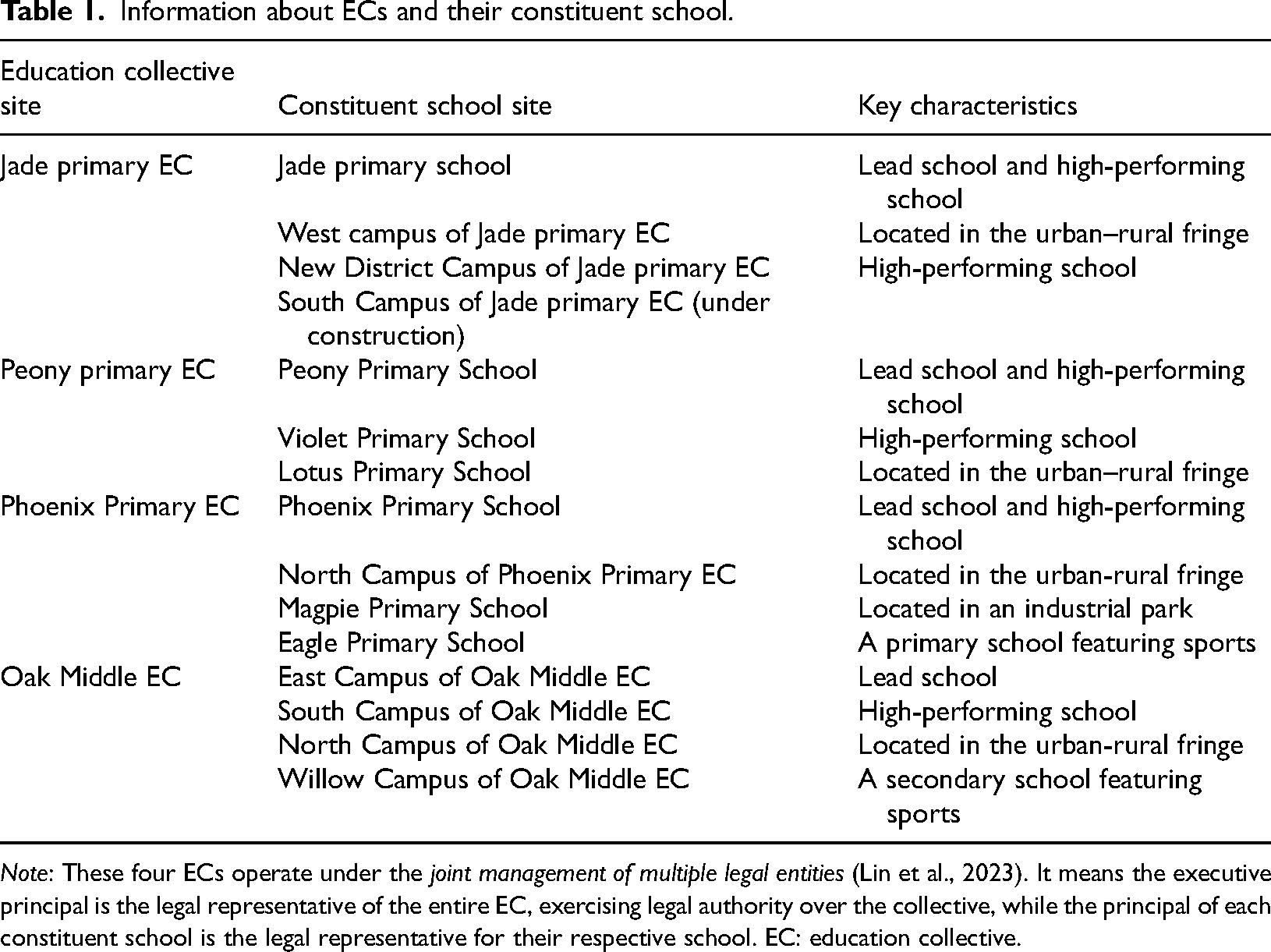
Note: These four ECs operate under the joint management of multiple legal entities (Lin et al., 2023). It means the executive principal is the legal representative of the entire EC, exercising legal authority over the collective, while the principal of each constituent school is the legal representative for their respective school. EC: education collective.
Information about the interviewees.
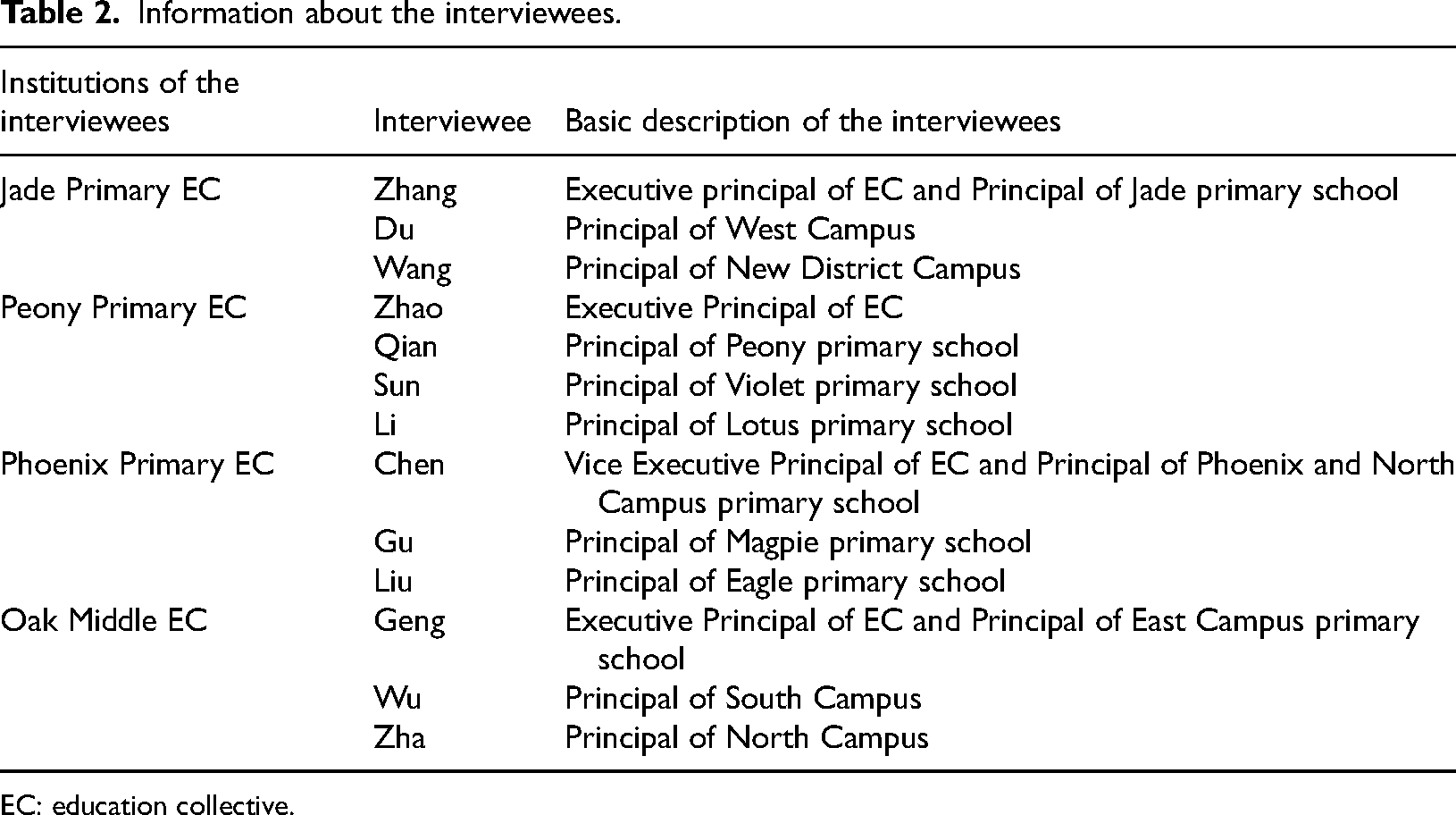
EC: education collective.
Given the constraints imposed by COVID-19, each semi-structured interview was conducted online and lasted no more than 1 h. The interview data were generated primarily through both notes and audio recordings, exploring perceptions of education collectivisation, the governance framework and its embedded relationship, personal work experiences and the development of leadership styles.
Influenced by the author's critical stance and research inquiries, the analysis of interview data utilised a critical approach to thematic analysis. While thematic analysis has been disputed for its challenges in ‘connecting everyday discourse with larger social and cultural practices nested in unequal power relations’ (Lawless and Chen, 2019: 93), a critical approach to thematic analysis retains its inherent flexibility (Braun and Clarke, 2022), offering more ontological freedom. It also provides a lens for understanding relational communication and daily interactions, with a focus on ideology and power (Lawless and Chen, 2019). Therefore, building on Braun and Clarke's (2021) six-step framework, I undertook a critical interpretation of the data, contextualising the interview discourse with cultural identities as well as social ideologies. By applying Owen's (1984) criteria of ‘recurrence, repetition, and forcefulness’, I identified and examined key themes, particularly during the closed coding phase (Lawless and Chen, 2019). This approach seeks to comprehend participants’ experiences and the aspects influenced by power dynamics, status-based hierarchies and broader social ideologies.
The combination of primary source and secondary source embraces the depth and richness of data, thereby ensuring a comprehensive exploration and conceptualisation of relational dynamics and power reshaping within governance structures. Nevertheless, several considerations are noteworthy here. First, my access to potential interviewees was influenced by the role of gatekeepers. While a vice executive principal, who was intimately involved in the establishment of the school's collectivisation, was eventually delegated by executive principal to participate, discrepancies may exist between different roles’ understanding and interpretation of the interview themes. Second, my self-identification as a Chinese academic researcher at a UK university seemed to cast me in the role of a ‘familiar stranger’ to the interviewees. This perceived positionality may have influenced the responses of the interviewees. Especially in the Chinese school environment, where autonomy may be somewhat limited, my position could have drawn particular attention.
Relationship governance in intra-school governance structures
The organisational and structural relationships established by executive principals and principals within their respective ECs and schools are deeply rooted in Confucian educational ideals, that is, prioritising virtue and emphasising the significance of people over institutional structures, which are strongly echoed in the relationship governance of individual schools within ECs.
Most of the principals interviewed reached a consensus that self-governance is foundational to school management, essentially described as spiritual self-cultivation – a core tenet of Confucian ethics (Wang et al., 2022). Confucianism sets high standards for self-governance, aiming mainly at the cultivation of personal virtue (Feng, 1983). Influenced by such notions, virtue has become the primary tenet adopted by the governors in traditional Chinese management, and the significance of personal virtue is increasingly prominent: ‘…I attach great importance to the pursuit of my own personal virtue and personal self-control. […] I think principals needs to be thoughtful, committed, action-oriented, and always maintain the best image of themselves in the school’ (Principal Wang).
One reason principals emphasise moral cultivation is that they suppose moral excellence can ‘attract middle leaders and teachers… thereby influencing them in a morally appropriate way and promoting the enhancement of [the entire school's] team’ (Principal Sun). On the other hand, as the concept of virtue explains, principals can cultivate their credibility and reputation through virtuous behaviours, even shaping themselves as moral role models, thus integrating flexibly and resiliently into ECs and broader social networks (Wang et al., 2022). Principal Qian illustrated this by describing how he addressed the resistance of teachers at Peony Primary School to joining the EC: ‘At that time […] I could only choose to use my personal reputation and character to assure them [the staff] … that I would guarantee their deserved treatment as well as their promotion and training paths’.
Along with the emphasis on moral excellence, principals also lean toward relational governance. For instance, Principal Zha expressed his disapproval of using ‘administrative authority’ for governance: ‘I am very familiar with all the teachers in this school. I hope to win their hearts with humane touch, so that my work can be carried out better’. Confucian virtue favours education and opposes the use of coercive authority to achieve ceremonial order and social behaviour (Wong, 2024). Influenced by this, principals embrace emotional appeal and relational governance as means of governing schools, resulting in a more humane touch within the governance system. This approach does not imply a rejection of the established norms, rituals and regulations that structure daily activities (Lin et al., 2013). In some instances, principals may become overwhelmed with personnel matters, as governing and teaching teams in constituent schools of ECs experience increased interactions, collaborations and job rotations compared to ordinary schools, potentially diverting attention from pupil development and overall organisational functioning (Zhang, 2023). Moreover, due to imperfect institutional systems, issues of misalignment or overstepping of authority can arise, especially in multilayered educational organisations like ECs.
Meanwhile, the principal of each EC also receives ‘consultation’ from teachers. Executive Principal Geng shared his views on the role of teachers in the governance system: ‘The water that bears the boat is the same that swallows it up. So, I am “afraid” of teachers, and they are also “afraid” of me, [laughs], which complement each other. Teachers are my biggest supervisors!’
The nature of this two-way consultation extends beyond a simple classification of accountability. Presently, there are two main avenues for teaching staff to be involved in school governance. One is to be designated as ‘backbone teachers’ and encouraged to practise limited instructional leadership (Gu et al., 2017), the other is to attend regular teacher congress meetings, to voice their opinions and offer suggestions. Similar training programmes and congresses are highlighted in the official websites and regulations of each constituent school in the sample. These approaches allow teachers to engage in the governance structure and maintain direct communication with the principal.
However, I argue this two-way consultative relationship cannot be categorised as accountability, as there may be a risk of overshadowing the personal values of principals and teachers. Accountability pays more attention to regulation and performance and is gradually implanted in the system (Møller, 2009), while the mutual consultative relationship between principals and teachers does not attempt to establish new hierarchies. This distinction is primarily due to ‘Bianzhi’ positions held by many teachers, which are officially budgeted posts managed by local EADs, not the schools themselves (Gu et al., 2017). Consequently, the extent of teachers’ involvement in school management is not directly linked to their salary levels. The security and stability offered by these officially budgeted posts deter teachers from blindly obeying hierarchical orders. Many times, I need to show enough sincerity to attract teachers to participate in some activities, or participate in the enactment of some policies. [pause] Because you know, the ‘Bianzhi’ teachers don’t do these things, and it doesn’t affect their salary… (Principal Sun)
This governance relationship thus represents a balance between restraint and direction. Principals and teaching staff realised the importance of maintaining harmony in their relationships and are cautiously exploring a safe zone for negotiation.
In a nutshell, relationship governance of intraschool governance in ECs mainly exhibits mutually reciprocal expectations. The Confucian classic, The Analects, is interpreted as fostering a culture of mutual interaction among individuals gathered around a teacher with uplifting powers (Li, 2019). The critical approach to thematic analysis, which is attentive to ideologies, reveals evidence of the impact of Confucian ideals – this kind of interaction is also deeply embedded in the relationship dynamics within constituent schools of ECs. China's education organisations’ reverence for virtue encourages principals to cultivate and demonstrate their own moral character and adopt a more humanistic governance system. The communication process between principals and teaching staff is also viewed as a relational endeavour – in the Confucian sense – characterised by mutual care and interaction. This interaction transcends mere ‘accountability’ and involves a two-way consultation, fostering reciprocal support to reinforce shared goals and maintain direction within ECs’ complex educational governance environment.
Relationship governance at inter-school and intra-school level
Education Collectivisation represents a coercive collective action, as most ‘prestigious’ schools participate in regional collective-based schooling not voluntarily, but through initiatives by local EADs to promote balanced development of high-quality compulsory education in the region (An, 2020). Consequently, tensions may inevitably arise between interschool and intraschool levels. However, I argue that such tensions are not inherently negative. For one thing, they facilitate rapid power dynamics and relationship negotiations within the governance layers of ECs, helping these entities quickly find their footing. For another thing, influenced by Confucian thought, these tensions drive ECs to become more institutionalised, standardised and inclusive.
Conflicts between infinite demands and finite resources become apparent as education collectivisation challenges the traditional operational boundaries of schools, complicating evaluation, incentives and funding allocation (Zhou, 2023). The following examples illustrate principals’ considerations regarding the borrowing and flow of resources within the Collective: When our school was initially established, temporary teachers were drawn from other schools within the Collective. […] As the school progressed, I began considering the potential for optimising our teaching staff. [long pause] I really wanted to keep these teachers. (Principal Li) As a new campus of the core school in EC, our school was originally in a position of resource recipient […] However, this status has weakened our ability to develop independently. I and other middle leaders have recognised this problem. Now, our school is no longer satisfied with passively accepting knowledge and is ready for two-way exchange and interaction. (Principal Wang)
These narratives highlight that as collective-level goals crystallise, principals tend to reshape internal organisational relationships and resource allocation. Simultaneously, it prompts principals to consider how to interact with other constituent schools and the broader collective. Evidence suggests that schools engaged in collaborative activities tend to focus on their priorities and organisational outcomes (Armstrong et al., 2021). Thus, the subjective and cognitive paradigm conflicts between constituent schools may lead to the dilemma of ‘connecting without collecting’. To alleviate this dilemma, mutual recognition and emotional connections between schools are crucial for education collectivisation. In this research, such connections are primarily achieved through institutional regulations and the construction of trust.
Chinese society is widely recognised for valuing the development of interpersonal relationships and maintaining group harmony (Li, 2019), and ECs are also engulfed in this way. Confucian teachings underline that social or organisational harmony stems from fulfilling responsibilities associated with social roles and adhering to external expectations, and with that, governors find themselves safeguarded by surrounding social structures and institutional regulations (Lin et al., 2013). This cultural backdrop highlights the increasing importance of formal mechanisms and institutions in interschool governance within ECs.
Current communication pathways between principals of constituent schools, such as the ‘Executive Principal roundtable gathering’ (Executive Principal Zhao) and ‘EC administrative meetings’ (Principal Wu), demonstrate that establishing and enhancing formal mechanisms are the cornerstone of ensuring the effectiveness and sustainability of collaboration. Executive Principal Geng elaborated: Our [Collective's] affairs committee convenes irregularly and consists of three components. They are, exchanges of ideas, discussions on top-level designs and training on principal's behaviours. Our discussions encompass various topics, including the design of collective activities, the exchange of management concepts, the discovery and development of middle-level administrators, and more. [pause] Of course, our ultimate goal is achieving consensus.
This example explicitly reveals that within interschool relationships in ECs, formal mechanisms enable principals to jointly formulate and negotiate development strategies, projects and activities. This not only ensures the consistent policy enactment at the collective level but also promotes clear information flow and organisational professionalism. More significantly, ‘this makes me feel that the progression of the entire EC is on the right track, giving me a sense of reassurance’ (Principal Wu). Aligning with Confucian principles, such formal governance mechanisms ensure ‘appropriate conduct’ between different levels and integrate a sense of order (Wong, 2024: 16). Yet, alongside formal communication, the significance of informal interactions within ECs’ governance structure also comes to the fore. Principal Liu illustrates its key role in establishing partnerships: ‘Sometimes, for some reasons, we gather over tea on the weekends [laughs], and we talk about school matters and personal concerns. I find such interactions essential’.
Such spontaneous and incidental information-sharing interactions within ECs’ governance structures create an environment where principals can freely share opinions, emotions and experiences, thereby fostering reciprocal understanding on ‘physical, social, emotional, and cognitive levels’ (Branson et al., 2016: 139). Additionally, informal communication can provide constituent schools with diverse development paths. Executive Principal Geng's insight confirms this: Obviously, the planning priorities and development paths of each school within our Collective are different. So I often need to communicate individually with every school's principal […]. You know, each school has its own ‘blooming’ time…so many things cannot be discussed at Collective's meetings but need their own time and space.
This attention to detail, considering the unique status and personality of individuals involved and the unique factors of each situation, is precisely a characteristic of Confucianism (Mou, 1971). As an embodiment of Chinese educational philosophy and governance ideas (Lin et al., 2023), ECs deeply embrace this trait. ECs encourage schools at different developmental stages to come together, continually adapting to inevitable differences, as emphasised by Confucian ideals of harmony. Although tensions may exist among ECs, these relationships are not entirely negative; the key lies in the philosophy and attitude with which they are approached.
Overall, both formal governance mechanisms and informal communication play crucial roles in building trust – whether between constituent schools with ECs or among the constituent schools themselves. The influence of Confucian thought makes this process more detail oriented and contextualised. Formal governance structures offer a framework and guidelines for interschool collaboration, while informal interactions shape the underlying dynamics of relationships. In turn, these dynamics happen to be essential in reshaping and strengthening governance structures, ensuring that they are not only efficient but also resilient, adaptable and built on reciprocal respect and trust.
Relationship governance between ECs and the local authority
One noteworthy feature of China's education governance framework is its multitiered management system (Tao, 2022), influenced by Confucian thought and characterised by a strict nested hierarchy of authority (Gu et al., 2017). This structure embodies Confucian principles of respecting for authority and seeking harmony within a structured social framework (Chien, 2016), which have permeated the governance framework to a significant extent.
According to the narratives of several interviewees, local EADs are the main driving force in promoting their schools’ collectivisation, with the necessary infrastructure and resources to facilitate these efforts. For example, Principal Sun expressed: Although our Violet [primary school] joining Peony [Primary EC] is a two-way effort putting, City H's EADs has also made a lot of preparation and planning for this process, especially concerning the relocation of campus and personnel adjustments. Without their robust push, our school would not have smoothly integrated into Peony EC!
For ECs spanning regions or with a larger geographic scope, official systems become even more critical. ECs’ investment and management conditions depend on city-level support, Executive Principal Geng stressed the necessity of rigid official guarantees from district governments for cross-regional ECs to ensure ‘operational arrangements and strategic planning at the EC layer’. Thus, the establishment of official systems are fundamental for sustaining interschool collaboration. Those official systems comprise a basic social framework, operating procedures and fundamental norms (Gu et al., 2017), which foster a sense of orderliness in the progress of interschool collaboration, thereby facilitating the advancement of interschool collaboration. As Li (2019) explained, order within Confucian thought allows parties seeking harmony to find their place within a properly structured system, so official systems also help ECs’ governance framework achieve harmony.
Although the official structure instils stability in the local education system, it is also carries potential risks regarding exercising power. As schools merge into larger collectives, they may wield a more profound influence when participating in external activities or advocacy efforts. But their independent characteristics and needs may be overshadowed or even deliberately ignored by a broader sense of collectivism, which diminishes the presence of individual entities (Ho and Tikly, 2012). For instance, the guidance and strategies proposed by local EADs are often aimed at promoting district-wide educational improvement and equity rather than the growth of individual schools. Moreover, on the official website of City H's EADs, it can be observed that policymakers have translated policies and guidelines by higher-level authorities according to local conditions, but they may not have a strong and sustainable impact on relatively weaker schools within ECs. Meanwhile, the direct communication channels between weaker schools within ECs and local EADs are limited, as EADs prioritise district-wide concerns over internal collective relationships. This can hinder the prompt resolution of conflicts or tensions within ECs.
Additionally, executive principals act as connecting rings between the governance layers of ECs and local EADs. Interviews with constituent school principals reveal that ‘the Executive Principal always charges the enemy lines in advancing ECs’ (Principal Gu) and ‘has a vision of overall situation, ensuring [our] EC is in a favourable position in official resource allocation’ (Principal Li). To achieve this, principals typically maintain close relationships with local EADs and influential stakeholders (Coleman, 2023).
The prominent figure in City H's education sector, Executive Principal Zhang, renowned for extensive school management experience, indicated a preference for proactive engagement with external stakeholders. For example, he actively engages with formal and informal activities organised by local EADs and hosts external visits and events. Executive Principal Zhang frankly stated, ‘Although these activities are time-consuming, you know, they are instrumental in securing resources, particularly financial support, for Jade [EC]’. Moreover, it is noteworthy that executive principals act like ‘protective goggles’ between constituent schools’ layer and the EADs’ layer, mitigating the direct impact of the EADs’ ‘strong authority’ on schools. Vice Executive Principal Chen noted: The EADs required every school to offer AI robotics courses within the year. But clearly, the government resources did not match up with this requirement! Particularly for schools with weak foundations, the necessary personnel, money, and materials were not in place, turning a good initiative into a burden […] So we are negotiating with the EADs to see if they can give these schools a reprieve … allowing them to pass this year's evaluation.
This example highlights how, at the collective level, executive principals shield schools in ECs from being directly entangled in complex hierarchical relationships because when an entity is completely enmeshed in such a network, its autonomy may be compromised (Walker et al., 2012). Notably, from the Confucian perspective on harmony and collectivism, harmony does not equate to mere compliance but advocates for reconciling differences through ‘creative tension’ (Li, 2019), aligning with what Executive Principal Geng stressed repeatedly in interview – the state of ‘harmony and diplomacy’.
Overall, the governance relationship between the collective and EADs is shaped by China's multitiered management system and the political interests and influence generated by executive principals’ upward social connections. While this system may exacerbate bureaucratic tendencies in hierarchical relationships within the local education system, the Confucian ideal of eliminating boundaries and achieving holistic harmony can help dismantle such entrenched authority, fostering a more forward-looking and harmonious EC governance framework in the long run.
Conclusions
This article illuminates the intricate interplay of relationships both within and between constituent schools in ECs, and between ECs and local EADs. The different levels of governance structures that facilitate the functioning of ECs strive to engage in dialogue through relational and power dynamics, an interactive process that is generally governed and constrained by the ideology that the value of virtue takes precedence over that of formal institutional systems, the value of the collective comes before the individual and the value of harmony over the competition.
In summary, within the governance framework of ECs’ constituent schools, there exists a dual consultative relationship between principals and teaching staff. The governance logic is not exclusively based on formal institutional norms within schools but is deeply rooted in Confucian principles of promoting moral conduct and respecting authority. The relationship governance between intraschool and interschool levels of ECs is greatly shaped by Confucianism's enshrinement of institutional norms and interdependence. While these principles play essential roles, the ultimate goal of governance at the collective level is not always to achieve a perfect balance (Mou, 1971) but to enable executive principals to address interschool relationships from diverse levels, perspectives and contextual viewpoints that accommodate individual cases. Such relational governance is integral for navigating the competitive and hierarchical nature of traditional standalone educational organisations – a task often underestimated by local EADs. The relationship governance between ECs and local EADs generally presents a complex narrative constrained by hierarchical authority in the pursuit of harmony. Here, power is not solely a one-way output from the government; rather, ECs can mobilise regional resources to meet specific educational needs through the political interests and interpersonal relationships built by executive principals. ECs serve as vital intermediaries and buffer zones within this framework, balancing the advancement of ECs with the preservation of individual school identities to achieve harmony in Confucian sense, which encompasses coordination and collaboration alongside heterogeneity and tension (Li, 2013).
This research shows that Confucian teachings are closely intertwined with and complement the societal context, governance structures and mechanisms that underpin the functioning of schools, including ECs. The contribution of this article is therefore mainly conceptual – it does not only treat these cultural roots as a backdrop but as a framework that helps me better enter the research field and construct data.
This article also elucidates potential misconceptions regarding the influence of Confucian social thought on ECs; for example, the belief that individual needs are subsumed under collective goals in a bid for homogeneity (Wang et al., 2022). My research demonstrates that ECs embrace heterogeneity and varied developmental paces, which not only fosters exclusive and diverse school identities but also positions ECs as a crucial pathway for policy interpretation and enactment, providing a flexible ‘digestive system’ for grasping the complexities of educational reform.
Another misinterpretation is that an orderly society or organisation is frictionless and full of hierarchy (Yang, 2020). In practice, the governance structures of ECs acknowledge a certain degree of tension and conflict. One of the governance goals of ECs is to transform into a community with strong inclusiveness and flexibility, capable of self-regulation and coordination. Constituent schools are therefore encouraged to explore their schooling decisions through constructive clashes, thus maintaining opportunities and abilities for independent thinking. In essence, ECs aim to strike a balance between order and adaptability, recognising that a dynamic and evolving educational landscape requires flexibility and autonomy for continuous improvement.
Finally, while my analysis centres on principles of multilevel school governance through school-to-school collaboration in China, elucidating its enactment experience and current situation in a specific region through empirical research, it can be argued that these principles can also illuminate research dedicated to analogous governance structures and networks in inter-school collaboration worldwide, especially those cases that are driven to some extent by hierarchical and coercive forces in their early stages of establishment. While the precise relationships between schools, districts and the central state are mediated by national history and culture, any instantiation of that relationship produces features which become available for recontextualisation, policy borrowing and policy learning.
Footnotes
Declaration of conflicting interests
The author declared no potential conflicts of interest with respect to the research, authorship, and/or publication of this article.
Funding
The author received no financial support for the research, authorship, and/or publication of this article.
