




Abstract
This article explores the UK's first specific lesbian, gay, bisexual, transgender, queer or questioning (LGBTQ+) leadership development programme in higher education. It assesses the programme's value for the participants, who comprised of 12 colleagues in academic and professional services roles in one English Post 92 University. The year-long programme offered leadership training, mentoring and networking to LGBTQ+ staff in aspiring to leadership roles. It adopted Whitmore's GROW coaching model and promoted authenticity in the workplace and authentic leadership. The article contends that leadership development initiatives for those with protected characteristics are important in an evolving higher education landscape which is ever more complex. Despite tensions with the concept of authenticity, the article is rooted in a post-structuralist theoretical framework that rejects essentialist views of gender and sexuality. Instead, it aligns with a Butlerian paradigm, where gender and sexual identities are diverse, fragmented and perpetually evolving in relation to others and within systems of power and knowledge. The leadership programme did not assume that LGBTQ+ individuals are intrinsically different from their heterosexual and cisgender peers. However, it developed in its participants, the insight to see that their distinct life experiences as an LGBTQ+ person in a hetero- and cisnormative society had given them a distinct set of attributes conducive to effective and authentic leadership.
Introduction
The primary responsibility of any university leader is to work with individuals to achieve their organisation's objectives. Effective leadership lies in grasping the nuances of human behaviour, skilfully conveying goals to followers and inspiring followers to adopt behaviours that contribute to goal attainment (Sashkin and Sashkin, 2003; Ruben et al., 2023).
Higher education institutions (HEIs) in the United Kingdom are heavily rooted in tradition, particularly in prestigious and highly ranked institutions where research has traditionally overshadowed teaching. According to Goodall (2009), teaching is considered secondary to research in the most esteemed universities, and an eminent research profile is a requirement in the person specifications of senior leadership positions, which typically necessitate a professorship.
Since the transformation of UK polytechnics into universities in 1992 and the introduction of league tables to monitor the performance of all universities, the significance of student attainment, satisfaction, graduate employability and access and participation has grown throughout the sector. The quality of teaching is now assessed through the teaching excellence framework, an endeavour designed to value and measure teaching in the same way that research has been measured for some time, through the research excellence framework.
With the shift from government university grants to student fees, which are in 2024 £9250 per year, students have become more discerning when applying to university. In response, universities have started to adopt practices resembling those seen more typically in the corporate world. University league tables, including those featured in The Guardian and The Times Newspapers, have fostered a culture in which metrics demonstrating student satisfaction, value for money and graduate outcomes are used to rank universities. The result is a ‘buyer's market’ for applicants, in all but the most prestigious institutions. This fundamental transformation toward marketisation in universities has influenced a shift in the skills required for university leadership. To uphold or enhance their positions in league tables, universities are driven by targets and key performance indicators (KPIs) and the academic and research expertise of university leaders is largely irrelevant (Dollinger and Vanderlelie, 2021).
Spendlove (2007) asserts that despite university leadership becoming increasingly complex, there exists a reticence within higher education to assign leaders from backgrounds outside academia. Goodall (2009) discovered that universities achieving the highest rankings in league tables tend to have leaders who are highly cited in research. Yielder and Codling (2004) similarly argue that within the traditional university sector, promotions to senior leadership often hinge on academic aptitude rather than an individual's suitability to lead a complex organisation.
In 2021, Lee observed that some HEIs were starting, albeit embryonically, to identify and nurture the leadership abilities of employees from diverse backgrounds According to the Times Higher Education supplement, in February 2023, women held the position of vice chancellor at 48 of the top 200 universities worldwide. This represents a 12% increase compared to the previous year and a 41% increase over the past 5 years. Just three vice chancellors were from black Asian or minority ethnic backgrounds. Data are not collected on vice chancellors with LGBTQ+ identities.
The advance HE equality in higher education staff report 2023 found that 47% or 200,100 of staff working in universities identified as heterosexual. 1.6% or 7020 identified as bisexual, 1.4% or 6085 identified as gay male and 0.7% or 3160 identified as lesbian or gay female. 0.5% or 2105 of staff said that their gender identity was different to that assigned to them at birth. Advance HE, a UK-based organisation dedicated to facilitating strategic change and continuous improvement in higher education, provide leadership programmes tailored to women and people of colour, but have yet to establish a specific development programme for LGBTQ+ aspiring university leaders.
In academic year 2022–2023, one Post 92 university introduced a leadership development programme specifically for LGBTQ+ staff who aspired to attain middle and senior university leadership positions. This article draws on the feedback received from participants to evaluate the impact of this leadership programme on those taking part. The article begins by considering relevant literature before outlining the theoretical framework underpinning the research. The methodology follows before the leadership programme is briefly described and the participants are profiled. The feedback from participants is then analysed and a conclusion with recommendations for further development draws the article to a close.
Literature review
In the context of UK higher education, effective communication, change management and negotiation skills are more critical than ever before (Vlachopoulos, 2021). Unlike the schools sector, where the National Professional Qualification for Headship (NPQH) is a mandatory requirement for leadership, the university sector lacks a formal or systematic approach for identifying and nurturing the necessary leadership skills in their workforce. Despite the increasing complexity of universities, leadership acumen is often secondary to research eminence and academic attainment (Lee, 2021). According to Furedi (2010), the market-oriented nature of universities dictates that it is transformational leadership not research expertise that is needed for universities to thrive in a competitive market, where students are consumers, and HEIs function as service providers (see also Gigliotti and Ruben, 2017).Transformational leadership reflects a departure from the traditional image of the highly academic masculine university leader (Ball, 2016), in favour of new leaders who act as change agents. These people are often disrupters in that they are typically entrepreneurs, outsiders, and idealists. Gigliotti and Ruben (2017) state that outsider candidates for senior leadership positions are often motivated by a perceived need for change within an institution and so tend to have transformation at the heart of their aspirations for an organisation.
McCauley and Brutus (1998) define leadership development as expanding the collective capacity of organisational members to effectively engage in leadership roles and processes (also see, Rosari, 2019). Through systematic succession planning, the development and promotion of a more diverse range of colleagues can result in the increased capacity in HEIs to lead transformational change (Gentle and Clifton, 2017). Gigliotti and Ruben (2017) argue for the diversification of leadership in higher education, challenging the traditional dominance of white male professors in prominent UK Vice-Chancellor roles.
Despite a rising number of LGBTQ+ staff in universities, their voices remain marginalised and under-researched (Lee, 2023). Coming out, the process of disclosing one's sexual or gender identity, is a complex journey in the university workplace and often occurs multiple times throughout a professional career (Fletcher and Everly, 2021; Lee, 2022). When a university staff member comes out, they provide LGBTQ+ students and colleagues with role models and challenge heteronormative and cisnormative assumptions but this does come with individual risk (Lee, 2022). Even though the Equality Act has since 2010 protected LGBTQ+ people in the UK from discrimination in the workplace, many LGBTQ+ worry that those who oppose same-sex relationships or disapprove of people who are non-binary or transgender may insidiously impede their career progression (Pichler and Ruggs, 2018).
The experiences of professional services staff in universities differ from their academic counterparts. The Higher Education Statistics Agency (HESA) in the UK redefined roles in 2012, expanding professional services roles to include student and staff development, research impact, global outreach and academic research. According to Baltaru (2019), university academics typically experience professionalisation and expansion, whilst those in administrative technical and manual occupations, are less likely to have a career development framework. Understanding how the broader university culture shapes administrative growth dynamics is crucial (Baltaru, 2019). By incorporating professional services staff into this leadership development programme and subsequently this research, the study aims to contribute to an understanding of their integration into the university workplace.
Fletcher and Everly (2021) explored the life satisfaction of LGBTQ+ employees, emphasising in particular the roles of disclosure (or coming out) and authenticity at work. Supportive LGBTQ+ practices in the workplace positively correlate with disclosure rates, perceptions of authenticity, and, indirectly, with LGBTQ+ employee workplace and life satisfaction. UK employees have, since 2010 had workplace protection for sexual orientation and gender reassignment under the Equality Act. Supportive LGBTQ+ policies reduce workplace discrimination and enhance positive perceptions of work for LGBTQ+ employees (Webster et al., 2018). In the education sector, visible LGBTQ+ workers demonstrate loyalty, effectiveness, and more openness to leadership skill acquisition (Lee, 2020).
LGBTQ+ leaders in universities serve as role models to other LGBTQ+ staff and often to LGBTQ+ students too (Graves, 2018). Their promotion to leadership roles signals a safe and inclusive environment for LGBTQ+ employees, indicating that their careers too can thrive (Lee, 2022). The visibility of LGBTQ+ leaders promotes authenticity and self-concept fit, enhancing workplace and life satisfaction for everyone, including those with other protected characteristics (Fletcher and Everly, 2021). However, LGBTQ+ leaders must navigate complex cultural and political workplace dynamics while being scrutinised by a diverse range of stakeholders (Fine, 2017). LGBTQ+ individuals face unique challenges and experiences related to their sexual orientation, gender identity and expression. These challenges can impact how they navigate workplace dynamics, handle discrimination and build professional networks (Lee, 2021). This research shows then that a distinct leadership development programme that acknowledges and addresses challenges faced by LGBTQ+ aspirant leaders in a safe space, can result in positive outcomes for those involved.
Theoretical framework
This article adheres to a Butlerian poststructuralist perspective, where gender and sexual identities are diverse, fragmented and shaped in relation to others. Butler (1990) stated that gender and sexual identity have no inherent status and result from repeated acts that over time ‘congeal’ and appear to constitute a natural presence. The article posits that sexuality and gender extend beyond the personal realm and, in organisations such as universities, become intertwined with social and political power dynamics, preserving the existing societal norms (Lee, 2022). Identities and relationships conforming to heterosexual and cisgendered norms, such as male masculinity and female femininity are privileged, whilst those not fitting these norms are excluded or marginalised (Talburt, 2000). The article also aligns with and authentic leadership theorists (e.g. Avolio and Gardner, 2005; George, 2012; Northouse, 2021). Authentic leaders strive to be true to themselves, demonstrating consistency between their values, beliefs and actions. This approach to leadership emphasises self-awareness, emotional intelligence and a commitment to fostering positive and ethical organisational cultures, by acknowledging that effective leaders influence others to achieve goals. Leaders and followers mutually benefit each other, collaborating through rewards, positive reinforcement and negotiation. This article argues that the symbiotic relationship between authentic leaders and their followers is fundamental to transformational improvement in universities (Lee, 2021).
This research also acknowledges the dynamic nature of sexual and gender identities, positing that they transcend the private sphere and are interwoven with social and political power discourses. These discourses, oriented toward upholding social institutions like the family, state and education, influence the evolution of LGBTQ+ identities (Foucault, 1980). When LGBTQ+ university staff refrain from coming out in the workplace and are not visible in university leadership teams, they perpetuate heteronormative and cisnormative discourses, contributing to the suppression of LGBTQ+ identities (Paechter, 2002). Conversely, when they are able to come out, they serve as role models for LGBTQ+ students, helping to foster a supportive and inclusive environment (Lee, 2021).
It is important to acknowledge the tensions between the concept of authentic leadership and gender performativity. George (2003) states that ‘sense of authenticity refers to the sense that one's life, both public and private, reflects one's real self’ (134), whilst Butler asserts that the gendered body has no no ontological status apart from the various acts which constitute its reality (1990: 134). While divergent it can be argued that they can be reconciled within a nuanced understanding of LGBTQ+ identity. Like gender, authenticity can also be read as a dynamic and multifaceted concept rather than a fixed core of the self, allowing for the recognition of the ongoing negotiation of identity within social and political contexts (Vannini and Franzese, 2008). Authenticity can emerge through performative acts that resonate with an individual's sense of self and integrity. A perpetually evolving authentic identity can be constructed through repeated actions and gestures. It can manifest as a form of resistance and subversion against dominant norms and power structures, involving the intentional performance of identities that challenge conventional expectations. An example of this is the work of Mason-Schrock (1996) who researched individuals undergoing gender reassignment. Mason-Schrock reported that their motivation for surgery was in large part to have a physical body that felt true to their authentic self. Similarly, research by Levitt and Hiestand (2004) found that when lesbians in their research were ‘butch’ they reported that this performance was a quest to remain authentic to one's internal sense of gender, despite societal pressures to be feminine. Both studies underscore the importance of authenticity in navigating gender identity, while also acknowledging the complexities and difficulties individuals face in acting authentically within societal norms and expectations. This article subscribes then to a notion of authenticity that is fluid, context-dependent and ultimately contingent upon the interplay of evolving workplace social, cultural and historical factors.
The LGBTQ± leadership development programme
The LGBTQ+ university leadership development programme drew on learning from work with LGBTQ+ aspirant leaders in schools (Lee, 2020). It was designed around five pillars that emerged from two focus groups with LGBTQ+ university staff. These were:
Inspirational LGBTQ + leadership journeys Developing leadership identities and practice Communication and presentation skills Breaking down barriers and influencing cultural change Networking and community building
The programme aimed to confront the challenges facing LGBTQ+ staff in universities and exploit the attributes LGBTQ+ colleagues may have already acquired through navigating these challenges. Over the course of an academic year, 12 participants attended 3 face-to-face leadership development days. In between these days, employing John Whitmore's Grow mentoring model (2010), they worked 1:1 with one of seven mentors supporting the programme who identified as LGBTQ+ and was an experienced leader in higher education.
Participants were recruited via HR and the LGBTQ+ staff network. Presentations about the programme were also made at a line-manager's forum with managers asked to encourage their LGBTQ + staff to take part. The programme was open to staff in both academic and professional services roles. It should be noted that in order to take part, participants needed the permission of their line-manager and so were already out as LGBTQ+ in the university workplace to some extent. The programme was aimed at aspirant middle leaders in the university, and excluded the most senior colleagues who sat at the university's executive leadership level.
Methodology
This study is grounded in a phenomenological framework (Husserl, 1999), which aims to unravel the intricate layers of human experiences, making explicit the implicit structures and meanings inherent in these experiences. Phenomenology was chosen because it allows the researchers to delve into the subjective lived experiences of individuals, constructing a researched object based on its own manifestations, structures and components. Traditionally, phenomenological investigations rely on open-ended interviews for data collection. However, in this study, participants were requested to complete an anonymous programme evaluation form after each of the three leadership development days. The evaluation forms were designed to serve a threefold purpose. First, it monitored the participant experience so that improvements could be made between sessions and ensures the programme met the needs of the aspiring leaders. Next it encouraged participants to critically reflect on their engagement with the programme and think about next steps between sessions. Finally, it collected data from participants as they proceeded through the programme, charting their progression.
The evaluation form comprised of open-text questions, prompting participants to reflect on their motivations for joining the programme, articulate their experiences during the programme and describe how these experiences had influenced their professional practices upon returning to their workplace. The evaluation forms were completed at the end of each session and time was set aside for participants to reflect silently and write.
It is crucial to acknowledge the relationship of the authors to the leadership programme and the research. We identify as a lesbian and a gay man and co-lead the university's LGBTQ+ staff network. We also designed and led the programme. This relationship of the authors to the programme added depth to the analysis, allowing us to contextualise the written responses based on firsthand knowledge of the participants over the course of the three face-to-face sessions. Our interpretations are however influenced by our own experiences and histories as members of the LGBTQ+ community and are loaded with our contexts as employees of the university.
As insider researchers, ethical considerations were paramount. Busher (2019) emphasises the importance of supportive research cultures, enabling marginalised participants to share their perspectives, thus developing their identities and voices. In this study, all participants willingly engaged in the research, underscoring their desire to have their voices heard. Although the researchers were affiliated with the programme, participants were not coerced into participating and could choose not to provide feedback or not to have their feedback included in this research.
Ethical approval was obtained from the researchers’ host university. Participants were assured of their right to withdraw their responses at any point. To maintain confidentiality, participants’ real names were replaced with LGBTQ+ identity and role descriptors, ensuring their anonymity upon publication.
The dataset, comprising of three separate evaluations by each of the 12 participants, underwent emergent coding following Carspecken's (2001) methodology. Emergent codes are derived from the data itself, without relying on any prior assumptions or expectations. The initial process consisted of creating a list of broad but comprehensive themes from the free-text comments to help identify common threads throughout the evaluations. This approach identified four key themes, which were confidence building; networking; harnessing the power of being othered and planning and pursuing leadership goals. Each key theme was further analysed using Carspecken's critical approach (2001), leading to the emergence of further themes, including receiving mentorship, changes as a consequence of the programme and the application of the new skills gained.
Results
Table 1 presents a profile of each of the 12 participants and includes their identity, their length of time at the university, their role, career goal and details of promotion sought and achieved.
Profile of the participants.
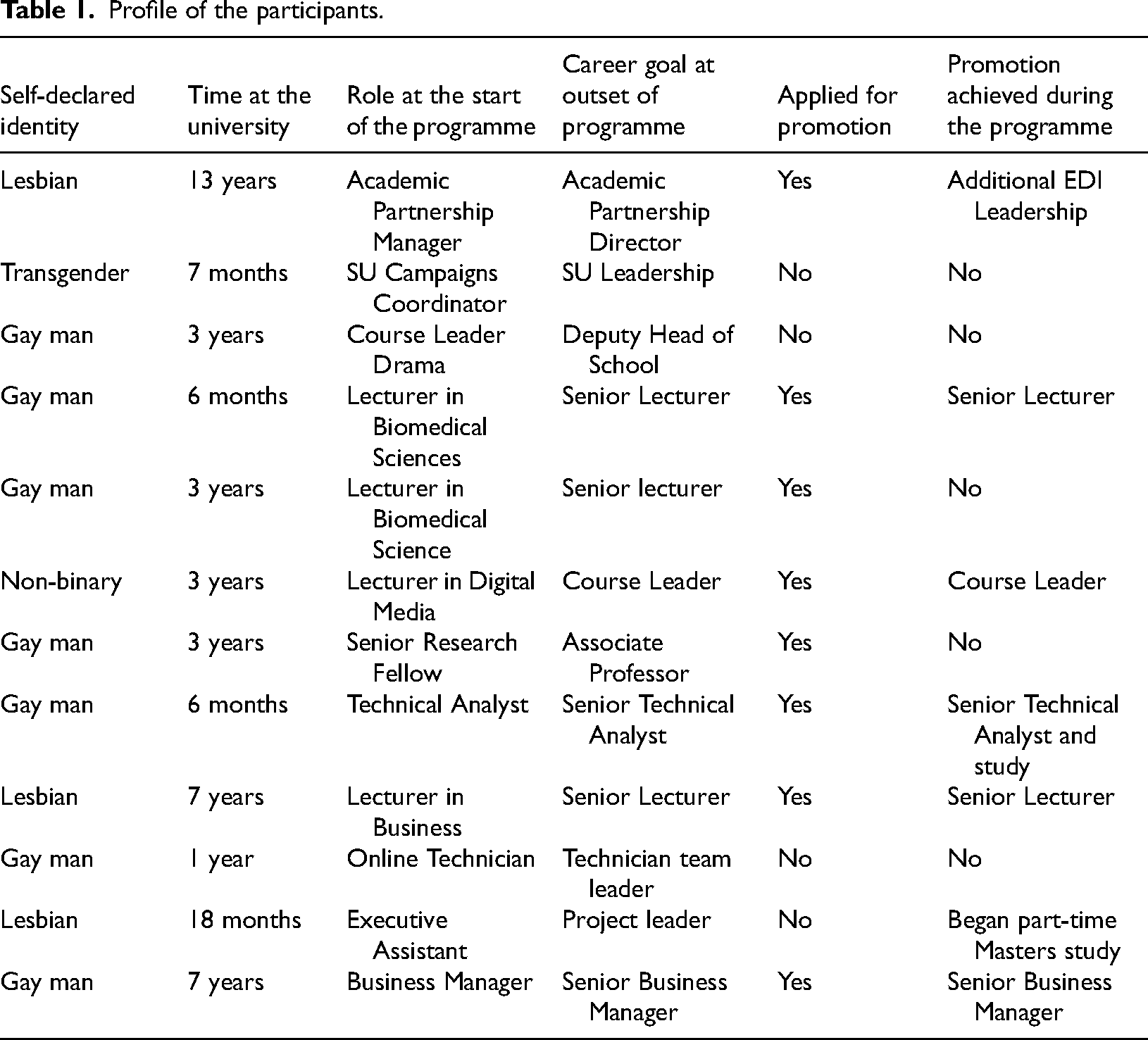
Of the 12 participants, 7 identified as gay men, 3 as lesbian, 1 as transgender and 1 as non-binary. Those identifying as gay men or lesbian women also identified as cisgendered. It is important to note that whilst the LGBTQ+ initialism is used throughout, there were no bisexual participants on the programme. This was regrettable as bisexuality is often described as an invisible diversity (Popova, 2018) and the bisexual workplace experience continues to be largely absent from academic research. Five participants were in academic roles, six worked in professional services and one worked for the students’ union.
The gay men had been at the university for an average of 2.5 years each whilst the lesbians had served the university for 7.1 years. There are a number of possible reasons for this. It may have been that when compared with their gay male counterparts, the lesbians lacked confidence in their leadership abilities and so waited much longer before embarking on or achieving promotion. Alternatively, it may have been related to gay men moving roles and between universities more readily than their lesbian peers.
Motivation for joining the programme
The first day of the programme centred on hearing from inspirational LGBTQ+ leaders in higher education. Three of the mentors shared their stories and the mentor pairings were established. A leadership compass self-assessment (Tharani et al., 2020) was undertaken and participants were invited to share this with their mentor. Then, using Whitmore's Grow model, participants were invited to identify a career goal they wished to aim for during the year long programme.
The evaluations of day one showed that the inspirational leadership journeys shared by the mentors were well-received and helped focus conversations in the mentoring sessions that followed. The evaluation also centred on the participants’ motivations for signing up to the programme and their hopes for the impact of the programme on their careers.
The most popular motivation for applying to the programme was to get promoted and enter leadership. Whilst one of the lesbian participants posited that she was not yet ready for leadership, she stated that she saw the programme as the beginning of her leadership pathway and this would ensure she was ready to step into leadership when a suitable role came along. The majority of the participants wanted to learn to behave more like a ‘leader’ and as a gay man in professional services stated ‘to gain insight into the leadership qualities needed’. Both lesbians, non-binary and gay male participants expressed a wish to develop the skills and attributes to be an effective line-manager of others and wished to gain confidence in how to embody leadership.
The opportunity to access mentoring was another compelling motivator for joining the LGBTQ+ leadership programme. Four participants specifically asked to have a mentor who was external to the university, to avoid any complexities developing between those with whom they already had a professional relationship. A gay man in a lecturer role hoped that his mentor would provide ‘support to identify goals and strategies and setting a pathway to become a leader’.
Three participants in professional services roles, sought specific advice on how to navigate being out at work in a leadership role, whilst a lesbian in a professional services role sought help to draw together a CV. The non-binary participant wanted help to be a successful leader from an ‘outsider's perspective’, seemingly needing help to have a more prominent role whilst acknowledging implicitly that they did not currently have a sense of belonging within the institution.
The outsider leader theme continued in the third most popular motivation for joining the programme; networking with other LGBTQ+ colleagues from within the university. The need for kinship, affinity and belonging within an LGBTQ+ space was important to over half the participants and some admitted to not knowing many, or in two cases any, other LGBTQ+ colleagues at the university before embarking on the programme.
When asked what the participants wished to learn from the programme, similar themes emerged. Under leadership, participants wanted gain a better understanding of how to navigate becoming a leader within the distinct culture of higher education. One gay man in a lecturer role hoped to grow in confidence and have support as he looked for and applied for promotion at the university. One of the lesbians in a professional services role wanted help with interview practice and presentation skills, whilst another expressed a wish to understand leadership theory and wanted help to map out their career trajectory.
Most of the participants wanted to learn more about their own identity, both personally and professionally. Whilst the non-binary participant sought ‘new techniques in communication’ and presentation skills, one of the lesbian lecturers wished to gain greater confidence in the decisions she took and to develop greater resilience in the workplace. Two gay men, wanted to understand their own strengths and weaknesses and to learn how to harness their strengths as a future leader.
Of the 12 participants, 8 applied for promotion during the year-long programme and of these 6, or half of the cohorts were successful. A further two embarked on part-time postgraduate study to help their career prospects. The programme was not designed solely to help the LGBTQ+ staff achieve promotion. It aimed to build self-confidence, promote workplace authenticity and rehearse leadership identities and behaviours. Of those participants not promoted, one lesbian in a professional services role embarked on further study by applying for an MSc in Psychology at the university. Another lesbian stated that she had actively started to look for a new role and declared that she was now ‘going for opportunities I would not have gone for previously’.
Analysis of emergent themes
Once the LGBTQ+ leadership programme was underway, the feedback from participants identified four main themes in which the programme has supported them. These were:
Confidence in their leadership abilities. Networking with LGBTQ + colleagues. Harnessing the power of being different Developing a plan for pursuing their leadership goals.
Each theme is now considered in turn drawing on the programme evaluations.
Confidence in their leadership abilities
Confidence building was a popular theme emerging from the written evaluations. The programme helped participants to identify their strengths and weaknesses as an aspirant leader, and to develop a more positive self-image. Two gay men also described learning to recognise and challenge their ‘imposter syndrome’ and to assert themselves in their university workplaces. These participants identified changes in their behaviours at work reporting that they had grown in confidence. New behaviours they adopted included being more assured in making decisions, being more direct in what they say and ask of others, being more resilient, being vulnerable and setting clearer boundaries in professional relationships. One of the lesbian participants in an academic role renegotiated her appraisal objectives with her line manager as a consequence of her increased confidence programme. She wrote: I have had a complete restructure of responsibilities with appraisal objectives focussed on moving up within the university.
This resetting of objectives reflects a renewed or accelerated ambition for this participant. She had found a space within the university workplace to reconcile her personal and professional identities (Lee, 2023) and so, became more confident about what she could achieve as her authentic self.
Another lesbian in a professional services role stated that the programme helped her to ‘Reflect on my own qualities (coming from my own lived experiences) which I’m starting to see/believe as a strength’.
A thread that runs through the programme is that the lived experience of being LGBTQ+ can actually help develop attributes that are conducive to transformational leadership. Lee (2020) working with LGBTQ+ aspiring headteachers found that some of the strategies LGBTQ+ teachers deploy to navigate the complexities of the heteronormative and cisnormative school workplace equips them with distinctive attributes useful for school leadership such as emotional intelligence, sensitivity to the inclusion of others, connecting with others and building teams, managing uncertainty and stressful situations and courage and risk-taking.
A non-binary academic stated that since taking part on the programme ‘I have also been able to prioritise my work and what is important for me as well as the needs of the organisation/other people’. A gay man in professional services stated ‘the programme helped me to align my compass and to be more balanced’. Another declared ‘it's helped me to find comfort in myself’.
Despite a prevalence of poor mental health for LGBTQ+ people when compared with their hetero and ciscounterparts, these participants showed a good deal of awareness of their well-being needs. Dickinson and Adams (2014) found that the LGBTQ+ community do demonstrate a great deal of self-awareness and self-care. Their participants provided accounts of resilience, particularly in relation to the ways in which they were caring for themselves. Many were engaged in a wide variety of activities that supported their well-being related to social connections, interests and hobbies and professional help.
Networking
The year-long leadership programme provided participants with a distinct LGBTQ+ network within the university. Participants appreciated the opportunity to meet and connect with other LGBTQ+ professionals and welcomed the opportunity to learn from and be mentored by experienced LGBTQ+ leaders. As Table 1 shows, the participants were in a wide variety of academic and professional services roles from across the university. Most met one another for the first time during the programme and all had a mentor who was a senior colleague who either worked at the university or was affiliated in some way, such as visiting professor or former member of staff. All the mentors identified as LGBTQ+.
Almost all the participants stated that extending their LGBTQ+ network at the university was one of the primary motivations for applying for the leadership development programme. A non-binary academic declared that the opportunity had been a ‘Fantastic programme to meet more LGBTQ+ humans’. A gay man in professional services stated that the programme had given him ‘Greater contact with colleagues across the university’, adding ‘My mentor has been fantastic, so helpful’. A lesbian academic stated, I wanted to join the university's LGBTQ+ network but did not really know how’.
It is important to describe the way in which the networking opportunities on the leadership development programme differed from those available through the university's LGBTQ+ staff network. The latter was perceived by participants not involved in it as a political group with the aim of greater visibility at its core. There was a sense that joining the network was a political statement and that it would necessitate members being out to the whole university community. There was a sense (incorrectly) from some that the leadership of the university would be opposed to those who were members of the LGBTQ+ staff network and joining this group would hinder their career prospects. This programme provided a stepping stone for some LGBTQ+ employees onto the university LGBTQ+ staff network. In meeting those who were already members in the context of this leadership development programme, some reframed their views of the network and joined it during the programme. One gay male academic typified the views of several when he wrote: This leadership programme has given me room for thought and made me consider the importance of my visibility to others as a role model in ARU. It is important that others see me and that doesn’t always have to be political.
McFadden and Crowley-Henry (2016) researched LGBT staff networks and found that they did help create a forum of affinity with other LGBT employees, but this was not unanimously felt by all. They state that not all LGBT employees feel they can join a network. Institutional structures perpetuate a specific agenda for LGBT networks and those that do join may not want to use it as a mechanism for their voice. This was certainly the case with these participants. They had regarded the university network a political space but this leadership programme had created a different space, a sanctuary of sorts where they could be vulnerable in a safe space. One lesbian in a professional services role revealed the way in which the programme had helped her find her place at the university. She wrote: As an Indian gay woman, I have felt so out of place, and through this I have found my confident voice and met people I would not have met.
Harnessing the power of being different
Drawing research by Lee (2020) with school leaders, the leadership development programme flipped the assumption that to be othered in the workplace is a disadvantage. Instead, the programme expounded the way in which being different could be an advantage in transformational leadership by driving cultural change. Participants learned through the programme that the adversity they may have experienced as LGBTQ+ people, had the potential to equip them with five distinct attributes that are important to university leadership. These include:
Emotional intelligence: LGBTQ+ people often have highly developed instincts from years of proceeding cautiously with people. They are discerning and quick to figure people out. This is important for appointing and building a trusted team.
Sensitivity to the inclusion of others: LGBTQ+ people have usually experienced feeling othered or different. This gives them a heightened awareness of those on the margins and a strong sense of social justice for those with other protected characteristics. This is important for inclusive leadership that recognises and celebrates diversity.
Building teams: LGBTQ+ people are often practised in connecting with others with whom they may not naturally have much in common. Where LGBTQ+ leaders can come out to colleagues, they may enjoy greater levels of trust from their colleagues. This is important in strengthening relationships, building trust and giving others permission to be themselves.
Managing uncertainty: LGBTQ+ people often operate under personal stress whilst betraying nothing in their professional demeanour. This is important in leadership when protecting teams from bad news or acute challenges.
Courage and risk-taking: LGBTQ+ people take a risk each time they come out or move jobs. Having courage and taking risks is important to realise the potential of an organisation (Lee, 2020).
The programme encouraged the LGBTQ+ participants to see the transformational leadership skills they may have inadvertently honed by navigating workplace challenges. In their written feedback, two participants referenced this aspect of the course in helping them to reframe their thinking about being an outsider. A gay male academic said that the programme had enabled him to ‘leverage his LGBTQ+ identity to become a more effective leader’. Another in professional services stated ‘Having taken part in the programme I now understand that my queer identity is powerful, not a handicap, and I’ll always wish to celebrate my identity in and out of the workplace’. A lesbian also working in professional services similarly observed ‘Since taking part in the programme, I have discovered that confidence in sexuality increases trust and can make you a better leader’.
Lee (2020) in using this approach with aspiring school leaders found that they too perceived that their confidence grew one their adverse experiences were reframed as useful to leadership. In four years, the school programme named Courageous Leaders helped over 100 LGBTQ+ teachers achieve middle or senior school leadership as their authentic selves.
Planning and pursuing leadership goals
The final theme emerging from the written feedback was planning and pursuing leadership goals: With their mentor, participants utilised Whitmore's GROW model (2010) to identify a career goal and developed a plan to achieve it. In all half of the participants were promoted during the year-long programme. Table 1 provides details of the roles participants applied for.
Some of the mentors provided direct support as participants applied for promotion within the university. A lesbian from professional services who was given a new EDI role stated: My mentor has been amazing, we have met monthly and discussed job applications, interviews, goals, how to work to be authentic, the public/private divide and how to navigate this.
A gay man in professional services attributed his success in moving up a grade and starting part-time study to the mentoring he received. He stated ‘since taking part in the programme I achieved a promotion and started a Project Management Degree Apprenticeship’. A non-binary academic stated ‘My mentor gave me positive interview techniques to achieve my grade 6 promotion’. Working with her mentor, one lesbian academic applied for and achieved promotion through a regrading on the university's academic career framework.
In total half of the participants secured promotion within the year-long programme. Two applied for promotion but were not successful and a further two embarked upon part-time postgraduate study, agreed and paid for by their line-manager. Those who did not apply for or secure promotion still valued their mentoring in providing encouragement and confidence building.
A gay man in professional services reflected on the value of ‘regular chats’ and ‘a supporting shoulder’. They added ‘my mentor has been brilliant, she has made me more confident and pushed me to think more’. Another gay man appreciated the way in which mentorship had provided him with ‘time to reflect on my journey and my effectiveness’.
It was important to the participants that their mentors identified as LGBTQ+ and had some affiliation to the university. One gay man stated that his mentor ‘just gets it’. The importance of empathy and a shared lived experience cannot be underestimated in mentoring. Young et al. (2017) found that mentees did better when their mentor was able to have empathy with their mentee and to share human capital. Whilst this programme may have worked well with heterosexual and cismentors from the university, the fact that the mentors were LGBTQ+ appeared to create a strong bond and high levels of trust from mentees.
Finally, the participants were asked to reflect on what they gained overall from the leadership programme.
The overall value of the LGBTQ ± leadership development programme
All participants valued the programme and the majority stated that they had changed as a consequence of it. By the final face to face day, participants collectively referred to the programme as their ‘safe space’. A gay male academic typified the comments of four other participants stating: ‘The programme allowed me to explore my vulnerability and build strengths to pursue leadership roles in the future’.
A non-binary academic relatively new to higher education revealed that the programme had prevented them from leaving academia. They wrote: ‘Honestly, I think I would have abandoned academia, it felt lonely and toxic before, but now I have my network and the support to achieve my career ambitions’.
According to Rose Ragins (2004)Ragins (2004), when the workplace is perceived to be a safe haven, LGBTQ+ employees in all sectors are likely to stay longer term. Whilst this is positive when LGBTQ+ employees are given a career pathway, staying in one institution can be career limiting. There is evidence that once settled and included in their workplace, some LGBTQ+ employees are reluctant to move away from their organisation, turning down promotion out of a fear that they will not be able to come out or be as authentic in a new workplace. Signs and symbols of LGBTQ+ inclusion are then very important in university workplaces as research shows that LGBTQ+ staff and student applicants look for these when selecting an institution in which to work or study (Lee, 2022).
A gay man promoted during the programme wrote that through the programme he had gained ‘Insight, direction, affirmation and network’ adding that ‘I have made some lifelong friends in the programme, it's helped me to love (name of university), progressed my career and given me the confidence to study a degree. Thank you, thank you, thank you!’.
A lesbian in a professional services role stated ‘I feel seen and valued as a member of staff, I have gained loads and allowed myself the space figure out what I want and how being an out lesbian might not be the negative thing I have perceived it to be at work’. A non-binary academic admitted that prior to the programme, they did not see themself as a leader but gained this identity through the programme. They wrote Leadership wasn’t something I thought I was built for, but now I can see how I can bring my values and authentic self to work and have positive impact on the humans I am fortunate to work with. Thank you!
Working with teachers on an LGBTQ+ leadership development programme, Lee (2020) found that when LGBTQ+ aspirant leaders are provided with a safe space reflect on and work towards their career development the outcomes for participants are positive and multifaceted. This project with LGBTQ+ staff in higher education has similarly found that LGBTQ+ specific leadership development provides a safe space in which LGBTQ+ people can be their authentic and vulnerable selves in the workplace, and with mentorship, gain the confidence and leadership acumen to apply for and secure promotion. Throughout the year-long programme, within a safe and inclusive space, this group of colleagues empowered to critically reflect on the intersection of their personal and professional identities. They learned to challenge hetero- and cisnormative practices and learned that prior experience of being different, actually gave them the attributes to become transformational leaders as their ever-evolving authentic selves.
Concluding comments
This research has demonstrated that LGBTQ+ specific leadership development in higher education can provide a safe and inclusive space in which university staff can as their authentic selves and reflect on their leadership aspirations. Half of the participants achieved a promotion within the year long programme. However, the impact of this programme extends beyond this. In the final written evaluation, every participant expressed appreciation for the safe space the programme facilitated. Half articulated an unexpected sense of relief in not having come out to a room of strangers, with two participants adding that because their LGBTQ+ identity was a given, they were able to focus more fully on the content of the programme. Reflecting on the value of the programme, five participants described the leadership development programme as the place where they found life-long friends or their ‘work family’. Only 2 of the participants were members of the university staff LGBTQ+ network before embarking on the leadership development programme but 10 had joined by the end of the programme. McFadden and Crowley-Henry (2018) found that whilst formal LGBT staff networks help to give a collective voice to those potentially marginalised in the workplace, they are not for everyone as some interpret their function as being political and potentially subversive or disruptive to their institution. This leadership development programme represented the university giving something to its LGBTQ+ employees. Inherent in this internally funded programme was a commitment to valuing LGBTQ+ colleagues and giving them the skills and attributes, they need to progress and get promoted. Its very existence implied that the university was committed to LGBTQ+ employees becoming leaders in the university. The fact that this development was offered within a safe space without the distraction of negotiating their LGBTQ+ identity, should not be underestimated.
This research presents a single case in one university and so generalisations are not appropriate. Further research on the value of specific leadership development programmes for LGBTQ+ employees is needed. The Advance HE Equality in Higher Education staff report 2023 found that almost half of the staff in universities refused to declare their sexual and/or gender identity to their employer.
The reason so many university employees choose not to disclose their sexual or gender identity is unclear, and it is of course difficult to gather data on this issue. However, there are a range of possible reasons for this. Some may wish for privacy and may believe that their sexual and gender identity should not be the business of their employer. Button (2004) found that disclosure is typically viewed along a continuum from explicit and full disclosure to actively concealing and fabricating identity-relevant information. Research by Fletcher and Everly (2021) found that when making a disclosure decision, the individual makes a cost-benefit appraisal of the value and risks associated with being out at work. Suen et al. (2021) similarly found that sexual and gender minority people look for environmental and relational cues that communicate inclusion and safety before they decide whether or not to declare their identity. With such a large number of university staff choosing not to disclose, it may be appropriate to assume that universities may not yet provide the safe and inclusive working environment needed to give LGBTQ+ employees the confidence to be their authentic selves.
This research concludes that specific higher education leadership development initiatives for LGBTQ+ employees are important in an evolving higher education landscape, where the skills and attributes of university leadership become ever more complex. This programme encouraged authentic leadership, fostered inclusivity, embraced diversity and challenged established norms. It also signified that the university was prepared to invest in and develop LGBTQ+ employees, that it recognised the additional challenges faced by the LGBTQ+ members of its workforce and was prepared to provide a safe space in which to find affinity with others, learn from an LGBTQ + mentor and develop a leadership pathway as their authentic selves.
In the UK, there has been a positive move towards the introduction of specific higher education senior leadership programmes for women and people of colour. However, there is currently a lack of equivalent programmes for aspiring LGBTQ+ university leaders. This article contends that the diverse lived experiences of LGBTQ+ academics equip them with the skills and attributes necessary for excelling in transformational university leadership.
This research represents a single case study in one Post 92 English University. Further research on the value of LGBTQ+ specific leadership development experiences and spaces is much needed. A dedicated national LGBTQ+ leadership programme, in which aspiring LGBTQ+ leaders are supported to leverage their lived experiences for effective university leadership, would contribute to a more diverse range of leaders in higher education.
When LGBTQ+ leaders become visible within universities, they embody a unique form of leadership characterised by the five attributes identified in this article. Their visibility challenges institutional heteronormative and heterosexist practices and encourages authentic participation from other LGBTQ+ staff and students in university communities. However, transformative university culture requires a collective effort. In addition to an LGBTQ+ leadership programme, comprehensive training for all university stakeholders is imperative to ensure awareness of the challenges and distinctiveness of the LGBTQ+ workplace and educational experience. Ultimately, the goal is to render the current pivotal coming-out event for LGBTQ+ university stakeholders unnecessary and obsolete and create an environment where all university stakeholders are included and celebrated as their authentic selves.
Footnotes
Declaration of conflicting interests
The authors declared no potential conflicts of interest with respect to the research, authorship, and/or publication of this article.
Funding
The authors received no financial support for the research, authorship, and/or publication of this article.
