



Abstract
As of our most recent census data, racialized people comprise 22.3% of the Canadian population (Statistics Canada, 2016). Canadian universities have espoused commitments to diversity and inclusion but there has long been a gap between the rhetoric and practice. Research has demonstrated that under-representation is a problem at all levels of academia but particularly within the senior ranks. Drawing on an original dataset representing 324 senior university leaders, this study will empirically map the demographic composition of academic leaders across Canada, including presidents, vice-presidents, assistant vice-presidents, associate vice-presidents, provosts, and vice-provosts. Our findings suggest that racialized people in leadership are under-represented compared with their presence in the university population—consistent with the pyramid of exclusion where the representation of racialized people decreases as we move up the ranks. Taking a systems perspective informed by our critical ecology model we examine the overlapping societal-, organizational-, and individual-level mechanisms that impede the advancement of racialized people into leadership positions at universities in Canada.
Introduction
Recent decades have witnessed a variety of government regulations and institutional-level policies designed to improve the representation of marginalized social groups among Canadian university faculty and administration (Choi, 2016; Dua, 2009; James, 2011; Katchanovski, Nevitte and Rothman, 2015; Ramos, 2012). This activity has been prompted by widespread allegations made by anti-racist and feminist movements that Canadian universities systematically discriminate against women and racialized minorities, preventing them from reaching tenured faculty and top administrative positions (Acker, 2012; Douglas and Halas, 2013; Dua and Lawrence, 2000; Henry and Tator, 1994, 2009; Henry et. al., 2017; Samuel and Burney, 2003; Samuel and Wane, 2005). It has been suggested that, despite the increasing diversity of their student bodies (Davies and Guppy, 2013; Thiessen, 2009), Canadian universities remain frozen in time—a “zone of white privilege” (Choi, 2016; Eisenkraft, 2010) and a “chilly climate” for women (Council of Canadian Academies, 2012; Cummins et al., 2013; Tate, 2014), especially across disciplinary spaces traditionally dominated by white men (Walton et al., 2015). The demographic composition of university staff has been found to be misaligned with that of their student bodies, a condition that hinders the universities’ ability to meet the needs of the latter (Henry and Tator, 2009). Others challenge claims of systemic discrimination as unsubstantiated, arguing that contemporary universities are typically governed by progressive, left-leaning academics (Duchesne, 2010). Canadian universities have espoused commitments to diversity and inclusion but there has long been a gap between the rhetoric and practice labelled the “Equity Myth” (Henry et. al, 2017). According to (Cukier et al., 2019), this is not a result of labour market availability, it is a result of “the priority and effort that organizations put into recruiting and retaining them.” Despite these ongoing debates, Canadian scholars note that “analyses of racism, racialization, and Indigeneity in the academy are notable by their absence” (Henry et al., 2017; Henry et al., 2012). Although studies have repeatedly assessed the representation of marginalized social groups among Canadian university students (Childs et al., 2016; Finnie et al., 2015) and faculty (Dua and Banji, 2012; Henry et al., 2017; Ramos, 2012), little peer-reviewed research exists on senior university academic and executive leaders, such as presidents and provosts—individuals charged with leading contemporary universities (Nakhaie, 2004).
This study addresses the gap within the existing literature by empirically mapping the demographic composition of senior leaders across all publicly funded universities in Canada. Drawing on an original dataset updated in 2020, representing a total of 324 senior university leaders, we find that racialized people tend to be generally under-represented relative to their presence in the broader Canadian population, according to the 2016 Census. We theorize these observed empirical trends through a critical ecology lens (Cukier et al., 2016), which draws attention to the overlapping societal-, organizational-, and individual-level mechanisms that hold whiteness in place and inhibit the entry of racialized minorities into positions of real authority. The critical ecology theoretical framework allows us to produce several recommendations that could be enacted to improve the representation of racialized minorities across senior leadership positions in universities across Canada. Below, we commence by discussing the varied benefits of diversity within contemporary higher education. We then proceed to summarize the methodological strategy and empirical sources which are employed through this study. This piece then culminates with the presentation of our findings, observed through a critical ecology perspective.
The benefits of diversity in higher education
Research has outlined the potential benefits of diversity at multiple levels of higher education. At the student level, campus diversity has been empirically linked to “growth and development in the cognitive, affective, and interpersonal domains” (Milem, 1999: 4). Individuals embedded within diverse communities also exhibit reduced levels of prejudice, and acquire cultural competencies that allow them to operate effectively within contemporary workplaces (Denson, 2009; Gurin et al., 2004; Pettigrew and Tropp, 2006; 2008). Diverse and inclusive campuses also allow students to develop a stronger sense of belonging, and improved satisfaction with their educational experience (Strayhorn, 2008; Van Dyke and Tester, 2014). These effects emerge through interactions with both diverse peer groups and faculty.
In Canada, the increase in the number of immigrants from non-European countries in the past few decades has increased diversity throughout the population—as of 2016, 22.3% of Canadians are considered to be “racialized” minorities, for example, those of Chinese, South Asian, and African descent (Statistics Canada, 2017). Projections estimate that by 2031, immigrants and second-generation immigrants will make-up half of the Canadian population (Smith, 2018: 45). Immigration is not the only area in which Canada will see an increase in diversity: Indigenous peoples are among the fastest-growing and youngest populations in the country (Smith, 2018: 43). In such a context, the age-old structures of Canadian universities will not be able to effectively meet the needs of a student population that is preparing to enter a diverse, ever-changing workforce (Weingarten and Deller, 2010).
At the organizational level, diversity is also a resource that can help universities adapt to their shifting socio-demographic environments. The ability to effectively capitalize on emerging demographic niches within the student market resides most naturally in those who share a racial identity or cultural background with them (Robinson and Dechant, 1997; Schmidt, 2004). Faculty from under-represented groups have been found to integrate marginalized perspectives and unorthodox pedagogical approaches into their courses that are normally absent from those delivered by their white counterparts (Han, 2014; Umbach, 2006). In addition, these faculty are more likely to engage in non-traditional research projects (Huber, 2009; Johnson, 2010; Turner, González and Wood, 2008) and service-related activities (Jones and Palmer, 2011). Across Canada, the proliferation of the executive presence of a leader responsible for “equity,” “diversity,” or “international” has demonstrated a new strategic direction. In fact, according to a 2018 report from the US National Bureau of Economic Research, “more than 60% of higher education institutions have established an executive-level diversity leadership position” (Henry, 2019: 36). By increasing diversity among their leaderships, universities are better positioned to respond to future demands, to offer students the opportunity to have someone like themselves as “university professors, mentors and leaders, researchers and knowledge producers” (Henry et al., 2017: 302). By accepting Indigenous and racialized academic leaders into one’s ranks, institutions signal their readiness to support scholarship as well (Henry et al., 2017: 302).
Still, universities in Canada are overwhelmingly top-down institutions. Even with an executive-level diversity advocate, there can be issues with diversity at the organizational level. Scholars have warned that these positions have the potential for tokenism, “whereby Chief Diversity Officers [and similar positions] may be seen as the face of diversity, but lack the formidable authority and support to create real and lasting change” (Henry, 2019: 27). As these institutions are structured to be top-down, this will require the diversification of university leadership outside of the executive responsible for diversity. This should not be a challenge, as diverse groups excel at generating novel ideas (Smallbone et al., 2010: 179), by cutting through “norms of the past” via drawing on contrasting experiences (Cox and Blake, 1991; McLoed et al., 1996; Stahl et al., 2010). Private sector studies also find that ethnic, gender, and racial diversity boost the innovation and financial performance of teams (Campbell and Minguez-Vera, 2008; Carter et al., 2003; Lee, 2014; Miller and Triana, 2009; Østergaard et al., 2011; Pierpaolo et al., 2014; Richard, 2000). 1
A benefit of effectively managing diversity within higher education is that, if done well, it mitigates organizational risk (Devine, et al., 2007; Miller and Triana, 2009). Universities that proactively address diversity and inclusion are able to stay ahead of government regulations mandating equitable practices, and avoid potential fines associated with non-compliance. Beyond financial costs, violations of equity-related regulations can have a lasting negative effect on an organization’s reputation (Goldman et al., 2006; James and Wooten, 2006; Triana et al., 2010). This could, in turn, lower the willingness of partners, funders, and students to collaborate, contribute, and attend the institution.
Despite ample evidence of the multiple benefits arising from diversity, research within the field of higher education has repeatedly found that racialized minorities encounter a “glass” or “concrete” ceiling within the system (Cook and Glass, 2013; Jackson and O’Callaghan, 2009; Lindsay, 1999; Murrell et. al., 2008). Recent research found that the profile (e.g., white, protestant, man) of the university president has changed little since the 1980s (Cook and Glass, 2013). Henry et al. (2017: 300), through their study of Canadian university administrators, also found that racialized minorities, when present, tend to be “not just low in numbers but also low in terms of power, prestige, and influence within the university.” Through this paper, we aim to add to the existing literature, mapping the demographic profile of leaders across all public universities in Canada. Providing a closer look at the representation of public university leadership and asking why Canada remains lacking in racialized leadership.
Methodology
To map the representation of racialized people across Canadians universities, we constructed an original dataset by pooling publicly available information accessible through the universities’ websites. This data collection methodology was approved by the Ryerson University Research Ethics Board. Once gathered, images of senior university leaders were categorized by a research assistant trained to identify gender, Indigenous, and racialized status through procedures developed and refined through a multi-year study of diversity across organizations in a variety of Canadian social sectors (Cukier et al., 2013; Cukier and Gagnon, 2017). With respect to race, we employed definitions communicated through the Canadian Employment Equity Act, and the classifications: “white,” “visible minority,” and “Indigenous.” Here, the reference category, visible minority 2 , is defined as “persons, other than Aboriginal (Indigenous) peoples, who are non-Caucasian in race or non-white in color” (Government of Canada, 2017). Beyond race, we also categorized individuals into “man,” “woman,” and “unsure” in an effort to acknowledge the impact of intersectionality on representation. We have elected to use the term “visible minority” and “racialized person” interchangeably. The terms refer to the same thing, but, for the data, we have coded for “visible minority” and when referring to or contextualizing within previous research we rely on the term “racialized,” a term that is overwhelmingly present in the literature. It is understood that some racialized groups are more well-represented than other racialized groups in Canadian universities, but for the purposes of this study, only Black leaders have been factored into the analysis. Anti-Black racism is acknowledged as an issue across Canadian universities.
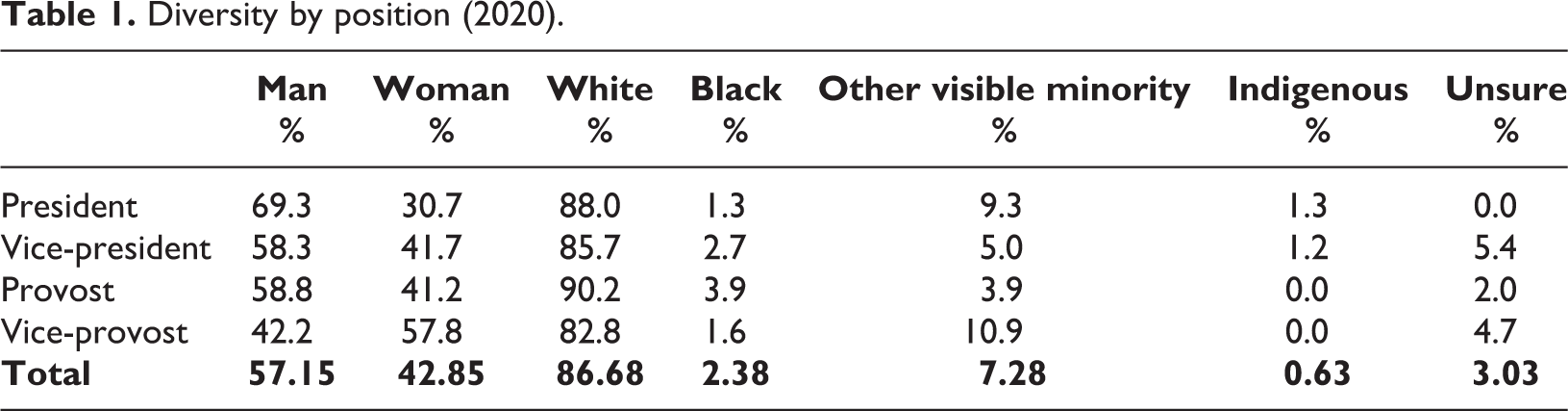
This is an approach that has been used effectively in other studies of minorities in Canadian higher education (Henry et al., 2012) and of diversity in leadership (Cukier et al., 2014, 2017). We navigated the websites of all publicly funded universities in Canada, searching and compiling details (names, title) and images of all 324 listed senior university leaders, including provosts, vice- (or assistant/associate) provosts, presidents, and vice-presidents. Although this dataset was updated in 2020 (Table 1), it has its shortcomings; this method does not rely on surveys which often suffer from low response rates, it requires researchers to code gender, Indigenous, and racialized status of senior leaders based on images and associated information and therefore can be subject to error. While the methodology has been named a best practice by the Ontario Human Rights Commission 3 (n.d.), imposing diversity categories presents a number of challenges. More complete institutional reporting of self-identification data would be preferable. Given the high-profile nature of these positions we assume that such cases would be exceedingly infrequent. Moreover, we posit that this novel dataset remains useful given the complete lack of peer-reviewed studies drawing on comparable data sources at the time of writing.
Diversity by position (2020).
We recognize that, by virtue of classifying race, we essentially contribute to the social reification of this arbitrary construct. Critics have noted that “the conceptual ‘fixing’ of ‘race’ and ethnicity is dangerous in terms of the limitations that it can place upon analysis, and because it can serve to produce and reproduce wider forms of essentialism, stereotyping and racism” (Gunaratnam, 2003: 19). However, our efforts to empirically chart the presence of marginalized social groups across the ranks of senior leaders in Canadian universities is consistent with the “collecting, compiling, and analyzing of reliable statistical data…to monitor the situation of racialized groups,” as endorsed by the Ontario Human Rights Commission (2005: 7). This empirical exercise is also consistent with United Nations (2001: 38) directives, which endorse the gathering of race-related data with a view toward “monitoring the situation of marginalized groups, and the development and evaluation of legislation, policies, practices, and other measures aimed at preventing and combating racism, racial discrimination, xenophobia, and related intolerance, as well as for the purpose of determining whether any measures have an unintentional disparate impact on victims.” 4
To ensure the reliability of coding processes, a random subset of 10% of senior leaders within our dataset were re-coded by the senior researcher. This exercise produced near-perfect levels of inter-coder agreement (> 99%) across coding decisions, validating the reliability of our coding procedures. This methodological strategy has been described by the Ontario Human Rights Commission (2010) as both “strong” and “rigorous,” and reflects best practices across existing studies of gender and race representation.
The critical ecology model will be used for deeper analysis of the impact of leadership at the societal, organizational, and individual levels. Grounded in a systems-level approach, the critical ecological model is pragmatic and solutions-focused—designed to offer Canadian universities a concerted, multi-level understanding of the systemic barriers at play. Practically, this model is applied one level at a time, focusing attention on broad discourses and opportunities for action. This model reminds us that “institutional environments of organizations are shaped by cultural carriers which act as important enablers and constraints of strategic action” (Cukier et al., 2013: 251). This reminder is important because actions at only one level are not sufficient to address the origins and resilient nature of chronic under-representation within these institutions; the notion is that by better understanding these systems we can advance diversity and inclusion within them.
Findings
Our analysis shows that a small minority of all senior university leaders in Canada (13.3%) are non-white, with white women as the next largest group of leaders after white men. At the intersections of race and gender, we find that racialized women (2.2%) make up very small fractions of the broader sample. According to the 2016 Census, racialized people constitute 22.3% of the country’s population, and female Black and ethnic minorities (referred to in North America as women of color), make up about half of the racialized population (Statistics Canada, 2016).
It is important to note, however, that there was considerable variation across universities and specific leadership ranks with respects to the representation of marginalized groups (Table 2).
University leadership diversity—by university (2020).
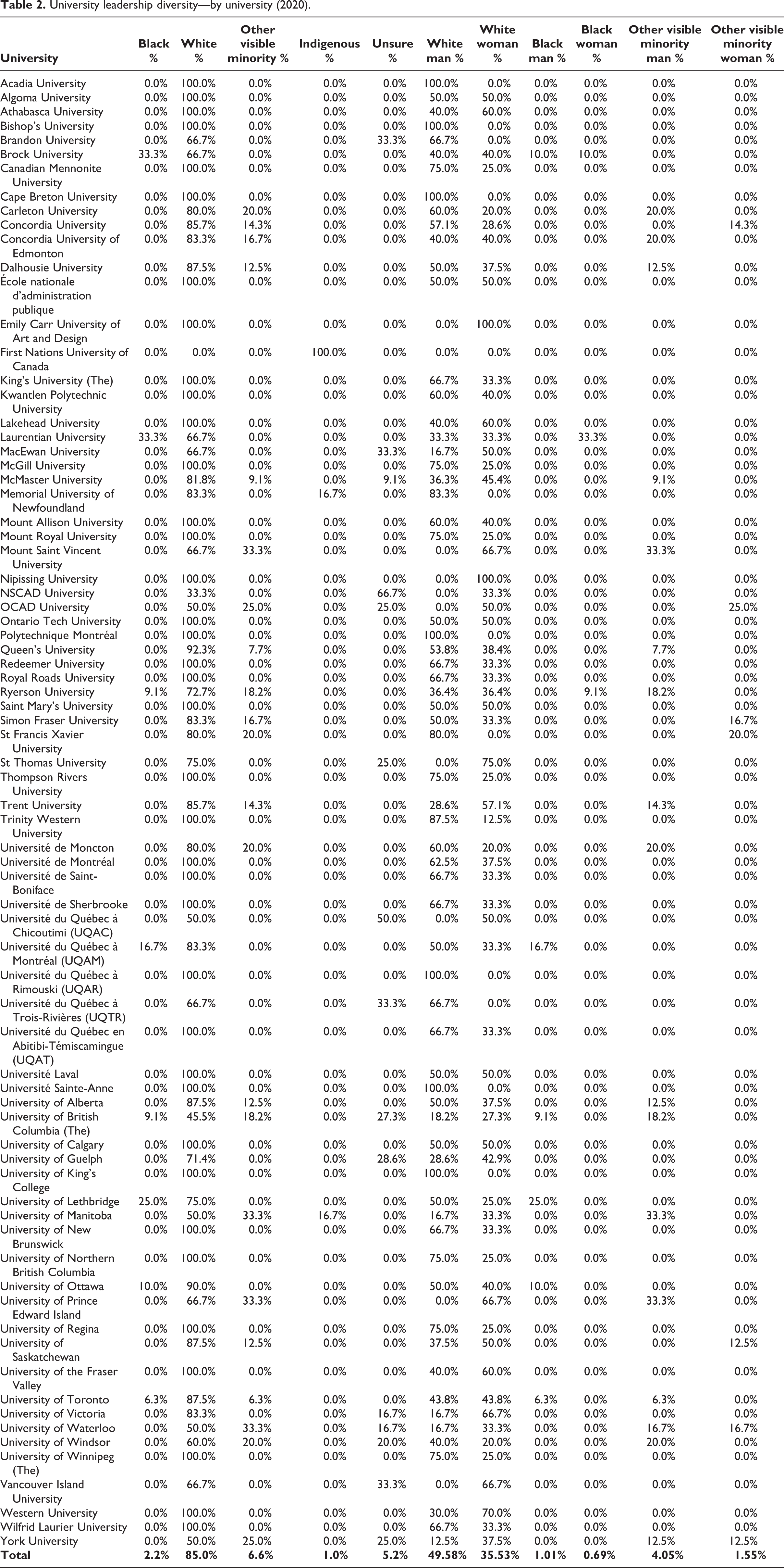
We observed various levels of diversity in senior leadership across Canadian universities. With respect to gender, we saw that close to half (42.1%) of universities reached or exceeded the gender parity mark. At the bottom of the scale are 11 universities with no women in leadership roles, including, but not limited to, Acadia, Brandon, and Cape Breton universities, Polytechnique Montreal, Redeemer University, and University of King’s College. In terms of visible minorities, the University of British Columbia (UBC) (27.3%), University of Waterloo (33.3%), and the University of Manitoba (33.3%) were the top institutions. Among more than 50% of the 76 institutions we included in this study we were unable to identify a single visible minority across their senior leadership. Among visible minorities, men were represented at more than two times the rate of women. Notably, only eight universities had Black representation in their leadership; the only university with more than one Black leader was Brock University—Canada’s only university with a Black President. In terms of Indigenous representation, only three universities had Indigenous leadership: the University of Manitoba (16.7%), Memorial University of Newfoundland (16.7%), and the First Nations University of Canada, which had exclusively Indigenous leadership (100%).
Although not available here, another trend that became apparent through the data is that of the 36 visible minorities (including Black) observed through the data collection process, 22.2% (eight) were in roles where the word “diversity,” “equity,” or “international” appeared in their title. As discussed earlier, scholars have found that these roles have a potential for tokenism and low power and influence in the organization.
Interestingly, only one of the racialized presidents was a woman, and most of them are also from Science, Technology, Engineering, and Mathematics (STEM) disciplines.
Discussion
This study finds that racialized people are under-represented across several segments of the senior leadership of Canadian universities. This situation is particularly acute across certain institutions and ranks of leadership, which remain the domain of white men. A similar pattern has been observed before. Malinda Smith (2018), as part of the University of Alberta’s Academic Women’s Association (2016, 2019), studied gaps in Canada’s 15 research universities—the so-called U-15—and found that racialized and Indigenous peoples (both men and women) were not present among chancellors, provosts, and vice-president academics. Racialized men represented 20% of presidents and only 4% of deans, with the situation being significantly worse for racialized women (Smith, 2018). As that study focused on some of Canada’s best universities, we thought it would be best to conduct a more comprehensive study that includes all public universities in Canada. The persistence of these inequities across Canadian universities, although certainly problematic for moral, legal, and technical reasons, constitutes a fascinating social phenomenon for empirical researchers.
At the heart of this study is an evaluation of the succession planning and policies at play at universities across the country. Leibman, Bruer and Maki (1996 :22) define this as “the deliberate and systematic effort made by an organization to identify, develop, and retain individuals with a range of leadership competencies who are capable of implementing current and future organisational goals” (as cited in Lacey, 2003: 192). Succession planning is what is needed to grow diversity in faculty and staff placements into diversity in leadership at the institution. A theoretical framework that is helpful in understanding what happens between faculty hiring decisions to leadership selection is the critical ecology model. Cukier et al. (2016) developed a critical ecology model to explain how the entry of racialized groups into high-status roles is restrained by an array of inter-related individual-, organizational-, and societal-level factors. We draw on that critical ecology model to theorize some of the likely mechanisms contributing to the present under-representation of racialized minorities in leadership positions across Canadian universities. These gaps suggest that the issue is not the pool of qualified candidates but rather organizational policies.
Societal level
Canadian universities have been exposed to substantial criticism for their treatment of racialized people from scholars (Acker, 2012; Douglas and Halas, 2013; Dua and Lawrence, 2000; Henry and Tator, 1994, 2009; Samuel and Burney, 2003; Samuel and Wane, 2005) and government sources (OHRC, 2016; Picard-Aitken et al., 2010). Our study endorses the criticism by providing new evidence that half of the country’s public universities have a leadership team composed of all white administrators. An awareness of the situation within higher education has prompted great interest in the development of legislative frameworks to protect these groups from overt and more subtle forms of discrimination (Dowdeswell et al., 2010; Dua and Bhanji, 2012). Universities are not subject uniformly to legislation requiring that they report representation of equity-seeking groups, and there has been little effort to monitor or incentivize more proactive institutional efforts to boost diversity (James, 2011). The government’s research funding agencies, whose decisions profoundly stratify the career outcomes of domestic academics, are also not subject to “consistent accountability frameworks and principles to guide policies, data collection, and reporting” as it relates to equity (Naylor et al., 2017: 94), although recently the funding councils’ Advisory Committee on Equity Diversity and Inclusion Programs (ACEDIP) has begun to implement accountability frameworks for Canada Research Chairs and has sought to establish a series of “best practices,” designed to improve the transparency and fairness of institutional nomination processes. The critical ecology model calls for more attention to be drawn to this shift. At the societal level, we have selected university-led processes that invite them to make change outside of their organization, specifically the Canada Excellence Research Chairs program. The Canada Research Chairs program has societal-level impact as it is federally funded. The program has also undergone a series of structural changes (Canada Research Chairs, 2018), meant to improve diversity across chair holders, in response to a review by an ad hoc committee (Dowdeswell et al., 2010). This includes requiring institutions to report on their recruitment and outreach efforts during the selection process, and adding the quality of recruitment as a formal evaluation criterion. Even more recently, Universities Canada has introduced a set of principles for equity, diversity, and inclusion which most institutions have voluntarily subscribed to. Remaining aware of the changes happening at these pivotal organizations that universities use to build their reputations and their influence is key to understanding what the barriers are for racialized leaders.
Organizational level
The process of identifying racialized people for senior leadership positions in universities is likely conditioned by biases that have traditionally restricted their rate of entry into high-status positions across other societal sectors. The critical ecological model leads the analysis to suggest that organizational-level barriers include issues like truncated informal networks, deficient understandings of the implicit rules governing career success within the university (e.g., cultural capital), along with stubborn norms that inhibit perceptions of marginalized groups as “leaders” (Cukier et al., 2014, 2016; Schilt and Connell, 2007). Although this study will not discuss specific policies and programs at particular universities, how faculty are recognized and eventually promoted to administrative leadership at universities is a critical organizational issue that the critical ecology approach is poised to reckon with. In the Frances Henry et al. (2017: 309) study, research participants stated that “‘good intentions’ of universities that brought them onto campuses in the 1980s were mere ‘rhetoric’ without substance.” The universities, although prepared to have diverse faculty, were not prepared for diversity of influence or of thought. This resistance to a change in influence is typical of organizations operating in a system. The proliferation of the executive presence of a leader responsible for “equity,” “diversity,” or “international” is cause for concern. Gender and racial diversity should not be limited to these positions, as diverse faculty are capable and deserving of a more comprehensive portfolio and significant influence. Some universities in Ontario, Canada’s most populous province, have recently enacted strategies in an effort to correct the structural disadvantages faced by marginalized academics within them, especially as it relates to gender discrimination. For example, institutions like McMaster University (CBC, 2015), the University of Waterloo (CBC, 2016), and Wilfrid Laurier University (CBC, 2017) have recently studied pay disparities among their professors, and boosted women faculty members’ salaries to ensure parity. Through our own sample, we also see that certain institutions appear to have developed routines that render them relatively more effective at recruiting individuals from traditionally marginalized groups. This is key to continued success, “succession planning should be based on agreed principles, provide a breadth of experiences critical to leadership, and be active at all levels of the organization” (Lacey, 2003: 192). Studying exemplary organizations, both within and outside of higher education, could help to isolate the strategies which have allowed them to excel.
Individual level
Previous studies (Baez, 2000; O’Meara et al., 2011; Tierney and Bensimon, 1996) have also demonstrated that racialized faculty both gravitate to, and are pushed toward, service work within the university, such as sitting on certain institutional committees or supervising under-represented students. These activities may curtail aspirations on their part to take on additional institutional responsibilities through becoming senior leaders. Further, as the diversity of the student population grows at the undergraduate- and graduate-level, racialized faculty carry the burden of having to support these growing numbers without support from faculty who understand those students.
At the individual level, preferences, attitudes, and behaviors are often the result of socialization. From a critical ecological perspective, this becomes significant when thinking about the composition of selection committees, “when succession planning is left completely to individuals to manage by themselves, job incumbents tend to groom successors who resemble them in appearance, background, and values” (Lacey, 2003: 193). This is the driving force behind the glass or concrete ceiling, and other forms of racial or gender-based discrimination. Importantly, these are particularly pronounced barriers for female Black and ethnic minorities (or women of color). Research shows that women are generally socialized to be passive, obedient, and dependent ( Spears et al., 2010), producing a “confidence gap” between boys and girls noticeable as early as the third grade which can impede their ambition and confidence. Gender and leadership stereotypes produce different expectations, and extensive research suggests female leaders are held to higher standards than their male counterparts. Even when women achieve leadership positions within organizations, lack of confidence, or the “imposter syndrome” (Fotaki, 2013), coupled with resistance to women’s leadership often increase the likelihood of failure. Conflicting demands placed upon women by “greedy” work organizations and the family produce role strain, which can augment the stress they experience (Burchielli et al., 2008; Gregory and Milner, 2009).
Conclusion
The lack of diversity in senior leadership positions across universities in Canada raises many questions. Do other sectors, including public colleges and for-profit colleges, fare any better with respect to diversity? The limited availability of data on this subject makes it difficult to ascertain how institutions within our sample measure up vis-à-vis counterparts in other areas of the field of higher education. It is our hope that this study will serve as a catalyst, motivating further empirical analyses of diversity across senior leadership ranks in other areas of Canadian higher education. We advance that, in the absence of better sector-level data, the methodology we employed through this study could prove useful for scholars, allowing them to expediently access this population of highly visible individuals.
One limitation of this approach, however, is that it relies on researcher categorizations and assessments of the gender and racialized status of senior leaders. Future research would do well to map self-identified gender and race across senior leadership ranks, given that, on occasion, our assessments of both of these categories may differ from that held by individuals themselves. Research of this sort on diversity within higher education should be motivated not just by a moral or legal obligation to improve the condition of marginalized groups (though this is a perfectly legitimate reason on its own), but, also, by strategic efforts to boost the competitiveness of these universities. In general, all institutions need to be cognizant of the dangers of tokenization, and their long-term impact on the integrity of university leadership. As mentioned in our discussion, diverse leadership is sought out by diverse student populations who look forward to leadership that is reflective of them and understanding of the challenges of their own lived experiences. As research suggests, homogenous workgroups or organizations are often outperformed by their more diverse counterparts. In their efforts to improve their social standing, and stave off competition from renowned universities in other nations, Canadian universities would do well to seek further talent within the pools of marginalized social groups within their own ranks.
Footnotes
Declaration of conflicting interests
The author(s) declared no potential conflicts of interest with respect to the research, authorship, and/or publication of this article.
Funding
This research received no specific grant from any funding agency in the public, commercial, or not-for-profit sectors.
