




Abstract
This article focuses on teachers’ and principals’ experiences of aggressive emails in home–school collaborations with parents. Semi-structured interviews with 31 teachers and principals from primary, lower and upper secondary schools in Sweden were conducted. Three categories were identified in the material which illuminate the phenomenon of cyberaggression towards principals and teachers from parents: ‘aggressive emails as reactions to principals and teachers’ performances’, ‘aggressive emails as a way of imposing power’ and ‘aggressive emails as a source of anxiety, loss of joy, and decreased focus on core tasks’. The study concludes that cyberaggression in emails from parents is centred around the act of negotiating and that email communication opens up spaces for negotiation to take place. The study also concludes that email cyberaggression tends to be instrumental in character, intended to result in a specific outcome rather than to cause harm. However, cyberaggression influences professional practice and can create a vicious circle of administrative obligation.
Keywords
Introduction
Over the last two decades, digitalisation has transformed nearly all sectors and workplaces and has exerted considerable influence on the ways people interact (European Agency for Safety and Health at Work, 2023). At the very least, digital technologies have changed how people connect, exchange information and provide services in both public and private sectors (European Parliamentary Research Service, 2019). Simultaneously, handling different forms of aggression from third parties in the course of relational work almost doubled between 2010 and 2015 (Eurofound, 2017), an increase that has been especially pronounced within the school sector (Arnold et al., 2024; Eurofound, 2017). In general, the legitimacy and authority of the teaching profession has been increasingly challenged (Torres and Weiner, 2018). With digital communication, professionals are facing a new working environment risk (European Agency for Safety and Health at work, 2023), and, given the amount of negative social behaviour online, teachers and principals are experiencing a new occupational health threat (Cox et al., 2017).
Communication between school and home is important for pupils’ social and educational progress and is therefore a central aspect of teachers’ work (Goodall, 2018; Niia et al., 2015; Strier and Katz, 2016). The digitalisation of school operations has, however, fundamentally transformed home–school communication. Email correspondence with parents has become an integral part of teachers’ and principals’ work and as a communication tool, email is a convenient way of exchanging information. However, if such communication includes adverse social behaviour and lacks constructiveness, it can be construed as aggression on the receiving end.
‘Cyberaggression’ is a term applied to adverse social behaviour which occurs on digital platforms such as email, text messaging services and social networking sites. Considering its wide scope, which covers different digital spaces and communication technologies, cyberaggression is understood to be platform-specific (Cowen Forssell et al., forthcoming). This implies that we need to investigate this phenomenon in relation to its occurrence within the confines of a specific platform. Email is a central digital communication channel in schools (Pollock and Hauseman, 2019) and an important platform to consider in situations pertaining to parents’ mistreatment of teachers (Cox et al., 2017). Accordingly, this article focuses on teachers’ and principals’ experiences of cyberaggression in its most common form: aggressive emails in the home–school collaborations. In these collaborations, teachers, principals and parents are key actors who bring their different interests, motives and social and professional affiliations to bear on their exchanges and interactions.
Aggressive behaviour in the home–school collaboration is widespread (Arnold et al., 2024). Media (The Guardian, 2022; The Independent, 2019) and research (de Wet, 2020; Rajbhandari and Rana, 2023) have both reported teachers and principals’ vulnerability to cyberaggression. In general, few studies have assessed the prevalence of work-related cyberaggression and related phenomenon such as cyberbullying at work (Vranjes et al., 2020). However, Kauppi and Pörhölä (2015), in their study of primary and secondary teachers in Finland, report that 7.6% had been cyberbullied by students. Küçüksüleymanoglu (2019) reports that nearly 75% of their sample of 181 teachers working at secondary schools in Turkey had received harrassing and threatening messages from parents. The study concludes that cyberbullying was higher among female teachers compared to male and that less experienced teachers received more threatning messages than their more experienced counterparts. In their study of university teachers, Cassidy et al. (2014) found that 12% of faculty members had experienced cyberbullying from students over the previous 12 months, with cyberbullying via email the most common form of aggression. In line with this finding, a qualitative study from Sweden reports aggressive emails from parents are one of the most common types of work-related cyberaggression in schools (Cowen Forssell et al., forthcoming).
Previous research suggests that online communication transforms human interactions and influences users’ behaviour in a negative way (Giumetti et al., 2013; Rains et al., 2017; Shmargad et al., 2022). Email communication is characterised by a lack of non-verbal cues and reduced compliance with social norms (Byron, 2008; Suler, 2004). Online communication can therefore have a disinhibiting effect on its users, making people say and do things they would not do face-to-face (Lowry et al., 2016; Suler, 2004). When emails are aggressively worded, or in other ways express adverse social behaviour, they can be understood as cyberaggression. Adding an online dimension to Neuman and Barons’ (2005) definition of workplace aggression, we define cyberaggression as ‘any form of online behaviour directed by one or more persons within or outside a work organisation with the goal, or with the consequence, of harming one or more other in the workplace (or the entire organisation) in ways the intended targets are motivated to avoid’.
While many countries are undergoing a digital transformation, Sweden is one of the world's most digitalised societies (IMD World Competitiveness Centre, 2023). This makes it an interesting case study. The Swedish National Agency for Education emphasises digitalisation as a priority learning area because it has an impact on both pupils’ education and teachers’ interaction with parents (The Swedish National Agency for Education, 2022). Along with digitalisation, a transformation underpinned by the principals of New Public Management (NPM) is currently affecting most Western schools, including those in Sweden. This change has also had an impact home–school collaboration (Alexiadou and Lundahl, 2016; Imsen et al., 2017). One example of this is that parents are expected and encouraged to take an active part in their children's education (Sivesind et al., 2023). Considering the new means of communication emerging with digitalisation and the resulting complexity of home–school relationships, the aim of this study is to gain a deeper understanding of the phenomenon of cyberaggression in email correspondence from the perspective of teachers and principals. The following research questions are addressed:
- How can we understand actors’ positioning in email communication? - What consequences does cyberaggression in email have on teachers’ and principals’ professional practice?
The focus on cyberaggression is this study is limited to micro-level interactions occurring through e-mail communication, although it does seek to consider contextual factors surrounding email that are related to school organisation and the teaching profession's overall social standing.
Literature review
In the following section, an overview of previous research on home–school collaboration and theoretical perspectives on cyberaggression is presented.
Home–school collaboration
Schools play a fundamental role in people’s lives. Pupils and their families rely on schools to provide a good education that will ultimately offer pupils better future life prospects. The relationship between the school and the home is therefore often complex and embedded in power dynamics (Ekornes and Bele, 2022; Honkasilta et al., 2015).
Manifested in teachers and principals’ control over resources and the exercise of authority in the form of grades, teachers and principals have a formal stronghold on power in the home–school collaboration. Professional power is justified by teachers’ and principals’ professional knowledge (Abbott, 1988). However, professional power is dependent on the political environment and on the resources available to teachers and principals (Garrow and Hasenfeld, 2016). Therefore, professional power can be challenged when teachers and principals face declining resources at the same time as collaborative actors’ demands persist, or even increase.
In all social interactions, individuals possess different kinds of situational and positional power. This impacts their ability to influence others. In schools, pupils and parents generally have less power than teachers and principals regarding issues pertaining to education. This power imbalance is particularly substantial when the family comes from a vulnerable population (Blair and Haneda, 2021). On the other hand, previous studies suggest that parents and students from affluent socio-economic backgrounds tend to mobilise resources in relation to their cultural, educational and social capital in their collaboration and negotiation with schools (Calarco, 2018; Pananaki, 2021). This is in line with the Lewis and Forman (2002) case study on elementary schools in the US, which stresses that material, social and cultural resources enable parents to influence the outcome of pupils’ performance by acting as their child's advocate. From an organisational perspective, pioneer work on organisational responsiveness to pressure and demands made through negotiations stresses that such actions are more successful when uncertainties prevail within the organisational context and/or when rules and policies are not comprehensive (Hall and Spencer-Hall, 1982; Svensson, 1996).
The relationship between home and school has significantly changed in recent decades. Home–school engagement today postulates effective communication about students’ progress and well-being (Saltmarsh and McPherson, 2022). Even more, it has altered parental expectations. Parents now understand that their role is to ensure a positive educational outcome for the children and the school's part is to provide a service that ensures such an outcome (Saltmarsh and McPherson, 2022). The increased administrative demands that many schools now experience is a direct result of such expectations and is operationalised by continuous reporting to parents (McGrath-Champ et al., 2018). To a large extent, home–school collaborations resemble customer relations. New Public Management reforms – which focus on choice and voice – are central to the Swedish school system. These reforms, introduced in 1991, give children a legal right to free education and parents the right to choose their child's school (Grand, 2010; Imsen et al., 2017). The Swedish educational system encourages competition among schools and promotes active parental involvement through school boards and direct dialogue (e.g., Alexiadou and Lundahl, 2016; Sivesind et al., 2023). While home–school collaboration is often emphasised as being desirable from the school's perspective, Lewis and Forman (2002) nuance this notion by drawing a distinction between collaboration that involves parent-driven supplemental teaching outside the school (such as help with homework) and activities that addresses the school's functioning. This latter type of collaboration is often driven by parents’ concern for their specific child, rather than teacher's and principals’ universal concern for all pupils in the school. Parental participation can therefore be a major source of ambivalence since it can introduce conflicting agendas to the school and to educators’ professional practice (Lewis and Forman, 2002). Indeed, differential prioritisation is an important source of conflict among parents and educators within a home–school collaboration (Lareau and Muñoz, 2012). Moreover, high workloads, a lack of competence in parental communications, and negative views on parental attitudes may act as a barrier to teachers initiating parental involvement (Anastasiou and Papagianni, 2020; Gartmeier et al., 2016).
Professional identity can be understood as how teachers and principals see themselves in relation to a broader context (Canrinus et al., 2012; Kelchtermans, 2009). This includes a professional dimension related to social and policy expectations of what a good educator is and teachers’ and principals’ own educational ideals; and a situational dimension that relates to teachers’ working environments (Day, 2008). As with other professional roles, what constitutes a professional identity for teachers and principals changes over time and reflects developments on a societal level. However, feeling unappreciated, not feeling accepted, or feeling unfairly treated, attacked, or disparaged, are examples of factors that can cause stress to the social self. Even subtly offensive feedback can result in an offense to personal identity (Semmer et al., 2019). Social self-esteem is referred to by Semmer et al. (2019) as ‘the degree to which one feels esteemed, acknowledged, and appreciated by significant others’ (p. 208). Contrary to personal self-esteem, social self-esteem is a type of esteem that is strongly linked to one’s social surroundings and related to the feedback one receives from others. Feedback is generally filtered and interpreted according to existing values. Feedback from individuals or groups who the teacher or principal defines as important is weighted differently (Kelchtermans, 2009). In relation to professional identity, people react positively when their professional role is affirmed but negatively, and with increased stress, when their professional role is threatened (Semmer et al., 2019).
Cyberaggression in email
A new means of collaboration with schools has emerged via digitalisation. The digital spaces surrounding online communication can be seen as an active element in the production of social relationships (Cowen Forssell, 2019a). In the school setting, email increases the accessibility of teachers and principals and offers novel forms of communication between parents and schools (Patrikakou, 2015, 2016). Still, previous research indicates that digital communication is also a source of misunderstanding in the home–school collaboration (Kuusimäki et al., 2019). To some extent, it can even be argued that email communication can induce aggressive behaviour. When an online platform provides anonymity and/or when the risk of confrontation decreases, users tend to express themselves more openly than they would if their identities were known (Kowalski et al., 2012; Suler, 2004). When anonymity is not provided, faceless communication in online interactions may still give users a sense of invisibility which can influence interactions (Vranjes et al., 2020). Increased emotional distance when communicating through screens, the asynchronous nature of email communication, and a perception of being invisible online are different aspects that influence interaction in digital spaces in general and power relations in particular. Asynchronous communication in emails creates, for instance, a time delay that gives users time to think, reflect and draft arguments before responding, adding to the dimensions of power involved in the interaction (Cowen Forssell, 2019b). The lack of non-verbal social cues in text-based digital communication – such as a lack of eye contact, facial expressions and body language from the correspondents – is also suggested to hinder the development of empathy for the respondent and to influence less empathic behaviour (Dooley et al., 2009; Slonje and Smith, 2008).
Cyberaggression in email can assume various forms and represent mixed motives and intentions. In their work on bullying and harassment, Neuman and Baron (2011) draw a distinction between instrumental and hostile aggressions. Instrumental aggressions refer to acts that are employed to obtain a valued outcome. Instrumental aggressions are proactive and occur when the aggressor has a clear goal in mind, which does not necessarily include harming the target. From this perspective, potential harm to an individual is a consequence of the action, rather than an act of intent. Hostile aggressions, on the other hand, are seen as impulsive acts often driven by anger that has been aroused in response to provocation. Hostile aggression is reactive and includes an intention to harm the target (Neuman et al., 2011). From this social interactionist perspective, both instrumental and hostile aggressions are justified by the aggressors as legitimate behaviour triggered by situational or interpersonal factors (Neuman et al., 2011).
Another distinction has been drawn between overtly and covertly expressed aggression. Previous research reports that cyberaggression aimed at teachers and principals can be both overt and covert in nature (Cowen Forssell et al., forthcoming). Examples of overt aggressions in emails include threats of reporting the school, removing the child from the school or holding the teacher or principal responsible for the child's well-being. Covert aggressions in emails typically include situations where demands, emotions and criticism are not explicitly formulated, but where there is an undertone and a hidden meaning to a message that affects the teacher or principal in a negative way.
Materials and methods
This article is based on a qualitative methodology using semi-structured interviews (Kvale et al., 2014). The approach was chosen to gain a deeper understanding of the phenomenon of cyberaggression in email from the perspectives of teachers and principals.
Participants and data collection
The empirical data was collected in Sweden, with the informants coming from eight different public and private independent schools covering primary (6–12 years of age), lower (13–15 years of age) and upper secondary (16–19 years of age) schools. The heterogenous sample (in terms of the age groups of pupils the teachers and principals were working with) and school organisation (public and independent private schools) were chosen considering the goal of reaching a broad understanding of aggressive emails in home–school collaboration. Pupils’ ages likely influence the home–school collaboration. Similarly, public versus independent private schools have different organisational contexts and incentives and attract a different clientele. It is relevant to include both principals’ and teachers’ perspectives, as they have different roles and responsibilities that lead to different experiences.
Participant recruitment relied on a voluntary approach. Head principals informed the teachers at the school about the project and teachers could then decide whether they wanted to participate. In some cases, however, principals approached teachers directly with a suggestion to participate because of a previously known experience of email aggression. From each of the eight schools, one to two principals (head principal and one assistant principal) and two to four teachers were interviewed.
In total, 31 informants were interviewed: 16 teachers and 15 head and assistant principals. The age of the participants ranged from 28 to 65 years, and years active in the profession ranged from 5 to 30 years. Most of the participants were women – only three of the participants were men, and all three of those were principals (Table 1).
Description of participants.
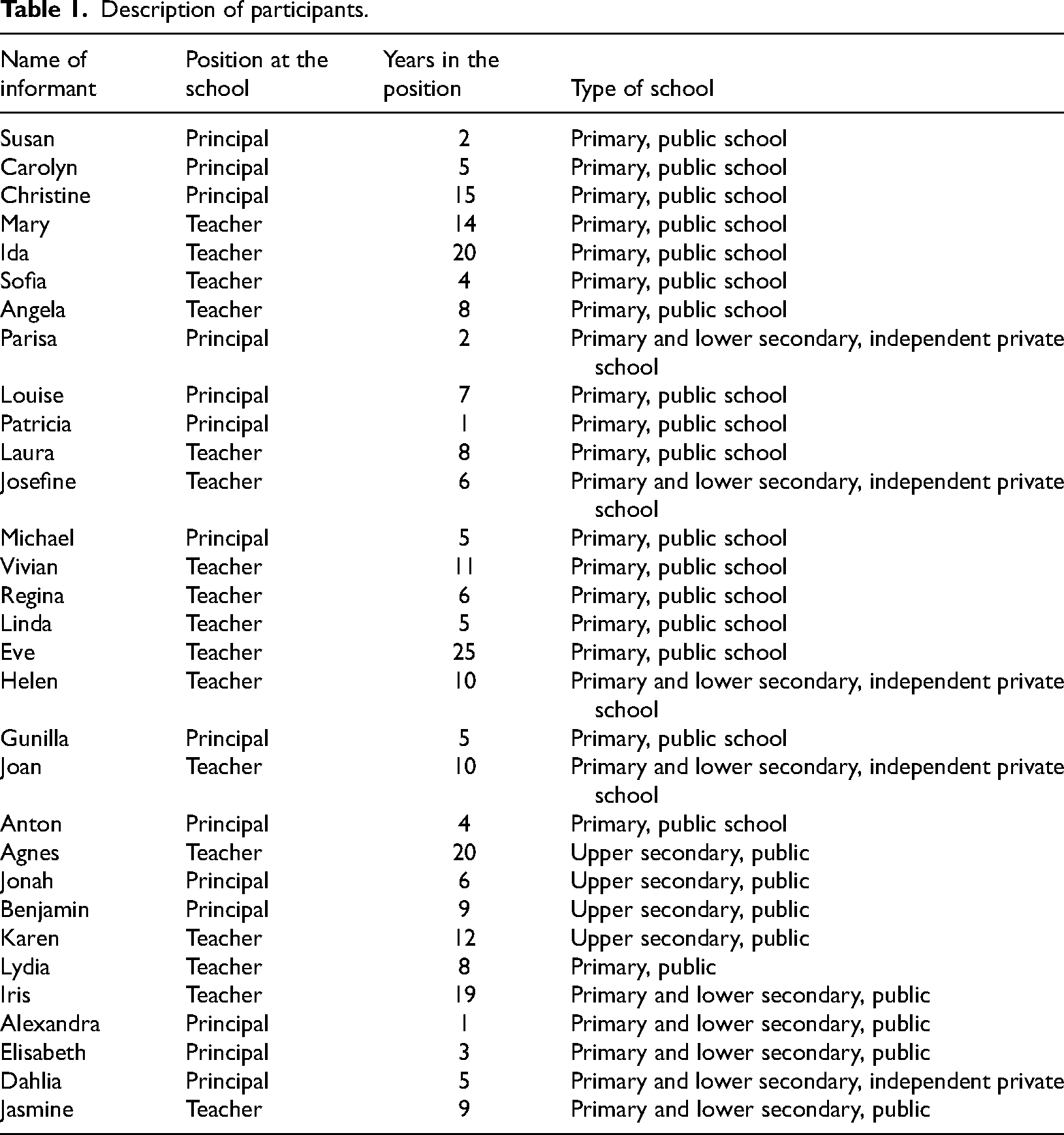
Individual semi-structured interviews lasting approximately 60–90 min were conducted from April to June 2020. Due to the COVID-19 pandemic, interviews took place via the digital video communication tool Zoom. A semi-structured approach was chosen to explore informants’ understanding of email aggressions in-depth. This approach ensured structure and the flexibility to follow up on any aspects raised which required further discussion (Bryman, 2018). An interview guide was developed by the authors that could be moderately adjusted in line with the informant's position as either a principal or a teacher. Thus, minor changes were made throughout the interview process to enhance the quality and clarity of the questions.
Data analysis
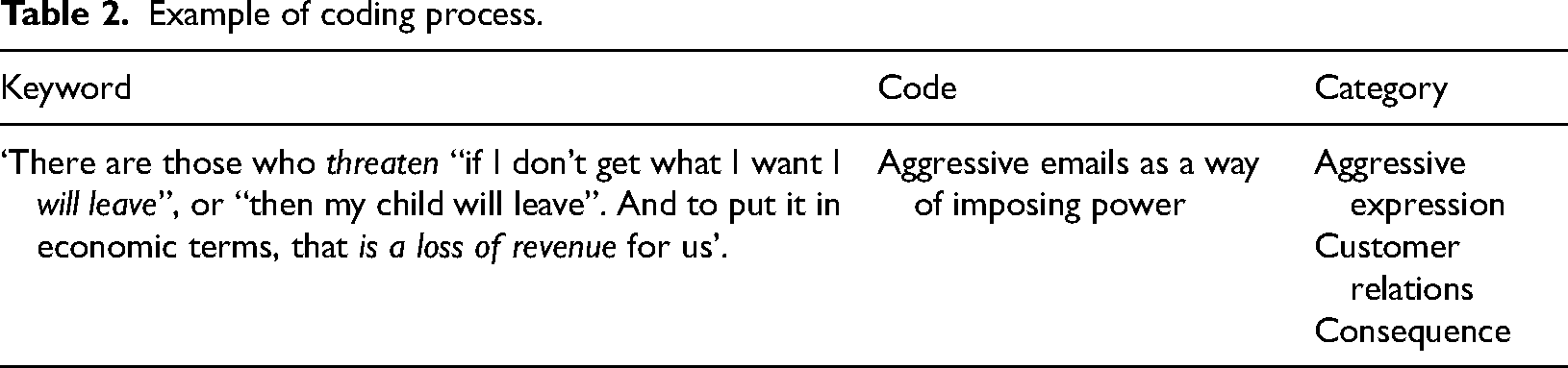
Empirical data was analysed using inductive content analysis. This analysis includes open coding, creating categories and abstraction (Elo and Kyngäs, 2008). In the first step, data analysis was carried out by the first author. The process of analysing the interviews involved several readings and re-readings of the 31 interviews, all of which had been transcribed verbatim. During the reading process, material was identified and coded that addressed the aim of the paper (see Table 2). Coding began by identifying keywords pertaining to how informants talked about the email aggressions they had received from parents, what seemed to be the issue at stake and what was causing parents to respond negatively to the school or to individual teachers’ performances. Also of interest in this analytical search for patterns was how the email aggressions progressed, which led the analytical process to discussions of power. In the second step, the first analysis of the interviews was discussed and expanded upon by the three authors. The search for codes was unprejudiced and inductive and eventually resulted in content-related categories. The categories include narratives and extracts from the interviews, all of which point in the same direction and share meaning.
Example of coding process.
Ethical considerations
The study was approved by the Swedish Ethical Review Authority (Dnr 2019-05196). All four principles for ethical consideration (information, consent, confidentiality and utilisation requirement) stated by the Swedish Research Council have been addressed in this study (Vetenskapsrådet, 2002). Prior to the interviews, all informants received written information about the research project. Participants were informed that participation was voluntary and that they could leave the interview at any time. The information letter also addressed how confidentiality was obtained and how the data would be used. Before the interview began, informants were asked whether they had read the information and whether they had received a consent form. Informed consent was obtained verbally from all participants. This included consent to participate in the study and to digital recording of the interviews. All participants were guaranteed confidentiality. To secure confidentiality in the handling of the data, the names of the informants have been deleted from the transcripts and replaced with pseudonyms when presenting the results. Audio files and transcripts from the interviews are stored in accordance with university guidelines.
Results
Three categories are identified below which illuminate the phenomenon of parental email aggression towards principals and teachers. The first category, ‘aggressive emails as a reaction to principals’ and teachers’ performances’ examines what is being communicated in the aggressive emails. The second category, ‘aggressive emails as a way of imposing power’ discusses how and in what way actors are positioning themselves in the email conversations. Finally, the third category, ‘aggressive emails as a source of anxiety, loss of joy, and decreased focus on core tasks’, examines the influence work-related aggressive emails have on teachers’ and principals’ professional practice. Moreover, it discusses what resources are being appropriated to manage these emails and from which venues these resources are taken.
Aggressive emails as a reaction to principals and teachers’ performances
When describing personal experiences of receiving aggressive emails, informants often started by describing the context from which the emails had emerged. The aggressive emails seldom happened for no reason but occurred in reaction to something that had happened at the school, such as a decision that had been made, a conflict between pupils or a general dissatisfaction with how the school was handling pupils with special needs. Dissatisfaction with grades is one example of a situation that was perceived as a trigger for aggressive emails. Sofia, working as a primary teacher, shares: The reason why she emailed me was that her son had received a much lower grade than she thought he should have. She thought he would have the highest grade. But he is not on that level and I tried to explain that. I also think it was based on the fact she doesn’t understand how the knowledge requirements are built up and how we set grades. But she was quite cheeky to me as she sent me films on how to set grades and referenced her [pedagogically educated] friends who thought my assessment was completely wrong. (Sofia, teacher)
Considering that grades are awarded to pupils aged 12 years and older in the Swedish school system, other aspects were at stake in the aggressive emails delivered to teachers working with younger children. Among the most common situations that could trigger aggressive email responses from parents included conflicts between pupils, where parents threatened to hold the school responsible, and situations around pupils with learning difficulties and where a need for extra resources was communicated. Carolyn, who works as a principal in primary schools, concludes that ‘when it is angry parents and tough emails, then this is often what it is about, that something has happened between their child and another pupil’. In general, conflicts between children are seen as legitimate reasons to contact teachers. However, as Eve, working as a teacher with younger children points out, these conflicts are often exaggerated and are ‘nothing like what they [parents] are trying to portray in the emails’. Accordingly, Eve describes these types of emails as ‘an excuse for something else’ which she understands as a need for ‘attention’. In situations where pupils are facing difficulties in their educational progress, and where a need for resources has been identified, Christine, who works as a principal, describes the emails as expressions of ‘frustration and fear’. Mary, who works as a teacher, confirms that demanding emails from parents often have only their own child in mind: Yes, demands from parents where the pupil is having difficulties at school. When there is a need for a resource [a special needs teacher]. They demand but they don’t really understand the whole school situation. There have been a lot very unpleasant emails from some parents about ‘why have you not done this?’ But they only see their child and not the whole picture. (Mary, teacher) It can be them thinking that the teacher is not responding [to their emails] or that they think that the teacher has done something wrong. (…) or that they think that there is a deficiency somewhere, for example, with cleaning. It can also be larger things, such as not having a functional anti-bullying team. (Susan, principal)
While aggressive emails directed to principals often contain concerns related to their leadership positions, such as problems with teachers or shortages that needed to be addressed at the managerial level, demands forwarded to teachers are often directly related to the individual pupil and to their well-being in school. When a parent was not satisfied with the teachers’ performance, the principal could be copied on the email or emailed directly. Susan shares her thoughts on the motives behind adding the principal to the email: It's quite common to write to the teachers and add us [principals] as a cc [carbon copy]. It's like: ‘Ha, I've actually added the principal here now, just so you know.’ I don't know if they think that we should have the information…I think that they think that the teacher should know.
Contrary to previous extracts that illustrate how parents turn to the principal, Vivian, who works as a teacher in primary school, describes how parental communication can also involve parents’ attempt to build alliances with teachers, in order to put pressure on management: They claim to have confidence in what we do, and think that we do it well, but to management they want to communicate that there are too few resources in the classroom. (Vivian, teacher)
Building alliances involved writing negatively about school management and offering to communicate a lack of resources higher up in the organisation. However, as was the case for Vivian, building alliances with parents is less appealing than having management backing them up.
Aggressive emails as a way of imposing power
In their narratives of aggressive emails from parents, informants describe situations that could be interpreted as attempts to impose power or in other ways influence outcomes. Receiving clear demands of what the school needs to do, and descriptions of consequences if they fail to comply, are experiences informants mentioned multiple times in the interviews. Christine, who works as a principal, describes the demands and criticisms outlined in emails as outspoken and sometimes a bit threatening: ‘You havn’t done this’ and ‘you don’t take responsibility’ and ‘that person said that’ and ‘how can you act in this way?’ and ‘it's a misdemeanour to do it that way’ and ‘you have a responsibility, and I’ll call the police’ and ‘you should report this and that’. A bit threatening, aggressive. (Christine, principal)
However, parents can also make demands in emails by presenting a strong line of argumentation. Besides the use of articulate language, status could be positioned using social cues that signal a corresponding social standing. As an example, Sofia, who works as a teacher, reflects on her understanding of parents using their professional email account and signature in emails as a way of signalling their status in communications about grades: ‘I don’t know if it was a power thing or if she didn’t have another email, but yeah’. (Sofia, teacher).
Being a junior teacher was often understood as a contributing factor in teachers’ vulnerability to aggressive emails. For some senior teachers, collaboration with parents was seen as unproblematic and often occurred on the teachers’ terms. For Helen, who has been working as a teacher for a longer time, setting the frame for what she tolerates in email was something she communicated to parents at the first parental meeting with a new class: ‘I kind of tell them at the parental meeting that I really don’t appreciate angry emails on a Sunday’ (Helen, teacher). For many teachers, however, communicating boundaries with parents this way was unthinkable. A recurrent theme in the interviews with principals was their concern about teachers not taking on an authority and leadership role in relation to parents. Taking on a leadership role in relation to parents was highlighted as particularly challenging for younger teachers. As an example, Regina, a young female teacher, points out that her age, in combination with her gender, is a potential reason why she has been recurrently targeted in emails from parents. I have also wondered if it has to do with the fact that I’m young, that I’m a young woman (…) When I was 25 and a new graduate I had parents who said to me the first time they met me – oh, you’re not very old. (Regina, teacher) They use patronising words. They imply that we don’t know what we’re doing. That we don’t know our profession. That we’re bad, that teachers are unqualified, that the school counsellor is not… it's always about the pupils, that they [parents] don’t get what they want. (Joan, teacher)
Stressing their role as customers, informants emphasised how parents can demand things from teachers and principals. Patronising words and the implication of a lack of competence can be a means of arguing for a desired outcome. The home–school collaboration is complex, and, as noted by Jonah, who works as an assistant principal in an upper secondary school, is underpinned by the fact that schools are run in competition with other schools. Parents actively choose schools for their children, and schools are financially compensated for each pupil they enrol. Hence, parents’ removal of a pupil means an economic loss for the school. Jonah explains: There are those who threaten ‘if I don’t get what I want I’ll leave’, or ‘then my child will leave.’ And to put it in economic terms, that is a loss of revenue for us. (Jonah, principal)
Even though Jonah describes his school as attractive to parents, with many children on the waiting list, he still reflects that the current educational system gives parents an advantage when it comes to power.
In general, teachers expressed their understanding of a decline taking place in the status of their profession. While parents’ role as customers strengthened their position in collaborations with the school, a general loss of social status for teachers was seen to undermine their position. Illustrative examples of the loss of status were provided by informants who compared the position of teachers with other occupational groups. For example, Laura, who works as a teacher, compares the status of teachers with doctors by stating that ‘you wouldn't have gone and questioned a doctor about their prescription’. While many informants express their perception of a decline in teachers’ professional status, constructive parental engagement was generally seen as positive and an important part of their work. As noted by Elisabeth, who works as a principal: The view of school and status in society [has changed]. If you think about when you went to school yourself, it was like, it was really that you listened to the teachers and you listened to the school. There was no discussion. Now it's much more, you are more involved, and you have opinions and make your voice heard in a different way than you did before. And that's positive too. (Elisabeth, principal)
Aggressive emails as a source of anxiety, loss of joy and decreased focus on core tasks
When describing the influence that aggressive emails have on professional practice, the most striking answer from teachers and principals involves the increasing administrative burden. In general, the informants valued being professional and correct in their email responses. Responding to emails took time and effort, which meant taking resources away from other important things. Susan reflects: Some emails are absolutely justified, and you need to take your time. But for many emails I feel that ‘just let me work on what I have to do and don’t spend time on this’. So that I can do all those things that you want me to have time for and for everyone else's children. (Susan, principal) It's always the same child, and it's always the same parents. I can almost feel my stomach turning because I know that I’ll get these emails and it will take a week of my working time to sort it out. (Eve, teacher)
Eve, Susan and many other informants describe how emails steal time that could have been spent on pupils. However, self-critical responses were also shared in the interviews regarding the informant's own communication with parents. Some of the aggressive emails could contain justified critiques by parents, triggered by the school not having been proactive enough in the home–school collaboration. When work hours are intense, communication with parents can be hampered. Susan explains: We’re chasing time, so you’re not as present and perhaps following up in the same way as you’d like. And then of course, you receive more questions and emails from parents who wonder what is happening. (Susan, principal)
Regardless of whether they understand the email as justified or not, aggressive emails tend to draw attention to the pupil of concern, making the teachers or principals spend extra time on that individual. For example, when grades have been the trigger point for an aggressive email, teachers can compensate by generating additional documentation on student performance. Sofia describes how previous email critiques regarding her grading of one particular student resulted in her ‘meticulous documentation’ of that student after each lesson. However, even while doing this she is also aware that other students are being neglected as a result. Moreover, she states that emails from parents about grades create in her an inner ambivalence as to whether or not she has set the right grade, a process which also robs her of time and energy. Sofia reflects: What if I have set the wrong grade? But at the same time, I'm quite confident with my assessment because I've had them for so long and have been thorough about keeping documentation. (Sofia teacher)
Like Sofia, Regina describes how negative emails can make her question herself and her performance as a teacher. For Regina, handling negative emails results in her losing the energy and joy she needs to be at her best at work: I don't feel as happy in the classroom as I want to be. You also have less energy to do the fun things that you might have energy to do otherwise. (Regina, teacher)
Besides the appropriation of resources, aggressive emails containing critiques of a teacher's performance can steal their energy and, in the end, rob them of their joy and happiness in doing their job.
Summary of findings
Aggressive emails reflect customer-based relationships in the home–school collaboration. These relationships are seen here as being amplified by digital communication. Email communication enables parents to impose power: by, for instance, revealing social cues about their profession, disclosing information directly to the principal by copying them in on the email and adding references to powerful sources to construct strong arguments. However, the easy accessibility of email also enables exposure to unfiltered texts often written in states of high emotion. In general, the context for aggressive emails was seen to be the perceived failures of the school and inadequate teacher and principal performance. The aggressive email primarily concerned critiques about grade setting, how conflicts among pupils had been handled, and a failure to support children with additional requirements. In general, parents’ critiques and demands were perceived as threatening and condescending and resulted in anxiety, a lack of joy and an increased administrative burden that kept teachers and principals from spending time on what they believed to be their core tasks.
Discussion
The aim of this study was to gain a deeper understanding of the phenomenon of email aggression from the perspectives of teachers and principals. This included increasing an understanding of each actor's position in email communication and the consequences these positions have for professional practice. Three categories have been identified in the empirical material: ‘aggressive emails as reactions to principals and teachers’ performances’, ‘aggressive emails as a way of imposing power’ and ‘aggressive emails as a source of anxiety, loss of joy, and decreased focus on core tasks’. These categories are discussed below in relation to the two research questions.
Understanding actors positioning in aggressive email communication
Our analysis concludes that negotiations are at the centre of aggressive emails. Rather than intended to cause harm to an individual teacher or principal, aggressive emails are an expression of parents’ attempts to negotiate with a school for increased resources and influence. Negotiations are understood here as compulsion, persuasion and manipulation employed to influence situations, persons and resources and can be interpreted as what Neuman and Baron (2011) categorise as ‘instrumental aggression’, an action employed by parents to obtain a valued outcome. Instrumental aggressions are proactive in nature and because they are goal-orientated, parents may view them as legitimate actions. In our understanding, email aggression is supported by the expectations a modern educational system places on parents in home–school collaborations and an increasingly customer-driven approach in education. Parents are not only required to take an active role in these collaborations but are also expected to ensure their child's positive experience of and successful outcomes in school (Saltmarsh and McPherson, 2022). Consequently, issues raised by parents in aggressive emails can be understood as outweighing potential damage caused to the professional.
In accordance with the essential work Neuman and Barons (2011) have carried out on workplace aggression, we believe that contemplating the goal-oriented approach in parents behaviour is vital in the understanding of email aggression towards teachers and principals. As important is to understand what is being negotiated in an email and who is vulnerable to such negotiations. Our findings show that the demands put forward in the aggressive emails varied with the age of the pupil and with the status of the informant. Teachers of younger pupils repeatedly referred to emails emerging from incidents of conflict between children, where pressure was put on the school to act, or perceived support failures regarding children with special needs. For teachers with older children, grade setting was a common issue that manifested itself in the form of persuasion and demands. For principals, aggressive email content concerned issues related to their managerial position and their ability to make organisational decisions.
While attempts at negotiation in home–school collaboration have previously been reported (e.g., Pananaki, 2021), we conclude that email communication in the home–school collaboration also creates digital spaces for negotiation. Negotiation in digital spaces differs from negotiation in face-to-face interactions in several ways. Enhanced by asynchronous communication, e-mail communication enables actors to reflect upon their messages and draft arguments before hitting ‘send’. In digital negotiating spaces, parents can express their needs based on thoroughly thought-out arguments with references to laws, school inspectors or powerful friends, and thus position themselves within the negotiation. Similar to what has previously been pointed out by Calarco (2018), Pananaki (2021) and Lewis and Forman (2002), cultural and social capital create advantages for parents and their children in such negotiation practices. In this study, this is manifested by parents’ ability to argue and position themselves within the email interaction. In all social interactions, individuals possess different kinds of situational and positional power that have an effect on their ability to influence. Signatures in emails that indicate professional and social status work to strengthen parents’ position in these interactions, while junior status can create a professional disadvantage. In general, a pattern was identified in the empirical material regarding junior teachers’ increased vulnerability and the reception of aggressive emails from parents compared to senior teachers. Besides status, we also noted that social categories such as gender and age – either individually or combined – played a role in how negotiations were expressed. These results are in line with the study by Küçüksüleymanoglu (2019) on cyberbullying of Turkish secondary teachers, which shows that female teachers were more exposed to insulting messages from parents than their male counterparts and that junior teachers were more exposed to threatening messages than senior teachers. This indicates that gender and professional experience are important dimensions of home–school collaborations, particularly when it comes to cyberaggression.
Also influencing the dynamics of the home–school collaboration, and the attempts at negotiation experienced by informants, is the decline in status of the teaching profession. While the importance of children's education has increased, the authority and autonomy of the teaching profession has been eroded over an extended period of time (Torres and Weiner, 2018), a change which is manifested as a decrease in professional legitimacy and authority. As stressed by Canrinus et al. (2012) and Kelchtermans (2009), professional identity is influenced by the broader social context. Even subtle negative feedback from one's social surroundings can negatively influence social self-esteem (Semmer et al., 2019). Not only can the aggressions be understood as an expression of disrespect and a demonstration of power (Jakobsson et al., 2022), professional weakness, manifested as a lack of social self-esteem, can also give parents an advantage in home–school negotiations.
Considering negotiation as a process that requires at least two actors, the next question considers what teachers and principals aim to protect in such processes. While the answer is complex, one dominant element revealed in the empirical material is that teachers and principals negotiate to defend their right to make autonomous decisions based on their professional knowledge and experience. Their aim is to preserve their role as a professional with the competence and experience to make decisions about what is best for the pupil and the school. Teachers are often strongly committed to supporting individual pupils. Equally important in teaching practices are the principals of distributed justice, referred to here as a just distribution of educational resources between individuals and groups (Resh and Sabbagh, 2009; Lewis and Forman, 2002). Distributed justice is an important element of the Nordic educational model (Imsen et al., 2017) and is manifested in teachers’ daily practices of sharing their time between pupils, their engagement and rewards (Resh and Sabbagh, 2009). Hence, the content of aggressive emails sent by individual parents with strong voices is likely to inflict a moral crisis of belief in the social ethics that are grounded in teachers’ professional identity. Such emails are likely to negatively influence social self-esteem over time.
Consequences for teachers and principals’ professional practice
Our findings indicate that allowing oneself to be affected by the demands in an aggressive email is controversial and was a response that was avoided. None of the informants explicitly described an occasion where grades were adjusted as argued for by parents. However, for most informants, extra attention was inevitably given to those pupils and students who had been at the centre of aggressive emails in the past, whether or not the emails concerned grades, conflicts or pupils with special needs. Hence, although not immediately expressed, our study indicates that in agreement with Calarco (2018), advantages could result from negotiation. For some teachers, aggressive emails from parents could, over time, influence their professional practice; more careful and extra diligent documentation became a form of protection against possible future aggressions. Studies have previously reported on the connections between increased educational administration and parental demands (McGrath-Champ et al., 2018). However, the increased administrative burden resulting from aggressive emails also contributes to a loss of control regarding how teachers and principals spend their time and distribute educational resources. In line with previous research (e.g., Lareau and Muñoz, 2012; Lewis and Forman, 2002), it is not home/school collaboration that induce ambivalence and conflicting agendas that are sought for by the schools. Losing control over how resources are spent and on which pupils increases the risk of unequal treatment, which contradicts teachers’ deeply established professional ideals (Day, 2008; Resh and Sabbagh, 2009). Increasing the documentation around pupils with strong-voiced parents can be seen as a form of insurance for the individual teacher. However, when documentation of pupils takes resources from other tasks, the quality of the core assignment risks becoming challenged. Our analysis concludes that vicious circles can be identified, where teachers, on the one hand, receive aggressive emails if they fail to be proactive in their communications with parents, and on the other hand tend to avoid communication if they expect a negative response. This avoidance of communication also causes negative results in that parents become even more disconnected, feeling they have even more evidence that teachers and principals are failing in their obligations.
Educational developments establishing customer-based relationships legitimise parents’ right to put pressure on schools (Saltmarsh and McPherson, 2022). Embedded in the principles of NPM, schools operate in competition with each other, thus requiring them not only to work cost-effectively but to be responsive to the surrounding community and increase the potential for parents to be active in their children's schooling (Alexiadou and Lundahl, 2016; Hasenfeld, 2010; Saltmarsh and McPherson, 2022; Sivesind et al., 2023). The marketisation of education and free school choice for parents and pupils have also steered the Swedish school system towards an educational system where the individual pupil is at the forefront (Imsen et al., 2017). Hence, while all organisations can be described as more or less open to societal influences, schools are highly dependent on legitimacy from the outside world. In combination with a lack of clarity in policy documents and regulations on how far home–school collaborations should stretch, the narratives of the teachers and principals in this study expressed an attitude towards communication with parents as comprising a too-high level of tolerance.
As many of the aggressive emails were triggered by a situation at school or a decision made by a school, we note that aggressive emails also require schools to be self-critical at an organisational level. As discussed by the informants, aggressive emails from parents may be a reflection of the failing to produce satisfactory quality in their educational activities or related communication. Many schools are experiencing a decline in resources (Hasenfeld, 2010), which challenges schools to meet the requirements for good quality. Moreover, the educational system in the Nordic countries has gained an increased focus on efficiency over the last few years that also challenges teachers’ ability to realise the demands placed on them (Imsen et al., 2017). While digital technology can enhance efficacy and potentially increase parental involvement (Patrikakou, 2015, 2016), there is a risk that replacing face-to-face meetings with emails in the long run leads to poorer quality in the home–school collaboration and an increased administrative burden for teachers and principals.
Practical and theoretical implications
We conclude that aggressive emails are a strain on professional practice and constitute a work environment problem for individual teachers and principals. For principal leadership, aggressive emails also create problems on an organisational level, as reactive responses to aggressive emails are time-consuming and likely to have negative consequences related to sick leave as well as to retaining staff in the profession. Schools of today are already experiencing difficulties in recruiting and retaining staff (Heystek, 2022). Aggressive emails in home–school collaboration are likely to contribute to this issue, as they negatively influence the work environment and the social status and legitimacy of the teaching profession over time. Moreover, aggressive emails in home–school collaboration are a societal problem. If fewer resources are spent on children who are not represented by parents who can challenge the professional power of the teacher, this threatens the principle of equality in education. This is particularly problematic if teachers comply with parental pressure to assign higher grades, in which case aggressive emails are a democratic problem that contributes to increasing social inequalities in access to teaching resources.
Pioneering organisational research on the social conditions necessary for negotiational order, stress that organisations largely standardised and routinised activities may be less vulnerable to external pressure (Hall and Spencer-Hall, 1982; Svensson, 1996). In line with this, we also suggest that organisational strategies that are proactive and seek to resolve problems before they escalate are crucial in avoiding situations where individual teachers can only respond reactively to pressure from individual parents. Moreover, recognising and handling digital aggressions as an element of workplace safety implies that this issue should be included in systematic occupational safety and health management guidelines. Another practical implication is the need for reviewing existing communication policies and practices to sustain constructive communication in the home–school collaboration.
While home–school collaboration can be complex, it is nonetheless an important element in education and when conducted constructively has the potential to influence pupils’ performance in a positive direction. Working proactively with these issues involves adopting strategies on an organisational level so that leadership can create space for constructive dialogue about these issues. Teachers’ positions in home–school collaborations can also be strengthened through clearly articulated policies and regulations developed by principal leadership in partnership with their staff. Moreover, working proactively could involve a national-level strategy where teachers and principals are made aware of these issues during teacher training and are provided with tools that could strengthen their professional handling of home–school collaboration. However, more research and developmental work is needed on the practical side of how email aggression can be prevented at an organisational level and how educational leadership can mitigate its negative effects among teachers.
One theoretical implication of this study is to highlight the need to contextualise email aggression for different professional groups. Motives behind aggressive emails as well as nuances in how email aggression is expressed changes within a given professional context. This in turn has an influence on how cyberaggression can be operationalised in survey studies.
Limitations and future research
One of the limitations of this study was that the interviews were conducted over Zoom and were intended to replicate in-person interviews. On Zoom, facial and bodily expressions were visible to both parties and the synchronous communication provided by the videoconference tool supported the removal of any misunderstandings. Still, problems with the internet connection could create uncertainty and disrupt communication, and in a few cases, informants had problems turning on their cameras. A few of the interviews, therefore, assumed the format of a telephone interview. In line with Greenfield et al. (2000), we understand that the distance provided by this type of communication did not necessarily negatively affect the quality of the interview, as they also provided a sense of anonymity that may have helped informants share personal information.
Another possible limitation is that the principals of the schools played an active role in recruiting informants to the study. The principals informed all of the teachers at their school about the project and everyone was informed of the opportunity to participate in the interviews. In some cases, however, the principals also approached certain teachers directly with a suggestion to participate because of their past experiences of online aggression. While this procedure ensured that we came into contact with informants with a good understanding of email aggression, the procedure influenced the overall selection of informants. It would be relevant for future research to investigate antecedents and consequences of cyberaggression in a multi-level quantitative design.
Lastly, the study shows a preponderance of female informants; only 3 of the 31 informants were men. This may be a result of how the informants were recruited, although there is a gender disparity on a national level in Swedish education, with women dominating the teaching profession. Seventy-five percent of Swedish teaching professionals are women (Statistics Sweden, 2020). Also related to transferability is the fact that the study was conducted in a Swedish setting. Considering the similarities between schools around the world, it is likely that similar patterns could be identified in other cultural contexts. Moreover, some of the results may also be transferable to other educational settings, such as colleges and universities.
Conclusions
The study underscores how aggressive email communication is a multifaceted negotiation process influenced by various factors such as digital space and power dynamics. Aggressive emails often reflect school shortcomings in quality and communication, influenced by resource challenges and demands for efficacy. Aggressive emails impact the professional practices of teachers and principals, drain resources and raise questions about distributed justice in relation to pupils. The findings point to the importance of continuously evaluating and developing communication policies and practices to sustain a constructive dialogue between the home and school.
Footnotes
Acknowledgments
The project was financed by AFA Försäkring (Dnr 190182) and The Swedish Research Council for Health, Working Life, and Welfare (FORTE) (grant no. 2016-07220).
Declaration of conflicting interests
The author(s) declared no potential conflicts of interest with respect to the research, authorship, and/or publication of this article.
Funding
The author(s) disclosed receipt of the following financial support for the research, authorship, and/or publication of this article: This work was supported by the AFA Försäkring (Dnr 190182) and, Forskningsrådet om Hälsa, Arbetsliv och Välfärd (FORTE) (grant no. 2016-07220).
